
1. Define the corridor as a cash-conversion system
An agribusiness corridor is more than a route from farms to a port. It is a controlled sequence of production decisions, input obligations, aggregation, grading, storage, processing, certification, transport, border procedures, sale, collection and repayment. Every stage can change quantity, quality, ownership, price, timing and recoverability. Financing one link without understanding the complete sequence can move risk rather than reduce it.
The board should define the corridor by commodity, origin, farmer base, collection geography, transformation step, buyer specification, destination, logistics path, payment cycle and currency. It should also identify the entity that owns the product at each stage and the evidence that transfers title. The investment perimeter may include farms, producer organisations, aggregators, warehouse operators, processors, logistics providers, trading companies and Gulf buyers. Those parties need not share ownership, but their contracts and data must reconcile.
The platform thesis should state the specific constraint it resolves. Examples include unreliable supply, high post-harvest loss, fragmented producer access, insufficient storage, limited processing, weak quality assurance, missing working capital or an unbankable gap between shipment and buyer payment. A transaction should not be approved merely because food security and Latin American agriculture are strategic themes. Capital should follow a measurable bottleneck, a defined operating model and a cash flow that can survive downside conditions.
2. Separate food security from physical control
Food security requires reliable access to safe, sufficient and affordable food. It does not require a Gulf investor to own every farm, warehouse or vessel. The UAE food cluster combines trade, investment, processing, stockpiling, traceability and innovation [1]. A Latin American platform should therefore be assessed as one component of a broader portfolio of origins, commodities, inventory, suppliers and contingency options.
Ownership can improve control when an asset is genuinely scarce or operationally critical. It can also concentrate political, climate, land and execution risk. Long-term offtake may secure supply while leaving production assets with local owners. A minority investment in a processor may align incentives without transferring farm land. Warehouse and receivables facilities can improve liquidity without buying operating companies. Each instrument should address a defined failure point.
The investment memorandum should distinguish security of supply from exclusivity. A buyer may need first-priority volume during shortage, minimum annual quantity, option volume, diversified origin or emergency substitution. Absolute exclusivity can strand farmers when the buyer rejects or delays collection. A resilient design protects agreed buyer priority while preserving controlled alternative-sale rights after objective triggers. Food-security resilience and farmer continuity should reinforce each other.
3. Start with a verified Gulf demand specification
The corridor should begin with demand that can be evidenced. The buyer specification should define commodity, variety, grade, moisture, residue limits, packaging, processing, certification, volume, seasonality, delivery point, incoterm, currency, price formula, inspection, rejection, payment and recall obligations. Forecast consumption, expressions of interest and strategic memoranda are useful for planning; they are not equivalent to committed offtake.
Demand diligence should identify the legal buyer, authority to contract, credit quality, payment history, import permissions, food-safety requirements, concentration and termination rights. A government-related buyer may have a strategic role without providing a sovereign guarantee. A distributor may have customer access without accepting inventory risk. A processor may buy only after third-party certification. The corridor model should reflect the actual obligation, not the perceived status of the counterparty.
Volume should be translated into farm and logistics requirements. The calculation needs expected yield, planted area, harvest timing, farmer participation, collection loss, grade mix, processing conversion, storage loss, route capacity and shipment frequency. A target of 150,000 saleable tonnes may require materially more harvested tonnage. Management should avoid using the final sales target as the production assumption.
4. Choose commodities and origins as a portfolio
Commodity selection should consider food-security relevance, production advantage, water intensity, climate exposure, storability, perishability, price transparency, processing requirements, shipping economics and producer inclusion. A grain corridor has a different cash cycle from fresh produce, edible oils, livestock, fisheries or processed foods. The capital structure should follow the physical product.
Origin selection should combine agronomic and institutional evidence. The screen should cover land and water rights, producer organisation, input access, extension capability, infrastructure, electricity, storage, food-control systems, export procedures, currency, political risk, labour conditions and local food-security implications. World Bank work on agrologistics identifies post-harvest management, storage, processing, transport and distribution as connected components of food-system performance [2]. The platform must address the local logistics constraint before assuming export competitiveness.
The portfolio should set limits by country, crop, harvest window, buyer and route. Diversifying origins that share the same rainfall pattern, port or shipping lane may create only apparent resilience. The board should test correlated drought, border closure, disease, export restriction, freight disruption and buyer delay. A portfolio is valuable when its components fail differently and substitution is operationally possible.
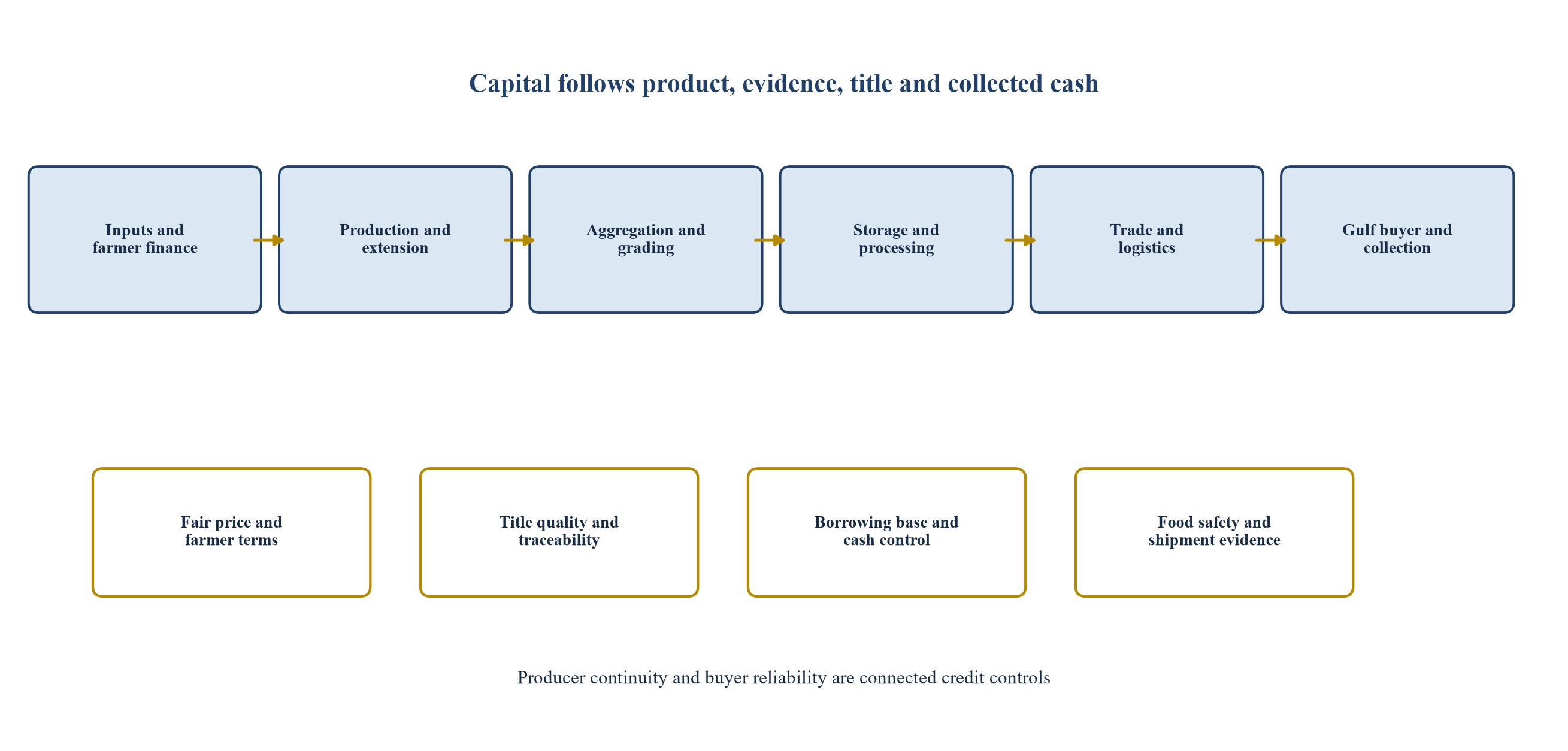
The figure is a proposed control map and does not represent an observed transaction.
5. Treat farmer economics as a financing condition
The corridor cannot be bankable if producers lose money, accumulate unserviceable input debt or exit after one season. Farmer economics should be modelled separately from processor and trader economics. The model should include yield, farmgate price, input cost, labour, irrigation, transport to collection point, quality deductions, spoilage, credit charges, payment delay and household consumption needs.
FAO describes contract farming as an advance agreement between producers and buyers covering production and marketing terms, and identifies potential benefits including market access, inputs, technology and finance [3]. FAO also identifies risks including indebtedness and reduced autonomy when the arrangement is poorly designed [4]. These risks affect continuity of supply. A buyer that extracts value through opaque deductions may improve one season's margin and damage the future corridor.
The board should require a producer viability test for each crop and farmer segment. It should show cash received under base, yield-down, quality-down and price-down cases; input-debt repayment; and the remaining household cash. The corridor should define relief or restructuring when verified shocks make scheduled input recovery impossible. Debt recovery that forces distress sales, land loss or immediate scheme exit may destroy the supply base that supports the investment.
6. Design contracts that farmers can understand and enforce
Farmer contracts should identify the parties, crop, production area, quantity basis, quality standard, delivery location, price formula, input support, extension services, inspection, deductions, payment timing, force majeure, default, dispute resolution, renewal and termination. FAO's contract-farming resources and the UNIDROIT-FAO-IFAD legal guide emphasise clarity, good-faith negotiation and the allocation of production and marketing obligations [3,5].
The agreement should be available in a language and form the producer understands. Producer organisations may need independent legal or commercial support. Digital acceptance can improve records, but it should not replace explanation. Each deduction should have an objective basis and an auditable calculation. The buyer should disclose the grading method, calibration, sampling process and appeal route.
Contract duration should match investment. A farmer asked to adopt a new variety, irrigation system or certification regime may need multi-season visibility. The buyer also needs exit rights when quality or delivery repeatedly fails. Balanced contracts can use cure periods, graduated remedies, volume bands and review mechanisms. The objective is a relationship that can adapt without making either party captive to arbitrary action.
| Gate | Evidence required | Buyer protection | Farmer protection |
|---|---|---|---|
| Identity and land | Verified producer, production site and lawful use rights | Traceable source and enforceable delivery | No transfer of land rights through hidden terms |
| Production | Crop plan, inputs, extension and forecast yield | Defined practices and monitoring | Realistic obligations and documented support |
| Quality | Measurable grade, sampling and calibration | Consistent product specification | Transparent testing and appeal rights |
| Price | Formula, reference, floor or review trigger | Predictable procurement economics | Protection from opaque or unilateral deductions |
| Payment | Invoice evidence, timing and account details | Validated delivery and set-off rights | Prompt payment and itemised deductions |
| Default | Material breach, cure and force majeure | Remedies for diversion or fraud | Relief for verified shocks and proportionate recovery |
The framework requires local legal review and producer consultation.
7. Build a price formula that survives volatility
A fixed long-term farmgate price can become uneconomic for the buyer when destination prices fall and unfair to the farmer when input costs rise. A pure spot-price formula transfers volatility to producers and weakens production planning. The corridor should use a formula suited to the commodity and available market references.
The formula may combine a published benchmark, quality differential, location basis, logistics adjustment, foreign-exchange reference and minimum floor. A collar can limit extreme outcomes. A seasonal review can reset assumptions when inputs, yields or regulation change. The contract should state the timing and source of each reference and the treatment of unavailable or disrupted benchmarks. World Bank commodity-market publications can provide context, but local farmgate and destination economics require transaction-specific evidence [6].
Price support should be funded deliberately. A guaranteed floor creates an obligation for the buyer or a reserve provider. It should not be hidden in optimistic trading margin. If public or catalytic capital supports the floor, eligibility, cap, duration and exit should be explicit. The investment committee should understand who bears loss when sale price, yield and currency move together.
8. Separate input credit from crop purchase
Input finance can improve yield and quality when seeds, fertiliser, crop protection, equipment and extension are appropriate. It can also create a debt trap when the package is overpriced, poorly timed or unsuitable for local conditions. The corridor should separate the input invoice, financing charge, delivery confirmation and recovery schedule from the crop-purchase price.
Credit should be sized to a verified crop budget and realistic yield. The financier needs farmer identity, land or production rights, historical performance, crop plan, insurance where available and a collection mechanism. Group guarantees or cooperative structures can improve monitoring, but they should not make one farmer responsible for losses beyond a transparent agreed limit. Data consent and privacy should be documented.
Recovery should occur from delivered crop proceeds after defined priority payments. The farmer statement should show gross value, grade, deductions, input principal, finance charge, prior balance and net payment. When adverse weather or disease is verified, the contract should define extension, rescheduling, insurance proceeds or partial relief. Automatic compounding without a viability test can strand the producer and create false receivables in the lender's books.
9. Aggregate supply without hiding concentration
Aggregation reduces transaction cost and creates financeable volume. It can also obscure dependence on one cooperative, trader, region or influential intermediary. The corridor should maintain farmer-level and lot-level records even when contracts and payments flow through producer organisations or aggregators.
Aggregator diligence should cover ownership, governance, field presence, weighing equipment, storage, payment systems, complaints, related parties and historical losses. The aggregator's margin should correspond to documented services. Cash advances need reconciliation to farmer deliveries and repayment. Side payments, informal deductions and forced purchases should be prohibited and monitored.
Volume forecasts should distinguish registered farmers, planted area, expected production, committed delivery and historical delivery. A list of names is not a supply contract. The corridor should track retention, delivery rate, side selling, quality, payment time and complaints by farmer cohort. Concentration limits should apply to aggregators and production zones as well as countries and crops.
10. Use warehouses as control points
Warehouses can convert a fragmented harvest into measurable inventory and collateral. Their value depends on title, segregation, grade, quantity, condition, insurance, access and release control. A building alone does not create a warehouse-receipt system.
IFC's Global Warehouse Finance Program supports working-capital finance against commodities in storage and describes collateral-management and stock-monitoring arrangements where formal warehouse-receipt law is absent [7]. The lender should confirm the legal status of the receipt, the warehouse operator's liability, insurance, inspection rights, release instructions and the enforceability of security. Electronic records should be reconciled to physical stock.
The borrowing base should apply advance rates by commodity, grade, age and price volatility. It should deduct prior liens, taxes, storage charges, shrinkage, quality risk and liquidation costs. Frequent independent inspection and surprise counts may be required. The facility should stop further advances when inventory, title or data cannot be reconciled.
11. Match processing assets to assured throughput
Processing can extend shelf life, meet Gulf specifications, improve value capture and reduce transport of waste. It can also create a stranded plant when throughput, utilities, maintenance or market access is overestimated. The investment case should model plant economics independently from the strategic appeal of processing.
The plant needs evidence of feedstock volume, seasonality, competing buyers, conversion yield, product mix, by-product value, energy, water, labour, packaging, quality control, maintenance and environmental obligations. The offtake agreement should specify whether the buyer purchases raw, semi-processed or finished product and who bears conversion loss. Imported equipment should include spare-parts and service plans.
Capacity should follow verified supply. Modular expansion can preserve option value. The base plant should remain viable under lower throughput and should not rely on forced producer exclusivity to fill capacity. Processing and logistics must be underwritten against crop calendars, verified conversion yields, route capacity and buyer specifications. IDB research identifies logistics, finance and market-access requirements among the constraints reported by agrifood companies, while its productivity work links competitiveness to technology, infrastructure and resilient production [8,9].
12. Finance cold chain from avoided loss and service revenue
Cold storage and refrigerated logistics are essential for some products, but the asset should be financed from measurable use and payment. A cold room that reduces spoilage without a contracted tariff or product margin can create economic value and still fail to service debt.
The model should identify product dwell time, temperature range, throughput, utilisation, energy intensity, backup power, maintenance, refrigerant, monitoring, insurance and responsibility for loss. Service agreements should define intake condition, temperature control, access, release, claims and payment. Shared facilities need allocation rules during peak harvest.
Debt sizing should use contracted or evidenced service cash rather than total regional production. The downside should combine lower harvest, delayed collection, power-cost increase and equipment outage. Reserves or availability support may be appropriate during ramp-up, but they need a funded source. Operating data should record temperature excursions, spoilage, downtime and customer claims.
13. Treat food safety as a financing covenant
Food safety failure can trigger rejection, recall, customer loss and regulatory action. It belongs in credit, insurance and investment governance. FAO describes traceability as the ability to follow food through production, processing and distribution, supporting recalls, compliance, market access and quality assurance [10].
The corridor should define critical tracking events and key data elements from farm registration through input application, harvest, lot creation, storage, processing, shipment and buyer receipt. Records should link product lot, producer, location, date, test result, transformation and custody. The system should allow rapid isolation of affected lots without blocking the entire corridor.
Standards and testing should follow commodity and destination requirements. The board should verify laboratory capability, accreditation, sampling, chain of custody, corrective action and recall procedures. Technology can improve records, but a ledger cannot correct false inputs or weak field controls. Financing covenants may require certification, audit, traceability coverage, recall testing and notification of material incidents.
14. Align the legal structure with product ownership
The legal structure should mirror the physical and commercial chain. A local operating company may contract with farmers and own aggregation assets. A warehouse company may issue receipts. A processor may hold environmental and food licences. A trading company may buy product, arrange export and invoice the Gulf buyer. An asset SPV may own cold-chain infrastructure. Combining every function in one entity can expose lenders to unrelated risks.
Each transfer requires title, price, tax, quality acceptance and payment terms. Related-party transfers need arm's-length governance and transfer-pricing advice. The investment committee should know when the product becomes eligible collateral and when risk passes under the sale contract. Security over inventory or receivables is valuable only when the borrower owns the asset and no superior claim exists.
The shareholder structure should respect local ownership rules and preserve lawful governance. Producer participation can occur through cooperatives, trusts, preference interests, profit-sharing or service contracts, depending on law and objectives. Participation should create understandable economic rights rather than symbolic ownership with undisclosed liabilities.
15. Build the capital stack around distinct cash cycles
Long-lived assets, seasonal crops and international trade have different tenors and risks. Processing, storage and cold-chain assets may support medium- or long-term debt after construction. Input and crop finance should revolve with the production cycle. Inventory finance should amortise with controlled release. Export or import facilities should self-liquidate from buyer payment. Mixing these uses in one undifferentiated facility weakens monitoring.
Equity should fund development, first loss, uncovered completion risk and costs that do not have predictable repayment. Asset debt should match construction and operating cash. Working-capital facilities can be borrowing-base driven. Trade facilities may use letters of credit, confirmed receivables, documentary collections or risk participation. IFC's trade and supply-chain programmes illustrate instruments that extend bank capacity and finance suppliers or inventory [11].
Concessional or catalytic capital may be justified for public infrastructure, inclusion, climate resilience, farmer capacity or demonstration risk. It should have a defined purpose, minimum required concession, measurable result and exit path. The corridor should avoid using grants to conceal an operating model that cannot cover recurring costs.
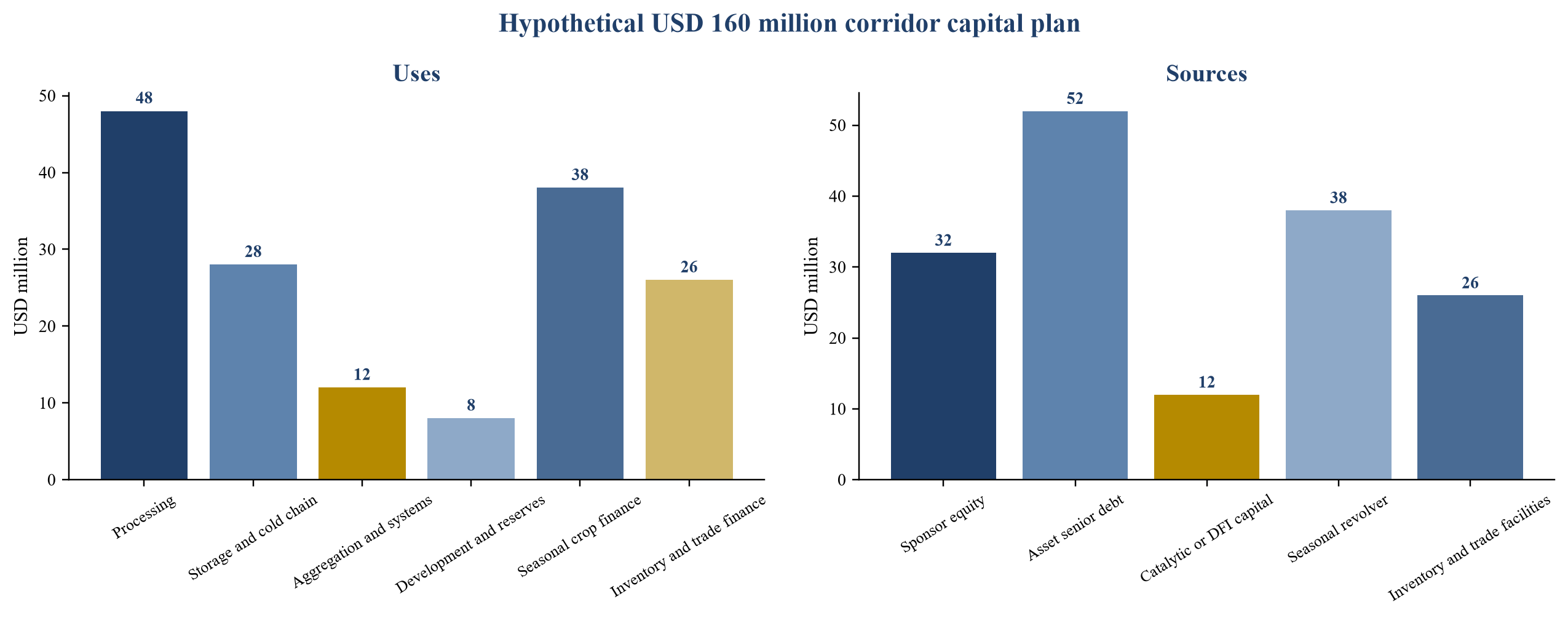
All amounts are hypothetical management assumptions in USD millions and do not represent an actual transaction.
16. Design a borrowing base that follows recoverable value
The working-capital lender should advance against eligible value rather than total accounting assets. Eligibility may include approved input receivables, delivered crops, certified warehouse stock, export documents and accepted buyer receivables. Each category requires a different advance rate, control and concentration limit.
Farmer receivables should be eligible only when the underlying input delivery, contract and repayment mechanism are documented. Inventory should be eligible only when title, grade, insurance, age and custody are verified. Buyer receivables should meet credit, acceptance, currency and dispute criteria. The base should deduct reserves for rejection, shrinkage, price volatility, taxes, charges and prior claims.
The facility should use frequent reporting and independent verification. Availability should decline automatically when quality deteriorates, stock ages, buyer disputes arise or concentration limits are exceeded. Cash from eligible sales should enter controlled accounts and reduce the facility before discretionary distribution. The objective is a self-liquidating cycle, not permanent leverage against uncertain pipeline.
17. Use trade instruments for the shipment-to-cash gap
The corridor may need finance between purchase from farmers and payment by a Gulf buyer. The appropriate instrument depends on buyer credit, documentary requirements, shipment risk, currency and bank appetite. Letters of credit can reduce payment risk when documents comply. Confirmation can transfer issuing-bank and country risk. Receivables purchase or supply-chain finance may accelerate cash after buyer approval. Pre-export finance may fund procurement against contracted shipments.
Documentary compliance should be operational, not merely legal. Invoice, packing list, bill of lading, certificate of origin, inspection, phytosanitary certificate, insurance and other documents must agree. A small inconsistency can delay payment. The operating system should assign document ownership, four-eye review and deadline control.
Islamic facilities may use approved structures for inventory, trade or asset finance where suitable and confirmed by advisers and Sharia governance. The economic exposure, title sequence and payment obligations should be transparent. Labels do not remove commodity, counterparty or execution risk. IFC trade and warehouse-finance programmes illustrate instruments that can connect verified inventory and trade flows with revolving liquidity [12,13].
18. Control currency across farm, asset and trade cash flows
Farm costs and payments may be in local currency, asset debt may be local or hard currency, and Gulf sales may be priced in US dollars or another currency. A single net foreign-exchange position can hide different timing and legal exposures. The corridor should map currency by obligation, entity and date.
Natural hedges may arise when export revenue and debt share a currency. Local-currency facilities can finance local crop purchases and operating costs. Forward contracts or other hedges may be available for committed exposures, subject to market depth and cost. Price formulas may include agreed currency references, but pass-through should remain affordable and understandable.
The downside should combine devaluation, export restriction, delayed conversion, buyer delay and local inflation. Transfer and convertibility cover may mitigate defined sovereign perils, subject to eligibility and exclusions. The corridor should hold sufficient liquidity for obligations that cannot be deferred. Currency gains in one entity should not be assumed to rescue another unless cash can lawfully and practically move.
19. Allocate climate and production risk explicitly
Yield depends on rainfall, temperature, water, soil, seed, disease, farm practice and timing. Climate resilience begins with crop and location decisions, production support, irrigation where sustainable, soil management, diversification and timely agronomic information. Insurance can complement these controls but cannot replace them.
Index insurance may pay when an agreed weather or yield index crosses a threshold. It can settle faster than individual loss adjustment, yet basis risk remains when the index and actual loss diverge. Indemnity cover may more closely follow loss but requires assessment and may exclude important perils. The corridor should model premium, deductible, limit, trigger, timing and beneficiary.
Insurance proceeds should follow a pre-agreed waterfall. A portion may support farmer recovery and replanting; another may repay input finance or restore working capital. The allocation should be disclosed before the season. If the lender takes all proceeds and producers cannot restart, the corridor may protect one balance sheet while destroying future supply.
20. Prevent export demand from stranding local food systems
An export corridor can create farmer income, investment and processing capacity. It can also intensify local scarcity or shift land and water away from domestic food needs when governance is weak. The CFS Principles for Responsible Investment in Agriculture and Food Systems apply across value chains and place food security, rights and sustainable development at the centre of investment quality [14].
The investment committee should assess local consumption, competing uses, nutrition, land tenure, water, labour, gender impacts and vulnerable groups. The corridor may include domestic-market allocations, crop diversification, rotation, local by-product use or emergency redirection. These provisions should be commercially and operationally defined rather than stated as broad intentions.
Farmer participation should remain voluntary within lawful agreements. Land acquisition and long leases require heightened diligence, consultation and remedy. The corridor should avoid making household food access dependent on one export crop or one buyer. Producer income, local availability and natural-resource use should be monitored alongside shipment and financial performance.
21. Apply risk-based supply-chain due diligence
The OECD-FAO Guidance provides a five-step risk-based approach for responsible agricultural supply chains [15]. The corridor can use that structure to embed policy, identify risks, design responses, verify implementation and communicate performance. Due diligence should cover operations, suppliers, investments and business relationships.
The risk map should include land, labour, child labour, health and safety, community impacts, water, biodiversity, deforestation, corruption, conflict, food safety and animal welfare where relevant. Severity and likelihood matter, as does the corridor's connection to the impact. A contractual warranty is not sufficient when operational evidence indicates a problem.
Remediation should have an owner, deadline, budget and verification method. Immediate exit can sometimes worsen harm for farmers or workers; continued purchasing without controls can perpetuate it. The governance process should distinguish situations requiring prevention, mitigation, leverage, suspension or exit. Material issues should reach the investment committee and lenders under defined escalation rules.
22. Build one traceability and finance data spine
The same core data should support operations, food safety, farmer payment, collateral and reporting. The corridor needs unique identifiers for farmer, plot or production unit, crop plan, input delivery, harvest lot, warehouse receipt, processing batch, shipment, invoice and buyer receipt. Each event should have date, quantity, quality, location, custodian and approval.
Finance should use operational evidence rather than parallel spreadsheets. A farmer advance should link to the input delivery and production contract. Inventory availability should link to verified stock and title. Trade drawdown should link to shipment documents. Buyer payment should close the invoice, reduce debt and update producer settlement. Exceptions should remain visible.
Access should follow role and consent. Farmers should be able to obtain their statements and challenge errors. Lenders require controlled reporting without unrestricted access to personal data. System design should include offline capture, audit logs, backups, cybersecurity, master-data governance and reconciliation. The platform should measure data completeness and correction time as operating indicators.
| Event | Core evidence | Financing use | Control failure |
|---|---|---|---|
| Farmer onboarding | Identity, production rights, consent and payment account | Input-credit eligibility | Duplicate, unverifiable or coerced enrolment |
| Production | Crop plan, inputs, field activity and forecast | Exposure and yield monitoring | Unsupported acreage or stale forecast |
| Delivery | Weight, grade, lot, deductions and acceptance | Farmer settlement and inventory creation | Uncalibrated scale or disputed grade |
| Storage and processing | Receipt, custody, condition, transformation and loss | Borrowing-base eligibility | Title gap or unexplained stock variance |
| Shipment and sale | Documents, inspection, invoice and buyer acceptance | Trade draw and receivables eligibility | Documentary discrepancy or buyer dispute |
| Collection | Bank receipt, allocation and debt reduction | Facility repayment and farmer residual | Cash leakage or double counting |
Data fields are illustrative and require legal, privacy and operational adaptation.
23. Model the corridor under correlated downside
Agribusiness risks rarely arrive one at a time. Drought can reduce yield, raise procurement prices and weaken farmer repayment. Freight disruption can extend storage, increase spoilage and delay buyer cash. Currency weakness can raise imported input cost while improving export revenue only after shipment. The model should combine these effects.
The hypothetical case has USD 180 million of long-lived investment and USD 110 million of peak seasonal working capital. Annual contracted volume reaches 240,000 tonnes and assumed gross sales value reaches USD 420 million at stabilisation. The asset capital comprises USD 65 million of equity, USD 90 million of senior debt and USD 25 million of catalytic or DFI capital. Seasonal and trade facilities revolve within the year and are not treated as permanent capital.
The base case produces a 1.46-times minimum asset debt-service coverage ratio and a 1.34-times working-capital borrowing-base cover. A combined downside assumes 12 percent lower saleable volume, 4 percentage points more rejection, 45 days of buyer delay, 10 percent higher freight and a weaker local currency. Before remedies, asset coverage falls to 1.12 times and borrowing-base cover to 1.05 times. These are hypothetical management assumptions, not forecasts.
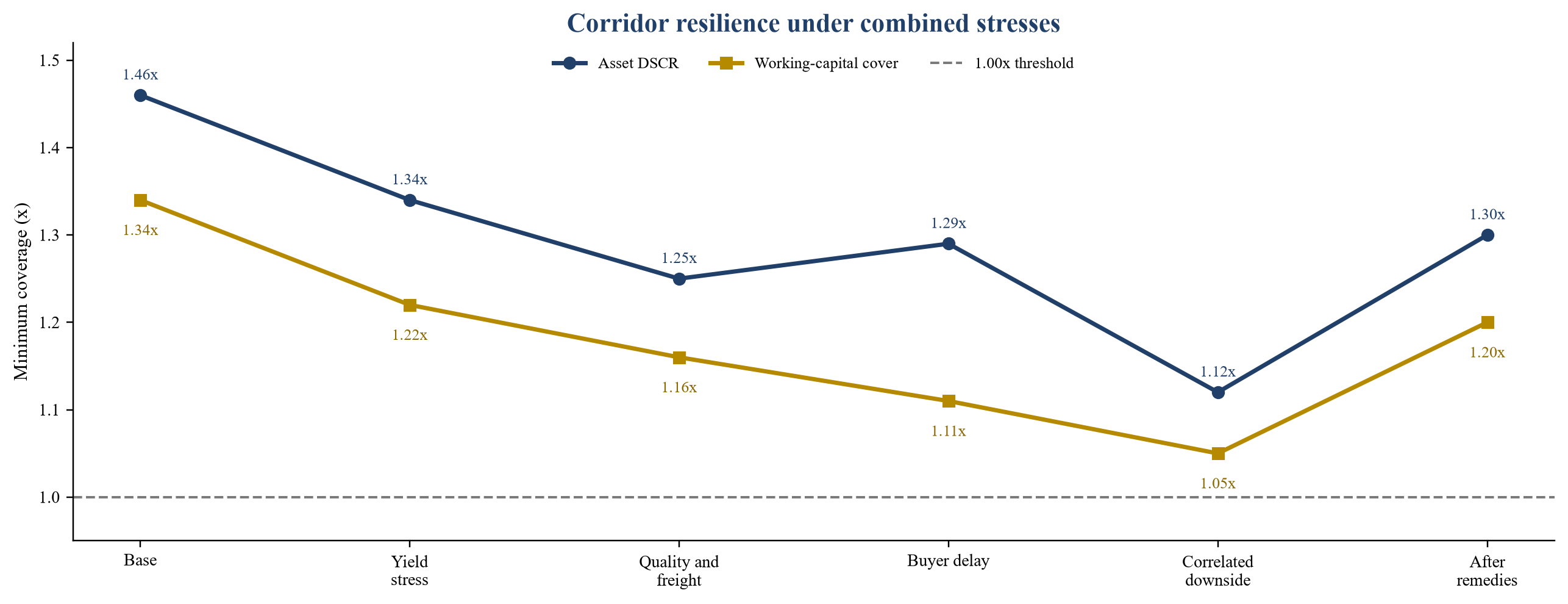
Ratios and stresses are hypothetical management assumptions and are not forecasts.
24. Define remedies before the stress occurs
Remedies should correspond to the failing cash cycle. A yield shortfall may require procurement from approved alternate origins, reduced processing throughput and farmer-debt rescheduling. Quality failure may require segregation, reprocessing, alternative markets and corrective agronomy. Buyer delay may require receivables finance, reserve use or suspension of further shipment. Freight disruption may require route substitution and inventory limits.
The model should rank remedies by decision time, cost, contractual authority and effect. Management should not assume a buyer, lender or government will provide support without a committed instrument. Additional equity should remain a last-resort source unless formally committed. Sale of inventory requires verified alternative buyers and net recovery values.
Stop conditions protect the corridor from compounding loss. These may include unresolved food-safety incidents, inventory variance above tolerance, payment delay beyond an agreed period, farmer complaints indicating systemic deduction errors, liquidity below minimum, or forecast coverage below covenant. The board should state who can stop procurement, shipment or capital expenditure and how activity restarts.
| Risk | Illustrative exposure | Primary control | Escalation trigger |
|---|---|---|---|
| Yield and climate | High during production | Diversification, agronomy, irrigation and insurance | Forecast volume below committed need |
| Farmer continuity | Medium to high | Fair terms, timely payment and viable input recovery | Retention or delivery rate falls materially |
| Quality and food safety | High throughout | Standards, testing, traceability and recall | Rejection, contamination or missing lot history |
| Inventory and title | High during storage | Controlled warehouse, receipts, inspection and insurance | Stock variance or competing claim |
| Buyer and payment | Medium to high | Credit limits, trade instruments and controlled collection | Dispute or delay beyond limit |
| Currency and trade | Medium | Natural hedge, local finance, limits and route options | Convertibility, export or import restriction |
Ratings are illustrative; management should replace them with evidence-based project ratings.
25. Govern farmer complaints as operating data
A grievance mechanism is both a rights safeguard and an early-warning system. Complaints about weights, grading, deductions, input quality, field conduct, payment or discrimination can reveal failures before they become supply disruption, litigation or reputational loss.
The corridor should provide accessible channels, local-language support, confidentiality, non-retaliation and time-bound response. Complaints should be classified, investigated and reported without suppressing legitimate disputes. Producer organisations should receive aggregate information while personal data remains protected. Repeated issues should trigger root-cause action.
The board dashboard should show complaint volume, category, ageing, outcome and recurrence alongside farmer retention and delivery. A low number of complaints may indicate good performance or inaccessible channels. Independent surveys and field audits can test whether producers understand contract terms and trust the process. Management incentives should not reward low reported complaints without considering access and resolution quality.
26. Measure food security and producer outcomes separately
Shipment volume is not a complete measure of food security or development. The corridor should distinguish destination outcomes, producer outcomes, local-market effects and financial performance. Each category needs a defined baseline, owner, method and frequency.
Destination indicators may include contracted volume delivered, on-time arrival, quality acceptance, landed-cost variance, origin concentration and days of cover supported. Producer indicators may include net income, payment time, yield, rejection, input-debt burden, retention, women and youth participation and grievance resolution. Local indicators may include domestic availability, jobs, processing value added, water use and land impacts.
Financial indicators should include asset coverage, borrowing-base cover, inventory days, cash conversion, buyer concentration, facility utilisation, arrears, losses and equity calls. Metrics should not double count the same benefit across food security, commercial return and development impact. Independent verification may be appropriate for material claims or linked finance.
27. Build the financing syndicate around accountable roles
The corridor may require sponsor equity, local banks, trade-finance banks, development institutions, insurers, guarantee providers and public agencies. A large syndicate adds value only when each participant addresses a defined risk or funding need.
The sponsor should own the operating model, completion support and governance. Local banks may understand farmers, currency and domestic security. International banks may provide trade lines, confirmations or hedging. Development institutions may support tenor, inclusion, climate or market creation. Guarantee and insurance providers may cover specific political, credit or climate perils. Public agencies may fund enabling infrastructure or extension.
The term sheet should align definitions, reporting, security, cash waterfalls, defaults and intercreditor rights. A concessional tranche should not be structurally subordinated without an explicit development rationale and loss cap. Senior lenders should not assume public support beyond binding documents. The financing plan should state which commitments are signed, under diligence, indicative or merely targeted.
28. Sequence a 180-day investment build
The first 30 days should establish the mandate, commodities, buyer need, origin shortlist, overlap with existing investments and decision rights. Days 31 to 60 should complete initial farmer, land, crop, infrastructure, buyer, food-safety and legal screens. The corridor should pause if its demand or producer-economics thesis cannot be evidenced.
Days 61 to 90 should develop the operating model, contract architecture, facility plan, data design, environmental and social scope and hypothetical downside model. Days 91 to 120 should complete priority diligence, test warehouse and logistics controls, agree farmer-engagement methods and seek lender and insurer feedback. Days 121 to 150 should negotiate heads of terms, define conditions precedent and confirm the first-season budget.
Days 151 to 180 should produce the investment memorandum, financing plan, implementation budget, governance calendar and risk register. Approval should release capital by milestone rather than approve the full corridor on day one. Farmer onboarding, crop finance, asset construction and trade facilities should each have separate readiness conditions.
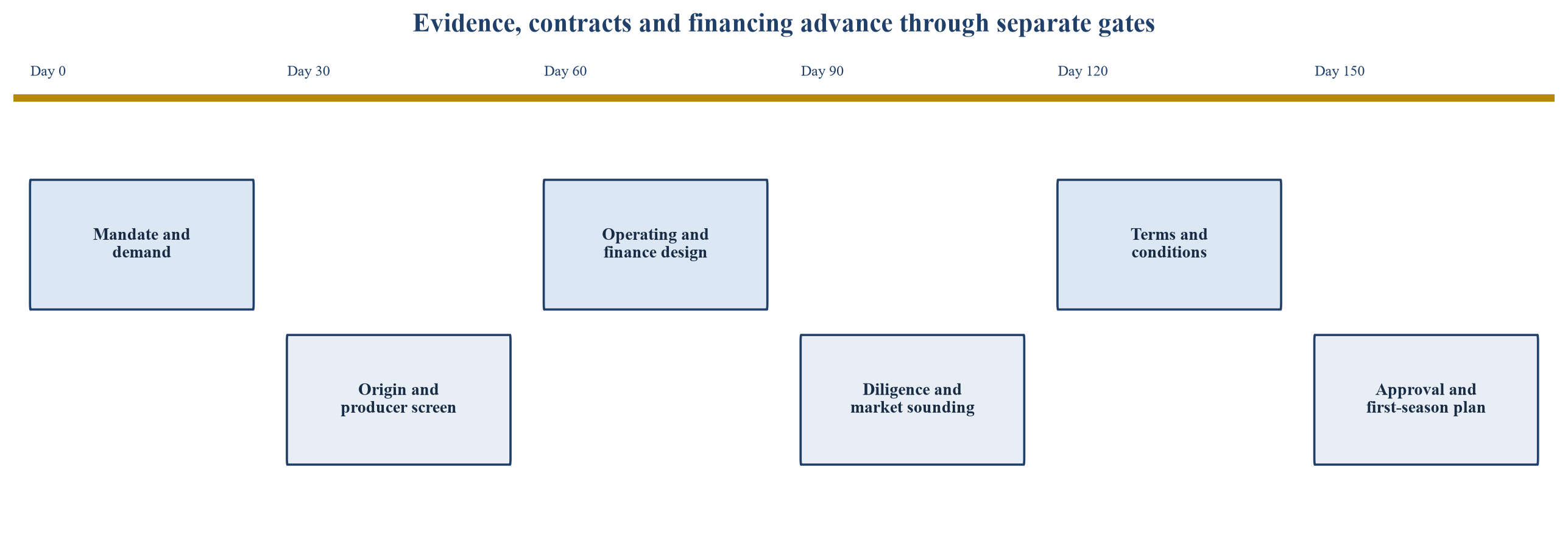
The sequence is a proposed implementation roadmap and must be adapted to the commodity and jurisdictions.
29. Use an approval memorandum that can reject the corridor
The approval memorandum should connect strategic need, producer economics, physical flow, contracts, financing and downside. It should identify the commodities, origins, farmers, assets, buyers, routes, currencies, seasonality, regulatory requirements and environmental and social obligations. It should separate signed evidence from management assumptions.
The committee should receive the transaction map, farmer viability analysis, price formula, contract matrix, sources and uses, working-capital borrowing base, asset model, trade-finance plan, risk heat map, climate scenario, food-safety controls, data architecture, grievance process and 180-day roadmap. Each unresolved issue should have an owner, deadline, budget and decision consequence.
Capital should stop when buyer demand is uncommitted, producer economics are negative under reasonable conditions, land or water rights are unresolved, farmer contracts are opaque, warehouse control is weak, food-safety capability is missing, inventory title cannot be verified, trade documents are unreliable, or correlated downside exhausts liquidity without a credible remedy.
The governing principle is that food security, producer continuity and lender recovery depend on the same disciplined system. Gulf buyers gain reliability when farmers can invest, perform and remain in the corridor. Latin American producers gain durable market access when quality, pricing, payment and finance are transparent. Capital can connect those interests when every draw follows evidence and every party's obligations remain enforceable and economically viable.
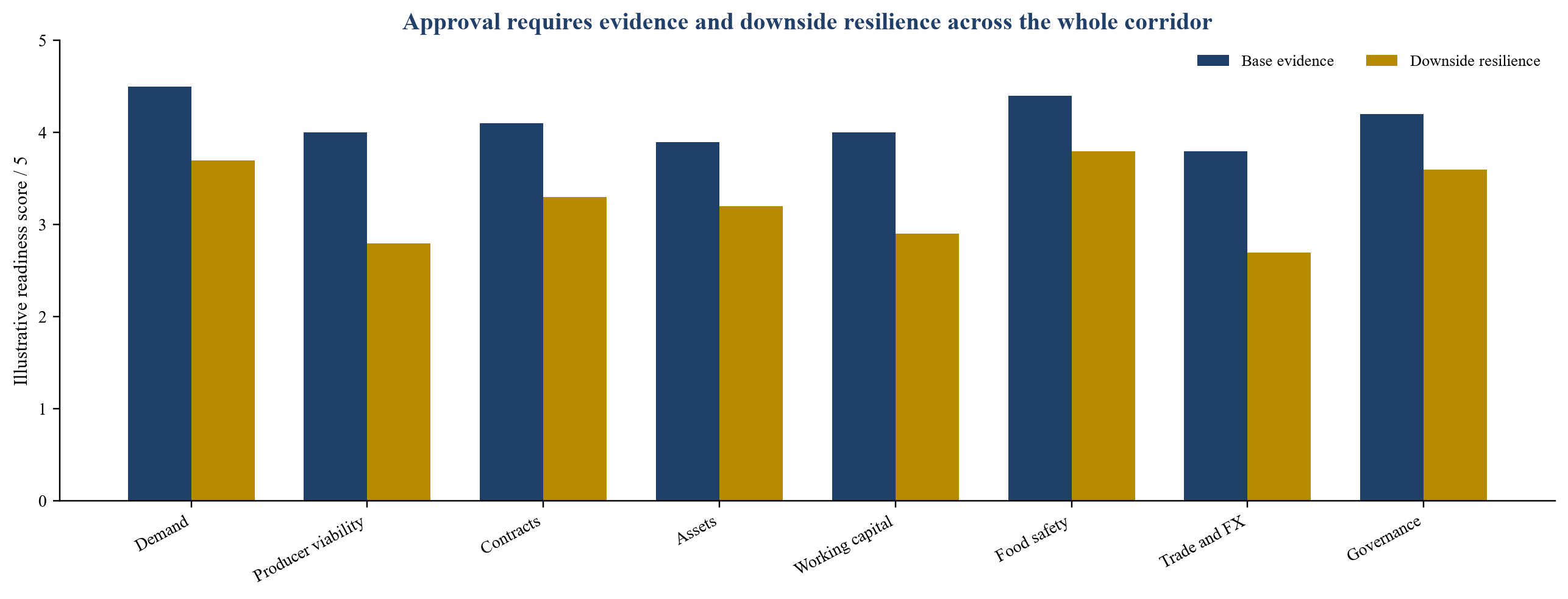
The framework is illustrative and requires transaction-specific legal, technical, agricultural and credit advice.
| Approval area | Evidence required | Board decision |
|---|---|---|
| Strategic demand | Buyer need, commodity portfolio, destination requirements and contingency role | Approve defined food-security contribution |
| Producer system | Farmer economics, contract fairness, extension, payment and grievance controls | Approve onboarding and farmer-finance limits |
| Physical corridor | Aggregation, storage, processing, cold chain, logistics and food safety | Approve assets by milestone |
| Financing | Equity, asset debt, seasonal borrowing base, trade facilities and reserves | Approve capped commitments and conditions |
| Responsible investment | Land, water, labour, local food security, climate and due diligence | Accept, mitigate or decline material impacts |
| Operating governance | Data, cash control, performance, escalation and stop authority | Approve first season and review calendar |
The checklist supports governance and does not replace specialist advice.
Sources
- UAE Ministry of Economy, Food Sector and Food Cluster Strategy. Read the primary source
- World Bank, Enhancing Agrologistics Systems in Northern Central America. Read the primary source
- Food and Agriculture Organization of the United Nations, Contract Farming Resource Centre. Read the primary source
- Food and Agriculture Organization of the United Nations, Promoting responsible investments through better contractual arrangements, 21 February 2019. Read the primary source
- UNIDROIT, FAO and IFAD, Legal Guide on Contract Farming. Read the primary source
- World Bank, Commodity Markets. Read the primary source
- International Finance Corporation, Global Warehouse Finance Program. Read the primary source
- Inter-American Development Bank, Logistics, Financing and Public Policies Are the Main Barriers for Agrifood Companies in Latin America and the Caribbean, 27 April 2026. Read the primary source
- Inter-American Development Bank, Agricultural Productivity and Food Security in Latin America and the Caribbean. Read the primary source
- Food and Agriculture Organization of the United Nations, Traceability and Recalls. Read the primary source
- International Finance Corporation, Trade and Supply Chain Finance. Read the primary source
- International Finance Corporation, Trade and Supply Chain Finance. Read the primary source
- International Finance Corporation, Global Warehouse Finance Program. Read the primary source
- Committee on World Food Security, Principles for Responsible Investment in Agriculture and Food Systems. Read the primary source
- OECD and FAO, Guidance for Responsible Agricultural Supply Chains. Read the primary source
- Gulf Cooperation Council, Agriculture and Food Security Ecosystem in GCC States Is a Strategic Priority, 3 September 2026. Read the primary source
- Food and Agriculture Organization, Regional Overview of Food Security and Nutrition in Latin America and the Caribbean 2024. Read the primary source
- Food and Agriculture Organization, Regional Strategic Foresight Report for Latin America and the Caribbean, 2026. Read the primary source
- Food and Agriculture Organization of the United Nations, Contract Farming Analysis Toolkit. Read the primary source
- Food and Agriculture Organization of the United Nations, Contract Farming Frequently Asked Questions. Read the primary source
- OECD and FAO, OECD-FAO Guidance for Responsible Agricultural Supply Chains, 2016. Read the primary source
- Food and Agriculture Organization of the United Nations, Food Inspection and Risk-Based Controls. Read the primary source
