

1. Define the investment decision before screening projects
The investment committee should decide what the platform is expected to achieve. Possible mandates include stable contracted yield, inflation-linked cash flow, development upside, regional scale, technology capability, access to corporate offtakers, or a base for future acquisitions. These objectives demand different portfolios. An operating solar asset with a long-term power purchase agreement can support yield. A wind development pipeline may offer higher upside and materially greater grid, permit and construction risk. A storage platform can monetise system flexibility only when market rules and dispatch rights support revenue.
The mandate should specify target countries, technologies, development stages, return range, currency tolerance, maximum single-asset exposure, leverage, construction capacity and holding period. It should also state whether the investor can provide completion equity, accept merchant revenue, fund transmission works or manage contested land and community issues. Ambiguous mandates encourage volume-led origination and defer difficult decisions until late diligence.
The first screening question is therefore whether an opportunity fits the approved risk and operating model. Installed or proposed megawatts are supporting data. The decision turns on executable rights, verified grid capacity, contracted or defensible revenue, financeable capital needs, competent operating control and a downside that remains fundable.
2. Treat Latin America as several power markets
Latin America and the Caribbean already derive around 60% of electricity from renewable sources, supported by hydropower and growing wind and solar fleets [1]. The regional figure can hide material differences in market design, dispatch, transmission, permitting, pricing, currency and counterparty quality. Brazil, Chile, Colombia and Mexico cannot be underwritten as one regulatory jurisdiction.
Brazil combines a large interconnected system, extensive hydro flexibility, competitive and regulated contracting channels, strong wind and solar resources and a growing need for transmission. EPE projected average annual load growth of 3.3% over 2025-2029 [2], while its 2035 planning work identified major transmission investment requirements [3]. Chile has high-quality solar and wind resources, significant curtailment and an expanding role for storage. Its 2025 decarbonisation plan emphasises transmission, market reform, storage and system services [4]. Colombia's 2025-2039 generation plan anticipates substantial change in the thermal fleet and a rising role for wind and solar, with firm capacity still required for reliability [5]. Mexico's 2024-2038 system plan integrates generation, transmission and distribution planning, while current participation structures require transaction-specific verification [6].
The platform should use a common evidence model across markets and local legal, technical, tax and regulatory analysis within each market. Comparability helps allocate capital; it does not erase jurisdiction-specific risk.
3. Convert the mandate into measurable portfolio limits
Portfolio limits should be expressed in operating and financial terms. Country exposure can be capped by invested equity, enterprise value, cash available for distribution or debt service rather than megawatts alone. Technology limits should recognise common-mode risks. Solar assets in separate countries may share equipment suppliers, irradiance assumptions or price exposure. Wind assets may share turbine fleets, blade risks or seasonal generation patterns. Hydro exposure adds hydrology and watershed risk.
Stage limits are equally important. The committee may allow a maximum percentage of equity in construction and development, a cap on projects without executed interconnection agreements and a minimum proportion of cash flow from operating assets. Development expenditure should be released against land, grid, permit and offtake milestones. A pipeline becomes valuable when it can move through those gates within a credible time and capital envelope.
The mandate should define currency limits by revenue, debt and investor reporting currency. A platform can be economically sound in Brazilian reais, Chilean pesos, Colombian pesos or Mexican pesos and still produce volatile USD, AED or SAR returns. Translation exposure, dividend convertibility and project debt service should be shown separately. Portfolio construction begins with those measurable limits and continues through every acquisition and capital-allocation decision.
4. Screen markets through a common decision architecture
A market screen should assess seven connected questions: Is demand growing? Can projects connect? Who buys the power? How is energy priced and settled? Can investors obtain and enforce permits, land and contracts? Is local or hedged financing available? Can cash be distributed under central and stress cases? Each answer should be supported by dated primary evidence and specialist advice.
Resource quality should enter after market access. The best solar irradiation can be economically irrelevant when transmission is saturated or curtailment is uncompensated. A favourable auction price can be unfinanceable when indexation does not match costs. A strong corporate offtaker can still create basis risk when the contract delivery point differs from the asset node. The screen therefore links physical production with legal rights and collected cash.
Current regional evidence supports both opportunity and caution. The IEA estimated 2025 clean-energy spending in Latin America at about USD 70 billion and highlighted the need for stronger grids, storage and risk-mitigation instruments [7]. UNCTAD reported substantial infrastructure project-finance activity alongside a 2024 regional decline in deal value and count [8]. The committee should treat regional capital need as context and verify each target independently.
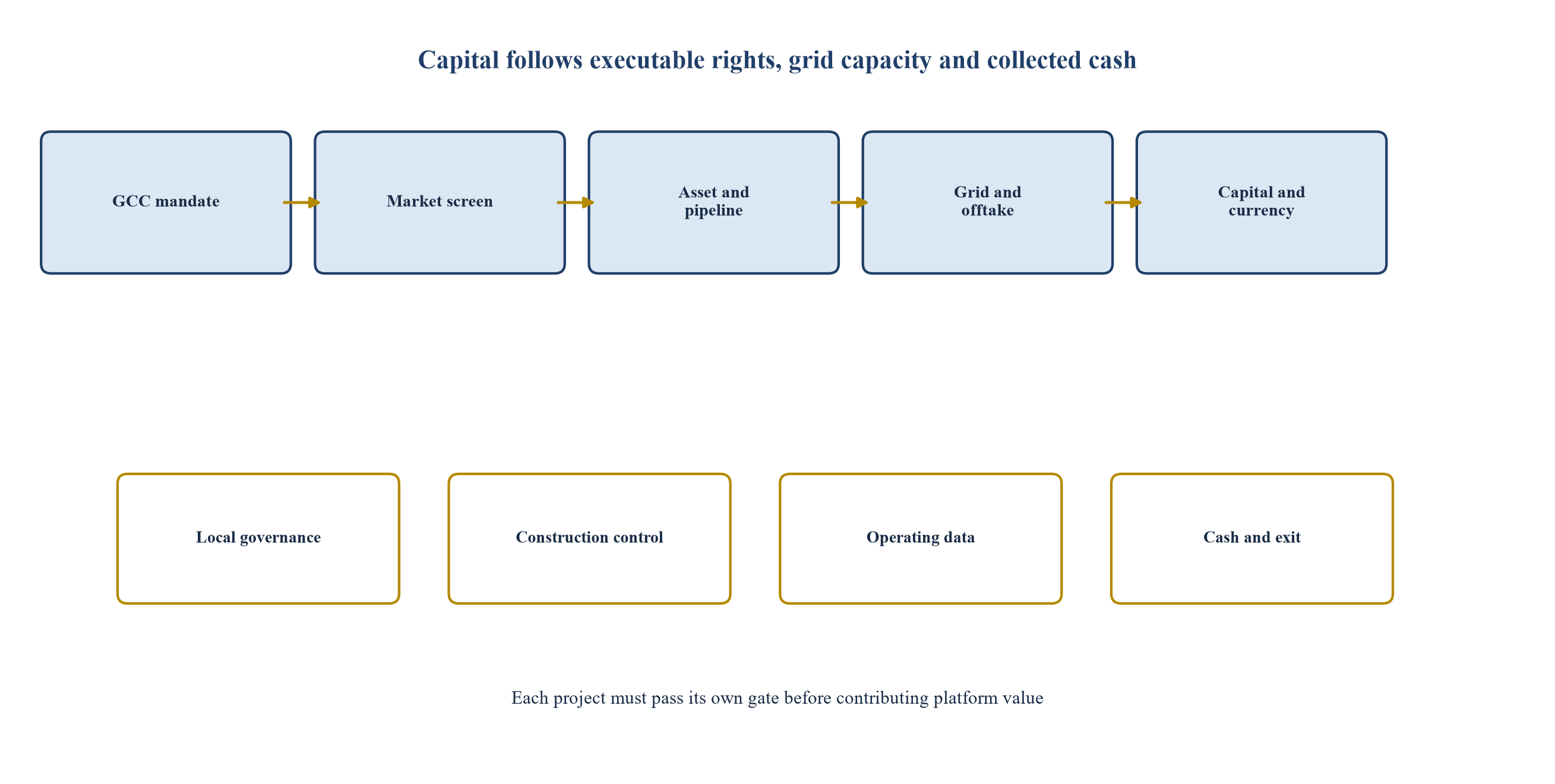
The architecture is a proposed decision framework and does not represent an observed transaction.
5. Classify pipeline value by evidence and conversion stage
The platform data room should classify every project as operating, construction, late-stage development or early-stage development. Each class requires objective criteria. Operating means commissioned, connected, permitted and producing under verified settlement arrangements. Construction means financing and material contracts are effective, key permits and grid rights are secured, and the remaining schedule and contingency are independently assessed. Late-stage development requires defined land, connection, environmental and offtake paths. Early-stage development remains an option until those elements mature.
Pipeline value should be probability-weighted only after milestone definitions are agreed. A single percentage applied to all projects conceals different failure modes. Grid-ready land without environmental approval differs from permitted land without transmission capacity. A project with an auction award differs from one with a non-binding corporate letter. The valuation bridge should show gross capacity, eligible capacity, stage, remaining spend, expected decision date, key dependency and risk-adjusted value.
Exclusivity, development rights and option expiry also matter. The buyer should verify who owns studies, grid applications, permits, meteorological data, designs and intellectual property. Change-of-control provisions may require consent. Projects should receive no value when rights cannot be transferred, milestones have expired or the seller cannot evidence title. A disciplined pipeline ledger prevents the platform multiple from becoming a payment for unsupported aspiration.
6. Make grid access the first technical investment gate
Grid access determines whether resource becomes saleable electricity. Diligence should identify the connection point, granted capacity, queue position, required reinforcements, responsibility for works, security deposits, milestones, energisation date, dispatch constraints, loss factors and curtailment treatment. A letter acknowledging an application is not an interconnection right. A completed substation does not prove upstream transmission capacity.
The grid study should test central and adverse system conditions, including nearby projects in the queue. It should reconcile the developer's model with system-operator and transmission-planning data. The IEA and IDB identify grid expansion, digitalisation, storage and system flexibility as essential to integrating renewable capacity [7,9]. An IDB study notes that the region plans more than 150,000 kilometres of new transmission by 2035 while current investment remains below projected needs [9]. These regional needs should not be translated into assumed access for an individual project.
Completion conditions should include effective connection agreements, approved studies, funded works, valid milestones and an updated schedule. The purchase agreement should allocate losses if stated grid rights prove inaccurate. Development capital should stop when queue position, reinforcement cost or energisation timing moves outside approved limits.
7. Underwrite offtake as a credit and basis instrument
A power purchase agreement needs more than a credible name. The review should cover legal buyer, authority, volume, profile, delivery point, price, indexation, currency, settlement, imbalance, curtailment, change in law, force majeure, termination, security and dispute resolution. The buyer's credit quality and the contract's enforceability are separate questions. A state-related company may not carry a sovereign guarantee. A corporate buyer may be financially strong and retain broad termination rights.
Volume shape affects value. Pay-as-produced contracts transfer less profile risk to the generator than fixed-volume or shaped delivery. Contracts for difference can leave physical and basis exposure. Merchant tails may support upside and refinancing while adding price volatility. The model should show contracted energy, expected generation, imbalance volume, node-to-hub basis and merchant exposure by month and asset.
Guarantees can strengthen payment obligations when the covered risk and trigger are explicit. MIGA's 2026 support for a CODELCO financing in Chile covered non-honouring risk associated with long-term renewable-energy purchases [10]. The example demonstrates that risk allocation can unlock tenor; it does not imply that comparable cover is available for every project. The platform should model its own counterparty and contract exposure before assuming enhancement.
8. Translate market rules into collected revenue
Revenue models should begin with actual settlement rules. Energy price, capacity payment, ancillary services, certificates, inflation indexation, transmission charges, losses, imbalance and taxes need separate lines. The model should distinguish invoiced revenue from collected cash and show the evidence for each assumption. Historic spot prices should be aligned to the project's node and production profile rather than used as annual averages.
Corporate PPAs can reduce price exposure and create concentration. Auctions can support bankability and introduce delivery, delay and guarantee obligations. Distributed generation can create customer-credit and aggregation risk. Storage may earn from arbitrage, capacity, ancillary services, congestion relief or contracted availability; each stream requires legal eligibility, dispatch control and measurable performance.
Market changes should be captured through an obligations matrix. Mexico's PRODESEN identifies generation, transmission and distribution needs [6], while the current participation framework includes several private and mixed structures [11]. Chile's plan includes market and system-service reforms [4]. Each transaction needs a dated legal opinion on the rules that affect revenue, transferability and financing. A regional narrative cannot replace that evidence.
| Gate | Brazil | Chile | Colombia | Mexico |
|---|---|---|---|---|
| Demand and system | Load growth, hydro balance and regional constraints | Mining load, decarbonisation and flexibility | Reliability, hydro exposure and new variable generation | System planning, demand growth and public-private structure |
| Grid | Queue, transmission reinforcement and curtailment | Congestion, curtailment, storage and new lines | Remote resource zones and transmission delivery | Interconnection, planning alignment and network works |
| Revenue | Regulated and free-market contracts, settlement and certificates | PPAs, merchant exposure, node basis and services | Contract market, reliability value and merchant exposure | Permitted private, mixed or contracted structures |
| Currency | BRL revenue, local debt and USD translation | CLP or indexed revenue, local debt and USD translation | COP revenue, local debt and USD translation | MXN or USD-linked revenue, local debt and USD translation |
| Approval | Asset-by-asset legal, tax, environmental and technical opinion | Asset-by-asset legal, tax, environmental and technical opinion | Asset-by-asset legal, tax, environmental and technical opinion | Asset-by-asset legal, tax, environmental and technical opinion |
The table is a diligence framework; current local law, regulation and market data require independent verification.
9. Price curtailment and congestion explicitly
Curtailment should be separated into economic dispatch, grid constraint, system security, negative-price response, maintenance and contractual limitation. The model should identify whether curtailed energy is compensated, which party bears the loss and whether storage or another operating action can mitigate it. Historic curtailment should be matched to location, hour, technology and system condition. A national average can materially misstate a project's exposure.
Chile's policy direction links high renewable penetration with storage, transmission and system-service reform [4]. Brazil's planning similarly reflects a system adapting to renewable growth and new transmission needs [3]. These conditions can create opportunity for batteries, hybridisation and grid investment. They can also reduce generation value before the enabling infrastructure is operational.
The acquisition case should therefore include a curtailment floor, a congestion scenario and an energisation-delay scenario. Pipeline value should reflect network works that are outside the developer's control. Storage should be approved only when interconnection rights, market participation, degradation, dispatch optimisation and revenue stacking are evidenced. Avoided curtailment is valuable when it produces measurable additional cash; it is not automatically a bankable revenue stream.
10. Underwrite technology as an operating fleet
Technology diligence should move beyond manufacturer warranties. The platform needs a fleet register by model, capacity, installation date, serial number, operating hours, failure history, service agreement, spare parts, software rights and remaining warranty. Wind turbine gearbox, blade and main-bearing exposure should be analysed by fleet. Solar modules require degradation, hotspot, soiling and warranty review. Inverters, transformers and substations can create common failure points.
Availability guarantees may exclude grid outages, force majeure, scheduled maintenance and owner-caused events. Liquidated damages can be capped below economic loss. Warranty claims require evidence, timely notice and solvent counterparties. The model should therefore include expected failure, major maintenance, replacement lead times and insurance deductibles outside vendor recovery.
The acquisition plan should consider supplier concentration across countries. Common equipment can simplify spares and technical capability while creating correlated defect exposure. The board should approve fleet limits, strategic spare inventory, long-term service arrangements and independent engineering oversight. An operating platform earns a premium when its technical data, maintenance planning and claims discipline convert equipment performance into predictable cash.
11. Rebuild the resource case from independent evidence
Wind and solar yields should be reviewed through independent measurements, long-term correlations, loss assumptions and uncertainty bands. Wind models need mast or lidar quality, terrain, wake, turbine power curve, air density, availability and electrical losses. Solar models need irradiance source, temperature, soiling, clipping, degradation, shading and grid-loss assumptions. Hydro and biomass projects require separate resource and sustainability analysis.
The committee should see median, conservative and severe-downside production cases, or equivalent probability cases, and understand how they affect debt sizing and equity returns. A lender's energy case may differ from the seller's central case. Correlated weather should be tested across assets. Geographic diversification is useful when resource patterns and grid constraints actually differ.
Climate change introduces physical risk to resource and infrastructure. Flood, wildfire, heat, drought, storm, sea-level and landslide exposure should be located at asset level. Resilience spending belongs in capital expenditure and insurance analysis. A project can retain average annual production and suffer unacceptable outage or repair risk. Resource quality should therefore be connected to asset resilience, grid availability and collected revenue.
12. Confirm land, community and environmental durability
Land rights should cover the complete operating footprint, access roads, collection lines, substations, transmission easements and temporary construction areas. The buyer should verify ownership or lawful use, boundaries, encumbrances, term, renewal, rent escalation, change of control, restoration and dispute history. A generation lease that excludes the export line can strand the project.
Environmental and social diligence should follow applicable law, financing standards and the actual risk profile. It should cover biodiversity, water, cultural heritage, indigenous peoples, labour, contractor management, resettlement, cumulative impact, grievance and benefit sharing. IFC's Performance Standards provide a recognised framework for identifying and managing such risks in private investment [12]. Their application requires project evidence and stakeholder engagement rather than a checklist reference.
The platform should track commitments from impact assessment through operations. Each obligation needs an owner, date, evidence and escalation path. Community agreements and payments should be transparent and enforceable. Material unresolved consent, land or biodiversity issues should remain closing conditions or exclusions. A project that cannot sustain its social licence cannot support long-term platform value.
13. Make permitting a dependency map
Permit diligence should identify every approval required for development, construction, grid connection, generation, environmental compliance, water, aviation, heritage, access, foreign investment and operations. The map should show issuing authority, legal basis, holder, status, conditions, expiry, renewal, transferability and dependencies. A permit labelled approved may remain ineffective until a bond, fee, consultation or ancillary approval is completed.
The critical path should distinguish developer-controlled tasks from government and grid processes. Schedule contingency should reflect historic and current evidence in the relevant jurisdiction. Construction contracts should align notice to proceed with effective permits and land access. Debt draw conditions should prevent spending ahead of an unmitigated legal dependency.
Change-of-control analysis is essential in acquisitions. Permits, concessions, PPAs, grid rights, leases and financing can require consent. The seller should deliver a complete consent schedule and bear agreed consequences for inaccuracies. The buyer should avoid treating a platform-level share purchase as automatically preserving every underlying right. Asset-by-asset confirmation protects the value attributed to each operating and development project.
14. Choose the transaction perimeter before negotiating price
The buyer can acquire a holding company, selected project companies, development rights, a management platform or a staged combination. A whole-platform purchase may preserve people, contracts and systems while importing contingent liabilities. An asset carve-out can isolate risk and complicate permits, services, tax and shared infrastructure. A minority investment can reduce initial capital and weaken control over development, financing and exit.
The perimeter should follow the mandate and diligence evidence. Operating projects with clean rights can close first. Construction projects may require completion support, seller cost-to-complete protection or earn-outs. Development projects can transfer through options or milestone payments. Shared personnel, licences, data, warranties and procurement agreements need explicit allocation.
Purchase-price mechanics should distinguish locked-box leakage, completion accounts, debt-like items, working capital, reserves, development expenditure and tax. Representations should cover grid, land, permits, contracts, environmental matters, related parties, sanctions and data. Indemnities, escrow and warranty insurance should be evaluated against enforceability and claim process. Transaction structure protects value only when the underlying project evidence remains sound.
15. Value the platform through asset-level cash and options
Operating assets should be valued from distributable cash under contract, resource, availability, curtailment, cost, tax and debt assumptions. Construction assets require remaining spend, contingency, delay, liquidated damages and ramp-up. Development projects require milestone probability, remaining capital, time to commercial operation and dilution. The management platform may carry value through people, origination, procurement, operations and data capability when those capabilities are transferable and retained.
The platform valuation bridge should reconcile enterprise value to equity value. It should include project debt, holding-company debt, cash, reserves, derivatives, tax liabilities, shareholder loans, minority interests and committed capital expenditure. Development value should be shown separately from operating value. A headline enterprise-value-to-megawatt multiple is a reference point and cannot capture stage, grid, contract, resource or capital needs.
Comparable transactions need normalisation for technology, market, stage, leverage, contract and date. Discount rates should reflect local risk, currency, stage and cash-flow quality. IRENA reports that financing cost remains a major component of renewable-energy cost and varies materially across countries [13]. The valuation should reveal how much price depends on future conversion and which milestones are required to earn it.
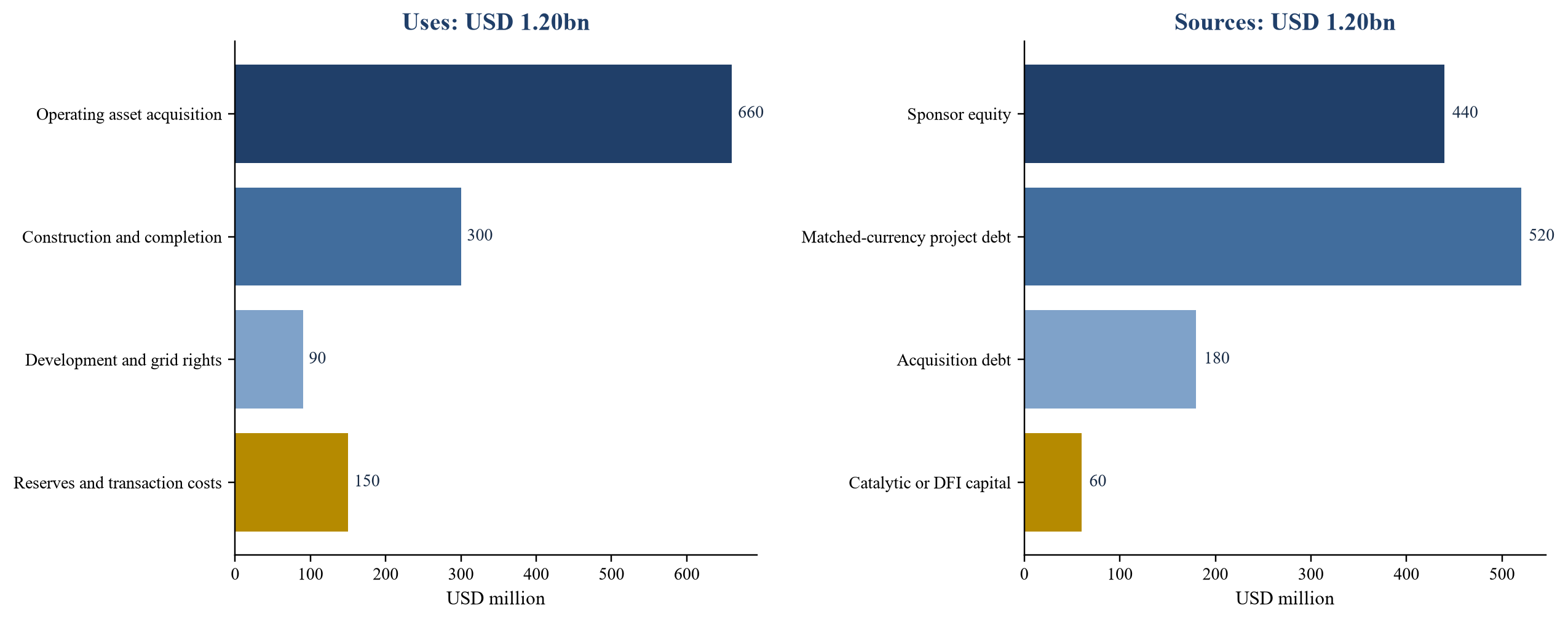
All amounts are hypothetical management assumptions in USD millions and do not represent an actual transaction.
16. Build the capital stack around stage and currency
Operating assets can support long-tenor project debt when revenue, resource, grid and costs are sufficiently predictable. Construction assets need completion equity, contingency and contractor security. Development spending is usually equity or risk capital until major milestones are secured. Acquisition debt at the holding company depends on reliable distributions from project companies and should not assume unrestricted cash transfer.
Debt currency should match revenue where practical. Local-currency debt can protect project debt service and introduce refinancing, market-depth and interest-rate constraints. Hard-currency debt may offer tenor or pricing and creates foreign-exchange exposure when revenue is local. A hedge should be modelled by notional, tenor, amortisation, collateral, termination and counterparty cost. The IMF and G20 work on infrastructure currency risk emphasises the importance of market development and risk-allocation mechanisms in emerging economies [14].
The investor's reporting currency creates another layer. A Brazilian asset may service BRL debt comfortably while producing volatile USD distributions. The model should show project coverage in functional currency, upstreamable cash after restrictions, hedge cost and translated investor return. Combining those into one exchange-rate assumption can hide a solvent project and a volatile equity outcome.
17. Size debt from resilient cash rather than installed capacity
Debt sizing should begin with cash available for debt service under lender-defined production, price, curtailment, availability, operating-cost and tax cases. The model should show senior debt service, reserve funding, covenant headroom and distribution lock-up. Holding-company debt needs a separate cash waterfall after project debt, reserves, taxes and minority distributions.
Construction facilities should control eligible costs, equity-first or pro-rata funding, contingency, draw conditions, completion testing and cost overruns. Development facilities require strong borrowing-base definitions and stop-draw triggers. Revolving facilities can support guarantees and working capital when exposure, expiry and reimbursement are tracked.
Portfolio financing can diversify asset risk and weaken transparency if weak projects are supported by strong ones without limits. Cross-collateralisation, cash sweeps and release provisions should be explicit. The committee should see asset-level and consolidated coverage. A platform should be able to identify which asset causes a covenant breach and which corrective action preserves value.
18. Model tax and cash mobility as transaction mechanics
The legal and financing structure should reflect operating substance, treaty eligibility, withholding tax, interest deductibility, transfer pricing, thin-capitalisation rules, indirect taxes, capital gains and controlled-foreign-company considerations. Advice should be current and jurisdiction specific. A structure that reduces one tax can create regulatory, governance or exit friction elsewhere.
Cash mobility depends on distributable reserves, corporate approvals, debt covenants, minority rights, currency conversion, banking process and tax. The model should bridge operating cash to project distribution, platform cash and investor receipt. It should show timing, leakage and blocked-cash cases. Assumed dividends should not exceed legally and contractually available amounts.
Management fees, development fees and related-party services require arm's-length support and clear value. Shared procurement can reduce cost and create customs or transfer-pricing issues. Tax attributes and losses should receive value only when use is legally supported and likely under the business plan. The purchase agreement should allocate pre-closing tax, audits and uncertain positions.
19. Allocate political and regulatory risk deliberately
Political risk includes expropriation, breach of public contract, transfer restriction, currency inconvertibility, political violence and discriminatory regulatory action. Commercial insurance and contractual protections cover defined events, conditions and exclusions. They do not replace legal diligence or a viable project.
MIGA describes renewable-energy projects as exposed to long-term government contracts, regulated tariffs and cross-border financing structures [15]. Its instruments can address specified non-commercial risks where eligible. The platform should test availability, premium, tenor, waiting periods, dispute requirements and recovery mechanics. A policy should be credited only after terms are accepted and aligned with financing.
Regulatory risk can also arise through market redesign, transmission charges, certificate rules, curtailment allocation or tax. Change-in-law clauses may share cost and can exclude general law or tax. The valuation should identify residual exposure after contract and insurance. Country caps, local partnerships, staged capital and financing structure can reduce concentration when supported by genuine control.
20. Treat environmental and social performance as value protection
Renewable generation can reduce operating emissions and create land, biodiversity, labour and community impacts. The acquisition thesis should state the expected environmental contribution and the controls required to achieve it. Claims should be measured against a baseline and avoid double counting between renewable attributes, carbon credits and buyer reporting.
The diligence plan should review supply-chain risks, including labour and traceability where material. Construction contractors need health, safety, worker accommodation, grievance, traffic and emergency plans. Operations need bird and bat monitoring where relevant, vegetation control, fire prevention, waste and end-of-life plans. Battery projects add chemistry, thermal-runaway, recycling and emergency-response requirements.
Performance should influence capital allocation. Material unresolved issues can require redesign, budget, covenants, price protection or exclusion. The platform dashboard should include incidents, corrective actions, grievances, habitat commitments, contractor performance and permit compliance. Strong environmental and social systems support licence to operate, financing and exit diligence.
21. Use data and AI for controls with accountable decisions
The platform can use operational data to improve forecasting, maintenance, curtailment analysis, trading and investment decisions. Inputs may include supervisory-control systems, meters, weather, market prices, outage records, work orders, contracts and settlement data. Data lineage should identify source, owner, timestamp, quality check, transformation and permitted use.
Machine-learning models can support generation forecasting, anomaly detection and predictive maintenance. They should be validated against operational outcomes, monitored for drift and governed by human accountability. A recommendation to defer maintenance or change dispatch can affect safety, warranty and revenue. The platform should record model version, decision owner, override and result.
Cybersecurity should cover operational technology, cloud services, remote access, vendors, identity, backups, incident response and regulatory notification. Acquisition diligence should identify unsupported systems, shared credentials and change-of-control restrictions in software licences. Data and AI create value when they reduce verified loss or cost; projected benefits should remain outside the base case until evidenced.
22. Build a hypothetical portfolio case that can be audited
The hypothetical case contains 900 MW operating, 350 MW under construction and 750 MW in development across Brazil, Chile, Colombia and Mexico. Operating and construction assets include wind, solar and storage. The development pipeline is assigned no value unless land, grid, permit and offtake milestones meet defined criteria. Total uses are assumed at USD 1.20 billion, funded by USD 440 million of equity, USD 520 million of matched-currency project debt, USD 180 million of acquisition debt and USD 60 million of catalytic or development finance.
The central case assumes USD 156 million of platform EBITDA, USD 24 million of tax and working-capital outflow, USD 18 million of sustaining and reserve expenditure and USD 9 million of other restricted cash, leaving USD 105 million available for debt service. Annual scheduled debt service is assumed at USD 75 million, producing 1.40-times coverage. The values are management assumptions used to demonstrate the framework.
The model should link every line to asset, contract, currency and source. Production, price, curtailment, availability, operating cost, tax, capital expenditure, debt and hedge schedules should reconcile. The committee should be able to remove a project and see the effect on price, leverage and coverage. An opaque consolidated model cannot support a platform acquisition.
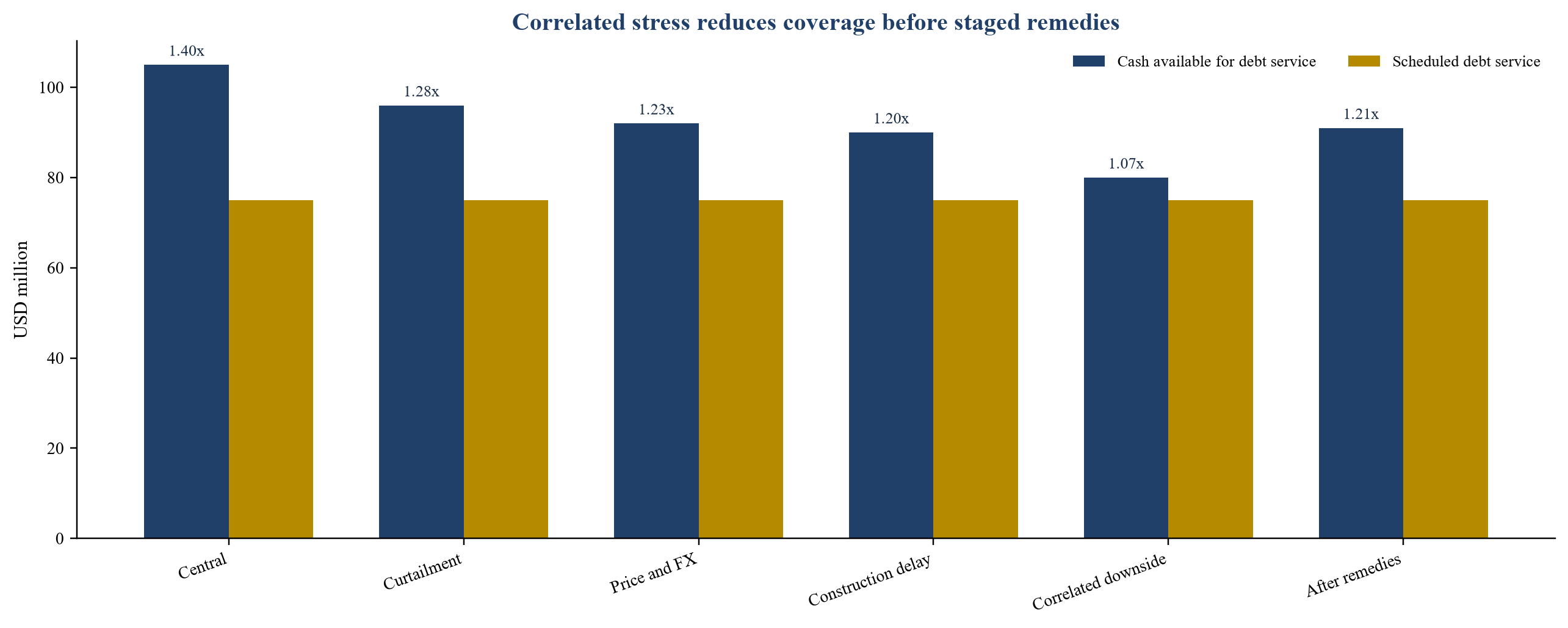
All amounts and outcomes are hypothetical management assumptions in USD millions; they are not forecasts.
| Item | Central case | Correlated downside | After remedies |
|---|---|---|---|
| Operating capacity | 900 MW | 900 MW | 900 MW |
| Construction capacity | 350 MW | 350 MW with delay | 350 MW with staged completion |
| Platform EBITDA | 156 | 129 | 140 |
| Tax and working-capital outflow | 24 | 27 | 25 |
| Sustaining and reserve expenditure | 18 | 19 | 18 |
| Other restricted cash | 9 | 3 | 6 |
| Cash available for debt service | 105 | 80 | 91 |
| Scheduled debt service | 75 | 75 | 75 |
| Debt-service coverage | 1.40x | 1.07x | 1.21x |
Every amount is a management assumption in USD millions unless stated otherwise.
23. Test correlated downside and funded remedies
Single-variable sensitivities identify exposure and can understate portfolio risk. The downside should combine conditions that can occur together: weak resource, grid congestion, delayed commissioning, lower merchant prices, higher operating cost, adverse currency translation and restricted distributions. It should also test counterparty delay and a major component failure where material.
In the hypothetical correlated case, lower production and curtailment reduce revenue, construction delay defers cash, and operating cost rises. Cash available for debt service falls to USD 80 million against USD 75 million of debt service, or 1.07 times. This narrow headroom may trigger distribution restrictions or refinancing concern even though scheduled debt service is paid. The case should also show liquidity, reserve and covenant effects.
Remedies must be executable and funded. The illustration assumes staged development expenditure, a hedge adjustment, contracted maintenance savings and portfolio cash retention increase cash available for debt service to USD 91 million, or 1.21 times. Asset sale, sponsor support or refinancing should not appear as automatic remedies. Each needs timing, approvals, price and certainty. The committee should decline the transaction when the correlated case has no credible path to liquidity and covenant compliance.
| Risk | Early warning | Hypothetical trigger | Proposed response |
|---|---|---|---|
| Grid and curtailment | Rising constrained hours and delayed network works | Asset curtailment exceeds approved budget | Freeze affected development spend; reassess storage and connection strategy |
| Offtake and price | Buyer deterioration, basis widening or settlement disputes | Uncovered revenue exceeds portfolio limit | Increase security, re-contract volume or cap merchant exposure |
| Construction | Milestone slippage, claims and contingency use | Forecast completion exceeds longstop or budget | Use contingency, enforce security and stage sponsor support |
| Currency | Hedge mismatch and falling upstreamable cash | Project or holding coverage falls below threshold | Rebalance hedge, retain cash and reduce hard-currency exposure |
| Operations | Availability decline and repeated major failures | Fleet performance breaches approved floor | Deploy spares, enforce warranty and change service plan |
| Liquidity | Reserve draw and delayed distributions | Consolidated headroom falls below minimum | Stop distributions and development draws; execute funded recovery plan |
The triggers and responses are illustrative; transaction documents and financing terms control actual rights.
24. Diversify by failure mode rather than country label
Country diversification can reduce exposure and add common risks. Projects in separate markets may depend on the same equipment, sponsor, lender, software, weather system or commodity-linked buyer. The platform should map correlation by resource, grid, price, currency, counterparty, technology, construction and regulation.
Hydro, wind, solar and storage can complement each other when production and revenue profiles differ. Storage can reduce curtailment and add flexibility where rights and economics are established. Corporate PPAs in mining, industrial and commercial sectors can diversify utility exposure while concentrating credit in cyclical industries. Transmission investments can complement generation and create a different regulatory risk.
Portfolio optimisation should therefore use constraints and scenarios rather than a single average return. The committee should see marginal effect on cash, risk and capital when adding each asset. A project with a lower standalone return may improve portfolio resilience through uncorrelated production or currency-matched revenue. A high-return project may consume scarce construction or country capacity. Capital allocation should follow the mandate and the portfolio's remaining risk budget.
25. Establish local governance with reserved decisions
The platform needs accountable local leadership, project-company boards and group-level controls. Reserved matters should cover acquisitions, development spend, financing, hedging, major contracts, related parties, budgets, litigation, environmental commitments, distributions and asset sales. Thresholds should reflect project size and risk rather than use one platform number.
Information rights need practical delivery. The investor should receive monthly operating, commercial, financial, construction, environmental, social and compliance reporting. Project-company data should reconcile to the group model. Material incidents, covenant risk and permit breaches require immediate escalation. Local management should retain authority to operate safely and respond to emergencies.
Minority partners can contribute relationships, operating capability and market access. Shareholder agreements should define funding, dilution, deadlock, transfer, change of control and exit. A nominal veto is weak when the investor cannot obtain information or enforce remedies. Governance becomes valuable when it improves decisions before capital is committed and enables intervention while value can still be preserved.
26. Convert integration into a value-creation programme
The first integration objective is continuity. Employees, control rooms, market registrations, bank accounts, insurance, contractor access, software and regulatory contacts should operate through closing. Day-one plans should separate mandatory control changes from later optimisation. Excessive centralisation can disrupt local operations and weaken accountability.
Value initiatives should be evidence based. Procurement aggregation, spare-parts strategy, performance analytics, refinancing, repowering, storage, contract optimisation and pipeline conversion can create value. Each initiative needs baseline, owner, cost, timing, dependency and cash measure. Benefits should enter the investment case only when supported by contractual or operating evidence.
The investor can add Gulf capital-markets capability, utility experience, strategic partnerships and long-duration capital. Local teams contribute market knowledge, licences, relationships and execution. The operating model should define where decisions sit and how capability is transferred. Integration succeeds when the platform improves availability, cash conversion and development quality while preserving local responsiveness.
27. Plan refinancing and exit before closing
Refinancing can extend tenor, release equity, match currency and reduce cost after construction or operating evidence improves. It can also add fees, hedge termination, covenant and market risk. The base acquisition case should not depend on refinancing unless terms and timing are credible. Debt maturity, cash sweep and prepayment provisions should support the planned route.
Exit options may include sale to a strategic utility, infrastructure fund, pension investor, sovereign-related investor, listed vehicle or continuation fund. Buyer requirements differ. A yield buyer values contracted operating cash and clean governance. A strategic buyer may value development and operating capability. Public-market access requires reporting, controls and scale.
Exit readiness begins with clean project rights, audited financials, consistent data, compliant operations, transferable contracts and an organised data room. Pipeline valuation should remain supported by milestone evidence. The platform should retain alternatives rather than build one speculative exit into the price. A credible hold case gives the investor time to choose market conditions.
28. Sequence the first 180 days through control gates
Days 1 to 30 should confirm mandate, markets, portfolio limits, origination sources and conflicts. Days 31 to 60 should complete the first market, grid, offtake, land and permit screen and exclude unsupported projects. Days 61 to 90 should build asset-level models, technical scopes, environmental and social plans, tax and structure options and financing strategy.
Days 91 to 120 should complete priority diligence, obtain lender and insurer feedback and negotiate transaction protections. Days 121 to 150 should finalise valuation, capital stack, conditions precedent, integration plan and governance. Days 151 to 180 should complete approval, funding, signing or closing readiness, with each development and construction draw controlled by milestone.
The timetable should not compress mandatory approvals or stakeholder processes. Its purpose is to sequence evidence and decisions. The committee should receive a red-flag report at each gate and have authority to stop. Speed comes from parallel workstreams, defined ownership and an agreed evidence standard.
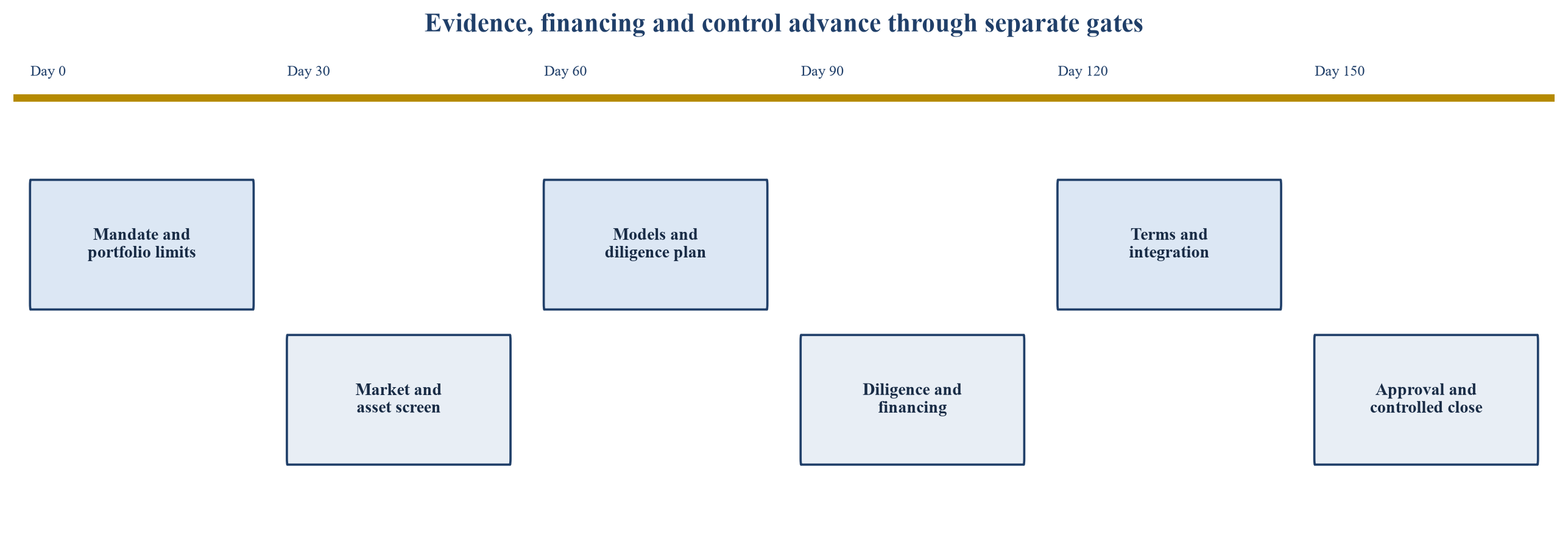
The roadmap is illustrative and must be adapted to transaction scope and regulatory timetables.
29. Use an approval memorandum that can reject the platform
The approval memorandum should state the mandate, markets, technologies, stages, transaction perimeter, price, capital stack, governance and exit. It should reconcile every asset to grid, offtake, land, permits, model, debt and environmental evidence. Signed rights, third-party evidence and management assumptions should be visibly separated.
The committee should receive the cross-market screen, pipeline ledger, grid report, offtake matrix, resource review, technical report, environmental and social assessment, tax and legal structure, valuation bridge, sources and uses, debt and hedge plan, downside model, integration plan, governance calendar and 180-day roadmap. Each unresolved matter needs an owner, deadline, budget and decision consequence.
Capital should stop when grid rights are not effective, material permits or land are missing, offtake cannot support the model, curtailment or basis exposure exceeds limits, construction is unfunded, currency mismatch threatens debt service, community obligations are unresolved, project cash cannot reach the investor or the correlated downside lacks a funded remedy. The governing principle is simple: a renewable-energy platform is worth the cash its projects can lawfully produce, collect, finance and distribute through adverse conditions.
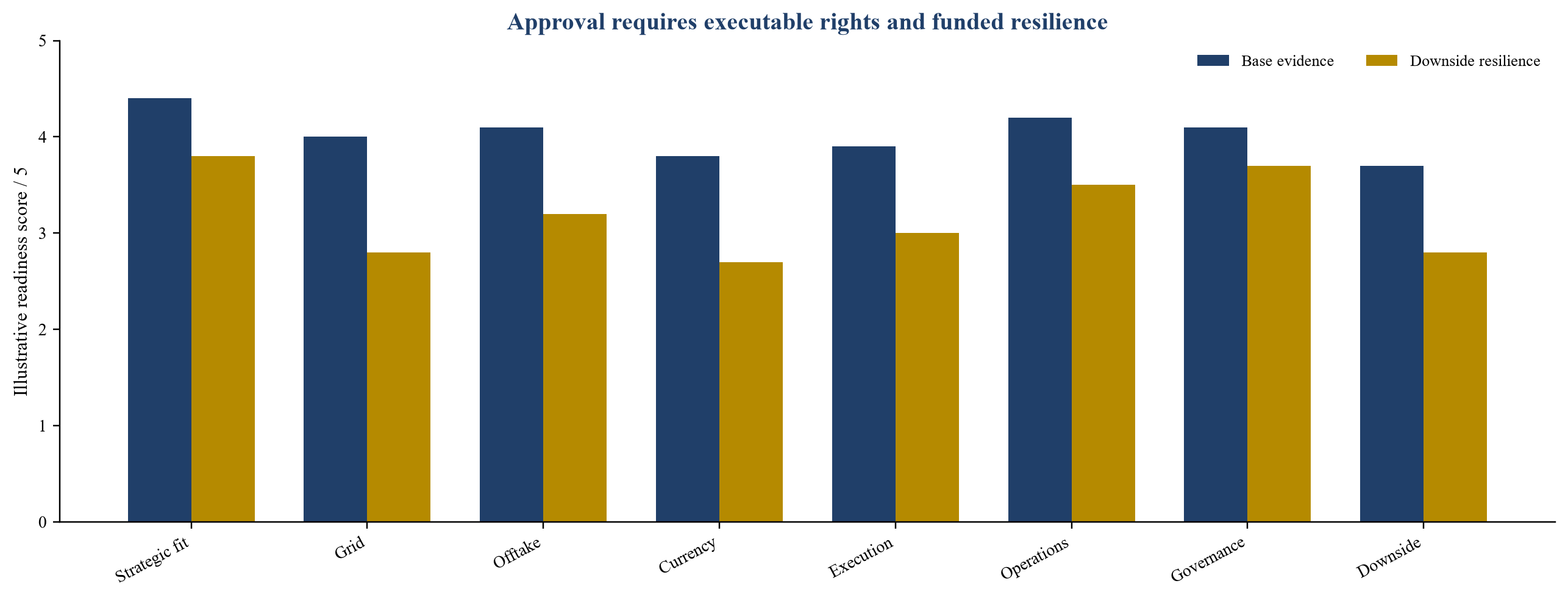
Scores are illustrative management assumptions and require transaction-specific evidence.
| Approval area | Evidence required | Decision |
|---|---|---|
| Mandate and portfolio | Country, technology, stage, currency and concentration limits | Confirm strategic fit and available risk budget |
| Projects and grid | Asset ledger, connection rights, transmission works, permits and land | Include, condition, stage or exclude each project |
| Revenue and operations | Offtake, prices, curtailment, resource, fleet and operating capability | Approve cash case and operating controls |
| Valuation and capital | Asset-level value, sources and uses, debt, hedging, tax and cash mobility | Approve price, leverage and funding conditions |
| Responsible investment | Environmental, social, community, labour, climate and cyber evidence | Accept, mitigate or decline material impacts |
| Governance and resilience | Reserved matters, reporting, integration, liquidity, downside and exit | Approve controlled close and review calendar |
The checklist supports governance and does not replace specialist advice.
Sources
- International Energy Agency, Latin America Energy Outlook 2023. Read the primary source
- Empresa de Pesquisa Energetica, ONS and CCEE, Load Forecast for Annual Energy Operation Planning 2025-2029. Read the primary source
- Empresa de Pesquisa Energetica, MME and EPE Forecast Approximately BRL 120 Billion of Transmission Investment to 2035. Read the primary source
- Chile Ministry of Energy, Final Decarbonisation Plan, 2 October 2025. Read the primary source
- Unidad de Planeacion Minero Energetica, Indicative Generation Expansion Plan 2025-2039. Read the primary source
- Mexico Secretariat of Energy, National Electricity System Development Programme 2024-2038. Read the primary source
- International Energy Agency and OLADE, Unlocking Investment Opportunities in Latin America's Energy Transition, 14 November 2025. Read the primary source
- UN Trade and Development, World Investment Report 2025. Read the primary source
- Inter-American Development Bank, Unlocking the Grid: How to Ensure Reliable and Sustainable Energy in Latin America and the Caribbean. Read the primary source
- Multilateral Investment Guarantee Agency, MIGA Continues to Support Renewable Energy in Chile, 27 January 2026. Read the primary source
- Proyectos Mexico, Electricity Investment Cycle. Read the primary source
- International Finance Corporation, Performance Standards on Environmental and Social Sustainability. Read the primary source
- International Renewable Energy Agency, The Cost of Financing for Renewable Power. Read the primary source
- International Monetary Fund and G20, Addressing Exchange Rate Risk in Infrastructure Projects in Emerging Market and Developing Economies. Read the primary source
- Multilateral Investment Guarantee Agency, Renewable Energy Catalyst Trust Fund. Read the primary source
- Mubadala, Renewable Investment in Emerging and Developing Economies. Read the primary source
- Mubadala, Crown Prince of Abu Dhabi Reviews Mubadala's Progress in Brazil, 19 November 2024. Read the primary source
- UN Trade and Development, World Investment Report 2025 Full Report. Read the primary source
- International Renewable Energy Agency, Regional Energy Transition Outlook South America 2025. Read the primary source
- Inter-American Development Bank, Energy Transition in Latin America and the Caribbean. Read the primary source
- World Bank, The Role of Private Capital in Shaping a Sustainable Future in Latin America and the Caribbean, 8 September 2024. Read the primary source
- International Finance Corporation, Future Grids Alliance Factsheet 2024. Read the primary source
