

1. Treat work location as a regulated fact
Cross-border employment begins with a basic fact: where did a person physically perform work on each day? Contracts, payroll records and organisation charts can describe an intended arrangement, while immigration authorities, tax administrations, labour regulators and courts may examine the duties actually performed. A family-office employment map should therefore connect each person to a legal capacity, employing or engaging party, work authorisation, work location, remuneration source, cost bearer and accountable manager.
This factual approach matters because residence permission and work permission can differ. The UAE Golden Residency programme allows eligible holders to reside without an employer sponsor, while an establishment that employs a Golden Residency holder can still require the relevant work permit [3, 5]. Switzerland requires foreign nationals to obtain the applicable work authorisation, with different access rules for EU or EFTA nationals and third-country nationals [29]. Singapore uses distinct passes for professional employment and domestic work [26, 28]. A visa that permits residence does not by itself settle payroll, tax, employment-law or regulatory questions.
The same distinction applies to tax. The United Kingdom's Statutory Residence Test analyses days, ties and work patterns, and HMRC states that work is generally done where it is physically performed [17, 18]. The UAE tax-residency certificate process can require entry and exit records, proof of employment or business, residence evidence and evidence of financial and personal interests [13]. A tax-residency certificate can support a treaty claim, yet the applicable treaty and domestic rules determine the result.
The employment map should be built before moves, contracts or payroll transfers are implemented. It should identify what is known, what requires professional analysis, what authority must approve each step and what evidence will prove completion. It should remain active after relocation because travel, role changes, new investments and family needs can change the position.
2. Separate principals, investment staff and household teams
A single family ecosystem contains different employment relationships. The principal may hold equity, serve on boards, direct investments, provide services, receive salary, draw partnership allocations or act through a personal office. Investment staff may be employees, secondees, consultants, authorised individuals or officers of investment vehicles. Household staff may be employed by a natural person, household, specialist service company or permitted sponsor under a dedicated domestic-worker regime.
These categories should not be collapsed into one mobility list. The principal's legal capacity determines whether an activity is employment, directorship, ownership oversight, self-employment or a regulated service. Investment staff require a duty-level analysis because researching assets, making internal recommendations, giving regulated advice, arranging transactions, managing assets and controlling client money can carry different regulatory consequences. Household teams require a separate welfare and safeguarding process because their workplace may also be their accommodation and their immigration position may depend closely on the employment relationship.
The map should also recognise that one person can occupy several capacities. A principal can be a director of a UK holding company, founder of a DIFC family office, beneficiary of a foundation and employee of an operating company. An investment professional can be employed by a UAE entity, seconded from London and appointed to the board of a portfolio company. A personal assistant can perform both business and household duties. Each capacity should have its own authority, remuneration, duties, location and record.
Table 1. Workforce questions by role lane
| Role lane | Core question | Evidence required | Principal failure mode | Gated output |
|---|---|---|---|---|
| principal as owner | which rights arise from ownership rather than employment? | registers, constitutions, shareholder and foundation records | distributions or authority treated as salary or job duties | capacity and rights schedule |
| principal as director | where are board duties exercised and decisions made? | appointments, calendars, minutes, travel and fee records | directorship ignored in mobility and tax review | director-duty map |
| principal as employee | who employs the principal and bears remuneration? | contract, payroll, benefits, cost recharge and workday ledger | title differs from legal and operational facts | employment position file |
| investment professional | which activities are performed for whom and where? | role profile, mandate, approvals, systems access and trade records | regulated activity assessed only by job title | activity and permission matrix |
| secondee or consultant | who directs the work and bears economic cost? | secondment or services agreement, supervision and recharge | paper employer differs from operational employer | substance assessment |
| household team member | who is the lawful employer and sponsor? | approved contract, work permit, wage, insurance and welfare records | business and household duties mixed without lawful basis | protected worker file |
The table is a management diagnostic. Legal characterisation depends on facts, contracts and applicable law.
3. Build the map in the correct sequence
The safest sequence begins with the person and the proposed work. First, establish nationality, residence status, family relationships and current immigration permissions. Second, describe actual duties without relying on titles. Third, identify every country in which the duties may be performed. Fourth, select a lawful employer or engagement model. Fifth, confirm work authorisation, employment law, payroll, tax, social security and benefits. Sixth, test corporate and regulatory consequences. Seventh, document approvals, contracts and operating controls before work starts.
Reversing this sequence creates predictable problems. A family office may incorporate an entity and issue contracts before confirming whether its licence covers the intended activities. A UK employer may keep a mobile employee on payroll without resolving duties performed elsewhere. A principal may ask an investment professional to work from a residence or hotel in a new country, creating local work-authorisation, payroll or corporate-presence questions. A household employee may travel under a visitor status that does not permit the intended work.
The sequence should apply to every move, including temporary arrangements. The OECD's 2025 Model Tax Convention update provides new guidance on cross-border work from a home or other relevant place and emphasises facts and circumstances when analysing whether an enterprise has a fixed place of business [25]. HMRC's globally mobile employee guidance explains that the location of duties and the employer's presence affect PAYE obligations [19]. A short trip can therefore require a different analysis from a holiday, a board meeting, a client visit or sustained remote work.
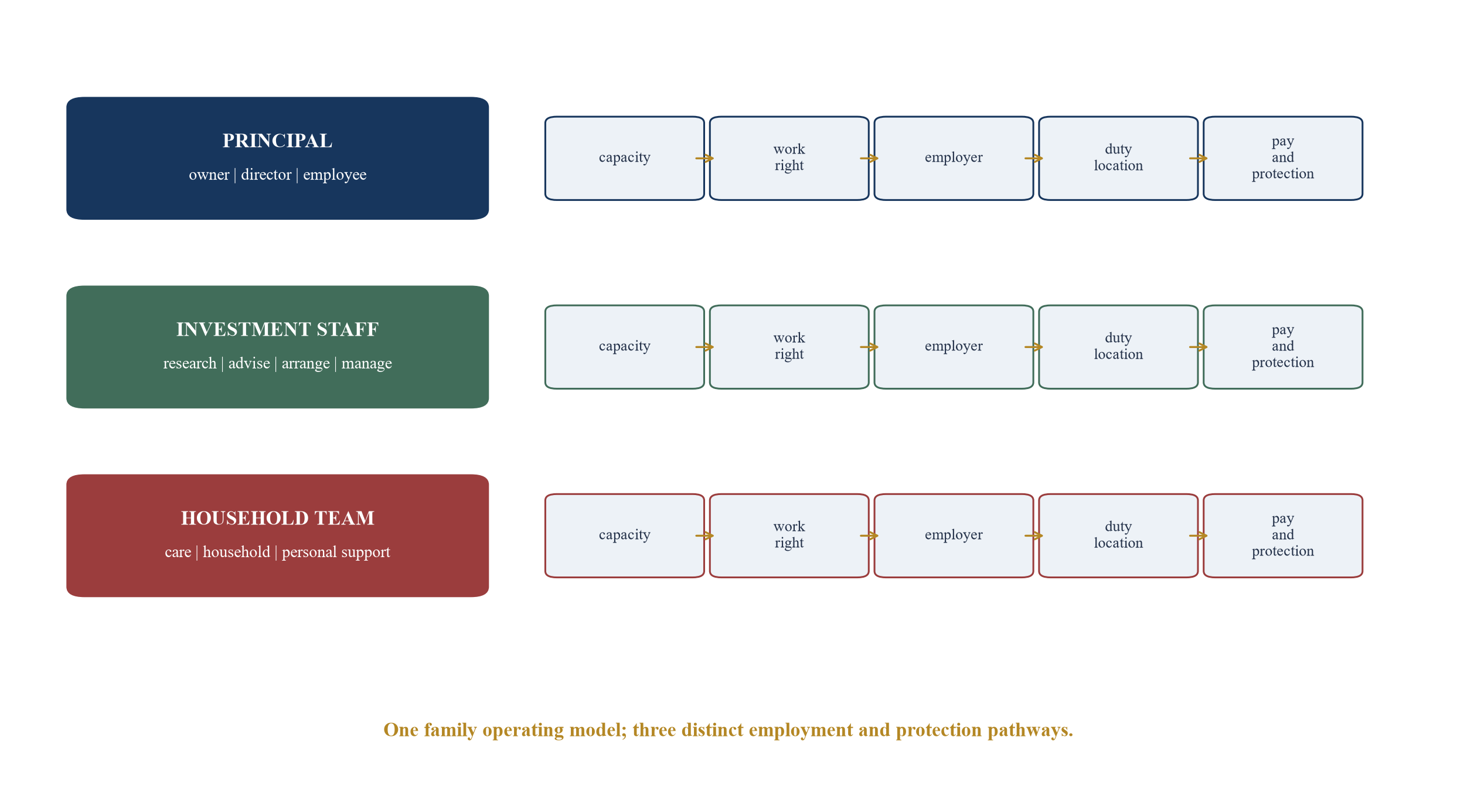
Each lane has a separate legal and evidence path before the three lanes reconnect in the family-office operating model.
4. Maintain a residence, presence and workday ledger
A reliable ledger separates presence from work. For each day, it should record country, arrival and departure times where material, overnight location, hours worked, duty type, employer, legal capacity, board activity, client or investment interaction and supporting evidence. It should also record non-working days, family days, transit and exceptional travel because residence tests can count days differently from payroll and employment-income rules.
HMRC's guidance for the full-time overseas test uses UK workdays and hours as part of the Statutory Residence Test, while its work-location guidance generally places work where the duties are physically performed [17, 18]. The UK-UAE treaty separately allocates taxing rights for employment income and includes conditions involving presence, employer residence and whether remuneration is borne by a permanent establishment [16]. These are related calculations with different legal purposes. A single field labelled "days abroad" cannot support them.
The UAE tax-residency evidence process provides another reason to maintain the ledger. The FTA may require entry and exit reports and additional evidence depending on whether the person relies on physical presence, employment or business, a permanent place of residence, or the centre of financial and personal interests [13]. Singapore's individual tax-residency rules also use day and employment-period tests, with special treatment for temporary absences and business trips in defined circumstances [27]. Switzerland links work authorisation to nationality, permit type, employment and duration [29].
The ledger should be contemporaneous and reconciled monthly. Calendar records can be compared with passport and immigration reports, travel bookings, expense claims, office access, virtual-meeting logs and board minutes. Data collection should be proportionate and lawful. The purpose is to support specific immigration, tax, payroll and governance conclusions, rather than create continuous surveillance.
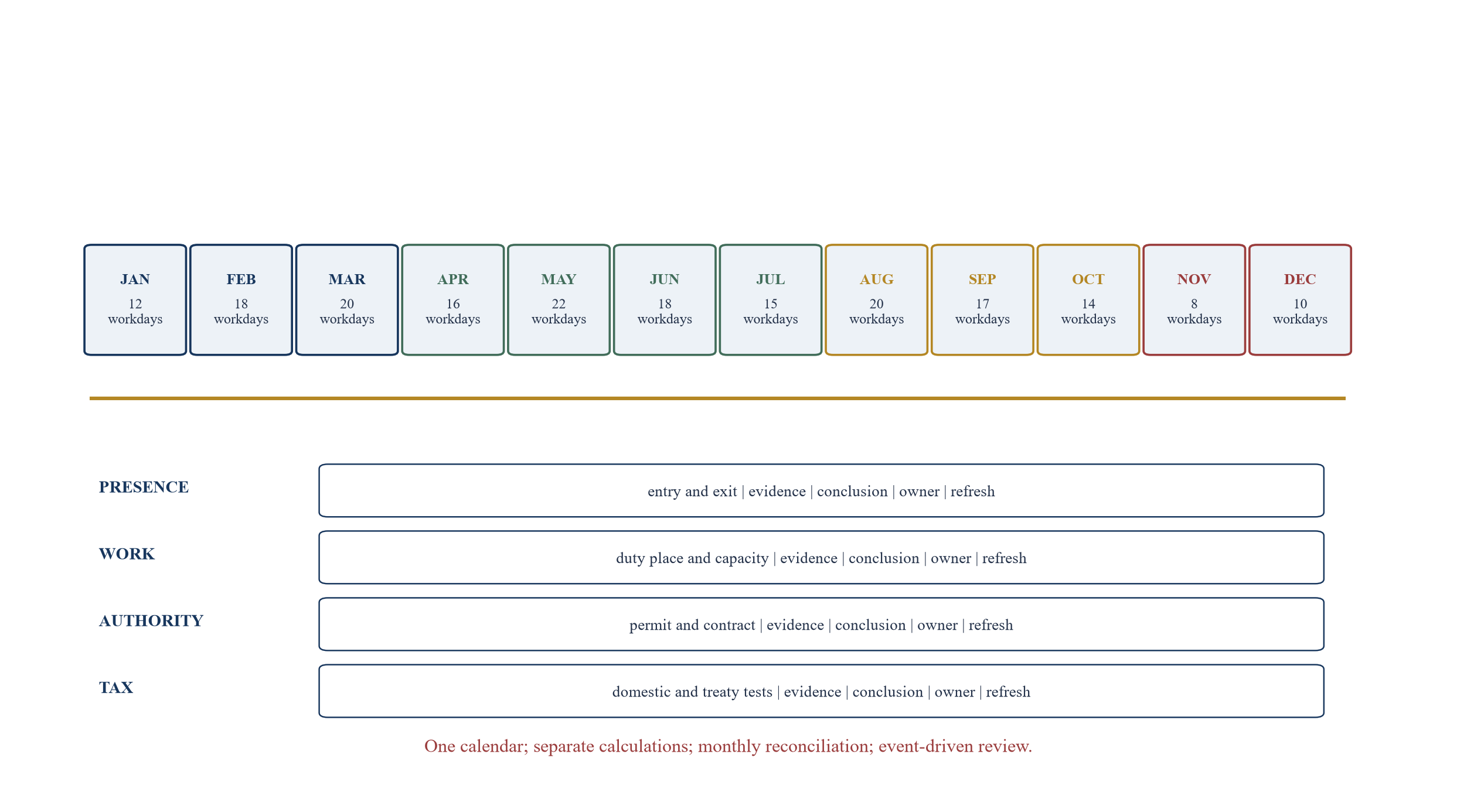
Days and thresholds are illustrative. Each person's tests must be calculated under the relevant domestic law and treaty.
5. Choose the employing entity by substance
The employing entity should have a lawful reason to employ the person, authority to direct the duties, sufficient operational substance and the ability to meet payroll, immigration, employment-law, data and benefit obligations. A low-cost entity is not automatically an appropriate employer. The decision should reflect where management sits, which business benefits from the work, who bears the cost, who controls performance and which regulator supervises the activity.
Four models appear frequently. A local employment model places the employee with an entity in the destination jurisdiction. A secondment retains the home employment while assigning duties to a host entity under written terms. A dual-employment model uses two genuine roles with distinct duties and remuneration. An employer-of-record model engages a third party as legal employer where permitted. Each model requires a substance review. Labels do not override who directs the work or enjoys its economic benefit.
The family office should test whether the proposed employer has the correct licence, premises, payroll registrations, bank account, insurance, pension or end-of-service arrangements and human-resources capability. It should also test whether the employee's activities create a regulated or taxable presence beyond the employer's intended footprint. Intercompany recharges need a documented basis and should align with the functions performed. A zero recharge can be as problematic as an arbitrary one if it hides where value is created and who bears remuneration.
The decision file should identify a fallback. If the preferred entity is not ready, the person should not begin substantive work under a visitor status or an informal arrangement. The fallback may be a delayed start, restricted non-working presence, a compliant temporary permit, a scoped secondment, or continued work from the existing jurisdiction until approvals are complete.
Table 2. Employing and engagement model decision matrix
| Model | Appropriate when | Evidence of substance | Key exposure | Release gate |
|---|---|---|---|---|
| destination employment | enduring role and management are located in destination | local licence, manager, payroll, workplace and cost ownership | premature transfer before entity readiness | permit, contract, payroll and manager live |
| home employment with secondment | temporary assignment with continuing home relationship | secondment agreement, host supervision, recharge and return plan | host becomes economic employer or creates payroll duty | dual-country advice and cost allocation approved |
| dual employment | genuinely separate roles exist in two jurisdictions | distinct duties, time, pay, reporting and decision rights | artificial split or double benefits | calendars and remuneration reconcile |
| employer of record | local hiring support is lawful and operationally appropriate | licensed provider, local contract, service agreement and controls | provider form conflicts with actual direction or regulation | due diligence, data and exit rights approved |
| consultancy | independent services exist without employee substance | deliverables, autonomy, own business risk and invoicing | worker misclassification | classification opinion and operating facts agree |
| household employment | domestic-work regime applies to work in or for a household | lawful sponsor, approved contract, wage and welfare record | business duties mixed with domestic role | separate protected worker file complete |
Suitability depends on local law, actual control, economic substance and the person's duties.
6. Test corporate presence, payroll nexus and cost bearing
An employee's location can affect the employer as well as the employee. Sustained work from a home, family residence or private office may create questions about fixed-place permanent establishment, dependent-agent authority, local payroll, employer registration, corporate tax, indirect tax and transfer pricing. The analysis depends on domestic law, the applicable treaty and the activities performed.
The OECD's 2025 update addresses cross-border work from a home or other relevant place. It considers facts including the regularity of use, whether the enterprise requires or commercially benefits from the location, and whether the activities form part of the enterprise's business [25]. A home office does not create a permanent establishment automatically. A policy allowing work from anywhere does not remove the need for analysis. Decision authority, client interaction, contract negotiation, investment execution and the employer's access to other premises can change the assessment.
Payroll follows its own rules. HMRC states that PAYE treatment for employees working abroad depends on where and how long they work and may require continued deductions, updated codes or separate payroll arrangements [20]. Its post-April 2025 globally mobile employee guidance covers notifications where employment duties are performed partly outside the UK and explains circumstances involving employers without a UK presence [19]. Social-security contributions require a separate treaty or domestic analysis [21].
The map should therefore connect each duty to four questions: which entity benefits; which entity directs; which entity pays; and which entity bears the cost. It should identify authority to negotiate or conclude contracts, manage investments, hire staff, commit capital or represent an enterprise. The result should be reviewed whenever the role, travel pattern, reporting line or transaction authority changes.
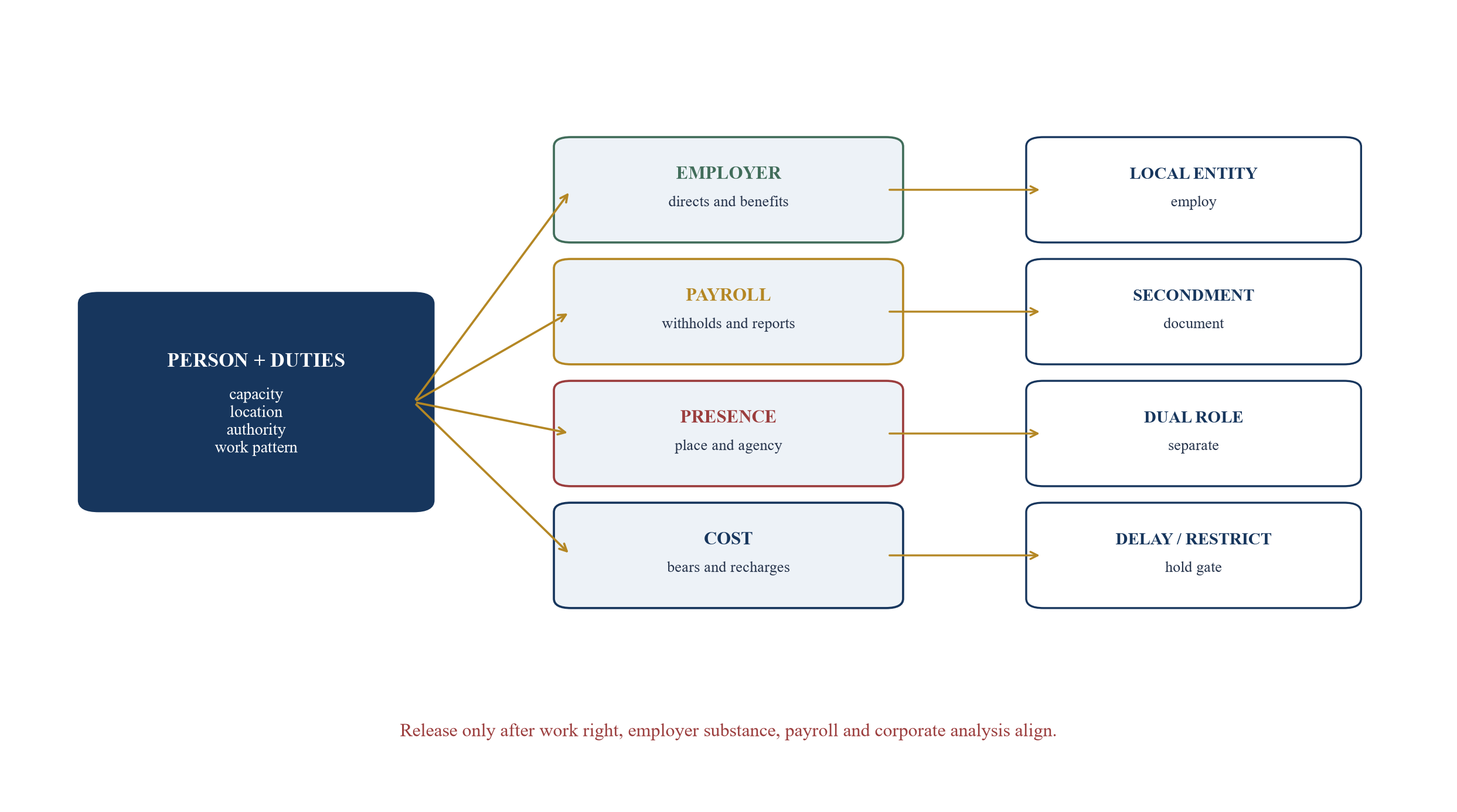
The architecture identifies issues for specialist review. It does not determine a permanent establishment or payroll outcome.
7. Map each principal capacity separately
Principals often operate across ownership, governance and executive roles. Ownership can produce dividends, partnership allocations or foundation benefits. A directorship can produce fees and fiduciary duties. Employment can produce salary, bonus and benefits. Investment activity can be conducted personally, through a family office or for a regulated vehicle. The map should separate these capacities before analysing pay or travel.
For each entity, the principal-capacity schedule should show appointment, authority, duties, reporting line, remuneration, expected work locations, meeting cadence and supporting records. Board calendars and minutes should show where governance occurred and which decisions were made. Employment records should show operational duties and supervision. Investment mandates should identify whose assets are involved and who has discretion. Personal ownership activity should be distinguished from services performed for another person or entity.
This matters for tax treaties. The UK-UAE treaty addresses employment income and directors' fees in separate articles [16]. Domestic rules can also classify share awards, carried interest, partnership income and benefits differently. A principal who receives one undifferentiated payment from a holding company can create avoidable uncertainty about the legal and economic reason for that payment.
The schedule should also protect governance substance. A move should not rewrite historic facts or manufacture decision-making in a preferred jurisdiction. Real meetings require prepared participants, reliable records and authority exercised consistently with constitutional documents. A family office can coordinate the calendar and evidence, while qualified advisers determine the legal and tax consequences.
8. Draw the regulated-activity boundary for investment staff
Investment staff should be mapped by activities, assets and recipients rather than job titles. An analyst may collect information and prepare internal research. A portfolio manager may exercise discretion. A chief investment officer may approve allocations, appoint external managers, negotiate terms or direct trading. A relationship manager may introduce funds or counterparties. A principal's employee may also support other family members, foundations, trusts or outside co-investors. Each change can affect the regulatory perimeter.
The first question is whose assets are being served. The second is what the person actually does. The third is whether the activity is carried on by way of business in or from a regulated jurisdiction. The fourth is whether an exclusion, exemption or licence applies to the entity and the activity. DFSA GEN 2.3.5 contains a defined treatment for activity carried on by a qualifying Single Family Office exclusively for its duties to that family [12]. The conditions should be tested against the current entity, family scope and activity. The presence of a family relationship or a family-office label is not a universal regulatory exemption.
The matrix should distinguish research, internal recommendations, investment decisions, trade instructions, negotiation, arranging, advising, management, custody, client-money control, fund promotion and services to third parties. It should identify systems permissions, signing authority, delegated limits and escalation. A person should not receive trading access or external-facing authority before the role, entity and permission path are approved.
Cross-border travel adds another layer. An investment professional employed in one country may conduct meetings, negotiate transactions or direct investments while visiting another. The map should test temporary work authorisation, local regulatory rules, employer presence, payroll and record keeping before the activity occurs. Where the conclusion is uncertain, the person can attend in a restricted capacity while authorised colleagues retain the decision or regulated function.
Table 3. Investment-staff activity and authority matrix
| Activity | Decision question | Evidence | Higher-risk indicator | Control response |
|---|---|---|---|---|
| market research | is output internal factual research or a recommendation to another person? | role profile, distribution list and approval process | tailored recommendation sent externally | restrict recipients and obtain perimeter advice |
| manager selection | who makes or influences the appointment decision? | investment policy, committee minutes and delegated authority | staff member commits capital outside mandate | dual approval and limit controls |
| trade instruction | does the person exercise discretion or transmit an approved decision? | order record, system rights and mandate | discretionary trading without confirmed permission | suspend access until authorised |
| negotiation | can the person bind an entity or settle material terms? | powers, term-sheet history and signature matrix | habitual contract conclusion | corporate and regulatory review |
| fund or deal introduction | is the person arranging, promoting or merely making an internal referral? | communication templates, recipient and compensation | success-based payment or external solicitation | approved channel and jurisdiction screen |
| services beyond one family | does the role serve outside capital or unrelated persons? | client perimeter, billing and ownership records | third-party assets or fees | licensing decision before service begins |
Regulatory treatment is jurisdiction and fact specific. The relevant regulator or qualified adviser should confirm the conclusion.
9. Engineer remuneration across salary, bonus, carry and equity
Cross-border remuneration should be decomposed into legal components. Salary pays for employment duties. A discretionary or formulaic bonus may relate to performance over a defined period. Carried interest may arise through a partnership or fund arrangement. Equity awards can depend on employment, vesting, performance and liquidity. Directors' fees compensate board service. Allowances and benefits can cover housing, education, travel, insurance or relocation. Each item needs an issuer or payer, earning period, service condition, valuation method, payment date, work-location allocation and reporting owner.
The map should begin with the governing documents. An employment contract should align with the approved offer, payroll and local mandatory terms. The UAE labour framework requires contracts to include core information such as place of work, working hours, wage, benefits, leave and notice [1, 2]. DIFC and ADGM have their own employment regimes for entities and employees within their jurisdictions [9, 10]. A side letter should not quietly contradict an approved statutory contract or payroll record.
Long-term incentives require special care. An award can vest after relocation while relating to services performed across several countries. A liquidity event can occur after employment ends. A carried-interest allocation can combine investment performance, partnership rights and service conditions. HMRC requires reporting for employment-related securities and identifies events that can include awards, options and carried interest [24]. Other countries apply their own sourcing, valuation, withholding and reporting rules.
The remuneration file should therefore maintain award-by-award records. It should show grant date, issuer, instrument, vesting conditions, service period, relevant workdays, tax elections, valuation, exercise or settlement, payroll treatment and adviser conclusion. The file should be updated before a grant, vesting event, exercise, sale, leaver event or change in residence. A global policy can set governance principles, while local schedules address mandatory terms and tax.
10. Separate payroll, tax and social-security analyses
Payroll withholding, personal tax residence, treaty residence and social security are separate analyses. They can reach different answers at the same time. A person may be resident in one country, perform duties in another, remain on a home payroll, require host reporting and continue contributions under a social-security agreement or domestic continuation rule. A single "tax resident" flag does not resolve the employer's obligations.
The payroll matrix should identify the employing entity, payer, cost bearer, work location, pay currency, payroll country, withholding basis, reporting filings, social-security system and benefit plan. It should record whether a shadow payroll is required and who reconciles home and host records. It should also identify exchange-rate methodology, gross-up or tax-equalisation policy, payment of adviser fees and treatment of benefits.
HMRC's guidance states that employers may need to continue PAYE for employees working abroad and should examine National Insurance and overseas obligations separately [20, 21]. Its globally mobile employee regime includes a notification process for operating PAYE on a proportion of employment income from April 2025, subject to detailed conditions and year-end reconciliation [19]. The UK-UAE treaty provides an employment-income framework that considers the place duties are exercised, presence, employer residence and whether remuneration is borne by a permanent establishment [16]. The treaty does not remove domestic registration, payroll or filing duties automatically.
The UAE currently excludes wages from the business activities that bring a natural person into Corporate Tax, while business and professional activities require their own analysis [14]. This distinction reinforces the need to characterise what a principal or consultant is doing. Singapore taxes employment income under its domestic rules and determines individual tax residence using its own tests [27]. Switzerland's employment and social-insurance position requires federal, cantonal and treaty review. The matrix should never apply one country's rule to another country by analogy.
Table 4. Comparative mobility control points
| Jurisdiction | Work-authorisation focus | Employment-law focus | Tax and payroll focus | Evidence anchor |
|---|---|---|---|---|
| UAE mainland | appropriate MoHRE permit and residence pathway | federal labour law, approved contract and WPS | duty character, FTA residence evidence and foreign-country obligations | permit, Emirates ID, contract, WPS and entry-exit report |
| DIFC or ADGM | free-zone permit and entity eligibility | applicable DIFC or ADGM employment regime | UAE residence evidence plus home-country and treaty analysis | licence, permit, free-zone contract and benefits record |
| United Kingdom | right to work or appropriate visitor and sponsor route | UK employment protections and sponsor duties where applicable | SRT, workdays, PAYE, National Insurance and treaty | immigration record, payroll, workday ledger and HMRC filings |
| Singapore | Employment Pass or other applicable work pass | Employment Act and pass-specific conditions | IRAS residence, employment-income and employer reporting | pass, contract, AIS or return and travel record |
| Switzerland | nationality-specific federal and cantonal permission | mandatory local employment conditions and contract | federal, cantonal, communal and treaty analysis | permit, cantonal registration, payroll and social-insurance record |
The table identifies research routes rather than conclusions. Current local law and treaties must be checked for each person.
11. Control short visits, remote work and travel seasons
Short business trips deserve a pre-clearance process. The system should ask whether the traveller will attend internal meetings, meet managers, negotiate terms, direct staff, approve investments, visit portfolio companies, solicit capital, give advice, sign documents or work remotely. It should then test work permission, regulated activity, payroll, permanent establishment, corporate residence, tax, sanctions, insurance and data access.
Duration is one input rather than a universal safe harbour. The 183-day condition in many employment-income treaty articles operates with additional employer and cost-bearing conditions [16]. Immigration and regulatory rules can apply from the first day. Repeated short visits can create a pattern. A director's fees article can differ from an employment article. A traveller who has authority to conclude contracts can create a different corporate risk from a person attending training.
Remote work should be approved by country, duration, duties and data. The OECD's 2025 commentary update addresses when a home or other relevant place can become a place of business for an enterprise [25]. The decision depends on the facts and the applicable treaty. The employer should record whether remote work is requested for personal reasons, required by the enterprise, commercially beneficial to the enterprise, regular, customer-facing or part of core operations.
Travel seasons also affect continuity. A family may spend summers in Europe, school terms in the UAE and investment periods in financial centres. The operating plan should state which duties may be performed in each location, which must pause, which require local approval and which can be delegated. Calendars should be reviewed before each season and after any material deviation.
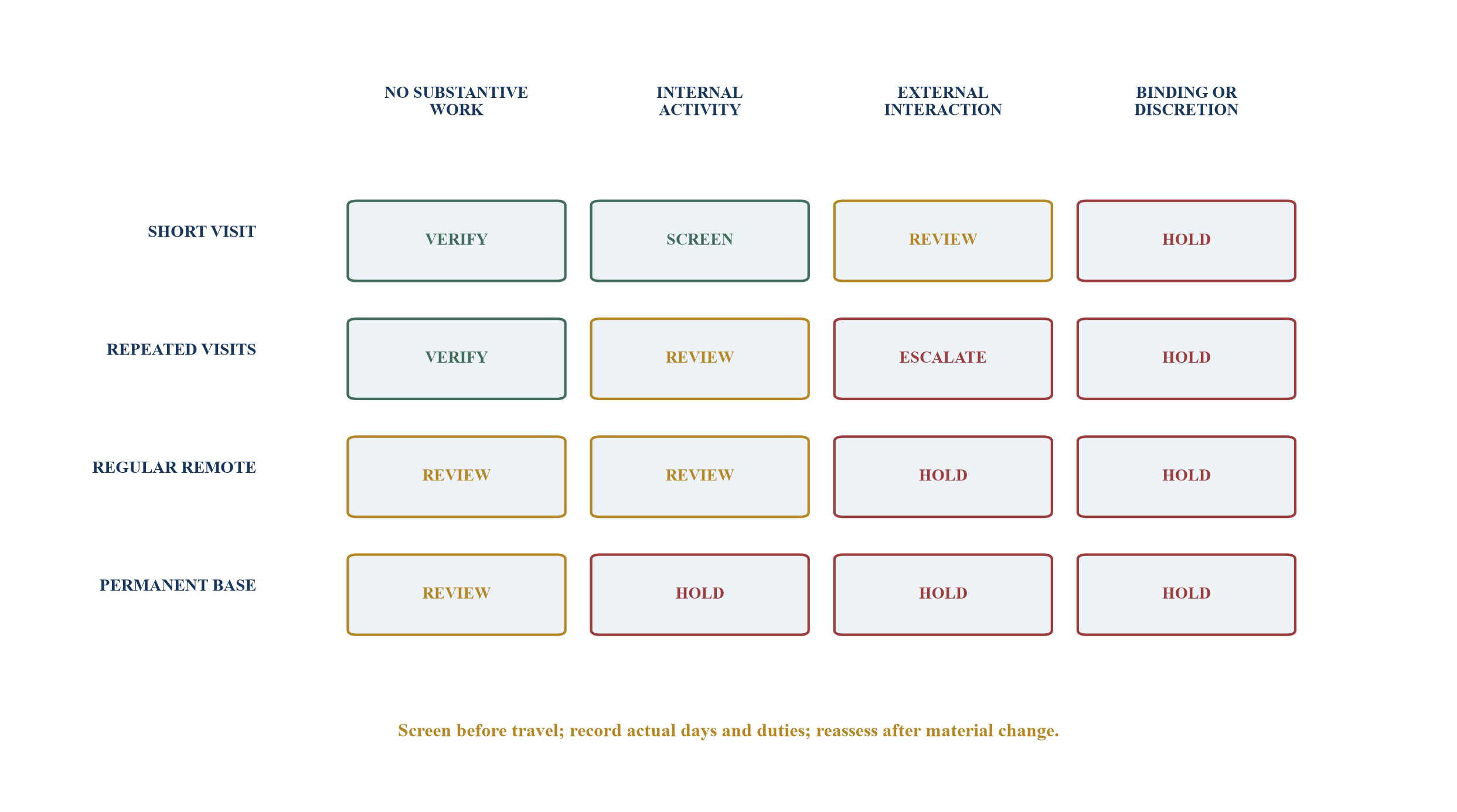
Colours are illustrative management categories. A green route still requires confirmed immigration, employment, tax and regulatory treatment.
12. Build the UAE immigration portfolio person by person
The UAE offers several residence and work pathways. The correct path depends on the person's role, employer, qualifications, income, investment position and family circumstances. MoHRE describes multiple work permits, including permits for workers recruited from abroad, transfers, family-sponsored residents, temporary work, part-time work, Golden Residency holders and freelance activity [3]. The audience Golden Residency programme identifies long-term residence categories for investors, entrepreneurs, executive directors and specialised talent [5].
The portfolio should begin with a status map. For each person, record nationality, passport validity, current residence basis, sponsor where relevant, work permit, employing entity, occupational title, qualification evidence, health insurance, Emirates ID, renewal date and dependent relationships. The system should distinguish the residence permission from the employer's authority to deploy the person in a specific role.
Job titles and qualifications should be reconciled. An investment professional's visa title, employment contract, regulatory status, organisation chart and actual duties should tell a coherent story. A principal who holds self-sponsored residence and also works for a family-office entity may require the applicable employer permit. A dependent who performs part-time work may require a family-sponsored resident permit for the employing establishment. A freelance permit may suit genuine independent activity and should not be used to disguise an employment relationship.
The immigration file should also address sequencing. The entity licence, establishment file, offer, work permit, medical process, insurance, Emirates ID and employment start date should be ordered correctly. Travel should not be booked on an assumption that an approval is automatic. Contingency time should be included for document legalisation, qualification verification, medical requirements and authority queries.
13. Distinguish UAE mainland, DIFC and ADGM employment regimes
The UAE employment map must identify the applicable legal regime for each employer. Federal Labour Law and its executive regulation govern private-sector employment within their scope and provide rules on work models, contracts, wages, leave, termination and other minimum rights [1, 2]. DIFC has its own Employment Law for DIFC employers and employees [10]. ADGM states that its Employment Regulations 2024 apply to ADGM registered entities and their employees from 1 April 2025, and it requires temporary work permits for defined non-employees such as certain secondees and consultants [9].
The contract, workplace and legal employer should align. A DIFC office address does not place a mainland employee under DIFC law. A UAE residence visa issued through one entity does not authorise work for every related entity. A secondee working in ADGM can trigger temporary-permit requirements even when employed elsewhere [9]. The map should show the entity, jurisdiction, licence, permit and worksite for every person.
Benefits also differ. DIFC uses qualifying schemes such as DEWS for covered end-of-service contributions, subject to its employment-law framework and exemptions [11]. Mainland employers operate under the federal end-of-service rules within scope. ADGM has its own regime. Pension and social-security obligations for UAE and GCC nationals require separate confirmation. Global benefits should be layered over mandatory local rights rather than substituting for them.
The family office should maintain a regime register containing the governing law, authority, statutory contract, payroll route, wage-payment mechanism, working-time rules, leave, benefits, insurance, end-of-service treatment, record retention, dispute route and renewal calendar. The register should be reviewed after legal amendments and before entity or role transfers.
14. Protect household teams as a separate mobility workstream
Household employment requires the same disciplined legal planning as executive employment and additional safeguards. The person may live at the workplace, travel with the family, handle children, health information, residences or personal security, and depend on the employer for immigration, accommodation or return travel. These facts increase the importance of clear consent, lawful recruitment, written terms, timely wages, rest, privacy, insurance, grievance access and a safe exit process.
The UAE's Domestic Workers Law and executive regulation create a dedicated framework for domestic workers, employers and recruitment agencies [6, 7]. MoHRE provides a service for domestic-worker employment contracts and identifies documentation and insurance requirements [8]. Its Wages Protection System now covers specified domestic-worker categories mandatorily and others optionally under relevant decisions [4]. The family office should confirm the current category and payment route for every role.
International travel does not carry the UAE arrangement automatically into another country. The United Kingdom's Overseas Domestic Worker route requires specified evidence of the existing employment relationship, and workers in the UK have rights including agreed pay at least at the applicable minimum, limits on excessive hours, holiday pay and notice [22, 23]. Singapore requires a dedicated Work Permit for migrant domestic workers and imposes employer, insurance, bond, medical and programme requirements within its regime [28]. Switzerland applies nationality, work-permit and cantonal rules [29].
The household-team map should use the law of each destination. It should record whether the person may work, who is the employer, where the person may live and work, how wages are paid, what insurance is required, how days off and travel are managed, and who receives concerns independently of the principal. ILO Convention 189 provides an international reference point for rights and protections in domestic work, while the legal effect in each country depends on applicable law and ratification [30].
Table 5. Household-team mobility safeguard register
| Control area | Before travel | During stay | Evidence | Stop condition |
|---|---|---|---|---|
| work permission | confirm destination route and permitted duties | monitor expiry and travel conditions | permit, visa and authority guidance | no lawful permission for intended work |
| informed contract | provide understandable written terms and obtain genuine agreement | record any lawful variation | approved contract and translated explanation | terms altered without consent or authority |
| wages | confirm currency, amount, deductions and payment channel | pay on time through required system | wage statement and bank or WPS record | late, withheld or unexplained payment |
| welfare and rest | plan accommodation, rest, healthcare and emergency support | confidential check-in and grievance access | schedule, insurance and welfare log | unsafe condition or inability to seek help |
| documents and privacy | retain copies for lawful purpose without controlling personal originals | restrict access to sensitive records | access log and return confirmation | passport or personal data used coercively |
| exit and transfer | document return, transfer or termination process | fund lawful repatriation and final dues | cancellation, settlement and travel record | worker left without status, pay or safe route |
The receiving country's law governs permission and minimum protections. The checklist should be reviewed directly with the worker.
15. Keep household and business duties legally distinct
Hybrid roles can arise in family environments. A personal assistant may coordinate travel and also support business meetings. A driver may transport family members and business guests. A private tutor may work in a residence and through an education service. A security professional may protect people, property and business premises. The map should identify whether the duties belong to domestic work, private-sector employment, licensed professional activity or more than one lawful engagement.
The answer should follow the legal regime and actual work. A domestic-worker contract should not be used to obtain general business services from a person. A company employment contract should not obscure that a person works predominantly in a household. Where two roles are lawful, each should have clear hours, direction, remuneration, permits, insurance and confidentiality provisions. The person should understand who employs them in each capacity and how concerns can be raised.
Recruitment and transfer require direct verification. The family should use authorised channels, review agency terms, confirm that fees and deductions comply with applicable law, and speak with the worker without the recruiter or household manager controlling the conversation. The onboarding record should include the worker's own contact details, emergency contact, preferred language, contract explanation and acknowledgement that personal documents remain accessible to the worker.
The operating model should place welfare oversight outside the daily command chain. A named human-resources or governance professional can conduct confidential check-ins, review pay and rest records, and escalate concerns. Serious safeguarding matters should be directed to the competent authorities and professional advisers. The family office should measure compliance through verified records and worker access to remedy, rather than through self-certification by the immediate supervisor.
16. Protect employment and family data across borders
Global mobility creates a dense employment-data set: passports, visas, addresses, travel history, salary, tax identifiers, bank details, medical records, family relationships, performance records, background checks and information about children or dependants. The data map should state why each field is collected, the lawful basis, controller, processor, location, access group, transfer route, retention period and deletion or return process.
The UAE Personal Data Protection Law includes requirements for fair, transparent and lawful processing, purpose limitation and cross-border transfers, with provisions relevant to employment and contractual obligations [15]. DIFC and other jurisdictions apply their own data-protection regimes. The family office should identify which regime applies to each employer and data system rather than assuming that a group-wide platform has one legal basis everywhere.
Access should be role based. Immigration counsel may need passports and entry records. Payroll providers may need compensation and bank details. investment committees do not ordinarily need household medical files. Household managers do not need carried-interest valuations. Principals should receive a decision summary rather than unrestricted access to every employee record. Service providers should have written scope, confidentiality, security, subprocessor, incident, retention and exit terms.
Travel tracking requires particular restraint. A contemporaneous ledger can support tax and immigration compliance, while continuous location monitoring may collect more information than necessary. The policy should define the source and precision of data, allow the person to correct errors and limit use to approved purposes. Security controls should cover encryption, multifactor authentication, download restrictions, incident response and prompt removal of access after role changes.
17. Preserve continuity through benefits, insurance and succession
Relocation can interrupt medical cover, life insurance, disability protection, pensions, end-of-service benefits and family support. A salary transfer does not automatically preserve these arrangements. Policies can have territorial exclusions, waiting periods, eligibility conditions and provider-network limits. Pension participation can depend on nationality, residence, employer and social-security agreements. The mobility file should compare existing and destination coverage before any cancellation.
The benefits inventory should record scheme, member, employer, contribution, currency, vesting, insured amount, territory, beneficiary, renewal, exclusions and portability. It should distinguish statutory benefits from discretionary benefits and identify who funds each cost. DIFC employers within scope use an approved qualifying scheme for end-of-service contributions, such as DEWS, subject to the applicable rules [11]. Other UAE regimes and other countries require their own analysis.
Continuity also means operational succession. If a key investment professional cannot travel or their permit expires, the office should know who can approve transactions, access systems and communicate with managers. If a household employee cannot accompany the family, the travel plan should identify lawful alternatives without pressuring the person to work without permission. If a principal becomes incapacitated, employment authority, payroll and banking should continue under valid delegations.
The continuity plan should be tested before peak travel periods. Tests can include payroll failure, visa delay, illness, sanctions screening, data incident, inaccessible office, unavailable signatory and emergency repatriation. The exercise should produce assigned actions, target dates and evidence of closure.
18. Assign decision rights through a mobility RACI
Cross-border employment requires coordinated decisions without allowing any one adviser to speak outside their discipline. The principal approves strategy and risk appetite. The family-office board or governance committee approves the workforce architecture, budget, material exceptions and service providers. Human resources owns employment records and worker communication. Immigration counsel confirms residence and work routes. Tax advisers analyse residence, payroll, treaty, corporate-presence and remuneration consequences. Regulatory counsel assesses investment activities. Payroll executes approved withholding and reporting. Information security protects the data platform.
Each decision needs a single accountable owner. The employing entity approves the role and contract. The host business confirms duties and supervision. The traveller owns accurate calendar information. The investment leader confirms system permissions and authority. The household governance lead confirms welfare controls. A central mobility coordinator maintains the integrated map and follows up dependencies without replacing specialist conclusions.
The RACI should cover new hires, relocations, secondments, short visits, remote-work requests, board appointments, equity awards, carried-interest changes, new regulated activities, household travel, medical incidents, terminations and return moves. Emergency decisions should be documented after the event and reviewed for any continuing obligations.
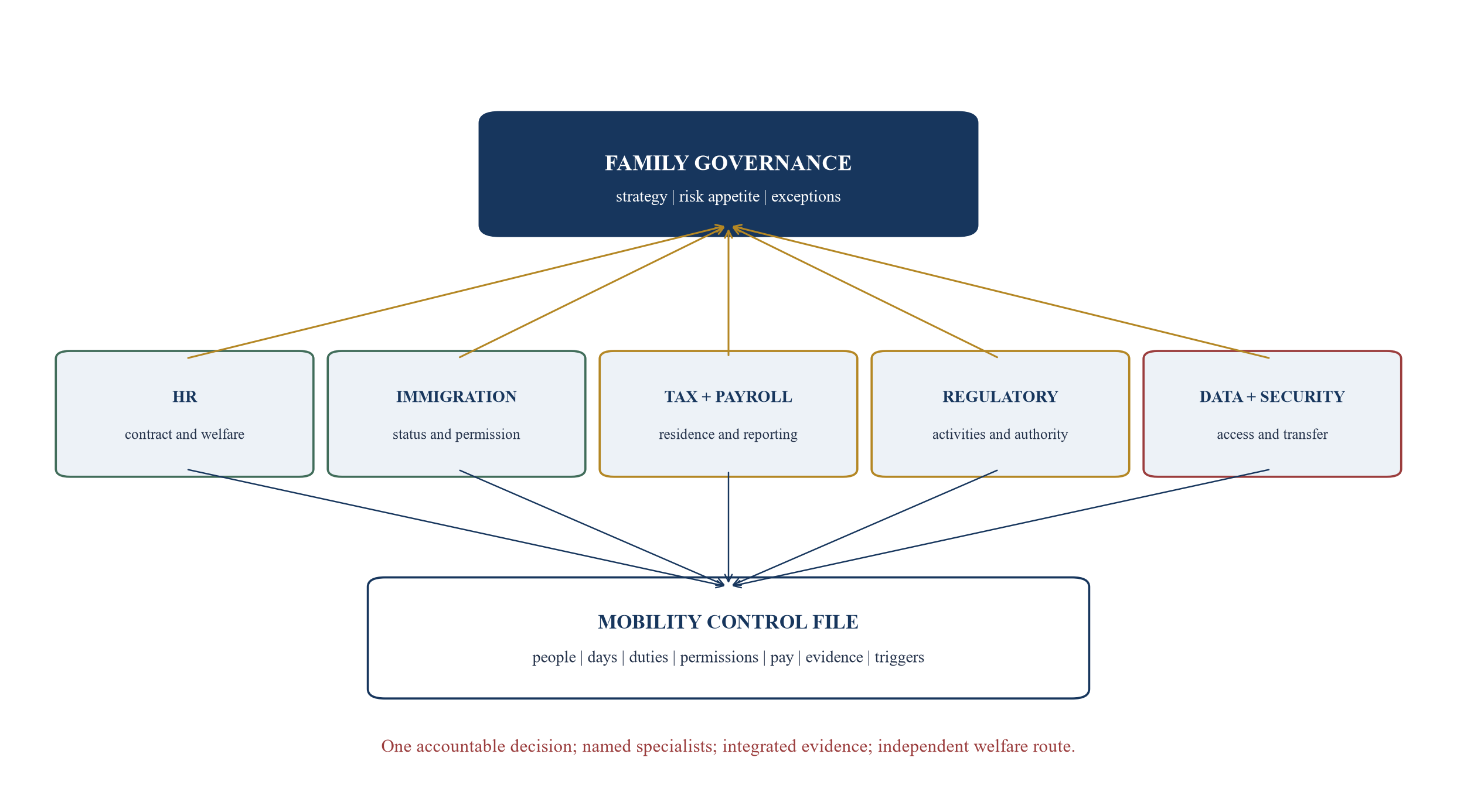
Specialists retain responsibility for their conclusions. The mobility office integrates dependencies and evidence.
19. Implement through a gated 120-day sequence
Implementation should begin with discovery rather than contract transfer. During the first phase, build the person and role inventory, travel calendar, entity register and legal-regime map. Freeze unapproved work in new locations and identify imminent travel, payroll and permit deadlines. Appoint a sponsor, accountable mobility lead and specialist advisers.
The design phase selects employing models, work-permission routes, payroll and benefit structures, regulated-activity boundaries, data architecture and household safeguards. Each proposed path should include a written conclusion, owner, dependencies, cost and fallback. The governance committee should approve the design before documents are issued.
The build phase executes entity, permit, contract, payroll, benefit and system changes. Records should be reconciled across immigration, HR, payroll, finance, tax and access-control systems. Staff should receive explanations in language they understand and have a route to correct errors. Investment permissions should be activated only after the role and regulatory gate passes.
The pilot phase tests a small group or travel cycle. It should reconcile actual workdays, payroll, expenses, system access, household welfare and service-provider performance. Exceptions should be corrected before scaling. The transition phase then moves the remaining population and activates periodic monitoring.
Table 6. 120-day cross-border employment implementation plan
| Phase | Days | Principal work | Gated output | Acceptance test |
|---|---|---|---|---|
| mobilise | 1-15 | sponsor, inventory, imminent travel and stop conditions | approved scope and critical-action log | every person and upcoming location identified |
| diagnose | 16-35 | capacities, duties, entities, permits, payroll and data | reconciled current-state employment map | contracts, payroll and actual work agree or gaps are logged |
| design | 36-60 | model options, adviser conclusions, costs and fallbacks | approved target architecture | each role has lawful work, employer, pay and protection path |
| build | 61-90 | permits, contracts, payroll, benefits, systems and training | evidence-backed readiness packs | no access or start before dependencies complete |
| pilot | 91-105 | controlled travel and payroll cycle | exception and remediation report | days, duties, pay and permissions reconcile |
| operate | 106-120 | dashboard, refresh triggers and assurance | business-as-usual handover | owners complete a material-event drill |
Timing and effort are hypothetical management assumptions. Actual sequencing depends on jurisdictions, permits, entity readiness and individual circumstances.
20. Operate an event-driven refresh system
Annual review is insufficient for a mobile workforce. The system should trigger review when a person changes country, residence status, employer, role, reporting line, authority, pay, work pattern, family relationship or regulated activity. It should also trigger when an entity changes licence, office, ownership, management or service provider, or when law and treaty guidance changes.
The trigger register should distinguish pre-approval events from notification events. A new country of work, employer transfer, equity award, board appointment or expanded investment authority should require approval before implementation. A passport renewal or residential address update may require prompt record updates and authority notifications. Material deviations from the travel calendar should create a retrospective review and, where needed, corrective filing.
The system should reconcile at three frequencies. Monthly reconciliation covers travel, workdays, payroll, permits and access. Quarterly review covers corporate presence, regulated activities, benefits, household welfare and service providers. Annual assurance tests contracts, data retention, remuneration records, tax filings, social security and end-of-service provisions. High-risk roles and frequent travellers may require more frequent review.
Metrics should measure evidence and control performance. Useful measures include people with complete role maps, permits valid through the planning horizon, workdays reconciled on time, payroll exceptions, unresolved regulatory questions, system access outside approved roles, benefits gaps, overdue household check-ins and material events closed within policy. Counts should be accompanied by red-flag gates because a high average score can hide one person working without permission.
21. Govern through a board-ready workforce decision file
The board-ready file should answer seven questions. Is every person mapped to all legal capacities? Is each proposed duty permitted in the country where it will occur? Does the employing entity have substance and authority? Do payroll, tax, social-security and cost-bearing records agree? Are investment activities within the approved regulatory perimeter? Are household workers protected under the correct regime? Can the system detect and respond to change?
The file should include the workforce inventory, capacity schedule, residence and workday ledger, entity architecture, immigration register, employment-law register, payroll matrix, remuneration schedule, regulated-activity matrix, benefits inventory, household safeguard register, data map, exception log and adviser conclusions. Each conclusion should identify the relevant person, period, facts, jurisdiction, authority or source, adviser, approval date and refresh trigger.
Management can use a readiness score, while critical gates remain visible. A person may be 95 percent ready and still lack the work permit required for the intended duties. A payroll can be accurate and still miss local registration. A family office can have strong contracts and still expose a foreign employer to corporate-presence risk. No person should start or continue material activity while a critical legal, worker-protection or data-security gate remains unresolved.
The operating principle is coherence. Residence, work rights, contracts, payroll, regulatory permissions, actual duties and evidence should describe the same reality. A controlled map does not guarantee permission, a tax result or a successful relocation. It gives decision-makers a structured way to obtain the right advice, sequence implementation, protect people and preserve family-office continuity across borders.
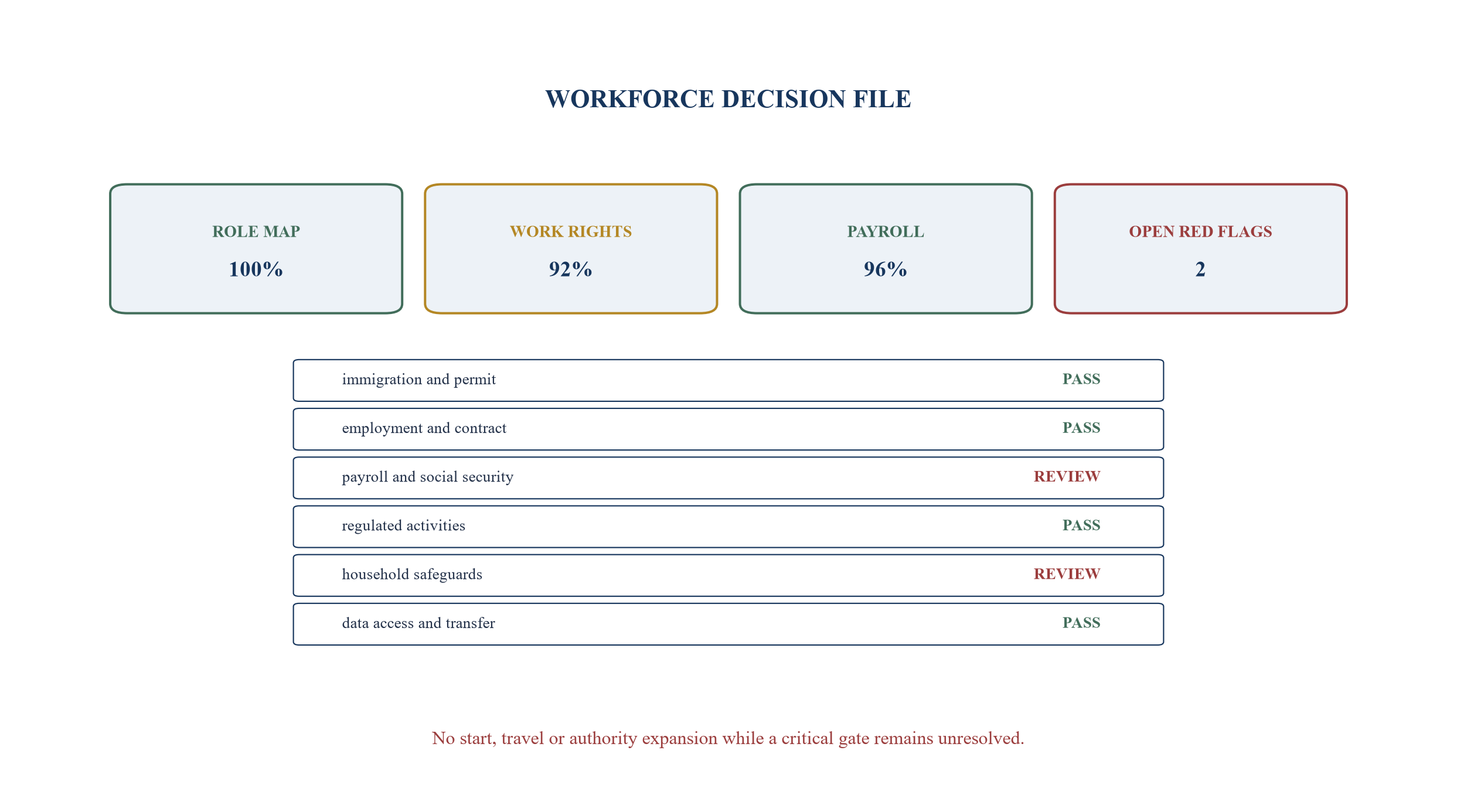
Values are illustrative. Release requires every critical red-flag gate to be resolved or explicitly approved within applicable law.
Sources and further reading
- United Arab Emirates Government, Federal Decree-Law No. 33 of 2021 Concerning Regulating Labour Relations Official source
- United Arab Emirates Government, Cabinet Resolution No. 1 of 2022 Executive Regulation of the Labour Relations Law Official source
- Ministry of Human Resources and Emiratisation, Types of Work Permits Official source
- Ministry of Human Resources and Emiratisation, Wages Protection System Official source
- Federal Authority for Identity, Citizenship, Customs and Port Security, UAE Golden Residency Official source
- United Arab Emirates Government, Federal Decree-Law No. 9 of 2022 Concerning Domestic Workers Official source
- Ministry of Human Resources and Emiratisation, Cabinet Resolution No. 106 of 2022 Executive Regulation of the Domestic Workers Law Official source
- Ministry of Human Resources and Emiratisation, Issuance of a New Employment Contract for a Domestic Worker Official source
- Abu Dhabi Global Market, Employment Affairs Office and Employment Regulations 2024 Official source
- Dubai International Financial Centre, Employment Law No. 2 of 2019 Consolidated March 2024 Official source
- Dubai International Financial Centre, Qualifying Schemes and DIFC Employee Workplace Savings Plan Official source
- Dubai Financial Services Authority, GEN Rule 2.3.5 Single Family Office Treatment Official source
- UAE Federal Tax Authority, Issuance of Tax Certificates for Tax Residency Official source
- UAE Federal Tax Authority, Basis of Taxation for Natural Persons Official source
- United Arab Emirates Government, Federal Decree-Law No. 45 of 2021 Concerning the Protection of Personal Data Official source
- HM Revenue and Customs, 2016 United Kingdom-United Arab Emirates Double Taxation Convention Official source
- HM Revenue and Customs, Statutory Residence Test Full-Time Overseas Test Official source
- HM Revenue and Customs, Statutory Residence Test Location of Work Official source
- HM Revenue and Customs, Globally Mobile Employees and PAYE Official source
- HM Revenue and Customs, Paying Employees Working Abroad Official source
- HM Revenue and Customs, National Insurance if You Work Abroad Official source
- United Kingdom Government, Overseas Domestic Worker Visa Employment Rights Official source
- United Kingdom Government, Overseas Domestic Worker Visa Required Documents Official source
- HM Revenue and Customs, Employment-Related Securities for Employers Official source
- Organisation for Economic Co-operation and Development, The 2025 Update to the OECD Model Tax Convention Official source
- Singapore Ministry of Manpower, Eligibility for Employment Pass Official source
- Inland Revenue Authority of Singapore, Working Out Individual Tax Residency Official source
- Singapore Ministry of Manpower, Work Permit for Migrant Domestic Worker Official source
- Swiss State Secretariat for Migration, Working in Switzerland Official source
- International Labour Organization, Domestic Workers Convention 2011 No. 189 Official source
