

1. Define the transaction perimeter before launching integration
Integration should begin with a verified perimeter. The buyer should identify every acquired and retained legal entity, branch, joint venture, regulated activity, licence, customer contract, employee population, pension or benefit plan, bank account, debt instrument, guarantee, tax registration, intellectual-property right, data set, application, infrastructure component, property, vendor and transitional service. Each item should have an owner, governing jurisdiction, control date and planned end state.
Geography should be recorded at the point where the obligation exists. A UK customer can contract with a UAE entity and receive services from an Indian delivery centre. An Indian employee can administer a global system hosted in another jurisdiction. A GCC distributor can hold customer relationships while intellectual property remains elsewhere. The integration blueprint should make these chains visible.
The acquisition thesis should be translated into measurable operating choices. These can include cross-selling, procurement scale, shared services, product combination, geographic expansion, site consolidation, technology standardisation and capital efficiency. Each choice creates dependencies. Cross-selling needs customer permission, product readiness and sales incentives. Shared services need lawful data access, role clarity and service levels. Site consolidation needs employee consultation, capacity and continuity plans. The perimeter is the evidence base for those choices.
Table 1. Cross-border integration perimeter
| Layer | Required inventory | Core evidence | Control question | Escalation trigger |
|---|---|---|---|---|
| legal entities | companies, branches, joint ventures and ownership | registers, constitutional documents and closing records | which entity owns each obligation and asset after close? | ownership, authority or filing remains unresolved |
| customers | contracts, orders, pricing, service levels and consent rights | executed agreements, amendments and account records | can service and commercial terms continue without consent? | material customer objects, delays or reduces scope |
| people | employees, contractors, benefits, visas and representatives | contracts, payroll, consultation and immigration records | who transfers, who manages and which obligations continue? | required consultation, consent or capacity is missing |
| technology and data | applications, interfaces, hosting, identities and data flows | architecture, access logs, data map and vendor terms | can the planned access and migration occur lawfully and securely? | unsupported interface, restricted transfer or security gap |
| cash and finance | accounts, debt, guarantees, tax, working capital and trapped cash | bank, ledger, facility, guarantee and tax records | which cash is accessible and which claims mature during integration? | minimum liquidity, covenant or authority threshold is threatened |
| operations | sites, inventory, suppliers, licences and service dependencies | operational records, permits, contracts and continuity tests | which activities must remain separate or locally controlled? | licence, supply or service continuity cannot be evidenced |
Each item should be verified by legal entity and jurisdiction before its integration date is approved.
2. Make the control tower a decision system
The control tower should combine governance, evidence, performance and escalation. Its purpose is to decide, direct and verify. It should not become a reporting office that collects coloured status slides after workstream decisions have already diverged.
The executive steering group should approve enterprise priorities, reserved matters, funding, customer interventions, material people decisions, end-state architecture and changes to the value case. The integration leader should own the integrated plan, dependency resolution and evidence standard. Workstream leaders should own delivery and control within their mandate. Country and legal-entity leaders should retain responsibilities that law, licence, fiduciary duty or local operations require.
Every status should point to evidence. A payroll workstream is not green because a meeting occurred. It is green when employee populations reconcile, bank files are tested, authority is approved, control owners are trained, statutory timing is met and a contingency run can pay people. A systems migration is not complete when data copied. It is complete when data reconciles, security controls work, business users accept outputs, fallback is tested and legacy retirement is approved.
3. Use an integration blueprint to connect value with dependencies
The integration blueprint should map five connected views: value thesis, operating capabilities, legal entities and jurisdictions, enabling systems and data, and cash and control. This creates a line from each acquisition objective to the work required to deliver it.
Dependencies should be explicit. A customer migration can depend on contract consent, product mapping, price approval, master-data quality, billing readiness, service ownership and data-transfer compliance. A shared-service migration can depend on employment consultation, role design, process documentation, controls, system access, language support and service-level testing. The blueprint should name the last responsible milestone before each irreversible action.
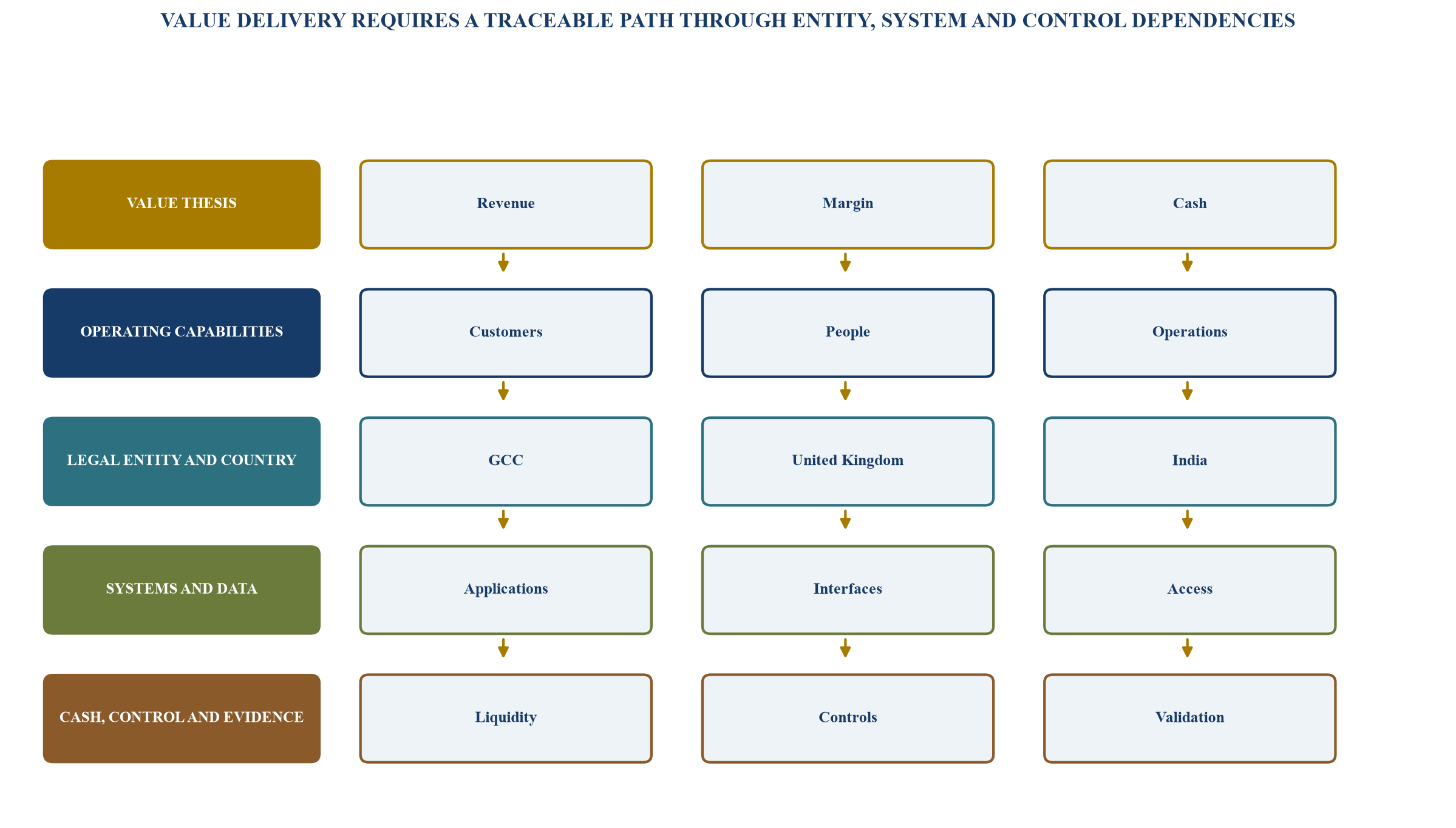
The blueprint links value objectives to legal entities, capabilities, enabling systems and control evidence.
4. Separate legal completion, operational control and end-state integration
The legal closing date creates ownership according to the transaction documents and applicable approvals. It does not automatically complete operational control, financial consolidation or systems integration. The control tower should therefore maintain distinct milestone definitions.
Day 1 should prove continuity and authority. Employees should know who leads them and how they are paid. Customers should know where to place orders and escalate service issues. Suppliers should know which entity orders and pays. Bank mandates, delegations, insurance and incident procedures should be effective. Financial reporting should capture opening balances and post-close activity. Technology access should follow approved roles.
Operational control requires functioning decisions, reconciled management information, control ownership and the ability to respond to failure. Financial consolidation requires the accounting team to determine the acquisition date, identify the acquirer, recognise and measure acquired assets and liabilities, and produce required disclosures under the applicable framework. IFRS 3 sets principles for recognition, measurement of goodwill or bargain purchase and disclosure of the financial effects of a business combination.[15]
End-state integration is achieved by capability, not calendar. A workstream can close when its end-state process is documented, accepted, controlled, measured and owned in business as usual. A legacy system can retire after data retention, reporting, security, interfaces and user needs are resolved. A legal entity can simplify after contracts, permits, employees, tax, debt, litigation and cash are addressed. The control tower should not force all workstreams to finish on one symbolic date.
5. Map competition and national-security gates before changing control
Competition and national-security conditions can restrict information exchange, operational direction, customer coordination, integration planning and legal completion. The integration plan should distinguish clean-team activity before clearance, permitted planning, Day 1 actions and post-clearance implementation.
In the UAE, Federal Decree-Law No. 36 of 2023 regulates economic concentration. Cabinet Decision No. 3 of 2025 applies notification thresholds where combined annual sales in the relevant UAE market exceed AED 300 million or combined market share exceeds 40 per cent, subject to the law and transaction facts.[1][2] The official process allows approval, conditional approval or rejection. The buyer should confirm relevant market, sales, control, exemptions, filing timing and any remedy with qualified counsel.
The UK Competition and Markets Authority's merger guidance addresses jurisdiction and procedure, and its current guidance reflects procedural revisions effective in 2025.[5] The National Security and Investment Act regime includes mandatory notification for qualifying acquisitions in specified areas.[6] The integration office should convert clearance conditions, hold-separate obligations and information barriers into named operational controls.
India regulates combinations under sections 5 and 6 of the Competition Act. The Competition Commission of India describes notification before consummation for transactions meeting applicable conditions, and the 2024 Combinations Regulations address matters including deal-value thresholds, substantial business operations in India and review procedure.[10][11] The substance and transaction sequence should be assessed; internal integration planning should not assume that corporate structure removes a filing requirement.
Where the legal restructuring itself is a cross-border merger involving an Indian company, the Ministry of Corporate Affairs' Rule 25A framework addresses prior Reserve Bank of India approval and Companies Act procedures.[14] Counsel should confirm the current route, eligibility and required approvals for the proposed structure.
Table 2. Regulatory and sequencing gate
| Jurisdiction or layer | Potential gate | Control-tower evidence | Permitted action before resolution | Failed-gate response |
|---|---|---|---|---|
| UAE competition | economic-concentration notification, clearance or conditions | market analysis, sales, control, filing and decision | approved clean-team planning and ordinary-course operation | pause restricted implementation and escalate to counsel |
| UK competition | CMA jurisdiction, review, remedies or information limits | jurisdiction paper, contact log, clearance and remedy plan | segregated diligence and approved planning | preserve separateness and implement remedy governance |
| UK national security | mandatory or voluntary NSI notification | activity mapping, acquisition rights and government decision | restricted planning within agreed information rules | suspend control steps within scope |
| India competition | CCI notification, review or modification | thresholds, deal value, India operations, filing and order | clean-team planning and ordinary-course operation | stop consummation or integration step as advised |
| sector regulation | ownership, licence, fit-and-proper or operating consent | regulator map, applications, conditions and licence register | maintain licensed operating perimeter | retain local control and continuity arrangement |
| contract and finance | consent, change of control, covenant or guarantee | contract review, waiver, lender and counterparty confirmation | perform only actions authorised by existing rights | use transition plan and escalate economic effect |
This table is a diligence framework; legal advisers should confirm current transaction-specific requirements.
6. Allocate decision rights by subject, entity and phase
Cross-border integration creates overlapping authority. Group executives can set strategy, legal-entity directors retain statutory duties, country leaders manage licensed operations, functional leaders own standards and integration teams manage change. Ambiguity produces delay, duplicated work and unauthorised commitments.
The decision-rights map should state who proposes, validates, approves, executes and is informed. It should cover customer pricing, contract changes, hiring, retention, redundancy, vendor commitments, capital expenditure, credit limits, cash transfers, bank mandates, tax positions, system access, data transfers, cyber incidents, accounting judgements and external communications. The map should use roles and legal entities rather than personal names alone.
Reserved matters should have thresholds and deadlines. An escalation route without a decision deadline can stop operations. The control tower should record the question, decision owner, evidence required, alternatives, financial effect, legal-entity effect and latest responsible date. Repeated escalations should identify a design defect in the operating model.
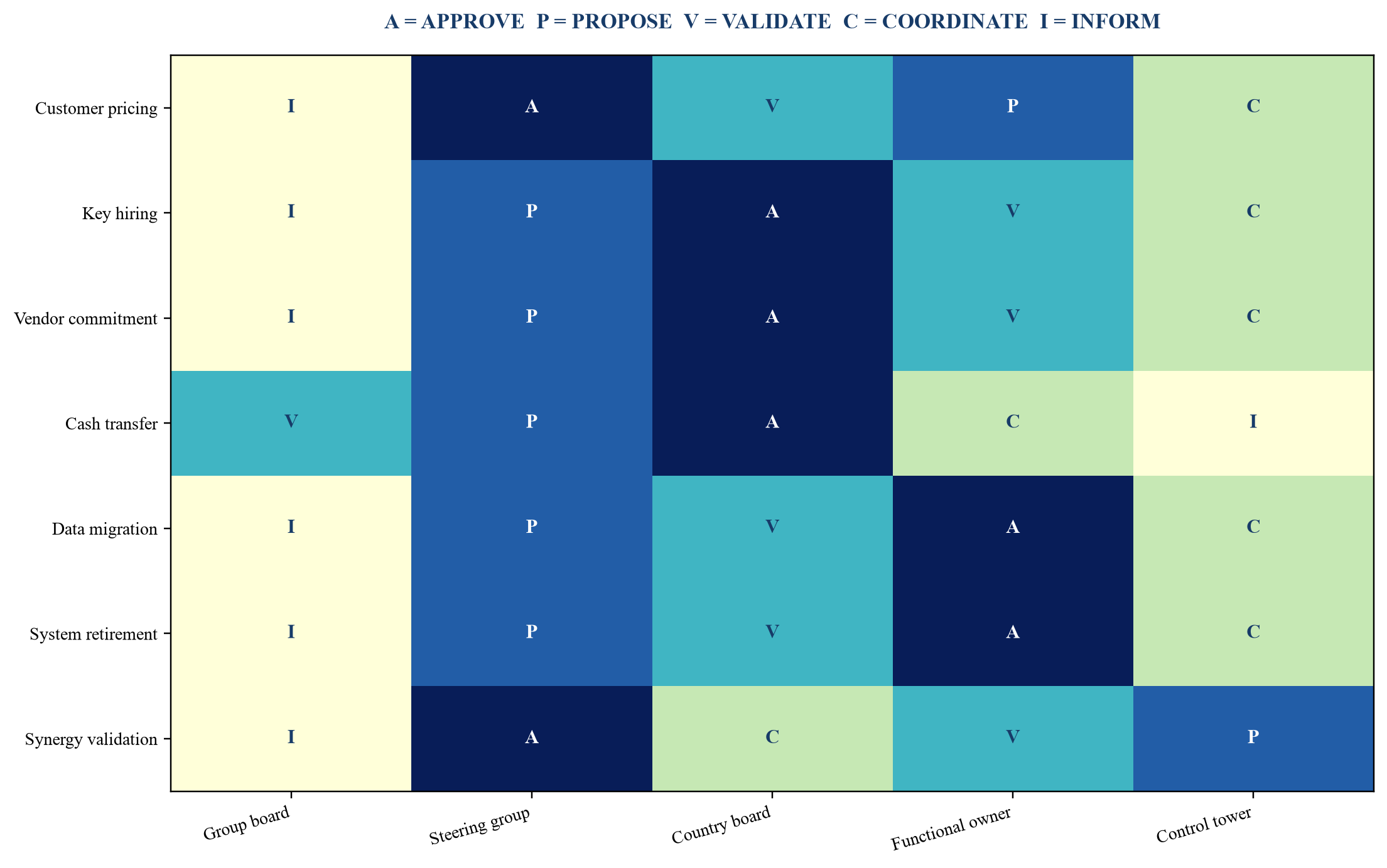
Roles and thresholds are hypothetical management assumptions and should be adapted to entity duties, licences and delegations.
7. Protect revenue through account-level continuity
Revenue protection should be managed by customer account, contract and service dependency. The control tower should identify the customers that determine revenue, gross margin, cash collection, references, market access or regulatory standing. It should also identify change-of-control clauses, consent rights, key-person dependencies, service-level penalties, data restrictions, pricing commitments and open disputes.
Each priority customer should have a continuity plan. The plan should name the executive sponsor, account owner, contracting entity, service owner, billing entity, delivery locations, critical systems, current commitments and integration message. It should state which changes require customer approval and which changes should remain invisible because service continues under the existing contract.
Cross-selling should enter the synergy case only when product eligibility, customer need, sales capacity, contracting route, pricing, delivery and revenue-recognition conditions are defined. A combined customer list is not a revenue synergy. A sales meeting is an activity. A contracted order delivered and recognised under the applicable accounting policy is evidence.
Customer attrition should be separated by cause. Integration-related losses can arise from service disruption, account-owner departure, confusing communications, price change, product withdrawal, credit tightening, billing error or data concern. Market losses and normal churn should remain visible. The baseline and counterfactual should be documented so management does not claim avoided losses as delivered synergy without evidence.
Table 3. Customer continuity and growth controls
| Customer event | Required evidence | Decision owner | Value measure | Escalation trigger |
|---|---|---|---|---|
| change-of-control communication | contract review, approved message and named sponsor | account executive and legal entity | retained revenue and uninterrupted service | objection, consent delay or material concern |
| service handover | accepted operating plan, contacts and service-level test | operations leader | incidents, response time and service credits | missed service level or unresolved ownership |
| billing migration | tax, master data, purchase order and invoice test | finance leader | billing accuracy, delay and collection | rejected invoice or delayed cash |
| cross-sell launch | customer need, product readiness, price and delivery capacity | commercial leader | signed order, recognised revenue and margin | capacity, permission or economics fail |
| contract renewal | performance evidence, pricing mandate and approval | account sponsor | renewal, term, margin and cash | price concession exceeds authority |
| at-risk account | issue log, root cause and recovery plan | executive sponsor | revenue and cash at risk | customer reduces scope or signals exit |
Revenue and retention outcomes should be reconciled by customer, contract, product and legal entity.
8. Integrate people through roles, obligations and capacity
People integration should begin with work and accountability. The buyer should identify critical roles, duplicated roles, scarce skills, customer relationships, regulated functions, control owners, integration capacity and succession risk. Organisation charts should follow the work design and legal requirements.
The UK Transfer of Undertakings framework can protect employment contracts in qualifying business transfers and provides structure for employee transfer and consultation.[7] The applicability and permitted changes depend on the facts. GCC employment, immigration, pension and end-of-service obligations vary by jurisdiction and free zone. Indian employment and social-security requirements can vary by state, establishment and worker category. Local counsel should confirm obligations before workforce actions.
Integration workload should be treated as capacity. Business leaders continue running customers and operations while designing the future company. The control tower should measure decision load, milestone concentration and critical-person dependency. Temporary programme resources, transitional services or deferred scope may be required. An overcommitted plan can convert an achievable synergy into customer and control failure.
9. Design the systems and data perimeter before granting access
Technology integration starts with identity, data and business process. The application inventory should identify owner, users, hosting, vendor, interfaces, data categories, criticality, support, recovery, licences, cost, control function and retirement condition. Shadow tools and manual workarounds should be included because they often carry customer, pricing or reconciliation data.
Day 1 access should follow least privilege and role approval. New parent-company access should be separated from migration access. Administrator rights, service accounts, remote access and third-party credentials should receive specific review. Identity federation can simplify access while creating a single failure path; the fallback and incident procedure should be tested.
Architecture dependencies should appear in the integrated plan. Customer billing can depend on tax configuration, master data, contract migration, price lists, bank details and accounts-receivable reporting. Human-resources migration can depend on consultation, payroll, benefits, time records, privacy and banking. The control tower should stop a cutover when any critical dependency lacks evidence.
10. Govern personal data and cross-border access
Personal data should be mapped by purpose, controller, processor, individual category, jurisdiction, system, hosting location, access location, retention and transfer mechanism. Acquisition due diligence, employee integration, customer migration and shared services can each change who processes data and why.
The UAE Personal Data Protection Law establishes a federal framework for personal-data processing, controller and processor obligations, data-subject rights and cross-border transfers.[3] The official UAE portal states that it applies to electronic processing inside or outside the state within its scope and addresses cross-border transfer and sharing.[3] Free-zone and sector regimes can add requirements.
The UK Information Commissioner's Office advises that mergers and acquisitions should consider data sharing in due diligence, including original purpose, lawful basis, transparency, governance and security.[8] Its international-transfer guidance, updated in January 2026, explains restricted transfers and mechanisms including adequacy, safeguards and exceptions.[9] Separate legal entities within one group can still create an international transfer.
India's Digital Personal Data Protection Act 2023 and the Digital Personal Data Protection Rules 2025 establish requirements with staged commencement provisions.[12][13] The control tower should confirm which obligations are in force for the relevant action date. A global policy should be supported by local legal analysis, records of processing, transfer documentation, notices, contracts, access controls, retention and incident procedures.
Table 4. Systems, data and cyber integration gate
| Action | Evidence before approval | Control owner | Completion evidence | Stop condition |
|---|---|---|---|---|
| Day 1 identity access | role, legal entity, system need and approval | information security and business owner | access report and sample test | orphaned, excessive or unapproved privilege |
| cross-border data access | data map, purpose, parties and transfer analysis | privacy and legal | executed mechanism and access log | lawful basis or transfer control unresolved |
| application interface | architecture, source, target and reconciliation design | technology owner | balanced totals and exception test | missing records or uncontrolled override |
| data migration | field map, quality result, retention and fallback | data owner | business acceptance and control sign-off | reconciliation or privacy threshold fails |
| system retirement | dependency, archive, retrieval and recovery test | application owner | approved decommission record | active dependency or retention need remains |
| cyber incident integration | contacts, logging, monitoring, response and recovery | security leader | tabletop and technical test | detection, escalation or recovery cannot operate |
Local privacy, employment, sector and security requirements should be confirmed before access or migration.
11. Treat cybersecurity as an enterprise integration dependency
An acquisition changes the attack surface. Connected identities, remote administration, shared networks, cloud tenants, vendor access and migrated data can expose both businesses. The control tower should maintain a current and target security profile and should sequence connection according to verified controls.
The NIST Cybersecurity Framework 2.0 organises cybersecurity outcomes around Govern, Identify, Protect, Detect, Respond and Recover.[18] Those functions can structure integration evidence. Governance defines risk ownership and policy. Identification maps assets and dependencies. Protection governs identity, configuration and data. Detection connects logging and monitoring. Response aligns incident roles and communications. Recovery tests continuity and restoration.
Critical findings should have compensating controls and deadlines. Unsupported systems can be segmented. Privileged access can be time limited. Vulnerable remote services can be disabled. Logging can be forwarded before broader network connection. Backups should be tested for restoration and protected from the same credentials that administer production.
Cyber synergy should not be claimed solely from tool consolidation. Value can arise from licence reduction, lower support cost, stronger detection, reduced incident probability or faster recovery. Each benefit should have a measurable baseline and should not depend on removing a control before the replacement is effective.
12. Put cash, liquidity and bank authority on the Day 1 critical path
The cash map should identify every bank account, currency, legal owner, signatory, digital-banking user, cash pool, debt facility, guarantee, letter of credit, security interest, merchant account and payment process. It should distinguish reported group cash from cash that is legally and operationally available to a particular entity.
Day 1 controls should cover bank mandates, payment authorities, treasury contacts, emergency payments, payroll, tax, debt service, customer receipts and fraud prevention. Changes to payment instructions should be independently verified. Vendor and customer communications should use controlled channels. Increased transaction volume and organisational uncertainty create a favourable environment for impersonation and mandate fraud.
The integration cash forecast should run by legal entity and currency. It should include transaction fees, retention, severance, system migration, transitional services, duplicated facilities, working-capital disruption, tax, debt repayment, one-time purchases and contingency. Synergy values expressed as annual EBITDA do not fund near-term cash needs. Cost to achieve and cash timing should be visible beside the benefit.
Cash transfer between jurisdictions should be supported by corporate authority, distributable reserves, debt covenants, tax analysis, exchange-control requirements and operating need. India and some GCC structures can require specific approvals or documentation. The control tower should treat unconfirmed upstream cash as unavailable in the downside case.
13. Build a closing and purchase-accounting evidence calendar
Financial integration should establish a controlled opening position and a repeatable reporting process. The finance workstream should reconcile trial balances, bank accounts, debt, guarantees, working capital, intercompany balances, tax, payroll, provisions, contingencies, revenue, leases, inventory, fixed assets and equity. It should preserve the line from local ledgers to consolidated reporting.
IFRS 3 requires the acquirer to recognise and measure identifiable acquired assets and assumed liabilities, goodwill or a bargain-purchase gain, and to disclose information about the combination.[15] The accounting team should maintain an evidence calendar for the acquisition date, consideration, closing statements, valuation inputs, contracts, customer relationships, technology, brands, deferred tax, contingent consideration and measurement-period adjustments.
Integration decisions can change forecasts and cash-generating units. IAS 36 requires assets to be carried at no more than recoverable amount and requires annual assessment of goodwill and certain intangible assets.[16] The synergy ledger should therefore reconcile with valuation assumptions and impairment monitoring. A missed synergy can be a performance issue, a forecast revision and a possible impairment indicator.
14. Design intercompany services, tax and legal-entity economics together
The operating model determines which entity performs functions, uses assets and bears risks. Management services, technology, procurement, intellectual property, financing, sales support and delivery should be reflected in contracts, conduct, systems, people and transfer-pricing analysis.
The OECD Transfer Pricing Guidelines describe the arm's-length principle as the international standard for pricing related-party cross-border transactions.[17] The UAE Federal Tax Authority's transfer-pricing guide states that UAE taxpayers should rely primarily on UAE corporate-tax law, the relevant ministerial decision and the guide, with reference to the OECD guidelines where appropriate.[4] UK and Indian rules should be analysed independently.
An integration recharge should have a defined service, beneficiary, allocation basis, evidence and invoice path. Duplicate services, shareholder activity, unsupported mark-ups and inconsistent allocations can create tax and management-reporting problems. The control tower should connect the service catalogue with roles, systems, budgets and legal agreements.
Legal-entity simplification should follow operational evidence. Removing an entity can require contract novation, employee transfer, licence change, tax clearance, debt consent, litigation treatment, data migration and cash extraction. The benefit should be measured against execution cost, stranded cost, timing and risk.
15. Create a synergy ledger that can withstand validation
Each synergy should have a unique identifier, thesis source, category, baseline, calculation, owner, delivery action, dependency, start date, run-rate profile, profit-and-loss classification, cash profile, cost to achieve, evidence source and validator. The ledger should also record dis-synergies, revenue loss, stranded cost and one-time leakage.
The baseline should be fixed to an approved reference period and adjusted only through a controlled change process. Foreign exchange, commodity price, market volume, accounting policy, acquisition perimeter and inflation can move reported performance without integration action. The ledger should isolate those effects where practical.
Cost synergies should enter delivery when a contract, role, facility, licence or spend has changed and the financial effect can be traced. Revenue synergies should require customer evidence and realised economics. Working-capital benefits should be measured as cash and should not be added to EBITDA. Avoided capital expenditure should be separated from operating savings.
The hypothetical example below starts with AED 24 million of gross annual run-rate opportunity. It applies AED 3 million of dis-synergy and AED 4 million of execution slippage, producing AED 17 million of validated run rate. It also assumes AED 29 million of cumulative cost to achieve. These figures demonstrate the ledger. They are not a forecast for any company or transaction.
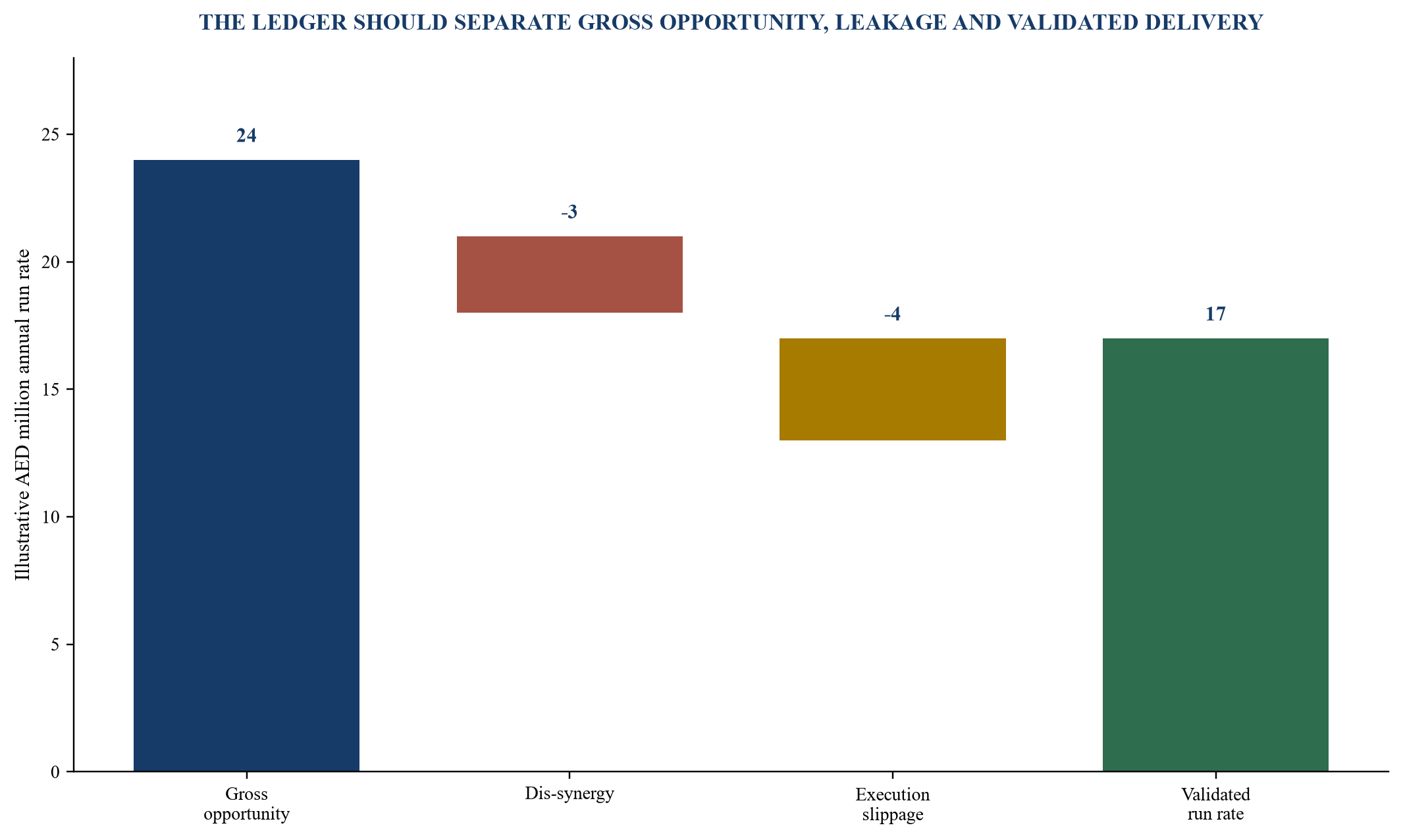
All AED amounts are hypothetical management assumptions; cost to achieve and cash timing require separate tracking.
Table 5. Synergy-ledger evidence rules
| Value category | Minimum baseline | Delivery evidence | Cash distinction | Validation response |
|---|---|---|---|---|
| procurement saving | comparable volume, specification, supplier and price | executed terms, purchase orders and invoices | payment timing and inventory effect shown separately | validate realised unit economics after mix and volume |
| role or contractor saving | approved organisation and fully loaded cost | exit, transfer or contract change plus replacement-capacity test | severance and retention recorded as cost to achieve | validate after cost leaves payroll or payable run |
| facility saving | lease, occupancy, service and exit cost | executed termination or sublease and operational exit | deposits, dilapidation and move cost separated | validate net recurring saving after stranded cost |
| technology saving | licence, support, hosting and internal run cost | terminated contract or reduced consumption after migration | migration and dual-run cash separated | validate after control and service acceptance |
| revenue synergy | customer, product, price, delivery and margin baseline | signed order, delivery, recognised revenue and cash | working-capital use shown separately | validate contribution after incremental delivery cost |
| working-capital release | receivable, inventory and payable baseline | sustained balance and cash reconciliation | report as cash, outside EBITDA | validate without double counting operating profit |
| avoided expenditure | approved capital or operating plan | cancelled commitment and capability evidence | classify according to accounting treatment | report separately from realised run-rate saving |
Values should be reported in transaction currency and reconciled to local ledgers and consolidation where applicable.
16. Control cost to achieve and stranded cost
Cost to achieve should be approved at the same granularity as synergy. It can include adviser fees, retention, severance, recruitment, relocation, training, data remediation, interfaces, licences, dual running, contract termination, property exit, branding, customer support, travel and programme resources. Each cost should have an owner, budget, cash date, accounting treatment and linked benefit or control requirement.
Stranded cost is expense that remains after the activity it supported has moved or stopped. A local finance team can be reduced while local audit, tax, payroll and statutory reporting still require capacity. A data centre can close while network, archive and contract costs remain. A procurement contract can terminate while minimum commitments or exit charges continue.
The control tower should report gross synergy, dis-synergy, cost to achieve, stranded cost, cash and validated net benefit. A lower cost-to-achieve estimate does not improve value when it removes necessary control, migration or continuity work. Scope reduction should state which benefit, risk or end-state feature changes.
17. Sequence the first 180 days through controlled waves
The first wave, from readiness through Day 1, should protect authority, customers, people, cash, data, technology access, reporting and incident response. The second wave, through approximately Day 30, should stabilise operations, reconcile opening information and confirm the detailed blueprint. The third wave, through approximately Day 60, should launch bounded commercial, procurement and shared-service actions.
The fourth wave, through approximately Day 100, should implement proven migrations and operating-model changes. The fifth wave, through approximately Day 140, should consolidate remaining capabilities, remove validated duplication and complete critical handovers. The sixth wave, through Day 180, should confirm value, transfer ownership to business as usual and decide which longer-term initiatives continue.
Dates are planning anchors. Regulatory approvals, consultation, customer consents, system quality and operating performance determine actual sequence. A workstream should move when entry criteria pass. It should pause when an unresolved dependency can damage service, value or control.
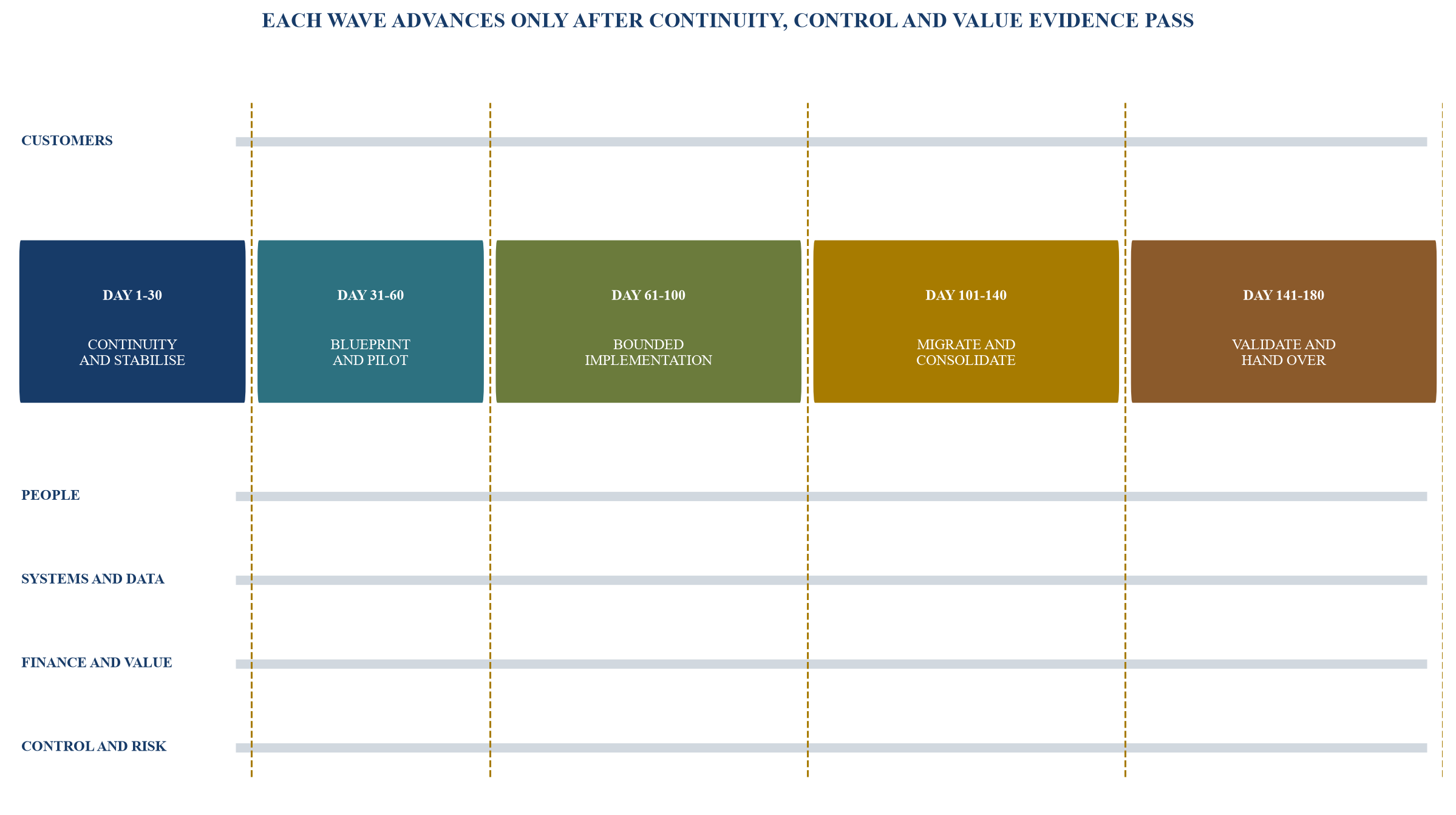
Timing is a hypothetical management frame; each wave requires transaction-specific entry and exit evidence.
18. Make value leakage visible and actionable
Value leakage is the difference between the approved value path and the outcome supported by evidence. It can arise from revenue loss, margin erosion, delayed synergy, cost overrun, stranded cost, working-capital use, service failure, customer credits, employee attrition, tax exposure, control failure or deferred migration.
The dashboard should show baseline, current result, variance, cause, owner, cash effect, forecast consequence, earliest action and decision deadline. It should separate temporary timing from structural loss. A three-month delay can create cash and valuation effects even if run rate eventually arrives.
Indicators should be tied to the integration thesis. Customer leakage can include attrition, order delay, price discount, service credit and collection delay. People leakage can include unwanted attrition, vacancy, contractor replacement and productivity loss. Systems leakage can include dual running, incident cost, manual work and delayed retirement. Finance leakage can include unplanned cost to achieve, stranded cost, trapped cash and missed working-capital release.
The hypothetical dashboard below uses indexed scores from zero to one hundred. The alert boundary is assumed for illustration. Actual thresholds should be set from customer economics, risk appetite, budgets, control tolerance and downside capacity.
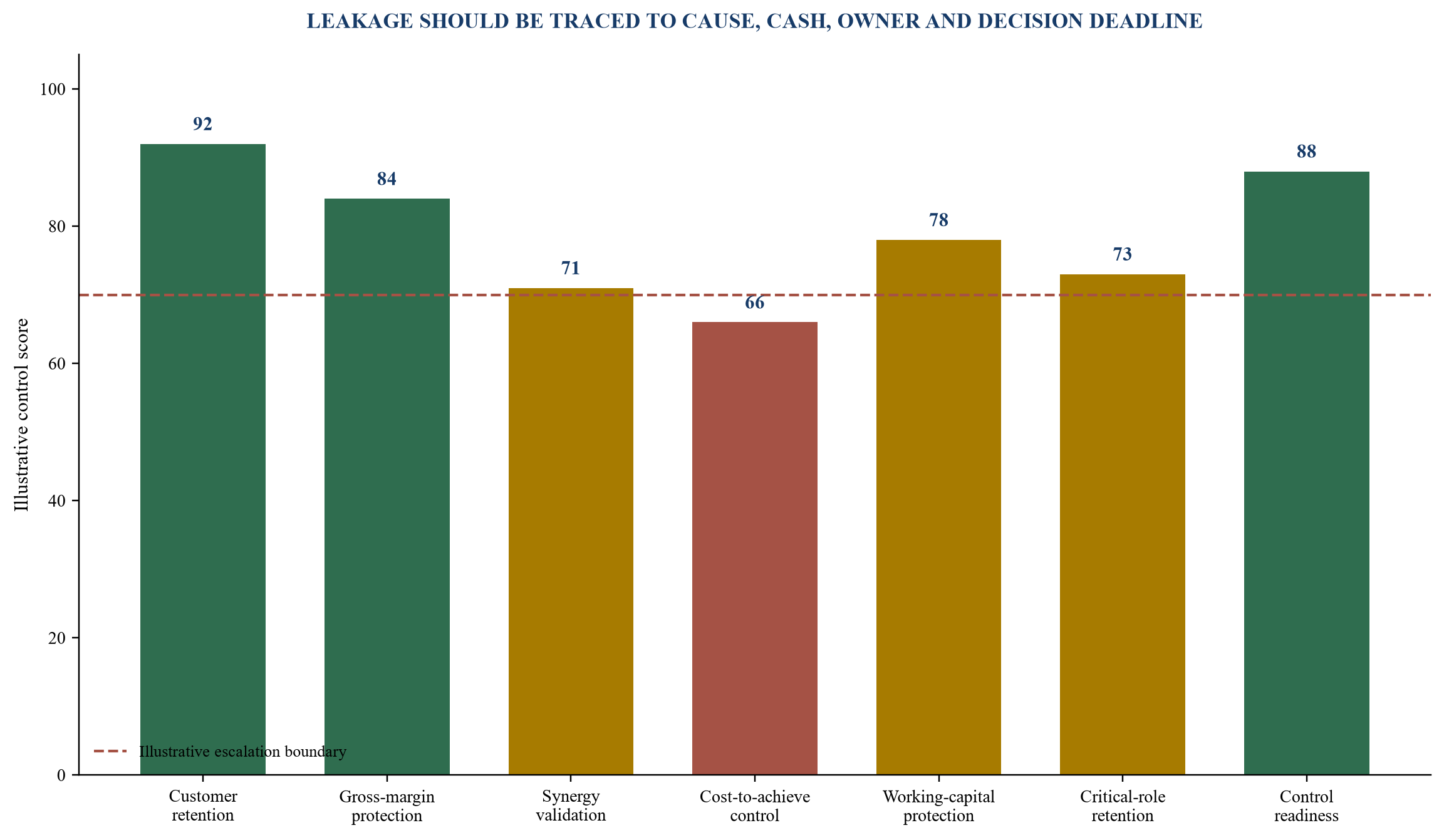
Scores and alert levels are hypothetical management assumptions and do not represent an identified transaction.
19. Use local operating models within one enterprise framework
The combined group needs common principles and locally executable processes. Group standards can govern ethics, risk appetite, finance policy, cybersecurity, data, capital allocation, customer experience and performance. Legal entities and countries should retain the roles required for statutory, regulatory, tax, employment and operational accountability.
Service catalogues should define the provider, recipient, activity, service level, control, data, price, escalation and exit. Transitional services should have the same discipline. A service that has no end date, volume assumption or exit owner can become an expensive permanent bridge.
20. Test Day 1 and each irreversible cutover
Day 1 readiness should be tested through scenarios. The team should simulate a customer escalation, urgent supplier payment, payroll issue, cyber incident, bank-access failure, executive decision, media enquiry and regulatory contact. Each scenario should show who acts, which entity has authority, which system provides evidence and how escalation works across time zones.
Cutover testing should include expected operations and failure. A billing migration should test correct and rejected invoices, credit notes, tax, cash application and customer queries. A payroll migration should test joiners, leavers, variable pay, statutory deduction, bank rejection and reconciliation. A data migration should test missing, duplicate, corrupted and restricted records.
21. Stress the integration plan as a value and liquidity system
The base case should connect customers, volume, price, margin, headcount, vendors, facilities, systems, working capital, cost to achieve, tax and cash. Downside cases should combine events that can occur together. Customer loss can coincide with key-person departure. A migration delay can extend transitional services and dual running. A clearance condition can remove an expected overlap and synergy.
Reverse stress testing should identify the point at which minimum liquidity, customer service, regulatory compliance, covenant headroom or the acquisition value case fails. It should show the earliest decision that can protect the business. Actions can include scope deferral, contingency funding, customer intervention, temporary service capacity, slower migration, cost freeze or operating-model redesign.
The numbers should remain transparent. A hypothetical model can assume AED 420 million of combined revenue, AED 58 million of baseline EBITDA, AED 24 million of gross run-rate opportunity, AED 29 million of cost to achieve and AED 20 million of minimum accessible liquidity. These are method assumptions. An actual model should use reconciled entity data and should explain the reliability and timing of each input.
Table 6. Illustrative integrated stress scenarios
| Scenario | Combined event | Value effect | Liquidity effect | Control-tower response |
|---|---|---|---|---|
| reference | customer, people and migrations follow approved plan | validated benefits track baseline | cost to achieve and working capital remain funded | normal wave governance |
| customer shock | two priority customers delay renewal and demand service credits | revenue and margin fall; cross-sell delayed | collection slows and remediation cost rises | executive account plans and protect service capacity |
| people shock | critical technology and account leaders leave together | handover and delivery milestones slip | contractors and retention cash rise | activate succession, defer cutover and protect accounts |
| migration failure | finance interface fails during first combined close | synergy and reporting confidence fall | dual running and correction cost extend | rollback, reconcile and require independent retest |
| regulatory condition | approval requires separation or disposal of overlapping activity | gross synergy perimeter reduces | advisory, separation and stranded cost rise | rebase blueprint and value case after legal approval |
| data incident | excessive cross-border access creates a reportable event | customer trust and operating capacity weaken | response, remediation and possible penalty exposure rise | contain access, execute incident plan and reassess transfers |
| combined downside | customer, people and migration shocks occur within one quarter | value case and timetable miss together | minimum liquidity breached without action | freeze optional scope, secure funding and reset waves |
Events, thresholds and responses are hypothetical management assumptions; they are not forecasts.
22. Run a 180-day evidence-led workplan
Before Day 1, the team should complete the perimeter, regulatory gate, authority map, customer continuity plans, critical-role actions, cash controls, access design, opening reporting plan and incident procedures. Day 1 through Day 30 should stabilise service, reconcile balances, verify controls and finalise the blueprint.
Days 31 through 60 should launch pilots for customer growth, procurement, shared services and management reporting. Days 61 through 100 should implement only the designs that passed pilot evidence. Days 101 through 140 should migrate selected processes and systems, validate removal of duplicated cost and complete major handovers.
Days 141 through 180 should validate synergy, cash, customer and control outcomes. Integration governance should transfer to business-as-usual owners with open actions, controls, budgets and long-term initiatives documented. The steering group should decide which projects continue, change or stop.
Table 7. Day 1 to Day 180 cross-border integration workplan
| Period | Primary work | Required output | Approval gate |
|---|---|---|---|
| pre-close to Day 1 | perimeter, regulatory conditions, authority, continuity and access | Day 1 evidence pack and incident plan | ownership changes only within approved legal boundaries |
| Day 1-30 | stabilise customers, people, cash, reporting and operations | reconciled opening view and confirmed integration blueprint | no critical continuity or authority gap remains |
| Day 31-60 | pilot commercial, procurement, shared-service and data changes | measured pilot result and refined dependencies | pilot meets service, control and economic criteria |
| Day 61-100 | implement bounded operating-model and system changes | accepted processes, controls and benefit evidence | irreversible actions pass cutover and fallback tests |
| Day 101-140 | migrate selected capabilities and remove proven duplication | controlled handovers and validated cost removal | replacement capability operates before legacy removal |
| Day 141-180 | validate value, cash and controls; transfer ownership | final 180-day scorecard and business-as-usual handover | open actions have funded owners, dates and governance |
Timing depends on clearance, consent, data quality, employee obligations, systems readiness and customer continuity.
23. Use an approval gate that can pause or reshape integration
The steering group should answer twelve questions before each wave. Which legal entities and jurisdictions are affected? Which regulatory, contract, employment, data or tax permissions apply? Which customers and services can be harmed? Who has authority to decide and execute? Which systems and data are required? Which cash funds the change? Which benefit does the action deliver? What cost and stranded cost arise? Which controls replace the current controls? How has fallback been tested? Which evidence proves readiness? What happens if the change is delayed or stopped?
The wave should pause when authority is unclear; regulatory conditions are unresolved; customer continuity lacks an owner; employee obligations are incomplete; data access or transfer lacks an approved basis; systems cannot reconcile; cyber monitoring or recovery is absent; cash is unavailable; cost to achieve is unapproved; or the value case depends on unsupported assumptions.
Each assumption should be dated, owned and sensitised. Legal, accounting, tax, employment, privacy, cyber and valuation conclusions should remain within qualified professional scope. Country familiarity does not replace transaction-specific advice.
The control tower should be designed to close. Long-term ownership should transfer to operating management, finance, risk and country boards. The integration team should retain a decision and evidence archive, unresolved obligation register, benefit ledger and lessons learned. Completion should mean that the combined business can operate, measure and govern the end state without programme dependence.
Conclusion
A cross-border acquisition becomes an operating company through coordinated decisions, evidence and execution. The integration control tower connects the value thesis with legal entities, customers, people, systems, data, cash and control. It distinguishes ownership from operational readiness and end-state integration.
The blueprint gives management one view of dependencies across GCC, UK and India operations. Decision rights allocate authority by subject, entity and phase. Customer plans protect service and revenue. People plans preserve critical capacity and comply with local obligations. Data, technology and cybersecurity gates govern access and migration. Finance connects purchase accounting, tax, liquidity, cost to achieve and realised value.
The synergy ledger requires a baseline, action, owner, dependency, cash timing and validation. The value-leakage dashboard exposes customer loss, margin erosion, delayed benefits, excess cost, stranded expense and control failure. The 180-day roadmap advances through evidence-led waves and can pause when continuity, permission or control is missing.
The 180-day horizon is a disciplined management frame. It does not convert uncertain approvals, consents, behaviour or systems into guaranteed outcomes. The control tower helps leaders decide what can change, when it can change, which evidence is required and which action protects value when assumptions fail. That discipline turns integration from a collection of projects into an accountable operating transition.
References
- UAE Ministry of Economy and Tourism. Economic Concentration. https://www.moet.gov.ae/en/economic-concentration
- UAE Ministry of Economy and Tourism. Cabinet Decision No. 3 of 2025 on thresholds related to Federal Decree-Law No. 36 of 2023. https://www.moet.gov.ae/documents/20121/0/Cabinet%2BDecision%2BNo.%2B%283%29%2Bof%2B2025%2BOn%2Bthe%2BThresholds%2BRelated%2Bto%2Bthe%2BImplementation%2Bof%2BFederal%2BDecree-Law%2BNo.%2B%2836%29%2Bof%2B2023%2BRegulati.pdf/0f228724-8dd5-9b9c-0ed8-0b94d5ae0873
- United Arab Emirates Government. Federal Decree-Law No. 45 of 2021 Concerning the Protection of Personal Data. https://www.uaelegislation.gov.ae/en/legislations/1972/download
- UAE Federal Tax Authority. Transfer Pricing Guide. https://tax.gov.ae/Datafolder/Files/Pdf/2023/Transfer%20Pricing%20Guide%20-%20EN%20-%2023%2010%202023.pdf
- UK Competition and Markets Authority. Mergers: Guidance on the CMA's Jurisdiction and Procedure. https://www.gov.uk/government/publications/mergers-guidance-on-the-cmas-jurisdiction-and-procedure
- UK Government. National Security and Investment Act Guidance Collection. https://www.gov.uk/government/collections/national-security-and-investment-act
- UK Government. Business Transfers, Takeovers and TUPE: Transfers of Employment Contracts. https://www.gov.uk/transfers-takeovers/transfers-of-employment-contracts
- UK Information Commissioner's Office. Due Diligence When Sharing Data Following Mergers and Acquisitions. https://ico.org.uk/for-organisations/uk-gdpr-guidance-and-resources/data-sharing/data-sharing-a-code-of-practice/due-diligence/
- UK Information Commissioner's Office. A Brief Guide to International Transfers. https://ico.org.uk/for-organisations/uk-gdpr-guidance-and-resources/international-transfers/a-brief-guide-to-international-transfers/
- Competition Commission of India. Regulation of Combinations. https://www.cci.gov.in/regulation-of-combination
- Competition Commission of India. General Statement on the Competition Commission of India (Combinations) Regulations, 2024. https://cci.gov.in/images/whatsnew/en/general-statement-combination-regulations1725954145.pdf
- India Ministry of Electronics and Information Technology. Digital Personal Data Protection Act, 2023. https://www.meity.gov.in/static/uploads/2024/06/2bf1f0e9f04e6fb4f8fef35e82c42aa5.pdf
- India Ministry of Electronics and Information Technology. Digital Personal Data Protection Rules, 2025. https://www.meity.gov.in/static/uploads/2025/11/53450e6e5dc0bfa85ebd78686cadad39.pdf
- India Ministry of Corporate Affairs. Companies (Compromises, Arrangements and Amalgamations) Amendment Rules, 2017. https://www.mca.gov.in/Ministry/pdf/CompaniesCompromises_14042017.pdf
- IFRS Foundation. IFRS 3 Business Combinations. https://www.ifrs.org/issued-standards/list-of-standards/ifrs-3-business-combinations/
- IFRS Foundation. IAS 36 Impairment of Assets. https://www.ifrs.org/issued-standards/list-of-standards/ias-36-impairment-of-assets/
- Organisation for Economic Co-operation and Development. OECD Transfer Pricing Guidelines for Multinational Enterprises and Tax Administrations 2022. https://www.oecd.org/content/dam/oecd/en/publications/reports/2022/01/oecd-transfer-pricing-guidelines-for-multinational-enterprises-and-tax-administrations-2022_57104b3a/0e655865-en.pdf
- National Institute of Standards and Technology. The NIST Cybersecurity Framework 2.0. https://www.nist.gov/publications/nist-cybersecurity-framework-csf-20
