

1. Diagnose the capital problem before selecting the investor
A refinancing gap is the difference between the cash required to stabilise the capital structure and the amount available from acceptable sources on executable terms. The required cash is wider than the principal balance. It can include accrued interest, hedge settlement, lender fees, break costs, capital expenditure, tenant incentives, tax, transaction costs, debt-service reserves, working capital and a minimum liquidity buffer. The new senior facility may advance less than expected because valuation, net operating income, debt-service coverage, loan-to-value, asset quality, lease events or completion risk have changed.
The first question is whether the gap is temporary, structural or evidence driven. A temporary gap can arise from a lease commencement, sale process or committed capital event occurring after the debt maturity. A structural gap exists when sustainable value or cash flow cannot support the current debt. An evidence-driven gap occurs when the asset may support more leverage after title, leases, cost, planning or operating information is verified. Each diagnosis supports different capital.
The recapitalisation should not conceal an operating problem. Weak occupancy, tenant concentration, obsolete specification, deferred maintenance, planning dependency, cost overrun or unsustainable rent requires an operating plan with cost, timing, capability and downside. Capital can fund the plan and protect the asset through it. Capital alone does not make the plan credible.
The sponsor should prepare a single maturity file containing facility agreements, lender correspondence, hedges, security, covenant status, title, leases, rent roll, operating accounts, valuation, capital programme, tax, insurance, litigation and the proposed business plan. The file should reconcile legal balances, accounting balances and cash settlement amounts to a common date. It should also identify consents, prepayment provisions, security releases and any lender control over accounts or disposals.
Table 1. Capital-gap evidence register
| Bridge component | Minimum evidence | Core question | Decision treatment |
|---|---|---|---|
| existing debt settlement | lender statement, facility, interest and fee calculation | what cash discharges all secured obligations on the target date? | obtain dated payoff and release mechanics |
| hedge and derivative close-out | confirmations, mark-to-market and counterparty quotation | what is the settlement or novation cost under scenarios? | include cash and collateral effects |
| new senior proceeds | credit terms, valuation basis, covenants and conditions | what is drawable at closing rather than headline commitment? | use the lower executable amount |
| capital expenditure and leasing | approved programme, contracts, surveyor review and leasing assumptions | what capital protects and executes the business plan? | fund by stage with contingency |
| transaction, tax and reserve uses | adviser estimates, tax analysis, duties, fees and liquidity policy | which uses are unavoidable and when are they payable? | identify owner and cash date |
| sponsor and third-party sources | bank evidence, approvals, ranking and conditions | which sources are committed, subordinated and available? | exclude conditional or circular funds until resolved |
A live transaction requires current lender, legal, tax and asset evidence.
2. Build the asset-level capital-gap bridge
The bridge starts with the cash settlement of existing secured obligations. It adds the amount needed to reach the next stable milestone, such as lease completion, practical completion, planning determination, disposal or permanent refinancing. It deducts the new senior debt that is actually available and any unrestricted cash that can be used without impairing operations. The residual is the capital gap.
The formula should be time specific. A three-month extension can change accrued interest, hedge value, fees, capital expenditure and new-lender proceeds. The model should therefore show a closing-date sensitivity. It should also separate closing uses from future committed uses. An investor asked to fund £30 million at closing and £20 million through a controlled draw programme is assessing a different risk from an investor funding £50 million immediately.
The bridge should distinguish value protection from growth. Essential fire-safety works, insurance requirements, lease obligations and committed construction protect the existing value. Speculative refurbishment, development expansion and tenant repositioning seek additional value. Mixing both makes it difficult to negotiate priority, return and stop rights.
The new senior facility should be modelled from covenants and conditions, not a headline loan-to-value ratio. Debt yield, interest coverage, minimum hedging, rent concentration, lease expiry, capital expenditure, cash trap, valuation frequency and permitted distributions can reduce the effective leverage. The model should test what happens if the lender's valuation, net operating income or completion assumptions differ from the sponsor's case.
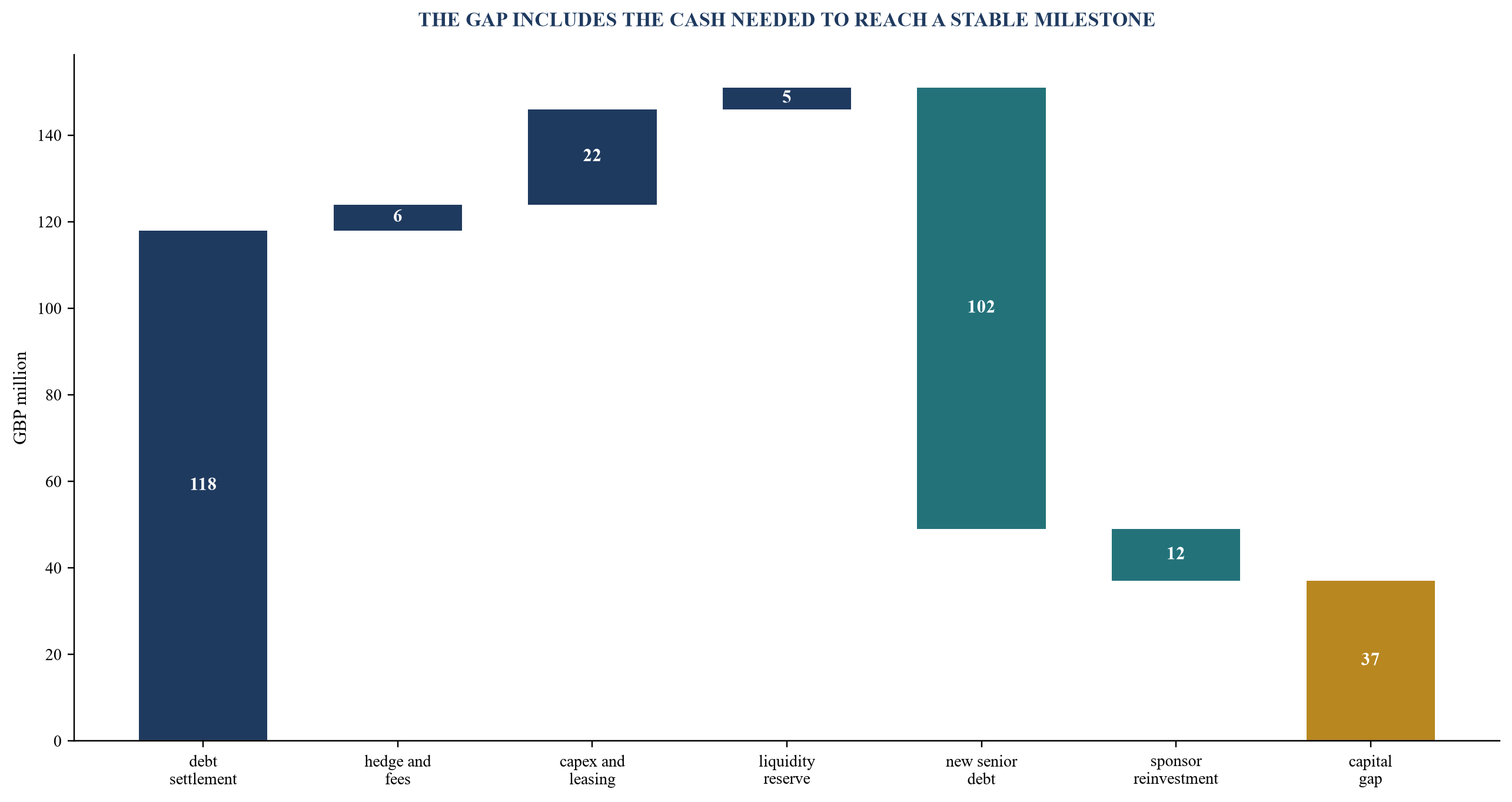
Amounts are hypothetical GBP millions and demonstrate classification rather than transaction terms.
3. Choose the instrument that funds the identified risk
Common equity absorbs full upside and downside and may suit a long-duration repositioning. Preferred equity can create a priority return and negotiated redemption path while retaining equity participation. Mezzanine debt can provide a contractual coupon, maturity and enforcement package between senior debt and equity. A whole loan can simplify intercreditor arrangements when one investor has the mandate and capability to underwrite the entire stack. A joint venture can combine local operating capability with institutional capital. A partial asset sale or sale-and-leaseback can release capital without funding the existing ownership structure.
Instrument labels do not determine economic substance. A preferred-equity instrument with a fixed return, mandatory redemption, extensive controls and limited upside can behave like junior debt. A participating loan can share equity characteristics. Legal, tax, accounting, regulatory and enforcement analysis should follow the actual rights, cash flows and risks.
The capital should be aligned to the milestone. Short-term bridge capital can fund a documented sale or refinancing process. Longer-duration preferred or common equity may fund leasing, refurbishment or development. A capital provider seeking a two-year contractual exit is poorly matched to a five-year planning and construction strategy.
Ranking and remedies require early discussion with the senior lender. Cash-pay interest, payment-in-kind accrual, cure rights, standstill, enforcement, security, permitted transfers, information, valuation and control changes can create intercreditor friction. A term sheet that ignores the senior facility can prove commercially unusable after weeks of work.
Table 2. Instrument-to-risk matching matrix
| Capital form | Risk best suited | Investor economics | Principal controls |
|---|---|---|---|
| common equity | long-duration repositioning and value creation | residual distributions and exit value | board rights, reserved matters, budget and transfer controls |
| preferred equity | defined gap with downside priority and equity option | preferred return, redemption and participation | cash sweep, priority, covenants, step-in and sale rights |
| mezzanine debt | stable asset with leverage gap and visible repayment | cash or accrued coupon, fees and repayment premium | intercreditor rights, covenants, security and enforcement |
| whole loan | integrated senior and junior underwriting | blended contractual return | full security, covenants and lender control |
| joint venture recapitalisation | sponsor capability plus external capital | negotiated waterfall and promote | governance, business plan, capital calls and exit rights |
| partial sale or asset-level disposal | deleveraging through realised value | direct asset ownership or sale proceeds | perimeter, allocation, transition and release mechanics |
Legal form, regulation, tax and accounting depend on the final terms and parties.
4. Translate the Gulf investor mandate into executable criteria
“Gulf private capital” covers sovereign-linked institutions, pension and insurance capital, family offices, private investment companies, banks, credit funds, real-estate funds and individual investors. Their return, duration, control, sector, geography, minimum cheque, Sharia, concentration, reporting, tax and governance requirements differ. A credible process records those criteria before presenting the asset.
The mandate record should identify the investment entity and decision chain. It should state whether the capital is proprietary, managed for clients or raised deal by deal. It should record required approvals, external advisers, target time, exclusivity expectations and conditions to issue a term sheet. A party that can express interest is not necessarily authorised or funded to complete.
Return should be expressed by source and currency. An investor can seek a current cash yield, preferred return, internal rate of return, equity multiple, capital protection or strategic access. The model should show whether the return comes from property cash flow, leverage, currency, sponsor promote, refinancing or exit appreciation. A high return generated mainly by an assumed yield compression requires stronger challenge than one supported by contracted cash and deleveraging.
Sharia considerations should be established at the start when relevant. The investor's adviser determines acceptable asset use, leverage, instrument, return and documentation. A structure should not be described as Sharia compliant without the required review and approval.
The process should identify any restrictions on residential, hospitality, development, operating assets, alcohol-linked tenants, gambling exposure, defence proximity, sanctions, politically exposed persons or other policy matters. Investment criteria can be narrower than legal permissibility. Early screening protects both parties from unnecessary disclosure and cost.
5. Underwrite the sponsor as carefully as the property
The sponsor is the operating counterparty, information source and first line of defence. The investor should assess historical capital contributions, realised outcomes, cost and programme performance, lender conduct, reporting quality, governance, key-person dependence, conflicts and liquidity. A valuable asset can become a weak investment when the sponsor cannot fund overruns, execute leases or provide reliable information.
Capital alignment should be measured in cash at risk after the recapitalisation. Historical equity can have been returned, impaired or represented by revaluation. The model should show cash contributed, distributions, shareholder loans, fees, related-party balances and the sponsor's proposed new money. It should also show whether sponsor fees continue ahead of the investor's preferred return.
Execution capability should be asset specific. Development expertise does not automatically establish office leasing capability. Local relationships do not substitute for technical delivery. The team, authority, external advisers, procurement, reporting and decision process should match the approved business plan.
Transparency is observable. A strong sponsor provides consistent data, explains adverse findings, reconciles changes and accepts appropriate verification. Late disclosure, inconsistent rent rolls, undocumented related-party costs or resistance to source-of-funds work should affect the score and transaction structure.
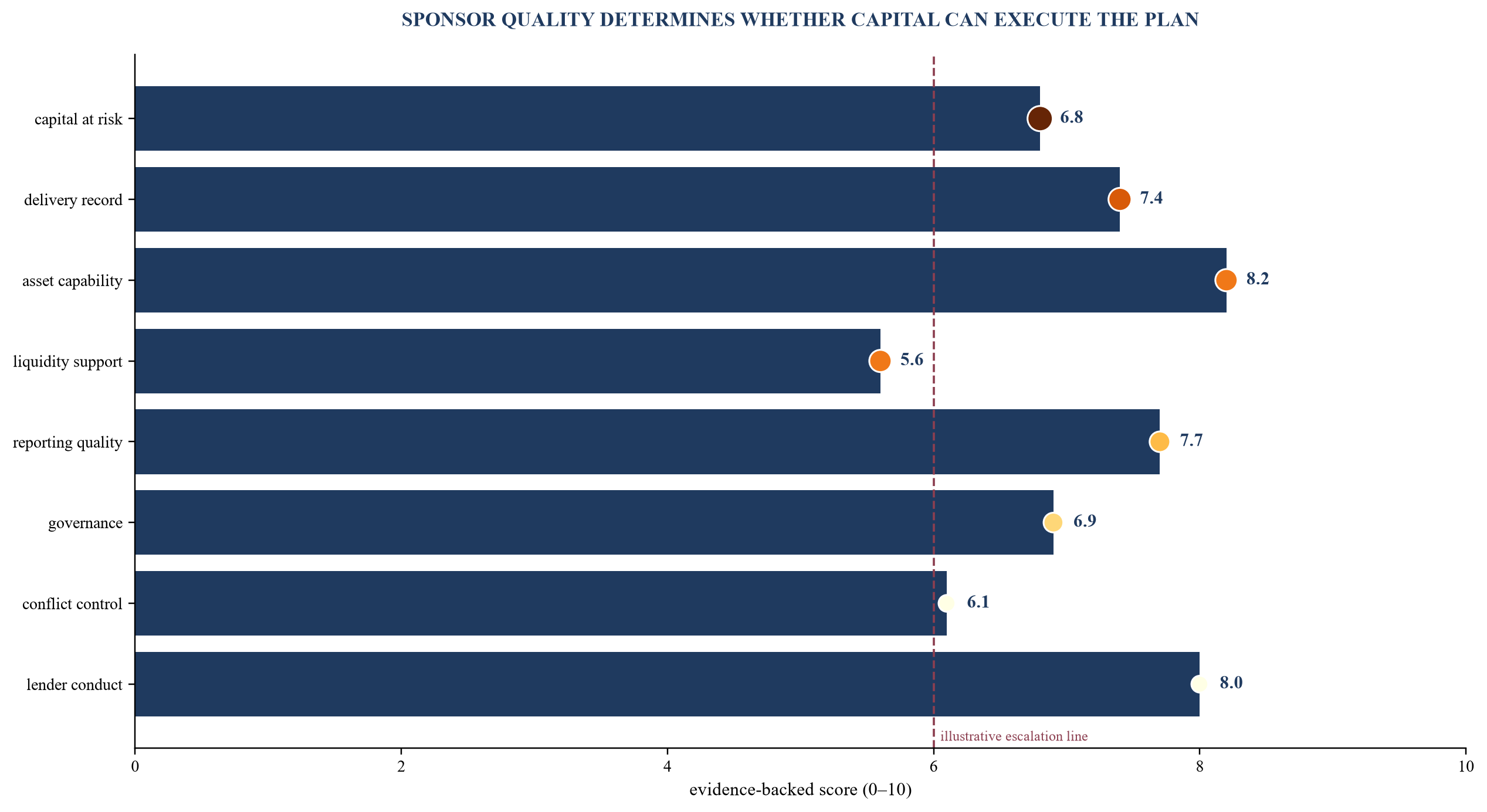
Scores and weights are hypothetical; the review requires evidence and accountable judgement.
Table 3. Sponsor evidence and downside controls
| Sponsor dimension | Evidence | Adverse indicator | Potential control |
|---|---|---|---|
| capital alignment | cash contributions, distributions, fees and proposed reinvestment | limited new money or capital funded from transaction proceeds | minimum contribution, subordination and distribution lock-up |
| delivery capability | completed projects, budgets, programmes and references | repeated delay, cost overrun or reliance on one person | approved team, key-person covenant and independent monitor |
| liquidity | bank evidence, facilities, contingent obligations and stress case | no capacity to fund agreed overruns or calls | reserve, guarantee, dilution or investor cure right |
| reporting | reconciled accounts, rent roll, capex and covenant history | unexplained changes, stale data or late lender reporting | monthly pack, audit rights and data-room covenant |
| conflicts | related parties, fees, procurement and other assets | undisclosed affiliate transactions or competing opportunities | conflict policy, approval threshold and arm's-length evidence |
| lender and stakeholder conduct | waiver history, disputes, references and compliance | unresolved defaults or weak disclosure | closing conditions, specific indemnity and enhanced oversight |
Controls should address identified risk and remain proportionate to the transaction.
6. Build the currency waterfall from property cash to investor return
The UK asset earns rent, pays costs, services debt and realises exit proceeds mainly in sterling. A Gulf investor may measure performance in US dollars or UAE dirhams. The CBUAE maintains a fixed AED/USD exchange rate, which makes GBP/USD a central economic exposure for an AED-reporting investor.[7] The asset can perform in sterling while the investor underperforms in its reporting currency.
The waterfall should state the currency of each cash flow, the investor's functional and reporting currencies, and the policy for funding, distributions and exit. It should identify whether the investment is unhedged, partially hedged, dynamically hedged or hedged only for contracted cash. The choice depends on duration, certainty, cost, collateral, liquidity and risk appetite.
Forwards and FX swaps can hedge currency or provide funding for a defined period. Cross-currency swaps can exchange principal and interest streams over longer tenors. Each instrument creates counterparty, collateral, rollover, documentation, termination and break-cost considerations. BIS work highlights the importance of foreign-currency funding risk and the obligations embedded in FX swaps and forwards.[9]
Hedge notional should follow exposure rather than invested cost alone. Capital expenditure drawdowns, debt amortisation, rent, distributions and exit proceeds change the exposure through time. An over-hedge can become speculative if an asset sale is delayed or proceeds are lower. A hedge linked to an expected exit requires a policy for timing uncertainty.
The committee should see returns in GBP and investor reporting currency, with and without the approved hedge. It should also see the cash collateral or liquidity required under stress. A hedge can stabilise value and still create a liquidity event before the underlying asset cash arrives.
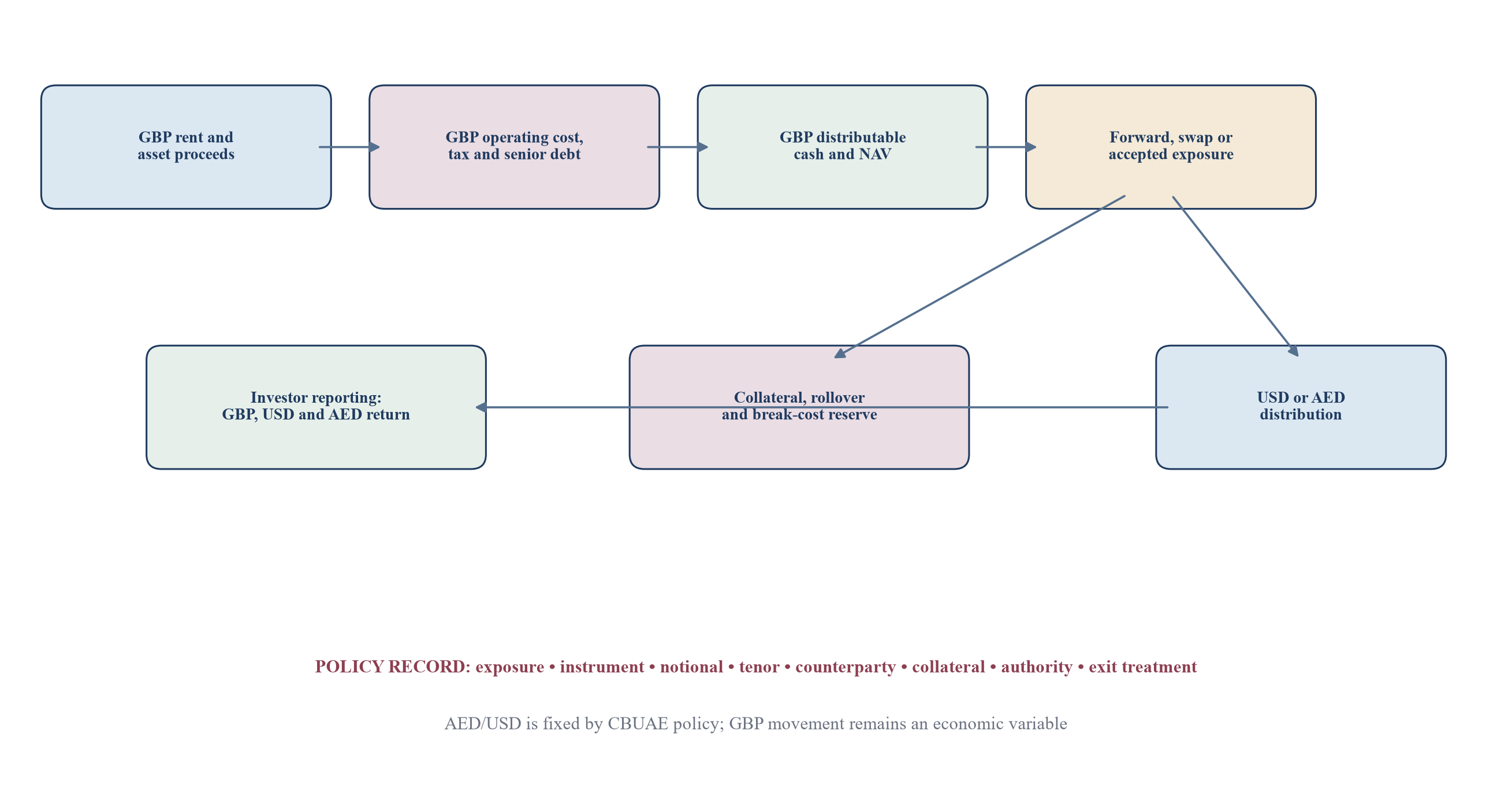
The framework is illustrative; hedge selection and accounting require qualified advice.
7. Verify ownership, source of funds and transaction legitimacy
Cross-border capital requires a complete ownership and control map. The map should identify the investor, fund, manager, general partner, limited partners where required, family holding companies, trusts, nominees, financing providers, UK acquisition vehicle, property company and sponsor. It should distinguish legal owner, beneficial owner, controller, authorised signatory, funding source and economic beneficiary.
The UK Register of Overseas Entities requires relevant overseas entities dealing with UK property or land to register and disclose registrable beneficial owners or managing officers, subject to the regime and available protections.[3] The transaction timetable should include registration, update statements, verification, overseas entity ID, Land Registry restrictions and any changes needed at closing. Filing is an operating dependency rather than a post-closing formality.
Customer diligence should cover identity, beneficial ownership, source of wealth, source of funds, sanctions, politically exposed persons, adverse information, business purpose and transaction rationale. FATF's real-estate guidance identifies property as a sector exposed to misuse and emphasises effective customer diligence and access to beneficial-ownership information.[5] The precise obligations depend on the regulated parties, jurisdictions and transaction.
Funds should move through accounts owned by verified parties and follow the agreed sources-and-uses schedule. Third-party payments, unexplained loans, late vehicle substitutions and complex circular flows require resolution. The closing process should reconcile investor subscription, debt draw, sponsor contribution, taxes, fees, lender repayment and reserve funding.
Privacy and confidentiality need governance. The data room should restrict access, record downloads, preserve legal privilege where applicable and retain only information required under the agreed policy and law. Sensitive beneficial-ownership evidence should not be distributed through ordinary marketing materials.
8. Establish the legal, regulatory and tax perimeter
The structure can involve a direct asset acquisition, UK property company, limited partnership, joint venture, offshore holding company, debt instrument or fund interest. Each route changes title, security, tax, regulation, governance, transfer, reporting and exit. The preferred structure should follow the business and investor requirements after professional analysis.
UK financial-services analysis is important when multiple investors pool contributions and do not exercise day-to-day control. FCA guidance states that property arrangements can fall within the collective investment scheme or alternative investment fund perimeter based on substance.[12] Promotion, arranging, advising, management and operation also require analysis. A transaction should not rely on labels such as club deal or co-investment to determine the regulatory outcome.
National-security screening can matter for land near sensitive sites or related to critical infrastructure. UK government guidance states that qualifying acquisitions of control over assets can be called in and that land is mainly expected to be of interest where it is or is proximate to a sensitive site, while asset acquisitions are generally not subject to mandatory notification.[6] Current legal advice should consider the asset, use, location, acquisition and investor.
Tax analysis should cover acquisition tax, rental income, interest deductibility, withholding, financing, management fees, distributions, gains, indirect disposals, group reliefs, residence, permanent establishment, treaty access, transfer pricing, anti-hybrid rules, corporate interest restriction and home-jurisdiction treatment. HMRC states that non-UK resident companies can be within Corporation Tax for UK property business and for gains on direct and certain indirect disposals of UK land.[10][11] The analysis should use the final ownership and financing terms.
Stamp Duty Land Tax depends on location, property type, consideration, buyer and reliefs. HMRC's current guidance identifies separate residential, non-residential and mixed-use rules and a two-percentage-point surcharge for certain non-resident residential purchases in England and Northern Ireland.[13][14] Scotland and Wales operate different property transaction taxes. A live model should use transaction-specific advice and current rates.
9. Price governance together with the capital
Governance determines how the business plan can change and how downside is managed. The shareholder agreement, partnership agreement, investment agreement, facility and property-management arrangements should create one coherent authority system. Reserved matters should be material, specific and workable rather than a generic list copied from another transaction.
The approved business plan should define leasing, capital expenditure, financing, hedging, insurance, development, distributions and exit. Deviations beyond agreed thresholds require approval. The investor should receive timely asset, covenant, cash, valuation, lease, capex and risk reporting. The sponsor should retain authority to operate within the plan.
Cash control should reflect ranking. Senior debt service, property costs, tax and essential capital expenditure commonly precede junior returns. Preferred returns, catch-up, sponsor promote and residual distributions should be calculated from defined cash and value concepts. The model should test whether fees or affiliate payments can leak value ahead of the investor.
Deadlock and default need separate remedies. A commercial disagreement can lead to escalation, mediation, expert determination, buy-sell or sale. A default can trigger distribution suspension, cure, step-in, removal, dilution, enforcement or mandatory sale. The remedy should match the breach and remain enforceable in the relevant jurisdictions.
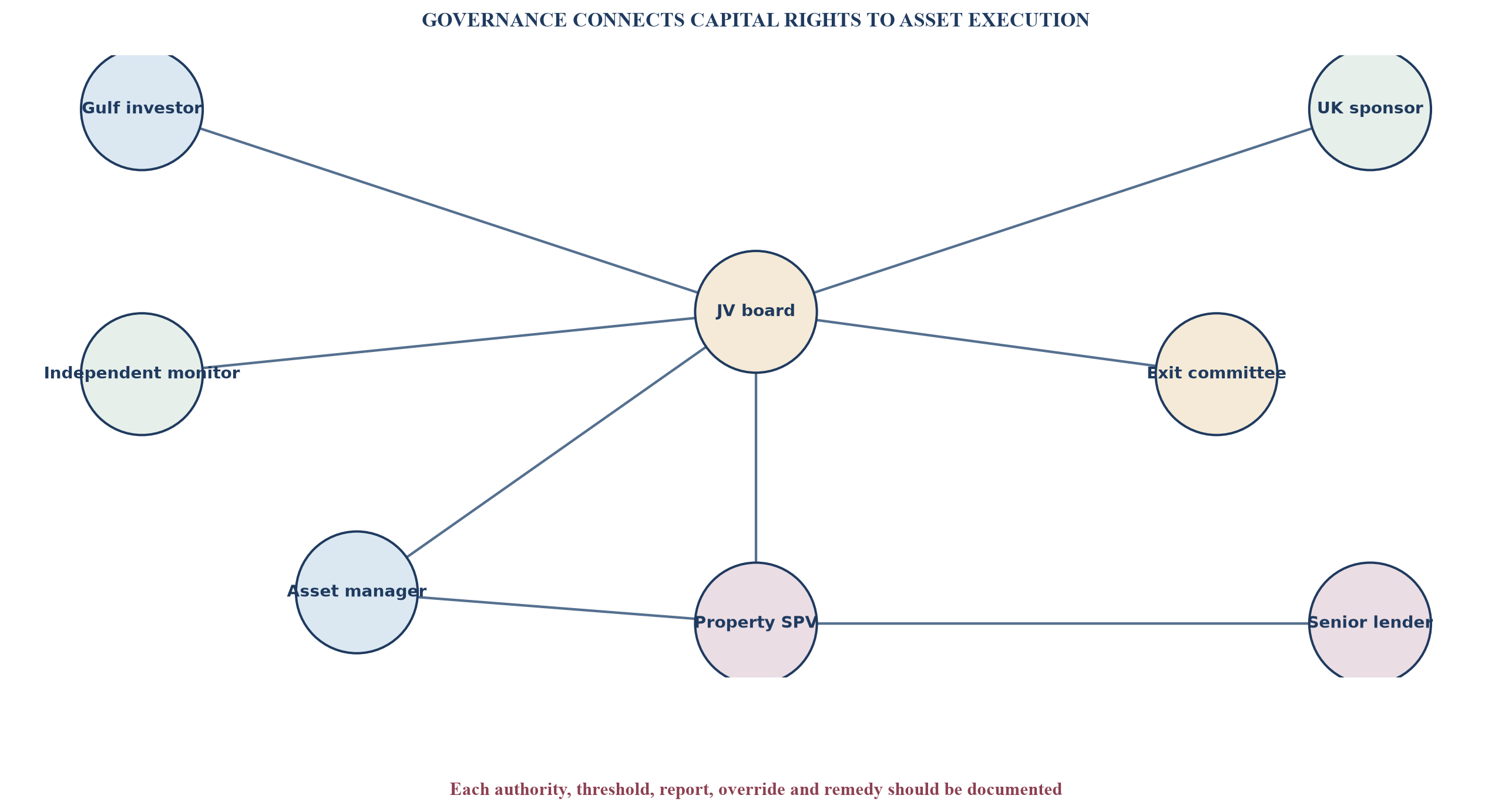
Roles are illustrative and require transaction-specific legal drafting.
Table 4. Governance decisions and evidence
| Decision | Operating authority | Investor consent trigger | Evidence pack |
|---|---|---|---|
| annual budget and business plan | sponsor proposes; board approves | initial plan and material revision | operating forecast, capex, leasing, funding and downside |
| lease and tenant action | asset manager within approved parameters | material incentive, break, concentration or related party | heads, covenant, fit-out, valuation and cash effect |
| capital expenditure | sponsor within approved packages | scope, cost or contingency beyond threshold | contract, monitor report, funding and programme |
| new financing and hedging | board within approved strategy | new security, leverage, tenor, counterparty or break cost | term sheet, model, covenant and stress case |
| distributions | property SPV after tests | any distribution outside agreed waterfall | cash statement, debt compliance, reserves and forecast |
| sale or refinancing | exit committee runs approved process | price, buyer, timing, warranty or reinvestment outside mandate | bids, valuation, tax, debt settlement and return bridge |
Thresholds should be defined in the final documents and aligned with lender rights.
10. Run an evidence-led matching and transaction process
The process should begin with a decision-ready investment memorandum rather than broad promotion. The memorandum should identify the asset, capital gap, operating plan, structure, sponsor capital, expected return range, currency, governance, risks, diligence status and transaction timetable. It should separate verified facts from modelling assumptions.
Investor screening should apply the mandate record before disclosure. The team can rank investors by strategy fit, cheque, geography, asset type, return form, duration, currency, governance, Sharia, speed, evidence of capital and relationship. A long list of names is less useful than a short list of institutions that can approve and fund the proposed structure.
The process should use controlled stages: anonymised screen, confidentiality agreement, initial memorandum, management session, data room, non-binding proposal, confirmatory diligence, binding documents, funding evidence and closing. Each stage should have an owner, required evidence and stop decision.
Competitive tension should remain credible. Investors should receive consistent information and deadlines. Material updates should reach all active parties under the process rules. The sponsor should avoid granting exclusivity before economics, funding, governance, diligence, approvals and documentation path are sufficiently clear.
The adviser should maintain a decision log. It should record contact, mandate fit, information issued, questions, diligence findings, valuation, terms, approvals, reasons for rejection and next action. This protects the process from memory bias and allows management to compare term sheets on a common basis.
11. Compare term sheets on economic value and execution certainty
Headline return and cheque size are incomplete. The comparison should include funding certainty, conditions, ranking, cash-pay burden, accrued return, participation, fees, governance, dilution, transfer, default, exit, tax assumptions, currency and timing. It should also identify which terms remain subject to committee, lender, regulatory or third-party approval.
The model should convert each term sheet into sponsor and investor cash flows under the same scenarios. A lower headline coupon can be more expensive after original issue discount, arrangement fees, exit fees, minimum return and participation. Preferred equity with a compounding return can transfer substantial value if the exit is delayed.
Execution certainty should be scored from evidence. Relevant evidence includes approved mandate, investment-committee timetable, funding source, completed diligence, adviser appointment, documentation comments, KYC progress and willingness to address lender requirements. A signed non-binding term sheet does not prove funded capacity.
The sponsor should assess downside behaviour. A structure can provide flexibility in the base case and severe control transfer in the downside. Cure rights, default interest, forced sale, removal, dilution and valuation procedures should be modelled before signing. The sponsor's residual value should be shown after each remedy.
12. Design the exit before closing the recapitalisation
Exit can occur through asset sale, portfolio sale, sponsor buyout, investor transfer, refinancing, recapitalisation, fund sale or enforcement. The documents should identify the expected route, earliest and latest dates, process control, valuation basis, rights of first offer or refusal, drag, tag, permitted transferees and treatment of an unresolved deadlock.
Exit value should be separated into operating cash flow, market yield, capital expenditure, leasing outcome, debt and currency. The model should show how much return depends on each driver. A recapitalisation intended to preserve an asset through a weak market should not assume an immediate return to the sponsor's original valuation.
Timing is economically material. Preferred returns and interest can compound while capex, tax and operating costs continue. Delay can also allow rent commencement, lease renewal, planning or asset improvement. The model should show the value of waiting and the cost of waiting under coherent scenarios.
Liquidity should be tested before the contractual exit date. If the sponsor buyout depends on new debt, the model should apply a stressed refinancing case. If the investor can force a sale, the process should allow a realistic marketing period. If an exit right can be exercised during construction or leasing, the documents should address unfinished obligations.
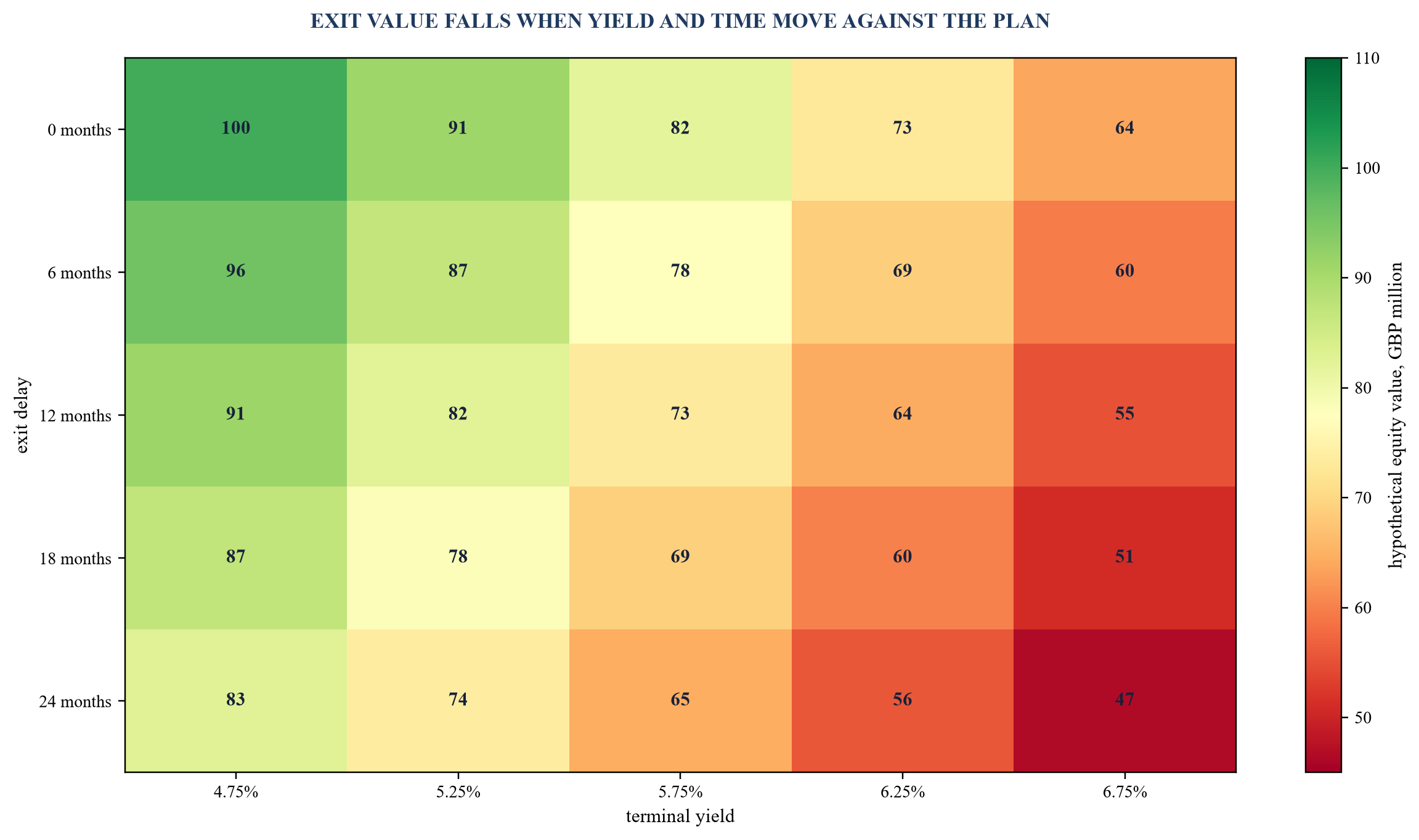
Equity values are hypothetical GBP millions and do not represent a market valuation.
Table 5. Exit-right design record
| Exit element | Decision question | Evidence | Drafting focus |
|---|---|---|---|
| target route and date | what event is expected to fund repayment or liquidity? | asset plan, market, lender appetite and buyer universe | milestone, process start and authority |
| valuation | how is value determined when parties disagree? | valuation standard, assumptions and comparable evidence | valuer appointment, basis, date and challenge |
| sponsor buyout | can the sponsor fund the price under a stressed case? | funding plan, debt capacity and liquidity | notice, deposit, completion and failure remedy |
| investor transfer | who can acquire the interest and on what conditions? | regulatory, sanctions, lender and governance analysis | permitted transferee, consent and adherence |
| drag and forced sale | when can a sale be required and how is it run? | process design, minimum evidence and marketing period | price protection, warranties and cooperation |
| unfinished plan | who funds and manages obligations during exit? | capex, leases, contracts and reserves | funding calls, holdback, transition and liability |
Enforceability, tax and regulatory treatment require transaction-specific advice.
13. Worked hypothetical recapitalisation
Consider a hypothetical UK mixed-use asset financed with £118 million of senior debt approaching maturity. The asset is operational, while a refurbishment and leasing programme requires further capital. The closing bridge includes £6 million for hedge settlement and transaction costs, £22 million of capital expenditure and leasing, and a £5 million liquidity reserve. A new senior lender is assumed to advance £102 million, and the sponsor contributes £12 million. The resulting illustrative gap is £37 million.
The diagnosis finds that part of the gap is structural and part is milestone related. Current cash flow supports less leverage than the maturing facility. Signed leasing activity and the refurbishment can improve income over time, while execution and market risk remain. The proposed capital therefore needs a multi-year duration and cannot rely solely on a short bridge to an immediate valuation recovery.
Three structures are modelled: mezzanine debt, preferred equity and joint-venture common equity. The mezzanine case has contractual cash and accrued return but creates a high fixed burden and intercreditor complexity. Preferred equity provides cash flexibility and a priority return, while delay compounds the redemption amount. Common equity shares more downside and upside, while requiring deeper governance and sponsor dilution.
The Gulf investor screen identifies a preference for income-producing UK assets, a minimum cheque compatible with the gap, a five-year maximum hold, USD reporting, board representation, material reserved matters, verified beneficial ownership and a defined exit process. The asset use passes the initial policy screen. Sharia review is treated as an investor-specific condition rather than assumed.
The sponsor scorecard is strongest on asset expertise, lender conduct and delivery evidence. Liquidity support and conflict controls score lower. The proposed term sheet therefore requires the sponsor's £12 million contribution at closing, an approved related-party policy, a funded contingency, monthly reporting, independent capital-expenditure monitoring and investor cure rights.
The currency model presents GBP and USD returns. Contracted near-term distributions are partially hedged, while exit value is shown under unhedged and rolling-hedge scenarios. The committee also sees collateral and break-cost sensitivities. These are hypothetical design choices and not a recommendation for a live hedge.
Exit sensitivity shows that a higher terminal yield and delay can materially reduce equity value while increasing the preferred return. The documents therefore start the refinancing or sale process before the long-stop date, require a credible marketing period and provide a sponsor buyout route supported by funding evidence.
The decision is to advance the preferred-equity and common-equity structures for investor discussion, subject to legal, tax, regulatory, technical, valuation, KYC and senior-lender work. The output is a controlled transaction path rather than a claim that capital is committed.
14. Implementation roadmap and transaction controls
The first phase is a two-week diagnostic. The sponsor reconciles debt, hedge, title, ownership, leases, cash, valuation, capex, tax and business plan. The adviser constructs the capital-gap bridge, identifies hard conditions and prepares the investor-mandate screen. Management approves the capital need, acceptable instruments, governance boundaries and stop criteria.
The second phase creates the investment package and controlled target list. The package includes the evidence-based asset case, sponsor record, currency policy, proposed structure, scenario model, source-and-use schedule and diligence index. Investor selection follows mandate fit and verified ability to execute.
The third phase runs engagement and non-binding proposals. The team controls confidentiality, data-room access, Q&A, management sessions and consistent information. It evaluates term sheets on economic value and execution certainty. Senior-lender and regulatory issues are tested early.
The fourth phase completes confirmatory diligence and binding documents. Workstreams cover property, leases, planning, environment, technical, valuation, tax, structuring, regulation, KYC, sanctions, funding, insurance, currency, governance and exit. Findings should change price, structure, protection, plan, condition or the decision to stop.
The fifth phase closes and transitions into asset governance. The closing statement reconciles every source and use. Security, accounts, filings, registrations, hedge, authorities, reporting and asset-management contracts become effective. The first board meeting confirms the budget, 100-day priorities, risk register and covenant calendar.
Monitoring should compare the approved plan with occupancy, rent, capex, programme, valuation, debt, hedge, liquidity and exit readiness. Changes should have an owner, decision right and recorded rationale. The investor and sponsor should know when a variance triggers information, consent, reserve, cure or a revised exit plan.
15. Limitations and conclusion
This framework cannot determine whether a particular asset or investor is suitable. Market, property, funding, tax, regulation, sanctions, currency, title, planning, technical and counterparty facts can change. Public evidence describes broad conditions and legal frameworks rather than an executable transaction conclusion.
Cross-border capital introduces additional dependencies. Beneficial-ownership information can be incomplete or require protection. Investor mandates can change. Senior lenders can refuse intercreditor terms. Currency hedges can require collateral. Tax treatment can differ across direct and indirect ownership. Exit rights can be difficult to exercise during a weak market.
The framework improves decision quality by forcing the parties to reconcile the capital gap, match the instrument to the risk, evidence the sponsor and investor mandate, price currency and governance, complete ownership checks, compare terms consistently and design the exit before closing. These disciplines do not guarantee a financing or investment outcome.
A credible recapitalisation connects property truth to capital truth. The asset case explains how value is protected and created. The sources-and-uses bridge shows the exact funding requirement. The investor mandate establishes fit. Governance allocates authority and downside protection. The currency policy translates sterling cash into the investor's return. The exit converts the plan into a timed liquidity path. Together, these elements create an investment-committee decision that can be challenged, documented and executed.
References
- Bank of England, Financial Stability Report, July 2026. https://www.bankofengland.co.uk/financial-stability-report/2026/july-2026
- Bank of England, Agents' summary of business conditions, July 2026. https://www.bankofengland.co.uk/agents-summary/2026/july-2026
- UK Government and Companies House, Register of Overseas Entities. https://www.gov.uk/government/collections/register-of-overseas-entities
- Financial Action Task Force, The FATF Recommendations, updated June 2025. https://www.fatf-gafi.org/en/publications/Fatfrecommendations/Fatf-recommendations.html
- Financial Action Task Force, Risk-based Approach Guidance for the Real Estate Sector, July 2022. https://www.fatf-gafi.org/en/publications/Fatfrecommendations/Guidance-rba-real-estate-sector.html
- UK Government, National Security and Investment Act 2021 statement for the purposes of section 3. https://www.gov.uk/government/publications/national-security-and-investment-statement-about-exercise-of-the-call-in-power/national-security-and-investment-act-2021-statement-for-the-purposes-of-section-3
- Central Bank of the UAE, Domestic Market Operations: Foreign Exchange Operations. https://centralbank.ae/en/our-operations/monetary-policy-and-domestic-markets/domestic-market-operations/
- Bank of England, Exchange rates. https://www.bankofengland.co.uk/statistics/exchange-rates
- Bank for International Settlements, Foreign currency funding risk and cross-border liquidity, CGFS Papers No. 71, March 2026. https://www.bis.org/publ/cgfs71.pdf
- HM Revenue & Customs, Company Taxation Manual CTM34210: non-resident companies and liability to Corporation Tax. https://www.gov.uk/hmrc-internal-manuals/company-taxation-manual/ctm34210
- HM Revenue & Customs, Capital Gains Tax and Corporation Tax: taxing gains made by non-residents on UK immovable property. https://www.gov.uk/government/publications/changes-to-taxing-gains-made-by-non-residents-on-uk-immovable-property/capital-gains-tax-and-corporation-tax-taxing-gains-made-by-non-residents-on-uk-immovable-property
- Financial Conduct Authority, PERG 11: Property investment clubs and land investment schemes. https://handbook.fca.org.uk/handbook/perg11
- HM Revenue & Customs, Stamp Duty Land Tax overview. https://www.gov.uk/stamp-duty-land-tax/overview
- HM Revenue & Customs, Rates of Stamp Duty Land Tax for non-UK residents. https://www.gov.uk/guidance/rates-of-stamp-duty-land-tax-for-non-UK-residents
- International Valuation Standards Council, International Valuation Standards, effective 31 January 2025. https://ivsc.org/standards/
- IFRS Foundation, IFRS 13 Fair Value Measurement. https://www.ifrs.org/issued-standards/list-of-standards/ifrs-13-fair-value-measurement/
- Royal Institution of Chartered Surveyors, RICS Valuation: Global Standards. https://www.rics.org/profession-standards/rics-standards-and-guidance/sector-standards/valuation-standards/red-book
- Financial Action Task Force, Beneficial Ownership. https://www.fatf-gafi.org/en/topics/beneficial-ownership.html
- UK Government, National Security and Investment Act 2021 guidance on compliance and enforcement. https://www.gov.uk/government/publications/national-security-and-investment-act-2021-guidance-on-compliance-and-enforcement
- Bank for International Settlements, BIS Quarterly Review, December 2025, explanation of FX swaps and hedging. https://www.bis.org/publ/qtrpdf/r_qt2512.pdf
