

1. Define the cross-border talent thesis
The cross-border talent thesis states which human capabilities must remain available for the transaction to achieve its approved outcomes. It links people to revenue, customers, products, operations, licences, cash, control, safety and integration. It begins before signing, when findings can still change price, structure, contractual protection, closing conditions and the operating plan.
The thesis should answer seven questions. Which business outcomes carry the value case? Which roles and networks produce or protect those outcomes? Which individual holders are exposed to departure, distraction or loss of authority? Which legal and mobility constraints affect continuity? What intervention is proportionate? Which successor and knowledge-transfer path reduces concentration? Which evidence will show that continuity and value have been protected?
The word talent can obscure accountability. A high performer is not automatically transaction-critical. A modestly graded role can be critical because it holds a licence, customer relationship, control approval, operational routine or specialised system knowledge. The thesis therefore starts with roles and value pathways before naming people. Individual assessment then considers performance, conduct, potential, availability and departure risk through authorised evidence and appropriate privacy controls.
The output is a talent-to-value register. Each material role records business outcome, loss pathway, incumbent, geographic and legal perimeter, decision rights, knowledge concentration, successor readiness, mobility dependency, flight risk, intervention, cost, accounting path, communication owner and evidence of continuity. The register supports investment-committee and board decisions without becoming a broad employee-ranking exercise.
Table 1. Evidence states in the cross-border talent thesis
| Evidence state | Minimum record | Permitted decision | Governance requirement |
|---|---|---|---|
| role hypothesis | business outcome, role and assumed dependency | commission diligence | exclude personal conclusion |
| supported role criticality | service, revenue, control or licence evidence | prioritise role | accountable business reviewer |
| individual continuity assessment | authorised performance, intent and constraint evidence | design intervention | privacy, fairness and challenge |
| approved retention response | value-at-risk, cost, terms and authority | make controlled offer | legal, tax and accounting review |
| mobility and transfer readiness | permits, employment route, benefits and timing | confirm closing or Day 1 plan | jurisdiction owner and evidence |
| verified continuity | role operating, successor progressing and transfer complete | reduce or close intervention | board-approved evidence and residual risk |
Individual conclusions require authorised evidence, appropriate privacy controls and management judgement.
2. Translate the transaction value case into critical outcomes
A deal team should freeze the transaction value case before it evaluates critical roles. The baseline includes stand-alone revenue, customer concentration, product roadmap, operational resilience, licences, regulated functions, financial controls, synergies, separation dependencies and integration decisions. Each outcome receives an accountable executive and a time horizon.
Critical outcomes vary by transaction. A software acquisition may depend on product architecture, release authority, security response and a handful of customer relationships. A healthcare roll-up may depend on clinicians, registrations, claims, referral networks and rota coverage. An infrastructure acquisition may depend on dispatch, maintenance, safety, permit and government-interface roles. A fund-manager acquisition may depend on investment decision makers, track-record attribution, key-person clauses and limited-partner relationships.
The team should distinguish value protection and value creation. Preserving a licence, customer renewal, safe operation or financial close protects the base business. Cross-selling, procurement, product acceleration or new-market entry may create incremental value. Retention interventions should state which pathway they support. Prevented loss should not be added mechanically to synergy benefits.
Timing matters. A role can be critical until a closing condition is met, through a six-month customer renewal cycle, during a two-year product migration or until a successor is licensed. The thesis should specify the dependency window rather than treating criticality as permanent. This supports targeted cost and succession.
3. Build the critical-role and relationship map
The critical-role map connects business outcomes to roles, decision rights, knowledge, relationships and substitutes. It should include formal authority and informal coordination. A person may hold no senior title while remaining the only individual who understands a configuration, regulator expectation, plant exception, customer history or investment process.
Role criticality can be assessed through five dimensions: consequence of loss, time to impact, substitution difficulty, knowledge concentration and external dependency. Consequence covers revenue, cash, customer, safety, licence, control and execution. Time to impact asks how quickly departure affects the business. Substitution difficulty considers internal successors, labour supply, location, language, qualification and relationship transfer. Knowledge concentration and external dependency capture tacit knowledge, regulators, customers, suppliers and partners.
The map should show networks rather than isolated people. Revenue can depend on an account leader plus solution engineer, delivery manager and executive sponsor. A regulated operation can depend on the licence holder, deputy, control team and external authority. A founder can coordinate product, customer and culture through one relationship web. Retaining one person while the supporting network leaves may preserve cost without preserving capability.
The team should verify key-person clauses, regulated-role designations, signing authorities, intellectual-property obligations, customer contacts, supplier dependencies, committees, succession plans and current vacancies. Management interviews should be reconciled with operating evidence. A name repeated in interviews is a signal for examination rather than proof of criticality.
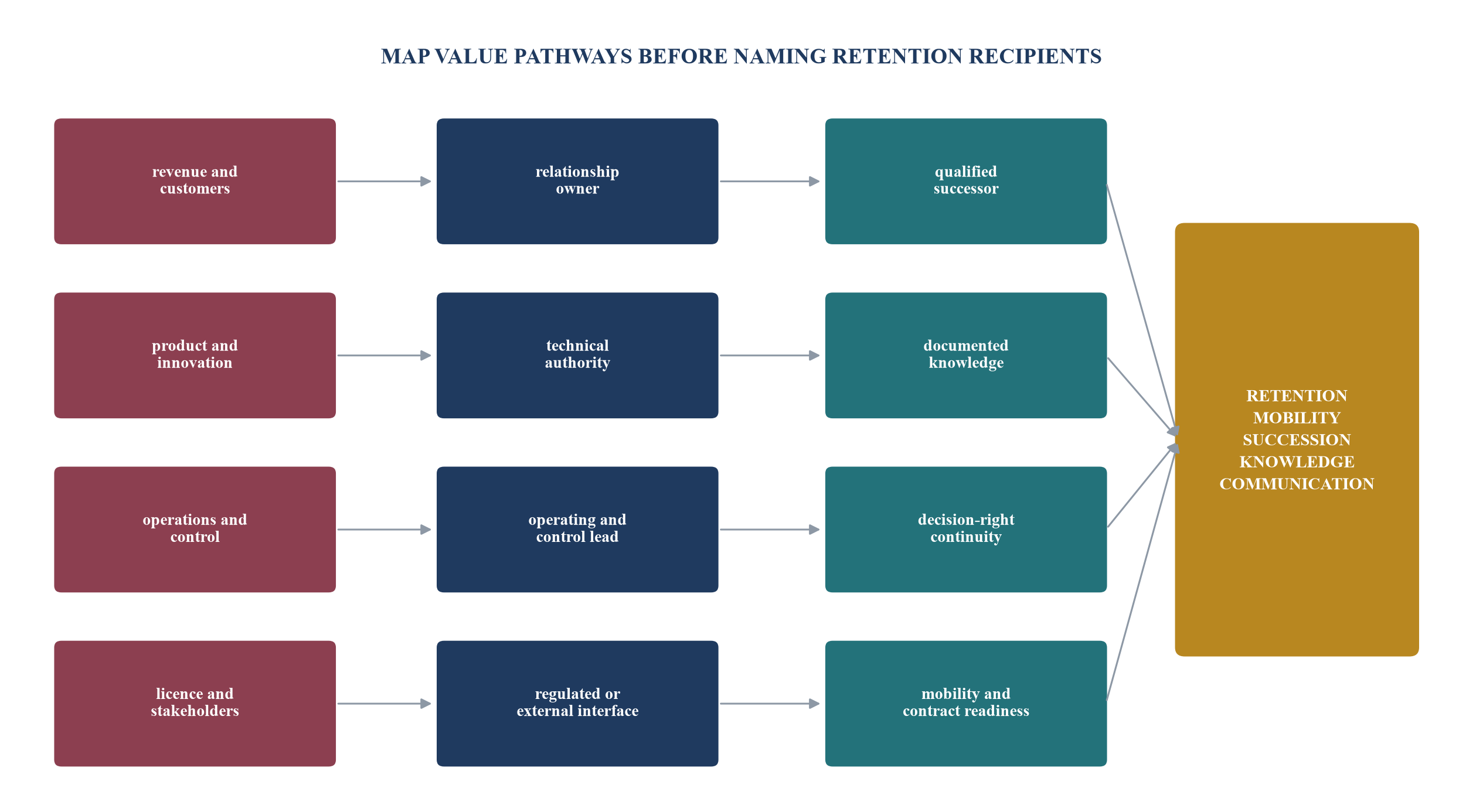
Criticality follows the business outcome, role network and substitution path rather than hierarchy alone.
Table 2. Critical-role classification standard
| Dimension | Core question | Evidence | Typical transaction response |
|---|---|---|---|
| loss consequence | what value, control or licence fails? | revenue, service, risk or approval record | protect outcome and assign executive owner |
| time to impact | how quickly does absence matter? | operating calendar and dependency | accelerate contact and cover |
| substitution difficulty | who can perform the role and when? | successor, labour market and qualification | develop, hire or procure capacity |
| knowledge concentration | what cannot be retrieved or taught quickly? | process, system, customer and decision evidence | structured transfer and documentation |
| relationship concentration | whose trust or access is personal? | customer, regulator, supplier or partner map | joint coverage and staged handover |
| mobility constraint | can the holder lawfully perform where needed? | permit, role, location and timing | jurisdiction-specific mobility gate |
Scores support prioritisation; accountable judgement and evidence determine the live conclusion.
4. Separate role criticality, incumbent quality and flight risk
Criticality belongs to the role and value pathway. Incumbent quality concerns the person's demonstrated performance, conduct and capability. Flight risk concerns the probability and timing of departure or disengagement. These dimensions can intersect while remaining analytically distinct. A critical role with weak incumbent performance may require transition rather than retention. A high performer in a non-critical role may merit normal reward without a transaction-specific award.
Flight-risk evidence should be specific and authorised. Relevant signals can include contractual expiry, unvested reward, location preference, family mobility, role ambiguity, duplicated authority, external demand, prior stated intent, founder identity, cultural fit, workload, reporting change and confidence in the transaction. Demographic proxies, hearsay and protected characteristics should not drive conclusions. Legal and HR review should define permissible data and process.
The team should assess both voluntary and transaction-induced risk. A person may remain employed while withdrawing discretionary effort, delaying decisions or protecting a legacy team. Authority loss can be as consequential as departure. The future role, decision rights, resources and strategic meaning should therefore be addressed alongside money.
Risk can change through the deal cycle. Rumour, announcement, regulatory delay, competing offers, leadership selection and integration decisions create inflection points. The register should include risk date, evidence confidence, trigger and next contact. A static colour assigned during diligence can become misleading within days.
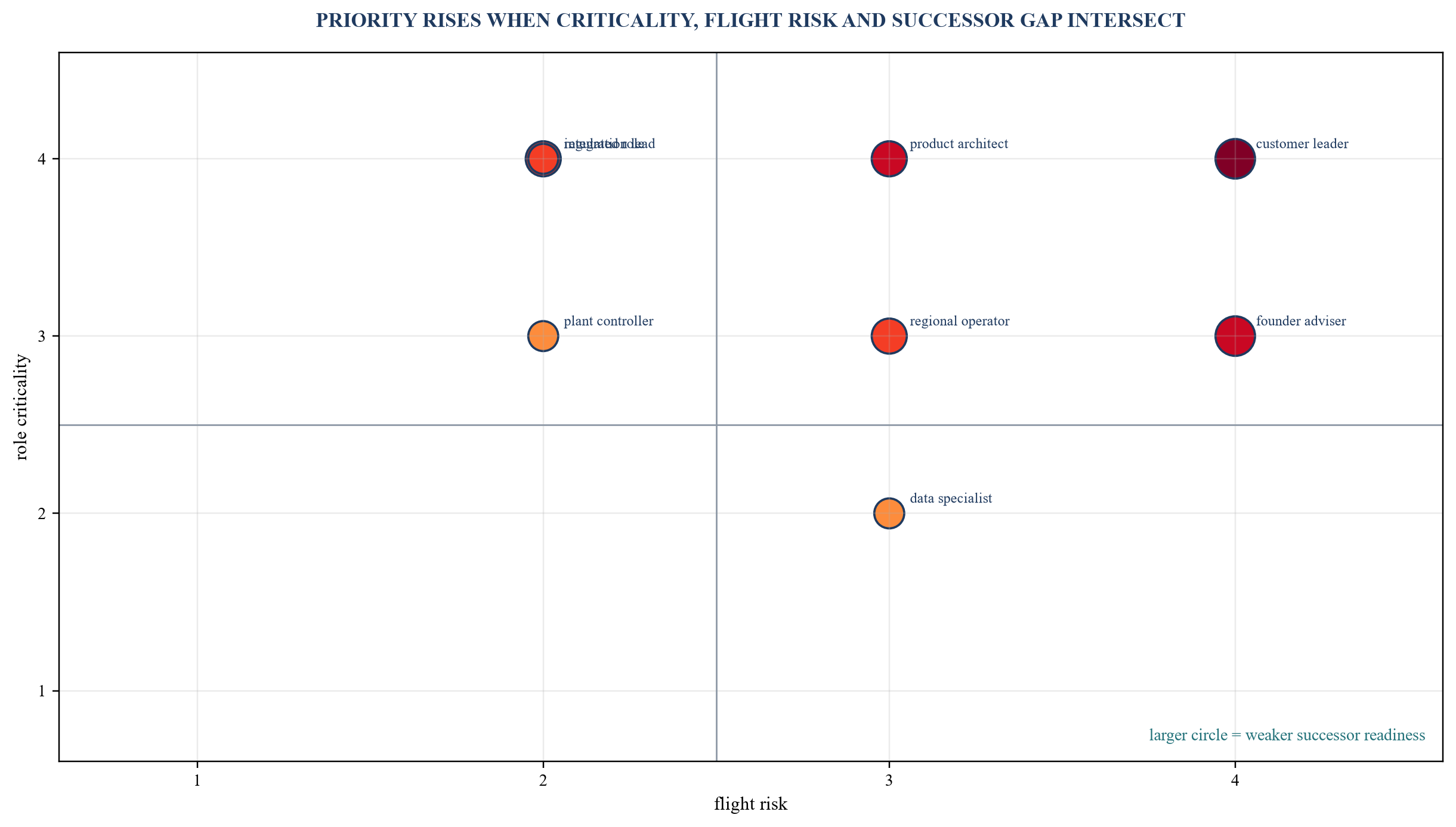
Scores are hypothetical. Individual decisions require authorised evidence, fairness review and accountable judgement.
5. Model retention economics
Retention economics compares the cost and behavioural effect of an intervention with credible value-at-risk pathways and available substitutes. It is not a simple percentage of salary or transaction value. The model should identify the business outcome, loss event, probability range, timing, mitigation, replacement lead time, transition cost, revenue or control effect and residual risk after intervention.
The value-at-risk pathway can include customer loss, delayed product release, operational disruption, licence breach, investment restriction, control failure, project delay, recruitment, relocation, contractor cost and management distraction. The model should distinguish one-time cash, recurring compensation, share-based expense, transition cost and potential value protection. It should also identify benefits already reflected in the transaction forecast.
Retention awards do not guarantee retention or performance. A recipient can remain until vesting and depart immediately afterward. An award can create perceived unfairness, crowd out intrinsic commitment or delay succession. The economic case should therefore compare a cash or equity award with role redesign, authority, promotion, succession, knowledge transfer, team retention, contractor support and external hiring.
Scenario analysis is more credible than false precision. The board can compare no intervention, targeted intervention and accelerated replacement. The model should show cost, likely continuity window, residual exposure and decision trigger. A modest intervention may be justified for a time-limited transition even when long-term succession remains the intended outcome.
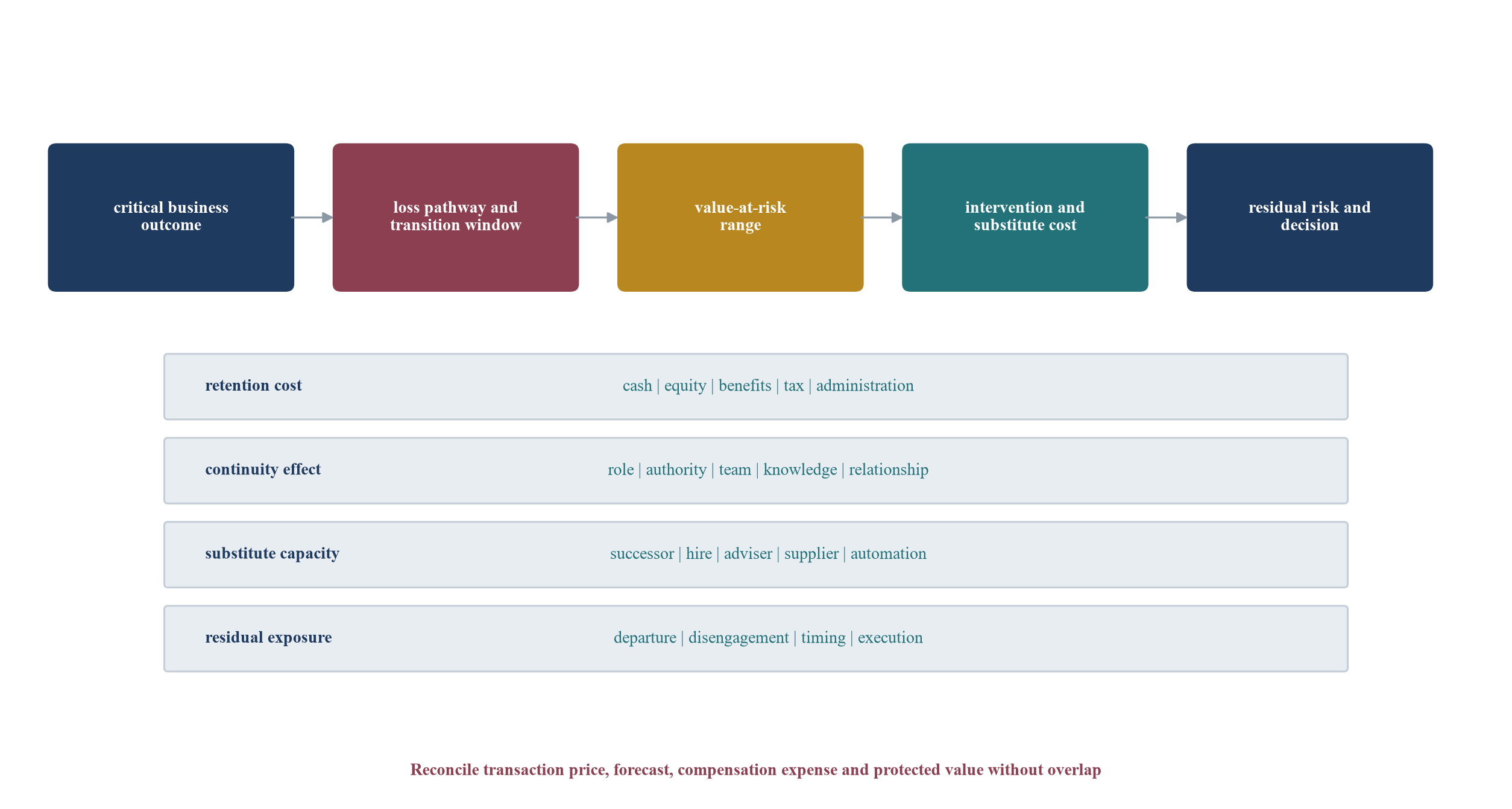
Value-at-risk and probability inputs are hypothetical; live models require deal-specific evidence.
Table 3. Illustrative retention economics scenarios
| Scenario | Two-year cash and equity cost | Continuity assumption | Residual exposure | Decision use |
|---|---|---|---|---|
| no transaction intervention | USD 0.0m | normal contractual position | high for concentrated roles | baseline and trigger monitoring |
| targeted critical-role plan | USD 2.4m | 12-24 month role and transfer commitments | medium, dependent on engagement | compare with value-at-risk pathways |
| broad retention pool | USD 7.5m | wider coverage with weaker precision | medium and potential fairness effects | test whether coverage adds continuity |
| accelerated succession and hiring | USD 3.8m | early duplicate capacity and knowledge transfer | lower after successor validation | use where concentration is structural |
| targeted plan plus successor build | USD 4.6m | protected transition and reduced concentration | lowest after verified transfer | preferred where value and timing support cost |
Amounts and probabilities are hypothetical modelling inputs, not benchmarks or recommendations.
6. Define the employment-transfer perimeter
Share acquisitions, asset transfers, mergers, carve-outs and service transfers can produce different employment consequences. The deal team should map each legal entity, employing entity, work location, employee group, collective arrangement, representative body, contract, benefit plan, secondment and proposed transfer route. Counsel determines whether employment transfers automatically, requires consent, terminates and rehires, or remains with a seller under transitional arrangements.
EU Directive 2001/23/EC addresses safeguarding employee rights for covered transfers of undertakings and includes rules concerning employment relationships and information or consultation.[4] National implementation determines the live result. UK government TUPE guidance states that, within scope, the new employer takes over employment contracts and identifies information and consultation obligations.[5] The exact application depends on the transaction and workforce.
UAE Federal Decree-Law No. 33 of 2021 and its amendments govern relevant private-sector labour relationships at federal level, with exemptions and separate regimes requiring analysis.[6] Free-zone, sector and immigration rules can add requirements. The US WARN Act can create notice obligations in covered plant closings and mass layoffs; Department of Labor guidance explains treatment of seller and buyer employees in business sales for WARN purposes.[7]
The transaction register should capture continuity of service, accrued leave, bonus, commission, pension, end-of-service benefit, severance, restrictive covenants, intellectual property, confidentiality, consultation, notice, union or works-council rights and employee claims. This is a legal and financial diligence process as well as a retention process. An apparently attractive future role cannot cure an unlawful or incomplete transfer.
7. Build the cross-border mobility gate
Cross-border continuity requires more than willingness to relocate. The mobility gate covers work authorisation, residence, role and salary eligibility, employer sponsorship, dependent status, family timing, regulated qualification, tax residence, payroll, social security, benefits, healthcare, housing, schooling, travel, data access and permanent-establishment concerns. Specialists determine the live route.
The deal team should map current and proposed employer, work location, travel pattern, job duties, reporting line, entity relationship and expected start date. Changes in ownership or employing entity can affect an existing immigration basis. USCIS L-1 guidance, for example, requires evidence of a qualifying organisational relationship and other eligibility facts; transaction teams should assess changes with authorised US immigration counsel.[8]
Mobility should be designed around the business need. Some knowledge can transfer through structured visits, secondment, remote access or a successor programme. Regulated, customer-facing or operational roles may require physical presence. The model should compare legal feasibility, time, cost, employee preference and family impact.
Closing conditions should avoid dependency on an unverified permit timetable. The plan can use a substitute role holder, interim authority, transitional service, remote working within legal limits or phased responsibility. Each route needs a deadline, owner, evidence and fallback.
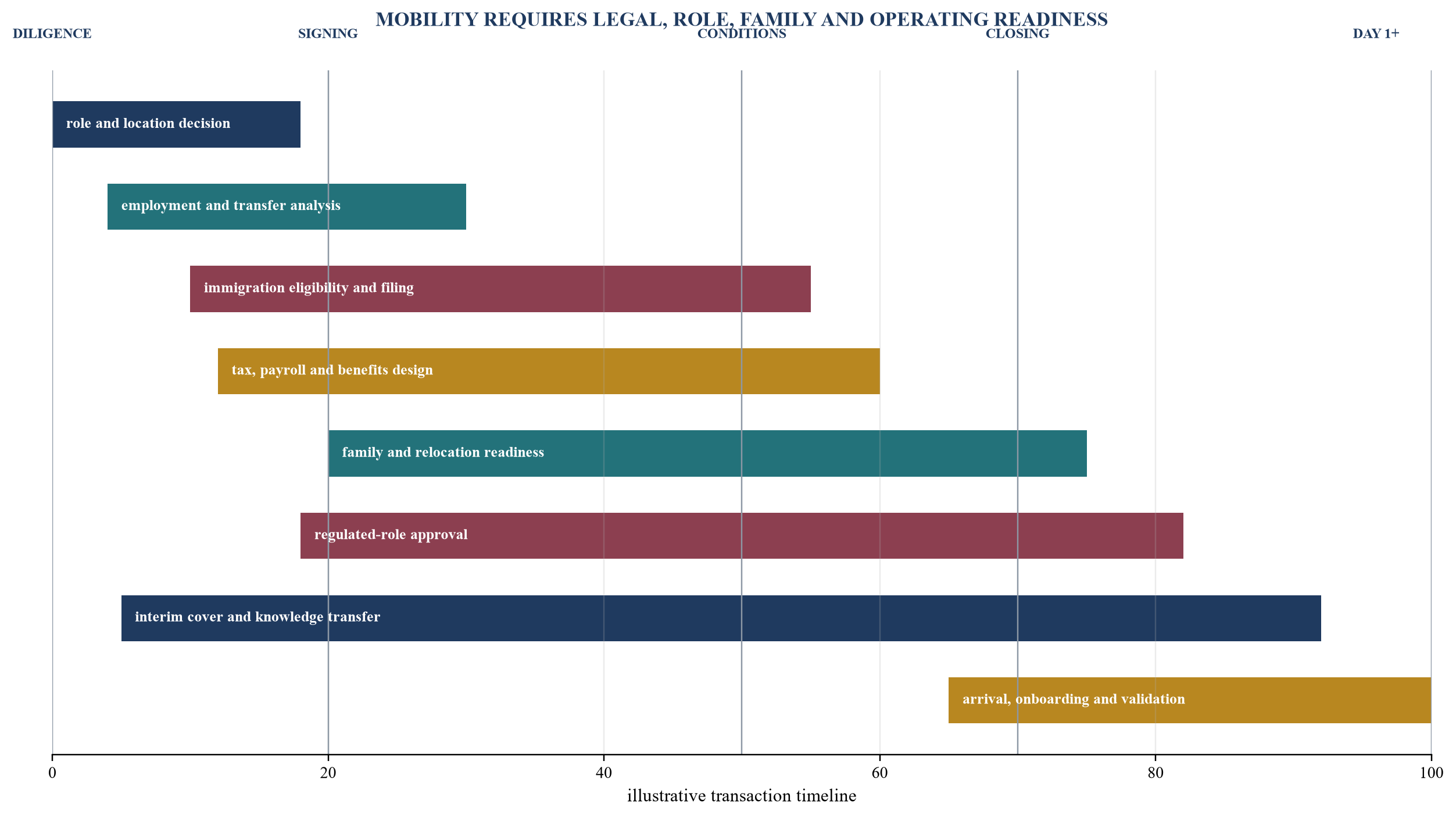
Timing is hypothetical; authorities, jurisdictions and individual circumstances determine live outcomes.
Table 4. Cross-border employment and mobility register
| Gate | Minimum evidence | Timing | Fallback |
|---|---|---|---|
| employment-transfer route | entity, transaction form, contract and counsel conclusion | before signing treatment is fixed | alternative employer or transitional arrangement |
| work authorisation | role, employer, location, eligibility and filing evidence | before work begins | interim cover or lawful remote route |
| regulated role | qualification, approval, fit and proper or licence record | before authority transfers | deputy or authorised interim holder |
| tax and payroll | residence, withholding, payroll, social security and benefit analysis | before compensation is paid | local payroll or compliant secondment |
| family mobility | dependants, healthcare, housing, school and timing plan | before commitment date | phased move or travel plan |
| data and systems access | location, role, transfer and security approval | before access is granted | restricted environment or clean-room access |
Each row requires jurisdiction-specific professional review and current authority evidence.
8. Design retention architecture around the role outcome
Retention architecture combines role, authority, reward, development, team, location and transition. A cash award can support a time-bound commitment. Equity can align longer-term value when terms, tax and accounting are suitable. Role clarity and decision rights can be more important than award size for senior or founder talent. Team interventions can preserve a capability that would fail if only one person stayed.
The plan should define eligibility, objective, service period, performance condition, payment timing, good-leaver and bad-leaver treatment, change of role, location, termination, clawback, confidentiality, restrictive covenant, dispute route and approval. Terms require jurisdiction-specific legal, tax and enforceability review. The communication should explain what is offered and what remains subject to approval.
The intervention should avoid creating permanent concentration. Every critical-role plan includes a successor, deputy, knowledge-transfer or capacity-build workstream. The recipient can have explicit responsibilities for documentation, joint customer coverage, training, access transfer and delegation. Payment can be aligned with lawful, measurable transition outcomes where appropriate.
Fairness matters. A restricted award pool can affect trust if selection appears arbitrary. The governance record should state the transaction rationale, consistent criteria, diversity and protected-characteristic review, conflicts, approvals and communication boundaries. Individuals outside the pool still need role clarity and normal reward management.
9. Treat founder and selling-shareholder arrangements carefully
Founders and selling shareholders can be essential to customer trust, product direction, licences, fund relationships and knowledge transfer. Their transaction consideration, earn-out, employment, consulting, non-compete, property, intellectual property and retention arrangements should be analysed together. Commercial negotiation, legal enforceability, tax and accounting can produce different classifications.
IFRS 3 includes indicators for assessing payments to selling shareholders who become employees. Its application guidance states that an arrangement in which contingent payments are automatically forfeited if employment terminates is remuneration for post-combination services unless the service condition is not substantive.[9] IFRS 2 addresses share-based payment, while IAS 19 addresses employee benefits outside IFRS 2.[10][11] Accounting specialists determine classification and measurement from the live terms.
The transaction model should separate purchase consideration, post-combination remuneration, transition service, non-compete and other arrangements. This protects forecast integrity and avoids describing an employee cost as purchase price or vice versa. It also clarifies which amount supports retention and which compensates ownership transfer.
Founder role design should include decision rights, reporting, reserved matters, product authority, customer interface, hiring, budget, board role and transition. Ambiguity can create conflict and flight risk for the founder and team. A staged authority map can preserve value while moving the business toward the intended operating model.
10. Protect clean-team, competition and employee-data boundaries
Pre-closing talent planning can involve competitively sensitive information, personal data and employment decisions. Counsel should define clean-team membership, permitted fields, aggregation, access, storage, meeting protocol, decision timing and destruction or transfer. The buyer should not direct the target's workforce before lawful control transfers.
The 2023 US Merger Guidelines describe evidence and analytical frameworks used in merger review, including labour-market considerations.[15] The deal team should obtain current competition advice for information exchange, recruitment, no-poach, wage and integration planning. Clean-team controls should be operational rather than ceremonial.
The EU General Data Protection Regulation governs personal-data processing within its scope and includes purpose, minimisation, security, rights and transfer requirements.[13] Other jurisdictions add privacy and employment-data rules. The talent register should collect only data required for authorised decisions, define retention and access, and separate broad role analysis from restricted individual evidence.
Automated scores require caution. A flight-risk model can reproduce biased history, rely on intrusive signals or create decisions the team cannot explain. Human accountability, data provenance, lawful purpose, validation and appeal routes should be explicit. A score should trigger review rather than determine an employment outcome.
11. Establish signing and closing conditions
Talent findings should influence the transaction while choices remain available. The signing package can include retention budget, approved recipients, draft offers, founder arrangements, employee-transfer plan, consultation plan, mobility routes, regulated-role approvals, key-person consents, benefit funding and communication governance. The SPA can address employee representations, liabilities, conduct covenants, access, consultation, offers and conditions as advised by counsel.
A closing condition should be objective. It can require a named regulated-role approval, lawful employment transfer, accepted retention agreement, immigration authorisation, customer consent tied to a key person or establishment of interim cover. The team should avoid conditions dependent solely on broad employee sentiment.
The deal model should show what happens if a critical individual declines. Options include price or structure change, delayed closing, transitional service, seller support, external hire, successor acceleration, customer transition or withdrawal. Waiver authority should reflect the value and control exposure.
The talent-to-value register follows each condition into the operating plan. A signed agreement is not proof of continuity. The holder still needs authority, resources, team, mobility, system access and an executable role on Day 1.
12. Build the integration communication architecture
Communication is an operating control. It should give each audience verified information at the right time, through an authorised messenger, with a route for questions and escalation. Silence creates rumours; premature certainty creates legal and trust risk. The plan distinguishes facts, decisions, proposals, dependencies and unknowns.
Critical people need five forms of clarity: transaction purpose, future role, decision authority, reward and timing. A generic celebration message does not answer whether a product leader retains roadmap authority, whether an investment professional remains on the committee, whether a plant manager will relocate or whether a customer leader can commit resources.
The communication plan should align board, executives, managers, employee representatives, critical-role holders, wider employees, customers, regulators and partners. Managers need scripts, boundaries and escalation. Questions should be logged and answered consistently. Material changes require an updated message and owner.
Two-way listening supports execution. The team can use structured interviews, manager feedback, pulse data and representative forums within legal boundaries. Inputs should be interpreted carefully and converted into decisions. Repeated questions about authority, location or reward are evidence that the operating model remains unclear.
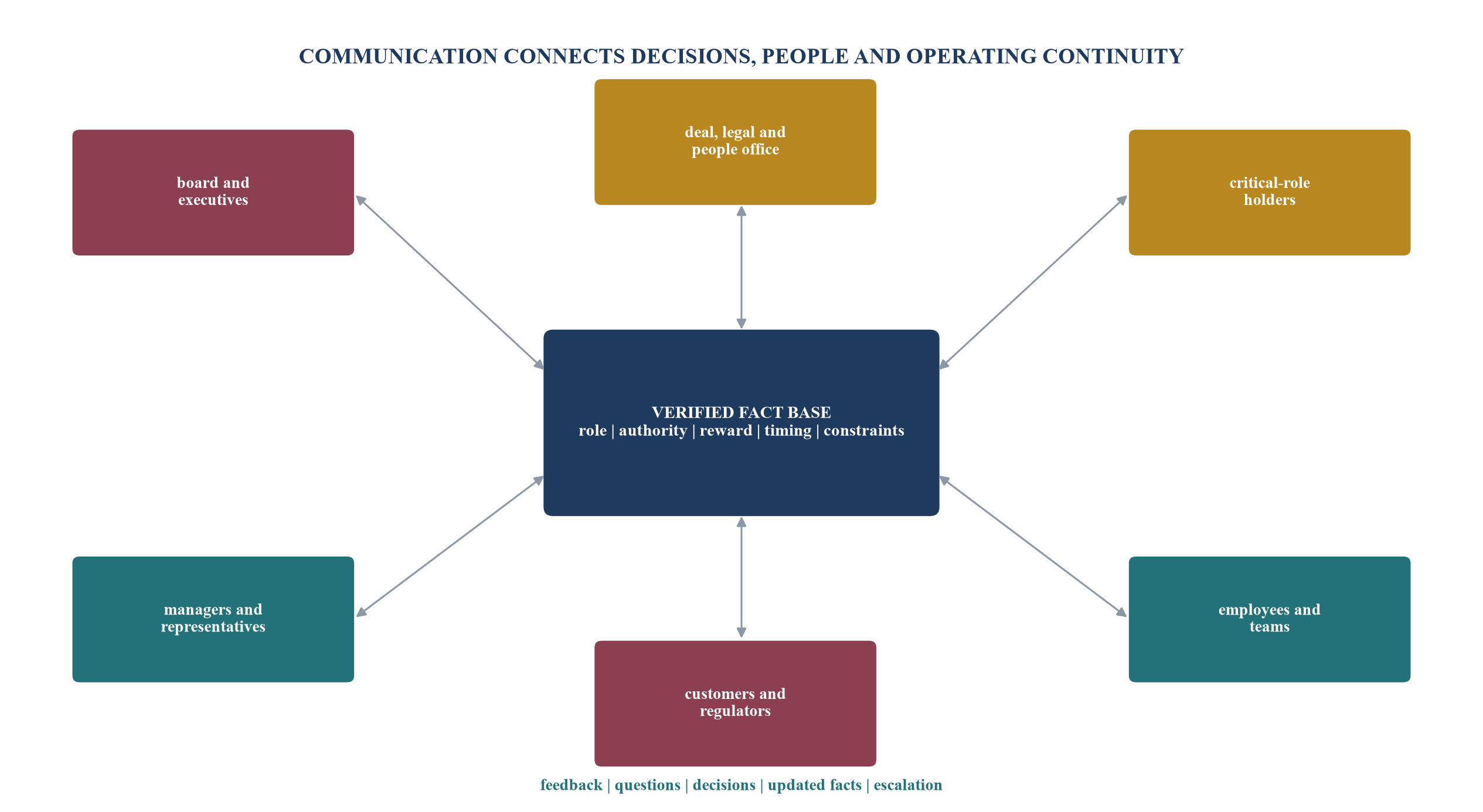
Each message should have a verified fact base, authorised messenger, timing and feedback route.
13. Protect Day 1 authority and continuity
Day 1 should confirm employment status, reporting, decision rights, signing authority, regulated roles, payroll, benefits, systems, travel, customer ownership and escalation. A retained person without access or authority cannot protect value. A transferred employee without accurate payroll or benefits can lose trust immediately.
The Day 1 control room should track critical-role attendance, accepted offers, permits, payroll, access, customer or regulator meetings, outstanding consultation, sensitive communications and exceptions. Issues are escalated by business consequence and legal timing rather than administrative category.
Customer-facing continuity needs joint coverage. The incumbent and successor or buyer sponsor can contact priority customers with an approved narrative. The purpose is to preserve service and trust, not to announce unapproved product or organisational changes. Relationship transition is evidenced through meetings, decision history, stakeholder map and next actions.
Operational and regulated roles need tested cover. The team confirms shift, licence, delegation, emergency authority, access and alternate holder. A single signed retention agreement does not resolve a missing deputy or lapsed approval. The board should see exceptions that could affect control or service.
14. Sequence the first 100 days
The first ten days stabilise authority, payroll, access, customers, regulated roles and critical communications. Days 11 to 30 validate the role map, individual commitments and successor readiness. Days 31 to 60 execute knowledge transfer, team design, mobility and priority hires. Days 61 to 100 test successors, embed the operating model and refresh the retention portfolio.
Each work package has a business outcome, accountable executive, critical holder, successor, knowledge object, relationship transfer, mobility dependency, cost, milestone and evidence. The people office controls the register; business executives own operating continuity. Finance reconciles cost and protected value. Legal and specialists govern jurisdictional matters.
Retention interventions should have expiry and transition conditions. The organisation should know when the critical period ends, when a successor is capable and when the award or special governance can close. Indefinite special arrangements can entrench concentration and inhibit integration.
The team should test scenarios. What happens if the holder leaves tomorrow, at closing, after the first vesting date or before a key renewal? What if the permit is delayed, the family move fails, the role changes or the integration model is rejected? The response should exist before the trigger.
15. Build succession and knowledge transfer into the deal
Succession is a transaction control. Each critical role should have a named deputy or capacity path, readiness assessment, development actions, access, authority and test date. A successor can be internal, external, interim or team-based. The plan should reflect qualification, customer trust and geographic availability.
Knowledge transfer should identify decisions, routines, systems, exceptions, contacts, obligations and judgement. Document production is one component. Effective transfer includes observation, joint execution, simulation, teach-back and independent operation. The recipient should demonstrate the capability rather than acknowledge receipt of a file.
Relationship transfer requires staged participation. The incumbent introduces the successor, shares history and context, supports live decisions and then reduces dependency. Customers, regulators, suppliers and partners should understand the new authority. The transition record captures concerns and unresolved commitments.
The board should monitor concentration reduction as a benefit. A retained person plus a tested successor, documented process and distributed relationship creates more durable value than a retained person alone. The economics model should recognise the cost of duplicate capacity as risk reduction rather than treating it automatically as inefficiency.
16. Govern the board talent dashboard
The talent governance forum should include the deal lead, accountable business executives, people leadership, finance, legal, integration, mobility and relevant risk or regulatory owners. Restricted individual data remains within authorised access. The board receives decisions and material exceptions rather than a broad list of personal assessments.
The dashboard should show value pathways, critical roles, successor readiness, accepted and declined interventions, mobility and transfer gates, regulated-role coverage, customer and knowledge transition, cost, accounting treatment, communication issues and residual exposure. It should separate role criticality, flight risk and continuity evidence.
ISO 30414 provides human-capital reporting guidance, while SEC rules require registrants to describe human-capital resources and measures or objectives that are material to understanding the business.[12][14] Applicability and disclosure require issuer-specific advice. The internal transaction dashboard can use disciplined measures without disclosing personal or speculative detail.
The FRC's current board-effectiveness and governance materials support clear accountability, risk oversight and stakeholder consideration.[16] The board should challenge unsupported certainty. A high retention acceptance rate can coexist with weak successor readiness, delayed mobility or unresolved role authority.
Table 5. Board cross-border talent dashboard
| Dashboard item | Evidence | Escalation trigger | Decision owner |
|---|---|---|---|
| critical-role continuity | role map, holder and active cover | value pathway lacks qualified capacity | accountable executive |
| flight-risk movement | dated authorised evidence and trigger | material change before decision date | people and business forum |
| retention economics | cost, value-at-risk and alternatives | cost or forecast exceeds authority | investment committee or board |
| employment and mobility | counsel, permit, payroll and benefit gates | closing or Day 1 evidence missing | jurisdiction owner |
| regulated-role coverage | approval, deputy and authority | licence or service at risk | regulated executive and board |
| succession and knowledge | readiness test and transfer evidence | concentration remains above tolerance | business executive |
| communication and trust | message log, questions and action | unresolved issue affects continuity | integration sponsor |
The board view should emphasise value pathways, decisions and exceptions.
17. Apply a worked cross-border scenario
Consider a hypothetical acquisition of an engineering and technology business operating in the UAE, United Kingdom and United States. The value case depends on three major customers, a patented control platform, regulated project delivery and expansion into the buyer's network. Diligence identifies twelve roles across customer leadership, product architecture, project control, treasury, safety and government relationships.
The role map shows four high-criticality positions. The product architect is willing to remain but seeks a clear roadmap mandate. A UK customer leader has moderate flight risk and no ready successor. A UAE regulated project role requires continuity of employing entity and authority. A US specialist may need an immigration and reporting-line review after the ownership change. The team does not apply one award to all four.
The hypothetical intervention portfolio costs USD 2.8 million over two years. It combines a time-bound cash award, equity subject to professional review, role and authority commitments, two successor hires, a deputy qualification plan, customer co-coverage and structured knowledge transfer. The model separately records USD 1.1 million of duplicate-capacity and mobility cost. It compares these amounts with customer, product and licence value-at-risk scenarios.
Signing governance approves the restricted recipient list, founder arrangements, employment-transfer paths and communication protocol. Closing evidence includes regulated-role continuity, accepted critical offers, lawful work routes or interim cover, payroll readiness and customer-contact plans. The first 100 days test successors and reduce personal concentration. This scenario is illustrative; live facts could produce different decisions.
18. Implementation sequence and conclusion
The cross-border talent thesis can be implemented through ten gates. Freeze the value case. Map critical outcomes and roles. Assess incumbent capability and flight risk through authorised evidence. Model retention economics. Determine employment-transfer and consultation obligations. Build mobility and regulated-role gates. Approve role, reward, succession and communication interventions. Test closing and Day 1 readiness. Execute the 100-day transfer plan. Verify continuity and move residual exposure into normal governance.
The method creates one evidence chain from transaction thesis to role, holder, legal route, intervention, successor and verified operating outcome. It gives the board a basis for allocating retention capital, challenging concentration and understanding where mobility or employment constraints can affect close.
People remain through a combination of purpose, role, authority, reward, relationships, location and confidence. A transaction team can influence each of these when it acts early and honestly. The durable outcome is a business that protects critical capability through closing while reducing its dependence on any one individual over time.
References
- International Labour Organization. Tripartite Declaration of Principles concerning Multinational Enterprises and Social Policy, Sixth Edition. 2022. https://www.ilo.org/publications/tripartite-declaration-principles-concerning-multinational-enterprises-and-0
- International Labour Organization. General Principles and Operational Guidelines for Fair Recruitment and Definition of Recruitment Fees and Related Costs. 2019. https://www.ilo.org/publications/general-principles-and-operational-guidelines-fair-recruitment-and
- Organisation for Economic Co-operation and Development. International Migration Outlook 2025. 3 November 2025. https://www.oecd.org/en/publications/international-migration-outlook-2025_ae26c893-en.html
- European Union. Council Directive 2001/23/EC on safeguarding employees' rights in transfers of undertakings. https://eur-lex.europa.eu/eli/dir/2001/23/oj
- UK Government. Business transfers, takeovers and TUPE: employment contracts, employee information and consultation. Accessed 30 August 2026. https://www.gov.uk/transfers-takeovers
- United Arab Emirates. Federal Decree-Law No. 33 of 2021 Concerning Regulating Labour Relations and amendments. https://uaelegislation.gov.ae/en/legislations/1541
- United States Department of Labor. WARN Advisor: Sale of a Business. https://webapps.dol.gov/elaws/eta/warn/fs1r.asp
- United States Citizenship and Immigration Services. Policy Manual, Volume 2, Part L, Chapter 8: Documentation and Evidence for L classification. https://www.uscis.gov/policy-manual/volume-2-part-l-chapter-8
- IFRS Foundation. IFRS 3 Business Combinations. https://www.ifrs.org/issued-standards/list-of-standards/ifrs-3-business-combinations/
- IFRS Foundation. IFRS 2 Share-based Payment. https://www.ifrs.org/issued-standards/list-of-standards/ifrs-2-share-based-payment/
- IFRS Foundation. IAS 19 Employee Benefits. https://www.ifrs.org/issued-standards/list-of-standards/ias-19-employee-benefits/
- United States Securities and Exchange Commission. Modernization of Regulation S-K Items 101, 103 and 105, Final Rule 33-10825. 26 August 2020. https://www.sec.gov/files/rules/final/2020/33-10825.pdf
- European Union. Regulation (EU) 2016/679, General Data Protection Regulation. https://eur-lex.europa.eu/eli/reg/2016/679/oj
- International Organization for Standardization. ISO 30414:2018 Human resource management; Guidelines for internal and external human capital reporting. https://www.iso.org/standard/69338.html
- United States Department of Justice and Federal Trade Commission. 2023 Merger Guidelines. 18 December 2023. https://www.justice.gov/atr/2023-merger-guidelines
- Financial Reporting Council. UK Corporate Governance Code 2024 and board-effectiveness guidance, current through 2026. https://www.frc.org.uk/library/standards-codes-policy/corporate-governance/uk-corporate-governance-code/
