

1. The credit decision
An initial lending decision should identify the reporting contracts that support repayment and the evidence needed to rely on their cash flows. A teleradiology operator may arrange interpretation of images acquired by healthcare facilities in another location. Its receivable depends on the precise service purchased, who is entitled to provide it and the contract's acceptance and payment terms. The lender should reconstruct that arrangement before assigning a debt amount to the operator's forecast. A signed customer agreement is one input to this exercise; delivery permissions and demonstrated collections require their own examination.
The central recommendation is to assess each material service route separately. In this paper, a route means an identified ordering facility, reporting entity, reader location, patient location and contractual debtor. These locations can fall within one country or across borders. The route should also identify the technology platform and the party responsible for data handling. The definition is an analytical device for diligence, without any suggestion that it replaces a legal classification. A route with unresolved permissions should be shown separately in the lender's proposed revenue and collateral analysis until the uncertainty is resolved.
The intended transaction is working-capital lending to a reporting-services business. The analysis does not value an imaging-equipment estate or an artificial-intelligence developer, and it makes no assumption that the lender acquires clinical authority through financing. Specialist clinical, regulatory, legal and data-protection assessments remain necessary. The lender's role is to understand the consequences of those assessments for the proposed credit exposure. The operating team and appropriately qualified healthcare professionals retain responsibility for clinical decisions and safe delivery of care.
Public sources reviewed on 10 September 2026 supply selected examples from Dubai, Abu Dhabi, Saudi Arabia and the United Kingdom. They do not establish a single GCC permission, a verified borrower pipeline or a current lending spread. A proposal involving Kuwait, Qatar, Bahrain, Oman or another jurisdiction needs its own current source and transaction review. No actual operator, patient record, facility agreement or lender term sheet was supplied for this analysis. The numerical case is deliberately hypothetical and serves to show how specified assumptions change a financing decision.
2. What the primary evidence establishes
Dubai's Standards for Diagnostic Imaging Services, issue 1.1, became effective on 26 November 2025. Section 10.3 states that teleradiology must not compensate for radiologist shortage or absence at the imaging facility. The following provision specifies transmitting-site personnel, and section 10.10 addresses the licensing of radiologists at the receiving site. A lender examining a Dubai route should have a qualified reviewer establish how these provisions apply to the proposed operating arrangement. A cost model that assumes all relevant on-site radiologist expense disappears would need particular scrutiny. [1]
The DHA Standards for Telehealth Services, issue 4, have the same effective date. Appendix 2 distinguishes physician and patient locations. For example, its scenario involving a physician outside DHA jurisdiction providing telehealth to a patient in Dubai shows both DHA licensing and compliance with the other relevant authority's requirements. The appendix separately addresses specialist consultation arrangements. These distinctions make the nature of the service important. An overseas expert opinion and a contracted primary diagnostic report should receive their own applicability assessment; the table should not be reduced to a universal permission for remote work. [2]
Abu Dhabi's Radiology and Medical Imaging Standard, published in May 2024 and effective in August 2024, addresses teleradiology and outsourcing in section 3.9. It specifies licensing and staffing requirements, including a UAE-licensed radiologist at the receiving site for reporting. Its outsourcing provisions address a contractual agreement, timely and accessible reports, confidentiality, image quality and records at both sites. These are Abu Dhabi-specific requirements in the reviewed standard. Later applicable directions and the actual facility's licence conditions still need to be checked in a transaction. [3]
The UAE's Federal Law No. 2 of 2019 addresses health information processed or transferred outside the state, including a framework for specified exceptions. Ministerial Resolution 51 of 2021 includes a telehealth case in Article 2(9), with conditions concerning the relevant doctor's time-limited access, the information or image transmitted when necessary and written patient consent. These provisions require a review of the actual data flow. A description of where the principal server is located does not, on its own, document every access, transfer or processing activity. [4], [5]
Saudi Arabia's National Health Information Center publishes executive rules that distinguish a licensed healthcare facility from a telehealth service provider in their licensing provisions. The reviewed rules also address collaboration, training, malpractice cover, consent, incident protocols and records of the participating locations. Separately, SDAIA's published transfer regulation addresses minimum necessary personal-data transfers and risk assessments in specified circumstances. The professional-service route and the data-transfer route therefore need distinct evidence. Neither document is treated here as approval for a particular foreign reporting team. [6], [7]
UK evidence provides a comparison with a defined geographic scope. The Royal College of Radiologists' 2025 workforce census reports over GBP 241 million of outsourcing expenditure within GBP 362 million spent on specified responses to excess reporting demand. Those are UK observations for 2025. They do not measure GCC demand or establish an addressable revenue pool for a new operator. The report also discusses reducing reliance on outsourcing, making changes in customers' sourcing strategies relevant to contract-renewal analysis. Its projected future expenditure is not adopted in the model below. [9]
3. Identify the parties and payment rights
The proposed diligence begins with the executed agreement between the reporting operator and its customer. Record the exact legal entities and the capacity in which each signs. Determine whether the borrower supplies the clinical report itself, arranges a subcontracted service or supplies technology alongside a separate clinical provider. Those arrangements can produce different payment rights and liabilities. The lender should ask counsel to explain the particular structure and its consequences before treating all activity recorded on the platform as revenue belonging to the borrower.
Identify the actual debtor for each invoice. A hospital may owe the operator under a reporting contract even when the hospital separately seeks reimbursement from an insurer. In that arrangement, the lender should examine the hospital's payment obligation and any provisions linking it to reimbursement. An insurance brand appearing in a patient record does not establish a direct claim by the reporting operator against that insurer. Similarly, several hospitals may contract through one purchasing entity. Concentration should follow the enforceable payment relationship and relevant guarantees, supported by legal review.
The agreement needs a clear description of the purchased output. A preliminary report, final report, second opinion and specialist discussion may have different acceptance conditions. The analyst should identify whether the charge is per accepted report, a fixed availability payment, a minimum-volume commitment or a combination. Any minimum should be examined for exclusions, service failures, termination rights and evidence of past payment. Forecast volume above an enforceable minimum remains an assumption until supported by orders and subsequent delivery evidence. The paper assumes no customary contract form or universal revenue-recognition rule.
Review the mechanism for disputing an invoice. Obtain the customer's stated grounds for withholding payment, the period for challenging a report, the treatment of partial disputes and the process for resolving them. Determine whether a disputed item affects that invoice alone or permits a broader withholding or set-off. Counsel should assess the effect under the relevant agreement and law. A finance model can then represent the resulting cash timing and possible deductions explicitly, with unresolved interpretation shown as a separate scenario.
Separate contract term from funded tenor. A nominally long agreement may allow termination on short notice, dependence on an annual purchase order or repricing when volumes change. The lender should place those dates alongside the amortisation schedule. If repayment depends on renewal, the credit memorandum should identify the renewal assumption and the evidence supporting it. The analysis should also show the consequences of no renewal. An assumed sale of the borrower or refinancing should be assessed as a distinct repayment source, with its own uncertainty and conditions.
| Contract feature | Evidence to examine | Consequence to model |
|---|---|---|
| Identity of debtor | Executed agreement and payment history | Concentration and collection timing |
| Report acceptance | Service specification and dispute records | Credits and delayed invoicing |
| Minimum commitment | Conditions, exclusions and paid invoices | Revenue supported by an enforceable obligation |
| Assignment and security | Counsel's analysis and required consents | Receivables available to support the loan |
| Termination and replacement | Notice, cure and handover provisions | Revenue interruption and transition cost |
| Data and reader permissions | Applicable approvals and operating records | Routes included in the lending case |
Proposed diligence matrix. Actual enforceability, consent and operating permissions require transaction-specific professional review.
4. Establish the permitted service route
The proposed route register should connect each material revenue stream to its relevant permissions. Record the facility and professional licences, scope of practice, privileges, relevant approvals and their dates. Distinguish evidence already obtained from an application, renewal request or management expectation. A reviewer should be able to identify the document supporting each entry and the authority responsible for it. The register should include the actual contracting and reporting entities because a licence held elsewhere in a corporate group may require a separate applicability assessment.
The lender should commission a qualified assessment of the clinical service configuration. That assessment should explain which professional is responsible for the report, where that professional is practising and how the local facility meets its obligations. A list of prestigious qualifications does not resolve those questions. Obtain evidence of the privileges and permitted activities used in the actual route. Where a clinician is available for several customers, confirm that the proposed coverage is supported by a workable allocation of time and contractual availability.
Map the movement of information with the operator's technical and privacy specialists. The map should show the originating system, image transfer, viewing environment, report return, backups and support access. Record the locations and entities involved, the permitted purpose and any restrictions on onward handling. The UAE telehealth exception reviewed for this paper contains specific conditions; the lender should request the evidence relied on for the chosen route and the controls used to implement it. Consent documentation should be examined within its proper clinical and legal context. [5]
For Saudi routes, the evidence request should distinguish the operator's role under the telehealth framework from the responsibilities attached to personal-data handling. The NHIC executive rules and SDAIA transfer provisions provide starting points for the relevant specialist reviews. The analyst should not infer an exception from commercial convenience or a general reference to encryption. The resulting report should state the precise route reviewed, the conditions on which the reviewer relied and any limits to the conclusion. That scope should accompany the financial model. [6], [7]
A proposed lender eligibility rule can exclude revenue or receivables linked to unresolved permissions while further work is undertaken. Such an exclusion is a credit-policy decision for the hypothetical analysis. It is not a judicial finding that an invoice is invalid. The documentation should preserve that distinction. If the borrower later supplies the missing evidence, an authorised reviewer can reconsider inclusion using the same criteria. The change should be dated, linked to the evidence and reflected consistently in the forecast and the borrowing-base certificate.
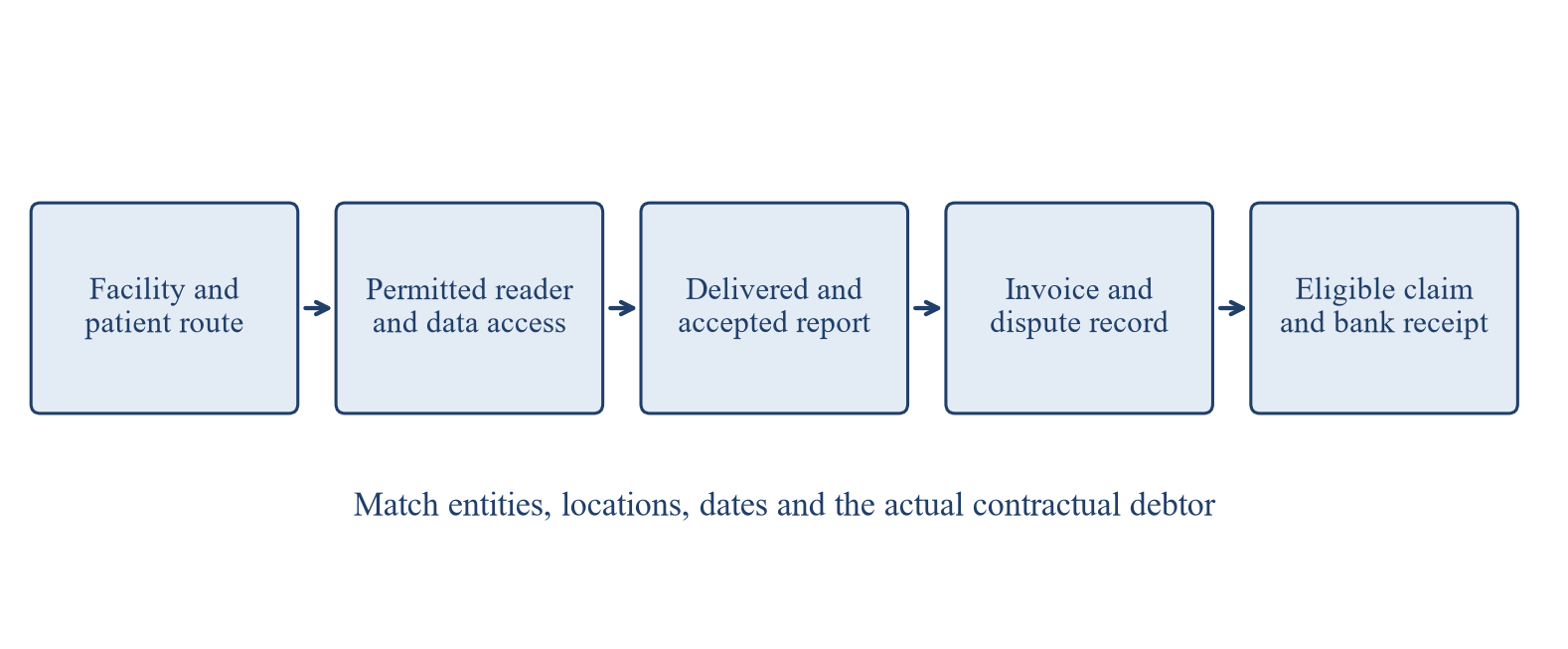
Proposed underwriting workflow. Clinical responsibility, contractual acceptance and cash collection remain separate review questions; this diagram represents no approved operating route.
5. Measure usable specialist capacity
Capacity analysis should begin with the work that each appropriately authorised clinician can undertake within the proposed service. A broad headcount figure can conceal a shortage in a particular modality, subspecialty, shift or customer privilege. Request a roster that maps the relevant qualifications and permissions to the reporting commitments. The lender should have the clinical reviewer explain the meaningful categories. This paper does not prescribe a safe reporting rate or infer that one clinician can replace another across all types of imaging.
The operator's historical records should distinguish contracted availability from actual sessions worked. Examine leave, training, sickness, other commitments and the time used for quality review and communication with referrers. A forecast relying on all contracted hours being available for uninterrupted reporting requires evidence. The capacity assessment should use the clinical team's documented method and disclose its limitations. Any productivity assumption used for financing should be challenged against the case mix and service requirements of the proposed contracts.
Turnaround analysis should retain its starting and ending events. Time from image acquisition to a final usable report may differ from time measured after the operator receives a complete case. Missing clinical information, failed transmission or a request for further images can affect those measures differently. Request both the operational record and the contractual definition. The relevant clinical specialists should assess acceptable standards and escalation. A lender can examine the economic consequences of missed commitments without imposing a clinical target of its own.
The RCR's December 2016 teleradiology guidance addresses access to relevant clinical information, integration of reports, identifiable reporting clinicians and quality governance. Its dated UK professional guidance supports operational diligence questions, while current local obligations require their own review. In practical terms, the proposed evidence request should include how the reporter accesses prior information, how an urgent finding reaches the appropriate clinician and how the receiving facility acknowledges the report. A completed transmission log alone does not establish all of those events. [8]
Test replacement capacity at the level of the affected service. A backup provider should be reviewed for the same permissions, customer acceptance and data arrangements that apply to the primary route. Obtain its contractual commitment and the conditions on which it can provide cover. A management list of possible substitutes represents a contingency idea until availability is evidenced. The stress model should distinguish the cost of reserved cover, the incremental cost of using it and any interval during which it cannot yet operate.
Dependency analysis should consider groups of clinicians sharing an employer, technology platform, location or key permission. Several individual contracts may still depend on one service provider's infrastructure. The lender should ask what happens if that common dependency fails and whether the proposed backup shares it. A useful scenario defines the affected workload, the permissible response and the resulting costs. Clinical continuity should remain the first operating consideration; the financing plan should identify how necessary continuity expenditure is funded.
6. Reconcile reports to accepted invoices and receipts
The proposed transaction dataset follows a stable case reference from the customer's request through reporting, acceptance, invoicing and cash allocation. The financing team generally needs a restricted operational identifier and commercial fields, with patient information handled only through authorised arrangements. Link amended reports and resubmitted invoices to the original case. Without that link, a dataset can count several versions as separate production. The analyst should preserve the version history and identify which version supported the amount ultimately invoiced.
At a common cutoff, reconcile opening receivables plus new billings, less credit notes, write-offs and allocated receipts, to closing receivables. Investigate differences between the report system, billing system and general ledger. Keep unapplied cash visible until it is allocated. A receipt after the cutoff supplies evidence about subsequent collection, but it should not overwrite the earlier record. This permits a reviewer to reconstruct the information available when the lender certified a borrowing base or considered a draw request.
Assess collections by debtor and by service cohort. The denominator should remain consistent as the cohort ages. Show paid amounts, issued credits and unresolved balances separately. An average collection period based only on paid invoices can omit the invoices creating the greatest uncertainty. The analysis should identify that unpaid population and its reasons. Where a customer pays a consolidated remittance, trace the allocation to the underlying invoices and investigate unexplained short payments rather than classifying the entire remittance as complete settlement.
Distinguish a delayed acceptance from a reduction in the amount due. A report awaiting a contractual review can delay invoice submission. An agreed service credit reduces the claim. An unresolved dispute may lead to either payment or a later adjustment. Those states should be reflected in the model according to the evidence available, with uncertainties shown explicitly. Counting both an issued credit and the same amount again as an outstanding disputed receivable would distort the exposure. The illustrative borrowing-base exclusions below apply only after issued credits.
The evidence should include a review of non-routine entries around reporting dates. Large manual invoices, credit-note reversals and late allocation changes require explanations supported by records. Obtain confirmation of relevant balances through an agreed, independent process where appropriate. The lender should retain the limits of any sampling exercise, including which customers and periods were not examined. A clean sample is evidence about the sample inspected; it does not demonstrate that every receivable in the portfolio meets the proposed eligibility rules.
7. Define the hypothetical cash model
Consider an invented reporting operator with annual gross fees of USD 20.00 million and issued service credits of USD 1.00 million. Net revenue is therefore USD 19.00 million. Opening receivables are USD 3.00 million and closing receivables are USD 4.00 million. With no write-offs, unallocated receipts or other receivables movements assumed, cash collected is USD 18.00 million. Every operating figure and financing term in this example is selected for illustration. None represents an observed operator, market price, agreed facility or forecast return.
Assume direct cash delivery costs of USD 12.00 million and fixed cash operating costs of USD 3.00 million. The simplified earnings measure before interest, tax, depreciation and amortisation is USD 4.00 million. Deducting the USD 1.00 million increase in receivables, an assumed cash-tax allowance of USD 0.30 million and capital expenditure of USD 0.20 million leaves USD 2.50 million of cash available for debt service. The same result follows directly from cash collections less these cash expenditures. There are no other working-capital movements or non-cash operating adjustments in the model.
Assume a USD 5.00 million facility commitment, with USD 1.50 million drawn at the beginning of the year. The invented annual interest rate is 12%, charged on that opening drawn amount for the full year, producing USD 0.180 million of interest. A hypothetical annual commitment fee of 1% on the opening undrawn USD 3.50 million produces USD 0.035 million. Scheduled principal repayment of USD 0.30 million occurs at year-end. Scheduled debt service is consequently USD 0.515 million, and cash available for debt service divided by that amount is approximately 4.85 times.
The interest and fee conventions are deliberately explicit. The example assumes no additional draw and no intra-year amortisation, so the stated opening balances remain the calculation basis until year-end. It contains no assertion that a lender would offer these terms. An actual model should reproduce its executed definitions, day-count conventions, payment dates and treatment of undrawn commitments. Fees for arrangement, diligence and advice are excluded here. They would need separate entries in an actual funding plan, together with any other transaction expenditure.
Opening unrestricted cash is assumed to be USD 0.25 million. After cash available for debt service of USD 2.50 million and scheduled debt service of USD 0.515 million, closing cash is USD 2.235 million before any additional collateral repayment. The illustrative minimum cash balance is USD 0.50 million. This annual result does not demonstrate that cash remains adequate on every intervening date. A real credit assessment needs a dated forecast of collections, salaries, provider payments and all financing obligations, particularly around periods of contract mobilisation or disruption.
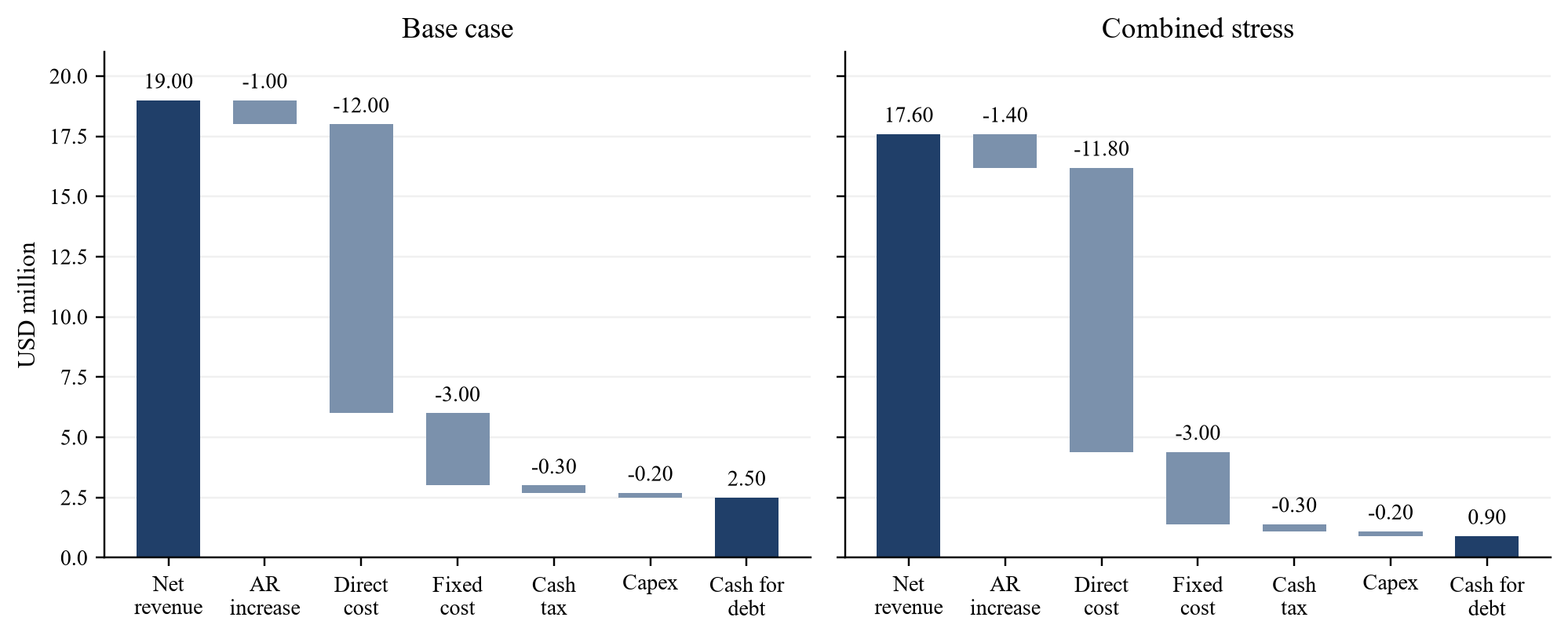
USD million. Issued credits are already deducted in net revenue. The receivables increase absorbs cash; the figure excludes debt service and any additional collateral repayment.
8. Establish the eligible collateral and available draw
The proposed borrowing base starts with the closing receivable ledger and applies documented eligibility rules. A facility commitment limits the lender's contractual exposure, subject to the agreement. The borrowing base supplies a separate limit derived from eligible collateral and the stated adjustments. The OCC's Asset-Based Lending handbook discusses eligibility, advance rates, reserves and excess availability within its US supervisory context. Those concepts provide an analytical reference here; its guidance is not presented as a rule for GCC lenders or as the source of the numerical terms selected for this example. [10]
Begin with the hypothetical base-case receivables of USD 4.00 million after issued service credits. Exclude USD 0.40 million of disputed invoices, USD 0.30 million associated with unresolved credential evidence, USD 0.20 million linked to unresolved data-route evidence, USD 0.10 million of aged invoices and USD 0.40 million of excess concentration. The five buckets are disjoint in the example. Each invoice enters one exclusion bucket only. The disputed amount is additional to the credits already issued, so the same deduction is not applied twice.
Eligible receivables are USD 2.60 million. Applying the hypothetical 75% advance rate produces USD 1.95 million, from which an assumed reserve of USD 0.15 million is deducted once. The borrowing base is USD 1.80 million. Against the opening draw of USD 1.50 million, this would leave USD 0.30 million of excess availability if that same borrowing base applied at that date and all contractual draw conditions were satisfied. The USD 5.00 million commitment does not make the entire undrawn commitment immediately available under these assumptions.
The timing qualification matters because the example uses a year-end receivable population to illustrate eligibility. It is not evidence of the opening borrowing base or an actual draw entitlement. After the scheduled year-end principal payment, drawn debt is USD 1.20 million. At that point, the base-case collateral calculation would be USD 0.60 million above drawn debt, before considering any other draw restrictions. A real facility requires each certificate to use receivables and debt balances from the same applicable date. Mixing dates can create apparent headroom that never existed.
The eligibility definitions should explain treatment of partial disputes and concentration. For example, a lender may exclude an entire invoice or only its disputed portion, depending on its documented policy and the legal and operational facts. The example assumes the listed amounts are the precise disjoint exclusions selected for modelling. It does not establish a statutory ageing limit, compulsory concentration cap or standard advance rate. The actual lender should define the rules with its advisers and apply them consistently to the complete population, preserving every exception and approval.
An evidence-related exclusion should also have a reinstatement process. A clinician's renewed permission, clarification of a data route or settlement of an invoice dispute may change the analysis. The reviewer should confirm whether that new evidence covers the dates and services underlying the receivable. A current approval does not automatically answer a question about an earlier reporting period. Reinstatement should therefore identify the affected claims and the basis for including them, with both the original exclusion and the subsequent decision retained.
| Calculation | Base case | Combined stress |
|---|---|---|
| Closing receivables after issued credits | 4.000 | 4.400 |
| Disputed amounts not yet credited | (0.400) | (1.200) |
| Unresolved credential evidence | (0.300) | (0.700) |
| Unresolved data-route evidence | (0.200) | (0.500) |
| Aged receivables | (0.100) | (0.300) |
| Excess concentration | (0.400) | (0.400) |
| Eligible receivables | 2.600 | 1.300 |
| Advance at 75% | 1.950 | 0.975 |
| Additional reserve | (0.150) | (0.150) |
| Borrowing base | 1.800 | 0.825 |
USD million. Exclusion buckets are disjoint and follow issued credits. The 75% advance rate and USD 0.15 million reserve are author-selected assumptions, with no asserted market or regulatory benchmark.
9. Test reporting disruption and delayed collection together
The combined stress is an invented joint scenario. Annual gross fees fall from USD 20.00 million to USD 19.00 million, and issued credits rise to USD 1.40 million. Net revenue becomes USD 17.60 million. Closing receivables rise to USD 4.40 million, with opening receivables unchanged at USD 3.00 million. Cash receipts consequently fall to USD 16.20 million. These assumptions illustrate a period with less billable activity, more agreed adjustments and greater uncollected balances. No probability is assigned, and the changes are not represented as a measured response to a particular clinical or regulatory event.
Direct cash costs become USD 11.80 million. For transparency, the assumed bridge begins with base direct cost of USD 12.00 million, deducts USD 0.60 million of activity-related cost reductions and adds USD 0.40 million of incremental cover expense. Fixed cash costs remain USD 3.00 million. The resulting simplified EBITDA is USD 2.80 million. The model retains the cash-tax allowance of USD 0.30 million and capital expenditure of USD 0.20 million. It assumes no automatic tax relief or discretionary reduction in expenditure required to keep the service operating.
Cash available for debt service is USD 0.90 million. It can be calculated from receipts of USD 16.20 million less direct cost, fixed cost, tax and capital expenditure. It can also be calculated from EBITDA of USD 2.80 million less the USD 1.40 million receivables increase, tax and capital expenditure. Against scheduled debt service of USD 0.515 million, coverage is approximately 1.75 times. This ratio describes the model's scheduled obligations only. It excludes an additional repayment required by a reduction in the borrowing base, which must be examined separately.
For the stressed closing receivable population, assume disjoint exclusions of USD 1.20 million for disputes, USD 0.70 million for unresolved credential evidence, USD 0.50 million for unresolved data-route evidence, USD 0.30 million for age and USD 0.40 million for excess concentration. Eligible receivables fall to USD 1.30 million. At the unchanged advance rate and reserve, the borrowing base is USD 0.825 million. Following scheduled principal repayment, drawn debt of USD 1.20 million exceeds that amount by USD 0.375 million.
Assume the illustrative agreement requires this excess to be repaid at the same year-end date, with no waiver or cure grace period modelled. Opening cash of USD 0.25 million plus cash available for debt service of USD 0.90 million, less scheduled debt service of USD 0.515 million and the additional repayment of USD 0.375 million, leaves USD 0.260 million. That is USD 0.240 million below the assumed minimum cash balance of USD 0.50 million. An approval based solely on the scheduled coverage ratio would omit this funding requirement.
The principal calculation avoids double counting. The additional repayment uses the debt balance after the scheduled USD 0.30 million amortisation. Total principal repaid is USD 0.675 million, leaving final drawn debt of USD 0.825 million. Adding a cure calculated against the original USD 1.50 million draw on top of scheduled amortisation would overstate the required repayment. In an actual facility, counsel and the credit team should establish the precise testing dates, payment order and cure provisions, then model those terms with the corresponding dated balances.
Now add further collection delays of USD 0.25 million, USD 0.50 million and USD 0.75 million to the combined stress. Assume each delayed amount remains in an entirely ineligible receivable bucket. The eligible pool and borrowing base therefore stay unchanged while cash falls by the delayed amount. The resulting funding gaps against the assumed minimum are USD 0.490 million, USD 0.740 million and USD 0.990 million. This sensitivity isolates collection timing; it does not introduce another credit loss, fee, tax adjustment or change in reporting volume.
For the USD 0.50 million additional delay, cash available for scheduled debt service falls to USD 0.40 million and the scheduled coverage ratio to approximately 0.78 times. Calculated closing cash after the stated repayments is negative USD 0.240 million. That negative result denotes an unfunded requirement. It does not mean the operator can make payments with cash it does not possess. A feasible response requires identified financing, a properly agreed change in obligations or another evidenced corrective action, with patient-care requirements and creditor rights assessed by the relevant specialists.
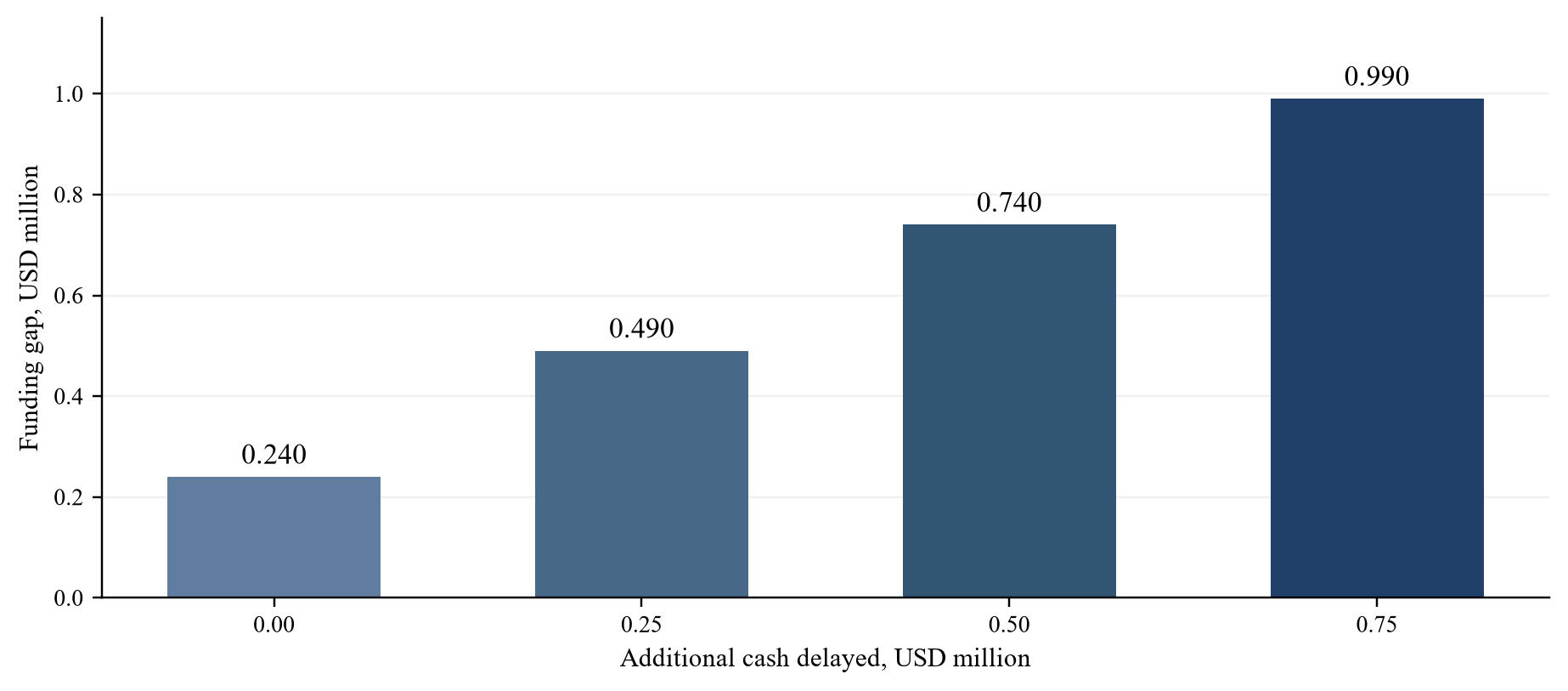
USD million, incremental to the combined stress. Delayed amounts are entirely ineligible, leaving the borrowing base fixed at USD 0.825 million. The gap includes restoration of the assumed USD 0.50 million minimum cash balance.
10. Assess continuity and security within the actual legal structure
The lender should ask counsel to evaluate the proposed security package using the actual entities, contracts and jurisdictions. Relevant questions include who owns the receivable, whether it can support the proposed security, what notices or consents are required and how competing claims affect recovery. The paper offers no conclusion about perfection, priority, assignment effectiveness or enforcement in a particular jurisdiction. Those conclusions require the executed documents and current legal analysis. The credit model should state which conclusions it depends on and which remain outstanding.
Security over an economic claim does not by itself establish a practical method of continuing clinical services. A proposed replacement operator may need customer acceptance, professional permissions, system access and appropriate data arrangements. The financing team should request a realistic transition plan reviewed by the relevant specialists. That plan should identify which services can continue, which must pause, who manages clinical handover and how records remain available through authorised channels. It should also identify the cost and time needed to implement the proposed response.
An insolvency or termination scenario should retain the difference between collecting existing invoices and generating new ones. Existing receivables may remain subject to disputes, withholding, legal costs and restrictions on access to supporting evidence. Future revenue depends on continued delivery and customer retention. The lender should model those streams separately. An assumed transfer of the entire customer book at its forecast value would require evidence concerning consent, continuity, replacement capacity and buyer appetite. Without that evidence, such a value should remain a scenario rather than the basis for a confident recovery estimate.
Customer substitution deserves a commercial review alongside legal termination rights. Ask the customer-facing team to document contract wins, losses, renewals and reasons for changes in scope. Examine whether the service depends on temporary backlogs, recurring out-of-hours coverage or a specialist capability that the customer intends to develop internally. Use actual correspondence and procurement documents where available. The UK workforce evidence discussed earlier supplies context for examining sourcing choices, but the borrower's renewal assumptions must be tested against its own customers and contractual arrangements.
Insurance review should address the actual insured parties, covered activities, territorial scope, reporting obligations and exclusions. The NHIC executive rules explicitly address telehealth in malpractice cover. That source supports asking the question for the Saudi framework; it does not establish that a particular policy responds to a particular claim. Obtain specialist insurance advice where the exposure warrants it. A policy limit should not be entered as immediately available recovery cash without considering coverage, deductibles, timing and the facts required for a valid claim. [6]
The continuity budget should be visible in the funding plan. Include payments needed to retain appropriately authorised reporting staff, provide approved cover, maintain necessary systems and complete a lawful handover. Distinguish those costs from discretionary growth expenditure. The resulting financial response may involve additional sponsor capital, a revised facility structure, a smaller initial draw or a decision not to proceed. Each response needs actual commitments and conditions. An unsigned intention to support the business should remain separate from funds available under an enforceable arrangement.
11. Design monitoring around changes that affect credit
The proposed reporting package should connect operating changes to the lender's decision rights. A useful monthly schedule identifies routes added or suspended, relevant permissions approaching expiry, contracted cover, unaccepted reports, issued credits and unpaid invoices. The operator should explain material movements and identify the underlying records. The lender can then examine whether a change affects revenue assumptions, receivable eligibility, the cash forecast or a condition in the financing documents. Reporting frequency should reflect the actual risk and agreement; this paper sets no universal regulatory timetable.
Some events require a response before the next routine certificate. A material loss of permission, failure of an essential reporting dependency or significant invoice dispute may change the information on which availability was calculated. The financing documents should define notice requirements, responsibilities and the consequences of the event, subject to appropriate advice. Operational and clinical escalation should follow the applicable healthcare arrangements. Lender reporting should support the financial assessment without delaying clinical action while a commercial approval is sought.
The monitoring process needs access boundaries. Commercial analysis can often use restricted identifiers, financial amounts and status fields without exposing the underlying images or clinical details to every reviewer. Qualified clinical reviewers may require different access under properly authorised arrangements. The parties should establish the lawful basis, purpose, retention and security of each disclosure with their specialists. A broad request for all patient data should not be treated as a default financing condition. The minimum evidence necessary for the specific question should guide the request.
Reconcile the borrowing-base certificate to the same dated ledger used in the cash forecast. Explain additions, exclusions, reinstatements and reserve changes. Compare actual collections with earlier predictions by cohort, preserving the forecasts originally approved. If a model repeatedly overstates cash conversion, examine whether the error arises before acceptance, during billing or after an invoice falls due. A revised assumption should carry the evidence and approval supporting it. Replacing the earlier forecast without a variance record would obscure the reason for changing the credit view.
Periodic review should also test the continuing usefulness of the model. A new contract form, a different debtor mix or a change in the operator's service role may require a new analysis rather than a percentage adjustment to the existing forecast. Check whether the definitions of revenue, direct cost and eligible receivables still correspond to the business being financed. The decision record should identify the changed perimeter and any implications for covenants, reporting or specialist review. Monitoring can reveal a need to restructure the assessment itself.
| Evidence | Appropriate reviewer | Condition for reliance |
|---|---|---|
| Executed service and debtor agreements | Legal and commercial specialists | Scope, parties and payment rights explained |
| Route permissions and privileges | Healthcare regulatory specialists | Relevant activity and dates covered |
| Roster and replacement arrangements | Qualified clinical and operational reviewers | Coverage and limitations documented |
| Data-flow and access controls | Privacy, security and legal specialists | Applicable route and controls assessed |
| Reports, invoices and bank allocations | Finance and credit reviewers | Dated reconciliation and exceptions retained |
| Borrowing base and cash forecast | Credit team with relevant advisers | Consistent dates, exclusions and repayment order |
Suggested responsibilities and reliance conditions. Actual reviewers, access rights and deliverables must be agreed for the engagement.
12. Translate the evidence into an approval and advisory scope
The credit memorandum should state the proposed exposure, its purpose and the evidence supporting repayment. It should identify the routes included in the lending case, the contracts examined, the tested collection population and the specialist conclusions relied on. Assumptions need to remain identifiable as assumptions. Where evidence is unavailable, explain how the analysis treats that gap and what would be required to change the decision. An initial screening conclusion should not be presented as a completed legal, clinical or underwriting opinion.
One possible decision is conditional progression to detailed diligence. The conditions could include satisfactory route assessments, reconciled cash records, agreed collateral definitions and funded continuity arrangements. Their exact content belongs to the transaction. A second possibility is a smaller proposed draw supported by the evidenced eligible population, with expansion considered after a defined period of verified performance. A third is rejection where essential permissions, repayment evidence or feasible continuity cannot be established. These are proposed decision paths, without any assertion that an actual lender has approved them.
A retained advisory mandate can give those questions a defined work programme. The scope might cover a borrower search against agreed criteria, initial contract mapping, financial screening, coordination of independent specialist reviews and preparation of a credit decision pack. The engagement should identify which tasks the adviser performs and which opinions must come from regulated or otherwise appropriately qualified specialists. It should also define the evidence the client supplies, confidentiality arrangements, conflicts, deliverables, acceptance criteria and the fees due for the agreed work.
The client should be able to distinguish advisory expenditure from investment principal. The principal amount remains subject to the lender's own decision, documentation and permissions. An adviser preparing a model or arranging specialist diligence is not thereby authorised to hold client money, make discretionary investments or commit a lender to fund. Any proposed arranging activity or referral must be assessed within the relevant permission framework and agreed scope. This paper offers no funding commitment, recommendation of a particular counterparty or assurance of a financial return.
The hypothetical case produces a specific conclusion about its own assumptions. Annual cash generation covers the stated scheduled debt service in the combined stress, yet the additional collateral repayment leaves a funding gap against the assumed minimum cash balance. A financing decision therefore needs the cash forecast, collateral calculation and repayment schedule to operate on consistent dates. The proposed evidence framework makes the required inputs inspectable. Whether an actual teleradiology operator can support a loan remains a question for transaction-specific diligence and the lender's documented approval process.
Appendix A. Model reconciliation and timing conventions
All monetary figures in this appendix are USD million. The base receivable movement is opening balance 3.00 plus gross fees 20.00 less issued credits 1.00 less cash receipts 18.00, leaving closing balance 4.00. Net revenue is 19.00. Subtracting direct cost 12.00 and fixed cost 3.00 gives EBITDA of 4.00. Deducting the receivable increase 1.00, cash-tax allowance 0.30 and capital expenditure 0.20 gives cash available for debt service of 2.50. The direct cash calculation is 18.00 less 12.00, 3.00, 0.30 and 0.20, with the same result.
The stressed movement is opening balance 3.00 plus gross fees 19.00 less issued credits 1.40 less cash receipts 16.20, leaving closing balance 4.40. Revenue is 17.60. Direct cost 11.80 and fixed cost 3.00 give EBITDA of 2.80. The increase in receivables is 1.40, leaving cash available for debt service of 0.90 after the same cash-tax allowance and capital expenditure. Disputed amounts included in the collateral exclusions have not already been deducted as issued credits. Eligibility treatment changes the lender's collateral calculation without independently writing off those receivables in the earnings model.
For both cases, the full-year cash financing cost is 1.50 multiplied by 12%, plus 3.50 multiplied by 1%, giving 0.215. Scheduled principal of 0.30 brings scheduled debt service to 0.515. The base ratio is 2.50 divided by 0.515, or 4.85 times when rounded. The stress ratio is 0.90 divided by 0.515, or 1.75 times. These ratios exclude additional collateral cure payments from their denominator, which is why the separate repayment calculation is essential. They are illustrative definitions and must not be substituted for an actual covenant without reading its terms.
The stressed borrowing base is eligible receivables 1.30 multiplied by 75%, less the reserve 0.15, giving 0.825. After scheduled principal, debt is 1.20. The additional repayment is the positive difference between those amounts, 0.375. Final debt is 0.825. Opening cash 0.25 plus cash available for debt service 0.90 less scheduled debt service 0.515 and additional repayment 0.375 gives closing cash 0.260. The gap to minimum cash 0.50 is 0.240. The example assumes the contractual cure can be tested and paid at year-end; actual interim testing may reveal a different or earlier funding requirement.
Further delays of 0.25, 0.50 and 0.75 reduce cash available for debt service to 0.65, 0.40 and 0.15 respectively. Scheduled coverage becomes approximately 1.26, 0.78 and 0.29 times. With all additional delayed receivables excluded from collateral, the borrowing base remains 0.825. Closing cash becomes 0.010, negative 0.240 and negative 0.490. The corresponding gaps to minimum cash are 0.490, 0.740 and 0.990. No additional credit loss is implied by these timing sensitivities. Actual credit-loss assessment and recovery timing would require separate evidence.
The model excludes foreign-exchange movements, arrangement and advisory fees, litigation and restructuring costs, distributions and any expenditure not explicitly included. Cash tax is a fixed illustrative allowance, with no asserted statutory rate or deductibility conclusion. No probability weights or risk-adjusted return estimate are calculated. An actual model should incorporate currency-specific receipts and costs, lender terms, relevant taxes, all transaction expenses and a dated liquidity forecast. Each addition should be reconciled to the existing calculation so that a new sensitivity does not silently duplicate an earlier deduction.
Appendix B. Evidence retained with the decision
The proposed approval file should retain the model version and input snapshot used for the decision. It should identify the date of each legal or regulatory assessment, the parties and activities covered and any reliance limitations. For financial testing, retain the ledger cutoff, the completeness reconciliation, the sample selected and unresolved exceptions. For specialist capacity, retain the roster basis, relevant permissions, contractual availability and the limits of the clinical review. These records allow a later reviewer to understand what evidence supported the original decision without assuming that current operating data describe the earlier position.
Document the decision-maker's treatment of each material unresolved question. If a route is excluded, record its financial effect and the evidence required for reconsideration. If a condition must be satisfied before a draw, identify who confirms satisfaction and how that confirmation is retained. If the lender accepts a residual risk, state the basis within its proper governance process. The aim is a reviewable decision record that connects evidence, assumptions and conditions to the amount actually committed and drawn. It does not replace the lender's own policies or the advice needed for the transaction.
Sources
- Dubai Health Authority. Standards for Diagnostic Imaging Services, issue 1.1, 26 September 2025; effective 26 November 2025. Section 10. Read the primary source
- Dubai Health Authority. Standards for Telehealth Services, issue 4, 26 September 2025; effective 26 November 2025. Appendix 2. Read the primary source
- Department of Health Abu Dhabi. Radiology and Medical Imaging Standard, DOH/ST/HCFS/RMIS/V1/2024, May 2024; effective August 2024. Section 3.9. Read the primary source
- United Arab Emirates Ministry of Justice. Federal Law No. 2 of 2019 concerning the use of information and communications technology in health fields. Article 13. Read the primary source
- UAE Ministry of Health and Prevention. Ministerial Resolution 51 of 2021 regarding cases in which health data and information may be stored or transferred outside the country. Article 2(9). Read the primary source
- Saudi National Health Information Center. The Governing Rules of Telehealth, Executive Rules. Sections 3.1-3.3; official publication reviewed 10 September 2026. Read the primary source
- Saudi Data and Artificial Intelligence Authority. Regulation on Personal Data Transfer outside the Kingdom, Articles 2 and 8. Knowledge-centre text reviewed 10 September 2026. Read the primary source
- Royal College of Radiologists. Standards for the Provision of Teleradiology within the United Kingdom, second edition, December 2016. Operational guidance; historical legal provisions are not adopted here. Read the primary source
- Royal College of Radiologists. Clinical Radiology Workforce Census 2025, published 2026. Page 43, historical 2025 expenditure. Read the primary source
- US Office of the Comptroller of the Currency. Comptroller's Handbook, Asset-Based Lending. Eligibility, reserves and excess availability; US supervisory scope. Read the primary source
