

1. Define the financing decision and the operating perimeter
A trucking loan should be assessed against the cash generated by the particular operating company and the journeys it is permitted to perform. Begin with the borrower, the fleet it controls, the contracts it fulfils and the accounts into which customers pay. A group presentation may combine owned vehicles, leased vehicles and subcontracted capacity. Those arrangements create different repayment obligations and different assets for a secured lender. The first credit memorandum should explain their contribution separately before proposing a single facility limit.
The decision examined here is whether a private-credit lender should provide a revolving facility to a cross-border road-freight operator. Equipment debt and leases are included in the cash burden because they compete for the same operating proceeds. The principal risk question is whether longer border-related cycles and fewer paid return loads leave enough cash to meet those obligations, including any repayment required when eligible receivables decline. An approval should identify the evidence that supports the initial commitment and the changes that would require reduced availability, additional funding or suspension of advances.
The illustrative commitment is USD 20 million within a hypothetical USD 10 million to USD 40 million screening envelope. These figures are editorial assumptions. They describe neither observed financing tickets nor a verified borrower request. No company accounts, route telemetry, customer agreements, security documents or lender quotations were supplied for this paper. Its contribution is an original analytical framework and a reproducible scenario, intended to help a capital provider identify what must be established before money is committed.
The geographical emphasis is on Gulf operations with Saudi Arabia, the UAE, Qatar and Kuwait as relevant underwriting contexts. A trip's actual origin, destination, transit countries, border posts, vehicle registration and cargo classification must be established individually. This paper does not certify that a specific route is open on a given day. It also makes no universal finding about the permissions available to a foreign truck, the enforceability of a particular security package or the regulatory permissions of a lender or adviser.
2. Use current evidence with its original scope intact
The World Bank's 2025 Logistics Performance Indicators redesign draws on shipment-level operational information from maritime, aviation and postal sources. The homepage describes connectivity, speed and reliability using observations for 2023 and 2024. Those data can inform the questions asked about logistics performance, with their mode and observation period retained. They do not establish a four-day trucking cycle or any other GCC route assumption used below. A lender should obtain the operator's own route-level timestamps before calibrating a truck-finance forecast. [1]
IRU reported on 15 June 2026 that operators had experienced improved processing through Saudi TIR procedures and described corridors connecting Saudi Arabia and Türkiye. These are attributed reports about trade facilitation. The article supplies context for examining a borrower's participation and actual experience. It supplies no numerical advance rate, borrower margin or binding journey-time commitment. A proposed efficiency benefit should be supported by the same operator's before-and-after records, adjusted for cargo, route and operating conditions. [4]
A separate IRU report dated 16 April 2026 summarised participant accounts of regional conflict, route changes and pressure on transport capacity. That historical discussion supports including disruption and rerouting in the diligence agenda. It does not prove the current status of any border or justify applying a participant's anecdotal cost increase to every borrower. Before drawdown, a lender needs contemporaneous operating confirmations, applicable restrictions, insurance information and a funded plan for any route change. [5]
Create an evidence register that distinguishes official requirements, operator records, customer confirmations and assumptions proposed for modelling. Each item should retain its source date, relevant jurisdiction and the claim it supports. A customs procedure can establish documents to prepare; an actual sequence of arrival and release records is needed to measure performance. A contract can establish a payment mechanism; bank records are needed to measure collection. The approval file should explain gaps in those connections and the financial consequences of proceeding before they are resolved.
3. Establish permission to perform the outward and return legs
Return-load revenue belongs in the forecast only after the proposed movement has been checked against the applicable operating permissions. Saudi Press Agency's 24 September 2024 account of a Transport General Authority announcement describes electronic transport documentation, restrictions on return-route loading, domestic-carriage restrictions and compliance requirements for foreign trucks. This dated announcement is a starting point for specialist review. The actual vehicle, carrier, loading location, destination and any relevant current authorisation must be checked before a lender accepts a backhaul assumption. [6]
A commercial team may identify cargo waiting near the delivery destination. Underwriting should establish whether the carrier can lawfully carry that cargo on the proposed journey and whether doing so fits its vehicle, insurance and customer commitments. Ask the operations manager to identify the permission and record supporting each representative movement. Where a broker arranges the load, examine the contracting chain and who is responsible for checking eligibility. The paper assigns no general permission to carry between domestic cities or onwards to a third country.
The document review should distinguish a customs transit procedure from a transport operating right. IRU describes TIR as a customs transit system and identifies its guarantee as covering customs duties and taxes. The lender should examine the applicable country and operation limits separately. Such a guarantee provides no stated basis here for assuming repayment of the operator's financing, collection of freight invoices or compensation for the entire cargo value. Those exposures require their own contracts, security or insurance analysis. [3]
Permission should remain traceable when circumstances change. A delay may lead a dispatcher to propose a different border, an alternative tractor, a subcontractor or a new return destination. The lender's monitoring terms should identify which changes require notification and which require approval before the related exposure is treated as eligible. A policy that records only the original route can miss the conditions under which the actual movement was completed. Retain the final executed route and any supporting authorisation with the shipment record.
4. Build a customs and delivery evidence chain
ZATCA's Import Instructions lists commercial and shipment documentation, origin information and additional requirements linked to the goods. It also addresses advance declaration through Fasah. Its English page, updated in August 2026, contains both an at-least-48-hours formulation and a within-48-hours formulation. A lender should require the importer or authorised broker to confirm the current applicable filing requirement for the shipment. This paper does not resolve that wording difference into a universal deadline or represent advance submission as a promised clearance time. [2]
Qatar Customs' Importation guidance addresses the land manifest, registration of the mode of transport, original invoice and origin documentation, electronic declaration and inspection procedures. Its details should be applied to the relevant import category and goods. Kuwait's published commercial-import procedure also lists original invoice and origin documents, a land manifest and a packing list for multiple goods, alongside the declaration and release sequence. These publications establish documentary questions. Neither establishes the elapsed border time to use for a particular operator. [7] [8]
For a UAE-origin movement, the lender should obtain the relevant departure, export or transit declaration and evidence of the actual customs office involved. The route file should distinguish mainland, free-zone, re-export and transit arrangements where applicable. This paper does not transplant a procedure from one emirate or customs office to every UAE movement. The same discipline applies when Saudi Arabia is a transit country and Qatar or Kuwait is the final importing jurisdiction. Require a complete sequence for the journey actually financed.
Use a single shipment identifier to join the transport order, vehicle assignment, load document, declaration, border arrival, release, customer delivery, acceptance, invoice and receipt. The identifier should survive amendments and partial deliveries. Where systems use different references, retain a mapping with the supporting documents. This permits a reviewer to test whether a long cash cycle began with missing import documents, a physical queue, rejected delivery evidence or a later commercial dispute. Each cause requires a different corrective action and funding assumption.
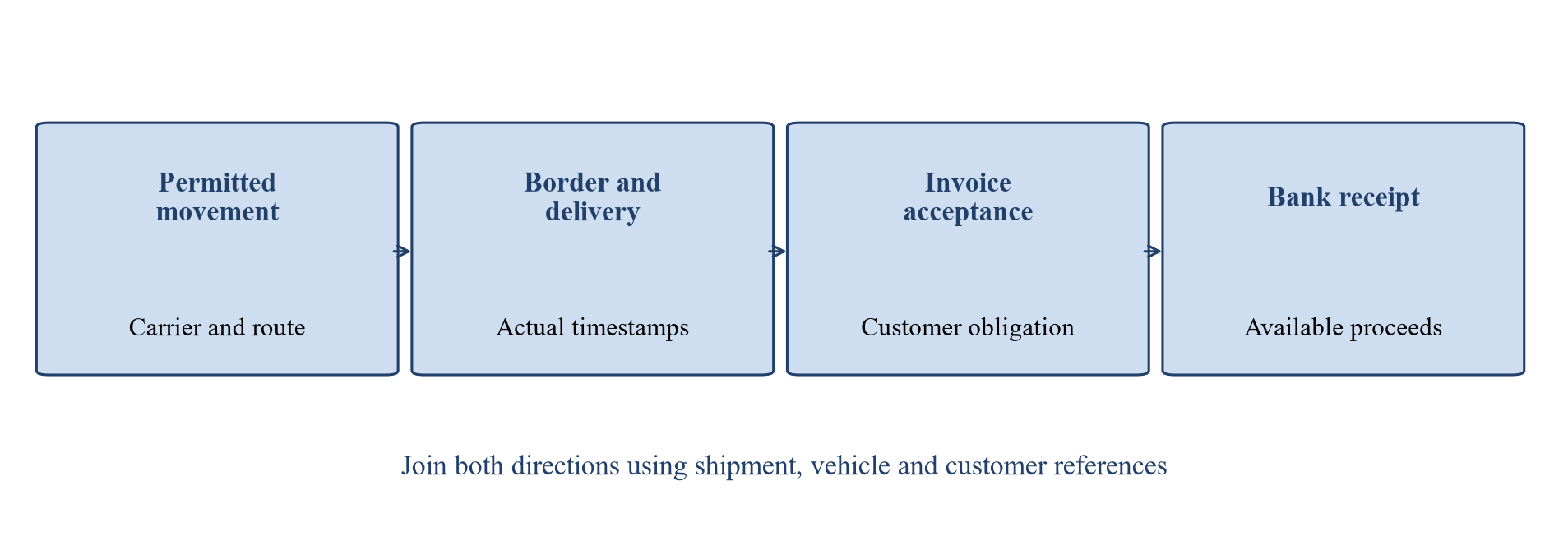
Original lender diligence framework. Documents and timestamps should refer to the same shipment and executed route.
5. Measure the whole round trip and the availability denominator
Define the cycle from the moment a vehicle becomes committed to the outward job until it is available for its next comparable assignment. Include loading, departure formalities, travel, both border directions, unloading, return-load waiting and repositioning where they fall within that definition. A border-release measure and a complete vehicle cycle answer different questions. Preserve both. A reduction in customs-processing time may leave utilisation unchanged if loading slots or return dispatch remain the limiting activity.
The denominator requires equal care. A fleet of 250 vehicles does not automatically provide 250 vehicles for every day of a month. Planned maintenance, driver availability and other non-operating periods should be recorded. Count a lost day once. If a model already reduces available days for planned maintenance, it should not deduct the same event again through a generic utilisation haircut. Unexpected maintenance can be a separate downside assumption when its incremental effect is specified.
Analyse completed cycles alongside journeys still in progress at the reporting date. A completed-trip average can become artificially favourable when the longest delayed vehicles remain outside the sample. Include their current age and location, and explain the treatment of unfinished observations. Route comparisons should retain the time window and cargo mix. Median and upper-tail observations can help describe variation, but a lender should not assign probabilities to severe delays without a defensible dataset and method.
Challenge the distinction between operational availability and customer demand. A vehicle may be mechanically ready with no qualifying job to perform. Conversely, a confirmed job may remain unserved because the required trailer or permitted driver is elsewhere. Reconcile offered loads, accepted orders, rejected work, available vehicles and completed journeys. This identifies whether the forecast depends on obtaining more business, changing the fleet mix or improving cycle time. Each assumption should have a separately costed implementation plan.
6. Establish the economics of paid return loads
A paid return-load share should use a clear denominator. In this paper it is the proportion of completed outward cycles that includes one revenue-earning return load. It is not a percentage of kilometres, payload capacity or fleet revenue. Those measures can be useful additional records, but mixing them produces misleading comparisons. A long empty repositioning movement may sit within a supposedly loaded return trip, so distance and duration should remain available at the individual-journey level.
Examine return-load revenue after the incremental costs of accepting it. These may include handling, a detour, broker commission, additional waiting or a different delivery obligation. The model below isolates a return-handling cost while keeping the remaining round-trip cost fixed per cycle. Actual operations require a more detailed schedule where accepting a return load changes distance, fuel consumption or the next departure date. An apparent improvement in load share can reduce cash generation if the extra job consumes too much vehicle time.
Check the commercial quality of the return customer. An invoice issued through a freight broker may expose the operator to that broker's payment terms and deductions rather than directly to the cargo owner's credit. Record the named payer, acceptance requirements, currency, contractual rate and observed receipt. Repeated small return loads can create administrative and collection costs that are absent from an outward contract's headline margin. The lender should ask whether those expenses are captured in route profitability.
Assess how the operator obtains loads during a disruption. A plan that relies on future spot bookings has a different evidence base from an existing contract with defined volumes, subject to its actual terms. Retain rejected or unavailable return opportunities so that the forecast can be challenged against the full experience. Where management proposes a new brokerage relationship, require the scope, permissions, commission and settlement arrangements. Treat the proposed improvement as conditional until the underlying arrangement and operating results support it.
7. Reconstruct the hypothetical route cash model
The worked example uses 250 trucks and a 30-day planning month with 24 scheduled available days per truck. The resulting 6,000 available truck-days are divided by the assumed complete round-trip cycle. A four-day cycle produces 1,500 outward cycles; a six-day cycle produces 1,000. These are steady-state planning equivalents. They do not represent a forecast of individual departure dates, and they should not be used to infer the number of journeys completed during the first month of a sudden disruption.
Every outward cycle earns an assumed USD 1,800. Each paid return load earns USD 1,200. Round-trip variable cash cost is USD 850 per cycle, including the outward and return movement, with a further USD 150 handling cost for a loaded return. Fixed fleet cash cost is USD 900,000 per month. That fixed amount excludes financing payments, central overhead and maintenance capital expenditure, which are shown separately. The figures are illustrative and have no verified relationship to a particular route, fleet specification or local cost base.
The base case assumes a 60% paid return-load share, producing 900 loaded returns and USD 3.780 million of monthly revenue. The fleet incurs USD 1.275 million of round-trip variable cost and USD 135,000 of return handling. After USD 900,000 of fixed fleet cost, the remaining contribution is USD 1.470 million. Deduct USD 200,000 of central costs, USD 100,000 of maintenance capital expenditure and a scheduled USD 70,000 cash-tax payment. Cash available for debt service is USD 1.100 million.
The scheduled tax payment is deliberately held constant across the scenarios. It represents an assumed cash obligation for the modelled month, with no assertion about the calculation of tax in any jurisdiction. Maintenance expenditure is also held constant; postponing it is not an approved response embedded in the example. The model contains no safety benefit from operating vehicles beyond permitted hours or service intervals. Any operational restructuring would require separate legal, technical and financial assessment.
| Measure | Base | Delay only | Return loads only | Combined |
|---|---|---|---|---|
| Round-trip cycle days | 4 | 6 | 4 | 6 |
| Paid return-load share | 60% | 60% | 30% | 30% |
| Outward cycles | 1,500 | 1,000 | 1,500 | 1,000 |
| Revenue | 3.7800 | 2.5200 | 3.2400 | 2.1600 |
| Cash operating and investment outflow | 2.6800 | 2.2100 | 2.6125 | 2.1650 |
| Cash available for debt service | 1.1000 | 0.3100 | 0.6275 | -0.0050 |
| Scheduled debt service | 0.5000 | 0.5000 | 0.5000 | 0.5000 |
| Coverage in times | 2.200 | 0.620 | 1.255 | -0.010 |
USD millions except days, percentages and coverage. All inputs are editorial assumptions; the scheduled tax payment remains fixed. Negative coverage denotes a cash deficit before debt service.
Assumed monthly debt service totals USD 500,000. It comprises USD 100,000 interest on USD 10 million of drawn revolving debt at a simple annual rate of 12%, USD 50,000 interest on USD 6 million of equipment debt at 10%, USD 250,000 scheduled principal, USD 90,000 lease payments and USD 10,000 commitment fees. The last figure assumes a 1.2% annual fee on USD 10 million of undrawn commitment. These are illustrative pricing and payment terms, not a financing offer. Actual contractual day counts and repayment schedules should replace the simple monthly calculations.
8. Stress cycle time and return loads together
The delay-only case retains the 60% return-load share while extending the cycle to six days. Revenue falls to USD 2.520 million because the same available truck-days support fewer completed cycles. Variable movement and handling expenses also decline. Fixed fleet, central, maintenance and scheduled tax cash requirements remain unchanged. Cash available for debt service falls to USD 310,000, giving coverage of 0.620 times against USD 500,000 of scheduled debt service. The result comes entirely from the specified assumptions.
The return-load-only case retains the four-day cycle and reduces paid returns to 30%. Revenue becomes USD 3.240 million. The reduction in return-handling expense offsets a small part of the lost freight income, leaving USD 627,500 for debt service and coverage of 1.255 times. This case assumes that the lower load share itself creates no extra waiting time. If the dispatcher searches longer for replacement loads, the forecast should change the cycle as well. Both effects are included in the combined case.
With a six-day cycle and 30% paid return loads, the operator earns USD 2.160 million against USD 2.165 million of pre-debt cash requirements. It has a USD 5,000 deficit before paying lenders and lessors. The negative coverage ratio is simply the arithmetic result of dividing that deficit by scheduled debt service. It is not a conventional positive covenant headroom measure. The committee should see the underlying deficit and repayment schedule directly, including the date at which cash becomes insufficient.
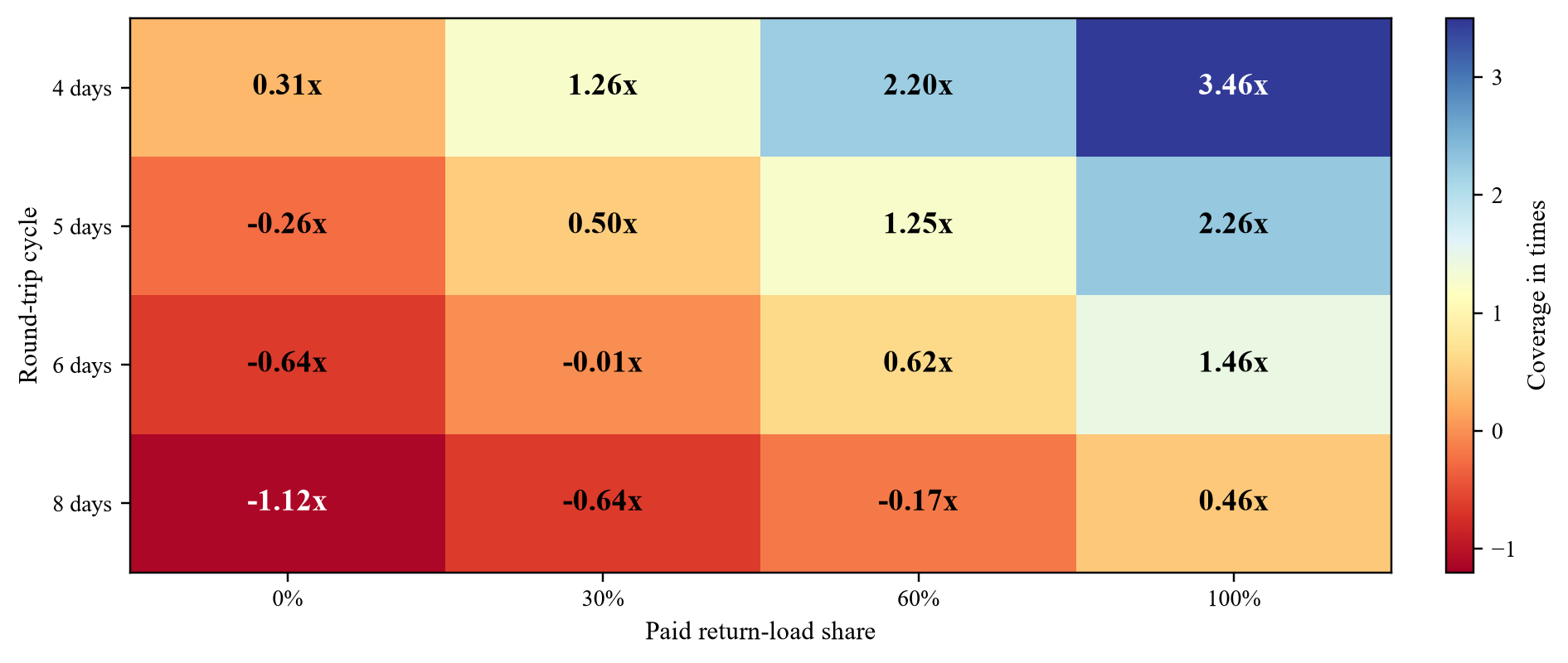
Monthly cash available for debt service divided by USD 0.5 million scheduled payments. Inputs are scenario choices. Negative values indicate a pre-debt cash deficit; one times means no residual cash after scheduled debt service.
The algebra also identifies the return-load share needed to cover all scheduled payments under the fixed assumptions. At a four-day cycle it is approximately 21.9%; at six days it is approximately 78.1%. At eight days the calculated requirement exceeds 100%, meaning even a paying load on every return cannot meet the specified debt service. That threshold is a property of this hypothetical cost and rate structure. An actual lender should recalculate it with evidenced prices, costs and operational constraints, then test whether the necessary loading pattern is permitted and achievable.
9. Distinguish run-rate earnings from the dated cash transition
The route model describes a recurring operating rate under each set of assumptions. A disruption beginning midway through a month produces a different sequence of invoices and receipts. Some trucks have already departed, some customers owe for earlier deliveries and some costs are prepaid. Build a separate dated cash schedule to capture that transition. Do not treat the fall in monthly revenue as an immediate identical fall in collections without examining the opening receivable book and payment timing.
The hypothetical transition starts with USD 1.200 million of unrestricted cash. Collections during the modelled month are assumed to be USD 2.600 million, reflecting payments from the operator's opening and current invoice vintages. This is an independently specified cash input, not revenue calculated from the combined route scenario. Pre-debt operating and investment cash outflow is USD 2.165 million, and scheduled debt service is USD 500,000. The resulting USD 1.135 million balance precedes any borrowing-base repayment or new financing.
The collection assumption exceeds combined-case route revenue by USD 440,000. That difference is a cash-timing bridge, not an additional gain. It would need a receivable-vintage reconciliation in a real transaction. The paper does not assume that the operator can continue collecting more than it invoices indefinitely. The next periods should roll forward the receivables, disputed amounts, credit notes and payments, with collections traced to the pool from which they arise.
Use weekly detail for the near term and retain daily obligations where timing is consequential. A positive month-end balance can conceal a fuel or payroll shortfall earlier in the month. Customs-related deposits, driver advances and supplier settlements should appear on their expected payment dates. Identify cash held in accounts that cannot be used by the borrowing entity or in the relevant currency. An available group balance should be excluded from the borrower's funding plan until transfer rights, restrictions and timing have been checked.
10. Calculate availability and the repayment demand independently
A commitment establishes the maximum contractual facility size. Actual availability may be lower under the borrowing-base formula, conditions precedent and lender controls. IFC's credit-infrastructure work identifies the role of movable collateral, receivables and legal frameworks in asset-based lending. That global framework does not validate a local security interest or an advance rate. The following percentages and reserves are hypothetical contractual assumptions requiring borrower-specific commercial and legal diligence. [9]
The example starts with USD 15 million of eligible receivables, an 80% advance rate and a USD 1 million reserve. Its borrowing base is USD 11 million. Against USD 10 million drawn, formula availability is USD 1 million, despite USD 10 million of undrawn commitment. The eligible receivable pool is an independently specified whole-operator opening balance. It is not inferred from the modelled corridor's monthly revenue and should not be interpreted as a receivable-days estimate for that corridor.
Under the assumed stress, eligible receivables decline to USD 12 million and the reserve increases to USD 1.2 million. The borrowing base falls to USD 8.4 million. Keeping USD 10 million drawn would create a USD 1.6 million excess over that base. The model assumes the agreement requires repayment in the modelled month. Actual cure periods, cash dominion and suspension rights must be read from the facility documents. The calculation does not assert that every asset-based facility imposes the same response.
Deducting USD 1.6 million from the transition's USD 1.135 million balance leaves a USD 465,000 deficit before new funds. To finish with the assumed USD 750,000 minimum cash balance, the operator needs USD 1.215 million of external funding. Its source is unspecified. The paper assumes no available sponsor cheque, lender waiver or refinancing offer. Any financing fee, interest, tax or transaction cost arising from the new funding would increase the required amount and needs a separate calculation.
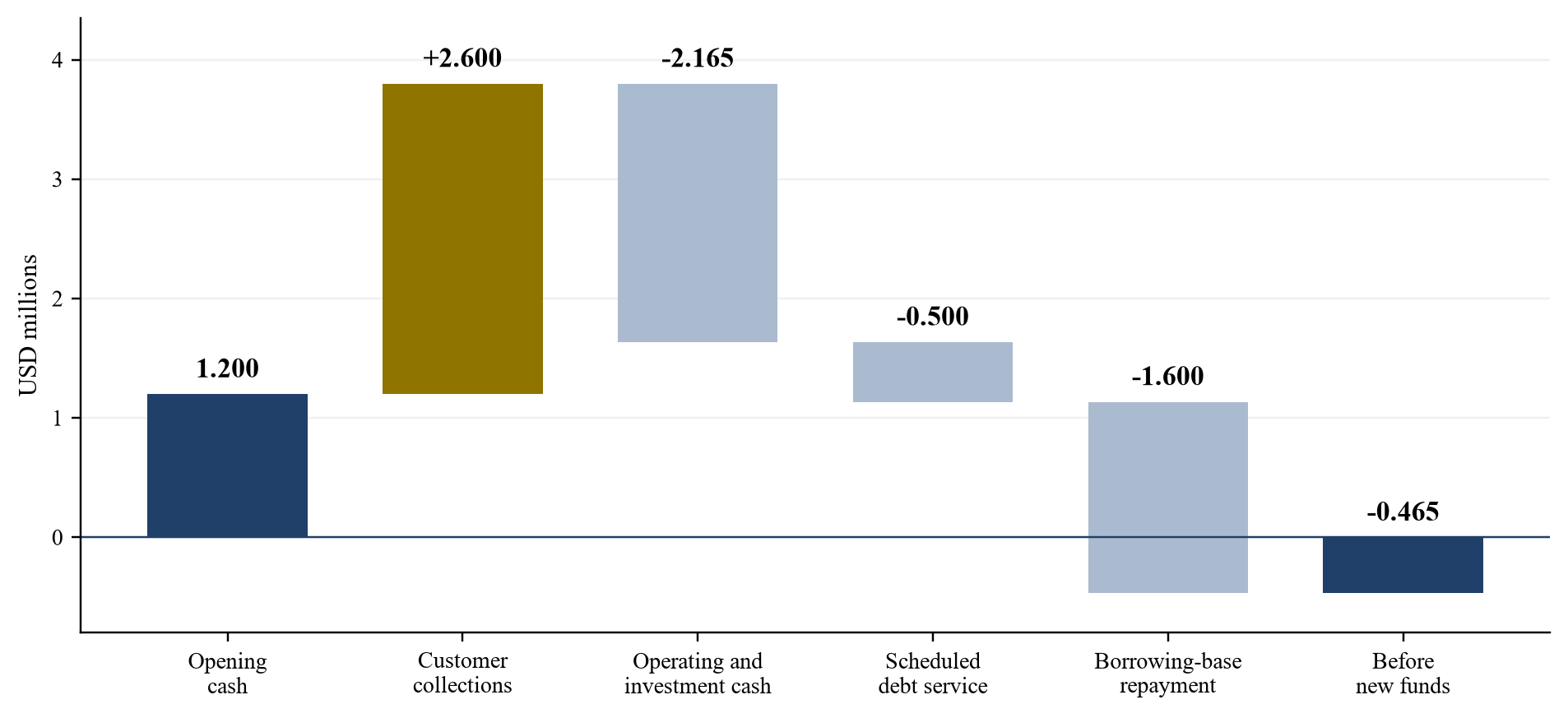
USD millions for one modelled month. Collections are separately specified across invoice vintages. The final bar shows the deficit before new external funding; maintaining USD 0.750 million minimum cash requires USD 1.215 million plus any new funding costs.
Avoid counting the same adverse receivable event repeatedly. Excluding an invoice from eligibility changes borrowing availability. Delaying its payment changes collections. A permanent credit loss is a further conclusion that needs its own evidence and accounting treatment. The example specifies the borrowing-base and cash effects without inventing an additional write-off. In an actual case, reconcile each invoice through all relevant schedules so the committee can identify distinct consequences without adding the same loss twice.
11. Examine the collateral and contract rights behind the model
Prepare the collateral schedule by legal owner and location. A truck under a lease or existing finance arrangement may have restrictions on further security or disposal. A trailer can have a different owner from the tractor pulling it. Goods inside the vehicle may belong entirely to customers. The lender should obtain the relevant title records, existing finance documents and legal advice before assigning a recovery value. Physical control and a photograph do not establish a right to sell an asset after default.
Receivable diligence should establish that the borrowing entity earned the amount, that the invoice corresponds to performed services and that material deductions or defences have been identified. Review assignment restrictions, notification, set-off, prior financing and payment-direction arrangements with qualified counsel. A clean ageing report alone cannot establish those rights. The commercial review should also test whether customers can deduct delay charges or cargo-related claims from unrelated invoices owed to the operator.
| Exposure | Evidence required | Consequence to assess |
|---|---|---|
| Owned tractor or trailer | Title, registration, location, condition, prior security | Permitted security and realistic net recovery |
| Leased or financed vehicle | Finance agreement and lessor or lender rights | Restrictions, competing payments and repossession risk |
| Freight receivable | Contract, delivery acceptance, invoice and bank matching | Eligibility, defences, assignment and collection control |
| Goods in custody | Customer ownership and carriage agreement | Cargo liability without assumed collateral ownership |
| Customs arrangement | Applicable procedure, guarantee and responsible parties | Customs exposure distinct from loan repayment |
| Subcontracted capacity | Carrier agreement, permissions and settlement terms | Service continuity and liabilities without owned fleet value |
| Insurance proceeds | Policy, endorsements, exclusions and claims process | Insured interest, recipient, timing and residual exposure |
Questions for transaction-specific commercial and legal diligence. No ownership, priority, enforceability or insurance coverage is assumed.
Recovery analysis should deduct the costs and time required to locate, preserve and realise the asset. A cross-border location can introduce permissions, storage, transport and competing claims requiring specialist assessment. Obtain condition evidence and a valuation appropriate to the recovery scenario. A vehicle's purchase price or book value should not be presented as cash immediately available for debt repayment. The approval should identify which recovery conclusions remain dependent on legal opinions or third-party inspections.
Separate customs guarantees, cargo insurance, motor cover and business-interruption cover in the file. Record who is insured, which interest is protected, the territory, exclusions, deductibles and the person entitled to proceeds. The existence of a policy should lead to wording review and confirmation of payment status. It should not create an assumed near-term receipt in the liquidity schedule. Use a dated claim scenario only when the hypothetical timing is explicit or actual evidence supports the expected payment.
12. Test commercial responses before relying on them
An operator may propose higher freight prices, detention charges or a fuel-adjustment mechanism to offset slower turns. Examine the actual contract provisions, their trigger, notice requirements and collection history. A charge shown on an invoice is not evidence that the customer accepts or pays it. In the model, no detention revenue or emergency surcharge is included. Adding such income would require a separate amount, cost, timing and enforceability assumption, with sensitivity to customer rejection or delay.
Subcontracting can provide extra capacity, but its cash terms need explicit treatment. A subcontractor may require an advance while the principal customer pays later. The lender should examine how the operator verifies permissions, service quality, insurance and delivery evidence. Establish which party invoices the customer and which party bears delay or damage liability. A shift towards subcontracting also changes the relationship between fleet collateral and revenue, so the original equipment-based lending thesis should be revisited.
Rerouting should be assessed across the full cycle. A shorter queue at one border could involve additional kilometres, tolls, driver accommodation, a different customer delivery slot or loss of a return load. Obtain a complete operating budget and the necessary current permissions. The hypothetical six-day stress does not identify a particular border or claim that an alternative route restores four-day performance. The committee should receive the incremental cost and funding requirement before accepting a rerouting plan as a mitigating factor.
Debt restructuring requires the same clarity. Deferring principal can improve immediate cash while increasing later payments, interest or refinancing exposure. A smaller initial draw can reduce interest and borrowing-base risk but may leave the proposed fleet programme underfunded. Additional equity has value only when the amount, source, conditions and transfer timing are sufficiently established. The credit memorandum should present the resulting payment schedule and residual downside after each proposed response, including situations in which the response is unavailable.
13. Set approval conditions and monitoring that change decisions
The approval memorandum should identify the exposure being accepted and the evidence supporting it. Specify the permitted borrower and operating perimeter, facility purpose, initial draw conditions, borrowing-base method and full repayment burden. Any dependence on a minimum paid return-load share should be visible with the route cycle and pricing assumptions that make it meaningful. A stand-alone target for loaded kilometres cannot substitute for the financial calculation if it measures a different operating concept.
Define a small number of monitoring measures with clear calculation rules and owners. These could include age of unfinished journeys, complete cycle time by route, legally qualifying paid returns, rejected invoices, collection performance by vintage and borrowing-base excess. Each measure should have an agreed data source and reconciliation process. Select thresholds using the actual financing case and available evidence. The numbers in this paper are explanatory examples and should not be copied into a facility as industry-standard covenants.
| Decision area | Evidence to review | Required committee explanation |
|---|---|---|
| Operating permission | Carrier, vehicle, cargo and route authorisations | Which outward and return jobs may be included |
| Vehicle availability | Fleet register, maintenance and driver records | Available days and exclusions counted once |
| Journey performance | Departures, arrivals, releases and unfinished trips | Complete cycle and disruption sensitivity |
| Return-load economics | Permitted orders, rates and incremental costs | Paid share, margin and time consumed |
| Customer cash | Accepted invoices, disputes and matched receipts | Collection timing and potential deductions |
| Borrowing availability | Eligible pool, reserves, prior finance and formula | Available draw and required repayment |
| Collateral recovery | Ownership, location, condition and legal review | Net realisation and recovery timing |
| Contingency funding | Source, amount, conditions and transfer evidence | Ability to fund the specific stressed dates |
Complete before relying on the related assumption. Any unresolved item should retain its exposure, owner and decision consequence.
Escalation should follow the financial consequence. A route interruption could first require a revised cash forecast and a temporary eligibility exclusion. A persistent unsupported return-load assumption may require re-underwriting the commitment. A disputed ownership record could require removing an asset from the collateral calculation while specialist review proceeds. The appropriate action depends on the documents, actual risk and lender authority. Record the decision and its basis, including any condition for restoring eligibility or further advances.
Management reporting should retain adverse observations and corrections. Preserve the original timestamp when a delivery document is resubmitted or an invoice is amended. Log changes to customer master data and payment instructions, with independent verification appropriate to the lender's procedures. The reviewer should be able to trace a material adjustment from operational evidence through the borrowing certificate and bank statement. A dashboard should support that examination by exposing exceptions and definitions rather than hiding them inside a single fleet-performance score.
14. Scope the advisory work and the capital provider's responsibility
A capital provider seeking a trucking opportunity can commission a defined commercial and financial diligence assignment. The scope could cover the initial operating screen, route and customer evidence, the cash model, borrowing-base reconciliation and preparation of the credit memorandum. The engagement should state deliverables, information access, responsibilities, exclusions and fees. Any origination or introduction activity should be assessed against the applicable regulatory requirements and the parties' actual permissions before it begins.
Legal conclusions on security, enforceability, transport permissions and regulated activity require appropriately qualified advice. Insurance coverage and technical fleet condition also require the relevant expertise and evidence. The research framework can organise those questions and connect their outcomes to financing assumptions. It provides no verification that an adviser is authorised to undertake every activity associated with lending or investment. The capital provider retains its own credit approval and should specify the decisions reserved to its investment committee.
Keep the proposed facility commitment separate from advisory revenue. A USD 20 million loan is principal at risk; it is not the adviser's fee or a forecast of collected consulting income. An engagement may provide for a retainer or other agreed fee structure, subject to the actual terms and permissible activity. This paper proposes no fee percentage and makes no claim that an investor or borrower has agreed to pay. A commercial mandate becomes evidence only when its scope and terms are established.
The work should culminate in a decision file that allows the lender to act on verified information. It should identify which exposures can be accepted, which require conditions and which remain unsuitable for the proposed structure. A lender may decide to reduce the commitment, delay the transaction or decline it. That decision is a legitimate outcome of diligence. The quality of the assignment should be judged by the accuracy and usefulness of its evidence and analysis, with any subsequent financing performance assessed separately.
15. Reach a decision that survives the cash test
The hypothetical example shows a specific dependence between vehicle cycle time, paid return loads and debt capacity. Under the assumed prices and costs, extending the cycle alone reduces coverage below one times. Combining that change with a lower paying return-load share produces a pre-debt cash deficit. The separate borrowing-base calculation then introduces a repayment demand that cannot be inferred from the income statement. These are calculated scenario results, not claims about the performance of an existing GCC transport company.
Before approving a real facility, establish the operator's permitted movements, reconcile its vehicle and customer records and calculate both the recurring operating case and the dated cash transition. Check the security and collection rights behind every material asset included in availability. Require a specific response to a borrowing-base excess and an evidence-based funding plan for the period before any proposed recovery. The analysis should show what changes when a key assumption fails and who has authority to respond.
The principal limitations remain substantial. The model holds rates, fixed costs, scheduled cash tax and maintenance spending constant; it omits foreign-exchange effects, new funding costs and detailed journey sequencing. It assigns no probabilities to the scenarios and assumes no funding source for the identified gap. Published guidance and dated industry accounts do not replace current local permissions or borrower records. Those boundaries should remain attached to any use of the calculations in screening, financing discussions or a formal investment decision.
Appendix A. Reconstructing the calculation from source records
The route calculation begins with available truck-days. Multiply the number of in-scope trucks by the scheduled available days for each truck, using the actual fleet calendar when availability differs between vehicles. Divide by the complete cycle length to obtain planning cycle equivalents. Multiply outward cycles by the outward price and add paid return loads multiplied by their price. Deduct the variable cost of both movements once, the incremental loaded-return cost, fixed fleet cash costs, central expenses, maintenance capital expenditure and scheduled cash tax. The remaining amount is the model's cash available for debt service.
For the assumptions used here, each outward cycle contributes USD 950 before return-load contribution and fixed monthly requirements. Each paying return adds USD 1,050 after its incremental handling cost. Fixed fleet, central, maintenance and scheduled tax requirements total USD 1.270 million. Adding USD 500,000 of debt service gives a USD 1.770 million monthly requirement. Dividing this requirement by the number of cycles, subtracting USD 950 and dividing by USD 1,050 produces the return-load share needed for debt-service break-even. A result above one means the required share exceeds the model's physical maximum.
The formula assumes each return either earns the specified full load price or earns zero. Part loads, multiple stops and different trailer capacities require a richer model. A weighted average can be used only when its weights and underlying contracts are visible. Preserve the distribution when a small number of attractive jobs materially changes the average. Separate fuel and exchange-rate sensitivities where they are relevant. Changing a cost input should also prompt review of the contractual ability and timing to recover it from customers.
The borrowing-base calculation is independent of cycle capacity. Apply the assumed advance rate to the eligible receivable pool and deduct the specified reserve. Compare the result with drawn debt and the contractual commitment. If drawn debt exceeds the base, calculate the repayment required under the actual agreement and place it on the correct date. The initial pool, eligibility movements and reserve changes should reconcile to customer-level schedules. A lender should question a large opening receivable balance until its age, collectibility, other-route contribution and relationship to audited turnover are explained.
For the liquidity bridge, start with unrestricted opening cash and add specified collections. Deduct dated operating and investment cash payments, scheduled debt service and the borrowing-base repayment. The difference between the result and the required minimum cash determines the external funding need before financing costs. This sequence avoids equating current-period invoices with receipts and makes the additional repayment visible. Test the bridge independently against the receivable roll-forward and the movement in debt. Unexplained differences remain open diligence issues.
Sources
- World Bank. Logistics Performance Indicators, 2025 edition overview. Observations described for 2023-2024. Accessed 10 September 2026. Read the primary source
- Zakat, Tax and Customs Authority. Import Instructions. Page updated 26 August 2026; accessed 10 September 2026. Read the primary source
- International Road Transport Union. TIR system overview and customs guarantee scope. Accessed 10 September 2026. Read the primary source
- International Road Transport Union. Faster times, new services: Saudi Arabia continues to boost trade with TIR. 15 June 2026. Read the primary source
- International Road Transport Union. War, transport and supply chains: Navigating a volatile region in flux. 16 April 2026. Read the primary source
- Saudi Press Agency. Transport General Authority announcement on four requirements for foreign trucks operating in the Kingdom. Arabic original, 24 September 2024. Read the primary source
- Qatar General Authority of Customs. Importation, unified customs procedures guide. Accessed 10 September 2026. Read the primary source
- Kuwait General Administration of Customs. Commercial import procedures. Arabic publication; accessed 10 September 2026. Read the primary source
- International Finance Corporation. Credit Infrastructure, including secured transactions and asset-based lending. Accessed 10 September 2026. Read the primary source
