

1. Treat currency alignment as a financing decision
Acquisition financing creates a schedule of principal, interest, fees and covenant tests. The acquired business creates cash through revenue, operating expenditure, working capital, tax and capital expenditure. When these schedules use different currencies, the financing model contains an exchange-rate exposure that can change after closing without any change in unit volumes, margins or integration delivery.
The board should therefore approve a currency architecture, not merely a debt quantum. The architecture identifies which entity borrows, the currency of each obligation, the currencies in which operating cash is produced, and the legal path by which that cash reaches the borrower. It also identifies which exposures are left open, naturally offset or converted through derivatives.
The decision affects more than reported earnings. A fall in the value of an operating currency can reduce the parent-currency amount available for debt service. A rise in the debt currency can increase leverage and interest expense measured in a subsidiary's functional currency. Cash may remain unavailable because of distribution restrictions, minority interests, local liquidity requirements, withholding taxes, exchange controls or banking interruptions.
The Cross-Currency Acquisition Finance Test begins with cash that can actually service debt. It then compares borrowing and hedging structures on the same operating, legal and liquidity assumptions. This sequence keeps product selection subordinate to the verified exposure.
2. Distinguish translation from cash conversion
Translation exposure arises when financial statements prepared in one functional currency are consolidated into another presentation currency. Cash-conversion exposure arises when one currency must be sold to obtain another currency required for interest, principal, fees or a derivative settlement. The two exposures can move together, but they are not the same decision.
A group can report a translation loss without an immediate debt-service shortfall if local cash and local debt remain aligned. It can also report stable consolidated earnings while facing a cash shortage at the acquisition vehicle because distributions arrive in the wrong currency or at the wrong time. The financing model should show both views and should avoid treating an accounting translation amount as available liquidity.
IAS 21 governs the effects of changes in foreign exchange rates in financial reporting. IFRIC 16 addresses hedges of net investments in foreign operations and clarifies that presentation currency by itself does not create an eligible hedged exposure. IFRS 9 provides the hedge-accounting framework for qualifying relationships. Those accounting rules should be assessed after the economic cash exposure has been identified.
The board pack should therefore contain a functional-currency map, a debt-service currency map and a cash-transfer map. Each map answers a different question. Together they reveal where an apparent natural hedge exists only in consolidated reporting and where cash must still cross a legal entity, currency or jurisdictional boundary.
3. Map the complete transaction and payment chain
The first control is a transaction map that follows cash from customers to debt service. It should show operating companies, intermediate holding companies, acquisition vehicles, lenders, derivative counterparties, security agents and controlled accounts. It should also show the currency and legal basis for each payment.
Customer receipts can remain at an operating company to fund payroll, suppliers, tax and capital expenditure. The residual amount may move through dividends, intercompany interest, management fees, loan repayments or other permitted channels. Each route has different corporate-law, tax, covenant, transfer-pricing and regulatory consequences. The structure should use transaction-specific advice rather than assume that consolidated cash can move freely.
The map should distinguish contractual obligations from management expectations. A dividend may require distributable reserves, board approval and solvency tests. An intercompany loan repayment may depend on its documented terms. A cash-pooling arrangement may be unavailable to regulated entities or minority-owned subsidiaries. Exchange controls and resident-account rules can restrict conversion or transfer in some jurisdictions.
The financing team should record the evidence for every link. Executed facility terms, local bank account arrangements, legal opinions, tax analysis, distribution approvals and derivative confirmations form part of the financing evidence, because a broken payment route can create the same cash consequence as a failed hedge.
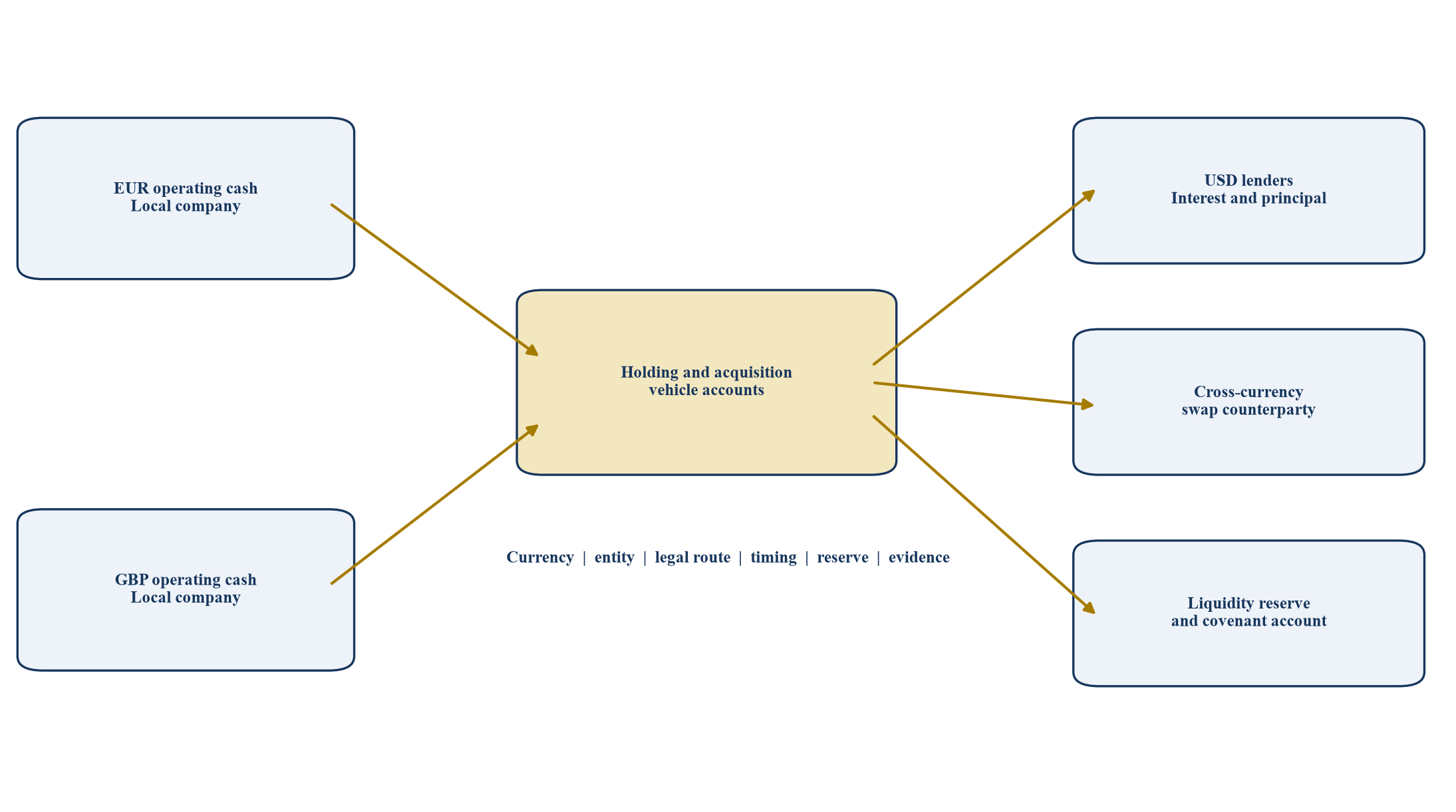
The architecture connects local operating cash, permitted upstreaming routes, debt service and derivative settlements. Transaction documents and local law determine the actual route.
4. Build a currency cash-flow ladder
A decision-grade model starts with gross operating cash by currency and then deducts local requirements. Revenue forecasts alone are insufficient because debt service is paid from cash after operating costs, working capital, tax, capital expenditure, local debt service and required reserves.
The ladder should show monthly or quarterly timing. Annual totals can hide a debt-service date that falls before a dividend declaration or a seasonal cash build. It should also show the currency of each item rather than translate everything immediately into the parent currency. Early translation can conceal the amount of natural matching and the operational conversion required.
The hypothetical case assumes annual distributable cash flow of EUR 45 million and GBP 22 million before acquisition debt service. The acquisition vehicle owes USD 60 million of annual debt service. Illustrative spot rates at closing are USD 1.10 per euro and USD 1.30 per pound. At those assumed rates, the operating cash has a USD equivalent of USD 78.1 million and leaves USD 18.1 million after debt service.
That base-case surplus does not prove resilience. If both operating currencies weaken by 15 per cent against the dollar, the same local cash converts to approximately USD 66.4 million and the surplus falls to about USD 6.4 million. A 30 per cent weakening reduces converted cash to approximately USD 54.7 million and creates a shortfall before transaction costs.
| Item | Currency | Annual amount | Payment location | Financing relevance |
|---|---|---|---|---|
| Euro operating cash | EUR | EUR 45.0m | Euro operating company | Available only after local requirements and permitted upstreaming |
| Sterling operating cash | GBP | GBP 22.0m | Sterling operating company | Available only after local requirements and permitted upstreaming |
| Acquisition debt service | USD | USD 60.0m | Acquisition vehicle | Requires conversion or currency-aligned funding |
| Closing EUR/USD assumption | USD per EUR | 1.10 | Model input | Used only for the hypothetical comparison |
| Closing GBP/USD assumption | USD per GBP | 1.30 | Model input | Used only for the hypothetical comparison |
| Minimum liquidity reserve | USD | USD 12.0m | Controlled account | Separate from operating and derivative collateral liquidity |
All amounts and exchange rates are illustrative. Distributable cash is shown after local operating requirements and before acquisition debt service.
5. Identify the true natural hedge
A natural hedge exists when operating inflows and financing outflows in the same currency occur in compatible amounts, entities and periods. Similar consolidated values are not enough. The cash must be legally and operationally available where the obligation is paid.
Direct local-currency borrowing can create a natural hedge when local operations generate dependable cash and the borrower can raise debt on acceptable terms. It can also support local lender relationships and reduce routine conversion. The trade-off can include smaller debt markets, shorter tenor, different covenant standards, security requirements and refinancing concentration.
Parent-currency borrowing can provide deeper markets or lower contractual spreads. The apparent funding advantage should be measured after expected conversion costs, cross-currency basis, collateral, documentation and liquidity. A narrow parent-currency spread can become more expensive after a swap, and the cost can change when the hedge rolls.
Natural matching should be measured against downside cash. The minimum dependable local cash may be smaller than the base forecast because revenue, working capital or capital expenditure responds to the same conditions that weaken the currency. A structure that matches debt service to optimistic cash can remain exposed when the business underperforms.
6. Choose the borrowing currency before choosing a derivative
The financing team should compare at least three structures. The first is parent-currency debt with periodic spot or forward conversion. The second is direct debt in operating currencies. The third is parent-currency debt converted through cross-currency swaps. A blended structure can assign stable local cash to local-currency obligations and retain a parent-currency tranche for central liquidity or uncertain cash.
Each structure should be priced on an all-in basis. The comparison includes reference rates, lender spread, issuance discount, fees, swap basis, dealer spread, collateral, withholding, tax gross-up, reserve requirements and expected refinancing cost. It should also include the cash consequence of early repayment, disposal or a change in the acquisition perimeter.
The relevant measure is the cost of dependable debt service under approved stresses. A structure with the lowest initial coupon can be inferior if a currency shock reduces coverage or if the hedge creates a material collateral call. A more expensive local tranche can be valuable if it removes a conversion dependency during the period of highest leverage.
The board should approve the rationale for each currency. That rationale should connect the debt to a defined cash source, maturity path and contingency plan. Borrowing in a foreign currency solely because its nominal rate is lower leaves the transaction exposed to the exchange rate and the cross-currency basis.
7. Understand cross-currency swap mechanics
A cross-currency swap can exchange principal and interest cash flows in two currencies. A common structure exchanges notionals at inception, pays interest in each currency during the term and re-exchanges the original notionals at maturity at the agreed initial exchange rate. Contract terms determine whether legs are fixed or floating, which basis applies and how payments, resets and collateral operate.
For acquisition finance, the economic objective can be to transform part of a USD loan into euro or sterling debt service without replacing the underlying facility. The borrower continues to owe the lender under the loan and owes or receives separate amounts under the derivative. The swap does not amend the lender's contractual currency.
This separation creates execution dependencies. Loan and swap payment dates, day counts, reference rates, amortisation and business-day conventions should align. The borrower must have authority and accounts to exchange notionals and settle interest. Security and intercreditor documents should state the derivative counterparty's position and payment priority.
The ISDA 2026 FX Definitions provide a current framework for privately negotiated FX and currency derivative transactions. The ISDA Master Agreement and any credit-support document govern broader close-out, netting and collateral terms. Legal analysis should confirm enforceability and insolvency treatment in the relevant jurisdictions.
8. Size converted debt service to dependable cash
The hypothetical aligned structure converts part of the USD debt-service obligation into annual payments of EUR 30 million and GBP 15 million, leaving USD 7.5 million payable in dollars. At the closing exchange-rate assumptions, those obligations have the same USD equivalent as the original USD 60 million debt service before swap basis, fees and collateral.
The converted amounts are smaller than the base local distributable cash of EUR 45 million and GBP 22 million. This leaves local buffers of EUR 15 million and GBP 7 million. The USD equivalent of those buffers changes with exchange rates, but the local coverage of the converted obligations remains unchanged if operating cash and debt service move in the same currency.
The structure should use minimum dependable cash rather than the base case. If euro cash falls to EUR 36 million and sterling cash falls to GBP 17.6 million, the local buffers narrow to EUR 6 million and GBP 2.6 million. The remaining USD 7.5 million still requires a dollar source. The model should therefore retain a parent-currency reserve or a recurring conversion plan for that tranche.
Notional schedules should decline with contractual amortisation and conservative cash expectations. The swap should not assume that a disposal, refinancing or distribution will occur until the relevant event becomes sufficiently certain and the adjustment mechanism is approved.
9. Model exchange rates and operating performance together
An exchange-rate sensitivity that holds operating cash constant can understate the acquisition risk. Currency weakness may accompany inflation, slower demand, higher imported-input costs or tighter funding. It can also improve export revenue or margins for some businesses. The model should use transaction-specific relationships rather than assume that every depreciation has the same operating effect.
The worked case separates pure translation from operating decline. With unaligned USD debt service, a 15 per cent weakening of both operating currencies reduces the base surplus from USD 18.1 million to approximately USD 6.4 million. If local distributable cash also falls by 20 per cent, converted cash is approximately USD 53.1 million and the structure has a USD 6.9 million shortfall before fees.
With currency-aligned debt service, the same 20 per cent operating decline leaves EUR 6 million and GBP 2.6 million after local debt service. At exchange rates 15 per cent below the closing assumptions, those buffers convert to approximately USD 8.5 million. After the residual USD 7.5 million obligation, the remaining cushion is approximately USD 1.0 million before basis and fees.
The aligned structure therefore reduces the direct exchange-rate sensitivity of debt service. It does not repair an operating shortfall, trapped cash or derivative liquidity event. The board should review all four dimensions in one scenario set.
| Scenario | Local distributable cash | Unaligned USD-debt surplus or shortfall | Aligned local-debt surplus after residual USD obligation |
|---|---|---|---|
| Base operating cash; closing FX | EUR 45.0m; GBP 22.0m | USD 18.1m surplus | USD 18.1m surplus |
| Base operating cash; currencies 15% weaker | EUR 45.0m; GBP 22.0m | USD 6.4m surplus | USD 14.3m surplus |
| Base operating cash; currencies 30% weaker | EUR 45.0m; GBP 22.0m | USD 5.3m shortfall | USD 10.4m surplus |
| Operating cash 20% lower; closing FX | EUR 36.0m; GBP 17.6m | USD 2.5m surplus | USD 2.5m surplus |
| Operating cash 20% lower; currencies 15% weaker | EUR 36.0m; GBP 17.6m | USD 6.9m shortfall | USD 1.0m surplus |
| Operating cash 20% lower; currencies 30% weaker | EUR 36.0m; GBP 17.6m | USD 11.8m shortfall | USD 0.5m shortfall |
USD equivalents use the illustrative closing rates and parallel weakening assumptions. The aligned structure excludes swap basis, fees, collateral and tax. Figures are rounded.
10. Include cross-currency basis in the all-in cost
Covered interest parity links spot exchange rates, forward rates and interest-rate differentials. Since the global financial crisis, persistent deviations have created a cross-currency basis in major currency pairs. The basis means that funding obtained through swaps can cost more or less than a simple comparison of cash-market interest rates suggests.
BIS analysis links the basis to hedging demand, intermediary balance-sheet capacity and funding conditions. A buyer should therefore request executable all-in terms rather than derive swap cost from published reference rates alone. The comparison should use the same notional, amortisation, payment dates, credit support and optionality across dealers.
The basis can move before signing, closing and refinancing. A transaction that relies on a particular swapped cost should define when the exposure becomes firm and which execution authority applies. The board may approve a maximum all-in cost, a minimum coverage outcome and a tolerance for basis movement rather than a single indicative quote.
The model should show basis and dealer spread as separate cash items. This prevents the apparent natural hedge from hiding a recurring cost. It also allows the team to compare direct euro or sterling borrowing with USD borrowing that is swapped into those currencies.
11. Control tenor and rollover exposure
A long-dated cross-currency swap can align with the expected acquisition-debt maturity. It can also create a close-out value if the loan refinances or repays early. A shorter swap can preserve flexibility but requires the borrower to renew the hedge at future market prices and under future counterparty capacity.
The BIS Committee on the Global Financial System reported in 2026 that derivatives can reduce currency mismatch while introducing rollover risk. That finding applies directly to acquisition financing when a borrower uses short-dated FX swaps or forwards against longer-dated debt. A hedge that expires before the loan leaves the transaction dependent on market access at the roll date.
The decision should compare contractual maturity, expected refinancing, amortisation and disposal plans. The minimum debt expected to remain outstanding can support longer protection. Debt likely to repay early can use shorter tenors or explicit adjustment rights. The structure should also identify who approves a roll and how the reserve covers adverse pricing or delayed execution.
Rollover dates should avoid known pressure points where practical. Quarter-end, year-end, holidays and major transaction dates can affect liquidity and operational capacity. The model should test a wider basis, reduced dealer capacity and a temporary inability to roll.
12. Separate operating liquidity from derivative liquidity
Operating coverage does not prove that the group can meet collateral or close-out payments. A cross-currency swap can have a positive or negative mark-to-market as exchange rates, interest curves, basis and credit conditions change. Credit-support terms can require collateral even when the underlying acquisition performs to plan.
The liquidity model should therefore contain separate lines for operating cash, debt service, swap settlements, margin, independent amount, thresholds and termination. It should state which entities can provide collateral, which currencies are eligible and whether moving cash to the derivative counterparty is permitted under the debt documents.
The hypothetical case assumes a USD 12 million controlled reserve. That amount is an input, not a recommended level. The required reserve should follow a transaction-specific stress of settlement timing, collateral terms, basis movement, currency shocks and close-out scenarios. It should also reflect the frequency of margin calls and the time needed to move cash between entities.
If the derivative shares security with lenders, the intercreditor agreement should define priority and enforcement. If it remains unsecured, the counterparty can price the credit exposure or demand collateral. The economic comparison should include that cost.
13. Treat upstreaming as a legal and operational constraint
Consolidated cash becomes debt-service cash only when it can move to the borrower. The route may depend on distributable reserves, solvency, minority protections, lender covenants, regulatory capital, local tax and exchange arrangements. A management intention to distribute cash does not establish legal availability.
The IMF Annual Report on Exchange Arrangements and Exchange Restrictions catalogues exchange arrangements, payment restrictions, capital controls and prudential measures across member countries. The report shows why a multi-jurisdiction acquisition requires a country-specific review rather than a general assumption of free conversion and transfer.
The financing model should classify cash as freely transferable, conditionally transferable or restricted. Conditional cash should state the approval, documentation, timing and cost. Restricted cash should not support acquisition debt service until the restriction is removed or a lawful alternative route is established.
Payment routes should be rehearsed before closing. The team should test bank accounts, signatories, value dates, cut-off times, currency-conversion authority and documentary requirements. A legally permitted dividend can still arrive late if operational setup is incomplete.
14. Stress trapped cash explicitly
Trapped cash can arise from law, regulation, lender restrictions, minority interests, tax, solvency, local liquidity needs or banking disruption. The model should apply a haircut and a delay to the cash-flow ladder. It should also identify whether the restriction affects one currency or the full operating group.
A 25 per cent trapped-cash assumption in the worked case reduces available euro cash from EUR 45 million to EUR 33.75 million and sterling cash from GBP 22 million to GBP 16.5 million. The aligned obligations of EUR 30 million and GBP 15 million remain covered in the base operating case, but the local buffers narrow to EUR 3.75 million and GBP 1.5 million.
If operating cash also falls by 20 per cent, a 25 per cent restriction leaves EUR 27 million and GBP 13.2 million available. Both local obligations then exceed transferable cash. Currency alignment has removed part of the exchange-rate risk, yet it cannot substitute for cash availability.
The response can include local reserve accounts, lower parent leverage, scheduled distribution windows, standby facilities, equity support or debt raised at the operating company. Each measure requires cost, authority and enforceability analysis. The chosen contingency should be funded and documented before a restriction appears.
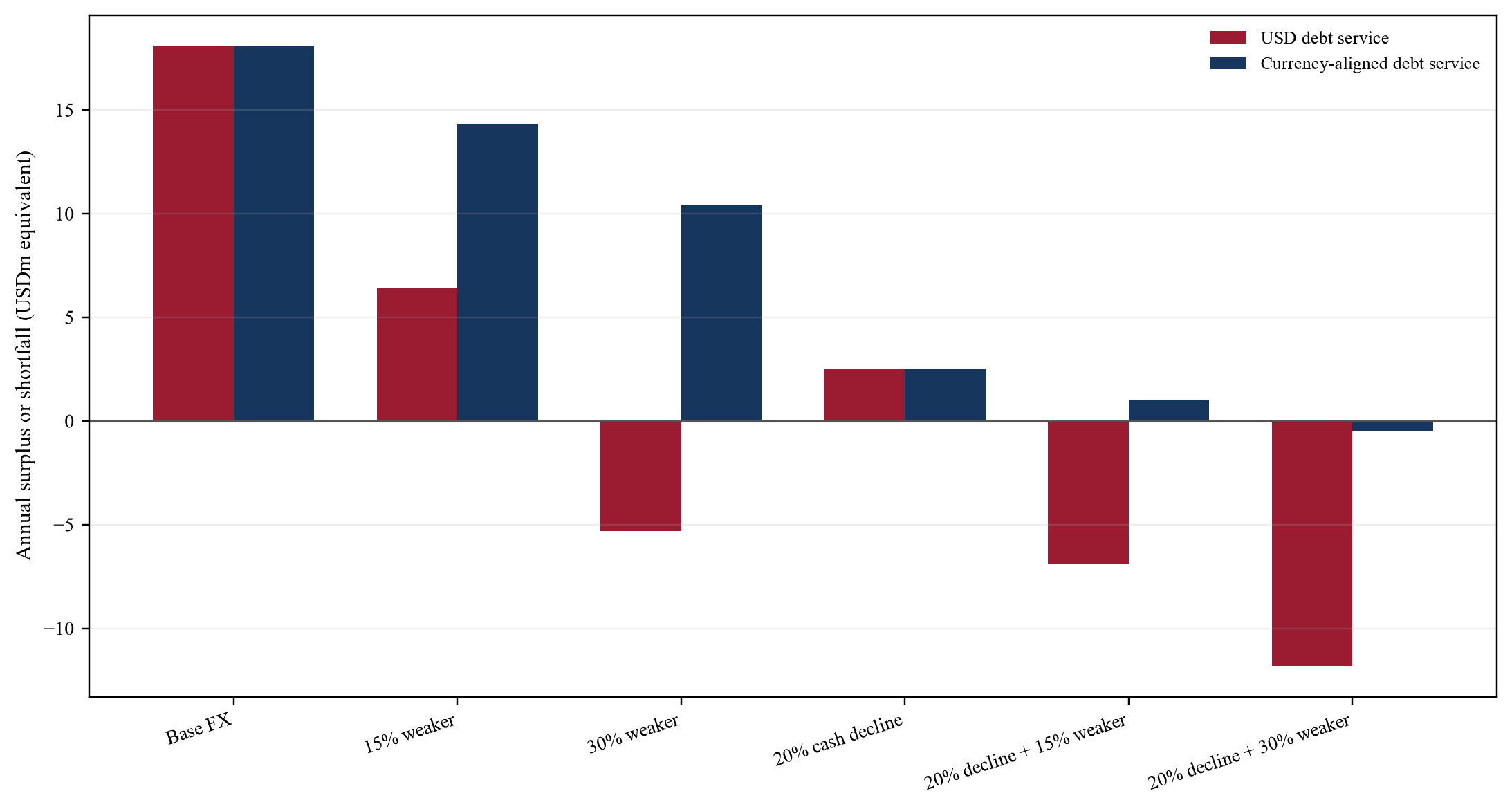
The chart compares annual surplus after debt service before basis, fees, collateral and tax. All values are illustrative.
15. Link currency structure to covenants
Covenants can measure leverage, interest cover, fixed-charge cover, debt service or minimum liquidity. The definitions determine which exchange rates, hedge settlements, derivative values and cash balances enter the calculation. A model that uses management definitions can differ materially from the legal test.
The financing team should reconstruct each covenant from the executed agreement. It should identify whether debt is translated at spot, average or another rate; whether hedge assets and liabilities affect net debt; whether realised derivative settlements enter interest expense; and whether restricted cash is excluded.
Currency alignment can stabilise cash debt service while consolidated leverage still moves through translation. The board should see both effects. The warning threshold should sit above the legal breach level and should be tested under combined currency, operating, basis and trapped-cash scenarios.
The covenant model should also address cure rights and timing. Equity cures, permitted acquisitions, disposals and refinancing actions may change the exposure and the hedge. A cure that reduces debt can produce over-hedging if the derivative notional remains unchanged.
16. Coordinate amortisation and prepayment
The derivative notional should follow the debt expected to remain outstanding and the cash expected to service it. Contractual amortisation is the starting point. Voluntary prepayment, cash sweeps, disposal proceeds and refinancing should be shown separately because they can occur at different times and in different currencies.
An operating-company disposal can remove the cash source that supported one swap leg. It can also generate sale proceeds in a currency that differs from the remaining debt. The financing plan should define how the relevant derivative is terminated, novated or resized and how any close-out amount enters the transaction sources and uses.
Step-down notionals can follow contractual principal. Optional reduction rights can add flexibility, though they can affect pricing. A buffer between protected notional and expected debt can reduce over-hedging at the cost of retaining some exchange-rate exposure.
Every prepayment event should trigger a reconciliation of debt, derivative and cash-flow forecasts. The trigger should operate before the payment where possible, because the derivative adjustment can require documentation, valuation and authority.
17. Plan refinancing and exit from the start
Refinancing can change currency, tenor, borrower, security, reference rates and operating perimeter. The existing cross-currency swap can have a significant value at that time. A refinancing model that includes only loan principal and fees is incomplete.
The borrower should obtain independent or contractually permitted valuations and test termination, novation and portability. A derivative may be retained against replacement debt if the exposure remains appropriate and the documents permit it. It may be novated to a new counterparty or terminated for cash. Each route affects timing, collateral and approvals.
Sale scenarios require similar analysis. A buyer may want debt and derivatives released at closing. The seller may retain a hedge only if it has another qualifying exposure and the contract allows it. The sale agreement should allocate responsibility for valuation, break costs and settlement mechanics.
The transaction calendar should include a derivative workstream alongside lender consents and security releases. Leaving it until final documentation can create price uncertainty and closing risk.
18. Control counterparty and close-out exposure
A cross-currency swap replaces part of an open currency exposure with contractual exposure to a derivative counterparty. The borrower should assess counterparty credit, concentration, collateral, netting, transfer rights and close-out mechanics. The lowest quoted basis is only one element of the decision.
Counterparty limits should reflect the potential future exposure of long-dated, two-currency cash flows. The structure can divide trades among counterparties, though fragmentation increases documentation and operational complexity. Security-sharing arrangements can also affect lender consent and enforcement outcomes.
The ISDA Master Agreement defines termination events, events of default, close-out and netting mechanics. The schedule and credit-support annex can add thresholds, eligible collateral, valuation agents and dispute procedures. The loan and intercreditor agreements should address the derivative consistently.
The borrower should rehearse a counterparty downgrade, dispute and replacement. The rehearsal should identify valuation sources, collateral timing, permitted transfers, substitute counterparties and decision authority. This converts a legal clause into an operational contingency.
19. Design hedge accounting around the economic exposure
IFRS 9 permits hedge accounting when the qualifying instrument, hedged item, risk-management objective, economic relationship and hedge ratio satisfy the applicable requirements and are documented. Cross-currency structures can involve cash-flow hedges, fair-value hedges or net-investment hedges depending on the actual exposure and designation.
IFRIC 16 clarifies that the presentation currency does not itself create the risk eligible for a net-investment hedge. It also addresses which group entity can hold the hedging instrument and how amounts are reclassified when a foreign operation is disposed of. The accounting analysis should use the actual functional currencies and group structure.
The economic financing decision should come first. A structure should not increase cash risk solely to obtain a preferred accounting result. The board should receive both the cash model and the expected financial-statement treatment, including sources of ineffectiveness, cost-of-hedging treatment and disclosure requirements.
The accounting workstream should start before execution. Designation, documentation, effectiveness assessment, valuation data and controls must be available at the required time. A later financing amendment, prepayment or disposal should trigger a reassessment of the designated relationship.
20. Address tax and regulatory requirements
Cross-border interest, derivative payments, guarantees, dividends and intercompany funding can create withholding, deductibility, transfer-pricing, substance, reporting and gross-up questions. The outcome depends on the entities, instruments, jurisdictions and applicable treaties. The financing model should use advice specific to the transaction.
Tax cash flows should appear separately from pricing. A structure with an attractive pre-tax swapped cost can become more expensive if a payment attracts withholding or if a deduction is unavailable. Tax analysis should also consider the consequences of termination, novation, premium and collateral.
Derivatives regulation can impose clearing, margin, reporting, confirmation, reconciliation and dispute-management requirements. Entity classification and cross-border rules determine the actual obligations. The execution timetable should allow for identifiers, onboarding, delegated reporting and operational setup.
Foreign-exchange and capital-flow rules require a country-by-country review. The IMF exchange-arrangements report provides a starting point for identifying controls and prudential measures, while local counsel and authorised banks should verify the transaction-specific position at execution.
21. Compare structures through one decision matrix
The board should compare direct local borrowing, parent-currency borrowing and swapped borrowing using the same cash-flow, operating, legal and liquidity assumptions. The matrix should record the debt-service currency, market depth, all-in cost, refinancing route, collateral, prepayment treatment, trapped-cash sensitivity and operational burden.
Direct local debt offers the clearest currency match when local cash is dependable. It can be constrained by market size, tenor or local security. Parent-currency debt can provide depth and central control, but it leaves conversion exposure unless the group has a natural parent-currency cash source. A cross-currency swap can combine market access with local-currency debt service, while adding basis, counterparty, collateral and close-out exposure.
A blended structure can allocate a stable minimum local cash flow to swapped or local debt and leave uncertain cash uncommitted. The residual parent-currency tranche can be supported by central liquidity. Complexity should increase only when it produces a measurable improvement in downside resilience.
The matrix should end with a documented reason for the selected structure and the scenarios in which it must be reconsidered. This supports later refinancing and audit review.
| Decision factor | Parent-currency debt | Direct operating-currency debt | Parent debt plus cross-currency swap | Blended structure |
|---|---|---|---|---|
| Currency match | Requires conversion or parent-currency cash | Direct match to local cash | Contractually converts selected debt service | Match stable slices; retain central tranche |
| Market access | Often deepest in the parent market | Depends on local market depth | Uses parent market and derivatives capacity | Uses more than one funding channel |
| All-in cost | Loan cost plus conversion | Local loan cost and fees | Loan cost plus basis, dealer and collateral terms | Weighted cost across tranches |
| Trapped-cash exposure | High when local cash must upstream | Lower for local debt service | Lower for converted local obligations; remaining transfer risk persists | Depends on allocation and reserve |
| Early repayment | Loan prepayment economics | Local loan prepayment economics | Loan plus derivative close-out or novation | Requires coordinated tranche adjustment |
| Operational burden | Currency conversion and transfer controls | Multiple local facilities | Derivative valuation, settlement and documentation | Highest coordination requirement |
| Best fit | Strong parent-currency cash and central liquidity | Dependable local cash and suitable debt market | Deep parent debt market with hedge capacity | Mixed cash certainty and refinancing objectives |
The assessment describes general features. Actual terms, enforceability, tax, accounting and regulation require transaction-specific analysis.
22. Establish the evidence required for approval
The approval pack should contain the sources and uses, legal-entity chart, functional-currency map, debt-service schedule, local operating cash ladder, upstreaming analysis, covenant model, derivative term sheets and liquidity stress. Each input should have an owner, date and source.
External evidence should be distinguished from management assumptions. Executed loan terms, official reference rates, dealer quotations and legal requirements can be tied to dated documents. Operating cash, distributions, refinancing and disposal timing remain scenarios until supported by performance or binding commitments.
The pack should show an unhedged case, each proposed structure and identified failure states. It should quantify the effect of currency movements, operating decline, trapped cash, wider basis, collateral and early termination. It should also identify the decisions available before a covenant or liquidity threshold is reached.
Version control is essential. A change in purchase price, debt quantum, borrower, amortisation, operating perimeter or payment date can alter the appropriate hedge. The final execution approval should reconcile the current documents with the model rather than rely on an earlier committee paper.
| Test | Required evidence | Decision output | Primary owner |
|---|---|---|---|
| Operating cash | Currency ladder after local needs and downside cases | Dependable cash by entity, currency and period | CFO and operating finance |
| Transfer route | Corporate, tax, regulatory and banking analysis | Freely transferable, conditional or restricted classification | Legal and tax |
| Debt terms | Currency, benchmark, spread, amortisation and prepayment | Contractual debt-service schedule | Financing team |
| Currency structure | Local debt, parent debt and swap term sheets | All-in comparison on common assumptions | Treasury and financing |
| Covenants | Executed definitions and testing dates | Headroom under combined stresses | Finance and legal |
| Derivative liquidity | Collateral, settlement and close-out scenarios | Dedicated reserve and escalation triggers | Treasury |
| Counterparty | Credit, netting, transfer and security terms | Approved limits and replacement plan | Treasury and legal |
| Accounting | Functional currencies, designation and controls | Accounting treatment and ineffectiveness assessment | Controller |
| Execution | Authorities, accounts, confirmations and settlement tests | Controlled closing and monitoring calendar | CFO |
Each item requires transaction-specific evidence and an accountable owner before execution.
23. Execute through a controlled calendar
The currency workstream should begin when the acquisition financing is designed. The first phase maps cash, entities, payment routes and covenants. The second obtains comparable debt and derivative terms and completes legal, tax, accounting and regulatory analysis. The third executes after the exposure is sufficiently firm and the required approvals are in place.
Signing and closing can create different exposures. A purchase-price hedge may protect the amount due at closing. The cross-currency financing hedge protects debt service after closing. The transaction plan should distinguish these objectives, instruments and dates so that one hedge is not assumed to cover both.
After closing, treasury should reconcile loan and derivative settlements, actual distributable cash, exchange rates, covenant headroom, collateral and counterparty utilisation. Reporting should use the same currency ladder approved at execution and should explain deviations.
Exception triggers should include lower local cash, delayed distributions, debt below derivative notional, reserve depletion, wider basis, counterparty downgrade and a probable refinancing or sale. Each trigger should initiate analysis, authority and a dated response.
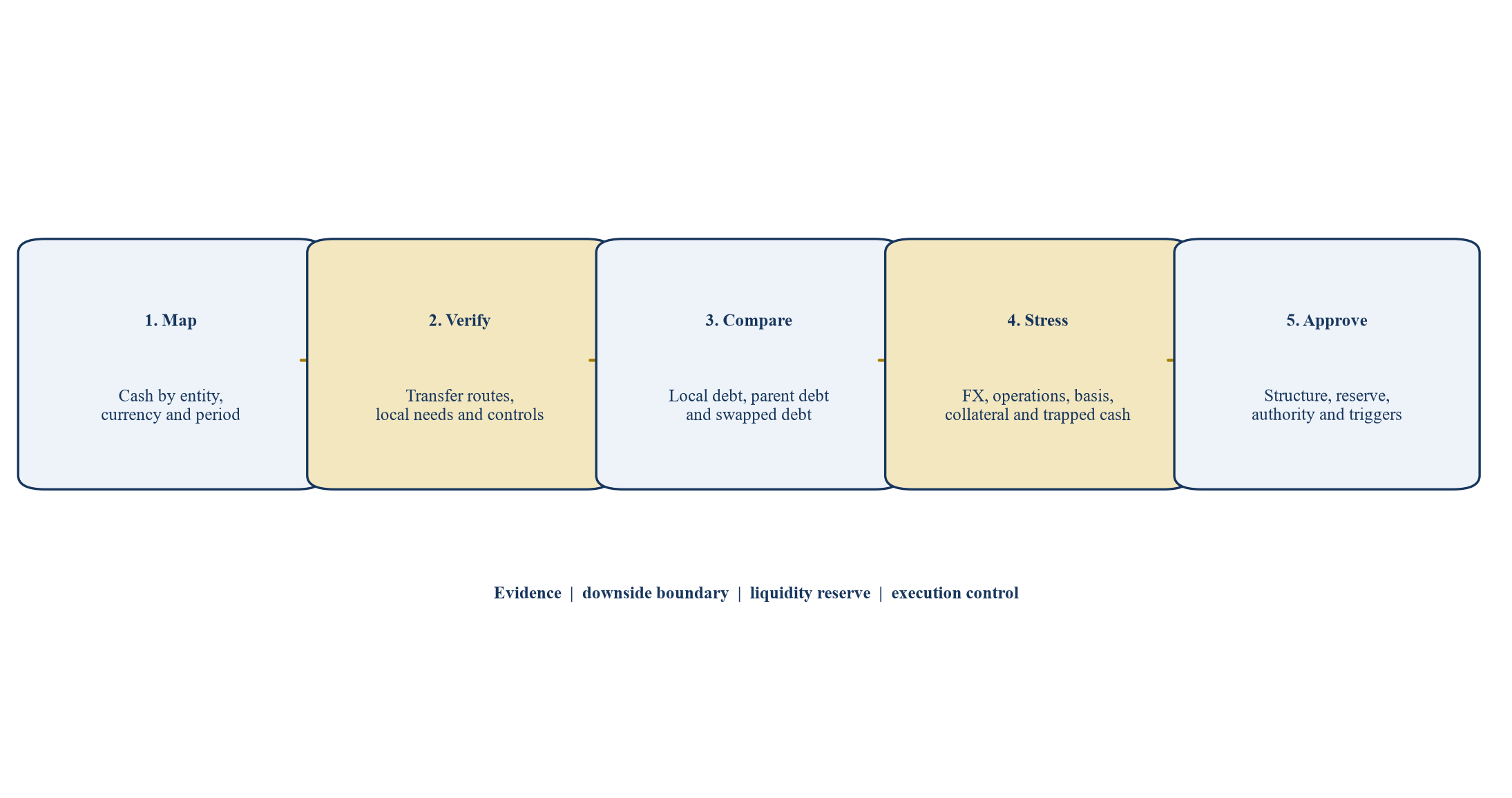
The sequence connects operating cash, transferability, borrowing choice, derivative design and liquidity approval.
24. Monitor the currency architecture after closing
Monitoring should compare actual cash with the approved ladder by entity and currency. It should show debt balance, derivative notional, all-in debt service, exchange rates, basis, mark-to-market, collateral, trapped cash and covenant headroom. It should also record distribution approvals and expected value dates.
The report should explain why cash differs from plan. A lower euro balance caused by working capital requires a different response from a delayed dividend or an exchange restriction. The first may require operating action, the second legal or treasury action, and the third a liquidity contingency.
Notional reconciliation should follow every amortisation, prepayment, acquisition, disposal and refinancing. The treasury system should retain the relationship among the debt, hedge and underlying cash source. Manual adjustments require independent review.
The board should receive warning-level exceptions before legal thresholds are reached. The reporting cycle should leave enough time to change distributions, reserve cash, resize a hedge, raise equity, amend debt or prepare a refinancing.
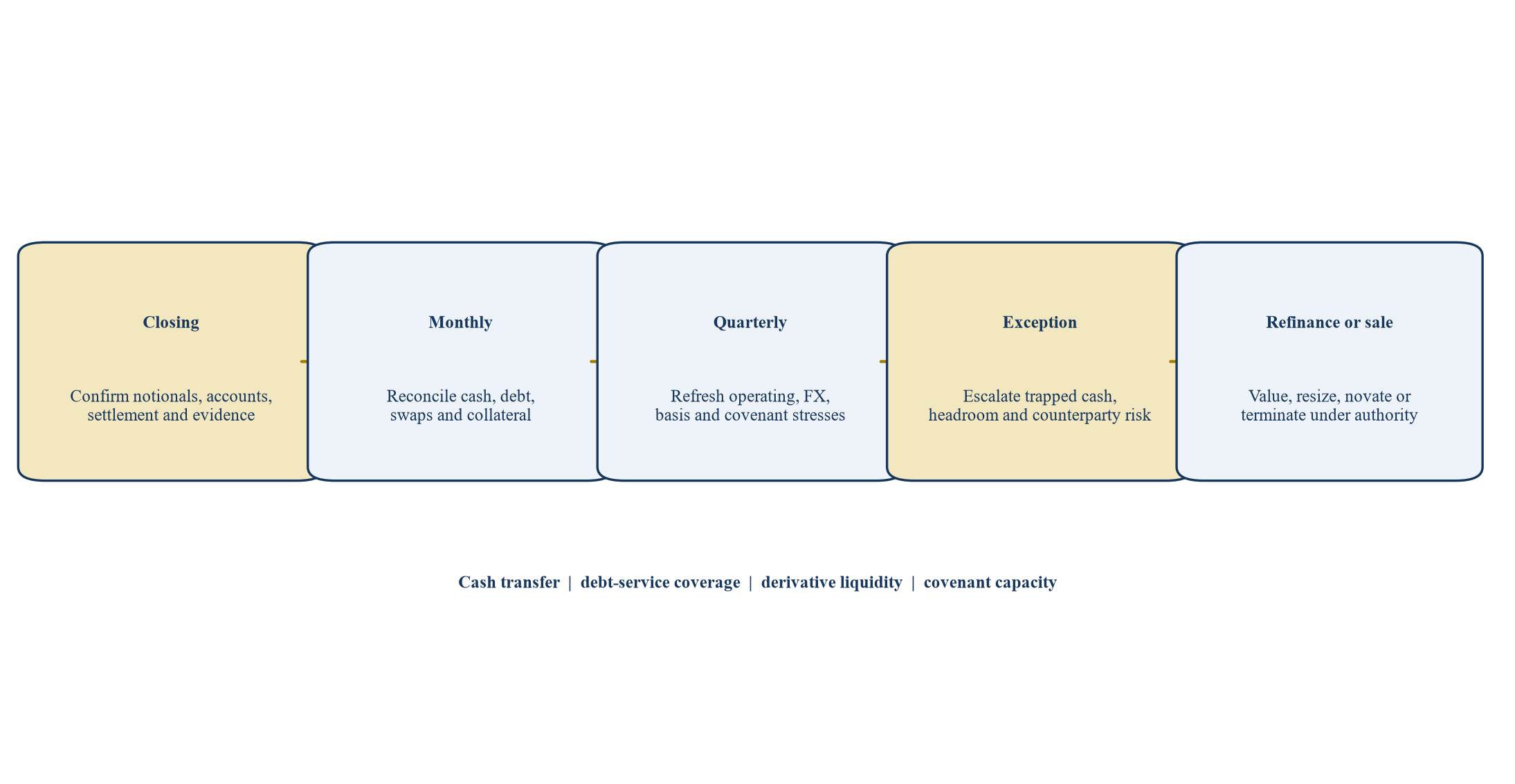
The roadmap separates closing controls from recurring monitoring, exception response and exit readiness.
25. Limitations and conclusion
This paper provides a decision framework and does not constitute investment, treasury, legal, tax, accounting or regulatory advice. Debt availability, derivative pricing, exchange controls, transferability, collateral and accounting treatment depend on market conditions, entities, jurisdictions and documents. The worked case is hypothetical and omits many transaction-specific cash flows.
Cross-currency acquisition finance should begin with cash that can actually service debt. The group should map functional currencies, local operating needs, payment routes and covenant definitions before selecting the borrowing currency or derivative.
Local-currency debt can align obligations directly with operations. Parent-currency debt can provide market depth and central control. A cross-currency swap can convert selected debt service into operating currencies. Each choice carries different cost, liquidity, refinancing and operational consequences.
The strongest structure assigns each obligation to a dependable cash source, retains a reserve for timing and trapped cash, and treats derivative liquidity as a separate risk. It also preserves the ability to resize or exit when debt, ownership or operating cash changes.
Currency alignment can reduce the sensitivity of debt service to exchange rates. It cannot guarantee operating performance, free cash that is legally restricted or ensure market access at refinancing. Continuous reconciliation among cash, debt, derivatives and payment routes is therefore the central control.
Sources
- Bank for International Settlements, Foreign currency funding risk and cross-border liquidity, CGFS Papers No 71, 12 March 2026, accessed 17 September 2026, Read the primary source
- Bank for International Settlements, FX debt and optimal exchange rate hedging, BIS Working Papers No 1303, accessed 17 September 2026, Read the primary source
- Bank for International Settlements, International finance through the lens of BIS statistics: derivatives markets, BIS Quarterly Review, December 2025, accessed 17 September 2026, Read the primary source
- Bank for International Settlements, Covered interest parity lost: understanding the cross-currency basis, BIS Quarterly Review, September 2016, accessed 17 September 2026, Read the primary source
- Bank for International Settlements, FX swaps and forwards: missing global debt?, BIS Quarterly Review, September 2017, accessed 17 September 2026, Read the primary source
- Bank for International Settlements, The financial channel of exchange rates, BIS Quarterly Review, December 2016, accessed 17 September 2026, Read the primary source
- International Swaps and Derivatives Association, 2026 FX Definitions, accessed 17 September 2026, Read the primary source
- International Swaps and Derivatives Association, The Value of OTC Derivatives, accessed 17 September 2026, Read the primary source
- IFRS Foundation, IFRS 9 Financial Instruments, issued standard text and hedge-accounting requirements, accessed 17 September 2026, Read the primary source
- IFRS Foundation, IFRIC 16 Hedges of a Net Investment in a Foreign Operation, accessed 17 September 2026, Read the primary source
- IFRS Foundation, IAS 21 The Effects of Changes in Foreign Exchange Rates, accessed 17 September 2026, Read the primary source
- International Monetary Fund, Annual Report on Exchange Arrangements and Exchange Restrictions 2023, published 19 December 2024, accessed 17 September 2026, Read the primary source
- Federal Reserve Bank of New York, Reference Rates: SOFR, SOFR Averages and Index, accessed 17 September 2026, Read the primary source
- European Central Bank, Euro short-term rate and compounded averages, accessed 17 September 2026, Read the primary source
- Bank of England, SONIA interest rate benchmark and compounded index, accessed 17 September 2026, Read the primary source
- European Securities and Markets Authority, Clearing obligation and risk mitigation techniques under EMIR, accessed 17 September 2026, Read the primary source
- Basel Committee on Banking Supervision, Counterparty credit risk guidelines and sound practices, accessed 17 September 2026, Read the primary source
- Board of Governors of the Federal Reserve System, Interagency Guidance on Leveraged Lending, accessed 17 September 2026, Read the primary source
