

1. Define the cyber diligence decision
Cyber diligence is a transaction decision process supported by technical evidence. Its purpose is to determine how digital exposure changes the economics, protections, readiness and operating plan of a proposed transaction. A high-quality review therefore starts with the acquisition thesis, critical services, legal perimeter, integration intent and deal timetable. It does not start with a generic control checklist.
The central question is whether the target can protect and operate the assets, services, data and relationships that support the transaction case within an acceptable risk and investment envelope. The answer requires evidence about how the business earns revenue, collects cash, serves customers, meets regulation, develops products, manages suppliers, recovers from disruption and controls privileged authority. A technically weak control becomes transaction-critical when it connects to a concentrated revenue stream, payment pathway, regulated service, safety function, irreplaceable dataset or delayed separation dependency.
The diligence mandate should state the transaction perimeter, authorised testing methods, evidence access, legal privilege, clean-team restrictions, data-handling protocol, escalation path and decision dates. Intrusive testing can disrupt operations or breach law and contract. The buyer and its advisers should obtain explicit authority and use proportionate techniques. Evidence supplied by management should be distinguished from independently observed configuration, tested operation and third-party assurance.
The output is a transaction cyber register. Every material finding records the source, affected asset and service, threat pathway, control state, evidence confidence, loss scenario, regulatory relevance, valuation path, contractual response, closing requirement, Day 1 control, remediation owner and residual risk. The register maintains traceability from technical observation to board decision.
Table 1. Evidence states for transaction cyber findings
| Evidence state | Minimum record | Transaction use | Control requirement |
|---|---|---|---|
| management assertion | owner, date, scope and supporting record | scope further work | label source and limitation |
| observed configuration | system, sample, method and timestamp | identify control design | preserve authorised evidence |
| tested operation | test procedure, population, exception and reviewer | assess operating effectiveness | reproducible test and access log |
| supported finding | threat pathway, affected service and consequence | quantify transaction exposure | independent challenge and confidence |
| approved response | valuation, SPA, condition, Day 1 or remediation decision | execute deal treatment | authority, rationale and residual risk |
| verified closure | remediation evidence and retest | close or reduce exposure | accountable owner and audit trail |
A finding advances only when its source, business consequence and decision treatment are explicit.
2. Start with critical business services and the transaction perimeter
An asset inventory alone cannot show transaction materiality. Deal teams should first identify the services whose disruption, manipulation or disclosure could materially affect customers, cash, safety, regulation or the deal thesis. Examples include order fulfilment, payment processing, clinical service, trading, grid operation, customer authentication, product release, treasury, financial reporting and regulatory submission. Each service is mapped to people, processes, technology, facilities, information and third parties.
The FCA's operational-resilience approach provides a useful discipline for relevant financial firms: identify important business services, define impact tolerances, map dependencies and test severe but plausible scenarios.[6][7] The underlying method has broader transaction value. A target can report good infrastructure uptime while a critical service remains unrecoverable because a specialist employee, supplier credential, encryption key, data feed or manual workaround is missing.
The transaction perimeter should capture legal entities, businesses, countries, products, customer groups, systems, networks, cloud tenants, development environments, operational technology, data stores, joint ventures and outsourced services. Carve-outs require special attention because the seller may retain identity, network, security monitoring, software licences, encryption keys, data platforms or response capabilities under transitional arrangements. The buyer must understand which controls move, which remain and which need replacement.
Integration intent changes exposure. A buyer planning rapid network connectivity inherits a different pathway from a buyer operating a ring-fenced platform. A transaction involving sensitive government, health, financial, defence or critical-infrastructure data can face ownership, localisation, access and national-security constraints. The diligence map should therefore show the current environment and the proposed post-close architecture.
3. Build the attack-surface and dependency map
The attack-surface map connects externally reachable services, identity systems, endpoints, applications, data, cloud, operational technology, development pipelines and third parties to critical business services. It should identify trust boundaries and concentrated control points. The goal is a decision model, not an exhaustive network diagram.
Identity deserves priority because valid credentials can bypass many perimeter controls. The review covers authoritative directories, single sign-on, multifactor authentication, privileged access, service accounts, dormant users, contractors, emergency access, secrets, keys and joiner-mover-leaver processes. The team should test representative populations and critical roles. A policy statement without configuration or operating evidence provides limited assurance.
Data mapping should classify sensitive and transaction-critical information; record location, ownership, purpose, retention, transfer, encryption, access, deletion and backup; and connect datasets to customer promises and legal bases. Unknown data flows can constrain consolidation, analytics, AI use, cross-border integration and divestment. The map should also show repositories used for source code, models, product telemetry, customer content, employee data and regulated records.
Third-party mapping includes cloud, managed service, payment, telecoms, software, security, data, development and operational suppliers. NIST CSF 2.0 identifies due diligence, contractual requirements, monitoring, incident planning and end-of-relationship provisions within cyber supply-chain governance.[1][3] The deal review should examine concentration, subcontracting, access, audit rights, incident notice, recovery commitments, portability, termination and exit evidence.
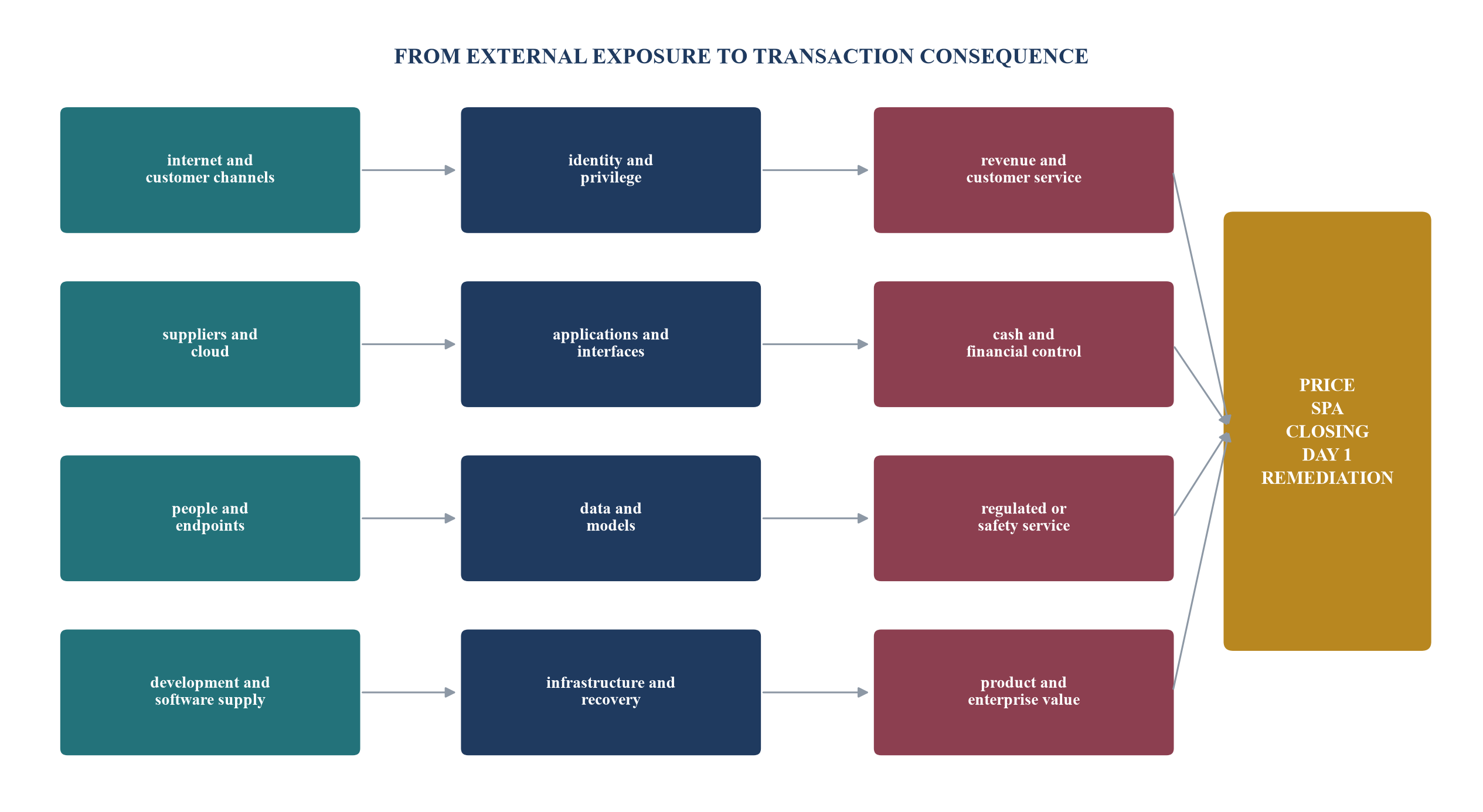
The map connects technical exposure to critical services and transaction decisions.
4. Test control operation across the six cyber functions
NIST CSF 2.0 organises outcomes through Govern, Identify, Protect, Detect, Respond and Recover.[1] A transaction review can use these functions as a common language while selecting evidence based on the target's services and risks. A framework mapping supports completeness; it does not substitute for testing.
Govern covers decision rights, risk appetite, policy, roles, oversight, supply chain and legal obligations. Evidence includes board reporting, risk acceptance, resource decisions, exceptions and accountability. Identify covers assets, services, data, dependencies, vulnerabilities and risk assessment. Protect covers identity, access, awareness, data security, platform configuration and technology resilience. Detect covers telemetry, coverage, alert logic, tuning and investigation. Respond covers incident command, analysis, containment, communication and reporting. Recover covers restoration, validation, customer service, lessons and resilience improvement.
The deal team should assess design, implementation, operation and outcome separately. A control can be well designed and partially deployed. A tool can be deployed without representative coverage. A process can operate without meeting the recovery outcome. Evidence confidence should reflect population coverage, sample selection, recency, independence and the target's ability to reproduce the result.
Maturity scores should remain subordinate to findings. An average score can hide a critical weakness in privileged access or recovery. The heat map should therefore show both control state and critical-service exposure. A low-maturity process attached to a non-critical environment may be a manageable technical-debt item. The same weakness in the only payment or clinical platform may require a closing gate.
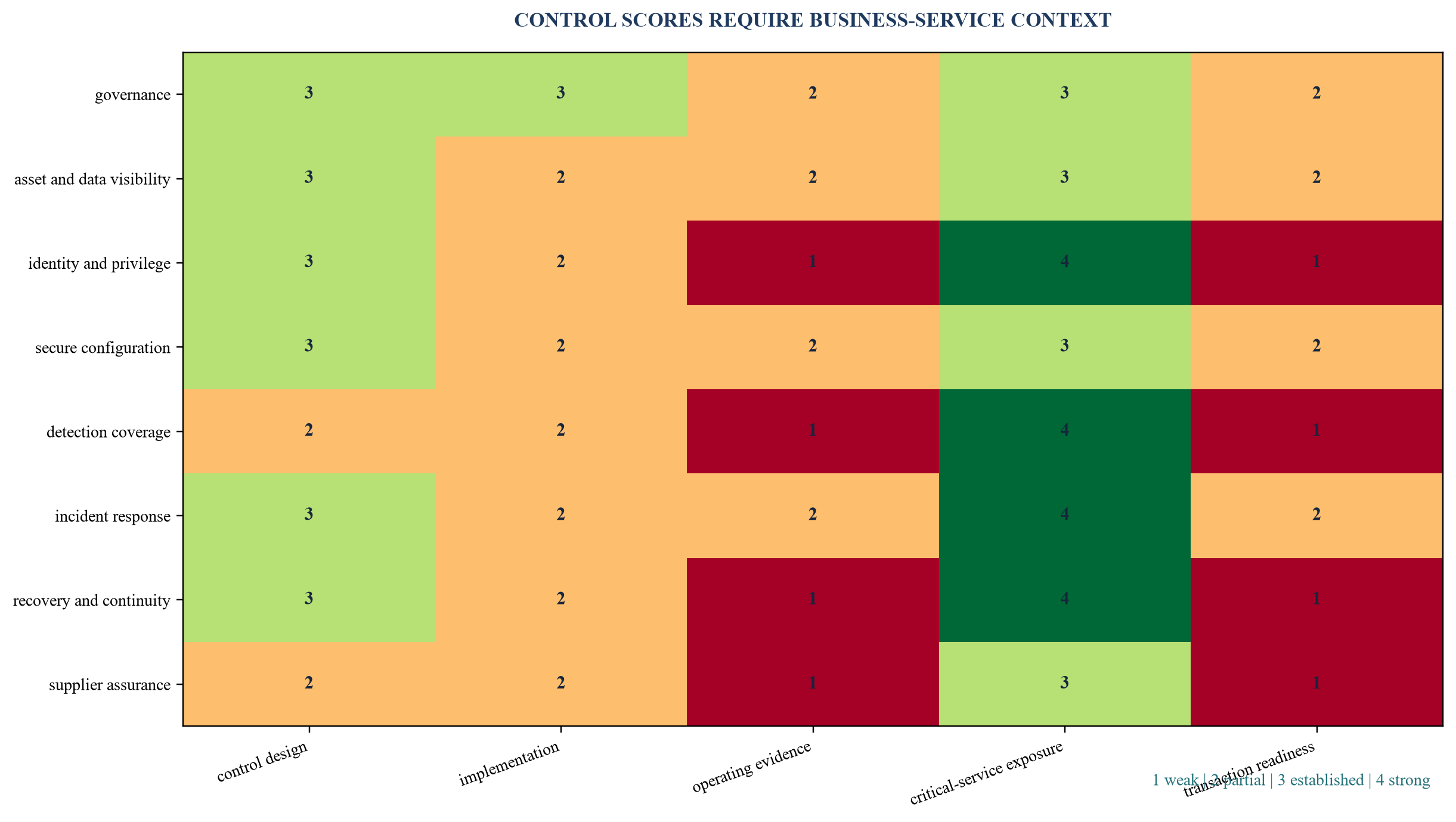
Scores are hypothetical; live conclusions require representative evidence and deal-specific materiality.
5. Separate active compromise, control weakness and technical debt
Not every cyber finding has the same transaction meaning. The first category is active or recent compromise: unauthorised access, persistence, exfiltration, fraud, destructive activity or unresolved incident. This can require immediate containment, forensic preservation, legal assessment, notification, customer action, insurer engagement and a decision about signing or closing.
The second category is a control weakness that creates a credible loss pathway. Examples include unrestricted privileged access, incomplete multifactor authentication, exposed services, unmonitored critical assets, weak development controls, untested restoration or unsupported software. The transaction response depends on exploitability, affected service, compensating controls, evidence and remediation timing.
The third category is legal or regulatory exposure. Data may lack an adequate processing basis, incident reporting may be incomplete, security commitments may be unmet, regulated services may exceed tolerance or product obligations may be unclear. Counsel determines legal conclusions. The diligence record supplies facts, systems, data, jurisdictions, dates and operating evidence.
The fourth category is technical debt. Remediation may be required to reach the buyer's operating standard even where no present breach or material control failure is established. Technical debt should be costed, sequenced and separated from incident loss. The fifth category is integration-created risk: combining identity, networks, data, development tools or suppliers can create exposure that neither stand-alone business had. The buyer owns this risk and should not attribute it automatically to the seller.
Clear classification prevents the same finding from becoming an undifferentiated red flag. It also supports fair negotiation. Active compromise may justify a closing condition. A finite technical-debt programme may influence price or the integration budget. Buyer-created integration exposure belongs in the buyer's plan.
6. Reconstruct incident history and latent exposure
Incident diligence should examine known events, suspected events, alerts, investigations, insurance notifications, customer communications, regulator engagement, litigation, law-enforcement contact, restoration, root cause and lessons. The absence of a recorded incident does not establish the absence of compromise. Detection coverage, log retention and investigation quality determine how much confidence can be placed in history.
The team should test whether the target can produce an incident chronology and evidence of decisions. It should reconcile security records with legal, privacy, customer-support, fraud, finance, insurance and operational-resilience records. Discrepancies can indicate fragmented reporting or incomplete escalation. A material customer outage recorded as an operational problem may have had a cyber cause; a fraud case may have involved compromised identity.
The SEC's 2023 final rule requires registrants to disclose material cybersecurity incidents on Form 8-K and provide annual disclosures about processes for assessing, identifying and managing material cyber risks, together with governance disclosures.[5] The exact applicability, materiality and reporting path require issuer-specific legal advice. Transaction teams should nevertheless preserve the evidence used for materiality decisions and reconcile public statements with diligence findings.
Incident evidence should be handled carefully. Premature system changes can destroy forensic artefacts. Broad circulation can affect privilege, confidentiality and response. The diligence protocol should define who receives details, who has authority to contain, how evidence is preserved and how the transaction timetable responds. If active compromise is suspected, the response team should take control through an agreed incident process.
7. Model credible cyber loss scenarios
A cyber loss scenario connects threat, vulnerability, asset, service, control, event and consequence. It avoids applying a generic breach cost to every finding. The scenario should specify the initiating event, access pathway, affected environment, detection and response assumptions, disruption duration, data impact, fraud exposure, regulatory pathway, customer effect, restoration work and residual uncertainty.
Financial consequences can include response and forensic cost, restoration, customer remedy, business interruption, lost gross profit, contractual credits, fraud, legal cost, regulatory penalty, insurance retention, higher premiums, accelerated capital expenditure, delayed integration, revenue churn and management diversion. Some are one-time cash items; others affect recurring earnings, growth, working capital or cost of capital. The model should identify tax, accounting and insurance treatment for professional review.
Probability estimates require humility. Sparse incident data, changing attackers and unknown control coverage make precise point estimates unreliable. The team can use ranges, scenarios and decision thresholds. Expected value may support negotiation, while tail severity may still justify a closing condition or risk limit. A low-probability event that can prevent safe operation of a critical service remains relevant.
Loss scenarios should distinguish target stand-alone exposure, transaction-triggered exposure and buyer integration exposure. A change-of-control clause, supplier termination, employee departure or accelerated attacker activity can alter risk around announcement and closing. The plan should account for heightened monitoring and privileged-access control during the transaction period.
Table 2. Illustrative cyber loss-scenario decision table
| Scenario | Stand-alone cash range | Recurring earnings effect | Transaction response | Key uncertainty |
|---|---|---|---|---|
| compromised privileged identity | USD 0.5m-4.0m | possible customer and control effect | containment, forensic gate and specific protection | persistence and data access |
| critical-service ransomware | USD 2.0m-15.0m | interruption and customer attrition | recovery test, liquidity and Day 1 command | restoration integrity and duration |
| unsupported product component | USD 0.8m-6.0m | margin or roadmap effect | remediation budget and product covenant | replacement scope and customer commitments |
| unlawful or uncontrolled data use | USD 0.3m-8.0m | analytics, AI or cross-sell constraint | legal review, data condition and integration ring-fence | jurisdiction and remediation feasibility |
| concentrated cloud or supplier failure | USD 0.5m-10.0m | service-level and revenue effect | contract, exit plan and resilience investment | subcontracting and portability |
| integration-created identity exposure | buyer-funded | execution and delay effect | staged connectivity and buyer control | target-to-buyer dependency sequence |
Amounts and probabilities are hypothetical modelling inputs, not benchmarks or forecasts.
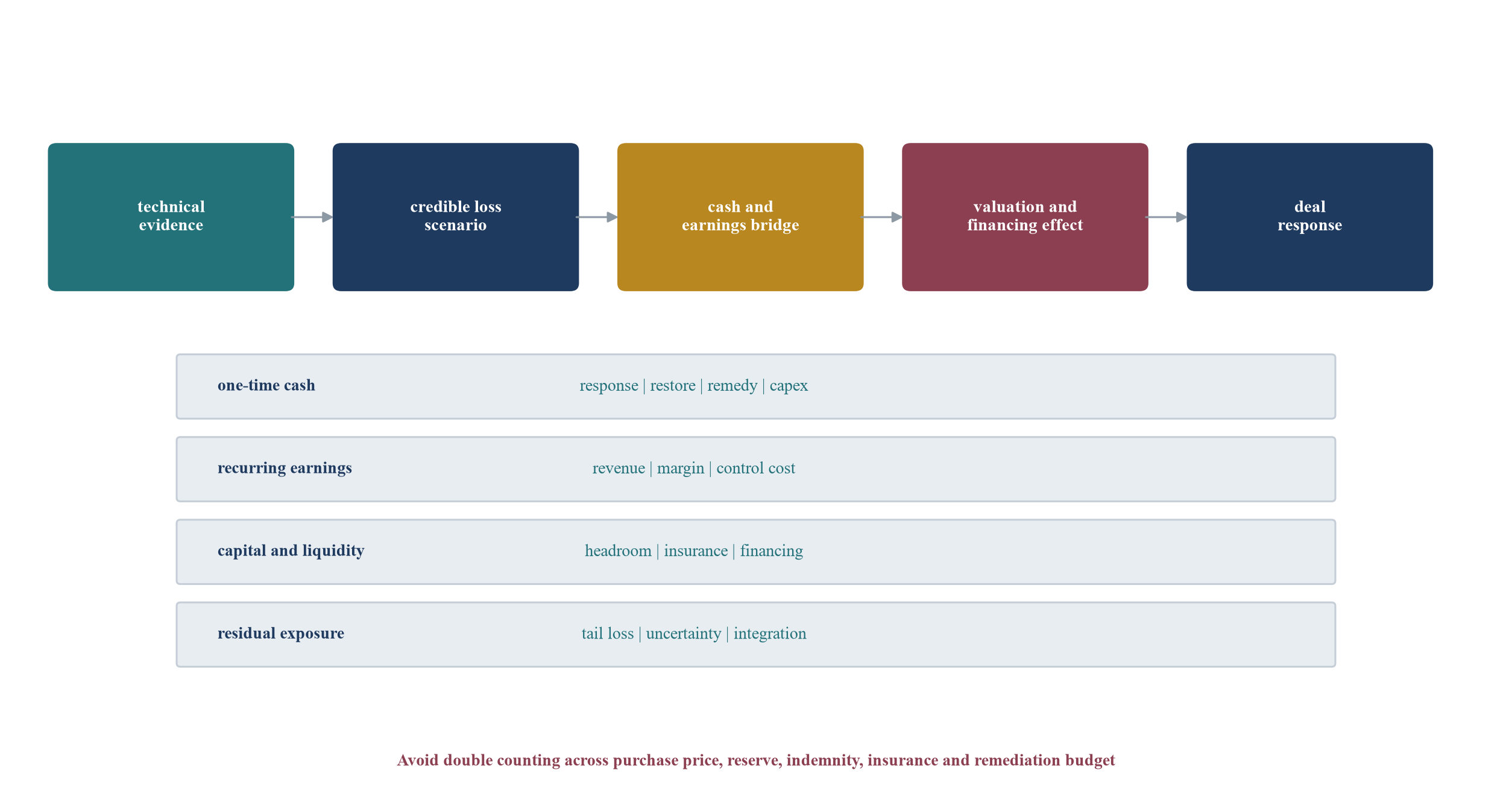
The bridge prevents repair cost, loss exposure and valuation effects from being combined without a defined economic path.
8. Translate exposure into valuation and financing
The valuation bridge starts with the nature of the economic effect. Immediate response, restoration and remediation are generally cash requirements. Sustained security staffing, licences, hosting changes, product support or customer concessions can affect recurring earnings. Lost or constrained revenue can affect forecasts and terminal value. Delayed integration can defer synergies and increase one-time cost. A severe uncertainty can affect financing capacity, insurance availability or the required return.
Repair cost alone can understate exposure because a technically simple control may sit on a severe loss pathway. It can also overstate seller responsibility where the buyer's standard exceeds the target's stand-alone need. The model should show the target requirement, buyer integration requirement and optional transformation separately. This allows the deal team to negotiate supported adjustments while budgeting buyer-led change honestly.
The team should define the valuation mechanism. A recurring earnings adjustment may flow through maintainable EBITDA and the selected multiple. A one-time cash item may affect equity value or a specific reserve. A contingent exposure may be addressed through probability-weighted scenarios, escrow, holdback, indemnity or insurance. The transaction model should prevent duplicate treatment across forecast, price adjustment, provision and synergy case.
IFRS 3 requires an acquirer to recognise identifiable acquired assets and assumed liabilities under the business-combination framework, while IFRS 13 defines fair-value measurement principles.[15][16] Cyber findings can influence information used in purchase-price allocation, asset valuation, contingent consideration, useful lives, provisions and impairment assessment, subject to professional accounting judgement. The diligence model should preserve source evidence and avoid presenting a transaction negotiation adjustment as an accounting conclusion.
Financing analysis should examine liquidity for response and remediation, covenant headroom, business interruption, delayed synergy, insurance retention, committed facilities and lender conditions. A lender may care about service continuity, regulatory standing, cash concentration and control over collateral or data. The cyber register should link these consequences to treasury and financing workstreams.
9. Select the transaction response without double counting
A supported finding can change price, structure, financing, SPA protection, closing conditions, Day 1 controls, remediation or risk acceptance. The selected response should address both economic allocation and operating cure. A price adjustment transfers value; it does not secure the environment. An indemnity may allocate specified loss; it does not restore a critical service. A remediation covenant may require action; it may provide limited recovery if the action fails.
The disposition paper should show evidence, uncertainty, economic path, available responses, residual risk and recommended authority. It should also show which treatments are mutually reinforcing and which would duplicate recovery. If remediation cost reduces price, is placed in escrow and is already reflected in the forecast, the model needs explicit reconciliation.
The deal team should preserve optionality. A suspected compromise may require forensic work before the appropriate economic response is known. The transaction can use a signing condition, closing condition, price mechanism, specific indemnity, information right or termination right as advised by counsel. Long-stop dates, materiality thresholds and waiver authority should align with the technical investigation timetable.
Risk acceptance should be written. The record identifies the decision maker, exposure, rationale, compensating controls, monitor, trigger and review date. The accepted finding remains in the Day 1 and 100-day register until the operating owner and risk authority approve closure.
10. Convert findings into SPA protection and closing conditions
Legal counsel determines drafting, enforceability and remedies. The cyber team provides the factual chain that allows provisions to be specific and operable. The SPA protection matrix links each finding to the relevant representation, warranty, indemnity, covenant, condition, price mechanism, escrow, insurance or information right. It records the protected exposure, evidence owner, survival period, cap, threshold, notice requirement, claim owner and remediation dependency.
Cyber representations may address incidents, compliance, security measures, data handling, contracts, business continuity, investigations and notices. Specific indemnities can allocate identified exposures. Pre-close covenants can preserve controls, require notification of new events, restrict material technology changes and support access for agreed remediation. Conditions can require containment, independent testing, regulator or customer action, restoration evidence, separation capability or delivery of critical records.
A closing condition should be objective and verifiable. “Improve cybersecurity” is not a controlled gate. A condition can identify a defined environment, control outcome, authorised test, evidence package, reviewer and acceptance authority. The target should know what completion means; the buyer should know which residual exposure remains.
The matrix should distinguish confidentiality and privilege. Sensitive technical details may sit in a restricted schedule or evidence room rather than broad transaction documents. Access should be proportionate. The operating team still needs enough information after closing to execute remediation and meet reporting obligations.
Table 3. Cyber finding transaction-response matrix
| Finding class | Price or structure | SPA protection | Closing evidence | Post-close control |
|---|---|---|---|---|
| active compromise | contingent or fixed adjustment after investigation | specific indemnity, covenant and notice | containment, forensic scope and clean restoration | heightened monitoring and closure retest |
| critical access weakness | remediation reserve where material | security covenant and incident notice | privileged-account inventory and tested control | Day 1 identity command |
| untested recovery | liquidity and delayed-synergy treatment | resilience covenant or specific protection | representative restore and service test | recovery programme and board tolerance |
| data-law exposure | scenario-based value and integration constraint | representation, indemnity and data covenant | legal basis, inventory and restricted-use plan | ring-fence, remediation and audit |
| unsupported technology | cash, earnings and product-roadmap effect | disclosure and remediation covenant | funded plan and critical supplier support | staged replacement with customer controls |
| supplier concentration | financing and continuity effect | contract and change-of-control protection | consent, service commitment and exit evidence | portability and resilience programme |
Live provisions require jurisdiction-specific legal advice and deal-specific evidence.
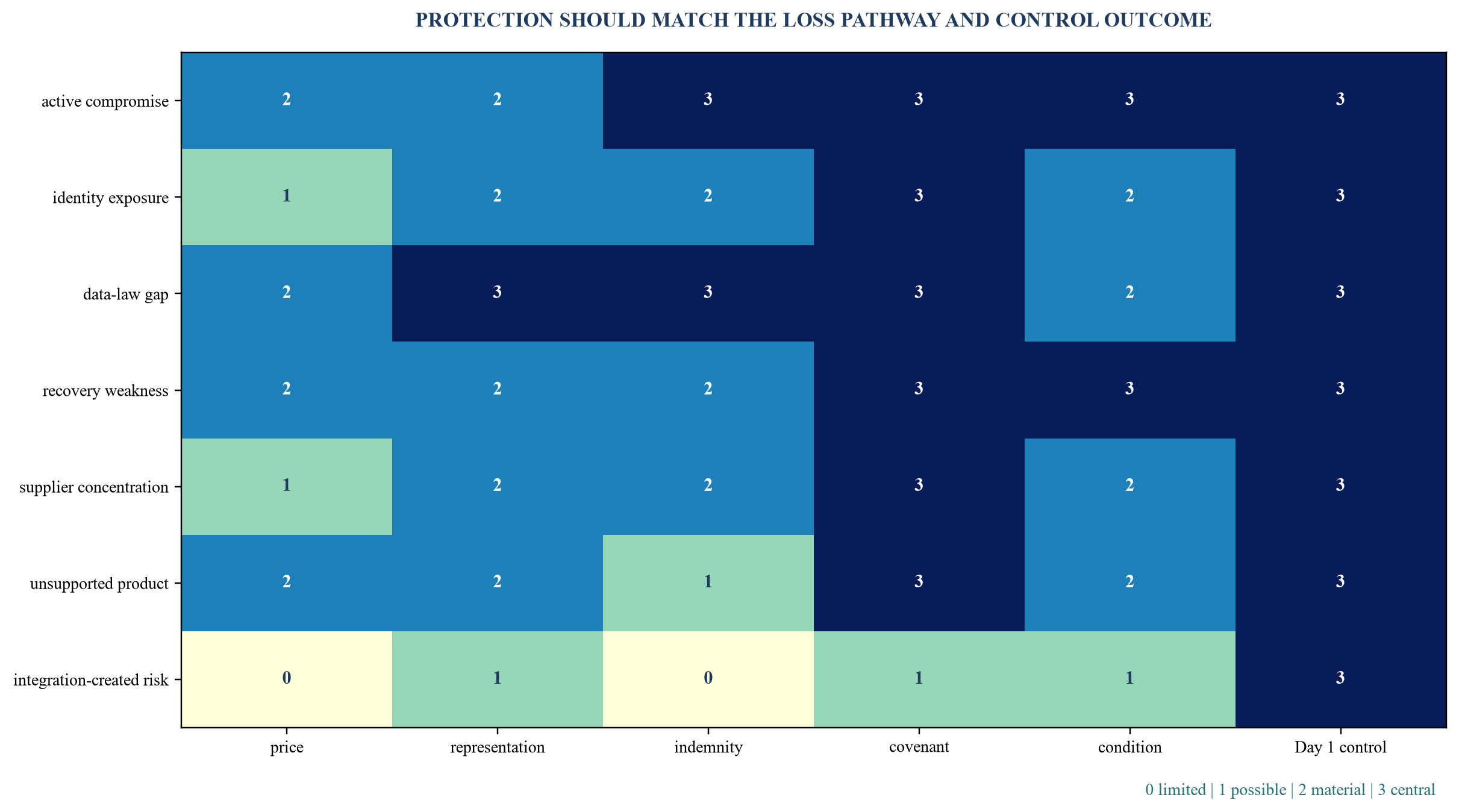
Scores indicate relative suitability in a hypothetical case; counsel selects live transaction treatment.
11. Define cyber closing readiness
Closing readiness protects the first hours and days of ownership. The buyer should know who has legal and technical authority, which critical services must remain available, how privileged access is controlled, how payments are protected, where incident evidence is reported and how recovery will work. Readiness should be tested rather than inferred from a completed checklist.
The closing gate can include confirmation of no unresolved active compromise within the agreed scope; controlled administrator and service-account access; multifactor authentication for critical pathways; secured transaction and payment communications; current backups with representative restoration evidence; active monitoring for critical environments; incident contacts; legal and regulator reporting routes; supplier and cloud access; cyber-insurance status; and a tested escalation bridge.
The deal period can heighten risk. Public announcement, employee uncertainty, adviser access, data-room activity and integration preparation create new pathways. The parties should agree enhanced monitoring, credential hygiene, phishing response, secure communication and notification of material events. Seller and buyer responsibilities remain distinct before control transfers.
Carve-outs need an explicit separation-security plan. It identifies shared directories, networks, monitoring, applications, data, keys, licences, certificates, suppliers and response processes. Transitional services should include access boundaries, incident responsibilities, service levels, evidence, audit, change control and exit. The buyer should test its replacement capability before dependency expiry.
12. Protect Day 1 and the first 100 days
Day 1 should stabilise identity, payments, critical services, incident response, regulatory reporting, data boundaries and recovery. Rapid network integration can wait where evidence is incomplete. The buyer can use ring-fencing, monitored gateways, staged trust, restricted data movement and dedicated privileged access until control outcomes are verified.
The first ten days establish command: confirm accountable executives, reconcile privileged identities, preserve evidence, validate monitoring, test payment controls, inspect critical alerts, confirm backups and review open incidents. Days 11 to 30 complete high-confidence containment and validate the target baseline. Days 31 to 60 deliver critical remediation and test service resilience. Days 61 to 100 embed controls, complete priority integration and transfer residual risks into normal governance.
Remediation sequencing should follow loss-pathway reduction. Disabling exposed or dormant access can reduce immediate risk before a broad platform replacement. Segregating critical assets can reduce blast radius while long-term architecture is designed. A roadmap should show dependency, service impact, change window, customer obligation, resource, evidence and rollback.
The buyer should avoid declaring closure based on tool deployment. Closure requires a defined outcome and retest. Privileged-access remediation means the population is known, access is justified, authentication is controlled, use is monitored and exceptions are governed. Recovery remediation means a representative service can be restored with verified data integrity, dependent resources and operating sign-off.
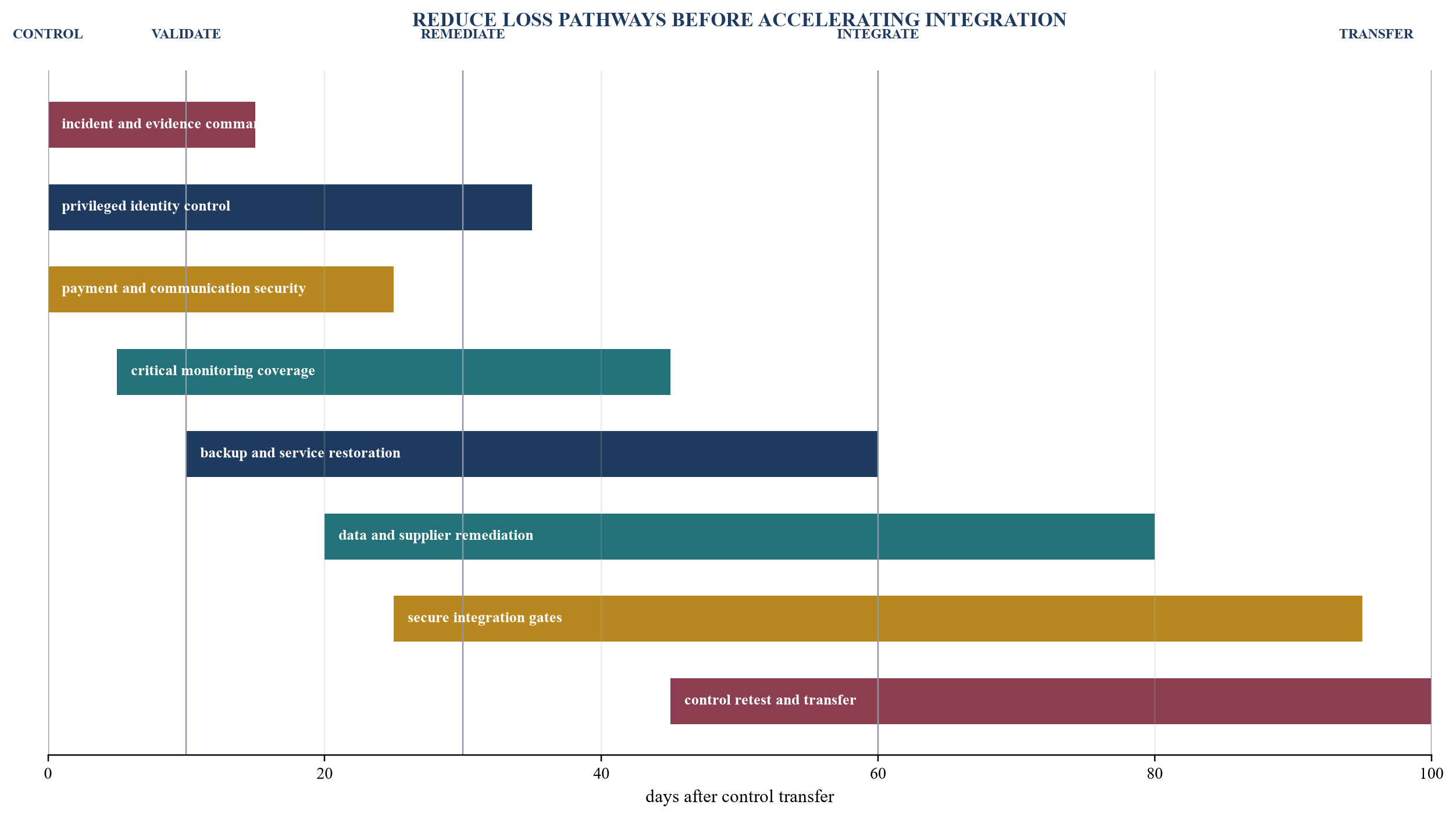
Timing is hypothetical; live sequencing depends on compromise status, legal duties and service constraints.
Table 4. Cyber remediation work-package standard
| Field | Required content | Decision use |
|---|---|---|
| supported finding | source, affected service, pathway and confidence | preserve why the work exists |
| target outcome | specific control and service result | define completion |
| accountable owner | executive, delivery lead and independent reviewer | establish authority |
| dependencies | legal, people, supplier, technology and change windows | sequence delivery |
| economic record | cash, recurring cost, downtime and forecast effect | control transaction model |
| evidence and retest | population, test, exception and acceptance | verify closure |
| residual exposure | remaining pathway, tolerance and monitor | support risk acceptance |
Each work package should produce evidence of an operating outcome.
13. Address data, privacy and cross-border integration
Data diligence connects inventory, purpose, legal basis, consent where relevant, contract, retention, security, sharing, localisation, transfer and data-subject rights. The team should identify which datasets support the transaction thesis and whether the buyer can lawfully and practically use them after closing. A large dataset can have limited transaction value if provenance, rights, quality or permitted purpose is unclear.
The EU General Data Protection Regulation governs personal-data processing within its scope and includes security, breach-notification, processor and transfer obligations.[10] NIS2 addresses cybersecurity risk-management and incident reporting for covered entities, while DORA creates a financial-sector digital operational-resilience regime.[8][9] The Cyber Resilience Act introduces horizontal cybersecurity requirements for products with digital elements, with phased application.[11] Applicability and transition require entity, product and jurisdiction analysis.
The UAE federal data-protection framework establishes obligations and rights for personal-data processing, security and cross-border transfers within its scope.[12] The UAE Cabinet approved a National Cybersecurity Strategy in February 2025 based on governance, protection, innovation, capacity building and partnership.[13] Free-zone and sector regimes can add requirements. The diligence map should identify each legal entity, processing role, jurisdiction, regulator and data flow for counsel review.
Integration should use a data-permission gate. Before migration, consolidation, analytics, cross-selling or AI use, the owner confirms purpose, authority, customer promise, retention, access, transfer, security and deletion. The buyer can ring-fence data while gaps are remediated. This protects value by preserving lawful use and reducing uncontrolled replication.
14. Govern third parties and the software supply chain
Third parties can concentrate service, data and access risk. Diligence should identify critical suppliers, subcontractors, shared-responsibility boundaries, privileged access, data locations, incident notification, resilience commitments, audit rights, change-of-control terms, termination, portability and exit. A strong cloud provider does not make the target's configuration, identity or recovery strong.
NIST SP 1305 explains how CSF 2.0 can support supply-chain risk management and communication of supplier requirements.[3] NIST SP 800-161 addresses cyber supply-chain risk-management practices.[2] The transaction team should use these sources as governance anchors while applying contract and service evidence to the live target.
Software-product diligence examines source control, build systems, dependencies, secrets, vulnerability management, signing, release authority, open-source obligations, support status and product incident response. A software bill of materials can support visibility while completeness, version accuracy and operating use still require testing. Unsupported components can affect product security, customer commitments, roadmap, gross margin and valuation.
Change-of-control analysis belongs in the critical-supplier register. Consent, termination, price reset, data transfer, licence scope and service support can change at closing. The team should obtain evidence, quantify alternatives and define Day 1 continuity. Portability claims should be tested against data volume, interfaces, skills, time and contractual exit support.
15. Set governance, escalation and board reporting
The cyber diligence lead owns technical integrity. The deal lead owns transaction decisions. Legal counsel owns legal advice and drafting. Finance owns the economic bridge. Business and technology executives own remediation and service outcomes. Risk and internal assurance provide challenge according to mandate. The board or authorised committee accepts exposure outside delegated tolerance.
Escalation should depend on consequence and timing. Immediate escalation applies to suspected active compromise, unsafe operation, material service disruption, possible legal reporting, payment fraud, critical evidence conflict or a closing condition at risk. Other findings follow the transaction cadence with clear decision dates. A late finding should not be diluted because the timetable is compressed.
The board dashboard should show critical services, active incidents, high-severity pathways, evidence confidence, transaction decisions, price and cash effects, closing conditions, Day 1 readiness, remediation spend, overdue decisions and residual risk. It should distinguish target exposure from buyer integration risk and show where professional conclusions remain pending.
Management should retain an evidence archive after closing. It includes authority, scope, source records, test results, finding decisions, SPA links, closing evidence, remediation, retest and acceptance. Access remains controlled. The archive supports integration, claims, audit, regulatory response, insurance and future divestment.
Table 5. Board cyber transaction dashboard
| Dashboard item | Evidence | Escalation trigger | Decision owner |
|---|---|---|---|
| critical-service exposure | service and dependency map | outcome outside approved tolerance | accountable executive |
| active or suspected incident | incident command record | material impact or unresolved compromise | executive, legal and board forum |
| valuation effect | controlled cash and earnings bridge | price or financing case changes | investment committee or board |
| SPA and closing protection | provision and condition matrix | protection unavailable or evidence overdue | deal and legal authority |
| Day 1 readiness | tested controls and exceptions | critical control lacks evidence | executive sponsor |
| remediation delivery | outcome, spend, dependency and retest | milestone or risk tolerance missed | value and risk forum |
| residual risk | accepted pathway and monitor | trigger reached or assumption invalidated | designated risk authority |
The board view should emphasise decisions and exceptions rather than tool activity.
16. Apply a worked transaction scenario
Consider a hypothetical acquisition of a business-to-business software provider with USD 90 million of annual revenue. The buyer plans to connect customer-support, identity and analytics environments within 60 days. Diligence identifies incomplete multifactor authentication for privileged cloud accounts, limited log retention, an untested customer-platform restoration process, uncertain rights for a legacy training dataset and a critical deployment supplier with a change-of-control consent requirement.
The team does not combine these findings into one maturity discount. It models separate pathways. Privileged access and limited logs create uncertainty about compromise and support a contained forensic review. Restoration weakness creates a critical-service scenario and a closing readiness test. The training dataset requires legal analysis and a restricted-use plan before integration. The supplier contract requires consent and a continuity alternative.
The hypothetical economic bridge includes USD 1.2 million of priority cash remediation, USD 0.6 million of recurring security and resilience cost, a range for customer-service interruption and a delay to the analytics synergy case until data rights are confirmed. The deal model excludes the delayed synergy until the permission gate is met. It prevents the same USD 1.2 million from reducing both cash consideration and recurring earnings.
Counsel then maps supported facts to representations, notification covenants, specific protections and objective closing evidence. The Day 1 plan ring-fences the target identity environment, establishes monitored administrator access, protects payment communications and creates a joint incident bridge. The first 100 days sequence forensic closure, recovery testing, supplier resilience, data remediation and staged integration. Each work package closes only after outcome evidence and retest.
This scenario is illustrative. A live decision could differ materially based on evidence, law, insurance, seller response, customer terms, financing and bargaining position. The value lies in the controlled translation from evidence to decision.
17. Implementation sequence and conclusion
The framework can be implemented through ten gates. Define authority and perimeter. Identify critical business services and integration intent. Build the attack-surface and dependency map. Test representative control operation. Reconstruct incident history. Classify findings. Model credible loss scenarios. Translate supported exposure into valuation and transaction protection. Test closing and Day 1 readiness. Verify remediation and transfer residual risk into normal governance.
Quality depends on traceability. A board should be able to move from a proposed price or condition back to the loss scenario, technical finding and authorised evidence. An operating owner should be able to move from a remediation task back to the service and transaction rationale. Finance should be able to reconcile cash, earnings, reserve, insurance and valuation treatment without overlap.
Cyber diligence creates transaction value when it changes a decision in time. It can identify a reason to stop, improve price, secure protection, protect critical services, preserve lawful data use, sequence integration and direct investment to the pathways that matter. The discipline is an evidence-led operating system connecting technology, law, finance and execution through closing and the first verified control cycle.
References
- National Institute of Standards and Technology. The NIST Cybersecurity Framework 2.0. 26 February 2024. https://nvlpubs.nist.gov/nistpubs/CSWP/NIST.CSWP.29.pdf
- National Institute of Standards and Technology. SP 800-161 Rev. 1, Cybersecurity Supply Chain Risk Management Practices for Systems and Organizations. May 2022, updates current. https://csrc.nist.gov/pubs/sp/800/161/r1/upd1/final
- National Institute of Standards and Technology. SP 1305, Cybersecurity Framework 2.0 Quick-Start Guide for Cybersecurity Supply Chain Risk Management. October 2024. https://csrc.nist.gov/pubs/sp/1305/final
- National Institute of Standards and Technology. SP 800-61 Rev. 3, Incident Response Recommendations and Considerations for Cybersecurity Risk Management. April 2025. https://csrc.nist.gov/pubs/sp/800/61/r3/final
- United States Securities and Exchange Commission. Cybersecurity Risk Management, Strategy, Governance, and Incident Disclosure, Final Rule 33-11216. 26 July 2023. https://www.sec.gov/files/rules/final/2023/33-11216.pdf
- Financial Conduct Authority. Operational resilience requirements and current implementation materials, updated 14 July 2026. https://www.fca.org.uk/firms/operational-resilience
- Financial Conduct Authority. Operational resilience: insights and observations one year on. 2026. https://www.fca.org.uk/publications/good-and-poor-practice/operational-resilience-insights-observations-one-year
- European Union. Regulation (EU) 2022/2554 on digital operational resilience for the financial sector. https://eur-lex.europa.eu/eli/reg/2022/2554/oj
- European Union. Directive (EU) 2022/2555 on measures for a high common level of cybersecurity across the Union. https://eur-lex.europa.eu/eli/dir/2022/2555/oj
- European Union. Regulation (EU) 2016/679, General Data Protection Regulation. https://eur-lex.europa.eu/eli/reg/2016/679/oj
- European Union. Regulation (EU) 2024/2847 on horizontal cybersecurity requirements for products with digital elements. https://eur-lex.europa.eu/eli/reg/2024/2847/oj
- United Arab Emirates Cabinet. UAE legislative reform and federal personal-data-protection framework. 27 November 2021. https://uaecabinet.ae/en/news/uae-adopts-largest-legislative-reform-in-its-history
- United Arab Emirates Cabinet. UAE Cabinet approves National Cybersecurity Strategy. 3 February 2025. https://uaecabinet.ae/en/news/uae-cabinet-approves-national-cybersecurity-strategy-api-first-policy
- International Organization for Standardization. ISO/IEC 27001:2022 Information security management systems. https://www.iso.org/standard/27001
- IFRS Foundation. IFRS 3 Business Combinations. https://www.ifrs.org/issued-standards/list-of-standards/ifrs-3-business-combinations/
- IFRS Foundation. IFRS 13 Fair Value Measurement. https://www.ifrs.org/issued-standards/list-of-standards/ifrs-13-fair-value-measurement/
