

1. Treat power as a commercial input
Headline power capacity is useful only when its legal, technical and commercial state is understood. A grid application, accepted connection offer, energised substation and commissioned data hall represent different levels of certainty. Each supports a different customer promise and a different financing conclusion. Commercial material should therefore identify the state of the megawatts being discussed, the date associated with that state and the evidence supporting it.
The scale of prospective demand increases the cost of ambiguity. The International Energy Agency projects that electricity consumption from data centres will more than double to around 945 terawatt-hours by 2030, rising at roughly 15 per cent a year from 2024 to 2030.[1] It also observes that a data centre can be operational within two to three years while energy infrastructure often requires longer lead times.[2] Those findings describe a global system issue; they do not establish demand, pricing or delivery dates for a particular campus.
The United States Department of Energy reported that US data centres used about 176 terawatt-hours in 2023 and could consume 325 to 580 terawatt-hours in 2028.[4] Its current resource hub cites a scenario range of 9.5 to 15.3 per cent of US electricity consumption by 2030.[5] Scenario ranges this wide reinforce the need for project-level evidence. A developer should avoid converting a system-wide forecast into an assumed tenant, tariff or energisation date.
The commercial question is narrower and more demanding: what service can this site deliver, in which phase, at what resilience and density, from what date, under which operating constraints, to which customer, with what payment security? A commercialisation office is the function that keeps those elements connected.
2. Give the commercialisation office an end-to-end mandate
The office should own the path from capacity evidence to contracted and billed revenue. Its mandate spans market segmentation, account selection, tenant qualification, technical solution coordination, pricing, contracting, capacity allocation, milestone control, forecast integrity and lender evidence. It should work with development, power, design, construction, operations, finance, legal and capital teams through one governed record.
This mandate differs from a conventional sales pipeline. A data-centre commitment can change the electrical design, equipment orders, cooling architecture, construction sequence, financing plan and concentration exposure. The commercial decision therefore requires cross-functional authority. The office should recommend capacity allocations and commercial terms within approved limits, while investment and risk committees retain decisions that exceed concentration, credit, capital or return thresholds.
The office needs a small number of controlled artefacts. These include a capacity ledger, opportunity register, tenant qualification score, technical requirements schedule, pricing waterfall, contract-terms matrix, milestone calendar, concentration view, revenue ramp, evidence index and exception log. Each artefact should share identifiers and dates so that a customer opportunity can be traced to a specific phase, capacity state, price, contract version and financing assumption.
Governance begins with decision rights. The power lead certifies connection status and constraints. Engineering certifies the design envelope and delivery basis. Construction certifies schedule confidence. Operations certifies the service model. Finance certifies price economics and cash timing. Legal certifies contract status and conditions. Credit certifies the counterparty and security package. The commercialisation office integrates these certifications and prevents an opportunity from advancing on commercial enthusiasm alone.
Table 1. Evidence ladder from site control to billed revenue
| Stage | Permitted claim | Minimum evidence | Commercial use |
|---|---|---|---|
| site controlled | defined land rights exist | executed title, lease or option; boundary and access record | site-specific engagement subject to development conditions |
| power applied | a connection request has been submitted | application receipt, requested capacity and point of connection | early market testing with explicit uncertainty |
| power secured | contractual connection rights exist | accepted offer, milestones, charges, securities and termination terms | qualified reservation discussions within the documented envelope |
| power energised | electrical infrastructure can receive power | completion and energisation records; operating constraints | commissioning and customer activation planning |
| facility commissioned | systems meet tested design criteria | integrated systems tests, capacity and resilience evidence | acceptance and ready-for-service process |
| capacity contracted | enforceable customer obligations exist | definitive agreement, conditions, security and committed ramp | revenue forecast and financing evidence subject to contract terms |
| capacity accepted and billed | service has passed acceptance and invoices accrue | acceptance certificate, meter and billing record | operating revenue and performance reporting |
Each stage has a distinct claim, proof and permitted commercial use.
3. Establish one capacity taxonomy
A controlled taxonomy prevents double counting. Applied megawatts are requested from a network or utility. Secured megawatts are supported by contractual rights, subject to the conditions in those rights. Energised megawatts can be received at the relevant point. Commissioned megawatts have passed defined facility tests. Sellable megawatts are available to customers after losses, reserves, redundancy, common infrastructure and operating limits. Reserved megawatts are temporarily held under an approved reservation instrument. Contracted megawatts are governed by definitive customer obligations. Accepted megawatts have passed the customer's agreed acceptance process. Billed megawatts are producing charges under the contract.
The ledger should record capacity at the connection point, facility input, critical IT load and contracted billing unit. These figures cannot be used interchangeably. Power usage effectiveness links total facility energy to IT equipment energy, but actual performance varies with design, climate, load, operations and measurement boundary. Any planning conversion should state its definition and sensitivity.
Timing is equally important. A campus may have a future ultimate power envelope, several grid milestones and phased data halls. Every megawatt record needs an earliest evidence-backed date, schedule-confidence classification and dependencies. Capacity without a date is unsuitable for a customer commitment. A date without conditions can create a misleading forecast.
Ofgem's 2026 consultation on proposed data-centre connection reforms illustrates the importance of maturity evidence. It proposes a commitment fee and milestones involving a credible end user, procurement of long-lead electrical equipment, and financial and technical capability.[6] The proposal was under consultation at the source date. A project in another jurisdiction will be governed by its own rules, yet the underlying discipline is broadly useful: queue position should be supported by progressive evidence.
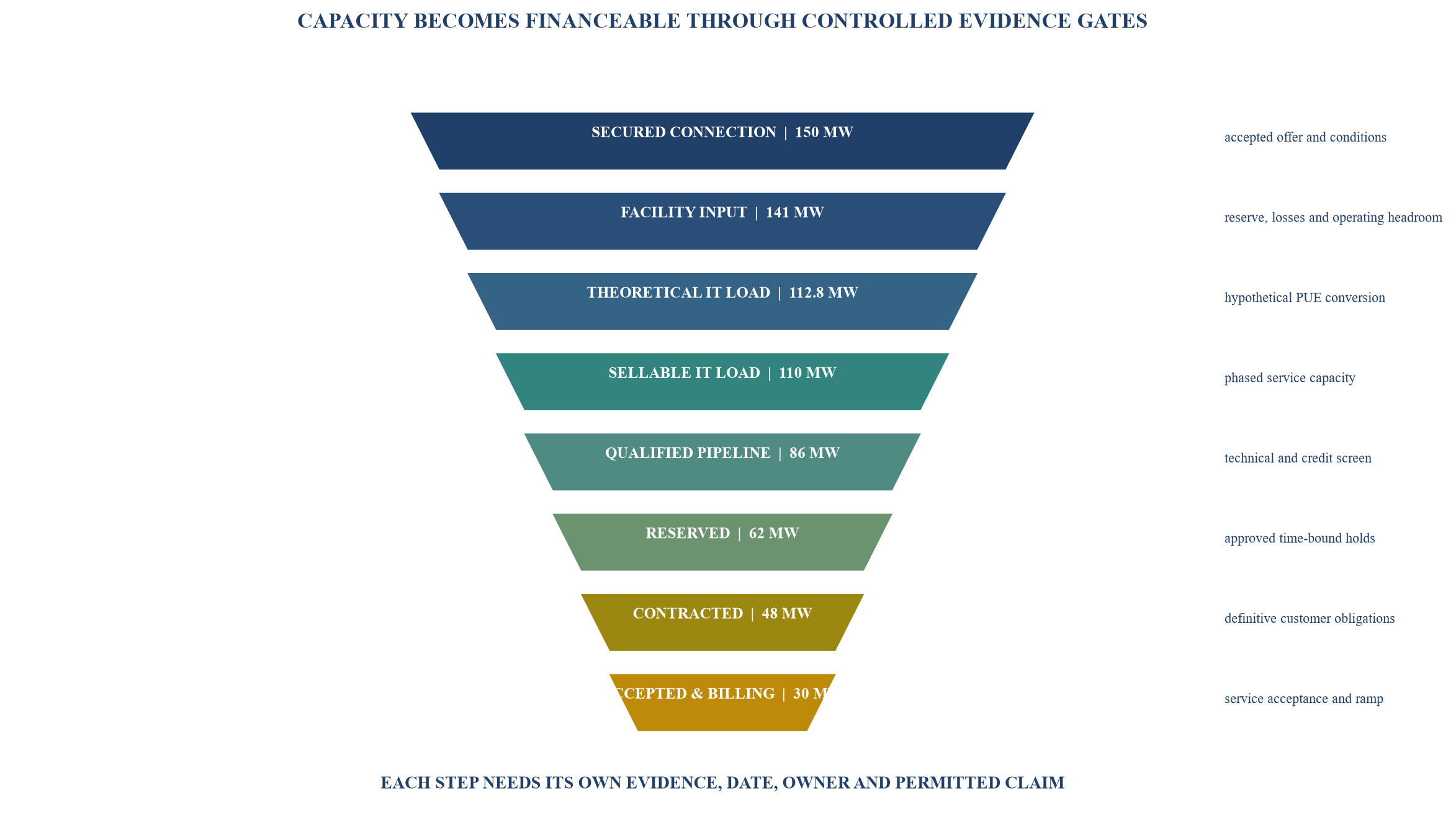
The funnel is a governance model; widths are illustrative and do not represent a market conversion rate.
4. Translate power into a sellable service envelope
The commercial product is a service envelope built around a defined megawatt. It includes location, phase, ready-for-service date, density, cooling method, redundancy, network access, security, operational coverage, metering, efficiency obligations, expansion rights and customer responsibilities. The office should publish an internally controlled product sheet for each phase and configuration.
The product sheet must state constraints. A design may support a maximum rack density only in specified zones. A cooling solution may require a particular water, temperature or equipment interface. A network route may have diverse-path conditions. Generator operation, demand response or utility curtailment may affect operating provisions. Customers need these constraints early enough to assess fit, and pricing needs to recover the capacity reserved for them.
Consider a hypothetical campus with 150 megawatts secured at the connection point. A 6 per cent planning allowance for losses, reserve and operating headroom produces 141 megawatts of facility input. A design planning assumption of 1.25 power usage effectiveness produces 112.8 megawatts of theoretical IT load. The commercial plan rounds this to 110 megawatts of sellable IT load across phases of 40, 40 and 30 megawatts. These values demonstrate capacity-bridge mechanics. They do not state expected performance for a real campus.
The bridge should be reconciled after each material design or contract change. If a tenant requires higher density, a different redundancy topology or a slower ramp, the sellable capacity and phase economics may change. The ledger needs to preserve the pre-change version and document the decision. A project that sells the same design contingency twice creates both delivery and credit risk.
Table 2. Hypothetical campus capacity bridge
| Capacity state | Hypothetical MW | Conversion or evidence | Principal sensitivity |
|---|---|---|---|
| secured connection capacity | 150.0 | accepted connection rights subject to conditions | network milestones, securities and curtailment terms |
| facility input planning capacity | 141.0 | 6 per cent reserve, loss and operating allowance | electrical design and operating policy |
| theoretical IT load | 112.8 | facility input divided by assumed 1.25 PUE | load, climate, cooling and measurement boundary |
| sellable IT load | 110.0 | allocation and rounding within the design envelope | redundancy, density and common infrastructure |
| phase 1 / phase 2 / phase 3 | 40 / 40 / 30 | staged delivery plan | equipment, construction and customer ramp |
| initial contracted capacity | 48.0 | hypothetical definitive commitments | conditions, security and acceptance |
| initial accepted and billing capacity | 30.0 | hypothetical service acceptance and ramp | commissioning, customer deployment and metering |
Values are modelling assumptions used to demonstrate reconciliation; they are not project forecasts or industry benchmarks.
5. Segment demand by deployment problem
Market segmentation should identify the customer's deployment problem and decision process. Hyperscale cloud platforms, artificial-intelligence infrastructure operators, large enterprises, content and network businesses, public-sector workloads and managed-service providers can require different densities, locations, connectivity, control rights, sustainability evidence, ramp profiles and contract forms. The office should avoid treating every expression of megawatt demand as equivalent.
The World Bank's framework for cloud and data-infrastructure markets highlights reliable and affordable power, broadband connectivity, scalable land and an enabling regulatory environment as supply-side foundations, while private-sector demand supports scale.[10] Its 2026 results note describes long-term demand commitments as one mechanism that can help de-risk infrastructure.[11] These principles support an integrated market view. They do not prove customer demand for a named site.
Segmentation should combine workload, buyer type and deployment path. A customer moving a latency-sensitive platform may prioritise network adjacency and delivery certainty. An AI training deployment may prioritise power density, cooling and rapid large-block expansion. A regulated enterprise may emphasise data location, audit, resilience and contracting entities. A platform serving several customers may need flexible ramp and interconnection.
Each segment should have a fact-based account hypothesis. The hypothesis states why the location and phase could fit, the customer's likely approval sequence, technical discovery questions, evidence required and disqualifiers. It remains a hypothesis until customer evidence confirms it. The office should record the source and date for every external demand signal.
Account selection then focuses scarce commercial and engineering time. Priority accounts should have a plausible workload, accountable sponsor, known procurement process, technical fit, credible timing and ability to support the required contract. High announced demand without these elements belongs in market intelligence rather than committed pipeline.
6. Qualify tenants before allocating scarce megawatts
Tenant qualification should measure several independent dimensions. Credit strength matters because a long contract can be valuable only if obligations are credible and enforceable. Workload durability matters because the underlying demand can change. Procurement authority matters because a technical team may lack budget or contracting power. Ramp credibility matters because reserved capacity produces weak economics when deployment slips. Technical fit matters because density, cooling, network and resilience requirements can consume project-specific capital.
Contract security should include the contracting entity, parent support, deposit, prepayment, letter of credit, termination payment, capacity charges and conditions. Strategic value may include network effects, an anchor role or repeat expansion, although it should receive a limited weight so that brand recognition does not override credit and execution evidence. Execution readiness covers site selection status, design inputs, equipment plan, internal approvals and implementation team.
The hypothetical scorecard in Figure 2 weights credit at 25 points, workload durability at 15, procurement authority at 10, ramp credibility at 15, design fit at 10, contract security at 10, strategic value at 5 and execution readiness at 10. A score of 80 or more can support advancement to a commitment process, subject to red-line gates. Scores from 65 to 79 can support a conditional reservation with an expiry and cure plan. Lower scores remain in development without a scarce-capacity hold.
The score does not prove creditworthiness. A weak contracting entity, unresolved sanctions or compliance issue, unacceptable termination right, speculative workload, unapproved budget or unfinanceable condition should stop advancement regardless of the total. Credit, legal, technical and compliance specialists should retain their approvals.
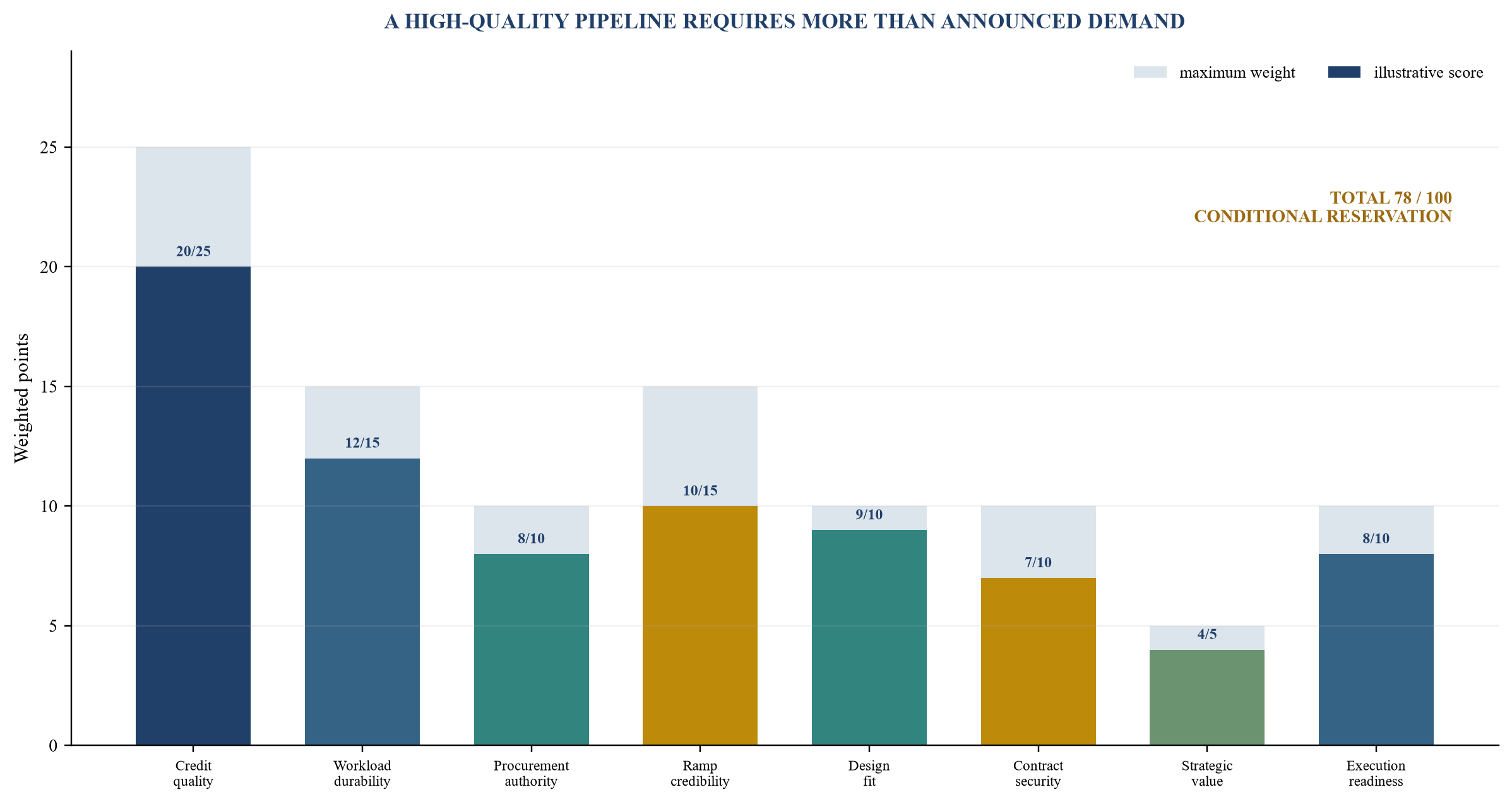
Scores and thresholds are illustrative management assumptions; a specific decision requires verified customer, credit, technical and contract evidence.
Table 3. Tenant qualification scorecard and red-line gates
| Dimension | Weight | Evidence examples | Red-line concern |
|---|---|---|---|
| credit quality | 25 | audited accounts, ratings, liquidity, ownership and guarantor evidence | unacceptable counterparty or unsupported obligation |
| workload durability | 15 | approved workload, customer demand, deployment logic and renewal case | speculative or readily cancellable demand |
| procurement authority | 10 | budget owner, approval path, authorised negotiator and timetable | no accountable decision maker or approved budget |
| ramp credibility | 15 | equipment orders, migration plan, implementation team and dependencies | ramp unsupported by delivery actions |
| technical design fit | 10 | density, cooling, network, resilience and security requirements | requirement outside approved design envelope |
| contract security | 10 | deposit, prepayment, guarantee, termination and capacity payment | insufficient remedy for reserved capacity and bespoke capital |
| strategic value | 5 | anchor role, network effect or credible expansion path | strategic narrative used to bypass economic controls |
| execution readiness | 10 | site selection, design inputs, internal approvals and delivery team | material conditions lack owners or dates |
The structure is illustrative; final thresholds and approvals depend on project governance and applicable requirements.
7. Run evidence-led account origination
Account origination should follow a controlled sequence. The first stage validates the deployment problem and decision owner. The second establishes technical fit and phase timing. The third tests credit, procurement and security. The fourth develops a priced solution. The fifth negotiates reservation or heads of terms. The sixth advances definitive documentation and conditions. Each stage has an evidence gate.
The opportunity register should record customer legal entity, ultimate parent, workload, location alternatives, requested IT load, density, cooling, resilience, network, desired date, ramp, term, expansion, procurement stage, technical status, credit status, contract status, probability basis and next decision. A single free-text sales note cannot support capital allocation.
Pipeline values should distinguish customer-stated demand, technically compatible demand, qualified demand, approved reservations and definitive commitments. Probability weighting is useful only when the probability is defined by evidence. A broad percentage applied by salesperson judgement can create false precision. The office should publish a stage definition and use the lowest relevant gate when evidence is incomplete.
Commercial engagement should also preserve confidentiality and competitive control. Capacity information, network design, security architecture, tenant identity and pricing may be sensitive. Data rooms should use role-based access, watermarking where appropriate, controlled downloads, expiry and an access log. The office should coordinate disclosures with legal and security teams.
The strongest account plan links a customer action to a project decision. A signed design freeze may permit equipment procurement. A non-refundable capacity payment may support a capital commitment. A definitive contract satisfying agreed conditions may support a financing draw. The office should state these links in advance so that negotiations produce decision-useful evidence.
8. Price the complete service and risk package
Pricing should start from the service and capital burden created by the customer. Base capacity covers the defined product. Increments may reflect density, cooling, resilience, network, security, rapid delivery, bespoke design or customer-specific equipment. Adjustments may recognise scale, a firm early ramp, operating flexibility, term, payment security or a portfolio benefit. Every adjustment needs an owner, rationale and approval limit.
The price architecture should separate recurring capacity charges, metered energy, one-time works, connection or fit-out contributions, reserved-capacity payments, service credits, indexation, taxes and pass-through items. The contract should state measurement points, loss factors, demand calculations, minimum charges and reconciliation. Legal and accounting advisers should determine the correct drafting and treatment.
The hypothetical waterfall in Figure 3 begins with a base price index of 100. Density adds eight index points, resilience five and a service package three. A firm ramp profile reduces seven, scale and concentration reduce six, and approved flexibility reduces three. The result returns to 100. This demonstrates how value and risk components can be visible even when the final index equals the base. It is not a market quote or price recommendation.
Discounts should have explicit conditions. A ramp discount may reverse if the tenant misses the contracted ramp. A scale discount may apply only while minimum capacity is billed. A flexibility credit may require tested response capability and defined dispatch terms. A strategic discount should identify the measurable benefit and expiry. Permanent discounts granted for temporary expectations weaken the project case.
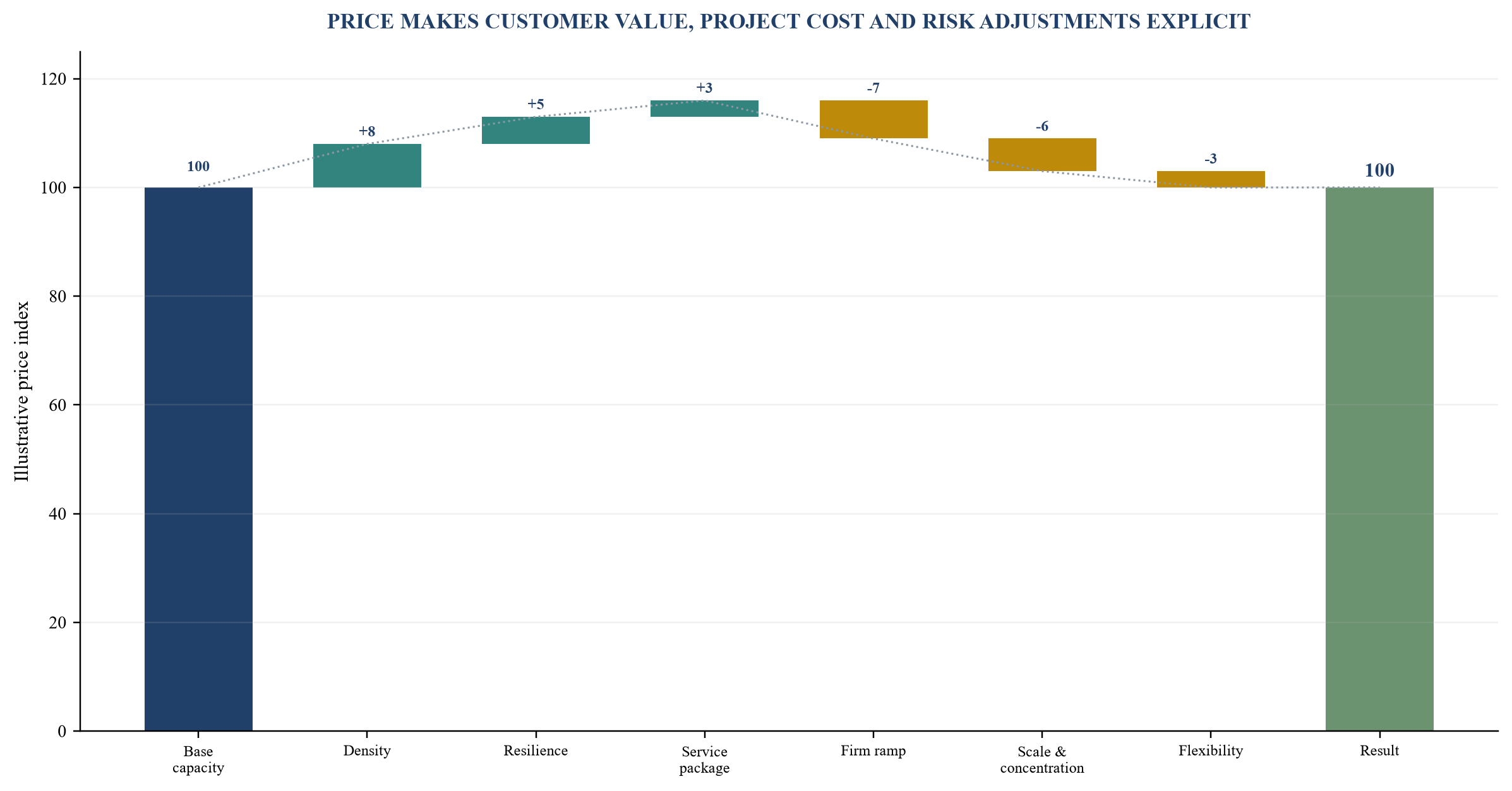
The index is an illustrative decision tool; it is not a market tariff, customer quote or forecast.
9. Convert pricing into contract architecture
The contract should preserve the economics and delivery assumptions approved during pricing. Core terms include capacity, phase, location, service description, ready-for-service process, ramp, term, renewal, price, energy treatment, indexation, one-time works, security, conditions, acceptance, service levels, change, expansion, termination and remedies. Schedules should carry the technical detail needed for operations and acceptance.
Capacity obligations need precision. The contract should distinguish reserved capacity, committed capacity, installed capacity, available capacity and billed capacity. It should state whether charges begin at ready for service, acceptance, customer deployment or another event. Delayed customer deployment should not automatically transfer the cost of idle dedicated capacity to the project.
Conditions should be narrow, objective, time-bound and allocated to an owner. Examples may include permits, grid milestones, site works, financing, customer approvals, equipment, sanctions or regulatory requirements. A long-duration contract with broad discretionary conditions can provide weak financing support. Lenders and investors need the remaining conditions, satisfaction mechanism, long-stop consequences and termination economics.
Security should align with exposure. A deposit may cover several months of charges. A letter of credit or parent guarantee may support obligations of a special-purpose contracting entity. Prepayments or customer contributions can support dedicated works. Termination payments can address unrecovered capital and reserved capacity. The appropriate package depends on credit evidence, jurisdiction, enforceability, contract term and legal advice.
Table 4. Contract terms and security matrix
| Risk | Contract mechanism | Evidence required | Escalation trigger |
|---|---|---|---|
| delivery scope | service description, design criteria and change control | signed technical schedules and controlled assumptions | requested change affects cost, date or capacity |
| project timing | milestone dates, long stop and relief events | integrated programme and dependency owners | critical path loses approved float |
| customer ramp | minimum capacity charges and ramp schedule | customer equipment and migration plan | customer actions no longer support the ramp |
| counterparty credit | deposit, prepayment, guarantee or letter of credit | entity, ownership, financial and enforceability review | security expires, weakens or falls below exposure |
| dedicated capital | contribution, cancellation payment or termination amount | approved cost and recovery schedule | bespoke commitment precedes adequate protection |
| performance | acceptance tests, service levels and service credits | measurable method, boundary and exclusions | remedy exceeds approved risk allocation |
| concentration | capacity limit, phased expansion and approval rights | portfolio view and downside case | customer exposure exceeds committee limit |
Terms are illustrative categories; transaction-specific legal, credit, accounting and tax advice is required.
10. Use milestones to connect customer decisions and capital
A milestone calendar should integrate commercial, technical, delivery and financing events. It begins with qualification and moves through requirements confirmation, reservation, heads of terms, design freeze, definitive documents, condition satisfaction, notice to proceed, equipment procurement, construction, commissioning, ready for service, acceptance and ramp. Each milestone needs evidence, an accountable owner and a consequence.
The calendar should distinguish project milestones from customer-controlled milestones. Grid works, permits and facility construction may sit with the developer and its contractors. Customer design inputs, equipment orders, network readiness, migration and acceptance sit partly with the tenant. Interdependencies should appear in both plans and the contract.
Long-lead procurement creates a critical commercial decision. Ordering electrical or cooling equipment before customer commitment may accelerate delivery while increasing speculative capital. Waiting for a definitive contract may preserve capital while losing schedule. The office should present the decision with cost, cancellation terms, reuse value, schedule benefit, customer security and downside scenarios.
Ofgem's proposed connection reforms explicitly identify long-lead equipment procurement as one possible maturity milestone.[6] The European Commission's grid guidance recommends transparent maturity criteria, milestones, penalties and queue monitoring.[9] These sources concern electricity connection governance. The same principles support internal project discipline when adapted to the contract and jurisdiction.
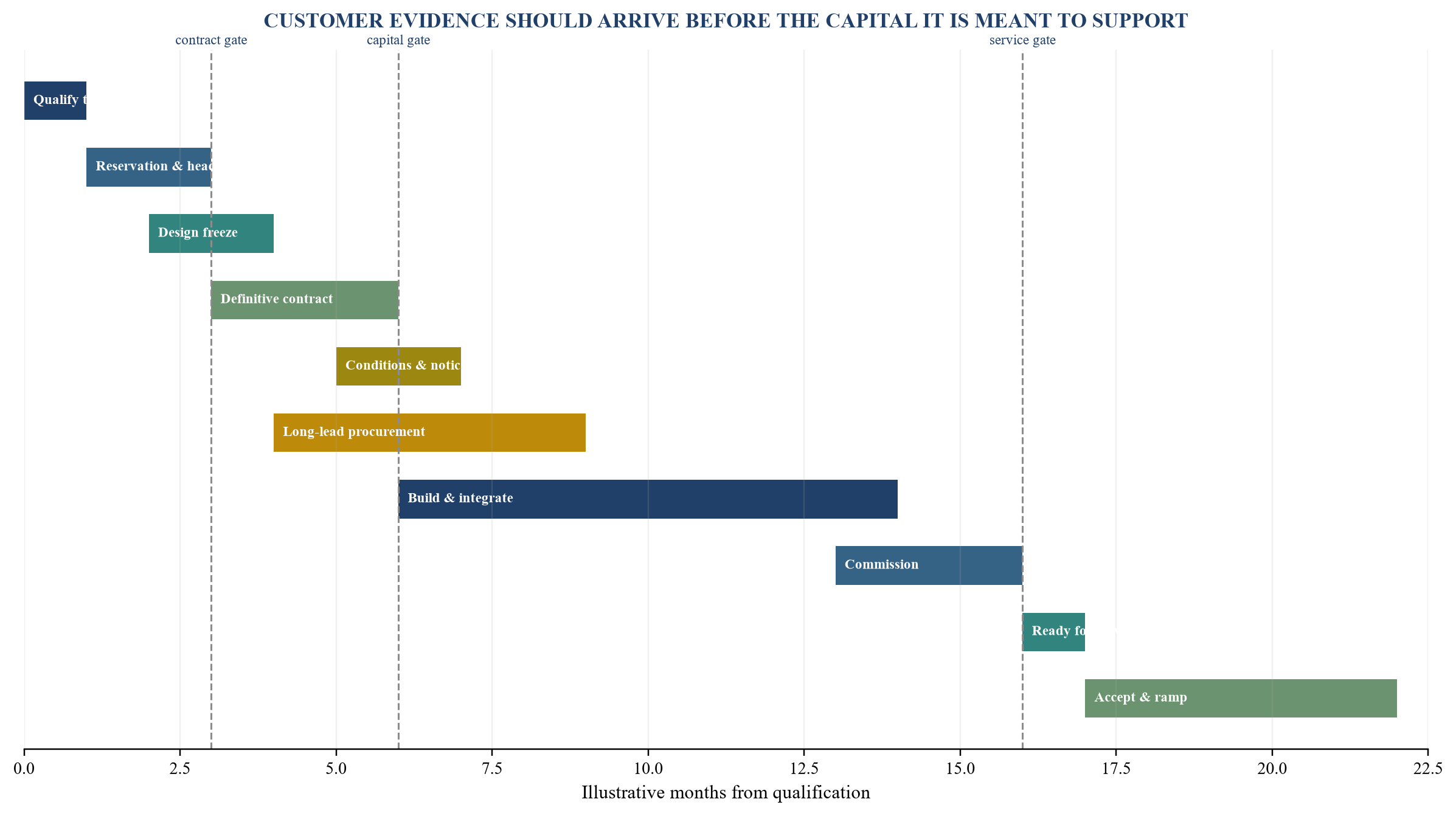
Timing is a hypothetical sequence; actual milestones depend on connection, design, construction, financing and customer requirements.
11. Build a creditworthy offtake file
A financeable offtake file contains more than a signed agreement. It identifies the legal counterparty and ownership chain, financial capacity, obligation type, conditions, security, term, ramp, price, indexation, termination rights, performance obligations, concentration, governing law and enforceability. It also connects the contract to the delivery plan and project economics.
Public company disclosures show why these details matter. Equinix states that expansion decisions consider demand, power availability, design, network presence, capacity, capital, break-even timing and customers already in place. It also defines bookings as contracts anticipated to generate revenue within 90 days, demonstrating the importance of a controlled commercial metric.[14] Digital Realty reported 769 megawatts under development at year-end 2025, with 64 per cent pre-leased, and separately disclosed customer concentration.[15] These are company-specific disclosures and cannot be applied as universal thresholds.
Some public filings describe tenant prepayments, security deposits, contributions toward construction, guarantees, insurance and other credit enhancements as possible mechanisms.[16] Their availability and value depend on the transaction. A commercialisation office should map each mechanism to a specific exposure, seek legal and accounting advice and avoid treating face value as recoverable cash without enforceability analysis.
The offtake file should include a contract abstract with links to source clauses. It should show gross committed capacity, expected billing capacity, conditions, cancellation exposure and downside recovery. A revenue model should use the contract's actual charging events. A headline signature date is insufficient. If acceptance or customer ramp drives billing, the model should reflect that timing.
Credit monitoring continues after signature. The office should track financial reporting, ratings where available, ownership changes, security validity, arrears, disputes, ramp performance and material customer events. Expansion rights should require a refreshed credit and concentration decision.
12. Govern concentration, ramp and renewal risk
Anchor tenants can support phase delivery, while a large single exposure can dominate cash flow, design and refinancing. Concentration should be measured by contracted capacity, annualised recurring revenue, contribution, security, expiry and ultimate parent. Affiliated customers should be aggregated where appropriate.
Digital Realty disclosed that its largest customer represented 11.7 per cent of aggregate annualised recurring revenue at year-end 2025, with no other customer above 9 per cent.[15] This is a public-company fact at a particular date. It does not establish a suitable limit for another project. Each investment committee should approve limits based on capital structure, tenant credit, contract protections, diversification path and downside resilience.
Ramp risk needs a cohort view. For every tenant and phase, the plan should show reserved, contracted, ready-for-service, accepted and billing capacity by month. Delays should be split between project causes, customer causes and agreed relief. The forecast should also show minimum charges, termination rights, security coverage and alternative use of the capacity.
Renewal risk begins at contract signing. The office should record expiry, extension rights, price resets, technology fit, equipment life, switching cost and remarketing lead time. A large block expiring shortly before debt maturity can create refinancing exposure. A staggered expiry profile may improve resilience, subject to market and contract evidence.
Downside scenarios should combine events. Examples include a delayed grid milestone, a six-month customer ramp delay, a lower sellable-capacity conversion, higher completion cost, a customer default or weaker renewal. Scenarios are decision tools rather than predictions. Their purpose is to identify liquidity, covenant and capital actions before exposure is accepted.
13. Align power procurement, flexibility and sustainability evidence
Customer demand and power strategy must use the same assumptions. The commercial proposal should explain the supply arrangement, metering, losses, pass-through treatment, renewable claims, efficiency measures, flexibility obligations and change mechanisms. Claims should distinguish physical supply, contractual procurement and environmental attributes.
The IEA expects renewables to meet nearly half of the growth in electricity demand from data centres to 2030, while natural gas, coal and nuclear also contribute in its outlook.[3] It also distinguishes the location and timing of data-centre load from the wider generation mix. A customer-specific claim therefore requires project and contract evidence rather than a global forecast.
The European Commission's 2026 roadmap proposes closer coordination among public authorities, data-centre operators and energy actors, together with flexible connections, clean energy, efficiency, demand response and waste-heat measures.[8] Its separate recommendation addresses power-purchase agreements and complementary efficiency and flexibility measures.[17] These initiatives provide a policy direction within the European Union. They do not determine the contract for a project elsewhere.
The office should capture customer requirements for carbon accounting, additionality, matching period, location, certificates, reporting, water, heat reuse and flexibility. Engineering and power teams should certify what the project can deliver. Legal teams should control claims and remedies. Commercial teams should price any dedicated procurement or operating constraint.
Flexibility can create value only when operational boundaries are clear. A customer may be able to shift non-critical workloads, reduce load, use stored energy or alter charging schedules. The contract should state notice, duration, frequency, measurement, exclusions, compensation and consequences. A modelled flexibility value should remain provisional until supported by technical testing and an enforceable arrangement.
14. Stage capital against commercial evidence
Capital staging connects customer evidence to irreversible spend. Early development capital may secure land, grid rights, permits and design. The next stage may fund site works and long-lead equipment. Construction funding may require a minimum contracted capacity, approved credit package and remaining-cost contingency. Later draws can depend on completion tests, acceptance and billing.
The stage-gate memorandum should show the decision amount, use of funds, evidence received, missing evidence, schedule effect, customer dependency, recovery options and downside liquidity. It should also show whether the spend is reusable across tenants or dedicated to one customer. Reusable site infrastructure has a different recovery profile from a bespoke cooling system.
Development-finance disclosures illustrate the breadth of diligence. IFC's proposed financing for NTT's Indian data-centre expansion describes operating and construction capacity, the debt structure and environmental and social review.[12] EBRD's DataVolt Uzbekistan project describes land, permits, design, construction, commissioning, operation, IT load and Tier III design in its project summary.[13] These disclosures do not reveal every underwriting term. They demonstrate that capacity, technical delivery, permissions, finance and environmental performance are considered together.
The capital plan should preserve optionality. A modular design, transferable equipment order or phased building shell may reduce loss if a tenant delays. Optionality has a cost and should be tested against schedule and customer value. The office should show the full economic trade-off.
Funding conditions should use controlled definitions. If a financing agreement requires a proportion of capacity to be pre-leased, the numerator and denominator, acceptable tenant, contract form, conditions and security should be specified. The commercial ledger should reproduce those definitions so that management reporting and lender certificates agree.
15. Create a financing-readiness dashboard
A financing-readiness dashboard should combine capacity, site, design, permits, construction, offtake, credit, economics, sustainability and governance. Each domain receives a score supported by dated evidence. Red-line gates sit outside the average. A high total cannot cure a missing site right, expired connection offer, unapproved permit, weak contract counterparty or unresolved funding gap.
The hypothetical dashboard in Figure 5 scores capacity evidence at 88, site and permits at 82, design and procurement at 75, construction plan at 70, tenant offtake at 68, credit and security at 64, economics and downside at 78, and governance at 85. The weighted picture may appear close to readiness, yet the credit and security domain remains below an illustrative 70-point red-line. The project would require a cure or explicit risk decision before relying on the offtake for financing.
Evidence quality should affect the score. A signed and unconditional agreement carries more confidence than a draft. An independent engineer's reviewed design carries different weight from a concept schedule. A current credit report differs from a brand assumption. The dashboard should show evidence type, date, reviewer, expiry and exceptions.
Uptime Institute's Tier certification process separates design-document review, constructed-facility verification and operational sustainability.[18] This staged approach supports a useful principle: design intent, built performance and operating capability require their own evidence. Any certification claim should be made only for the actual scope and status awarded.
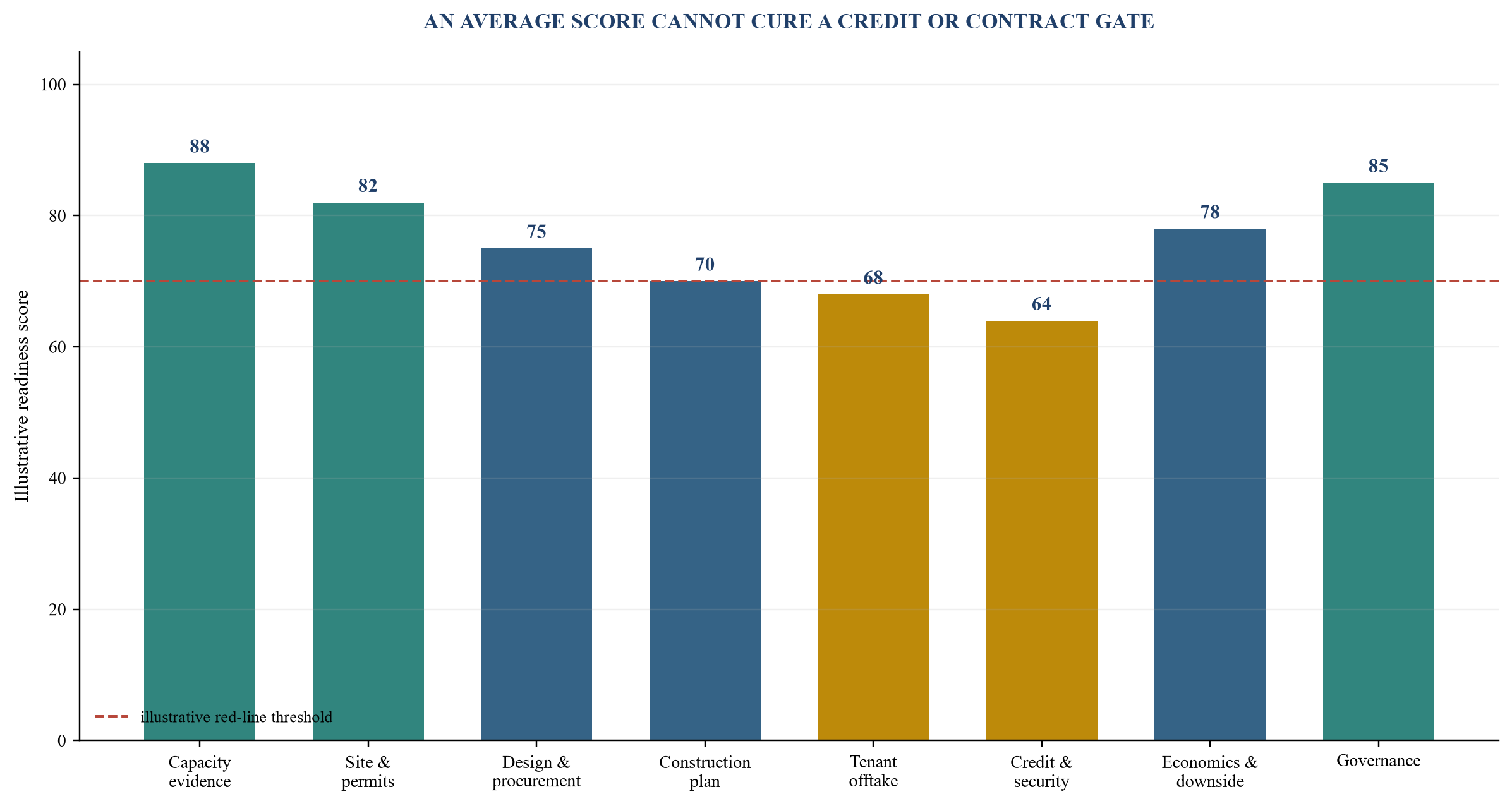
Scores and red-line threshold are illustrative; financing decisions require project-specific diligence and lender approval.
Table 5. Financing-readiness evidence pack
| Domain | Core evidence | Key reconciliation | Red-line example |
|---|---|---|---|
| site and permits | land rights, access, planning, environmental and construction permissions | site boundary, phase and permitted design agree | material right or permit absent or expiring |
| connection and power | accepted offer, milestones, securities, network works and operating terms | capacity, date and conditions match the commercial ledger | rights can terminate before required evidence is delivered |
| design and procurement | basis of design, equipment plan, contracts, tests and contingencies | customer requirements fit the approved design | dedicated equipment lacks approved recovery |
| construction | budget, schedule, contractor terms, completion support and independent review | remaining cost, contingency and draw plan agree | funding gap or unmitigated critical-path failure |
| offtake and credit | definitive contracts, conditions, ramp, security and legal review | revenue model matches contract charging events | counterparty or security fails approval |
| economics and downside | sources and uses, operating model, sensitivities, liquidity and covenants | capacity, price, cost and timing use the same version | downside breaches liquidity without an action plan |
| sustainability and operations | energy, water, emissions, resilience, staffing and reporting plan | customer commitments match deliverable operating evidence | public or contractual claim lacks a deliverable basis |
Evidence requirements are illustrative and should be adapted to the financing structure and jurisdiction.
16. Operate a weekly commercial control cycle
The office should run a weekly decision-centred control cycle. The cycle reconciles capacity, pipeline, technical changes, contracts, credit, schedule, price, capital and financing. Each change should reach every affected artefact through a controlled owner and version.
The capacity review starts with the ledger. It identifies new evidence, expiries, reservations, double-counting risks and phase constraints. The opportunity review tests movement against stage gates and removes unsupported probability. The deal review covers technical solution, price, security, exceptions and next customer decision. The delivery review links commitments to design, procurement, construction and commissioning.
The financing review reconciles offtake and project assumptions. A signed contract may increase committed capacity while a delayed acceptance date reduces near-term revenue. A customer design change may improve price while increasing capital and schedule. A stronger guarantee may improve credit while adding a condition. These effects should appear together.
Decision logs should be concise and durable. Each entry records the issue, evidence, alternatives, decision, authority, conditions, owner and review date. Exceptions expire. A capacity reservation should never roll forward solely because the account remains important.
Table 6. Commercial governance cadence
| Forum | Frequency | Controlled inputs | Required output |
|---|---|---|---|
| capacity and pipeline control | weekly | capacity ledger, stage evidence, reservations and conflicts | approved availability and opportunity stage |
| deal desk | weekly or event-driven | technical scope, price, credit, security and terms | offer approval, exceptions and negotiation mandate |
| delivery integration | weekly | design changes, procurement, construction and customer dependencies | baseline change or corrective action |
| credit and concentration | monthly and on material change | counterparty, security, exposure, expiry and downside | limits, cures and monitoring actions |
| investment and capital gate | at defined milestones | evidence pack, sources and uses, schedule and downside | commit, defer, condition or reject decision |
| lender reporting | as agreed | contracts, conditions, progress, cost, liquidity and compliance | reconciled certificate and evidence index |
The cadence is illustrative; accountability should align with the project's governance documents.
17. Control commissioning, acceptance and revenue start
Commercial value becomes operating cash only after the agreed service is available, accepted and billed. The commissioning and acceptance plan should be written early enough to influence design, contracts and schedule. It should identify test boundaries, loads, duration, witnesses, data, defects, retests, deemed-acceptance rules and evidence retention.
Facility commissioning may include electrical, mechanical, controls, life-safety, security, network and integrated systems testing. Customer acceptance may add workload-specific, connectivity, performance, audit or operational tests. The two processes should be linked while retaining their separate criteria and owners.
Ready for service needs an objective definition. It may require facility completion, utilities, permits, connectivity, operating staff, documentation, tests and customer access. The contract should state which matters are conditions, which are punch-list items and which remedies apply. A generic declaration can create disputes over revenue commencement.
The revenue controller should reconcile acceptance certificates, contracted ramp, meter data, invoices, credits and cash. Commercial reporting should distinguish signed annualised value from billed and collected revenue. This distinction improves forecast credibility and provides feedback on qualification and delivery assumptions.
Post-acceptance performance should feed renewal and expansion decisions. Service levels, incidents, energy use, density, support, change requests and payment performance become evidence. A customer that ramps reliably and operates within the agreed envelope may qualify for expansion. A customer that consumes engineering capacity, delays decisions or disputes obligations should be re-scored.
18. Implement the office through four controlled releases
The first release establishes definitions and data. Management approves the capacity taxonomy, stage gates, decision rights and minimum registers. Teams reconcile current power, site, design, pipeline and contract data. Unsupported claims are corrected, and every reservation receives an owner and expiry.
The second release applies qualification and pricing. Priority accounts receive a complete score, technical discovery record and approval path. The deal desk implements the pricing waterfall, discount authorities and term matrix. Capacity allocation follows evidence and red-line gates.
The third release integrates delivery and finance. Customer milestones enter the master schedule. Capital gates identify the commercial evidence required before each commitment. The offtake abstract, concentration view, revenue ramp and downside cases feed the financing pack.
The fourth release embeds operating control. Weekly forums use controlled versions. Acceptance and billing are reconciled. Credit, security and contract expiries are monitored. Post-acceptance performance informs renewals and expansions. Internal audit or an independent reviewer can test definitions, approvals and evidence lineage.
Success measures should reflect conversion quality. Useful measures include the proportion of sellable capacity supported by current evidence, qualified-to-reserved conversion, reservation expiry discipline, contracted-to-accepted conversion, ramp variance, price leakage, security coverage, customer concentration, evidence age, change latency and billed-to-collected conversion. Each measure needs a definition and source.
The office should remain small enough to make decisions and broad enough to connect the project. Its value comes from integrated evidence. A capacity figure, customer name, price, contract, delivery date and financing assumption should always reconcile to the same approved state.
Conclusion
Data-centre commercialisation converts infrastructure potential into a service that a customer can procure and a financier can examine. The conversion begins with precise language. Applied, secured, energised, commissioned, sellable, reserved, contracted, accepted and billed capacity require separate evidence.
The commercialisation office owns the chain across power, land, design, customer, price, contract, delivery and finance. It qualifies tenants before allocating scarce megawatts, prices the full service and risk package, turns negotiation into staged obligations and connects customer milestones to capital decisions.
Financeable offtake requires a credible counterparty, durable obligation, limited conditions, adequate security, deliverable technical scope, governed ramp and coherent downside case. A signature can strengthen the case only to the extent that its obligations, dates and remedies withstand diligence.
The hypothetical models in this paper show how to organise the decisions. They do not predict market demand, price, performance or financing. A real project should replace each assumption with current site, network, design, customer, contract, cost and lender evidence.
The result is a disciplined path from connection rights to collected cash. It supports better customer choices, earlier risk escalation, more credible capital gates and a transparent record for boards, lenders and investors.
Appendix A. Minimum commercial data room
1. Site ownership, lease or option documents, access rights, surveys and boundary plans. 2. Grid or utility application, accepted offer, connection agreement, securities, milestones, charges and correspondence. 3. Phase plan, basis of design, single-line diagrams, cooling design, density envelope, resilience and capacity bridge. 4. Permit, planning, environmental, water, construction and operating approvals with conditions and expiry dates. 5. Equipment register, long-lead orders, cancellation terms, transferability, delivery dates and testing plan. 6. Sellable-capacity ledger with version history, assumptions, reservations, contracts, acceptance and billing. 7. Customer opportunity register, qualification evidence, credit review, technical requirements and approval path. 8. Pricing models, approval records, cost allocation, customer-specific capital and discount conditions. 9. Reservations, heads of terms, definitive agreements, guarantees, letters of credit, deposits and amendments. 10. Integrated project and customer milestone schedules, dependencies, float, changes and recovery plans. 11. Construction budget, sources and uses, remaining-cost forecast, contingency, draw conditions and downside cases. 12. Commissioning, ready-for-service, acceptance, metering, billing and performance evidence. 13. Energy procurement, metering, emissions, water, flexibility and sustainability commitments with reporting methods. 14. Governance charters, decision logs, exception register, concentration limits and lender reporting definitions.
Appendix B. Investment committee questions
1. Which capacity state supports every megawatt presented in the base case? 2. Which connection, site, permit or design condition can still remove or delay that capacity? 3. How is connection capacity converted into sellable IT load, and who approved each assumption? 4. Which tenant obligations are definitive, enforceable and supported by adequate credit evidence? 5. Which conditions remain before customer obligations and project revenue become effective? 6. Which capital commitments are reusable, and which are dedicated to one tenant? 7. What protection covers customer cancellation, delayed ramp and bespoke works? 8. How do price adjustments reflect density, resilience, delivery, scale, concentration and flexibility? 9. Which customer milestone must occur before each long-lead order or construction draw? 10. What happens to liquidity, covenants and completion funding under combined downside scenarios? 11. Which acceptance test controls ready for service and billing commencement? 12. How are capacity, contracts, schedule, revenue and lender certificates reconciled to one version?
References
- International Energy Agency, Energy and AI, published 10 April 2025. https://www.iea.org/reports/energy-and-ai/
- International Energy Agency, Energy demand from AI, Energy and AI, published 10 April 2025. https://www.iea.org/reports/energy-and-ai/energy-demand-from-ai
- International Energy Agency, Energy supply for AI, Energy and AI, published 10 April 2025. https://www.iea.org/reports/energy-and-ai/energy-supply-for-ai
- United States Department of Energy, DOE Releases New Report Evaluating Increase in Electricity Demand from Data Centers, published 20 December 2024. https://www.energy.gov/articles/doe-releases-new-report-evaluating-increase-electricity-demand-data-centers
- United States Department of Energy, Powering America's AI Future: Data Center Resource Hub, accessed 29 August 2026. https://www.energy.gov/powering-americas-ai-future-data-center-resource-hub
- Ofgem, Proposed data centre connection reforms, published 29 July 2026. https://www.ofgem.gov.uk/consultation/proposed-data-centre-connection-reforms
- Ofgem, Ofgem acts to free up grid capacity by tackling speculative data centre projects, published 29 July 2026. https://www.ofgem.gov.uk/press-release/ofgem-acts-free-grid-capacity-tackling-speculative-data-centre-projects
- European Commission, Strategic roadmap for digitalisation and artificial intelligence in the energy sector, published 3 June 2026. https://energy.ec.europa.eu/document/download/fbe97b7a-20ff-4361-a8b2-9a4055695f3a_en?filename=COM_2026_501_1_EN_ACT_part1_v9.pdf
- European Commission, European grids, accessed 29 August 2026. https://energy.ec.europa.eu/topics/infrastructure/european-grids_en
- World Bank, Advancing Cloud and Data Infrastructure Markets: Strategic Directions for Low- and Middle-Income Countries, accessed 29 August 2026. https://www.worldbank.org/en/publication/advancing-cloud-and-data-infrastructure-markets
- World Bank, Building Data Infrastructure for AI Readiness, published 6 May 2026. https://www.worldbank.org/en/results/2026/05/06/data-infrastructure-for-ai
- International Finance Corporation, NTT India Loan, project number 50807, accessed 29 August 2026. https://disclosures.ifc.org/project-detail/ESRS/50807/NTT%20India%20Loan
- European Bank for Reconstruction and Development, DataVolt Uzbekistan, project number 56480, accessed 29 August 2026. https://www.ebrd.com/home/work-with-us/projects/psd/56480.html
- Equinix, Inc., Annual Report on Form 10-K for the year ended 31 December 2025, filed 2026. https://www.sec.gov/Archives/edgar/data/1101239/000110123926000032/eqix-20251231.htm
- Digital Realty Trust, Inc., Annual Report on Form 10-K for the year ended 31 December 2025, filed 2026. https://www.sec.gov/Archives/edgar/data/1297996/000110465926015365/dlr-20251231x10k.htm
- Fermi Inc., Annual Report on Form 10-K for the year ended 31 December 2025, filed 2026. https://www.sec.gov/Archives/edgar/data/2071778/000207177826000010/frmi-20251231.htm
- European Commission, Recommendation on removing barriers to the development of power purchase agreements and other energy contracts, published 22 April 2026. https://energy.ec.europa.eu/publications/commission-recommendation-removing-barriers-development-power-purchase-agreements-and-other-energy_en
- Uptime Institute, Tier Certification, accessed 29 August 2026. https://connect.uptimeinstitute.com/tier-certification
