

Introduction
A modern data-centre campus can require several billion dollars of computing, electrical and civil investment before its full load is energised. The physical campus may be developed within two or three years, while major transmission, generation and equipment programmes can take longer. That timing mismatch creates a transaction problem as important as the engineering problem. Someone must reserve land, equipment and interconnection capacity before every permit, customer commitment and funding source is final.
Four groups often sit around the table. The hyperscaler or anchor customer brings computing demand, technical specifications and credit. The utility controls regulated service, network planning and the relationship with public authorities. The generator develops or operates energy supply. The infrastructure fund provides risk capital, development discipline and a route to long-duration ownership. Each can make the campus more bankable. Each can also create a veto, conflict or contingent liability.
The term joint venture can conceal several different arrangements. The parties may own one company together. They may invest in separate special-purpose vehicles linked by contracts. They may share only common infrastructure. A utility may remain outside the ownership chain because regulation requires arm's-length service. A hyperscaler may prefer a long-term capacity agreement to an equity interest. The structure should follow rights, obligations and risk allocation rather than a preference for a particular label.
This paper asks how the four parties should define the campus, divide control, fund construction, allocate delay and volume risk, protect ratepayers and lenders, and preserve a workable exit. It uses a general framework that can be adapted to regulated, liberalised and vertically integrated electricity systems.
1 Define the investment decision
The first decision is the asset perimeter. A campus can include land, data halls, substations, transmission connections, generation, batteries, water systems, fibre, roads and shared control platforms. Placing every asset inside one company can simplify coordination while increasing regulatory, accounting and financing complexity. Separating every asset can preserve specialist ownership while creating interface risk.
The investment committee should identify which assets require common control and which can be delivered under long-term contracts. Assets with shared construction interfaces, common security, or indivisible land rights may belong in a campus infrastructure vehicle. Regulated network assets will usually remain with the utility. Generation may sit in a separate project company because its permits, tax attributes, revenue model and lenders differ from those of the data centre. Computing equipment can remain with the hyperscaler because it has a shorter technology cycle and specialised security requirements.
The decision record should state the proposed ownership, contractual connection and financing treatment for every material asset. It should also identify who bears cost before commercial operation and who receives value after energisation.
2 Start with the four partner mandates
The hyperscaler's mandate is capacity, reliability, security, delivery speed and operating flexibility. Its energy objectives may include cost certainty, carbon-free supply, hourly matching or demand response. It may accept long commitments for electricity while preserving flexibility over servers and workloads.
The utility's mandate is defined by law, licence and regulation. It must plan and operate the system safely, recover prudent costs, apply approved tariffs and protect customers from inappropriate cost transfer. Its ability to hold equity, guarantee a project or discriminate among customers may be limited.
The generator's mandate is to develop, finance and operate energy assets. It needs land, permits, interconnection, technology, fuel or resource rights and a revenue contract. The project can be exposed to construction, availability, basis, curtailment and market-price risk.
The infrastructure fund seeks a risk-adjusted return within its mandate and fund life. It can fund development, common infrastructure or generation. It also requires governance, information rights, transfer protections and a credible refinancing or sale. A workable structure translates these four mandates into compatible rights rather than asking one party to absorb every risk.
Table 1. Four-partner role and bankability matrix
| Partner | Essential contribution | Primary right | Principal obligation | Core protection |
|---|---|---|---|---|
| Hyperscaler or anchor customer | Contracted compute demand, specifications and credit | Reserved capacity and service performance | Minimum payment, ramp schedule and operating cooperation | Delay remedies, expansion options and service-level protection |
| Utility | Network access, system planning, metering and regulated service | Compliance with grid and tariff rules | Defined connection and supply service | Cost recovery, credit support and ratepayer protection |
| Generator | New energy, capacity, storage or flexible supply | Long-term revenue and dispatch terms | Construction, availability and environmental performance | Termination payment, curtailment rules and change-in-law relief |
| Infrastructure fund | Development and long-duration capital | Governed economic interest and distributions | Equity commitments and oversight | Reserved decisions, information, security and exit rights |
3 Choose the structure before negotiating price
Price negotiations often begin before the parties agree what is being priced. A generator may quote energy at the plant gate while the hyperscaler assumes delivered power. The utility may include network upgrades and reserves that the generator excludes. The fund may underwrite a long-term infrastructure yield while the anchor customer expects termination flexibility.
The parties should compare at least four structures. A single integrated joint venture owns the campus and energy assets. A twin-project structure separates CampusCo and EnergyCo. A shared-infrastructure joint venture owns only the substation, private wires and common services. A contractual consortium leaves ownership separate and coordinates performance through a development agreement.
The choice should be tested against regulatory permissions, insolvency remoteness, tax, accounting, lender security and exit. The single vehicle can reduce interfaces but may combine short-lived computing assets with long-lived power infrastructure. The twin-project model can attract specialist lenders but needs robust cross-default and interface provisions. The shared-infrastructure model can work when ownership of the core businesses must remain separate. The contractual consortium can be efficient for strong counterparties but depends heavily on enforceable coordination.
4 Define the campus boundary
The campus boundary determines which costs and failures are shared. It should be mapped physically and contractually. The physical boundary includes property, security, utilities and metering. The electrical boundary identifies the point of interconnection, import and export rights, private-wire assets, backup systems and settlement meters. The commercial boundary states which services CampusCo provides and which remain bilateral.
Metering deserves early attention. Separate revenue meters may be required for utility supply, generation, storage, auxiliary consumption and data-centre load. Without a clear meter hierarchy, the parties can dispute performance, losses, renewable attributes and tariff charges. The design should support lender reporting and regulatory audit.
Shared land also requires allocation rules. The campus plan should reserve corridors for transmission, fibre, water and future phases. Expansion rights should specify priority, pricing and technical limits. A party should not be able to block a later phase merely by controlling a narrow easement or control room.
5 Build the power-to-compute architecture
The commercial structure should follow the physical chain. Generation and storage deliver energy products. The utility or grid operator balances the system and controls the regulated connection. Campus infrastructure transforms and distributes power. Data halls convert electricity into computing output. Metering and digital controls prove delivery and allocate cash.
Each interface needs a performance standard. EnergyCo can promise availability at a delivery point. The utility can promise service subject to tariff and system conditions. CampusCo can promise distribution capacity and redundancy. The hyperscaler can promise a load ramp and defined flexibility. The infrastructure fund can commit capital against milestones.
A failure at one interface can affect every party. If a transmission upgrade is late, generation may be complete without a customer. If the data hall is late, committed energy can be stranded. If generation is late, the campus may buy costly replacement power. The architecture therefore requires an integrated schedule, coordinated testing and a single interface register.
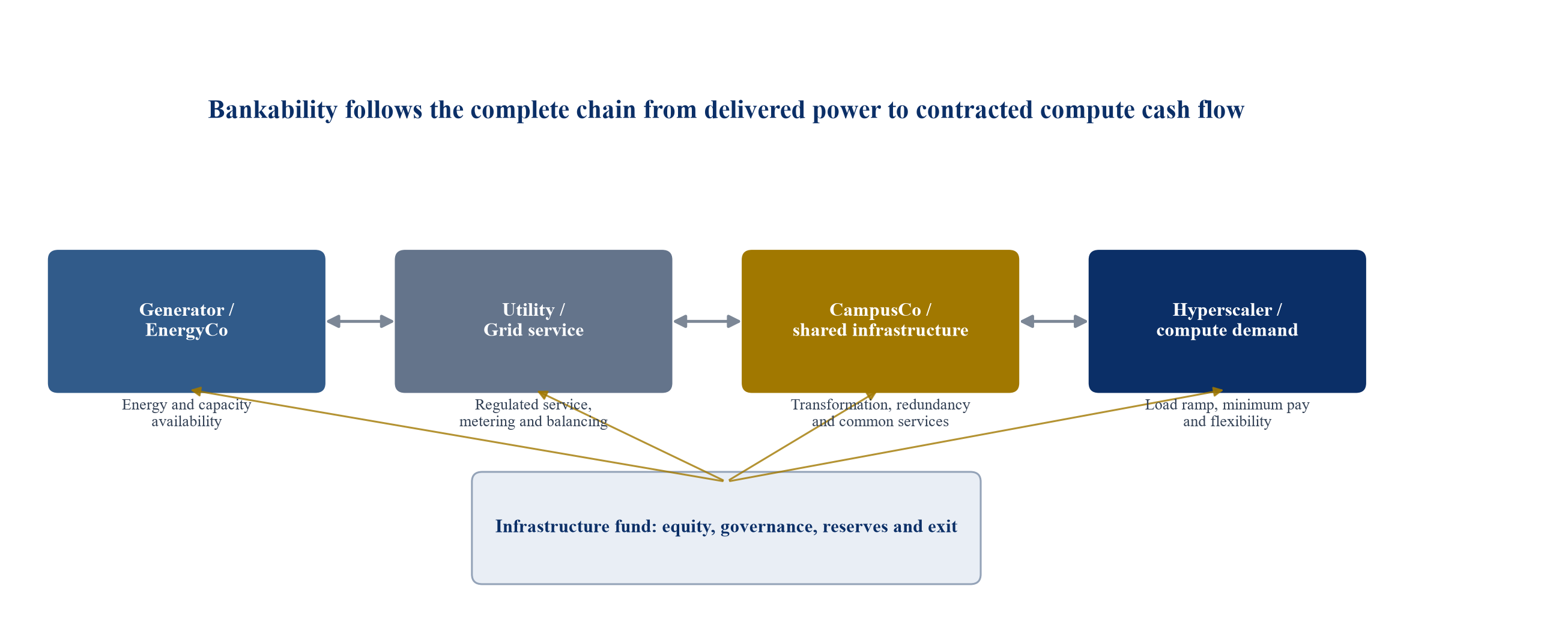
This author-developed diagram is a general analytical framework. The legal and physical arrangement will vary by jurisdiction and project.
6 Design the entity stack
A practical stack can use HoldCo above CampusCo, with EnergyCo and regulated utility assets outside the consolidation perimeter. HoldCo receives equity from the infrastructure fund and, where useful, a minority strategic investment from the hyperscaler or developer. CampusCo owns land, substation equipment, common cooling or water systems and data-hall shells. The hyperscaler owns or leases computing equipment. EnergyCo holds generation and storage. The utility owns regulated network assets.
The stack should avoid circular obligations. CampusCo should not guarantee EnergyCo debt unless it receives and controls the benefit. The utility should not be expected to support an unregulated vehicle without authority. The hyperscaler's payment obligation should be clear and limited to contracted services. The fund's commitment should be staged and capped.
Bankruptcy remoteness requires restrictions on additional debt, asset sales, distributions and related-party transactions. Project accounts and cash waterfalls should be separate. Cross-defaults should cover only failures that genuinely threaten the integrated campus.
7 Allocate control and reserved decisions
Equal shareholding does not guarantee balanced control. The documents should identify relevant activities and the consent required for each. Under IFRS 11, joint control depends on contractual sharing of control and unanimous consent over relevant activities. The legal and accounting analysis must reflect enforceable rights and obligations.
Day-to-day operations should be delegated to qualified managers under approved budgets. Reserved decisions can include changes to campus capacity, material contracts, financing, distributions, related-party transactions, technology changes, litigation, asset sales and insolvency. Vetoes should protect fundamental interests without paralysing routine delivery.
Deadlock procedures should begin with management escalation, then board escalation, expert determination for technical matters, and a defined commercial remedy. A shotgun or forced-sale mechanism can be inappropriate during construction because one party may exploit temporary distress. A staged buy-sell process, put or call at pre-agreed triggers, or transfer to an approved replacement can preserve continuity.
8 Contract the anchor demand
The anchor capacity agreement is the principal bridge between computing demand and finance. It should define committed megawatts, data-hall specifications, ready-for-service tests, ramp dates, minimum payments, service levels, term, renewal, expansion and termination.
The payment structure can combine a fixed capacity charge, variable electricity pass-through and performance adjustments. A minimum payment can support fixed infrastructure and debt. Variable charges should reflect actual energy, losses, network tariffs and agreed operating costs. The contract should state whether unutilised reserved capacity still attracts payment.
Credit support can include a parent guarantee, letter of credit, deposit or termination payment. The support should match the period during which assets are specialised and cannot be remarketed. A rapidly declining guarantee can leave lenders exposed before the campus reaches alternative-tenant readiness.
9 Protect the utility and other customers
Large-load growth can require generation and network investment before usage is certain. Regulators increasingly examine minimum bills, contract terms, collateral and cost allocation. The campus structure should demonstrate that project-specific costs are recovered from the project and that shared investments create measurable system value.
The utility agreement can include an upfront contribution, minimum demand charge, long-term service commitment, collateral and exit fee. It should state which costs are refundable, which assets enter the regulated rate base and how unused capacity is treated. The utility should retain operational authority required by its licence.
Ratepayer protection is also a financing issue. A contract that depends on shifting project costs to other customers can face challenge, delay or revision. The investment case should use an approved tariff or a credible regulatory path and should model the consequences of disallowance.
10 Structure the generation route to market
EnergyCo needs a contract that converts output into predictable revenue. Options include a physical power purchase agreement, a utility-administered clean-energy tariff, a tolling agreement, a capacity contract or a portfolio of market and hedging arrangements.
The delivery point determines basis and network risk. A plant can be electrically distant from the campus while its output is matched commercially. A co-located plant can reduce selected network requirements, but it remains subject to interconnection, reliability and cost-allocation rules. The contract should distinguish energy, capacity, ancillary services and environmental attributes.
Where technology is new, the parties can use milestone payments, performance guarantees, liquidated damages, contingency and a replacement-power mechanism. The hyperscaler should avoid taking construction risk indirectly through an unconditional tariff. The generator should avoid unlimited exposure to data-centre delay.
11 Link milestones across the four parties
The integrated schedule should contain a small number of bankable gates. Land control and development approvals come first. Grid studies, generation permits and equipment reservations follow. Financial close should occur only when critical contracts and conditions precedent align. Mechanical completion, energisation, data-hall commissioning and computing acceptance should then unlock later capital and revenue.
The schedule should identify dependencies and long-stop dates. A transformer reservation may expire before a generation permit. A turbine or reactor project may outlast the initial data hall. The parties should assign each dependency to an owner with reporting and mitigation duties.
Completion tests should be objective. CampusCo can test electrical capacity, redundancy and cooling. The utility can confirm interconnection and metering. EnergyCo can test output and availability. The hyperscaler can test computing readiness. Commercial operation should require all tests needed for the relevant phase, not every later expansion.
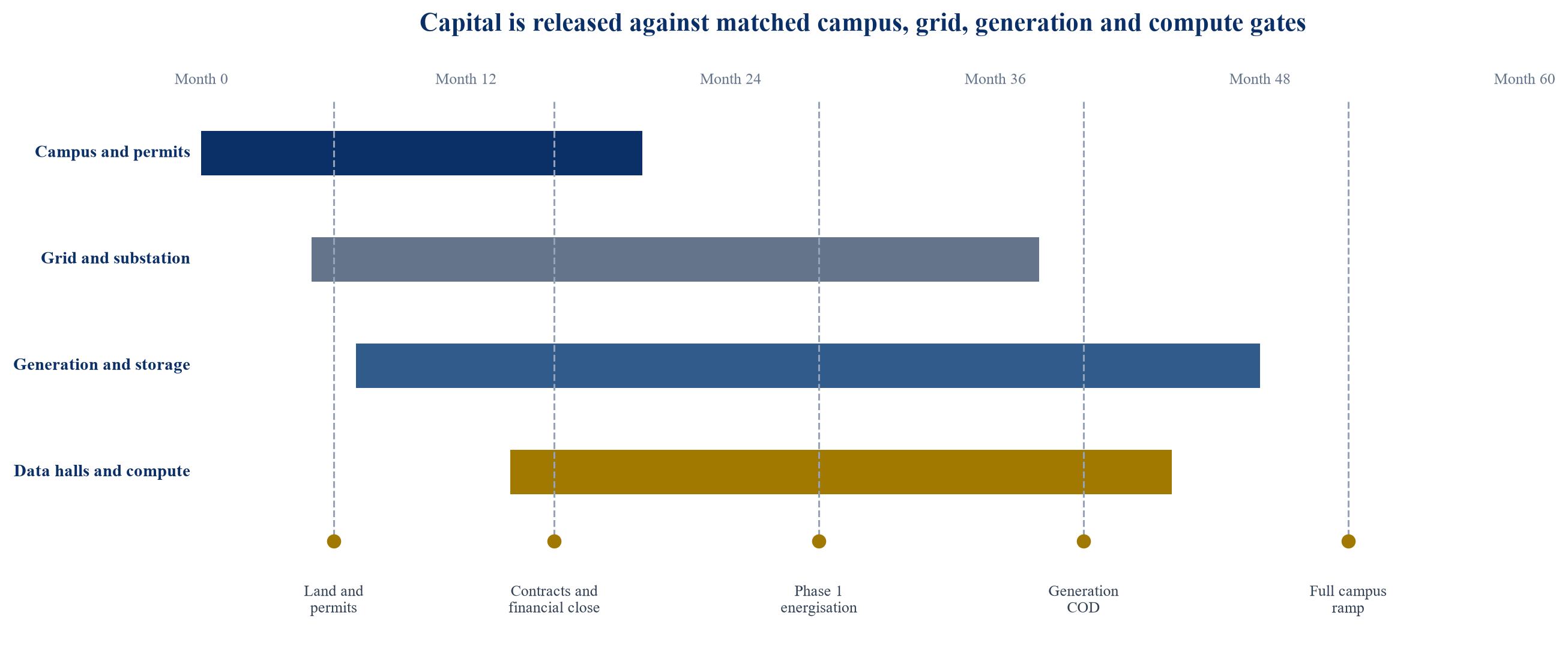
This author-developed timeline is hypothetical. Months and milestones illustrate sequencing rather than a forecast for any project.
12 Stage equity commitments
The infrastructure fund can commit capital at signing while funding it against conditions. Early development equity covers land, design, permits and deposits. Construction equity is released after contracts, approvals and debt commitments. Additional equity funds later phases when utilisation and connection evidence meet agreed thresholds.
The commitment agreement should address cost overruns, defaulting investors and changes in scope. A defaulting partner can face dilution, loss of governance rights or a forced transfer. Those remedies must be proportionate and enforceable. The hyperscaler may contribute customer-funded equipment or deposits rather than ordinary equity. The utility may contribute network assets under regulated arrangements rather than shares.
The funding plan should include contingencies for interfaces. Separate project contingencies can leave a gap when the root cause is disputed. A shared interface reserve, drawn under independent certification, can keep the programme moving while liability is resolved later.
13 Select the debt perimeter
CampusCo debt should be supported by capacity payments, leases or service charges that it controls. EnergyCo debt should be supported by energy and capacity revenue. Combining both in one financing can diversify cash flow but may expose lenders to unrelated construction and operating risks.
A common structure uses separate senior facilities with limited cross-defaults and a holding-company instrument above them. Lenders can take security over shares, accounts, material contracts and project assets within the relevant perimeter. Intercreditor arrangements govern shared collateral and cure rights.
Debt tenor should match contracted revenue and asset life. Data halls, substations and generation have different useful lives. Refinancing assumptions should be conservative. A balloon that depends on uncontracted expansion can transfer volume risk to lenders without adequate compensation.
14 Size debt from contracted capacity
Debt sizing should begin with contracted and available capacity, not headline campus megawatts. The model should multiply each energised phase by its minimum payment, deduct electricity and operating pass-throughs, and apply availability and credit assumptions. Debt service coverage should remain adequate after delay, underutilisation and replacement-power stresses.
Generation debt should use the contracted delivery profile and recognised capacity value. Merchant revenue and uncontracted environmental attributes can be treated as upside or heavily discounted. Campus debt should distinguish committed capacity from expansion options.
The lender model should reconcile physical megawatts, billing megawatts and cash-paying megawatts. These can differ during ramp, maintenance and curtailment. A single average utilisation percentage can hide the timing of cash deficits.
15 Analyse capacity economics
Capacity economics connect capital cost, fixed revenue and delivery risk. The relevant unit is often a commissioned megawatt at the contractual delivery point. The cost per megawatt should include land, common infrastructure, data-hall shell, electrical systems, network contribution, development cost and financing during construction. Generation is analysed separately when it sits outside CampusCo.
The hypothetical case below illustrates method. It assumes a 300 MW campus with 240 MW of committed capacity at steady state. Figures are author-developed and do not represent market benchmarks. The calculation tests whether minimum capacity charges cover fixed operating cost and debt service before variable energy pass-through.
Table 2. Hypothetical campus capacity economics
| Item | Base case | Delayed-ramp case | Low-commitment case | Interpretation |
|---|---|---|---|---|
| Total commissioned capacity | 300 MW | 300 MW | 300 MW | Physical phase capacity |
| Contracted capacity at steady state | 240 MW | 240 MW | 180 MW | Minimum-pay capacity |
| Campus infrastructure cost | USD 1.35bn | USD 1.47bn | USD 1.35bn | Excludes servers and separate generation |
| Annual fixed capacity revenue | USD 216m | USD 173m in first full debt year | USD 162m | Hypothetical USD 0.9m per committed MW-year |
| Annual fixed operating cost | USD 58m | USD 64m | USD 55m | Common infrastructure and administration |
| Illustrative annual debt service | USD 96m | USD 102m | USD 88m | Hypothetical financing output |
| Pre-tax fixed-cash DSCR | 1.65x | 1.07x | 1.22x | Before variable energy and tax |
16 Allocate network-upgrade cost
Network cost can be funded by the utility, customer, campus vehicle or a combination. The economic allocation should follow causation, system benefit and regulatory rules. The legal allocation should follow the approved tariff and connection agreement.
The contract should identify direct-connection assets, shared reinforcements and future reusable capacity. It should state whether customer contributions are refundable if later users benefit. It should also address abandonment, downsizing and project relocation.
The investment model should treat uncertain refunds conservatively. A future reimbursement can be excluded until the triggering event is sufficiently supported. The project should maintain records that allow the utility or regulator to audit cost and asset ownership.
17 Allocate replacement-power risk
Generation can fail or arrive late while the campus remains ready to consume. Replacement power may be available at a higher cost or with different environmental attributes. The contract should define the replacement obligation, price cap, duration and exclusions.
EnergyCo can bear replacement cost for controllable underperformance. The hyperscaler or CampusCo can bear market cost when demand exceeds the contracted profile. The utility can provide balancing under its tariff without guaranteeing generator performance. Force majeure should suspend only obligations genuinely prevented by the event.
The model should stress correlated conditions. A heatwave can raise campus demand, reduce thermal generation performance and increase market prices. A separate single-factor stress can understate exposure.
18 Make load ramp enforceable
The campus may commission capacity before the hyperscaler installs servers. A minimum ramp schedule protects infrastructure recovery. It should specify dates, megawatts, tolerance bands and payment consequences.
The customer may require flexibility for equipment supply or demand uncertainty. That flexibility can be priced through reservation fees, option payments or a delay right backed by termination compensation. The seller should not accept a free option over scarce power and land.
Ramp reporting should compare forecast, reserved, installed, tested and billed load. These five measures support construction planning, utility forecasting and lender surveillance. Persistent variance should trigger reforecasting and, where agreed, release of unused capacity to another customer.
19 Design performance and availability regimes
The parties should avoid overlapping penalties for the same failure. Campus availability, utility service, generation availability and computing service are distinct. Each should have its own measurement point and remedy.
Service credits can address short outages. Liquidated damages can address delayed completion. Termination can apply after sustained failure. Aggregate caps should preserve a meaningful remedy without creating unfinanceable unlimited liability.
Planned maintenance must be coordinated. The integrated schedule should show generation outages, network maintenance, campus electrical work and customer maintenance. Redundancy claims should be tested during realistic outage combinations.
20 Use flexibility as a shared resource
Flexible computing demand can reduce network stress, support earlier connection and complement variable generation. Its value depends on workload rights, controls, measurement and settlement. The hyperscaler should retain authority over workloads while committing an agreed net-load response.
Flexibility revenue and savings should be allocated according to contribution. CampusCo may provide batteries and controls. The hyperscaler provides workload tolerance. The utility or market provides the product. EnergyCo may benefit from reduced imbalance. The contract should prevent double counting.
Lenders should recognise flexibility only after testing and contractual settlement. Until then, it can improve the upside case without supporting base debt service.
21 Govern the common control platform
The campus may use a digital platform to coordinate grid signals, generation, storage, cooling and workloads. That platform becomes operationally critical. Governance should cover access, change control, cybersecurity, data ownership, audit logs and fallback modes.
Each party should receive only the data required for its role. A utility can require net-load and meter data without access to customer content. EnergyCo can receive dispatch and settlement information without visibility into computing workloads. Lenders can receive aggregated performance data.
The platform should support manual safe states and independent metering. A cyber incident should not create automatic authority for one partner to control another partner's protected systems.
22 Protect environmental attributes and claims
The structure should define ownership and retirement of renewable-energy certificates, guarantees of origin, carbon-free energy attributes and other claims. Physical delivery and environmental attribution are separate concepts in many markets.
The hyperscaler may require hourly or regional matching. EnergyCo may need attributes for financing or compliance. The utility may report system-wide performance. Double claiming can create legal and reputational risk.
The contracts should specify measurement boundaries, registries, retirement, replacement and audit. Claims should describe the actual product. A campus supplied from the grid under a financial match should not describe itself as physically isolated from the grid.
23 Address water, land and community obligations
Energy and computing development affect land, water, noise, traffic and local infrastructure. The partnership should allocate permitting and community commitments to the party with control. Shared obligations can sit in a campus environmental and social management plan.
Water rights and cooling design can constrain expansion. The model should include treatment, recycling and discharge cost where relevant. Generation can have separate water or land needs. Cumulative impacts should be assessed at campus level even when permits are separate.
Community commitments should be specific, funded and governed. The parties should avoid relying on projected tax or employment benefits that have not been independently validated.
24 Manage technology and obsolescence
Computing hardware can change faster than substations and generation. Higher rack density can increase cooling and electrical requirements without changing the contracted campus megawatts. More efficient computing can reduce load per task while total demand still grows.
The technical schedule should define allowable density, power quality, cooling parameters and upgrade rights. CampusCo should price modifications that exceed the original design. The hyperscaler should retain flexibility to refresh servers without reopening the entire energy contract.
Generation technology risk should remain within EnergyCo unless another party knowingly sponsors first-of-a-kind deployment. Performance guarantees, contingency and staged capacity can reduce exposure. The structure should preserve the ability to add storage or other resources without impairing lender security.
25 Test the combined downside
The severe case should combine events that can occur together. A twelve-month grid delay can coincide with construction inflation and a slower load ramp. Generator delay can coincide with high replacement prices. A customer downgrade can increase collateral requirements while equity is already committed.
The figure below uses hypothetical values to show the direction of impact on CampusCo debt-service coverage. It is not a forecast or market calibration. The model begins with a 1.65x fixed-cash DSCR and applies combined operating effects rather than multiplying independent probability estimates.
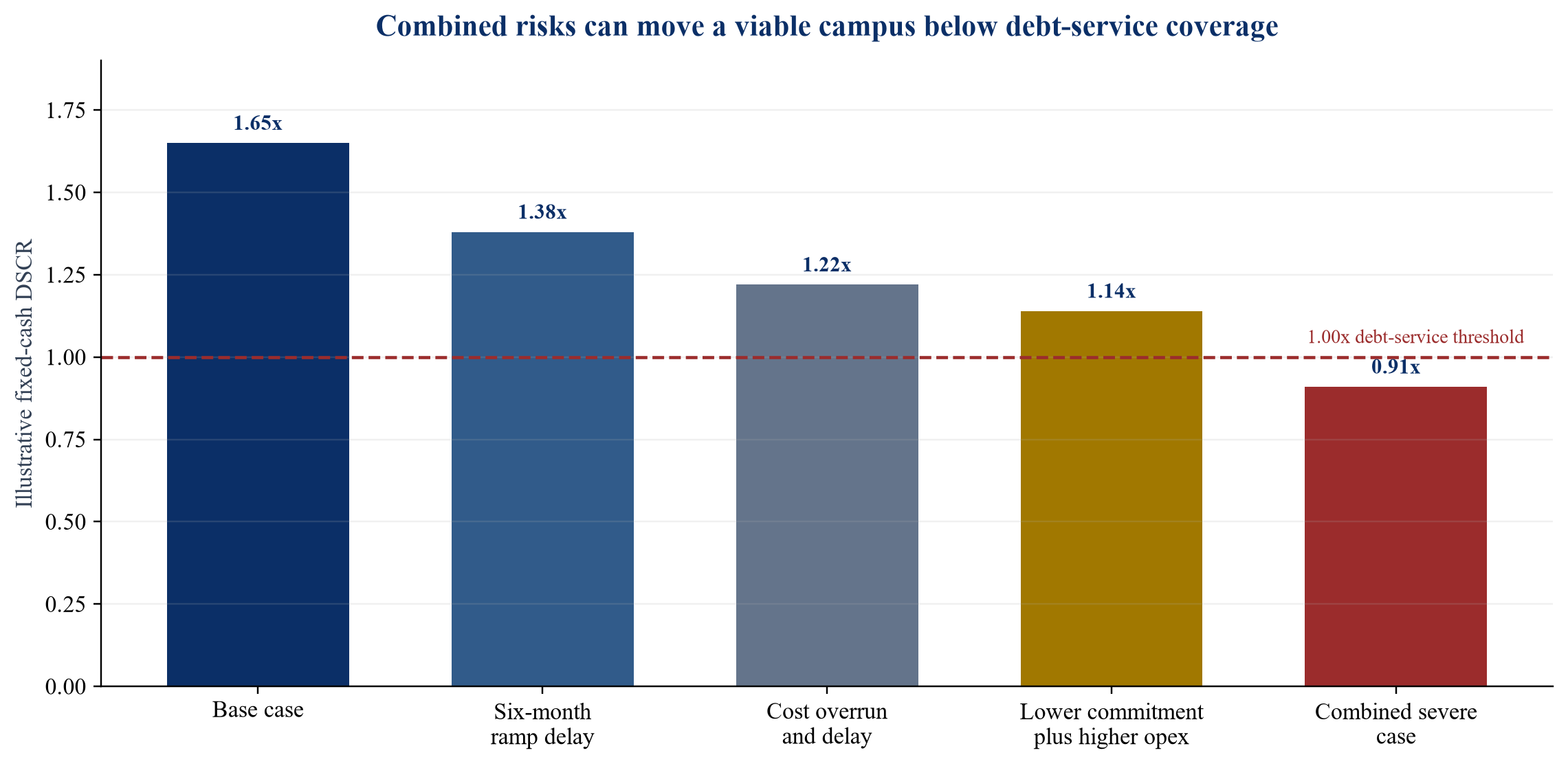
Author-developed scenario. Values illustrate method and do not represent observed project performance or an investment forecast.
Table 3. Downside allocation and financing response
| Downside event | Immediate exposure | Contractual allocation | Financing response | Early indicator |
|---|---|---|---|---|
| Grid connection delay | CampusCo and anchor customer | Utility relief only for obligations within its control; interface reserve for disputed causes | Delayed draw, interest reserve and long-stop test | Study changes, equipment slippage and permit delay |
| Generation delay | EnergyCo and power buyer | Replacement-power and liquidated-damages regime | Generation contingency and sponsor support | EPC schedule variance and missed testing |
| Slower compute ramp | Hyperscaler and CampusCo | Minimum payment, reservation fee or termination compensation | Lower leverage and phased debt | Server orders, commissioning and billed load |
| Campus cost overrun | CampusCo sponsors | Fixed-price packages, contingency and capped equity support | Completion support and distribution lock-up | Awarded-contract variance and change orders |
| Regulatory cost disallowance | Utility and project parties according to tariff | Approved cost-recovery path and change-in-law provisions | Holdback until approval and rebase rights | Staff evidence requests and intervenor challenge |
| Customer credit deterioration | CampusCo and lenders | Collateral top-up and replacement rights | Cash sweep, reserve and covenant tightening | Rating action and delayed payments |
26 Align accounting with legal substance
The accounting analysis should be performed while the contracts are negotiated. IFRS 10 addresses control and consolidation. IFRS 11 distinguishes joint operations from joint ventures based on rights to assets and obligations for liabilities. IAS 28 addresses equity accounting for associates and joint ventures. IFRS 12 requires disclosures about interests in other entities.
The label Joint Venture Agreement does not determine the result. A separate vehicle can still involve rights and obligations that require different treatment. Long-term capacity and power contracts also require assessment under IFRS 9, IFRS 15, IFRS 16 and other applicable standards.
Accounting outcomes can affect leverage, covenants, earnings and distributable cash. The parties should obtain project-specific advice and ensure that lender definitions remain coherent if accounting treatment changes.
27 Address tax and transfer pricing
The entity stack can create land-transfer taxes, withholding, permanent establishment, interest limitation and indirect-tax consequences. Cross-border investors may require treaty analysis. Public incentives can contain clawbacks tied to investment, employment or operating duration.
Related-party charges for development, energy management, operations, technology and financing should be documented at arm's length. Transfer pricing should follow the functions, assets and risks actually borne. A thin CampusCo should not pay for risks retained elsewhere.
Tax assumptions should remain separate from operating economics so that the investment committee can see whether the project is viable before incentives. The model should stress delayed or unavailable benefits.
28 Create a coherent security package
Lenders need security that can be enforced without disrupting regulated assets or protected computing systems. CampusCo lenders can take security over land interests, project accounts, shares and assignable contracts. EnergyCo lenders take security over generation assets and revenues. Utility assets usually remain outside the package.
Direct agreements should provide notice, cure and step-in rights. Replacement operators must meet technical, security and regulatory requirements. The hyperscaler can restrict access to sensitive equipment while allowing a lender to preserve the service contract.
Intercreditor terms should address shared accounts, common infrastructure and enforcement sequencing. A foreclosure on EnergyCo should not sever essential campus easements. A CampusCo enforcement should preserve utility access and safety rights.
29 Plan exit and refinancing at entry
The infrastructure fund needs transfer and liquidity mechanisms. A sale can occur at HoldCo, CampusCo or asset level. Consent rights should protect strategic and regulatory interests without creating an indefinite lock-in.
Permitted transferees should meet financial, technical, sanctions, competition and security criteria. Rights of first offer or first refusal need strict timelines. A hyperscaler may require protection against a competitor acquiring governance access. The utility may require regulatory approval.
Refinancing gains and costs should be allocated in advance. An extension of customer term or a reduction in construction risk can support lower-cost debt. The contract should preserve incentives for the parties that created the value.
30 Establish integrated reporting
The board should receive one campus report that reconciles construction, grid, generation, compute and finance. Separate reports can each appear green while the combined programme is late.
Core measures include permitted and commissioned megawatts, firm and conditional connection capacity, generation availability, contracted and billed load, capital committed and spent, contingency, forecast completion, service credits, environmental performance and covenant headroom.
Data definitions should be fixed before financial close. Independent engineers, model auditors and technical advisers should use the same milestone and capacity definitions. Material changes should be approved through the reserved-decision process.
31 Use a disciplined negotiation sequence
The parties should begin with a term sheet that fixes perimeter, roles, capacity, schedule, payment, risk allocation and governance. Technical and regulatory work should then validate those terms. Detailed contracts follow in parallel with financing and accounting analysis.
Negotiations should maintain an interface register. Every obligation that depends on another contract should identify the corresponding obligation, timing and remedy. A red-team review should test whether a party can be required to perform without receiving the input it needs.
Before signing, the investment committee should receive a single decision paper covering economics, combined downside, unresolved consents, completion support, security and exit. Conditions precedent should close genuine gaps rather than defer fundamental commercial decisions.
32 Apply the four-partner decision framework
The decision framework has eight gates. First, define the physical and legal perimeter. Second, identify each partner's contribution and prohibited exposure. Third, select the entity and contract stack. Fourth, align milestones and capital. Fifth, protect the utility and other customers. Sixth, establish enforceable anchor demand and generation revenue. Seventh, size debt from contracted and tested cash flow. Eighth, preserve governance, security and exit.
A project that fails one gate may still proceed with a different structure. Regulatory limits on utility equity can lead to a tariff and service agreement. Hyperscaler reluctance to invest can be addressed through minimum payments and deposits. Generator technology risk can remain in a separately financed vehicle. The framework is designed to change the structure when the evidence changes.
33 Recognise common failure modes
The first failure is assuming that a shared site creates shared incentives. The second is using one company to warehouse every risk. The third is securing generation without a viable grid route. The fourth is securing a connection without enforceable load. The fifth is relying on tariff approval that has not been obtained.
Other failures include mismatched long-stop dates, double-counted environmental attributes, unrestricted partner vetoes, insufficient customer collateral, hidden related-party charges, unallocated replacement-power cost and an exit right that threatens operating continuity.
The remedy is an auditable chain of rights and obligations. Every capital contribution, performance duty and cash distribution should connect to a measurable milestone or delivered service.
34 Limitations
This paper provides a general corporate-finance and project-finance framework. Electricity regulation, utility authority, tariff design, interconnection, tax, accounting, competition, foreign-investment review, environmental requirements and insolvency law differ by jurisdiction.
Public announcements describe selected commercial arrangements but rarely disclose the full contracts, financing terms or risk allocation. They are evidence of market development rather than complete transaction precedents. The hypothetical figures illustrate analytical method and are not market benchmarks, forecasts, valuations, credit opinions or offers.
Every project requires engineering, legal, tax, accounting, regulatory, cybersecurity, environmental and financial advice based on its facts.
Conclusion
One campus can support four partners when the structure respects their different mandates. The hyperscaler converts power into contracted compute demand. The utility provides regulated access and system integrity. The generator provides energy and capacity. The infrastructure fund supplies governed, patient capital. Their shared objective is a reliable chain from construction to energisation, service and cash flow.
The most bankable arrangement is rarely defined by equal ownership. It is defined by a clear asset perimeter, matched milestones, enforceable minimum payments, approved cost recovery, separated specialist risks, disciplined governance and lender rights that preserve operations. Separate vehicles can improve transparency when contracts close the interfaces. A single vehicle can work when the parties can legally and commercially share the relevant risks.
The investment decision should therefore begin with the complete power-to-compute chain. Capacity should be measured at the delivery point, revenue should trace to contracted demand, and debt should survive combined downside. The result is a structure that can fund new energy and digital infrastructure while preserving accountability to customers, regulators and capital providers.
References
- International Energy Agency, Energy and AI: Energy Demand from AI, 2025. https://www.iea.org/reports/energy-and-ai/energy-demand-from-ai
- International Energy Agency, Energy and AI: Energy Supply for AI, 2025. https://www.iea.org/reports/energy-and-ai/energy-supply-for-ai
- International Energy Agency, Key Questions on Energy and AI, 2026. https://www.iea.org/reports/key-questions-on-energy-and-ai
- International Energy Agency, Energy and AI Data Product, June 2025. https://www.iea.org/data-and-statistics/data-product/energy-and-ai
- Federal Energy Regulatory Commission, Interconnection of Large Loads to the Interstate Transmission System, Docket RM26-4. https://www.ferc.gov/rm26-4
- Federal Energy Regulatory Commission, FERC Launches Targeted Action to Speed Large Load Integration, 18 June 2026. https://www.ferc.gov/news-events/news/ferc-launches-aggressive-targeted-action-speed-large-load-integration
- Federal Energy Regulatory Commission, Commissioner Rosner's Remarks on Large Load Show Cause Orders, 18 June 2026. https://www.ferc.gov/news-events/news/commissioner-rosners-remarks-large-load-show-cause-orders-e-7-e-12-june-18-2026
- Federal Energy Regulatory Commission, Commissioner Phillips' Concurrence Statement on Co-location Issues, 20 February 2025. https://www.ferc.gov/news-events/news/commissioner-phillips-concurrence-statement-co-location-issues
- Electric Power Research Institute, DCFlex: Data Center Flexible Load Initiative, 2025. https://restservice.epri.com/publicdownload/000000003002031004/0/Product
- Electric Power Research Institute, Grid Flexibility Needs and Data Center Characteristics, June 2025. https://restservice.epri.com/publicdownload/000000003002031504/0/Product
- Electric Power Research Institute, DCFlex Demonstration Projects Update, 2025. https://dcflex.epri.com/demonstrations
- North American Electric Reliability Corporation, Characteristics and Risks of Emerging Large Loads, July 2025. https://www.nerc.com/globalassets/who-we-are/standing-committees/rstc/3_doc_white-paper-characteristics-and-risks-of-emerging-large-loads.pdf
- North American Electric Reliability Corporation, 2025 Long-Term Reliability Assessment. https://www.nerc.com/pa/RAPA/ra/Reliability%20Assessments%20DL/NERC_Long%20Term%20Reliability%20Assessment_2025.pdf
- Google, A New Approach to Data Center and Clean Energy Growth, 10 December 2024. https://blog.google/innovation-and-ai/infrastructure-and-cloud/global-network/new-approach-to-data-center-and-clean-energy-growth/
- Google, How We Are Working with Utilities to Create a New Model for Clean Energy, 11 June 2024. https://blog.google/company-news/outreach-and-initiatives/sustainability/google-clean-energy-partnership/
- Google, Our First-of-its-kind Partnership for Clean Energy Has Been Approved in Nevada, 13 May 2025. https://blog.google/feed/nevada-clean-energy/
- Duke Energy, Amazon, Google, Microsoft and Nucor Execute Agreements to Accelerate Clean Energy Options, 29 May 2024. https://news.duke-energy.com/releases/responding-to-growing-demand-duke-energy-amazon-google-microsoft-and-nucor-execute-agreements-to-accelerate-clean-energy-options
- Google, Scaling Clean Energy and Reliability in Michigan, 17 March 2026. https://blog.google/innovation-and-ai/infrastructure-and-cloud/global-network/clean-energy-reliability-michigan/
- Google, New Milestone for Smart, Affordable Electricity Growth, 19 March 2026. https://blog.google/innovation-and-ai/infrastructure-and-cloud/global-network/demand-response-data-center-milestone/
- Google, New Nuclear Clean Energy Agreement with Kairos Power, 14 October 2024. https://blog.google/company-news/outreach-and-initiatives/sustainability/google-kairos-power-nuclear-energy-agreement/
- Constellation Energy, Constellation to Launch Crane Clean Energy Center, 20 September 2024. https://www.constellationenergy.com/news/2024/Constellation-to-Launch-Crane-Clean-Energy-Center-Restoring-Jobs-and-Carbon-Free-Power-to-The-Grid.html
- Georgia Public Service Commission, 2025 Annual Report. https://psc.ga.gov/site/downloads/annual_reports/2025_GAPSC_Annual_Report.pdf
- IFRS Foundation, IFRS 10 Consolidated Financial Statements. https://www.ifrs.org/issued-standards/list-of-standards/ifrs-10-consolidated-financial-statements/
- IFRS Foundation, IFRS 11 Joint Arrangements. https://www.ifrs.org/issued-standards/list-of-standards/ifrs-11-joint-arrangements/
- IFRS Foundation, IFRS 12 Disclosure of Interests in Other Entities. https://www.ifrs.org/issued-standards/list-of-standards/ifrs-12-disclosure-of-interests-in-other-entities/
- IFRS Foundation, IAS 28 Investments in Associates and Joint Ventures. https://www.ifrs.org/issued-standards/list-of-standards/ias-28-investments-in-associates-and-joint-ventures/
- IFRS Foundation, IFRS 9 Financial Instruments. https://www.ifrs.org/issued-standards/list-of-standards/ifrs-9-financial-instruments/
- IFRS Foundation, IFRS 15 Revenue from Contracts with Customers. https://www.ifrs.org/issued-standards/list-of-standards/ifrs-15-revenue-from-contracts-with-customers/
- IFRS Foundation, IFRS 16 Leases. https://www.ifrs.org/issued-standards/list-of-standards/ifrs-16-leases/
- International Valuation Standards Council, International Valuation Standards. https://www.ivsc.org/standards/
- National Institute of Standards and Technology, Cybersecurity Framework 2.0, 2024. https://doi.org/10.6028/NIST.CSWP.29
- National Institute of Standards and Technology, Guide to Operational Technology Security, SP 800-82 Revision 3, 2023. https://doi.org/10.6028/NIST.SP.800-82r3
- Equator Principles Association, The Equator Principles EP4, July 2020. https://equator-principles.com/app/uploads/The-Equator-Principles_EP4_July2020.pdf
- World Bank Group, Guidance on PPP Contractual Provisions, 2019 Edition. https://ppp.worldbank.org/public-private-partnership/library/guidance-ppp-contractual-provisions-2019
About the Author
Chennakeshav (CK) is a corporate finance and investment banking executive with 25+ years of global experience in deal origination, structuring and execution across M&A, growth capital and corporate strategy. He has led value-creation mandates for founders, corporates and funds — bridging the boardroom view to hands-on execution and close.
His career spans Morgan Stanley, HSBC, Lloyds Banking Group, EWEC, ADQ portfolio companies and Emirates Growth Fund, across TMT, real estate, fintech, deeptech, cleantech, infrastructure and energy. He has partnered with C-suite leaders, private equity and venture funds, sovereign wealth funds and family offices to finance complex fund raises and scale-up ventures, and has led M&A due diligence, post-merger integration and business-transformation initiatives to create value.
At Matchpoint Partners he is Managing Partner, leading the firm's corporate finance, M&A and capital-raising practice. He holds an MBA from London Business School, an engineering degree from VTU and a Master of Laws (LLM, in progress) from UCL London.
An active start-up mentor, CK mentors at Techstars, DIFC FinTech Hive, Startup Grind, Founder Institute and IN5, serves as Entrepreneur Mentor in Residence (EMiR) at London Business School, and judges the Entrepreneurship World Cup.
