
Introduction
The expansion of artificial-intelligence infrastructure has changed the question asked of a data-centre site. Land, fibre and a viable building remain necessary. Power availability increasingly determines how quickly a campus can reach revenue, how much computing equipment it can support and how confidently capital providers can underwrite expansion. The International Energy Agency estimated global data-centre electricity consumption at about 415 terawatt hours in 2024 and projected around 945 terawatt hours in 2030 in its Base Case. The US Department of Energy reported that American data centres consumed about 176 terawatt hours in 2023 and could reach 325 to 580 terawatt hours by 2028. These system-level figures signal scale. They do not establish the financeability of any individual project.
A lender sees several megawatts. The utility may describe gross service capacity. Engineers distinguish facility input from critical IT load after cooling and electrical losses. A customer may reserve less capacity than the facility can deliver and may ramp its use over time. The revenue agreement may include fixed availability payments, pass-through energy, service credits and termination rights. The financing model must reconcile each unit and attach evidence to it.
The central conclusion is that debt capacity follows recognised cash-generating megawatts. Recognition requires enforceable power rights, a credible energisation path, completed infrastructure, commercially durable customer obligations and sufficient operating resilience. A larger announced pipeline can support option value and future financing. It should not be treated as current debt service capacity until the relevant conditions are satisfied.
1 Define the debt-capacity question
Debt capacity is the amount and structure of borrowing that an asset can support through its cash flows, collateral, contractual protections and sponsor support under agreed downside conditions. The answer changes with the financing perimeter. A corporate revolver may rely on a diversified operating platform and unencumbered assets. A construction facility relies on budget control, equity, completion support and future take-out. A project loan relies on ring-fenced contracts and security. Equipment debt relies on financed hardware, customer cash flow and residual-value protections.
The board should define the decision before selecting a leverage metric. The decision may concern the maximum construction commitment, the amount that can convert into term debt at completion, the debt that remains sustainable after a technology refresh, or the price at which an acquired energy platform can be financed. Each decision needs a specific date, asset perimeter, currency, revenue contract and downside case.
A single net-debt-to-EBITDA multiple provides limited insight during development. EBITDA may not exist before energisation. It may exclude recurring replacement expenditure, capitalised interest, restricted cash and customer-funded construction obligations. Project-level debt service coverage can provide a clearer view after contractual cash flow begins, while enterprise leverage remains relevant for sponsor and platform creditors.
2 Reconcile the six meanings of a megawatt
The first meaning is announced capacity: the number used to describe the development opportunity. The second is controlled power: capacity supported by land, utility, generation or interconnection rights held by the borrower or a secured affiliate. The third is deliverable gross capacity: power that can reach the site after specified works and conditions. The fourth is critical IT load: the portion available to computing equipment after cooling, conversion and facility loads. The fifth is contracted capacity: the amount covered by binding customer obligations. The sixth is billable capacity: the capacity accepted, available and eligible for payment under the revenue agreement.
The conversion from one measure to the next is rarely one-to-one. A 120-megawatt gross connection may support 80 megawatts of critical IT load depending on design, redundancy and efficiency. A customer may contract 60 megawatts in phases. Lenders may recognise 50 megawatts after applying construction, counterparty, ramp and performance haircuts. Debt is then sized from the cash flow produced by those 50 megawatts, subject to reserves and coverage.
The reconciliation should appear in technical, commercial and financial diligence. Every model sheet and financing paper should use defined terms consistently. Gross power, critical IT load, reserved capacity and contracted revenue should never be combined without an explicit conversion bridge.
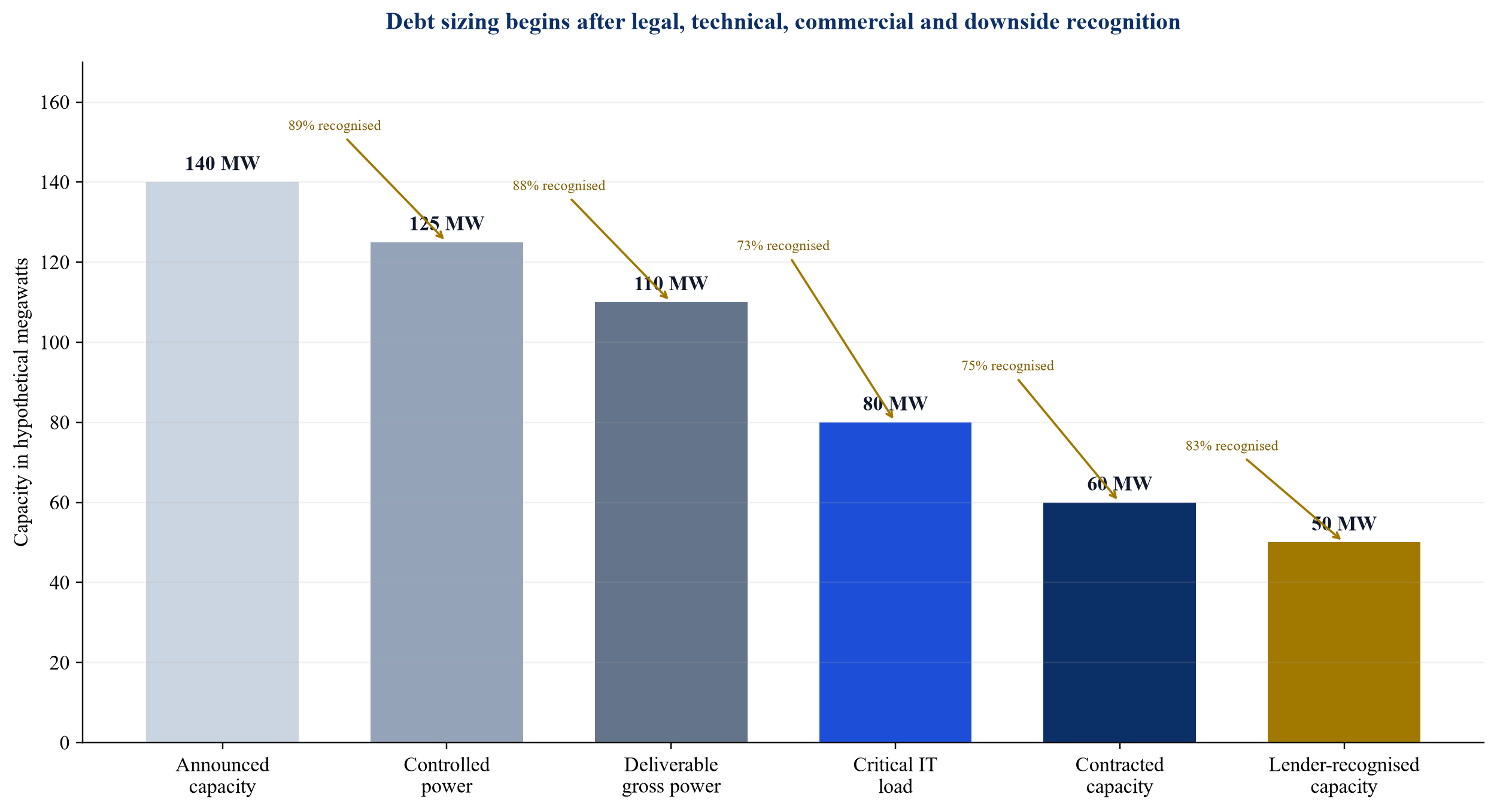
The capacities and recognition percentages are hypothetical author-developed assumptions. They do not describe a particular project.
3 Establish legal control of power rights
Power access can arise through a utility service agreement, interconnection agreement, transmission right, power-purchase agreement, on-site generation contract, land right, option or reservation. The lender should identify the legal holder, duration, transferability, security rights, milestones, deposits, upgrade obligations, curtailment terms, termination events and change-control restrictions. A sponsor affiliate holding the critical agreement outside the security perimeter creates dependency on an unsecured relationship.
FERC's work on large-load interconnection illustrates the evolving regulatory setting. Its large-load docket has examined connection of substantial loads, including data centres, and questions such as responsibility for grid upgrades, reliability evaluation and co-location with generation. PJM's large-load process similarly reflects the need to coordinate forecasting, generation, transmission, utilities and state authorities. These developments reinforce a transaction-level lesson: a development plan should identify the operative tariff and contract position as of the underwriting date.
Evidence quality matters. An executed agreement with completed studies and paid security carries more weight than a queue position or marketing statement. Rights that depend on future network upgrades should be recognised in stages. A financing can fund defined development expenditure while reserving full construction leverage until required milestones are achieved.
4 Separate energy from capacity and deliverability
Energy is electricity consumed over time. Capacity is the ability to supply a quantity at a specified moment or within a period. Deliverability concerns whether that capacity can physically and legally reach the load under relevant system conditions. A renewable power-purchase agreement may provide economic exposure and environmental attributes while the grid supplies the physical energy. An on-site generator may provide firm output subject to fuel and maintenance. A battery provides power for a limited duration and depends on charge availability.
The debt case should state the source, firmness, delivery point, outage exposure, price formula, escalation, dispatch rights and replacement arrangements for each supply component. Annual energy matching does not prove continuous availability. Nameplate generation does not equal dependable output. A utility commitment subject to extensive works does not equal energised service.
The supply portfolio should be tested against the customer service obligation. A powered-shell lease may allocate energy cost to the tenant while leaving the landlord responsible for availability. A compute-service contract may require a higher standard because interruptions affect the customer's workload. The financing model should include service credits, curtailment, backup costs and performance remedies.
5 Translate gross power into critical IT load
Critical IT load is influenced by power-usage effectiveness, redundancy, cooling technology, ambient conditions and operating practice. A facility designed for conventional racks may require significant changes for high-density accelerated computing. Liquid cooling, electrical distribution, backup configuration and heat rejection can change the conversion between gross input and billable computing capacity.
The International Energy Agency identifies servers as the largest electricity-consuming component in modern data centres while recognising substantial variation by facility type. It also expects accelerated servers to become a major driver of incremental demand. Equinix reported in its 2025 Form 10-K that customer power and cooling requirements were increasing per cabinet and that new facilities were being designed for materially higher needs. Digital Realty identified rapid advances in compute, cooling and power technologies as a source of changing customer requirements and potential obsolescence.
Lender technical diligence should confirm the critical-load definition, metering, redundancy mode, tested capacity and upgrade path. The debt model should use the lower of demonstrated capacity and contractually supportable capacity until independent evidence supports expansion.
6 Assess the quality of customer capacity reservations
A reservation can range from a refundable deposit to a long-term take-or-pay agreement. Its value depends on counterparty credit, guarantee support, payment commencement, ramp schedule, conditions, acceptance, termination, service credits, change control and remedies. A contract that describes a large capacity may produce limited financeable revenue when the customer can defer delivery or terminate without meaningful compensation.
Public filings demonstrate varied structures. CoreWeave reported that it finances infrastructure primarily through asset-level debt supported by take-or-pay customer contracts and that committed contracts had a weighted-average duration of about five years at the end of 2025. Hut 8 announced a 15-year lease for 245 megawatts of critical IT capacity at River Bend, with a Google financial backstop and project-level financing described as subject to definitive agreements and closing conditions. Cipher Mining disclosed a ten-year hosting agreement for 168 megawatts of critical IT load with a customer obligation backstop. These transactions provide observable examples of the contract features investors consider. Each remains specific to its documentation and circumstances.
The credit committee should analyse the contract itself. Public announcements cannot replace diligence on definitions, exclusions, liability caps and conditions. The recognised revenue case should be based on payments enforceable under the downside being modelled.
Table 1. Capacity-contract features and their debt-capacity effect
| Contract feature | Stronger recognition evidence | Principal weakness | Typical financing treatment |
|---|---|---|---|
| Payment obligation | Fixed availability or take-or-pay payment after objective delivery | Payment depends primarily on utilisation or discretionary orders | Recognise fixed minimum; treat variable revenue as upside |
| Counterparty support | Investment-grade obligor, guarantee, letter of credit or funded security | Thin special-purpose customer without support | Apply credit haircut, reserve or sponsor support |
| Term and ramp | Term exceeds debt tenor with defined phased commencement | Long ramp or optional deferral without compensation | Size to committed ramp and delay case |
| Acceptance | Objective tests aligned with design and independent certification | Subjective acceptance or changing technical specification | Hold debt conversion until acceptance |
| Termination | Limited termination with make-whole or replacement period | Broad convenience or technology termination | Shorten tenor, reduce leverage or require termination payment |
| Service levels | Measurable obligations with capped credits and cure rights | Open-ended liability or cascading credits | Deduct expected credits and stress repeat failures |
| Change control | Defined upgrade process, cost allocation and schedule relief | Customer can require redesign without price or time adjustment | Add contingency, equity support and change-order controls |
This author-developed matrix is a screening tool. Contract interpretation requires transaction-specific legal and credit advice.
7 Distinguish pipeline value from debt service capacity
A multi-gigawatt pipeline can be strategically valuable. It can create options in constrained power markets, support customer negotiations and justify development capability. It also includes sites at different stages of control, study, permitting, design and commercialisation. Aggregating them into a single capacity number can obscure the amount available to repay debt.
The platform should report a maturity ladder. Tier one can contain energised and billable capacity. Tier two can contain completed infrastructure awaiting customer acceptance. Tier three can contain contracted power with construction underway. Tier four can contain executed connection rights subject to works. Tier five can contain studies, options and early-stage sites. Each tier should have defined evidence, probability treatment and capital limit.
Corporate investors may value the option portfolio through scenarios. Project lenders generally size to ring-fenced cash flow and collateral. A borrowing-base facility can bridge the two approaches by applying advance rates to eligible assets and zero or low recognition to early-stage opportunities.
8 Match leverage to the development stage
Development debt funds site control, studies, deposits, design and permits. Its repayment relies on sponsor support, asset sale, construction financing or a broader platform. Exposure should be capped because the project may remain unbuildable. Construction debt begins after clearer evidence exists. It relies on budget, schedule, equity, contracts, contingency, completion support and a path to operating cash flow. Stabilised debt relies on completed assets, accepted service and recurring revenue.
Using the stabilised leverage ratio during development hides completion risk. Using only development cost after stabilisation ignores the durability of contracted cash flow. The capital stack should state when and how debt changes character. Conversion conditions can include energisation, mechanical completion, integrated testing, customer acceptance, funded reserves and a minimum period of compliant operations.
The same platform may contain several financings. A corporate facility can fund common infrastructure. Site-level construction loans can finance campuses. Equipment facilities can finance servers and network hardware. Intercreditor arrangements should define collateral, cash, enforcement and access across these layers.
9 Build the cash-flow bridge
Debt service begins with revenue eligible for recognition. The bridge should separate fixed capacity payments, variable utilisation, energy pass-through, installation income and ancillary services. It should deduct operating cost, purchased energy, maintenance, insurance, property charges, management cost, expected service credits, taxes and recurring replacement reserves. The remaining cash flow available for debt service supports interest and amortisation.
Energy pass-through can reduce commodity exposure when the formula and payment timing are aligned. It can still create working-capital risk if the project pays the utility before collecting from the customer. Minimum bills can support fixed cost recovery. Escalators can protect nominal revenue while interest, labour, maintenance and replacement costs follow different indices.
Cash flow should be tested on an accrual and liquidity basis. A project can meet annual coverage while facing a monthly cash deficit during a delayed ramp or large utility deposit. Revolving liquidity, reserves and equity cure rights address timing as well as ultimate economics.
10 Size debt from coverage and tenor
A project-finance sizing method divides sustainable cash flow available for debt service by the required debt service coverage ratio. The resulting annual debt service is converted into principal through the assumed interest rate, tenor and amortisation profile. The lower of coverage-based debt, loan-to-cost, collateral value and lender limits becomes the practical constraint.
The coverage ratio should reflect risk. Contracted cash flow from a credit-supported obligor may support a lower required ratio than merchant or highly variable revenue. Construction and ramp risk can justify higher coverage, lower advance rates or more equity. The ratio should remain a decision tool rather than a substitute for cash-flow analysis.
In the hypothetical case below, 50 megawatts of lender-recognised capacity earns a fixed infrastructure charge, producing recurring revenue and cash flow after operating cost and reserves. At a 1.40-times minimum coverage ratio, eight-percent interest and twelve-year amortisation, the simplified debt capacity is approximately $330 million. The illustration excludes taxes, fees, sculpting, hedging, capitalised interest and jurisdiction-specific constraints.
Table 2. Hypothetical stabilised debt-capacity illustration
| Item | Base assumption | Downside treatment | Underwriting implication |
|---|---|---|---|
| Lender-recognised critical IT load | 50 MW | 42.5 MW after 15% availability or contract haircut | Apply only to tested and eligible capacity |
| Fixed infrastructure charge | $130 per kW per month | $117 after 10% price or credit stress | Exclude uncommitted utilisation upside |
| Annual fixed revenue | $78.0 million | $59.7 million | Reconcile kW, commencement and indexation |
| Cash operating margin before reserve | 85% | 78% | Stress energy, maintenance and service credits |
| Recurring replacement and liquidity reserve | $5.0 million | $6.0 million | Fund technology and operating resilience |
| Cash flow available for debt service | $61.3 million | $40.6 million | Test monthly liquidity as well as annual total |
| Minimum debt service coverage ratio | 1.40x | 1.55x | Higher requirement reflects weaker evidence |
| Sustainable annual debt service | $43.8 million | $26.2 million | Lowest case controls sizing |
| Illustrative amortising principal | About $330 million | About $197 million | Eight-percent rate; twelve-year annuity |
All values are hypothetical author-developed assumptions for explaining the method. They are not a market quotation, valuation or forecast.
11 Use a capacity-recognition committee
The financing team should govern capacity recognition through a cross-functional committee. Technical, commercial, legal, insurance and finance specialists should review evidence using one register. The committee approves the movement of capacity between stages and records unresolved conditions.
This discipline prevents inconsistent reporting. Commercial teams may use planned capacity in customer discussions. Engineers may use gross electrical capacity. Finance teams may use critical IT load. The committee maintains the bridge and ensures that debt sizing uses the approved measure.
Recognition should be reversible. A missed utility milestone, permit appeal, supplier failure, customer downgrade or design change can move capacity to a lower stage. Governance should require timely reporting and specify the effect on draw availability, distributions and covenants.
12 Underwrite connection timing as a distribution
An energisation date is the output of studies, equipment, permits, civil works, utility coordination and testing. A single date provides false precision when several dependencies remain open. The model should use a range of credible dates and identify the conditions that move the project between them.
The base case can reflect the current critical path. The early case requires explicit accelerants. The delay case should include additional interest, staff, insurance, security, storage, supplier claims, customer remedies and potential warranty erosion. Long-stop dates should align across construction, power and customer agreements.
Procurement deserves particular attention. Transformers, switchgear, generators, cooling and control systems can have long lead times. Early orders can protect schedule while increasing cancellation exposure. Limited notice-to-proceed arrangements, supplier security and assignment rights can balance these risks.
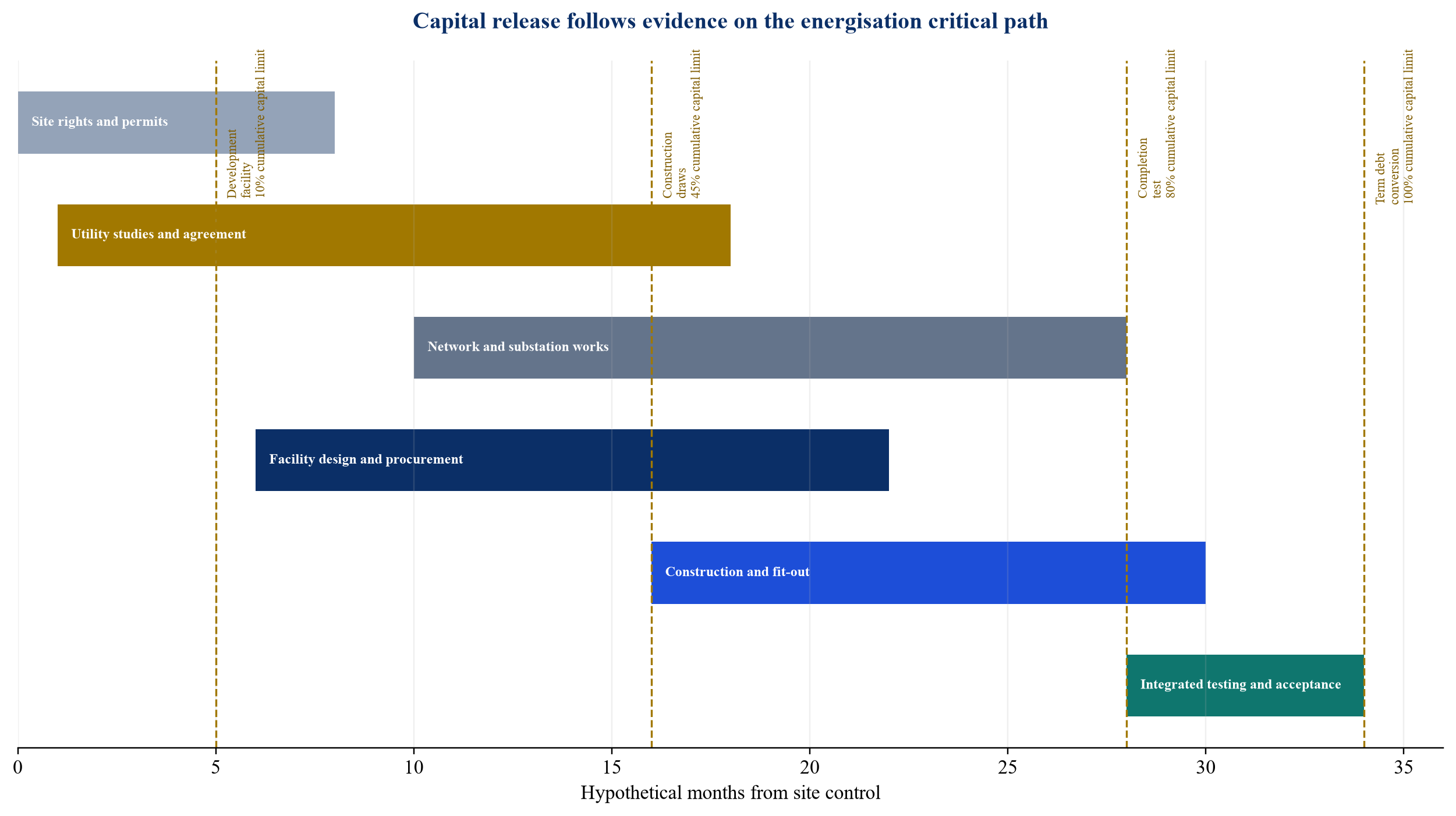
Dates and percentages are hypothetical author-developed assumptions. Actual sequencing depends on jurisdiction, contracts, design, procurement, permitting and construction.
13 Price delay risk explicitly
Connection delay affects more than capitalised interest. The facility may carry unused staff, insurance, security and maintenance. Customer obligations may trigger liquidated damages or termination. Equipment can sit in storage while warranties and economic life advance. Hedging or power contracts can begin before corresponding revenue. Sponsors may need to fund cost overruns and extended reserves.
The financing documents should allocate delay risk to controllable causes. The utility or network company may control connection works. The contractor controls construction within its scope. The customer may control design changes or acceptance. Force majeure and regulatory change need defined relief. Gaps between agreements remain a sponsor risk unless separately insured or reserved.
A delay reserve can cover a limited period. Completion support can fund overruns and debt service until tests are met. The lender should assess the sponsor's capacity and willingness to perform, including competing commitments across a large development pipeline.
14 Protect against technology obsolescence
Technology risk enters the facility through rack density, cooling, power distribution, networking, equipment dimensions, control systems and customer buying criteria. Long-lived infrastructure should accommodate a range of computing generations. Modularity, spare electrical paths, flexible cooling and defined upgrade zones can preserve adaptability.
The lender should distinguish facility obsolescence from server obsolescence. Tenant-owned or separately financed computing equipment can isolate rapid depreciation. The facility still faces redesign risk if next-generation equipment requires different power density or heat rejection. Digital Realty's 2025 filing identifies rapid changes in compute, cooling and power technologies as a source of evolving requirements and potential capital expenditure.
Debt tenor should respect contract duration and adaptation cost. A long lease with customer-funded fit-out can support infrastructure debt when the service obligation and residual building remain viable. A compute-service model carrying the hardware may require shorter tenor, equipment amortisation and more frequent refinancing.
15 Reserve for lifecycle capital
Initial construction expenditure does not capture the full cost of maintaining billable capacity. Batteries degrade. Cooling and electrical components require overhaul. Backup systems need testing and replacement. Controls and cybersecurity require continuing investment. Customer density upgrades can trigger additional distribution and cooling works.
The base case should include recurring maintenance and a lifecycle reserve. The reserve can be funded from operating cash before distributions. Release conditions should reflect independent engineering forecasts and actual equipment condition. A fixed reserve per megawatt can provide simplicity while a component-level plan provides better precision.
Technology upgrades that increase capacity may be treated as growth expenditure. Replacement needed to sustain contracted service should remain ahead of equity distributions. The distinction should be defined before financial close.
16 Control construction through measurable tests
Construction leverage should follow completed value and remaining cost. Draw conditions can require certified work, paid equity, contingency sufficiency, lien releases, insurance and continuing compliance with power and customer milestones. The independent technical adviser should reconcile physical progress, invoices, schedule and cost to complete.
Completion should mean an integrated operating state. Tests can cover utility energisation, generation, protection, electrical systems, cooling, controls, fibre, security, fire systems, backup transition and sustained load. Customer acceptance should align with the technical tests. A facility can be mechanically complete while remaining ineligible for contracted payment.
Phased campuses need phase-specific and shared-infrastructure tests. Shared substations, cooling plants or fibre routes can create cross-phase dependency. Financing documents should allocate cost and access if later phases are delayed or transferred.
17 Design a cash waterfall
The project account structure should receive customer payments and apply them in a defined order. A common sequence is taxes and essential operating cost, purchased energy, senior fees and interest, scheduled principal, reserve replenishment, hedging, permitted lifecycle capital, subordinated obligations and distributions. The sequence depends on law, contracts and the financing structure.
Revenue and energy accounts should address timing. Customer prepayments may be restricted to specified construction uses. Utility deposits may remain locked. Tax refunds and insurance proceeds may have separate treatment. Cash generated by one phase should not support another phase unless the financing permits it and the risk is understood.
Distribution tests can require no default, completed milestones, funded reserves and forward-looking coverage. A trailing coverage ratio alone may release cash immediately before a known customer ramp-down or major replacement event.
18 Use covenants that observe the real risks
Financial covenants can include debt service coverage, interest coverage, leverage, loan-to-cost, minimum liquidity and reserve requirements. Operating covenants can cover available capacity, contracted capacity, customer concentration, connection status, insurance, maintenance and permitted technology changes. Construction covenants can cover budget, schedule, contingency and equity.
Public credit agreements provide reference points for enterprise leverage. Equinix's 2025 credit agreement amendment included a maximum consolidated net leverage ratio of 6.50 times, with temporary acquisition flexibility. CoreWeave disclosed a delayed-draw facility with a minimum debt service coverage ratio of 1.40 times beginning in 2027. These public terms show that covenant selection reflects business model and financing perimeter. They do not set a universal benchmark for data-centre projects.
Covenants should provide early warning. A minimum recognised-capacity test can respond when a customer reduces commitment. A forward coverage test can capture a scheduled ramp-down. A technology-change covenant can require lender review for material redesign without preventing ordinary improvements.
19 Build reserves around identifiable gaps
A debt service reserve covers temporary cash-flow interruption. A delay reserve covers carrying cost before revenue. An operating reserve covers unexpected cost or service credits. A lifecycle reserve supports replacement. A power-cost reserve can address tariff timing or pass-through lag. Each reserve should have a purpose, sizing method, funding source and release condition.
Over-reserving can make a viable project inefficient. Under-reserving shifts predictable volatility to emergency equity. The sizing should follow modelled gaps and contract remedies. Letters of credit or sponsor facilities can supplement cash when their availability and renewal are reliable.
Reserve draws should trigger reporting and replenishment. Persistent use indicates a structural problem and may require cash trapping, remediation or debt resizing.
20 Test counterparty concentration
An anchor customer can enable a large project and improve construction coordination. It also concentrates revenue, technical specification and renewal risk. A guarantee or financial backstop improves payment support while leaving operational and strategic dependence. The lender should review the obligor, guarantor, contract, claims limits and interaction between them.
Diversification can occur across customers, sites, power markets and contract maturities. It should be measured through cash flow rather than logos. Several customers exposed to the same end market or parent can remain correlated. Several sites dependent on one utility constraint can share delay risk.
The downside case should include customer downgrade, delayed commencement, partial termination and replacement. Re-leasing cost and time depend on the facility's design, market demand and ability to meet another customer's technical requirements.
21 Measure operating performance at the financed boundary
Lenders need performance measures that connect engineering to cash. Relevant measures include available critical IT load, energy availability, power-usage effectiveness, cooling performance, service-credit incidence, customer acceptance, contracted occupancy and billable capacity. The delivery point should be consistent across contracts and reporting.
Metering and data governance should be independently reviewable. The project should retain source data, calibration records, incident logs and customer calculations. Disputes over energy, availability or service credits can weaken collections even when the physical asset operates.
Performance should be tracked by phase and customer. Portfolio averages can hide a failing hall that supports a material contract. Financing reports should show the metric that drives payment and covenant compliance.
22 Stress correlated failures
Data-centre risks can occur together. Extreme weather can affect the grid, fuel delivery and cooling. A design problem can delay several phases using the same equipment. A utility restriction can coincide with high market prices. A cyber incident can affect operations and billing. A customer downgrade can arrive during a refinancing window.
The downside analysis should combine plausible dependencies. Independent single-variable sensitivities provide a starting point. A coherent scenario defines the event sequence, operational response, contractual remedies, liquidity draw and recovery period. The board and lenders can then assess whether reserves and sponsor support bridge the event.
Stress severity should match the decision. Construction financing needs a completion and delay scenario. Term debt needs operating and customer scenarios. Acquisition finance also needs entry valuation and refinancing scenarios.
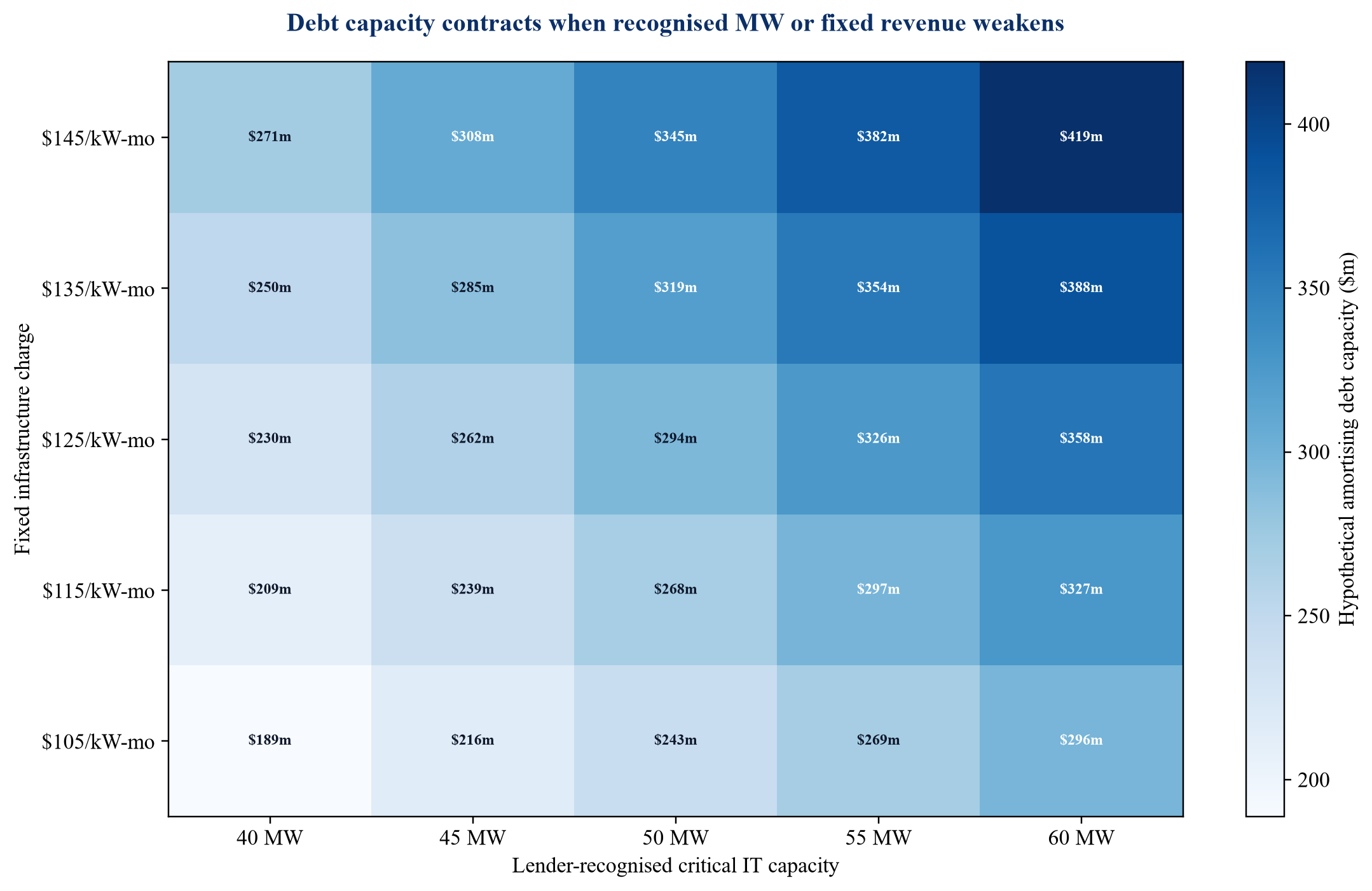
Values are hypothetical author-developed debt capacities in US dollars millions. They use a simplified twelve-year annuity at eight percent with scenario-specific cash flow and coverage assumptions.
23 Integrate power-price and revenue stress
The project may pass energy cost to the customer, absorb it within a fixed charge or use a hybrid formula. Full pass-through depends on measurement, timing and collectability. Demand charges, network fees, imbalance, fuel, carbon and taxes may follow different rules. A cap or lag can create residual exposure.
The stress model should reconcile the customer's bill with the utility or supplier invoice. It should include loss factors, minimum charges, ramp, outages and service credits. Hedging can reduce price volatility while introducing collateral and termination exposure. On-site generation adds fuel and operating risk.
The credit case should avoid double counting. A high fixed infrastructure charge may exclude energy. A lower all-in charge may expose the project to input cost. Comparable pricing should be normalised before it informs valuation or debt sizing.
24 Address refinancing risk
Refinancing depends on remaining contract term, customer credit, asset condition, power rights, operating history and capital markets. Debt maturing before the customer contract can be refinanced more readily when future cash flow remains visible. Debt maturing near a contract expiry relies on renewal or re-leasing assumptions.
The base case should amortise sufficiently to preserve refinance coverage under realistic rates and valuation. Balloon debt can increase initial proceeds while concentrating risk. Cash sweeps can reduce the balance when performance exceeds the base case. Extension options should require continued covenant compliance and adequate contract tail.
Technology refresh can coincide with refinancing. The capital plan should show who funds upgrades and whether they interrupt service. A refinancing model that assumes both full leverage and major unfunded replacement contains an internal gap.
25 Align security and step-in rights
Security can include shares, bank accounts, receivables, contracts, equipment, land rights, insurance and permitted assignments. Power and customer agreements may require consent. Essential software, licences and operational data may be non-transferable. The security review should identify each dependency needed to keep the asset operating after enforcement.
Direct agreements can give lenders notice, cure and step-in rights. Operational step-in requires a capable replacement operator, access to staff and systems, continuity of suppliers and customer cooperation. A paper right without an executable transition plan offers limited protection.
Intercreditor terms matter when facility debt, equipment finance and power-project debt share the campus. Enforcement should preserve safety and service while allocating proceeds and control. Asset removal rights should respect building, cooling and electrical interfaces.
26 Establish an evidence gate
The credit process should use a hierarchy. Executed and transferable rights, completed studies, certified construction, accepted service and collected revenue carry the greatest weight. Supplier quotations, letters of intent, management forecasts and early studies provide useful context with lower recognition.
Every material assumption should link to a document, responsible owner, expiry date and effect on financing. Open items can become conditions precedent, draw conditions, covenants or sponsor obligations. A red flag should change leverage, timing or structure rather than remain a narrative footnote.
The evidence register supports the board, lenders and future refinancing. It also reduces drift between technical reports, contracts, financial models and public communications.
Table 3. Megawatt-to-debt evidence gate
| Gate | Required evidence | Failure signal | Financing response |
|---|---|---|---|
| Site and power control | Title or lease, executed power rights, transfer and security consents | Headline capacity lacks enforceable borrower right | Limit exposure to capped development funding |
| Deliverability | Studies, network scope, deposits, permits, schedule and curtailment terms | Energisation depends on undefined works or approvals | Defer full construction debt; increase contingency |
| Critical IT conversion | Mature design, efficiency assumptions, redundancy and integrated test plan | Gross MW used as billable MW without reconciliation | Apply technical haircut and completion test |
| Revenue | Executed contract, guarantee, ramp, acceptance, termination and service levels | Customer can defer or terminate without adequate payment | Reduce recognised capacity, tenor or leverage |
| Construction | Fixed or bounded scope, procurement, contingency, equity and completion support | Remaining cost exceeds committed liquidity | Require equity, reserve or stronger completion support |
| Operations | Accepted capacity, metering, insurance, maintenance, cyber controls and reporting | Performance data cannot be independently reconciled | Delay term conversion or trap cash |
| Stabilisation | Collected revenue, coverage, reserves, contract tail and forward compliance | Debt relies on uncommitted capacity or refinancing | Resize debt and preserve liquidity |
This author-developed checklist supports transaction planning and does not replace lender, legal, technical, tax, accounting or regulatory requirements.
27 Apply a board decision sequence
The board can begin with the financing perimeter and service. It reconciles all capacity measures, reviews power rights and connection timing, confirms critical IT conversion, evaluates customer contracts and builds the cash-flow bridge. It then sizes debt through coverage, cost and collateral constraints. Downside analysis determines reserves, covenants, completion support and stop conditions.
Approval should record the recognised capacity, excluded pipeline, base and downside debt, conditions precedent, sponsor obligations and authorities. It should also state which events require renewed approval. A material customer change, power delay, design revision or financing repricing can change sustainable leverage.
The process should be repeated at construction conversion, stabilisation and refinancing. Debt capacity evolves as evidence improves or deteriorates.
28 Recognise common failure modes
Common failures include treating announced capacity as deliverable power, treating gross capacity as critical IT load, treating a reservation as take-or-pay revenue, and treating customer credit support as a cure for construction risk. Other failures include ignoring utility deposits and upgrade costs, using annual coverage to overlook monthly liquidity, leaving technology replacement outside the capital plan, and assuming refinancing at the original leverage.
Portfolio reporting can create another failure. Summing megawatts across early and mature sites suggests scale without showing evidence. A maturity ladder and recognised-capacity bridge provide a more useful financing picture.
Documentation can also become inconsistent. The utility agreement, engineering design, customer contract and model may define capacity differently. One controlled assumptions register should govern the transaction.
29 Limitations
This paper presents a general analytical framework. It does not establish the technical feasibility, financeability, legal status, credit quality, valuation or expected return of a particular data-centre, energy platform, customer contract or financing. Outcomes depend on site, jurisdiction, grid and market rules, counterparties, technology, design, construction, contracts, taxes, accounting, insolvency law, insurance and capital markets.
The figures and tables use hypothetical author-developed assumptions. They do not represent observed project data, a financing offer, a tariff, a credit rating or investment advice. Public-company disclosures describe their own transactions and reporting and should be read with the full filing. Project-specific legal, regulatory, technical, environmental, insurance, accounting, tax and investment advice is required.
Conclusion
Power scarcity can create substantial value in data-centre development. Debt capacity depends on the portion of that value converted into enforceable, deliverable and contracted cash flow. The conversion begins with precise definitions. Announced capacity, controlled power, deliverable gross power, critical IT load, contracted capacity and billable capacity are separate measures.
The Megawatt-to-Debt Capacity Framework applies evidence and haircuts at each stage. It links recognised megawatts to fixed revenue, operating cost, reserves, coverage and amortisation. It changes leverage as the project moves from development through construction to stabilisation. It also tests delay, counterparty concentration, power cost, technology change and refinancing.
The strongest financing case combines credible power rights, integrated completion, durable customer obligations, adaptable infrastructure, transparent operating data and sufficient liquidity. These elements give lenders a measurable basis for leverage and give sponsors a disciplined route for converting scarce megawatts into sustainable capital.
References
- International Energy Agency, Energy and AI: Executive Summary, 2025. https://www.iea.org/reports/energy-and-ai/executive-summary
- International Energy Agency, Energy and AI: Energy demand from AI, 2025. https://www.iea.org/reports/energy-and-ai/energy-demand-from-ai
- International Energy Agency, Energy and AI: Energy supply for AI, 2025. https://www.iea.org/reports/energy-and-ai/energy-supply-for-ai
- International Energy Agency, Energy and AI data product, 2025. https://www.iea.org/data-and-statistics/data-product/energy-and-ai
- International Energy Agency, Data centre electricity use surged in 2025, 2026. https://www.iea.org/news/data-centre-electricity-use-surged-in-2025-even-with-tightening-bottlenecks-driving-a-scramble-for-solutions
- US Department of Energy, DOE Releases New Report Evaluating Increase in Electricity Demand from Data Centers, 2024. https://www.energy.gov/articles/doe-releases-new-report-evaluating-increase-electricity-demand-data-centers
- Lawrence Berkeley National Laboratory, 2024 United States Data Center Energy Usage Report, 2024. https://eta-publications.lbl.gov/publications/2024-lbnl-data-center-energy-usage-report
- US Department of Energy, United States Data Center Energy Usage Report 2025 Update, 2026. https://www.energy.gov/documents/united-states-data-center-energy-usage-report-2025-update
- Federal Energy Regulatory Commission, Interconnection of Large Loads to the Interstate Transmission System, Docket RM26-4-000. https://www.ferc.gov/rm26-4
- Federal Energy Regulatory Commission, FERC Directs PJM to Create Rules for Co-Located Large Loads, 2025. https://www.ferc.gov/news-events/news/fact-sheet-ferc-directs-nations-largest-grid-operator-create-new-rules-embrace
- PJM Interconnection, Critical Issue Fast Path: Large Load Additions. https://www.pjm.com/committees-and-groups/cifp-lla
- PJM Interconnection, Data Center Planning. https://www.pjm.com/planning/service-requests/data-center-planning
- North American Electric Reliability Corporation, Characteristics and Risks of Emerging Large Loads, 2025. https://www.nerc.com/globalassets/who-we-are/standing-committees/rstc/whitepaper-characteristics-and-risks-of-emerging-large-loads.pdf
- Digital Realty Trust, Annual Report on Form 10-K for the year ended 31 December 2025. https://www.sec.gov/Archives/edgar/data/1297996/000110465926015365/dlr-20251231x10k.htm
- Equinix, Annual Report on Form 10-K for the year ended 31 December 2025. https://www.sec.gov/Archives/edgar/data/1101239/000110123926000032/eqix-20251231.htm
- Equinix, First Amendment and Joinder to Credit Agreement, 4 April 2025. https://www.sec.gov/Archives/edgar/data/1101239/000162828025021086/eqix-033125xexhibit103.htm
- CoreWeave, Annual Report on Form 10-K for the year ended 31 December 2025. https://www.sec.gov/Archives/edgar/data/1769628/000176962826000104/crwv-20251231.htm
- CoreWeave, Delayed Draw Term Loan Facility disclosure, 28 July 2025. https://www.sec.gov/Archives/edgar/data/1769628/000176962825000033/crwv-20250728.htm
- CoreWeave, Quarterly Report for the period ended 30 June 2025. https://www.sec.gov/Archives/edgar/data/1769628/000176962825000041/crwv-20250630.htm
- Hut 8, River Bend 245 MW AI Data Center Lease announcement, 17 December 2025. https://www.sec.gov/Archives/edgar/data/1964789/000110465925122052/hut-20251217xex99d1.htm
- Cipher Mining, 168 MW AI Hosting Agreement announcement, 25 September 2025. https://www.sec.gov/Archives/edgar/data/1819989/000095010325012168/dp234624_ex9901.htm
- Core Scientific, Quarterly Report for the period ended 30 June 2026. https://www.sec.gov/Archives/edgar/data/1839341/000183934126000014/core-20260630.htm
- Core Scientific, Project financing and contracted-capacity disclosure, 2026. https://www.sec.gov/Archives/edgar/data/1839341/000119312526165121/d149019dex992.htm
- Galaxy Digital, Helios Data Center Financing investor presentation, 2026. https://www.sec.gov/Archives/edgar/data/1859392/000185939226000068/launch8-kexhibit99172226.htm
- Solaris Energy Infrastructure, Power Generation Capacity Offering Disclosure, 2026. https://www.sec.gov/Archives/edgar/data/1697500/000119312526397255/d182097dex991.htm
- Liberty Energy, Annual Report for 2025, distributed power disclosures. https://www.sec.gov/Archives/edgar/data/1694028/000199937126005126/lbrt-ars_123125.pdf
- European Commission, Energy efficiency in data centres. https://energy.ec.europa.eu/topics/energy-efficiency/energy-efficient-products/energy-efficiency-data-centres_en
- European Commission, Commission Delegated Regulation EU 2024/1364 on data-centre reporting. https://eur-lex.europa.eu/eli/reg_del/2024/1364/oj
- World Bank Group, Infrastructure Finance. https://ppp.worldbank.org/infrastructure-finance
- World Bank Group, Project Finance: Key Concepts. https://ppp.worldbank.org/financing/project-finance-concepts
- World Bank Group, Finance Structures for PPP. https://ppp.worldbank.org/finance-structures-ppp
- World Bank Group, Risk Allocation in Public-Private Partnerships. https://ppp.worldbank.org/allocating-risks
- International Finance Corporation, Performance Standards on Environmental and Social Sustainability, 2012. https://www.ifc.org/en/insights-reports/2012/ifc-performance-standards
- National Institute of Standards and Technology, Guide to Operational Technology Security, SP 800-82 Revision 3, 2023. https://doi.org/10.6028/NIST.SP.800-82r3
- National Institute of Standards and Technology, Cybersecurity Framework 2.0, 2024. https://doi.org/10.6028/NIST.CSWP.29
- Uptime Institute, Tier Standard: Topology. https://uptimeinstitute.com/tiers
- ASHRAE, Data Center Resources. https://www.ashrae.org/technical-resources/bookstore/datacom-series
- International Organization for Standardization, ISO 50001 Energy management systems. https://www.iso.org/iso-50001-energy-management.html
- International Organization for Standardization, ISO 55001 Asset management systems. https://www.iso.org/standard/83054.html
- Organisation for Economic Co-operation and Development, Due Diligence Guidance for Responsible Business Conduct, 2018. https://mneguidelines.oecd.org/due-diligence-guidance-for-responsible-business-conduct.htm
About the Author
Chennakeshav (CK) is a corporate finance and investment banking executive with 25+ years of global experience in deal origination, structuring and execution across M&A, growth capital and corporate strategy. He has led value-creation mandates for founders, corporates and funds — bridging the boardroom view to hands-on execution and close.
His career spans Morgan Stanley, HSBC, Lloyds Banking Group, EWEC, ADQ portfolio companies and Emirates Growth Fund, across TMT, real estate, fintech, deeptech, cleantech, infrastructure and energy. He has partnered with C-suite leaders, private equity and venture funds, sovereign wealth funds and family offices to finance complex fund raises and scale-up ventures, and has led M&A due diligence, post-merger integration and business-transformation initiatives to create value.
At Matchpoint Partners he is Managing Partner, leading the firm's corporate finance, M&A and capital-raising practice. He holds an MBA from London Business School, an engineering degree from VTU and a Master of Laws (LLM, in progress) from UCL London.
An active start-up mentor, CK mentors at Techstars, DIFC FinTech Hive, Startup Grind, Founder Institute and IN5, serves as Entrepreneur Mentor in Residence (EMiR) at London Business School, and judges the Entrepreneurship World Cup.
