

1 Decision ownership after completion
After completion, two organisations that were separate begin to disagree in small, specific ways. A pricing rule differs between them, a customer sits in both ledgers, two suppliers hold competing terms, a hire needs two approvals. Each disagreement has a cost for every day it stays open, and each can be closed wrongly. The decision this paper addresses is how decision rights should be allocated between acquirer and target for such cross-company conflicts, and which feature of the allocation, the identity of the owner or the clock that forces a decision, does the work.
The paper builds its framework from primary and peer-reviewed sources on decision speed, authority, conflict and director duties, then runs a constructed experiment. Five structures face the same 160,743 conflicts across 3,000 constructed deals. Conflicts arrive during the first 180 days and are followed to eventual modelled resolution, including work after that window. The structures are acquirer line authority, two co-owners, a unanimity committee, an executive sponsor and a tiered decision-rights matrix. The outcomes include resolution days, error, reopening, sponsor workload and cost per conflict.
The result is specific to these premises. Acquirer authority is fastest at a mean of 6.4 days, with an overall wrong-decision share of 25.2%. Time-boxed co-owners cost 142.8 thousand dollars per conflict. The committee averages 21.6 days and leaves 24.1% unresolved thirty days after raising. The matrix costs about two per cent more than co-owners. The study-size exercise recovers the ordering of that small gap inconsistently under its fixed-population resampling design. These are constructed results; observed integration outcomes and a field study's required size remain separate empirical questions.
2 Resolution time and the unit of analysis
A comparison needs a consistently defined clock. The simulation reports final modelled resolution time T: time from raising a conflict to first commitment T0, plus the full assigned delay of a modelled reopening. A reopening adds delay even when the initial error indicator is zero. The proposed field log retains first commitment, each reopening and subsequent commitment separately, with the reported endpoint fixed before analysis. Eisenhardt's observed decision-speed measure ran from a first deliberate action to commitment. [1] That provides a distinct first-commitment concept; the reopening extension is this paper's authored choice.
The paper reports resolution days, the share whose resolution duration exceeds thirty days, the wrong-decision indicator and the reopening indicator. The thirty-day share is calculated over every conflict in the arrival cohort, including those whose resolution occurs after calendar day 180. Sponsor escalation is a separate share. Sponsor load divides all service days eventually generated by the cohort by the 180-day arrival window. This offered-workload ratio differs from occupied sponsor time measured strictly inside that window. A field log should retain actual service timestamps so that both measures can be calculated and labelled.
Cost combines delay, error and reopening. Each day to final modelled resolution incurs an authored delay rate. A wrong decision incurs an authored loss; a reopening adds a quarter of that loss in rework. These weights determine the cost ranking and can be replaced in the reproducible calculation. A legal consent or a narrow veto is part of the proposed authority record. The engine's ordinary unanimity rule supplies no separate legal-veto mechanism, and its numerical results cannot determine whether a reserved approval may be bypassed.
3 Evidence on strategic decision speed
Eisenhardt's inductive study of eight microcomputer firms provides observed evidence on conflict resolution and strategic decision speed. Four firms took less than four months over the strategic decisions studied and four took at least six months, typically more than twelve; the slow firms averaged 14 months against 2.8 months for the fast ones. [1] The study shows that speed varied by a factor of five across firms facing the same industry. It does not show that any one structure caused the difference, and its eight firms were independent companies, not a combined group.
The mechanism the study reports is close to the question here. Every fast team used what one executive called consensus with qualification: the team tried to reach consensus by involving everyone and, if agreement was not forthcoming, the chief executive and often the relevant vice president made the choice, guided by input from the whole team. [1] Slow firms relied on consensus without a fall-back, and one executive described how that gave everybody veto power. An autocratic chief executive at one slow firm decided alone and still took a year, because centralised authority did not remove the information and psychological barriers to deciding. [1]
The source therefore supports two design statements. A fall-back owner when agreement fails is associated with speed, and authority without information is not sufficient for it. It supplies no estimate of days saved, it concerns a fast-moving industry in the 1980s, and its decisions were strategic choices of single companies. The model in this paper turns the two statements into inputs, a time box and an information mismatch, and asks how much each is worth when the setting is a combination of two companies. The source supplies the direction of both. It supplies no size for either.
4 Integration decisions and target autonomy
Graebner, Heimeriks, Huy and Vaara's 2017 review organises the post-merger integration literature. It reports limited knowledge of how integration decisions are made, few real-time observations and a tendency to assume that the acquirer decides, while noting roles for acquired managers and consultants. [2] The accepted manuscript was read for autonomy and decision-making. Its review period and selected scope bound the claim: this paper does not treat a historical research gap as proof that later work has left the question unanswered.
The review also records how the field measures authority. Zaheer, Castañer and Souder define target autonomy as the extent to which the acquirer delegates or defers to the expertise of target managers over decision-making within target functions, and they treat it as distinct from structural integration; the review reports a correlation of -0.19 between their measures, not statistically significant. [2] Reported relationships between autonomy and performance are mixed across studies. [2] These are measures of how much authority the target keeps. They are not measures of how long a given conflict takes to close or how often it is closed wrongly.
The review further reports survey and case evidence that acquirers favour their own resources and practices when making integration decisions, and cites an argument that initial integration decisions are suboptimal because of information asymmetries and bounded rationality. [2] That supports the information-mismatch input used later, in which decisive information sits with the target in a stated share of conflicts. It does not supply the share. These cited passages motivate examining individual decisions. They provide no calibration for the experiment's days, error rates or ranking of structures.
5 Formal authority and access to information
Aghion and Tirole distinguish formal authority, the right to decide, from real authority, the effective control over decisions. In their account real authority depends on how information is distributed, and an increase in an agent's real authority promotes initiative but costs the principal control. The abstract lists overload, urgency of decision and multiplicity of superiors among the factors that increase a subordinate's real authority in a formally integrated structure. [3] The published text was read in a repository copy for its abstract and introduction; the paper uses these statements as a framing and cites nothing else from the article.
Alonso, Dessein and Matouschek study a multi-divisional organisation in which decisions must be adapted to local conditions and coordinated across divisions, with the allocation of decision rights as the only formal mechanism. The accepted manuscript shows that a greater need for coordination improves communication between divisions and worsens communication between divisions and headquarters, so that decentralisation can dominate even when coordination is very important. [4] Their Proposition 5 gives conditions: when divisional managers are only weakly biased toward their own division, decentralisation dominates for any weight on coordination; when bias and the need for coordination are both large, centralisation dominates. [4]
The theories motivate varying the information and coordination assumptions across the constructed conflict classes. Translating those mechanisms into acquisition-specific consultation days, time boxes, error rates and four classes is this paper's modelling choice. The passages cited here provide no calibration for those parameters. The experiment can test consequences under the stated choices; field applicability requires separate evidence. [3, 4]
6 Consensus and the handling of disagreement
Eisenhardt, Kahwajy and Bourgeois report a field study of top management teams and the managerial levers that help executives engage in conflict: a heterogeneous team, frequent interaction, a distinct set of roles, and multiple-lens tactics. The abstract states that substantive conflict is natural in high-stakes choices and that many teams fail to debate sufficiently. [5] Only the abstract was read. The source implies that suppressing disagreement is not a goal, and the design question is therefore when and by whom a disagreement is closed after it has been aired.
Thomas and Louisgrand's abstract concerns involvement in integration decisions and employees' perceptions of the speed of change. [6] The full text was not available for this paper. The abstract supports a limited connection between involvement and perceived speed. It supplies no conflict-level closure durations or parameter calibration. The experiment treats consultation time as an authored component, and any relationship between that component and actual integration performance remains to be tested.
The sources motivate the paper's proposed modelling interpretation: consultation can supply relevant information and consume time, while an ordinary joint-agreement rule can add discussion rounds. A unilateral route may leave information unused when the owner lacks access to it. The experiment turns these possibilities into stated consultation times and error probabilities. Its matrix and co-owner comparisons then follow those authored mechanisms. A transaction evaluation would need to establish whether the information and delay assumptions fit the decisions observed.
7 Company law and transaction-specific authority
An integration authority record operates within the duties applicable to the relevant company. Section 172(1) of the UK Companies Act 2006 requires a director to act in the way the director considers, in good faith, most likely to promote the company's success for its members as a whole, having regard to the listed matters, including long-term consequences, employees and business relationships. Section 172(3) preserves rules requiring directors, in certain circumstances, to consider or act in creditors' interests. The company's identity and the applicable duties should be confirmed before authority is assigned. [7]
Section 175 addresses situations involving a director's direct or indirect interest that conflicts, or may conflict, with the company's interests. Its scope has limits: subsection (3) excludes conflicts arising in relation to a transaction or arrangement with the company, and subsection (4)(a) addresses situations that cannot reasonably be regarded as likely to create a conflict. For board authorisation under subsections (5) and (6), a private company's constitution must not invalidate the route; a public company's constitution must enable it. The quorum must exclude every interested director, and the approval must be effective without their votes. A dual role should therefore receive a fact-specific assessment of the applicable duty and approval route. [8]
The UK Supreme Court's 14 July 2026 judgment in Saxon Woods Investments Ltd v Costa adds a useful boundary to delegated decision-making. It held that section 172's good-faith requirement concerns conduct in pursuing the company's success; it also preserved respect for a genuinely held business judgment. The director's covert subversion of the board's agreed strategy breached that duty on the facts. The proposed authority record should identify the entity's decision-making organs, the purpose and limits of a delegation, and the route for recording disagreement. Counsel must assess the application to the transaction. [22]
Selected UAE federal provisions give a separate, legal-form-specific illustration. Federal Decree-Law No. 32 of 2021, read with the 2025 amendment, requires an applicability check: Article 4 contains exemptions, and amended Articles 3 and 5 distinguish free-zone companies' specially regulated matters from branches or representative offices carrying on permitted activity outside the zone within the State. For an in-scope limited liability company, Article 83 addresses appointment of managers and the management powers specified in the appointment or constitutional documents; Article 22 places the managing director's acts within the company's objects and authorised powers. These selected provisions do not establish a rule for all GCC companies. [19, 20]
For an in-scope public joint stock company, Article 150 requires disclosure in the board minutes of a member's interest in a transaction presented for approval and excludes that member's vote. Articles 154 and 155 distinguish board powers from matters reserved to the general assembly and prohibit an absolute delegation of all board powers to the chairman. The proposed integration record should therefore identify the legal form, appointment instrument, reserved approver, delegation limits and conflict record before applying an internal time box. Sector rules, constitutional documents and any applicable free-zone law require separate transaction-specific review. This is a proposed control grounded in the selected provisions; it supplies no observed integration outcome. [19, 20]
Public transaction records illustrate obligations imposed outside the combined management team. The OCC's 18 April 2025 conditional approval concerned Discover Bank's merger into Capital One, National Association. It required that bank to submit a plan within 120 days after consummation for supervisory non-objection, covering corrective action, timelines and remediation of harm associated with outstanding Discover Bank enforcement actions. The Federal Reserve's separate holding-company approval announcement records Capital One Financial Corporation's commitment to comply with the Board's action against Discover, including remediation requirements. These United States records establish conditions at approval; they supply no evidence here about subsequent compliance, conflict-resolution speed or realised integration benefits. [16, 17]
The UK government's 16 December 2024 Royal Mail announcement describes a different reserved approval. Its summary of the undertakings states that HMG permission is required before moving Royal Mail's headquarters, central operations or tax residency out of the UK, with the qualifications and limited exceptions described in the announcement. It also describes conditional restrictions on value extraction, including financial and service-quality tests and limited exceptions. This is the government's announcement and summary; the full executed instruments and later compliance have not been assessed here. The proposed authority record should identify the actual consent-holder and governing instrument. The example supplies an authority constraint and no calibration for the experiment. [18]
The proposed operating implication is to record the authority behind a decision as well as the person managing its timetable. The record should identify the affected legal entity, the operative approval or delegation, any external consent and the evidence needed to release a condition. An expired internal deadline should trigger the authorised escalation route. A required third-party consent remains outstanding until the applicable process records it. The model's negotiation and committee rules concern ordinary disagreements inside their assumed authority boundary. Applying those rules to a legally reserved decision would require a separate legal assessment.
8 The decision-rights record
For firms within SYSC 25's specified scope, the FCA requires a comprehensive, current management responsibilities map and a clear account of shared responsibilities. Guidance in SYSC 25.4.4G addresses gaps, and SYSC 25.4.10G addresses a designated senior management function or FCA-prescribed responsibility shared by more than one person. The chapter covers specified banking, insurance and enhanced-scope SMCR firms, subject to its exclusions and branch provisions; the paper uses it by analogy. [9] PS26/6 gave firms up to six months to notify relevant changes to statements of responsibilities and maps. [15] The FCA then published CP26/37 on 22 October 2026, proposing changes including removal of routine map-update submissions while retaining internal updating and provision on request. Consultation closes on 22 January 2027, with final regulatory requirements expected in the first half of 2027. Those proposals are distinct from the rules displayed as current on 6 November 2026. [21]
The second document is Bain & Company's description of RAPID, assigning recommend, agree, perform, input and decide roles and stating that ideally each decision has one decider. [10] It supplies practitioner vocabulary for the proposed record. The agree role concerns a recommendation's feasibility. The experiment separately represents ordinary joint agreement; it has no distinct legal or narrow-veto parameter. No outcome estimate in this paper is calibrated from the RAPID page.
Table 1 combines responsibility mapping and decision-role vocabulary into a proposed record. It asks for a named owner or explained co-owners, required information, any reserved consent and its grounds, a time box, a permitted escalation owner, dissent and reopening conditions. Several fields correspond to model inputs, including consultation, meeting intervals and escalation. Entity authority and legal consent remain outside the engine. A transaction team must establish those boundaries before testing the ordinary operating rules.
| Field | What it fixes | Parameter in the experiment |
|---|---|---|
| Decision owner | One accountable person, or named co-owners with the reason | Which structure applies |
| Required inputs | Who must be consulted, especially the side holding the decisive information | Information mismatch and consultation days |
| Narrow veto | Grounds on which another party may block, such as legal or regulatory limits | Outside the engine; confirm the approval and legal process |
| Time box | Number of rounds or days before the owner changes | Rounds before escalation |
| Escalation owner | Who decides when the time box ends, and their available time | Sponsor service time |
| Dissent record | Position of each party and reason for the decision taken | Brief that lowers sponsor error |
| Reopening rule | Evidence needed to reopen a decision and who may do so | Reopening probability and rework |
| Entity check | Whether the decision belongs to the target board and who authorised any conflict | Outside the model; legal review |
MatchPoint analysis combining the cited guidance on responsibility maps and the role vocabulary of a decision tool. Proposed record; the entries describe information to obtain and are not findings about any transaction. [7, 8, 9, 10]
The proposed record has a version and an effective date. Before completion, the company secretary or equivalent governance owner should reconcile it with the relevant entity's constitutional documents, board resolutions, signing authorities and transaction conditions. This is a proposed review process, and the documents required depend on the entity and decision. A label such as commercial director does not establish a universal authority limit. The record should state who checked the delegation, which evidence was inspected and which proposed decisions still await confirmation. An unresolved authority question remains visible when the workstream timetable is approved.
Consultation and consent should occupy separate fields. Consultation identifies information that the decision-maker should obtain, including a target manager's knowledge of a customer, system or supplier. Consent identifies an approval that the applicable record requires before action. The owner can document a consultation that has not produced agreement and use a permitted escalation. A required consent follows the process specified by its governing document. This proposed distinction allows a board to see whether delay arises from missing information, commercial disagreement or an outstanding approval, each of which calls for a different intervention.
For a routine decision already confirmed as delegable, the proposed workstream record names one accountable owner, the person responsible for the analysis, the parties consulted and those informed after commitment. A pricing issue might assign analysis to the pricing lead and accountability to the authorised commercial director, with finance and the target customer owner consulted. A proposed bank-signatory change needs the authority confirmed for that account and entity. These are planning examples, with no claim that they describe a particular transaction. If the decision belongs to a board or another approval-holder, the record should name that holder and describe the workstream's supporting role.
A handover test can use a small set of completed decision files from the transaction team, with permission and appropriate redaction. The proposed test asks different workstream members to identify the owner, consultation requirement, escalation route and evidence needed for commitment. Disagreements are logged and the record clarified before the next live item. This procedure tests whether people can interpret the same authority record consistently. It does not establish that the revised arrangement saves time or money. Its immediate output is a list of ambiguous decisions, the agreed classification and the owner responsible for keeping that classification current.
9 Source evidence and the modelling boundary
Table 2 distinguishes the selected sources from the authored comparison. The cited studies discuss authority, information, conflict and decision speed in their own settings. Statutory and regulatory sources define selected duties and responsibility-record requirements within their scope. The public transaction records illustrate external approval conditions. No source in this reviewed set supplies a calibrated ranking of these five structures on conflict-resolution days, error rates or sponsor load. The experiment therefore reports its own stated mechanisms and numerical premises.
The reviewed corpus is selective. It comprises the named strategic-decision studies, integration review, involvement abstract, authority theory, methodological references and selected current legal and regulatory records. It does not constitute a systematic review of every subsequent integration study, unpublished work or proprietary transaction archive. The paper makes no first-in-the-literature claim. Its contribution is the specified authority record, event clocks and reproducible comparison, together with a protocol through which transaction evidence could evaluate those proposals.
The proposed evidence programme begins with a prospective conflict log. The log connects the authority applicable to an issue with analysis, consultation, commitment, reopening and final resolution events. It records shared sponsor capacity and unresolved follow-up. No private integration-office archive has been supplied for this study. The availability, legal basis and completeness of such records would need agreement with participating companies before an empirical comparison. This requirement determines feasibility and the population to which any eventual result could apply.
| Source group | Establishes | Does not establish |
|---|---|---|
| Study of decision speed in eight firms [1] | Fast firms used a fall-back decider; some slow firms waited for consensus, while one was autocratic | Days saved by structure; acquisitions; causal effect size |
| Integration review [2] | Decision processes are little studied; autonomy and integration are distinct; acquirers favour own practices | Resolution time or error rate for any allocation |
| Authority and communication theory [3, 4] | Real authority follows information; decentralisation can dominate even when coordination matters | Days; acquisitions; parameter values |
| Conflict and involvement studies [5, 6] | Conflict is normal; involvement relates to perceived speed | Closing time of a conflict |
| Companies Act 2006 sections 172 and 175 [7, 8] | Selected company-specific duties; defined conflict rules and constitution-dependent authorisation conditions | Other jurisdictions; particular transaction applicability |
| Responsibility-map guidance and decision tool [9, 10] | Scoped responsibility-map requirements; explained sharing; practitioner decision-role vocabulary | That either is faster; any data |
| Selected UAE federal companies provisions [19, 20] | Legal-form-specific powers, approvals and delegation limits | All GCC or free-zone regimes; transaction clearance |
| Public UK/US approval records [16, 17, 18, 22] | Stated approval constraints and a fact-specific director-duty holding | Realised integration speed, compliance or financial benefit |
MatchPoint analysis of the cited documents. Abstract-only sources are identified in the text and in the source record.
10 The constructed population and its inputs
The experiment comprises 3,000 constructed acquisitions. Conflicts arrive during 180 days after completion and remain followed to eventual resolution, without administrative censoring at day 180. The arrival rate is 0.30 per day for complexity one; the constructed average is about 54 conflicts per deal. Complexity varies across deals and affects arrivals, analysis and friction. Four classes differ in affected parties, analysis, daily delay rates and losses from error. Table 3 reports their authored inputs. None of these values is an observation of an integration.
Decisive information sits on the target side in 55% of conflicts. The last column of Table 3 gives a per-round disagreement propensity, scaled by deal friction and capped at 0.9. Kappa, 0.65, scales that propensity in the agreement probability. Conditional on those inputs, each discussion round receives an independent success draw with constant probability. This is a memoryless sequence of trials. It does not represent a single initial disagreement gradually surviving successive rounds. Culture and individual personality are outside the engine; structures differ through their authored operating rules.
All five structures receive the same conflict population, analysis times and random-draw arrays. This paired design controls differences in inputs and reduces Monte Carlo noise; finite-draw uncertainty remains. Every regime is applied to the whole deal, producing a separate sponsor queue. The independent reconstruction reproduces those five regimes from the saved inputs. A mixed allocation would generate its own queue and would need to be recomputed. Selecting among the frozen results therefore supplies a comparison reference with a defined limitation.
| Conflict class | Share | Parties | Analysis days | Delay cost, USD k/day | Wrong-decision loss, USD k | Per-round disagreement propensity |
|---|---|---|---|---|---|---|
| Local | 45% | 2 | 2.0 | 2.0 | 40 | 20% |
| Cross-functional | 30% | 3 | 4.0 | 6.0 | 150 | 35% |
| Cross-company policy | 18% | 3 | 6.0 | 15.0 | 400 | 50% |
| Strategic | 7% | 4 | 10.0 | 50.0 | 1,500 | 55% |
Authored inputs. Analysis days are means of a gamma distribution; delay cost is a median with lognormal spread; wrong-decision loss is the central value with lognormal spread. USD thousand. Not observed data.
11 Five allocations of decision rights
Acquirer authority assigns the decision to an acquirer functional head, with a short exponential wait and no target consultation. Internal functional disagreement can send the item to the sponsor. Without escalation, authored error probabilities are 8 per cent for acquirer-held information and 40 per cent for target-held information. Escalated items instead use 10 and 30 per cent, respectively. Target-information items reopen with probability 20 per cent; other items use 3 per cent. These are specified information and authority assumptions, informed in direction by the cited literature. [1, 2]
Two co-owners, one per company, receive independent negotiation rounds with exponentially distributed duration averaging three days. Agreement is redrawn at each round; after three failures the sponsor receives a brief. Error is 8 per cent without escalation and 12 per cent with it. The unanimity committee meets every 14 days, needs papers three days beforehand and escalates after three failed meetings. Its ordinary agreement probability compounds across affected parties. The central-sponsor structure sends every item to one FIFO queue with mean service of 1.5 days. These service and calendar assumptions are authored.
The matrix routes a contained issue to an owner who consults, intermediate issues to a weekly forum and a strategic issue to a briefed sponsor. Its nominal routing-attempt parameter is 10 per cent. Equal 5 per cent directional draws attempt a move down or up one tier; an attempt beyond a boundary retains the tier. The authored class shares imply 7.4 per cent actual changes in expectation and 7.56 per cent in the base realisation. Overall under- and over-routing shares consequently differ. Table 4 specifies the ordinary rules and error exceptions.
| Structure | Who decides | When it moves up | Information and error |
|---|---|---|---|
| Acquirer line authority | Acquirer functional head | If acquirer functions disagree (0 to 15% by class) | Without escalation: error 8%/40% by information side; with escalation: 10%/30%; reopening 3%/20% |
| Bilateral co-owners | Two co-owners, one per company | After 3 failed rounds; each duration exponential, mean 3 days | Error 8%; 12% if escalated with a brief; reopening 4% |
| Joint committee (unanimity) | All affected parties together | After 3 meetings, 14 days apart | Error 8%; 12% if escalated; reopening 3% |
| Everything to the sponsor | Executive sponsor | Not applicable: all conflicts start there | Error 10% plus 20% if information is on the target side; reopening 8% |
| Tiered decision-rights matrix | Named owner, weekly forum chair or sponsor by class | Forum defers up to 3 meetings, then sponsor | Ordinary error 8%; strategic or over-routed 7%; intermediate escalation 12%; under-routed 38%; reopening 4% or 45% |
Authored routing rules. Percentages are model inputs, not market observations. Round and meeting counts are the time boxes tested in the sensitivity section.
12 Meeting calendars and agreement
Equation 1a decomposes final modelled resolution time. A_i is common analysis time. W_is covers pre-sponsor consultation, negotiation and calendar waiting. Z_is indicates escalation; q_is is sponsor queue waiting and S_is sponsor service. The term Z_is(q_is+S_is) includes both components when escalation occurs. R_is is the full assigned reopening delay. First commitment T0 contains the same terms before R_is. Equation 1b gives the first committee meeting reachable from the conflict's calendar arrival and completed analysis, subject to the paper cutoff.
In Equation 1b, m_0i is the calendar day of the first meeting that conflict i can reach, phi is the day of the first meeting in the series, c is the interval between meetings, here 14 days for the committee and 7 for the matrix forum, and l is the paper cut-off, three days for the committee and one for the forum. The expression rounds up to the next meeting on the grid. If positions agree at the first meeting, the committee wait equals l plus a uniform wait of half the interval on average. The model confirms this identity numerically: simulated mean wait is 10.0 days against 10.0 days. With the cut-off unchanged, shortening the cycle from fourteen to seven days reduces this first-meeting calendar wait by 3.5 days on average. A weekly cycle contributes 3.5 days of mean residual calendar waiting before any additional failed meetings.
After the first reachable meeting, conditionally independent trials determine whether ordinary agreement is reached. Equation 2a defines the per-trial probability. Equation 2b gives the expected number of attempted rounds, capped at J_max, and the probability of escalation after every permitted trial fails. The assumptions keep the probability fixed across trials within a conflict. They provide a tractable mechanism for comparing meeting cadence and a time box; persistence or learning across actual discussions would require a different model.
Delta_i is the authored per-round disagreement propensity after the friction adjustment; kappa scales it, n_i counts parties whose agreement is required and J_max caps attempted rounds. For n_i equal to four, agreement compounds across three pairwise conditions at each independent trial. The bilateral structure uses n_i equal to two. Under strategic-class inputs at average friction, per-meeting agreement is about 27 per cent. Earlier escalation changes how often the committee waits for another calendar meeting. A legally reserved consent requires its own process regardless of this ordinary-agreement calculation.
13 Sponsor queues and the cost of decisions
Escalated conflicts in a deal join one first-in first-out queue served by the executive sponsor. Equation 3a is the recursion for the waiting time of successive items: the wait of the next item is the wait of the current item plus its service time less the gap between arrivals, never below zero. Equation 3b is the standard result for a single server with exponential service and Poisson arrivals, which the simulation reproduces: with an arrival rate of 0.6 and a service rate of 1.0 the simulated mean wait is 1.49 days against 1.50 from the formula. [11]
In Equation 3a, q_k is waiting before service, S_k is service and Delta is the gap between successive queue arrivals. Equation 3b is the stationary homogeneous M/M/1 expectation with Poisson arrivals, exponential service and rho below one. [11] Deal heterogeneity and the finite arrival cohort differ from those conditions. At the base nominal load 45%, the stationary reference gives 1.2 queue days; adding one preparation day and 1.5 service days gives about 3.7. The simulated pre-commitment wait is 4.5 days. That difference reflects a finite, heterogeneous constructed process. The overload sweep later remains a finite-cohort calculation, outside the stationary formula where rho reaches or exceeds one.
Equation 4a combines final resolution delay, wrong-decision loss and reopening rework. Equation 4b states the acquirer error draw conditional on escalation Z_i and target-held information tau_i. The escalation branch has its own information-sensitive probabilities. Error and reopening use separate authored draws; a reopened decision can therefore carry rework even when its original error indicator is zero. The cost function prices those two indicators separately.
C_is is USD thousand per conflict, v_i is USD thousand per day, T_is is resolution days and L_i is USD thousand lost on error. E_is and G_is indicate error and reopening, while omega is the 0.25 rework share. Tau_i equals one for target-held information. Equation 4b yields 8/40 per cent without escalation and 10/30 per cent with escalation. Table 4 states the other rules, including the matrix's strategic, over-routing and under-routing exceptions. The weights are authored and require transaction evidence before use as financial estimates.
14 Resolution times in the base case
Table 5 and Figure 1 give the time results for the 160,743 conflicts. Acquirer line authority is fastest, with a mean of 6.4 days and a median of 4.3. Two co-owners follow at 8.4 days, the matrix at 8.6 days and the sponsor structure at 9.4 days. The joint committee takes 21.6 days on average, with a 90th percentile of 43.5 days, and 24.1% of its conflicts are still open after thirty days. For every other structure the share open after thirty days is at most 2.6%.
Acquirer authority escalates 7% of conflicts; its eventual offered sponsor load is 2%. The central-sponsor regime escalates every item and generates service equal to 45% of the arrival-window duration on average; the 90th percentile across deals is 69%. These ratios include service after day 180. The corresponding mean busy time strictly inside the window is 42.34 per cent for the sponsor regime. The matrix escalates 8% and has offered load 2%. Committee pre-commitment waiting beyond analysis averages 17.2 days against 3.9 for co-owners.
Within this model, the unanimity committee with escalation after three failed meetings creates the longest resolution tail. Earlier permitted escalation changes that result, as the sensitivity analysis shows. The other four regimes resolve most conflicts within three weeks, with mean durations between 6.4 and 9.4 days. Sponsor scarcity, error and reopening still matter when choosing among them. The comparison concerns the stated calendars, success trials and information rules, with all arrival-cohort items followed to eventual resolution.
| Structure | Mean days | Median days | 90th percentile | Unresolved after 30 days | Escalated to sponsor | Sponsor load |
|---|---|---|---|---|---|---|
| Acquirer line authority | 6.4 | 4.3 | 13.5 | 1.4% | 7% | 2% |
| Bilateral co-owners | 8.4 | 6.6 | 16.5 | 1.3% | 2% | 1% |
| Joint committee (unanimity) | 21.6 | 17.1 | 43.5 | 24.1% | 9% | 3% |
| Everything to the sponsor | 9.4 | 7.1 | 17.9 | 2.6% | 100% | 45% |
| Tiered decision-rights matrix | 8.6 | 6.7 | 17.2 | 1.3% | 8% | 2% |
Source: author's analysis of the constructed arrival cohort. Resolution includes assigned reopening delay and follow-up after calendar day 180. Sponsor load is all eventual cohort service divided by the 180-day arrival window; it is an offered-workload ratio. Percentile load is the 90th percentile across deals.
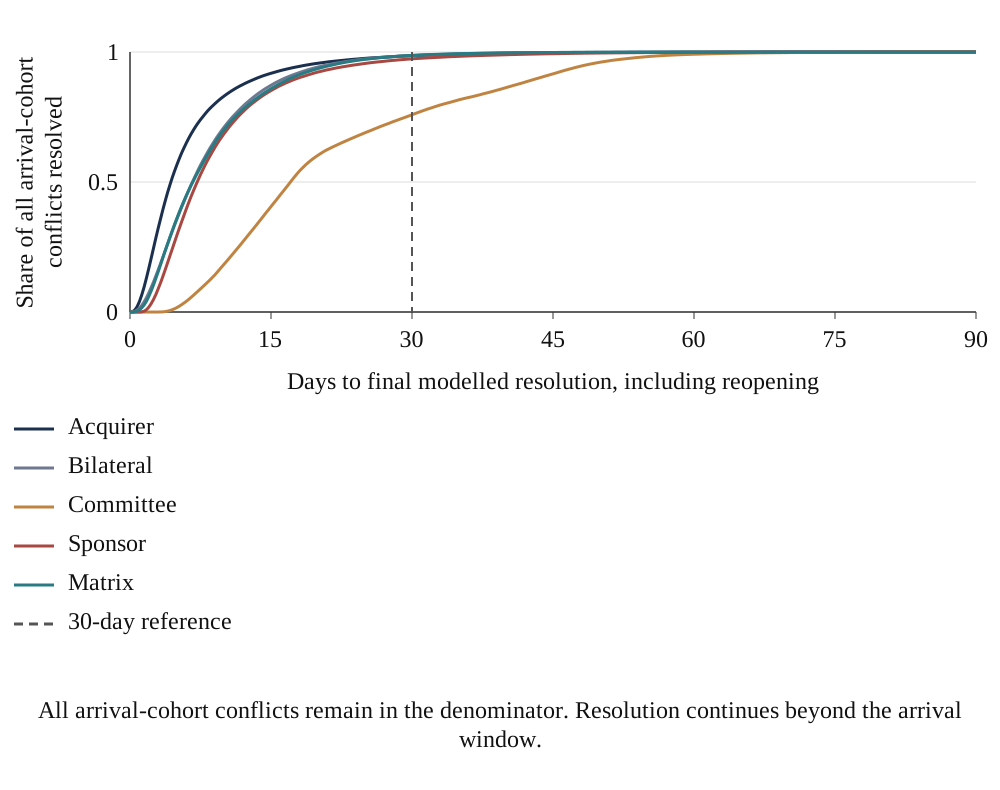
Source: author's analysis. Cumulative final modelled resolution, including assigned reopening delay. Every arrival-cohort conflict remains in the denominator; there is no day-180 censoring. Dashed line marks thirty days from raising.
15 Decision costs and frozen-outcome references
Table 6 and Figure 2 add error and rework. Two co-owners cost 142.8 thousand dollars per conflict, the matrix 145.9, acquirer line authority 164.9, the sponsor structure 181.9 and the committee 333.7. Delay is 93% of the committee's cost, 82% of the matrix's and 69% of the sponsor structure's. In the acquirer structure 42% of the cost is wrong decisions and rework, because 25.2% of its decisions are wrong, against 8.1% for two co-owners. Speed bought by deciding without the other side is partly returned as error.
Table 7 compares frozen costs from five separate whole-deal regimes. The ex-post reference chooses each conflict's lowest realised cost and averages 107.4 thousand dollars. The equal-weight reference averages the five regimes' conflict-weighted costs, 193.8 thousand dollars; it represents an equally probable random whole-deal regime. Equation 4c defines a normalized reference-gap index. The best single structure, Bilateral, has index 59%, the matrix 56% and the in-sample class-selected comparison 70%. The committee's index is -162%. These are descriptive comparisons of frozen outcomes.
C_ref is 193.804640136 and C_frozen,min is 107.449600997, in USD thousand per conflict, rounded here; index calculations use the retained full-precision costs. C_s is the evaluated mean frozen cost. Class choices are selected and evaluated on the same constructed population. The matrix's forum calendar and routing attempts affect its comparison with co-owners. A mixed allocation changes the shared sponsor queue and may incur operating costs absent from these references. The index supplies no feasible optimum or attainable-saving limit. Section 20 describes the uncertainty in recovering small cost orderings under a fixed-population experiment; it does not determine a field sample requirement.
| Structure | Wrong decisions | Reopened | Delay cost | Error and rework cost | Total cost per conflict |
|---|---|---|---|---|---|
| Acquirer line authority | 25.2% | 12.4% | 95.5 | 69.4 | 164.9 |
| Bilateral co-owners | 8.1% | 4.1% | 119.9 | 22.8 | 142.8 |
| Joint committee (unanimity) | 8.4% | 3.1% | 309.5 | 24.2 | 333.7 |
| Everything to the sponsor | 20.9% | 8.1% | 125.3 | 56.6 | 181.9 |
| Tiered decision-rights matrix | 8.7% | 5.2% | 119.8 | 26.1 | 145.9 |
MatchPoint analysis of the constructed population. Model output under stated inputs; not an observed result. Cost in USD thousand per conflict; delay and error cost sum to the total.
| Policy | Total cost per conflict | Normalized reference-gap index |
|---|---|---|
| Ex-post frozen-outcome minimum | 107.4 | 100% |
| In-sample class-selected frozen comparison (Matrix, Bilateral, Bilateral, Matrix) | 133.5 | 70% |
| Best single structure (Bilateral) | 142.8 | 59% |
| Tiered decision-rights matrix | 145.9 | 56% |
| Equal-weight whole-deal reference | 193.8 | 0% |
| Worst single structure (Committee) | 333.7 | -162% |
Source: author's analysis. Indices use Equation 4c and full-precision frozen whole-deal costs. Ex-post conflict selection and in-sample class selection retain the original regime queues; a mixed queue and operating costs are not evaluated. Reference values are not feasible cost bounds.
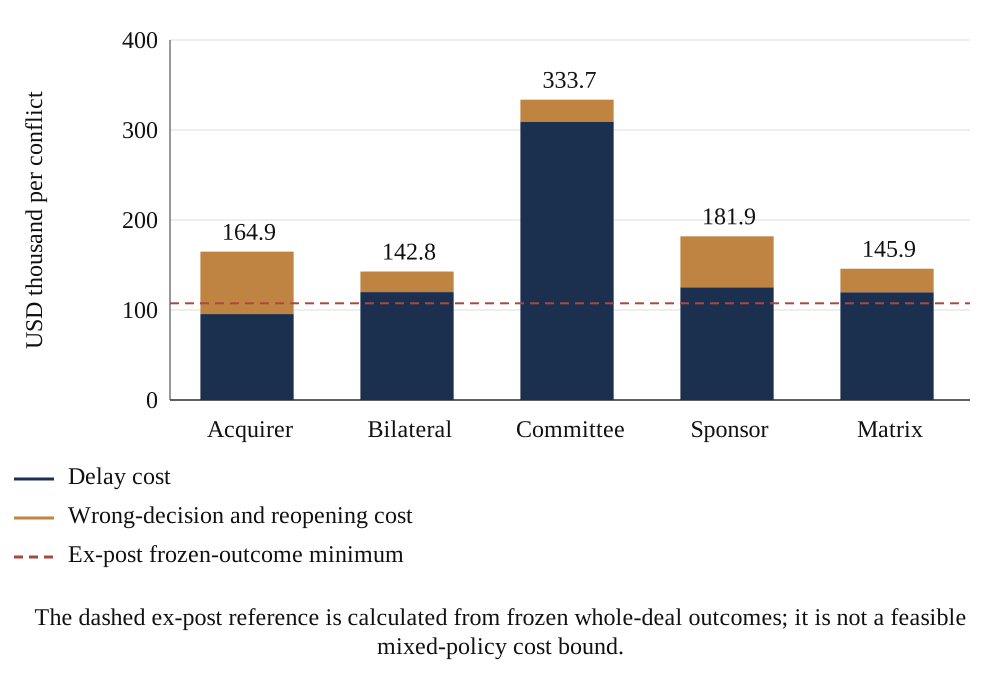
Source: author's analysis. USD thousand per conflict. Bars combine delay, wrong-decision and reopening costs. The dashed line is the ex-post frozen-outcome minimum, with no feasible-cost-bound interpretation.
A bounded diagnostic retained the analysis, error, reopening and service draws, chose each conflict's cheapest recorded regime and rebuilt the shared FIFO sponsor queue. Mean cost changed from 107.449600997 to 107.367588536 USD thousand per conflict. This counterexample establishes that the frozen minimum is no universal lower-cost bound for a mixed allocation. The selection uses hindsight. It supplies a diagnostic of the reference label, with no mixed-policy optimisation or observed integration result.
16 Results by class of conflict
Table 8 reports, for each class, the median days and the cost per conflict under each structure. Acquirer line authority has the fastest median in every class, from 3.0 days for local conflicts to roughly 11 days for strategic ones. The cheapest structure differs: the matrix is cheapest for local and strategic conflicts, and two co-owners are cheapest for cross-functional and cross-company policy conflicts. Across the four classes, 2 different structures are cheapest.
The local class is dominated by the matrix because a named owner who must consult the other side is almost as quick as the acquirer alone and far less often wrong; its median is 3.9 days against 13.5 for the committee. For cross-company policy the committee's median is 27.8 days against 11.9 for the matrix, and two co-owners are cheaper than the matrix because they avoid the forum's calendar. For strategic conflicts, which are 7% of the count and 44% of the matrix's total cost, the matrix costs 915.7 thousand dollars per conflict, two co-owners 1028.8, and the committee 2406.8. 71% of strategic conflicts under the committee are still open after thirty days, against 5% under the matrix.
The class comparison motivates testing class-sensitive allocation. In the frozen outcomes, an owner with consultation has the lowest local cost, co-owners have the lowest intermediate-class cost and a briefed sponsor route has the lowest strategic cost. Selecting those class rules in the same population improves the frozen mean. Its implementation would require classification, authority checks, operating resources and a recomputed shared sponsor queue. The present comparison leaves those practical effects unevaluated. A transaction can use it to formulate a testable proposal while retaining the class-selection and queue limitations beside the result.
| Class | Acquirer | Bilateral | Committee | Sponsor | Matrix | Fastest / cheapest |
|---|---|---|---|---|---|---|
| Local | 3.0 / 21.7 | 4.8 / 17.4 | 13.5 / 37.0 | 5.6 / 26.2 | 3.9 / 14.4 | Acquirer / Matrix |
| Cross-functional | 5.0 / 88.4 | 7.3 / 72.5 | 19.6 / 172.1 | 7.6 / 100.3 | 9.1 / 87.8 | Acquirer / Bilateral |
| Cross-company policy | 6.9 / 265.1 | 9.8 / 230.5 | 27.8 / 542.7 | 9.6 / 294.6 | 11.9 / 274.1 | Acquirer / Bilateral |
| Strategic | 10.6 / 1160.5 | 13.6 / 1028.8 | 41.8 / 2406.8 | 13.2 / 1248.2 | 11.2 / 915.7 | Acquirer / Matrix |
MatchPoint analysis of the constructed population. Model output under stated inputs; not an observed result. Each cell shows median days / cost in USD thousand per conflict. Last column names the structure with the lowest median and the lowest cost.
17 Stress conditions and constructed response patterns
Four authored stresses are applied separately and together. Higher friction multiplies the per-round disagreement propensity by 1.6, subject to the existing cap. Target-held information rises from 55% to 85 per cent. Sponsor service duration doubles. The matrix's nominal routing-attempt parameter rises from 10 to 30 per cent, implying expected actual tier changes of 7.4 and 22.2 per cent under the authored class shares. Table 9 and Figure 3 compare the resulting median, thirty-day unresolved share and error rate. Each stress uses a 1,500-deal base distinct from the main 3,000-deal population.
Within these scenarios, higher friction raises committee unresolved share from 24.1% to 36.7% and escalation from 9% to 21%, while the other displayed medians barely move. Higher target-held information leaves acquirer median near 4.5 days against 4.3 and raises error from 25.1% to 34.5%. Doubled sponsor service raises its median from 7.1 to 18.1, unresolved share from 2.1% to 31.0% and eventual offered load to 88%. The matrix unresolved share moves from 1.2% to 1.3%. These patterns are conditional scenario responses, with several possible explanations in actual data.
Higher routing attempts move matrix error from 8.6% to 10.1%, reopening from 5.0% to 7.4% and median resolution from 6.6 to 6.8 days. The median movement is modest in this sweep; routing also changes delay and reopening. Under combined stresses the lowest cost is Bilateral at 153.6 thousand dollars, followed by matrix 162.0, acquirer 197.3, sponsor 394.1 and committee 401.1. These contrasts suggest questions about disagreement, information and capacity. They do not uniquely diagnose a mechanism in a transaction.
| Case | Acquirer | Committee | Sponsor | Matrix |
|---|---|---|---|---|
| Base | 4.3 / 1% / 25% | 17.1 / 24% / 8% | 7.1 / 2% / 21% | 6.6 / 1% / 9% |
| High friction | 4.3 / 1% / 25% | 20.7 / 37% / 9% | 7.1 / 2% / 21% | 6.6 / 1% / 9% |
| Information on target side | 4.5 / 2% / 35% | 17.1 / 24% / 8% | 7.1 / 2% / 27% | 6.6 / 1% / 9% |
| Scarce sponsor time | 4.4 / 1% / 25% | 17.1 / 24% / 8% | 18.1 / 31% / 21% | 6.7 / 1% / 9% |
| Nominal matrix routing attempts 30% | 4.3 / 1% / 25% | 17.1 / 24% / 8% | 7.1 / 2% / 21% | 6.8 / 1% / 10% |
| Combined | 4.6 / 2% / 35% | 20.7 / 37% / 9% | 18.1 / 31% / 27% | 6.9 / 2% / 10% |
MatchPoint analysis of the constructed population. Model output under stated inputs; not an observed result. Each cell shows median days / share open after 30 days / wrong-decision rate. 1,500 deals per case.
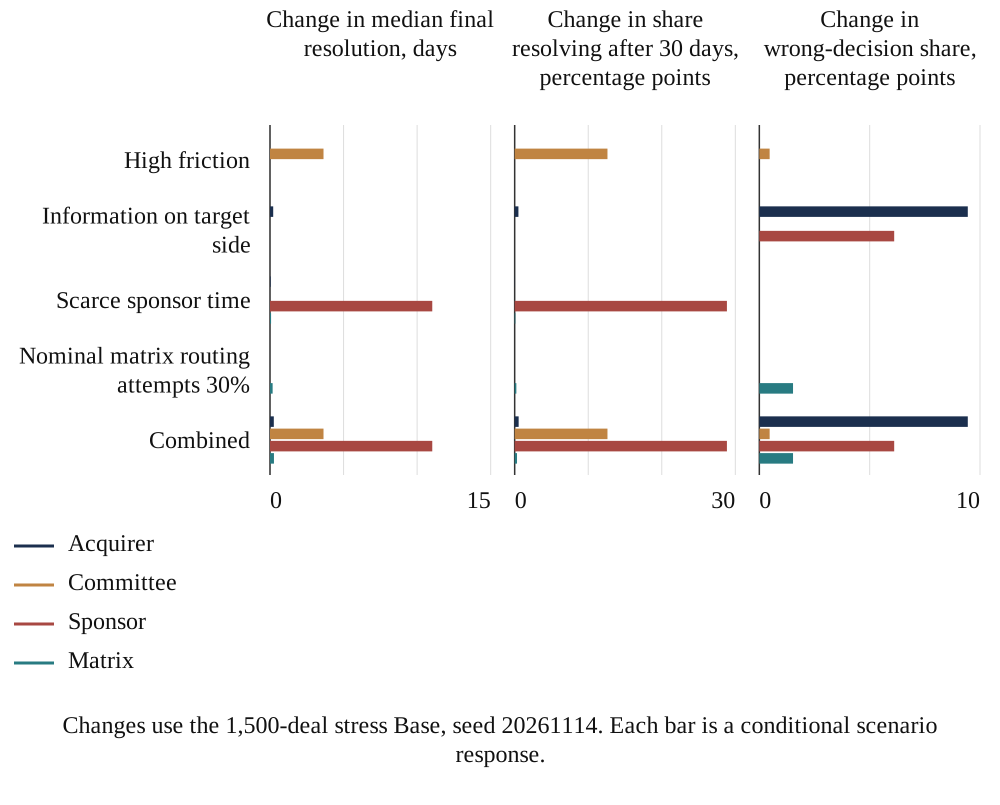
Source: author's analysis. Changes from the separate 1,500-deal stress Base in median final resolution days, thirty-day unresolved share and wrong-decision rate. These conditional responses do not identify a unique real-world cause.
18 Sensitivity to calendars and routing
Figure 4 varies one input at a time with 1,500 deals per point. Committee mean resolution moves from 14.6 days at seven-day meetings to 50.4 at forty-two days. Sponsor mean moves from 6.9 at half base service to 67.2 at triple service; the matrix moves from 8.5 to 8.7. Longer service increases queue delay in the finite cohort. Triple base sponsor service implies nominal rho of 1.35, beyond the stationary M/M/1 condition rho below one. Finite reported durations arise because arrivals stop and the cohort is followed until its work completes.
The time box matters most for the committee. If the committee escalates after the first failed meeting, its mean falls to 15.1 days and the open share to 2.8%, against 21.6 days and 24.1% at three meetings and 24.3 days at six. Its cost falls from 333.7 to 212.7 thousand dollars, and sponsor load rises to 10%. For two co-owners the time box matters little in this network: one round before escalation costs 134.0 thousand dollars, three rounds 141.3 and twelve 142.6, because the disagreement is resolved in a round or two in most conflicts.
As the nominal matrix routing-attempt parameter rises from zero to 50 per cent, cost rises from 140.4 to 170.4 thousand dollars. With the authored class shares, 50 per cent attempts imply 37 per cent expected actual tier changes. A grid-interpolated cost crossing with acquirer authority occurs near 41% nominal attempts. The sweep and reference line use different Monte Carlo samples; no crossing uncertainty is estimated. The crossing describes this constructed comparison. Transaction monitoring should record actual under-routing, over-routing, resolution and cost separately before selecting any operational threshold.
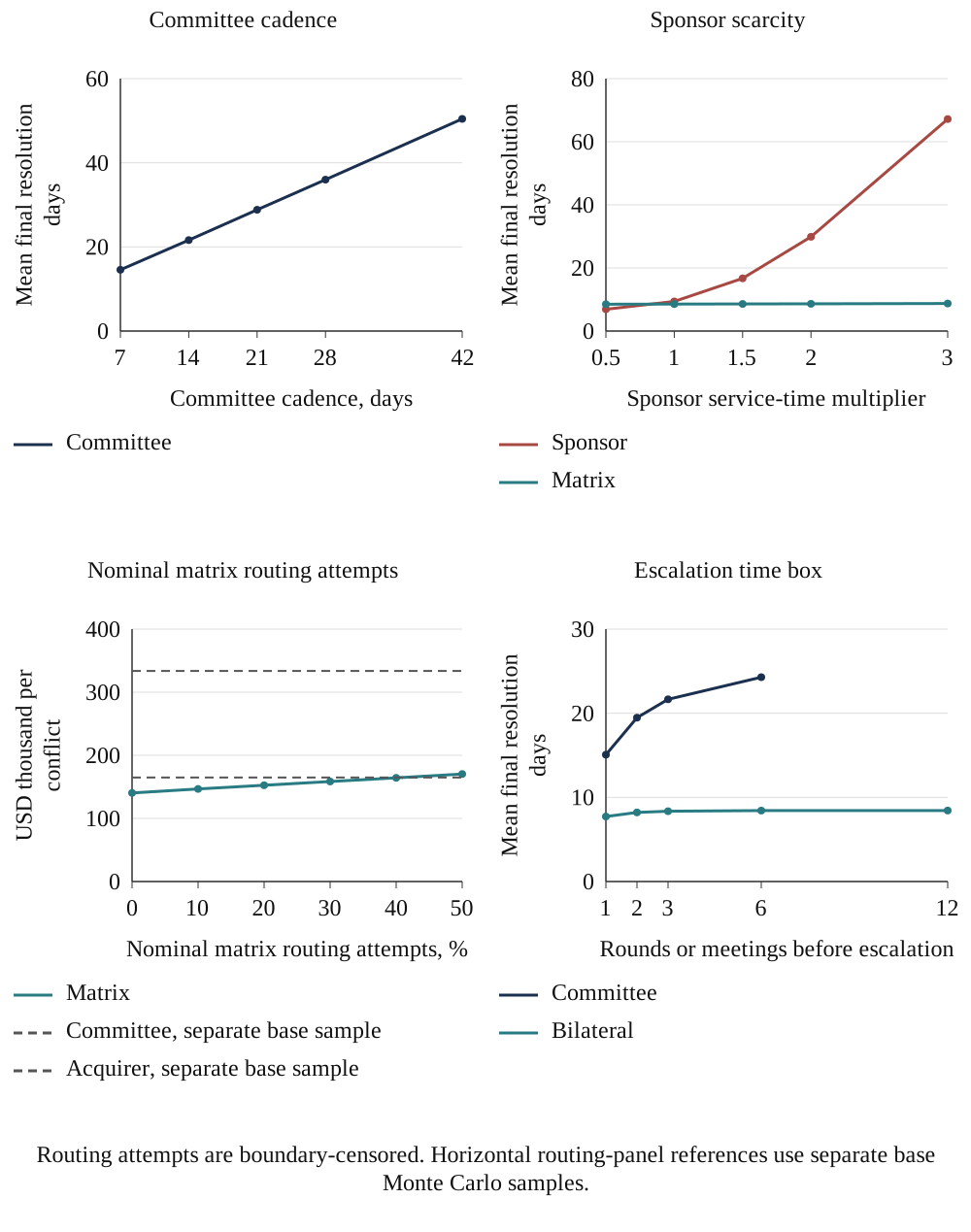
Source: author's analysis. 1,500 deals per sweep point. Resolution includes reopening. Routing uses the nominal boundary-censored attempt parameter; horizontal cost references use the separate main base sample. Overloaded sponsor points are finite-cohort results, outside stationary M/M/1 conditions.
19 Selection and measurement bias
The selection experiment authors a link between complexity and structure choice. At log complexity x equal to -0.35, acquirer authority is selected with probability 73% and the matrix with 1%. At x equal to +0.35, the probabilities are 2% and 55%. These evaluation points are defined explicitly; the population mean log complexity differs from zero. Complexity also affects analysis and friction. The scenario therefore creates confounding between the structure chosen and the deal receiving it. It supplies a controlled demonstration of selection bias, with no claim about the frequency of that choice rule in real deals.
Equation 5a is a population identity for Delta_naive, defined as E[Y|S=a] minus E[Y|S=b] under consistency. It decomposes that contrast into an effect among deals choosing a and a selection term. A finite-sample estimate can carry a hat; the displayed identity concerns expectations. Equation 5b simplifies the selection term under an explicitly assumed common linear conditional mean E[Y(b)|x,S]=alpha+gamma x. Nonlinear or heterogeneous conditional means require a different adjustment.
Y(s) is the deal's mean final modelled resolution days if it had used structure s, S is the structure chosen, x is log complexity and gamma is the slope of days on complexity. The model computes Y(s) for every structure in every deal, so the true population difference is known. In each of 400 samples of 150 deals the structure is chosen by the rule, and the contrast is estimated naively, by regression on a proxy for complexity with an authored reliability of one half, and by regression on exact complexity. The publisher abstract of a simulation study reports that unreliable measurement of covariates can degrade the bias reduction of a propensity-score adjustment; the regression used here is a different adjustment, and the analogy is the paper's own. [13]
Table 10 and Figure 5 compare the known equal-deal population contrast with sample estimates. For committee comparisons the selection term is small relative to the -12.6-day difference. Matrix versus co-owners has true gap 0.2 days, naive estimate 1.2 and bias 1.0. Bias remains 0.6 after noisy-proxy adjustment and -0.2 after exact-complexity adjustment. Acquirer versus co-owners has true difference -1.9 and naive estimate -2.3. The specified linear regression leaves residual differences when response is nonlinear and effects vary across deals. This calculation does not establish a unique overlap-weighted causal estimand.
In this authored selection scenario, confounding can change interpretation of close contrasts. The size and direction in an archive depend on its selection mechanism and outcome distribution. A complexity measure fixed before structure choice can support an adjustment with stated assumptions. Random allocation is another design for addressing selection, subject to allocation units, compliance and interference. A credible evaluation should explain its identification argument, show overlap and missingness, and test how conclusions change under plausible alternative specifications. These requirements apply before a governance comparison is described as a measured integration effect.
| Contrast in mean days | True population difference | Naive comparison | Adjusted, noisy proxy | Adjusted, exact complexity |
|---|---|---|---|---|
| Matrix minus Bilateral | 0.2 | 1.2 | 0.8 | 0.1 |
| Acquirer minus Bilateral | -1.9 | -2.3 | -2.1 | -1.6 |
| Matrix minus Committee | -12.6 | -13.0 | -13.2 | -13.4 |
Source: author's analysis. Equal-deal-weighted mean final resolution days; first structure minus second. Averages over 400 samples of 150 deals from the constructed population. Complexity proxy reliability is 0.5. Regression specifications impose a common linear complexity adjustment.
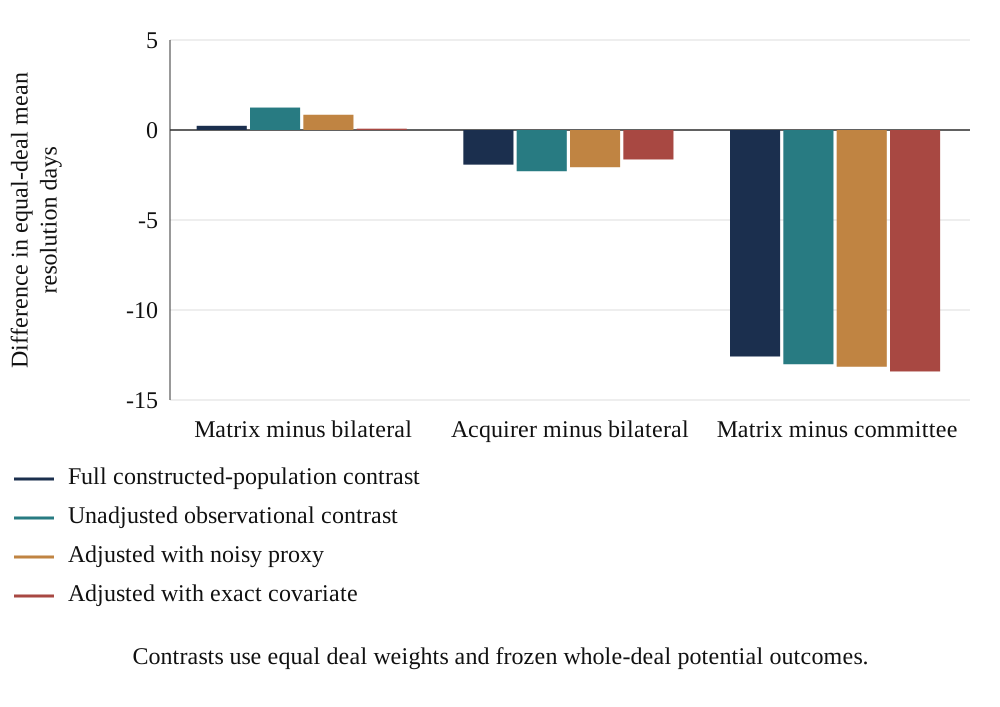
Source: author's analysis. Differences in equal-deal-weighted mean final resolution days. True denotes the known contrast in the full constructed population. Adjusted estimates use the stated linear regressions.
20 Study size and uncertainty
The study-size exercise samples m total deals without replacement from the fixed 3,000-deal constructed population. Between-deal assignment allocates them randomly across five regime arms. The second design randomly selects each conflict's recorded outcome from the separate whole-deal regimes, then averages within deals. This frozen-outcome within-deal resampling leaves sponsor queues unchanged. It illustrates an imposed no-recomputed-queue comparison; a conflict-randomised field trial would face interference that this resampling omits. Each design uses 400 replications at each tested size.
The equal-deal mean gaps are 23.2 thousand dollars for acquirer versus co-owners and 4.2 for matrix versus co-owners; Table 6 instead weights conflicts. With 80 total deals, about sixteen per arm on average, between-deal resampling recovers the large-gap sign in 90.5 per cent of replications, Monte Carlo standard error 1.47 percentage points. At 320, large-gap frequencies are 99.75 per cent between deals and 99.5 per cent within; small-gap frequencies are 70.5 and 70.75 per cent. These are sign frequencies without a significance test or a power calculation. At ten total deals, missing comparison arms count as incorrect; empirical range widths condition on computable contrasts.
Equation 6a defines an intracluster variance ratio. Equation 6b gives the usual equal-cluster-size working design effect with b conflicts per deal. [12] The reported model estimate uses mean cluster size as an approximation although the constructed deals are unequal. It helps describe this output distribution. It cannot determine the relative efficiency of field designs where queue interference, cluster sizes, missing follow-up or variance components differ.
Sigma_c squared and sigma_w squared denote between- and within-cluster variance. Kerry and Bland's equal-size example uses correlation 0.019 and fifty referrals per practice, giving design effect 1.93. [12] Here the mean-size method-of-moments approximation gives correlation 0.004 and design effect 1.2 with mean 54 conflicts per deal. Constructed cluster sizes range from eleven to 156. A separate balanced-data control checks the equal-size formula under its own inputs. Field archives may differ in either direction; their variance, cluster sizes and interference need estimation before study-size calculation.
| Total deals across five arms | Bilateral vs matrix: between-deal | Bilateral vs matrix: frozen within-deal resampling | Bilateral vs acquirer: between-deal | Bilateral vs acquirer: frozen within-deal resampling | 95% range, between-deal | 95% range, within-deal |
|---|---|---|---|---|---|---|
| 10 | 42% | 56% | 51% | 66% | 202.3 | 227.3 |
| 20 | 53% | 54% | 68% | 70% | 152.4 | 149.8 |
| 40 | 56% | 56% | 80% | 80% | 105.8 | 108.6 |
| 80 | 61% | 56% | 90% | 89% | 71.0 | 74.8 |
| 160 | 64% | 63% | 95% | 96% | 55.8 | 55.3 |
| 320 | 70% | 71% | 100% | 100% | 36.0 | 39.8 |
Source: author's analysis. Size is total deals across five arms. Correct signs are counted over 400 replications; no hypothesis-test power is calculated. Within-deal columns resample frozen whole-deal outcomes. Empty comparison arms count as incorrect; 95 per cent empirical range widths use computable contrasts. Whole-per-cent rounding displays 99.75 and 99.5 per cent as 100 per cent.
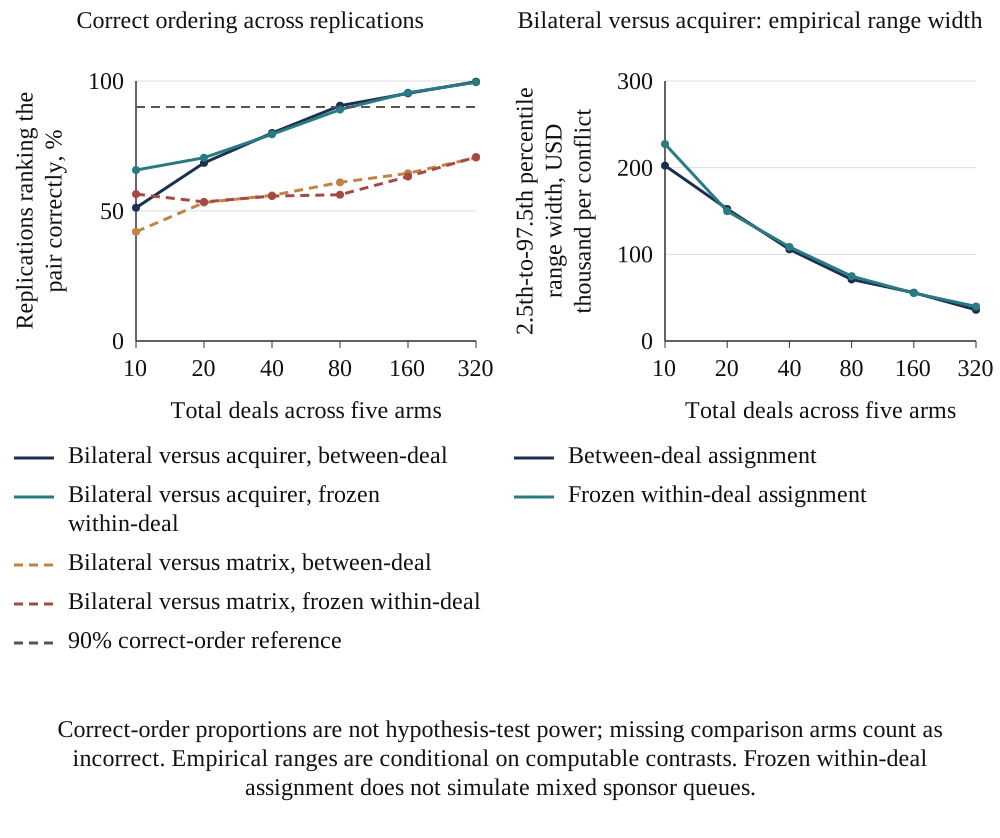
Source: author's analysis. Total deals across five arms. Left: correct-sign frequencies over 400 resamples. Right: empirical 95 per cent estimator-range widths conditional on computable contrasts. Frozen within-deal resampling preserves the original queues. Neither panel supplies field-trial power or a required field sample size.
21 A prospective evaluation protocol
The proposed observation is a cross-company conflict nested in a deal. A prospective log opens when either side records a disagreement its own function cannot close. Fields include class, parties, authority, value exposure, information side and operating structure. Timestamps retain raising, completed analysis, consultation, escalation, first commitment, reopening, later commitment and implementation. Recording items as they arise makes the entry rule auditable. Retrospective reconstruction can omit forgotten, brief or poorly documented conflicts; the direction and extent of that selection require checking.
Where the parties and advisers permit a comparison, specify eligible decisions and an allocation unit before enrolment. Workstreams, time blocks or other clusters may be appropriate when decisions share a sponsor or forum; the choice requires an interference assessment. Include the agreed cohort consistently and retain deviations from allocation. Table 11 motivates questions about sign recovery under a constructed distribution. A real trial needs a separate study-size calculation based on its endpoint, variance, desired precision or testing criterion, clustering, allocation and shared capacity.
The analysis plan defines first commitment and final resolution separately, retains the thirty-day unresolved share, and specifies blinded review of error and reopening. A proposed ninety-day information-review window needs a documented rule for available evidence and disagreements between reviewers. Record actual sponsor service rather than substituting offered load. Report cohort entry, follow-up, unresolved items and uncertainty for pre-specified contrasts. Cluster-aware inference alone cannot remove queue spillovers or selection; those need to be addressed in the design and interpretation. Determine the required sample from that plan before data collection.
The proposed log needs a jurisdiction-specific data-processing assessment. The UAE federal Personal Data Protection Law defines the data subject as a natural person and provides specified exceptions to consent in Article 4. Company permission to use transaction documents and the lawful basis for processing employees' or counterparties' personal data are separate checks. Article 2 sets scope and exclusions; Articles 5 and 6 address purposes, minimisation, security and conditions for consent. The protocol should identify the controller, each field's purpose and basis, access limits and retention, and distinguish reversible pseudonymisation from anonymisation. Articles 28 and 29 link implementing regulations and the adjustment period, so the current implementation and transition position should be confirmed before use. Applicable free-zone or sector legislation and cross-border conditions also require review. The paper determines no particular log's compliance. [14, 23]
The proposed log separates the date of first commitment from the date at which a reopened issue reaches a further committed decision. Each reopening has its own reason and timestamp. The team should define the reported resolution endpoint before collecting data and retain the underlying events so that another reader can reconstruct it. A late implementation step, a reversed decision and an unfinished discussion are distinct states. Combining them into one closure field would make the result depend on record-keeping practice. The experiment's resolution measure includes its assigned reopening delay; a real study should explain exactly which corresponding events it counts.
Follow-up should have a stated cutoff. Every item open at that cutoff remains recorded as open, with its observed age and last known state. The reporting table should show how many conflicts entered, reached first commitment, reopened, remained unresolved or left observation. It should retain items whose owner changes or whose workstream is reorganised. This proposed rule makes missing follow-up visible and avoids treating unresolved items as decisions completed at zero cost. Estimates requiring additional assumptions about incomplete durations should state those assumptions and receive a separate methodological review before use.
The randomised slice needs an interference assessment because conflicts can share the same sponsor, meeting or workstream. Assigning some conflicts to a sponsor-intensive rule may change the waiting time faced by other conflicts. The present model generates outcomes for separate whole-deal regimes; resampling those outputs does not reproduce the queue created by a real mixed allocation. A proposed trial should therefore specify the allocation unit, record shared capacity and consider blocks or clusters that keep interacting work together. The choice depends on the transaction. The study should report spillovers and any changes to the agreed allocation.
Eligibility for that evaluation should be defined with the parties and their advisers. Decisions with mandatory approvals, urgent safety consequences or unresolved authority should follow their applicable processes. The proposed experimental comparison concerns comparable decisions for which alternative governance routes have been approved. The protocol should record the permitted intervention, stopping conditions and a human owner who can suspend the comparison. An observed association in an archive also needs a stated identification argument before it is described causally. Random allocation is one possible design; its interpretation depends on compliance with the allocation and on the treatment of interference.
22 Board reporting and financial attribution
Board reporting should show the authority record beside observed outcomes for each conflict class: count, accountable owner, time box, median and 90th-percentile resolution, thirty-day unresolved share, error-review result, reopening and sponsor escalation. Show actual service hours and their observation window separately from work offered by an arrival cohort. Increasing service demands can prompt a capacity review; the stationary queue formula applies only within its stated conditions. Small counts, missing follow-up and changed reporting definitions should remain visible beside rates.
Each comparison should state its design and identification assumptions. A within-period, within-class comparison may improve comparability while retaining selection and shared-capacity problems. Archive comparisons need their adjustment and missingness assumptions; allocated comparisons need compliance and interference checks. The constructed resampling recovers the larger cost sign more frequently than the smaller one. That conditional result does not establish which gaps a particular board's archive can identify. Its counts, variability and decision process determine the evidence available.
Dissent should be reported with the decision. Where a time box expires and the sponsor decides, the report should retain the parties' positions, the decision and its reason so a later reviewer can reconstruct it. The record can then be checked against the entity's applicable delegation, approval and conflict-recording requirements. [7, 8, 19, 20, 22] A causal comparison needs a justified identification design and its assumptions stated. Random allocation is one possible design; adherence, interference, missing outcomes and follow-up still require assessment.
Financial attribution should distinguish the experiment's loss function from the transaction's accounts. The model attaches authored daily delay values and wrong-decision losses to conflicts. Those amounts are scenario inputs. A board record of actual integration value needs a separately evidenced baseline, a benefit owner, the observed financial movement, its date and the basis for attribution. Estimated exposure, observed cash and recognised accounting effects should be reported in their own fields. A shorter recorded decision time alone does not substantiate an EBITDA improvement, a cash saving or a realised synergy.
The proposed synergy tracker should link each claimed benefit to its decision record and include a check for overlap with other workstreams. A supplier-term change and a payment-timing change can affect the same cash flow. The finance owner should explain how the incremental effects were separated before adding them to a total. The tracker should retain implementation costs, reversals and benefits that have not yet been evidenced. This paper provides no client benefit figures. The proposed tracker creates a route from an authorised decision to a financial claim that can be checked against transaction records.
23 Applying the framework to a transaction
Table 12 turns the results into a rule that can be applied before completion. Each line has a condition, an action and the model result that motivates it. The thresholds are proposals derived from the constructed experiment and are authored. They should be replaced by the transaction's own values once the first weeks of a log exist.
The proposed operating rule emphasises a lawful escalation clock. In the model, the committee with three failed meetings before escalation leaves 24.1% unresolved after thirty days; first-failure escalation gives 2.8%. Co-owner costs range between 134.0 and 142.6 thousand dollars across the tested time boxes. A shareholder, financing or regulatory instrument may reserve an approval or prescribe the decision process. Any altered deadline, escalation or membership needs the consent required by that instrument. The simulated ordinary disagreement rule cannot override it.
Data tools could assist classification, prepare a brief or flag an approaching deadline, with a named person retaining the authorised decision. Actual under-routing and over-routing would need validation by class. The sweep adds about 6.0 thousand dollars per conflict for each ten nominal percentage points of routing attempts on average across zero to fifty per cent; boundary retention makes this different from observed classifier error. No trained classifier, measured accuracy or automation benefit is reported. An integration team would need its own error-cost evaluation and the applicable authority and data controls before use.
| Condition | Proposed action | Result in the model that motivates it |
|---|---|---|
| Contained conflict; decisive information on one side | Named owner with a duty to consult the other side; decide in days | Matrix median 3.9 days for local conflicts; acquirer alone is wrong more often when the target holds the information |
| Conflict between the companies; both hold information | Two co-owners; reviewed time box; exponential model rounds average three days | Cheapest for cross-functional and policy conflicts; time box matters little for two parties |
| Strategic conflict or value above a stated threshold | Sponsor decides from a briefed pack within a set number of days | Matrix cost 915.7 against 2406.8 for the committee |
| A committee is required by contract | Review permitted escalation and cycle with the required approval-holders | Mean 15.1 days at one meeting against 21.6 at three |
| Share open after thirty days above a few per cent, or sponsor load rising | Add a delegated tier or reallocate classes; review the routing errors | Sponsor offered load has 90th percentile 69% across deals; this includes eventual work after the arrival window |
| Routing disputes over class | Redefine classes; log every reclassification | Matrix cost rises from 140.4 to 170.4 thousand dollars across zero to fifty per cent nominal attempts; expected actual tier changes reach 37% |
MatchPoint analysis. Proposed rule; thresholds are authored and drawn from model output under stated inputs, not observed integration outcomes. Selected UK duties and UAE federal company-law provisions are discussed; transaction-specific authority and other GCC or free-zone corporate regimes require separate review.
Before Day One, the proposed integration checklist is to identify the material decision classes, obtain the authority evidence, name the owners and agree the escalation clocks. Each workstream should record the decisions it expects to make, rather than relying only on a generic organisation chart. Treasury can identify account mandates; commercial teams can identify pricing and customer approvals; technology teams can identify access decisions and their privacy constraints. These are proposed workstream checks. Their detail should be adapted to the transaction and reviewed by the relevant professionals before operational authority is changed.
The first operating reviews should compare the agreed decision record with the files created in practice. The questions are whether the named owner acted, whether the required information and approvals were obtained, when the item escalated and whether a decision reopened. The review should show exceptions and their causes. A deadline missed because a sponsor had no capacity calls for a capacity or routing response. A delay caused by an unclear entity approval calls for clarification of authority. The proposed framework makes those explanations testable through records; the effect of the resulting changes remains a question for the evaluation.
24 Reproducibility and limitations
The retained run executes 48 assertions; Table 14 summarises groups, including repeated probability checks. The whole-model reproduction matches all recorded numerical tables; independent arithmetic also reproduces all five base regimes and selected tables. Common inputs support paired comparison. A meaningful decomposition check replaces the original self-comparison and checks each regime's first-commitment time against its shared analysis array. Calendar, FIFO, cost and boundary-eligible routing checks pass on the stated constructions. Frozen-reference ordering is an arithmetic property of those outcome arrays. The separate balanced-cluster control verifies its own design-effect example. These checks establish numerical implementation within scope; empirical calibration remains outstanding.
Table 13 summarises principal authored inputs. The accompanying reproducible source and full register preserve all 54 base keys, distribution constants and experiment settings, including analysis-complexity scaling, lognormal spreads, exponential rounds, reopening, error exceptions and selection coefficients. Every value is authored. Tables display rounded values while computations use full precision. Stress cases and sweeps use 1,500 deals per point; the main base uses 3,000. Cross-experiment differences therefore combine parameter changes with different fixed samples, as labelled.
Distribution choices matter beyond the summary table. Analysis uses a shape-two gamma draw, with class means scaled by deal complexity to the power 0.6. Log complexity has standard deviation 0.35 and mean -0.06125, giving mean complexity one. Deal friction is exponential in half log complexity plus a normal disturbance with standard deviation 0.2. Class disagreement propensities are multiplied by that friction and capped at 0.9. Delay rates and wrong-decision losses are lognormal, with log-standard deviations 0.5 and 0.25 respectively. These assumptions generate heterogeneity; they are available for replacement when an empirical calibration exists.
Reopening delays are exponential with mean ten days, except under-routed matrix items with mean eight. Owner waiting, consultation and sponsor service also use their stated exponential means; committee and forum intervals are fixed calendar grids. The selection experiment uses five specified intercept/slope pairs, with slopes multiplying log complexity divided by 0.35 without centring, and a proxy reliability of one half. Its 400 samples contain 150 deals each. The rank-recovery experiment has six total-deal sizes from ten to 320 and five assignment arms. These choices describe the reproducible construction. They require re-estimation before a study's uncertainty is presented as evidence about an actual transaction.
| Input | Value | Status |
|---|---|---|
| Deals and conflicts | 3,000 deals; 160,743 conflicts over a 180-day window | Authored |
| Conflict arrival | 0.30 per day for a deal of complexity 1; Poisson; complexity lognormal, log-sd 0.35 | Authored |
| Decisive information on target side | 55% | Authored |
| Per-round disagreement propensity scale (kappa) | 0.65 | Authored |
| Acquirer: mean exponential wait; non-escalated error target / other | 1.0 day; 40% / 8% | Authored |
| Bilateral: mean exponential round duration; failed rounds before escalation | 3.0 days (exponential mean); 3 | Authored |
| Committee: cadence; paper cut-off; rounds before escalation | 14 days; 3 days; 3 | Authored |
| Sponsor: service time raw / briefed; preparation lag | 1.5 / 1.0 days; 1.0 day | Authored |
| Matrix: forum cadence; deferral probabilities (cross-functional, policy) | 7 days; 15%, 25% | Authored |
| Matrix: nominal routing-attempt parameter; error if under-routed | 10%; 38% | Authored |
| Rework cost of a reopened decision | 25% of the wrong-decision loss | Authored |
| Cost per conflict | Delay rate x days + wrong-decision loss x error + 25% of loss x reopening | Authored |
| Replications | 400 samples of 150 deals (selection); 400 per study size (sample size) | Authored |
Source: author's constructed inputs. This summary is supplemented by the complete parameter, distribution and experiment register in the reproducible source. Transaction use requires its own calibration.
| Control | Result |
|---|---|
| Retained assertion executions | 48 |
| FIFO queue against M/M/1 formula (arrival 0.6, service 1.0) | Simulated wait 1.49 days; formula 1.50 days |
| Committee wait with full agreement | Simulated 10.0 days; lag plus half cadence 10.0 days |
| Unanimity probability | Simulated first-round frequency within 0.02 of (1 - kappa delta)^(n-1) |
| Cost decomposition | Delay cost plus error and rework cost equals total cost for each structure |
| Routing frequencies | Boundary-eligible under- and over-routing frequencies match their input-implied shares within 0.003 |
| Design effect | Simulated variance ratio within 5% of 1 + (m - 1) rho |
| Common random numbers | All five structures face the same conflicts, analysis times and draws |
| Random seeds | Fixed: 20261014 base; separate fixed seeds for sweeps, selection and sample-size studies |
| Frozen-reference ordering | Ex-post frozen minimum no greater than in-sample class selection, best uniform and equal-weight regime mean |
Source: author's analysis. The retained run has 48 assertion executions, including repeated checks. The table groups controls. Independent reconstruction and the separately recorded non-vacuous decomposition check supply additional scoped evidence; they do not validate field outcomes.
The experiment shows how five structures behave when the premises are as stated. Resolution times, error rates and costs are generated from the same inputs that define the structures, so the ranking follows from the premises, and the experiment cannot show that real conflicts behave like them. The paper contains no observed integration, no client data and no estimate of the frequency of conflicts. The statement that a unanimity committee is slowest rests on a compounding rule for agreement and a fixed calendar, both authored, and the statement that it is slowest in practice would need data.
Important simplifications remain. Two co-owners represent every affected function, favouring bilateral agreement when several parties are involved. Each regime receives a whole deal; mixed selections and within-deal resampling retain frozen queues. Ex-post references and in-sample class choices omit implementation and mixed-capacity effects. Sponsor service is exponential, arrivals and class mix stay fixed within the 180-day arrival window, and follow-up continues afterwards. Culture, personalities, departures and operating several structures are excluded. Cost weights are authored. The legal context covers selected UK duties and UAE federal commercial-company provisions. Other GCC and free-zone corporate regimes, sector rules and transaction-specific applicability require separate review.
A transaction team can begin by agreeing an entity-specific authority record and a prospective decision log. A permitted evaluation should retain commitment and reopening events, unresolved follow-up, actual shared capacity and deviations from allocation. Its sample size needs the observed variance and a pre-specified estimation or testing objective. Eighty total deals is the first tested grid point with at least ninety per cent large-gap sign recovery in the constructed five-arm exercise; it supplies no universal field threshold. Governance choice remains a proposal to test. A claim of realised speed, financial benefit or causal improvement needs transaction evidence and a defensible identification argument.
References
- Eisenhardt, K. M. Making fast strategic decisions in high-velocity environments. Academy of Management Journal 32(3), 1989, pp. 543-576. DOI 10.2307/256434. https://pdf.stafforini.com/eisenhardt-1989-making-fast-strategic.pdf
- Graebner, M. E., Heimeriks, K. H., Huy, Q. N. and Vaara, E. The process of postmerger integration: a review and agenda for future research. Academy of Management Annals 11(1), 2017, pp. 1-32. DOI 10.5465/annals.2014.0078. Accepted manuscript. https://ora.ox.ac.uk/objects/uuid:eab00102-5fc7-4bc2-9ae4-9fd30bdee804
- Aghion, P. and Tirole, J. Formal and real authority in organizations. Journal of Political Economy 105(1), 1997, pp. 1-29. DOI 10.1086/262063. https://discovery.ucl.ac.uk/17678/1/17678.pdf
- Alonso, R., Dessein, W. and Matouschek, N. When does coordination require centralization? American Economic Review 98(1), 2008, pp. 145-179. DOI 10.1257/aer.98.1.145. Accepted manuscript. https://researchonline.lse.ac.uk/id/eprint/58664/1/Alonso_Dessein_Matouschek_When-does-coordination-require-centralization_2008.pdf
- Eisenhardt, K. M., Kahwajy, J. L. and Bourgeois, L. J. Conflict and strategic choice: how top management teams disagree. California Management Review 39(2), Winter 1997. https://cmr.berkeley.edu/1997/02/39-2-conflict-and-strategic-choice-how-top-management-teams-disagree/
- Thomas, M. and Louisgrand, N. How does decision-making involvement affect perceptions of speed during post-merger integration? European Management Journal 40(6), 2022, pp. 906-916. DOI 10.1016/j.emj.2022.10.005. https://ideas.repec.org/a/eee/eurman/v40y2022i6p906-916.html
- United Kingdom. Companies Act 2006, section 172, Duty to promote the success of the company. https://www.legislation.gov.uk/ukpga/2006/46/section/172
- United Kingdom. Companies Act 2006, section 175, Duty to avoid conflicts of interest. https://www.legislation.gov.uk/ukpga/2006/46/section/175
- Financial Conduct Authority. FCA Handbook, SYSC 25, especially 25.1.1R, 25.2.1R-25.2.2R, 25.4.4G and 25.4.10G. Current text checked 6 November 2026. https://handbook.fca.org.uk/handbook/sysc25
- Bain & Company. RAPID: a tool to clarify decision accountability. 13 October 2023. https://www.bain.com/insights/rapid-tool-to-clarify-decision-accountability/
- Massachusetts Institute of Technology, OpenCourseWare. 2.854 Introduction to Manufacturing Systems, Fall 2016: M/M/1 Queue. Course notes. https://ocw.mit.edu/courses/2-854-introduction-to-manufacturing-systems-fall-2016/927056a1af54772a587fd84ad4951e71_MIT2_854F16_Mm1Queue.pdf
- Kerry, S. M. and Bland, J. M. The intracluster correlation coefficient in cluster randomisation. BMJ 316(7142), 1998, p. 1455. DOI 10.1136/bmj.316.7142.1455. https://www.bmj.com/content/316/7142/1455.1.full
- Steiner, P. M., Cook, T. D. and Shadish, W. R. On the importance of reliable covariate measurement in selection bias adjustments using propensity scores. Journal of Educational and Behavioral Statistics 36(2), 2011, pp. 213-236. DOI 10.3102/1076998610375835. https://ideas.repec.org/a/sae/jedbes/v36y2011i2p213-236.html
- Government of the United Arab Emirates. Data protection laws. Official portal overview. https://u.ae/en/about-the-uae/digital-uae/data/data-protection-laws
- Financial Conduct Authority. PS26/6, Senior Managers and Certification Regime Review. April 2026, chapter 2. https://www.fca.org.uk/publication/policy/ps26-6.pdf
- Office of the Comptroller of the Currency. Conditional Approval for Application for the Merger of Discover Bank with and into Capital One, National Association. 18 April 2025, section IV, p. 5. https://www.occ.gov/news-issuances/news-releases/2025/nr-occ-2025-36a.pdf
- Board of Governors of the Federal Reserve System. Federal Reserve Board announces approval of application by Capital One Financial Corporation to merge with Discover Financial Services and issues a consent order with Discover. 18 April 2025. https://www.federalreserve.gov/newsevents/pressreleases/orders20250418a.htm
- United Kingdom Department for Business and Trade. Royal Mail remains based in UK in deal to bolster key services. 16 December 2024. Official announcement and summary of undertakings. https://www.gov.uk/government/news/royal-mail-remains-based-in-uk-in-deal-to-bolster-key-services
- United Arab Emirates. Federal Decree-Law No. 32 of 2021 on Commercial Companies, selected Articles 4, 22, 83, 150, 154 and 155, read with Federal Decree-Law No. 20 of 2025. Ministry-hosted English base translation; not a consolidated post-2025 edition. https://www.moet.gov.ae/en/companies-legislations
- United Arab Emirates. Federal Decree-Law No. 20 of 2025 amending Federal Decree-Law No. 32 of 2021 on Commercial Companies, Article 1 including substituted Articles 3 and 5, and Article 4. Official Arabic text. https://www.moet.gov.ae/en/companies-legislations
- Financial Conduct Authority. CP26/37, Senior Managers and Certification Regime Review: Phase 2. 22 October 2026, paragraphs 3.92-3.96. Consultation proposals. https://www.fca.org.uk/publication/consultation/cp26-37.pdf
- United Kingdom Supreme Court. Saxon Woods Investments Limited and others v Costa [2026] UKSC 21. 14 July 2026, paragraphs 45 and 51-64. https://www.supremecourt.uk/cases/judgments/uksc-2025-0149
- United Arab Emirates. Federal Decree-Law No. 45 of 2021 concerning the Protection of Personal Data, selected Articles 1, 2, 4-6 and 28-31. Arabic statute in the government-linked Dubai Judicial Institute 2023 compilation. https://assets.u.ae/api/public/content/954629a06cc64fd887771ce3273d6154?v=21d88839
About the Author
Chennakeshav (CK) is a corporate finance and investment banking executive with 25+ years of global experience in deal origination, structuring and execution across M&A, growth capital and corporate strategy. He has led value-creation mandates for founders, corporates and funds — bridging the boardroom view to hands-on execution and close.
His career spans Morgan Stanley, HSBC, Lloyds Banking Group, EWEC, ADQ portfolio companies and Emirates Growth Fund, across TMT, real estate, fintech, deeptech, cleantech, infrastructure and energy. He has partnered with C-suite leaders, private equity and venture funds, sovereign wealth funds and family offices to finance complex fund raises and scale-up ventures, and has led M&A due diligence, post-merger integration and business-transformation initiatives to create value.
At Matchpoint Partners he is Managing Partner, leading the firm's corporate finance, M&A and capital-raising practice. He holds an MBA from London Business School, an engineering degree from VTU and a Master of Laws (LLM, in progress) from UCL London.
An active start-up mentor, CK mentors at Techstars, DIFC FinTech Hive, Startup Grind, Founder Institute and IN5, serves as Entrepreneur Mentor in Residence (EMiR) at London Business School, and judges the Entrepreneurship World Cup.
https://www.linkedin.com/in/ckadya/
https://www.matchpoint-partners.com/team/ck-adya.html
Disclaimer
This paper is part of a continuing series on the structure of private and alternative markets. The views expressed are the author's own. The paper is for information only, describes market structure in general terms, and does not constitute investment, legal, tax or regulatory advice or a recommendation in respect of any security, vehicle or counterparty.
