

1. The financing problem is the conversion of uncertainty into evidence
The defining financing challenge in deeptech is not simply a long period before revenue. It is a sequence of uncertainties that are resolved at different speeds and by different evidence. A device can satisfy its laboratory specification while failing in a customer environment. A prototype can function while the production process remains unstable. A regulator can accept the proposed test plan while withholding final approval. A customer can complete a pilot while delaying procurement. Each state has a different implication for technical risk, cash need, valuation and debt capacity.
Technology readiness language helps describe maturity, but a financing decision requires more precision. NASA describes a technology readiness level as a record of demonstrated performance relative to defined levels, and emphasises what was demonstrated and in which environment [1]. The U.S. Government Accountability Office adds that credible technology readiness assessment should be objective, reliable and useful, because immature technology has contributed to delay and cost growth in major programmes [2]. A financing committee should therefore ask which uncertainty has actually been retired, what evidence proves it, and which risks remain.
Calendar runway can conceal this structure. A board may see eighteen months of cash and assume that the next round will be raised in month twelve. The next investor may require a certification outcome that has no fixed delivery date, a customer may control access to the operating environment, or a failed test may require redesign. The relevant runway is the cash required to reach a financeable evidence state with a credible buffer. That runway changes whenever the test plan, evidence quality, regulator interaction, customer commitment or cost-to-complete changes.
The central design principle is simple: a draw should fund the work needed to reach the next independently testable state. The state must matter to the next investment, credit, procurement or strategic decision. Capital released against a weak activity measure, such as hours spent or prototypes assembled, does not prove that risk has fallen. Capital released only after flawless success can also be destructive, because genuine innovation produces failed tests and useful redesign. The financing architecture needs defined routes for pass, conditional pass, repeat and stop.
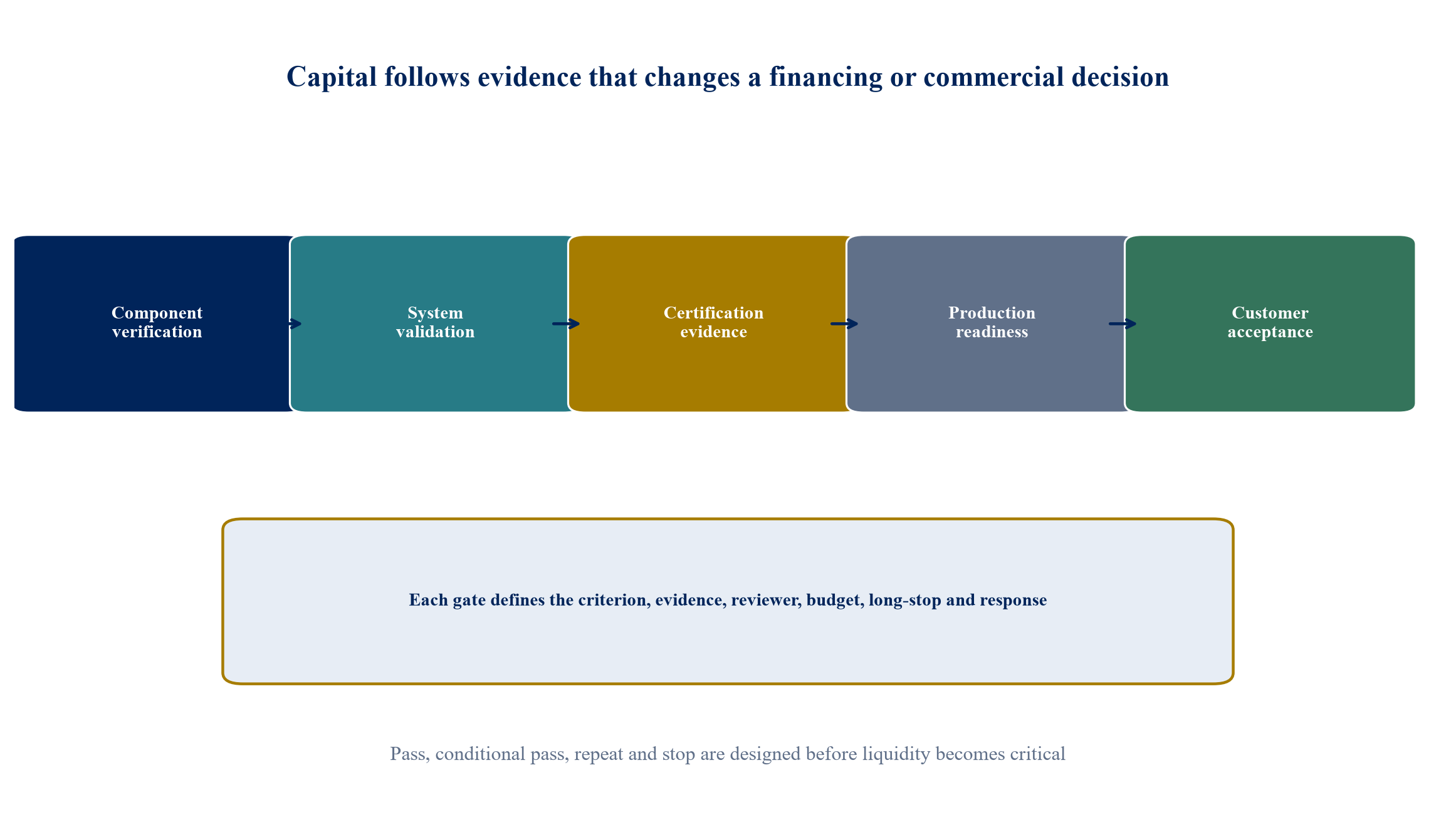
Author-designed framework. The order and responsible authorities vary by technology, jurisdiction and customer.
2. Separate the five proof layers before setting milestones
Technical verification asks whether an output meets an approved requirement. Validation asks whether the system is suitable for its intended use in a representative or actual environment. NASA distinguishes verification against specified requirements from validation under realistic conditions with representative users and mission needs [3]. That distinction matters in financing. A completed design verification package may support a draw for system integration, while it cannot by itself support a claim that customers will accept the product.
Regulatory or standards certification is a separate proof layer. The regulator may assess safety, efficacy, airworthiness, cybersecurity, environmental performance or conformity. The applicant controls preparation and evidence quality, while the authority controls review and approval. The U.S. Federal Aviation Administration presents aircraft certification as a multi-phase process covering standards, definition, detailed compliance planning, build, test, certification and production [4]. A financing plan should therefore distinguish applicant-controlled deliverables from authority-controlled decisions and avoid promising a date that only the authority can determine.
Production readiness asks whether the organisation can build the validated design repeatedly at the required quality, yield, cost and volume. A successful hand-built prototype does not answer supplier qualification, process capability, test coverage, traceability or field-support questions. The U.S. Food and Drug Administration explains that design verification and validation need to be followed by evidence that manufacturing can consistently reproduce the approved design [5]. This principle extends beyond medical devices to advanced materials, robotics, photonics, semiconductors, aerospace and energy hardware.
Customer acceptance asks whether a named customer has tested, accepted and committed to use or purchase the product under defined terms. IFRS 15 notes that customer acceptance may be substantive when compliance with agreed specifications cannot be objectively determined before the customer's decision [6]. A non-binding pilot, a successful technical trial, a purchase order, an accepted delivery and cash collection represent different commercial states. The financing model should use the exact state achieved.
These layers interact but should not be collapsed. A credible evidence map shows the baseline, target state, test environment, completion criterion, reviewer, document set and commercial consequence for each layer. It also identifies dependencies. A regulator may require production samples; a customer may require certification; certification may require a final design; and the final design may depend on pilot data. The critical path is an evidence dependency network, not a list of dates.
3. Build a validation baseline that survives diligence
Before financing is structured, the company should establish what has already been demonstrated. The baseline should identify every critical technology element, system interface and claim that matters to intended use. Evidence can include test protocols, raw data, calibration records, laboratory accreditation, simulation assumptions, design reviews, defect logs, prototype bills of material, regulator correspondence, customer feedback and independent assessments. The record should show versions, dates, owners and traceability to requirements.
The baseline should distinguish repeatable evidence from a single promising result. One test on one prototype under favourable conditions may justify further work but rarely proves reliability. A lender or investor will want to understand sample size, environmental range, controls, reproducibility, failure distribution and changes made after the test. GAO's technology readiness guidance stresses the importance of credible and objective assessment [2]. The company should preserve adverse results and explain how they changed the design rather than presenting a curated success file.
External validation can improve confidence when the reviewer is competent, independent and working to an agreed scope. Independence alone is insufficient. A reviewer who examines a narrow component cannot opine on system integration, and a laboratory certificate may not cover the intended operating range. The engagement letter should state the claims tested, standards used, data accessed, reliance limits and material exceptions. Management remains responsible for the financing representation.
The baseline should also record commercial and organisational readiness. Key questions include ownership of intellectual property, freedom to operate, data rights, supplier dependency, quality-system maturity, customer access, regulatory strategy, insurance, export controls and the availability of qualified staff. WIPO advises ventures to prepare an auditable intellectual-property portfolio and supporting data room for financing diligence [7]. A technically strong programme can still become unfinanceable if its core licence is terminable, a university retains unaddressed rights, or a key contractor owns foreground intellectual property.
Table 1. Evidence domains for a financeable validation baseline
| Evidence domain | Decision question | Minimum evidence | Common false positive |
|---|---|---|---|
| Requirements | What must the product demonstrably do? | Approved, version-controlled requirements linked to intended use | Feature list presented as a verified specification |
| Technical performance | Has the critical function been demonstrated? | Protocol, raw data, calibration, sample and exception record | Selected chart without underlying data |
| Operating environment | Was the test representative of actual use? | Environmental envelope and documented differences | Laboratory success described as field validation |
| System integration | Do components and interfaces work together? | Integrated test, interface control and defect closure | Component maturity averaged into system maturity |
| Certification | Is the approval path agreed and progressing? | Applicable rules, accepted plan, submissions and regulator record | Application filing described as approval |
| Production | Can the design be reproduced at required quality and cost? | Process flow, yield, supplier, quality and traceability evidence | One hand-built unit described as production ready |
| Customer acceptance | Has a customer accepted defined performance and terms? | Signed protocol, results, acceptance record and commercial document | Letter of interest treated as contracted revenue |
| Intellectual property | Can the company control and commercialise the solution? | Ownership chain, licences, filings, freedom-to-operate analysis | Patent filing treated as enforceable market freedom |
Author-designed checklist; sector-specific legal, technical and regulatory advice remains necessary.
4. Define milestones as financing decisions rather than project labels
A milestone should answer a financing question. Examples include whether a system is safe enough to enter field trials, whether a design is frozen enough to order long-lead tooling, whether a regulator has accepted the compliance plan, whether a pilot has met contracted acceptance criteria, or whether a production line has achieved repeatable yield. Labels such as prototype complete, certification progress or customer engagement do not specify an investable state.
Each milestone should contain seven elements. First, the decision that the evidence will support. Second, objective completion criteria. Third, the evidence package and data lineage. Fourth, the reviewer and approval authority. Fifth, the budget and cash period financed. Sixth, the due date and long-stop date. Seventh, the response to pass, conditional pass, repeat or failure. DARPA's guidance for research and prototype transactions requires milestone descriptions, completion criteria, due dates and payment schedules linked to technical metrics [8]. The discipline transfers well to private finance.
Criteria should be measurable, material and resistant to self-certification. A thermal system milestone could require operation at defined load, temperature and duration across a specified sample, with no critical failure and with raw data reviewed by an agreed laboratory. A certification milestone could require regulator acceptance of the test plan rather than the company's submission. A customer milestone could require signed acceptance against the pilot protocol and a purchase decision under stated conditions. The criterion should specify permitted deviations and the process for adjudicating exceptions.
Milestones can be cumulative or severable. The U.S. Federal Acquisition Regulation requires performance events to be defined, identifies cumulative preconditions, and links payment to successful accomplishment of agreed criteria [9]. A private financing agreement should likewise show whether a later success cures an earlier shortfall, whether one workstream can progress independently, and whether funds may be reallocated. Ambiguity creates disputes exactly when the company is most liquidity constrained.
The design should protect learning. A conditional pass can release a reduced draw while funding a defined remediation plan. A repeat outcome can permit one re-test within budget and time limits. A failure can trigger a board decision on redesign, strategic partnership, sale, licensing or orderly stop. The company should never discover after a failed test that the documents provide only an immediate funding cliff.
5. Size a draw to the next financeable state
The starting point is a cost-to-evidence budget. It includes direct research and engineering, prototypes, tooling, laboratories, regulatory advisers, quality systems, customer-site work, data infrastructure, insurance, intellectual-property work and programme management. It should also include working capital for long-lead components and realistic payment timing. The budget is tied to the evidence package rather than to a broad department allocation.
Each draw should cover the base cost to the next state, an evidence-specific contingency and a minimum liquidity reserve. Contingency should reflect the failure modes that remain. A redesign reserve may be higher before integrated testing; a regulatory reserve may reflect requests for additional information; a customer reserve may fund deployment support or a longer evaluation. The reserve is not hidden padding. It is an explicit response to remaining uncertainty, with release and governance rules.
The company should model three clocks. The technical clock covers build, test, analysis and rework. The authority clock covers regulator, laboratory, notified-body or grant-agency review. The commercial clock covers customer access, procurement, budgeting, acceptance and payment. The financing clock covers diligence, documentation, conditions precedent and funding. The cash model uses the slowest credible combination, with scenarios for dependency failure.
A draw should not end on the exact day of the milestone. The board needs time to assemble evidence, obtain review, cure immaterial exceptions and complete the next financing. A post-milestone financing buffer is therefore part of the cost of reaching the state. The appropriate buffer depends on the instrument, investor process, regulatory uncertainty, customer concentration and availability of bridge capital.
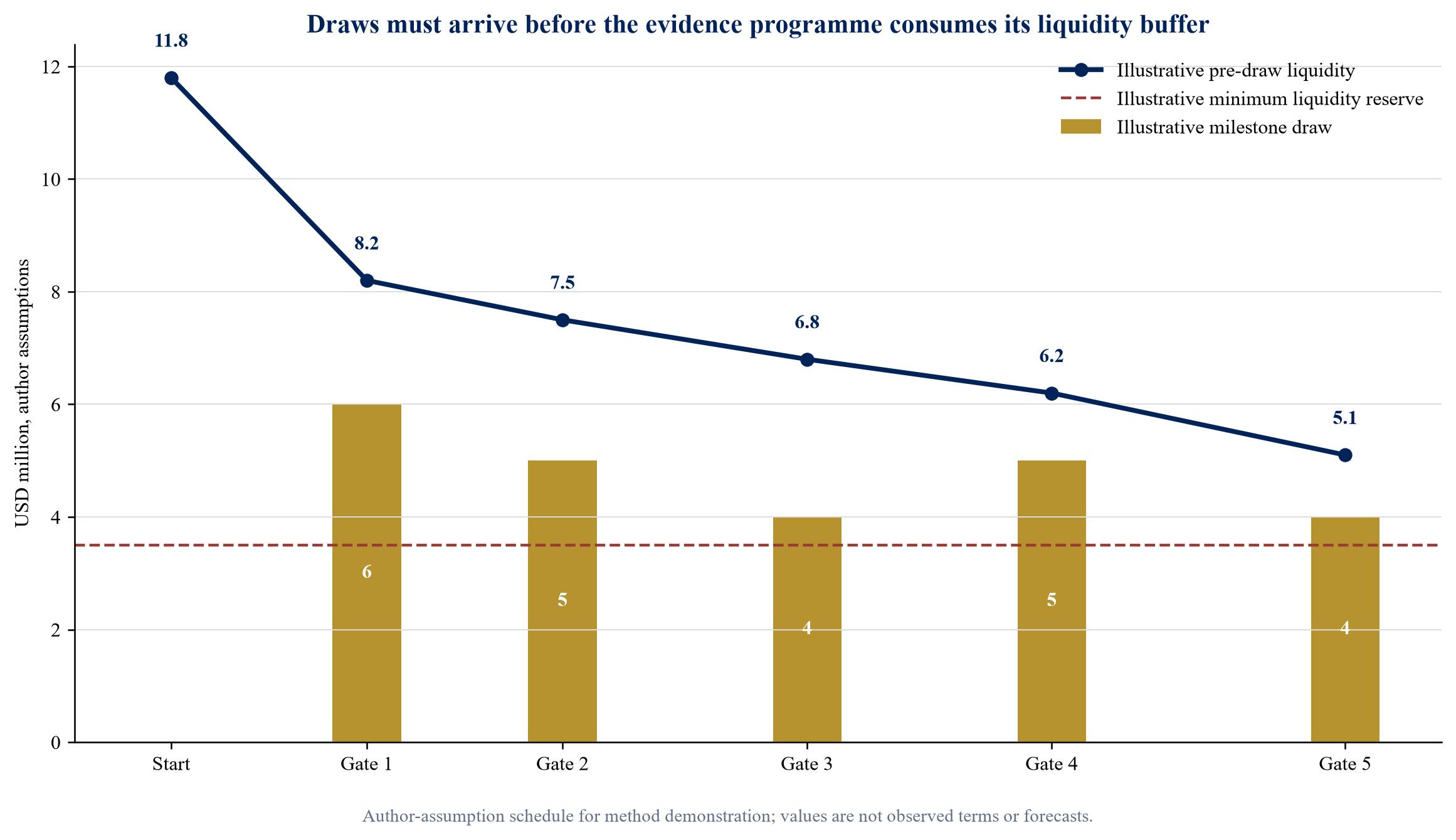
Author assumptions for method demonstration; values are not observed financing terms or forecasts.
6. Use one evidence register across all capital providers
Different capital providers often request different versions of the same programme. A grant office tracks work packages and deliverables, an equity investor tracks product and commercial milestones, a lender tracks covenants and draw conditions, and a customer tracks acceptance. Parallel reporting creates inconsistent definitions and consumes management capacity. The company should maintain one controlled evidence register with purpose-specific views.
The register records the requirement, owner, baseline, target, test protocol, dependency, due date, budget, evidence location, reviewer, result, exception and decision. It should link to the cash model and risk register. Changes require version control and approval. A test result is entered once and can support several decisions only where its scope permits. Evidence produced for a grant claim should not automatically be treated as sufficient for a lender or customer.
Horizon Europe grant reporting requires coordinators to submit reports, payment requests and proof of deliverables through the grant-management service [10]. Innovate UK assigns monitoring and requires exploitation planning and evidence of project progress [11]. These systems illustrate a useful discipline: funding depends on documented commitments and monitored delivery. Private capital can use the same evidence architecture while avoiding unnecessary bureaucracy.
Access should be controlled. Technical secrets, personal data, customer information, export-controlled material and regulator correspondence may require separate permissions. A diligence index should show what exists, who can rely on it and which redactions or clean-team arrangements apply. The register can contain a non-confidential summary linked to restricted source documents. Security and audit logs matter because the financing process itself can expose valuable know-how.
7. Match the instrument to the risk it can absorb
Early technical uncertainty is usually better absorbed by grants, founder capital, strategic research funding and equity. These instruments do not require a fixed repayment schedule from an unproven revenue base. Later validation and commercialisation may support convertible instruments, venture debt, customer advances, contract finance, equipment facilities or project debt. The sequence should follow evidence maturity and cash-flow visibility.
The EIC Accelerator combines grants with direct equity or quasi-equity for high-risk innovation, with grants supporting innovation activities and investment capital helping bridge toward market finance [12]. The EIC Fund describes a patient, milestone-based investment approach with follow-on capacity [13]. The EIB offers venture debt to innovation-driven companies that have raised professional equity and can support a substantial investment, including firms in deeptech, advanced engineering, quantum, artificial intelligence, space, advanced materials and clean technology [14]. These public programmes are not templates for every private deal, but they demonstrate that instrument choice changes as evidence and scale develop.
Customer finance can be powerful because it validates demand and reduces external capital need. Options include paid pilots, non-recurring engineering fees, deposits, minimum purchases, capacity reservations, milestone payments and co-funded certification. The contract must define intellectual-property rights, exclusivity, termination, acceptance and refund obligations. An advance that is repayable after a delayed pilot can create debt-like risk. A heavily customised programme can consume resources without creating a repeatable product.
Debt should finance a credible repayment source. It may bridge a contracted receivable, fund equipment with residual value, finance inventory against committed orders, or extend runway after technical risk has fallen and equity is committed. Venture debt can include bullet repayment and equity-linked remuneration [14]. It remains debt, with maturity, covenants and downside consequences. A company should not use debt merely because equity dilution feels expensive.
Table 2. Instrument selection by evidence state and repayment source
| Instrument | Evidence state suited to instrument | Primary repayment or return source | Principal control risk |
|---|---|---|---|
| Research grant | Defined technical programme before commercial proof | Policy objective and eligible delivery | Restricted use, reporting and reimbursement timing |
| Equity | High uncertainty with large residual upside | Enterprise value and exit | Dilution and governance misalignment |
| Convertible capital | Interim state before a priced valuation | Conversion or repayment under agreed trigger | Maturity pressure and valuation ambiguity |
| Venture debt | Demonstrated technology, funded plan and credible growth | Future equity, revenue or liquidity event | Refinancing dependence and covenant stress |
| Paid pilot | Customer-specific validation with agreed scope | Customer budget and acceptance | Customisation, delay and refund exposure |
| Customer advance | Contracted order or capacity commitment | Delivery and final invoice | Performance security and working-capital mismatch |
| Contract finance | Enforceable milestone or receivable | Contracted payment | Set-off, acceptance and customer concentration |
| Equipment finance | Identifiable productive asset | Operating cash flow and asset value | Specialised equipment with weak recovery value |
Indicative decision framework; availability and terms vary by company, investor and jurisdiction.
8. Protect debt capacity without starving the programme
A milestone-draw debt facility needs conditions that protect the lender and leave the company able to complete the financed work. Conditions precedent can cover committed equity, intellectual-property ownership, insurance, budget approval, material contracts, licences and a minimum cash reserve. Draw conditions can cover evidence completion, absence of material adverse change, updated cost-to-complete and compliance with information undertakings. The lender should specify who determines satisfaction and how disputes are resolved.
Financial covenants based only on revenue or EBITDA may be poorly matched to pre-commercial deeptech. Liquidity runway, cost-to-complete, committed co-funding, customer concentration, overdue payables and milestone variance may provide earlier warning. Technical covenants should focus on reporting and governance rather than allowing a lender to manage engineering. The board remains responsible for technical decisions, with reserved matters for material scope changes, abandonment, intellectual-property disposal and unbudgeted commitments.
Tranching reduces exposure, while excessive discretion can make committed capital unreliable. The agreement should distinguish objective conditions from lender-consent items. It should provide a cure process for immaterial documentation gaps and a defined response to disputed evidence. A company cannot prudently plan a certification programme around capital that can be withheld for an undefined reason.
The facility should address delay. Options include automatic extension within a funded reserve, a reduced remediation draw, capitalised interest, covenant resets, sponsor cure, or conversion of part of the instrument. The lender should receive an updated evidence and liquidity package. Default should be reserved for material failures such as misuse of funds, insolvency, fraud, loss of core rights or abandonment, rather than every missed forecast date.
9. Connect milestone evidence to valuation and dilution
Milestones can change value because they alter expected cash flow, probability of commercialisation, capital required and the set of available investors. The change is not mechanical. A certification success may have limited value if manufacturing cost remains uneconomic. A failed pilot may reveal a valuable adjacent use. A purchase commitment can be more valuable than a technical pass, but only if pricing, volume, termination and collection are credible.
The company should show a value bridge rather than promise a valuation uplift. Start with the commercial cases that become possible after the milestone. Model revenue timing, gross margin, capital expenditure, working capital, additional development and downside. Identify which assumptions are supported by contracts or tests and which remain management estimates. The bridge should also show how the next financing requirement changes.
Equity can be released in stages at one agreed price, at milestone-linked prices, or through separate closings. A fixed price gives certainty but may transfer too much value if risk falls materially. A milestone ratchet can align price with evidence but create argument over completion. Convertible capital defers pricing but can compound and dilute sharply if the next round is delayed. The choice should be evaluated across success, delay and failure scenarios.
The board should compare the expected dilution cost of equity with the cash and control cost of debt. It should include warrants, fees, interest, covenants, refinancing risk and the value of flexibility. The cheapest headline instrument can be expensive if it forces a financing during a delay. The objective is sufficient capital to reach a stronger state while preserving a viable downside path.
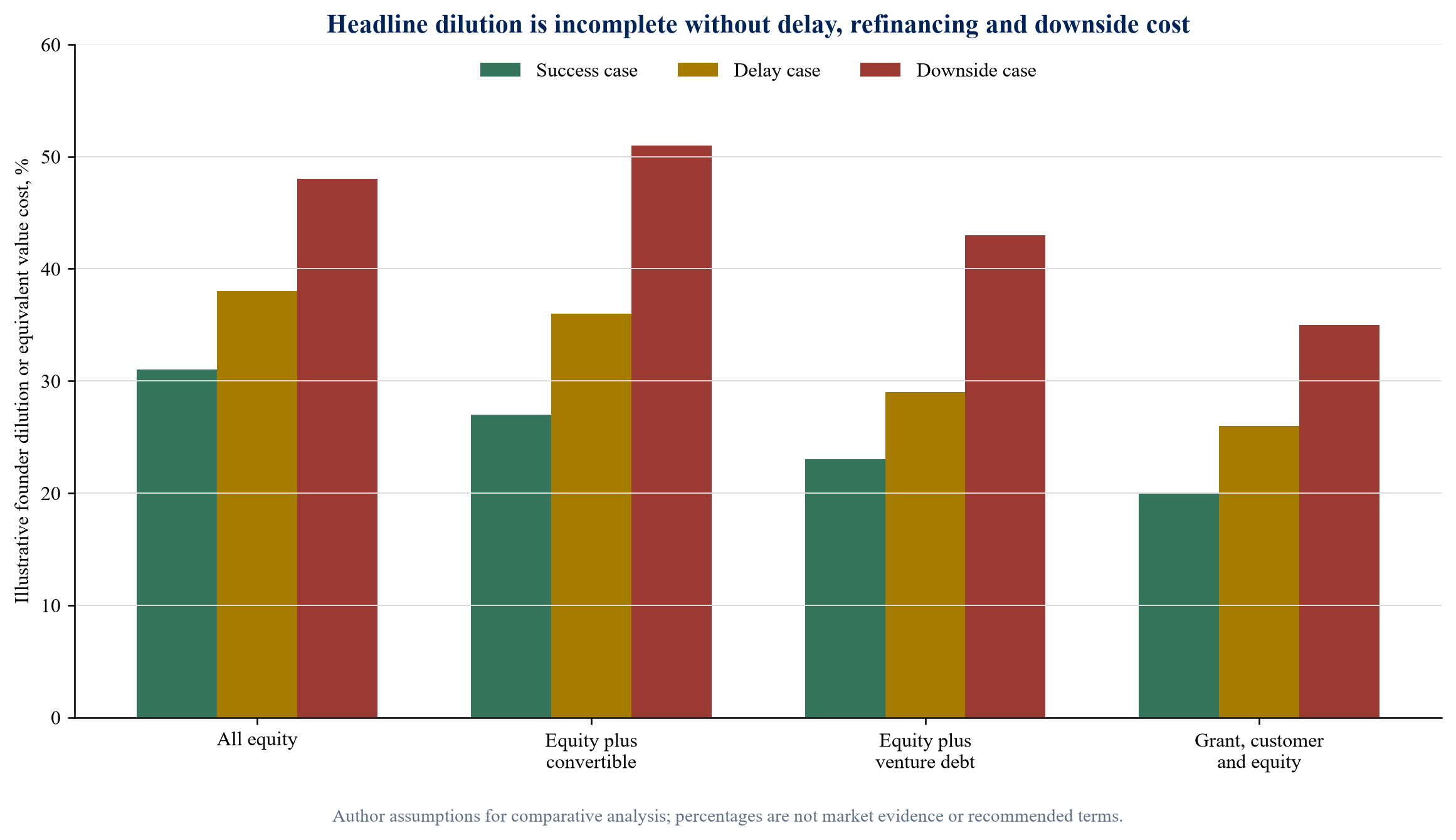
Author assumptions for analytical comparison; outputs are not market valuations, quoted terms or recommendations.
10. Make customer acceptance a contractual evidence gate
Customer acceptance often sits between technical success and financeable revenue. The pilot agreement should state the intended use, test environment, responsibilities, installation, data access, success metrics, test duration, exception handling, acceptance authority and commercial consequence. If the customer's operational data or facility is required, access obligations and delays should be explicit.
Acceptance criteria should be objective where possible. Performance can be measured against accuracy, uptime, throughput, energy use, defect rate, latency, safety, cost or another operational metric. The baseline and measurement method should be agreed before the trial. The protocol should address exclusions, missing data, changes in operating conditions and who validates the result. A customer should not be able to move the target after the company has spent the capital.
The commercial consequence distinguishes validation from procurement. A successful pilot may trigger a purchase order, preferred-supplier process, negotiation right, deployment plan or no obligation. Finance providers should model the actual contract. IFRS 15's treatment of acceptance highlights that control and revenue recognition depend on whether compliance with agreed specifications can be objectively established [6]. A financing model should also distinguish signed backlog, conditional orders, trials and informal pipeline.
Customer concentration creates bargaining risk. A strategic customer can provide facilities, data, credibility and cash, while demanding exclusivity, ownership, broad indemnities or termination rights. The board should define the price of those concessions. The programme should preserve the ability to commercialise elsewhere unless exclusivity is deliberately funded and limited by field, geography, time and performance.
11. Finance certification as a controlled external dependency
Certification planning begins with the applicable regulatory or standards pathway. The company should document the intended use, jurisdiction, product classification, responsible authority, required submissions, test standards, quality-system obligations, expected interactions and post-approval duties. Where classification or pathway is uncertain, early written advice can prevent a costly programme built against the wrong standard.
The financing milestone should focus on controllable and observable states. Examples include acceptance of a certification plan, completion of a conformity review, submission of a complete dossier, closure of material questions, successful witnessed testing and issuance of approval. The FAA process demonstrates how certification moves from basis and means of compliance through build, test and final approval [4]. The date of authority action remains an external dependency, so the budget needs time and cash contingencies.
Evidence quality affects both schedule and valuation. The FDA's design-control guidance defines verification as evidence that specified requirements have been fulfilled and validation as evidence that specifications conform to user needs and intended use [15]. In regulated products, financing diligence should examine protocols, deviations, corrective action, design history, data integrity and quality-system readiness. A certificate without a scalable, compliant process may not support commercial deployment.
The agreement should allocate change risk. Regulations, standards, notified bodies, test methods or intended use can change. A material change-control process should assess technical scope, cost, schedule, customer commitments and financing. The board should know which reserve is available and whether investors are committed to fund it. A certification delay is manageable when it is visible early and financed deliberately.
12. Treat intellectual property and data rights as draw conditions
Deeptech value often depends on patents, trade secrets, software, data, know-how, designs and specialised process knowledge. The company should show a complete chain from inventor or contractor to the operating entity. Employment and consulting agreements, university licences, joint-development terms, open-source software, background rights and government funding conditions can affect control and commercial freedom.
WIPO describes intellectual-property due diligence as a comprehensive audit used by investors, partners and buyers, supported through a controlled data room [7]. It also notes that intellectual property can support finance through security or transfer of cash-flow rights, while practical adoption requires valuation and risk controls [16]. A lender may take security over shares, accounts and intellectual property, but recovery value depends on transferability, continued know-how, licences, regulatory files and the ability to operate the asset.
Each milestone should specify ownership of foreground intellectual property and test data. A customer-funded pilot may create jointly developed improvements. A university or laboratory may retain rights. A regulator may restrict data use, and personal or sensitive operational data can impose legal obligations. The financing documents should not assume that the company owns every output simply because it paid the invoice.
The evidence register should include invention disclosure, filing decisions, prosecution status, freedom-to-operate updates, licence obligations, encumbrances and renewal dates. Security documents should be consistent with existing licences and public funding. A material intellectual-property dispute, loss of exclusivity or breach of a grant condition should trigger a specific board review because it can change both milestone value and available financing.
13. Govern evidence with independent challenge and rapid decisions
The board should appoint a validation finance committee with authority over milestone definitions, budgets, evidence acceptance, draw requests and remediation. Membership can include the chief executive, chief financial officer, technical lead, product or commercial lead and an independent director. Regulatory, quality, legal and external technical advisers participate where relevant. Conflicts should be recorded, especially when management compensation or survival depends on a pass decision.
Management prepares the evidence package. An independent reviewer tests whether the defined criterion is met. The committee decides the financing consequence. These roles should remain separate. The reviewer should not silently redefine the milestone, and the capital provider should not substitute its technical opinion for the agreed test. Any reservation should be documented with materiality and proposed cure.
The monthly pack should include cash, cost-to-complete, milestone status, dependencies, change requests, defects, regulator or customer interactions, financing headroom and decisions required. Red status should prompt action rather than cosmetic reforecasting. The committee needs a short decision timetable because a laboratory slot, customer site or production run can be lost while documents circulate.
Information rights should continue after a draw. The company reports use of funds, evidence progress, material deviations and liquidity. Capital providers should receive enough information to monitor risk without receiving restricted technical data they cannot protect or use. Cybersecurity, export control and confidentiality protocols should be built into diligence and monitoring.
Table 3. Milestone decision rights and evidence ownership
| Activity | Management responsibility | Independent evidence role | Financing decision authority |
|---|---|---|---|
| Define intended decision | Propose business need and programme scope | Challenge testability and evidence relevance | Board approves; capital provider confirms contractual relevance |
| Set completion criteria | Draft technical and commercial measures | Test objectivity, scope and materiality | Board approves; capital provider agrees draw condition |
| Produce evidence | Execute work and preserve controlled records | Observe or review under agreed scope | Board monitors; capital provider receives permitted package |
| Classify result | Recommend pass, conditional pass, repeat or fail | Issue finding and reservations | Board decides programme response; provider applies agreed draw consequence |
| Approve remediation | Prepare scope, budget and schedule | Review whether proposed cure addresses the failure | Board approves or stops; provider funds only under agreed mechanism |
| Control change | Identify impact on evidence, cash and dependencies | Assess whether prior evidence remains valid | Board approves material change; provider consents where required |
Author-designed governance model; fiduciary, contractual and regulatory duties vary by entity and jurisdiction.
14. Apply the architecture to a hypothetical validation programme
Consider a hypothetical industrial sensing company preparing a system for harsh operating environments. The author assumes that component performance has been demonstrated in the laboratory, while integrated field reliability, a sector certification, production yield and a customer's acceptance remain outstanding. Opening liquidity is USD 11.8 million. The planned programme costs USD 31.5 million over twenty-four months, including a USD 4.0 million explicit contingency. The company seeks USD 24 million of new capital in five draws and expects customer and grant receipts to fund the balance.
Draw one of USD 6 million funds integrated engineering units, environmental testing and the quality-system build. The evidence gate requires traceable requirements, an approved protocol, operation across the specified environmental envelope and closure of all critical defects. Draw two of USD 5 million funds certification specimens, regulator or standards submissions and long-lead production tooling. Its gate requires acceptance of the compliance plan and a frozen configuration for the required tests.
Draw three of USD 4 million funds field pilots at two customer sites. The gate requires installation, agreed data quality, completion of the operating period and an independently reviewed performance report. Draw four of USD 5 million funds production validation and supply-chain qualification. The gate requires repeatable yield, traceability, supplier approvals and a costed production plan. Draw five of USD 4 million funds initial deployment and working capital after signed customer acceptance and a commercial order.
The base case assumes each gate is reached within its planned window. A delay case assumes certification questions add four months and USD 2.2 million of rework. A downside case assumes the first customer pilot misses one performance threshold, requiring redesign and a second pilot. These are author assumptions. The committee should examine remaining cash at each gate, the availability of the contingency, the timing of customer receipts and the amount of committed capital still available.
The structure is viable only if the company has authority to use contingency for genuine evidence work and enough liquidity to survive review. A draw that arrives after cash is exhausted has no practical value. The financing agreement should therefore permit a defined remediation draw when evidence shows a curable shortfall, subject to an approved plan and a revised cost-to-complete.
15. Pre-agree responses to delay, partial success and failure
Four outcomes should be available. A pass confirms that the criterion is met and releases the next draw. A conditional pass identifies a limited exception that does not invalidate the state and releases capital with a cure. A repeat funds one additional test or evidence cycle within defined limits. A fail indicates that the original programme no longer supports the financing case and requires a strategic decision.
Delay should be classified by cause. Technical rework, regulator review, customer access, supplier failure and financing documentation require different responses. A schedule slip without evidence of increasing cost or reduced probability may use the existing buffer. A delay that changes the design, certification basis, customer commitment or total capital need requires re-underwriting. The company should disclose the cause and revised evidence plan promptly.
Remediation capital can be pre-committed, conditionally committed or raised after the event. Pre-commitment improves resilience but may be expensive. A conditional reserve can be released against a board-approved plan and independent confirmation that the problem is curable. Fresh fundraising preserves investor discretion but can force a distressed negotiation. The optimal mix reflects the technology's failure modes and the company's alternatives.
Failure can still preserve value through licensing, asset sale, strategic partnership, narrowing the intended use, changing the customer segment or orderly wind-down. The documents should preserve intellectual property, data, equipment, regulator files and customer relationships. Security enforcement should avoid destroying the technical team and know-how before a sale can be assessed. Early planning increases the probability of a controlled outcome.
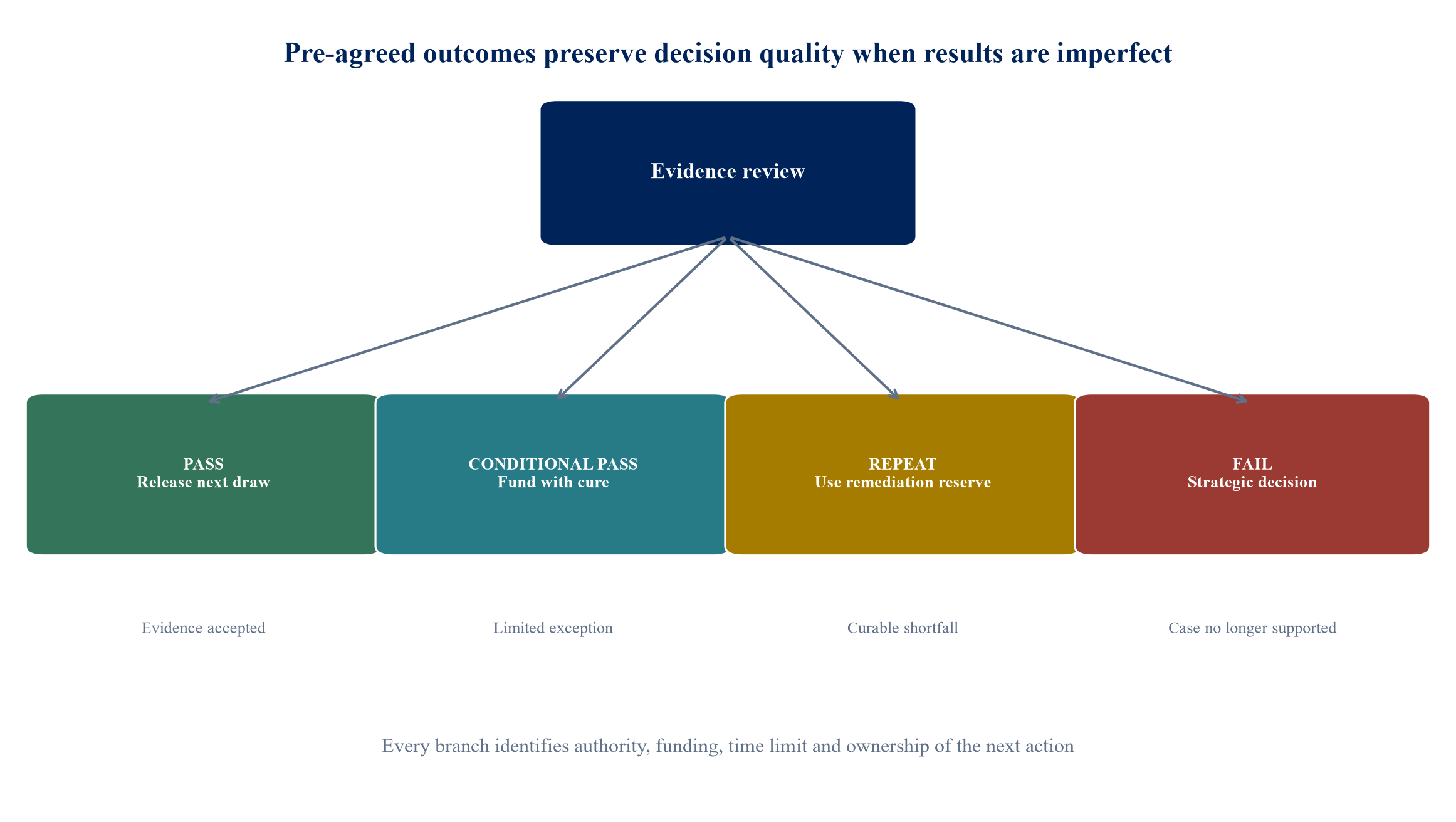
Author-designed decision framework. Actual remedies depend on contract, solvency, fiduciary duties and available capital.
16. Combine public and private capital without double funding or control conflict
Public programmes can absorb early technical risk, provide validation infrastructure and attract private co-investment. The EIC Accelerator supports high-risk innovation through grants and investment [12]. Innovate UK offers patient innovation loans to eligible UK SMEs through a competitive credit process [17]. The U.S. Department of Energy Loan Programs Office conducts due diligence, issues conditional commitments and monitors construction, commissioning and operations for eligible projects [18]. America's Seed Fund supports technology development through SBIR and STTR phases [19].
The company should map eligible costs, funding rates, match requirements, state-aid or subsidy rules, procurement, intellectual-property terms, reporting and change control. The same cost should not be claimed twice. A private lender should understand whether grant receipts are reimbursement based, conditional, delayed or subject to clawback. The grant agreement and financing documents need consistent budgets and rights.
Conditions can conflict. A public funder may restrict security, relocation, control change, intellectual-property transfer or use of proceeds. A venture lender may require security and consent rights. A strategic customer may seek exclusivity or foreground rights. The capital map should identify these conflicts before commitments are signed. The cheapest source can reduce future strategic flexibility.
The company should also distinguish a public conditional commitment from funded liquidity. DOE explains that financing progresses through application, due diligence, conditional commitment, financial close and monitoring [18]. Conditions precedent can remain after the public announcement. The cash model should include only amounts whose conditions, timing and draw mechanics are understood.
17. Execute a 180-day validation-finance readiness programme
Days one to thirty establish the baseline. Management identifies critical technology elements, intended use, certification path, customer acceptance process, intellectual-property ownership, programme dependencies and existing evidence. Finance reconciles the programme budget to cash, grants, customer receipts and committed capital. The board approves the key decisions the next financing must support.
Days thirty-one to sixty define milestones and protocols. Technical, quality, regulatory and commercial teams draft completion criteria, evidence packages, reviewers and exception rules. The company agrees pilot protocols with customers and obtains early regulatory or standards feedback where available. Finance builds base, delay and downside cost-to-complete cases.
Days sixty-one to ninety design the capital stack. The company allocates work between grant, equity, convertible, customer and debt capacity. It tests repayment sources, dilution, covenants, security, conditions precedent and funding timing. Legal advisers review intellectual-property, data, customer, grant and regulatory constraints. The board approves the target structure and stop conditions.
Days ninety-one to one hundred and twenty prepare diligence. The evidence register, data room, financial model, test record, regulator file, customer documents, intellectual-property chain and governance minutes are reconciled. Independent reviewers confirm their scope. Management prepares a concise explanation of what is proven, what remains uncertain and how the requested capital changes the evidence state.
Days one hundred and twenty-one to one hundred and fifty run capital-provider diligence and negotiate terms. Proposed draw conditions are tested against operational reality. The company ensures that funding arrives before laboratory, supplier, customer and payroll commitments. Discretion, cure, remediation, reporting and long-stop mechanics are documented.
Days one hundred and fifty-one to one hundred and eighty complete conditions precedent and rehearse the first draw. The committee reviews the baseline evidence, liquidity, approved uses and reporting system. Access controls and data rights are tested. After funding, the same programme becomes the monitoring system rather than a presentation that is abandoned at closing.
18. Finance the next credible proof while preserving the company
Deeptech capital becomes more efficient when it follows evidence. The framework does not remove technical, regulatory or commercial risk. It makes each risk visible, assigns evidence to it and connects the result to a financing decision. That discipline helps boards avoid both premature leverage and repeated emergency equity raises.
A strong milestone is specific enough to be verified and important enough to change a capital or commercial decision. It identifies the environment, criterion, data, reviewer, budget and consequence. It permits a reasoned response to partial success and funds a credible delay. It also recognises that certification and customer acceptance depend partly on external actors.
The capital stack should evolve. Grants and equity can absorb early uncertainty. Customer finance can connect development to demand. Venture debt and contract finance become more credible when technology, governance, repayment and liquidity are demonstrable. Public and private instruments should share one evidence baseline while respecting their distinct legal terms.
The final board paper should state the evidence state being financed, the cost to reach it, the committed capital, the liquidity buffer, the acceptance authority, the downside path and the next financing decision. It should distinguish observed evidence from management estimates and author assumptions. A milestone-draw structure succeeds when the company can continue to make good decisions after an unexpected result.
Table 4. Hypothetical five-draw financing schedule
| Draw | Amount USDm | Release state and evidence | Planned liquidity buffer USDm |
|---|---|---|---|
| 1 | 6.0 | Integrated environmental validation; approved protocol, raw data and critical-defect closure | 4.5 |
| 2 | 5.0 | Certification-plan acceptance and design freeze; accepted compliance plan and configuration record | 4.0 |
| 3 | 4.0 | Two-site customer pilot; completed operating period and reviewed performance report | 3.8 |
| 4 | 5.0 | Production validation; yield, traceability, supplier and cost evidence | 4.2 |
| 5 | 4.0 | Initial deployment; signed customer acceptance and commercial order | 3.5 |
| Total | 24.0 | Cumulative validation through deployment | Not additive |
Author assumptions for method demonstration; amounts, timing and outcomes are not observed terms or forecasts.
References
- National Aeronautics and Space Administration. Systems Engineering Handbook, Appendix G: Technology Assessment and Technology Readiness Levels. 2016. https://www.nasa.gov/reference/system-engineering-handbook-appendix/
- U.S. Government Accountability Office. Technology Readiness Assessment Guide: Best Practices for Evaluating the Readiness of Technology for Use in Acquisition Programs and Projects. GAO-20-48G. January 2020. https://www.gao.gov/products/gao-20-48g
- National Aeronautics and Space Administration. Systems Engineering Handbook, Product Realization: Verification and Validation. 2016. https://www.nasa.gov/wp-content/uploads/2018/09/nasa_systems_engineering_handbook_0.pdf
- Federal Aviation Administration. How It Works: Aircraft Certification. 23 April 2026. https://www.faa.gov/newsroom/how-it-works-aircraft-certification
- U.S. Food and Drug Administration. Medical Device Premarket Approval and Postmarket Inspections, Part I: Background. https://www.fda.gov/medical-devices/quality-and-compliance-medical-devices/medical-device-premarket-approval-and-postmarket-inspections-part-i-background
- IFRS Foundation. IFRS 15 Revenue from Contracts with Customers, paragraphs - on customer acceptance. https://www.ifrs.org/content/dam/ifrs/publications/pdf-standards/english/2022/issued/part-a/ifrs-15-revenue-from-contracts-with-customers.pdf
- World Intellectual Property Organization. How to Prepare for IP Due Diligence: The Ultimate Guide for Ventures. 14 July 2026. https://www.wipo.int/en/web/ip-commercialization/w/blog/how-to-prepare-for-ip-due-diligence-the-ultimate-guide-for-ventures
- Defense Advanced Research Projects Agency. Proposer Instructions: Other Transactions, Milestone Schedule Instructions. Updated 25 September 2025. https://www.darpa.mil/about/offices/contracts-management/proposer-transactions
- U.S. General Services Administration. Federal Acquisition Regulation, Subpart 32.10: Performance-Based Payments. FAC 2026-01. https://www.acquisition.gov/far/subpart-32.10
- European Research Executive Agency. Horizon Europe: Grants and Reporting. https://rea.ec.europa.eu/horizon-europe-grants-reporting_en
- UK Research and Innovation. What Happens If You Receive a Funding Offer. Updated 7 July 2026. https://www.ukri.org/councils/innovate-uk/guidance-for-applicants/general-guidance/what-happens-if-you-receive-a-funding-offer/
- European Innovation Council. EIC Accelerator. 2026 programme. https://eic.ec.europa.eu/eic-funding-opportunities/eic-accelerator_en
- European Innovation Council. EIC Fund Investment Guidelines and Approach. 27 August 2026. https://eic.ec.europa.eu/eic-fund/eic-fund-investment-guidelines-approach_en
- European Investment Bank. Venture Debt. https://www.eib.org/en/products/equity/venture-debt/index
- U.S. Food and Drug Administration. Design Control Guidance for Medical Device Manufacturers. https://www.fda.gov/media/116573/download
- World Intellectual Property Organization. Intellectual Property Finance. https://www.wipo.int/en/web/ip-financing/index
- UK Research and Innovation. Innovation Loans. Updated 8 May 2026. https://www.ukri.org/councils/innovate-uk/guidance-for-applicants/guidance-for-specific-funds/innovation-loans/
- U.S. Department of Energy, Loan Programs Office. Application Process and Advanced Technology Vehicles Manufacturing Loan Program Guide. https://www.energy.gov/edf/application-process
- U.S. Small Business Administration. America's Seed Fund: SBIR and STTR. https://www.sbir.gov/
- European Innovation Council. Frequently Asked Questions: EIC Accelerator. 2026. https://eic.ec.europa.eu/eic-frequently-asked-questions/faqs-eic-accelerator_en
- European Innovation Council. EIC Work Programme 2026. https://eic.ec.europa.eu/eic-funding-opportunities/eic-2026-work-programme_en
- European Investment Bank. TechEU Platform: What We Offer. https://www.eib.org/en/projects/topics/innovation-digital-and-human-capital/techeu/platform.htm
- U.S. General Services Administration. FAR 52.232-32 Performance-Based Payments. FAC 2026-01. https://www.acquisition.gov/far/52.232-32
- U.S. Food and Drug Administration. Applying Human Factors and Usability Engineering to Medical Devices. https://www.fda.gov/regulatory-information/search-fda-guidance-documents/applying-human-factors-and-usability-engineering-medical-devices
- World Intellectual Property Organization. Securing Loans with Your IP Assets. 2024. https://www.wipo.int/publications/en/details.jsp?id=4768
