
1 The investment decision and analytical contribution
A buyer of a desert solar asset needs to determine the cash-flow effect of environmental exposure and the cost of an effective operating response. The purchase decision involves temperature-dependent output, dust accumulation, cleaning water, equipment condition and the rights to operate the proposed policy. A uniform percentage deduction from asset value provides little information about those mechanisms. This paper proposes a structured valuation that traces each supported loss and intervention to delivered energy, expenditure, physical feasibility and remaining operating value.
The analysis combines primary technical and environmental evidence with a fictional daily operating case. The evidence establishes mechanisms, measurement needs and source-specific limitations. The worked case then tests alternative cleaning policies under an explicitly specified weather sequence, water budget and contract horizon. Its contribution is a reproducible connection between dust accumulation, intervention timing, annual water use and owner cash flow. The tables and figures report conditional outcomes from that example. They are not observed performance or market valuations.
The commercial reader can use the framework to organise acquisition diligence, compare operating proposals and identify the evidence needed for a price adjustment. A measured production shortfall should first be attributed to the correct cause. A proposed intervention should then be evaluated against the attainable production under the same weather and plant boundary. The final operating plan also needs a supported water source, suitable equipment, contractual acceptance and sufficient cash to fund implementation. These requirements determine which model inputs need confirmation before a transaction proceeds.
The paper separates its proposed method from the factual material cited in the references. Public sources describe performance mechanisms, measurement methods, environmental considerations and particular disclosed projects. They do not validate this paper's fictional plant, cleaning costs, tariff or acquisition value. Each numerical assumption is stated with the model. This separation permits the analytical contribution to be examined and reproduced without implying that a source has endorsed the resulting recommendation for a real asset.
2 Define the environmental cash-flow boundary
An acquisition price or refinancing plan needs an operating boundary that connects environmental exposure with dated receipts and expenditure. This paper proposes a loss ledger for that purpose. Begin with the equipment and contract perimeter, the remaining evaluation horizon, the settlement meter and the cleaning policy presently funded. Record whether the decision concerns the asset's operating cash flow, a purchaser's equity commitment or a lender's coverage calculation. Keep these accounts separately identifiable throughout the analysis. Every forecast adjustment should have a physical cause, a measurement basis, a timing rule and an identified cash-flow consequence.
IEA PVPS's analytical-monitoring guidance covers plant-level performance assessment, measurement configuration and regression-based analysis of temperature, wind and electrical behaviour. Its methods provide a basis for diagnosing operating losses; they do not establish the recoverable energy of an unidentified asset. [1]
For the proposed ledger, reconcile the recorded energy chain over matching intervals. Start with resource and equipment assumptions, then identify temperature response, soiling, conversion constraints, ordinary unavailability and persistent condition changes. Compare the result with metered export and investigate the residual. Describe the order of these adjustments explicitly. A percentage attributed to dust on one intermediate energy quantity cannot be added mechanically to another percentage measured against final export. The residual should remain an open reconciliation item until its cause is evidenced. Its presence alone supplies no diagnosis of degradation or contractor underperformance.
The proposed commercial bridge starts at that reconciled export. Apply only the payment arrangements established by the actual contract review, with separate treatment of excluded energy, deductions and collection timing. A cleaning intervention receives credit for incremental paid output within the selected horizon. A cash-flow model should also include the expenditure and operating interruption associated with that intervention. No market tariff, payment entitlement or contractual permission is established by the technical sources used here.
Preserve three forecast versions: the measured operating baseline, the proposed policy case and a downside case with explicitly selected assumptions. State the observation window and any missing intervals beside each version. The investment committee can then see the extent to which value depends on observed conditions, an engineering extrapolation or a discretionary operating change. An environmental price adjustment becomes a traceable consequence of these accounts. The framework supplies no standard geographical discount for a GCC solar asset.
3 Price heat through the equipment configuration
SAM's module documentation describes temperature calculations using solar radiation, ambient temperature, wind and module or mounting characteristics. It distinguishes module and cell temperature and allows configuration-dependent thermal parameters. These are modelling relationships requiring suitable inputs; the help page supplies no validated temperature-loss estimate for a particular GCC plant. [2]
SAM's inverter documentation treats power limiting, maximum-power-point voltage limits and inverter temperature derating as separate model elements. The thermal derate curve is editable. Its published default is a software input, with no status as an equipment-wide operating threshold or regional performance benchmark. [3]
The proposed diligence starts with the installed module bill of materials, inverter model, firmware and cooling configuration. Request the relevant equipment data, measured temperatures, alarm records and time-aligned irradiance. Identify sensor location and calibration history before comparing readings with a modelled cell temperature. Keep measured ambient temperature, measured module-back temperature and estimated cell temperature in distinct data fields. Where a field is unavailable, retain the gap and test an expressly assumed range. An absent measurement should never acquire the status of a recorded operating condition through spreadsheet repetition.
Evaluate a thermal intervention over the intervals in which it changes paid export. Construct a baseline and a changed-equipment case using the same resource sequence, service horizon and payment perimeter. Identify any resulting conversion limit and ordinary outage before calculating additional receipts. The comparison should disclose the method used to translate equipment response into export, including its time resolution. Daily or monthly approximations require an accompanying limitation because the chosen interval is an analytical simplification. Engineering review remains necessary for any actual design or control change.
Keep the reversible operating response to temperature separate from a persistent condition allowance. In this proposed account structure, the first changes output in the affected interval, while the second changes the later equipment baseline. A single measured shortfall should not be entered in both accounts. Attribute a lasting change only after the condition evidence and normalisation method support that classification. Model the cost and availability of inspections, cooling maintenance, spares and replacements on their own dates. A favourable annual energy comparison may still leave a concentrated funding requirement during the selected high-temperature scenario. Neither the software documentation nor this framework establishes a future weather sequence.
4 Measure dust recovery before paying for cleaning
The IEA PVPS soiling report describes substantial variation across modules and across a plant, with multi-sensor measurement relevant to cleaning decisions. It also identifies continuing validation needs for soiling models. Its global observations provide technical context; no global loss estimate is adopted as an asset-specific operating assumption here. [4]
DEWA's December 2025 disclosure describes an autonomous soiling detector tested at its head-office parking installation. The device compares actual production with expected production under defined conditions. The announcement is a bounded prototype example; it supplies no independently verified utility-fleet recovery or investment return for this analysis. [15]
The proposed measurement programme partitions the array into representative operating blocks and preserves the basis for that selection. Compare cleaned and untreated observations over aligned conditions, with the test method reviewed for suitability to the installed equipment. Keep the cleaning time, method, local irradiance, temperature, operating status and sensor condition in the same record. Report the sample coverage and unexplained variation. A clean reference device and an independently checked export record are separate evidence items, each with its own limitations. The proposed programme requires an engineer to determine an appropriate measurement design for the actual site.
The economic question concerns the next feasible cleaning event. Estimate the paid output recoverable between that event and the next reset or end of the evaluation period. State the assumed reset mechanism and the evidence supporting it. Then deduct mobilisation, labour, power, water, supervision, equipment wear and any installation or cleaning interruption. A proposal to clean every block on a fixed calendar should be compared with feasible selective or condition-triggered policies using a common resource sequence. None of those policy labels establishes an observed optimum.
Maintain separate entries for observed dirt recovery, modelled reaccumulation and persistent unrecovered loss. An unverified expectation of rainfall or full restoration belongs in an assumed sensitivity and must be identified in the accompanying prose. Test whether the commercial conclusion survives lower recovery, higher event cost and a delayed next cleaning. If a vendor's forecast requires measurements unavailable from the plant, price the information gap through a conditional decision or an explicit range. The acquisition case should retain the cost of obtaining that information and the time needed to act on it.
5 Make water availability a dated operating constraint
IFC Performance Standard 3 requires additional water-use measures where a project is a potentially significant consumer and its consumption could adversely affect others. Its framework applies to relevant IFC investments and may be adopted by other institutions. It establishes no general GCC water allocation, licence or delivery entitlement. [13]
WRI describes Aqueduct as a water-risk information platform. Its FAQ states that baseline data are historical representations and are not real-time observations. The tool supports a screening enquiry; it does not verify a plant's contracted volume, water quality, delivery reliability or current storage. Those matters require local evidence. [14]
The IFC disclosure for Egypt's Abydos project describes a proposed cleaning regime prioritising dry brushing, with wet cleaning contemplated for adhesive dust following rain or humidity. It is a project-specific environmental-review account, including estimated requirements. It supplies an external comparator for diligence questions and no observed GCC cleaning demand or water-supply right. [18]
The proposed water account follows physical delivery and use by date. Identify the source, quality specification, contracted quantity, delivery route, storage capacity and responsibility for each step. Obtain evidence of relevant permissions and contractual restrictions from the actual asset review. Reconcile receipts, tank movements and cleaning records. A supplier quotation should retain its validity period and conditions. A volume available only after an uncertain approval or an unsigned contract remains an assumption. Record any dependence on shared infrastructure, limited delivery windows or a single transport provider without assigning an unsupported failure probability.
Constrain each proposed cleaning event by usable water and delivery capacity at that time. Water reserved for another evidenced purpose should remain outside the cleaning balance. Where supply is insufficient, record the deferred event, resulting assumed loss path and additional expenditure. A policy that exceeds the stipulated physical supply can remain an unconstrained diagnostic, with that status explicit. It cannot serve as the feasible acquisition or refinancing operating case.
Compare storage, alternative supply and lower-water cleaning proposals on the same service horizon. Include their installation, replacement, maintenance and residual operating needs. The chosen water price is only one part of this comparison. A low quoted unit cost does not resolve an uncommitted delivery date. An investment decision should identify the party funding the gap, the evidence required to release expenditure and the fallback policy if supply remains unavailable.
6 Keep humidity and lasting degradation in separate accounts
IEA PVPS's 2025 failure-mode report discusses encapsulation challenges and the need to investigate combined UV, humidity and temperature stresses. It also records limits in translating some laboratory results into field conditions. These observations motivate equipment-specific examination; they supply no incidence or annual degradation rate for a GCC portfolio. [9]
The February 2026 NLR PV Lifetime report uses repeated indoor current-voltage measurements under controlled temperature and irradiance to assess selected field-exposed module samples. Its executive summary describes differing technology profiles and measurement-reference changes. Those results concern the studied samples and are not adopted as a forecast for an operating desert asset. [8]
IEC 61215-1:2021's public scope states that qualified modules' useful life depends on design, environment and operating conditions, and that its test results are not quantitative lifetime predictions. This paper relies on that public scope; it does not assess a product certificate or claim access to the paid standard's complete test requirements. [10]
The proposed condition account should preserve the distinction between a temporary operating shortfall and a lasting change in the equipment baseline. Request a chronological record of inspections, electrical tests, defects, repairs and serial-number changes. Match it to the operating history and document the method used to normalise comparisons. Retain any uncertainty arising from changed sensors, test procedures or reference devices. A selected observation can support a specific condition finding only within the competence and scope of the engineer's assessment. It should not silently become a whole-fleet remaining-life conclusion.
For acquisition analysis, carry evidenced defects into a dated repair or replacement plan. Where the remedy and extent remain unresolved, present explicit scenario allowances with their assumed timing and costs. Keep the cost of investigation separate from the cost of remedial work. A replacement proposal should include compatibility review and any required contractual consent as open diligence tasks until their outcomes are documented. This paper asserts no automatic right to alter an operating plant.
Maintain a separate warranty-recovery schedule. Identify the covered equipment, claimant, conditions, remaining period and evidence required, using the actual documents. Forecast receipts only on the stipulated recovery basis and timing. A provision for replacement expenditure and an assumed claim receipt are separate entries. Show the cash shortfall if the receipt is delayed or disputed. Product qualification and the presence of a warranty provide distinct evidence items, neither of which supplies a verified future cash recovery here.
7 Compare cleaning methods on avoided paid loss
The NREL presentation on cleaning-related abrasion includes field-study locations in Dubai and Kuwait City and considers glass, coatings and cleaning methods. It supports examining cleaning-related wear alongside dirt removal. The 2018 presentation describes work informing abrasion-standard development; it establishes no current standard adoption or universal wear cost. [16]
Sweihan PV Power Company's September 2021 Noor Abu Dhabi green-bond framework states that the project uses plant-powered cleaning robots that use no water. This is an issuer's project-specific disclosure. It supplies no independent assessment of all site water requirements, transferable cleaning performance or economic superiority for another asset. [17]
IEA PVPS's climate-specific O&M guidance covers monitoring, maintenance and inspection across climate categories including hot-dry and hot-humid conditions. Its executive summary also emphasises defining service scope, responsibilities and negotiated performance measures. The guidance provides a diligence framework without establishing the terms of a particular operating contract. [5]
The proposed method comparison places manual wet cleaning, dry mechanical cleaning and automated alternatives on a common cash-flow boundary, where technically suitable. Give each alternative its own coverage rate, recovery assumption, event duration, water requirement and operating interruption. Identify equipment compatibility and field validation as conditions requiring actual review. Include capital equipment, installation, spare brushes or other consumables, power supply, operator oversight and planned replacement. Any residual wet-cleaning requirement should remain visible. The alternative's name supplies no evidence that these requirements are absent.
Use incremental paid energy as the benefit measure in the proposed investment account. Distinguish the physical removal estimate from additional export after other limits and from receipts after the contract bridge. Avoid allocating the same recovered output to both a robot investment and a separate increase in cleaning frequency. A combined policy requires one integrated operating sequence with all interventions recorded. Compare it with the baseline over the same remaining horizon, including closure expenditure and any stipulated residual value.
A cleaning service tender should request evidence against the same technical and commercial perimeter used in the valuation. Specify how recovery is measured, how exclusions are handled and who pays for failed coverage, equipment damage and remobilisation. Keep these as proposed contract questions pending negotiation and review. Sensitivities should show which variable changes the decision first: recovery, event cost, water feasibility, replacement timing or service availability. This comparison produces an assumption-dependent policy ranking and supplies no observed market return.
8 Translate operating uncertainty into transaction cash
The NREL O&M guide separates annual cash costs, discounted costs and reserve-account analysis, and allows inputs to reflect equipment, environment and local costs. It highlights the concentration of major repair expenditure. Its 2018 cost examples are not current GCC quotations and are excluded from the numerical assumptions proposed here. [12]
IEA PVPS's technical-risk report links failure consequences and mitigation expenditure in cost-benefit analysis and discusses limits in risk definitions and event-data consistency. It offers methods for technical-risk appraisal. It establishes no lender threshold, acquisition premium or statistically calibrated probability for the scenarios in this paper. [11]
The proposed transaction bridge first values the operating cases on a stated cash-flow basis. Deduct the dated cost of the selected feasible cleaning and water policy, condition work and closure. State the discount convention and compare the same asset perimeter in each case. If environmental losses are already included in the cash flows, a further price adjustment for the identical loss needs a separately explained basis. A general risk premium should not obscure the specific exposure already entered in the operating account.
Next prepare a funding schedule. List amounts required before additional revenue arrives, with separate columns for unrestricted available funds, restricted balances and conditional support. The classification here is a transaction-analysis convention requiring review of the actual arrangements. Preserve the dates on which funds become usable and the conditions on their use. Discounted expenditure is an economic measure; the operating response still needs cash when payment is due. A modelled positive project value alone supplies no evidence of that dated availability.
For refinancing diligence, present the operating downside before applying any hypothetical debt-sizing rule. Identify payment delays, maintenance concentrations and water-driven cleaning deferrals separately. Use only verified loan definitions and lender instructions in an actual transaction. Any illustrative coverage or reserve condition should be expressly stipulated as an assumption. This paper establishes no advance rate, contractual default, financing approval or ability to refinance a particular asset.
The purchaser can also compare price, retained cash and a specifically negotiated remedy as separate proposed responses to unresolved exposure. Quantify their different timing and counterparty dependence. An indemnity or service promise should enter the case only on its evidenced scope and selected recovery assumption. Keep a version showing the consequences of no timely recovery. The resulting decision record should explain the amount paid, capital retained and residual operating exposure accepted.
9 Value residual exposure with an evidence schedule
IEA PVPS's June 2025 climate-optimisation report notes that mitigation aimed at one issue can exacerbate another, that coatings require further longevity and economic study, and that field experience with climate-optimised modules remains limited. These cautions support testing combined interventions under relevant conditions; they supply no quantified asset-level benefit. [6]
The December 2025 IEA PVPS extreme-weather report distinguishes acute and chronic damage and recommends retaining commissioning, inspection and electrical-performance records for comparison with later conditions. Its discussion includes dust storms and heatwaves. No site-specific future weather probability, GCC event frequency or insured recovery is inferred here. [7]
The proposed final valuation presents a finite set of dated exposures. For each exposure, record the observed evidence, unresolved question, operating consequence, response cost and responsible party. Identify the decision date on which missing evidence matters. An inspection available after closing can inform later operations while leaving a purchaser exposed at closing. Price that timing explicitly through the proposed transaction alternatives. The schedule should distinguish evidence requested, evidence received and evidence accepted by the appropriate reviewer.
Construct combined stresses as declared scenarios. A hotter operating sequence, faster assumed dirt accumulation, interrupted water delivery and earlier replacement can be examined together without assigning an unsupported joint probability. Explain which assumptions change and which remain fixed. Keep an unconstrained cleaning diagnostic available to identify the value of additional supply, with its infeasibility clearly stated. The investment case should use the policy that meets the stated physical and funding limits. These comparisons are decision experiments and provide no empirical estimate of expected weather or realised investment performance.
Use monitoring to test the assumptions after an operating-policy change. Establish the baseline, measurement window and acceptance rule before implementation. Preserve results that disagree with the proposed case and investigate the attribution. Reopen the valuation when new evidence changes recoverable paid energy, feasible water supply, condition expenditure or contractual recovery. A lower apparent loss in one short observation window should be carried with that observation's scope and uncertainty.
The proposed decision record concludes with the feasible policy, its funded implementation, the residual downside and the conditions for revisiting the price or refinancing plan. It retains an explicit account of the limits of the evidence. The desert discount considered here is the resulting asset-specific change in value under stated operating and commercial assumptions. It is an analytical output requiring actual diligence and approval before use in a transaction.
10 The fictional asset and the valuation boundary
The worked case values the remaining operating cash flows of an existing photovoltaic asset. Every plant input is fictional. The remaining contract life, electricity price, weather profile, equipment response, cleaning effectiveness and expenditure describe a controlled analytical example. They provide a way to examine a proposed transaction; they establish no actual plant performance, water entitlement, commercial quotation or financing offer. An investment team applying the method must replace them with site records and executed terms before negotiating a binding price.
The acquisition boundary includes revenue from delivered energy, the common operating cost, cleaning expenditure and energy consumption, policy-specific equipment expenditure, scheduled replacement and closure. Acquisition consideration is the output to be negotiated. Deducting it inside the operating calculation and subsequently treating that calculation as the maximum purchase price would count the same payment twice. The model therefore reports an operating value before purchase consideration. Transaction costs, taxes, financing, currency movements and distributions are outside this boundary and require separate treatment in an actual bid.
The clean reference case holds the same remaining horizon and common costs while removing the specified temperature and dust losses. It is an accounting comparator. It is physically unrealistic as a forecast for a desert plant. Its purpose is to show the value attributed to each environmental mechanism and intervention. A price adjustment against a seller's forecast requires a separate reconciliation of what that forecast already includes. A seller model containing measured temperature losses and a realistic cleaning schedule should be adjusted only for the supported differences.
The model evaluates successive days because dust accumulates and cleaning acts on the accumulated stock. A single annual loss percentage would conceal the sequence that determines cleaning need, consumption and recovered energy. Daily synthetic inputs still omit the within-day electrical and weather detail needed for engineering design. They do not resolve hourly export constraints, inverter behaviour, actual storm deposition or the distribution of future weather. The output is a conditional cash-flow comparison with explicit limitations.
11 Define the asset and the acquisition reference
The illustration values an existing solar asset under three cleaning policies at a common acquisition date. Every weather, engineering, operating and financial input is fictional. The stipulated plant has an 80 MWac interface, ten remaining contracted operating years and a first-year clean reference of 180,000 MWh at a constant 25°C cell temperature. The interface identifies the asset; the calculation contains no hourly power curve, dispatch model or further export clipping. Each policy uses the same assumed USD 45/MWh collected price, 98.5% ordinary availability and 0.5% annual degradation. Existing construction expenditure is sunk. There is no capacity increase, tariff renegotiation or extension of the operating term.
The decision-date cash account uses real USD million, an 8% annual discount rate and year-end operating receipts and payments. Base operating expenditure is USD 1.1 million each year. A common USD 2 million closure payment falls at the end of year ten, followed by zero operating or terminal receipts. This is a chosen financial boundary; the example establishes no actual physical asset life. Taxes, inflation, financing, receivables, acquisition fees and unexpected liabilities are excluded. Seller consideration is outside the operating cash flow. The resulting value can inform a conditional enterprise-price ceiling before those additional transaction items are reconciled.
Wet manual cleaning is scheduled every twenty-one days and removes the accumulated soiling stock completely. Each completed event uses 320 m³ of water, costs USD 8,000 before water and purchased electricity, and interrupts 3% of that day's otherwise available energy. Dry robotic cleaning occurs every four days and removes 85% of stock. Its event cost is USD 800, with a 0.2% interruption, no process water, USD 1.8 million initial equipment expenditure and USD 0.9 million replacement at year six. Hybrid equipment costs USD 1.1 million initially and USD 0.55 million at year six. It combines seven-day dry cleaning with a wet clean when pre-cleaning stock reaches 5%. Hybrid wet events use 240 m³ and cost USD 6,000. Annual equipment support adds USD 40,000 for the robot and USD 30,000 for hybrid.
The policy and seasonal exhibits identify these commitments and the synthetic conditions. Their purpose is to make comparison possible with an auditable set of inputs. Actual equipment suitability, cleaning effectiveness, water quality, service access and permitted work remain unverified. The clean 25°C reference removes heat, dirt and cleaning activity while retaining ordinary availability, degradation, base operating cost and closure. It is an analytical upper comparator under this perimeter. It is neither a seller's warranted output nor a forecast that could be achieved without expenditure at a real site.
Public sources accessed 9 October 2026. Model inputs, calculated examples and proposed decision records are author-created illustrations. The daily operating scenarios are hypothetical. Their weather, temperature response, dust deposition, cleaning recovery, water access, cost and revenue assumptions require asset-specific technical and contractual verification. They establish no actual production forecast, water entitlement, equipment compatibility or financing commitment. The model horizon, cash boundaries and residual treatment are stated with the calculations. Calculated table values use up to three decimal places with round-half-up; calendar years are shown as integers. Floating-point noise is removed at twelve decimal places before display rounding. Calculations retain their underlying precision.
Table 1. Fictional operating policies and equipment commitments
| Policy | Interval days | Initial USDm | Year 6 USDm | Wet m3/event | Dry removal % |
|---|---|---|---|---|---|
| Wet manual | 21.000 | 0.000 | 0.000 | 320.000 | 0.000 |
| Dry robot | 4.000 | 1.800 | 0.900 | 0.000 | 85.000 |
| Hybrid | 7.000 | 1.100 | 0.550 | 240.000 | 85.000 |
All inputs fictional. Hybrid wet cleaning is triggered at 5% pre-cleaning soiling; wet resets fully. Dry cleaning removes 85% of accumulated stock.
Table 2. Synthetic seasonal profile and first-year hybrid events
| Month | Cell C | Dust %/day | Reference MWh | Wet events | Dry events |
|---|---|---|---|---|---|
| 1 | 32.000 | 0.100 | 10,800.000 | 0.000 | 4.000 |
| 2 | 35.000 | 0.100 | 11,700.000 | 0.000 | 4.000 |
| 3 | 42.000 | 0.150 | 14,400.000 | 0.000 | 4.000 |
| 4 | 49.000 | 0.200 | 16,200.000 | 1.000 | 5.000 |
| 5 | 56.000 | 0.250 | 18,000.000 | 0.000 | 4.000 |
| 6 | 61.000 | 0.300 | 18,900.000 | 0.000 | 4.000 |
| 7 | 64.000 | 0.300 | 18,900.000 | 1.000 | 4.000 |
| 8 | 63.000 | 0.250 | 18,000.000 | 0.000 | 4.000 |
| 9 | 58.000 | 0.200 | 16,200.000 | 0.000 | 5.000 |
| 10 | 49.000 | 0.150 | 14,400.000 | 1.000 | 4.000 |
| 11 | 40.000 | 0.100 | 11,700.000 | 0.000 | 4.000 |
| 12 | 33.000 | 0.100 | 10,800.000 | 0.000 | 5.000 |
No weather forecast. Three stipulated 6-percentage-point deposition events occur on days 100, 210 and 275 before the cleaning decision.
View figure at full size; scroll horizontally on smaller screens.
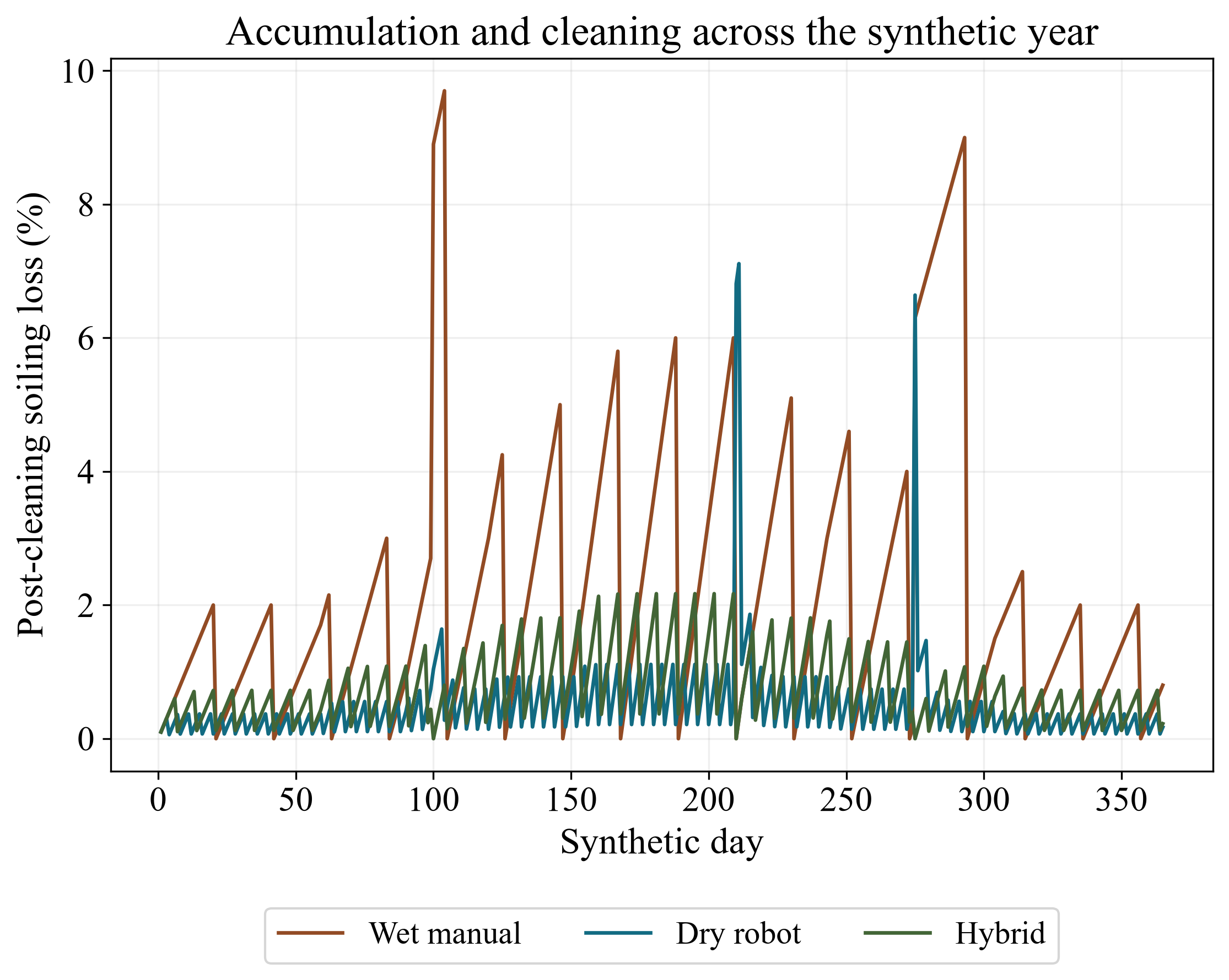
All inputs fictional. Stock follows stipulated deposition, three dust events and explicit cleaning resets. No observed weather, hourly dispatch or cleaning-performance certification is implied.
12 Reconcile daily heat and soiling without overlapping losses
The synthetic calendar has 365 days and repeats the same twelve monthly profiles. Monthly reference-energy shares are 6%, 6.5%, 8%, 9%, 10%, 10.5%, 10.5%, 10%, 9%, 8%, 6.5% and 6%. Each month's energy is spread evenly across its days. Stipulated cell temperatures range from 32°C in January to 64°C in July. Temperature loss is 0.35% per degree above 25°C, bounded between zero and 100%. This editable coefficient is an original assumption. No inverter derating curve, measured module response or temperature forecast is inferred from it. Within-month hourly irradiance and temperature covariance remain outside the calculation.
Each day begins with the previous day's residual soiling stock. Deposition adds between 0.10 and 0.30 percentage points according to the month. Three additional six-percentage-point events occur on days 100, 210 and 275. Total stock is capped at 60%; excess deposition is recorded as discarded at that analytical cap. There is no rainfall or natural wash-off. The cleaning decision follows deposition and precedes production. A completed wet event resets stock to zero. A dry event leaves 15% of pre-cleaning stock. Wet cleaning takes priority when it coincides with a scheduled hybrid dry event, so the same day is charged for one cleaning operation. Equipment schedules use the absolute day number across all ten years. Soiling stock carries across December and January without an artificial annual reset.
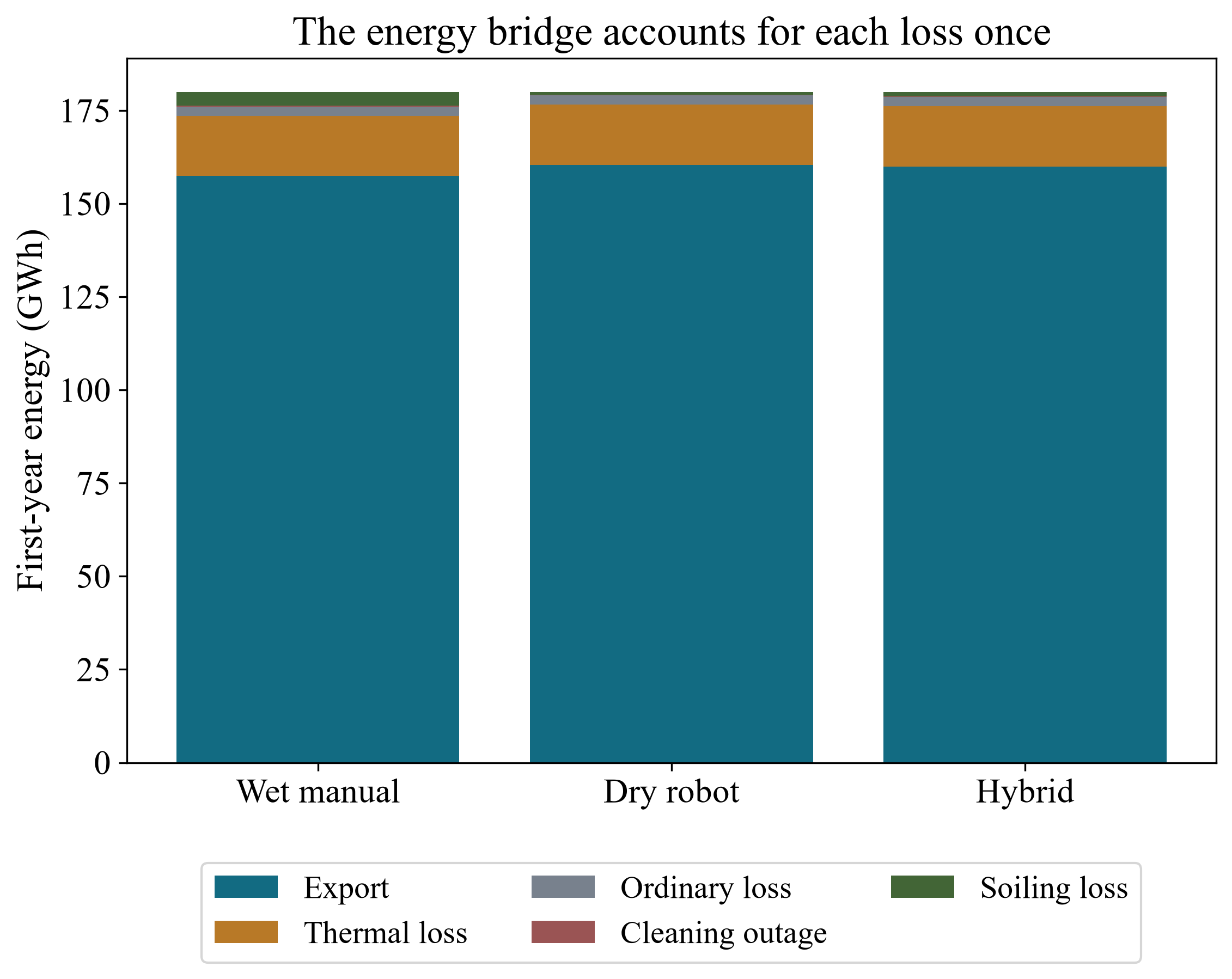
The energy waterfall first deducts thermal loss, then ordinary availability loss, then any cleaning interruption, then residual soiling loss. This ordering assigns each MWh once. First-year gross energy is 180,000 MWh and thermal loss is 16,197.300 MWh under every base policy. Ordinary availability removes a further 2,457.041 MWh. Cleaning interruption and soiling differ by policy. Manual cleaning leaves 3,744.920 MWh of soiling loss, compared with 838.883 for the robot and 1,278.152 for hybrid. Final first-year export is 157,373.758, 160,426.127 and 159,979.752 MWh respectively.
The daily trace exposes both event-driven spikes and scheduled resets. Hybrid's 5% trigger produces three wet cleans in the first year, accompanied by fifty-one dry events. Manual has seventeen wet cleans; the robot has ninety-one dry events. The annual-energy exhibit shows that later values change through degradation and the interaction of the continuous schedule with the repeated calendar. Cleaning electricity is stipulated as externally purchased: 2 MWh per wet event and 1 MWh per dry event at USD 100/MWh. It enters cash expenditure and is not deducted again from export. Equipment replacement creates no additional outage in this limited case; an actual replacement plan requires that missing operating assumption to be tested.
Table 3. First-year non-overlapping energy loss bridge
| Policy | Gross MWh | Heat loss | Other downtime | Soiling loss | Export MWh |
|---|---|---|---|---|---|
| Wet manual | 180,000.000 | 16,197.300 | 2,684.022 | 3,744.920 | 157,373.758 |
| Dry robot | 180,000.000 | 16,197.300 | 2,537.689 | 838.883 | 160,426.127 |
| Hybrid | 180,000.000 | 16,197.300 | 2,544.796 | 1,278.152 | 159,979.752 |
All energy in MWh. Other downtime combines separate ordinary availability and cleaning interruption; their individual values remain in the ledger. Purchased cleaning electricity is a separate cash cost.
Table 4. Annual exported energy with continuous soiling stock
| Year | Manual MWh | Robot MWh | Hybrid MWh | Hybrid wet events |
|---|---|---|---|---|
| 1 | 157,373.758 | 160,426.127 | 159,979.752 | 3.000 |
| 2 | 155,994.507 | 159,590.529 | 159,187.816 | 3.000 |
| 3 | 155,875.866 | 158,776.733 | 158,399.076 | 3.000 |
| 4 | 154,636.073 | 157,946.266 | 157,605.588 | 3.000 |
| 5 | 153,914.800 | 157,240.730 | 156,811.248 | 3.000 |
| 6 | 153,816.234 | 156,422.577 | 156,016.315 | 3.000 |
| 7 | 151,966.614 | 155,624.936 | 155,237.795 | 3.000 |
| 8 | 151,849.879 | 154,810.954 | 154,460.865 | 3.000 |
| 9 | 150,658.784 | 154,119.423 | 153,699.123 | 3.000 |
| 10 | 149,946.298 | 153,317.511 | 152,937.578 | 3.000 |
The 365-day profile repeats; deposition stock and absolute cleaning schedule continue across year boundaries. Energy degradation is 0.5% a year.
View figure at full size; scroll horizontally on smaller screens.
Sequential deductions assign each MWh once. Cleaning electricity is purchased separately and charged to cash; the energy bridge is a synthetic calculation.
13 Translate policy cash into a conditional purchase price
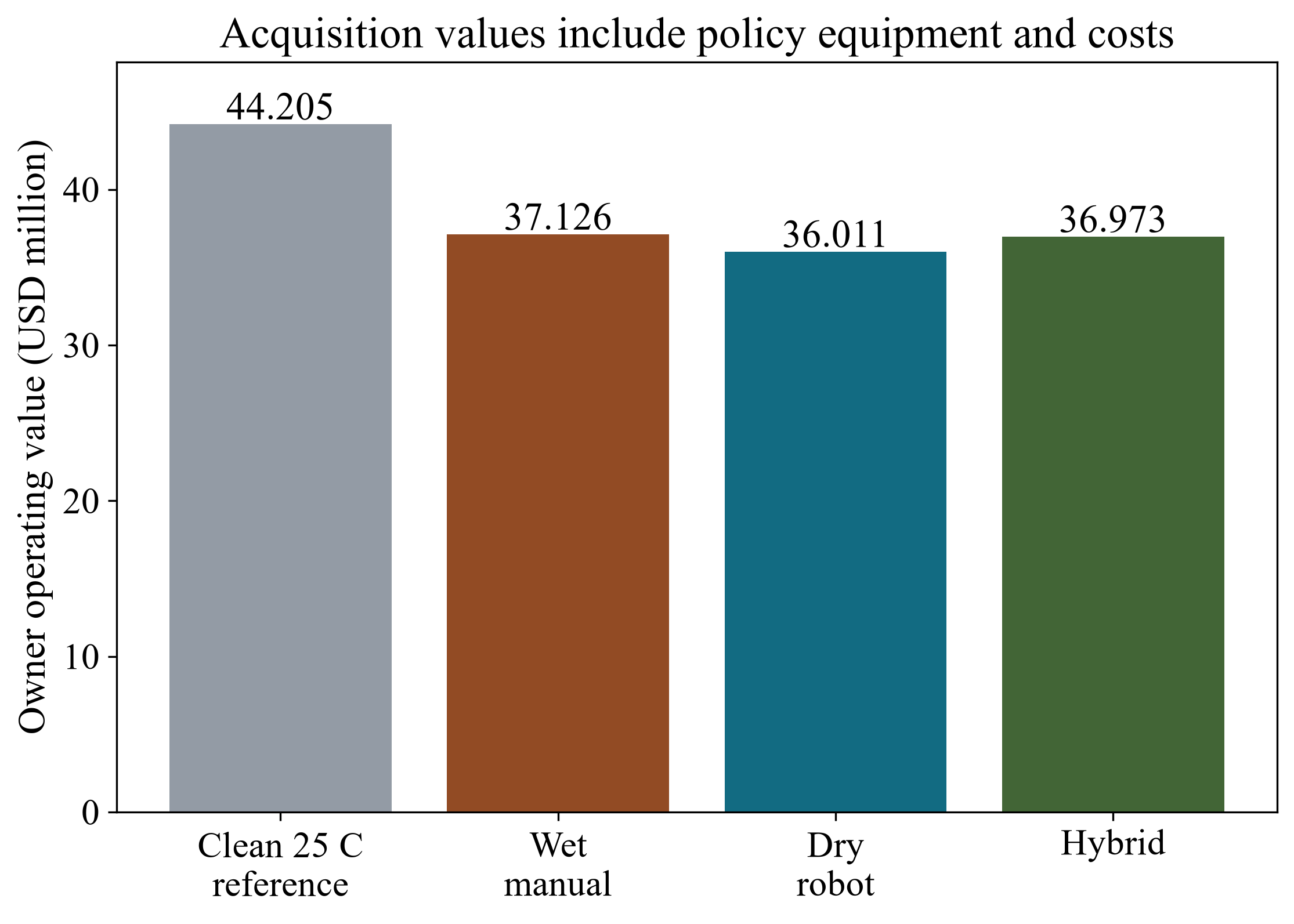
The clean reference has a decision-date value of USD 44.205 million. Manual cleaning produces USD 37.126 million, hybrid USD 36.973 million and robotic cleaning USD 36.011 million. The corresponding reductions from the common reference are USD 7.080 million, USD 7.232 million and USD 8.195 million. These differences combine lost receipts and policy costs inside the specified horizon. Calling them a desert discount identifies the analytical comparison only. No observed market pricing multiple, regional risk premium or required acquisition discount is claimed.
Manual's present-value receipts are USD 46.533 million. Base operating expenditure has present value of USD 7.381 million, cleaning labour USD 0.928 million, water USD 0.149 million, purchased cleaning electricity USD 0.023 million and closure USD 0.926 million. Subtraction reconciles to its USD 37.126 million operating value. The receipt-and-cost exhibit applies the same account to all policies. Equipment expenditure includes the initial payment and the discounted year-six replacement; no separate depreciation expense enters cash. Replacement capacity remains unchanged, and the model assumes the new cleaning equipment performs identically after replacement.
Robotic cleaning adds energy relative to manual cleaning, but its equipment and support costs reduce its value by USD 1.115 million. Holding all other assumptions fixed, its maximum initial equipment cost to equal manual value is USD 0.685 million, against the stipulated USD 1.800 million. Hybrid's initial-equipment ceiling is USD 0.947 million, against USD 1.100 million. These are conditional negotiation boundaries with replacement and operating cash unchanged. They do not establish a supplier price, an executable scope or permission to omit equipment that the policy needs.
A buyer must avoid charging the same equipment twice. The reported operating values already deduct the future cleaning investments. Paying those values to the seller would still require cash for immediate equipment installation: USD 1.8 million for the robotic option or USD 1.1 million for hybrid, plus any excluded fees and working capital. Those payments are separate closing uses and are already reflected as deductions in the valuation. Conversion from enterprise consideration to an equity payment also needs actual debt, cash, liabilities and negotiated terms. The illustration contains no borrowing capacity, debt-service test, sponsor distribution schedule or funding commitment. Its annual netting supplies no intrayear liquidity assurance.
Table 5. Owner operating value and the clean temperature reference
| Policy | Owner value USDm | Reference USDm | Discount USDm | Water feasible |
|---|---|---|---|---|
| Wet manual | 37.126 | 44.205 | 7.080 | Yes |
| Dry robot | 36.011 | 44.205 | 8.195 | Yes |
| Hybrid | 36.973 | 44.205 | 7.232 | Yes |
Decision-date unlevered value includes future cleaning equipment expenditure. The analytical clean 25 C reference has no heat, dirt or cleaning costs; it retains ordinary availability, degradation, base O&M and closure.
Table 6. Present value cost and receipt reconciliation
| Policy | Receipts USDm | O&M USDm | Cleaning USDm | Equipment USDm | Closure USDm |
|---|---|---|---|---|---|
| Wet manual | 46.533 | 7.381 | 1.100 | 0.000 | 0.926 |
| Dry robot | 47.504 | 7.649 | 0.551 | 2.367 | 0.926 |
| Hybrid | 47.385 | 7.582 | 0.456 | 1.447 | 0.926 |
Every amount is discounted at 8%. Equipment combines immediate investment and year 6 replacement. Water and purchased cleaning electricity are included once in cleaning cash cost.
View figure at full size; scroll horizontally on smaller screens.
Real USD million at the decision date, 8% discount, ten remaining years, no extension or terminal receipt. Future equipment costs are already deducted; acquisition funding is a separate account.
14 Apply water feasibility before selecting a cleaning schedule
The base annual cleaning-water budget is a fictional 6,000 m³. Manual use reaches a maximum of 5,760 m³ in a later calendar year, with 5,440 m³ in year one. Hybrid uses 720 m³ annually; the robot has no process-water demand in this perimeter. Water costs USD 4/m³. These quantities cover cleaning only, excluding staff, landscaping and other site needs. An annual allowance also supplies no evidence of monthly delivery, storage, water quality or rights. Those matters can constrain an actual policy even when the annual sum fits.
Two different water tests are retained. Reducing the budget to 2,000 m³ without changing scheduled cleaning leaves manual's calculated value at USD 37.126 million, but marks the policy infeasible. That value is a diagnostic for an unavailable schedule. The enforced-budget case skips a wet clean when its full water requirement exceeds the unused annual allowance. It purchases no emergency water and permits no partial wet clean. Under that implementation, manual value falls to USD 27.087 million. Hybrid retains USD 36.973 million because its required 720 m³ fits. The robot remains at USD 36.011 million. Each January replenishes the annual budget; it does not reset soiling.
The budget exhibit and figure trace the consequences of that deterministic rationing rule. At a 4,000 m³ budget, the twenty-one-day manual schedule with skipped events produces USD 35.648 million. This is not the best possible manual policy under every budget. The interval grid separately shows that a forty-two-day manual schedule uses at most 2,880 m³ and produces USD 36.491 million. Jointly choosing the interval and allocating water across high-value days could change the ranking further. The plotted budget lines describe the stated implementation and should not be interpreted as an optimized frontier.
Zero water supplies another informative boundary. Hybrid continues scheduled dry cleaning while skipping wet requests and produces USD 36.997 million, slightly above its base value. In these assumptions, avoided wet-event costs outweigh the additional dirt losses. The trigger grid confirms the same result when thresholds of 12% or 20% generate no wet events. A 2% trigger causes fourteen wet cleans in year one and lowers value to USD 36.481 million. The base 5% trigger is therefore an illustrative operating rule, with no claim of economic optimality. Skipped wet counts are daily failed requests; a persistent stock exceedance can create several requests from one dust event. They must not be reported as distinct storms.
Table 7. Enforced water budgets and implementable policy values
| Budget m3/year | Manual USDm | Robot USDm | Hybrid USDm | Hybrid skipped wet |
|---|---|---|---|---|
| 0.000 | 12.365 | 36.011 | 36.997 | 128.000 |
| 500.000 | 21.690 | 36.011 | 36.986 | 43.000 |
| 1,000.000 | 22.813 | 36.011 | 36.973 | 0.000 |
| 2,000.000 | 27.087 | 36.011 | 36.973 | 0.000 |
| 4,000.000 | 35.648 | 36.011 | 36.973 | 0.000 |
| 6,000.000 | 37.126 | 36.011 | 36.973 | 0.000 |
A required wet clean exceeding the remaining annual budget is skipped. Scheduled dry cleaning can still occur. A skipped event can recur as a daily request; the final column counts skipped daily requests across ten years, not unique storms.
Table 8. Cleaning intervals under unchanged hypothetical conditions
| Policy | Interval days | Value USDm | Max annual water | Feasible |
|---|---|---|---|---|
| Wet manual | 7.000 | 35.601 | 16,960.000 | No |
| Wet manual | 14.000 | 36.934 | 8,320.000 | No |
| Wet manual | 21.000 | 37.126 | 5,760.000 | Yes |
| Wet manual | 28.000 | 37.120 | 4,160.000 | Yes |
| Wet manual | 42.000 | 36.491 | 2,880.000 | Yes |
| Dry robot | 2.000 | 35.594 | 0.000 | Yes |
| Dry robot | 4.000 | 36.011 | 0.000 | Yes |
| Dry robot | 7.000 | 36.009 | 0.000 | Yes |
| Dry robot | 14.000 | 35.601 | 0.000 | Yes |
This discrete grid is a policy screen, not a claim of global optimization. Unconstrained values for infeasible schedules cannot be selected under the 6000 m3 annual budget.
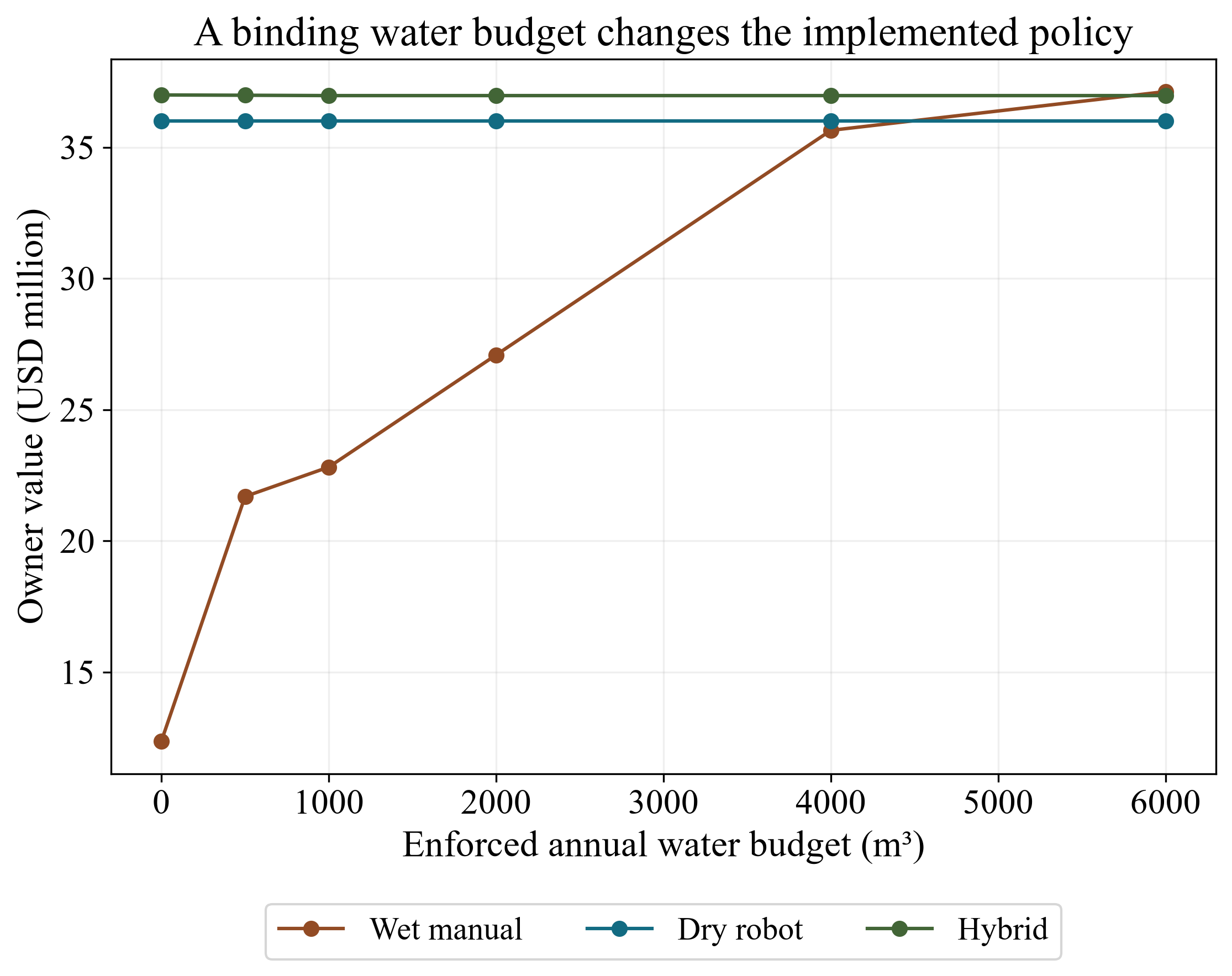
View figure at full size; scroll horizontally on smaller screens.
Each line implements a fixed policy with annual water limits. These are conditional policy curves, not a globally optimized allocation or evidence of actual water entitlement.
15 Set the evidence thresholds that change the acquisition decision
Water price can change the preferred policy without changing physical energy. Holding quantities, equipment and all other cash fixed, hybrid equals the manual base schedule at USD 8.728/m³ and the robot equals it at USD 34.034/m³. At the tested USD 25/m³, hybrid value is USD 36.872 million, manual USD 36.346 million and robot USD 36.011 million. The thresholds compare those exact schedules. A change in cleaning frequency or a binding supply constraint requires a new calculation, because the quantity of water and the resulting energy would also change.
The scenario exhibit keeps each cause identifiable. Adding 8°C to every synthetic cell-temperature value reduces manual value to USD 35.695 million and hybrid to USD 35.515 million. Increasing deposition by 50%, including the three dust events, changes manual to USD 36.533 million and hybrid to USD 36.785 million. The ranking reverses in that dust case. Doubling annual degradation from 0.5% to 1% reduces all policy values through the remaining operating years. The 6% and 10% discount cases describe alternative investor valuation requirements; they contain no forecast of financing rates or regional market pricing.
The combined case adds 8°C, increases deposition by 50%, charges USD 25/m³, triples event-related interruption and enforces a 2,000 m³ annual budget. Manual value becomes USD 22.876 million, robotic value USD 34.377 million and hybrid USD 35.181 million. The severe reduction in manual value depends on the explicit skipped-cleaning rule and saturated soiling state. It is a stress calculation with no probability attached. A real decision would need a feasible alternative schedule, actual water arrangements and evidence that the proposed cleaning equipment can deliver its assumed removal and interruption performance.
The reproducible calculation retains annual cash ledgers and first-year daily records for each case. Forty-digit decimal arithmetic is used internally, with conventional numeric serialization for exhibits. Author tests cover the sequential energy identity, cash-to-present-value reconciliation, continuous year-boundary stock, zero and unrestricted water budgets, full daily dirt removal, bounded no-clean accumulation and the equal-value water-price equations. These calculation checks establish no measured engineering performance. The model has no actual weather series, event probability, measured cleaning recovery, abrasion effect, equipment reliability distribution or site water entitlement. Acquisition discipline therefore centres on replacing the few assumptions that change the decision with asset evidence, while preserving the same energy and cash boundaries through the revised comparison.
Table 9. Scenario changes to owner value
| Scenario | Manual USDm | Robot USDm | Hybrid USDm | Manual feasible |
|---|---|---|---|---|
| Base | 37.126 | 36.011 | 36.973 | Yes |
| Heat plus 8 C | 35.695 | 34.549 | 35.515 | Yes |
| Dust times 1.5 | 36.533 | 35.881 | 36.785 | Yes |
| Water USD 25 | 36.346 | 36.011 | 36.872 | Yes |
| Water budget 2000 diagnostic | 37.126 | 36.011 | 36.973 | No |
| Water budget 2000 enforced | 27.087 | 36.011 | 36.973 | Yes |
| Degradation 1 percent | 36.241 | 35.107 | 36.072 | Yes |
| Cleaning downtime times 3 | 36.990 | 35.963 | 36.921 | Yes |
| Discount 6 percent | 40.581 | 39.521 | 40.514 | Yes |
| Discount 10 percent | 34.107 | 32.944 | 33.880 | Yes |
| Combined enforced | 22.876 | 34.377 | 35.181 | Yes |
Diagnostic water-budget case changes feasibility only. Enforced case changes actual cleaning and energy. Combined case adds 8 C, 50% deposition, USD 25/m3 water, triple cleaning interruption and an enforced 2000 m3 budget.
Table 10. Hybrid trigger sensitivity and wet cleaning demand
| Trigger % | Value USDm | First-year wet | First-year dry | Max water m3 | Feasible |
|---|---|---|---|---|---|
| 2.000 | 36.481 | 14.000 | 41.000 | 3,600.000 | Yes |
| 3.500 | 36.973 | 3.000 | 51.000 | 720.000 | Yes |
| 5.000 | 36.973 | 3.000 | 51.000 | 720.000 | Yes |
| 8.000 | 36.970 | 1.000 | 51.000 | 240.000 | Yes |
| 12.000 | 36.997 | 0.000 | 52.000 | 0.000 | Yes |
| 20.000 | 36.997 | 0.000 | 52.000 | 0.000 | Yes |
Six author-selected trigger levels. Trigger uses stock after daily deposition and before cleaning. Wet cleaning takes priority over scheduled dry cleaning on the same day.
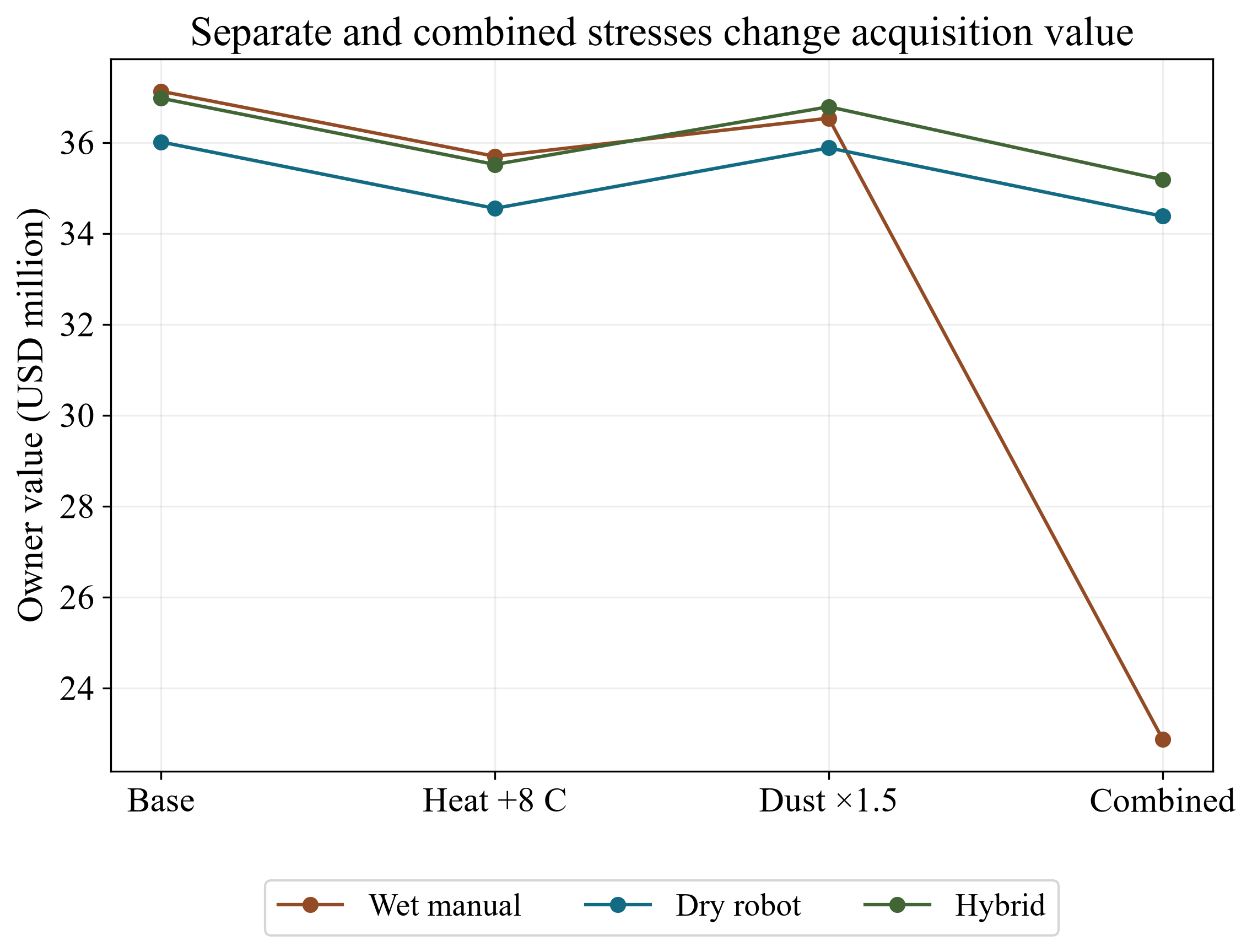
View figure at full size; scroll horizontally on smaller screens.
The combined case changes temperature, deposition, water price, cleaning interruption and enforceable model budget together. No probabilities or actual site forecasts are assigned.
16 Build a loss ledger that can survive acquisition diligence
A proposed acquisition review should begin with a dated reconciliation from measured resource to delivered energy and collected revenue. Request the original interval records, equipment register, sensor locations, calibration history, availability events and settlement statements. Preserve time zones and the treatment of missing observations. The diligence team should identify whether a reported loss was measured, estimated through a technical model or allocated as an unexplained residual. Each category needs a named reviewer and an explicit treatment in the purchase case. An unexplained residual should remain visible until evidence supports its assignment to a physical mechanism.
Separate the tests for irradiance, module temperature, soiling and unavailable equipment. Ask the engineer to specify the measurements and comparison method used for each attribution, including interactions and uncertainty. A buyer should question a reconciliation that credits cleaning with every improvement after a wash while also crediting the same energy to improved availability. Construct an event ledger linking each intervention to the affected equipment, measurement window and excluded events. Where two explanations compete, retain both explanations and show how the investment decision changes under each. Reconcile the aggregate back to the revenue meter before translating recoverable energy into value.
The purchase model should distinguish the operating baseline that the buyer can support from improvements that still require action. For a proposed cleaning change, request evidence of the existing programme, expenditure, water consumption, access restrictions and actual completion records. Establish which costs would cease and which would continue alongside the new programme. Reconcile additional exported energy to the settlement boundary and payment terms. The valuation should identify the spend required to obtain each assumed improvement, the date of that spend and the period during which the buyer could collect the associated receipts. An engineering improvement with unresolved commercial treatment belongs in a conditional case.
In the hypothetical model, manual cleaning produces owner value of USD 37.126 million against the analytical clean-temperature reference of USD 44.205 million. The USD 7.080 million difference includes the model's operating and cleaning cash consequences; it is not a measured acquisition discount or a sum of independently priced physical losses. The diligence register should trace that comparison to its assumptions before applying it to a purchase case. Missing seasonal evidence should remain a valuation condition.
Table 11. Proposed acquisition loss-to-cash register
| Evidence | Decision owner | Control |
|---|---|---|
| Interval resource and sensor records | Technical lead | Retain calibration and missing-data flags |
| Loss attribution and event log | Independent engineer | Reconcile overlaps and residuals |
| Export and settlement records | Finance lead | Trace recoverable energy to collections |
| Conditional improvement budget | Investment committee | Separate base and intervention cases |
Author-proposed diligence controls. No measured plant loss or payment entitlement is established.
17 Establish the water case before choosing a cleaning programme
For any intervention relying on water, the buyer should assemble a site-specific water dossier before approving the associated operating budget. The proposed dossier identifies the supply source, party entitled to use it, delivery arrangement, quality specification, storage and treatment equipment, restrictions and relevant permissions. Counsel and responsible site specialists should confirm which records apply to the actual activity. A supplier quotation alone leaves open the authority to obtain and use the water, its suitability for the proposed method and the practical ability to deliver it when required. These open matters should be recorded separately.
Translate the proposed cleaning schedule into a dated water requirement using the contractor's stated method and the actual equipment population. Include setup, flushing, treatment losses and rejected water where relevant and evidenced. State the boundary of the quantity estimate so that the same volume is not charged twice through a delivered-water rate and a separate treatment allowance. Obtain the applicable delivered-cost terms, escalation basis and minimum purchase obligations. Match payment dates to deliveries and identify deposits, storage investment and contingency cash. A low unit quotation can leave an expensive schedule if the delivery pattern or minimum commitment is poorly matched to the site.
Test the programme against a constrained-supply case agreed with the operating team. The case should identify which work could be postponed, which alternative methods are technically admissible and what approval is required before changing method. Price the approved alternatives on a comparable basis, including mobilisation, labour, consumables, access and expected interruption. Any modelled water limit should be labelled as an assumption until supported by the relevant documents and operating evidence. A financial model can test the cash consequence of a reduced allowance; it cannot establish that an alternative cleaning method is safe for the equipment.
In the hypothetical enforced-budget case, an annual allowance of 2,000 cubic metres reduces manual-policy value to USD 27.087 million because required wet cleans are skipped. Hybrid value remains USD 36.973 million with maximum annual water use of 720 cubic metres. Merely flagging the unrestricted manual schedule as infeasible would leave its USD 37.126 million diagnostic value unchanged. The committee therefore needs the executable restricted schedule and its cash result. The asset manager should reconcile metered consumption, deliveries and invoices to completed work before approving further commitments.
Table 12. Proposed water readiness controls
| Evidence | Decision owner | Control |
|---|---|---|
| Supply rights and applicable permissions | Legal and site leads | Confirm exact activity and boundary |
| Quality and method compatibility | Technical lead | Approve admissible water specification |
| Quantity and delivery calendar | Asset manager | Reconcile work to available supply |
| Delivered cost and deposits | Finance lead | Budget dated gross cash requirements |
Supply, suitability and permissions require site-specific verification; a modelled budget does not establish access.
18 Contract for a measured service and an executable exception process
A proposed cleaning tender should define the service boundary with enough precision to compare bids. Identify the equipment population, access windows, permitted methods, completion evidence and responsibility for supplying water and other consumables. Ask each bidder to state exclusions, mobilisation conditions, inspection requirements and assumptions about owner support. The technical team should review compatibility with the installed equipment and applicable manufacturer instructions. A bid using a different method or completion boundary should receive a separate comparison, with its outstanding technical questions and owner costs shown explicitly.
Define how the parties would assess completion and investigate an unsatisfactory result. The owner may propose a documented inspection protocol, agreed measurement windows and a process for handling missing or disputed data. Weather changes, operating outages and maintenance events should be recorded so that their effects can be considered in evaluating performance. Any output-linked payment mechanism needs a specified baseline, adjustment method, measurement authority and dispute procedure. These are proposed commercial terms for negotiation. Their inclusion in a tender establishes no entitlement to an energy payment, warranty recovery or compensation from another party.
Allocate responsibility for exceptions before mobilisation. The contract schedule should identify who can suspend work, who approves a restart, who records affected equipment and how the parties establish the cost of a delay. Ask counsel to reconcile proposed workmanship obligations, damage provisions and insurance with the existing equipment and service agreements. A contractor's commitment should be examined for its scope, exclusions, claim requirements and payment timing. The owner should retain gross potential expenditure in the cash assessment until the actual recovery terms support an offset. Record responsibility for investigating damage independently of responsibility for paying an invoice.
In the hypothetical base case, dry robotic cleaning exports more first-year energy than manual cleaning, yet its owner value is lower: USD 36.011 million against USD 37.126 million after stipulated equipment and operating cash. A tender should therefore compare the complete dated cost and service package. Reconcile completed quantities, approved variations and deductions before certification. If observed performance fails to support the purchase case, the asset manager should recommend a response under the actual terms, with finance updating the remaining cash requirement.
Table 13. Proposed cleaning contract interface record
| Interface | Decision owner | Control |
|---|---|---|
| Scope and exclusions | Procurement lead | Compare complete service boundaries |
| Completion and measurement | Technical lead | Agree evidence and exception process |
| Damage and disputed recovery | Legal and asset leads | Retain gross owner exposure |
| Invoices and variations | Finance lead | Reconcile approved work before certification |
Proposed terms are subject to technical review and negotiation of actual agreements.
19 Separate recoverable operating loss from lifetime impairment
The investment team should request a condition dossier that distinguishes current performance from evidence about future deterioration. Record the equipment cohort, installation date, maintenance history, observed defects, inspection method and environmental exposure information available for the site. Specialist reviewers should identify which observations support a repair decision and which would require further testing before changing useful-life assumptions. A photograph, alarm or short performance trend may prompt investigation; the proposed framework assigns no universal lifetime adjustment to it. The record should explain the evidence required to support any longer-term conclusion.
For humidity or corrosion concerns, identify the affected component and the proposed causal explanation precisely. Request the inspection report, sample-selection basis, test conditions and any contrary findings. Compare the sampled population with the equipment to which the conclusion would be applied. Where access or testing is limited, disclose the unexamined population and the possible financial exposure without assigning an unsupported failure rate. Ask the engineer to distinguish remedial work, recurring monitoring and replacement recommendations. Each recommendation should have a scope, decision date and stated reason, allowing the valuation team to build a dated expenditure case.
Review warranties and service support alongside the technical findings. Establish the actual claimant, covered equipment, documentation requirements and unresolved conditions with the appropriate advisers. An accounting receivable or an asserted claim should carry its own collection assumptions. The operating forecast should include the cash needed to investigate and maintain the plant while responsibility is disputed. If a proposed repair would affect another warranty or service arrangement, record the required consent or clarification before authorisation. This connects technical readiness to the owner's cash exposure without assuming that a possible contractual remedy funds the immediate work.
The hypothetical model's higher-degradation case changes a stipulated annual rate; it supplies no evidence that humidity or corrosion caused that rate at an actual plant. The committee should require a separate condition record before adopting such a change. State the revised expenditure, availability and terminal assumptions, supporting observations and remaining uncertainty. Preserve the previous model and require explicit sign-off for extrapolation from short observations to long cash-flow periods.
Table 14. Proposed condition-to-lifetime evidence gate
| Evidence | Decision owner | Control |
|---|---|---|
| Defect population and inspection basis | Technical lead | State sampled and unexamined scope |
| Repair and monitoring recommendation | Asset manager | Date each expenditure decision |
| Warranty and service correspondence | Legal lead | Separate asserted claim from collection |
| Revised lifetime cash assumptions | Investment committee | Approve evidence-backed extrapolation |
No universal failure rate, life adjustment or warranty recovery is assumed.
20 Validate analytics through incremental economic decisions
An owner considering an analytics-led cleaning schedule should first define the decision it would change. Specify the relevant operating blocks, feasible intervention dates, measurement inputs and available actions. Establish a documented reference policy against which the proposed policy can be evaluated. That reference should reflect the programme the owner could actually execute with its current resources and permissions. Include the information available at each decision date; later observations should not enter an earlier recommendation. The economic comparison should use the same asset boundary, settlement assumptions and evaluation horizon for both policies.
Design a bounded evaluation with the technical and operating teams. Depending on the site and available evidence, they may propose matched operating areas, a staggered trial or another defensible comparison. Document why the selected design can address the question and what it cannot establish. Record weather, equipment changes, outages and intervention completion so that alternative explanations can be examined. Preserve failed recommendations and missing observations in the assessment. Where an algorithm is used, retain its version, input definitions, training population where available, validation method and authority for changing it. No autonomous intervention should be assumed from a software recommendation.
Translate the measured decision effect into incremental owner cash. Include additional visits, water, labour, licences, integration, sensing, maintenance and any approved operational interruption. Distinguish gross extra energy from the portion that can be delivered and paid under the actual arrangements. Reconcile costs avoided by the reference policy before claiming savings. Report the range of outcomes supported by the evaluation and identify the inputs that dominate the result. A policy that improves a technical metric may still require a cash commitment the owner cannot justify within the remaining operating period.
In the hypothetical trigger screen, the 3.5% and 5% hybrid thresholds produce identical owner value and cleaning counts. These selected points provide no evidence that a finely tuned algorithm adds value. Acceptance should require a measurable improvement against an executable reference after full tool and implementation costs. State the expenditure limit, operating scope and conditions requiring human review. Retain a usable reference procedure for missing data, sensor disagreement or tool unavailability, with a dated decision on whether the evidence still supports deployment.
Table 15. Proposed analytics evaluation boundaries
| Test | Decision owner | Control |
|---|---|---|
| Executable reference policy | Asset manager | Freeze decision-date information |
| Trial and alternative explanations | Technical lead | Log outages and configuration changes |
| Incremental owner cash | Finance lead | Include full delivery and operating cost |
| Model change or data failure | Operating executive | Retain authorised human review |
The framework proposes an evaluation process; it supplies no measured algorithmic performance or autonomous authority.
21 Use the first ninety days to resolve named investment conditions
A proposed post-close programme should assign ownership before the transaction completes. The first thirty days would focus on custody and reconciliation: secure access to operating records, confirm responsible service parties, reconcile meters and event logs, and identify imminent payments and unresolved permissions. The asset manager should maintain a short exception register showing the decision affected, evidence missing, cash at risk and responsible person. Urgent safety and operating matters remain with the qualified site professionals. The commercial programme should recognise their decisions and costs without attempting to substitute a timetable for technical authority.
During days thirty-one to sixty, the proposed programme would test the highest-value unresolved intervention within an authorised budget and operating scope. The technical lead should approve the comparison method and document conditions that would invalidate the result. Procurement should obtain comparable service terms and confirm exclusions; finance should update the dated cash requirement. Counsel should resolve the specific permissions and contract questions identified during diligence. The committee should receive a concise reconciliation between the acquisition case and the evidence now available, including adverse findings. Completion of an investigation should be recorded separately from approval of a larger capital commitment.
During days sixty-one to ninety, the responsible executive should recommend the continuing operating policy and any further staged expenditure. The acceptance package should contain the measured findings, remaining uncertainties, executed commercial terms, approved work scope and revised cash forecast. Assign ownership for monitoring each material assumption after the programme ends. Where the evidence remains incomplete, propose a bounded extension or continued operation under the supported baseline. The calendar is an author-proposed management sequence; actual permits, seasons, access and investigation requirements may demand a different timetable.
In the hypothetical base case, hybrid trails manual value by approximately USD 0.153 million. Its comparison changes under the enforced water constraint. The ninety-day programme should therefore resolve the actual supply boundary and admissible service scope before choosing a policy from either calculation. Close with accepted, rejected and conditional improvements, their cash consequences and named decision owners. Preserve unresolved defects and disputed recoveries with review dates. Subsequent reporting should compare like periods and document changes in measurement or plant configuration.
Table 16. Proposed ninety-day decision sequence
| Period | Decision owner | Acceptance record |
|---|---|---|
| Days 1-30 | Asset manager | Reconciled records and exception register |
| Days 31-60 | Technical and finance leads | Bounded test and revised cash case |
| Days 61-90 | Responsible executive | Supported policy and staged expenditure |
| Continuing review | Investment committee | Named owners for unresolved conditions |
Illustrative management timetable. Actual technical, seasonal and permission constraints determine execution.
22 Acquisition price and environmental underwriting
The buyer should request the seller's generation model with its temperature response, soiling allowance, availability definition and cleaning assumptions intact. A reconciliation begins with the same energy-meter boundary and dates. Differences in gross resource, equipment response, downtime, delivered energy and operating cost then become separate adjustments. Each adjustment needs an evidence entry and a description of the data already reflected in the seller's case. This proposed procedure addresses a practical source of negotiation error: placing a new environmental haircut on cash flows that already include the corresponding loss.
An equipment intervention can recover only the losses it actually affects. Cleaning may recover dust-related output while leaving temperature-related output unchanged. A robot supplier's recovery estimate should therefore use the attainable clean-module output under the site's weather and plant constraints. Applying that estimate to a hypothetical cool, perfectly available plant would overstate the revenue opportunity. The operating comparison should also include the electricity used by the intervention, access interruptions, service cost, equipment expenditure and replacement. The difference in discounted cash available to the owner determines the modelled economic benefit.
Water access introduces a second negotiation question. A model may contain an apparently affordable wet-cleaning programme whose required volume lacks a secure supply route. The buyer can request evidence of the proposed source, permitted use, quality, storage, delivery schedule and contractual priority during shortage. A regional water-stress screening result can direct diligence; it does not establish the availability of a particular connection or delivered volume [13][14]. If the proposed programme exceeds the supported supply, the energy and operating plan must be recalculated with the actual constraint. Increasing an assumed water price alone does not resolve a physical shortage.
Commercial allocation should follow the identified cause and the counterparty's ability to control it. A purchase agreement may need a condition covering incomplete water documentation. A cleaning contract may need an acceptance test for energy recovery and a defined treatment of inaccessible rows. Equipment coverage may need confirmation of the permitted cleaning method. These are proposed diligence and negotiation items. Their enforceability, pricing and final language require review of the actual contracts and governing law. No generic clause in this paper establishes recovery against a seller, contractor, insurer or manufacturer.
Residual uncertainty should have a recorded financial treatment. A buyer might commission a measurement campaign, revise the operating forecast, hold a specifically justified reserve, request a price adjustment or defer closing. The record should explain which uncertainty each action addresses. A reserve and a cash-flow reduction can address different consequences of the same event, such as repair expenditure and lost revenue. Their amounts should be reconciled so the event is not charged twice. The proposed reconciliation gives an investment committee a basis to distinguish an observed loss from a precaution against incomplete evidence.
23 Financing and the treatment of residual uncertainty
The worked valuation is unlevered. It provides no lender terms, debt capacity, credit approval or equity return. An actual financing analysis begins with the lender's definition of cash available for debt service, the accepted generation case, required reserves, repayment profile and distribution conditions. The modelled operating value can inform that analysis after its assumptions have been replaced with acceptable evidence. Converting it into a leverage percentage without those inputs would leave the repayment question unanswered.
Timing deserves separate attention. A cleaning programme pays for labour, delivery or equipment before the resulting generation receipts are necessarily collected. An interrupted delivery can also leave expenditure committed while output deteriorates. Annual positive cash flow can coexist with a short-term funding gap. A transaction team should therefore reconcile the proposed operating schedule with monthly receipts, payment terms and available cash. The illustrative daily operating calculations do not themselves model collection delays, working-capital facilities or reserve release conditions.
The proposed evidence record should distinguish persistent performance differences from episodic disturbances. A stable temperature coefficient affects the production calculation repeatedly. A single damaged component can create a repair payment and a bounded outage. Recurrent dust deposition can alter the cleaning programme. Uncertain lifetime damage can affect replacement expenditure and the remaining generation path. Combining all four into one permanent discount-rate increase loses the information required to price a mitigation or negotiate responsibility. Separate cash-flow scenarios preserve those causal distinctions while keeping the remaining uncertainty visible.
Scenario combinations need an explicit rationale. Greater dust deposition and a tighter water budget can occur together in a stress test. The combination is useful for testing the operating plan's dependence on water. It carries no probability simply because the model computes it. Likewise, the scenario with the lowest value is a conditional adverse case, not an estimate of a specified confidence percentile. Investment committees requesting probabilistic values need a defensible joint distribution, temporal dependence, measurement uncertainty and a documented simulation design. This paper does not supply those missing data.
The financing response can depend on which item remains unresolved. A disputed sensor reading may call for an independent measurement review. A missing supply entitlement may require a condition before drawdown. An untested cleaning technology may require a bounded pilot and retained alternatives. A forecast replacement may require a funded expenditure plan. These proposed actions should be priced with their implementation time and cost. A mitigation described in a presentation should enter the final financing case only when the decision record identifies the supporting evidence, contractual position and responsible owner.
24 Conclusions and asset-specific application
The proposed desert-discount method produces a conditional operating-value bridge. It separates energy lost through the defined temperature response, ordinary unavailability, cleaning interruptions and remaining dust. It then includes the intervention's water, energy, operating expenditure and equipment costs on a common remaining horizon. This construction allows an investment team to examine the financial consequence of a measured problem and the incremental value of a proposed response. The actual worked-case results depend on fictional inputs and remain demonstrations of that construction.
Application to a transaction begins with the plant's meter and equipment records, weather data, cleaning logs and water documentation. The buyer should reconcile those records with the seller's model before introducing a new adjustment. A targeted pilot can test an intervention where the evidence remains incomplete. A revised forecast should retain the observed baseline and identify every changed assumption. The investment record can then show the price difference, the expenditure required to obtain it and the unresolved conditions that could alter the result.
The method's contribution is the integration of physical feasibility with cash-flow comparison. The cleaning policy selected by an unconstrained model may require a water supply the site cannot support. The implemented constrained policy can deliver a different volume of electricity and incur a different cost. Keeping both calculations visible explains the consequence of the constraint and the value of resolving it. A transaction team can use that information to assess a supply investment, an alternative cleaning method or a revised acquisition price. Those options require their own verified costs and permissions.
The analysis remains incomplete for any actual asset until site engineering, contractual rights and financial terms have been reviewed. Daily synthetic weather does not establish bankable production or extreme-event risk. The chosen horizon does not establish a contract extension or residual sale. An assumed cleaning recovery does not establish equipment compatibility or warranty coverage. Each of these boundaries identifies a specific workstream for a real assignment. The resulting deliverable should be a reconciled operating case and decision record whose material inputs can be traced to evidence.
References
- IEA PVPS Task 13. Analytical Monitoring of PV Systems Final. 28 May 2014. Official summary, monitoring and regression-analysis paragraphs. https://iea-pvps.org/key-topics/analytical-monitoring-of-pv-systems-final/
- National Laboratory of the Rockies. System Advisor Model Help: Module. Undated; accessed 9 October 2026. Sandia Temperature Correction; Module Structure and Mounting; equations. https://samrepo.nlr.gov/help/pv_module.html
- National Laboratory of the Rockies. System Advisor Model Help: Inverter. Undated; accessed 9 October 2026. Inverter Clipping Loss; Inverter Temperature Derate Curves. https://samrepo.nlr.gov/help/pv_inverter.html
- IEA PVPS Task 13. Soiling Losses: Impact on the Performance of Photovoltaic Power Plants. January 2023; Report T13-21:2022. Official summary, Key Takeaway 3. https://iea-pvps.org/key-topics/soiling-losses-impact-on-the-performance-of-photovoltaic-power-plants/
- IEA PVPS Task 13; Jahn et al. Guidelines for Operation and Maintenance of Photovoltaic Power Plants in Different Climates. October 2022. Executive summary, PDF pp. 1-2; Report T13-25:2022. https://iea-pvps.org/wp-content/uploads/2022/11/Final-Executive-Summary-IEA-PVPS-T13-25_2022.pdf
- IEA PVPS Task 13. Optimisation of Photovoltaic Systems for Different Climates. June 2025. Official summary, Key Findings 2-4. https://iea-pvps.org/key-topics/t13-optimisation-pv-systems-different-climates-2025/
- IEA PVPS Task 13. Operational and Economic Impacts of Extreme Weather on PV Power Plants. December 2025. Official summary, damage discussion and Key Takeaways 3-4. https://iea-pvps.org/key-topics/t13-extreme-weather-impacts-power-plants/
- Deline et al.; National Laboratory of the Rockies. PV Lifetime Project: 2025 NLR Annual Report. February 2026. Executive summary, printed pp. iv-v; NLR/TP-5K00-98639. https://docs.nlr.gov/docs/fy26osti/98639.pdf
- IEA PVPS Task 13. Degradation and Failure Modes in New Photovoltaic Cell and Module Technologies. February 2025. Official summary, Key Findings 3-4. https://iea-pvps.org/key-topics/degradation-failure-modes-new-cell-module-technologies/
- International Electrotechnical Commission. IEC 61215-1:2021: Terrestrial photovoltaic (PV) modules - Design qualification and type approval - Part 1: Test requirements. 23 February 2021. Public scope and publication metadata; complete paid standard not inspected. https://webstore.iec.ch/en/publication/61345
- IEA PVPS Task 13; Herz et al. Quantification of Technical Risks in PV Power Systems. October 2021. Executive summary, printed pp. 9-10; conclusions, p. 42; T13-23:2021. https://iea-pvps.org/wp-content/uploads/2021/11/Report-IEA%E2%80%93PVPS-T13-23_2021-Quantification-of-Technical-Risks-in-PV-Power-Systems_final.pdf
- NREL; SuNLaMP PV O&M Best Practices Working Group. Best Practices for Operation and Maintenance of Photovoltaic and Energy Storage Systems, Third Edition. December 2018. Cost and reserve analysis, printed pp. 93-95; NREL/TP-7A40-73822. https://docs.nlr.gov/docs/fy19osti/73822.pdf
- International Finance Corporation. Performance Standard 3: Resource Efficiency and Pollution Prevention. 1 January 2012. Overview paragraph 1; Water Consumption paragraph 9, printed p. 3. https://www.ifc.org/content/dam/ifc/doc/2010/2012-ifc-performance-standard-3-en.pdf
- World Resources Institute. Aqueduct FAQ. Undated; accessed 9 October 2026. Baseline-data question and indicator-reference-period explanation. https://www.wri.org/aqueduct/faq
- Dubai Electricity and Water Authority. DEWA's Autonomous Soiling Detector improves solar PV system performance and cuts dust-related energy losses. 30 December 2025. Prototype-location and actual-versus-expected-production paragraphs. https://www.dewa.gov.ae/en/about-us/media-publications/latest-news/2025/12/dewas-autonomous-soiling-detector
- Miller et al.; National Renewable Energy Laboratory. Soiling Related Abrasion and the Development of a PV Abrasion Standard. 2018. Official abstract and workshop metadata; NREL/PR-5K00-72850. https://research-hub.nlr.gov/en/publications/soiling-related-abrasion-and-the-development-of-a-pv-abrasion-sta/
- Sweihan PV Power Company. Noor Abu Dhabi Solar PV Project: Green Bond Framework. September 2021. Section 1.2, printed p. 2; dated cover. https://noorabudhabi.ae/wp-content/uploads/2022/04/Noor-Abu-Dhabi-Green-Bond-Framework.pdf
- International Finance Corporation. Environmental and Social Review Summary: Abydos Solar IPP, project 41727. 7 March 2022; updated 10 June 2023. PS3, Water Consumption; disclosure metadata. https://disclosures.ifc.org/project-detail/ESRS/41727/abydos-solar-ipp
About the Author
Chennakeshav (CK) is a corporate finance and investment banking executive with 25+ years of global experience in deal origination, structuring and execution across M&A, growth capital and corporate strategy. He has led value-creation mandates for founders, corporates and funds — bridging the boardroom view to hands-on execution and close.
His career spans Morgan Stanley, HSBC, Lloyds Banking Group, EWEC, ADQ portfolio companies and Emirates Growth Fund, across TMT, real estate, fintech, deeptech, cleantech, infrastructure and energy. He has partnered with C-suite leaders, private equity and venture funds, sovereign wealth funds and family offices to finance complex fund raises and scale-up ventures, and has led M&A due diligence, post-merger integration and business-transformation initiatives to create value.
At Matchpoint Partners he is Managing Partner, leading the firm's corporate finance, M&A and capital-raising practice. He holds an MBA from London Business School, an engineering degree from VTU and a Master of Laws (LLM, in progress) from UCL London.
An active start-up mentor, CK mentors at Techstars, DIFC FinTech Hive, Startup Grind, Founder Institute and IN5, serves as Entrepreneur Mentor in Residence (EMiR) at London Business School, and judges the Entrepreneurship World Cup.
https://www.linkedin.com/in/ckadya/ https://www.matchpoint-partners.com/team/ck-adya.html
