

Introduction
Direct-to-device satellite service connects ordinary or lightly modified mobile devices to a satellite when terrestrial coverage is unavailable or impaired. The service can support emergency messaging, text, voice, narrowband data, broadband data or internet-of-things applications depending on the spectrum, device, satellite power, waveform, network integration and regulatory permission. The transaction opportunity arises because a satellite operator can supply coverage while a mobile-network operator contributes licensed spectrum, subscriber authentication, billing, customer support, roaming relationships and local market access.
The partnership can look commercially powerful before it becomes economically proven. A press release may cite the mobile operator's total subscriber base even though only a portion of users live in authorised territories, own compatible devices, register for the service, spend time outside terrestrial coverage or pay for satellite access. Satellite capacity may be shared across large areas and may support messaging before broadband. Commercial launch may depend on spectrum coordination, gateways, handover, lawful intercept, emergency routing, device certification and constellation deployment. Transaction diligence must translate these dependencies into cash flows, conditions and downside rights.
The paper addresses acquisitions, strategic investments and joint ventures involving a satellite platform whose value depends materially on mobile-network partnerships. It does not value a named company or recommend a security. The worked case is hypothetical and should be replaced with verified transaction evidence in a live mandate.
1 Define the transaction perimeter
The buyer should begin by defining what is being acquired. A direct-to-device platform can include spacecraft, payload intellectual property, ground gateways, network software, spectrum rights, regulatory licences, launch contracts, manufacturing capacity, patents, employees, MNO agreements, government contracts, customer data and future orbital capacity. Some assets may sit in subsidiaries or joint ventures. Others may be licensed from shareholders, manufacturers or spectrum holders.
The perimeter should distinguish owned assets from contracted access. A company may control satellite hardware while depending on another party for spectrum, gateways or network-core integration. It may have a commercial agreement with an MNO that is subject to regulatory approval and service readiness. It may describe a broad partnership footprint even though only a few agreements contain price, term, exclusivity or minimum commitments. The acquisition model should not treat those categories as equivalent.
The buyer should prepare an asset-and-dependency map for each territory. The map identifies the satellite entity, spectrum holder, MNO, gateway operator, device ecosystem, regulator, customer contract, billing party and data controller. It should also identify change-of-control consents, assignment limits and termination rights. This map becomes the foundation for valuation, merger documentation and integration planning.
2 Separate technical reach from economic reach
Technical reach describes where the network may be capable of providing a signal. Economic reach describes the population and devices that can generate collected revenue under authorised, integrated and available service. The gap can be large. Satellite coverage over a territory does not establish capacity for every user, continuous availability, indoor performance, handset compatibility or a paying proposition.
The valuation model should build reach through a funnel. Eligible subscriber identities are reduced by territory, compatible device, service registration, geographic time outside terrestrial coverage, satellite visibility, network availability, successful session, billable event and collection. Enterprise and government use cases may require a separate funnel based on devices, sites, missions or reserved capacity.
Each conversion factor should have evidence. Device compatibility can be tested by model and operating-system version. Registration can be observed after launch. Geographic need can use verified coverage maps and mobility data. Availability requires measured service records. Paid use requires invoices and receipts. Until those data exist, the model should present a range and preserve the assumptions as explicit decision variables.
3 Classify the partnership evidence state
Partnership announcements represent different contractual states. A non-binding memorandum can support technical exploration and market access discussions. A testing agreement can define integration work and data rights. A commercial framework can allocate pricing, customer ownership and responsibilities while leaving deployment conditions open. A definitive service agreement may still depend on regulatory approval, coverage, capacity and acceptance. A launched service with paying customers provides stronger evidence, while recurring collected revenue and renewal behaviour support a mature valuation.
The buyer should classify every relationship using a common ladder: announced discussion, memorandum, funded test, signed commercial agreement, regulatory approval, integrated service, accepted launch, paying usage and collected recurring cash. The data room should include complete contracts, amendments, side letters, purchase orders, invoices, acceptance records and correspondence concerning unresolved conditions.
The ladder prevents a portfolio of preliminary arrangements from being valued like contracted revenue. It also helps structure contingent consideration. A relationship can receive option value at the memorandum stage, additional value at definitive agreement, and cash-flow value after service acceptance and collection. The buyer should avoid paying twice when a partnership milestone is already reflected in the base forecast.
4 Diligence spectrum as an operating asset
Spectrum access is central to direct-to-device service. The platform may use mobile-satellite-service spectrum, terrestrial mobile spectrum through a supplemental framework, or a combination. Rights differ by band, jurisdiction, direction, service, power, interference conditions and device ecosystem. The economic asset is not the frequency alone. It is the authorised ability to provide the planned service with sufficient capacity and acceptable coexistence.
The FCC's Supplemental Coverage from Space framework permits authorised satellite operators working with terrestrial licensees to seek approval for service in specified flexible-use bands and geographic areas, subject to prerequisites and interference protections. Ofcom's UK framework similarly relies on MNO and satellite-operator partnerships, licence variations, technical parameters and handset exemption. International coordination and future WRC decisions remain relevant when service crosses borders or uses bands whose satellite status is evolving. [1][3][4][5][7][8]
Diligence should list every required authorisation, filing, coordination, consent, equipment approval and emergency-service obligation. It should test whether change of control affects the right, whether the MNO can withdraw spectrum access, whether exclusivity is permitted, and whether the satellite platform can substitute another band. Valuation should reflect the narrowest usable right across the intended service chain.
5 Test capacity rather than coverage claims
Coverage is a geographic statement. Capacity determines the number and quality of sessions that can be served. Direct-to-device capacity depends on satellite count, orbital geometry, payload power, spectrum bandwidth, beam reuse, gateway connectivity, device link budget, service mix and congestion policy. A map showing broad landmass reach can coexist with limited simultaneous throughput.
The buyer should obtain a capacity model that links each orbital shell and satellite generation to usable beams, bandwidth, availability and service quality by territory. The model should show how text, voice, low-rate data and broadband consume capacity. It should reconcile engineering output with the commercial forecast and the MNO's proposed service tiers. Independent technical review should test weather, terrain, indoor use, device orientation, handover and interference assumptions.
GSMA analysis highlights both the potential of satellite-terrestrial convergence and practical capacity and spectral-efficiency constraints. The acquisition memorandum should therefore avoid valuing theoretical coverage as if it were unconstrained terrestrial capacity. Revenue should be capped by the lower of customer demand, authorised spectrum, service availability and delivered network capacity. [10][11][12]
6 Reconcile standards and device compatibility
The direct-to-device market includes several technical approaches. 3GPP Release 17 introduced non-terrestrial-network specifications that support integration with the cellular ecosystem. Other services use proprietary adaptations, ordinary handsets in terrestrial spectrum, or devices with mobile-satellite-service capability. These approaches have different device requirements, network dependencies, time-to-market and upgrade paths. [9][10]
The buyer should create a device matrix by chipset, radio bands, antenna performance, operating system, carrier configuration and service type. A statement that service works with unmodified phones should be tested against the actual models, firmware, network settings and geographic authorisations. Compatibility with one demonstration device cannot be extended to an installed base without evidence.
Device economics also affect customer acquisition. A service that requires a new handset may rely on replacement cycles and manufacturer agreements. A service that uses existing devices may still need software, carrier provisioning and certification. The transaction model should reflect the supported installed base at each launch date and the cost of device testing, customer education and support.
7 Map customer ownership and the billing chain
The partnership contract should state who owns the retail customer relationship. In many models, the MNO markets, authenticates, bills and supports the subscriber while the satellite operator earns a wholesale fee or revenue share. Other models may allow direct subscription, emergency access, roaming or enterprise capacity. Customer ownership affects pricing power, churn data, cross-selling, brand exposure and the buyer's access to usage information.
The diligence team should follow a billable event from handset registration through network selection, authentication, session record, mediation, invoice, dispute and bank receipt. It should identify which party bears fraud, bad debt, refunds, taxes, emergency obligations and customer support. The model should include settlement timing and any minimum payment, prepaid credit or take-or-pay commitment.
A large eligible subscriber base has limited value when the target cannot observe usage, audit the MNO's calculation or enforce payment. Audit rights, data schemas, settlement files and dispute procedures are therefore valuation assets. The acquisition agreement should protect access to historical and continuing records needed to verify revenue.
8 Model wholesale economics explicitly
Wholesale arrangements can use revenue share, per-subscriber fees, per-message charges, data usage, capacity reservations, minimum commitments or combinations. The model should reproduce the contractual formula for each MNO and territory. It should distinguish gross retail revenue from the satellite operator's net consideration and identify taxes, app-store fees, customer credits, roaming payments and network costs.
The hypothetical case begins with 180 million eligible subscriber identities. It assumes 30 per cent registration, 65 per cent geographic and device reach, 10 per cent monthly active use, 55 per cent paid conversion, USD 2.80 monthly wholesale revenue per paying active user and 75 per cent service availability. The resulting annual wholesale revenue is approximately USD 49 million before incremental network, gateway and support cost. Every rate is an assumption and describes no company.
The board should view a full funnel rather than a single penetration percentage. Registration, active use and paid conversion respond to product design and MNO execution. Reach and availability respond to technical delivery. Wholesale price responds to contract power and service quality. The model should show who controls each variable and which evidence updates it.
9 Value minimum commitments and prepayments correctly
A prepayment can provide liquidity and signal counterparty engagement. Its valuation depends on refund rights, creditability against future service, conditions, expiry, security and accounting treatment. A prepayment that must be returned after failed regulatory approval creates a liability. A non-refundable payment may compensate development work or reduce future revenue. It should not automatically be added to enterprise value.
Minimum commitments are stronger when they specify service availability, volume, price, term and remedies. A commitment subject to customer discretion or broad termination rights may offer limited downside protection. The buyer should model the enforceable floor, the expected utilisation and the amount already received separately.
Public filings by direct-to-device companies show that commercial payments can be contingent on approvals, credited against future service and linked to definitive agreements. Those structures provide useful diligence categories. The transaction team should read the contract and accounting note because announcement language rarely captures the full economic treatment. [16][17][18]
10 Test network integration readiness
Commercial service requires more than an operational satellite. The satellite system may need integration with the MNO core, authentication, billing, customer provisioning, gateway routing, lawful intercept, emergency services, cybersecurity, roaming and service assurance. Integration work can differ by operator and country even when the space segment is shared.
The buyer should request an integration plan for each definitive partnership. The plan should identify completed interfaces, open defects, test environments, acceptance criteria, responsible teams, third-party dependencies and launch dates. Payment milestones should be tied to accepted end-to-end service rather than isolated technical demonstrations.
Integration creates switching costs and operating knowledge. It can also create concentration if the platform depends on a particular vendor, gateway or MNO architecture. The valuation should recognise reusable integration assets only when software, documentation, rights and skilled personnel transfer with the target. Custom work that cannot be reused should remain a contract cost.
11 Assess regulatory approval by territory
Regulatory approval should be modelled as a territory-specific gate. The relevant authority may need to approve satellite operations, use of mobile spectrum, handset operation, gateways, numbering, emergency routing, lawful intercept, data localisation and market entry. International coordination may constrain power or coverage near borders. The MNO's terrestrial licence may require variation or notification.
The United States and United Kingdom illustrate structured but distinct approaches. The FCC framework connects the satellite operator to a terrestrial licensee and defines authorisation and interference requirements. Ofcom has implemented licence variations and exemption measures for authorised MNO partnerships in specified bands. These examples support a practical diligence principle: a successful approval in one market does not establish permission in another. [1][2][3][4][5]
The revenue model should include only territories with a documented route and an achievable timetable. Delays should affect cash burn, constellation utilisation and partnership termination risk. The merger agreement can allocate risk through conditions precedent, long-stop dates, covenants, reverse fees and contingent consideration.
12 Analyse MNO concentration
A satellite platform may rely on a small number of MNO groups for spectrum, distribution and revenue. Concentration should be measured across contracted revenue, eligible subscribers, spectrum bands, gateways, geographic rights and board influence. Two MNO brands can remain economically linked when they belong to one group or use the same network.
The buyer should assess the consequence of losing the largest partner. The loss can remove more than forecast revenue. It may eliminate spectrum access, local licences, customer authentication, marketing and a reference relationship needed for other markets. Replacement time and integration cost should be modelled.
Governance rights held by strategic MNO investors require separate review. Board seats, vetoes, information rights, pre-emption, exclusivity, most-favoured terms and commercial agreements can affect a buyer's control. The transaction may need consents or a negotiated continuation package. The valuation should reflect the enforceable post-change-of-control relationship.
13 Distinguish exclusivity from durable advantage
Exclusivity can protect a partnership, although its value depends on scope, duration, performance conditions and competition law. An MNO may have exclusivity for a country, band, service or customer segment. The satellite operator may be permitted to work with other operators using different spectrum. A broad label can therefore hide a narrow right.
The buyer should compare exclusivity with the obligations that support it. An exclusive MNO that makes no minimum commitment can delay market access. An exclusive satellite operator that misses coverage or capacity milestones may lose the right. Most-favoured pricing can reduce future margin. Non-compete restrictions may limit combinations after an acquisition.
Durable advantage may instead arise from approved spectrum, integrated systems, device support, operating data and collected usage. These assets improve service and make replacement difficult. The diligence report should value contractual exclusivity and operational embeddedness separately.
14 Build a territory-level contribution model
The consolidated forecast should be built from territory-level contribution. For each market, the model includes eligible subscribers, compatible devices, registration, usage, price, revenue share, capacity, service start, regulatory cost, gateways, integration, support, bad debt and taxes. It then allocates shared constellation and corporate cost.
This structure prevents profitable mature markets from concealing loss-making launches. It also supports capital allocation. A territory can be delayed when approval, integration or demand evidence is weak while other markets proceed. The buyer can compare the value of another partnership with the value of additional capacity in an existing market.
The model should reconcile to contractual settlement statements and network records after launch. Forecast accuracy becomes an operating-control measure. Material variance should trigger updates to earnout accruals, impairment testing and constellation investment.
15 Separate platform value from partnership value
Platform value includes transferable technology, spacecraft, software, spectrum rights, manufacturing capability, licences and reusable integration assets. Partnership value includes territory-specific distribution, customer access, spectrum contribution, billing, data and commitments. The same asset should not be counted in both categories.
A discounted cash-flow model can value evidenced partnership cash flows. Development options can be probability-weighted by technical, regulatory and commercial gates. Strategic spectrum or control rights can receive separate value when they are legally transferable and economically usable. Headline subscriber reach without a mechanism for monetisation should receive no standalone value.
The buyer should maintain a valuation ledger for each partnership. The ledger shows base cash flow, option value, required future capital, concentration adjustment, change-of-control effect and overlap with platform assets. This makes negotiation transparent and supports later purchase-price allocation.
16 Estimate the constellation funding gap
Direct-to-device networks require continuing capital for spacecraft production, launch, insurance, gateways, network software, spares and replenishment. A target can have valuable commercial relationships while remaining unable to finance the capacity needed to serve them. The acquisition model should therefore include the full funding requirement to reach service and to maintain the constellation through the forecast period.
The buyer should reconcile satellite production status, launch manifests, contractual deposits, supplier payments, debt, restricted cash and contingency. A satellite described as in production may still require material cash before launch. Launch cadence can be affected by provider availability, regulatory approval, satellite readiness and deployment failures. Replenishment should reflect orbital life and failure experience.
Future funding is part of transaction value. It should not disappear below the enterprise-value headline. The board should compare the cash paid to sellers with the cash required to deliver the forecast. A lower purchase price can still be unattractive when the completion funding gap is large or open-ended.
17 Stress deployment and service cadence
The central case should specify the number of satellites, launch dates, operational acceptance, usable capacity and territories activated each quarter. A delay case should move revenue, extend overhead and integration cost, consume liquidity and test partnership termination rights. A failure case should include replacement hardware, relaunch cost and customer remedies.
Service cadence matters because subscriber adoption can weaken when launch is repeatedly deferred. MNO partners may redirect resources, change technology priorities or select another provider. Regulatory approvals can expire or require updates. The model should therefore link schedule delay to commercial attrition rather than merely shifting revenue.
The buyer should maintain funded response plans for single-satellite failure, launch failure, gateway outage and slower constellation deployment. Insurance proceeds can provide cash, although they may not replace schedule, customer confidence or scarce production capacity. The transaction agreement should disclose material launch and manufacturing dependencies.
18 Examine spectrum and service substitution
The market can evolve through terrestrial coverage expansion, roaming, high-altitude platforms, mobile-satellite-service devices, terrestrial-spectrum direct-to-device systems and new 3GPP-compatible services. A partnership valued on scarcity may face substitution before the constellation reaches scale. The buyer should assess the customer's next-best alternative by territory and use case.
Substitution is not uniform. Emergency messaging in remote locations has different performance and willingness-to-pay from broadband, maritime, enterprise resilience or mass-market voice. Terrestrial networks can cover population economically while satellites cover landmass. The strongest proposition may be service continuity and reach rather than direct replacement of mobile capacity.
The valuation should use service-specific price and churn assumptions. It should avoid applying terrestrial broadband multiples to a narrow supplemental service. Product roadmaps should identify when messaging, voice and data become available and which devices support them.
19 Test churn and retention claims
An MNO may promote direct-to-device service as a retention feature even when standalone revenue is modest. The target may argue that the service reduces churn across the MNO's whole base. Such value belongs primarily to the MNO unless the satellite operator captures it through price, minimum commitment or revenue share.
The buyer should require a controlled measurement plan. It can compare churn among eligible registered users, comparable uncovered users and control cohorts while adjusting for plan, geography, tenure and device. The analysis should distinguish correlation from attributable effect. Retention value should not enter the target valuation without a contractual capture mechanism.
The commercial agreement can share value through tiered pricing, adoption bonuses or minimum payments. The buyer should confirm that the metric is observable and auditable. A broad statement that connectivity improves loyalty provides a product hypothesis rather than a financial asset.
20 Diligence service quality and remedies
Service-level terms should match the customer proposition. Relevant measures can include geographic availability, successful registration, session completion, latency, message delivery, voice quality, data throughput, emergency routing, incident response and restoration. Measurement points and exclusions matter because satellite visibility and handset conditions can affect performance.
The contract should identify service credits, refunds, termination rights, capacity priority and liability. If the MNO controls retail promises while the satellite operator bears wholesale remedies, the target may face asymmetric risk. Conversely, broad force-majeure and experimental-service terms may limit customer protection and weaken adoption.
Diligence should compare contractual standards with network telemetry and trial results. The buyer should model the cash and reputation effect of missing service levels. Earnout milestones should require accepted performance over a representative period rather than a single successful demonstration.
21 Protect operating and customer data
Operating data can improve beam planning, capacity allocation, device support, product design and partnership economics. Customer and location data also create privacy, cybersecurity, national-security and contractual obligations. The acquisition should identify who controls each dataset, where it is stored and whether it can transfer after change of control.
The target should maintain data lineage from handset and satellite telemetry through network records, billing and management reporting. Access controls should separate customer information from aggregate service analytics. Retention periods, lawful access and cross-border transfers require jurisdiction-specific review.
The buyer should secure continuing access to the data needed to operate, bill and validate the acquisition thesis. If the MNO retains all usage data and provides only an invoice total, the satellite operator has limited insight into adoption and quality. Contractual audit and reporting rights therefore affect both governance and value.
22 Analyse competition and transaction approvals
An acquisition may affect access to satellite capacity, spectrum, mobile distribution or device ecosystems. Competition review should examine whether the buyer can foreclose rival MNOs, bundle services, restrict interoperability or control scarce inputs. National-security and foreign-investment review may consider communications infrastructure, spectrum, data, government customers and supply chains.
The transaction team should map filing thresholds and substantive theories by jurisdiction. MNO partnership restrictions can create additional consents. Spectrum and satellite licences may contain ownership or control provisions. Government contracts can require notice or approval.
Remedy risk should enter valuation and deal structure. Potential responses include access commitments, information barriers, non-discrimination, capacity reservations, contract amendments or divestiture. The buyer should model remedy cost, delay and effect on the commercial thesis before signing.
23 Structure consideration around evidence
The hypothetical USD 680 million enterprise value comprises USD 420 million of cash at completion, USD 140 million of contingent consideration and USD 120 million of seller rollover. The contingent amount is allocated to regulatory approval, accepted integrated service, minimum paying usage and collected wholesale revenue. The structure is illustrative and describes no actual transaction.
Milestones should be mutually exclusive and measurable. Regulatory approval should identify the territory, band and service. Technical acceptance should define duration and performance. Usage should be based on verified billable sessions. Revenue should require collection and exclude related-party or refundable amounts. The buyer should retain audit rights and dispute procedures.
Seller rollover can preserve alignment, although it does not replace evidence. Governance should address future funding, dilution, board rights and related-party contracts. Consideration should not accelerate because the buyer elects to integrate or finance faster unless the seller has delivered the agreed outcome.
24 Design change-of-control protection
The acquisition depends on continuity of MNO, spectrum, gateway, launch and supplier contracts. The buyer should identify consent requirements and termination rights early. A contractual right can lose value if the counterparty can terminate, renegotiate price or withdraw spectrum after a control change.
Conditions precedent should cover the partnerships and licences that are essential to the valuation. Material agreements can be supported by direct confirmations, waivers or replacement arrangements. The buyer may require a price adjustment when a relationship continues on weaker terms.
Interim covenants should protect the ordinary operation of the network and partnership portfolio. The target should not amend economics, grant new exclusivity, waive claims or accelerate spending without agreed consent. These controls preserve the evidence on which the buyer priced the transaction.
25 Plan integration without disrupting partners
Integration should preserve service delivery and partner confidence. MNOs may be sensitive to ownership by a rival operator, technology vendor or government-linked investor. The buyer should communicate governance, data separation, neutrality and service continuity before closing where permitted.
The integration plan should identify customer leadership, technical interfaces, network operations, billing, product roadmap, cybersecurity, regulatory reporting and constellation funding. Partner-specific commitments should be visible to the integration office. Synergy plans should avoid consolidating systems in a way that breaches data, spectrum or neutrality obligations.
The first one hundred days should prioritise contract continuity, launch readiness, cash control and transparent operating metrics. Commercial renegotiation can follow after the buyer understands partner performance and capacity. A rapid attempt to standardise every agreement can damage the relationships that support value.
26 Build a board decision dashboard
The board dashboard should connect technical, regulatory, commercial and financial evidence. Technical measures include operational satellites, capacity, availability, successful sessions and open defects. Regulatory measures include approved territories, bands, licence conditions and unresolved coordination. Commercial measures include definitive agreements, integrations, paying users, wholesale revenue, collections and concentration.
Financial measures include cash runway, capital to the next service gate, constellation funding, gross contribution and contingent consideration exposure. Partnership measures include consent status, term, exclusivity, audit rights and termination risk. Each measure should have an owner, source, review date and decision trigger.
The dashboard should focus on decisions. A missed approval may delay a territory. Low service availability may suspend marketing or consideration. Weak paid conversion may resize capacity investment. Partner concentration may require new distribution or covenant protection. A metric without a linked action can become reporting theatre.
27 Make the investment-committee decision
The investment committee should approve a defined evidence state and funding plan. The memorandum should identify what is owned, what is contracted, what is authorised, what is operational, what customers pay, what capacity exists and what cash is required. It should separate base value from options and strategic claims.
Approval should require that the buyer can operate through the next decision point under central and downside cases. Essential MNO and spectrum relationships should survive change of control or be conditions precedent. The price should reflect future funding, concentration, remedies and uncertainty. Contingent consideration should correspond to evidence not yet delivered.
The committee should state the claims that remain hypotheses. It should identify the amount of capital allocated to learning and the stop conditions. This creates a disciplined basis for owning uncertainty without paying the full value of success at signing.
28 Plan exit and portfolio options
Exit value can arise through a strategic sale to a mobile group, satellite operator, infrastructure investor, technology company or sovereign platform. Public-market value may become available after reliable service, recurring revenue and funded constellation economics. A joint venture or regional platform can also be separated when rights and operations are locally complete.
Exit diligence begins at entry. Contracts should permit assignment or change of control. Spectrum and licences should have a documented transfer route. Data, software, gateways, manufacturing and personnel should be separable. Concentrated partnerships should not possess rights that prevent a competitive process without compensation.
The buyer should preserve options for whole-platform sale, territory sale, spectrum partnership, infrastructure financing and strategic recapitalisation. Each option requires different rights and evidence. Portfolio planning should be reviewed after major regulatory, capacity and commercial gates.
Conclusion
Direct-to-device satellite transactions combine telecommunications distribution with space-system execution. The mobile-network partnership can contribute spectrum, customers, authentication, billing, support, local approvals and market credibility. Its value depends on enforceable obligations and usable service rather than the size of the MNO's headline subscriber base.
The proposed framework converts each partnership into an evidence record covering contract status, spectrum, territory, devices, integration, capacity, performance, customer ownership, price, commitments, data and change of control. It builds revenue through an explicit subscriber and usage funnel, deducts the funding required to deliver capacity, and separates base cash flow from options and strategic claims.
A disciplined acquisition links price to completion evidence and future consideration to regulatory approval, accepted integrated service, paying use and collected cash. Governance should protect essential partnerships, operating data and funding decisions. This structure enables buyers to pursue satellite-terrestrial convergence while maintaining control of valuation and downside risk.
Appendix A Hypothetical acquisition case
The hypothetical target owns satellite payload technology, network software, gateway contracts and four definitive MNO agreements. It reports 180 million eligible subscriber identities in the contracted territories and additional preliminary relationships. The service roadmap begins with messaging and limited data before expanding with constellation capacity. The company has received or contracted development and commercial prepayments, all of which require individual treatment under their governing terms.
The central operating case assumes 30 per cent registration, 65 per cent geographic and device reach, 10 per cent monthly active use, 55 per cent paid conversion, USD 2.80 of monthly wholesale revenue per paying active user and 75 per cent service availability. These assumptions produce approximately USD 49 million of annual wholesale revenue before incremental cost. A downside case uses 20 per cent registration, 50 per cent reach, 7 per cent active use, 40 per cent paid conversion, USD 2.20 price and 60 per cent availability. No amount represents an observed company result or market forecast.
The valuation bridge includes USD 620 million for evidenced and near-term cash flows, USD 410 million for probability-weighted market and capacity options, and USD 240 million for transferable spectrum, technology and strategic rights. It deducts USD 380 million of future constellation and integration funding and USD 210 million for concentration, regulatory, execution and downside exposure, producing USD 680 million of illustrative enterprise value. The proposed consideration consists of USD 420 million cash at completion, USD 140 million contingent consideration and USD 120 million seller rollover.
Appendix B Partnership evidence file
The partnership file should include the executed agreement and amendments, authority and signatory evidence, spectrum schedule, territory, service definition, exclusivity, pricing, minimum commitments, prepayments, acceptance criteria, service levels, customer ownership, billing and settlement, data rights, audit rights, emergency obligations, cybersecurity, change of control, termination and dispute terms. It should link each obligation to technical and financial records.
The file should also contain the integration plan, test results, regulatory applications and approvals, device matrix, capacity allocation, gateway design, launch and service schedule, marketing plan, support model, invoices, receipts and management reporting. Open conditions should have owners and dated resolution plans. Annual legal and commercial confirmation should test whether the relationship remains enforceable and economically consistent with the model.
Appendix C Red flag tests
Red flags include counting all MNO subscribers as addressable revenue; valuing preliminary memoranda like definitive contracts; treating geographic coverage as capacity; omitting future constellation funding; relying on one MNO for spectrum and distribution; assuming a regulatory approval transfers across territories; using a device demonstration as proof of installed-base compatibility; recognising prepayments without refund and credit analysis; claiming churn value without contractual capture; ignoring change-of-control rights; and combining platform, spectrum and partnership value without removing duplication.
The investment committee should require remediation or a valuation adjustment when a material red flag remains. Some gaps can be addressed through conditions, earnouts, holdbacks, covenants, direct agreements or funded reserves. Others may prevent a reliable transaction because the buyer cannot control the service, customer relationship or essential spectrum right.
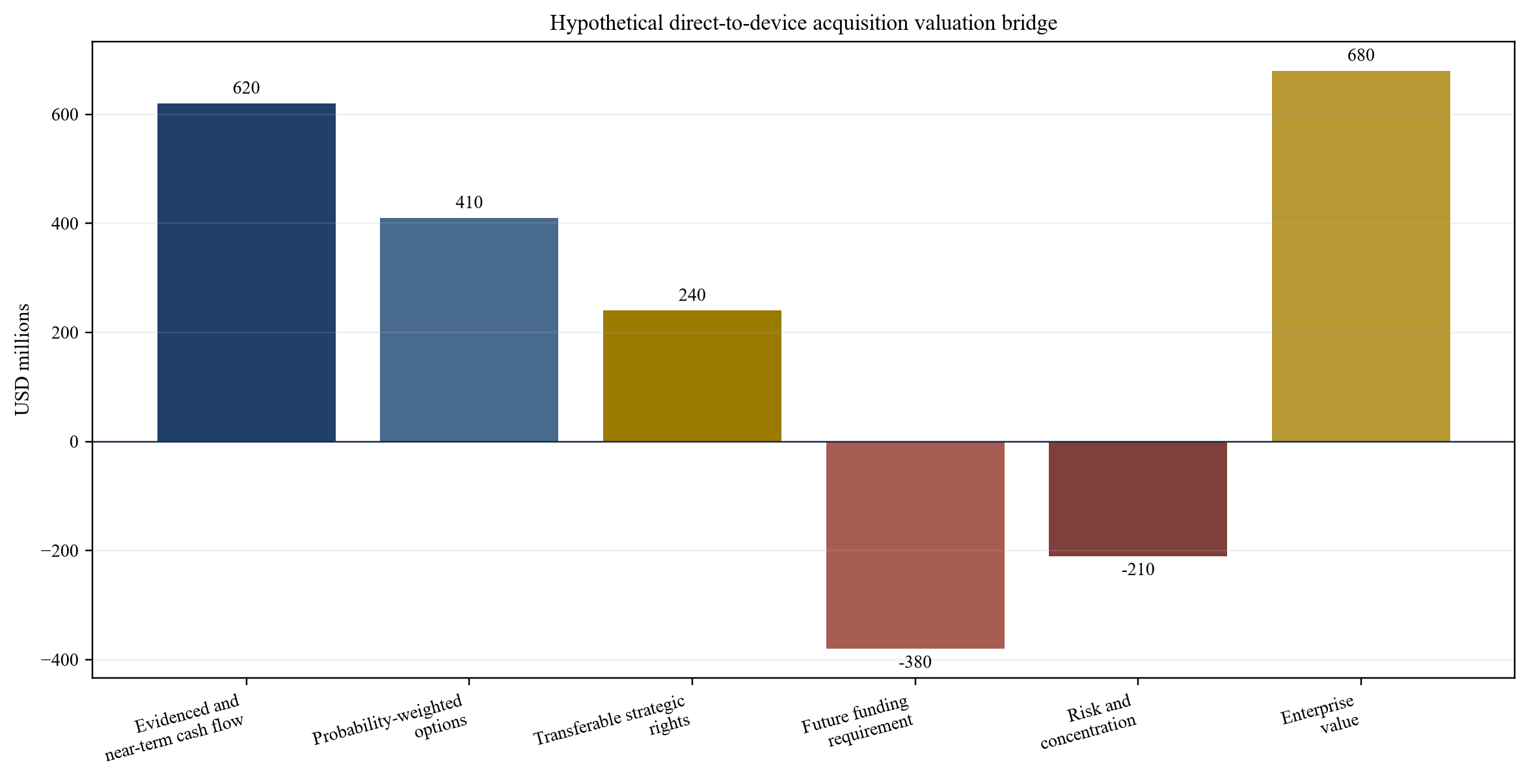
Illustrative USD millions; every amount is a transaction assumption.
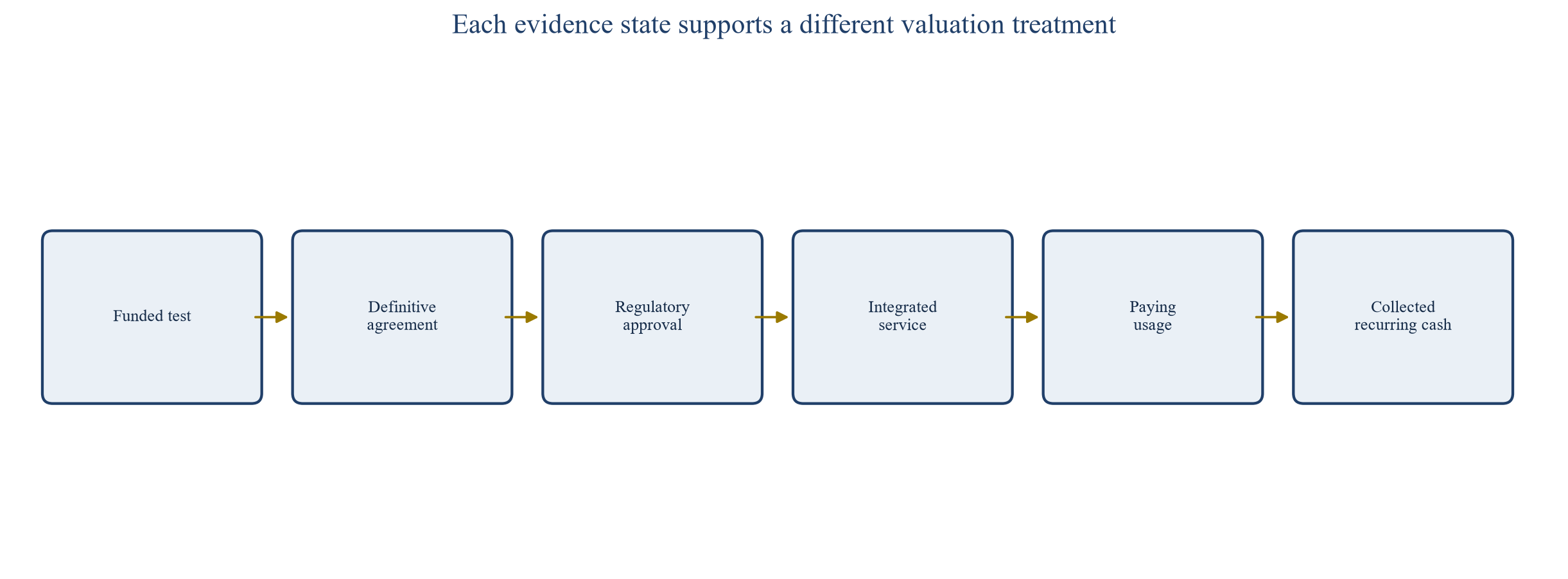
Proposed sequence from announced relationship to collected recurring cash.
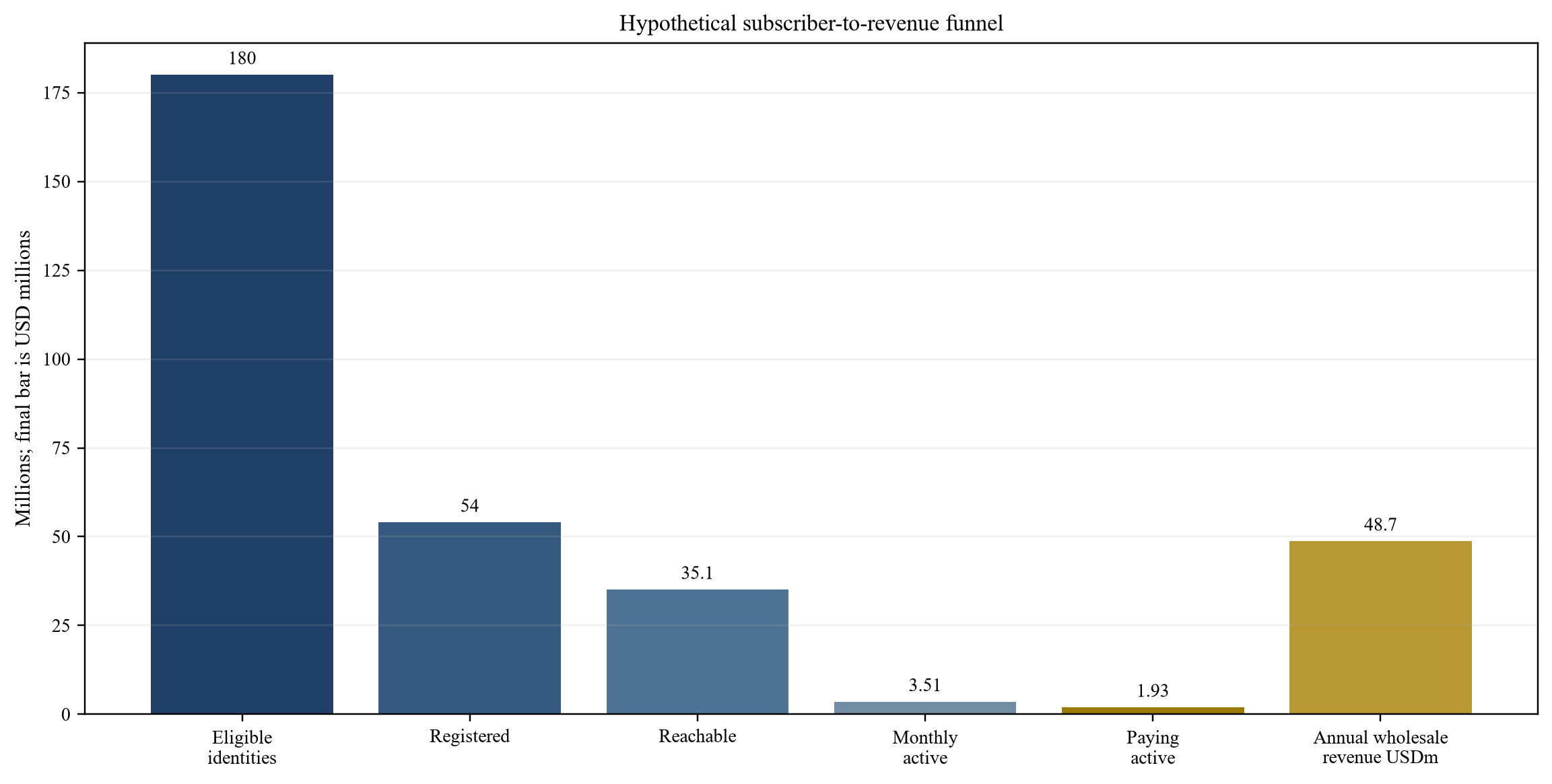
Illustrative millions of subscriber identities or users; the final bar is annual wholesale revenue in USD millions.
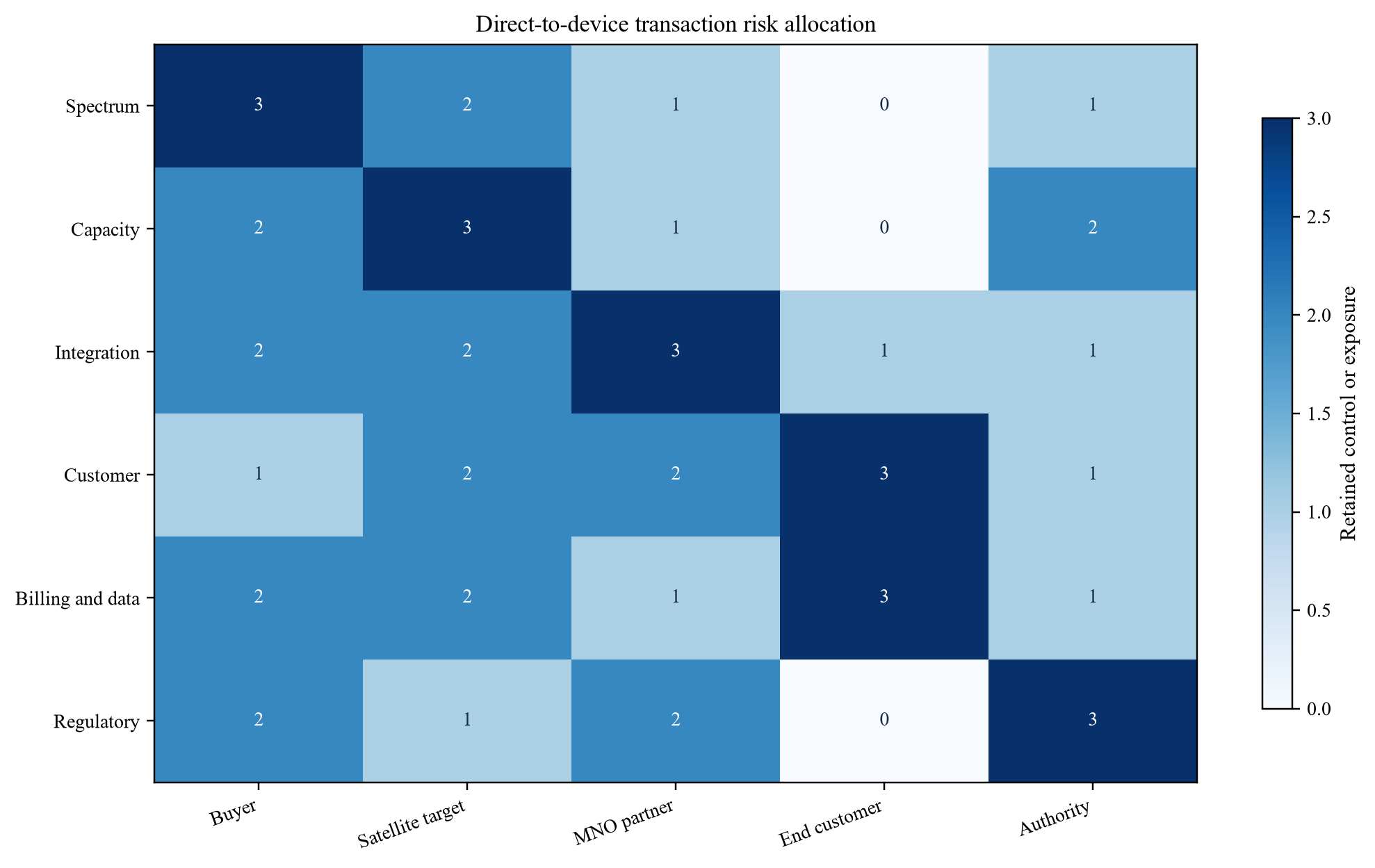
Proposed allocation; higher cells indicate greater retained control or exposure.
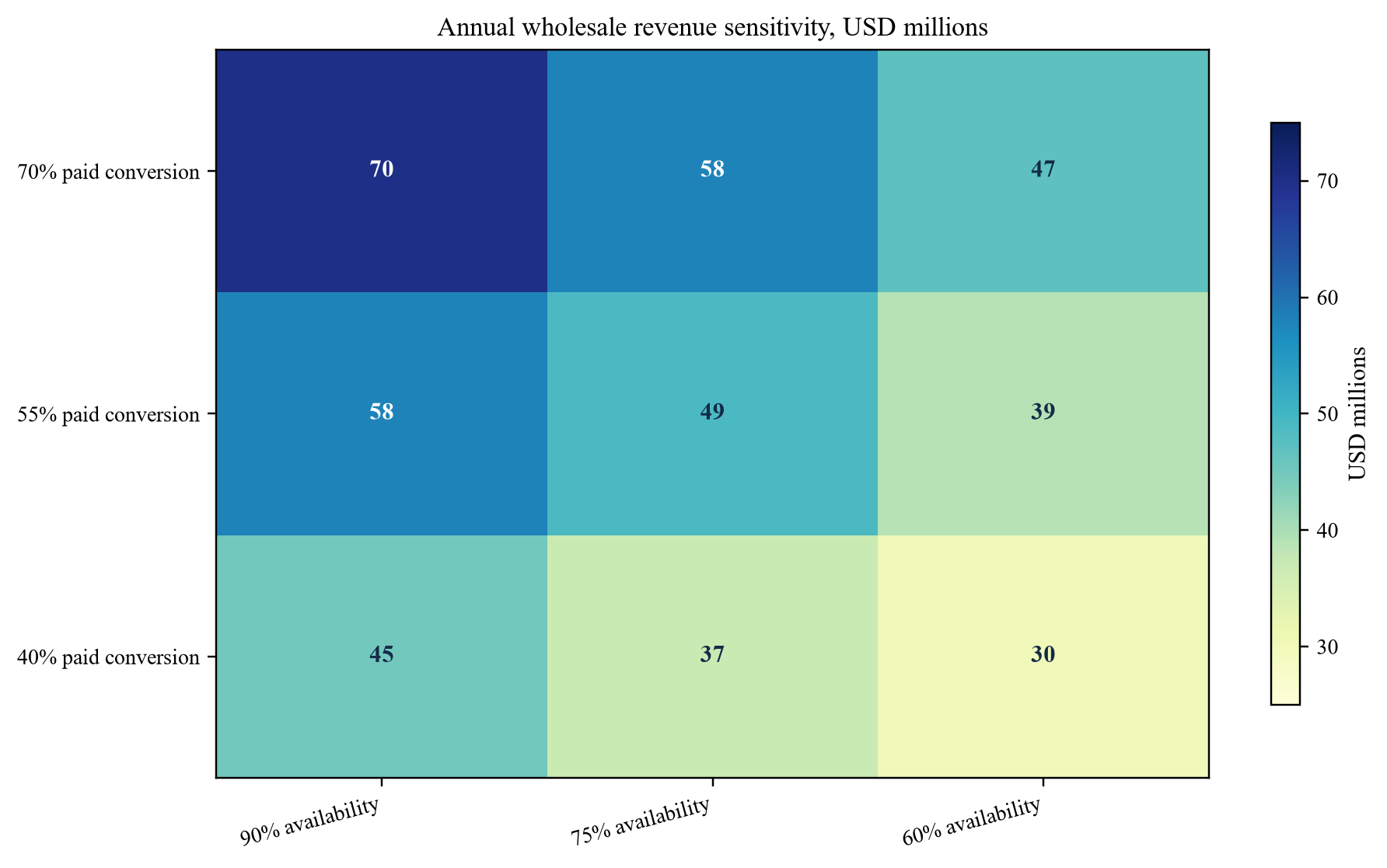
Illustrative USD millions under combined paid-conversion and service-availability assumptions.
| Evidence state | Minimum record | Valuation treatment | Principal risk |
|---|---|---|---|
| Announced relationship | Public statement and named parties | No contracted cash flow | Scope and commitment unknown |
| Funded test | Signed scope, budget and acceptance | Development revenue only | No commercial launch obligation |
| Definitive agreement | Executed economics and responsibilities | Probability-weighted option | Conditions may remain open |
| Regulatory approval | Territory, band and service permission | Increase territory readiness | Technical delivery remains |
| Integrated service | End-to-end accepted operation | Near-term commercial value | Adoption and availability |
| Paying usage | Auditable billable sessions | Observed unit economics | Scale and retention |
| Collected recurring cash | Reconciled receipts and renewal | Base cash-flow value | Concentration and capital need |
Proposed valuation treatment by evidence state.
| Driver | Assumption | Result | Evidence required |
|---|---|---|---|
| Eligible identities | 180.0 million | 180.0 million | Contracted territory and MNO records |
| Registration | 30% | 54.0 million | Provisioning records |
| Geographic and device reach | 65% | 35.1 million | Coverage, device and authorisation data |
| Monthly active use | 10% | 3.51 million | Network session records |
| Paid conversion | 55% | 1.93 million | Billing and settlement records |
| Monthly wholesale revenue | USD 2.80 | USD 5.41 million | Contract formula and invoices |
| Service availability | 75% | USD 48.7 million annually | Accepted service records |
Every value is an assumption and describes no company.
| Field | Question | Evidence | Failure response |
|---|---|---|---|
| Right holder | Who controls the underlying spectrum? | Licence and registry | Stop unsupported territory value |
| Satellite authority | Can the space system transmit the planned service? | Authorisation and conditions | Delay launch or change design |
| MNO agreement | Is spectrum contribution enforceable? | Executed agreement | Require consent or replacement |
| Interference | What limits power and availability? | Coordination and test records | Reduce capacity forecast |
| Device permission | Can ordinary devices lawfully operate? | Exemption or equipment approval | Limit eligible device base |
| Change of control | Does the right survive the acquisition? | Consent and legal confirmation | Make consent a condition |
Proposed minimum fields for each territory and band.
| Component | USDm | Evidence treatment |
|---|---|---|
| Evidenced and near-term cash flow | 620 | Contract and capacity-based value |
| Probability-weighted options | 410 | Explicit regulatory and delivery gates |
| Transferable strategic rights | 240 | Usable spectrum, technology and control |
| Future constellation and integration funding | -380 | Cash required to deliver service |
| Concentration and execution adjustment | -210 | MNO, approval and deployment exposure |
| Enterprise value | 680 | Illustrative transaction value |
Illustrative USD millions; options and strategic rights remain separate from evidenced cash flow.
| Consideration | USDm | Release evidence | Protection |
|---|---|---|---|
| Cash at completion | 420 | Essential consents and transferred assets | Closing conditions and warranties |
| Regulatory milestone | 35 | Specified territory, band and service approval | Long-stop and no partial credit |
| Integrated-service milestone | 35 | Accepted end-to-end service period | Independent test and holdback |
| Paying-usage milestone | 35 | Verified billable sessions | Audit rights and exclusions |
| Collected-revenue milestone | 35 | Reconciled third-party cash | Collection and clawback terms |
| Seller rollover | 120 | Continuing equity ownership | Funding and governance agreement |
Proposed evidence-linked transaction structure.
| Dimension | Core measure | Trigger | Required decision |
|---|---|---|---|
| Spectrum | Authorised territories and usable bands | Approval loss or restriction | Remove value or change scope |
| Capacity | Available service units and congestion | Capacity below contracted demand | Add capacity or limit product |
| Integration | Accepted MNO interfaces and open defects | Critical acceptance delay | Withhold milestone |
| Commercial | Paying usage, price and collections | Conversion or price miss | Reprice forecast |
| Partnership | Term, consent, concentration and audit rights | Essential MNO deterioration | Secure replacement or protection |
| Financial | Cash runway and capital to next gate | Unfunded deployment gap | Finance, resize or suspend |
Proposed quarterly transaction and operating record.
| Gate | Decision question | Minimum evidence | Failure response |
|---|---|---|---|
| Perimeter | What assets and contracts transfer? | Ownership and dependency map | Exclude unsupported assets |
| Spectrum | Where can the service operate? | Licences, agreements and coordination | Remove territory value |
| Capacity | What service can be delivered? | Independent capacity model | Cap revenue and price |
| Partnership | Which MNO obligations survive control change? | Executed contract and consent | Make continuity a condition |
| Demand | Who pays and at what rate? | Billable events, pricing and collections | Exclude unsupported revenue |
| Funding | What cash reaches reliable service? | Production, launch and liquidity plan | Reduce price or require support |
| Governance | Who controls data, funding and downside? | Rights, covenants and dashboard | Renegotiate structure |
Proposed decision record before signing.
Sources
- Federal Communications Commission, Report and Order and Further Notice of Proposed Rulemaking, FCC 24-28, 15 March 2024. Read the primary source
- Federal Communications Commission, OMB Approval for 911 Information Collection Requirements Associated with Supplemental Coverage from Space, 7 October 2024. Read the primary source
- Ofcom, Enabling satellite direct-to-device connectivity in mobile spectrum bands, 9 December 2025. Read the primary source
- Ofcom, Direct to Device licence exemption regulations update, 18 June 2026. Read the primary source
- Ofcom, Mobile and wireless broadband below 5 GHz, direct-to-device licence variations, 2026. Read the primary source
- International Telecommunication Union, Direct-to-device satellites: Four ways to connect the world, 16 March 2026. Read the primary source
- International Telecommunication Union, Direct to device services: Poised for the leap to 6G, 21 April 2026. Read the primary source
- International Telecommunication Union, Recommendation ITU-R M.2177, Detailed specifications of the satellite radio interfaces of IMT-2020, February 2026. Read the primary source
- 3GPP, Release 17 and non-terrestrial networks. Read the primary source
- GSMA, Non-Terrestrial Networks: Opportunities and Challenges, 2025. Read the primary source
- GSMA, Guidance to Support New Direct-to-Device Satellite Services, 12 September 2025. Read the primary source
- GSMA, The Limits of Direct-to-Device, 2025. Read the primary source
- GSMA, Spectrum Policy Trends 2026. Read the primary source
- GSMA, The Mobile Economy 2024. Read the primary source
- GSMA, Mobile Innovation Report 2026. Read the primary source
- AST SpaceMobile, Annual Report on Form 10-K for the year ended 31 December 2025. Read the primary source
- AST SpaceMobile, Annual Report on Form 10-K for the year ended 31 December 2024. Read the primary source
- AST SpaceMobile and Ligado Networks, Framework Agreement, 22 March 2025. Read the primary source
- AST SpaceMobile, Amended and Restated Stockholders Agreement, 5 June 2024. Read the primary source
- Globalstar, Annual Report on Form 10-K for the year ended 31 December 2025. Read the primary source
- Apple, Use Emergency SOS via satellite on iPhone. Read the primary source
- T-Mobile, T-Satellite service information. Read the primary source
- European Space Agency, Satellite communications and 5G/6G. Read the primary source
- European Commission, EU Space Strategy for Security and Defence, 10 March 2023. Read the primary source
- IFRS Foundation, IFRS 13 Fair Value Measurement. Read the primary source
- IFRS Foundation, IFRS 3 Business Combinations. Read the primary source
- IFRS Foundation, IAS 36 Impairment of Assets. Read the primary source
- U.S. Department of Justice and Federal Trade Commission, Merger Guidelines, 18 December 2023. Read the primary source
- European Commission, Guidelines on the assessment of horizontal mergers, 2004. Read the primary source
- OECD, Broadband and telecom market developments. Read the primary source
