

1. Establish the mandate and authority before the first request
A distressed acquisition begins with an operating mandate, not a data-room checklist. The buyer should state the capability, customer access, assets or market position it seeks; the cash it can expose; the control it requires; the risks it will not assume; and the time by which the opportunity ceases to be attractive. A written mandate gives the decision team a basis for refusing activity that consumes time without reducing uncertainty.
The mandate should distinguish four objects that are often blurred under pressure. The first is the legal seller and its authority to transfer shares, a business or assets. The second is the operating perimeter needed to serve customers after completion. The third is the liability perimeter that follows the chosen route. The fourth is the funding perimeter, including purchase consideration, cure payments, working capital, restructuring costs, capital expenditure and contingency. A buyer can agree a low headline price and still inherit an uneconomic total funding requirement.
Authority should be tested before sensitive diligence begins. The team needs to know whether directors, shareholders, secured creditors, an insolvency officeholder, a court or a combination of parties controls the process. Security enforcement, moratoria, creditor committees, statutory approvals and avoidance rules can affect what can be transferred and when. The UAE federal framework provides preventive settlement, restructuring and bankruptcy procedures, subject to its scope and exclusions.[1][2] Saudi Arabia provides seven bankruptcy procedures, including protective settlement, financial restructuring and liquidation variants.[3][5] ADGM and DIFC operate separate insolvency regimes within their respective jurisdictions.[6][7]
The buyer should appoint a single transaction sponsor and a Distressed Acquisition Office lead. The sponsor owns the capital decision. The office lead owns the evidence register, cash model, workplan, issue decisions, stakeholder map, document architecture and closing readiness. Named leaders for finance, operations, legal, commercial, tax, people, technology, compliance and integration should have explicit decision rights. Advisers provide specialist conclusions; management retains the investment decision.
The office should open with a one-page decision charter:
1. the acquisition objective and required operating perimeter; 2. the maximum capital at risk, including post-completion liquidity; 3. mandatory legal, integrity, continuity and return gates; 4. the seller's stated authority and the evidence required to confirm it; 5. the daily decision forum and escalation route; 6. the evidence standard for price, funding and completion; and 7. the circumstances that require a pause or withdrawal.
This charter prevents urgency from becoming permission to accept unsupported assumptions. It also gives the seller and advisers a clear route for resolving the few matters that can change the decision.
2. Determine the legal route and transaction perimeter
The legal route determines which rights and liabilities move, which approvals are needed and how much continuity the buyer can preserve. A share acquisition may keep the operating entity, contracts, workforce and licences together, subject to change-of-control and regulatory provisions. Historical liabilities remain within the company. An asset or business acquisition can select assets and assumed obligations, yet it may require individual transfers, novations, employee steps, licence replacement, data migration and operational cutover. An insolvency process may permit a supervised sale, subject to the governing law, officeholder powers, creditor interests and court or committee oversight.
The office should prepare a route memorandum within the first three business days. It should identify the entities, place of incorporation, centre of main interests where relevant, active insolvency or enforcement process, shareholder and board powers, material security, pending petitions, court orders, creditor approvals and statutory restrictions. The memorandum should state which conclusions are supported by primary documents, which await counsel confirmation and which depend on future consent.
In the UAE, Federal Decree-Law No. 51 of 2023 and its Executive Regulations apply within their defined scope. The law excludes, among others, entities governed by special insolvency regimes in certain free zones and Central Bank-regulated banks, financial institutions and insurers.[1][2] A transaction involving ADGM or DIFC entities therefore requires analysis under the applicable financial-free-zone regime.[6][7] In Saudi Arabia, the Bankruptcy Law and Implementing Regulations allocate powers among the debtor, bankruptcy trustee, creditors, court and Bankruptcy Commission according to the procedure.[3][4]
The route memorandum should then connect legal form to an operating-perimeter schedule. For every customer contract, licence, site, employee group, system, data set, supplier, bank account, intellectual-property right, permit, inventory pool and insurance policy, the schedule should state:
- current legal owner and operating user;
- whether it transfers automatically, needs consent, must be replaced or stays behind;
- the deadline and evidence for transfer;
- the consequence if unavailable on Day One; and
- the temporary service or workaround, if lawful and practical.
The transaction perimeter is viable only when the surviving pieces can operate together. A production line without environmental approval, a customer book without assignable contracts, a platform without data rights or a distribution business without key employees may have little going-concern value. UNCITRAL's Legislative Guide recognises going-concern sale and other restructuring techniques as tools for preserving value, within a predictable and efficient insolvency framework.[8] The World Bank's principles similarly emphasise transparent, predictable regimes that preserve viable businesses and reallocate productive assets efficiently.[9]
Table 1. First 24-hour evidence request
| Evidence stream | Minimum first release | Decision supported | Escalation trigger |
|---|---|---|---|
| authority and process | constitutional documents, ownership, board authorities, petitions, orders, officeholder appointment, sale protocol | seller authority and route | authority cannot be evidenced |
| liquidity | bank balances, daily cash, 13-week forecast, aged receivables and payables, payroll and tax calendar | survival runway and funding | cash control or completeness unclear |
| security and debt | facility letters, security register, guarantees, defaults, waivers and enforcement notices | consent, priority and payoff | disputed priority or imminent enforcement |
| customers and revenue | top contracts, current orders, churn, disputes, change-of-control and assignment terms | revenue continuity | consent-dependent material revenue |
| operations | sites, inventory, suppliers, licences, maintenance, health and safety, systems | Day One viability | critical dependency lacks lawful continuity |
| people and data | employee list, payroll, key roles, claims, data map, access rights and incidents | workforce and data continuity | key-person or unlawful-access risk |
The request is a management starting point. The governing procedure and adviser instructions determine access, privilege, confidentiality and authority.
3. Stand up the 30-day command structure
The Distressed Acquisition Office operates as a short-cycle control system. It maintains one source register, one issues register, one cash model, one stakeholder map, one transaction timetable and one decision log. Each fact has a source, date, owner and confidence description. Each issue has a decision route, monetary or operating relevance, responsible executive and deadline. Documents can remain in specialist workstreams; conclusions should converge in the office record.
The daily rhythm should match the target's cash and operational volatility. A 30-minute cash and continuity call reviews opening cash, receipts, critical payments, stock-outs, service incidents, employee departures and stakeholder actions. A 45-minute diligence decision call reviews only matters that can change price, perimeter, protection, funding, control, timing or withdrawal. A sponsor call approves changes to the investment case and escalates matters that the office cannot resolve under delegated authority.
The office needs controlled access. The buyer should separate unrestricted commercial information, personal data, competitively sensitive information, privileged material and information subject to court or officeholder controls. Clean-team or adviser-only arrangements may be needed before competition approval or where competitors are involved. The evidence register should record who received each item and the lawful purpose for access.
Figure 1 organises the 30 days around six gates. Calendar days are illustrative. The legal process, creditor actions, authority reviews, data access and operational events can require a longer period or an earlier decision.
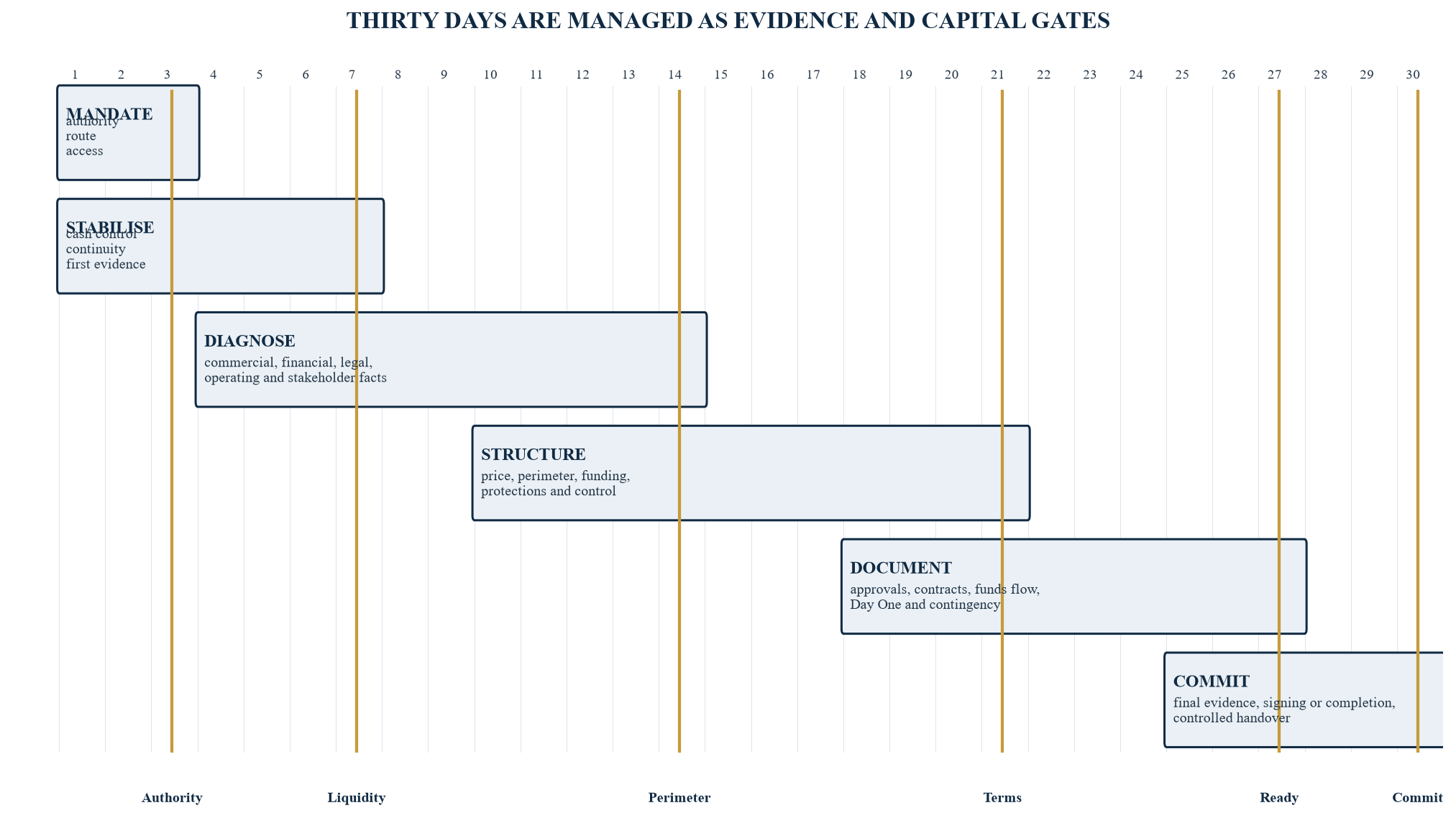
Timing is an original management assumption. Each gate requires verified evidence and the approvals applicable to the transaction.
The office should publish a short internal dashboard after each daily cycle. It shows cash headroom, critical continuity incidents, unresolved authority items, issues by decision route, stakeholder changes, document status and the next irrevocable action. Management should be able to trace every headline to source evidence.
4. Stabilise cash and continuity in the first 72 hours
Liquidity diligence begins with control over the opening bank position. The office should obtain direct statements or read-only bank evidence, reconcile restricted and unrestricted cash, identify trapped balances, review overdraft and sweep arrangements and list every account, signatory and payment mechanism. A balance in the ledger is not equivalent to cash that can legally and operationally fund the acquired business.
The team should build a daily cash bridge for the first two weeks and a weekly view to week 13. Receipts are analysed customer by customer, including invoice status, dispute, offset, assignment, collection route and concentration. Payments are analysed by legal due date, continuity consequence, priority, security, employee impact and statutory exposure. The office should document the authority for any payment prioritisation. Insolvency law and director duties can constrain selective payment and the use of company resources.
IAS 7 explains that cash-flow information helps users assess the ability to generate cash and the timing and certainty of those flows.[12] IAS 1 requires management to assess going concern and consider available information for at least 12 months from the end of the reporting period, while disclosing material uncertainties under the applicable conditions.[11] A 13-week model serves a different operational purpose; it gives the acquisition office a short-cycle view of receipts, payments, minimum operating cash and funding triggers. It does not replace the reporting-entity assessment.
Continuity should be protected through a critical-payment protocol. The protocol groups payments into payroll and employee safety, taxes and statutory items, utilities and essential infrastructure, critical suppliers, secured debt and other obligations. Legal and insolvency advisers should confirm priorities, restrictions and approvals. The buyer should avoid funding a target through informal advances whose ranking, security, use and repayment are unclear. UAE law provides mechanisms concerning new financing in applicable restructuring contexts; Saudi procedures also address secured or guaranteed financing and stakeholder approvals under the governing provisions.[1][3][5]
Table 2. Liquidity action ladder
| Headroom signal | Management response | Evidence required | Control condition |
|---|---|---|---|
| more than eight weeks | validate collections and recurring costs; protect working capital | bank evidence, receipts, payables and order book | weekly forecast reconciliation |
| four to eight weeks | activate collection sprints and vendor continuity plans | customer-level receipts and supplier dependencies | daily cash review |
| two to four weeks | freeze discretionary spend; negotiate standstills and funding documents | authorised payment list and stakeholder consents | dual approval and use-of-funds reporting |
| less than two weeks | run daily survival plan; prepare lawful contingency or controlled shutdown | direct bank visibility and critical service map | sponsor, counsel and officeholder approval as applicable |
| funding condition failed | stop unprotected exposure; reassess transaction route | failed condition and revised downside case | written investment decision |
Actions depend on legal authority, insolvency duties, security and the operating facts. The sequence does not establish payment priority.
5. Build a 13-week cash curve with scenario ranges
The 13-week model should be simple enough to update daily and detailed enough to drive decisions. It begins with verified opening unrestricted cash. It models customer receipts by expected date and probability, payroll by pay cycle, taxes by legal deadline, suppliers by operating consequence, rent and utilities, debt service, professional costs, capital expenditure, restructuring costs and acquisition funding. It shows minimum cash, cumulative funding need and the week in which each control action must occur.
Three cases can expose timing risk. The base case uses the office's best supported assumptions. The downside case delays uncertain receipts, increases critical supplier payments and removes uncommitted savings. The severe case tests customer loss, operational interruption or delayed completion. Scenario probabilities should not be invented to produce a single expected value. Decision makers benefit more from seeing the conditions that produce each case and the capital required to remain solvent and operational.
The model should reconcile forecast to actual at least weekly. Variances are separated into timing, volume, price, one-off and model errors. A favourable timing variance is not a permanent saving. An uncollected receivable should remain outside usable cash until its collection evidence supports inclusion. IFRS 9's expected-credit-loss framework reinforces the relevance of probability-weighted cash shortfalls and timing, although the acquisition office model is an operational tool rather than a substitute for the accounting measurement.[13]
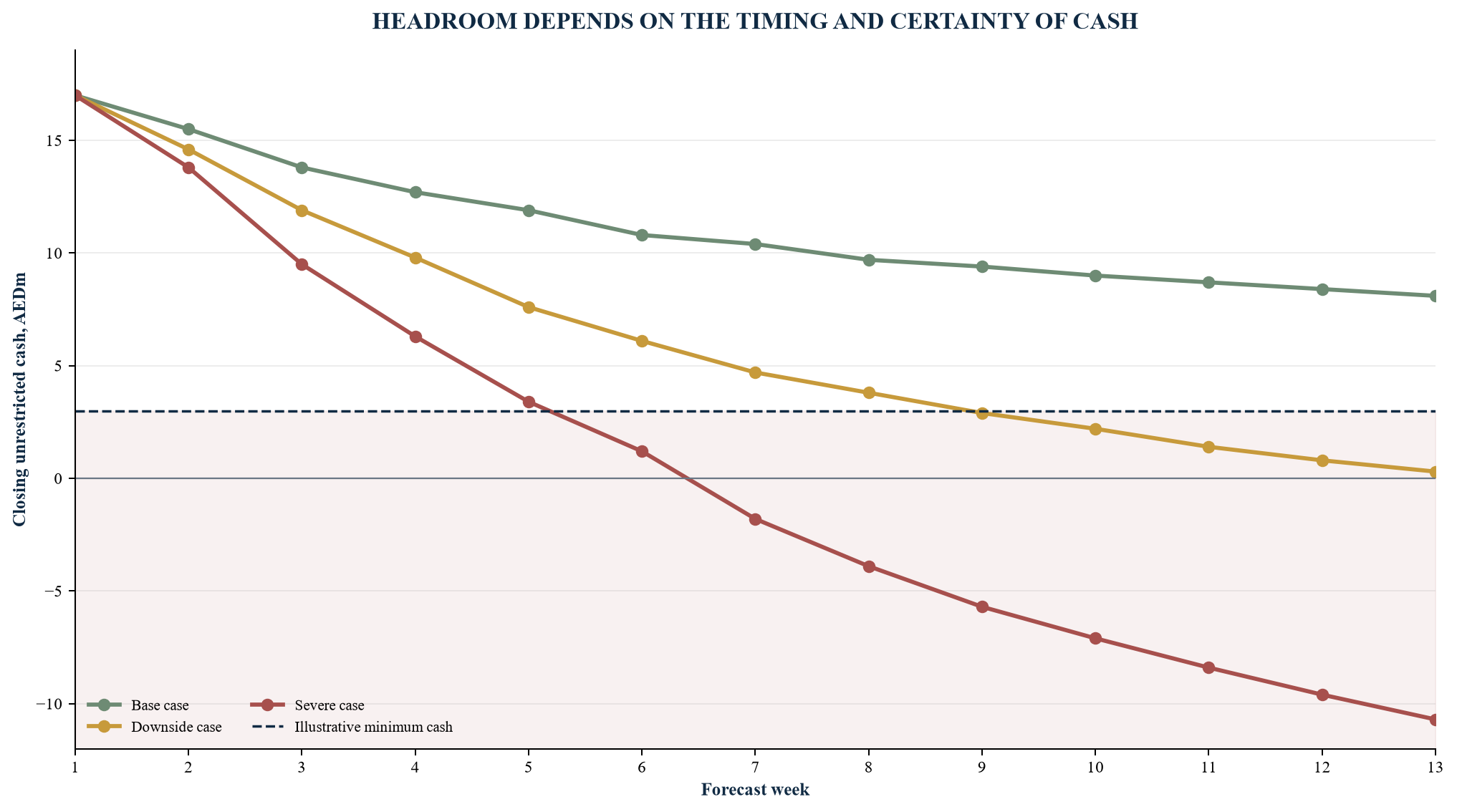
Amounts are hypothetical management assumptions in AED millions. They do not forecast a transaction or target.
The illustrative curve shows why the office should agree funding triggers before cash is exhausted. In the severe case, minimum cash is breached in week five and cash becomes negative in week seven. The buyer would need to change the transaction, secure controlled funding, reduce the operating perimeter or withdraw. The figure does not prescribe the lawful response.
6. Triage issues by value, continuity, legality and reversibility
A distressed process cannot investigate every issue to the same depth. The office should triage each finding through four lenses. Value asks how the matter affects enterprise value, debt, working capital, investment or recovery. Continuity asks whether customers, employees, systems, licences or supply can operate. Legality asks whether the route, transfer, payment, funding or intended action is permitted. Reversibility asks whether the buyer can correct the matter after completion without disproportionate loss.
The triage score directs attention; it does not replace judgement. A low-value sanctions, ownership or safety issue can still stop a transaction. A high-value accounting adjustment may be addressed through price if evidence is reliable. Each issue must produce one or more decision routes: reprice, remove from the perimeter, make completion conditional, obtain contractual protection, fund a remedy, secure control, or withdraw.
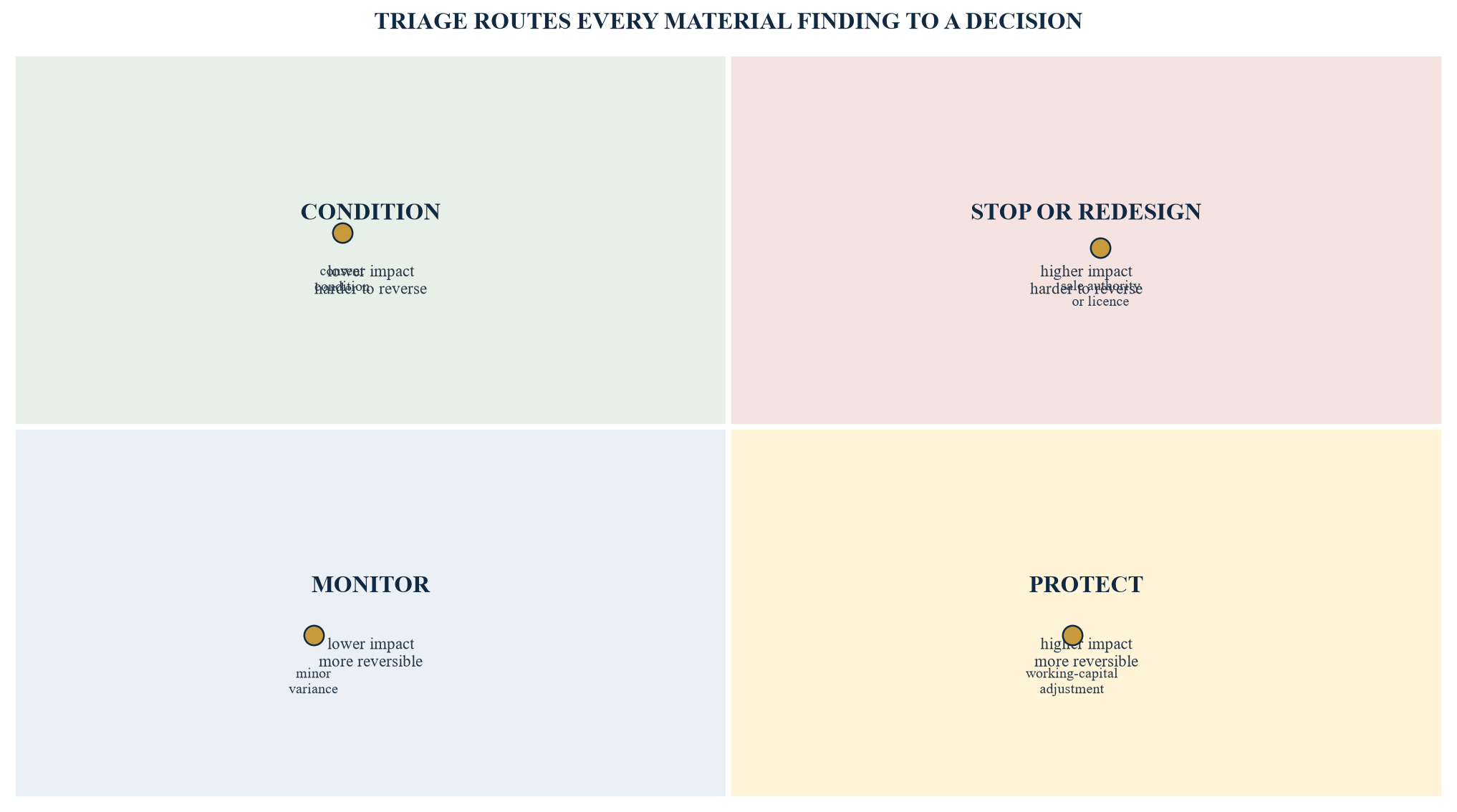
The map is an original management tool. Scores support prioritisation and do not override legal, integrity or safety gates.
Table 3. Issue-to-response register
| Finding | Decision question | Primary response route | Evidence needed to close |
|---|---|---|---|
| seller authority uncertain | can the asset be transferred with good title? | condition, route redesign or withdrawal | court order, corporate authority, officeholder power and security release |
| cash forecast unsupported | how much funding is exposed and when? | funding cap, control or withdrawal | direct cash evidence, customer receipts and critical payments |
| material contract cannot transfer | does the remaining perimeter operate? | condition, perimeter change or reprice | counterparty consent or executable replacement |
| historical liability cannot be quantified | can exposure be bounded or excluded? | indemnity, escrow, perimeter change or withdrawal | claim file, adviser estimate and enforceable recourse |
| key team at risk | can service continue through Day One? | retention, condition and transition control | signed arrangements and succession plan |
| system or data access unlawful | can the buyer operate compliantly? | condition, transition service or perimeter change | rights, lawful basis, security design and migration test |
The response is selected after evidence review. Several responses may apply to one issue.
7. Map stakeholders, incentives and decision power
Distress changes stakeholder behaviour. A secured lender may favour a rapid sale, a supplier may demand arrears, an employee may require certainty, a customer may seek an alternative provider and a regulator may prioritise continuity or compliance. The office should map legal power, economic exposure, operating dependency, current position, required decision and engagement owner for each stakeholder.
The map should separate formal authority from practical influence. A customer may have no formal approval right and still determine the value of the business. A landlord may control access to a critical site. A minority shareholder may hold reserved-matter rights. A creditor committee may have statutory functions in an applicable procedure. Saudi guidance describes roles for creditor committees in areas including asset sales, financing and contracts, subject to the particular procedure and governing provisions.[5]
Stakeholder engagement should use one approved fact base. The buyer should avoid representations about job security, payment, contract continuation or regulatory outcomes that it cannot support. Every commitment should have an owner, authority, funding source and written record. Inside-information, confidentiality, competition and data restrictions should shape who receives which information.
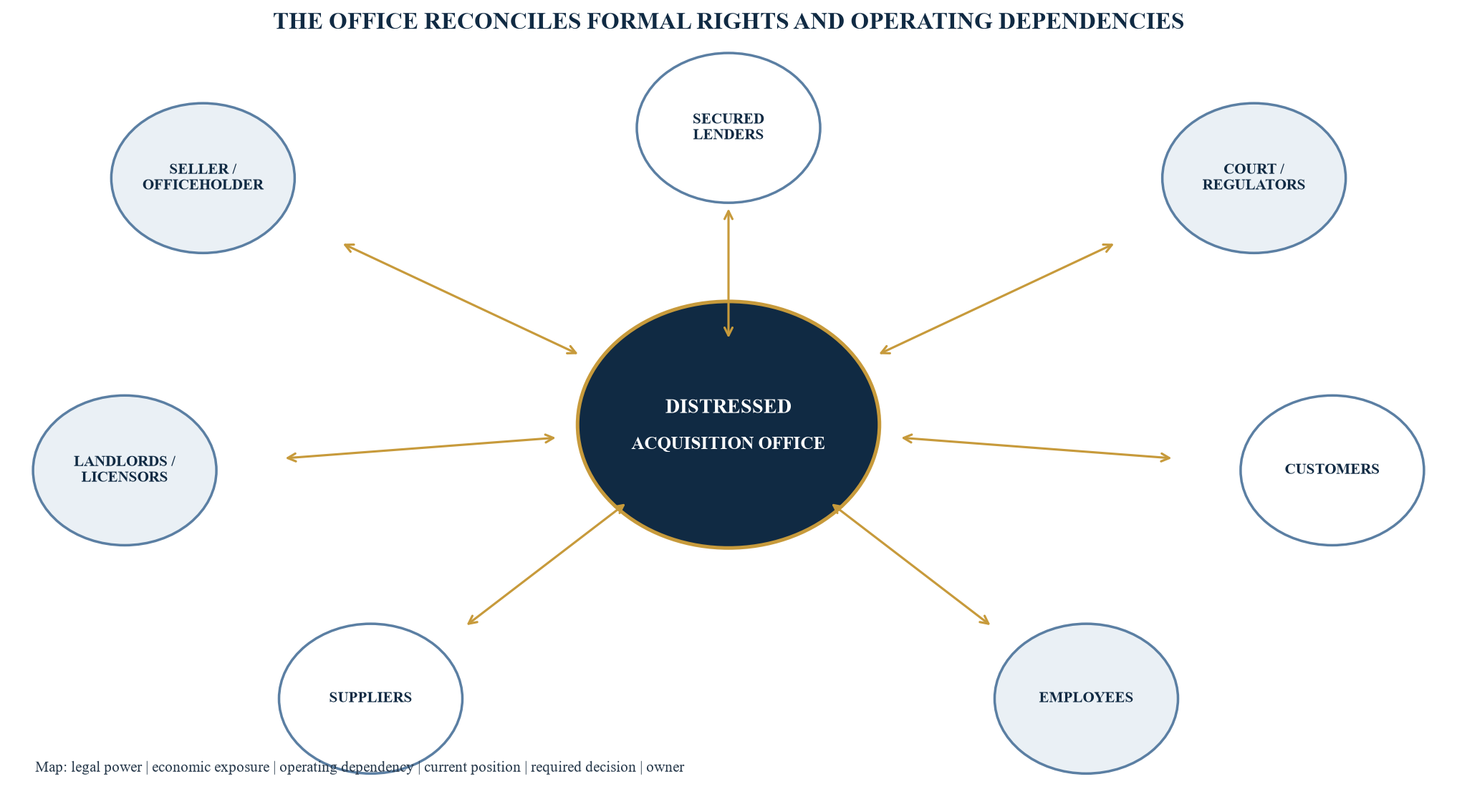
Relative positions are illustrative. The office should replace them with transaction-specific authority, exposure and dependency evidence.
The office should update the map when an enforcement step, missed payment, customer decision, employee departure or regulatory request changes leverage. Stakeholder positions are evidence, not constants.
8. Diligence the operating perimeter under time pressure
Operational diligence asks whether the purchased perimeter can fulfil customer commitments on Day One and generate cash thereafter. The office should trace the service or production chain from customer order to cash receipt. At each stage it identifies the entity, site, licence, employee, system, data, supplier, working capital and approval required. This dependency chain is more useful than a broad process description.
Customer diligence should begin with direct contract evidence, invoices, fulfilment, credits, collections, disputes, renewals, termination rights and concentration. The team should distinguish contracted revenue, order backlog, recurring usage, management pipeline and aspirational opportunity. It should test whether revenue depends on founder relationships, loss-making pricing, informal rebates or non-transferable rights.
Supplier and inventory diligence should connect aged payables to continuity. A creditor balance does not show whether the supplier has stopped shipment, asserted title, holds customer-owned property or is the sole qualified source. Inventory should be tested for ownership, location, condition, obsolescence, consignment, liens and the demand that will convert it to cash. Capital expenditure should be separated into maintenance, compliance and growth.
Technology and data diligence should verify ownership, licences, hosting, privileged access, cyber incidents, resilience, source-code availability and separation from seller systems. In Saudi Arabia, the Personal Data Protection Law includes requirements relevant to disclosure and transfers outside the Kingdom.[17] The buyer should confirm the lawful basis, transfer conditions, minimum-data principle, security and data-subject implications. Equivalent analysis is needed under the laws governing other entities and data sets.
The operating test should culminate in a Day One bill of materials: every asset, person, permission, service, payment and system needed for the first day, week and month. Missing items become conditions, transition services, funded remedies or changes to the perimeter.
9. Diligence liabilities, security, claims and avoidance risk
The liability review should start with a complete legal-entity and security map. It identifies lenders, facility amounts, accrued interest, default, guarantees, pledges, mortgages, account charges, assignment, retention of title, set-off, intercompany balances and enforcement notices. Counsel should confirm perfection, priority, release mechanics and the effect of the chosen insolvency or sale process. Management should avoid assuming that an asset sale automatically produces clean title.
Claims diligence should cover litigation, arbitration, regulatory investigations, tax, customs, employee claims, pensions or end-of-service obligations, environmental matters, product liabilities, warranties, fraud and related-party transactions. The office should distinguish filed claims, threatened matters, management awareness and matters discovered from source evidence. Each exposure needs a range, timing, defence, insurance or recourse assessment and a route into transaction terms.
Avoidance and antecedent-transaction rules can affect pre-sale transfers and payments. Saudi Bankruptcy Commission guidance describes look-back analysis, including longer periods for related-party transactions, subject to the law and facts.[5] UAE and financial-free-zone regimes have their own provisions.[1][6][7] The office should refer unusual asset transfers, preferences, security grants, related-party payments and undervalue transactions to qualified insolvency counsel.
Purchase accounting should be addressed before the investment paper is final. IFRS 3 requires the acquisition method for a business combination within its scope, including recognition and measurement of identifiable assets and liabilities and goodwill or a bargain purchase.[10] A bargain purchase requires reassessment before gain recognition. IAS 36 governs impairment testing for relevant assets and cash-generating units.[14] IFRS 5 addresses measurement and presentation for qualifying assets held for sale and discontinued operations.[15] These standards do not determine the cash purchase price; they can materially affect post-completion reporting and the credibility of the buyer's value bridge.
10. Convert findings into price, perimeter and protection
The investment model should bridge from operating evidence to total capital at risk. It begins with maintainable revenue and margin, then adjusts for customer loss, one-off trading, underinvestment, working capital, debt-like items, liabilities, taxes, restructuring, separation and the liquidity required to reach a stable operation. Buyer-specific upside belongs in a separate case with explicit timing, cost and probability assumptions.
The headline purchase price should be reconciled to cash paid at completion and to total funding. Debt repayment, arrears, cure payments, employee obligations, adviser fees, capital expenditure, systems separation and contingency can exceed the equity consideration. A low or nominal price is not evidence of a low-risk acquisition.
Findings should be routed into executable terms:
- price adjustment for measurable and accepted value differences;
- excluded asset or liability where the operating perimeter remains viable;
- completion condition for authority, consent, release, funding or continuity;
- warranty for a factual state within the seller's knowledge and capacity;
- indemnity for a defined exposure, subject to enforceability and credit support;
- escrow, holdback or deferred consideration for recourse where lawful;
- covenant controlling conduct before completion;
- transition service for a time-limited dependency; and
- withdrawal when exposure cannot be bounded or control cannot be secured.
Seller creditworthiness matters. An indemnity from an insolvent entity may have little economic value. The buyer should analyse escrow, guarantee, insurance, price retention or structural exclusion where available and lawful. The transaction document should state evidence standards for each condition and the person authorised to accept satisfaction.
Competition review belongs in the timetable before control is implemented. UAE Federal Decree-Law No. 36 of 2023 requires prior notification for an economic concentration when the applicable criteria are met and provides a review timetable under the law and implementing framework.[18][19] Saudi Arabia's current Economic Concentration Review Guidelines explain notification and review for qualifying transactions.[20] The office should calculate filing requirements from verified group, target, market and revenue facts, then design information controls and completion mechanics around the result.
11. Secure control rights before new money is exposed
Control is a package of legal rights, operating access and enforceable approvals. Equity ownership alone may not give the buyer timely authority over cash, contracts, data, employees and capital allocation. The office should map each right to the document that creates it, the person who can exercise it, the condition that activates it and the remedy if breached.
Pre-completion controls should respect the seller's continuing legal responsibility and competition restrictions. They can include information rights, ordinary-course covenants, consent for exceptional debt or asset transfers, access to prepare integration and agreed steps for preserving critical operations. The buyer should avoid premature control before approvals and completion.
Where the buyer provides interim or completion funding, the use-of-funds schedule should identify permitted payments, bank controls, reporting, milestones, security or priority where lawful, draw conditions, default rights and unused-funds treatment. Insolvency and financial-assistance analysis may be required. A funding document should agree with the cash model and transaction perimeter.
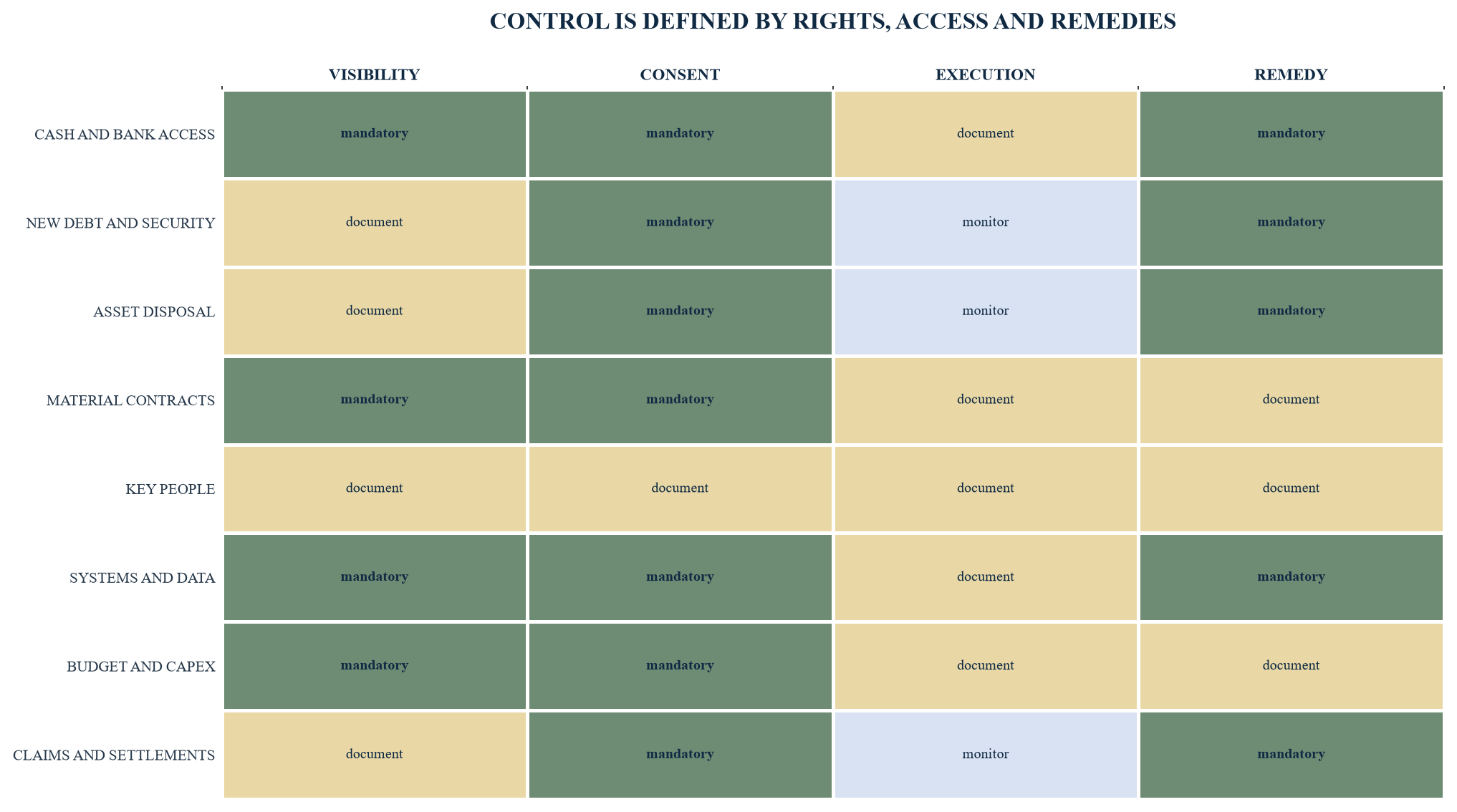
Rights are illustrative. Counsel should confirm legality, drafting, enforceability and any insolvency or competition restrictions.
Table 4. Control-rights schedule
| Control domain | Required right | Evidence before exposure | Failure response |
|---|---|---|---|
| liquidity | direct visibility, authorised payment protocol and use-of-funds reporting | bank mandate, signed protocol and tested reporting | suspend draw or escalate under documents |
| debt and security | restriction on new borrowing, guarantees and security | covenant and complete security register | condition, consent or default remedy |
| operating perimeter | preservation of assets, licences, contracts and inventory | verified schedule and exception approval | price, perimeter or withdrawal decision |
| governance | reserved matters, reporting and delegated authority | constitutional and transaction documents | delay control transfer or revise route |
| people | access, retention authority and succession for critical roles | signed arrangements and funded plan | continuity contingency |
| systems and data | lawful access, security, separation and transition | rights schedule, testing and incident review | transition service, remediation or stop |
The schedule separates economic intent from the instrument that makes a right executable.
12. Protect Day One and the first 100 days
Completion should occur only when the business can operate and the buyer can exercise the agreed controls. The closing room should contain authority, conditions, approvals, releases, funds-flow instructions, ownership transfer, bank access, licence evidence, insurance, key contracts, employee steps, system access and the Day One operating pack. The office should distinguish documents signed in advance, documents released at completion and actions confirmed after funds move.
Day One priorities are continuity, cash control, safety, legal compliance, employee communication, customer service and evidence preservation. The buyer should secure banking, accounting access, payment authority, inventory and site control, system credentials, incident reporting and critical supplier contact. Communications should be consistent with the transaction documents and approved employment, regulatory and customer positions.
The first 100 days should be structured around three horizons. Days 1 to 10 stabilise cash, service, people and access. Days 11 to 30 validate the operating baseline, reset the forecast and resolve inherited control failures. Days 31 to 100 execute the funded turnaround plan, including commercial focus, working capital, cost actions, governance, systems, compliance and leadership. Each initiative needs a baseline, owner, investment, milestone, evidence and stop or redesign threshold.
Turnaround research cautions against treating activity volume as effectiveness. Sudarsanam and Lai studied 166 potentially bankrupt UK firms and found that recovery and non-recovery firms adopted similar categories of strategy; implementation effectiveness differed.[23] Trahms, Ndofor and Sirmon's review frames turnaround through the interaction of decline, strategic response, management and context.[22] Hotchkiss and Mooradian's study of 55 Chapter 11 acquisitions found evidence of asset redeployment and post-acquisition operating improvement in its historical US sample.[21] These studies support disciplined execution questions. Their samples, jurisdictions and periods do not predict the outcome of a GCC transaction.
13. Apply the office to an illustrative 30-day scenario
Consider a hypothetical regional technical-services company with annual revenue of AED 180 million, reported EBITDA of AED 12 million and opening unrestricted cash of AED 17 million. A lender has issued a reservation-of-rights letter. Payroll is due in nine days. Two suppliers have reduced credit terms. The largest customer represents 22 per cent of revenue and can terminate following a change of control. The seller proposes a share sale within 30 days.
The buyer's first-day mandate caps total initial exposure at AED 55 million and requires uninterrupted service to the top five customers. The figures are illustrative management assumptions. They do not represent a forecast, valuation or recommendation.
During days 1 to 3, the office verifies the seller's corporate authority, lender security, bank balances, payroll, tax calendar and operating licences. Counsel identifies that lender consent and security-release mechanics are required. The cash team rebuilds the forecast from bank evidence and customer-level receipts. The severe case shows a minimum-cash breach in week five.
During days 4 to 14, commercial diligence removes AED 3 million of one-off margin from maintainable EBITDA and identifies an unprofitable contract whose exit cost requires analysis. Operations finds one site dependent on a licence held by another seller entity. Technology review identifies seller-controlled credentials and a data-hosting arrangement that needs lawful separation. People review identifies six critical managers and overdue employee balances.
The office routes the customer change-of-control right and site licence to completion conditions. It routes the EBITDA adjustment and exit cost to price. It routes credentials and hosting to a tested transition service. It routes employee balances and forecast headroom to the funds-flow and liquidity package. The lender release becomes a condition that cannot be waived without the sponsor and counsel.
During days 15 to 21, the buyer proposes an asset perimeter after comparing continuity, liabilities and transfer execution. The final route remains subject to verified licence, contract, employment, tax and insolvency advice. The buyer's model includes AED 24 million of purchase and cure payments, AED 16 million of 13-week liquidity and AED 9 million of separation and compliance expenditure, with AED 6 million of contingency. The sum equals the illustrative AED 55 million exposure cap.
Table 5. Illustrative 30-day decision record
| Issue | Illustrative effect | Office response | Residual uncertainty |
|---|---|---|---|
| one-off margin | AED 3m EBITDA removed | rebase price case | future trading remains uncertain |
| customer change of control | 22% of revenue exposed | completion condition and direct continuity plan | customer decision remains open |
| site licence dependency | one operating site exposed | transfer, replacement or perimeter change | authority timing remains open |
| week-five minimum-cash breach | AED 16m liquidity package modelled | controlled funding with draw conditions | collections and supplier behaviour vary |
| employee balances | amount under verification | funds-flow reserve and legal review | final claim population remains open |
| seller systems | access depends on transition | tested service agreement and migration milestone | separation execution remains uncertain |
Amounts and responses are hypothetical management assumptions. Actual outcomes require verified evidence and qualified advice.
During days 22 to 27, the office reconciles the purchase agreement, funding documents, releases, consents, transition services, funds flow and Day One pack. Every condition has an owner, evidence and acceptance authority. During days 28 to 30, the sponsor receives the final paper showing total capital, cash cases, unresolved risks, protections, control rights and the funded 100-day plan. A decision to proceed would remain conditional on satisfaction of the mandatory gates.
The scenario shows how speed arises from decision architecture. It does not show that every distressed acquisition can or should complete in 30 days.
14. Maintain professional and jurisdictional boundaries
This paper is general research and a management framework. It is not legal, insolvency, restructuring, competition, tax, accounting, valuation, employment, data-protection, sector-regulatory or investment advice. The applicable position depends on the parties, entities, jurisdiction, procedure, security, assets, contracts, workforce, data, conduct and timing.
Official English translations may state that another language version prevails. Advisers should check current legislation, implementing rules, court or authority practice and procedural status. The UAE federal law, ADGM, DIFC and Saudi sources cited describe distinct regimes. A group transaction may engage more than one regime.
The calendar, cash curve, triage map, stakeholder map, control matrix, numerical scenario, thresholds and scores are original illustrative management assumptions. They have not been statistically validated. They do not estimate sale authority, liquidity, creditor recovery, approval, completion, turnaround success or investment return.
Academic evidence also has boundaries. The cited acquisition and turnaround studies use historical samples outside the GCC or review prior research.[21][22][23] Their findings guide questions about asset redeployment, strategic response and implementation. They do not establish causal results for a particular target.
15. Implementation conclusion
A distressed acquisition can be executed at speed when the buyer manages evidence, liquidity and control through one decision office. The mandate defines the desired operating perimeter and maximum capital. The route memorandum establishes who can sell and under which regime. The first 72 hours stabilise cash and continuity. The 13-week model identifies funding triggers. Triage converts findings into price, perimeter, conditions, protections, funding, control or withdrawal. The stakeholder map reconciles formal authority and practical dependency. The control-rights schedule makes the investment terms executable.
The 30-day calendar is a governance discipline rather than a promise of completion. Each gate requires evidence. The office should delay, redesign or stop when authority, title, liquidity, continuity, legality or control cannot be supported. It should also prepare a funded Day One and first 100 days before new money is exposed.
The board's final paper should contain the source register, route, operating perimeter, cash cases, issues and responses, stakeholder positions, total capital, transaction protections, control rights, conditions, funds flow and Day One plan. This record gives decision makers a traceable basis for committing capital under pressure and gives management a controlled basis for operating after acquisition.
References
- [1] United Arab Emirates, Federal Decree-Law No. 51 of 2023 Promulgating the Financial and Bankruptcy Law. https://uaelegislation.gov.ae/en/legislations/2190
- [2] United Arab Emirates, Cabinet Resolution No. 94 of 2024 concerning the Executive Regulations of Federal Decree-Law No. 51 of 2023. https://uaelegislation.gov.ae/en/legislations/2582
- [3] Saudi Bankruptcy Commission, Bankruptcy Law and statutory framework. https://bankruptcy.gov.sa/en/BankruptcyLaw/SystemAndRegulations/Pages/default.aspx
- [4] Saudi Bankruptcy Commission, Implementing Regulations of the Bankruptcy Law. https://bankruptcy.gov.sa/en/KnowledgeCenter/Publications/Documents/Implementing%20Regulations.pdf
- [5] Saudi Bankruptcy Commission, Bankruptcy procedures and frequently asked questions. https://bankruptcy.gov.sa/en/KnowledgeCenter/FAQ/Pages/FAQ.aspx
- [6] Abu Dhabi Global Market, Insolvency Regulations 2022. https://assets.adgm.com/download/assets/Insolvency%2BRegulations%2B2022.pdf/5e74b73e5e1f11ef89ae4202e67280b5
- [7] Dubai International Financial Centre, Insolvency Law and current legal database. https://www.difc.com/business/laws-and-regulations/legal-database/difc-laws/insolvency-law-difc-law-no-1-2019
- [8] UNCITRAL, Legislative Guide on Insolvency Law. https://uncitral.un.org/en/texts/insolvency/legislativeguides/insolvency_law
- [9] World Bank, Principles for Effective Insolvency and Creditor and Debtor Regimes, 2021. https://documents1.worldbank.org/curated/en/391341619072648570/pdf/Principles-for-Effective-Insolvency-and-Creditor-and-Debtor-Regimes.pdf
- [10] IFRS Foundation, IFRS 3 Business Combinations. https://www.ifrs.org/issued-standards/list-of-standards/ifrs-3-business-combinations/
- [11] IFRS Foundation, IAS 1 Presentation of Financial Statements. https://www.ifrs.org/content/dam/ifrs/publications/pdf-standards/english/2021/issued/part-a/ias-1-presentation-of-financial-statements.pdf?bypass=on
- [12] IFRS Foundation, IAS 7 Statement of Cash Flows. https://www.ifrs.org/content/dam/ifrs/publications/pdf-standards/english/2022/issued/part-a/ias-7-statement-of-cash-flows.pdf?bypass=onStatement
- [13] IFRS Foundation, IFRS 9 Financial Instruments. https://www.ifrs.org/content/dam/ifrs/publications/pdf-standards/english/2022/issued/part-a/ifrs-9-financial-instruments.pdf?bypass=on
- [14] IFRS Foundation, IAS 36 Impairment of Assets. https://www.ifrs.org/issued-standards/list-of-standards/ias-36-impairment-of-assets/
- [15] IFRS Foundation, IFRS 5 Non-current Assets Held for Sale and Discontinued Operations. https://www.ifrs.org/issued-standards/list-of-standards/ifrs-5-non-current-assets-held-for-sale-and-discontinued-operations/
- [16] Ministry of Human Resources and Social Development, Saudi Labour Law general provisions including change of ownership or legal form. https://www.hrsd.gov.sa/en/%D8%%D9%84%D8%AA%D8%%D8%%D9%8A%D9%81%D8%%D8%AA/%D8%%D9%84%D8%%D8%AD%D9%83%D8%%D9%85-%D8%%D9%84%D8%%D8%%D9%85%D8%
- [17] Saudi Data & AI Authority, Personal Data Protection Law. https://sdaia.gov.sa/en/SDAIA/about/Documents/Personal%20Data%20English%20V2-23April2023-%20Reviewed-.pdf
- [18] United Arab Emirates, Federal Decree-Law No. 36 of 2023 Regulating Competition. https://uaelegislation.gov.ae/en/legislations/2117
- [19] United Arab Emirates, Cabinet Resolution No. 59 of 2026 concerning the Executive Regulation of the Competition Law. https://uaelegislation.gov.ae/en/legislations/4451
- [20] Saudi General Authority for Competition, Economic Concentration Review Guidelines. https://gacbep.gac.gov.sa/cms/b9376edc-79a1-4573-a36d-4f3effaba838.pdf
- [21] Edith S. Hotchkiss and Robert M. Mooradian, Acquisitions as a Means of Restructuring Firms in Chapter 11, Journal of Financial Intermediation 7(3), 1998, 240-262. https://papers.ssrn.com/sol3/papers.cfm?abstract_id=116668
- [22] Cheryl A. Trahms, Hermann Achidi Ndofor and David G. Sirmon, Organizational Decline and Turnaround: A Review and Agenda for Future Research, Journal of Management 39(5), 2013, 1277-1307. https://doi.org/10.1177/0149206312471390
- [23] Sudi Sudarsanam and Jim Lai, Corporate Financial Distress and Turnaround Strategies: An Empirical Analysis, British Journal of Management 12(3), 2001, 183-199. https://doi.org/10.1111/1467-8551.00193
About the Author
Chennakeshav Adya is an independent researcher whose work focuses on corporate finance, value creation, private capital and transaction execution. His research translates financial, commercial and operating evidence into decision frameworks for boards, investors and management teams.
Appendix A: Distressed Acquisition Office opening checklist
- Confirm the acquisition objective, required operating perimeter, capital limit, control objective and mandatory gates.
- Evidence seller, board, shareholder, officeholder, court and creditor authority under the applicable route.
- Obtain direct bank evidence, rebuild the 13-week cash model and agree payment and funding controls.
- Map customers, licences, sites, people, systems, data, suppliers, inventory, security and transition dependencies.
- Route every material issue to price, perimeter, condition, protection, funding, control or withdrawal.
- Maintain one source register, issue register, stakeholder map, decision log and closing timetable.
Appendix B: Completion and Day One checklist
- Confirm authority, title, security releases, regulatory approvals, creditor consents and conditions with qualified advisers.
- Reconcile purchase consideration, cure payments, debt, arrears, liquidity, separation expenditure and contingency to total capital.
- Test bank access, payment authority, payroll, insurance, licences, customer service, inventory, sites, systems and incident escalation.
- Document reserved matters, information rights, use of funds, governance, delegations and remedies before exposing new money.
- Issue consistent, approved communications to employees, customers, suppliers, lenders and regulators.
- Reforecast cash and reset the operating baseline during the first 30 days; release turnaround investment through evidenced milestones.
