

1. Define the investment decision
The buyer should define which capability it is acquiring and how that capability produces cash. Possible theses include improved risk selection, access to underserved borrowers, faster decisioning, lower operating cost, superior pricing, embedded distribution, a proprietary data asset, a servicing platform or a funding franchise. Each thesis requires its own evidence. A lender that approves quickly without controlling losses or funding cost has not demonstrated valuable automation.
The decision perimeter should identify legal entities, licences, products, geographies, origination channels, balance-sheet assets, securitisation vehicles, warehouse facilities, forward-flow contracts, servicing obligations, data rights, models and vendors. Revenue, receivables, loans, debt and restricted cash should reconcile to that perimeter. A platform label should not obscure where risk and cash actually sit.
The board should compare acquisition with a commercial partnership, funding arrangement, minority investment, technology licence or internal build. Ownership may be justified when underwriting data, customer relationships, regulatory permissions, funding access and operating control are transferable. A narrower structure may be proportionate when value depends mainly on distribution or a model service.
Approval should state which outcomes support base consideration and which remain contingent. Proven retained contribution can support current value. Unseasoned vintages, prospective funding improvements, future cross-sell and model upgrades should be treated as contingent until their operating and cash evidence exists.
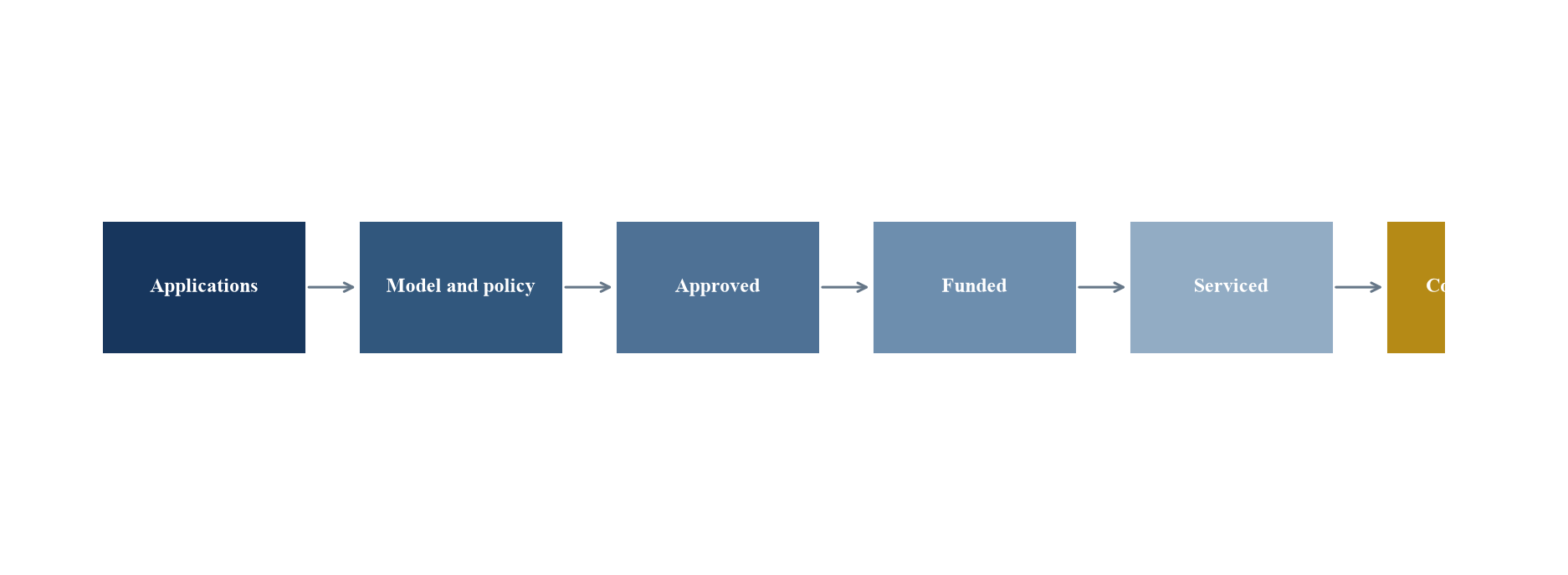
The proposed chain connects model decisions and credit policy to funded cohorts, realised performance and collected cash.
2. Define an AI-native lender precisely
An AI-native lender uses machine-learning or related computational models as a material part of customer acquisition, identity and fraud assessment, credit decisioning, pricing, limit management, servicing, collections or portfolio management. The label should describe an operating dependency rather than a marketing claim. The diligence team should identify every consequential decision in which a model changes customer treatment, credit exposure, funding eligibility or cash timing.
The model layer may include internally developed algorithms, third-party scores, alternative-data features, fraud tools, document models, generative-AI assistants and rules engines. The business layer includes policy cut-offs, manual review, pricing, offers, disbursement, servicing and collections. Value depends on the combined system. A strong score can produce poor outcomes when policy, distribution, incentives or operations are weak.
The target should maintain a model inventory linked to owners, purpose, version, data, validation, deployment, monitoring, overrides, incidents and retirement. Hidden models inside vendor services, spreadsheets or workflow tools should enter the same inventory when they influence material decisions. The Bank of England's 2024 survey identifies model complexity, third-party dependency and embedded models among growing AI risks.[4]
The acquisition thesis should therefore avoid treating a single algorithm as the asset. Transferable value can include data rights, engineering capability, model-development process, policy expertise, feedback loops, integration, customer trust, regulatory permissions and funding relationships.
3. Establish the regulatory and conduct perimeter
Credit decisioning operates inside existing credit, consumer, fair-treatment, data, model-risk and prudential regimes. The BIS Financial Stability Institute observes that AI often intensifies existing risks and highlights governance, skills, model risk, data, third parties and new business models as areas requiring attention.[1] The applicable perimeter should be mapped by legal entity, product, borrower, decision and jurisdiction.
In the United States, creditors using complex models must still provide specific and accurate principal reasons for adverse action. Model opacity does not remove that obligation.[13][14] In the European Union, certain creditworthiness and credit-scoring systems for natural persons fall within the AI Act's high-risk framework, alongside existing credit and prudential requirements.[15][16]
The United Kingdom applies existing financial regulation alongside principles for model risk, consumer outcomes, data protection and operational resilience. Regulators have emphasised accountability and proportionality while continuing to examine AI-specific risks.[5][6][7] Other jurisdictions combine technology-neutral rules with supervisory guidance on fairness, ethics, accountability, transparency and model governance.[17][18][19]
Diligence should record the precise requirement, responsible entity, operational control, evidence, breach consequence and remediation owner. A generic compliance statement cannot establish whether a model version, data source, pricing rule or customer workflow is permitted and supportable.
| Lens | Core question | Evidence | Transaction consequence |
|---|---|---|---|
| credit conduct | are decisions and notices accurate and fair | policy, reasons, testing, complaints | customer and remediation exposure |
| model risk | are models governed and independently challenged | inventory, validation, monitoring | control maturity and cost |
| data protection | is data lawfully obtained and used | lineage, consent, purpose, retention | feature eligibility and liability |
| prudential treatment | are credit risk, losses and capital measured | portfolio data, ECL, capital | distributable cash and funding |
| AI governance | is accountability maintained across lifecycle | owners, tests, incidents, change | deployment and integration conditions |
| operational resilience | can service continue through disruption | maps, tolerances, tests, exit | liquidity and customer continuity |
Requirements vary by jurisdiction and product; current qualified advice is required.
4. Build the model and policy lineage
The buyer should reconstruct each production decision from source data through features, model, policy rule, override, offer and booked loan. Version control should identify when code, data, feature definitions, thresholds, pricing or policy changed. Without lineage, vintage performance cannot be attributed to the operating system that created it.
Development evidence should show population, target definition, observation window, exclusions, missing-data treatment, transformations, sampling, validation and approval. Production evidence should show the deployed version, configuration, feature availability, latency, fallback behaviour and monitoring. Differences between development and production are potential sources of drift and customer harm.
Credit policy can dominate model performance. Approval cut-offs, debt-service constraints, fraud screens, exposure limits, affordability rules and manual review determine which ranked applicants become loans. A model improvement measured before policy interaction may have little economic value. Diligence should measure incremental outcomes after all policy layers.
The transaction team should obtain a reproducible decision sample. For selected applications, it should recreate the exact inputs, score, reason codes, policy outcome, pricing, offer, override and audit record. Failure to reproduce a material sample should reduce confidence in reported model assets and increase integration cost.
5. Reconstruct the population through time
Model performance depends on the population presented to it. Distribution can shift through marketing campaigns, embedded partners, search channels, brokers, geography, seasonality, product design and competitor behaviour. A stable portfolio average can conceal a deteriorating new channel or a favourable mature book.
The buyer should create monthly cohorts by application date, origination date, product, channel, geography, borrower segment, model version and policy version. Each cohort should reconcile applications, approvals, funded accounts, exposure, utilisation, repayments, arrears, defaults, recoveries, prepayments, complaints and cash. Reconciliation should reach the general ledger and facility reports.
Population drift should be measured in both input characteristics and economic outcomes. Feature-distribution measures can identify movement before losses season. They should be connected to approval, pricing and realised performance. A statistically visible shift matters commercially when it changes loss, contribution, funding eligibility, customer outcome or operating cost.
Management should explain which shifts were expected and how limits respond. The buyer should test whether monitoring would have detected past deterioration early enough to change acquisition, pricing, credit policy or collections.
6. Separate discrimination from calibration and economics
A model can rank risk effectively while producing poorly calibrated probabilities. It can also be well calibrated overall while failing within important segments. Diligence should examine discrimination, calibration, stability, approval rate, loss rate and contribution together. No single metric should stand in for the lending decision.
Calibration connects predicted risk to observed outcomes. It should be assessed by score band, product, channel, geography, borrower group and vintage. Confidence intervals and exposure-weighted results matter when sample sizes differ. The definition of default, cure and recovery should remain stable or be reconciled across periods.
Economics add pricing, funding, servicing, collections, fraud, loss timing, recovery and capital. A lower-risk borrower can still destroy value if acquisition expense and price are misaligned. A higher-risk segment can create value only when pricing, affordability, collection, funding and customer outcomes remain supportable.
The board should require a common dashboard that links model metrics to realised cash. The dashboard should identify thresholds, owners, actions and decision rights. Metrics without a response process provide limited transaction assurance.
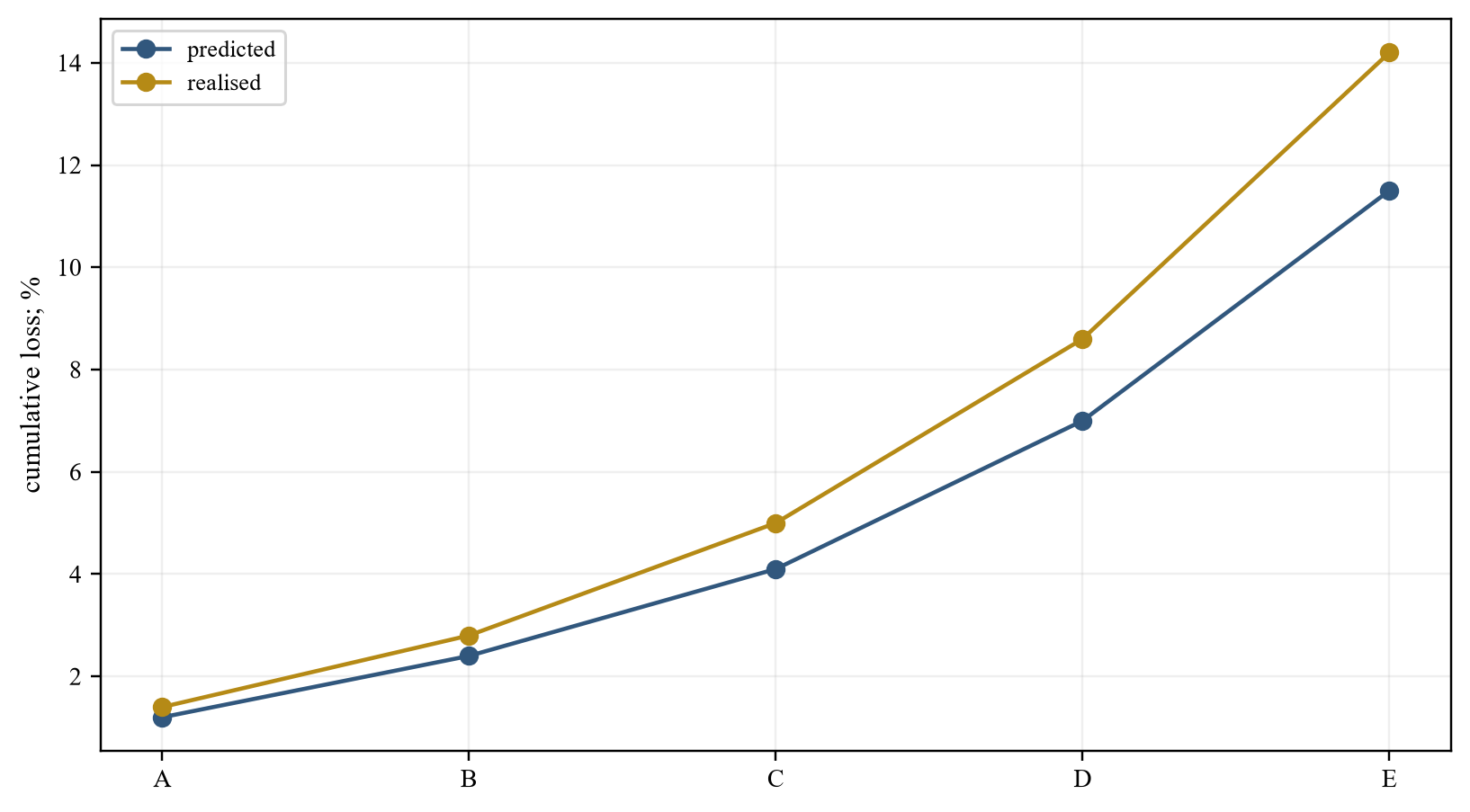
Wholly hypothetical percentages; the pattern demonstrates calibration analysis and is not a market benchmark.
7. Measure drift as an operating process
Drift includes changes in input data, borrower mix, relationships between features and outcomes, labels, policy, prices, operations and external conditions. It may arise gradually or after a discrete event. The diligence team should distinguish ordinary seasonal movement from a structural break that invalidates past performance.
Monitoring should combine statistical measures with business indicators. Useful signals include population stability, missingness, score distribution, approval rates, reason codes, override rates, early-payment default, first-payment default, delinquency roll rates, fraud, complaints, prepayment and collection yield. Thresholds should reflect consequence and sample size.
Model retraining is one possible response. Other responses include feature withdrawal, policy tightening, pricing change, channel suspension, manual review, reserve increase and funding notification. Retraining without understanding the cause can conceal deterioration or introduce new instability.
The buyer should review every material drift event, management response and outcome. It should ask whether the event was detected promptly, escalated independently, documented, remediated and communicated to funders or regulators where required. The evidence informs both valuation and the integration workload.
8. Rebuild vintage performance
Vintage analysis follows accounts from a common origination period through seasoning. It prevents recent growth from diluting the apparent loss rate and separates underwriting change from portfolio age. The buyer should present exposure, borrower count, payment, delinquency, default, recovery and prepayment on consistent months-on-book axes.
Each vintage should be linked to model version, policy, price, channel, funding facility and macroeconomic conditions. A portfolio that appears stable in aggregate can contain a weakening recent vintage whose losses have not matured. Conversely, a temporary early-delinquency increase may cure without producing equivalent lifetime loss.
The analysis should reconcile reported charge-offs and provisions to operational default events. Recovery timing, sale proceeds, collection costs and write-back policies should be visible. Changing definitions should be bridged rather than spliced into a continuous series.
For valuation, the relevant question is which vintages support the forecast. Mature cohorts may reflect an obsolete model or benign funding environment. Recent cohorts may reflect the current system but lack seasoning. The forecast should combine evidence with explicit uncertainty rather than select the most favourable period.
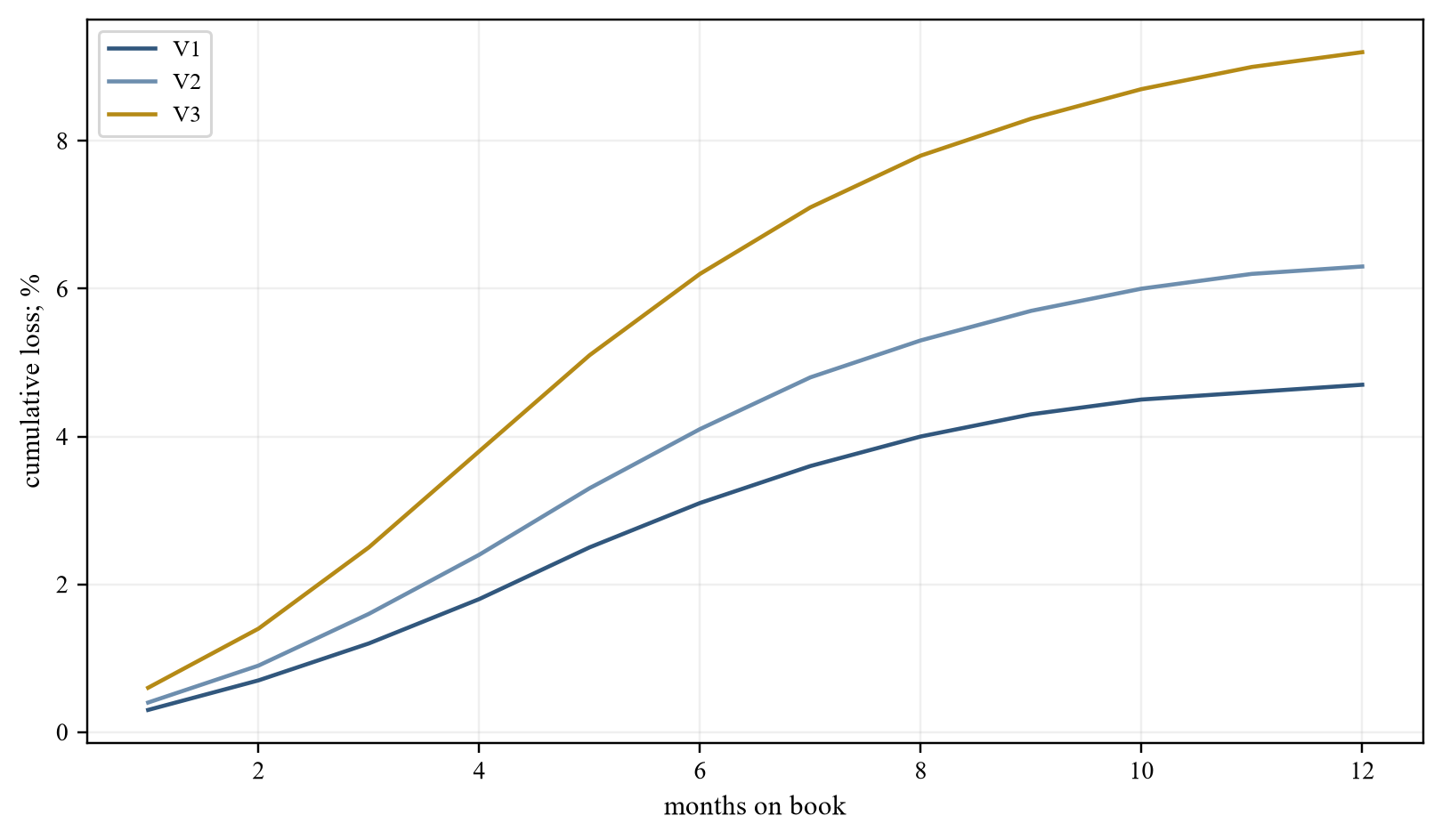
Wholly hypothetical percentages; later vintages are less seasoned and should not be treated as complete.
9. Examine fairness, explainability and customer outcomes
Fairness should be assessed across the complete credit process. Marketing, data availability, fraud controls, approval, pricing, limits, servicing and collections can each change outcomes. A model-level test does not cover policy choices, operational overrides or channel selection. The buyer should identify legally protected groups and other vulnerable cohorts relevant to each jurisdiction.
Testing should examine selection rates, error rates, pricing, limit allocation, adverse-action reasons, complaints, hardship outcomes and collection treatment. Statistical differences require contextual investigation. Sample size, legitimate risk factors, missing data and policy effects should be documented. Qualified legal analysis should determine applicable standards and permissible data use.
Explainability should support the people who act on a decision. Customers may require accurate reasons. Underwriters require a basis for review. Validators require evidence of model behaviour. Funders require comfort that eligible assets are originated consistently. Boards require a clear account of risk and limitations. One explanation technique may not serve every purpose.
Historical complaints and remediation can reveal weaknesses not visible in accuracy measures. Diligence should reconcile complaints, disputes, reversals, regulator correspondence, litigation, refunds and policy changes to model versions and cohorts. Known exposure should enter valuation and transaction protection.
| Area | Evidence | Warning signal | Possible response |
|---|---|---|---|
| data | lineage, consent, completeness | proxy or missingness shift | remove feature or restrict use |
| decision | score, policy, reasons | unstable or inaccurate reasons | redesign explanation and test |
| pricing | price and limit by cohort | unexplained differential | reprice, remediate or stop |
| servicing | assistance and treatment | vulnerable cohort harm | amend workflow and oversight |
| collections | contact, cure, recovery | inconsistent treatment | control strategy and vendor |
| governance | approvals and incidents | repeated unresolved exception | restrict deployment |
Proposed diligence structure; legal standards and testing methods depend on the applicable jurisdiction.
10. Test fraud and identity economics
AI-native lenders often combine credit and fraud decisions. Stronger fraud rejection can improve portfolio losses while excluding legitimate borrowers. Weaker controls can increase approval and reported revenue before first-payment defaults emerge. The buyer should separate identity, application fraud, synthetic identity, account takeover and transaction fraud.
The evidence should trace each fraud rule and model through decisions, manual review, customer friction, confirmed events, recoveries and operational cost. Definitions matter because suspected fraud can be reclassified as credit loss or vice versa. Loss allocation should match facility eligibility, accounting and contractual representations.
Channel and partner incentives require attention. A distributor paid on funded volume may generate applications that pass initial screens but perform poorly. Device, network and behavioural data can change after acquisition if consent, platform access or vendor contracts are not transferable. The forecast should reflect only durable data and rights.
Stress testing should include attack adaptation. Fraudsters respond to controls and may exploit a common vendor or model. The buyer should examine response time, feedback quality, false-positive cost, customer recovery and the cash effect of a material control failure.
11. Reconcile override and human-review performance
Manual review and overrides can correct unusual cases, satisfy policy or add uncontrolled discretion. The target should record who overrode which decision, why, under what authority and with what outcome. Override rates should be analysed by reviewer, channel, score band, product and time.
The buyer should compare overridden and non-overridden cohorts on approval, price, delinquency, loss, customer complaint and contribution. Better outcomes may indicate valuable expertise. Worse outcomes may reveal incentive problems, policy leakage or model limitations. Low override rates can also reflect superficial review rather than effective control.
Human reviewers require training, capacity, access to relevant evidence and independence from volume targets. Decision-support tools should distinguish recommendation from authority. Generative-AI summaries need source traceability and verification when they influence consequential credit decisions.
Integration should preserve effective judgement while closing undocumented discretion. The 180-day plan should define decision rights, sampling, quality assurance, escalation and feedback into model and policy development.
12. Build complete unit economics
Reported net revenue can omit the costs required to create and preserve it. The buyer should build contribution by vintage, product and channel from interest and fee income through acquisition, verification, fraud, funding, servicing, collections, credit loss, recoveries, partner share, technology and directly attributable compliance.
Cash timing matters. Marketing and funding occur before repayments. Defaults and recoveries emerge later. Annual contribution can appear positive while growth consumes liquidity. The model should be monthly and connect originations, principal, interest, fees, repayments, losses, recoveries, facility draws, collateral, reserves and operating expenditure.
The hypothetical base case assumes USD 240 million of originations, a 19 per cent portfolio yield, 8 per cent cumulative net credit loss, 6 per cent funding cost, 3 per cent acquisition cost and 4 per cent servicing and collections cost. These assumptions produce USD 45.6 million of gross yield and USD 21.6 million before central technology, compliance, tax and capital costs. They are methodological assumptions only.
Contribution should be tested after seasoning. A rapid-growth cohort can recognise fees before expected losses emerge. The board should see realised and expected economics, the reconciliation between them, and the sensitivity of cash to loss timing, prepayment, utilisation and funding terms.
| Item | Assumption | USD million |
|---|---|---|
| originations | 100% | 240.0 |
| gross yield | 19% | 45.6 |
| net credit loss | 8% | (19.2) |
| funding cost | 6% | (14.4) |
| acquisition cost | 3% | (7.2) |
| servicing and collections | 4% | (9.6) |
| direct partner and data income | assumed | 26.4 |
| contribution before central cost | calculated | 21.6 |
Wholly hypothetical USD millions and percentages; the table demonstrates the method and is not a market benchmark.
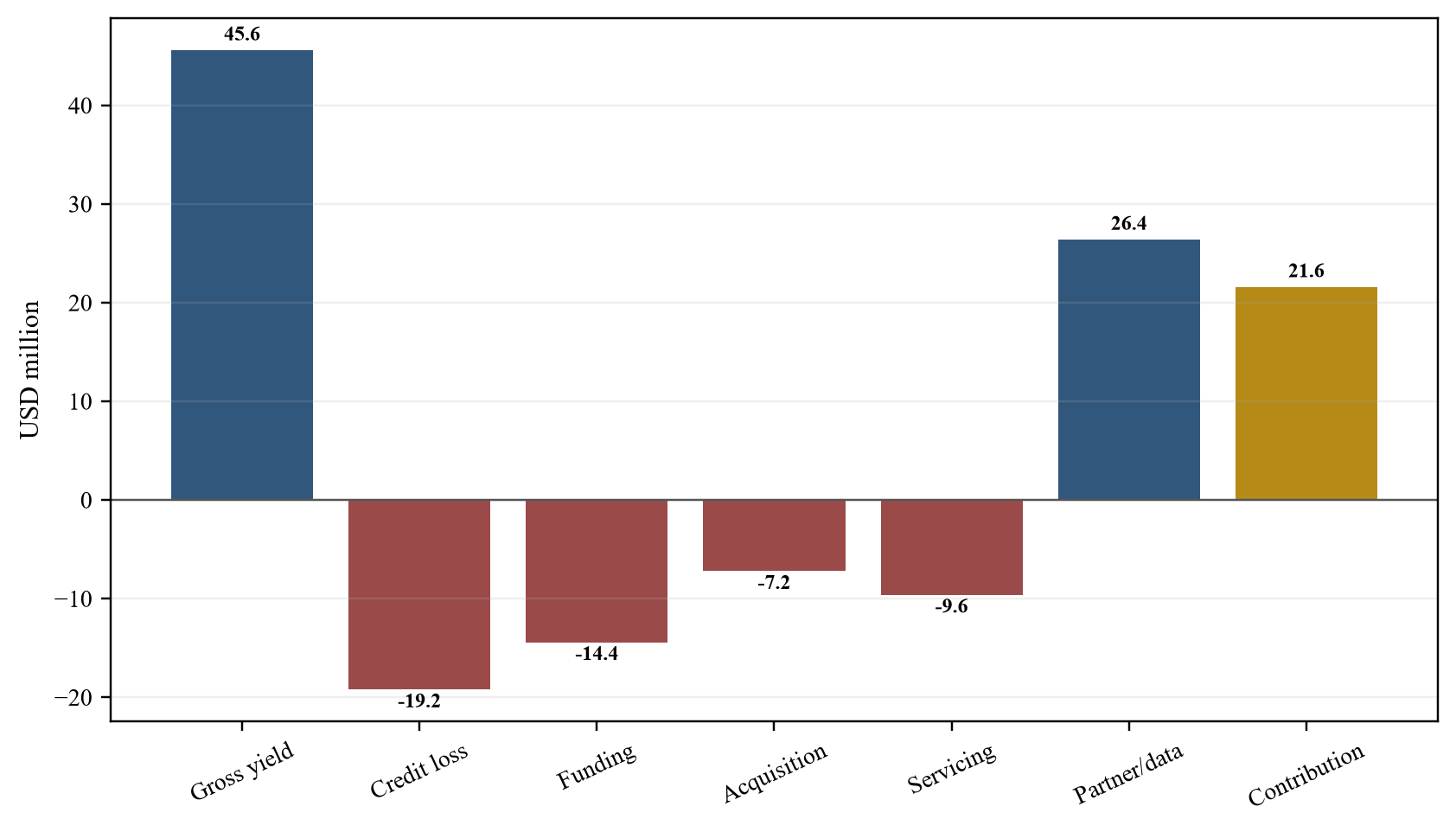
Wholly hypothetical USD millions; central costs, tax and capital requirements remain outside the displayed contribution.
13. Analyse collections and recovery capability
Underwriting value cannot be separated from servicing and collections. Payment methods, reminders, hardship, restructuring, contact strategy, legal enforcement, sale and recovery determine realised loss and customer outcome. The buyer should map each delinquency state, action, authority, vendor and cash result.
Roll-rate and cure analysis should be segmented by vintage, product, channel, model and strategy. Collection performance can improve because of harsher treatment, favourable borrower mix or temporary staffing. The diligence record should distinguish sustainable process from a period-specific result and test customer-treatment consequences.
Recoveries should be shown gross and net of collection cost, sale discount, litigation cost and time. Booked recoveries should reconcile to bank receipts. Portfolio sales, guarantees and insurance need separate contractual analysis because eligibility, exclusions and claim timing affect liquidity.
Integration can interrupt customer contact, payment routing, data access and legal authority. Day One should preserve functioning accounts, hardship arrangements, complaints, vendor instructions and reconciliations. Synergy actions should follow evidence that customer and cash continuity remain intact.
14. Map the funding architecture
AI-native lenders may use equity, deposits, warehouse facilities, forward-flow purchases, securitisations, whole-loan sales, guarantees or sponsor funding. Each source defines eligible assets, advance rates, concentration limits, performance triggers, reserves, reporting, collateral, representations and termination rights. Headline funding capacity is not equivalent to available cash.
The buyer should construct a facility-level borrowing-base model. Every asset should be tested against product, geography, borrower, delinquency, fraud, documentation and concentration rules. Haircuts, reserves, undrawn commitments, collateral calls, cash traps and amortisation should be visible through time.
Model or policy changes can affect eligibility. A facility may require lender consent, historical performance or specified underwriting criteria. Change of control can trigger review or termination. The transaction timetable should therefore connect model integration and policy changes to funding approvals and liquidity.
Forward-flow arrangements can transfer credit exposure while creating purchase, servicing, repurchase and performance obligations. Their economics should include retained risk, operational cost and concentration. A buyer should not value sold volume as risk-free platform revenue without reconstructing the contractual and cash position.
| Source | Core evidence | Hidden dependency | Valuation treatment |
|---|---|---|---|
| equity | cash, runway, capital plan | repeated external funding | deduct future funding need |
| warehouse | eligibility, advance, triggers | collateral and performance | stress availability and margin |
| forward flow | purchase and servicing terms | buyer concentration | value retained net economics |
| securitisation | pool, waterfall, triggers | market and execution window | probability-weight takeout |
| guarantee | scope, cap, claims | exclusion and timing | recognise evidenced protection |
| deposits | licence, pricing, stability | liquidity and conduct | model regulatory cost |
Proposed matrix; transaction-specific documents determine rights and exposure.
15. Stress funding through the cycle
Funding stress can precede credit loss. A fall in advance rate, asset eligibility or investor appetite can require equity before accounting losses appear. The model should therefore stress originations, collections, eligibility, collateral, reserves, interest, covenant headroom and refinancing together.
The hypothetical downside assumes originations fall 25 per cent, net credit loss rises from 8 to 12 per cent, funding cost rises from 6 to 9 per cent and the warehouse advance rate falls from 85 to 70 per cent. It also assumes a three-month securitisation delay. These are management assumptions created for illustration and are not probabilities.
The stress should identify the first date minimum liquidity or a facility condition fails. Management actions should have amounts, owners, lead times and customer effects. Possible actions include slowing originations, changing price, reducing marketing, adding equity, selling assets, replacing a facility or activating a committed backstop.
A valuation that capitalises growth while omitting its collateral and equity needs overstates distributable value. The forecast should show operating contribution, restricted cash, facility equity, central cost, tax and capital expenditure separately.
16. Treat model governance as an operating asset
Effective governance can reduce the probability and duration of harmful model behaviour. The buyer should assess board oversight, senior accountability, independent validation, development standards, change control, monitoring, incident management, audit and retirement. The Federal Reserve's SR 11-7 and the Bank of England's model-risk principles provide useful governance lenses even where their formal scope differs.[20][21]
Independence should be practical. Validators require data, code, methods, skills and authority to challenge deployment. Repeated waivers, overdue findings or validation after launch weaken assurance. The target should show how material limitations affect policy, capital, customer treatment and funding communication.
Third-party models and data should enter the same governance system. Contracts should provide sufficient information, testing rights, continuity, security, change notice, subcontractor control and exit. Concentration in a common model or data provider can create correlated risk across lenders.[2][4]
The buyer should estimate the steady-state cost of compliant governance. Founder intervention and informal knowledge should be replaced with funded roles, systems and evidence. These costs belong in stand-alone economics and the integration plan rather than a generic contingency.
| Capability | Strong evidence | Weak evidence | Transaction effect |
|---|---|---|---|
| inventory | complete lineage and owner | undocumented embedded models | discovery and control reserve |
| validation | independent pre-use challenge | approval after deployment | condition or restricted use |
| monitoring | cohort and cash-linked limits | accuracy metric only | drift discount |
| change | tested version and rollback | informal release | integration gating |
| incident | classified, escalated, remediated | recurring silent exception | remediation and protection |
| retirement | controlled exit and records | orphaned dependency | continuity deduction |
Proposed framework; the appropriate standard depends on materiality and regulation.
17. Reconcile accounting, provisions and capital
Credit performance enters valuation through cash, accounting and capital. The buyer should reconcile operational delinquency and default data to the allowance for expected credit losses, charge-offs, recoveries and carrying values. IFRS 9 or the applicable accounting framework determines recognition, staging and measurement; transaction-specific accounting advice is required.[22][23]
Management overlays and forward-looking scenarios should be documented. A model can appear accurate while accounting reserves rely on separate judgement or macroeconomic adjustments. The buyer should identify which assumptions are embedded in underwriting, portfolio forecasting, expected-loss measurement and valuation to avoid double counting.
Regulated entities may face capital, liquidity, concentration and provisioning requirements. Unregulated lenders can still have contractual capital requirements through facilities and rating processes. The forecast should show which capital is available to owners, restricted for funding or required to support growth.
Purchase accounting should identify acquired financial assets, intangible assets, liabilities, contingencies and expected synergies under the applicable standards. Data, software, customer relationships and licences require rights and separability analysis. An AI narrative does not itself establish a separately recognisable asset or useful life.[24][25][26]
18. Value the lender by evidence layer
Valuation should begin with a reconciled stand-alone forecast. The model should project applications, approvals, funded exposure, repayments, losses, recoveries, funding, restricted cash, operating cost, tax and capital monthly. It should identify which cohorts and facilities support each assumption.
Proven value comes from seasoned cohorts, durable customer acquisition, repeatable contribution, functioning servicing, transferable data and code rights, compliant governance and committed funding. Expansion value depends on unseasoned cohorts, new channels, additional products, funding improvement or buyer distribution. Those layers should be explicit.
The hypothetical valuation begins with USD 96 million of value from a cash-flow model. It adds USD 18 million for evidenced operating improvements and USD 12 million for buyer-specific distribution synergies. It deducts USD 14 million for drift and vintage uncertainty, USD 11 million for funding and liquidity exposure, USD 7 million for governance remediation and USD 6 million for integration. The resulting illustrative equity value is USD 88 million. Every figure is a management assumption and not a valuation opinion.
Market multiples can provide a cross-check when comparable business mix, credit exposure, growth, funding and accounting are understood. Revenue or origination multiples can mislead when lenders retain different credit and funding risk. Price-to-book, earnings, assets and platform measures should be reconciled to the same risk and cash perimeter.
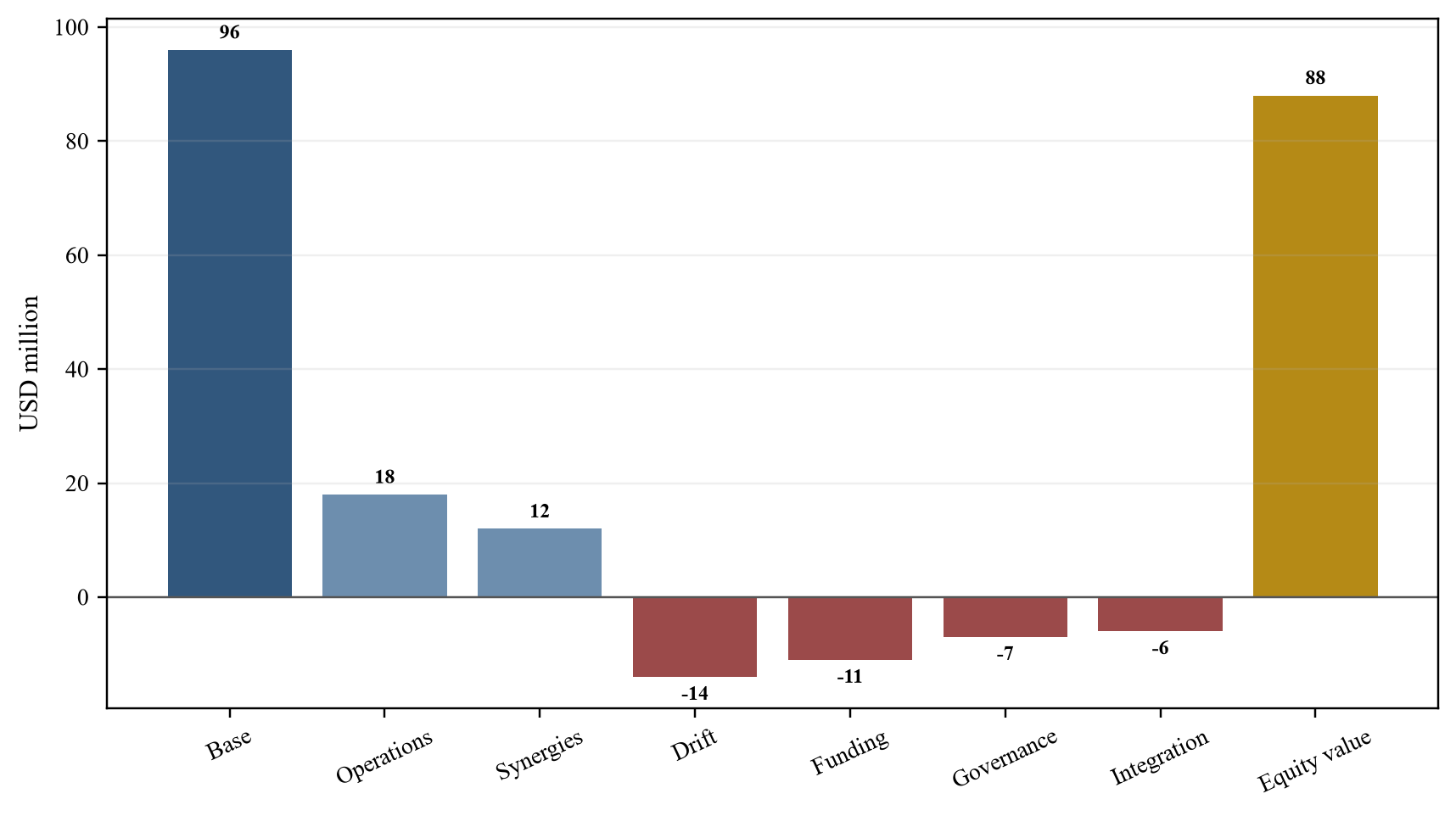
Wholly hypothetical USD millions; the bridge is methodological and is not a valuation opinion.
| Layer | Gross value | Evidence adjustment | Included value |
|---|---|---|---|
| stand-alone cash flow | 96 | 100% | 96 |
| operating improvement | 18 | 100% | 18 |
| buyer distribution | 20 | 60% | 12 |
| drift and vintage risk | (14) | 100% | (14) |
| funding and liquidity | (11) | 100% | (11) |
| governance remediation | (7) | 100% | (7) |
| integration | (6) | 100% | (6) |
| illustrative equity value | 88 |
Wholly hypothetical; values and probabilities are management assumptions.
19. Apply a drift discount transparently
The drift discount represents uncertainty that current model and portfolio performance will persist under future borrower populations, policy, competition, fraud, macroeconomics and funding. It should not be an arbitrary percentage. The buyer should connect each adjustment to evidence, cash, duration and control.
One approach is scenario-weighted cash flow. Base, deterioration and severe cases can change approval, yield, loss, funding, acquisition cost and capital coherently. Another approach adjusts the forecast horizon over which current performance is credited before reverting to conservative economics. A third approach places contingent consideration against future cohort outcomes.
The discount should decline when new evidence arrives. Useful milestones include a seasoned current-model vintage, stable calibration, completed validation, accurate reasons, renewed facilities, sustained eligibility, acceptable complaints and collected contribution. Each milestone should have a definition, measurement period, data source and independent verifier.
The buyer should avoid counting the same uncertainty in loss assumptions, discount rate, multiple and price protection without reconciliation. The investment paper should show where each risk appears and why.
20. Translate evidence into transaction protections
Transaction terms should allocate uncertainty to the party that controls or can verify it. Base consideration can follow seasoned portfolio and transferable assets. Deferred consideration can follow current-model vintage performance, facility renewal, contribution, collections or regulatory remediation. Seller rollover can preserve alignment where operating continuity matters.
Conditions may address licences, change-of-control approvals, funding consents, material customer and partner consents, data rights, specified validation and remediation. Representations can address portfolio data, models, policy, adverse-action reasons, fairness testing, complaints, cyber incidents, intellectual property, facilities and financial records.
Specific indemnities, escrow, retention or price adjustment may address identified exposures. A broad compliance warranty cannot replace a quantified mechanism when customer remediation, facility repurchase or liquidity exposure is measurable. Qualified counsel should design enforceable terms for the relevant jurisdictions.
The buyer should retain access to the evidence needed to calculate deferred payments. Definitions should prevent changes in policy, funding, marketing or collections from distorting the metric. Disputes require an agreed expert, source hierarchy and calculation process.
| Uncertainty | Evidence date | Protection | Release condition |
|---|---|---|---|
| unseasoned current model | 12-month vintage | deferred consideration | loss and contribution threshold |
| facility renewal | lender execution | closing condition | committed terms effective |
| portfolio data gap | completed reconciliation | retention or escrow | independent verification |
| customer remediation | claims and cohort review | indemnity | resolved exposure |
| governance weakness | remediation testing | funded reserve | control acceptance |
| integration dependency | operating milestone | holdback | service and cash continuity |
Proposed transaction structure; qualified legal and tax advice is required.
21. Design integration around decision continuity
Integration can change data, models, policy, channels, pricing, funding and customer treatment at once. The buyer should protect the decision chain before pursuing synergy. Day One should preserve legal entities, licences, facility reporting, payment routing, decision logs, complaint handling, model monitoring and incident escalation.
Model migration should be evidence-gated. The team should establish benchmark populations, outcome definitions, champion and challenger tests, reason-code checks, fairness review, fallback and rollback. Parallel operation may be appropriate where the consequence of error is material and the old system remains supportable.
Data consolidation requires lawful purpose, lineage, quality, access control and retention. Combining datasets can create value while changing consent, bias, security and explainability. The integration team should approve each use case with legal, risk, credit and product ownership.
Funding counterparties should receive required notices and evidence before material changes. The operating plan should identify which changes affect eligibility, representations, servicing or reporting. Liquidity should be sized for a delayed consent or migration.
22. Execute a 180-day programme
The first thirty days should establish control. Confirm cash, facilities, licences, model inventory, production versions, policy, portfolio reconciliations, incident escalation, customer treatment and critical vendors. Freeze undocumented changes and preserve decision evidence.
Days thirty-one to ninety should reproduce key decisions, rebuild vintages, validate current models, reconcile funding eligibility, test adverse-action reasons, examine complaints and establish complete unit economics. Known gaps should enter funded remediation plans with owners and deadlines.
Days ninety-one to one hundred and eighty should implement approved policy and monitoring changes, complete funding consents, test migration, automate evidence, close high-priority findings and release value initiatives that meet their gates. The board should see cash, customer and control outcomes together.
The programme should retain stop points. Deteriorating vintages, unexplained fairness results, funding pressure, data loss or customer harm should pause affected growth or integration. Governance should support timely action rather than ceremonial reporting.
Cohort reconstruction protocol
The reconstruction should begin with immutable source extracts rather than management dashboards. Application, bureau, bank-transaction, fraud, device, pricing, offer, contract, disbursement, payment, servicing, collection and accounting records should carry stable identifiers and event times. The team should document source ownership, extraction date, transformation, duplicate treatment, exclusions and control totals. Each step should preserve enough lineage for another analyst to reproduce the cohort without relying on undocumented management intervention. Customer and personal data should be handled within applicable legal, security and confidentiality constraints.
The application population should reconcile submitted, completed, scored, manually reviewed, approved, offered, accepted and funded cases. Withdrawals, timeouts, duplicate applications, suspected fraud and technical failures should remain visible. Otherwise, conversion and model-performance measures can exclude difficult cases. Approval and funding denominators should be defined consistently across periods. Changes in application form, channel, pre-screening and eligibility should be dated because they alter the population before the underwriting model acts.
The loan population should reconcile original principal, net disbursement, fees, interest, scheduled payment, actual payment, arrears, restructuring, charge-off, recovery, sale, repurchase and closing balance. A roll-forward should tie operational balances to the general ledger, facility reports and financial statements. Differences should have quantified causes, owners and closure dates. The team should preserve original contractual terms and subsequent modifications so pricing, affordability and performance can be analysed on the basis that applied at each decision date.
Performance should be presented on months-on-book and calendar-time views. Months-on-book reveals seasoning; calendar time reveals common shocks. Both should be segmented by product, model version, policy version, score band, price, channel, geography and material borrower characteristics. Small cohorts should not be overinterpreted. Exposure-weighted measures, account counts and confidence intervals should be shown together. The resulting data asset should support underwriting, finance, conduct and funding conclusions from the same controlled population.
Model reproduction protocol
The reproduction sample should cover approvals, declines, boundary cases, overrides, missing-data cases, high-loss accounts, complaints and facility-ineligible assets. For every selected application, the team should obtain the raw inputs available at the decision time, the feature vector, model artefact, version, score, reason outputs, policy configuration, manual action, price, limit and final disposition. Current data should not be substituted for historical data. Reproduction should run in a controlled environment with dependency versions, random seeds and external-service responses recorded where relevant.
Exact numerical reproduction may be impossible when a third-party score or transient data service cannot recreate a historical response. The target should then provide stored outputs, vendor records and compensating evidence. The buyer should classify the limitation by materiality. A missing low-impact enrichment field differs from an unavailable fraud or credit score that determined thousands of decisions. The valuation adjustment should reflect the affected revenue, loss, funding and remediation exposure rather than the mere count of unavailable inputs.
Validation should challenge conceptual soundness, data, implementation and outcomes. It should test ranking, calibration, stability, segment performance, reasons, policy interaction, sensitivity, limitations and monitoring. Challenger models can show whether performance depends on complexity or on data that simpler methods also capture. A challenger result should not automatically replace the production model; it should identify the incremental value and risk of the deployed approach after complete operating cost.
The review should also test failure behaviour. Unavailable data, delayed bureau response, malformed documents, extreme values, vendor outage and corrupted feature pipelines should trigger controlled outcomes. Silent substitution or a permissive default can change credit risk without a model release. Fallbacks should have owners, monitoring and limits. A model that performs well in normal conditions while failing unpredictably during operational stress deserves a control and continuity deduction.
Funding and liquidity protocol
Every facility should be abstracted into a common term sheet showing commitment, maturity, availability, advance rate, eligible assets, concentration, reserves, interest, fees, collateral, cash control, reporting, covenants, performance triggers, amortisation, termination and change of control. The abstraction should be reconciled to executed documents and amendments. Side letters and operational interpretations should be included. Where eligibility depends on underwriting criteria, the exact model and policy representation should be connected to the facility schedule.
The borrowing-base model should operate at asset level where practicable. It should show why each loan is eligible, ineligible or haircut and calculate availability after concentration limits, reserves and prior drawings. Facility certificates should be regenerated for selected dates and tied to lender acknowledgements and bank movements. Repeated manual adjustments, late reports or lender waivers indicate operating dependency. Undrawn commitment should be distinguished from immediately drawable cash after all conditions and collateral requirements.
Liquidity forecasting should integrate originations, collections, facility draws, principal amortisation, interest, collateral, restricted accounts, operating expenditure, tax and equity. The model should identify intramonth peaks rather than rely on month-end balances. Growth can consume cash when equity must fund the unadvanced portion of each loan and reserves increase before contribution is collected. Management should show the first binding constraint and the action available before that date.
The downside should change related assumptions together. A deterioration in early delinquency can reduce eligibility, lower the advance rate, increase reserves, trigger amortisation, delay securitisation and require customer-support expenditure. A single-factor stress understates this feedback. The investment committee should see how much committed equity or liquidity is required, which management actions are credible within the time available, and how those actions affect customers, portfolio value and future originations.
Conduct and customer-evidence protocol
Customer-outcome testing should use the actual decision and service journey. Marketing eligibility, application design, consent, verification, approval, price, documentation, payment, hardship, collections, complaint and closure should each be sampled. The review should examine whether model-derived actions match policy, contract and legal requirements. It should also identify points where staff, vendors or interfaces change the outcome after the model. This prevents a favourable model audit from obscuring harmful implementation.
Adverse-action and price reasons should be generated from factors actually used in the decision. The team should compare stored reasons, customer notices and reproducible model outputs for a sample of declines and unfavourable changes. Generic or nearest-available reasons can create exposure where they do not accurately describe the decision. The process should identify who approves reason taxonomies, how changes are tested and whether customers can correct inaccurate source data.
Fairness analysis should combine statistical testing with process review and qualified legal advice. Differences can arise from data availability, proxy relationships, policy, channel, fraud controls, manual review, pricing or servicing. The review should avoid declaring a result acceptable or unacceptable from one metric. It should identify the source, affected population, customer effect, business justification, alternative design and remediation path. Historical changes should be retested to determine whether reported improvement persisted.
Complaints, hardship, disputes, refunds and regulatory correspondence should be coded to product, model, policy, reason and customer journey. Text analysis can help identify themes, but the source records and resolution should remain reviewable. A low complaint rate may reflect customer friction or weak recording. The buyer should reconcile intake channels, response times, upheld outcomes, monetary redress and repeat causes. Known cohorts with probable remediation should enter the valuation and transaction documents.
Unit-economics and accounting protocol
The economics model should preserve a distinction between contractual yield, recognised income, collected income and cash returned to investors or the balance sheet. Fees, interest and partner income should be linked to contracts and actual collections. Funding cost should include margin, base rate, unused fees, arrangement fees, hedging, collateral and cash drag. Acquisition cost should include paid media, affiliates, brokers, incentives, verification and failed applications. Servicing and collections should include internal people, vendors, payment fees, communications, legal action and asset sale costs.
Credit loss should be measured on a definition that reconciles to accounting. Default, charge-off, sale, cure, recovery and fraud classifications should be bridged. Gross loss, recovery and net loss should remain separate. Expected future recovery should not be treated as current cash. Where portfolios are sold, the proceeds, carrying value, servicing transfer and any retained obligation should be shown. A change in write-off policy can move the timing of loss without changing ultimate economics.
Central technology, compliance and governance costs should be allocated on a basis that reflects the stand-alone business. Founder time, shared group functions and buyer infrastructure should not disappear. The buyer should distinguish target stand-alone cost, required remediation, buyer synergy and future growth investment. Each synergy needs an owner, timing, cost and dependency. Buyer-specific savings should remain separate from market-participant value when applying fair-value concepts.
Accounting forecasts should tie to operational drivers. Originations, principal, interest, fees, provisions, charge-offs, recoveries, funding, restricted cash and capital should reconcile across income statement, balance sheet and cash flow. The investment model should explain differences between accounting profit, portfolio contribution, free cash and distributable cash. A lender can report growth and profit while requiring substantial equity for facility haircuts, loss absorption and regulatory or contractual capital.
Valuation and consideration protocol
The valuation model should begin with controlled historical periods and state which model, policy and funding regime each period represents. Forecast cohorts should be constructed from application volume, approval, take-up, principal, price, term, prepayment, loss, recovery and cost. Existing-book runoff should be separated from new originations. This shows whether value comes from assets already funded, future lending activity, technology or buyer actions.
Scenario design should change related drivers coherently. A weaker borrower mix can reduce approval, increase acquisition cost per funded account, change price, raise loss, weaken facility eligibility and increase collections. A funding shock can slow originations, reduce revenue, create stranded operating cost and require equity. The board should see the cash and covenant path, not only a terminal value. Probability weights are management judgements and should be identified as such.
The drift discount should be allocated to specific exposure. One part may reflect unseasoned current-model vintages; another may reflect borrower-population change; another may reflect funding conditions or model-governance weakness. Each component should have evidence that can retire it. If the same exposure already reduces forecast loss or funding assumptions, any additional discount should be reconciled to avoid double counting. The bridge should permit reviewers to trace every adjustment to a source and decision.
Consideration can follow the evidence calendar. Closing value may reflect seasoned cohorts and transferable assets. Deferred value can follow a defined observation period for current-model losses, contribution and customer outcomes. A funding milestone can require committed capacity on specified terms. A remediation milestone can require independent validation and closure of material findings. The metric should resist manipulation through changes in volume, channel, policy, write-off, sale or cost allocation.
Scenario governance protocol
Scenario governance should begin with a small number of decision-relevant cases. A base case should reflect the evidence-supported operating plan. A deterioration case should combine weaker acquisition, adverse borrower mix, higher fraud, rising delinquency, tighter funding and delayed management response. A severe case should test survival and customer continuity rather than an arbitrary percentage reduction in revenue. Each case should identify assumptions, causal links, evidence, owner and date.
The model should distinguish external conditions from management choices. Interest rates, unemployment, inflation, competitor pricing and capital-market access may be external. Approval limits, marketing, price, collections, facility use and cost action remain partly controllable. The scenario should state when management observes the change, when it decides, and when the action affects cash. Immediate perfect mitigation should not be assumed. Customer, contractual and regulatory constraints may limit the speed or form of action.
Reverse stress testing should identify the combination that causes minimum liquidity, facility breach, capital shortfall, operational failure or unacceptable customer outcome. The exercise should work backwards to early indicators and credible recovery actions. It should include loss of a material funding counterparty, data provider or distribution partner where concentration warrants it. The output should guide price, equity commitment, covenant headroom, backstop liquidity and integration sequencing.
Scenario results should reconcile to the valuation bridge and transaction terms. If a downside requires USD 20 million of additional equity, the investment paper should show whether that amount reduces value, sits in committed financing or becomes a condition. If a drift milestone releases deferred consideration, the same cohort definitions should appear in the operating model. This common scenario language helps the board avoid approving valuation, financing and legal terms built on inconsistent assumptions.
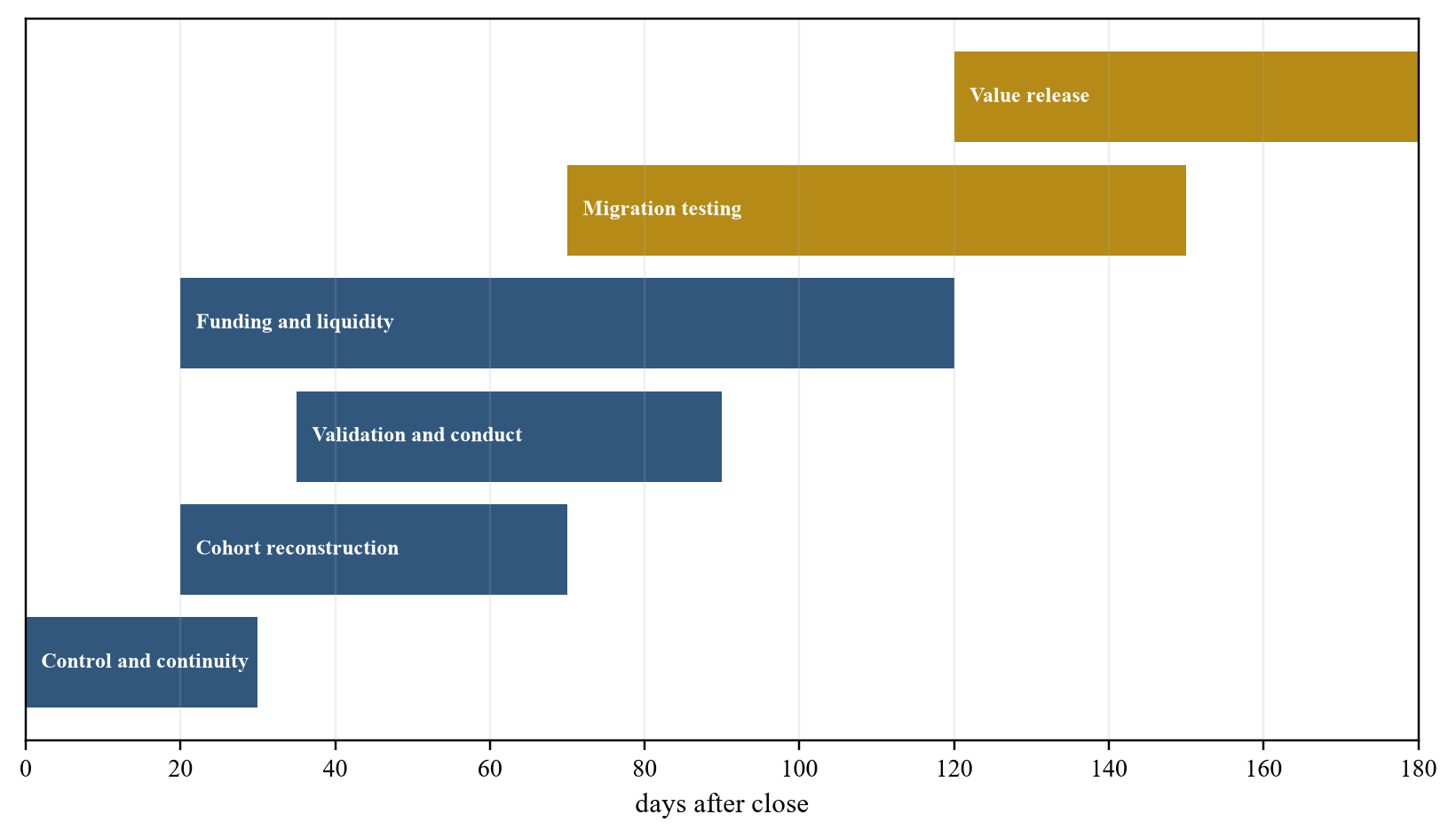
Proposed sequence; timing should follow the transaction, regulatory and funding constraints.
23. Decision and conclusion
An AI-native lender deserves value for a repeatable system that converts lawful data, governed models, disciplined policy, durable funding and effective servicing into acceptable customer outcomes and collected contribution. Speed, automation and model accuracy are supporting evidence. They do not replace realised credit and cash performance.
The buyer should reconstruct model and policy lineage, borrower populations, vintages, fairness, overrides, fraud, servicing, collections, funding, accounting and capital. Every forecast assumption should connect to a cohort and facility that can be examined. Unseasoned growth should remain distinct from proven economics.
The drift discount should quantify the exposure that current performance will weaken as models, borrowers, fraud, competition and funding change. It should be linked to observable evidence and reduced when milestones are achieved. Transaction terms can retain contingent value without paying fully for uncertainty at closing.
The resulting investment decision is practical. A premium is supportable when the lender has seasoned current-model cohorts, durable contribution, transferable rights, effective governance, compliant customer outcomes and committed funding. Price protection, narrower scope or delayed value recognition is appropriate when the thesis depends on unseasoned vintages, opaque models, unstable funding or incomplete data.
Sources
- Bank for International Settlements, Regulating AI in the financial sector: recent developments and main challenges Read the primary source
- Financial Stability Board, The Financial Stability Implications of Artificial Intelligence Read the primary source
- Basel Committee on Banking Supervision, Principles for the management of credit risk Read the primary source
- Bank of England and Financial Conduct Authority, Artificial intelligence in UK financial services 2024 Read the primary source
- Bank of England, Model risk management principles for banks Read the primary source
- Financial Conduct Authority, AI Update Read the primary source
- Financial Conduct Authority, Consumer Duty Read the primary source
- European Banking Authority, Guidelines on loan origination and monitoring Read the primary source
- European Central Bank, Guide on effective risk data aggregation and risk reporting Read the primary source
- European Central Bank, Guide to internal models Read the primary source
- International Monetary Fund, Artificial Intelligence and its Impact on Financial Markets and Financial Stability Read the primary source
- International Organization of Securities Commissions, The Use of Artificial Intelligence and Machine Learning by Market Intermediaries and Asset Managers Read the primary source
- Consumer Financial Protection Bureau, Circular 2022-03 on adverse action and complex algorithms Read the primary source
- Consumer Financial Protection Bureau, Circular 2023-03 on adverse action notification sample forms Read the primary source
- European Union, Regulation EU 2024 1689 Artificial Intelligence Act Read the primary source
- European Commission, AI Act high-risk systems Read the primary source
- Monetary Authority of Singapore, FEAT Principles Read the primary source
- Monetary Authority of Singapore, Information Paper on AI Model Risk Management Read the primary source
- Hong Kong Monetary Authority, High-level Principles on Artificial Intelligence Read the primary source
- Board of Governors of the Federal Reserve System, SR 11-7 Guidance on Model Risk Management Read the primary source
- Office of the Comptroller of the Currency, Comptroller's Handbook Model Risk Management Read the primary source
- IFRS Foundation, IFRS 9 Financial Instruments Read the primary source
- Financial Accounting Standards Board, Current Expected Credit Losses Read the primary source
- IFRS Foundation, IFRS 3 Business Combinations Read the primary source
- IFRS Foundation, IAS 38 Intangible Assets Read the primary source
- IFRS Foundation, IFRS 13 Fair Value Measurement Read the primary source
- National Institute of Standards and Technology, AI Risk Management Framework Read the primary source
- National Institute of Standards and Technology, AI RMF Generative AI Profile Read the primary source
- National Institute of Standards and Technology, Cybersecurity Framework 2.0 Read the primary source
- Basel Committee on Banking Supervision, Principles for operational resilience Read the primary source
- Basel Committee on Banking Supervision, Principles for effective risk data aggregation and risk reporting Read the primary source
- Basel Committee on Banking Supervision, Prudential treatment of problem assets Read the primary source
- Federal Deposit Insurance Corporation, Guidance for Managing Third-Party Risk Read the primary source
- Board of Governors of the Federal Reserve System, Commercial Bank Examination Manual Credit Risk Management Read the primary source
- Office of the Comptroller of the Currency, Comptroller's Handbook Credit Risk Read the primary source
- Consumer Financial Protection Bureau, Equal Credit Opportunity Act and Regulation B Read the primary source
- Consumer Financial Protection Bureau, Fair Credit Reporting Act Regulation V Read the primary source
- Federal Trade Commission, Big Data A Tool for Inclusion or Exclusion Read the primary source
- UK Information Commissioner's Office, Guidance on AI and data protection Read the primary source
- European Data Protection Board, Guidelines on automated individual decision-making and profiling Read the primary source
- Central Bank of the UAE, Consumer Protection Regulation Read the primary source
- Central Bank of the UAE, Financial Consumer Protection Standards Read the primary source
- Saudi Central Bank, Principles of Conduct and Work Ethics in Financial Institutions Read the primary source
- Abu Dhabi Global Market, Data Protection Regulations 2021 Read the primary source
- Dubai Financial Services Authority, Principles for Authorised Firms Read the primary source
- International Valuation Standards Council, International Valuation Standards Read the primary source
- International Valuation Standards Council, Deciphering Technology Read the primary source
- International Organization for Standardization, ISO IEC 42001 Artificial Intelligence Management Systems Read the primary source
- OECD, Recommendation of the Council on Artificial Intelligence Read the primary source
- Bank for International Settlements, AI fintechs and banks Read the primary source
