
Introduction
E-methane is methane produced by combining hydrogen with carbon dioxide. When the hydrogen meets the applicable renewable or low-carbon standard and the carbon source is treated appropriately under the governing lifecycle methodology, the resulting fuel can contribute to decarbonisation objectives. Its principal infrastructure advantage is molecular familiarity. Methane is already moved, stored, traded and consumed through an extensive network of pipelines, storage facilities, liquefied-natural-gas assets, meters, burners and industrial equipment.
That advantage can conceal the conversion burden. Electricity is converted into hydrogen; hydrogen and carbon dioxide are converted into methane; the methane is dried, purified, compressed, measured and delivered. Each step consumes energy, loses material or reduces availability. Carbon capture and transport create additional cost and emissions. Certification can restrict when electricity is consumed, which assets qualify and how the final fuel is traced. The commercial question is therefore broader than the efficiency of a methanation reactor.
This paper addresses the financing question: how should a project define, measure, allocate and price the losses between renewable electricity and delivered pipeline-quality methane? The answer requires a common boundary for engineering, commercial agreements, lifecycle accounting and debt sizing. A project that quotes plant-gate efficiency while selling delivered certified fuel leaves its most important economic interfaces unresolved.
1. Begin with the delivered product
The contractual product should be defined before the production configuration is selected. A buyer may require methane at a specified interconnection point, pressure, heating value, Wobbe index, composition, carbon intensity, certificate status, nomination profile and minimum annual quantity. These requirements determine equipment, operating flexibility, storage and the point at which title and risk transfer.
The definition should distinguish physical gas from environmental attributes. Molecules can enter a common gas system while certificates or mass-balance records establish renewable content. The European Commission's Union Database covers traceability for liquid and gaseous renewable and recycled-carbon fuels and records sustainability characteristics and greenhouse-gas information.[16] A financing model should therefore identify both the physical delivery obligation and the evidence needed for the buyer to make an environmental claim.
2. Draw one boundary from electricity to buyer
The project boundary should start at the electricity meter and end at the buyer's agreed delivery point. It should include electrolyser consumption, water treatment, hydrogen drying and compression, carbon capture or receipt, carbon conditioning, methanation, recycle compression, heat rejection or recovery, methane drying, gas-quality control, export compression, pipeline injection, storage and downstream transport.
Losses outside the fence can be as important as losses inside it. Curtailment, grid charges, renewable-generation imbalance, carbon transport, pipeline fuel, compressor consumption, boil-off in an LNG route, storage withdrawal and metering differences can all change the delivered cost. The model should record each loss in its natural unit and reconcile the units to one megawatt-hour of methane delivered.
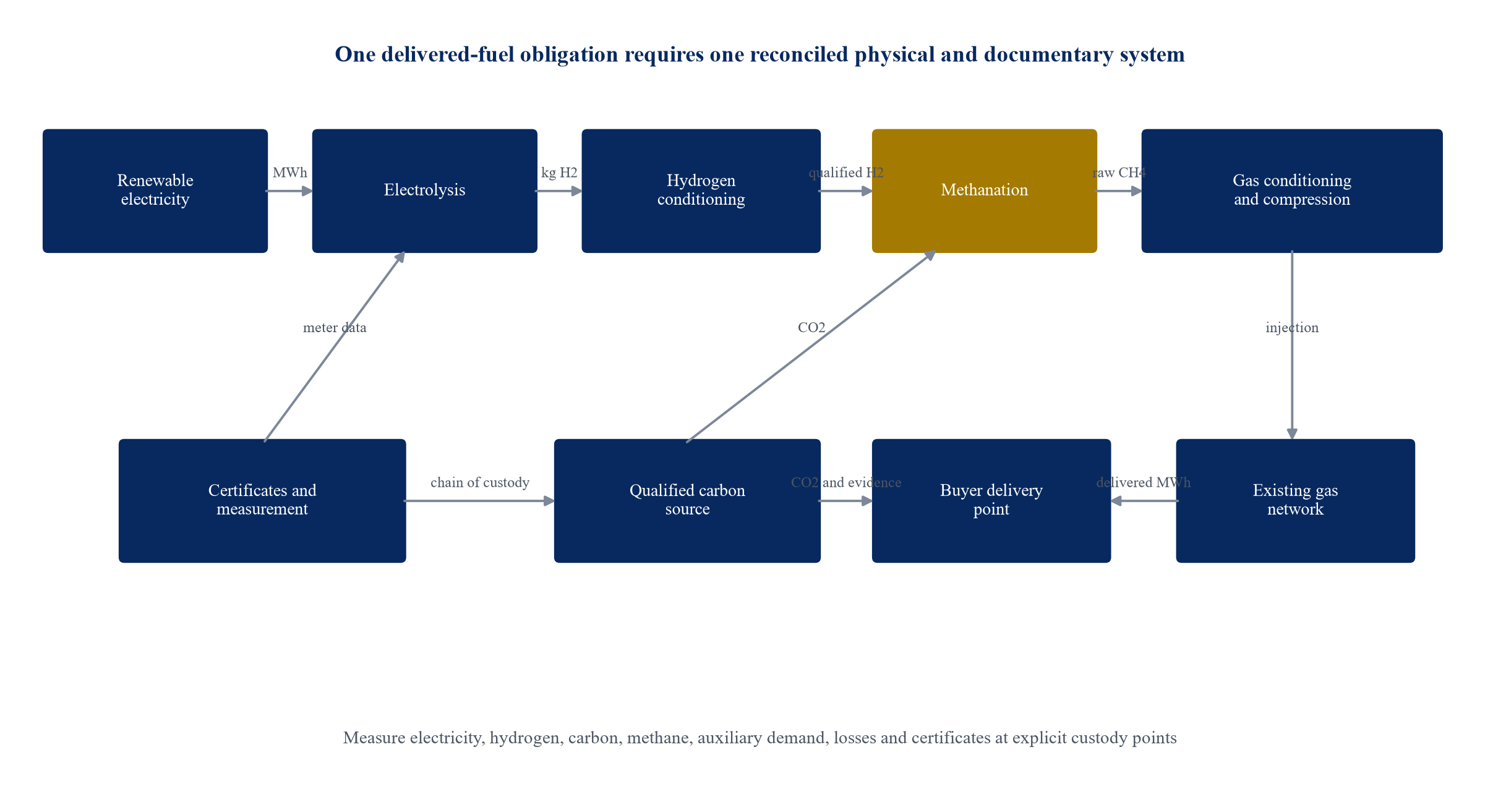
Proposed system map; equipment and contractual boundaries vary by technology, carbon source, network and jurisdiction.
3. Separate stoichiometry from plant efficiency
The Sabatier reaction combines carbon dioxide and hydrogen to form methane and water. The stoichiometric relationship is stable; the commercial conversion ratio is not. In theory, one kilogram of methane contains carbon from about 2.75 kilograms of carbon dioxide and hydrogen from about 0.5 kilograms of hydrogen. Actual plants require excess reactants, recycle streams, purification, pressure management and auxiliary power. The model should preserve this distinction.
Stoichiometry establishes a mass-balance test. Metered flows that cannot be reconciled within the agreed uncertainty indicate leakage, venting, off-specification production, instrument error or inventory change. Plant efficiency should then compare the lower heating value of saleable methane with all measured energy inputs inside the defined boundary. A project should publish both the gross reaction yield and the net delivered-energy efficiency.
4. Electricity is the dominant operating exposure
The IEA has observed that electricity can account for a large share of synthetic-fuel production cost.[8] E-methane adds a methanation stage after electrolysis, so the project purchases more electricity than the energy content of the gas it sells. The electricity price, electrolyser efficiency, operating profile and renewable-qualification rules therefore determine the core margin.
A fixed-price renewable power purchase agreement can reduce price volatility while creating shape and volume mismatch. A merchant purchase strategy can capture low-price hours while weakening utilisation and debt-service predictability. A hybrid portfolio can combine contracted baseload, shaped renewable supply, short-term purchases and curtailment rights. The financing model should value the portfolio hour by hour where temporal correlation rules or volatile power prices apply.
5. Certification changes dispatch economics
European Union rules for renewable hydrogen and renewable fuels of non-biological origin apply additionality, temporal-correlation and geographic-correlation criteria.[4][5] The lifecycle methodology accounts for input supply, processing, transport, distribution and end use, and requires a minimum greenhouse-gas saving threshold.[6] A project may therefore have electricity available while being unable to classify the resulting production as the contracted renewable product.
Dispatch logic should classify each operating hour by electricity source, certificate eligibility, expected methane value, start-up cost, efficiency and equipment condition. The project should define the treatment of gas produced during a non-qualifying hour. Options include sale as conventional gas, separate certification, inventory segregation or curtailment. Senior-debt cash flow should recognise only the value supported by the relevant sales and certification arrangements.
6. Electrolyser loading affects yield and degradation
Electrolysers do not necessarily consume a fixed number of kilowatt-hours per kilogram of hydrogen at every load. Efficiency, minimum stable load, start-up time, stack temperature, water quality and degradation interact. Frequent cycling may provide flexibility while increasing maintenance or replacement needs. Long operation at high load can improve utilisation while reducing access to the cheapest renewable hours.
The base case should use a performance curve rather than one nameplate number. The engineering contract should specify beginning-of-life and end-of-life consumption, tested load points, stack-replacement assumptions and permitted measurement uncertainty. The operating agreement should distinguish normal degradation from underperformance. Reserve accounts and maintenance budgets should reflect the selected dispatch strategy.
7. Methanation creates heat and integration choices
Methanation is exothermic. Heat can be rejected or recovered for steam, district heating, carbon-capture regeneration, water treatment or another industrial process. A claimed efficiency that includes useful heat should identify the buyer, temperature, availability and replacement value of that heat. Unsold heat should not be valued as revenue merely because it is physically recoverable.
Heat integration can reduce project cost while creating an interface dependency. If a host facility stops taking heat, the methanation plant may require additional cooling and lose revenue. The contracts should state minimum take, temperature, metering, outages and compensation. Lenders should model the project with and without the heat credit.
8. Carbon is a feedstock and a compliance attribute
Carbon dioxide can come from biogenic processes, direct air capture or an industrial source. Its price includes capture, purification, compression, transport, storage buffer and measurement. Its eligibility for a renewable or low-carbon claim depends on the applicable legal methodology, the source, timing, alternative use and chain of custody.
IRENA identifies sustainable carbon availability and co-location with low-cost hydrogen as important constraints for carbon-based e-fuels.[9] The project should avoid treating carbon as a costless waste stream. A carbon-supply agreement should define composition, pressure, contaminants, delivery profile, sustainability evidence, ownership of environmental attributes, alternative fate and remedies for interruption or ineligibility.
9. Existing pipes reduce one class of capital expenditure
E-methane has physical properties close to natural gas and can be compatible with existing gas infrastructure and end-use equipment, subject to gas-quality and network requirements.[1] This can avoid a dedicated hydrogen pipeline, end-user conversion and some storage changes. Japan's energy policy explicitly treats use of existing gas infrastructure as an important route for synthetic methane deployment.[11][12]
Avoided infrastructure is not free infrastructure. Network-entry capacity, metering, odorisation, pressure, quality monitoring, balancing, tariffs, storage access and incremental reinforcement remain relevant. The project should distinguish assets already included in regulated tariffs from project-specific connection works and future network charges.
10. Gas quality is a financing condition
The network operator determines whether gas can be injected. Relevant parameters may include heating value, Wobbe index, methane number, oxygen, hydrogen, carbon dioxide, water dew point, sulphur, particulates, temperature and pressure. ENTSOG's gas-quality work highlights harmonisation, monitoring and renewable-gas injection issues.[13]
The interconnection agreement should define the specification, sampling frequency, analyser standards, calibration, data hierarchy, off-specification response and liability. The project should have safe recycle, storage or shutdown capability when the network rejects gas. A completion test should include sustained production across representative conditions and successful network acceptance.
11. Metering defines revenue and loss
Electricity, water, hydrogen, carbon dioxide, raw methane, recycle gas, export gas, compressor fuel and delivered gas should be measured at defined points. Metering uncertainty can appear small at one meter while becoming material across a chain. The agreements should establish a hierarchy among fiscal meters, operational meters and laboratory analyses.
The loss account should reconcile opening inventory, measured inputs, measured output, vented or flared quantities, process water, stored gas and closing inventory. Corrections should follow a stated temperature, pressure and calorific-value basis. An independent meter auditor can review persistent imbalance before the difference becomes a payment dispute.
12. Define the loss taxonomy
Conversion loss includes more than thermodynamic efficiency. The commercial taxonomy should include electrolysis consumption, hydrogen conditioning, methanation conversion, recycle, methane purification, compression, planned downtime, unplanned downtime, start-up and shutdown, off-specification production, pipeline shrinkage, storage loss, certificate disqualification and measurement uncertainty.
Each loss should have a controllable owner and a pricing treatment. Some losses are physical; some are commercial; some are documentary. The model should avoid combining them into one unexplained percentage. A transparent taxonomy allows engineers to test performance, operators to manage causes, buyers to verify delivery and lenders to size reserves.
13. Benchmark configurations by delivery route
An onshore plant connected to a nearby gas grid has a different loss stack from an export project that liquefies, ships and regasifies synthetic methane. A project using biogenic carbon has a different carbon-cost and eligibility profile from one using direct air capture. A flexible electrolyser has a different utilisation profile from a baseload configuration.
The benchmark below is a decision framework. It does not describe a universal market price. Project sponsors should replace every range with current vendor bids, power terms, network studies, carbon contracts and certification advice.
Table 1. Commercial benchmark for e-methane configurations
| Configuration | Infrastructure advantage | Principal conversion or delivery loss | Key financeability evidence |
|---|---|---|---|
| Local power-to-gas with pipeline injection | Short carbon and gas logistics; existing network access | Electricity-to-hydrogen efficiency, methanation auxiliaries and export compression | Bankable power supply, network acceptance, carbon evidence and measured net efficiency |
| Industrial co-location with waste heat use | Potential heat revenue and lower carbon transport | Dependence on host uptime and heat offtake | Long-term host agreement, alternative cooling, shared-services allocation and step-in rights |
| Biogas upgrading plus methanation | Uses biogenic carbon already present in raw biogas | Variable biogas composition, upgrading loss and feedstock availability | Feedstock history, gas analysis, sustainable-carbon evidence and integrated performance test |
| Direct-air-capture e-methane | Potentially durable atmospheric carbon pathway | High carbon-capture energy and capital intensity | Proven capture performance, low-carbon energy, water plan and verified lifecycle model |
| Overseas production with LNG delivery | Access to lower-cost renewable resource and existing LNG chain | Liquefaction, shipping, boil-off, regasification and certificate transfer | Full-chain tolling, shipping, terminal access, custody transfer and cross-border recognition |
| Flexible merchant-power plant | Access to low-price or curtailed electricity | Lower utilisation, cycling loss and uncertain renewable-hour availability | Hourly dispatch model, degradation warranty, liquidity reserve and downside power cases |
Qualitative comparison; actual performance and eligibility depend on project-specific engineering, contracts and law.
14. Build the price from a delivered unit
The project model should begin with one megawatt-hour of methane delivered at the contracted point. It should work backwards through pipeline and storage loss, export compression, conditioning, methanation yield, hydrogen conditioning and electrolysis. This approach converts every input into a delivered-product denominator.
The illustrative base case assumes 1.98 megawatt-hours of electricity and 0.20 tonnes of qualified carbon dioxide per delivered megawatt-hour of methane. At EUR 30 per megawatt-hour for electricity and EUR 100 per tonne for carbon dioxide, those two inputs cost EUR 79.4 per delivered megawatt-hour before capital recovery, fixed operations, network charges and certification. These values are hypothetical and do not represent a market quotation or operating project.
15. Treat utilisation as a joint variable
Higher utilisation spreads fixed capital and operating cost across more production. It may also require electricity during expensive or non-qualifying hours. Lower utilisation can improve the power price and carbon intensity while increasing capital cost per unit and cycling. The model should solve for the combination of utilisation, electricity price and eligibility that maximises contracted margin within equipment constraints.
A lender case should avoid assuming both the lowest electricity price and the highest utilisation unless one contract supports both. A credible base case should derive hourly or monthly production from the actual power portfolio. The downside should include lower renewable availability, delayed grid connection, certificate disqualification and equipment degradation.
16. Distinguish nameplate and delivered efficiency
Nameplate efficiency often excludes upstream renewable losses, electricity balancing, carbon capture, export compression or downstream transport. Delivered efficiency should include every energy input required to meet the contracted delivery point and quality. The agreement should define lower or higher heating value consistently.
A guaranteed metric can state megawatt-hours of qualifying electricity consumed per megawatt-hour of saleable methane delivered, adjusted only for a limited list of agreed conditions. This metric aligns the engineering test with the revenue model. Separate guarantees can cover availability, methane recovery, carbon conversion, gas quality and auxiliary consumption.
17. Price degradation explicitly
Electrolyser stacks, catalysts, compressors, analysers and membranes degrade or require replacement. The financial model should state efficiency drift, availability loss, maintenance duration, spare-parts strategy and replacement capital. A flat efficiency assumption across twenty years understates operating exposure.
The project can establish a lifecycle reserve funded from cash flow. The amount should reflect replacement timing, vendor warranty, foreign-exchange exposure, transport and installation. A major-maintenance test can restrict distributions when the reserve falls below the approved forecast.
18. Use a transparent hypothetical cost stack
The cost stack below shows how conversion assumptions translate into a delivered price. It is designed for transaction testing. It excludes tax and financing effects and uses rounded assumptions. No amount is attributed to an identified project.
Table 2. Hypothetical delivered e-methane cost stack
| Cost component | Base assumption | EUR per delivered MWh | Primary sensitivity |
|---|---|---|---|
| Qualifying electricity | 1.98 MWh at EUR 30 per MWh | 59.4 | Power price, net efficiency and qualifying hours |
| Qualified carbon dioxide | 0.20 t at EUR 100 per t | 20.0 | Source, capture energy, transport and eligibility |
| Water and consumables | Combined allowance | 3.0 | Water quality, catalyst and treatment demand |
| Fixed operations and maintenance | Annual cost allocated at base utilisation | 12.0 | Utilisation, labour, maintenance and insurance |
| Capital recovery before financing | Simplified annualised allowance | 33.0 | Installed cost, life, construction period and utilisation |
| Network, storage and balancing | Contracted allowance | 6.0 | Entry tariff, capacity, imbalance and storage cycle |
| Certification and assurance | Audit, data and scheme allowance | 3.0 | Jurisdiction, chain of custody and reporting scope |
| Total before financing and tax | Sum of above | 136.4 | Combined power, efficiency, carbon and utilisation case |
Management-model illustration only; all values are hypothetical and require replacement with project-specific evidence.
19. Test power and efficiency together
An electricity-price sensitivity alone can understate risk because plant efficiency changes with load and degradation. The relevant variable is electricity cost per delivered unit. At 1.98 megawatt-hours of electricity per delivered megawatt-hour, every EUR 10 per megawatt-hour change in power price changes delivered cost by EUR 19.8 before any change in utilisation or certification.
The project should also test the effect of a lower delivery yield. If consumption rises from 1.98 to 2.20 megawatt-hours per delivered unit, the additional power cost at EUR 30 is EUR 6.6 per delivered megawatt-hour. Lost output also increases fixed cost per unit. The combined effect can be larger than the direct electricity calculation.
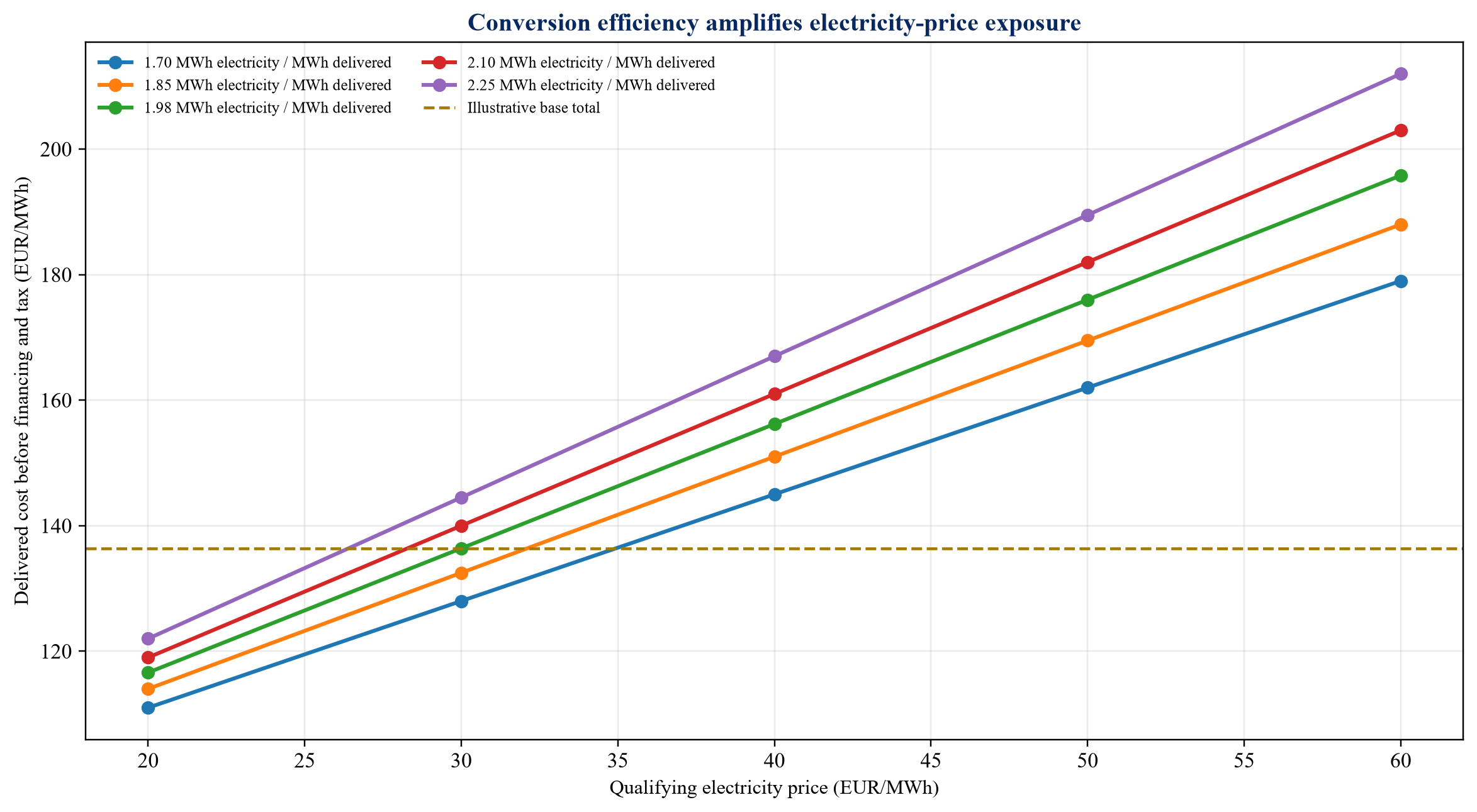
Illustrative management model; values exclude financing and tax and do not represent an identified project or market quotation.
20. Allocate power-price risk deliberately
A fixed-price fuel offtake leaves power-price risk with the project unless the input is hedged. A cost-plus offtake can pass power cost to the buyer while weakening the buyer's price certainty. An indexed formula can share risk by linking part of the fuel price to a defined renewable-power index, with caps, floors and efficiency standards.
The selected mechanism should preserve incentives. Full pass-through of electricity consumption can remove the operator's incentive to maintain efficiency. A prudent formula can pass through an efficient benchmark quantity and leave excess consumption with the project. Persistent grid congestion or curtailment should be allocated to the party best able to manage the connection and portfolio.
21. Align the hydrogen and methane warranties
Where a separate hydrogen supplier feeds the methanation plant, the hydrogen agreement and methane offtake must use compatible quantities, pressure, purity, ramping and availability. The methanation project should not guarantee gas delivery when the hydrogen supplier's permitted outages are broader than the buyer's relief events.
The interface agreement should state nomination timing, meter hierarchy, impurities, pressure, minimum flow, ramp rate, outage coordination, make-up rights and liability. A single integrated completion test can demonstrate the combined chain. Separate tests may leave a gap in which each facility passes its own guarantee while the system cannot meet the delivered-fuel requirement.
22. Contract the carbon source for the debt tenor
A short carbon-supply agreement can limit debt tenor even when the physical source appears durable. The agreement should cover volume, quality, pressure, delivery profile, price, indexation, sustainability evidence and change in eligibility. Replacement carbon may cost more or require new capture and transport assets.
The supplier's alternative use of carbon should also be understood. The EU lifecycle methodology can take account of existing use or fate and the treatment of rigid inputs.[6] The transaction should obtain legal and technical advice on the chosen source. A generic statement that carbon is captured does not establish the final fuel's lifecycle treatment.
23. Keep certificate value outside debt until evidenced
Certificates, quotas, carbon contracts for difference, tax credits or premium buyer claims can support revenue. They should enter the senior-debt base case only when eligibility, ownership, measurement, duration, transfer, double-counting controls and payment are established. A policy target does not itself create a bankable cash flow.
The European Commission recognises voluntary schemes for certification of renewable hydrogen and related fuels.[4][17] The project should identify the intended scheme, auditor, data fields, frequency and consequences of non-conformity. A cure process should distinguish correctable data defects from physical non-compliance.
24. Manage lifecycle emissions as an operating covenant
Lifecycle carbon intensity can change after financial close because the power mix, carbon source, transport route, methane leakage or methodology changes. The project should calculate carbon intensity using controlled data and preserve an audit trail. The offtake should define the applicable methodology and a change mechanism.
The operator can maintain a monthly provisional carbon-intensity account and an annual verified account. The finance documents can require timely certification, data retention and notification of a potential breach. Distributions can be restricted when loss of qualification threatens contracted revenue or creates repayment exposure.
25. Include methane leakage
Methane is a potent greenhouse gas. Leakage can arise from valves, compressors, seals, storage, venting, maintenance and downstream infrastructure. The IEA's methane work identifies leak detection and repair, equipment replacement and vapour recovery among cost-effective abatement measures.[18] The European Union Methane Regulation adds measurement, reporting, verification and import-related requirements for fossil energy supply chains.[19]
E-methane projects should apply a credible measurement and maintenance regime even where the legal treatment differs from fossil gas. The model should include expected physical loss and monitoring cost. The contracts should prohibit routine venting except for defined safety conditions and should allocate the value and emissions consequence of lost gas.
26. Design the offtake around energy and attributes
The offtake should state annual contract quantity, daily or hourly flexibility, take-or-pay or deliver-or-pay treatment, quality, delivery point, price, indexation, attributes, certification, force majeure, change in law and termination. It should avoid using one remedy for every failure.
A physical shortfall, certificate failure and gas-quality breach create different consequences. A physical shortfall may require replacement gas; a certificate failure may require attribute replacement or price adjustment; an off-specification delivery may require rejection and safety response. Separate remedies improve clarity and insurance placement.
27. Avoid double recovery
Public support, environmental attributes, buyer premiums and regulated cost recovery can overlap. The project should disclose each support mechanism and define the order of application. If a grant reduces capital cost, the tariff model should state whether the benefit lowers the buyer price, increases equity return or supports a higher-cost technology.
Japan has created a mechanism under which qualifying incremental procurement cost for synthetic methane and biogas can be included in gas-network cost recovery, subject to approval.[10][11] This illustrates the need to connect policy support with procurement, retail competition and tariff treatment. Project finance should model only support that has been awarded and remains available under the actual structure.
28. Structure construction around interface completion
The construction package may include renewable generation, grid connection, electrolyser, hydrogen storage, carbon capture, carbon pipeline, methanation, gas conditioning and gas interconnection. One engineering contractor may not accept every interface. The project company should maintain an interface register that maps design data, schedule dependencies, performance guarantees and liability.
Completion should require the whole system to produce qualified methane at the delivery point over a sustained test. Component completion remains useful for progress payments. Debt completion should test integrated availability, electricity consumption, methane recovery, gas quality, emissions, data systems and certificate evidence.
29. Protect schedule from grid and network delay
Electricity and gas interconnections can drive the critical path. The project should obtain connection studies, capacity reservations, land rights, permits and construction schedules before relying on a target operating date. A delay in either connection can strand completed process equipment.
The contracts should allocate liquidated damages and relief according to control. A project company should not promise fuel delivery before both utilities have firm obligations. Lenders should require long-stop dates, cost-to-complete coverage and a credible temporary commissioning plan.
30. Size reserves to the loss stack
Traditional debt-service reserves cover cash-flow interruption. An e-methane project may also need reserves for power imbalance, certificate true-up, stack replacement, catalyst replacement, carbon-supply interruption and network imbalance. The reserve package should reflect the actual risk allocation.
The project can separate scheduled lifecycle reserves from contingency liquidity. Scheduled reserves accumulate for known replacements. Contingency liquidity addresses short-term volatility or operational events. Draw and replenishment rules should avoid using long-term replacement funds for recurring operating deficits.
31. Use a risk-allocation matrix
The matrix should assign each risk to the party that controls its probability or consequence, supported by a contract and measurable remedy. Residual risks remain with the project company and equity. A label such as technology risk is too broad for financing analysis.
Table 3. Proposed e-methane risk allocation and controls
| Risk | Proposed primary bearer | Core control | Financing evidence |
|---|---|---|---|
| Renewable-power price and shape | Project, buyer or shared under formula | PPA portfolio, indexed offtake, caps and efficient-consumption benchmark | Hourly model, executed PPAs and hedge counterparty review |
| Electrolyser and methanation efficiency | EPC contractor before completion; operator thereafter | Net delivered-efficiency guarantee, degradation curve and maintenance plan | Integrated test, warranty, damages and lifecycle reserve |
| Carbon volume and quality | Carbon supplier within agreed specification | Long-term supply, buffer storage and alternative source plan | Source history, composition tests and replacement-cost case |
| Carbon eligibility and certificates | Party controlling source evidence; shared for law change | Scheme approval, chain of custody, audit and change mechanism | Legal opinion, auditor plan and data architecture |
| Gas quality and network acceptance | Project within specification; network for connection availability | Interconnection agreement, analysers, recycle and rejection procedure | Network study, signed terms and sustained injection test |
| Methane leakage and process loss | Operator within guaranteed boundary | Meter reconciliation, leak detection and repair, venting controls | Loss guarantee, monitoring plan and insurance review |
| Pipeline, storage and balancing tariff | Project or buyer according to delivery point | Capacity booking, tariff index and nomination rules | Executed capacity agreement and tariff downside |
| Change in lifecycle methodology | Shared under defined change-in-law regime | Reference methodology, adjustment process and termination threshold | Regulatory review and downside valuation |
| Construction interfaces | Project company with contractor pass-through | Interface matrix, common schedule and integrated completion test | Fixed-price packages, contingency and independent engineer report |
| Technology obsolescence | Equity after contracted performance is met | Modular design, upgrade rights and disciplined base case | Competitive procurement and no speculative upgrade revenue |
Illustrative allocation; applicable law, market design, contracting strategy and bargaining position determine the final structure.
32. Build a downside hierarchy
The model should test individual and combined downside cases. First-order cases include higher power price, lower conversion efficiency, lower utilisation, higher carbon cost, delayed operation and lower premium. Combined cases should reflect causal relationships. A lower renewable load factor can increase the power price, reduce utilisation and raise fixed cost per unit at the same time.
Debt sizing should use cash flow after maintenance, network, certification and reserve funding. The model should show the price required to maintain minimum debt-service coverage under each case. Equity returns should remain a residual output rather than an assumed input that forces the buyer price.
33. Preserve optionality without underwriting it
Future value may come from oxygen sales, heat sales, ancillary services, flexible power demand, direct-air-capture integration, carbon credits or premium maritime fuel markets. These options can improve value when supported by contracts and technical design. They should not repair a weak base case through unsupported revenue.
The project can preserve connections, land, control-system capability and contractual rights for later additions. The investment committee should approve the base plant on contracted evidence. Optional revenue can be treated as upside until the required buyer, permit and operating data exist.
34. Establish decision gates
Gate one confirms the target buyer, delivery product and policy pathway. Gate two confirms electricity, carbon and network resource evidence. Gate three confirms technology, site, permitting and lifecycle methodology. Gate four confirms integrated contracts and a financeable model. Gate five authorises construction and financing. Gate six confirms sustained delivered performance and certification.
Each gate should have a named owner and current evidence. Approval should expire when a power offer, connection reservation, carbon contract, certificate opinion or vendor bid expires. A governance process that records evidence dates prevents a historic assumption from becoming an unchallenged financing fact.
35. Implement through a controlled roadmap
Engineering, certification, market design and financing should proceed as connected workstreams. The buyer product definition and regulatory route come before final equipment selection. Power and carbon procurement should proceed alongside site and interconnection development. Contract integration should precede financial close.
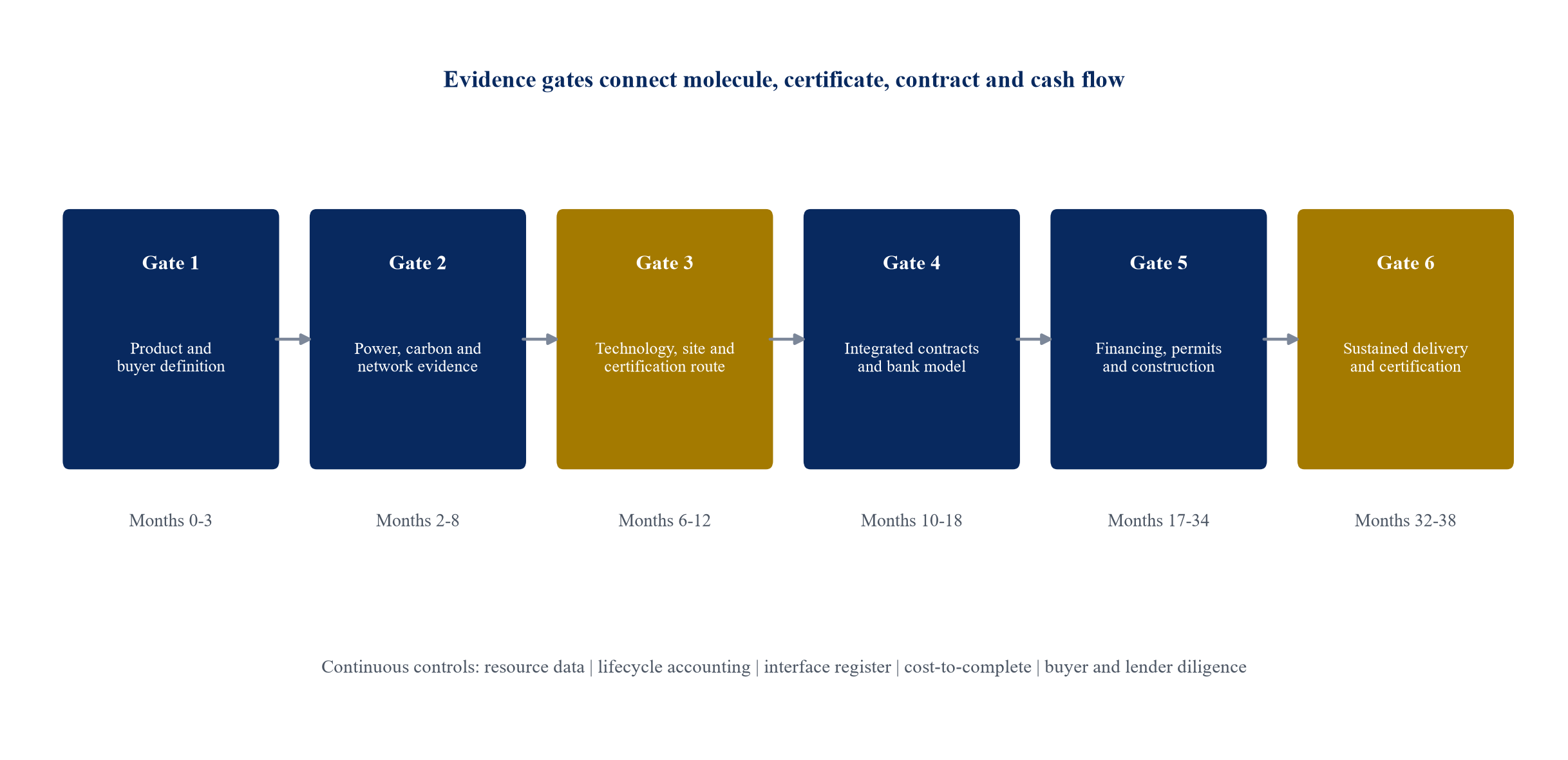
Illustrative gates; timing depends on jurisdiction, technology maturity, resource contracting, permitting and network access.
36. Govern operating data
The operating data platform should connect fiscal meters, laboratory results, maintenance records, power certificates, carbon-source evidence, gas nominations and buyer invoices. Data ownership, retention, cyber security and audit access should be stated in contract. Manual reconciliation can support early operation; it should not become the permanent control for a complex certificate chain.
Monthly management reporting should show energy and mass balance, qualifying production, delivered volume, loss by category, carbon intensity, availability, degradation, maintenance, certificate status and commercial settlement. Exceptions should have named owners and closure dates. The same dataset should support operator incentives, buyer verification and lender monitoring.
37. Set operator incentives around delivered value
An operator can meet gross production while missing delivered quality, efficiency or certification. The operating fee should therefore combine availability, net electricity consumption, methane recovery, gas quality, planned maintenance and data quality. Deductions should reflect economic effect and remain capped only where other remedies cover severe or repeated failure.
The operator needs relief for buyer curtailment, network unavailability, off-specification inputs and instructed dispatch outside the guaranteed envelope. The project company should avoid paying a performance bonus for output that cannot be certified or sold under the offtake.
38. Prepare for change in law and methodology
Renewable-fuel regulation and carbon-accounting methods continue to develop. The contracts should identify the baseline legal framework, the date of assessment, who monitors changes and how cost or eligibility impacts are addressed. A broad change-in-law clause can create uncertainty; a specific methodology-change process can provide evidence and decision deadlines.
The adjustment sequence can require mitigation, alternative certification, operating change, price discussion and, only at a defined threshold, termination. Debt documents should address how compensation, insurance or reserve proceeds are applied. Equity should retain ordinary market-development risk where no public or buyer commitment exists.
39. Compare alternatives at the service level
E-methane should be compared with direct electrification, renewable hydrogen, biomethane, efficiency, heat pumps, district energy and other fuels for the specific end use. The EU gas-market regulation states that hydrogen blending should be a last-resort solution where more efficient alternatives exist.[7] The same discipline applies to e-methane: compatibility alone does not establish best value.
The comparison should include end-user conversion, network reinforcement, storage, resilience, seasonal demand, import exposure, lifecycle emissions and option value. E-methane may be most valuable where high-temperature heat, dispatchable generation, seasonal storage or existing gas equipment creates a material avoided-cost case.
40. Frame the investment-committee decision
The investment committee should ask five connected questions. Is there a contracted buyer for a defined delivered product? Are power and carbon available for the debt tenor on qualifying terms? Does the integrated plant meet a measured delivered-efficiency threshold? Can the existing gas system accept, transport and account for the product? Does the downside case preserve liquidity and debt service without speculative support?
Approval should state the maximum power-price exposure, minimum net efficiency, permitted carbon sources, required certificate treatment, network conditions, price floor, reserve package and completion tests. This converts a technology narrative into controlled investment authority.
Conclusion
Existing gas infrastructure can give e-methane a valuable route to storage, transport and end users. The economic result remains governed by the losses and obligations that precede pipeline injection. Renewable-electricity procurement, electrolysis, carbon supply, methanation, conditioning, compression, storage, leakage and certification must be measured against one delivered-fuel obligation.
A financeable project defines the product first, contracts the resource chain for the debt tenor, guarantees net delivered efficiency, separates physical gas from environmental attributes, tests integrated completion and sizes reserves to the actual loss stack. The delivered-price formula should reward efficient operation and allocate policy, power and certificate exposure explicitly. This structure allows existing pipes to create genuine value without obscuring the cost of making new methane.
FREQUENTLY ASKED QUESTIONS
1. Why can e-methane cost more than natural gas when it uses existing pipelines?
Existing pipelines reduce some transport and end-user conversion costs. E-methane still requires qualifying electricity, hydrogen production, carbon dioxide, methanation, gas conditioning, compression, certification and financing. These upstream costs can dominate the delivered price.
2. What is the most useful efficiency metric for lenders?
The most useful metric is qualifying electricity consumed per megawatt-hour of saleable methane delivered at the contracted point, supported by separate guarantees for availability, gas quality, methane recovery and certificate compliance.
3. Should recovered heat be included in the base case?
Recovered heat should be included only when a creditworthy buyer, usable temperature, delivery obligation, price and outage treatment are contracted. A technical ability to recover heat does not establish revenue.
4. How should carbon dioxide be priced?
The model should include capture or purchase, purification, compression, transport, buffer storage, measurement and certification. It should also test whether the selected source remains eligible under the applicable lifecycle methodology.
5. Who should bear conversion-efficiency risk?
The engineering contractor should bear tested performance risk before completion. The operator should bear controllable degradation and operating efficiency thereafter, subject to relief for off-specification inputs, network events and instructed dispatch outside the guaranteed envelope.
6. Can policy targets support senior debt?
Policy targets can support market development. Senior debt should rely on awarded support, enforceable tariff treatment, contracted buyer payments or other cash flows whose eligibility, duration and payment mechanics have been verified.
7. What must an integrated completion test demonstrate?
It should demonstrate sustained qualified methane delivery, net electricity consumption, methane recovery, gas quality, availability, emissions, meter reconciliation, network acceptance, data integrity and the evidence needed for certification.
8. When is e-methane most commercially relevant?
It can be commercially relevant where existing gas assets, seasonal storage, dispatchability, high-temperature heat or difficult-to-electrify demand create meaningful avoided costs, and where qualifying electricity and carbon can be secured at an acceptable delivered price.
References
- International Energy Agency, E-methane: a new gas for a net-zero future?, 2024, https://www.iea.org/events/e-methane-a-new-gas-for-a-net-zero-future
- International Energy Agency, Establishment of Approval Criteria for Procurement Costs of Synthetic Methane, accessed 3 October 2026, https://www.iea.org/policies/28114-establishment-of-approval-criteria-for-procurement-costs-of-synthetic-methane-etc
- International Renewable Energy Agency, Hydrogen: A Renewable Energy Perspective, 2019, https://www.irena.org/-/media/Files/IRENA/Agency/Publication/2019/Sep/IRENA_Hydrogen_2019.pdf
- European Commission, Renewable hydrogen, accessed 3 October 2026, https://energy.ec.europa.eu/topics/eus-energy-system/hydrogen/renewable-hydrogen_en
- Commission Delegated Regulation (EU) 2023/1184 on a Union methodology setting out detailed rules for the production of renewable liquid and gaseous transport fuels of non-biological origin, 2023, https://eur-lex.europa.eu/eli/reg_del/2023/1184/oj
- Commission Delegated Regulation (EU) 2023/1185 on greenhouse-gas savings from renewable fuels of non-biological origin and recycled-carbon fuels, 2023, https://eur-lex.europa.eu/eli/reg_del/2023/1185/oj
- Regulation (EU) 2024/1789 on the internal markets for renewable gas, natural gas and hydrogen, 2024, https://eur-lex.europa.eu/eli/reg/2024/1789/oj
- Directive (EU) 2024/1788 on common rules for the internal markets for renewable gas, natural gas and hydrogen, 2024, https://eur-lex.europa.eu/eli/dir/2024/1788/oj
- International Renewable Energy Agency, Decarbonising hard-to-abate sectors with renewables: Perspectives for the G7, 2024, https://www.irena.org/Publications/2024/Apr/Decarbonising-hard-to-abate-sectors-with-renewables
- Agency for Natural Resources and Energy, Japan, Approval applications for synthetic methane procurement costs, 2026, https://www.enecho.meti.go.jp/category/electricity_and_gas/gas/e-methane/e-methane.html
- Ministry of Economy, Trade and Industry, Japan, Seventh Strategic Energy Plan, 2025, https://www.enecho.meti.go.jp/category/others/basic_plan/pdf/2025_strategic_energy_plan.pdf
- Ministry of Economy, Trade and Industry, Japan, Next-generation heat energy industry, accessed 3 October 2026, https://www.meti.go.jp/policy/energy_environment/global_warming/ggs/03_netsu.html
- European Network of Transmission System Operators for Gas, Gas Quality Standardisation and Monitoring, accessed 3 October 2026, https://www.entsog.eu/gas-quality-standardisation-and-monitoring
- European Network of Transmission System Operators for Gas, Gas Quality Monitoring Report First Edition, 2024, https://www.entsog.eu/sites/default/files/2025-02/ENTSOG%20Gas%20Quality%20Monitoring%20Report%202024.pdf
- National Renewable Energy Laboratory, Hydrogen Energy Storage: Grid and Transportation Services, 2015, https://www.nrel.gov/docs/fy15osti/62518.pdf
- European Commission, Union Database for liquid and gaseous renewable and recycled-carbon fuels, accessed 3 October 2026, https://energy.ec.europa.eu/topics/renewable-energy/bioenergy/biofuels/union-database-liquid-and-gaseous-renewable-and-recycled-carbon-fuels_en
- European Commission, Voluntary schemes, accessed 3 October 2026, https://energy.ec.europa.eu/topics/renewable-energy/bioenergy/voluntary-schemes_en
- International Energy Agency, Global Methane Tracker 2026: Key findings, 2026, https://www.iea.org/reports/global-methane-tracker-2026/key-findings
- European Commission, Methane emissions, accessed 3 October 2026, https://energy.ec.europa.eu/topics/carbon-management-and-fossil-fuels/methane-emissions_en
- United States Department of Energy, Sustainable Transportation Action Plan, 2022, https://www.energy.gov/sites/default/files/2023-01/STAS_v2_2022-12-16.pdf
- European Commission, Hydrogen and decarbonised gas market package, accessed 3 October 2026, https://energy.ec.europa.eu/topics/markets-and-consumers/hydrogen-and-decarbonised-gas-market-package_en
- International Energy Agency, CCUS in the transition to net-zero emissions, 2020, https://www.iea.org/reports/ccus-in-clean-energy-transitions/ccus-in-the-transition-to-net-zero-emissions
About the Author
Chennakeshav (CK) is a corporate finance and investment banking executive with 25+ years of global experience in deal origination, structuring and execution across M&A, growth capital and corporate strategy. He has led value-creation mandates for founders, corporates and funds — bridging the boardroom view to hands-on execution and close.
His career spans Morgan Stanley, HSBC, Lloyds Banking Group, EWEC, ADQ portfolio companies and Emirates Growth Fund, across TMT, real estate, fintech, deeptech, cleantech, infrastructure and energy. He has partnered with C-suite leaders, private equity and venture funds, sovereign wealth funds and family offices to finance complex fund raises and scale-up ventures, and has led M&A due diligence, post-merger integration and business-transformation initiatives to create value.
At Matchpoint Partners he is Managing Partner, leading the firm's corporate finance, M&A and capital-raising practice. He holds an MBA from London Business School, an engineering degree from VTU and a Master of Laws (LLM, in progress) from UCL London.
An active start-up mentor, CK mentors at Techstars, DIFC FinTech Hive, Startup Grind, Founder Institute and IN5, serves as Entrepreneur Mentor in Residence (EMiR) at London Business School, and judges the Entrepreneurship World Cup.
