

1. Treat currency as part of the earn-out bargain
An earn-out defers part of acquisition consideration and makes the amount depend on later performance or another event. It can reconcile different views of future value, preserve buyer liquidity and allow a seller to participate in post-closing upside. The same structure also creates a continuing contract between parties whose interests can diverge after control transfers.
Currency risk enters at several points. The target may sell in multiple currencies, record results in a functional currency, report to a parent in another currency and owe the earn-out in a third currency. A buyer can therefore face a payment that changes even when the operational formula is unchanged. A seller can receive the contractual amount and still realise less value after conversion.
The board decision should state who bears each currency movement and why. That decision belongs in the acquisition economics, purchase agreement, financing plan and hedge mandate. A treasury solution cannot repair an ambiguous formula, and a drafting solution cannot create the liquidity needed at settlement.
The proposed Earn-Out Currency Allocation Test begins with the commercial bargain. It then identifies the currency of the metric, threshold, cap, payment, funding source and seller objective; specifies exchange-rate rules; models combined performance and currency stresses; and creates a controlled calculation and dispute process.
2. Separate six currency questions
The first question is the functional currency of the acquired business. IAS 21 defines the framework for determining functional currency and translating foreign-currency transactions and financial statements [4]. The second question is the currency in which the earn-out performance metric is calculated. That choice can differ from the functional currency when a contract defines a bespoke revenue or EBITDA measure.
The third question is the currency of each threshold, floor and cap. A threshold stated as EUR 50 million is economically different from a USD threshold translated each month. The fourth question is the currency in which the earned amount is denominated. The fifth is the currency actually delivered to the seller. The sixth is the currency in which the buyer funds the payment.
Each question requires an explicit answer. A statement that the earn-out is “based on international revenue” does not identify how local revenue is translated. A statement that the seller will receive the “euro equivalent” does not identify the rate, source, observation time or treatment of unavailable rates.
The contract schedule should contain a currency matrix. It should record the relevant entity, ledger, metric, threshold, exchange-rate source, conversion date, rounding rule, payment account and responsible party. The model and calculation statement should use the same matrix.
3. Map the complete obligation and data chain
The earn-out begins in operating systems and ends with cash or securities delivered to the seller. The chain can include customer contracts, invoices, revenue recognition, cost allocation, consolidation, metric adjustments, currency conversion, calculation approval, dispute resolution, funding and payment.
Each link can change the result. A customer contract may be invoiced in dollars while the acquired entity has a euro functional currency. The accounting system can translate revenue at transaction-date or average rates. The earn-out schedule can require a different reference rate. The buyer can fund the final payment from a dollar revolver and convert at settlement.
The map should distinguish source evidence from contractual calculations. Audited financial statements may support the underlying records, while the earn-out formula can require exclusions or additions that do not appear in statutory reporting. Currency translation for financial statements does not automatically determine the contractual conversion method.
The parties should also identify which records remain accessible after closing. Sellers commonly depend on the buyer for calculation data. Recent Delaware decisions illustrate how earn-out disputes can become document-production and interpretation disputes when the agreement and supporting records do not resolve the issue clearly [12][13][14].
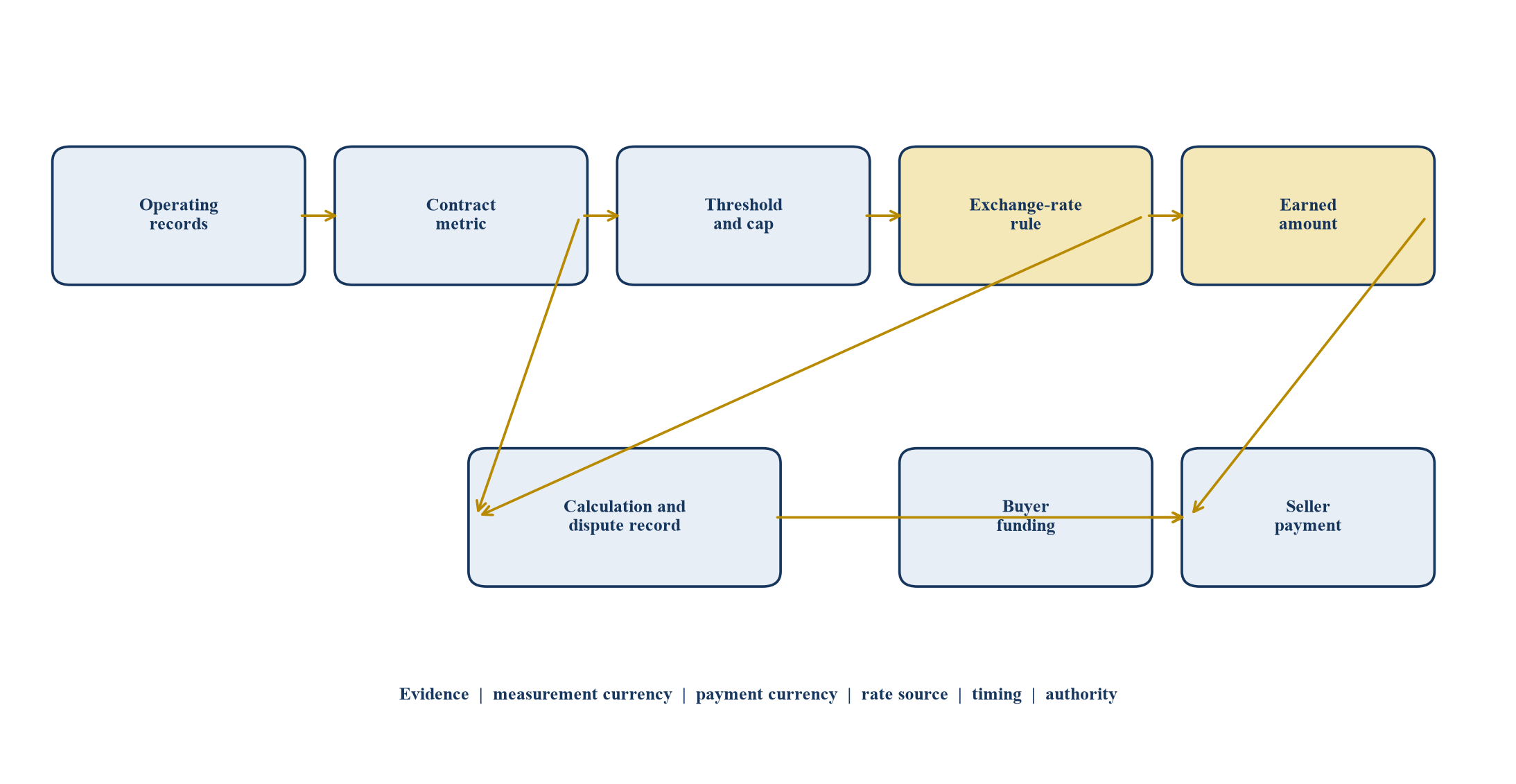
The architecture separates operating evidence, contractual calculation, currency conversion, funding and settlement while preserving one decision record.
4. Define the hypothetical case
The worked case assumes a buyer with a US dollar reporting and funding base acquires a euro-area operating business. The maximum earn-out is EUR 30 million and the measurement period is two years. The business records the relevant operating metric in euros. The parties calculate an illustrative earned amount of EUR 24 million after applying the agreed formula.
The closing exchange-rate assumption is USD 1.10 per euro. The analysis tests settlement at USD 0.90, USD 1.10 and USD 1.30 per euro. These scenarios describe market rates rather than probabilities. Transaction costs, tax, credit spreads, option premiums and accounting effects are excluded from the first comparison and considered separately.
Three structures are tested. Under the euro-payment structure, the buyer pays EUR 24 million and bears the dollar cost of acquiring euros. Under the fixed-rate structure, the buyer pays USD 26.4 million, calculated at the closing rate of USD 1.10 per euro; the seller bears the value of converting that fixed dollar amount back into euros. Under the collar structure, the conversion rate used for payment cannot fall below USD 1.00 or rise above USD 1.20 per euro.
The case does not identify a universally preferable allocation. It shows how the same operating result produces different buyer cash costs and seller proceeds. The commercial choice should reflect bargaining power, natural currency exposures, financing capacity, tax and the feasibility of hedging.
| Item | Currency or rule | Illustrative value | Decision relevance |
|---|---|---|---|
| Maximum earn-out | EUR | EUR 30.0m | Defines the contractual cap |
| Earned amount | EUR | EUR 24.0m | Result after applying the operating formula |
| Closing exchange rate | USD per EUR | 1.10 | Reference for the fixed-rate alternative |
| Settlement exchange rates | USD per EUR | 0.90; 1.10; 1.30 | Downside and upside comparison |
| Collar floor and ceiling | USD per EUR | 1.00; 1.20 | Limits the contractual conversion rate |
| Buyer funding currency | USD | USD revolver or cash | Determines buyer cash exposure |
| Seller value objective | EUR | Euro-equivalent proceeds | Determines seller conversion exposure |
All terms and values are illustrative. The earned amount is assumed rather than forecast.
5. Choose the measurement currency before the payment currency
Measurement currency determines how operating performance enters the earn-out formula. The strongest choice usually follows the currency in which the relevant business performance is generated and controlled. A euro operating metric can preserve the relationship between prices, costs and the threshold when the target primarily operates in euros.
A parent-currency metric can support consolidated reporting, though it imports exchange-rate movement into the performance test. If euro revenue is translated into dollars each month, a weaker euro can reduce reported dollar revenue even when local volumes and prices meet plan. The earn-out can then reward or penalise currency movement rather than management performance.
The parties can reduce that effect by setting thresholds in the operating currency, fixing a budget rate or using constant-currency calculations. Each choice has limitations. A fixed budget rate can depart from actual cash economics. Constant-currency reporting requires a precise base period and method. A spot or average rate exposes the metric to market movement.
The agreement should state whether acquisitions, disposals, new currencies, discontinued products and changes in functional currency alter the metric. It should also state whether the buyer may change accounting systems or policies during the measurement period and how comparability is preserved.
6. Define the exchange-rate source and observation rule
An exchange-rate clause requires more than a named currency pair. It should identify the administrator or published source, rate type, observation date and time, business-day convention, time zone, fallback and rounding rule. A daily rate, monthly average and period average can produce materially different outcomes.
Public filings show that transaction parties do write detailed conversion rules. One filed agreement required relevant revenue to be translated daily into euros using the exchange rate employed for the buyer's financial reporting [15]. Another required alternative-currency business to be converted into US dollars using the average exchange rate for the relevant month [16]. These examples demonstrate available drafting approaches; they do not establish a preferred term.
The clause should address market closure, benchmark discontinuation and a currency that becomes restricted or non-deliverable. ISDA's 2026 FX Definitions provide a current framework for privately negotiated FX transactions and disruption events [10][11]. Acquisition agreements can use their own provisions, though treasury documentation and the purchase agreement should not rely on incompatible rate conventions.
The calculation statement should show every rate used, the source record and the resulting converted amount. Version-controlled evidence reduces the risk that a later disagreement becomes a reconstruction exercise.
The source should also be operationally obtainable on the required date. A contract can name a reputable benchmark and still fail in practice if the publication occurs after the calculation deadline, if the relevant currency pair is derived indirectly or if the buyer's systems store a different timestamp. The specimen statement should therefore be run with actual historical data before signing. This test can reveal time-zone, holiday, precision and inversion errors while the parties can still amend the drafting.
Rate inversion deserves explicit control. A quotation expressed as dollars per euro moves in the opposite numerical direction from euros per dollar. A spreadsheet that inverts one rate and multiplies another can produce a plausible-looking result that is economically wrong. The contract should state the quotation convention, and the calculation control should independently recompute at least one sample payment from source evidence. Where several operating currencies feed the metric, each conversion leg should have its own rule and the aggregated result should reconcile to the ledger and the contractual statement.
7. Allocate the exposure deliberately
A euro-denominated earn-out paid in euros gives the seller a fixed euro claim once the amount is determined. The buyer bears the dollar cost if its funding is in dollars. This can be appropriate when the seller's value objective and the acquired business are euro based, while the buyer has the treasury capacity to manage the exposure.
A fixed dollar payment calculated at signing or closing transfers the subsequent currency movement to the seller. It can give the buyer certainty over the maximum dollar obligation, but the seller's realised euro proceeds can vary materially. The negotiation should recognise that transfer through price, cap, floor or another term.
A floating conversion at settlement can move the buyer's dollar obligation while preserving the seller's euro amount. A collar shares movements outside an agreed band. A split-currency payment can allocate a minimum amount in the seller's preferred currency and a residual amount in the buyer's currency.
Allocation should follow capacity to manage the risk, not administrative convenience. The party that can naturally offset the exposure or hedge it efficiently may be able to bear it at lower cost. The agreement should still state the risk explicitly because market access and hedge capacity can change.
8. Compare buyer cash cost and seller realised value
If the buyer pays EUR 24 million, its dollar cost is USD 21.6 million at USD 0.90 per euro, USD 26.4 million at USD 1.10 and USD 31.2 million at USD 1.30. The seller receives EUR 24 million in each case before tax and transaction costs.
If the agreement fixes payment at USD 26.4 million, the buyer's dollar cost is constant. The seller's euro equivalent is approximately EUR 29.33 million at USD 0.90 per euro, EUR 24.0 million at USD 1.10 and EUR 20.31 million at USD 1.30. The fixed rate therefore transfers a potentially significant economic movement to the seller.
Under the illustrative collar, the contractual rate is bounded between USD 1.00 and USD 1.20 per euro. The buyer pays USD 24.0 million, USD 26.4 million or USD 28.8 million across the three market scenarios. The corresponding seller values are approximately EUR 26.67 million, EUR 24.0 million and EUR 22.15 million if the seller converts the dollars at the market rate.
The comparison should include funding interest, derivative premium, collateral, tax and settlement costs before approval. The table isolates the currency allocation so the parties can see the mechanism clearly.
| Settlement market rate | Euro payment: buyer USD cost | Fixed USD 26.4m: seller EUR value | Collar: buyer USD cost | Collar: seller EUR value |
|---|---|---|---|---|
| USD 0.90 per EUR | USD 21.60m | EUR 29.33m | USD 24.00m | EUR 26.67m |
| USD 1.10 per EUR | USD 26.40m | EUR 24.00m | USD 26.40m | EUR 24.00m |
| USD 1.30 per EUR | USD 31.20m | EUR 20.31m | USD 28.80m | EUR 22.15m |
The earned amount is EUR 24 million. Seller euro value assumes immediate conversion of a dollar payment at the stated market rate. Figures are rounded.
9. Model performance and exchange rates together
Currency should not be tested only after the earn-out is assumed to be fully earned. The amount can range from zero to the contractual cap, and the exchange rate can move during the same period. The financing model should therefore combine operating outcomes with currency outcomes.
The worked matrix tests earned amounts of EUR 0 million, EUR 12 million, EUR 24 million and EUR 30 million. Under euro payment, the buyer's dollar cash need ranges from zero to USD 39.0 million across the selected scenarios. The maximum occurs when the cap is earned and the euro settles at USD 1.30.
A fixed dollar conversion at USD 1.10 limits the cap to USD 33.0 million. That certainty does not remove the seller's currency exposure. A collar bounds the cap between USD 30.0 million and USD 36.0 million across the selected market rates.
The board should compare these amounts with acquisition debt headroom, revolver availability, restricted cash, distributions and other closing obligations. The hedge decision should use the same payout grid rather than a single expected amount.
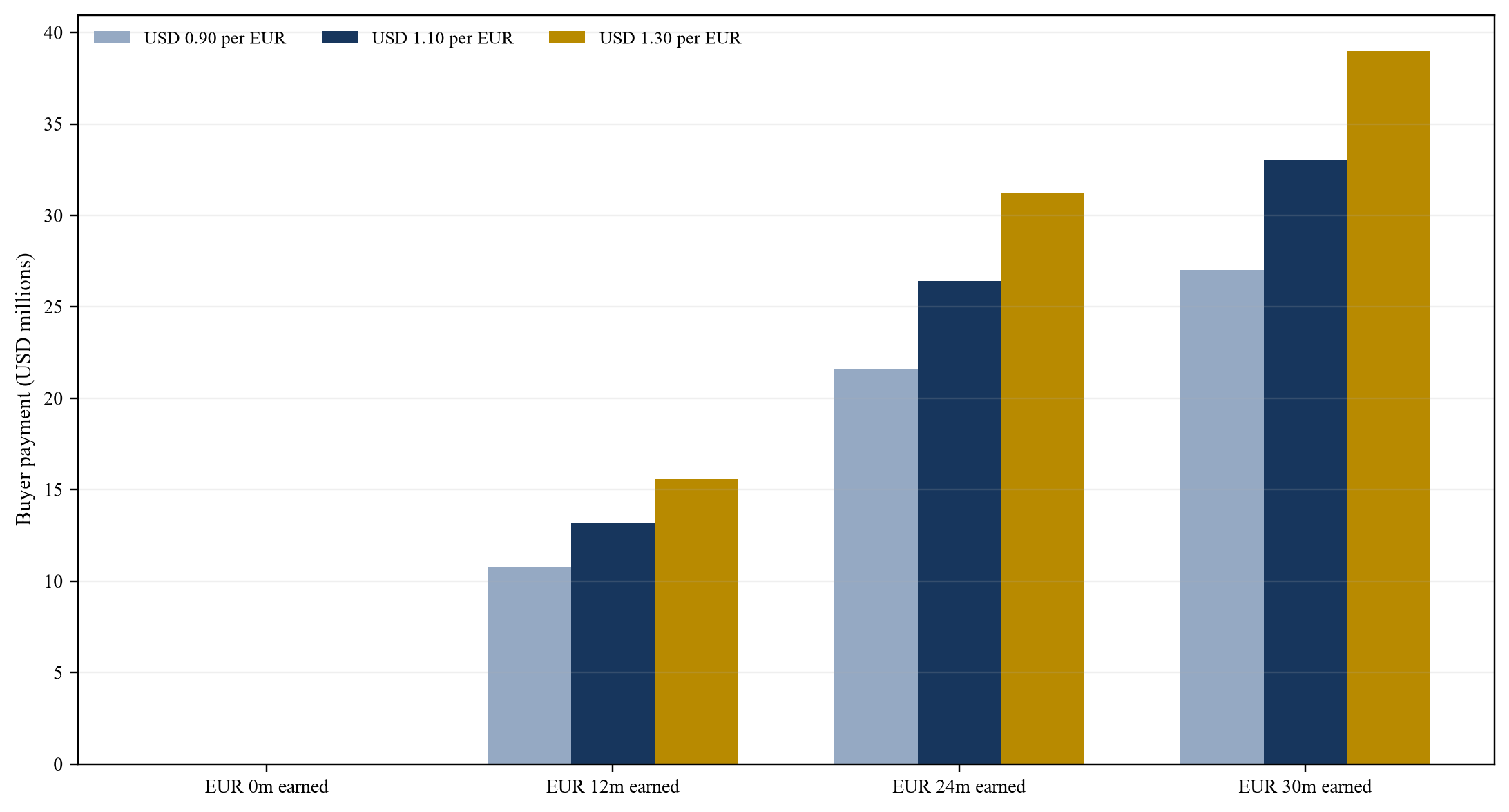
The chart combines four hypothetical euro earn-out outcomes with three euro-dollar settlement rates. It does not assign probabilities.
10. Distinguish the operating contingency from the currency contingency
An earn-out contains an operating contingency because the amount depends on performance. A foreign-currency earn-out also contains a market contingency because the buyer's funding cost or seller's proceeds depend on exchange rates. The two risks have different evidence, owners and hedge instruments.
Operating performance is managed through the business plan, governance rights, accounting definitions and calculation controls. Currency risk is managed through contract allocation, natural offsets, reserves and financial hedges. Combining them in one undifferentiated provision makes approval and monitoring harder.
The transaction model should show the earned amount in measurement currency first. It should then apply the contractual conversion rule. A separate treasury schedule should show any hedge and funding cash flows. This sequence preserves the distinction between what was earned and how it was paid.
The same separation assists disputes. An objection to revenue recognition is different from an objection to the reference exchange rate. The agreement should route accounting disputes, currency-source disputes and payment failures to the appropriate process.
11. Link the currency clause to operating covenants
Earn-out agreements often regulate how the buyer may operate the acquired business. The clauses can address funding, product investment, customer allocation, accounting policies, integration and conduct intended to avoid payment. Delaware decisions show that earn-out outcomes frequently turn on the precise language the parties adopted [12][13][15].
Currency choices can interact with those obligations. A buyer that changes invoicing currency, centralises sales, reallocates customers or changes transfer-pricing arrangements can alter the reported metric. The agreement should state how such changes affect the earn-out calculation and whether a constant-currency adjustment applies.
The contract should distinguish legitimate operating discretion from prohibited manipulation. It can require consistency, defined adjustments, information rights and a calculation statement without forcing the buyer to preserve every pre-closing practice. The correct balance depends on the transaction and governing law.
The board should approve the operational freedom it needs during the earn-out period and the seller protections required to preserve the bargain. Currency provisions should support that allocation rather than create an indirect restriction that neither party intended.
12. Choose a hedge only after the contractual exposure is defined
A buyer cannot size a hedge accurately until it knows the currency, maximum amount, measurement period, likely payment dates, calculation timetable and dispute process. An earn-out is conditional and the exposure can change as performance evidence develops.
A forward can fix the rate for a known amount and date. It can create over-hedging if the earn-out is not achieved or payment is delayed. An option can preserve participation and limit downside, while requiring a premium. A layered programme can hedge a minimum expected amount first and add protection as evidence strengthens.
The 2026 ISDA FX Definitions provide current documentation architecture for privately negotiated FX and currency option transactions [10]. The derivative remains separate from the acquisition agreement. Counterparty credit, collateral, close-out, disruption and settlement provisions require their own review.
The hedge should follow an approved decision rule. Evidence thresholds can include signed contract enforceability, elapsed performance, verified metric attainment, unresolved objections and payment timing. Treasury should not convert an uncertain legal claim into a certain derivative obligation without a funded exit plan.
13. Prevent over-hedging and timing mismatch
Over-hedging occurs when derivative notional exceeds the exposure that remains payable. An earn-out can fall below forecast, be set off against claims, be delayed by dispute, accelerate on a change of control or convert into shares. Each event can leave a hedge unmatched.
The hedge schedule should therefore contain minimum, central and maximum exposure paths. It should identify the earliest and latest settlement date. Optional reduction, extension, novation or cancellation rights can provide flexibility, though they affect pricing and documentation.
A reserve can cover close-out or rollover costs. The amount should be based on transaction-specific market and timing stresses. The reserve for the earn-out payment should remain distinct from derivative collateral and from operating liquidity.
Every calculation update should trigger a reconciliation of the contractual exposure, hedge notional, maturity and payment currency. The reconciliation should occur before an objection period expires or a hedge adjustment deadline passes.
14. Treat accounting as a separate decision layer
IFRS 3 requires an acquirer to recognise and measure consideration transferred in a business combination, including contingent consideration, within the acquisition accounting framework [1][2][3]. Classification and subsequent measurement depend on the terms and applicable standards. IFRS 13 provides the fair-value measurement framework, while IAS 32 and IFRS 9 can affect classification and measurement of financial instruments [5][6][7].
Foreign-currency terms can affect measurement and reported volatility. IAS 21 addresses foreign-currency transactions, monetary items and translation [4]. The accounting analysis should identify the functional currency of the relevant entity, the nature of the liability or equity instrument, the exchange rate applied and the treatment of subsequent changes.
An economic hedge and an accounting hedge are not automatically the same. Qualification for hedge accounting requires satisfaction of the relevant designation, documentation and effectiveness requirements. The transaction should not accept additional cash risk solely to obtain a preferred reporting presentation.
The accounting paper should reconcile the acquisition-date valuation, subsequent remeasurement, currency effects, derivative treatment and settlement. It should also distinguish consideration from remuneration when payments are connected to continuing employment or other post-combination arrangements [2].
15. Model the seller's exposure separately
The seller's objective can differ from the buyer's reporting and funding currency. A founder who plans to reinvest in euros may value euro certainty. An institutional seller with dollar liabilities may prefer dollars. A multi-seller group can have several base currencies and different tax positions.
The seller model should show the contractual amount, payment currency, expected conversion route, bank charges, withholding, timing and any restrictions on receipt. A fixed dollar amount can expose the seller to the euro value of the dollar. A euro payment can expose a dollar-based seller in the opposite direction.
Sellers should also assess buyer credit. Currency protection has limited value if the payer lacks liquidity or if the claim is deeply subordinated. Security, escrow, guarantee, set-off rights and acceleration events can affect the quality and timing of proceeds.
The parties may agree different elections for different sellers, though operational complexity and equal-treatment requirements must be considered. Any election should have a clear deadline, irrevocability rule and payment instruction.
Seller exposure can also change when proceeds are distributed through an exchange agent, escrow vehicle or shareholder representative. The contractual payer may discharge its obligation in one currency while the intermediary converts or distributes in another. Fees, cut-off times and bank-account location can then affect the amount and date received by each seller. The transaction documents should identify the responsible party for conversion and the evidence that establishes correct discharge.
Where the seller retains a vendor note or another deferred claim alongside the earn-out, the exposures should be aggregated. Two individually manageable currency positions can create concentration when they settle in the same period. The seller should test delayed receipt, buyer default, exchange-rate movement and reinvestment needs together, using the same payment dates and legal priorities stated in the transaction documents.
16. Integrate the earn-out with acquisition financing
The acquisition financing model should include the maximum and stressed earn-out payment even when the amount is contingent. Lender definitions may treat deferred consideration as debt, a permitted payment, restricted payment, contingent liability or acquisition cost. The executed credit documents determine the actual result.
The borrower should confirm whether paying, hedging, securing or accelerating the earn-out requires lender consent. It should test leverage, fixed-charge coverage, minimum liquidity and available baskets under each performance and currency scenario. A strong euro can increase the dollar cash requirement while the acquired business also faces weaker local trading.
Funding should be identified before the obligation becomes due. Sources can include retained cash, a revolver, seller financing, escrow or equity. A revolver can bridge timing, but availability and pricing may deteriorate when operating performance is below plan or markets are stressed.
The financing plan should also address a dispute. An amount can remain uncertain beyond the expected payment date while hedge maturity and financing commitments approach. The model should show the cost and authority for extension, partial payment, escrow or reserve.
17. Control tax and legal characterisation
The tax treatment of contingent consideration depends on the parties, structure, jurisdiction and connection to employment, shares, assets or another arrangement. Withholding, deductibility, capital treatment, payroll taxes and timing can differ. Currency gains or losses can also be treated differently across jurisdictions.
The agreement should state whether payments are grossed up, which party bears transfer charges and how tax withholding affects the contractual cap. A provision that simply permits legally required withholding does not answer whether the earn-out target or seller economics are adjusted.
Legal characterisation matters for enforceability, insolvency, security, set-off and transfer. A payment obligation can be subject to conditions, defences and dispute procedures that affect whether a derivative or funding commitment is appropriately sized.
Transaction-specific legal and tax advice is required. The model should display those cash consequences separately from purchase price and exchange-rate economics so that the board can see each effect.
18. Design the calculation statement before signing
The parties should build a specimen earn-out statement while negotiating the agreement. It should start with source accounts, show contractual adjustments, calculate the metric, test thresholds, compute the earned amount, apply the exchange-rate rule and reconcile the final payment.
The statement should show rates to the agreed precision and identify rounding at each stage. Rounding only at the final payment can differ from rounding individual monthly translations. The treatment should be explicit, especially when revenue across several currencies is aggregated.
Supporting schedules should include the general ledger, customer and invoice data, allocation methods, excluded items, acquisitions and disposals, currency-rate evidence and reconciliations to audited or management accounts. Access rights should extend through the objection period.
A specimen can expose ambiguity before signing. It also allows treasury, accounting, tax and legal teams to test whether their documents use the same currency definitions.
| Structure | Buyer exposure | Seller exposure | Drafting burden | Hedge implication | Suitable circumstance |
|---|---|---|---|---|---|
| Pay fixed operating currency | Buyer funding cost moves with FX | Seller receives stated local amount | Moderate | Buyer can hedge conditional FX obligation | Seller values local-currency certainty |
| Pay fixed buyer currency | Buyer maximum is fixed | Seller local value moves with FX | Moderate | Buyer may not need payment-currency hedge | Seller accepts or can manage buyer-currency risk |
| Convert at settlement spot | Buyer cost moves with FX | Depends on payment currency and conversion route | High | Exposure evolves until settlement | Parties want market conversion at payment |
| Fixed contractual rate | Buyer amount fixed by agreed rate | Seller bears later market movement | Moderate | Hedge may be unnecessary or used for seller | Parties price currency allocation at signing |
| Contractual collar | Movement shared within stated bounds | Movement shared within stated bounds | High | Hedge can mirror contractual floor and ceiling | Parties want bounded exposure and participation |
| Split-currency payment | Exposure divided across currencies | Proceeds diversified | High | Multiple hedge legs may be required | Both parties have natural needs in different currencies |
The comparison describes general features. Actual economics depend on the transaction, jurisdictions, documents and market terms.
19. Build a disciplined dispute process
An earn-out dispute can concern the metric, accounting policy, operational conduct, exchange-rate source, calculation or payment. The agreement should classify disputes and identify the forum, timetable, evidence and authority for each category.
Independent accountants can determine defined calculation matters when the mandate is precise. Courts or arbitration may address contractual interpretation and breach. A recent Delaware decision discussing a resolution accountant emphasised the importance of the submitted disagreement and agreed process [14].
The objection notice should specify each disputed item, proposed adjustment and supporting evidence. The agreement should address undisputed amounts, interest, escrow and access to records during the dispute. Currency movement during the dispute requires an allocation rule.
The parties should avoid a process in which the final rate is unknown until after the dispute, unless that result is deliberate. They can fix the conversion rate on the original due date, the determination date or the actual payment date. Each choice allocates delay risk differently.
20. Establish governance and decision rights
The buyer board or delegated committee should approve the earn-out currency architecture, maximum cash requirement, hedge mandate, reserve and dispute authority. Treasury, finance, legal, tax, integration and business leadership should have defined responsibilities.
The seller representative should have a clear channel for information requests, notices, objections and payment instructions. Multiple sellers require a valid representative mechanism and allocation schedule. Changes to bank accounts or payment currency should be independently verified.
The governance calendar should include metric closes, rate observations, calculation delivery, objection periods, expert determination, hedge adjustment and payment dates. Each event should have an owner and evidence requirement.
Material changes should return to the approving authority. These can include a revised forecast, delayed milestone, new operating currency, acquisition or disposal, dispute, counterparty downgrade or financing constraint.
21. Apply the Earn-Out Currency Allocation Test
The proposed test asks four groups of questions. The first concerns economics: what operating result is being measured, in which currency, and whose value objective the payment serves. The second concerns contract mechanics: thresholds, caps, rate sources, dates, fallbacks, rounding and disputes.
The third concerns cash and risk: who funds the payment, which natural offsets exist, what combined performance and FX scenarios apply, and how much reserve is required. The fourth concerns execution: accounting, tax, legal characterisation, derivative documentation, reporting and authority.
No item should be approved from an unsupported assumption. Each answer should link to executed terms, source records, market quotations, legal or tax advice, or an explicitly labelled scenario. The final pack should reconcile the purchase agreement, model, financing documents and hedge confirmation.
The test is a control framework rather than a substitute for transaction advice. It helps the board identify where a commercial allocation has become hidden inside a calculation or operational process.
| Test | Required evidence | Decision output | Primary owner |
|---|---|---|---|
| Measurement currency | Functional-currency analysis; metric definition; specimen statement | Currency and basis for each operating metric | Finance and business lead |
| Thresholds and cap | Draft agreement; valuation bridge; scenario model | Fixed thresholds, floor and cap | Deal team and board |
| Conversion rule | Rate administrator; date; time; fallback; rounding | Executable contractual rule | Legal and treasury |
| Payment currency | Seller instructions; funding plan; tax analysis | Currency and payment route | Deal team and tax |
| Combined downside | Performance and FX scenario grid | Maximum cash need and reserve | CFO and treasury |
| Hedge | Exposure evidence; quotes; documentation; close-out model | Instrument, notional, tenor and authority | Treasury |
| Accounting | IFRS or GAAP paper; valuation; designation evidence | Recognition and subsequent treatment | Controller |
| Dispute | Notice, evidence, forum and timing provisions | Controlled resolution process | Legal |
| Monitoring | Calendar, owners, trigger thresholds and reports | Post-closing control plan | CFO and integration lead |
Each item requires transaction-specific evidence and an accountable owner before signing or hedge execution.
22. Execute through a controlled calendar
Before signing, the parties should agree the metric, currency architecture, specimen statement and dispute process. The buyer should price funding and hedge alternatives and test lender permissions. Accounting, tax and legal papers should be sufficiently advanced to identify structural conflicts.
At closing, the team should confirm the applicable reference rate, maximum obligation, funding sources, authorisations and payment routes. Any hedge should be executed only after the exposure and mandate satisfy the approved evidence gate.
During the measurement period, the buyer should produce regular shadow calculations. The seller representative should receive the information required by the agreement. Treasury should reconcile expected exposure with hedge notional and maturity.
At determination, the buyer should issue the calculation statement with supporting evidence. Uncontested amounts, objections, expert determination, final conversion and payment should follow the agreed timetable. The complete record should be retained for audit and any later dispute.
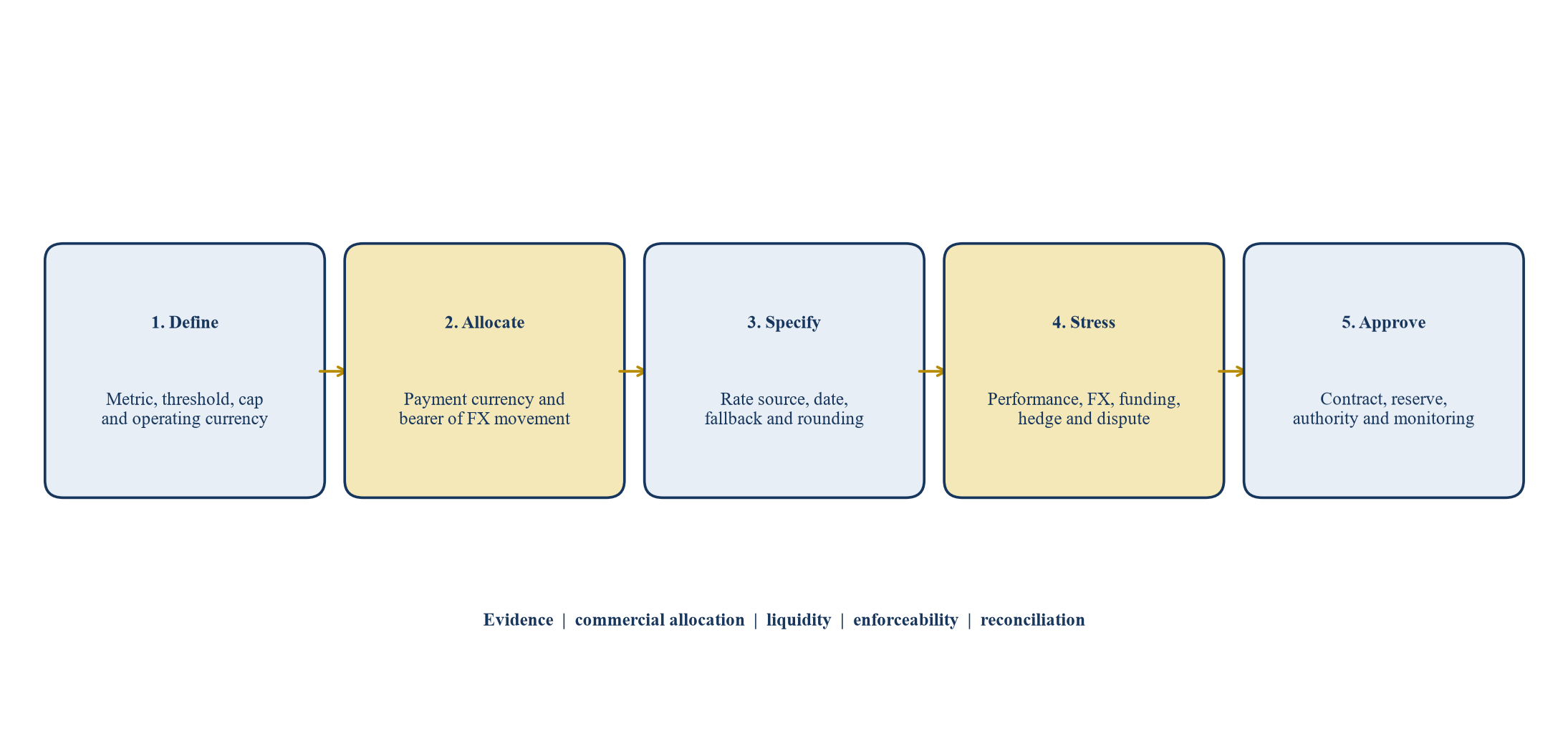
The sequence begins with the commercial metric and ends with an approved, funded and monitored currency allocation.
23. Monitor the exposure after closing
The monitoring report should show actual metric performance in source currencies, contractual adjustments, expected earned amount, relevant exchange rates, projected payment currency, hedge notional, mark-to-market, collateral, reserve and financing headroom.
The report should distinguish observed data from scenarios. Actual revenue and incurred costs can be reconciled to ledgers. Future performance, settlement timing, exchange rates and dispute outcomes remain assumptions until evidenced.
Triggers should include material forecast changes, new currencies, changes in invoicing, acquisitions or disposals, accounting-policy changes, delayed calculation, seller objection, derivative mismatch, counterparty downgrade and reduced funding availability.
Each trigger should initiate a defined response. Available actions can include updating the calculation, obtaining consent, increasing reserves, resizing a hedge, extending maturity, arranging funding or escalating a contractual interpretation.
24. Prepare for acceleration, refinancing and exit
An earn-out can accelerate on a change of control, asset sale, breach or another agreed event. The payment can also survive a refinancing or be transferred with the business. The agreement and financing documents should address these events before signing.
Acceleration changes currency and timing exposure. A hedge designed for a two-year payment can become mismatched if the obligation becomes payable earlier. A sale can remove the operating cash source or change the seller's security and information rights.
The exit model should compare settlement, assumption by a buyer, escrow, novation and negotiated buyout. It should show the currency, valuation method, tax, consents, derivative close-out and financing effect of each route.
A clean exit requires a reconciled record of performance and currency calculations. The transaction team should maintain that record throughout the measurement period rather than reconstruct it during a sale process.
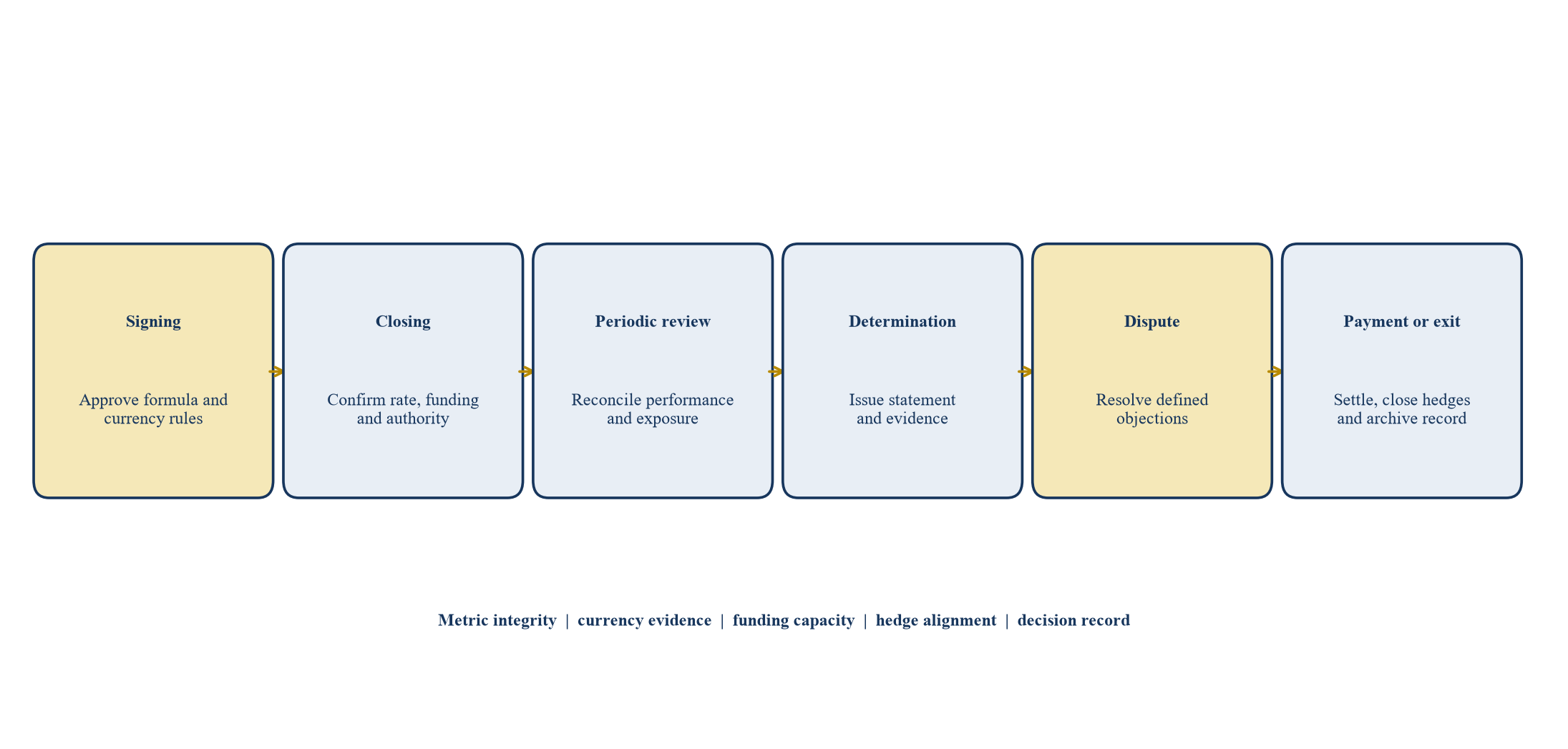
The roadmap links contract formation, exposure monitoring, determination, dispute control, payment and exit readiness.
25. Limitations and conclusion
This paper provides a decision framework and does not constitute investment, legal, tax, accounting, treasury or regulatory advice. Earn-out economics, enforceability, accounting, tax, financing and derivative pricing depend on the parties, jurisdictions, documents and market conditions. The worked case is hypothetical and omits transaction-specific facts.
Currency risk should be allocated as part of the earn-out bargain. The agreement should identify the measurement currency, threshold currency, denomination, payment currency, rate source, observation rule, fallback and rounding method. It should also show who bears movement during a dispute or delayed payment.
The operating formula and currency conversion should be calculated separately and then reconciled. The buyer's funding and hedge should follow the legally enforceable exposure. The seller's realised-value objective should be modelled independently.
The strongest structure is one that both parties can calculate from the same evidence, fund under combined performance and currency stress, and settle through a controlled process. Clear allocation at signing is more valuable than a sophisticated hedge applied to an ambiguous obligation.
Sources
- IFRS Foundation, IFRS 3 Business Combinations, standard overview and supporting material, accessed 17 September 2026, Read the primary source
- IFRS Foundation, IFRS 3 Business Combinations, issued standard text, accessed 17 September 2026, Read the primary source
- IFRS Foundation, Accounting for Contingent Consideration in a Business Combination, completed amendments project, accessed 17 September 2026, Read the primary source
- IFRS Foundation, IAS 21 The Effects of Changes in Foreign Exchange Rates, accessed 17 September 2026, Read the primary source
- IFRS Foundation, IFRS 9 Financial Instruments, issued standard text, accessed 17 September 2026, Read the primary source
- IFRS Foundation, IFRS 13 Fair Value Measurement, accessed 17 September 2026, Read the primary source
- IFRS Foundation, IAS 32 Financial Instruments: Presentation, accessed 17 September 2026, Read the primary source
- Bank for International Settlements, FX debt and optimal exchange rate hedging, BIS Working Papers No 1303, 18 November 2025, accessed 17 September 2026, Read the primary source
- Bank for International Settlements, Exchange rate effects on firm performance: a NICER approach, BIS Working Papers No 1266, accessed 17 September 2026, Read the primary source
- International Swaps and Derivatives Association, 2026 FX Definitions, accessed 17 September 2026, Read the primary source
- International Swaps and Derivatives Association, FX Definitions Update InfoHub and implementation roadmap, accessed 17 September 2026, Read the primary source
- Delaware Court of Chancery, earn-out revenue and EBITDA dispute opinion, accessed 17 September 2026, Read the primary source
- Delaware Court of Chancery, milestone earn-out funding, notice and dispute opinion, accessed 17 September 2026, Read the primary source
- Delaware Court of Chancery, earn-out resolution-accountant mandate opinion, accessed 17 September 2026, Read the primary source
- US Securities and Exchange Commission, filed earn-out agreement using daily dollar-euro conversion, accessed 17 September 2026, Read the primary source
- US Securities and Exchange Commission, filed earn-out agreement using monthly average alternative-currency conversion, accessed 17 September 2026, Read the primary source
- Financial Accounting Standards Board, contingent consideration payments after a business combination, EITF Issue Summary, accessed 17 September 2026, Read the primary source
- International Monetary Fund, Annual Report on Exchange Arrangements and Exchange Restrictions 2023, published 19 December 2024, accessed 17 September 2026, Read the primary source
