

Introduction
An Earth-observation company can continue to monetise historical imagery after individual spacecraft retire. It can also lose customer relevance quickly when refresh, latency, spectral coverage or tasking deteriorates. The archive and fleet therefore complement one another without being interchangeable.
The archive becomes valuable when it is legally usable, searchable, calibrated and connected to customer decisions. The fleet becomes valuable when it can produce required observations at the necessary cadence, quality and cost. Algorithms and workflows create additional value when their contribution can be separated from the underlying data and when customers repeatedly use the output.
This paper treats the target as four linked assets: archive, refresh capability, algorithms and workflows. Each receives an independent cash and evidence test before combination value is admitted.
1. Define the transaction decision
The analysis begins with the acquisition objective, valuation date, perimeter, decision users and intended operating model. Earth-observation value can migrate among data, hardware, software and customer use, so the unit of account must be explicit. The model should identify the legal right, technical dependency, user, cost and cash mechanism for every material component. This permits the team to test whether value survives a change in fleet, platform or ownership.
The evidence set comprises process materials, board mandate, target structure, financial statements and product architecture. Records should be dated, owned and reconciled to the relevant scene, sensor, product, contract and model assumption. Missing support remains a visible diligence gap. The financial model converts the verified record into one transaction question shared by technical, commercial and financial teams. The board should approve the decision and evidence cut-off before modelling value, with every adjustment linked to one ledger and one accountable owner.
2. Map the asset and rights perimeter
Decision usefulness requires a trace from archives, satellites, sensors, ground stations, processing, metadata, software, models, contracts, people and licences to customer action and cash. The trace should distinguish data collected in the past, capability that creates future observations, software that transforms data and workflow adoption that makes the output operational. It should also show where public or third-party substitutes limit exclusivity and pricing power.
Diligence should obtain asset registers, ownership records, data licences, IP schedules and intercompany agreements. The team should test completeness, rights, technical fitness and commercial use. Valuation then measures which assets and rights transfer and which remain dependencies. Decision makers should reconcile legal ownership with operational control; the assumption register should prevent the same observation from appearing as archive value, model advantage, retention benefit and terminal uplift.
3. Separate four value ledgers
The control question concerns archive cash, refresh capability, algorithms and customer workflows. It should be answered through a dated data, operating and customer record. Gross archive size, theoretical revisit, model demonstrations and aggregate backlog can hide unusable scenes, cloud constraints, degraded sensors, unsupported algorithms and customers who do not rely on the product in production.
Required support includes product revenue, usage, cost, contracts and dependency maps. Exceptions, failed tests, missing rights and deteriorating usage deserve separate review. The model uses the evidence to calculate standalone value components with explicit overlap controls. The investment committee should keep each component separate until the final combination test, retaining deductions for incomplete rights, fleet replacement, remediation and integration.
4. Inventory the archive
The analysis begins with scenes, modalities, dates, geographies, resolution, spectral bands, processing levels and metadata. Earth-observation value can migrate among data, hardware, software and customer use, so the unit of account must be explicit. The model should identify the legal right, technical dependency, user, cost and cash mechanism for every material component. This permits the team to test whether value survives a change in fleet, platform or ownership.
The evidence set comprises catalogues, storage manifests, checksums, provenance and customer entitlements. Records should be dated, owned and reconciled to the relevant scene, sensor, product, contract and model assumption. Missing support remains a visible diligence gap. The financial model converts the verified record into a reproducible inventory of economically usable data. The board should exclude inaccessible duplicate or unsupported holdings, with every adjustment linked to one ledger and one accountable owner.
5. Measure historical coverage
Decision usefulness requires a trace from the geographic and temporal depth required for baselines, trends and change detection to customer action and cash. The trace should distinguish data collected in the past, capability that creates future observations, software that transforms data and workflow adoption that makes the output operational. It should also show where public or third-party substitutes limit exclusivity and pricing power.
Diligence should obtain scene footprints, acquisition dates, cloud masks, quality flags and application demand. The team should test completeness, rights, technical fitness and commercial use. Valuation then measures coverage density by customer use case. Decision makers should value observed usable history rather than gross file volume; the assumption register should prevent the same observation from appearing as archive value, model advantage, retention benefit and terminal uplift.
6. Measure archive uniqueness
The control question concerns the extent to which data cannot be replicated through public sources, competitors or new collection. It should be answered through a dated data, operating and customer record. Gross archive size, theoretical revisit, model demonstrations and aggregate backlog can hide unusable scenes, cloud constraints, degraded sensors, unsupported algorithms and customers who do not rely on the product in production.
Required support includes resolution, timing, modality, rights, event rarity and alternative datasets. Exceptions, failed tests, missing rights and deteriorating usage deserve separate review. The model uses the evidence to calculate incremental willingness to pay and avoided recreation cost. The investment committee should test substitutes before applying an archive premium, retaining deductions for incomplete rights, fleet replacement, remediation and integration.
7. Test data rights and restrictions
The analysis begins with ownership, end-user licence, derivative rights, government restrictions, privacy, export control and redistribution. Earth-observation value can migrate among data, hardware, software and customer use, so the unit of account must be explicit. The model should identify the legal right, technical dependency, user, cost and cash mechanism for every material component. This permits the team to test whether value survives a change in fleet, platform or ownership.
The evidence set comprises contracts, licences, consent records, jurisdiction and customer terms. Records should be dated, owned and reconciled to the relevant scene, sensor, product, contract and model assumption. Missing support remains a visible diligence gap. The financial model converts the verified record into cash that the buyer can lawfully continue and expand. The board should condition value on transferable and usable rights, with every adjustment linked to one ledger and one accountable owner.
8. Test archive quality
Decision usefulness requires a trace from radiometric, geometric, temporal, atmospheric and metadata quality across sensors and years to customer action and cash. The trace should distinguish data collected in the past, capability that creates future observations, software that transforms data and workflow adoption that makes the output operational. It should also show where public or third-party substitutes limit exclusivity and pricing power.
Diligence should obtain quality reports, calibration, validation, error rates and customer acceptance. The team should test completeness, rights, technical fitness and commercial use. Valuation then measures fitness for purpose and remediation cost. Decision makers should retain deductions for inconsistent or unverifiable data; the assumption register should prevent the same observation from appearing as archive value, model advantage, retention benefit and terminal uplift.
9. Test discoverability and access
The control question concerns catalogue completeness, search, APIs, latency, delivery, formats and compute proximity. It should be answered through a dated data, operating and customer record. Gross archive size, theoretical revisit, model demonstrations and aggregate backlog can hide unusable scenes, cloud constraints, degraded sensors, unsupported algorithms and customers who do not rely on the product in production.
Required support includes platform logs, query success, download times, API performance and support tickets. Exceptions, failed tests, missing rights and deteriorating usage deserve separate review. The model uses the evidence to calculate customer use and serving cost. The investment committee should separate valuable content from friction that prevents monetisation, retaining deductions for incomplete rights, fleet replacement, remediation and integration.
10. Measure archive monetisation
The analysis begins with subscriptions, usage, licences, professional services and derived products linked to historical data. Earth-observation value can migrate among data, hardware, software and customer use, so the unit of account must be explicit. The model should identify the legal right, technical dependency, user, cost and cash mechanism for every material component. This permits the team to test whether value survives a change in fleet, platform or ownership.
The evidence set comprises contract terms, product entitlements, queries, downloads, invoices and collections. Records should be dated, owned and reconciled to the relevant scene, sensor, product, contract and model assumption. Missing support remains a visible diligence gap. The financial model converts the verified record into archive cash after storage, processing and support. The board should attribute revenue through observed product use, with every adjustment linked to one ledger and one accountable owner.
11. Reconstruct the fleet by sensor cohort
Decision usefulness requires a trace from satellite age, sensor type, resolution, swath, spectral bands, capacity, reliability and remaining life to customer action and cash. The trace should distinguish data collected in the past, capability that creates future observations, software that transforms data and workflow adoption that makes the output operational. It should also show where public or third-party substitutes limit exclusivity and pricing power.
Diligence should obtain manufacturing lots, launch records, telemetry, anomalies and calibration history. The team should test completeness, rights, technical fitness and commercial use. Valuation then measures usable collection capacity and replacement timing. Decision makers should model each cohort against customer requirements; the assumption register should prevent the same observation from appearing as archive value, model advantage, retention benefit and terminal uplift.
12. Measure revisit and refresh
The control question concerns the frequency at which a target can be observed under operational and weather constraints. It should be answered through a dated data, operating and customer record. Gross archive size, theoretical revisit, model demonstrations and aggregate backlog can hide unusable scenes, cloud constraints, degraded sensors, unsupported algorithms and customers who do not rely on the product in production.
Required support includes tasking records, achieved collections, coverage, cloud statistics and priority rules. Exceptions, failed tests, missing rights and deteriorating usage deserve separate review. The model uses the evidence to calculate usable refresh by geography and use case. The investment committee should use achieved delivery rather than design orbit claims, retaining deductions for incomplete rights, fleet replacement, remediation and integration.
13. Measure latency and delivery
The analysis begins with time from customer request or event to collection, processing, analytics and usable output. Earth-observation value can migrate among data, hardware, software and customer use, so the unit of account must be explicit. The model should identify the legal right, technical dependency, user, cost and cash mechanism for every material component. This permits the team to test whether value survives a change in fleet, platform or ownership.
The evidence set comprises timestamps, service levels, queue records and customer acceptance. Records should be dated, owned and reconciled to the relevant scene, sensor, product, contract and model assumption. Missing support remains a visible diligence gap. The financial model converts the verified record into time-sensitive value and contract performance. The board should price speed through observed customer economics, with every adjustment linked to one ledger and one accountable owner.
14. Measure tasking optionality
Decision usefulness requires a trace from customer ability to request, prioritise and receive future collections to customer action and cash. The trace should distinguish data collected in the past, capability that creates future observations, software that transforms data and workflow adoption that makes the output operational. It should also show where public or third-party substitutes limit exclusivity and pricing power.
Diligence should obtain tasking rights, queue rules, acceptance rates, conflicts and delivered scenes. The team should test completeness, rights, technical fitness and commercial use. Valuation then measures incremental tasking cash and capacity cost. Decision makers should avoid valuing theoretical tasking that is routinely displaced; the assumption register should prevent the same observation from appearing as archive value, model advantage, retention benefit and terminal uplift.
15. Model fleet reliability
The control question concerns sensor degradation, spacecraft failures, common-mode risk, station-keeping and calibration drift. It should be answered through a dated data, operating and customer record. Gross archive size, theoretical revisit, model demonstrations and aggregate backlog can hide unusable scenes, cloud constraints, degraded sensors, unsupported algorithms and customers who do not rely on the product in production.
Required support includes telemetry, anomaly logs, insurance, fleet availability and failure investigations. Exceptions, failed tests, missing rights and deteriorating usage deserve separate review. The model uses the evidence to calculate capacity loss and expected replacement. The investment committee should stress correlated cohort failures, retaining deductions for incomplete rights, fleet replacement, remediation and integration.
16. Model replacement capital
The analysis begins with design, manufacture, launch, insurance, commissioning and calibration required to sustain refresh. Earth-observation value can migrate among data, hardware, software and customer use, so the unit of account must be explicit. The model should identify the legal right, technical dependency, user, cost and cash mechanism for every material component. This permits the team to test whether value survives a change in fleet, platform or ownership.
The evidence set comprises supplier contracts, production cadence, launch slots, cost history and acceptance. Records should be dated, owned and reconciled to the relevant scene, sensor, product, contract and model assumption. Missing support remains a visible diligence gap. The financial model converts the verified record into sustainable free cash flow after replenishment. The board should fund replacement before applying terminal value, with every adjustment linked to one ledger and one accountable owner.
17. Test launch and ground dependencies
Decision usefulness requires a trace from launch providers, ground stations, cloud, processing, data transport and specialist suppliers to customer action and cash. The trace should distinguish data collected in the past, capability that creates future observations, software that transforms data and workflow adoption that makes the output operational. It should also show where public or third-party substitutes limit exclusivity and pricing power.
Diligence should obtain contracts, capacity, arrears, change rights, lead times and alternatives. The team should test completeness, rights, technical fitness and commercial use. Valuation then measures continuity, cost and concentration exposure. Decision makers should price dependencies through executable continuation plans; the assumption register should prevent the same observation from appearing as archive value, model advantage, retention benefit and terminal uplift.
18. Reconcile archive and refresh
The control question concerns the relationship between historical baselines and new observations that detect change. It should be answered through a dated data, operating and customer record. Gross archive size, theoretical revisit, model demonstrations and aggregate backlog can hide unusable scenes, cloud constraints, degraded sensors, unsupported algorithms and customers who do not rely on the product in production.
Required support includes customer workflows, model inputs, product design and renewal evidence. Exceptions, failed tests, missing rights and deteriorating usage deserve separate review. The model uses the evidence to calculate combined value without duplicate attribution. The investment committee should identify which product requires both components, retaining deductions for incomplete rights, fleet replacement, remediation and integration.
19. Inventory algorithms and models
The analysis begins with detection, classification, segmentation, forecasting, fusion and tasking capabilities. Earth-observation value can migrate among data, hardware, software and customer use, so the unit of account must be explicit. The model should identify the legal right, technical dependency, user, cost and cash mechanism for every material component. This permits the team to test whether value survives a change in fleet, platform or ownership.
The evidence set comprises model registry, code, training data, benchmarks, versioning and access rights. Records should be dated, owned and reconciled to the relevant scene, sensor, product, contract and model assumption. Missing support remains a visible diligence gap. The financial model converts the verified record into attributable product performance and development cost. The board should distinguish proprietary capability from replaceable tooling, with every adjustment linked to one ledger and one accountable owner.
20. Test model performance
Decision usefulness requires a trace from accuracy, recall, precision, drift, robustness, explainability and mission-specific thresholds to customer action and cash. The trace should distinguish data collected in the past, capability that creates future observations, software that transforms data and workflow adoption that makes the output operational. It should also show where public or third-party substitutes limit exclusivity and pricing power.
Diligence should obtain validation sets, independent tests, customer acceptance and incident records. The team should test completeness, rights, technical fitness and commercial use. Valuation then measures commercial contribution after error and oversight cost. Decision makers should value performance at the customer's operating threshold; the assumption register should prevent the same observation from appearing as archive value, model advantage, retention benefit and terminal uplift.
21. Test training-data dependency
The control question concerns the extent to which models depend on the acquired archive, third-party data or continuing fleet refresh. It should be answered through a dated data, operating and customer record. Gross archive size, theoretical revisit, model demonstrations and aggregate backlog can hide unusable scenes, cloud constraints, degraded sensors, unsupported algorithms and customers who do not rely on the product in production.
Required support includes lineage, licences, feature stores, retraining cadence and model cards. Exceptions, failed tests, missing rights and deteriorating usage deserve separate review. The model uses the evidence to calculate portability and future operating cost. The investment committee should discount models that cannot be retrained lawfully or effectively, retaining deductions for incomplete rights, fleet replacement, remediation and integration.
22. Measure workflow integration
The analysis begins with APIs, alerts, dashboards and outputs embedded in customer decisions and systems. Earth-observation value can migrate among data, hardware, software and customer use, so the unit of account must be explicit. The model should identify the legal right, technical dependency, user, cost and cash mechanism for every material component. This permits the team to test whether value survives a change in fleet, platform or ownership.
The evidence set comprises usage logs, integrations, automation, user roles, support and renewal evidence. Records should be dated, owned and reconciled to the relevant scene, sensor, product, contract and model assumption. Missing support remains a visible diligence gap. The financial model converts the verified record into retention and expansion attributable to workflow adoption. The board should separate genuine switching cost from contract lock-in, with every adjustment linked to one ledger and one accountable owner.
23. Reconstruct customer cohorts
Decision usefulness requires a trace from civil government, defence, agriculture, mapping, energy, insurance, finance and enterprise users to customer action and cash. The trace should distinguish data collected in the past, capability that creates future observations, software that transforms data and workflow adoption that makes the output operational. It should also show where public or third-party substitutes limit exclusivity and pricing power.
Diligence should obtain contracts, usage, price, gross margin, renewal, churn and service requirements. The team should test completeness, rights, technical fitness and commercial use. Valuation then measures cohort contribution and sensitivity to archive or refresh. Decision makers should value each cohort through its actual decision workflow; the assumption register should prevent the same observation from appearing as archive value, model advantage, retention benefit and terminal uplift.
24. Test government and defence contracts
The control question concerns funding, task orders, security, acceptance, assignment, termination and data-rights clauses. It should be answered through a dated data, operating and customer record. Gross archive size, theoretical revisit, model demonstrations and aggregate backlog can hide unusable scenes, cloud constraints, degraded sensors, unsupported algorithms and customers who do not rely on the product in production.
Required support includes executed awards, funded backlog, clearances, invoices and collections. Exceptions, failed tests, missing rights and deteriorating usage deserve separate review. The model uses the evidence to calculate durable cash after change of control. The investment committee should treat unfunded ceilings and non-assignable rights separately, retaining deductions for incomplete rights, fleet replacement, remediation and integration.
25. Measure customer concentration
The analysis begins with reliance on individual agencies, programmes, anchor users and channel partners. Earth-observation value can migrate among data, hardware, software and customer use, so the unit of account must be explicit. The model should identify the legal right, technical dependency, user, cost and cash mechanism for every material component. This permits the team to test whether value survives a change in fleet, platform or ownership.
The evidence set comprises revenue, backlog, receivables, renewals and product use by counterparty. Records should be dated, owned and reconciled to the relevant scene, sensor, product, contract and model assumption. Missing support remains a visible diligence gap. The financial model converts the verified record into downside cash and bargaining exposure. The board should stress loss or delay of the largest customer, with every adjustment linked to one ledger and one accountable owner.
26. Test storage and compute economics
Decision usefulness requires a trace from object storage, retrieval, processing, model inference, egress and support cost to customer action and cash. The trace should distinguish data collected in the past, capability that creates future observations, software that transforms data and workflow adoption that makes the output operational. It should also show where public or third-party substitutes limit exclusivity and pricing power.
Diligence should obtain cloud bills, unit metrics, architecture and workload patterns. The team should test completeness, rights, technical fitness and commercial use. Valuation then measures gross margin by archive query and refreshed product. Decision makers should include the full serving cost of historical and new data; the assumption register should prevent the same observation from appearing as archive value, model advantage, retention benefit and terminal uplift.
27. Test cybersecurity and provenance
The control question concerns integrity, access, chain of custody, tamper evidence and recovery across data and models. It should be answered through a dated data, operating and customer record. Gross archive size, theoretical revisit, model demonstrations and aggregate backlog can hide unusable scenes, cloud constraints, degraded sensors, unsupported algorithms and customers who do not rely on the product in production.
Required support includes identity controls, logs, hashes, incident tests and customer requirements. Exceptions, failed tests, missing rights and deteriorating usage deserve separate review. The model uses the evidence to calculate trust, remediation and residual risk. The investment committee should require proven provenance for high-consequence use, retaining deductions for incomplete rights, fleet replacement, remediation and integration.
28. Construct sustainable free cash flow
The analysis begins with archive, refresh, algorithm and workflow cash after operations, replacement, tax and working capital. Earth-observation value can migrate among data, hardware, software and customer use, so the unit of account must be explicit. The model should identify the legal right, technical dependency, user, cost and cash mechanism for every material component. This permits the team to test whether value survives a change in fleet, platform or ownership.
The evidence set comprises reconciled accounts, product metrics and fleet plans. Records should be dated, owned and reconciled to the relevant scene, sensor, product, contract and model assumption. Missing support remains a visible diligence gap. The financial model converts the verified record into cash available after preserving the complete service. The board should use the same product state in forecast and terminal value, with every adjustment linked to one ledger and one accountable owner.
29. Build the hypothetical component case
Decision usefulness requires a trace from USD 4.55 billion of admitted archive, refresh, algorithm and workflow value to customer action and cash. The trace should distinguish data collected in the past, capability that creates future observations, software that transforms data and workflow adoption that makes the output operational. It should also show where public or third-party substitutes limit exclusivity and pricing power.
Diligence should obtain illustrative inputs clearly separated from public evidence. The team should test completeness, rights, technical fitness and commercial use. Valuation then measures a component sum before overlap and capital deductions. Decision makers should use the case to demonstrate mechanics rather than represent a company; the assumption register should prevent the same observation from appearing as archive value, model advantage, retention benefit and terminal uplift.
30. Eliminate overlap
The control question concerns duplicate value across archive uniqueness, model training, customer retention and terminal growth. It should be answered through a dated data, operating and customer record. Gross archive size, theoretical revisit, model demonstrations and aggregate backlog can hide unusable scenes, cloud constraints, degraded sensors, unsupported algorithms and customers who do not rely on the product in production.
Required support includes an assumption register linking every benefit to one model location. Exceptions, failed tests, missing rights and deteriorating usage deserve separate review. The model uses the evidence to calculate a USD 0.45 billion deduction in the worked case. The investment committee should reconcile all components before board approval, retaining deductions for incomplete rights, fleet replacement, remediation and integration.
31. Apply replacement and quality deductions
The analysis begins with fleet replenishment, launch, data-rights limits and archive remediation. Earth-observation value can migrate among data, hardware, software and customer use, so the unit of account must be explicit. The model should identify the legal right, technical dependency, user, cost and cash mechanism for every material component. This permits the team to test whether value survives a change in fleet, platform or ownership.
The evidence set comprises engineering plans, rights review, quality tests and executable budgets. Records should be dated, owned and reconciled to the relevant scene, sensor, product, contract and model assumption. Missing support remains a visible diligence gap. The financial model converts the verified record into USD 0.80 billion of deductions in the worked case. The board should release deductions only after verified evidence and funding, with every adjustment linked to one ledger and one accountable owner.
32. Apply integration deductions
Decision usefulness requires a trace from platform migration, data harmonisation, model retraining, customer transition and organisational integration to customer action and cash. The trace should distinguish data collected in the past, capability that creates future observations, software that transforms data and workflow adoption that makes the output operational. It should also show where public or third-party substitutes limit exclusivity and pricing power.
Diligence should obtain workplan, dependencies, costs, owners and acceptance criteria. The team should test completeness, rights, technical fitness and commercial use. Valuation then measures USD 0.15 billion of integration cost. Decision makers should fund the plan and stage value through milestones; the assumption register should prevent the same observation from appearing as archive value, model advantage, retention benefit and terminal uplift.
33. Admit verified combination value
The control question concerns benefits created by joining unique history, future refresh, models and embedded workflows. It should be answered through a dated data, operating and customer record. Gross archive size, theoretical revisit, model demonstrations and aggregate backlog can hide unusable scenes, cloud constraints, degraded sensors, unsupported algorithms and customers who do not rely on the product in production.
Required support includes cross-sell evidence, product tests, customer commitments and avoided cost. Exceptions, failed tests, missing rights and deteriorating usage deserve separate review. The model uses the evidence to calculate USD 0.30 billion in the worked case. The investment committee should cap synergy by buyer capture and delivery evidence, retaining deductions for incomplete rights, fleet replacement, remediation and integration.
34. Structure the transaction
The analysis begins with price, earn-outs, holdbacks, data-right warranties, fleet milestones, transition and financing. Earth-observation value can migrate among data, hardware, software and customer use, so the unit of account must be explicit. The model should identify the legal right, technical dependency, user, cost and cash mechanism for every material component. This permits the team to test whether value survives a change in fleet, platform or ownership.
The evidence set comprises term sheet, sources and uses, consent map and downside case. Records should be dated, owned and reconciled to the relevant scene, sensor, product, contract and model assumption. Missing support remains a visible diligence gap. The financial model converts the verified record into risk allocation aligned with unresolved evidence. The board should use contingent value for archive quality, refresh and customer retention, with every adjustment linked to one ledger and one accountable owner.
35. Establish post-close governance
Decision usefulness requires a trace from authority over data, fleet, algorithms, customers, capital and integration to customer action and cash. The trace should distinguish data collected in the past, capability that creates future observations, software that transforms data and workflow adoption that makes the output operational. It should also show where public or third-party substitutes limit exclusivity and pricing power.
Diligence should obtain board mandates, dashboards, model governance, assurance and decision logs. The team should test completeness, rights, technical fitness and commercial use. Valuation then measures accountable delivery and early warning. Decision makers should refresh valuation when quality, capacity or retention changes materially; the assumption register should prevent the same observation from appearing as archive value, model advantage, retention benefit and terminal uplift.
36. Define the investment decision
The control question concerns the price, perimeter, funding, conditions and integration actions supported by evidence. It should be answered through a dated data, operating and customer record. Gross archive size, theoretical revisit, model demonstrations and aggregate backlog can hide unusable scenes, cloud constraints, degraded sensors, unsupported algorithms and customers who do not rely on the product in production.
Required support includes the final value bridge, downside liquidity, consent schedule and milestone plan. Exceptions, failed tests, missing rights and deteriorating usage deserve separate review. The model uses the evidence to calculate an auditable decision range. The investment committee should approve, reprice, stage or decline through a dated record, retaining deductions for incomplete rights, fleet replacement, remediation and integration.
Conclusion
Earth-observation M&A requires separate treatment of historical data and future collection. An archive can remain useful after a satellite retires, while its value depends on rights, quality, discoverability and customer use. A sensor fleet produces refresh and tasking, while its value depends on capacity, reliability, remaining life and replacement funding.
The framework adds algorithms and customer workflows as separate ledgers, then removes overlap before admitting combination value. This allows the buyer to identify which cash comes from unique history, which requires continuing refresh, which depends on software and which reflects adoption inside customer decisions.
For a board or investment committee, the decisive test is whether the combined archive, fleet, platform and workflows can sustain customer outcomes and cash after replacement and integration. The answer determines price, conditions, financing and post-close priorities.
Appendix A. Archive register
The minimum register contains dataset, sensor, date, geography, modality, resolution, processing level, quality, metadata, provenance, ownership, licence, customer entitlement, storage location, access method, observed use and serving cost.
Appendix B. Refresh-capability register
For each fleet cohort, record sensor capability, orbit, capacity, achieved revisit, latency, reliability, remaining life, calibration, tasking priority, ground dependency, replacement date, capital, launch and acceptance plan.
Appendix C. Investment checklist
The approval file should contain archive inventory, rights, quality, uniqueness, access, monetisation, fleet cohorts, refresh, latency, tasking, replacement, algorithms, training data, workflows, customer cohorts, contracts, serving cost, security, integration, financing and downside liquidity. Evidence should be dated and owned.
Appendix D. Worked-case figures and tables
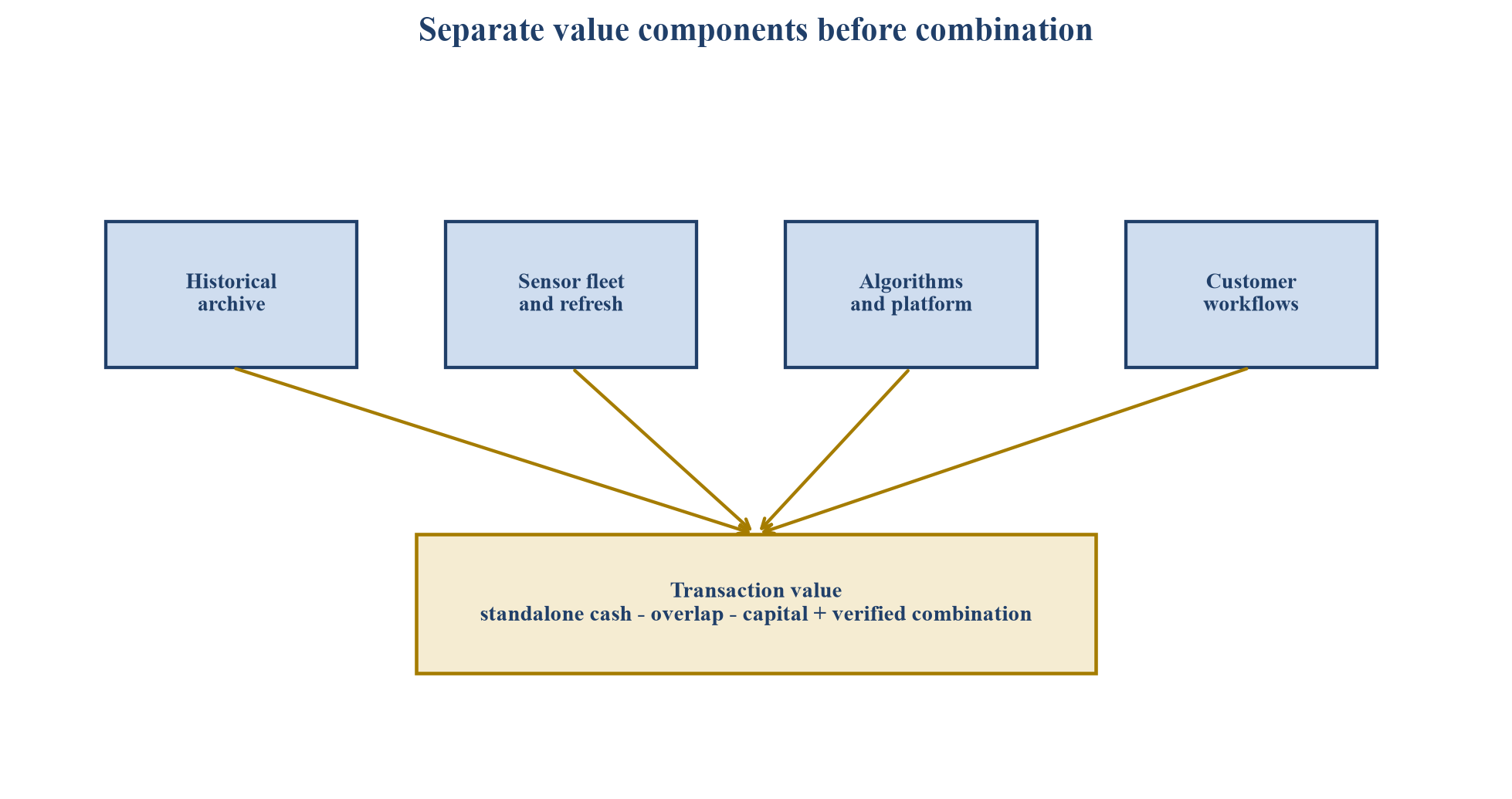
Proposed architecture separating archive, refresh, algorithms and customer workflows.
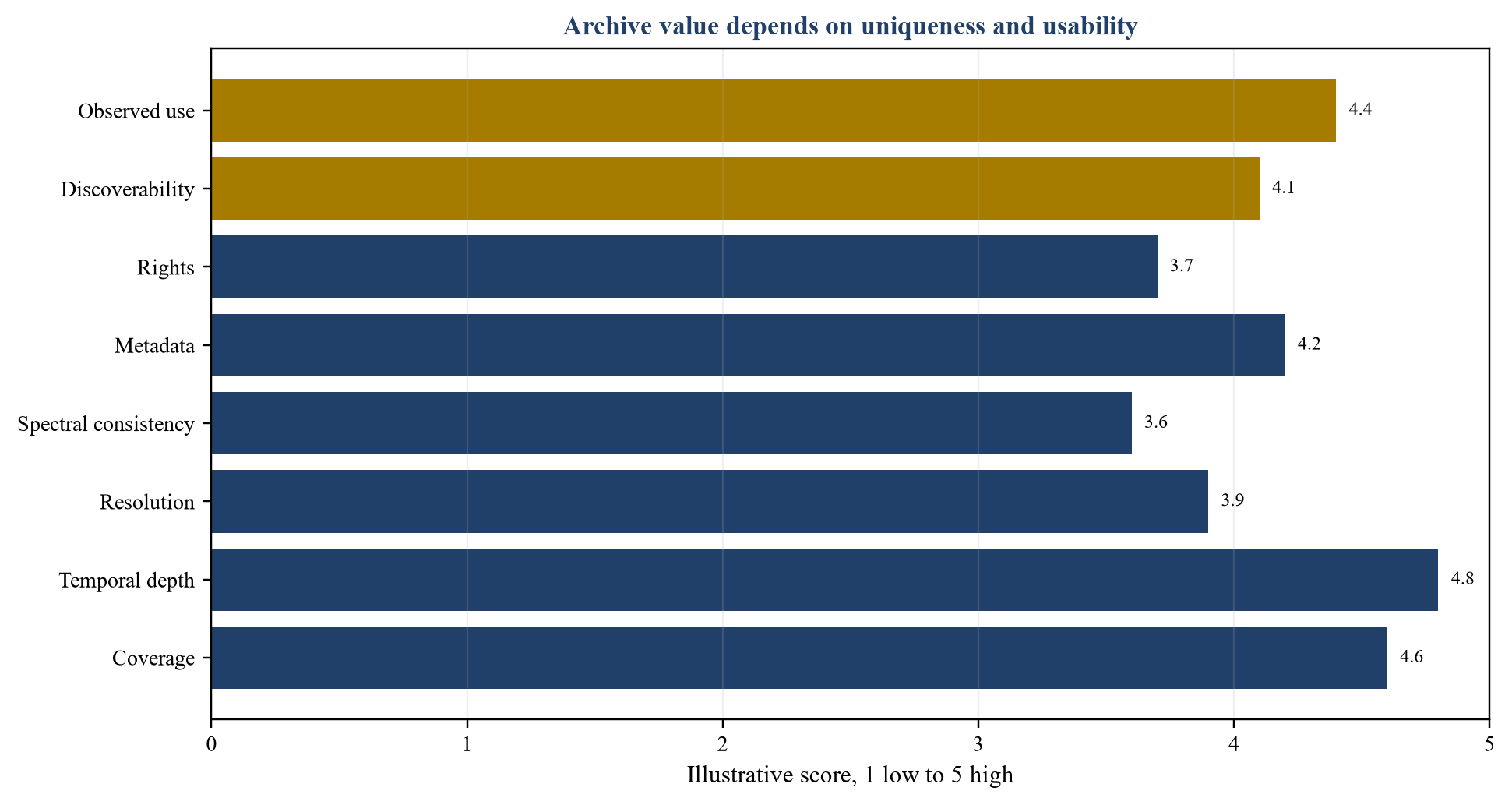
Illustrative assessment of archive uniqueness and usability.
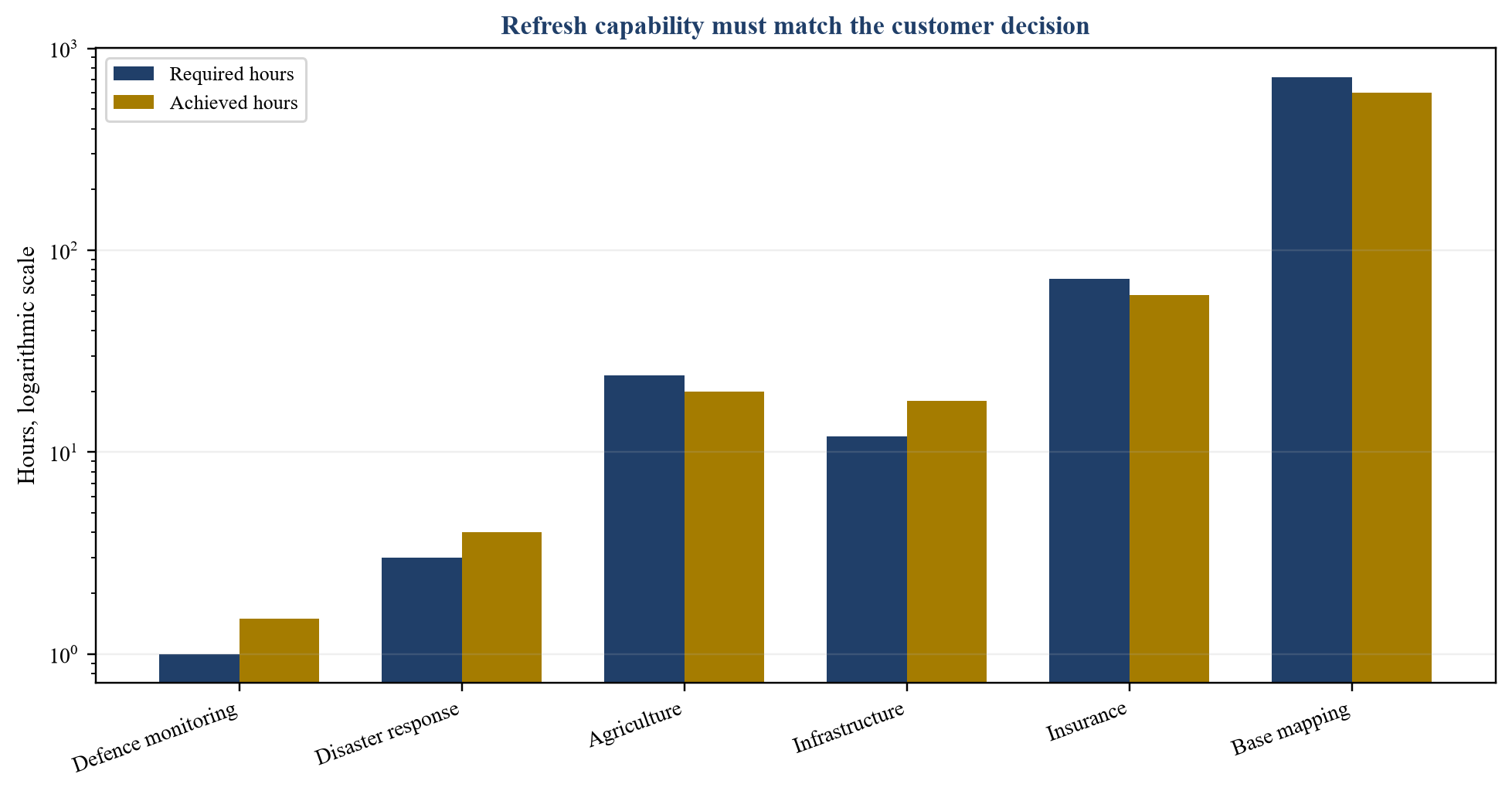
Illustrative required and achieved refresh intervals.
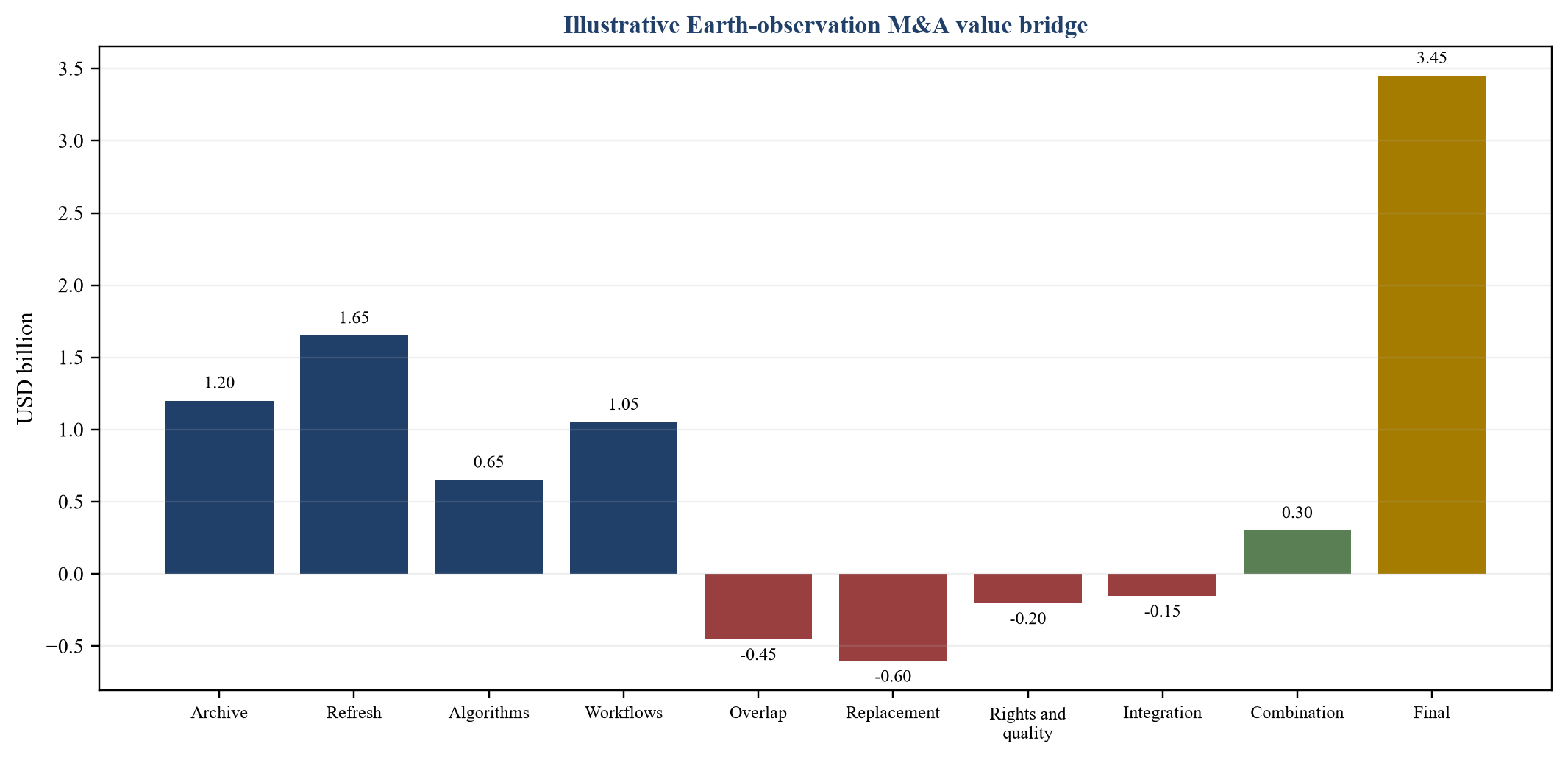
Illustrative bridge from admitted components to final transaction value.
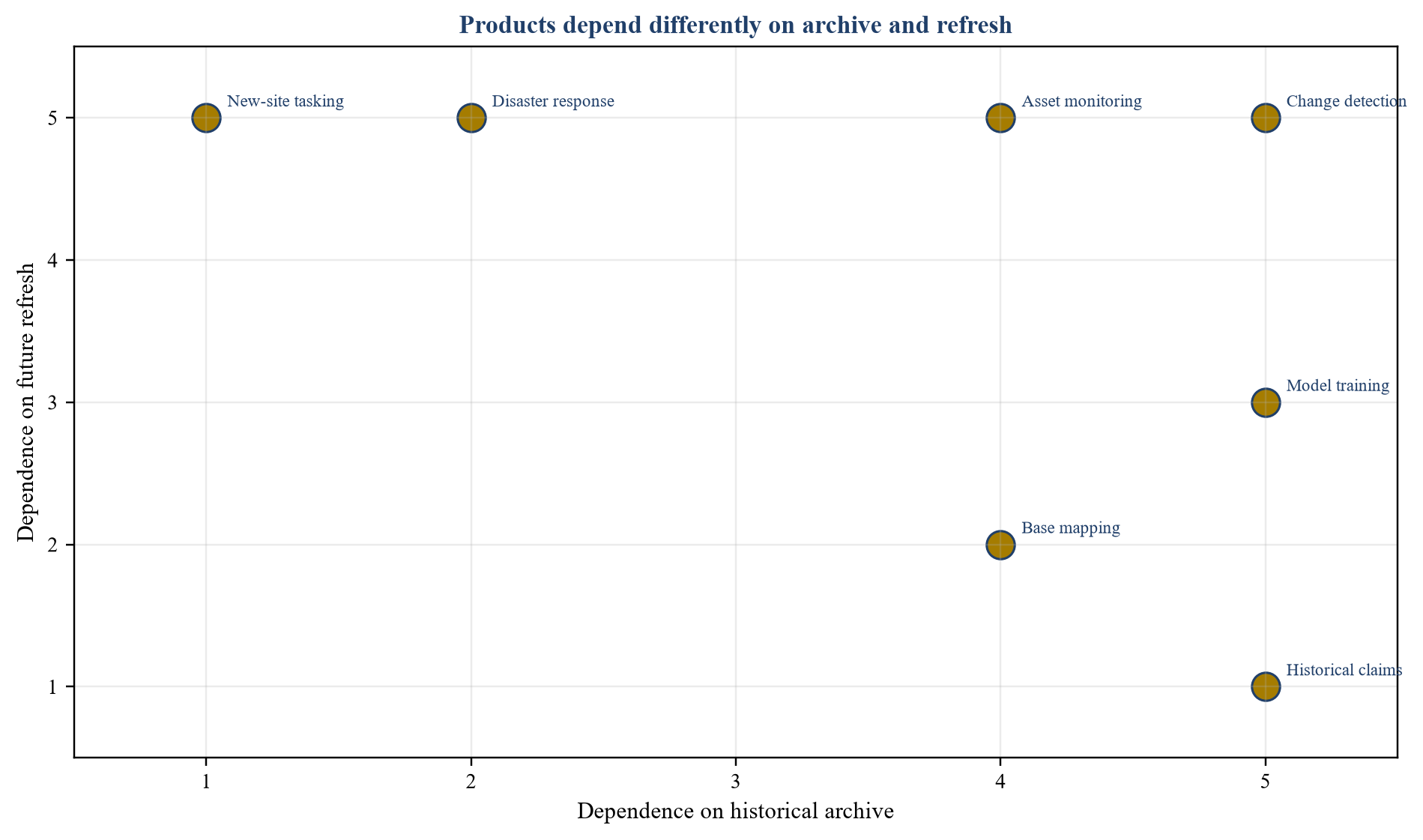
Illustrative dependence of customer products on history and future collection.
| Component | Minimum evidence | Primary cash mechanism |
|---|---|---|
| Archive | rights quality uniqueness and observed use | licence usage and derived products |
| Refresh | achieved collection and replacement plan | tasking subscriptions and capacity |
| Algorithms | attributable performance and lawful training | analytics and operating leverage |
| Workflows | embedded use renewal and switching evidence | retention expansion and solution revenue |
Proposed valuation treatment.
| Measure | Illustrative result | Valuation use |
|---|---|---|
| Unique scenes | 2.4 billion | gross inventory before usability tests |
| Median temporal depth | 11 years | longitudinal analysis |
| Searchable with complete metadata | 86 per cent | addressable archive |
| Rights permitting derived products | 72 per cent | monetisable subset |
| Scenes used by paying customers in 12 months | 8 per cent | observed demand |
Illustrative measures describing no identified company.
| Dimension | Evidence | Valuation use |
|---|---|---|
| Capacity | achieved scenes and area per day | usable supply |
| Revisit | achieved intervals by geography | workflow fit |
| Latency | request to delivered product | time-sensitive value |
| Reliability | cohort availability and anomalies | expected capacity |
| Replacement | manufacture launch and calibration | sustaining capital |
Proposed diligence fields.
| Step | Amount | Evidence required |
|---|---|---|
| Archive cash value | 1.20 | rights use and contribution |
| Refresh capability | 1.65 | fleet capacity and funded replacement |
| Algorithms and platform | 0.65 | performance adoption and IP |
| Customer workflows | 1.05 | retention integration and contribution |
| Overlap | minus 0.45 | assumption reconciliation |
| Replacement capital | minus 0.60 | executable fleet plan |
| Data rights and quality | minus 0.20 | legal and technical remediation |
| Integration | minus 0.15 | funded delivery plan |
| Verified combination value | plus 0.30 | buyer capture and customer evidence |
| Final illustrative value | 3.45 | integrated evidence set |
All amounts are illustrative USD billions.
| Gate | Approval evidence | Stop condition |
|---|---|---|
| Archive | inventory rights quality and use | material unusable or restricted data |
| Fleet | achieved collection and replacement | refresh gap before funded replacement |
| Algorithms | validated performance and training rights | non-portable or unsupported model |
| Workflows | production integration and renewal | unverified switching benefit |
| Economics | serving cost and sustainable cash | margin or liquidity gap |
| Combination | attributable buyer benefit | duplicated or aspirational synergy |
Proposed board control.
| Risk | Potential protection | Release evidence |
|---|---|---|
| Archive completeness | holdback or price adjustment | verified inventory |
| Data rights | warranty indemnity and condition | transferable licences |
| Fleet performance | earn-out or milestone | achieved capacity and latency |
| Replacement | committed funding and covenant | launch and acceptance |
| Customer retention | earn-out | collected retained revenue |
| Algorithm performance | staged payment | independent validation |
Proposed risk allocation.
| Dimension | Core measure | Trigger |
|---|---|---|
| Archive | usable scenes queries and contribution | falling usage or rights gap |
| Refresh | revisit latency and capacity | missed workflow requirement |
| Fleet | reliability life and replacement | capacity shortfall |
| Models | accuracy drift and adoption | performance deterioration |
| Customers | renewals churn expansion and margin | cohort below case |
| Integration | migrations dependencies and benefits | missed milestone |
| Capital | cash burn replacement and liquidity | funding shortfall |
Proposed monthly decision record.
Sources
- NASA, Commercial Satellite Data Acquisition Programme. Read the primary source
- NASA, Commercial Satellite Data Acquisition available datasets. Read the primary source
- NASA, Satellite Data Explorer. Read the primary source
- NASA, Satellite Data Evaluation. Read the primary source
- Planet Labs PBC, 2026 Annual Report. Read the primary source
- BlackSky Technology, 2025 Annual Report. Read the primary source
- BlackSky Technology, 2026 Annual Shareholder Letter. Read the primary source
- Satellogic, 2025 Annual Report. Read the primary source
- Spire Global, 2025 Annual Report. Read the primary source
- European Space Agency, Copernicus Contributing Missions commercial data procurement. Read the primary source
- European Commission, Copernicus Data Space Ecosystem. Read the primary source
- U.S. Geological Survey, Landsat data access and archive. Read the primary source
- NOAA, Commercial Data Program. Read the primary source
- NASA, Earth Science Data Systems data standards and practices. Read the primary source
- NASA, Satellite Tasking and Archive Request System. Read the primary source
- NASA, LAADS Distributed Active Archive Center data access. Read the primary source
- Open Geospatial Consortium, standards and specifications. Read the primary source
- U.S. National Institute of Standards and Technology, AI Risk Management Framework. Read the primary source
- U.S. National Institute of Standards and Technology, Cybersecurity Framework 2.0. Read the primary source
- IFRS Foundation, IFRS 3 Business Combinations. Read the primary source
- IFRS Foundation, IAS 38 Intangible Assets. Read the primary source
- IFRS Foundation, IAS 36 Impairment of Assets. Read the primary source
- IFRS Foundation, IFRS 13 Fair Value Measurement. Read the primary source
- International Private Equity and Venture Capital Valuation Guidelines. Read the primary source
- International Valuation Standards Council, International Valuation Standards. Read the primary source
