

1. Frame the deployment decision
Define the workload, users, consequence, service level, geography and investment question.
The controlled record includes workload; version; device; network; tariff; utilisation; source; reviewer; decision. The immediate deliverable is an approved deployment charter. Preserve geography, effective date, workload and model version, device class, network condition, tariff basis, utilisation, reviewer, approval and unresolved exceptions.
The principal failure occurs when architecture fashion replaces a controlled economic choice. Reviewers should reproduce the benchmark, reconcile technical and financial units, stress adverse conditions and identify who may approve, remediate or withhold the investment recommendation.
Edge, cloud and hybrid inference should be compared on the same workload, service level, outcome quality, demand scenario and financial horizon.
The decision pack for frame the deployment decision should show the prior assumption, observed evidence, correction, unit and fleet consequence, alternative architecture, owner, due date, next evidence gate and outcome. Material gaps flow into the funding plan, contractual protections and valuation scenarios.
2. Map the inference workload
Inventory models, inputs, outputs, frequency, concurrency, context size and processing stages.
The controlled record includes workload; version; device; network; tariff; utilisation; source; reviewer; decision. The immediate deliverable is a workload demand model. Preserve geography, effective date, workload and model version, device class, network condition, tariff basis, utilisation, reviewer, approval and unresolved exceptions.
The principal failure occurs when capacity is sized from averages that exclude peaks. Reviewers should reproduce the benchmark, reconcile technical and financial units, stress adverse conditions and identify who may approve, remediate or withhold the investment recommendation.
The investment case needs measured latency, power, availability and platform performance alongside privacy, field operations and hardware lifecycle evidence.
The decision pack for map the inference workload should show the prior assumption, observed evidence, correction, unit and fleet consequence, alternative architecture, owner, due date, next evidence gate and outcome. Material gaps flow into the funding plan, contractual protections and valuation scenarios.
3. Classify latency requirements
Separate physical-control, interactive, near-real-time and batch workloads.
The controlled record includes workload; version; device; network; tariff; utilisation; source; reviewer; decision. The immediate deliverable is a latency tier map. Preserve geography, effective date, workload and model version, device class, network condition, tariff basis, utilisation, reviewer, approval and unresolved exceptions.
The principal failure occurs when all workloads receive an expensive low-latency design. Reviewers should reproduce the benchmark, reconcile technical and financial units, stress adverse conditions and identify who may approve, remediate or withhold the investment recommendation.
Architecture economics change with utilisation, model growth, network conditions, supplier constraints, release operations and refresh timing.
The decision pack for classify latency requirements should show the prior assumption, observed evidence, correction, unit and fleet consequence, alternative architecture, owner, due date, next evidence gate and outcome. Material gaps flow into the funding plan, contractual protections and valuation scenarios.
4. Measure end-to-end latency
Measure capture, preprocessing, network, queue, inference, postprocessing and action time.
The controlled record includes workload; version; device; network; tariff; utilisation; source; reviewer; decision. The immediate deliverable is an end-to-end latency budget. Preserve geography, effective date, workload and model version, device class, network condition, tariff basis, utilisation, reviewer, approval and unresolved exceptions.
The principal failure occurs when model latency is presented as user response time. Reviewers should reproduce the benchmark, reconcile technical and financial units, stress adverse conditions and identify who may approve, remediate or withhold the investment recommendation.
Decision-makers can connect the technical frontier to gross margin, capital intensity, customer retention, financing requirements and enterprise value.
The decision pack for measure end-to-end latency should show the prior assumption, observed evidence, correction, unit and fleet consequence, alternative architecture, owner, due date, next evidence gate and outcome. Material gaps flow into the funding plan, contractual protections and valuation scenarios.
5. Value latency economically
Connect delay to safety, conversion, productivity, downtime and customer retention.
The controlled record includes workload; version; device; network; tariff; utilisation; source; reviewer; decision. The immediate deliverable is a latency value curve. Preserve geography, effective date, workload and model version, device class, network condition, tariff basis, utilisation, reviewer, approval and unresolved exceptions.
The principal failure occurs when milliseconds are valued without a business consequence. Reviewers should reproduce the benchmark, reconcile technical and financial units, stress adverse conditions and identify who may approve, remediate or withhold the investment recommendation.
Edge, cloud and hybrid inference should be compared on the same workload, service level, outcome quality, demand scenario and financial horizon.
The decision pack for value latency economically should show the prior assumption, observed evidence, correction, unit and fleet consequence, alternative architecture, owner, due date, next evidence gate and outcome. Material gaps flow into the funding plan, contractual protections and valuation scenarios.
6. Map data sensitivity
Classify personal, biometric, health, operational, commercial and regulated data.
The controlled record includes workload; version; device; network; tariff; utilisation; source; reviewer; decision. The immediate deliverable is a data sensitivity register. Preserve geography, effective date, workload and model version, device class, network condition, tariff basis, utilisation, reviewer, approval and unresolved exceptions.
The principal failure occurs when privacy claims rely on physical location alone. Reviewers should reproduce the benchmark, reconcile technical and financial units, stress adverse conditions and identify who may approve, remediate or withhold the investment recommendation.
The investment case needs measured latency, power, availability and platform performance alongside privacy, field operations and hardware lifecycle evidence.
The decision pack for map data sensitivity should show the prior assumption, observed evidence, correction, unit and fleet consequence, alternative architecture, owner, due date, next evidence gate and outcome. Material gaps flow into the funding plan, contractual protections and valuation scenarios.
7. Define data movement
Trace collection, local storage, transmission, caching, cloud processing and deletion.
The controlled record includes workload; version; device; network; tariff; utilisation; source; reviewer; decision. The immediate deliverable is a governed data-flow map. Preserve geography, effective date, workload and model version, device class, network condition, tariff basis, utilisation, reviewer, approval and unresolved exceptions.
The principal failure occurs when hidden transfers invalidate the privacy case. Reviewers should reproduce the benchmark, reconcile technical and financial units, stress adverse conditions and identify who may approve, remediate or withhold the investment recommendation.
Architecture economics change with utilisation, model growth, network conditions, supplier constraints, release operations and refresh timing.
The decision pack for define data movement should show the prior assumption, observed evidence, correction, unit and fleet consequence, alternative architecture, owner, due date, next evidence gate and outcome. Material gaps flow into the funding plan, contractual protections and valuation scenarios.
8. Test privacy architecture
Compare minimisation, local processing, encryption, access, aggregation and federated options.
The controlled record includes workload; version; device; network; tariff; utilisation; source; reviewer; decision. The immediate deliverable is a privacy-control matrix. Preserve geography, effective date, workload and model version, device class, network condition, tariff basis, utilisation, reviewer, approval and unresolved exceptions.
The principal failure occurs when edge deployment is assumed to eliminate privacy risk. Reviewers should reproduce the benchmark, reconcile technical and financial units, stress adverse conditions and identify who may approve, remediate or withhold the investment recommendation.
Decision-makers can connect the technical frontier to gross margin, capital intensity, customer retention, financing requirements and enterprise value.
The decision pack for test privacy architecture should show the prior assumption, observed evidence, correction, unit and fleet consequence, alternative architecture, owner, due date, next evidence gate and outcome. Material gaps flow into the funding plan, contractual protections and valuation scenarios.
Table 1. Deployment decision layers
| Layer | Primary question | Evidence |
|---|---|---|
| workload | what must run | demand profile |
| service | how fast and reliable | latency budget |
| data | where information may move | control map |
| economics | which costs scale | unit model |
Illustrative controls require workload-, device-, geography-, tariff-, firm- and period-specific approval.
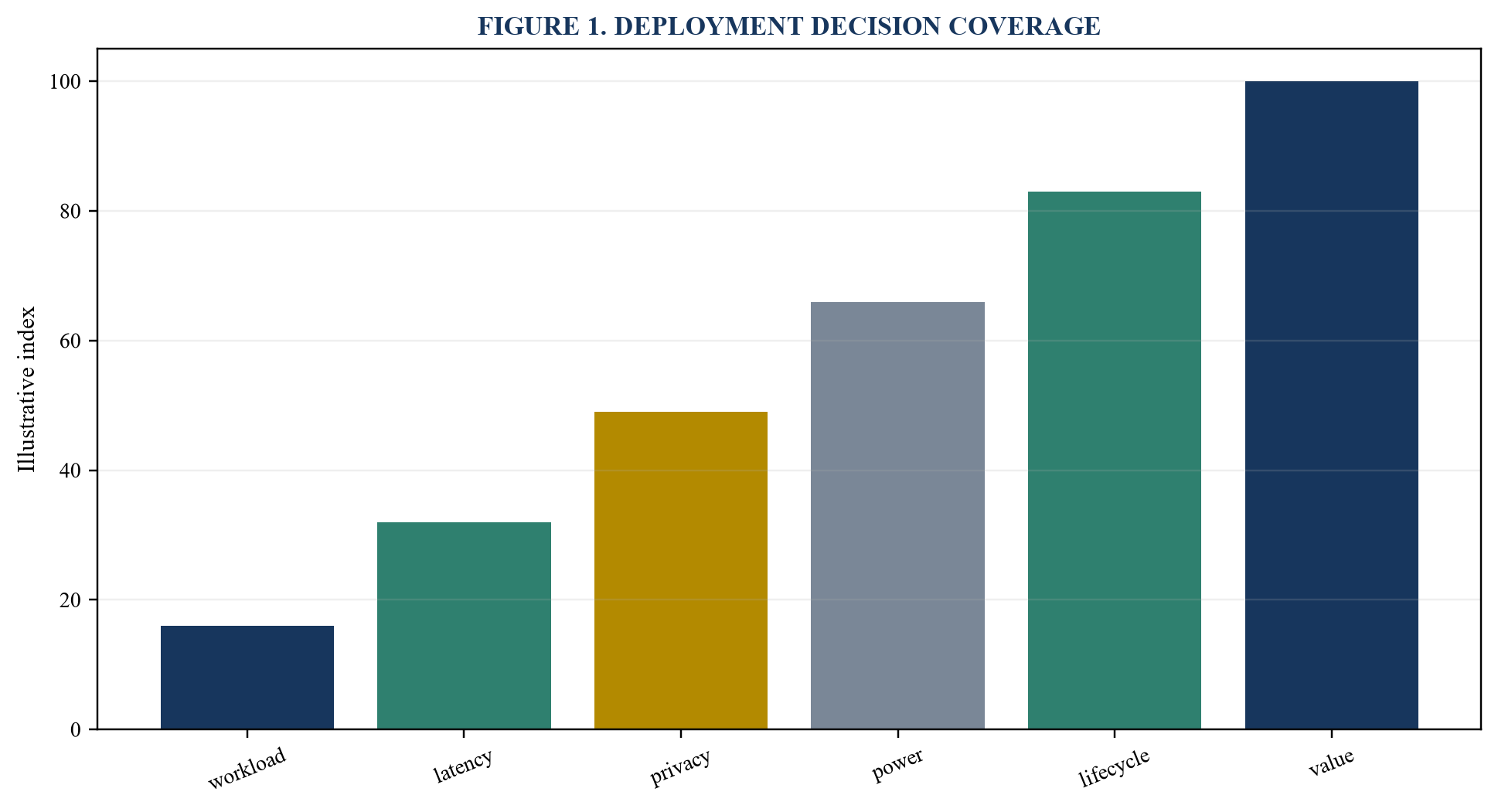
Values are illustrative indices and require replacement with approved operating and financial evidence.
9. Model device fleet size
Count installed, active, spare, failed, offline and geographically dispersed devices.
The controlled record includes workload; version; device; network; tariff; utilisation; source; reviewer; decision. The immediate deliverable is a fleet capacity model. Preserve geography, effective date, workload and model version, device class, network condition, tariff basis, utilisation, reviewer, approval and unresolved exceptions.
The principal failure occurs when unit economics exclude fleet growth and inactive hardware. Reviewers should reproduce the benchmark, reconcile technical and financial units, stress adverse conditions and identify who may approve, remediate or withhold the investment recommendation.
Edge, cloud and hybrid inference should be compared on the same workload, service level, outcome quality, demand scenario and financial horizon.
The decision pack for model device fleet size should show the prior assumption, observed evidence, correction, unit and fleet consequence, alternative architecture, owner, due date, next evidence gate and outcome. Material gaps flow into the funding plan, contractual protections and valuation scenarios.
10. Segment device classes
Define compute, memory, accelerator, battery, thermal, sensor and operating-system tiers.
The controlled record includes workload; version; device; network; tariff; utilisation; source; reviewer; decision. The immediate deliverable is a device-class matrix. Preserve geography, effective date, workload and model version, device class, network condition, tariff basis, utilisation, reviewer, approval and unresolved exceptions.
The principal failure occurs when one hardware profile masks fragmented deployment economics. Reviewers should reproduce the benchmark, reconcile technical and financial units, stress adverse conditions and identify who may approve, remediate or withhold the investment recommendation.
The investment case needs measured latency, power, availability and platform performance alongside privacy, field operations and hardware lifecycle evidence.
The decision pack for segment device classes should show the prior assumption, observed evidence, correction, unit and fleet consequence, alternative architecture, owner, due date, next evidence gate and outcome. Material gaps flow into the funding plan, contractual protections and valuation scenarios.
11. Benchmark representative hardware
Test approved model builds on actual processors, accelerators and memory limits.
The controlled record includes workload; version; device; network; tariff; utilisation; source; reviewer; decision. The immediate deliverable is a hardware benchmark pack. Preserve geography, effective date, workload and model version, device class, network condition, tariff basis, utilisation, reviewer, approval and unresolved exceptions.
The principal failure occurs when vendor peak performance substitutes for measured throughput. Reviewers should reproduce the benchmark, reconcile technical and financial units, stress adverse conditions and identify who may approve, remediate or withhold the investment recommendation.
Architecture economics change with utilisation, model growth, network conditions, supplier constraints, release operations and refresh timing.
The decision pack for benchmark representative hardware should show the prior assumption, observed evidence, correction, unit and fleet consequence, alternative architecture, owner, due date, next evidence gate and outcome. Material gaps flow into the funding plan, contractual protections and valuation scenarios.
12. Measure power per task
Record idle, active, peak and thermal-throttled energy across workload mixes.
The controlled record includes workload; version; device; network; tariff; utilisation; source; reviewer; decision. The immediate deliverable is an energy-per-outcome model. Preserve geography, effective date, workload and model version, device class, network condition, tariff basis, utilisation, reviewer, approval and unresolved exceptions.
The principal failure occurs when headline efficiency excludes system overhead. Reviewers should reproduce the benchmark, reconcile technical and financial units, stress adverse conditions and identify who may approve, remediate or withhold the investment recommendation.
Decision-makers can connect the technical frontier to gross margin, capital intensity, customer retention, financing requirements and enterprise value.
The decision pack for measure power per task should show the prior assumption, observed evidence, correction, unit and fleet consequence, alternative architecture, owner, due date, next evidence gate and outcome. Material gaps flow into the funding plan, contractual protections and valuation scenarios.
13. Model battery and duty cycle
Connect inference frequency, radio use, sensing, sleep states and recharge patterns.
The controlled record includes workload; version; device; network; tariff; utilisation; source; reviewer; decision. The immediate deliverable is a field battery model. Preserve geography, effective date, workload and model version, device class, network condition, tariff basis, utilisation, reviewer, approval and unresolved exceptions.
The principal failure occurs when battery life is extrapolated from a laboratory duty cycle. Reviewers should reproduce the benchmark, reconcile technical and financial units, stress adverse conditions and identify who may approve, remediate or withhold the investment recommendation.
Edge, cloud and hybrid inference should be compared on the same workload, service level, outcome quality, demand scenario and financial horizon.
The decision pack for model battery and duty cycle should show the prior assumption, observed evidence, correction, unit and fleet consequence, alternative architecture, owner, due date, next evidence gate and outcome. Material gaps flow into the funding plan, contractual protections and valuation scenarios.
14. Control thermal performance
Test sustained load, ambient temperature, enclosure and cooling constraints.
The controlled record includes workload; version; device; network; tariff; utilisation; source; reviewer; decision. The immediate deliverable is a thermal operating envelope. Preserve geography, effective date, workload and model version, device class, network condition, tariff basis, utilisation, reviewer, approval and unresolved exceptions.
The principal failure occurs when short benchmarks miss throttling and component stress. Reviewers should reproduce the benchmark, reconcile technical and financial units, stress adverse conditions and identify who may approve, remediate or withhold the investment recommendation.
The investment case needs measured latency, power, availability and platform performance alongside privacy, field operations and hardware lifecycle evidence.
The decision pack for control thermal performance should show the prior assumption, observed evidence, correction, unit and fleet consequence, alternative architecture, owner, due date, next evidence gate and outcome. Material gaps flow into the funding plan, contractual protections and valuation scenarios.
15. Quantify network dependence
Measure bandwidth, packet loss, jitter, outage, roaming and data cost.
The controlled record includes workload; version; device; network; tariff; utilisation; source; reviewer; decision. The immediate deliverable is a network resilience model. Preserve geography, effective date, workload and model version, device class, network condition, tariff basis, utilisation, reviewer, approval and unresolved exceptions.
The principal failure occurs when connectivity is treated as continuously available. Reviewers should reproduce the benchmark, reconcile technical and financial units, stress adverse conditions and identify who may approve, remediate or withhold the investment recommendation.
Architecture economics change with utilisation, model growth, network conditions, supplier constraints, release operations and refresh timing.
The decision pack for quantify network dependence should show the prior assumption, observed evidence, correction, unit and fleet consequence, alternative architecture, owner, due date, next evidence gate and outcome. Material gaps flow into the funding plan, contractual protections and valuation scenarios.
16. Price cloud inference
Model compute, accelerator, storage, egress, observability and support by volume.
The controlled record includes workload; version; device; network; tariff; utilisation; source; reviewer; decision. The immediate deliverable is a cloud unit-cost curve. Preserve geography, effective date, workload and model version, device class, network condition, tariff basis, utilisation, reviewer, approval and unresolved exceptions.
The principal failure occurs when list prices omit committed spend and operational overhead. Reviewers should reproduce the benchmark, reconcile technical and financial units, stress adverse conditions and identify who may approve, remediate or withhold the investment recommendation.
Decision-makers can connect the technical frontier to gross margin, capital intensity, customer retention, financing requirements and enterprise value.
The decision pack for price cloud inference should show the prior assumption, observed evidence, correction, unit and fleet consequence, alternative architecture, owner, due date, next evidence gate and outcome. Material gaps flow into the funding plan, contractual protections and valuation scenarios.
Table 2. Latency and cost tiers
| Tier | Illustrative workload | Decision focus |
|---|---|---|
| control | physical response | bounded delay |
| interactive | user session | tail latency |
| near real time | event processing | availability |
| batch | offline analysis | throughput cost |
Illustrative controls require workload-, device-, geography-, tariff-, firm- and period-specific approval.
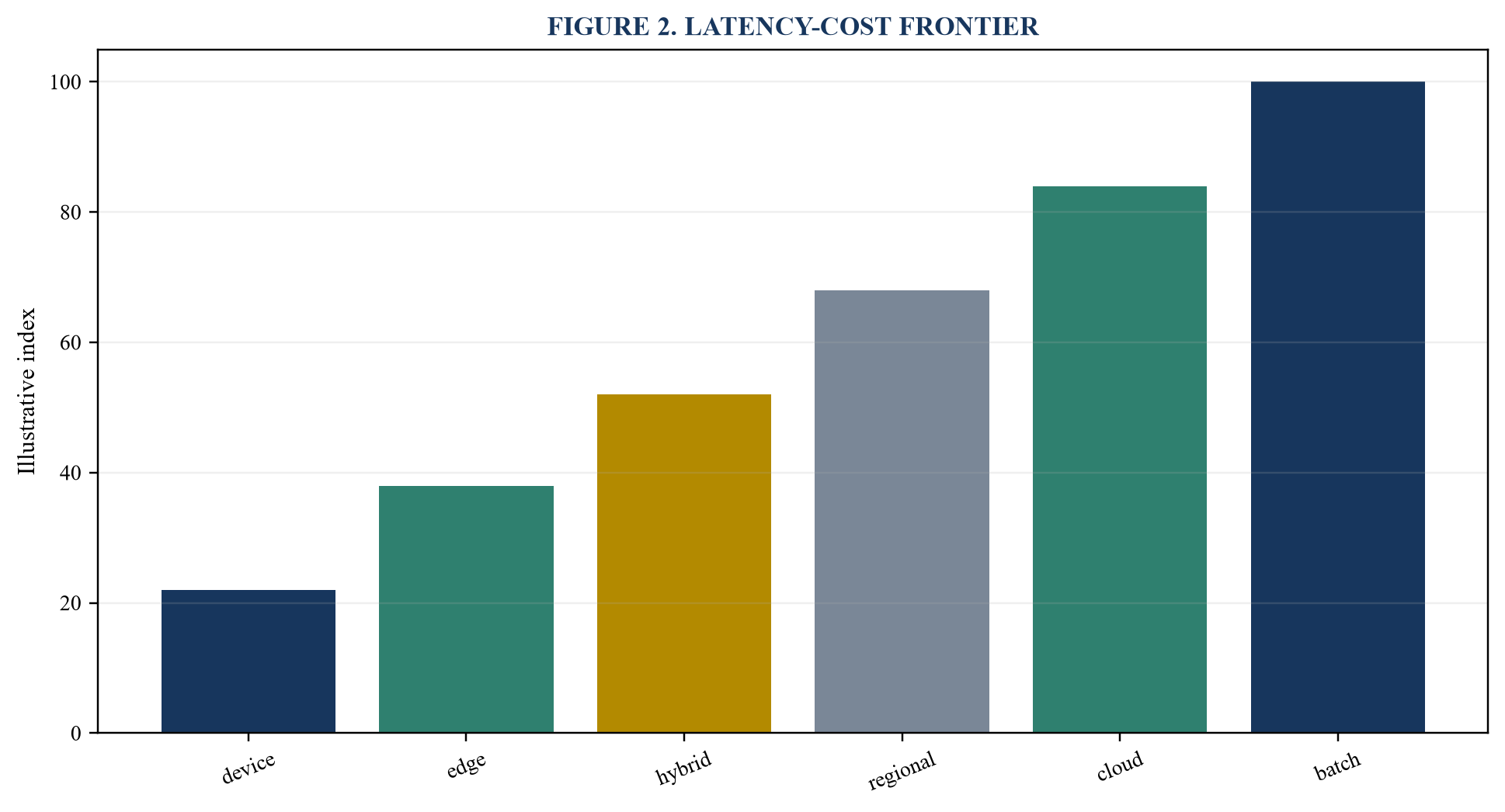
Values are illustrative indices and require replacement with approved operating and financial evidence.
17. Price edge inference
Model hardware, integration, provisioning, field support, energy and disposal.
The controlled record includes workload; version; device; network; tariff; utilisation; source; reviewer; decision. The immediate deliverable is an edge total-cost curve. Preserve geography, effective date, workload and model version, device class, network condition, tariff basis, utilisation, reviewer, approval and unresolved exceptions.
The principal failure occurs when device capital expenditure is spread over an unrealistic life. Reviewers should reproduce the benchmark, reconcile technical and financial units, stress adverse conditions and identify who may approve, remediate or withhold the investment recommendation.
Edge, cloud and hybrid inference should be compared on the same workload, service level, outcome quality, demand scenario and financial horizon.
The decision pack for price edge inference should show the prior assumption, observed evidence, correction, unit and fleet consequence, alternative architecture, owner, due date, next evidence gate and outcome. Material gaps flow into the funding plan, contractual protections and valuation scenarios.
18. Price hybrid inference
Allocate filtering, embeddings, detection, escalation and learning across edge and cloud.
The controlled record includes workload; version; device; network; tariff; utilisation; source; reviewer; decision. The immediate deliverable is a hybrid cost architecture. Preserve geography, effective date, workload and model version, device class, network condition, tariff basis, utilisation, reviewer, approval and unresolved exceptions.
The principal failure occurs when hybrid complexity is treated as free optionality. Reviewers should reproduce the benchmark, reconcile technical and financial units, stress adverse conditions and identify who may approve, remediate or withhold the investment recommendation.
The investment case needs measured latency, power, availability and platform performance alongside privacy, field operations and hardware lifecycle evidence.
The decision pack for price hybrid inference should show the prior assumption, observed evidence, correction, unit and fleet consequence, alternative architecture, owner, due date, next evidence gate and outcome. Material gaps flow into the funding plan, contractual protections and valuation scenarios.
19. Measure utilisation
Track peak, average, idle, stranded and reserved capacity on device and cloud fleets.
The controlled record includes workload; version; device; network; tariff; utilisation; source; reviewer; decision. The immediate deliverable is a utilisation-adjusted model. Preserve geography, effective date, workload and model version, device class, network condition, tariff basis, utilisation, reviewer, approval and unresolved exceptions.
The principal failure occurs when cost comparisons use inconsistent utilisation assumptions. Reviewers should reproduce the benchmark, reconcile technical and financial units, stress adverse conditions and identify who may approve, remediate or withhold the investment recommendation.
Architecture economics change with utilisation, model growth, network conditions, supplier constraints, release operations and refresh timing.
The decision pack for measure utilisation should show the prior assumption, observed evidence, correction, unit and fleet consequence, alternative architecture, owner, due date, next evidence gate and outcome. Material gaps flow into the funding plan, contractual protections and valuation scenarios.
20. Model demand uncertainty
Build low, base and high scenarios for users, events, task complexity and model growth.
The controlled record includes workload; version; device; network; tariff; utilisation; source; reviewer; decision. The immediate deliverable is a demand scenario set. Preserve geography, effective date, workload and model version, device class, network condition, tariff basis, utilisation, reviewer, approval and unresolved exceptions.
The principal failure occurs when one volume forecast determines the architecture. Reviewers should reproduce the benchmark, reconcile technical and financial units, stress adverse conditions and identify who may approve, remediate or withhold the investment recommendation.
Decision-makers can connect the technical frontier to gross margin, capital intensity, customer retention, financing requirements and enterprise value.
The decision pack for model demand uncertainty should show the prior assumption, observed evidence, correction, unit and fleet consequence, alternative architecture, owner, due date, next evidence gate and outcome. Material gaps flow into the funding plan, contractual protections and valuation scenarios.
21. Model model-size evolution
Test parameter, memory, context, precision and accelerator requirements over releases.
The controlled record includes workload; version; device; network; tariff; utilisation; source; reviewer; decision. The immediate deliverable is a model-growth sensitivity. Preserve geography, effective date, workload and model version, device class, network condition, tariff basis, utilisation, reviewer, approval and unresolved exceptions.
The principal failure occurs when today's model is assumed to fit future hardware. Reviewers should reproduce the benchmark, reconcile technical and financial units, stress adverse conditions and identify who may approve, remediate or withhold the investment recommendation.
Edge, cloud and hybrid inference should be compared on the same workload, service level, outcome quality, demand scenario and financial horizon.
The decision pack for model model-size evolution should show the prior assumption, observed evidence, correction, unit and fleet consequence, alternative architecture, owner, due date, next evidence gate and outcome. Material gaps flow into the funding plan, contractual protections and valuation scenarios.
22. Test compression choices
Compare quantisation, pruning, distillation, caching and smaller task-specific models.
The controlled record includes workload; version; device; network; tariff; utilisation; source; reviewer; decision. The immediate deliverable is a quality-efficiency frontier. Preserve geography, effective date, workload and model version, device class, network condition, tariff basis, utilisation, reviewer, approval and unresolved exceptions.
The principal failure occurs when efficiency gains are accepted without outcome validation. Reviewers should reproduce the benchmark, reconcile technical and financial units, stress adverse conditions and identify who may approve, remediate or withhold the investment recommendation.
The investment case needs measured latency, power, availability and platform performance alongside privacy, field operations and hardware lifecycle evidence.
The decision pack for test compression choices should show the prior assumption, observed evidence, correction, unit and fleet consequence, alternative architecture, owner, due date, next evidence gate and outcome. Material gaps flow into the funding plan, contractual protections and valuation scenarios.
23. Measure accuracy by platform
Compare outputs across device classes, runtimes, precision and model versions.
The controlled record includes workload; version; device; network; tariff; utilisation; source; reviewer; decision. The immediate deliverable is a cross-platform outcome benchmark. Preserve geography, effective date, workload and model version, device class, network condition, tariff basis, utilisation, reviewer, approval and unresolved exceptions.
The principal failure occurs when cost savings create silent performance dispersion. Reviewers should reproduce the benchmark, reconcile technical and financial units, stress adverse conditions and identify who may approve, remediate or withhold the investment recommendation.
Architecture economics change with utilisation, model growth, network conditions, supplier constraints, release operations and refresh timing.
The decision pack for measure accuracy by platform should show the prior assumption, observed evidence, correction, unit and fleet consequence, alternative architecture, owner, due date, next evidence gate and outcome. Material gaps flow into the funding plan, contractual protections and valuation scenarios.
24. Plan over-the-air updates
Cost bandwidth, signing, staged rollout, rollback and failed update recovery.
The controlled record includes workload; version; device; network; tariff; utilisation; source; reviewer; decision. The immediate deliverable is an update economics model. Preserve geography, effective date, workload and model version, device class, network condition, tariff basis, utilisation, reviewer, approval and unresolved exceptions.
The principal failure occurs when release operations are absent from the business case. Reviewers should reproduce the benchmark, reconcile technical and financial units, stress adverse conditions and identify who may approve, remediate or withhold the investment recommendation.
Decision-makers can connect the technical frontier to gross margin, capital intensity, customer retention, financing requirements and enterprise value.
The decision pack for plan over-the-air updates should show the prior assumption, observed evidence, correction, unit and fleet consequence, alternative architecture, owner, due date, next evidence gate and outcome. Material gaps flow into the funding plan, contractual protections and valuation scenarios.
Table 3. Edge-cloud cost stack
| Cost pool | Edge exposure | Cloud exposure |
|---|---|---|
| compute | device capital | usage fees |
| operations | field service | platform operations |
| network | updates and sync | ingress and egress |
| lifecycle | refresh | commitments |
Illustrative controls require workload-, device-, geography-, tariff-, firm- and period-specific approval.
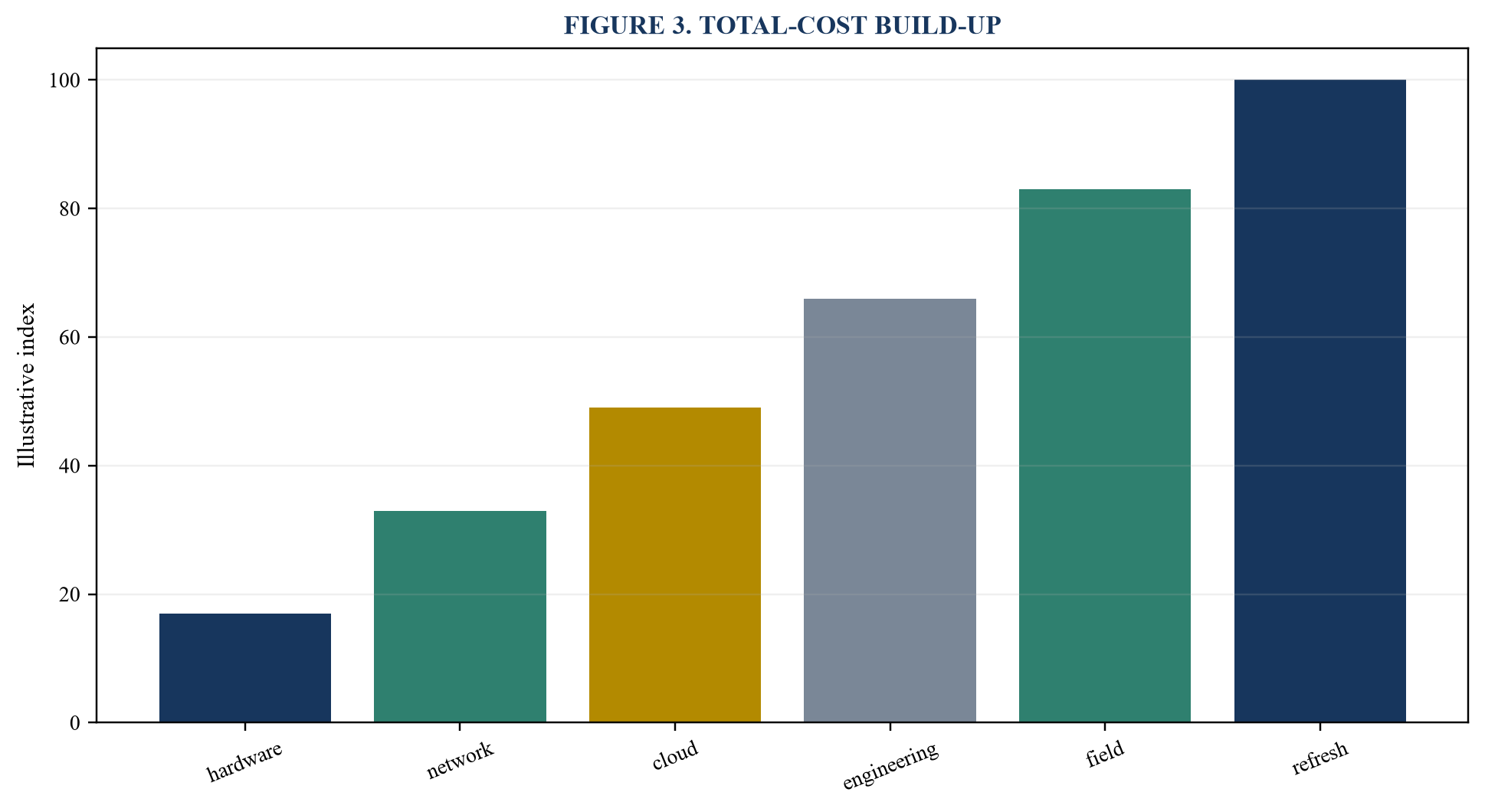
Values are illustrative indices and require replacement with approved operating and financial evidence.
25. Control configuration drift
Track firmware, drivers, runtimes, models, thresholds and customer settings.
The controlled record includes workload; version; device; network; tariff; utilisation; source; reviewer; decision. The immediate deliverable is a configuration-control register. Preserve geography, effective date, workload and model version, device class, network condition, tariff basis, utilisation, reviewer, approval and unresolved exceptions.
The principal failure occurs when the fleet becomes an untestable set of variants. Reviewers should reproduce the benchmark, reconcile technical and financial units, stress adverse conditions and identify who may approve, remediate or withhold the investment recommendation.
Edge, cloud and hybrid inference should be compared on the same workload, service level, outcome quality, demand scenario and financial horizon.
The decision pack for control configuration drift should show the prior assumption, observed evidence, correction, unit and fleet consequence, alternative architecture, owner, due date, next evidence gate and outcome. Material gaps flow into the funding plan, contractual protections and valuation scenarios.
26. Model hardware refresh
Forecast obsolescence, failure, warranty, support horizon and replacement triggers.
The controlled record includes workload; version; device; network; tariff; utilisation; source; reviewer; decision. The immediate deliverable is a hardware refresh schedule. Preserve geography, effective date, workload and model version, device class, network condition, tariff basis, utilisation, reviewer, approval and unresolved exceptions.
The principal failure occurs when accounting depreciation substitutes for useful life. Reviewers should reproduce the benchmark, reconcile technical and financial units, stress adverse conditions and identify who may approve, remediate or withhold the investment recommendation.
The investment case needs measured latency, power, availability and platform performance alongside privacy, field operations and hardware lifecycle evidence.
The decision pack for model hardware refresh should show the prior assumption, observed evidence, correction, unit and fleet consequence, alternative architecture, owner, due date, next evidence gate and outcome. Material gaps flow into the funding plan, contractual protections and valuation scenarios.
27. Model supply-chain risk
Assess accelerator availability, vendor concentration, lead times, export controls and substitutes.
The controlled record includes workload; version; device; network; tariff; utilisation; source; reviewer; decision. The immediate deliverable is a supply resilience plan. Preserve geography, effective date, workload and model version, device class, network condition, tariff basis, utilisation, reviewer, approval and unresolved exceptions.
The principal failure occurs when the scaling plan depends on one constrained component. Reviewers should reproduce the benchmark, reconcile technical and financial units, stress adverse conditions and identify who may approve, remediate or withhold the investment recommendation.
Architecture economics change with utilisation, model growth, network conditions, supplier constraints, release operations and refresh timing.
The decision pack for model supply-chain risk should show the prior assumption, observed evidence, correction, unit and fleet consequence, alternative architecture, owner, due date, next evidence gate and outcome. Material gaps flow into the funding plan, contractual protections and valuation scenarios.
28. Plan field operations
Cost installation, commissioning, diagnostics, maintenance, swaps and retrieval.
The controlled record includes workload; version; device; network; tariff; utilisation; source; reviewer; decision. The immediate deliverable is a field-service model. Preserve geography, effective date, workload and model version, device class, network condition, tariff basis, utilisation, reviewer, approval and unresolved exceptions.
The principal failure occurs when remote software economics ignore physical service. Reviewers should reproduce the benchmark, reconcile technical and financial units, stress adverse conditions and identify who may approve, remediate or withhold the investment recommendation.
Decision-makers can connect the technical frontier to gross margin, capital intensity, customer retention, financing requirements and enterprise value.
The decision pack for plan field operations should show the prior assumption, observed evidence, correction, unit and fleet consequence, alternative architecture, owner, due date, next evidence gate and outcome. Material gaps flow into the funding plan, contractual protections and valuation scenarios.
29. Measure reliability and availability
Connect device failure, network outage, cloud outage, degradation and recovery to service levels.
The controlled record includes workload; version; device; network; tariff; utilisation; source; reviewer; decision. The immediate deliverable is an availability evidence pack. Preserve geography, effective date, workload and model version, device class, network condition, tariff basis, utilisation, reviewer, approval and unresolved exceptions.
The principal failure occurs when nominal compute capacity is mistaken for delivered availability. Reviewers should reproduce the benchmark, reconcile technical and financial units, stress adverse conditions and identify who may approve, remediate or withhold the investment recommendation.
Edge, cloud and hybrid inference should be compared on the same workload, service level, outcome quality, demand scenario and financial horizon.
The decision pack for measure reliability and availability should show the prior assumption, observed evidence, correction, unit and fleet consequence, alternative architecture, owner, due date, next evidence gate and outcome. Material gaps flow into the funding plan, contractual protections and valuation scenarios.
30. Design fallback modes
Define local, cloud, cached, manual and safe-state behaviour under failure.
The controlled record includes workload; version; device; network; tariff; utilisation; source; reviewer; decision. The immediate deliverable is a fallback operating design. Preserve geography, effective date, workload and model version, device class, network condition, tariff basis, utilisation, reviewer, approval and unresolved exceptions.
The principal failure occurs when outages produce uncontrolled or unusable service. Reviewers should reproduce the benchmark, reconcile technical and financial units, stress adverse conditions and identify who may approve, remediate or withhold the investment recommendation.
The investment case needs measured latency, power, availability and platform performance alongside privacy, field operations and hardware lifecycle evidence.
The decision pack for design fallback modes should show the prior assumption, observed evidence, correction, unit and fleet consequence, alternative architecture, owner, due date, next evidence gate and outcome. Material gaps flow into the funding plan, contractual protections and valuation scenarios.
31. Map cybersecurity exposure
Assess device identity, secure boot, keys, tamper, updates, APIs and cloud control plane.
The controlled record includes workload; version; device; network; tariff; utilisation; source; reviewer; decision. The immediate deliverable is a cyber-control dossier. Preserve geography, effective date, workload and model version, device class, network condition, tariff basis, utilisation, reviewer, approval and unresolved exceptions.
The principal failure occurs when distributed compute expands attack surface without cost recognition. Reviewers should reproduce the benchmark, reconcile technical and financial units, stress adverse conditions and identify who may approve, remediate or withhold the investment recommendation.
Architecture economics change with utilisation, model growth, network conditions, supplier constraints, release operations and refresh timing.
The decision pack for map cybersecurity exposure should show the prior assumption, observed evidence, correction, unit and fleet consequence, alternative architecture, owner, due date, next evidence gate and outcome. Material gaps flow into the funding plan, contractual protections and valuation scenarios.
32. Map regulatory exposure
Connect data, model, device and intended use to applicable AI, privacy, product and sector rules.
The controlled record includes workload; version; device; network; tariff; utilisation; source; reviewer; decision. The immediate deliverable is a jurisdictional obligations map. Preserve geography, effective date, workload and model version, device class, network condition, tariff basis, utilisation, reviewer, approval and unresolved exceptions.
The principal failure occurs when architecture choice ignores market-access obligations. Reviewers should reproduce the benchmark, reconcile technical and financial units, stress adverse conditions and identify who may approve, remediate or withhold the investment recommendation.
Decision-makers can connect the technical frontier to gross margin, capital intensity, customer retention, financing requirements and enterprise value.
The decision pack for map regulatory exposure should show the prior assumption, observed evidence, correction, unit and fleet consequence, alternative architecture, owner, due date, next evidence gate and outcome. Material gaps flow into the funding plan, contractual protections and valuation scenarios.
Table 4. Hardware lifecycle controls
| Stage | Primary risk | Required evidence |
|---|---|---|
| select | benchmark mismatch | qualified device |
| deploy | configuration drift | fleet record |
| operate | failure and throttling | health telemetry |
| refresh | obsolescence | funded schedule |
Illustrative controls require workload-, device-, geography-, tariff-, firm- and period-specific approval.
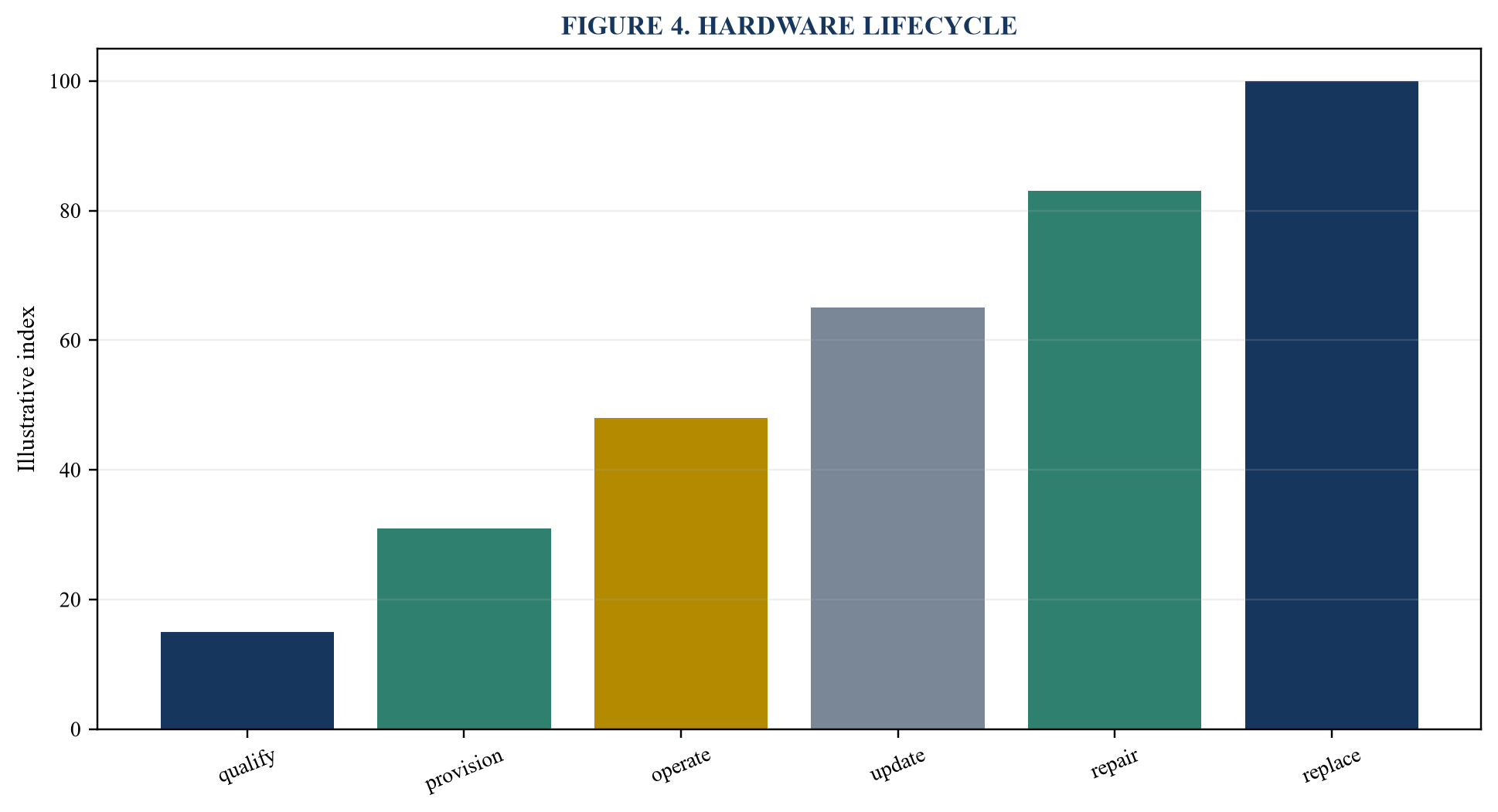
Values are illustrative indices and require replacement with approved operating and financial evidence.
33. Model environmental effects
Compare operational energy, embodied hardware, network and data-centre impacts.
The controlled record includes workload; version; device; network; tariff; utilisation; source; reviewer; decision. The immediate deliverable is a lifecycle resource model. Preserve geography, effective date, workload and model version, device class, network condition, tariff basis, utilisation, reviewer, approval and unresolved exceptions.
The principal failure occurs when one energy metric supports an incomplete sustainability claim. Reviewers should reproduce the benchmark, reconcile technical and financial units, stress adverse conditions and identify who may approve, remediate or withhold the investment recommendation.
Edge, cloud and hybrid inference should be compared on the same workload, service level, outcome quality, demand scenario and financial horizon.
The decision pack for model environmental effects should show the prior assumption, observed evidence, correction, unit and fleet consequence, alternative architecture, owner, due date, next evidence gate and outcome. Material gaps flow into the funding plan, contractual protections and valuation scenarios.
34. Allocate engineering cost
Estimate model optimisation, runtime, firmware, MLOps, monitoring and support effort.
The controlled record includes workload; version; device; network; tariff; utilisation; source; reviewer; decision. The immediate deliverable is an engineering investment plan. Preserve geography, effective date, workload and model version, device class, network condition, tariff basis, utilisation, reviewer, approval and unresolved exceptions.
The principal failure occurs when build cost is excluded from run-cost comparisons. Reviewers should reproduce the benchmark, reconcile technical and financial units, stress adverse conditions and identify who may approve, remediate or withhold the investment recommendation.
The investment case needs measured latency, power, availability and platform performance alongside privacy, field operations and hardware lifecycle evidence.
The decision pack for allocate engineering cost should show the prior assumption, observed evidence, correction, unit and fleet consequence, alternative architecture, owner, due date, next evidence gate and outcome. Material gaps flow into the funding plan, contractual protections and valuation scenarios.
35. Set observability controls
Capture latency, energy, errors, drift, versions, device health and user outcomes.
The controlled record includes workload; version; device; network; tariff; utilisation; source; reviewer; decision. The immediate deliverable is an edge-cloud monitoring design. Preserve geography, effective date, workload and model version, device class, network condition, tariff basis, utilisation, reviewer, approval and unresolved exceptions.
The principal failure occurs when distributed failures remain invisible. Reviewers should reproduce the benchmark, reconcile technical and financial units, stress adverse conditions and identify who may approve, remediate or withhold the investment recommendation.
Architecture economics change with utilisation, model growth, network conditions, supplier constraints, release operations and refresh timing.
The decision pack for set observability controls should show the prior assumption, observed evidence, correction, unit and fleet consequence, alternative architecture, owner, due date, next evidence gate and outcome. Material gaps flow into the funding plan, contractual protections and valuation scenarios.
36. Build the economic frontier
Plot latency, privacy, quality, availability, power and total cost across architectures.
The controlled record includes workload; version; device; network; tariff; utilisation; source; reviewer; decision. The immediate deliverable is an approved decision frontier. Preserve geography, effective date, workload and model version, device class, network condition, tariff basis, utilisation, reviewer, approval and unresolved exceptions.
The principal failure occurs when a single ranking conceals multi-dimensional trade-offs. Reviewers should reproduce the benchmark, reconcile technical and financial units, stress adverse conditions and identify who may approve, remediate or withhold the investment recommendation.
Decision-makers can connect the technical frontier to gross margin, capital intensity, customer retention, financing requirements and enterprise value.
The decision pack for build the economic frontier should show the prior assumption, observed evidence, correction, unit and fleet consequence, alternative architecture, owner, due date, next evidence gate and outcome. Material gaps flow into the funding plan, contractual protections and valuation scenarios.
37. Translate into financing needs
Map device capital, cloud commitments, working capital, spares and refresh to funding.
The controlled record includes workload; version; device; network; tariff; utilisation; source; reviewer; decision. The immediate deliverable is a financing and liquidity plan. Preserve geography, effective date, workload and model version, device class, network condition, tariff basis, utilisation, reviewer, approval and unresolved exceptions.
The principal failure occurs when architecture choice creates unfunded capital intensity. Reviewers should reproduce the benchmark, reconcile technical and financial units, stress adverse conditions and identify who may approve, remediate or withhold the investment recommendation.
Edge, cloud and hybrid inference should be compared on the same workload, service level, outcome quality, demand scenario and financial horizon.
The decision pack for translate into financing needs should show the prior assumption, observed evidence, correction, unit and fleet consequence, alternative architecture, owner, due date, next evidence gate and outcome. Material gaps flow into the funding plan, contractual protections and valuation scenarios.
38. Test valuation consequences
Connect architecture to gross margin, retention, scalability, capital intensity and risk.
The controlled record includes workload; version; device; network; tariff; utilisation; source; reviewer; decision. The immediate deliverable is a valuation sensitivity model. Preserve geography, effective date, workload and model version, device class, network condition, tariff basis, utilisation, reviewer, approval and unresolved exceptions.
The principal failure occurs when technical design is disconnected from enterprise value. Reviewers should reproduce the benchmark, reconcile technical and financial units, stress adverse conditions and identify who may approve, remediate or withhold the investment recommendation.
The investment case needs measured latency, power, availability and platform performance alongside privacy, field operations and hardware lifecycle evidence.
The decision pack for test valuation consequences should show the prior assumption, observed evidence, correction, unit and fleet consequence, alternative architecture, owner, due date, next evidence gate and outcome. Material gaps flow into the funding plan, contractual protections and valuation scenarios.
39. Structure contractual protections
Address service levels, hardware warranties, vendor change, data location, security and exit.
The controlled record includes workload; version; device; network; tariff; utilisation; source; reviewer; decision. The immediate deliverable is a contract protection schedule. Preserve geography, effective date, workload and model version, device class, network condition, tariff basis, utilisation, reviewer, approval and unresolved exceptions.
The principal failure occurs when commercial contracts fail to allocate architecture risk. Reviewers should reproduce the benchmark, reconcile technical and financial units, stress adverse conditions and identify who may approve, remediate or withhold the investment recommendation.
Architecture economics change with utilisation, model growth, network conditions, supplier constraints, release operations and refresh timing.
The decision pack for structure contractual protections should show the prior assumption, observed evidence, correction, unit and fleet consequence, alternative architecture, owner, due date, next evidence gate and outcome. Material gaps flow into the funding plan, contractual protections and valuation scenarios.
40. Close through investment gates
Require tested outcomes, realistic demand, funded refresh, supplier resilience and monitored economics.
The controlled record includes workload; version; device; network; tariff; utilisation; source; reviewer; decision. The immediate deliverable is an accountable investment decision. Preserve geography, effective date, workload and model version, device class, network condition, tariff basis, utilisation, reviewer, approval and unresolved exceptions.
The principal failure occurs when deployment scales before the operating model is investable. Reviewers should reproduce the benchmark, reconcile technical and financial units, stress adverse conditions and identify who may approve, remediate or withhold the investment recommendation.
Decision-makers can connect the technical frontier to gross margin, capital intensity, customer retention, financing requirements and enterprise value.
The decision pack for close through investment gates should show the prior assumption, observed evidence, correction, unit and fleet consequence, alternative architecture, owner, due date, next evidence gate and outcome. Material gaps flow into the funding plan, contractual protections and valuation scenarios.
Table 5. Investment gates
| Gate | Primary work | Completion evidence |
|---|---|---|
| performance | outcome and latency | reproduced benchmark |
| economics | fleet and cloud TCO | approved model |
| resilience | supplier and fallback | tested plan |
| capital | funding and refresh | accountable decision |
Illustrative controls require workload-, device-, geography-, tariff-, firm- and period-specific approval.
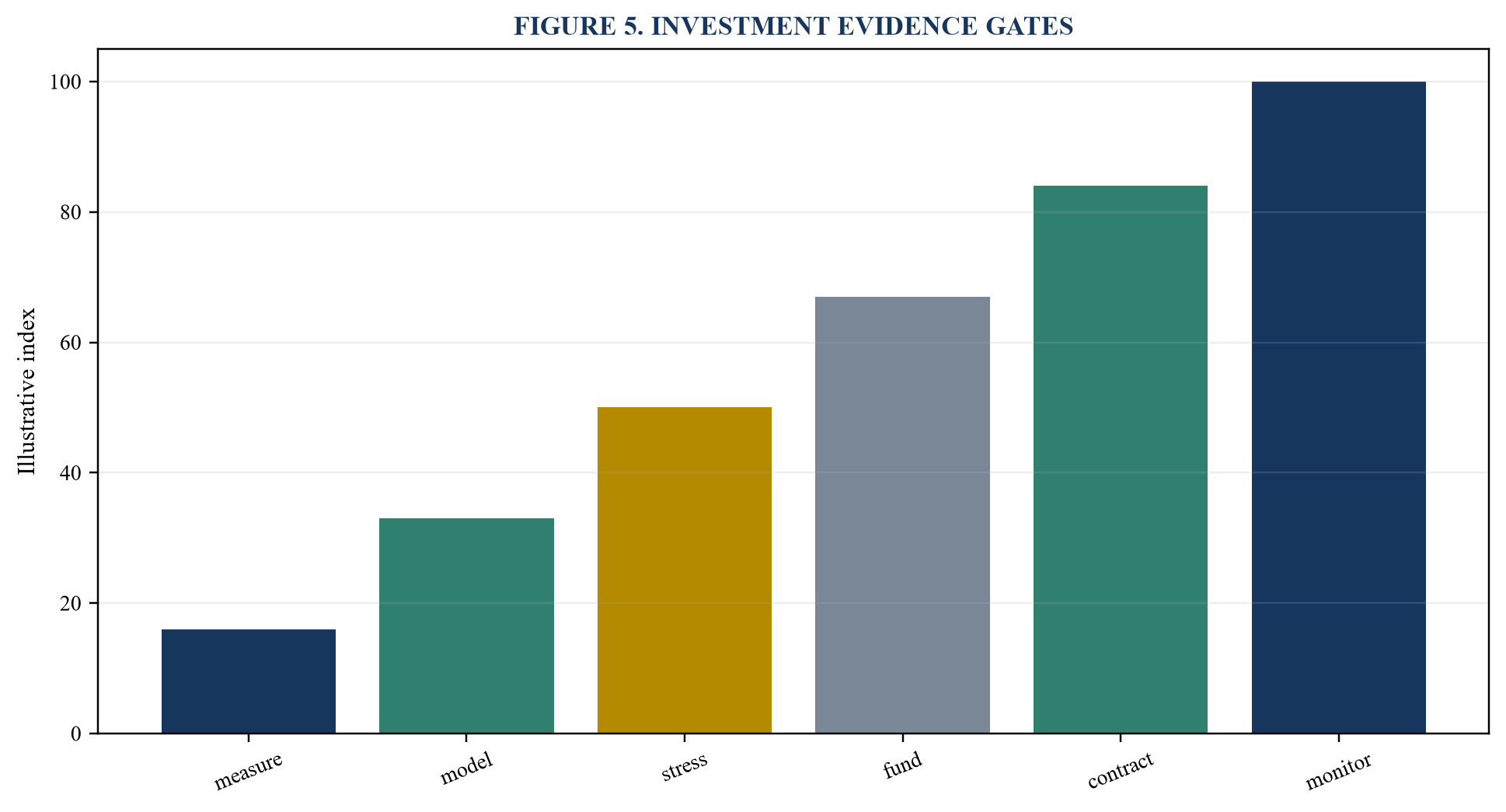
Values are illustrative indices and require replacement with approved operating and financial evidence.
References
- National Institute of Standards and Technology, Hardware for AI, https://www.nist.gov/hardware-ai
- National Institute of Standards and Technology, AI Risk Management Framework 1.0, https://www.nist.gov/publications/artificial-intelligence-risk-management-framework-ai-rmf-10
- National Institute of Standards and Technology, AI Resource Center, https://airc.nist.gov/
- National Institute of Standards and Technology, Adversarial Machine Learning Taxonomy, https://csrc.nist.gov/pubs/ai/100/2/e2023/final
- International Energy Agency, Energy and AI, https://www.iea.org/reports/energy-and-ai
- International Energy Agency, Energy and AI Executive Summary, https://www.iea.org/reports/energy-and-ai/executive-summary
- International Energy Agency, Data Centres and Data Transmission Networks, https://www.iea.org/energy-system/digitalisation/data-centres-and-data-transmission-networks
- International Energy Agency, Understanding the Energy-AI Nexus, https://www.iea.org/reports/energy-and-ai/understanding-the-energy-ai-nexus
- European Commission Joint Research Centre, Artificial Intelligence Technologies, https://publications.jrc.ec.europa.eu/repository/handle/JRC142380
- European Union, Regulation 2024/1689 Artificial Intelligence Act, https://eur-lex.europa.eu/eli/reg/2024/1689/oj
- European Union, General Data Protection Regulation, https://eur-lex.europa.eu/eli/reg/2016/679/oj
- UK Information Commissioner's Office, Guidance on AI and Data Protection, https://ico.org.uk/for-organisations/uk-gdpr-guidance-and-resources/artificial-intelligence/
- Central Bank of the UAE, Guidance Note on Responsible Adoption and Use of Artificial Intelligence, https://rulebook.centralbank.ae/en/rulebook/guidance-note-consumer-protection-and-responsible-adoption-and-use-artificial-intelligence
- UAE Government, Federal Decree-Law No. 45 of 2021 on Personal Data Protection, https://uaelegislation.gov.ae/en/legislations/1972
- United States Food and Drug Administration, Artificial Intelligence in Software as a Medical Device, https://www.fda.gov/medical-devices/software-medical-device-samd/artificial-intelligence-software-medical-device
- United States Food and Drug Administration, Good Machine Learning Practice, https://www.fda.gov/medical-devices/software-medical-device-samd/good-machine-learning-practice-medical-device-development-guiding-principles
- International Organization for Standardization, ISO IEC 42001 AI Management Systems, https://www.iso.org/standard/81230.html
- International Organization for Standardization, ISO IEC 23894 AI Risk Management, https://www.iso.org/standard/77304.html
- International Organization for Standardization, ISO IEC 30141 Internet of Things Reference Architecture, https://www.iso.org/standard/65695.html
- International Organization for Standardization, ISO IEC 20924 Internet of Things Vocabulary, https://www.iso.org/standard/69470.html
- International Organization for Standardization, ISO IEC 27001 Information Security Management, https://www.iso.org/standard/27001
- European Telecommunications Standards Institute, Multi-access Edge Computing, https://www.etsi.org/technologies/multi-access-edge-computing
- GSMA, Edge Computing, https://www.gsma.com/futurenetworks/edge-computing/
- Organisation for Economic Co-operation and Development, OECD AI Principles, https://oecd.ai/en/ai-principles
- National Institute of Standards and Technology, Cybersecurity Framework 2.0, https://www.nist.gov/cyberframework
- International Telecommunication Union, AI and Machine Learning, https://www.itu.int/en/ITU-T/AI/Pages/default.aspx
