

Introduction
Electricity systems are becoming more distributed. Rooftop solar exports during the day; batteries charge and discharge around network constraints; electric vehicles create flexible load; buildings can shift cooling, heating and industrial demand; and community projects combine generation with local consumption. These assets can contribute energy, capacity, congestion relief, voltage support, reserve and resilience. The International Energy Agency identifies distributed resources and demand flexibility as material sources of system value when markets and digital infrastructure enable participation [1][2].
The commercial problem begins where the engineering opportunity ends. A battery can respond within seconds, yet the buyer must know where it is connected, what service it has promised elsewhere, how its counterfactual output is calculated and who bears the cost when communications fail. A household may share renewable energy with neighbours, yet retail supply, network charges, balancing responsibility and consumer rights remain. An aggregator may pool thousands of devices, yet investors need confidence that revenues are durable enough to service debt and support platform expenditure.
This paper presents a rulebook for these decisions. It treats a local power market as an organised arrangement in which distribution-connected resources exchange energy or provide defined services within a geographic or electrical perimeter. The framework is applicable to competitive markets, vertically integrated utilities, single-buyer systems and regulated pilots. Jurisdiction-specific legal, regulatory, tax and grid-code advice remains necessary.
1 Define the market before selecting the technology
The first decision is the purpose. A local market may reduce a specific feeder constraint, defer reinforcement, improve voltage, increase renewable hosting capacity, support restoration, lower community energy costs or create a route to wholesale participation. These objectives require different products and governance. A neighbourhood energy-sharing scheme should not be presented as a congestion market unless the network operator can dispatch and verify a locational response.
The perimeter should identify the physical network, eligible connection points, voltage levels, customer classes, technologies, market operator and settlement boundary. It should also state whether participation is voluntary, whether regulated network businesses may procure services, and how local dispatch interacts with the transmission system operator, retailer, supplier and balancing-responsible party.
FERC Order No. 2222 requires regional market rules that enable aggregations of distributed energy resources to participate in US wholesale markets while coordinating with distribution utilities and retail regulators [3]. European Union rules enable active consumers and energy communities to generate, consume, share, sell and provide flexibility services [4]. These frameworks illustrate that local participation needs a defined bridge to the wider market.
2 Separate four commercial models
Four models are often grouped together. Energy sharing allocates production from an identified asset among participating customers. Peer-to-peer trading enables bilateral or platform-mediated exchange, subject to retail and network rules. Local flexibility procurement pays a resource to alter injection or withdrawal at a location and time. Wholesale aggregation pools small resources to meet minimum participation and operational requirements in a regional market.
The models can coexist, but their rights must remain distinguishable. A kilowatt-hour allocated to a community member can still create balancing and network consequences. A battery contracted for local congestion relief may also earn wholesale energy revenue if dispatch obligations do not conflict. An aggregator can manage the interfaces, provided the rulebook defines priority, telemetry and settlement.
IRENA's work on peer-to-peer electricity trading identifies digital platforms, smart metering and enabling regulation as important components [5]. The commercial design should begin with product and risk allocation rather than the trading interface.
Table 1. Local-market models and required commercial rules
| Model | Primary exchange | Principal buyer or counterparty | Essential rule | Main risk |
|---|---|---|---|---|
| Energy sharing | Allocation of local generation | Participating customers | Allocation key and residual supply treatment | Benefits diverge from forecast consumption |
| Peer-to-peer trading | Bilateral energy transaction | Local buyer or platform participant | Supplier, balancing and network-charge treatment | Trade price obscures total delivered cost |
| Local flexibility | Change in injection or demand | Distribution or system operator | Baseline, dispatch and performance measurement | Counterfactual output is disputed |
| Wholesale aggregation | Pooled energy, capacity or ancillary service | Regional market operator | Coordination and minimum technical capability | Local and wholesale instructions conflict |
The table distinguishes common models. Legal treatment depends on the jurisdiction.
3 Design products around a system need
A product should describe a measurable outcome. Relevant attributes include location, direction, minimum quantity, response time, ramp rate, duration, availability window, activation limit, recovery time, telemetry, persistence and notice. The buyer should explain the underlying need sufficiently for providers to price delivery and assess technical feasibility.
Products can include scheduled peak reduction, dynamic congestion relief, voltage support, reactive power, fast reserve, black-start support, islanded resilience and non-firm connection management. Product proliferation creates cost. A common product catalogue can reduce qualification and integration expense, while locational parameters preserve network relevance.
Ofgem's decision on local energy institutions calls for accessible, transparent and coordinated flexibility markets [6]. The Energy Networks Association's Open Networks programme has also developed standardisation for distribution flexibility in Great Britain [7]. Standard products can expand participation when the network need remains clear.
4 Establish the locational unit of value
Distribution constraints can be highly local. Flexibility behind one transformer may not relieve a constraint on another feeder. The market should map eligible nodes or zones to the network model and publish enough information for providers to understand where value exists without disclosing security-sensitive detail.
Locational granularity creates a trade-off. A narrow zone improves engineering accuracy but may produce thin competition. A wider zone increases liquidity but can pay resources that do not resolve the constraint. The operator can use prequalification, constraint factors or nodal effectiveness scores to preserve value.
The investment case should distinguish system-wide revenue from local scarcity revenue. Local payments may be episodic and can disappear after reinforcement. A financeable project needs a view of contract duration, expected utilisation and the buyer's right to change the zone.
5 Procure availability and utilisation separately
Availability pays a resource to remain capable during defined windows. Utilisation pays for delivered energy or response when activated. The split supports technologies with fixed readiness costs and uncertain dispatch. A single utilisation price may under-remunerate readiness; a large availability payment can pay resources that are rarely useful.
The procurement should state whether availability is firm, whether outages can be declared, how maintenance is scheduled and whether the provider may substitute resources. Utilisation pricing may be pay-as-bid, uniform or administratively determined. Each method affects bidding incentives and price discovery.
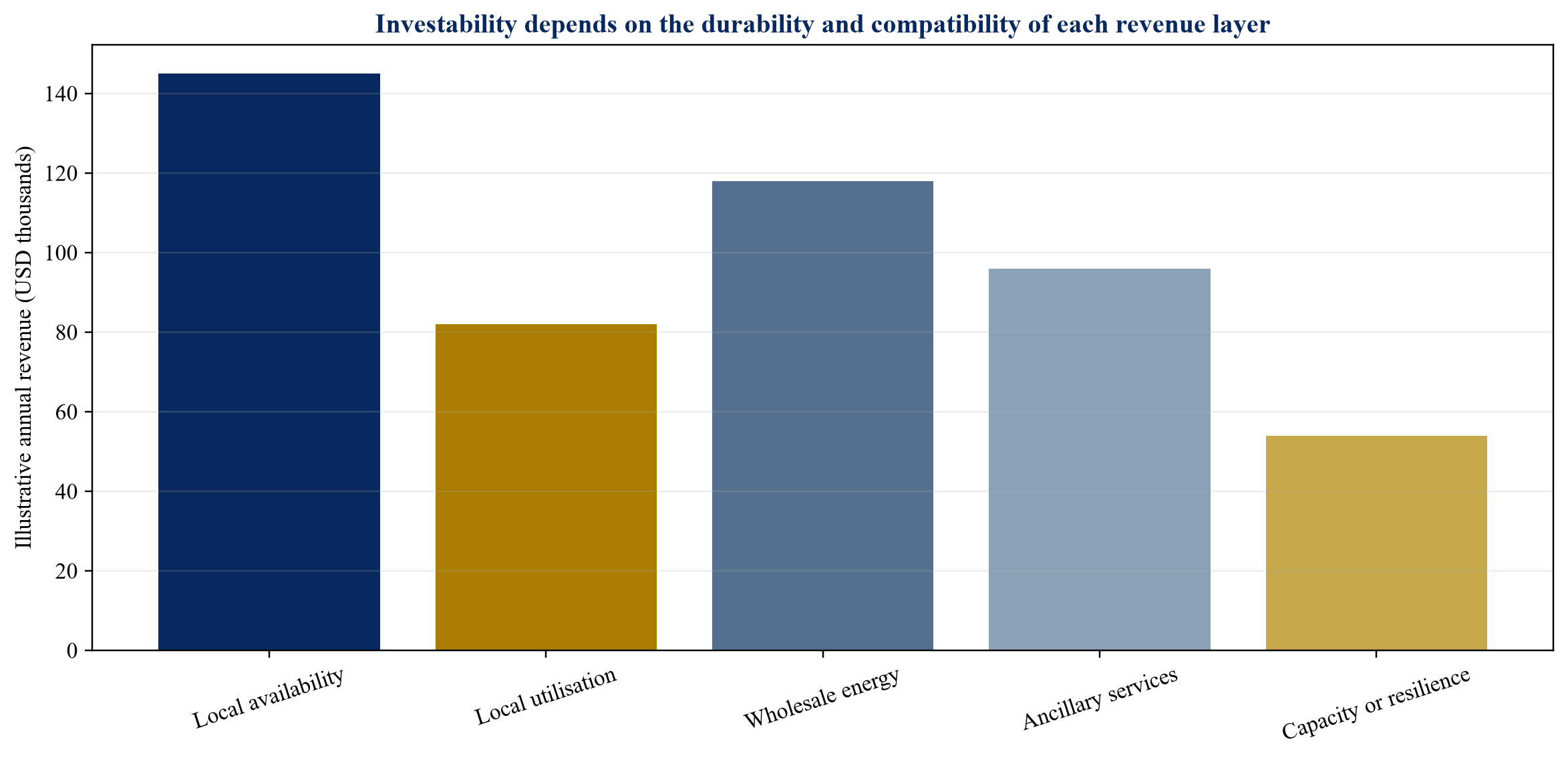
All values are hypothetical author-modelled assumptions in USD thousands. They demonstrate a valuation method and do not represent a market forecast or transaction.
6 Make qualification proportionate
Qualification should prove safe and reliable participation without imposing utility-scale processes on small resources. Requirements can cover connection status, controllability, response testing, metering, cybersecurity, communications, insurance, financial standing and customer consent. Aggregators should be permitted to qualify portfolios where individual-device testing would be disproportionate.
The rulebook should define retesting, material modification, replacement devices and suspension. A transparent rejection and appeal process supports trust. Technical qualification should remain separate from commercial selection so that a qualified provider has no automatic right to a contract.
Qualification data can support diligence. Investors should test whether revenue forecasts include only assets that are connected, consented, controllable and qualified. Pipeline devices should be risk-weighted until evidence is available.
7 Set a defensible baseline
Demand response and flexible generation are often measured against a counterfactual baseline. The baseline may use historical matching days, weather adjustment, regression, nominated schedules or control groups. Each method creates gaming and error risks. A provider can inflate an expected load before dispatch; unusual weather can make a historical baseline inaccurate; customer operations can change structurally.
The methodology should be published, version-controlled and independently auditable. It should define data exclusions, missing values, adjustment caps, holidays and disputes. Where feasible, metered output against a forward schedule can reduce ambiguity.
ACER identifies baseline methodology, market access and price signals among barriers to demand response [8]. Baseline error should be reflected in product design and performance tolerance rather than treated as perfect measurement.
8 Coordinate dispatch across markets
A resource may receive instructions from a local market, wholesale market, retailer or behind-the-meter optimiser. The stacking policy should define priority. Safety and network-security instructions should prevail. Contractual priority among commercial services should then be explicit, with rules for reservation, notification and non-availability.
Double payment occurs when two buyers pay for the same incremental response. Double participation is different: one asset can provide compatible services at different times or reserve separate capacity. The rulebook should identify mutually exclusive products, permissible combinations and the data needed to reconcile dispatch.
FERC's implementation process places coordination among regional operators, distribution utilities and aggregators at the centre of distributed participation [3]. A local design should allocate a single operational contact and maintain a dispatch log available to authorised parties.
9 Meter, validate and settle
Settlement converts technical performance into cash. The market should specify meter class, interval, time standard, data owner, validation process, substitution rules, correction window and settlement calendar. Device-level telemetry may support operations while the revenue meter supports billing. Differences should be reconciled.
Provisional settlement can improve liquidity where validated data arrives slowly. Final settlement should occur within a defined period, with materiality thresholds for reopening. The buyer should publish invoices or statements showing availability, activation, measured delivery, prices, penalties, taxes and adjustments.
Investors should test the working-capital effect of settlement lag. A platform with growing customer payments and delayed market receipts may need a revolving facility even when unit economics appear positive.
10 Bound performance penalties
Penalties should reflect the cost and recurrence of non-performance. An unlimited exposure can make a small contract unfinanceable. A weak penalty can encourage speculative bidding. The design may use payment reduction, strike-based suspension, replacement-cost recovery and capped liquidated damages.
Force majeure, communications failure, operator override and network outage require separate treatment. The provider should not be penalised for an instruction that could not be received because the buyer's interface failed. The buyer should retain rights where the provider's own system caused the failure.
Performance assessment should distinguish portfolio delivery from individual-device failure. Aggregation can improve reliability through diversification, provided substitution remains within the relevant location and product limits.
11 Protect customers and allocate data rights
Participation agreements should use clear consent, explain revenue sharing, disclose device-control rights and state how a customer exits. Vulnerable customers require particular care where remote control affects heating, cooling, mobility or medical needs. The service should define override rights and essential-use protections.
Data governance should identify controller, processor, permitted use, retention, sharing and breach response. Granular consumption data can reveal occupancy and behaviour. Cybersecurity obligations should extend through devices, gateways, aggregators and market platforms.
European Union energy-community policy emphasises active participation and consumer rights [4]. Customer trust is a commercial asset: high churn can increase acquisition cost, weaken portfolio availability and reduce debt capacity.
12 Build a neutral market function
The market facilitator should publish needs, qualify providers, administer tenders, coordinate dispatch and report results under clear governance. A distribution utility may perform some functions, but conflicts arise if it also owns competing resources or earns returns on conventional reinforcement.
Independent oversight, ring-fenced information and transparent procurement can mitigate conflict. The regulator should define audit rights, performance reporting and treatment of affiliate participation. Ofgem selected a single expert market-facilitation function to support accessible and coordinated flexibility arrangements [6].
The operator should publish procurement volumes, tender participation, awarded prices, delivery, settlement time and complaints. Commercial confidentiality can be preserved while reporting aggregate outcomes.
13 Translate network value into a ceiling price
The buyer's ceiling price should reflect the avoided or deferred alternative. Relevant costs include reinforcement capital expenditure, losses, outage risk, temporary generation, curtailment, connection delay and operational complexity. The calculation should consider duration, probability, residual asset value and whether flexibility eliminates or merely postpones investment.
The value should be locational and time-specific. A constraint expected for ten winter evenings has a different ceiling from a persistent voltage problem. The buyer should avoid paying more than the risk-adjusted alternative without a documented wider benefit.
Table 2. Illustrative local-flexibility procurement economics
| Case | Conventional reinforcement present value | Flexibility programme present value | Expected deferral | Risk adjustment | Illustrative net value |
|---|---|---|---|---|---|
| Urban feeder peak | 6.8m | 2.9m | 5 years | 0.9m | 3.0m |
| Rural voltage constraint | 3.2m | 1.8m | 4 years | 0.5m | 0.9m |
| Commercial district growth | 11.5m | 5.7m | 3 years | 1.6m | 4.2m |
| EV charging cluster | 8.4m | 4.6m | 4 years | 1.2m | 2.6m |
Values are hypothetical author-modelled assumptions and do not represent a utility plan or forecast.
14 Model provider economics
Provider economics combine device cost, controls, communications, customer acquisition, operations, degradation, energy purchases, imbalance, insurance and financing. Revenue includes availability, utilisation, wholesale services, retail optimisation and customer subscription. Each stream should be modelled with its own probability and contract term.
Battery degradation links dispatch to future replacement cost. Electric-vehicle participation depends on connection time and mobility need. Building flexibility can affect comfort or production. The bid should recover these opportunity costs.
The base case should use contracted revenue and observed availability where available. Pipeline revenue, merchant prices and assumed customer retention should be scenario-tested. The investment committee should see the break-even utilisation, maximum acceptable churn and cash requirement during scaling.
15 Finance the platform and the assets separately
The platform has software, integration, cybersecurity, staff and customer-acquisition costs. The assets have equipment, installation and maintenance costs. Combining them can obscure risk. Asset finance may rely on equipment security and contracted cash flows; platform equity may carry market-development and technology risk.
A special-purpose vehicle can own batteries or community generation and contract with an aggregator. The contracts should address dispatch rights, revenue allocation, data access, replacement, step-in and termination. Lenders should assess whether market-rule changes or platform failure interrupt asset revenue.
Project finance becomes more feasible when revenue duration aligns with debt tenor, dispatch risk is bounded and contracts survive a change of service provider. Short procurement cycles may support working-capital or portfolio facilities rather than long-tenor non-recourse debt.
16 Value optionality without capitalising every possibility
Local-market platforms can create options: entry into new zones, addition of devices, access to wholesale products and sale of grid analytics. Optionality has value only where legal access, technical capability and a credible commercial route exist.
A valuation should separate contracted cash flow, probable extensions and strategic options. Contracted cash flow can be valued through a risk-adjusted discounted model. Probable extensions require renewal and volume probabilities. Strategic options should receive a transparent probability-weighted value or remain outside the base case.
Comparable-company multiples can mislead when one platform owns assets and another only orchestrates them. Gross traded energy is not revenue. Customer count is not available capacity. The diligence team should reconcile device, customer, connection and contract data.
17 Use standard contracts with modular schedules
A master agreement can cover legal terms, data, liability, credit, audit, change control and termination. Product schedules can specify location, capacity, availability, dispatch, metering, prices and penalties. This structure reduces transaction cost while allowing different services.
Key change-in-law provisions should allocate costs when market rules, licences, network charges or taxes change. A broad unilateral variation right weakens financeability. A rigid contract can prevent necessary system changes. The agreement can use consultation, objective triggers and termination compensation for material adverse changes.
Assignment and step-in rights matter for financing. Customer consent and data rules may limit transfer. The structure should anticipate platform replacement and asset enforcement before closing.
18 Allocate credit and collateral proportionately
Market operators need protection against unpaid charges and imbalance exposure. Small providers cannot post utility-scale collateral. A risk-based framework can use net exposure, settlement frequency, guarantees, reserve accounts and credit limits.
The buyer's credit also matters. A regulated utility may recover procurement through tariffs, but timing and approval should be verified. A community entity may depend on member payments. A private platform may have venture funding but limited operating history.
Payment waterfalls should state whether customer receipts, market receipts and asset-service payments are segregated. Lenders should understand set-off, insolvency and priority. Faster settlement can reduce collateral requirements and expand participation.
19 Integrate flexible connections
A flexible or non-firm connection can allow an asset to connect before full reinforcement if it accepts curtailment under defined conditions. The connection agreement should specify the constraint, dispatch method, expected curtailment information, compensation, review and conversion to firm access.
Local markets can create an alternative to uncompensated curtailment by procuring flexibility from connected resources. The two arrangements should align. A resource should not receive a flexibility payment for complying with an existing uncompensated connection obligation unless the incremental service is clear.
The IEA identifies non-firm connections and operational measures as ways to unlock hosting capacity while grid expansion proceeds [9]. Investors should model curtailment and market revenue together rather than assuming both independently.
20 Coordinate transmission and distribution operation
Local dispatch can affect wholesale schedules, balancing and transmission constraints. The transmission and distribution operators should exchange forecasts, constraints, qualification status and dispatch information. Roles should remain clear during emergencies.
The coordination model can be centralised, distributed or layered. A central model gives the transmission operator broad visibility. A layered model lets the distribution operator validate local feasibility before wholesale dispatch. The chosen model should match system maturity and data capability.
The IEA recommends clear responsibility and coordination across transmission and distribution functions as distributed resources grow [10]. Market speed should not exceed operational visibility.
21 Apply the framework in single-buyer systems
A competitive retail market is not required for local flexibility. A vertically integrated utility or single buyer can procure a defined service through bilateral contracts or tenders. The regulator or ministry can approve cost recovery and performance targets.
The design should guard against pilot economics that depend on grants without a durable tariff or budget route. The utility should identify the avoided investment, procurement budget and accounting treatment. Community ownership can be used where local participation and benefit sharing are policy objectives.
World Bank and ESMAP work on distributed energy highlights the need for enabling regulation, utility integration and sustainable commercial models [11]. Procurement can begin with a constraint-specific pilot and expand after verified delivery.
22 Design community governance
An energy community needs membership, voting, benefit allocation, capital contribution, exit and dispute rules. Democratic participation does not remove the need for professional operation. The entity should appoint accountable technical, financial and data functions.
Benefits may be allocated by investment, consumption, participation or social objective. Each method creates incentives. Vulnerable households may need low-capital entry, while project lenders need predictable cash flow. The governance document should separate member benefits from debt-service obligations and operating reserves.
The European Commission reports more than 8,000 energy communities across the European Union and recognises legal forms including cooperatives, partnerships and companies [4]. National rules determine eligibility and control.
23 Create an auditable market platform
The platform should maintain a single record of qualified resources, bids, awards, dispatches, telemetry, meter data, settlements, disputes and rule changes. Access should be role-based. Critical actions should be logged and recoverable.
Automation can reduce cost, but material settlement and suspension decisions need controls. Algorithms used for dispatch or matching should have documented objectives, constraints and monitoring. A platform should be tested for erroneous signals, clock drift, duplicate messages and cyber intrusion.
The operator should prepare business-continuity and manual fallback procedures. A local market that cannot stop safely during a platform failure creates operational and liability risk.
24 Test economics under utilisation and price stress
Revenue projections can be sensitive to dispatch frequency. A network constraint may disappear after reinforcement, demand changes or customer turnover. Wholesale price spreads may narrow. The model should stress utilisation, availability, degradation, churn, settlement delay and contract renewal.
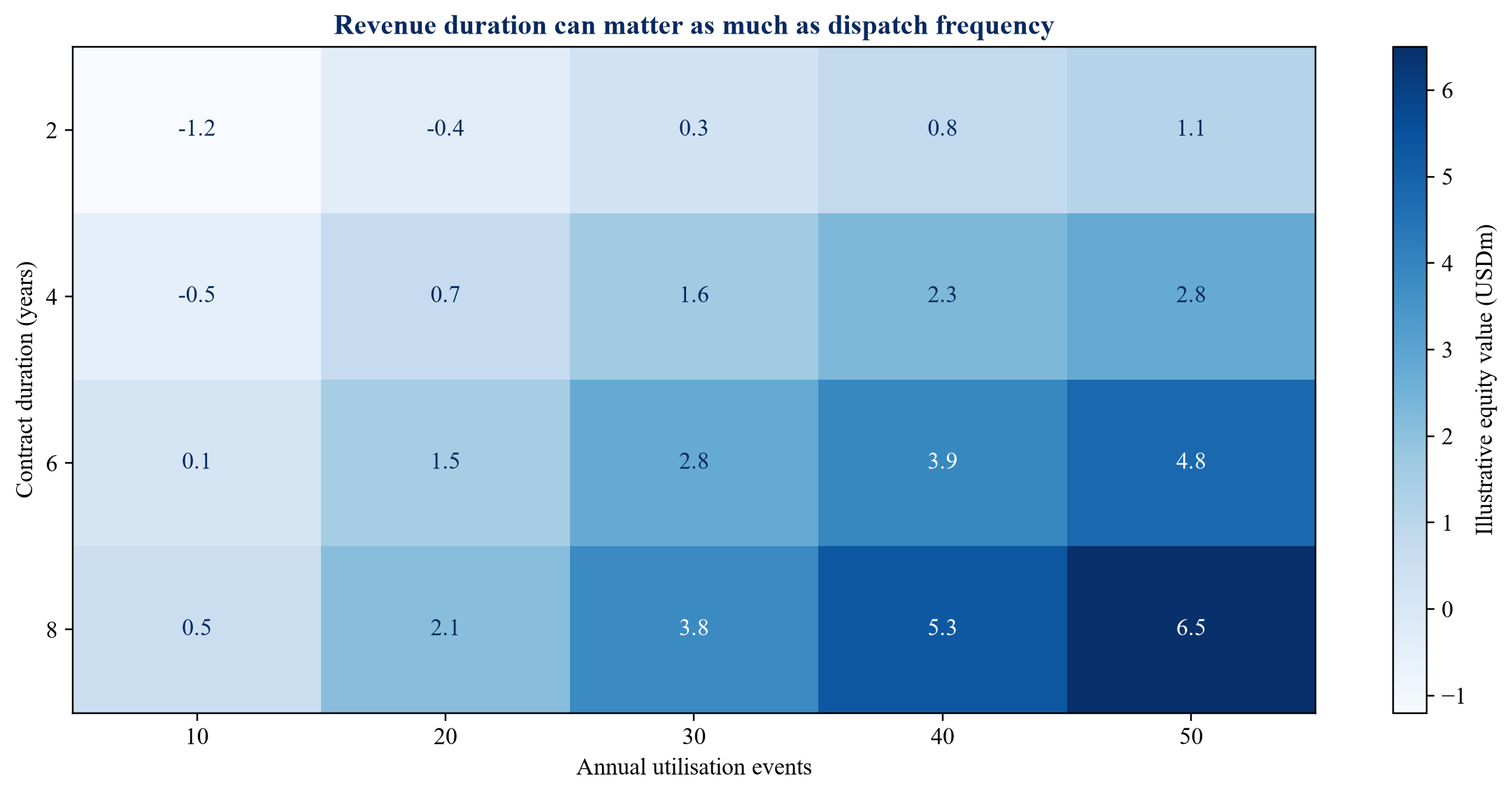
Values are hypothetical author-modelled assumptions in USD millions. They illustrate sensitivity and are not a valuation opinion.
25 Build a decision and control matrix
Market launch requires coordinated decisions across regulator, network operator, market facilitator, retailer, aggregator and consumer body. Each decision should have an owner, evidence, approval threshold and review date.
Table 3. Decision and control matrix for a local-market launch
| Decision | Accountable party | Evidence required | Launch gate | Continuing control |
|---|---|---|---|---|
| Market need | Network operator | Constraint forecast and alternative cost | Board-approved need case | Annual need refresh |
| Product rules | Market facilitator | Technical specification and consultation | Published rulebook | Version control |
| Customer protection | Regulator | Consent, override and complaints design | Compliance approval | Complaints and churn report |
| Operational coordination | System operators | Dispatch and emergency protocol | Simulation passed | Incident exercises |
| Settlement | Market operator | Meter and invoice tests | Parallel settlement passed | Error-rate reporting |
| Cost recovery | Regulator or ministry | Procurement budget and tariff treatment | Funding approved | Variance reconciliation |
| Cybersecurity | Accountable operator | Threat assessment and recovery test | Critical findings closed | Continuous monitoring |
The matrix is a governance template and should be adapted to legal responsibilities.
26 Use a 180-day implementation programme
Days 1 to 30 should confirm the network need, legal perimeter, stakeholders and data availability. Days 31 to 60 should define products, qualification, baseline, dispatch and settlement. Days 61 to 90 should complete consultation, procurement documents, platform configuration and customer protections.
Days 91 to 120 should qualify providers, run communications and dispatch tests, and perform parallel settlement. Days 121 to 150 should execute limited live dispatch under enhanced monitoring. Days 151 to 180 should reconcile performance, resolve defects and approve scale-up.
Launch gates should include operational safety, customer consent, settlement accuracy, cost recovery, cyber readiness and dispute handling. A public launch date should follow evidence from these gates.
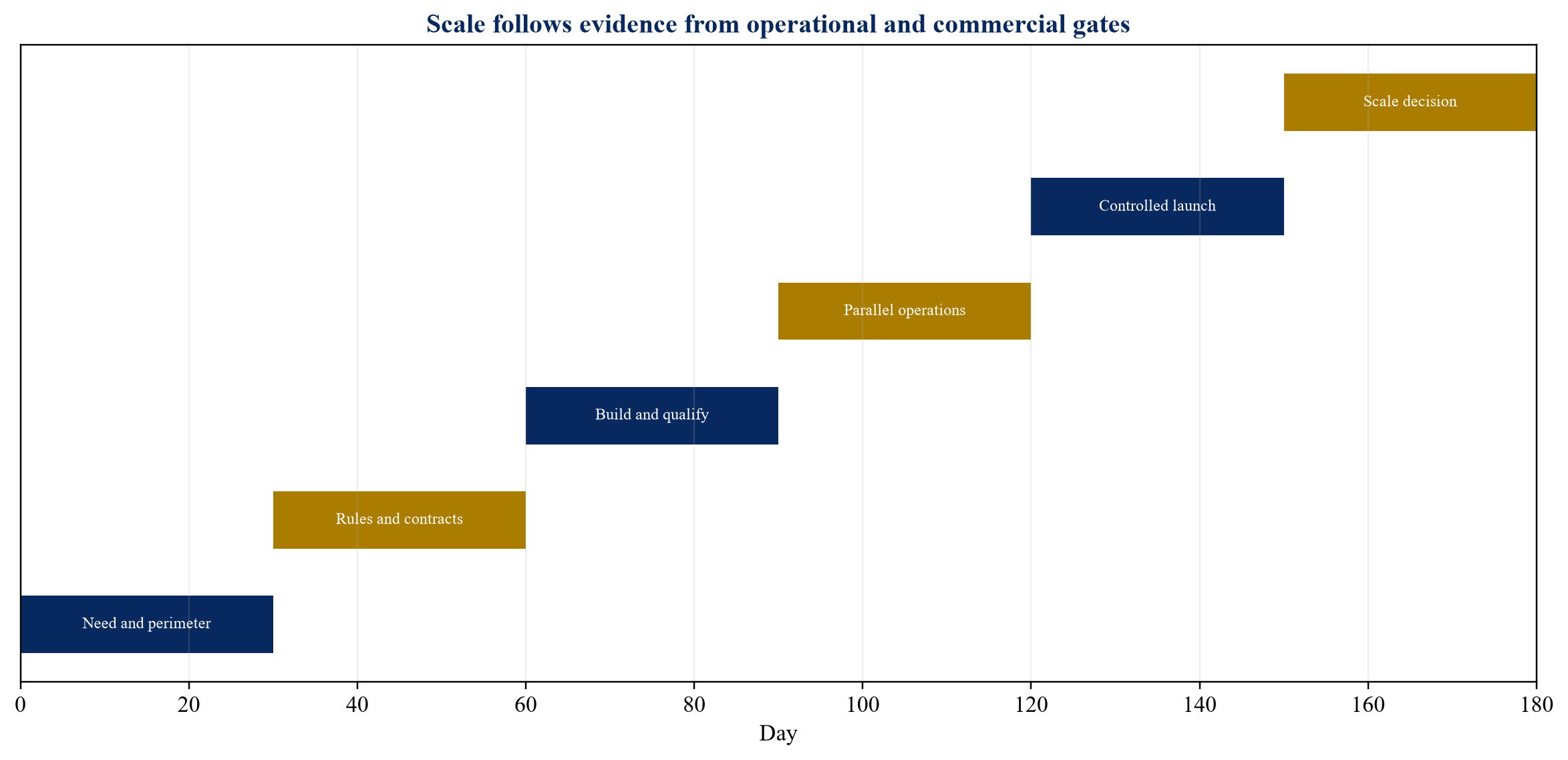
The roadmap is an author-developed implementation framework.
27 Define scale-up evidence
A pilot should answer a decision question. Evidence should include delivered capacity, response time, baseline error, availability, customer retention, settlement accuracy, procurement cost and avoided network expenditure. Participation volume alone is insufficient.
Scale-up should require repeated performance across relevant seasons and operating conditions. The operator should identify which results are transferable to other zones. A successful urban commercial-building pilot may not prove residential response or rural communications.
The post-pilot review should publish methods, limitations and rule changes. Investors need visibility on the route from temporary pilot authority to enduring regulation and cost recovery.
28 Conduct transaction diligence
Buyers and lenders should reconcile the device register to customer consent, connection point, qualification, contract, telemetry and revenue. They should sample dispatches from instruction through meter data to settlement. Revenue concentration by zone, buyer, product and rule version should be reported.
Legal diligence should cover licences, supply activity, consumer contracts, data rights, intellectual property, subcontractors, market participation and change in control. Technical diligence should test platform resilience, device interoperability and cybersecurity. Commercial diligence should assess acquisition cost, churn, renewal and competing flexibility supply.
The investment case should state which revenues are contracted, regulated, merchant or grant-funded. It should identify reinforcement decisions that can terminate a local need.
29 Monitor market quality
Market-quality indicators include bid coverage, provider concentration, awarded-price dispersion, delivery, baseline error, settlement lag, disputes, customer complaints and cost per unit of verified flexibility. Network outcomes should include constraint hours, curtailment, hosting capacity and deferred expenditure.
The regulator should watch for withholding, self-preferencing, baseline manipulation and barriers to small providers. Thin local markets may require price caps, bilateral procurement or wider zones. These measures should be reviewed as participation grows.
Reporting should distinguish contracted megawatts from available and delivered megawatts. Public dashboards can build confidence if definitions remain consistent.
30 Set rules for AI-assisted forecasting and dispatch
Local markets increasingly use forecasting and optimisation to predict demand, renewable output, asset availability and network conditions. These tools can improve scheduling and reduce the cost of coordinating large portfolios. Their use should remain governed by the same commercial obligations as other operational systems. A provider should understand which forecast determines a bid, which data supports it and how an error affects availability or imbalance.
The accountable party should document model purpose, inputs, training period, refresh frequency, performance metric and fallback process. Forecast accuracy should be monitored by product, zone, season and customer class. A portfolio-level average can conceal repeated under-performance at a constrained location. Material model changes should pass testing before production use.
Dispatch optimisation should respect connection limits, customer overrides, reserved capacity, state of charge, equipment warranties and conflicting market commitments. An optimiser should not create apparent value by assuming perfect foresight or ignoring degradation. Investment models should use observed forecast error where available and a disclosed stress where it is not.
Automated decisions need an audit trail. The market operator should be able to reconstruct the data, rule version, constraint and instruction that produced a dispatch or settlement result. Human override should be available for system security and material customer-impact events. Liability should follow contractual responsibility rather than an unsupported claim that an algorithm acted independently.
31 Align procurement with M&A and capital decisions
Local-market rules influence corporate transactions. A utility acquiring an aggregator may gain control of customer relationships and orchestration capability, while raising neutrality and affiliate concerns. A technology platform acquiring an asset portfolio may strengthen revenue visibility while adding capital intensity. A community-energy developer may seek a strategic partner to fund replication across zones.
Transaction teams should map value to identifiable rights: customer contracts, dispatch authority, qualified capacity, market access, data licences, software ownership, cost recovery and renewal. A buyer should avoid capitalising announced megawatts that lack connection, consent or qualification. Earn-outs can link consideration to live capacity, verified delivery, revenue renewal and margin.
Change-of-control provisions can trigger consent from customers, network operators, market bodies or funders. Data-transfer restrictions may limit integration. A regulated buyer should assess whether affiliate rules, procurement obligations or ring-fencing constrain synergies. Competition review may consider local concentration even when national market share appears small.
Capital structure should reflect revenue quality. Contracted availability payments may support asset debt; merchant optimisation and new-zone expansion may require equity. Acquisition financing should stress loss of a major zone, a rule change, customer churn and delayed settlement. The integration plan should protect operational continuity during platform migration.
32 Create an investability scorecard
An investability scorecard can convert a complex rulebook into a repeatable decision. The first dimension is market authority: legal basis, regulator approval, cost recovery and rule-change process. The second is revenue quality: product definition, term, price, utilisation, buyer credit and renewal. The third is operational evidence: qualification, availability, delivery, telemetry and settlement.
The fourth dimension is portfolio durability: customer consent, churn, device life, location, technology diversity and replacement. The fifth is downside protection: penalty caps, force majeure, curtailment, termination, change in law and dispute resolution. The sixth is scalability: standard contracts, interoperable devices, repeatable integration and credible expansion zones.
Scores should link to actions rather than create false precision. A weak cost-recovery score can require a condition precedent. Unproven settlement can require a reserve account or shorter debt tenor. High customer concentration can require retention covenants. A scorecard also helps management identify which rule changes create the greatest financing benefit.
The final investment paper should preserve the evidence behind every score. Management estimates should be labelled and separated from contracts, regulator decisions, metered delivery and audited financial information. This discipline supports valuation, financing and post-close monitoring.
33 Stress the market against failure events
A local market should be tested against operational, financial and institutional failure. The scenarios should include loss of communications, corrupted meter data, simultaneous customer override, aggregator insolvency, market-operator outage, a cyber incident, an extreme-weather event and a conflicting transmission instruction. Each scenario needs an accountable decision maker, safe state, notification route and recovery objective.
The commercial model should show the cash effect. A prolonged platform outage may suspend utilisation revenue while fixed operating costs continue. A buyer payment delay may require additional liquidity. Aggregator insolvency may interrupt customer payments and device control. Reserve accounts, insurance, replacement-service rights and data escrow can reduce exposure when their scope is verified.
Operational exercises should include the network operator, market facilitator, providers and customer-service function. The exercise should test whether dispatch can be stopped, whether essential loads remain protected, whether the market can reconstruct events and whether settlement can resume from an agreed record. Findings should have owners and closure dates.
Failure testing also informs transaction terms. A buyer may require remediation before closing, hold back consideration, require a transitional service or price an additional working-capital facility. Lenders may require minimum liquidity, cyber cover, business-continuity tests and notification covenants. The objective is to expose dependencies before they become service interruptions or value impairment.
34 Recognise limitations
Local markets do not remove the need for grid investment. Flexibility may defer a reinforcement, improve utilisation or bridge a connection delay. Persistent growth can still require physical capacity. The value of a product changes with network topology, technology cost and regulation.
Illustrative economics in this paper are not observed market results. The framework does not determine legal classification, tariff treatment, tax, licensing or consumer-law compliance in a specific jurisdiction. Those questions require current local advice and primary data.
Digital participation also creates cyber, privacy and exclusion risks. Market design should preserve essential service, equitable access and operational security.
Conclusion
Local power markets can convert distributed assets into useful system resources when the commercial rulebook is as rigorous as the technical interface. The core requirements are a defined system need, locationally effective products, proportionate qualification, defensible baselines, coordinated dispatch, auditable settlement, bounded penalties, customer protection and funded cost recovery.
Financeability follows the same discipline. Investors and lenders need to identify the contractual claim behind each revenue stream, test its duration and compatibility, and understand how network decisions can change demand. A controlled implementation programme can establish evidence before scale.
The practical objective is a market in which the buyer can verify value, the provider can price risk, the customer can understand participation and the system operator can preserve security.
The rulebook should therefore be treated as an investable infrastructure layer. Product definitions determine what can be contracted. Metering and settlement determine what can be financed. Coordination and customer protections determine whether the market can operate at scale. Governance determines whether participants can rely on the process when commercial interests conflict.
Implementation should begin with a documented constraint and a bounded product. The buyer should publish the alternative investment cost, expected service window and evidence required for scale. Providers should bid against known delivery and penalty rules. Parallel operational and settlement tests should precede live dispatch. The first expansion decision should follow verified delivery across a relevant operating period.
The resulting market can support several strategic outcomes. It can create time for network reinforcement, improve the utilisation of existing assets, accelerate connections, give communities a role in the energy transition and provide additional revenue for distributed infrastructure. Each outcome should remain measurable. Claims of avoided investment, customer savings or resilience should be reconciled to an approved baseline and updated when system conditions change.
For transaction and financing teams, the final test is simple: every projected cash flow should be traceable to a qualified asset, an enforceable contract, a permitted market activity, a measurable service and a credible payer. Where that chain is incomplete, the value should remain an option or management estimate until evidence supports inclusion in the base case.
References
- International Energy Agency, Electricity Grids and Secure Energy Transitions, 2023. https://www.iea.org/reports/electricity-grids-and-secure-energy-transitions
- International Energy Agency, The Value of Demand Flexibility, 2025. https://www.iea.org/reports/the-value-of-demand-flexibility
- Federal Energy Regulatory Commission, Order No. 2222 Explainer: Facilitating Participation in Electricity Markets by Distributed Energy Resources. https://www.ferc.gov/ferc-order-no-2222-explainer-facilitating-participation-electricity-markets-distributed-energy
- European Commission, Energy Communities. https://energy.ec.europa.eu/topics/markets-and-consumers/energy-consumers-and-prosumers/energy-communities_en
- International Renewable Energy Agency, Peer-to-peer electricity trading: Innovation Landscape Brief, 2020. https://www.irena.org/Publications/2020/Jul/Peer-to-peer-electricity-trading
- Ofgem, Decision on Future of Local Energy Institutions and Governance, 2023. https://www.ofgem.gov.uk/decision/decision-future-local-energy-institutions-and-governance
- Energy Networks Association, Open Networks. https://www.energynetworks.org/industry/our-projects/open-networks
- ACER, Unlocking flexibility: No-regret actions to remove barriers to demand response, 2025. https://www.acer.europa.eu/monitoring/MMR/barriers-demand-response-2025
- International Energy Agency, Electricity 2026: Grids. https://www.iea.org/reports/electricity-2026/grids
- International Energy Agency, Secure Energy Transitions in the Power Sector, 2021. https://www.iea.org/reports/secure-energy-transitions-in-the-power-sector
- World Bank ESMAP, Mini Grids for Half a Billion People, 2022. https://www.esmap.org/mini_grids_for_half_a_billion_people
- European Commission, Recommendation on Empowering Energy Communities and Self-consumption, 2026. https://energy.ec.europa.eu/publications/recommendation-empowering-energy-communities-and-self-consumption_en
- European Commission, Directive (EU) 2019/944 on Common Rules for the Internal Market for Electricity. https://eur-lex.europa.eu/eli/dir/2019/944/oj
- European Union, Directive (EU) 2023/2413 amending the Renewable Energy Directive. https://eur-lex.europa.eu/eli/dir/2023/2413/oj
- FERC, Participation of Distributed Energy Resource Aggregations in Markets Operated by RTOs and ISOs, Docket RM18-9. https://www.ferc.gov/industries-data/electric/power-sales-and-markets/rtos-and-isos/order-no-2222
- National Renewable Energy Laboratory, Transactive Energy Application Landscape Scenarios, 2016. https://www.nrel.gov/docs/fy16osti/65466.pdf
- US Department of Energy, Grid Modernization Initiative. https://www.energy.gov/gmi/grid-modernization-initiative
- Australian Energy Market Commission, Integrating Distributed Energy Resources for the Grid of the Future. https://www.aemc.gov.au/our-work/changing-energy-market/integrating-distributed-energy-resources-grid-future
- Australian Energy Market Operator, Distributed Energy Resources Program. https://aemo.com.au/en/initiatives/major-programs/der-program
- Australian Energy Market Commission, Wholesale Demand Response Mechanism. https://www.aemc.gov.au/rule-changes/wholesale-demand-response-mechanism
- Council of European Energy Regulators, Flexibility Use at Distribution Level, 2020. https://www.ceer.eu/documents/104400/-/-/6e03ada0-2b03-aed7-3978-f62f764da457
- ENTSO-E and EU DSO Entity, Network Code on Demand Response. https://www.entsoe.eu/network_codes/demand-response/
- UK Department for Energy Security and Net Zero, Review of Electricity Market Arrangements. https://www.gov.uk/government/collections/review-of-electricity-market-arrangements-rema
- Ofgem, Flexibility Digital Infrastructure consultation and decisions. https://www.ofgem.gov.uk/energy-policy-and-regulation/policy-and-regulatory-programmes/flexibility-digital-infrastructure
- European Commission, Protecting and Empowering Energy Consumers. https://energy.ec.europa.eu/topics/markets-and-consumers/energy-consumers-and-prosumers/protecting-and-empowering-energy-consumers_en
- International Energy Agency, Scaling Up Demand Flexibility, 2026. https://www.iea.org/reports/scaling-up-demand-flexibility
- International Energy Agency, Electricity 2026: Flexibility. https://www.iea.org/reports/electricity-2026/flexibility
- International Energy Agency, Power Systems in Transition, 2020. https://www.iea.org/reports/power-systems-in-transition
- European Commission, Energy Communities Repository Products. https://energy.ec.europa.eu/topics/markets-and-consumers/energy-consumers-and-prosumers/energy-communities/energy-communities-repository-products_en
- European Commission, Setting up an Energy Community, 2026. https://energy.ec.europa.eu/topics/markets-and-consumers/energy-consumers-and-prosumers/citizens-energy-package/setting-energy-community_en
About the Author
Authored by Chennakeshav Adya Independent Researcher
Chennakeshav (CK) is a corporate finance and investment banking executive with 25+ years of global experience in deal origination, structuring and execution across M&A, growth capital and corporate strategy. He has led value-creation mandates for founders, corporates and funds — bridging the boardroom view to hands-on execution and close.
His career spans Morgan Stanley, HSBC, Lloyds Banking Group, EWEC, ADQ portfolio companies and Emirates Growth Fund, across TMT, real estate, fintech, deeptech, cleantech, infrastructure and energy. He has partnered with C-suite leaders, private equity and venture funds, sovereign wealth funds and family offices to finance complex fund raises and scale-up ventures, and has led M&A due diligence, post-merger integration and business-transformation initiatives to create value.
At Matchpoint Partners he is Managing Partner, leading the firm's corporate finance, M&A and capital-raising practice. He holds an MBA from London Business School, an engineering degree from VTU and a Master of Laws (LLM, in progress) from UCL London.
An active start-up mentor, CK mentors at Techstars, DIFC FinTech Hive, Startup Grind, Founder Institute and IN5, serves as Entrepreneur Mentor in Residence (EMiR) at London Business School, and judges the Entrepreneurship World Cup.
LinkedIn: https://www.linkedin.com/in/ckadya/ Matchpoint Partners: https://www.matchpoint-partners.com/team/ck-adya.html
This paper is part of a continuing series on the structure of private and alternative markets. The views expressed are the author's own. The paper is for information only, describes market structure in general terms, and does not constitute investment, legal, tax or regulatory advice or a recommendation in respect of any security, vehicle or counterparty.
