

1. Bid-to-cash is one economic system
An engineering contract converts a promise into cash through a chain of dependent events. The company selects an opportunity, defines scope, prices resources and risk, agrees contractual rights, mobilises a team, produces deliverables, records progress, manages changes, applies for payment, obtains certification, invoices and collects. Each stage changes the quality of the economic asset. An attractive tender margin has limited meaning when scope is ambiguous, authority is weak, progress cannot be evidenced or the payment path is obstructed.
Most operating models split this chain across business development, estimating, legal, engineering, project management, planning, quantity surveying, finance and collections. Each function can complete its own tasks while the end-to-end result deteriorates. Estimating may produce a technically credible price without documenting the productivity assumptions. Project teams may protect schedule by starting additional work before authority and commercial treatment are clear. Finance may recognise revenue using forecast inputs that do not reconcile to the change register. Collections may chase an invoice without access to the certificate, contract, delivery proof or dispute history.
The reset begins by treating bid-to-cash as a value stream with one executive owner, one evidence architecture and a small number of controlled state transitions. Work moves from bid to awarded baseline, from baseline to performed work, from performed work to measured progress, from measured progress to certified value, from certified value to invoice, and from invoice to collected cash. Value that cannot move to the next state should have an identified blocker, owner, date and escalation route.
This approach preserves professional roles. Engineers remain accountable for technical delivery. Contract managers remain accountable for rights and notices. Project controls maintain schedule and cost evidence. Finance applies the accounting policy. Treasury manages liquidity. The bid-to-cash owner resolves gaps between roles and keeps the commercial record coherent.
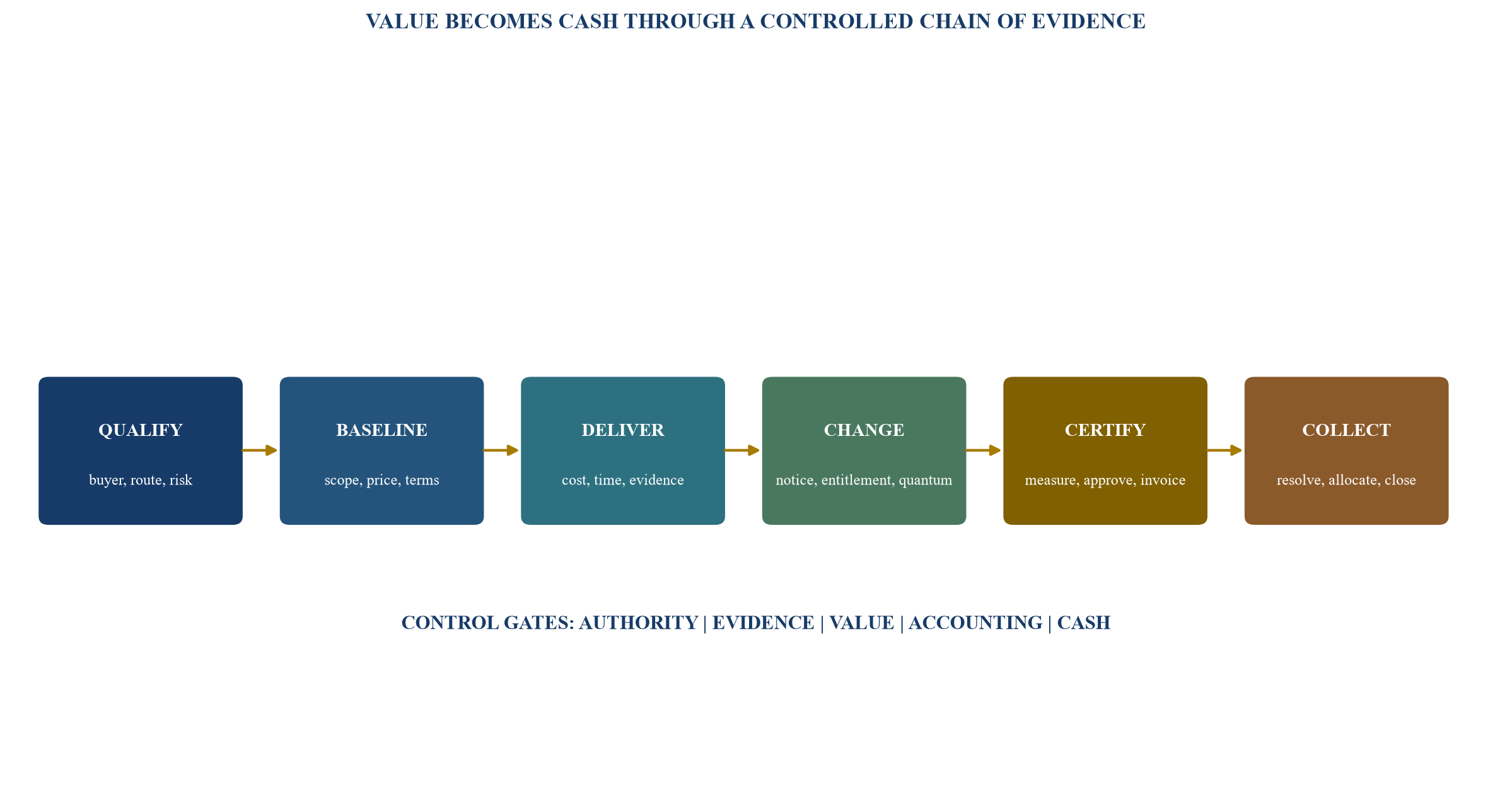
Each gate converts operational activity into progressively stronger commercial and cash evidence.
2. Diagnose leakage with a tender-to-cash bridge
A reset should start with project-level facts. The first question is not whether the portfolio is profitable in aggregate. The useful question is how the expected margin at tender moved to the current forecast and then to cash. A bridge should begin with the approved tender gross margin and identify price adjustments, scope movement, productivity variance, procurement variance, schedule effect, rework, delay, liquidated damages exposure, change recovery, currency, financing cost, tax, retention, credit loss and collection timing.
The bridge should separate five categories. Baseline correction covers errors in the tender or mobilisation baseline. Client-driven change covers instructed or constructive changes for which rights may exist. Delivery variance covers productivity, rework, resource, procurement and planning performance within the company's responsibility. External event covers events whose allocation depends on contract and law. Commercial settlement covers concessions, negotiated outcomes, claims and final-account decisions. Mixing these categories weakens accountability and makes the forecast difficult to challenge.
The bridge should show expected value and evidence quality. A signed variation, a properly instructed but unpriced change, a disputed claim and an internal hope of recovery should not carry the same weight. Management can use explicit confidence states for operational planning while finance applies its approved recognition policy. The bridge should also state when cash is expected. A recoverable amount that requires final-account settlement in two years cannot fund payroll next month.
Portfolio analysis can then identify recurring leakage. If most projects lose margin between tender and mobilisation, bid governance and assumption transfer are weak. If leakage accelerates after design freeze, interface and change control require attention. If forecast margin holds while cash conversion deteriorates, certification, invoicing and collections are likely the constraint. If recoveries cluster at close-out, the business is financing disputed work for too long.
Table 1. Tender-to-cash margin leakage bridge
| Bridge item | Illustrative margin effect | Evidence state | Accountable owner | Immediate decision |
|---|---|---|---|---|
| approved tender margin | 18.0% | approved bid model | business and bid sponsor | preserve baseline |
| scope and assumption gap | -2.2% | mobilisation review | bid sponsor and project director | assign recovery or accept correction |
| delivery productivity | -1.8% | timesheets and earned progress | project director | redesign work plan |
| procurement and subcontract | -0.9% | commitments and forecast | procurement lead | negotiate and contain |
| client changes performed | +2.6% | mixed approval states | commercial manager | notice, price and secure authority |
| delay and disruption | -1.3% | programme analysis required | planner and contract manager | establish cause and entitlement |
| forecast-at-completion margin | 14.4% | current integrated forecast | project director and finance | approve corrective plan |
| certification and collection risk | -1.1% cash-equivalent exposure | application, certificate and aging | commercial and finance | unblock and escalate |
Values are hypothetical management assumptions for method illustration only.
3. Qualify the opportunity before spending bid capital
Bid discipline starts with selection. Engineering firms often devote scarce technical talent to opportunities where decision authority, funding, procurement route, specification maturity, competitor position or commercial terms make an attractive outcome unlikely. A qualification gate should test buyer credibility, budget, approval path, delivery model, scope maturity, strategic fit, resource capacity, payment history, security requirements, liability allocation and expected cash profile.
The gate should state the proposed source of advantage. A low price is a fragile advantage when the scope is incomplete and variation recovery is slow. Technical differentiation is useful when evaluation criteria and decision makers value it. Relationship strength matters when it is supported by lawful access, verified demand and a credible procurement path. The company should record which elements are evidenced and which remain management assumptions.
Bid cost should be treated as a portfolio investment. High-complexity bids require an expected-value view that combines win probability, contribution margin, execution risk, cash demand and strategic option value. A large contract with negative early cash, onerous security and capped variation recovery can consume more enterprise capacity than its revenue suggests. The qualification decision should include the maximum bid spend and the evidence required before each additional stage.
The commercial team should also identify disqualifying terms early. Unlimited or disproportionate liability, broad fitness-for-purpose obligations, uninsurable exposure, pay-when-paid dependence, excessive retention, weak variation mechanisms, long certification periods, unilateral set-off, adverse intellectual-property terms and impractical programme commitments require explicit senior approval or a bid condition. Silence turns a known commercial issue into a delivery problem.
4. Build a tender baseline that can survive delivery
The approved tender baseline should contain more than price and total hours. It should connect deliverables, work breakdown, quantity, resource, productivity, schedule, procurement, subcontract, escalation, currency, contingency, tax, bonding, insurance, payment milestones and cash. Each major assumption should have an owner, source and sensitivity. Exclusions and interfaces should be written in operational language that can be tested during mobilisation.
Estimate quality depends on maturity. A concept design, a developed design and an issued-for-construction package support different degrees of certainty. Contingency should relate to identified uncertainty and risk rather than serve as an undisclosed margin plug. AACE's recommended practices distinguish estimate classes and emphasise the relationship between scope maturity and expected accuracy.[2] A firm should calibrate its estimate governance to its engineering domain and historical performance.
The baseline should include a commercial schedule. It identifies notice periods, submission dates, client information dependencies, access dates, design approvals, measurement rules, milestone evidence, payment applications, certification windows, invoice requirements, retention release, final-account steps and dispute routes. These obligations should appear in the project schedule and responsibility matrix. A contractual date kept only in a legal summary is unlikely to control behaviour.
Cash should be modelled weekly or monthly through the period of greatest exposure. Advance payments, bonds, mobilisation, procurement deposits, subcontractor terms, payroll, milestone timing, certification lag, invoice timing, retention and tax create a funding curve. The bid margin can be positive while the contract creates a material peak cash requirement. The bid approval should state the planned funding source and downside capacity.
Table 2. Minimum tender baseline for engineering work
| Baseline layer | Minimum evidence | Delivery use | Failure signal |
|---|---|---|---|
| scope and deliverables | specifications, drawings, responsibility matrix and exclusions | work packaging and acceptance | repeated clarification or unowned interface |
| quantity and productivity | take-off, norms, crew or discipline plan and estimate basis | cost and progress control | hours or quantities diverge without explanation |
| schedule and dependencies | logic-linked plan, access, client inputs and approvals | delay analysis and resource planning | critical assumptions absent from schedule |
| commercial and legal | terms, liability, notices, variation, payment and security | rights and administration | project team cannot identify key obligations |
| procurement and subcontract | market quotes, lead times, scope splits and conditions | commitment control | tender allowance differs from awarded package |
| cash and finance | payment curve, tax, bonds, retention and peak funding | liquidity planning | approved work creates unplanned cash deficit |
The baseline should be version-controlled and approved before commercial submission.
5. Transfer assumptions at mobilisation
Award is the most important control handover. The bid team knows why the price works. The delivery team knows how the work must be organised. A structured mobilisation should place both groups in the same room and reconcile the executed contract with the final tender. Redlines, clarifications, negotiated changes and post-tender commitments should be mapped into the baseline before work accelerates.
The assumption-transfer record should identify each material assumption, its tender source, contractual status, delivery owner, validation date and consequence if false. Examples include client-provided data, access, approval duration, design maturity, reuse of standard solutions, resource location, subcontract price, equipment availability, working hours, productivity, exchange rates and tax treatment. The project team should validate high-impact assumptions within the first weeks.
The mobilisation gate should freeze the control baseline. The contract sum, original scope, budget, schedule, cash curve, risks, contingency, milestones and payment plan should reconcile. Any difference from the approved tender should appear as an explicit baseline adjustment with accountable approval. Recasting the budget until the project appears healthy destroys the ability to learn from estimating and to identify leakage.
Mobilisation should also establish authority. The team should know who can accept scope, issue instructions, approve subcontract commitments, submit notices, agree rates, sign applications, accept certificates, issue invoices, negotiate settlements and escalate disputes. Client-side authority should be mapped from contract and verified communication. An instruction from a technically influential person may lack contractual authority.
6. Create one controlled change path
Change is normal in engineering work. The commercial outcome depends on whether the organisation captures cause, authority, effect and evidence before the work becomes indistinguishable from baseline performance. AACE Recommended Practice 100R-19 provides a structured approach to contract change management in engineering, procurement and construction and recommends agreeing the process before work begins.[3] FIDIC material similarly emphasises notification, records, substantiation, valuation and determination.[4][5][6] Project Management Institute material also supports a defined scope-change procedure and impact assessment.[17]
Every potential change should receive a unique identifier when first observed. The record should include date, source, instruction, affected scope, contractual basis, notice requirement, immediate safety or continuity need, estimated cost and time range, evidence owner, decision status and next deadline. The identifier should follow the change through schedule, cost, timesheets, procurement, correspondence, proposal, approval, billing and collection.
The path needs decision states. Observed means a potential event has been logged. Notified means required notice has been issued. Assessed means entitlement, cost and time have been analysed. Submitted means the proposal or claim has been delivered. Negotiating means the parties are resolving scope, rate or effect. Approved means authorised value and time are recorded. Rejected or withdrawn means the exposure has an explicit outcome. Billed, certified and collected are later cash states. A single status called open hides where value is stuck.
Emergency or safety-critical work requires a controlled exception. The project may need to act before price agreement. The exception should preserve contemporaneous instruction, necessity, scope, resources, time and authority, followed by rapid commercial regularisation. The framework should never obstruct lawful safety decisions.
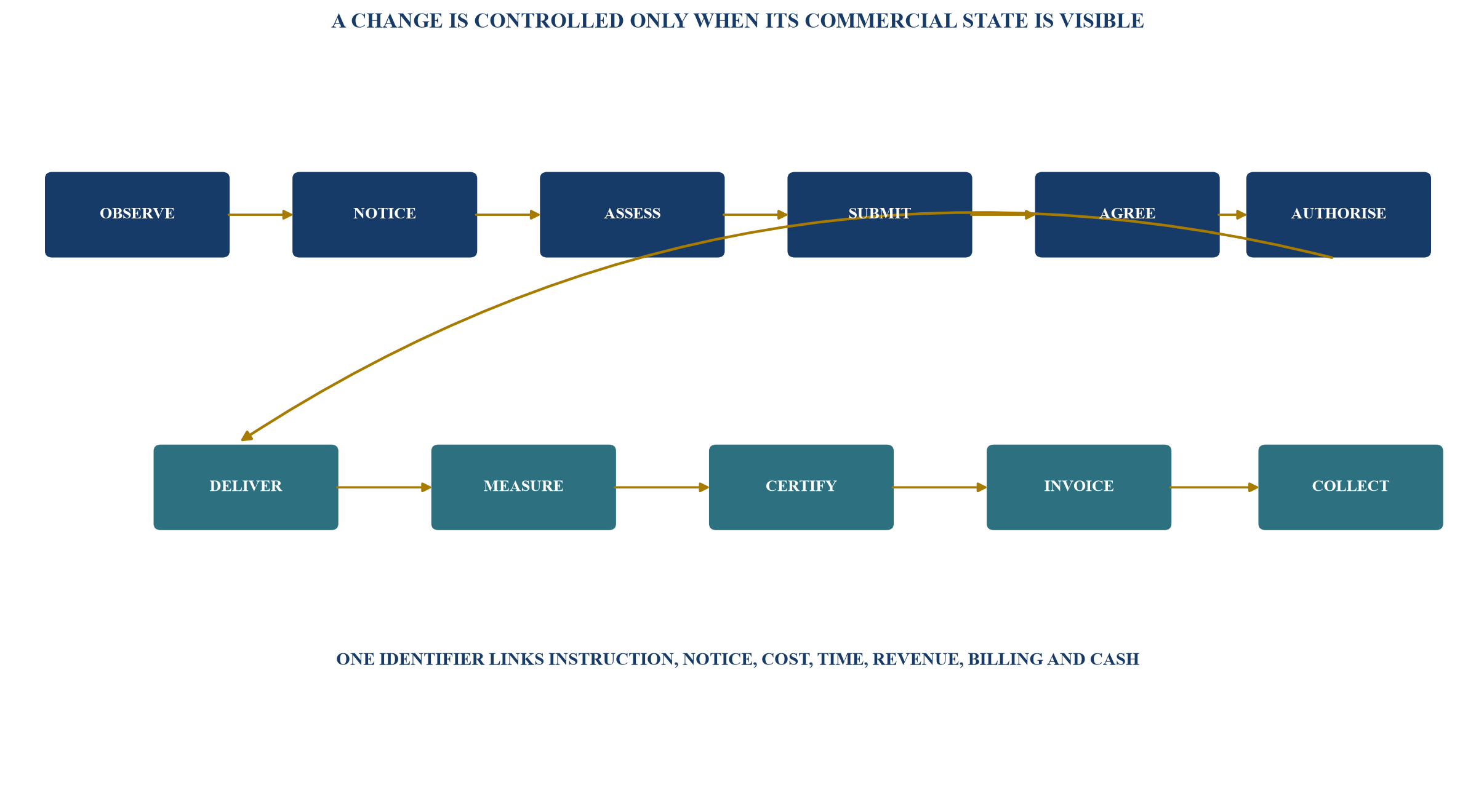
Contract-specific notice, authority and valuation requirements govern each transition.
7. Protect entitlement with notices and records
Notice provisions allocate information and procedural risk. The contract can require a notice within a defined period, to a named party, in a specified form and with stated particulars. The legal consequence of non-compliance depends on contract and governing law. Project teams should therefore maintain a notice matrix and obtain project-specific advice instead of relying on general practice.
The US Federal Acquisition Regulation provides a useful illustration of disciplined administration. FAR 52.243-4 treats specified written or oral directions as potential changes when the contractor gives written notice stating the circumstances and source. It also imposes a period for asserting adjustment rights, subject to the clause and agency procedures.[7] FAR 43.204 requires documentation, prompt negotiation of equitable adjustments and data on definitisation time for construction change orders.[8] These provisions do not govern every project, but they demonstrate why instruction, notice, time and cost records should remain connected.
Contemporaneous records should answer what happened, who directed it, when it occurred, which baseline activity was affected, which resources were used, what work was displaced and how the programme changed. Useful evidence includes dated drawings, requests for information, meeting minutes, correspondence, site diaries, photographs, model revisions, timesheets, plant logs, procurement records, quantity measurements, cost codes and schedule updates.
Evidence quality improves when capture is designed into operations. A supervisor selecting a change identifier on a timesheet is stronger than a commercial analyst reconstructing labour months later. A revised drawing linked to its instruction is stronger than a folder of versions without cause. A daily diary that records affected workfronts supports both management and later analysis.
The notice and evidence process should be proportionate. Small repetitive changes can use standard forms and agreed rates. Material events need fuller cause-effect analysis. The system should support rapid capture at the workface and deeper analysis by specialists without creating unnecessary administrative load.
8. Price change before cost becomes sunk
The strongest commercial position is often a priced and authorised change before execution. The proposal should define changed scope, omissions, interfaces, assumptions, programme effect, direct cost, indirect cost, escalation, risk, tax, fee and validity. It should state which baseline work is affected and prevent double counting. Where price cannot be agreed, the parties can use an approved provisional limit, daywork or other contractually permitted mechanism.
Pricing should distinguish the cost of changed work from disruption to unchanged work. A design revision can require new engineering hours, procurement cancellation, resequencing, idle time, reduced productivity and extended supervision. These effects require evidence and appropriate analysis. The proposal should identify cause and show how the effect differs from existing delay or internal inefficiency.
Rates should be governed. Existing bill rates or schedule rates may apply when the work is comparable and contract conditions support their use. New work can require new rates based on resources, productivity, overhead and fee. The FAR's equitable-adjustment guidance requires detailed breakdowns and separately identifies added, deleted and affected unchanged work in relevant federal contracting contexts.[9] Similar analytical discipline is useful in private contracts.
Approval authority should align with value and risk. Project teams can approve small changes within delegated limits. Material changes, cumulative scope movement, liability shifts or schedule concessions require senior review. The client-side approver's authority should also be verified. A technically accepted proposal may still lack contractual approval.
Unpriced change exposure should have limits. Management can set an absolute and percentage cap by project, customer and portfolio. Exceeding the limit triggers executive escalation, a stop-or-continue decision and explicit funding. This prevents the business from becoming the involuntary financier of unresolved scope.
Table 3. Controlled change register fields
| Field group | Required content | Evidence standard | Escalation trigger |
|---|---|---|---|
| cause and authority | instruction, event, source, date and authorised party | correspondence, drawing, minute or site record | authority unclear or disputed |
| contractual position | clause, notice, time bar and relief sought | reviewed notice and contract analysis | deadline within agreed warning window |
| scope and delivery | added, deleted and affected work, interfaces and safety | defined work package and owner | work starts without controlled basis |
| cost and time | resources, quantities, rates, disruption and programme effect | cost code and logic-linked analysis | estimate exceeds delegation or remains unpriced |
| decision state | submitted, queried, agreed, rejected or reserved | dated correspondence and approval | state unchanged beyond target days |
| accounting and cash | transaction-price treatment, application, certificate, invoice and receipt | finance policy and reconciled documents | recognised value lacks cash pathway |
Contract wording determines entitlement, notice and valuation; the register supports management rather than legal conclusions.
9. Integrate schedule, cost and commercial evidence
Project controls should provide the factual spine for commercial management. The baseline schedule, current schedule, cost ledger, commitments, progress measurement and change register should use aligned work breakdown and coding. A change identifier should connect the instruction to affected schedule activities and cost transactions. This enables management to distinguish baseline work, authorised change, pending change, rework and inefficiency.
Progress measurement should reflect the nature of the deliverable. Engineering can use weighted deliverables with defined maturity gates. Procurement can use verifiable milestones such as purchase order, manufacture, inspection, shipment and delivery. Construction can use measured quantities, installed progress or approved rules of credit. Percent-complete opinions without objective criteria create forecast and certification disputes.
Schedule updates should preserve logic and record cause. Progress override, broken links and unexplained constraint changes can hide delay. The planner should maintain contemporaneous narratives for critical-path movement and connect events to change records. Delay analysis for entitlement requires specialist judgement and contract-specific methodology; the operational schedule should still remain disciplined enough to support that work.
Cost-to-complete should be independent of desired margin. Remaining hours, quantities, rates, procurement commitments, risk and schedule duration should be estimated from current evidence. Expected commercial recovery can then be added through an explicit, governed layer. This separation exposes self-inflicted cost and prevents optimistic recovery assumptions from masking delivery deterioration.
A weekly integrated forecast should reconcile opening forecast, actual cost, commitments, remaining cost, approved changes, pending recoveries, risk, contingency and forecast margin. Changes between weeks should have explanations. Senior management should challenge movements in both operating and commercial assumptions.
10. Apply IFRS 15 without turning the change register into revenue
IFRS 15 defines a contract modification as an approved change in scope or price, or both, that creates or changes enforceable rights and obligations. Approval can be written, oral or implied by customary business practices, depending on facts and enforceability. When scope is approved and price remains unresolved, the entity estimates the transaction-price effect using the variable-consideration requirements.[1]
The Standard requires management to determine whether a modification is a separate contract or should be accounted for through the existing contract, based on the nature of remaining goods or services and pricing. Variable consideration is included only to the extent that it is highly probable that a significant reversal will not occur when uncertainty resolves. IFRS 15 also requires an appropriate measure of progress for obligations satisfied over time and updates to estimates as circumstances change.[1]
These accounting decisions require a documented policy and project-specific evidence. A notified change is not automatically approved. An approved technical instruction may not establish price. A strong contractual claim can still have uncertainty that affects the amount or timing of recognition. Conversely, a cash dispute may reflect credit risk rather than a price concession. The IASB's post-implementation review material acknowledges application challenges in distinguishing contract modifications, variable consideration, price reductions and expected credit losses.[10][11]
The commercial register should therefore feed a separate accounting assessment. Finance should record enforceability, approval, transaction-price method, constraint analysis, performance-obligation effect, progress measure, contract asset or receivable classification and required disclosure. The review should update at each reporting date and reconcile to project evidence.
The board should see at least four distinct values: approved contract value, operational forecast revenue, accounting transaction price and certified or billed value. Treating them as one number creates false confidence. The differences reveal where entitlement, recognition, certification and cash are disconnected.
11. Design the payment application as an evidence package
Payment applications should be assembled throughout the period. The package typically includes the contractual form, progress measurement, approved variations, supporting quantities, deliverable acceptance, timesheets or dayworks where relevant, material evidence, prior certificates, retention, tax and other required documents. The precise content follows the contract.
A pre-application review can identify disagreement before the formal deadline. The project manager, commercial manager and client representative can reconcile measurement, missing evidence and change status without waiving rights or bypassing contract requirements. The objective is a complete application that the certifier can assess efficiently.
Applications should reconcile from prior certified value to current cumulative value and period movement. Baseline work, approved change, provisional sums, dayworks, materials, retention, deductions and taxes should be separately visible. Values submitted for commercial preservation can be distinguished from those expected to certify, subject to legal and accounting advice.
The company should measure application quality. Metrics include first-pass completeness, days from period end to submission, percentage certified, disputed value, missing-document incidence and repeat query causes. A low certification ratio can result from aggressive application, weak evidence, measurement disagreement, unresolved change or client process delay. The remedy depends on the cause.
World Bank contract-management guidance emphasises planned milestones, deliverables, key performance indicators and active contract-management plans.[12][13] This discipline supports a payment process in which obligations, evidence and decisions remain visible rather than emerging only at month end.
12. Manage certification as a queue with aging clocks
Certification is a control process between performed work and invoicing. The business should record application date, contractual due date, reviewer, queries, resubmissions, amount applied, amount assessed, amount certified, deductions, withheld items and next action. Each line should have an aging clock from application and from the latest complete response.
The certification-aging schedule should separate administrative blockers, technical acceptance, measurement, rate agreement, change approval, contractual dispute, set-off, retention and client liquidity. These causes require different owners. Finance cannot resolve a missing design approval. The project manager cannot allocate an unidentified bank receipt. The control room assigns the correct function and keeps one escalation path.
Material gaps between application and certificate should feed the forecast. If the certifier consistently excludes pending variations, expected cash and working capital should reflect the observed delay. If deductions reveal quality or schedule issues, the project forecast should include corrective cost and potential commercial exposure.
The contract may provide deadlines, deemed approval, interest, adjudication, dispute boards or other remedies. Their availability and use require legal review. The operating dashboard should identify approaching deadlines and preserve evidence so management can decide before rights are weakened.
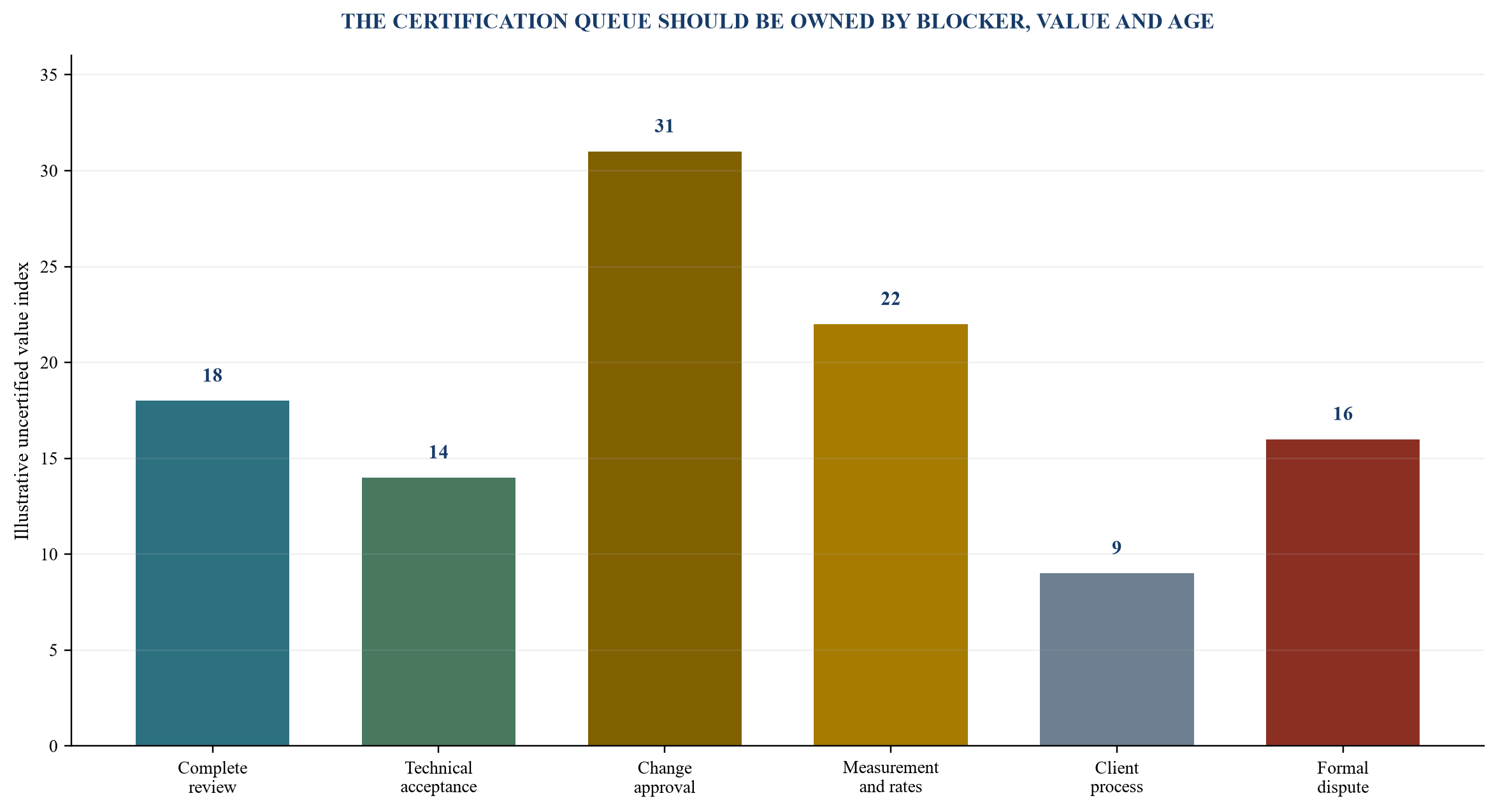
Values are hypothetical and show how a queue can be segmented for action.
13. Invoice immediately and correctly after certification
Certification should trigger a controlled invoice workflow. The invoice needs the correct legal entity, customer master data, purchase order, certificate reference, tax treatment, currency, bank account, period, retention and supporting documents. Errors create avoidable aging and can restart the customer's approval clock.
The trigger should be automated where systems permit, with human review of material exceptions. The company should measure days from certificate to invoice, invoice rejection rate and first-time accuracy. A certificate that remains uninvoiced is approved economic value without a formal payment claim.
Electronic invoicing regimes are expanding across jurisdictions. The operating design should retain structured identifiers linking contract, purchase order, certificate, invoice, credit note, payment and tax record. Electronic transmission improves identity and auditability; it does not replace proof of performance or resolve a substantive dispute.
Credit notes and invoice cancellation require governance. A customer request to reissue can be administrative, or it can signal a price concession, scope dispute or legal-entity problem. Finance and commercial teams should agree the reason and accounting treatment before altering the record.
Unbilled revenue and contract assets should be reconciled by project and reason. Categories can include timing under the revenue policy, pending certification, pending change approval, missing documentation and disputed entitlement. Aging and conversion history should influence challenge and provisioning.
14. Turn collections into a project discipline
Collections begin before the due date. The company should confirm invoice receipt, system acceptance, approval status, scheduled payment run and any missing document. Strategic or complex accounts need a collection plan identifying the commercial sponsor, project approver, accounts-payable contact, treasury route and escalation authority.
The receivables cockpit should show contractual due date, customer-promised date, last verified status, dispute code, owner, next action, expected cash and confidence. Generic notes such as chasing or client reviewing are insufficient. A useful note identifies the person, blocker, promised action and date.
Dispute resolution should link back to source evidence. A quantity dispute needs measurement. A quality dispute needs acceptance and remediation evidence. A rate dispute needs contract and variation records. A missing purchase order needs customer-side authority. Collections should route the blocker to the function able to resolve it and maintain contact cadence until closure.
Cash application completes the process. Unapplied receipts, short payments, withholding tax, bank charges, retention and cross-invoice netting can leave the ledger open after money arrives. Treasury and accounts receivable should match receipts promptly and return unexplained deductions to the commercial owner.
Payment behaviour can affect market access. UK government guidance states prompt-payment criteria for major public contracts and, following the Procurement Act 2023, describes 30-day payment terms in public procurement supply chains and spot checks on certain contracts.[14][15] Large UK businesses also have reporting obligations for payment practices and performance, with construction-specific reporting changes introduced in 2025.[16] Engineering groups bidding for public and tiered supply-chain work should treat payment performance as both a liquidity and qualification issue.
Table 4. Certification and collections control matrix
| Cash state | Primary owner | Required evidence | Weekly metric | Escalation question |
|---|---|---|---|---|
| work complete, not applied | project and commercial | progress and application pack | days from cut-off to submission | what evidence is missing? |
| applied, not certified | commercial and client reviewer | application, query log and response | value and days by blocker | which decision unlocks certification? |
| certified, not invoiced | finance operations | certificate, tax and customer data | days certificate to invoice | why has the trigger failed? |
| invoiced, not due | accounts receivable | accepted invoice and payment route | confirmed payment date | has the invoice entered the payment run? |
| overdue, undisputed | account sponsor and finance | promise, escalation and customer status | days past due and broken promises | who has authority to release payment? |
| overdue, disputed | project, commercial and legal as needed | coded dispute and source evidence | disputed value and age | what fact or remedy closes the issue? |
| received, unapplied | treasury and accounts receivable | bank receipt and remittance | unapplied cash age | which invoice and deduction does cash settle? |
Contractual and statutory deadlines require current jurisdiction-specific review.
15. Build a weekly bid-to-cash control room
The control room should make decisions, not merely review slides. A disciplined meeting can cover portfolio value at risk, margin bridge movements, unpriced change, notice deadlines, application and certification gaps, overdue receivables, cash forecast, disputes and required executive intervention. Project teams should bring current evidence and proposed actions.
The dashboard should use reconciled definitions. Contract value equals original award plus approved modifications. Pending change is separate. Forecast revenue follows the accounting policy. Certified value follows the certifier's decision. Billed value follows valid invoices. Collected cash follows bank evidence. Each metric should state source system, owner and refresh time.
Exception thresholds should direct attention. Examples include unpriced change above an approved percentage of contract value, notices due within five working days, forecast margin movement above a set level, applications submitted late, certification below target, invoices not issued within two days of certificate, overdue receivables above an amount or age, and cash forecast below minimum liquidity. Thresholds are management decisions calibrated to portfolio risk.
The meeting should record decisions and owners. A project can require a stop-work recommendation, executive customer engagement, additional records, a revised proposal, dispute escalation, forecast adjustment or cash contingency. The dashboard remains useful only when actions close and repeated blockers lead to process redesign.
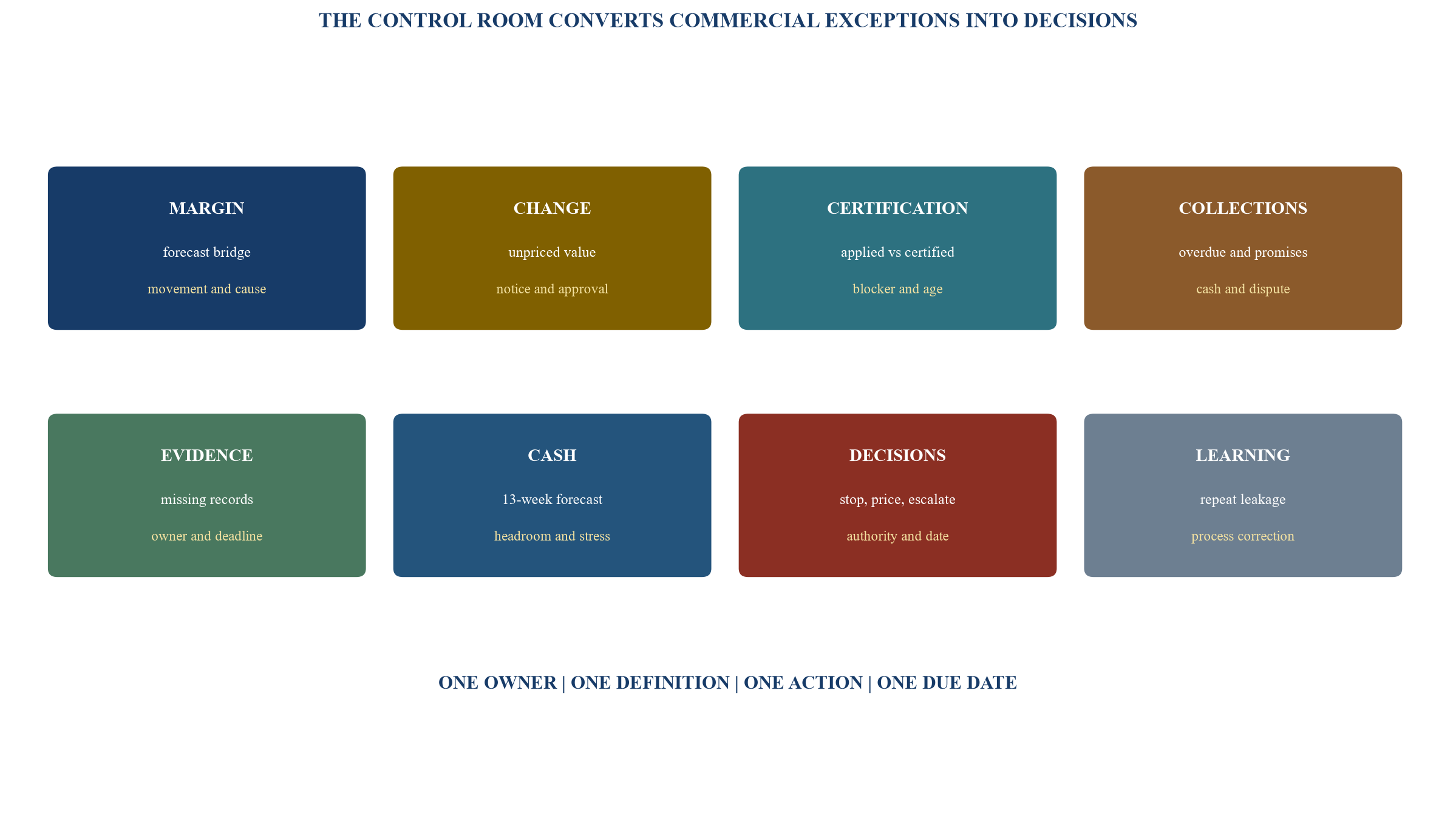
Illustrative thresholds and values require calibration to portfolio size, contract terms and risk appetite.
16. Align incentives and decision rights
Incentives can create leakage. Sales teams rewarded on award value may accept weak terms or unrealistic assumptions. Project managers rewarded on schedule may proceed with changed work before commercial control. Commercial teams rewarded on submitted claims may accumulate low-quality value. Finance teams rewarded on reported margin may resist necessary forecast correction. Collections teams measured only on overdue balances may focus on easy accounts and ignore root causes.
Balanced incentives should include quality of award, margin conversion, cash conversion, change cycle time, forecast accuracy, customer outcome and evidence discipline. Metrics should recognise controllability. A project manager should not absorb customer insolvency risk, but should own timely certification evidence and escalation. Sales should remain involved through mobilisation and early delivery to resolve tender assumptions.
Decision rights need boundaries. The bid sponsor approves strategic position and major concessions. The project director owns delivery and current forecast. The commercial manager owns notices, change records and application quality. Finance owns accounting policy, invoicing and ledger integrity. Treasury owns cash visibility. Legal advisers guide rights, process and disputes. Senior management decides material exposure, settlement and continuation.
The client relationship should have one accountable sponsor. Technical, commercial and finance contacts can engage their counterparts, while the sponsor ensures messages are consistent. Escalation should preserve the working relationship and make the required decision explicit.
17. Recover the existing portfolio without overstating value
A portfolio recovery sprint should identify projects with the largest combination of margin movement, unpriced change, uncertified applications, unbilled certificates, overdue receivables and final-account exposure. The team should rank recoverability using entitlement, evidence, counterparty, age, quantum, cost to pursue and expected timing. Large unsupported claims should not crowd out smaller, well-evidenced recoveries.
Each priority item needs a recovery thesis. It states the event, contractual basis, evidence, amount range, counterparty position, decision maker, negotiation path, accounting treatment, legal risks, cost and next date. Management should approve the objective: rapid cash, full entitlement, relationship preservation, precedent protection, project completion or negotiated close-out.
The business should distinguish recovery from forecast repair. If evidence does not support the existing forecast, management should correct the forecast while continuing a commercially justified claim. Delaying recognition of bad news until settlement weakens credibility and consumes time. A transparent downside can improve negotiating discipline because the organisation no longer depends on one optimistic outcome.
Settlement authority should consider total economics. A discount that releases immediate cash and management capacity may create more value than a long dispute. A concession that creates an adverse precedent across a portfolio may be expensive. Legal advice should address releases, reservation of rights, confidentiality, tax, accounting and enforceability.
Table 5. Portfolio recovery prioritisation
| Dimension | High-priority evidence | Lower-priority warning | Management use |
|---|---|---|---|
| entitlement | clear clause, authority and timely notice | rights unclear or time-bar concern | obtain legal and contract review |
| factual record | contemporaneous cause, resources and programme effect | reconstructed narrative or missing source records | close evidence gaps before escalation |
| quantum | traceable cost, rate and effect without duplication | top-down amount or unsupported disruption | rebuild pricing and independent challenge |
| counterparty path | identified decision maker and active timetable | no owner, repeated generic responses | sponsor escalation or formal route |
| cash timing | certification or settlement can convert promptly | value depends on distant final account | reflect liquidity realistically |
| strategic effect | protects precedent and customer economics | pursuit damages larger value without justification | approve objective and settlement range |
Scores and weights are hypothetical management assumptions and should be approved for each portfolio.
18. Execute a twelve-week reset
Weeks one and two establish the fact base. The team reconciles the project portfolio, contract value, forecast margin, change register, applications, certificates, invoices, receivables and cash. It selects priority projects and identifies data-quality failures. No recovery claim should be created merely to improve the dashboard.
Weeks three and four rebuild the commercial baseline for priority projects. The team retrieves contract documents, tender assumptions, schedules, cost records, correspondence and payment history. It produces margin bridges, notice calendars, certification-aging schedules and recovery theses. Forecast corrections are routed through normal governance.
Weeks five to eight pursue value and repair operations. Project teams submit missing notices or proposals where rights and advice support them, close evidence gaps, reconcile measurement, accelerate certificates, issue invoices and resolve collection blockers. Senior sponsors engage counterparties on specific decisions. Finance updates cash and accounting assessments.
Weeks nine and ten redesign the forward process. The company establishes qualification gates, tender baseline standards, mobilisation handover, change identifiers, cost codes, authority matrices, application checklists, certification workflow and collections cockpit. System changes should support the process rather than delay useful control.
Weeks eleven and twelve transfer ownership. Executives approve thresholds, meeting cadence, role descriptions, policies and incentive changes. Project leaders receive training using live examples. Internal audit or another independent function tests a sample from bid through cash. The programme closes only when owners can operate the control room without the reset team.
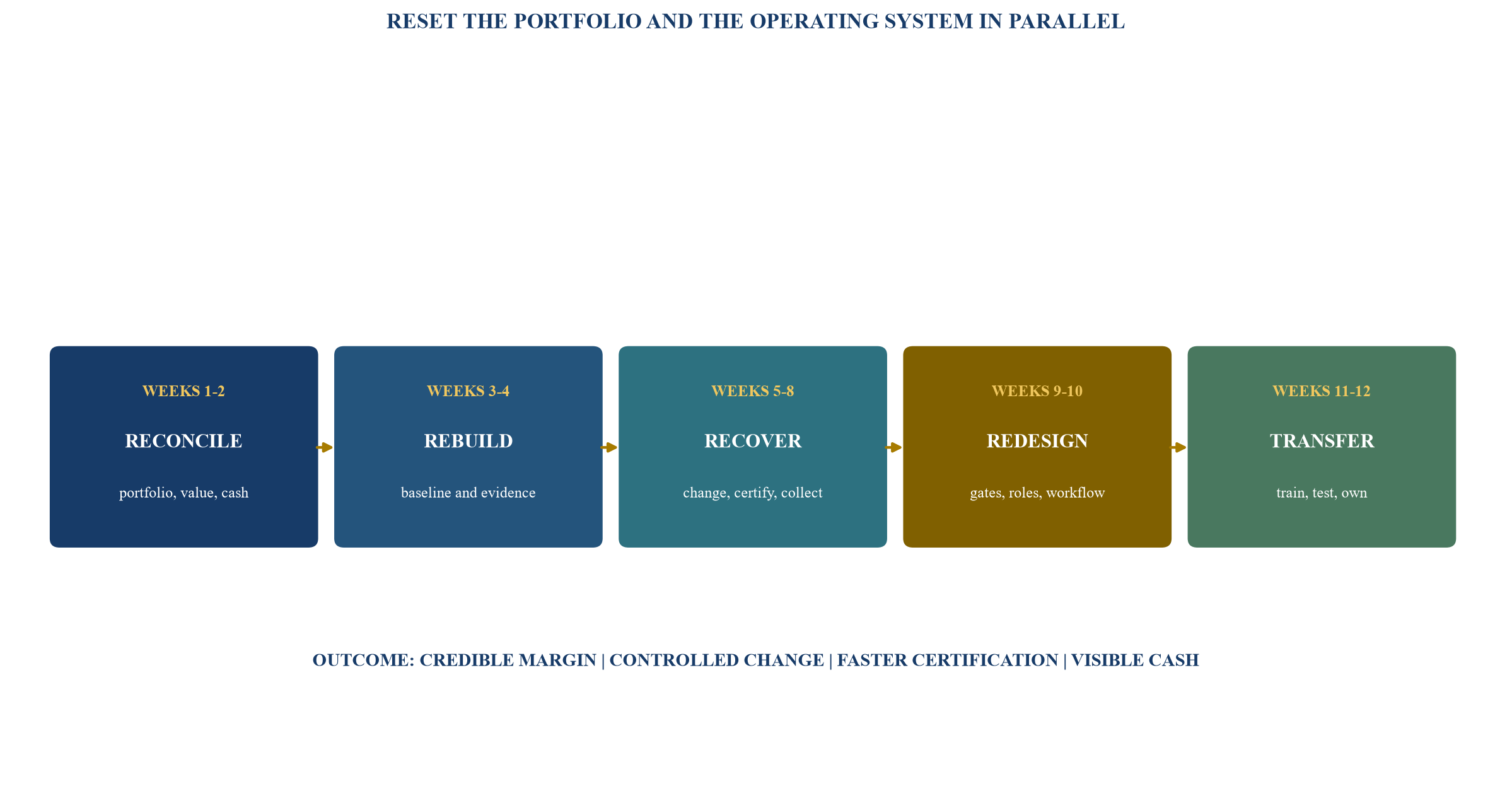
Timing is illustrative and depends on portfolio scale, evidence quality and contractual urgency.
Table 6. Twelve-week reset deliverables and gates
| Period | Core deliverable | Value action | Control gate |
|---|---|---|---|
| weeks 1-2 | reconciled portfolio and leakage heatmap | select priority value and cash items | source data agrees across project, finance and bank records |
| weeks 3-4 | baselines, margin bridges and recovery theses | correct forecasts and define recovery paths | rights, evidence and accounting states separated |
| weeks 5-8 | notices, proposals, certificates, invoices and collection actions | convert recoverable items toward cash | senior approval for material positions and settlements |
| weeks 9-10 | redesigned bid, mobilisation, change and cash workflows | prevent recurrence on new and live work | authority, identifiers, evidence and thresholds configured |
| weeks 11-12 | trained owners, tested dashboard and assurance sample | embed weekly control room | owners demonstrate end-to-end operation |
Each deliverable should be evidenced, owned and approved before transfer to routine governance.
19. Use technology to strengthen evidence and attention
Technology should create transaction identity and workflow discipline. A common project, work-breakdown, contract, change, application, certificate, invoice and receipt identifier allows data to move across estimating, scheduling, enterprise-resource-planning, document-management and customer systems. Interfaces should preserve source documents and audit history.
Workflow tools can route notices, approvals, pricing, application packs and escalation. Mobile capture can link photographs, diaries, quantities and timesheets to work packages and change identifiers. Rules can flag work charged to pending changes, missing authority, notice deadlines, aged certification and broken payment promises.
Analytical models can identify recurring variance, inconsistent rates, unusual deductions, duplicated claims, delayed approvals and forecast bias. Generative tools can help organise correspondence or draft internal summaries when confidentiality, accuracy and human review controls are in place. Contract interpretation, entitlement, accounting judgement and external submissions remain accountable human decisions.
The data model should avoid false precision. Status labels require defined evidence. Forecast confidence should be traceable to inputs. Automated alerts should lead to an owner and decision. A dashboard with stale or unreconciled data can accelerate the wrong action.
Access, retention, privilege, data protection and cyber security require governance. Dispute material and personal data may need restricted handling. The system should preserve original records, revisions, approvals and exports needed for audit or proceedings.
20. Measure the reset through economic outcomes
The primary outcomes are forecast credibility, protected margin and collected cash. Supporting measures include tender-to-mobilisation variance, unpriced change exposure, average time from event to notice, time from notice to priced submission, change approval cycle, application timeliness, certification ratio, certificate-to-invoice days, overdue receivables, broken promises, unapplied cash and final-account duration.
Metrics should show distributions and value, not only averages. One large unresolved change can dominate portfolio risk. Aging bands reveal whether exposure is moving. Project, customer, geography, contract type and business-unit views can identify structural causes.
Forecast accuracy should compare prior forecasts with actual cost, approved value and cash. Persistent optimism requires governance response. A project that repeatedly moves recovery into later periods should face stronger evidence thresholds. A business unit that preserves margin while extending cash may need working-capital accountability.
Customer outcomes remain important. Faster decisions, clearer scope and complete applications can reduce client administration and dispute. The reset should track service, quality, schedule and relationship indicators so commercial control does not become indiscriminate confrontation.
Board reporting should connect the operational measures to enterprise value. Margin at risk, cash trapped, funding cost, covenant headroom, bond exposure and dispute cost translate project administration into capital-allocation decisions. The objective is a business that chooses work intelligently, delivers within controlled scope and converts earned value into cash with credible evidence.
Conclusion
Engineering margin is created at tender, protected in delivery and realised in cash. Weakness at any transition can turn profitable technical work into disputed value, unreliable forecasts and avoidable borrowing.
The bid-to-cash reset treats the commercial chain as one operating system. Opportunity qualification tests whether the work deserves bid capital. The tender baseline connects scope, resources, schedule, terms and cash. Mobilisation transfers assumptions and authority. A controlled change path links instruction, notice, evidence, cost, time, approval, accounting, certification, invoice and collection.
The margin bridge distinguishes baseline correction, client change, delivery variance, external events and settlement. Project controls connect schedule and cost to commercial evidence. IFRS 15 assessment remains a governed finance decision rather than an automatic output of the change register. Payment applications become complete evidence packages. Certification and collections become visible queues with aging clocks and accountable owners.
A weekly control room concentrates management attention on value at risk and required decisions. A twelve-week programme can recover priority items while redesigning the process for future work. Technology then supports identifiers, workflow, evidence and analytics within clear accountability.
The result is a more credible engineering business: bids are selective, scope is explicit, changes are controlled, forecasts are challengeable, certificates move faster and cash follows completed work through a traceable path.
References
- IFRS Foundation. IFRS 15 Revenue from Contracts with Customers. https://www.ifrs.org/issued-standards/list-of-standards/ifrs-15-revenue-from-contracts-with-customers/
- AACE International. Recommended Practices and Standards. https://web.aacei.org/resources/publications/recommended-practices
- AACE International. 100R-19 Contract Change Management as Applied in Engineering, Procurement, and Construction. https://web.aacei.org/docs/default-source/toc/toc_100r-19.pdf
- International Federation of Consulting Engineers. Construction Contract, Second Edition 2017 Red Book. https://fidic.org/books/construction-contract-2nd-ed-2017-red-book
- International Federation of Consulting Engineers. Construction Claims and Responses: Effective Writing and Presentation. https://fidic.org/books/construction-claims-responses-effective-writing-presentation
- International Federation of Consulting Engineers. Management of Variations and Claims. https://fidic.org/sites/default/files/Fidic%202017%20-%20Mod%201_Mod%202_%20Beirut_%203-4%2C5-6%20July%202017.pdf
- United States Government. Federal Acquisition Regulation 52.243-4, Changes. https://www.acquisition.gov/far/52.243-4
- United States Government. Federal Acquisition Regulation 43.204, Administration of Change Orders. https://www.acquisition.gov/far/43.204
- United States General Services Administration. GSAM 552.243-71, Equitable Adjustments. https://www.acquisition.gov/gsam/552.243-71
- IFRS Foundation. Post-implementation Review of IFRS 15: Requirements for the Five-step Model. https://www.ifrs.org/content/dam/ifrs/meetings/2023/march/iasb/ap6c-ifrs-15-pir-feedback-5-step-model.pdf
- IFRS Foundation. Applying IFRS 15 with IFRS 9. https://www.ifrs.org/content/dam/ifrs/meetings/2024/april/iasb/ap6a-ifrs15-pir-applying-ifrs-15-with-ifrs-9.pdf
- World Bank. Contract Management: Practice. https://pubdocs.worldbank.org/en/531561507743080555/Contract-Management-Guidance2017.pdf
- World Bank. Systematic Tracking of Exchanges in Procurement. https://projects.worldbank.org/en/projects-operations/products-and-services/brief/systematic-tracking-of-exchanges-in-procurement-step
- United Kingdom Government. Prompt Payment Policy. https://www.gov.uk/guidance/prompt-payment-policy
- United Kingdom Government. Procurement Act 2023. https://www.legislation.gov.uk/ukpga/2023/54/contents
- United Kingdom Government. Business Payment Practices and Performance Reporting Requirements. https://www.gov.uk/government/publications/business-payment-practices-and-performance-reporting-requirements
- Project Management Institute. Scope Change Control. https://www.pmi.org/learning/library/scope-control-projects-you-6972
- United States Government. Federal Acquisition Regulation Part 43, Contract Modifications. https://www.acquisition.gov/far/part-43
