

1. Automation investment fails when the financing question begins with the machine
Industrial automation is commonly presented as an equipment decision: select a robot, machine tool, vision system, warehouse system or production line and calculate payback from labour savings or additional output. That framing is incomplete. The customer is buying a production capability whose value depends on the interaction of hardware, software, tooling, utilities, materials, operators, quality controls and downstream demand. A machine can pass its factory test and still fail to deliver the customer's expected economics after installation.
Adoption is substantial. The International Federation of Robotics reports that 542,000 industrial robots were installed in 2024, more than twice the number ten years earlier [1]. The scale of adoption supports a mature equipment ecosystem, while each plant remains site-specific. Product mix, takt time, material variation, line balance, skills, maintenance and legacy systems shape realised performance. Financing that relies only on equipment invoices and nominal capacity therefore misses the principal operating risks.
Traditional purchase places most capital and performance exposure with the customer. A finance lease spreads payment but may leave integration, uptime and obsolescence risk largely unchanged. Equipment-as-a-Service, or EaaS, can make a provider responsible for defined service outcomes over time. The provider may combine equipment, installation, software, monitoring, maintenance, spares and upgrades into one commercial proposition. Capital can then be repaid from recurring service cash flow rather than a single equipment sale.
The structure works only when outcome, evidence and control are aligned. A provider cannot guarantee production volumes that depend on customer orders, input material or staffing. A customer cannot demand full service credits for a stoppage caused by an unavailable utility or an unapproved product change. A lender cannot treat invoiced service charges as dependable cash flow when acceptance, measurement and dispute rules are vague. The transaction must begin with a controlled definition of service and a map of the conditions required to produce it.
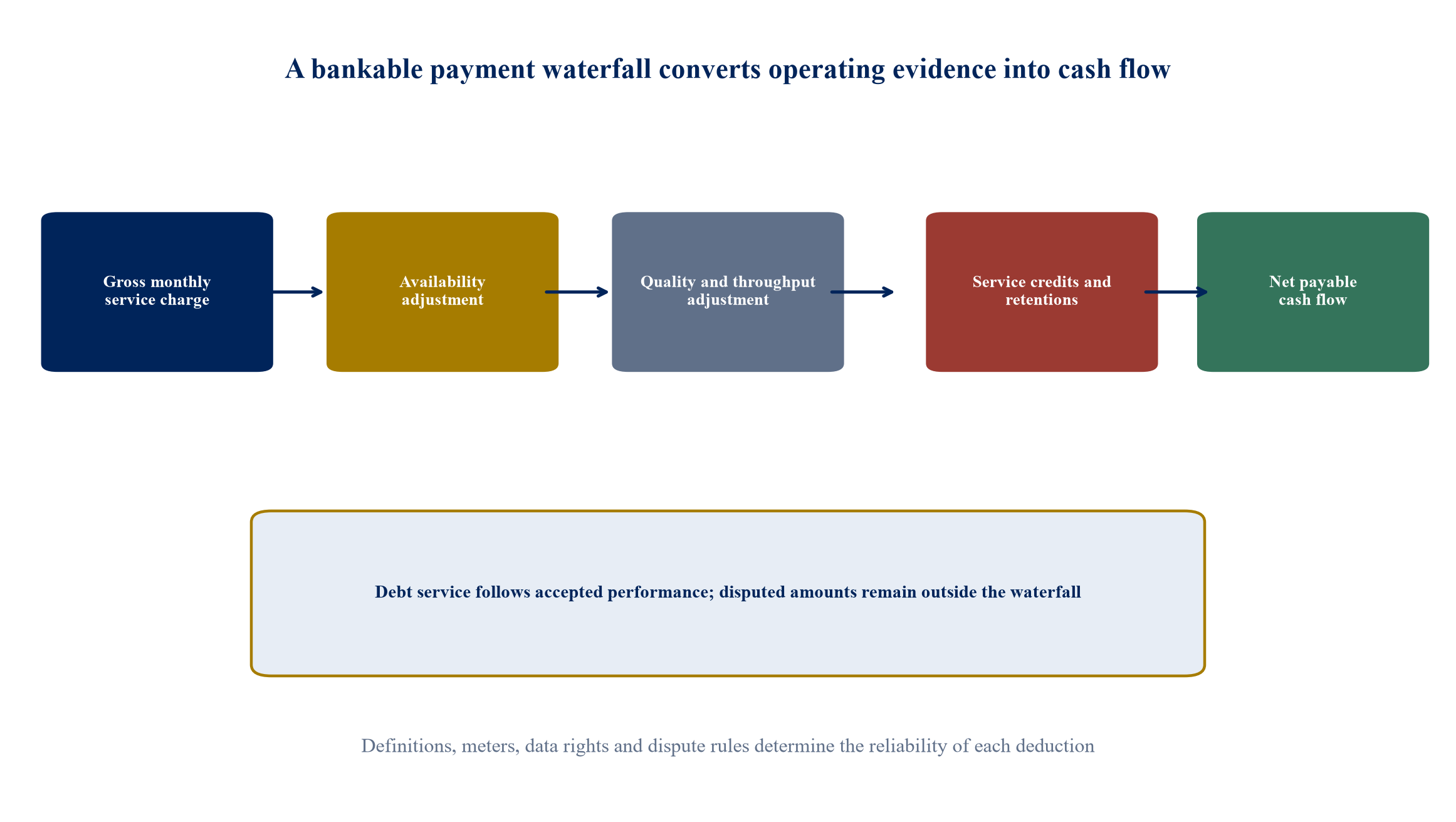
Author-designed framework. Payment deductions and priorities require transaction-specific legal, accounting, tax and credit review.
2. Define Equipment-as-a-Service by rights and obligations
EaaS is a commercial architecture rather than a single financing product. At one end, it resembles a rental or lease: the customer controls identified equipment and pays a fixed amount. At the other, it resembles a managed production service: the provider decides how to deploy equipment and supplies a specified output or availability level. Many contracts combine both characteristics with software, maintenance and variable charges. The legal and accounting result follows the substantive rights, not the marketing label.
The service definition should identify the unit being purchased. It may be equipment availability, productive machine hours, accepted units, tonnes processed, picks completed, welds inspected, energy saved or another operational result. Each unit has strengths and limitations. Availability is comparatively observable but does not prove output quality. Accepted units connect payment to value but expose the provider to customer demand and input variability. Energy savings require a credible counterfactual baseline. A blended charge can match fixed capital recovery with variable customer use.
The contract should state the boundary of the service. Equipment supply, installation, commissioning, tooling, controls, software, network interfaces, training, preventive maintenance, corrective maintenance, spares, consumables, calibration, upgrades and decommissioning may sit inside or outside the provider's obligation. Ambiguity creates hidden capital requirements and operational gaps. A responsibility matrix should identify the party that performs, approves, pays for and bears delay risk for each element.
Control rights must follow responsibility. A provider held accountable for uptime needs timely maintenance access, approved spare parts, remote monitoring and change control. A customer needs production priority, safety oversight, cyber protections, data rights and remedies for sustained underperformance. The lender needs assignment, notice, cure and step-in rights consistent with plant safety and customer continuity. These interests can coexist where the contract distinguishes ordinary operating control from ownership and enforcement rights.
3. Test the accounting substance before making balance-sheet claims
IFRS 16 defines a lease through the right to control the use of an identified asset for a period in exchange for consideration. Control requires the right to obtain substantially all economic benefits and the right to direct how and for what purpose the asset is used [2]. An EaaS contract can therefore contain a lease even when invoices use service terminology. Identified equipment, limited substitution rights and customer decision-making can support a lease conclusion.
A supplier's substitution right matters only when it is substantive. The supplier must have the practical ability to substitute the asset throughout the period and expect to benefit economically from doing so [3]. A contractual statement that equipment may be replaced has limited effect when specialised installation, tooling, qualification or site access makes substitution impractical. Conversely, a genuinely pooled fleet that can be redeployed without disrupting the service can support a different analysis.
Operation and maintenance do not automatically determine who directs use. IFRS implementation material distinguishes decisions about how and for what purpose an asset is used from decisions that merely operate or maintain it [4]. A customer may pre-determine production specifications while the provider controls day-to-day operation, or the reverse. The assessment requires a complete rights map covering product, schedule, volume, location, operating parameters, substitution, access and modification.
Service and lease components may coexist and require separation under the applicable requirements. IFRS 15 governs revenue from customer contracts and requires identification of performance obligations, determination of transaction price, allocation to distinct promises and recognition as control transfers [5]. Availability deductions, performance bonuses, usage charges and service credits can create variable consideration. The provider must assess constraint, enforceability and measurement. Customers and providers should obtain transaction-specific accounting advice before approval; financial models should include plausible accounting outcomes and covenant implications.
4. Translate the production objective into a measurable service
The service specification begins with the customer's production objective. It should state the products or families covered, required capacity, operating pattern, quality standard, changeover frequency, traceability, safety constraints and interfaces to upstream and downstream processes. The parties should distinguish nameplate capability from the service level that can be demonstrated under agreed conditions. A line designed for 100 units per minute may have lower sustainable throughput after planned cleaning, changeovers and quality checks.
Availability is normally defined as the time the service is capable of operating divided by a defined scheduled time. The denominator is critical. Planned maintenance, customer shutdowns, lack of material, utility failures, safety stops, product trials and force majeure may be excluded or treated separately. A broad exclusion list can make a headline availability guarantee meaningless. A narrow list can place uncontrollable customer risk on the provider. Each exclusion should have an owner, evidence source and maximum response time.
Quality should refer to accepted output, not merely machine completion. Relevant measures include first-pass yield, defect rate, scrap, rework, dimensional conformity, false-positive inspection and traceability completeness. Throughput should be measured only when the agreed inputs, product mix and line conditions are present. The service can use a matrix combining availability, quality and throughput so that no single metric rewards undesirable behaviour. Maximising speed while creating defects should reduce, rather than increase, payment.
ISO 22400-2 provides manufacturing-operations management KPI definitions, descriptions and formula elements that can support consistent performance measurement [6]. The standard does not replace site-specific engineering or commercial agreement. It offers a disciplined vocabulary that can be reconciled with the customer's manufacturing execution system, enterprise systems and operating procedures. The contract should contain a metric dictionary, calculation examples and a hierarchy for resolving inconsistencies between data sources.
5. Establish the baseline and measurement system before financial close
An outcome-linked contract needs a baseline. For a capacity project, the baseline may be current throughput, bottleneck time and demand. For a quality project, it may be defect and rework rates by product. For an energy-efficiency project, it includes production-normalised consumption, operating hours, weather or process variables. The baseline period should be sufficiently representative and should exclude exceptional events only through documented rules.
Measurement architecture should identify sensors, meters, programmable logic controllers, manufacturing execution systems, quality systems and financial records. Each data field needs an owner, frequency, timestamp, unit, retention period and validation rule. The parties should agree which system prevails when records conflict. A lender will want evidence that the same data determining customer payment cannot be altered by one party without detection.
Data quality controls include calibration, reconciliation, missing-data treatment, outlier review, access logs and version control. A short outage should trigger an agreed estimation method. A longer outage may move the service into a conservative fallback state. Manual overrides and quality dispositions should be visible. Independent verification can be proportionate: continuous third-party review is rarely necessary, while periodic assurance and event-driven audits can materially improve confidence.
The baseline must adapt to legitimate change. New products, revised specifications, different materials, extended shifts, plant expansion and customer-directed process changes can alter attainable performance. A change-control mechanism should state when the baseline is re-opened, who provides evidence, how price is adjusted and how interim performance is treated. Without that mechanism, a commercially successful plant can create disputes because the original service definition no longer matches operations.
6. Allocate integration risk to a single accountable architecture
Automation projects cross mechanical, electrical, controls, software, process and organisational boundaries. Individual components can meet specification while the combined cell misses cycle time or quality. A single integration architecture should map equipment, tooling, controls, safety systems, data interfaces, utilities, building works and production processes. The lead integrator must own the complete acceptance result or the contract must establish a clear multi-party interface regime.
Site readiness is a customer and provider dependency. Foundations, power quality, compressed air, cooling, network connectivity, permits, material supply, upstream equipment and operator access can affect installation. The project schedule should include verifiable readiness gates and consequences for delay. Provider-caused delay may support liquidated damages or deferred payment; customer-caused delay may extend time and require documented standby cost. The contract should prevent either party from converting minor slippage into an unbounded claim.
Factory acceptance testing demonstrates that equipment meets defined functions before shipment. Site acceptance testing demonstrates performance in the installed environment. Production acceptance should then prove service under agreed product mix and duration. A short demonstration using ideal inputs can hide reliability and changeover problems. The acceptance programme should include endurance, fault recovery, safety, data, cyber, quality and maintainability tests.
Ramp-up deserves a separate regime. Early operation includes learning, tuning and workforce adaptation. The payment waterfall can use staged availability thresholds during a defined ramp period, provided minimum safety and quality remain absolute. Capital draws can follow factory acceptance, site acceptance, provisional production acceptance and final acceptance. This milestone structure prevents the entire equipment facility from funding before the service has been demonstrated.
Table 1. Purchase, lease and Equipment-as-a-Service decision matrix
| Dimension | Direct purchase | Equipment lease | Equipment-as-a-Service |
|---|---|---|---|
| Initial cash requirement | Customer funds purchase and integration | Financed equipment payment, often with deposit and customer integration cost | Provider or vehicle funds equipment; customer may fund mobilisation or site works |
| Performance allocation | Customer bears operating outcome after warranties | Often similar to purchase after equipment delivery | Provider can bear defined availability, maintenance and selected outcome obligations |
| Payment basis | Purchase price and maintenance | Fixed rental, possibly with variable elements | Fixed readiness, availability, usage or accepted-output charge |
| Control and accounting | Customer ownership is clear | Lease assessment is central | Lease and service analysis remains necessary; label is not determinative |
| Obsolescence and residual value | Primarily customer | Allocated through lease and end-of-term terms | Provider or financing vehicle can retain risk, subject to contract and practical redeployability |
| Integration risk | Customer or integrator contract | Often outside lease | Can be included in provider obligation with acceptance gates |
| Data and operating access | Customer controls | Customer usually controls | Shared rights are required for service measurement and maintenance |
| Best fit | Stable specification, capital available, strong internal capability | Predictable use and conventional asset | Measurable service, provider capability and credible recurring cash flow |
The matrix is an author-designed comparison. Actual accounting, tax, legal and financing outcomes depend on transaction terms and jurisdiction.
7. Build the contract around a complete responsibility matrix
The customer agreement should combine a service description, technical schedules, performance regime, payment terms and lifecycle rights. It should identify the equipment and site where relevant without assuming that identification settles the accounting analysis. Drawings, bill of materials, software versions, interfaces, approved inputs and operating envelopes belong in controlled schedules. Changes should require documented technical and commercial approval.
Responsibilities cover design, procurement, installation, commissioning, permits, safety, utilities, production planning, staffing, materials, consumables, cleaning, calibration, maintenance, spares, software, cyber security, insurance and decommissioning. Each task needs an accountable party and supporting evidence. The matrix should also state who bears consequences when a dependency fails. For example, the provider may guarantee equipment availability while the customer bears lost output caused by unavailable raw material.
The provider needs access that is sufficient and bounded. Planned maintenance windows, emergency access, remote access, escort requirements and safety induction should be agreed. Customer security policies apply, yet a blanket refusal of access can prevent the provider from meeting its obligation. The contract can distinguish monitoring, diagnosis and control privileges and require approval for changes affecting production or safety.
Dispute procedures should preserve operations and cash flow. Undisputed amounts remain payable. A technical expert can determine measurement or causation disputes within a short timetable, while legal disputes follow the governing process. The agreement should require contemporaneous data and root-cause analysis. Repeated disputes over the same metric can trigger an independent measurement audit and, if necessary, a reset of the calculation protocol.
8. Apply a transparent hypothetical case
Consider a hypothetical mid-market engineering manufacturer installing three automation cells for machining, inspection and material handling. Every amount, percentage, performance threshold and operating result in this section is an author assumption created to demonstrate the framework. It is not an observed transaction, market quote, forecast or recommendation. The assumed installed cost is USD 15 million, including equipment, controls, integration, site works, commissioning and initial spares.
The provider funds the programme with USD 3 million of equity, USD 9 million of senior equipment debt and USD 3 million of vendor or subordinated capital. The customer pays an annual readiness charge of USD 1.10 million and a usage charge of USD 0.12 for each accepted unit. At an assumed eight million accepted units, the usage charge is USD 0.96 million and the gross annual charge is USD 2.06 million before performance adjustments.
The assumed target availability is 97 percent and the minimum service floor is 92 percent. Quality is measured through first-pass yield, with a 98 percent target after agreed exclusions. Throughput applies only when the specified product mix, material, utilities, staffing and upstream conditions are present. Payments below target follow pre-agreed bands, subject to caps and a separate persistent-default regime. Safety breach, data manipulation or unauthorised change is governed separately and is not cured by paying a service credit.
At year five, the author assumes three redeployment outcomes: 35 percent, 20 percent and 5 percent of original equipment cost. The wide range reflects uncertainty around specialisation, removal cost, software rights, technical condition, demand and requalification. Senior debt should not rely on the upside case. The base financial model uses contracted service cash flow after conservative deductions, reserve funding, maintenance, insurance and taxes, while residual value supports recovery analysis rather than routine debt service.
9. Convert performance into a controlled payment waterfall
The payment waterfall begins with a gross service charge. A fixed readiness component can support unavoidable capital and standing costs. An availability component can reward the provider for keeping the system capable of operation. A usage or accepted-output component aligns payment with customer activity. The mix should reflect who controls volume. A provider should not carry unrestricted demand risk when the customer decides whether to schedule production.
Performance adjustments require a clear sequence. Availability is calculated first against scheduled service time. Quality and throughput adjustments then apply to periods when service was available and required inputs were present. Service credits, retentions and disputed amounts are deducted under agreed caps. Taxes and pass-through costs are addressed separately. The resulting net payable cash flow enters the secured collection account.
Cash priority can pay operating costs required to preserve service, senior debt service, reserve accounts, approved lifecycle capital, subordinated capital and provider distributions. Direct payment or account control can improve lender confidence, subject to customer consent and insolvency analysis. The provider should retain adequate working capital because invoice timing and performance reconciliation can create a gap between service delivery and cash collection.
IFRS 15 treats discounts, rebates, refunds, credits, incentives, performance bonuses and penalties as forms of variable consideration where applicable [7]. The provider's accounting may therefore differ from cash invoicing. The finance model should reconcile billed, recognised, collected and available cash. Covenant definitions should use an observable measure and prevent disputed or constrained revenue from inflating debt-service coverage.
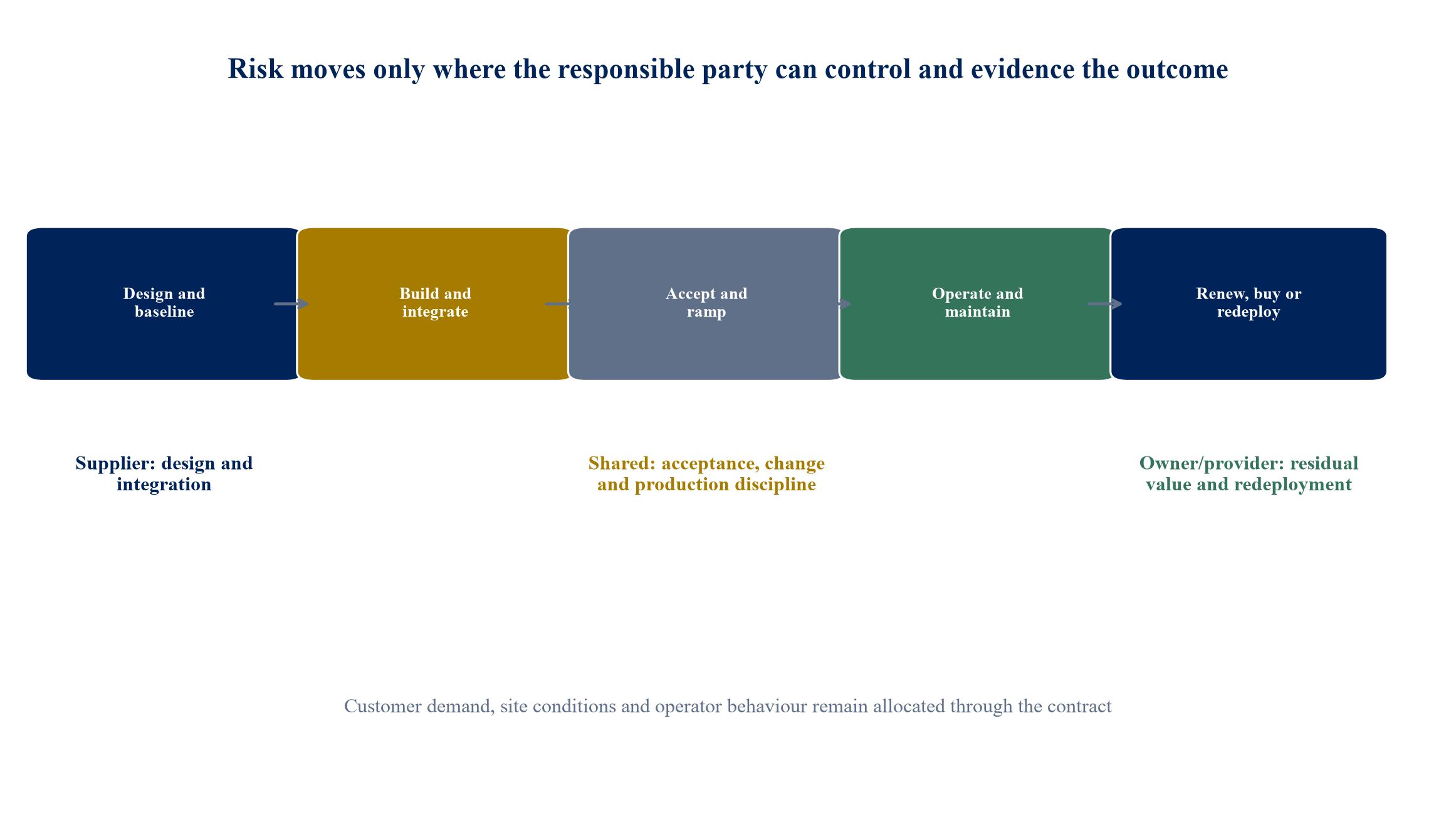
Author-designed framework. Responsibility should follow practical control, evidence and applicable law at each lifecycle stage.
10. Match the financing stack to the service risk
The financing vehicle can be the equipment provider, a special-purpose owner or a partnership between manufacturer, provider and capital source. A separate vehicle can isolate equipment and cash flow, while adding governance, tax, accounting, licensing and insolvency questions. The structure should serve an identifiable risk-allocation purpose. Complexity without control or recovery benefit weakens the proposition.
Provider equity absorbs development, integration and early-performance risk. Senior equipment debt funds accepted assets and relies on contracted cash flow, security and a conservative recovery case. Vendor or subordinated capital can bridge commissioning, demonstrate confidence and absorb first loss. Customer mobilisation payments may fund bespoke engineering, while guarantees, letters of credit or deposits can support early termination exposure. Public support may be appropriate where productivity, energy efficiency or resilience objectives are documented.
Draw conditions should track evidence. Initial draws can fund long-lead equipment after contract effectiveness, permits and customer credit approval. Later draws follow factory acceptance, delivery, site installation and production acceptance. The lender should receive independent-engineer confirmation where the scale or technical risk justifies it. Cost overruns remain allocated through fixed-price scope, contingency, sponsor support and change orders rather than being assumed away.
Debt tenor should fit the enforceable service term and economic life. A contract that the customer can terminate for convenience without adequate compensation does not support long-dated debt. Termination value can include outstanding senior debt, unavoidable demobilisation, committed vendor liabilities and a calibrated equity amount, adjusted for provider fault. Enforcement must remain compatible with safe plant operation, customer continuity and applicable insolvency law.
Table 2. KPI evidence and anti-gaming controls
| Measure | Primary evidence | Common distortion | Control response |
|---|---|---|---|
| Availability | Controller state, downtime code and scheduled-time calendar | Reclassifying provider downtime as customer exclusion | Locked reason codes, dual approval and periodic audit |
| First-pass yield | Quality system and accepted-unit records | Deferring inspection or changing rejection thresholds | Controlled specifications, timestamped results and traceability |
| Throughput | Good units per qualified operating period | Running easy products or excess speed | Product-mix normalisation and quality gate |
| Energy performance | Metered energy normalised to production | Selecting an unrepresentative baseline | Agreed baseline period, adjustment model and independent review |
| Maintenance response | Work orders, alarm log and parts issue | Closing tickets without restored performance | Restoration test and customer confirmation |
| Customer exclusions | Utility, material, staffing and production records | Broad or retrospective exclusions | Defined evidence hierarchy and time-limited notification |
| Cyber availability | Authenticated logs and incident records | Suppressing remote-access or control incidents | Segregated logs, notification duty and assurance testing |
The controls are author-designed and require site-specific engineering, legal and systems validation.
11. Underwrite residual value and redeployment as an operating capability
Residual value is often presented as a percentage in a financial model. Realisable value depends on whether the equipment can be removed, transported, reconfigured, licensed and accepted by another user. Highly standardised robots, drives and controls may have a broader secondary market than custom tooling, foundations, safety systems and integrated software. A valuation should separate reusable modules from site-specific cost.
The redeployment plan should identify title, serial numbers, software rights, maintenance history, condition monitoring, dismantling method, storage, transport, export controls, taxes and re-certification. The owner needs access rights after termination and a practical route through the customer's site. If removal would interrupt essential production or damage the building, contractual title may provide limited recovery. The security package should therefore be tested operationally.
Technology change can compress value. New control architectures, unsupported software, unavailable spares or revised safety requirements can make physically functional equipment uneconomic to reuse. The European Union's Machinery Regulation 2023/1230 addresses emerging digital and AI-related safety concerns and applies from 20 January 2027 [8]. Equipment intended for long life needs a compliance, update and documentation plan that survives provider or software-vendor failure.
Debt sizing should use a downside recovery case after removal, refurbishment, broker, transport, tax, storage and remarketing cost. Residual value can support a balloon only where evidence is strong and concentration is manageable. Otherwise, amortisation should be supported by service cash flow during the contracted term. Provider equity receives the benefit of upside redeployment after senior obligations are protected.
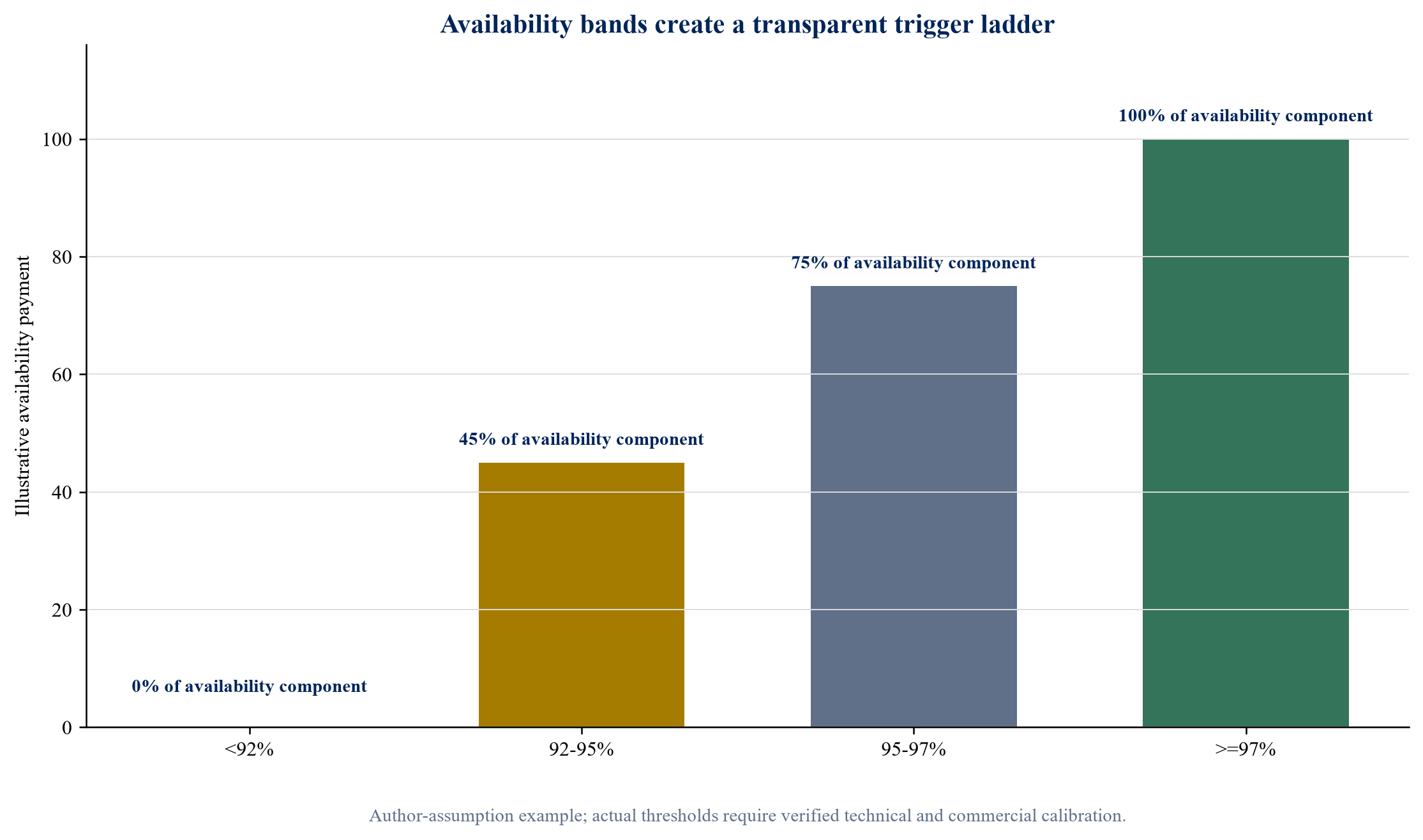
Author-assumption example. Thresholds and payment bands are analytical inputs and do not represent market terms.
12. Make maintenance, spares and lifecycle capital financeable
Availability obligations require a maintenance system. The provider should supply preventive schedules, condition monitoring, corrective response, reliability analysis and critical-spares planning. The schedule must fit the production calendar and warranty requirements. Deferred maintenance can temporarily improve cash flow while weakening future service and residual value, so the lender needs visibility of completion and exceptions.
Spare-parts strategy should reflect lead time, failure consequence and obsolescence. A low-cost proprietary controller with a long replacement lead time can be more critical than an expensive mechanical assembly with local repair capability. The provider should classify critical parts, set minimum stock, define ownership and identify alternative suppliers. Consigned inventory, vendor support and pooled spares can reduce capital, provided access is enforceable.
Lifecycle capital includes major overhauls, software upgrades, tooling renewal, safety modifications and capacity changes. The service price should fund expected lifecycle needs through an explicit allowance or reserve. Unexpected customer changes should follow the change process. A provider cannot sustainably offer a fixed price for unlimited product evolution. The customer needs transparency that necessary upgrades will occur and will not be deferred to protect distributions.
Maintenance performance should link to credit controls. Missed critical maintenance, declining mean time between failures, repeated temporary repairs or reserve underfunding can trigger a cure plan and distribution lock-up. The lender may require an independent maintenance review after persistent underperformance. Step-in service arrangements or an alternative maintenance provider can preserve continuity if the original provider fails.
13. Treat software, data and cyber security as part of the financed asset
Modern automation depends on embedded software, programmable controllers, industrial networks, cloud analytics, remote support and production data. The financing package therefore includes rights that may not follow physical title. Software licences should permit operation, maintenance, security updates, lender cure and transfer or redeployment where intended. Source-code escrow or continuity arrangements can be appropriate for critical bespoke software, subject to practical support capability.
The customer and provider should define data ownership, permitted use, retention, confidentiality and access. Performance measurement requires shared operational data. Predictive maintenance may require fleet-level analysis. Customer production data can contain trade secrets or personal information. The contract should grant the minimum rights necessary for service and financing while restricting unrelated commercial use. Data export and transition support are essential at termination.
NIST describes operational technology as programmable systems and devices that interact with the physical environment and recommends security controls adapted to their performance, reliability and safety requirements [9]. A financed service should include asset inventory, network segmentation, identity and access control, secure remote access, change management, vulnerability handling, backups, logging, incident response and recovery testing. Safety and availability constrain the timing and method of patches.
Cyber incidents can affect payment, safety and credit. The contract should distinguish an attempted event from a material service failure, require prompt notification and preserve evidence. A customer-caused policy change that blocks approved remote maintenance needs an operational workaround. A provider-caused insecure configuration requires remediation. Insurance can supplement controls but does not replace them. Covenants should require maintained security capability and independent assurance proportionate to risk.
14. Design performance triggers that preserve the service
Performance triggers should distinguish ordinary variation, material shortfall and persistent failure. A monthly availability level slightly below target may create a calibrated deduction. A fall below the service floor can suspend the availability component and require a cure plan. Repeated failure over rolling periods can trigger reserve top-up, enhanced monitoring, equipment augmentation, replacement rights or termination. The thresholds should be linked to customer impact and technical evidence.
Quality and throughput require separate triggers. A high-availability machine producing defective output has not delivered the service. A provider may be excused where the cause is an out-of-specification input, while it remains accountable for tooling, calibration or control failure. Root-cause allocation should use agreed evidence and time limits. Interim payment can reflect the undisputed portion while the technical issue is determined.
Financial triggers monitor customer credit, collection, debt-service coverage, liquidity, reserve balances and concentration. A downgrade or payment delay may require cash retention or additional security. Provider financial distress may require direct agreements with key vendors, licence continuity and a standby operator. Change in control can require consent where technical capability or customer relationship is central to performance.
The remedy should repair the failed function. Additional spares address parts delays; software support addresses obsolescence; equity addresses cost overrun; a reserve addresses timing; a replacement provider addresses sustained capability failure. Broad acceleration rights can destroy operating value if exercised too early. A graduated regime gives the customer and lender information, control and time to preserve service before enforcement.
Table 3. Financing stack, control and principal risk allocation
| Layer | Hypothetical amount | Primary repayment or return | Principal risks | Core protections |
|---|---|---|---|---|
| Provider equity | USD 3.0m, 20% | Residual cash and end-of-term value | Integration, ramp-up, performance and residual value | Governance, distributions after senior tests, upside ownership |
| Senior equipment debt | USD 9.0m, 60% | Accepted service cash flow | Customer credit, underperformance, termination and recovery | Assignment, controlled account, reserves, amortisation and step-in |
| Vendor or subordinated capital | USD 3.0m, 20% | Subordinated cash flow | Commissioning and technology performance | Standstill, warranty alignment and performance support |
| Customer service payment | USD 2.06m gross annual assumption | Operating service received | Availability, quality, change and continuity | KPI regime, credits, audit, cure and termination rights |
| Residual value | 35%, 20% or 5% at year five | Sale, reuse or renewal | Specialisation, removal, obsolescence and market depth | Modular design, title, maintenance records and redeployment plan |
Percentages refer to the hypothetical author-assumption case and are not observed market terms.
15. Underwrite customer credit and portfolio concentration
Recurring service revenue is only as strong as the customer's obligation and ability to pay. Credit review should cover financial performance, liquidity, leverage, ownership, market position, plant importance and termination rights. A service essential to production can have high operational value, yet distress can still interrupt payment or create pressure to renegotiate. Security deposits, guarantees, letters of credit, advance billing and direct agreements can address specific exposure.
The agreement should distinguish termination for provider default, customer default, convenience, prolonged force majeure, illegality and change in law. A convenience right without adequate payment transfers stranded capital to the provider and lender. Termination compensation should be transparent and should decline as debt amortises and equipment becomes more redeployable. It should avoid charging the customer for provider-caused failure.
Portfolio concentration affects the provider's cost of capital. One bespoke installation for one customer resembles project risk. A portfolio of standardised assets across customers can create diversification and operating scale. Lenders should still examine correlation by sector, geography, equipment vendor, software platform and economic cycle. Several nominal customers may depend on the same end market or critical component.
The provider can improve financeability through standard contracts, modular equipment, common KPI definitions, central monitoring and controlled maintenance. Standardisation should preserve site-specific safety and process requirements. Portfolio data can demonstrate uptime, failure rates, maintenance cost and redeployment experience. Until such evidence exists, debt sizing should recognise limited operating history and avoid treating management targets as proven performance.
16. Resolve end-of-term, renewal and termination before installation
End-of-term options include renewal, customer purchase, provider removal, replacement, upgrade or continued service at a revised price. Each option should contain a pricing method, notice period, condition standard, software treatment and transition plan. A nominal purchase option or economically compelling renewal can affect the substantive accounting analysis and should be reviewed before signature.
Removal rights need site access, safety procedures, isolation, decommissioning, restoration and data transfer. The parties should identify which foundations, cabling, guards, tools and software remain. Environmental and waste obligations should be allocated. A customer may need continuity while replacement equipment is installed, so the transition can require parallel operation or a phased handover.
Termination for sustained underperformance should follow evidence and cure. The customer needs the right to preserve production, possibly through temporary operation or a substitute maintainer. The lender needs notice and a bounded opportunity to cure or replace the provider. These rights must respect safety, intellectual property and the customer's cyber policies. A direct agreement can coordinate them without rewriting the service contract.
Redeployment should be tested during the term rather than discovered after default. The owner can maintain an asset register, transferable licences, configuration records, service history, removal plan and potential user map. Periodic valuation should distinguish orderly reuse from forced sale. A credible exit strengthens financing even when the intended outcome is renewal at the original site.
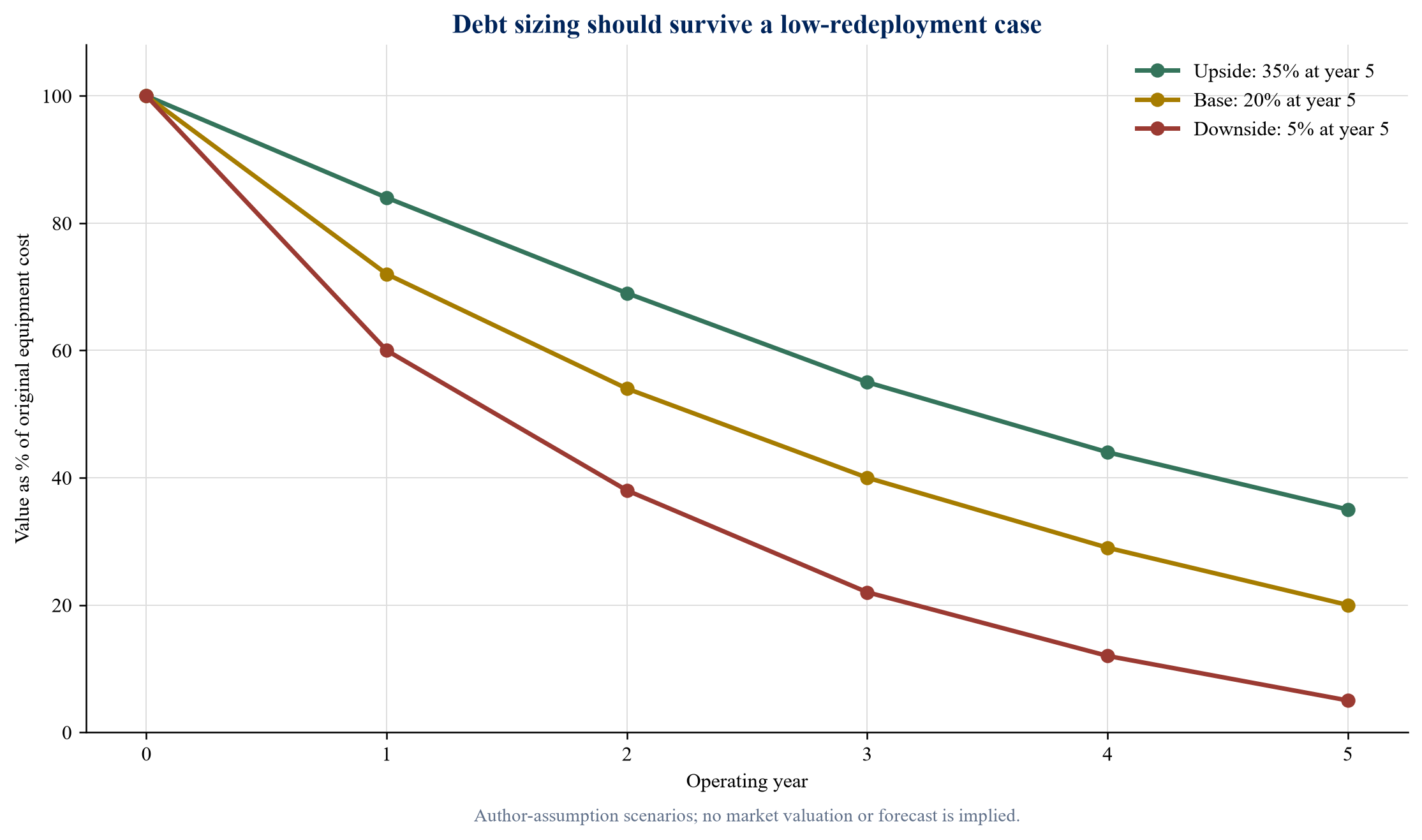
Author-assumption scenarios. Values exclude removal, refurbishment, transport, tax and remarketing costs and are not forecasts.
17. Execute a ninety-day transaction-readiness programme
During days one to thirty, the customer should define the production problem and baseline. It should assemble product mix, operating calendar, throughput, quality, downtime, utility, maintenance and financial data. The provider should conduct site surveys and develop the service boundary, technical concept and responsibility matrix. Accounting, tax and legal advisers should identify the lease-service, revenue, security and licensing questions that affect structure.
During days thirty-one to sixty, the parties should complete the performance model, integration architecture, acceptance plan and change-control protocol. The provider should obtain equipment and vendor terms, lifecycle cost, spares plan, software rights and cyber design. The financial model should separate fixed, availability, usage and outcome charges and should apply downside deductions, ramp-up delay, cost overrun, customer stress and residual-value cases.
During days sixty-one to ninety, the parties should agree commercial heads, financing heads and a controlled diligence index. The lender and independent engineer should review site readiness, specification, integration, acceptance, service metrics, maintenance, cyber, residual value and removal. Legal advisers should draft the customer agreement, equipment contracts, security, account control, direct agreements and step-in arrangements. Investment approval should identify conditions precedent, draw gates and unresolved items.
The output is a transaction-ready proposition: a measured baseline, service specification, responsibility matrix, accepted technical design, milestone budget, payment waterfall, financing stack, downside cases, contracts plan and diligence room. The programme should end with named owners and dates for every gap. Proceeding with a vague service promise simply moves engineering uncertainty into the capital structure.
18. Conclude with an outcome that capital can observe
Equipment-as-a-Service can make industrial automation more accessible by spreading capital recovery and allocating defined operating obligations to a capable provider. Its value depends on the quality of the service architecture. Hardware, software, integration, production practices and customer conditions must be connected through measurable definitions and evidence.
The financing case rests on accepted cash flow. Availability, quality and throughput should be measured through controlled data, adjusted for agreed causes and converted into a transparent payment waterfall. Provider equity absorbs development and performance risk. Senior debt relies on a conservative share of contracted service cash flow, supported by reserves, maintenance, direct rights and a practical recovery plan. Residual value is an operating capability rather than a convenient terminal percentage.
Accounting, safety, data and cyber issues belong at the centre of structuring. The contract label does not settle whether an arrangement contains a lease. Outcome payments create revenue-recognition questions. Software rights can determine whether equipment remains usable. Secure and reliable operational technology protects production as well as credit. These matters should be resolved with transaction-specific professional advice.
The central discipline is to finance a service that the parties can define, control and prove. When obligations follow practical control and remedies address the failed function, EaaS can align a manufacturer's need for productive automation with a provider's technical capability and a capital provider's demand for observable repayment.
Table 4. Covenant, trigger and remedy framework
| Control | Measurement | Illustrative trigger | Proportionate response |
|---|---|---|---|
| Service availability | Qualified available time divided by scheduled service time | Below target in one period; below floor or repeated miss | Credit, cure plan, reserve lock-up, augmentation or replacement |
| First-pass yield | Accepted output divided by completed output | Sustained deviation after input exclusions | Root-cause review, tooling or process cure and payment adjustment |
| Acceptance and ramp-up | Milestone tests and endurance run | Missed long-stop or failed repeat test | Stop draw, provider equity, rework or termination |
| Maintenance | Completed critical work and reliability indicators | Missed critical task or worsening failure pattern | Distribution block, additional spares or independent review |
| Cyber and software continuity | Control effectiveness, support and recovery tests | Material incident, unsupported release or lost licence | Safe state, remediation, continuity rights and enhanced assurance |
| Customer credit | Timely collection and credit indicators | Payment delay, downgrade or covenant stress | Cash retention, additional security or reduced exposure |
| Residual value | Net orderly-redeployment estimate | Downside value below debt assumption | Faster amortisation, prepayment or additional equity |
| Concentration | Exposure by customer, sector, vendor and platform | Limit exceeded | New origination restriction or credit enhancement |
Thresholds require calibration to verified operating evidence, customer impact and financing terms.
Frequently asked questions
Does Equipment-as-a-Service keep automation off the customer's balance sheet?
The commercial label does not determine accounting. The parties must assess whether the contract conveys control of an identified asset under IFRS 16 and how service components and other obligations are accounted for. Transaction-specific accounting advice is required.
Which payment model is most financeable?
A blended structure can combine a fixed readiness amount with availability and usage components. Financeability depends on customer credit, enforceability, measurement, termination protection and downside performance rather than the label applied to the charge.
Who should bear production-volume risk?
The party controlling customer demand and production scheduling should generally bear the associated volume risk. The provider can bear equipment availability, maintenance and defined performance within agreed input and operating conditions.
How should availability be measured?
Availability should use a controlled scheduled-time denominator, precise downtime rules, an evidence hierarchy, calibrated data and defined exclusions. The contract should include worked calculations and a process for disputed causation.
Can a lender rely on residual equipment value?
Residual value can support recovery where equipment is standardised, removable, maintained, transferable and supported by software rights and a secondary market. Debt sizing should use net downside value after removal and remarketing costs.
What happens when the customer changes the product or process?
A change-control mechanism should assess technical feasibility, acceptance, timing, price and baseline effects. Provider obligations should not extend automatically to untested products or conditions.
Why does cyber security matter to equipment finance?
Automation depends on operational technology, software and remote support. A cyber incident can interrupt production, create safety risk, invalidate performance data and reduce cash flow. Security and recovery capability are therefore credit considerations.
What should be ready before approaching capital providers?
The parties should have a baseline, service specification, responsibility matrix, technical design, acceptance plan, payment waterfall, customer contract heads, lifecycle plan, downside model, residual-value evidence and controlled diligence index.
References
- International Federation of Robotics. World Robotics 2025: Industrial Robots. 2025. https://ifr.org/worldrobotics/report-2025
- IFRS Foundation. IFRS 16 Leases, issued standard. 2022. https://www.ifrs.org/content/dam/ifrs/publications/pdf-standards/english/2022/issued/part-a/ifrs-16-leases.pdf?bypass=on
- IFRS Foundation. IFRIC Update, March 2023: Definition of a Lease and Substitution Rights. 2023. https://www.ifrs.org/news-and-events/updates/ifric/2023/ifric-update-march-2023/
- IFRS Foundation. IFRIC Update, September 2019: Right to Direct the Use of an Asset. 2019. https://www.ifrs.org/news-and-events/updates/ifric/2019/ifric-update-september-2019/
- IFRS Foundation. IFRS 15 Revenue from Contracts with Customers. https://www.ifrs.org/issued-standards/list-of-standards/ifrs-15-revenue-from-contracts-with-customers/
- International Organization for Standardization. ISO 22400-2:2014, Automation systems and integration, key performance indicators for manufacturing operations management. 2014. https://www.iso.org/standard/54497.html
- IFRS Foundation. IFRS 15 Revenue from Contracts with Customers, issued standard. 2022. https://www.ifrs.org/content/dam/ifrs/publications/pdf-standards/english/2022/issued/part-a/ifrs-15-revenue-from-contracts-with-customers.pdf?bypass=on
- European Commission. Machinery safety and Regulation (EU) 2023/1230. https://single-market-economy.ec.europa.eu/sectors/mechanical-engineering/machinery_en
- National Institute of Standards and Technology. SP 800-82 Rev. 3, Guide to Operational Technology Security. 2023. https://doi.org/10.6028/NIST.SP.800-82r3
- IFRS Foundation. Effects Analysis: IFRS 16 Leases. 2016. https://www.ifrs.org/-/media/project/leases/ifrs/published-documents/ifrs16-effects-analysis.pdf
- IFRS Foundation. IFRIC Update, November 2018: Customer's Right to Receive Access to Supplier Software. 2018. https://www.ifrs.org/news-and-events/updates/ifric/2018/ifric-update-november-2018/
- International Electrotechnical Commission. IEC 62264-4: Enterprise-control system integration. 2015. https://www.iso.org/obp/ui#iso:std:iec:62264:-4:ed-1:v1:en
- European Investment Bank. Investment Report 2017/2018: From Recovery to Sustainable Growth. 2018. https://www.eib.org/files/efs/economic_investment_report_2017_en.pdf
- International Labour Organization. Generative AI and Jobs: A Refined Global Index of Occupational Exposure. 2025. https://www.ilo.org/publications/generative-ai-and-jobs-refined-global-index-occupational-exposure
- Organisation for Economic Co-operation and Development. The Impact of Artificial Intelligence on the Workplace. 2021. https://www.oecd.org/content/dam/oecd/en/publications/reports/2021/03/the-impact-of-artificial-intelligence-on-the-workplace_50c9bdf2/7d5d4c0c-en.pdf
- United Nations Industrial Development Organization. Industrial Development Report 2024: Turning Challenges into Sustainable Solutions. 2024. https://www.unido.org/idr2024
- National Institute of Standards and Technology. Cybersecurity Framework 2.0. 2024. https://www.nist.gov/cyberframework
- National Institute of Standards and Technology. Protecting Information and System Integrity in Industrial Control System Environments. 2022. https://www.nccoe.nist.gov/projects/protecting-information-and-system-integrity-industrial-control-system-environments
- European Union. Regulation (EU) 2023/1230 on machinery. 2023. https://eur-lex.europa.eu/eli/reg/2023/1230/oj
- International Organization for Standardization. ISO 12100:2010, Safety of machinery, general principles for design, risk assessment and risk reduction. 2010. https://www.iso.org/standard/51528.html
- International Organization for Standardization. ISO 10218-1:2025, Robotics, safety requirements, industrial robots. 2025. https://www.iso.org/standard/73933.html
- International Organization for Standardization. ISO 10218-2:2025, Robotics, safety requirements, industrial robot applications and robot cells. 2025. https://www.iso.org/standard/73934.html
- International Federation of Robotics. World Robotics 2025 Executive Summary. 2025. https://ifr.org/img/worldrobotics/Executive_Summary_WR_2025_Industrial_Robots.pdf
- IFRS Foundation. IFRIC Update, June 2019: Compensation and Variable Consideration under IFRS 15. 2019. https://www.ifrs.org/news-and-events/updates/ifric/2019/ifric-update-june-2019/
