AI & Frontier Tech · Real Estate Finance

Escrow Analytics: AI Monitoring of RERA and Wafi Waterfalls

A controlled AI architecture for reconciling construction progress, escrow balances and release entitlements across Dubai RERA and Saudi Wafi projects.

Gulf real-estate specialists review a milestone model whose verified construction stages connect to controlled escrow-release channels
Quick answer

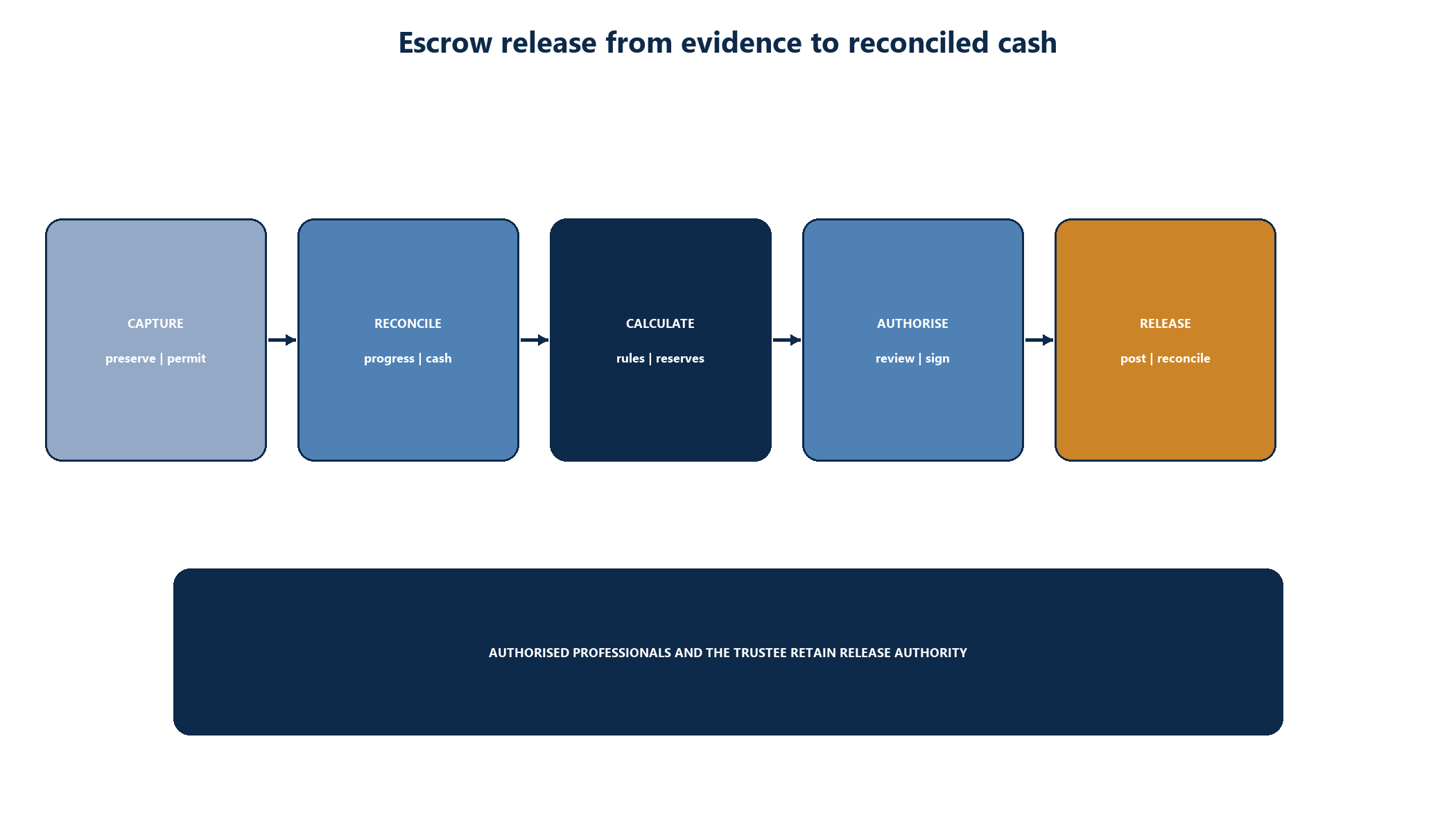
AI can help reconcile project records, construction evidence, escrow cash, invoice entitlement and exceptions. Deterministic rules calculate provisional release limits; engineers, accountants, trustees, lenders and regulators retain the authority to certify, approve, sign or release.

Abstract

Background. Milestone-linked real-estate escrow releases join legal rules, project progress, professional certification, invoices, bank balances, reserves and segregated approvals.

Objective. This paper develops a controlled escrow-analytics architecture for developers and project-finance teams, with lenders, account trustees and monitoring professionals as the secondary audience.

Approach. The analysis reviews 50 primary, official and peer-reviewed sources available through 2 August 2026 and joins canonical ledgers, deterministic release rules, bounded Claude analysis, construction computer vision, source lineage and named human authority.

Findings. Claude and computer vision can support bounded extraction, comparison, imagery review, source-linked drafting and exception preparation. Approved professionals retain progress certification, accounting confirmation, payment orders, trustee review, lender consent and regulatory authority.

Implications. Implementation should begin with one jurisdiction, one project, one request category and one shadow-mode pilot. The worked cases and operating inputs are hypothetical illustrative examples; attributed Matchpoint or client revenue, cash cost reduction, loss reduction and alpha remain USD 0 until approved observed evidence exists.

JEL Classification: G17, G28, G32, G33, G38, K22, K25, L85, M15, O33

Keywords: real-estate escrow, RERA, Wafi, construction progress, computer vision, Claude, release entitlement, account trustee, lender dashboard, off-plan development

This Matchpoint Insight presents the web edition of Matchpoint Partners' research. The supporting paper contains the detailed decision perimeter, Dubai and Saudi waterfall crosswalk, canonical escrow data model, construction-evidence protocol, computer-vision workflow, milestone-reconciliation agent, lender dashboard, alert taxonomy, controlled scenarios and ninety-day roadmap.

Read the full research paper   Explore Last-Mile & Escrow-Release Financing

Introduction

Off-plan real-estate escrow is a controlled release process. Money enters a project-specific account, evidence accumulates as construction advances, authorised parties certify or challenge that evidence, and the trustee or bank releases only the amount permitted by the applicable legal and contractual waterfall. Dubai and Saudi Arabia implement this logic through different institutional arrangements. Dubai Law No. 8 of 2007 requires a separate project escrow account, project-level records and regulated withdrawals; Dubai Land Department guidance describes progress certification and trustee verification in operational terms [1-6]. Saudi Arabia's active off-plan law and implementing regulations require a separate account, three-party payment orders, engineering and accounting reports, and defined retentions and exceptions within the Wafi framework [11-15].

The control problem is therefore larger than recognising a building element in a photograph. A release decision depends on five linked questions:

  1. Which legal and contractual rule applies to this project, account, cost category and request?
  2. What work was approved, completed, measured, certified and invoiced?
  3. What cash has entered, left or been reserved in the escrow account?
  4. Which authorised people and firms have reviewed the request, and what exceptions remain open?
  5. Can a later reviewer reconstruct the decision from immutable source evidence?

This paper develops an escrow-analytics architecture for real-estate finance participants, including developers, project-finance teams, account trustees, lenders and authorised monitoring professionals. The architecture joins a canonical project ledger, a milestone graph, a controlled evidence vault, computer-vision support, deterministic reconciliation, a release-entitlement engine, an exception queue and a lender dashboard. Claude is used only for bounded document and image analysis, source-linked extraction, comparison, explanation and draft preparation. Deterministic services calculate balances and thresholds. Named professionals retain certifications, payment instructions, waivers, overrides and disbursement authority.

The term RERA waterfall in this paper refers to the project-specific release logic operating under Dubai's escrow framework and related agreements. The term Wafi waterfall refers to the project-specific release logic operating under Saudi Arabia's off-plan framework and its implementing regulations. These labels are analytical shorthand; they do not replace statutory language, regulator instructions, escrow agreements or professional advice.

The paper answers four practical questions. First, what data must be joined before a milestone-linked release can be evaluated? Second, where can computer vision reduce evidential friction without becoming a substitute for professional certification? Third, how should an AI agent reconcile progress, cash, invoices and entitlement while preserving segregation of duties? Fourth, what should a lender dashboard display so that uncertainty, exceptions and approvals remain visible?

The central proposition is bounded. AI can improve the organisation, comparison and traceability of escrow evidence when access, provenance, deterministic calculation, model evaluation and human decision rights are designed into the workflow. This paper does not claim observed financial benefit. Attributed Matchpoint or client revenue, cash cost reduction, loss reduction and alpha remain USD 0 until approved observed evidence exists. Worked examples, amounts, thresholds, timelines and performance values are Illustrative examples unless explicitly attributed to a cited source.

QuestionProposed control answerRetained authority
Is the request legally and contractually eligible?Versioned rule pack plus deterministic eligibility testsLegal adviser, regulator, trustee and authorised account parties
Does evidence support stated progress?Source-linked documents, approved schedules, imagery, measurements and exception analysisApproved consultant or engineer
Is the cash movement mathematically permitted?Double-entry escrow ledger, reserved balances and release calculationTrustee or bank and required signatories
Can the pack be defended later?Immutable evidence objects, model-run records and signed approvalsAudit, compliance and authorised management

Decision Perimeter: Real-Estate Finance

Primary users

The principal operating users are real-estate finance participants. A developer's finance team needs a current view of collections, certified work, invoices, contractual limits, requested releases and blocked items. An account trustee or escrow bank needs a complete instruction pack and an auditable basis for any movement. A project lender needs visibility into progress, cost to complete, liquidity headroom, contractor concentration and compliance with financing conditions. An approved consultant or engineering firm needs an evidence workspace that preserves its independent judgement. A certified public accountant, where required, needs accounting records, supporting invoices, account statements and calculations. Regulators require the statutory reports, notifications and project information specified by the applicable regime.

Decision-rights map

The system must distinguish analysis from authority. A model can classify an invoice, extract a claimed amount, compare a photograph with an approved model and draft an exception note. Those outputs are provisional. They do not certify construction progress, approve a payment order, amend an escrow agreement, waive a covenant or instruct a bank.

RoleMay prepare or analyseMay certify or approveMay not be delegated to the model
Developer financeRequest pack, ledger reconciliation, forecastDeveloper-side request and authorised signatureBank release, independent certification
Project controlsSchedule mapping, quantities, change logInternal measurement under delegated authorityRegulator or trustee approval
Approved consultant or engineerSite evidence, measurement, progress certificateProfessional certification within licence and appointmentAutomated final certification
Certified public accountantFinancial report, invoice and account reviewRequired accounting confirmation or signatureModel-generated audit opinion
Account trustee or bankEligibility and instruction reviewEscrow disbursement within mandateRelease based solely on model output
LenderCovenant tests, cost-to-complete challengeConsent or waiver where finance documents require itRegulatory approval
RegulatorMonitoring data, reports, exception evidenceStatutory direction, approval or enforcementPrivate model recommendation

Jurisdiction, project and contract specificity

Every project must be configured from approved source documents. The legal regime is one layer. The project licence, escrow agreement, sale contracts, construction contracts, consultant appointment, financing documents, approved budget and regulator directions add project-specific conditions. The same apparent milestone label can produce different release outcomes because eligible costs, signatories, retentions, caps, timing conditions and documentary requirements differ.

The system therefore stores a rule pack with an effective date, source hash, jurisdiction, project scope, reviewer, approval status and supersession history. A request is evaluated against the approved rule pack that was effective for that request. Later amendments create new versions; they do not silently rewrite prior decisions.

Rule layerExamplesRequired system treatment
Statute and regulationDubai escrow law; Saudi off-plan law and regulationsAuthoritative source, effective date and legal review
Regulator service or instructionDLD submission requirements; Wafi reporting or platform processOperational requirement, source date and refresh trigger
Escrow agreementSignatories, eligible payees, documents, account mechanicsProject-specific executable rules after approval
Construction contractMilestones, valuations, retention, variationsLinked to work packages and certified quantities
Finance documentsConditions precedent, drawstop, consent, reserveSeparate lender-control layer
Internal policyMateriality, escalation, service levelCannot relax law, regulation or contract

Dubai Rera Escrow Control Model

Statutory account and evidence perimeter

Dubai Law No. 8 of 2007 establishes a project-specific escrow structure for off-plan real-estate development. The law addresses deposits, separate accounts, statements, depositor records, financing paid into escrow, a five per cent post-completion retention and regulator responses where completion is at risk [1]. The official English text states that the Arabic text prevails if there is a conflict; production legal interpretation must therefore use approved Arabic and English sources where applicable.

Dubai Land Department guidance provides operational context. The official FAQ states that completion percentage is determined through a consultant approved by DLD, that an investor can follow the project through official services, and that the account trustee's engineer visits the site and verifies achievement before payment under the escrow agreement [2]. DLD's mortgage-to-escrow service requires current project and technical-report conditions, while its completed-project payment service defines submission requirements for a completed project [4-5]. These service pages are living operational sources and require scheduled refresh.

Dubai control objects

Dubai objectMinimum fieldsPrimary evidence
Project registrationDLD number, licence status, developer, trustee, approved consultantRegulator record and approved agreements
Escrow accountBank, account identifier, currency, status, restrictionsExecuted escrow agreement and bank confirmation
Depositor sub-ledgerInvestor or financier reference, unit, amount, date, sourceBank statement and sales or finance records
Approved budgetCost code, amount, category, revision, approvalApproved feasibility and project budget
Progress certificatePeriod, work package, percentage, amount, author, signatureApproved consultant certificate
Trustee verificationSite visit, observations, exceptions, approvalTrustee engineer record
Release instructionPayee, invoice, amount, signatories, basisSigned instruction and supporting pack
Completion reserveBase, percentage, release conditions and dateLaw, agreement and completion evidence

Dubai waterfall representation

The proposed Dubai waterfall is a project-specific state machine:

  1. Confirm the project, account and request are active and in scope.
  2. Confirm all relevant buyer and financier receipts have been reconciled to the escrow account.
  3. Confirm the payee, cost code and purpose are eligible under the law and escrow agreement.
  4. Confirm the current approved budget and remaining budget for the cost code.
  5. Confirm professional progress certification and required trustee verification.
  6. Confirm invoice identity, amount, tax treatment, prior payments, retention and variation status.
  7. Apply legal, contractual and financing reserves, caps and drawstops.
  8. Route the resulting entitlement and exceptions to the required signatories.
  9. Release through the trustee's controlled banking process.
  10. Reconcile the bank debit and close or escalate differences.

The engine produces a calculated maximum eligible release and a complete exception list. It does not produce an unconditional instruction to pay.

Saudi Wafi Escrow Control Model

Active statutory structure

Saudi Arabia's active Law of Selling and Leasing Off-Plan Real Estate Projects requires a separate escrow account for each project [11]. The account is for the licensed project, funds are protected from attachment for developer creditors, and project-financing funds must be deposited into the account [11]. Article 11 requires a payment order signed by the developer, consulting firm and certified public accountant, subject to the law's exceptional mechanism. Articles 12 to 14 address non-construction expenditure, excess funds and retention [11].

The implementing regulations add operational detail. They address independent accounts and reports for project scopes, public project information, project-reporting frequency, project and unit identifiers, secure withdrawal requests, exceptional withdrawals, delayed-project controls and notification of violations [12]. The official Wafi platform describes the national off-plan licensing service and provides the current operating context [13].

Wafi control objects

Wafi objectMinimum fieldsControl significance
Licensed projectLicence, developer, scope, phases, land and unit identifiersDetermines lawful project perimeter
Project escrowSAR account, activation state, bank, project referenceSeparates cash and instruction chain
Consulting firmApproval, appointment, scope, authorised signersEngineering certification control
Certified public accountantApproval, appointment, reporting period, signerFinancial confirmation control
Monthly or quarterly reportReporting class, period, progress, financial statusRegulatory monitoring and refresh cadence
Withdrawal requestPayee, purpose, amount, supporting records, three approvalsCore payment-order object
Non-construction capSold-unit values, cumulative eligible non-construction releasesStatutory cap control
Completion retentionConstruction-cost base, five per cent amount, alternative securityPost-completion protection

Wafi waterfall representation

The proposed Wafi waterfall validates the project licence and account status, assigns the request to the correct project scope, matches the payee and cost category, reconciles the invoice and account ledger, tests statutory and approved-budget limits, verifies engineering and accounting evidence, gathers the required signatures, applies retentions and exceptional approvals, submits through the approved channel and reconciles the resulting cash movement.

The Saudi model creates a particularly clear segregation-of-duties requirement. The developer, consulting firm and certified public accountant are separate approval principals for ordinary disbursement. An AI service may prepare a common evidence pack for their review; it must preserve separate identities, review histories and signatures.

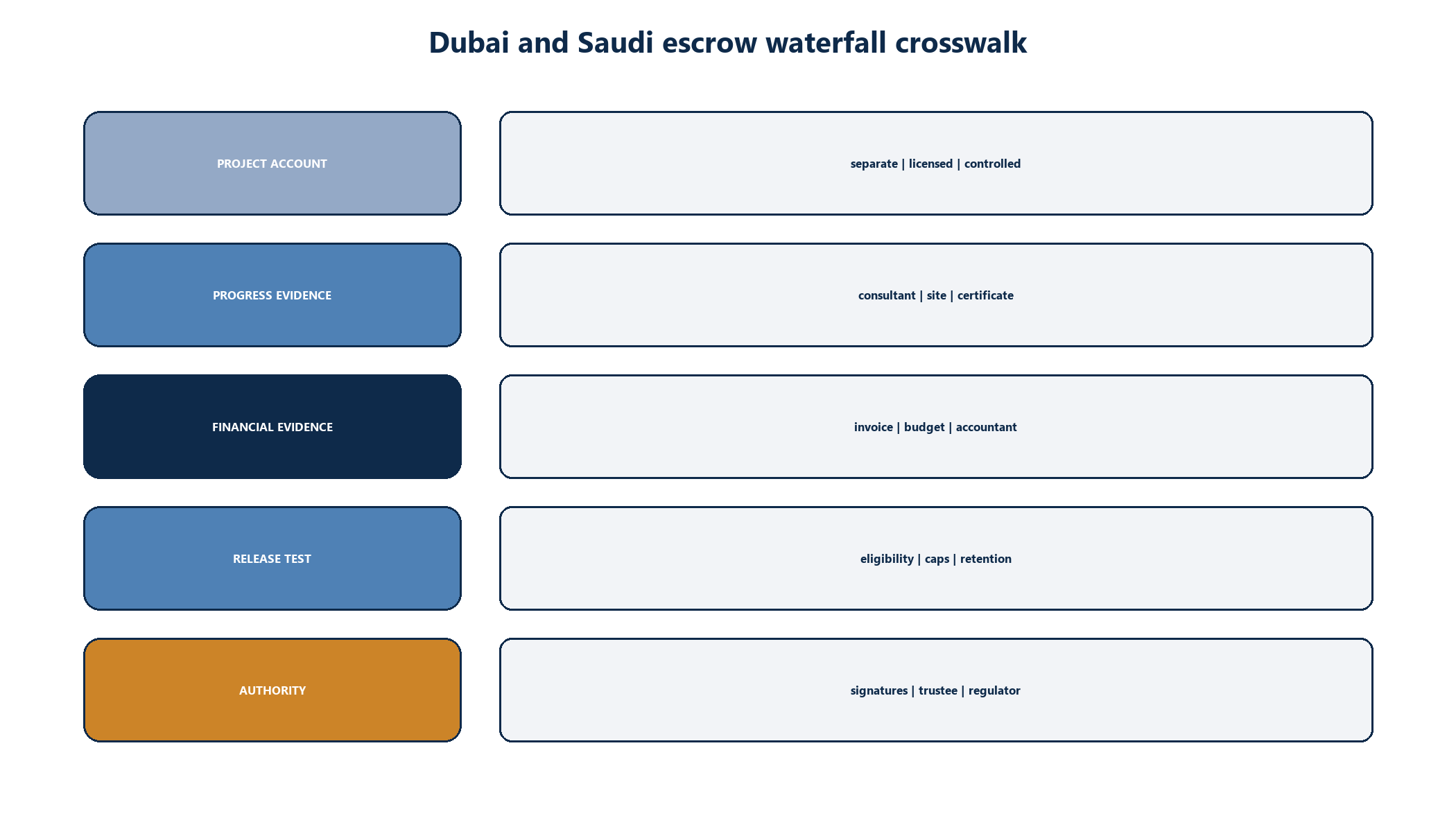
Control issueDubai analytical treatmentSaudi analytical treatment
Separate accountOne account per project under Dubai escrow frameworkSeparate account per licensed project
Progress evidenceApproved consultant and trustee verification per current processConsulting-firm reports and approvals
Financial evidenceProject records, statements, trustee packCPA reports, accounting records and signature
Ordinary releaseProject agreement and required approvalsThree-party payment order under Article 11
Non-construction spendEligibility and project-agreement limits; confirm current DLD rulesStatutory 20 per cent framework under Article 12
Completion holdbackFive per cent framework under Dubai lawFive per cent construction-cost framework or permitted alternative
Exceptional releaseApplicable regulator and agreement routeCompetent-authority route under law and regulations

Canonical Escrow Data Model

Design principle

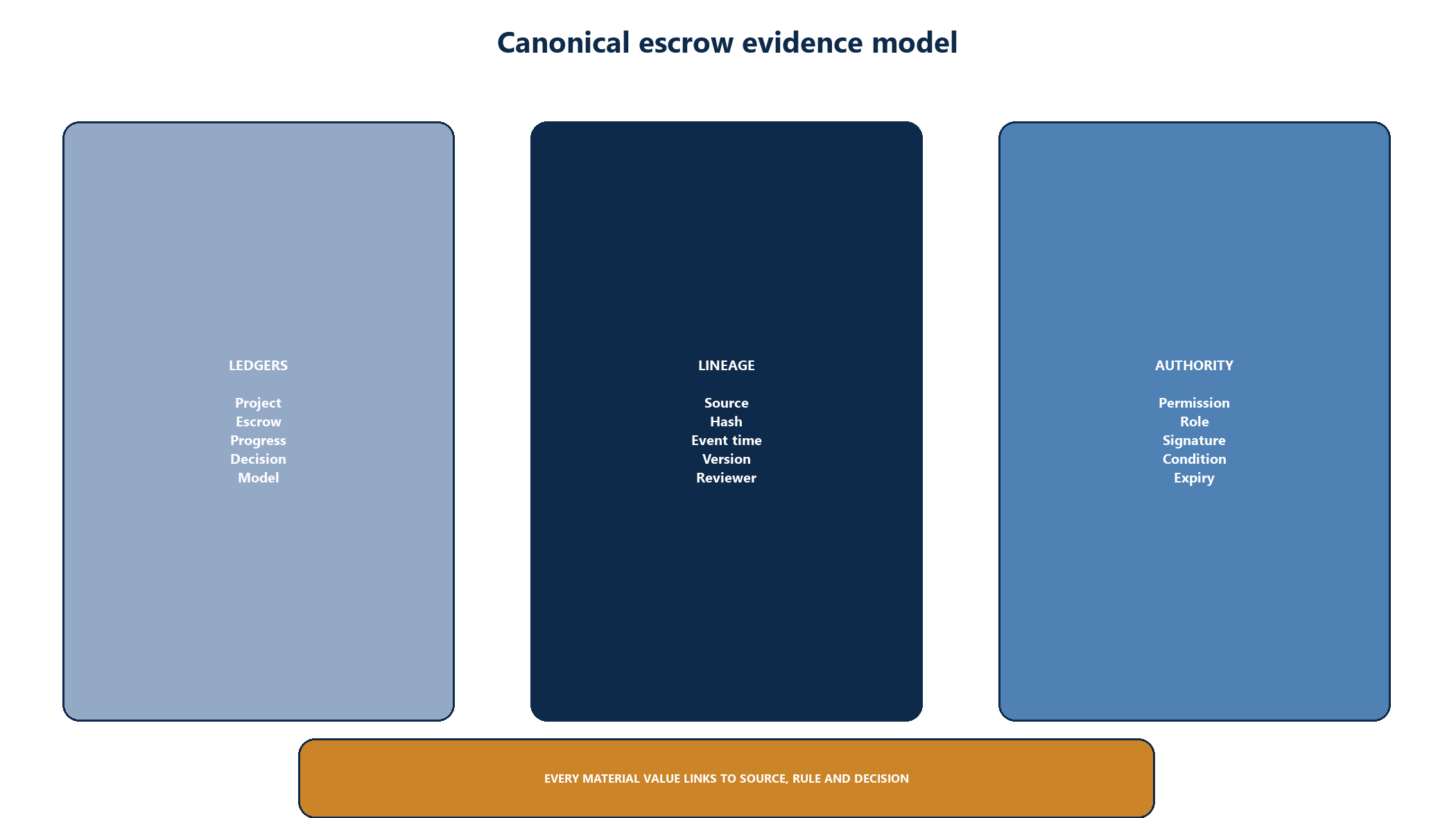
The proposed architecture treats each consequential statement as an evidence-backed object. A dashboard percentage without lineage is insufficient. The system must retain the source file, exact location, extraction method, transformation, reviewer, approval status, effective period and link to the decision in which the value was used.

The canonical model has six ledgers:

  • a project ledger for licence, parties, contracts, budgets, units and work packages;
  • an escrow ledger for receipts, releases, reserves, returns, fees and bank balances;
  • a progress ledger for planned, measured, certified and accepted progress;
  • an evidence ledger for documents, images, video, scans, certificates and observations;
  • a decision ledger for requests, tests, exceptions, approvals, overrides and releases;
  • a model ledger for prompts, model versions, tools, inputs, outputs, evaluations and reviewer corrections.

Core identifiers

ObjectStable identifierRequired links
Projectjurisdiction + regulator project IDdeveloper, licence, escrow, phase
Unitproject ID + official unit referencesale, buyer, collection, project scope
Work packageproject ID + approved WBS codeschedule, budget, contract, BIM element
Evidence assetcryptographic hash + capture IDproject, location, time, custodian, permissions
Certificateissuer + serial + period + hashwork packages, evidence, invoice, request
Invoicesupplier + invoice number + tax identitycontract, purchase order, work package, request
Bank transactionbank reference + account + datereceipt or release, counterparty, reconciliation
Release requestproject + sequence + versionrule pack, evidence, approvals, bank transaction

Atomic evidence object

An evidence object records a single proposition or asset with custody and scope. Its fields include evidence ID, project ID, asset hash, source type, source owner, capture time, receipt time, location, period, work package, claim, unit, value, confidence, permission, reviewer, review status, supersession, retention class and source pointer.

Confidence is not approval. A high model score does not turn an image into a professional certificate. The model score supports routing and review prioritisation. The approved professional status is stored separately.

Temporal and version controls

Construction, certification, bank and contract data arrive at different times. The architecture stores both event time and processing time. This permits a reviewer to see what was known when a release was evaluated and what arrived later. A schedule revision, budget variation or replacement certificate creates a new version with an explicit effective date. Prior packs remain reproducible.

Escrow Data-Flow Architecture

Layers

The proposed architecture has eight layers:

  1. Permissioned connectors receive bank files, regulator data, project-controls data, approved documents and captured media.
  2. Evidence vault preserves originals, hashes, signatures, metadata, permissions and retention controls.
  3. Canonicalisation services map account, project, WBS, cost code, payee, invoice and unit identifiers.
  4. Deterministic reconciliation services balance cash, duplicate invoices, cumulative releases, budget availability, caps, retention and entitlement.
  5. AI analysis services classify, extract, compare, explain and draft with source pointers.
  6. Policy and rule engine evaluates the approved jurisdiction and project rule pack.
  7. Workflow service routes exceptions, reviews, signatures, consent and bank instructions.
  8. Decision surfaces present developer, trustee, accountant, engineer, lender and regulator views appropriate to their authority.

Trust boundaries

BoundaryMain riskProposed control
Bank to platformTruncated, duplicated or altered transactionsSigned transfer, control totals, hashes and independent balance check
Site capture to vaultWrong project, time, location or manipulated mediaAuthenticated device, capture manifest, chain of custody and review
Document to modelPrompt injection or malicious contentTreat files as untrusted data, isolate instructions and restrict tools
Model to rule engineUnsupported value or invented fieldSchema validation, source pointers and rejection of missing evidence
Rule engine to workflowWrong rule version or scopeApproved version, effective-date test and project binding
Workflow to bankUnauthorised or altered instructionSegregated signature, secure channel and bank-side mandate
Dashboard to userFalse precision or stale dataAs-of time, source status, uncertainty and open-exception count

Event-driven processing

Each change emits a signed event, such as bank statement received, progress capture received, certificate approved, invoice superseded, request submitted, exception opened, approval recorded, release posted or reconciliation failed. Idempotency keys prevent duplicate processing. The system writes append-only events and builds current views from them. Corrections are additional events linked to the original entry.

Data freshness service levels

Data classProposed targetStaleness response
Bank balance and transactionsDaily or bank-supported intradayBlock final release if the configured cut-off is exceeded
Approved project scheduleOn every approved revisionRecalculate milestone dependencies
Progress evidencePer monitoring plan and requestMark affected work packages unsupported
Professional certificateOn issuance and amendmentBlock request until approved version is present
Invoice and variationOn receipt and approvalDetect duplicates and recalculate commitment
Regulator instructionsScheduled review plus event-driven updateSuspend affected rule pack pending approval

Construction-Progress Evidence

Evidence hierarchy

Computer vision is one component of a broader evidence hierarchy. The proposed hierarchy moves from approved design and schedule, through contemporaneous capture and quantitative measurement, to professional certification and trustee or regulator review.

Evidence classExamplesProposed use
Approved baselineDrawings, BIM, WBS, programme, bill of quantitiesDefines expected scope and sequence
Contemporaneous captureGeotagged photographs, video, 360-degree imagery, scansShows visible site state
Quantitative observationPoint cloud, measured quantity, test resultSupports quantity and completion assessment
Commercial evidenceInvoice, valuation, purchase order, delivery noteConnects work to amount and payee
Professional certificationConsultant or engineer certificateAuthoritative progress opinion within appointment
Trustee or regulatory evidenceSite verification, platform report, directionEnables required external control

Capture protocol

Every capture campaign should have an approved plan: project and zone, date window, responsible operator, device, route, viewpoints, lighting tolerance, privacy exclusions, safety controls, file format, resolution, capture manifest and upload deadline. The protocol must preserve negative evidence; missing areas are recorded rather than silently omitted.

For fixed cameras, the system records calibration, field of view, obstruction and uptime. For mobile capture, the operator follows a defined route and confirms checkpoints. For laser scanning or photogrammetry, the technical team records coordinate reference, registration error, coverage and processing parameters. For drone capture, aviation and security approvals are preconditions; Section 17 addresses the jurisdiction-specific constraint.

BIM and schedule alignment

IFC is an open, vendor-neutral schema for built-asset information and is published as ISO 16739 [26]. The architecture maps an approved IFC or equivalent model to work packages, cost codes and schedule activities. Model elements receive stable identifiers. A change-control service records additions, deletions, geometry revisions and classification changes. A progress algorithm must compare against the approved revision applicable to the observation date.

Research on computer-vision-based progress monitoring commonly separates data acquisition and reconstruction, as-built modelling and progress assessment [32-41]. Methods include photographic reconstruction, object detection, semantic segmentation, scan-to-BIM comparison and schedule-linked visual evaluation. The literature also reports limitations involving occlusion, viewpoint, changing site conditions, labelled data, element granularity and generalisation [32-41]. These limitations support a review-first design.

Progress state taxonomy

StateMeaningRelease treatment
Not observableRequired area absent, occluded or unusableNo visual support; obtain evidence
Not startedApproved scope visible and no start evidenceZero visual completion for that element
In progressWork started but completion criteria unmetPartial measurement only under approved method
Apparently completeVisual completion criteria appear metRequires measurement and professional review
Certified completeApproved professional certifies criteriaEligible input to entitlement tests
Accepted or handed overContractual acceptance recordedSupports later release or retention events
Defective or disputedQuality issue, rework or dispute recordedException and possible hold

Computer-Vision Progress Verification

Bounded role for vision models

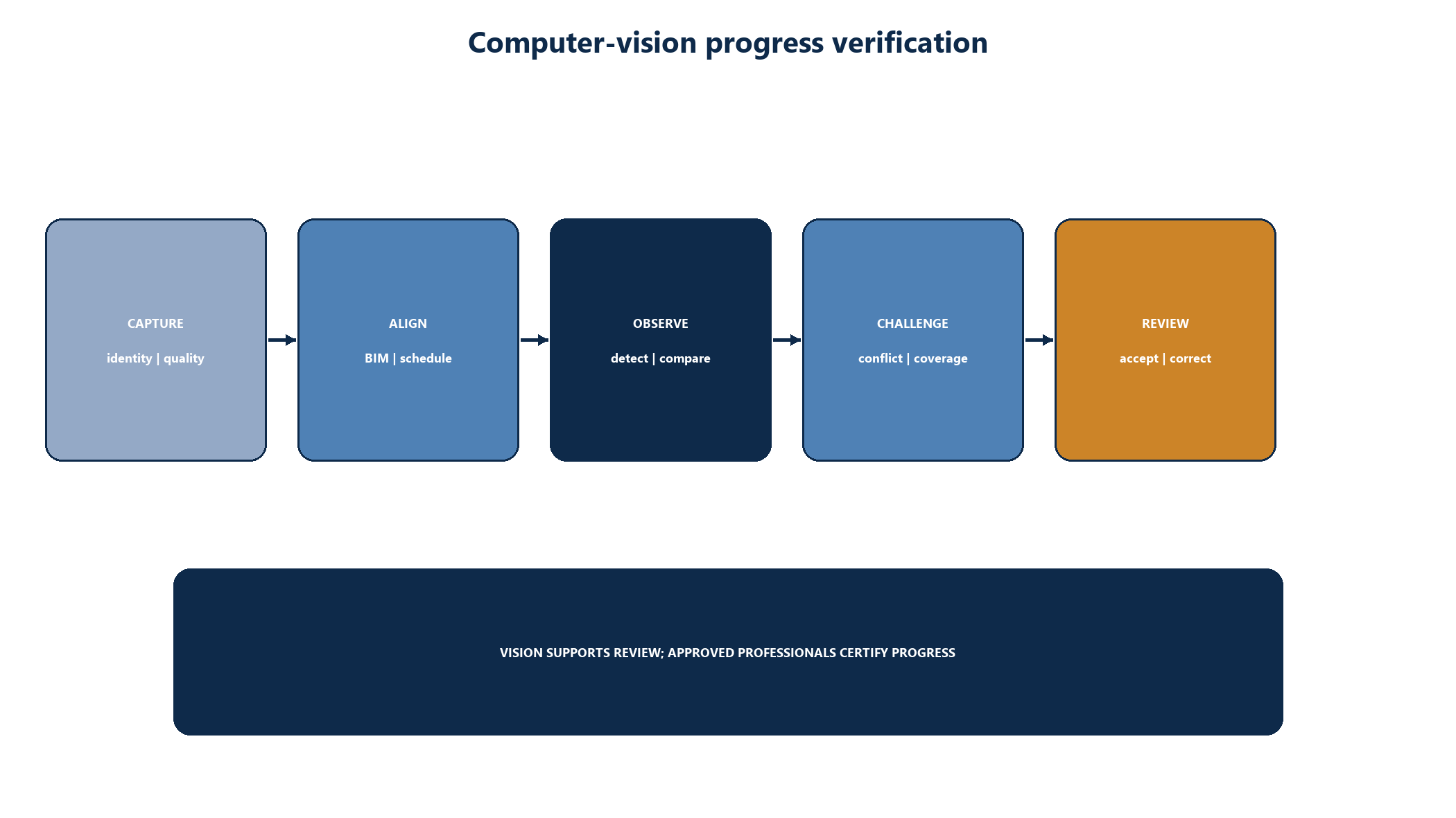
Vision models can identify and localise visible construction elements, compare repeated viewpoints, read supported labels, highlight discrepancies and prepare a reviewer queue. Claude can analyse images and visual PDF content under current platform capabilities, subject to documented limits [21-25]. These functions support evidence preparation. They do not establish hidden work, structural quality, material compliance, test performance, title, contractual acceptance or legal entitlement.

Model pipeline

The proposed pipeline is:

  1. Validate capture identity, hash, time, location, permissions and project binding.
  2. Run quality checks for blur, exposure, occlusion, field of view and duplicate frames.
  3. Register the image or point cloud to the approved project coordinate system.
  4. Retrieve the applicable model elements, work packages and schedule activities.
  5. Run approved detection, segmentation or scan-comparison models.
  6. Create element-level observations with source crops, model version and confidence.
  7. Aggregate only under an approved measurement rule.
  8. Route low-confidence, conflicting or material observations for professional review.
  9. Store reviewer corrections and final status without overwriting the model output.

Quality gates

GateTestFailure response
Capture validityHash, project, time, operator and permission presentReject from analytical pipeline
Image qualityMinimum resolution, blur, exposure and coverageRecapture or manual review
Spatial alignmentRegistration within approved toleranceBlock quantitative comparison
Model applicabilityProject type, element class and conditions in evaluation perimeterRoute to manual review
Evidence sufficiencyMultiple views or measurement required by protocolMark unsupported
MaterialityPotential release impact above approved thresholdMandatory human review
ConflictVision, schedule, certificate or invoice disagreementOpen exception and suspend aggregation

Evaluation metrics

Object-detection precision, recall and mean average precision describe model performance; they do not measure release-decision safety. A production evaluation also measures element-status accuracy, quantity error, coverage, false-completion rate, conflict detection, source-pointer validity, reviewer correction rate and downstream release impact.

Published studies provide context rather than a transferable production benchmark. For example, Park and Kang report a case-specific visual schedule-progress method and disclose its evaluation metrics [37]. Bhattacharjee and colleagues report a single-project integrated UAV, photogrammetry and BIM study [39]. Reja, Varghese and Ha's systematic framework emphasises the stages and levels of computer-vision progress monitoring [32]. A Matchpoint or client claim requires testing on the intended project's elements, capture conditions, languages, schedule and evidence rules.

Milestone-Reconciliation Agent Design

Agent contract

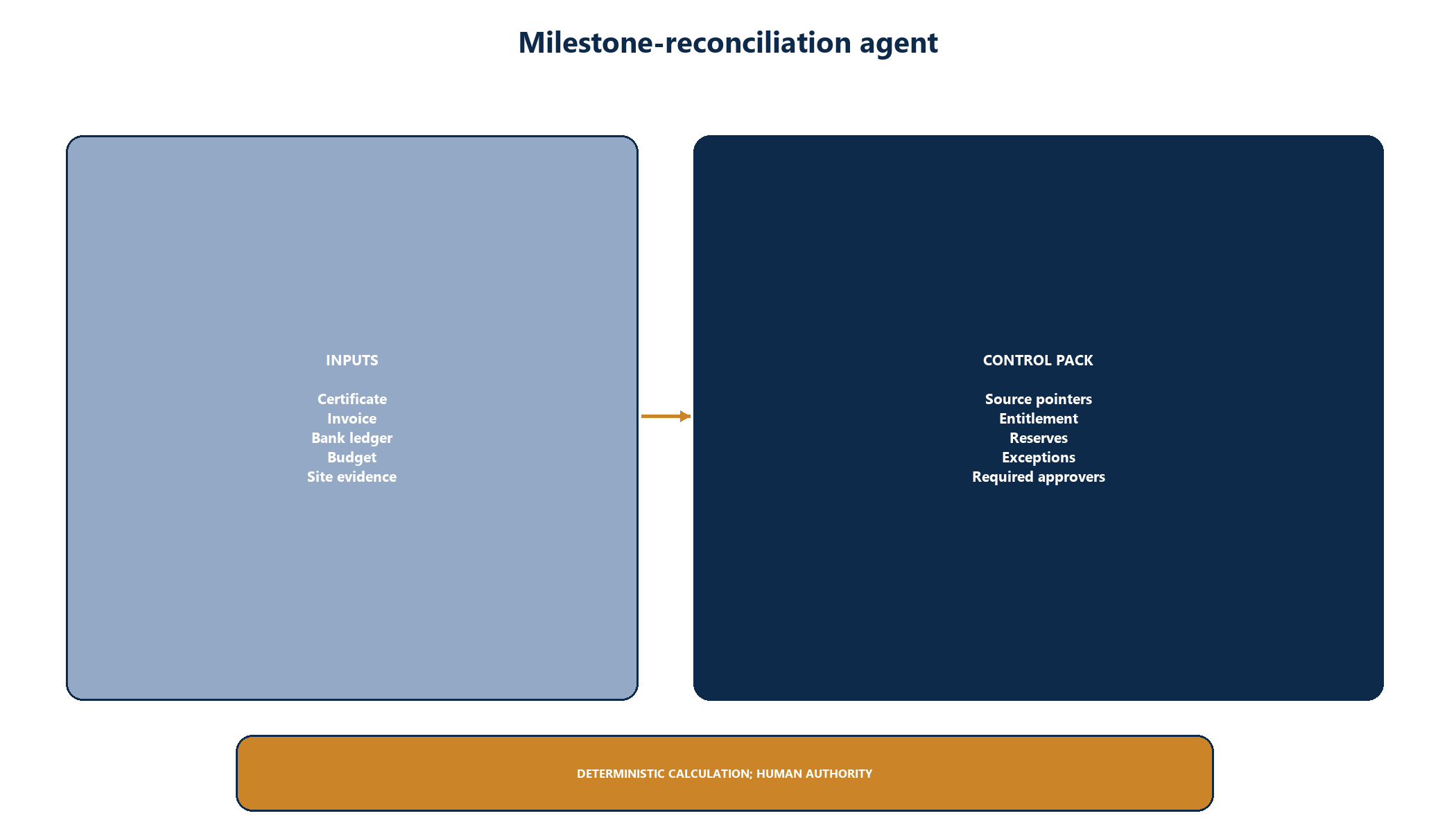
The milestone-reconciliation agent receives a release request ID and an approved rule-pack version. It may retrieve only permitted project objects. It produces a structured reconciliation pack, never a free-form payment instruction.

The output schema contains:

  • request and rule-pack identifiers;
  • project, account, payee and invoice identity;
  • milestone and work-package mapping;
  • planned, measured, model-observed, certified and accepted progress;
  • budget, commitment, prior release, retention and reserve values;
  • source pointers for every material input;
  • deterministic entitlement calculation result;
  • conflicts, omissions and stale evidence;
  • proposed routing and required approvers;
  • model version, prompt, tools and execution record.

Task decomposition

Agent taskPermitted model roleDeterministic or human control
Classify requestMap documents and stated purpose to schemaReviewer confirms material classification
Extract fieldsRead amount, date, parties, certificate and invoice dataSchema, checksum and source-pointer validation
Map milestoneSuggest WBS and cost-code linksApproved project map and reviewer confirmation
Compare evidenceSummarise agreement and conflict across sourcesRule engine calculates; professional resolves
Draft exceptionExplain missing or conflicting evidenceNamed owner accepts, edits or rejects
Draft decision packAssemble accepted evidence in templateRequired approvers authorise

Source-grounded extraction

Claude's citation feature can return document-linked citation blocks for supported document content [23]. The production design stores its own immutable source pointers as well: file hash, page or cell, bounding box where available, exact extracted text, parser version and reviewer status. Visual citations require separate crops and coordinates because current citation support may be text-focused under particular platform paths [21-23].

Each numeric field has a unit and sign convention. Amounts retain source currency. Percentages distinguish percentage points from proportions. Dates use ISO format plus source timezone. The model may not calculate final entitlement. It emits parsed inputs; a deterministic service performs calculation and returns a signed result.

Missing evidence and abstention

The agent must produce unsupported, conflicted, stale or not applicable where evidence is insufficient. It may not infer a certificate date from an upload date, a payee from a filename, a progress percentage from a narrative adjective, or legal eligibility from a prior similar request.

Prompt-injection resistance

Construction packs can contain arbitrary text. All document content is treated as untrusted data. Model instructions are separated from source content. Tools use allowlisted schemas and read-only access during analysis. The agent cannot send email, alter a bank file, modify a certificate, approve a request or execute a payment. Any source text that asks the model to ignore controls is captured as a security event.

Escrow And Cash Reconciliation

Double-entry project sub-ledger

The platform maintains a project sub-ledger reconciled to the trustee bank statement. Receipts are classified as buyer collections, financier deposits, developer injections, refunds, interest or other approved categories. Debits are classified by payee, invoice, cost code, release request and bank reference. Unmatched items remain in suspense with an owner and ageing status.

Control totals

For each cut-off date, the system tests:

Opening bank balance + cleared receipts - cleared debits = closing bank balance.

Opening project ledger + posted ledger entries = closing project ledger.

Bank closing balance - project ledger closing balance = unreconciled difference.

The final release workflow is blocked when the unreconciled difference exceeds an approved tolerance or includes a material unexplained item. Tolerance does not permit concealment; it governs routing and timing.

Release-base calculations

QuantityProposed formulaEvidence
Certified value to dateApproved certified quantity x approved rate, adjusted for authorised variationCertificate, contract and variation
Gross amount currently dueCertified value to date - prior certified valueCurrent and prior certificate
Net invoice eligibleGross due - contractual retention - deductions - prior paymentInvoice and contract
Cost-code availabilityApproved budget + approved transfers - commitments - prior eligible releasesBudget and commitment ledger
Cash availabilityCleared escrow balance - protected reserves - pending authorised debitsBank and reserve ledger
Provisional maximumMinimum of eligible invoice, cost-code availability, cash availability and applicable rule capsDeterministic result

Duplicate and anomaly controls

The platform detects exact and near-duplicate invoice numbers, reused certificate periods, repeated bank references, round-dollar splits, payee-account changes, invoice-date anomalies, duplicate image captures, abrupt progress reversals and requests just below an approval threshold. An anomaly is a review signal. It is not proof of fraud.

Three-way and four-way matching

Ordinary construction requests should match contract or purchase order, certified work, invoice and bank instruction. Where delivery evidence is material, a delivery note, test certificate or inspection record becomes a fifth component. Each mismatch has a defined owner and status.

Release-Entitlement Engine

Rule representation

The release-entitlement engine applies approved machine-readable rules to accepted inputs. Each rule has a unique ID, legal or contractual source, exact source pointer, jurisdiction, project scope, cost category, effective date, expression, required evidence, approvers, exception route, test cases and approval history.

A rule is not placed in production because a model extracted it. Legal, escrow, finance and project-control reviewers approve the rule and its test cases. The system preserves the legal text next to the executable expression so reviewers can identify any gap between them.

Waterfall sequence

The proposed sequence is strict:

  1. Validate project, account, request and rule-pack identity.
  2. Validate source completeness, authenticity and freshness.
  3. Validate payee, cost purpose and account eligibility.
  4. Validate professional certifications and required signatures.
  5. Calculate gross certified entitlement.
  6. Deduct prior releases, retention, liquidated or other approved deductions.
  7. Apply budget availability and cumulative category limits.
  8. Apply legal and contractual reserves.
  9. Apply lender drawstops, consent conditions and cash controls.
  10. Calculate a provisional maximum and required approvals.
  11. Route all exceptions; do not net unrelated exceptions into one score.
  12. After approval, generate a controlled instruction record for the trustee process.

Release states

StateMeaningPermitted transition
DraftRequest is incomplete or editableSubmit, cancel
SubmittedVersion frozen for analysisReturn, analyse
AnalysedCalculations and exceptions producedReview, return
Under professional reviewConsultant, accountant or other required reviewer engagedApprove evidence, reject, request information
Under trustee reviewRequired pack presented to trustee or bankApprove release, reject, request information
ConditionalOne or more explicit conditions remainSatisfy, expire, reject
ApprovedAll required approvals present for a defined amountIssue instruction, revoke before execution
ReleasedBank debit confirmedReconcile, dispute
ReconciledBank and project ledgers matchClose, reopen by controlled exception

Reserve stack

The engine calculates reserves independently and then applies the approved priority. Typical categories include statutory completion retention, contractual retention, defect reserve, tax reserve, unresolved-variation reserve, lender interest or debt-service reserve, cost-to-complete buffer and disputed-payment hold. The presence and priority of each reserve are project-specific.

ReserveBasisRelease triggerOwner
Statutory completion retentionApplicable law and approved calculation baseStatutory condition and approved evidenceTrustee, regulator and authorised parties
Contract retentionConstruction contract and certificatesContractual milestone and certificationContract administrator
Defect reserveDefect list and estimated remediationVerified remediation or approved securityEngineer and trustee
Variation reserveUnapproved or disputed variationFormal variation approvalDeveloper, consultant and lender as applicable
Lender reserveFinance documentsCovenant or consent conditionLender

Rule conflict

If two approved rules produce inconsistent results, the engine stops. It records the conflicting rule IDs, sources and affected amount. An authorised legal or contractual reviewer resolves the conflict through a new rule-pack version. The system does not choose the more permissive rule.

Alert Taxonomy And Exception Workflow

Alert design

An alert must identify the affected object, evidence, rule, amount, materiality, owner, clock and permitted resolution. Generic red warnings create noise. The proposed taxonomy distinguishes eligibility, evidence, progress, finance, cash, counterparty, authority, security and data-quality alerts.

Alert classExampleDefault severity driver
EligibilityCost category excluded by approved rule packAmount and legal consequence
EvidenceMissing current certificate or source pointerRequired-document status
ProgressCertified completion materially exceeds measured observationAmount, work package and confidence
FinanceRequest exceeds remaining budget or cumulative capMonetary exposure
CashBank balance stale or reconciliation difference openAmount and age
CounterpartyPayee bank details changed after approvalChange criticality
AuthorityMissing signer, expired appointment or conflicted reviewerDecision-rights breach
SecuritySource contains prompt injection or invalid signatureAccess and integrity impact
Data qualityProject, unit or cost-code identifier unresolvedDownstream calculation impact

Severity

Severity is calculated from consequence, exposure, reversibility, legal significance, evidence reliability and time sensitivity. A low model confidence is not automatically a critical business alert. A missing legally required signature is critical even if all amounts reconcile.

SeverityProposed responseRelease status
InformationalDisplay with source and refresh dateNo automatic block
ReviewNamed owner checks within service levelMay proceed only if rule permits
MaterialIndependent review and documented resolutionAffected amount held
CriticalEscalation to authorised control ownerRequest blocked
Security incidentIsolate inputs, revoke affected access and investigateWorkflow suspended

Exception lifecycle

Each exception moves through open, assigned, under review, information requested, resolved, accepted risk, rejected or expired. Resolution requires evidence and an authorised person. Accepted risk requires an explicit authority and expiry. Reopening preserves the prior history.

Alert fatigue controls

The system groups alerts only when they share a root cause and authority. It suppresses exact duplicates, preserves the highest materiality, and displays the number of affected requests and amount. It measures alert precision, override rate, ageing and repeated root causes. A control owner reviews thresholds; the model does not tune materiality autonomously.

Lender Dashboard Mock-Up

Purpose

The lender view is a decision surface for exposure, completion, liquidity, cost to complete, covenant and exception status. It must state its as-of time and data coverage. It should display planned, observed, certified and accepted progress separately.

Dashboard hierarchy

The top panel contains project identity, licence status, escrow account status, current data cut-off, total lender exposure, cleared escrow cash, remaining approved project cost, latest certified progress and open critical exceptions. A second panel shows progress against schedule, certified value against release, and forecast cost to complete. A third panel shows releases by cost category and payee concentration. A fourth panel presents covenants, consents and reserves. A final panel lists decision-ready exceptions with source links.

Dashboard fieldDefinitionSourceCaution
Observed progressModel or measurement-supported visible progressCapture and analysisProvisional until reviewed
Certified progressCurrent approved consultant or engineer statusCertificateCertification scope must be clear
Cash balanceCleared escrow balance at cut-offBankPending items shown separately
Cost to completeApproved remaining cost plus approved forecast adjustmentsBudget and forecastScenario and confidence disclosed
Release coverageCash available divided by approved pending releasesLedgerExcludes unsupported requests
Exception exposureSum of amounts affected by open material exceptionsWorkflowAmount is exposure, not expected loss

Text wireframe

Dashboard bandIllustrative fields
Project headerProject, licence, account and as-of time
ExposureLoan exposure, escrow cash, certified progress and critical-exception count
Progress bridgePlanned, observed, measured, certified and accepted progress
Cash waterfallOpening cash, cleared receipts, reserves, approved pending releases and forecast closing cash
Cost to completeBase cost, approved changes, contingency and forecast adjustment
Covenants and consentsStatus, threshold, headroom, source and required action
Decision queueSeverity, request, amount, rule, evidence gap, owner, age and action

The values in this wireframe are placeholders. They are not observed project data.

Explainability

Clicking any KPI opens its calculation, source objects, rule version, evidence status and reviewer. The dashboard does not present a single opaque project-health score. A lender can see whether a warning arises from cash, physical progress, a missing approval, a contract issue or stale data.

Human Review, Signature And Override

Separate workspaces

The developer, consultant, certified public accountant, trustee and lender receive separate workspaces and credentials. The system may show a common evidence pack, but each party records its own review, comments, approval scope and signature. One party cannot use the model to impersonate another.

Professional review checklist

Review questionEvidenceRecorded outcome
Is the request within appointment and licence scope?Appointment, licence, project recordIn scope, out of scope, refer
Is the source set complete for the relevant opinion?Checklist and evidence objectsComplete, incomplete, qualified
Are physical observations consistent with certification?Capture, measurement, site recordConsistent, explained difference, unresolved
Are amounts and cumulative values correct?Deterministic calculation and ledgerConfirmed, corrected, disputed
Are required restrictions and qualifications stated?Rule pack and professional judgementAccepted wording or revision

Electronic signatures

An approval record contains signer identity, role, organisation, authority, appointment version, approved amount, conditions, timestamp, signature mechanism, document hash and revocation status. The signature is bound to the exact pack version. Any change after signature creates a new version requiring the applicable approvals again.

Override policy

Overrides are exceptional and transparent. An override record contains the failed rule, affected amount, reason, approving authority, supporting source, compensating control, expiry and required notification. Rules classify which failures are non-overridable. The dashboard reports override volume, ageing and concentration by approver or counterparty.

No autonomous release

The system does not hold bank credentials and cannot submit a final payment instruction without the bank's approved human and technical controls. Where an authorised integration is later implemented, transaction limits, dual control, payee validation, step-up authentication and independent reconciliation remain mandatory.

Worked Escrow Scenarios

Scenario status

The examples in this section are Illustrative examples. Names, projects, balances, progress percentages, invoices, thresholds, outcomes and timelines are invented to demonstrate the framework. They are not client facts, regulator decisions or observed performance.

Dubai request

Illustrative example A Dubai off-plan project submits an AED 12.0 million contractor request. The current approved consultant certificate supports AED 11.4 million of gross work for the period. Contractual retention and a prior payment reduce the net invoice-supported amount to AED 9.7 million. Cost-code availability is AED 10.2 million. Cleared escrow cash after protected reserves is AED 10.0 million. The deterministic provisional maximum is therefore AED 9.7 million, before final trustee review.

The vision service finds that several facade zones visible in the capture appear less complete than the schedule mapping assumed. The model does not reduce the certified amount. It opens a material evidence conflict, links the affected images and BIM zones, and routes the exception to the approved consultant and trustee engineer. The release remains held until they resolve the discrepancy or provide additional evidence.

Dubai scenario inputIllustrative valueStatus
Contractor requestAED 12.0mUnverified illustrative
Gross certified period valueAED 11.4mUnverified illustrative
Net invoice-supported amountAED 9.7mUnverified illustrative
Cost-code availabilityAED 10.2mUnverified illustrative
Cash after reservesAED 10.0mUnverified illustrative
Provisional mathematical maximumAED 9.7mCalculated from illustrative inputs

Saudi request

Illustrative example A Saudi off-plan project prepares a SAR 7.5 million release. The project record confirms the licensed scope and escrow account. The consulting firm approves the engineering evidence and the certified public accountant confirms the financial calculation. A payee-bank change was entered after the invoice review. The system blocks instruction generation, requires independent payee verification and preserves the three approval records. Once the payee change is verified under the bank's approved process, the signatories review the final pack version.

Cross-scenario lesson

The main control value is the separation of evidence, arithmetic and authority. A vision discrepancy creates a review item. A bank-detail change creates a security and counterparty control. A calculated maximum constrains the amount. None of those outputs substitutes for the required professional and banking decisions.

Model Evaluation And Production Monitoring

Golden set

Before production, the project team creates a permissioned, representative golden set of past requests. It includes ordinary, incomplete, disputed, amended, multilingual, low-quality, duplicate and adversarial cases. Specialists label fields, source pointers, eligibility, progress states, exceptions and final human outcomes. The evaluation set remains separate from prompt and workflow development.

Component evaluations

ComponentPrimary metricRelease gate
Document classificationMacro F1 plus material-class recallNo critical class below approved recall
Numeric extractionExact match with unit, sign and source pointerZero critical unsupported amounts in release set
Entity matchingPrecision, recall and false payee matchNo unresolved material counterparty match
Vision observationClass and state precision, recall and coverageProject-specific approved thresholds
Citation or pointerEntailment and location validityEvery material claim traceable
Rule calculationTest-vector exact match100 per cent on approved deterministic cases
Exception draftingCorrect rule, amount, evidence and ownerHuman acceptance and correction threshold

End-to-end evaluation

The end-to-end unit is a release pack. Reviewers compare the AI-supported pack with the approved human baseline on amount, unsupported release risk, missed exception risk, time, specialist effort, reviewer disagreement and reproducibility. Cases are stratified by jurisdiction, project phase, value, cost category, evidence quality and language.

Severity-weighted error

A false positive visual alert creates review cost. A missed duplicate invoice or unsupported payee change can create a larger exposure. The evaluation therefore weights errors by approved severity and affected amount. Weighting is governance policy, not a model-selected parameter.

Production monitoring

Production monitoring covers input drift, capture quality, extraction accuracy, correction rate, source-pointer failure, rule-pack version, tool errors, latency, security events, exception ageing and override patterns. Any material model, prompt, parser or rule change triggers regression testing.

Incident response

An incident playbook defines detection, containment, evidence preservation, impacted requests, access revocation, bank and regulator escalation, human fallback, root-cause review and controlled restart. The platform retains model inputs and outputs subject to privacy and legal retention rules.
Privacy, Security And Media Provenance

Data-protection perimeter

Site imagery may contain workers, visitors, vehicle plates, neighbouring properties and location data. Payment packs contain identities, account details and signatures. UAE Federal Decree-Law No. 45 of 2021 defines and regulates personal-data processing [16]. Saudi Arabia's Personal Data Protection Law and its implementing guidance establish rights and controller obligations [17-18]. A project must obtain jurisdiction-specific legal advice, define purpose and lawful basis, minimise capture, restrict access, set retention and manage cross-border processing.

Privacy-by-design controls

RiskProposed control
Incidental faces or platesAvoid capture where possible; approved redaction for analytical copies
Neighbouring propertyGeofence or mask excluded zones; route approval
Location leakageRole-based access and restricted exports
Signature and bank dataField-level protection, limited views and audit logging
Model-provider processingApproved data-processing terms, region and retention configuration
Secondary useProhibit training or unrelated use without approved basis

Evidence integrity

Every original asset receives a cryptographic hash on ingestion. The system stores device, operator, capture time, upload time, geospatial metadata where permitted, transformations and derivative hashes. C2PA defines an opt-in technical standard for content provenance and authenticity manifests [27]. Where supported by capture devices and software, C2PA-compatible credentials can supplement the custody record. They do not prove the semantic truth of the scene; they help verify declared provenance and tamper evidence.

Access control

Access is granted by project, organisation, role, object class and purpose. Retrieval filters are enforced before a source reaches the model. Privileged actions require step-up authentication. Service accounts receive narrowly scoped permissions. The system records read, export, correction, approval and administrative events.

Cybersecurity baseline

The control programme maps the service to NIST AI RMF governance, mapping, measurement and management functions [19-20], the organisation's information-security management system, secure software practices and incident processes [42-46]. Generative-AI risk controls include pre-deployment testing, provenance, incident disclosure, model and supplier governance, and documented human roles [20].

Drone And Remote-Capture Constraints

UAE

The UAE GCAA treats commercial photography, aerial survey and related work as regulated professional drone operations and describes registration, operator authorisation, security clearance and operational permission requirements [28]. Current airspace publications and safety decisions can change quickly. A GCAA decision dated 28 February 2026 temporarily suspended drone operations [29]. A later GCAA alert dated 2 May 2026 addressed the resumption of normal air navigation operations [30]. I cannot verify from the cited publications that the drone-specific suspension was explicitly cancelled for every proposed construction-capture operation. A project must obtain current written confirmation and all required approvals before any flight.

Saudi Arabia

Saudi GACA material requires applicable government approvals, registration and operational authorisation for small UAS; aerial survey or photography can require additional approvals [31]. Current GACA rules and the intended project's location and operation must be verified before capture.

Capture fallback

The operating model must function without drones. Approved fixed cameras, ground-based mobile routes, 360-degree capture, handheld imagery and terrestrial laser scanning can supply evidence where legally, safely and technically permitted. Capture method is recorded as part of evidence quality; the system does not merge methods without an approved comparison protocol.

Capture methodStrengthLimitationApproval check
Fixed cameraConsistent view and frequencyOcclusion and limited coverageSite, privacy and security approval
Ground mobileFlexible and relatively accessibleOperator and route variabilitySite safety and privacy approval
360-degree cameraBroad contextual recordDistortion and privacy exposureSite and data-protection approval
Terrestrial scanQuantitative geometryCost, registration and reflective surfacesTechnical and site approval
Drone imageryRoof, facade and site coverageAviation, security, weather and privacy constraintsCurrent aviation and security permissions

Economics, Capacity And Ninety-Day Roadmap

Evidence boundary

No supplied Matchpoint or client dataset establishes time saved, cash cost reduction, loss reduction, financing improvement, release acceleration or additional revenue from this architecture. Those values remain USD 0 for attribution until a controlled pilot produces approved observed evidence.

Measurement model

The baseline and pilot use the same request definition and quality gate. Measures include active human hours, elapsed calendar time, specialist hours, exception detection, rework, unsupported-field rate, release-pack quality, incidents and technology cost.

MeasureDefinitionEvidence source
Decision-ready packRequest with complete accepted evidence and required reviews ready for authorityWorkflow state and checklist
Active human hoursTime spent performing or reviewing the caseApproved time record
Elapsed cycle timeSubmission to final decision excluding defined pausesEvent log
Quality-gated throughputDecision-ready packs meeting the approved quality thresholdQA record
Cost per packLoaded labour, specialist, technology and exception cost divided by accepted packsFinance and time evidence
Prevented exposureAmount of a request held due to a valid exceptionDecision record; not realised saving

Ninety-day roadmap

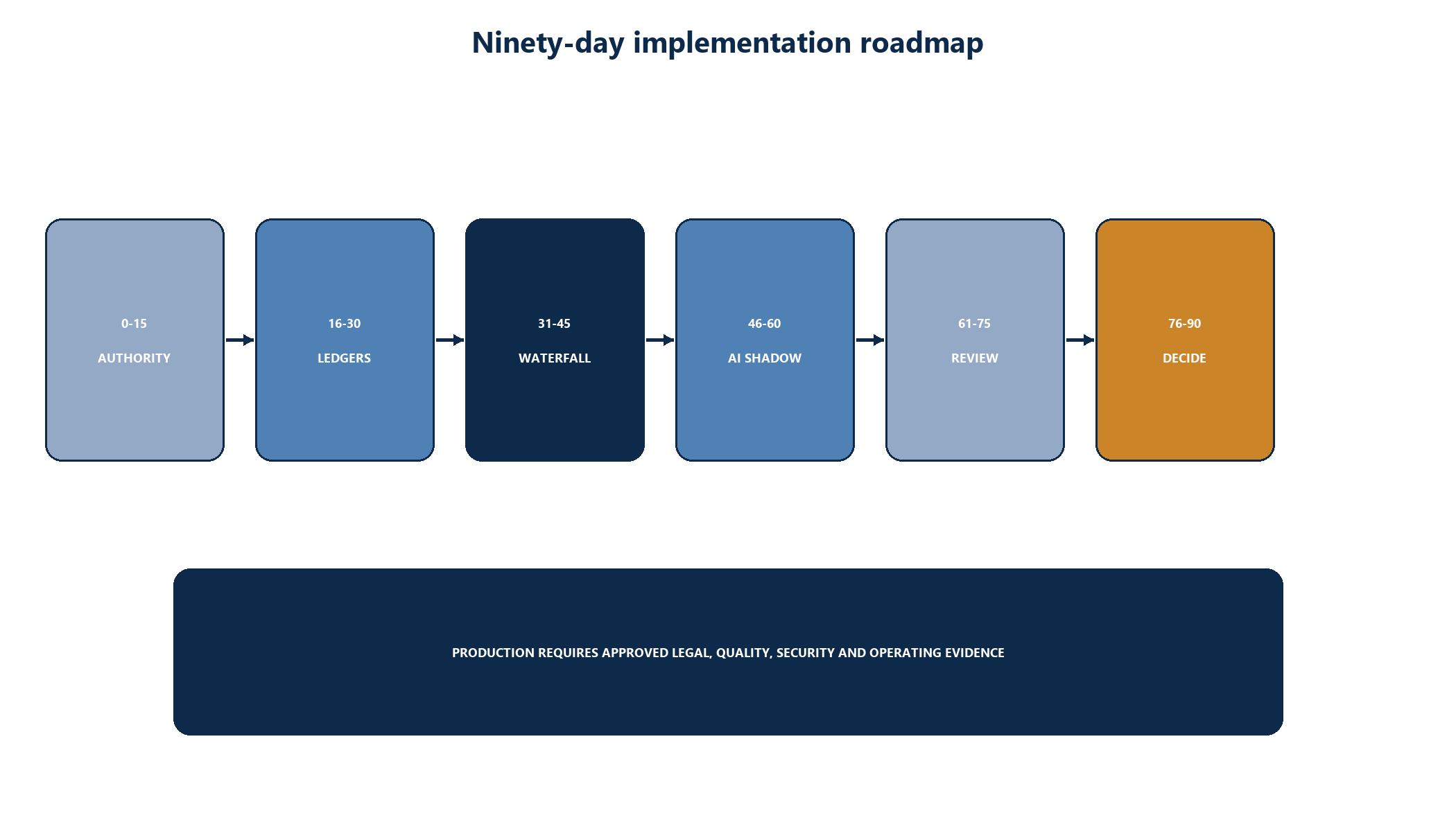
Days 0 to 15: authority and source map. Confirm jurisdictions, projects, professional roles, current laws, regulator services, account agreements, finance documents, capture permissions, data-protection requirements and system boundaries. Freeze the initial source register.

Days 16 to 30: canonical data and evidence vault. Configure identifiers, bank reconciliation, WBS and cost-code maps, evidence objects, access, retention, hashes and event records. Load a limited historical set.

Days 31 to 45: deterministic waterfall. Encode and approve one narrow request category, calculate budget, cash, retention and release constraints, and test against approved examples.

Days 46 to 60: AI shadow workflow. Add controlled document extraction, source pointers, progress-image analysis and exception drafting. Run in shadow mode with no production decision effect.

Days 61 to 75: professional and lender review. Approved professionals compare outputs with their current process. The team measures correction, missed exceptions, false alerts, time and usability.

Days 76 to 90: governance decision. Review security, privacy, evaluation, incidents, supplier terms, operational support and observed economics. Authorised management decides whether to stop, extend shadow mode or permit a tightly scoped production pilot.

Minimum production gates

GateEvidence required
Legal and contractualApproved current rule pack and professional review
DataReconciled identifiers, provenance, permissions and retention
CalculationExact-match deterministic test suite
ModelProject-specific golden-set results and accepted thresholds
WorkflowSeparate identities, approvals, signature and override controls
SecurityThreat model, access tests, logging and incident drill
OperationsOwners, service levels, fallback and change control
EconomicsApproved observed pilot evidence or explicit non-financial rationale

Limitations And Conclusion

Limitations

This paper is a research and operating-design document. It does not provide legal, regulatory, engineering, audit, accounting, banking, privacy, cybersecurity, aviation, valuation or investment advice. Official translations may not prevail over Arabic source texts. Laws, implementing regulations, service requirements, regulator directions, bank processes and platform capabilities can change. Every project requires current professional review.

The computer-vision literature includes diverse datasets, project types, capture methods, element classes and metrics [32-41]. Reported case performance is not evidence of equivalent performance on a Dubai or Saudi project. Visual evidence cannot reliably establish hidden work, material quality, test compliance or contractual acceptance without additional evidence. BIM and schedule data can themselves be incomplete or stale. Model outputs may be wrong, unsupported or manipulated.

The proposed rule engine requires accurate approved legal and contractual interpretation. The dashboard depends on bank, project-controls, certification and evidence freshness. A well-designed platform cannot repair a defective appointment, fraudulent source, unauthorised capture, missing professional independence or compromised banking process by itself.

Conclusion

Milestone-linked escrow releases are a data, evidence and authority problem. Dubai and Saudi Arabia provide distinct legal structures with a common need for project-specific accounts, professional evidence, controlled disbursement and records. A defensible digital architecture joins those structures to a canonical ledger, immutable evidence, deterministic entitlement, exception-led workflow and segregated approval.

Claude and construction computer vision can support document analysis, imagery review, comparison, source-linked drafting and exception preparation. Their useful role is bounded by custody, evaluation, abstention, deterministic calculation and human authority. The authorised consultant, accountant, developer, trustee, lender and regulator remain responsible for the decisions allocated to them.

The recommended first implementation is one jurisdiction, one project, one request category and one shadow-mode pilot. Expansion should follow approved evidence on quality, security, reviewer effort and operating economics. Attributed Matchpoint or client revenue, cash cost reduction, loss reduction and alpha remain USD 0 until approved observed evidence exists.

References

[1] Government of Dubai. Law No. (8) of 2007 Concerning Escrow Accounts for Real Estate Development in the Emirate of Dubai. Official legislation portal. https://dlp.dubai.gov.ae/Legislation%20Reference/2007/Law%20No.%20%288%29%20of%202007.html

[2] Dubai Land Department. Frequently Asked Questions. Official guidance on project progress, escrow trustees and related real-estate services. https://dubailand.gov.ae/en/frequently-asked-questions

[3] Dubai Land Department. Real Estate Project Status. Official service. https://dubailand.gov.ae/en/eservices/real-estate-project-status-landing/real-estate-project-status/

[4] Dubai Land Department. Depositing a mortgage into an escrow account application. Official service. https://dubailand.gov.ae/en/eservices/request-for-mortgage-payment-in-escrow-account/

[5] Dubai Land Department. Receive a payment from the project's Escrow Account. Official service. https://dubailand.gov.ae/en/eservices/request-to-receive-a-payment-from-the-projects-escrow-account/

[6] Dubai Land Department. Approval and renewal of an account trustee and auditing company. Official service. https://dubailand.gov.ae/en/eservices/approval-renewal-of-an-account-trustee-and-auditing-company/

[7] Government of Dubai. Law No. (13) of 2008 Regulating the Interim Real Property Register in the Emirate of Dubai. https://dlp.dubai.gov.ae/Legislation%20Reference/2008/Law%20No.%20%2813%29%20of%202008.html

[8] Government of Dubai. Law No. (19) of 2017 Amending Law No. (13) of 2008. https://dlp.dubai.gov.ae/Legislation%20Reference/2017/Law%20No.%20%2819%29%20of%202017%20Amending%20Law%20No.%20%2813%29%20of%202008%20Regulating%20the%20Interim%20Real%20Property%20Register%20in%20the%20Emirate%20of%20Dubai.html

[9] Government of Dubai. Law No. (16) of 2007 Establishing the Real Estate Regulatory Agency. https://dlp.dubai.gov.ae/Legislation%20Reference/2007/Law%20No.%20%2816%29%20of%202007.html

[10] Government of Dubai. Executive Council Resolution No. (6) of 2010 Approving the Implementing Bylaw of Law No. (13) of 2008. https://dlp.dubai.gov.ae/Legislation%20Reference/2010/Executive%20Council%20Resolution%20No.%20%286%29%20of%202010%20Approving%20the%20Implementing%20Bylaw%20of%20Law%20No.%20%2813%29%20of%202008.html

[11] Real Estate General Authority, Saudi Arabia. Law of Selling and Leasing Off-Plan Real Estate Projects. Active official law. https://rega.gov.sa/en/laws-and-decisions/regulations-and-by-laws/rules/law-of-selling-and-leasing-off-plan-real-estate-projects/

[12] Real Estate General Authority, Saudi Arabia. Implementing Regulations of the Off-Plan Sale and Lease of Real Estate Projects Law. Active official regulations. https://rega.gov.sa/en/laws-and-decisions/regulations-and-by-laws/regulations/implementing-regulations-of-the-off-plan-sale-and-lease-of-real-estate-projects-law/

[13] Real Estate General Authority, Saudi Arabia. Wafi Off-Plan Sales and Lease. Official platform description. https://rega.gov.sa/en/rega-services/platforms/wafi-off-plan-sales-and-lease/

[14] Real Estate General Authority, Saudi Arabia. Law of Selling and Leasing Off-Plan Real Estate Projects, official PDF. https://rega.gov.sa/media/lj3hhr42/law-of-selling-and-leasing-off-plan-real-estate-projects.pdf

[15] Real Estate General Authority, Saudi Arabia. Implementing Regulations of the Off-Plan Sale and Lease of Real Estate Projects Law, official PDF. https://rega.gov.sa/media/xswbjgnx/implementing-regulations-of-the-off-plan-sale-and-lease-of-real-estate-projects-law.pdf

[16] United Arab Emirates. Federal Decree by Law No. (45) of 2021 Concerning the Protection of Personal Data. https://uaelegislation.gov.ae/en/legislations/1972

[17] Saudi Data and AI Authority. Personal Data Protection Law. Official English text. https://sdaia.gov.sa/en/SDAIA/about/Documents/Personal%20Data%20English%20V2-23April2023-%20Reviewed-.pdf

[18] Saudi Data and AI Authority. Guide to the Saudi Personal Data Protection Law, Version 1.0. https://dgp.sdaia.gov.sa/wps/portal/pdp/knowledgecenter/details/GPDPL/

[19] Tabassi, E. Artificial Intelligence Risk Management Framework (AI RMF 1.0). NIST AI 100-1, 2023. https://doi.org/10.6028/NIST.AI.100-1

[20] Autio, C. et al. Artificial Intelligence Risk Management Framework: Generative Artificial Intelligence Profile. NIST AI 600-1, 2024. https://doi.org/10.6028/NIST.AI.600-1

[21] Anthropic. PDF support. Claude Platform documentation. https://platform.claude.com/docs/en/build-with-claude/pdf-support

[22] Anthropic. Vision. Claude Platform documentation. https://platform.claude.com/docs/en/build-with-claude/vision

[23] Anthropic. Citations. Claude Platform documentation. https://platform.claude.com/docs/en/build-with-claude/citations

[24] Anthropic. Tool use overview. Claude Platform documentation. https://platform.claude.com/docs/en/agents-and-tools/tool-use/overview

[25] Anthropic. Define success criteria and build evaluations. Claude Platform documentation. https://platform.claude.com/docs/en/test-and-evaluate/develop-tests

[26] buildingSMART International. Industry Foundation Classes (IFC). Official standard overview; IFC 4.3.2.0 and ISO 16739-1:2024. https://www.buildingsmart.org/standards/bsi-standards/industry-foundation-classes/

[27] Coalition for Content Provenance and Authenticity. C2PA Technical Specification. https://spec.c2pa.org/specifications/

[28] UAE General Civil Aviation Authority. UAS Registration and Professional Operations Requirements. https://www.gcaa.gov.ae/en/pages/uasregistration.aspx

[29] UAE General Civil Aviation Authority. Safety Decision 2026-03: Temporary Suspension of Operation of Unmanned Aircraft Systems and Light Sport Aircraft within UAE Airspace, 28 February 2026. https://www.gcaa.gov.ae/en/epublication/EPublications/Safety%20Decisions/2026/SAFETY%20DECISION%202026-03%20-%20TEMPORARY%20SUSPENSION%20OF%20OPERATION%20OF%20UNMANNED%20AIRCRAFT%20SYSTEMS%20%28DRONES%29%2C%20AND%20LIGHT%20SPORT%20AIRCRAFT%20WITHIN%20UAE%20AIRSPACE%20-%20ISSUE%2001.pdf

[30] UAE General Civil Aviation Authority. Safety Alert 2026-02: Return to Normal of Operations within the UAE Airspace, 2 May 2026. https://www.gcaa.gov.ae/en/epublication/EPublications/Safety%20Alerts/SAFETY%20ALERT%202026-02%20-%20RETURN%20TO%20NORMAL%20OF%20OPERATIONS%20WITHIN%20THE%20UAE%20FIR%20-%20ISSUE%2001.pdf

[31] General Authority of Civil Aviation, Saudi Arabia. AC 101-01: Small Unmanned Aircraft Systems. https://gaca.gov.sa/-/media/Files/PDF/LawsAndRegulation/Aviation-Safety-and-Environmental-Sustainability/Safety-and-Aviation-Standards-Advisory-Circulars/AC-101-01-Small-Unmanned-Aircraft-Systems.pdf

[32] Reja, V. K., Varghese, K. and Ha, Q. P. "Computer vision-based construction progress monitoring." Automation in Construction 138 (2022), 104245. https://doi.org/10.1016/j.autcon.2022.104245

[33] Rehman, M. S. U., Shafiq, M. T. and Ullah, F. "Automated Computer Vision-Based Construction Progress Monitoring: A Systematic Review." Buildings 12(7) (2022), 1037. https://doi.org/10.3390/buildings12071037

[34] Golparvar-Fard, M., Pena-Mora, F. and Savarese, S. "Automated Progress Monitoring Using Unordered Daily Construction Photographs and IFC-Based Building Information Models." Journal of Computing in Civil Engineering 29(1) (2015). https://doi.org/10.1061/(ASCE)CP.1943-5487.0000205

[35] Deng, H., Hong, H., Luo, D., Deng, Y. and Su, C. "Automatic Indoor Construction Process Monitoring for Tiles Based on BIM and Computer Vision." Journal of Construction Engineering and Management 146(1) (2020). https://doi.org/10.1061/(ASCE)CO.1943-7862.0001744

[36] Mahami, H., Nasirzadeh, F., Hosseininaveh Ahmadabadian, A. and Nahavandi, S. "Automated Progress Controlling and Monitoring Using Daily Site Images and Building Information Modelling." Buildings 9(3) (2019), 70. https://doi.org/10.3390/buildings9030070

[37] Park, S.-M. and Kang, L.-S. "Visual Evaluation of Construction Schedule Progress by Linking Photographs and 4D Model." Buildings 16(4) (2026), 733. https://doi.org/10.3390/buildings16040733

[38] Tang, K. and Shi, W. "RandLA-Net-Assisted Scan-vs-BIM Framework with Adaptive Parameter Optimization for Construction Progress Monitoring." Journal of Computing in Civil Engineering (2026). https://doi.org/10.1061/JCCEE5.CPENG-6962

[39] Bhattacharjee, A., Rana, M. J., Zaman, A. A. U. and Dang, H. "Integrated Information System for Periodic Construction Progress Monitoring: Utilizing UAV, Photogrammetry, and BIM for Enhanced Decision-Making and Optimization." Civil Engineering Sciences (2026). https://doi.org/10.34133/cesci.0022

[40] Yang, J., Wilde, A., Menzel, K., Sheikh, M. Z. and Kuznetsov, B. Computer Vision for Construction Progress Monitoring: A Real-Time Object Detection Approach. arXiv preprint, 2023. https://doi.org/10.48550/arXiv.2305.15097

[41] Halder, S., Afsari, K. and Akanmu, A. A Robotic Cyber-Physical System for Automated Reality Capture and Visualization in Construction Progress Monitoring. arXiv preprint, 2024. https://doi.org/10.48550/arXiv.2402.07034

[42] National Institute of Standards and Technology. Security and Privacy Controls for Information Systems and Organizations. NIST SP 800-53 Rev. 5. https://doi.org/10.6028/NIST.SP.800-53r5

[43] National Institute of Standards and Technology. Secure Software Development Framework (SSDF) Version 1.1. NIST SP 800-218. https://doi.org/10.6028/NIST.SP.800-218

[44] OWASP Foundation. OWASP Top 10 for Large Language Model Applications. https://genai.owasp.org/llm-top-10/

[45] International Organization for Standardization. ISO/IEC 27001: Information security management systems. https://www.iso.org/isoiec-27001-information-security.html

[46] Center for Internet Security. CIS Critical Security Controls Version 8. https://www.cisecurity.org/controls/v8

[47] International Organization for Standardization. ISO 19650-1: Organization and digitization of information about buildings and civil engineering works, including building information modelling. https://www.iso.org/standard/68078.html

[48] International Auditing and Assurance Standards Board. Audit Evidence project and ISA 500 materials. https://www.iaasb.org/consultations-projects/audit-evidence

[49] Basel Committee on Banking Supervision. Principles for effective risk data aggregation and risk reporting. Bank for International Settlements, 2013. https://www.bis.org/publ/bcbs239.htm

[50] Institute of Internal Auditors. The IIA's Three Lines Model. https://www.theiia.org/en/content/position-papers/2020/the-iias-three-lines-model-an-update-of-the-three-lines-of-defense/

Appendix A. Release Request Object

FieldTypeRequired control
request_idStable stringUnique and immutable
project_idReferenceActive licensed project
rule_pack_idVersion referenceApproved and effective
account_idReferenceProject escrow account
payee_idReferenceVerified counterparty
invoice_idsListSource-linked and duplicate-checked
certificate_idsListCurrent approved versions
work_packagesListApproved WBS mapping
requested_amountCurrency amountUnit, sign and source required
provisional_maximumCurrency amountDeterministic signed calculation
exceptionsListOwner, severity, status and amount
approvalsListSeparate identity and scope
statusEnumControlled transition

Appendix B. Progress Observation Object

FieldDescription
observation_idUnique element-level observation
evidence_idLink to immutable source asset
model_element_idApproved model element reference
work_package_idApproved schedule and cost mapping
observed_stateControlled progress taxonomy
quantityValue, unit and approved method
model_name_versionExact model and configuration
confidenceModel score; never approval
source_cropCoordinates or derivative hash
applicabilityIn-perimeter, out-of-perimeter or unknown
reviewer_statusPending, accepted, corrected or rejected
reviewer_identityApproved professional identity

Appendix C. Rule Object

FieldDescription
rule_idStable rule identifier
source_idStatute, regulation, service, agreement or policy source
source_pointerArticle, clause, page or controlled location
jurisdictionDubai, Saudi Arabia or project-specific layer
project_scopeApplicable projects, phases and categories
effective_fromEffective date and time
effective_toSupersession date where applicable
expressionDeterministic executable rule
required_evidenceEvidence and approval prerequisites
exception_routePermitted legal or contractual escalation
testsApproved positive, negative and boundary cases
approvalLegal, finance and control approvals

Appendix D. Model Run Record

FieldDescription
run_idUnique execution identifier
taskApproved bounded task
modelProvider, model and version
prompt_versionApproved system and task prompt IDs
tool_versionsParsers, retrieval, vision and calculation tools
input_hashesExact source objects supplied
output_hashImmutable output record
citationsSource pointers returned and validated
safety_eventsPrompt injection, policy or access events
latency_and_costTechnical operating metrics
reviewer_outcomeAccepted, corrected, rejected or escalated

Appendix E. Release Pack Checklist

  • [ ] Project, licence, account and rule-pack identities confirmed.
  • [ ] Bank cut-off and project ledger reconciled.
  • [ ] Payee and bank details independently verified.
  • [ ] Invoice, contract, work package and cost code matched.
  • [ ] Current approved progress certificate present.
  • [ ] Required site, measurement and trustee evidence present.
  • [ ] Budget, prior release, retention and reserve calculations validated.
  • [ ] Statutory and contractual caps tested.
  • [ ] Lender conditions, consents and drawstops tested.
  • [ ] All model-supported fields have valid source pointers.
  • [ ] Material exceptions resolved by authorised owners.
  • [ ] Required separate signatures bind to the final pack version.
  • [ ] Bank instruction uses the approved secure channel.
  • [ ] Bank debit is reconciled after release.

Source Register

The full paper records the scope, evidence setting and limitations applied to these sources.

  1. [1] Government of Dubai. *Law No. (8) of 2007 Concerning Escrow Accounts for Real Estate Development in the Emirate of Dubai*. Official legislation portal. Open source
  2. [2] Dubai Land Department. *Frequently Asked Questions*. Official guidance on project progress, escrow trustees and related real-estate services. Open source
  3. [3] Dubai Land Department. *Real Estate Project Status*. Official service. Open source
  4. [4] Dubai Land Department. *Depositing a mortgage into an escrow account application*. Official service. Open source
  5. [5] Dubai Land Department. *Receive a payment from the project's Escrow Account*. Official service. Open source
  6. [6] Dubai Land Department. *Approval and renewal of an account trustee and auditing company*. Official service. Open source
  7. [7] Government of Dubai. *Law No. (13) of 2008 Regulating the Interim Real Property Register in the Emirate of Dubai*. Open source
  8. [8] Government of Dubai. *Law No. (19) of 2017 Amending Law No. (13) of 2008*. Open source
  9. [9] Government of Dubai. *Law No. (16) of 2007 Establishing the Real Estate Regulatory Agency*. Open source
  10. [10] Government of Dubai. *Executive Council Resolution No. (6) of 2010 Approving the Implementing Bylaw of Law No. (13) of 2008*. Open source
  11. [11] Real Estate General Authority, Saudi Arabia. *Law of Selling and Leasing Off-Plan Real Estate Projects*. Active official law. Open source
  12. [12] Real Estate General Authority, Saudi Arabia. *Implementing Regulations of the Off-Plan Sale and Lease of Real Estate Projects Law*. Active official regulations. Open source
  13. [13] Real Estate General Authority, Saudi Arabia. *Wafi Off-Plan Sales and Lease*. Official platform description. Open source
  14. [14] Real Estate General Authority, Saudi Arabia. *Law of Selling and Leasing Off-Plan Real Estate Projects*, official PDF. Open source
  15. [15] Real Estate General Authority, Saudi Arabia. *Implementing Regulations of the Off-Plan Sale and Lease of Real Estate Projects Law*, official PDF. Open source
  16. [16] United Arab Emirates. *Federal Decree by Law No. (45) of 2021 Concerning the Protection of Personal Data*. Open source
  17. [17] Saudi Data and AI Authority. *Personal Data Protection Law*. Official English text. Open source
  18. [18] Saudi Data and AI Authority. *Guide to the Saudi Personal Data Protection Law*, Version 1.0. Open source
  19. [19] Tabassi, E. *Artificial Intelligence Risk Management Framework (AI RMF 1.0)*. NIST AI 100-1, 2023. Open source
  20. [20] Autio, C. et al. *Artificial Intelligence Risk Management Framework: Generative Artificial Intelligence Profile*. NIST AI 600-1, 2024. Open source
  21. [21] Anthropic. *PDF support*. Claude Platform documentation. Open source
  22. [22] Anthropic. *Vision*. Claude Platform documentation. Open source
  23. [23] Anthropic. *Citations*. Claude Platform documentation. Open source
  24. [24] Anthropic. *Tool use overview*. Claude Platform documentation. Open source
  25. [25] Anthropic. *Define success criteria and build evaluations*. Claude Platform documentation. Open source
  26. [26] buildingSMART International. *Industry Foundation Classes (IFC)*. Official standard overview; IFC 4.3.2.0 and ISO 16739-1:2024. Open source
  27. [27] Coalition for Content Provenance and Authenticity. *C2PA Technical Specification*. Open source
  28. [28] UAE General Civil Aviation Authority. *UAS Registration and Professional Operations Requirements*. Open source
  29. [29] UAE General Civil Aviation Authority. *Safety Decision 2026-03: Temporary Suspension of Operation of Unmanned Aircraft Systems and Light Sport Aircraft within UAE Airspace*, 28 February 2026. Open source
  30. [30] UAE General Civil Aviation Authority. *Safety Alert 2026-02: Return to Normal of Operations within the UAE Airspace*, 2 May 2026. Open source
  31. [31] General Authority of Civil Aviation, Saudi Arabia. *AC 101-01: Small Unmanned Aircraft Systems*. Open source
  32. [32] Reja, V. K., Varghese, K. and Ha, Q. P. "Computer vision-based construction progress monitoring." *Automation in Construction* 138 (2022), 104245. Open source
  33. [33] Rehman, M. S. U., Shafiq, M. T. and Ullah, F. "Automated Computer Vision-Based Construction Progress Monitoring: A Systematic Review." *Buildings* 12(7) (2022), 1037. Open source
  34. [34] Golparvar-Fard, M., Pena-Mora, F. and Savarese, S. "Automated Progress Monitoring Using Unordered Daily Construction Photographs and IFC-Based Building Information Models." *Journal of Computing in Civil Engineering* 29(1) (2015). Open source
  35. [35] Deng, H., Hong, H., Luo, D., Deng, Y. and Su, C. "Automatic Indoor Construction Process Monitoring for Tiles Based on BIM and Computer Vision." *Journal of Construction Engineering and Management* 146(1) (2020). Open source
  36. [36] Mahami, H., Nasirzadeh, F., Hosseininaveh Ahmadabadian, A. and Nahavandi, S. "Automated Progress Controlling and Monitoring Using Daily Site Images and Building Information Modelling." *Buildings* 9(3) (2019), 70. Open source
  37. [37] Park, S.-M. and Kang, L.-S. "Visual Evaluation of Construction Schedule Progress by Linking Photographs and 4D Model." *Buildings* 16(4) (2026), 733. Open source
  38. [38] Tang, K. and Shi, W. "RandLA-Net-Assisted Scan-vs-BIM Framework with Adaptive Parameter Optimization for Construction Progress Monitoring." *Journal of Computing in Civil Engineering* (2026). Open source
  39. [39] Bhattacharjee, A., Rana, M. J., Zaman, A. A. U. and Dang, H. "Integrated Information System for Periodic Construction Progress Monitoring: Utilizing UAV, Photogrammetry, and BIM for Enhanced Decision-Making and Optimization." *Civil Engineering Sciences* (2026). Open source
  40. [40] Yang, J., Wilde, A., Menzel, K., Sheikh, M. Z. and Kuznetsov, B. *Computer Vision for Construction Progress Monitoring: A Real-Time Object Detection Approach*. arXiv preprint, 2023. Open source
  41. [41] Halder, S., Afsari, K. and Akanmu, A. *A Robotic Cyber-Physical System for Automated Reality Capture and Visualization in Construction Progress Monitoring*. arXiv preprint, 2024. Open source
  42. [42] National Institute of Standards and Technology. *Security and Privacy Controls for Information Systems and Organizations*. NIST SP 800-53 Rev. 5. Open source
  43. [43] National Institute of Standards and Technology. *Secure Software Development Framework (SSDF) Version 1.1*. NIST SP 800-218. Open source
  44. [44] OWASP Foundation. *OWASP Top 10 for Large Language Model Applications*. Open source
  45. [45] International Organization for Standardization. *ISO/IEC 27001: Information security management systems*. Open source
  46. [46] Center for Internet Security. *CIS Critical Security Controls Version 8*. Open source
  47. [47] International Organization for Standardization. *ISO 19650-1: Organization and digitization of information about buildings and civil engineering works, including building information modelling*. Open source
  48. [48] International Auditing and Assurance Standards Board. *Audit Evidence project and ISA 500 materials*. Open source
  49. [49] Basel Committee on Banking Supervision. *Principles for effective risk data aggregation and risk reporting*. Bank for International Settlements, 2013. Open source
  50. [50] Institute of Internal Auditors. *The IIA's Three Lines Model*. Open source
Questions, answered

AI escrow analytics for RERA and Wafi: frequently asked questions

It means that project, escrow, progress, invoice, certificate and approval evidence is reconciled inside one controlled workflow. The platform calculates provisional release entitlement and routes exceptions; authorised professionals, trustees, lenders and regulators retain consequential decisions.

The proposed architecture does not permit a model to approve, sign or transmit an unconditional release. Deterministic rules calculate a provisional maximum, and named legal, engineering, accounting, trustee, lender or regulatory authorities approve within their mandates.

Claude can support bounded document classification, schema-based extraction, source-linked comparison, exception explanation and controlled pack drafting. Exact arithmetic, legal rules, access controls, signatures and release authority remain deterministic or human-controlled.

Computer vision can compare approved viewpoints, detect supported elements and changes, measure observable quantities and route conflicts for review. It provides evidence for professional assessment; it does not replace certification, contract interpretation or acceptance.

Dubai and Saudi Arabia have distinct statutory structures, platforms, professional roles, account controls and release routes. The proposed canonical model preserves the applicable jurisdiction, project, account, rule-pack version and named authority for every request.

It should show exposure, cash, planned and observed progress, certified and accepted progress, cost to complete, release coverage, covenants, exceptions, owners, ageing, cut-off time, data coverage and source links.

The escrow sub-ledger reconciles bank transactions, request records, invoices and certificates. Deterministic controls test duplicates, reversals, unmatched cash, sequence, budget, reserves and approved cumulative limits before a request advances.

No general permission is assumed. Each capture requires current project, site, aviation, privacy, security and operating approvals. The paper records that the UAE drone-specific status must be confirmed in writing for the proposed operation.

The paper provides an architecture, formulas and hypothetical illustrative examples. It proves no release acceleration, cost saving, loss reduction or financing benefit. Attributed Matchpoint or client revenue, cash cost reduction, loss reduction and alpha remain USD 0 because approved observed evidence was not supplied.

This publication is general research for professional audiences. It is not investment, legal, regulatory, compliance, accounting, audit, tax, valuation, privacy, cybersecurity or technology advice, and it is not an offer, solicitation, recommendation or promise of results. Readers should verify current requirements and decisions with qualified advisers.

Build one controlled escrow-release workflow

Discuss the escrow ledgers, progress-evidence protocol, release rule engine, exception taxonomy, lender dashboard and ninety-day pilot with a Matchpoint partner.

WhatsApp