

1. Treat employee equity as a capital-allocation system
A senior hire can change product velocity, commercial conversion, operating control, financing credibility or transaction readiness. Equity can help recruit and retain that person when cash compensation alone does not match the risk, time horizon or value-creation mandate. The grant still has an economic owner: existing and future shareholders bear dilution, while the company records legal, accounting and administrative consequences. The board therefore needs the same discipline for employee equity that it applies to an acquisition, financing or capital expenditure decision.
The discipline begins with the business outcome. A chief revenue officer hired to build an enterprise sales engine has a different mandate from a chief financial officer hired to prepare an institutional round, a chief technology officer hired to rebuild the platform, or a regional leader hired to open a regulated market. The company should define the outcome, time horizon, decision authority, cash alternative, replacement risk and measurable evidence before selecting a grant. A percentage offered before this analysis becomes an arbitrary price for an undefined result.
Pool size is an output of a hiring portfolio. The portfolio contains named roles, timing, probability of hire, target award range, refresh policy, vesting assumptions, expected forfeitures and any planned adviser or board awards. It also contains an explicit reserve for roles that are not yet approved. The sum of these requirements, expressed on a consistent fully diluted basis, becomes the pool need. This method allows directors and investors to test each component instead of debating a headline percentage.
Cap-table control means more than minimising dilution. It means knowing the issued, reserved, granted, vested, exercised, cancelled and available amounts; understanding who has economic and voting rights at each stage; setting approval limits; and modelling how hiring and financing events interact. A company can have a small pool and weak control if grants are undocumented or the denominator is inconsistent. A larger pool can be well controlled when every award has a clear purpose, authority and evidence trail.
The reset has four objectives: recruit the talent required by the operating plan; preserve a defensible allocation of ownership; administer awards correctly across jurisdictions; and enter financing or transaction diligence with a reconciled record. The four objectives should be tested together because a grant that succeeds at recruitment and fails at tax, accounting or closing is incomplete.
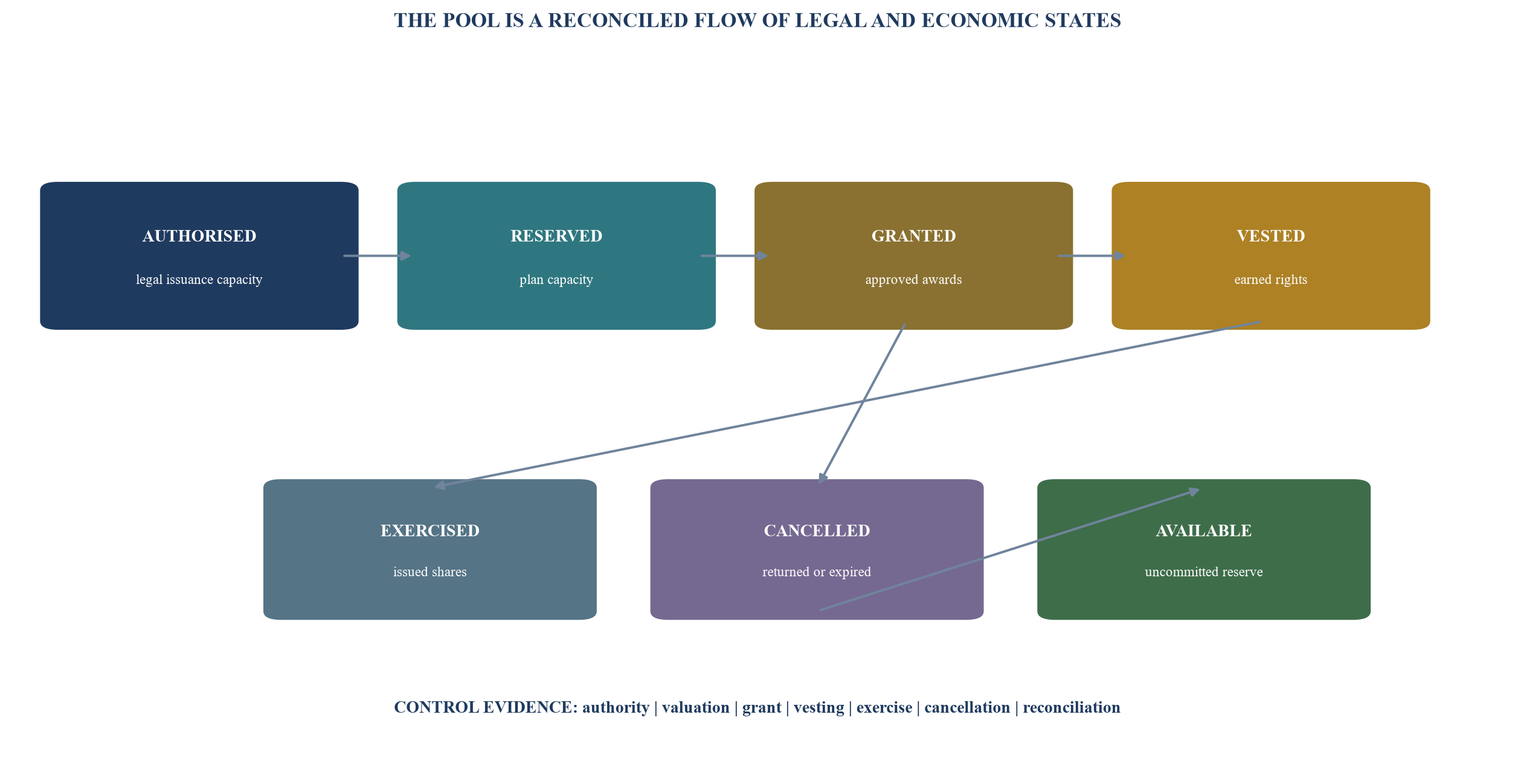
The board controls capacity by reconciling each legal and economic state; available pool is calculated after every approved movement.
2. Establish one fully diluted denominator
The board cannot compare grants until it defines the denominator. Companies use phrases such as “one per cent” to mean different things: one per cent of issued ordinary shares; one per cent after including the existing option pool; one per cent after all convertibles; one per cent immediately before a financing; or one per cent after the financing. Each interpretation produces a different number of securities and a different economic result.
The reset should create a security register that reconciles statutory shares, share classes, paid status, options, restricted shares, warrants, convertible securities, simple agreements for future equity or similar instruments, phantom awards, repurchase rights, nominee positions and written or oral commitments. The board should choose a fully diluted convention and show every exclusion. Financing documents may define the denominator differently, so the cap-table model must contain the contractual calculation as well as the management view.
Pool capacity has three layers. Authorised capacity is the legal ability to issue shares or rights under the constitution, charter and applicable law. Reserved capacity is the amount shareholders or directors have allocated to the plan. Available capacity is the reserved amount that has not been consumed by grants or other commitments, after applying the approved treatment of cancelled or expired awards. These layers should never be treated as interchangeable.
ADGM's Companies Regulations include allotment and pre-emption rules and contain an employee-share-scheme exception within the relevant pre-emption provisions. The exact authority still depends on the company's articles, resolutions, share rights and the circumstances of the allotment. Delaware General Corporation Law section 157 permits corporations to create rights or options to acquire shares and requires the board resolution or certificate to set relevant terms, subject to statutory requirements. These legal frameworks illustrate why a spreadsheet cannot itself authorise an award.
The ledger should have a permanent identifier for every award and link to the plan, grant notice, approval, valuation, employee, employing entity, award type, currency, number, exercise price, grant date, vesting, performance conditions, exercise, cancellation and tax or payroll handling. It should reconcile monthly during an active hiring programme and immediately before every board meeting, financing, audit or transaction data-room release.
Table 1. Pool ledger reconciliation
| Ledger state | Required evidence | Control calculation | Principal failure signal |
|---|---|---|---|
| authorised | constitution or charter, shareholder and board authority | maximum legally issuable less prior issuances | awards exceed authority or use the wrong class |
| reserved | approved plan and pool resolutions | approved plan reserve less all plan movements | reserve differs across board papers and cap tables |
| granted | executed grant notice and approval | sum of outstanding approved awards | offer letter promises have no matching grant |
| vested | vesting schedule and service or performance evidence | earned portion of each outstanding award | system dates differ from signed documents |
| exercised | exercise notice, payment, tax and share issuance | exercised awards added to issued securities | register and ledger do not reconcile |
| cancelled and available | leaver record, expiry, cancellation and recycling rule | approved reserve less outstanding grants and commitments | forfeitures are recycled without legal authority |
The illustrative control fields should be adapted to the parent law, plan documents, award type and employing jurisdiction.
3. Convert the workforce plan into a role portfolio
The hiring plan should identify roles that change enterprise capability rather than titles that sound senior. For each role, management should define the business gap, value at stake, expected start date, success measures, cash range, equity purpose, decision authority, replacement difficulty and dependency on a financing or market launch. The equity request then becomes a component of a documented investment case.
A useful decision frame has two axes: expected enterprise contribution and scarcity or execution risk. High-contribution, high-scarcity roles can justify the greatest equity attention. High-contribution roles with readily available candidates may be served by competitive cash, a smaller grant and a performance-based refresh. Scarce specialists with bounded enterprise impact may need a targeted retention instrument. Roles with weakly defined outcomes should remain outside the allocation envelope until the mandate is clear.
Value at stake should be expressed through operating drivers. For a commercial leader, the model may include qualified pipeline, conversion, gross margin and sales-cycle changes. For a technology leader, it may include release reliability, security, architecture cost and product adoption. For a finance leader, it may include close quality, working-capital control, forecast accuracy, audit readiness and financing milestones. The model should avoid presenting the grant as payment for a forecast that the individual cannot control.
The board should also estimate replacement cost and failure cost. Replacement cost includes search, notice period, onboarding and lost management time. Failure cost includes delayed launches, customer or regulatory risk, repeated reorganisation and the effect on financing. These estimates are management assumptions, and their purpose is to compare roles consistently. They should not be presented as compensation benchmarks.
Figure 2 shows an illustrative role-prioritisation matrix. The scores do not describe market practice. A company should replace them with its own evidence and should document why a role moves between quadrants as strategy, funding and organisational maturity change.
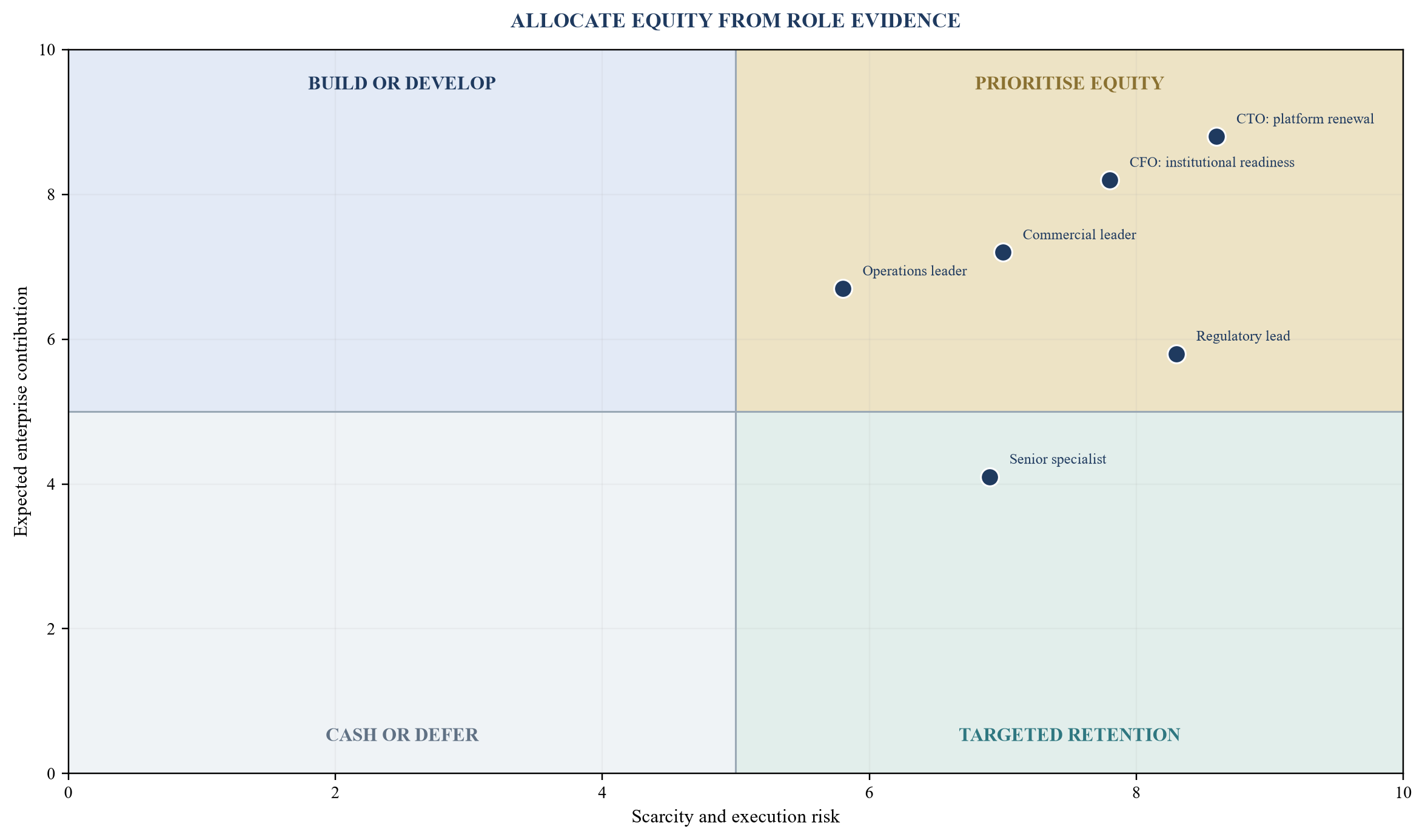
Role positions are illustrative management assumptions; the matrix organises board discussion and does not prescribe grant size.
4. Select the award instrument before negotiating the percentage
Options, restricted shares, restricted stock units, share appreciation rights and cash-settled phantom plans produce different legal, tax, cash-flow, accounting and behavioural effects. The company should choose the instrument before agreeing the headline economics because the same notional percentage can deliver very different value and obligations.
An option gives a right to acquire shares at an exercise price. It can align value with appreciation above that price, while creating valuation, exercise funding, expiry and tax questions. Restricted shares provide current ownership subject to vesting or repurchase conditions and may create immediate rights and tax consequences. Restricted stock units generally promise shares or cash after vesting and settlement conditions; they can avoid an exercise price but may create settlement timing and withholding issues. A cash-settled phantom plan can mirror value without issuing shares, while creating a cash obligation and liability accounting.
The accounting distinction matters. IFRS 2 requires recognition of share-based payment transactions, including employee transactions settled in equity, cash or other assets. Classification affects measurement and remeasurement. The accounting team should evaluate the terms before the offer is signed because a discretionary cash alternative, net settlement, modification or group-company arrangement can change the analysis.
The instrument also determines the employee experience. A grant that has theoretical value but requires unaffordable exercise funding, creates unexpected tax before liquidity or lapses shortly after departure may fail as a retention tool. Management should provide plain-language illustrations showing vesting, exercise, liquidity uncertainty, tax advice boundaries and the consequences of leaving. The illustration should avoid promising value or an exit.
Table 2. Award instrument decision matrix
| Instrument | Economic mechanism | Company control question | Employee implementation question |
|---|---|---|---|
| share option | participation above exercise price after vesting | valuation, authority, exercise window and dilution | exercise funding, tax timing and liquidity uncertainty |
| restricted share | current share ownership subject to restrictions or repurchase | voting, dividends, repurchase and register mechanics | acquisition tax, elections, forfeiture and transfer restrictions |
| restricted stock unit | promise to deliver shares or cash after conditions | settlement timing, withholding and share availability | tax at vesting or settlement and liquidity for withholding |
| share appreciation right | value linked to appreciation, settled in shares or cash | classification, measurement and settlement capacity | payment timing, tax and absence of full shareholder rights |
| cash phantom plan | contractual cash value linked to a share or enterprise metric | future cash funding and liability remeasurement | contractual rights, payment conditions and creditor risk |
| performance share | shares or units contingent on defined outcomes | measurable conditions, attribution and modification rules | transparency, controllability and evidence of achievement |
Treatment varies by jurisdiction and facts; legal, tax and accounting advisers must confirm each proposed award.
5. Set a grant policy that directors can administer
The grant policy translates the role portfolio into repeatable decisions. It should specify eligible populations, award instruments, reference denominator, valuation method, approval authority, grant-date process, vesting defaults, performance-condition design, leaver categories, acceleration, exercise windows, transfer restrictions, refresh criteria and required employee communications. Deviations should require a recorded reason and the appropriate approval.
Ranges are more governable than single percentages. A range allows the compensation committee or board to consider experience, mandate breadth, cash trade-off, stage, location and replacement risk. The policy can define a base grant, a performance component and a refresh component. The three parts should have separate purposes. A large initial grant should not be used to avoid building a repeatable refresh process.
Grant cadence also matters. Monthly ad hoc approvals can create inconsistent valuation dates and heavy administration. Quarterly grants can create a predictable process, provided the company has authority and candidates understand that employment acceptance does not itself issue the award. Exceptional grants can remain available for critical hires, with a clear escalation rule.
Delegation must have limits. Delaware section 157 permits certain board delegations for rights or options if the board resolution fixes the statutory parameters, including maximum shares, time periods and minimum consideration where relevant. Other jurisdictions have their own rules. The company should ask counsel to draft a delegation that reflects the applicable law and prevents an executive from granting an award to that executive under an unauthorised process.
The policy should be accompanied by a one-page decision memo for each senior grant. The memo records the role outcome, cash package, award type, quantity, denominator, implied percentage, valuation, vesting, performance conditions, leaver treatment, dilution impact, jurisdiction and approval. This creates a record that can be understood years later during an audit, financing or exit.
6. Design vesting around service and controllable value creation
Vesting converts an award from a recruitment promise into an earned right. Time-based vesting rewards continued service. Performance vesting links the award to an outcome. Hybrid vesting combines both. The appropriate design depends on the role, the measurability of the outcome, the employee's control over it and the company's ability to administer evidence consistently.
A common error is to use broad enterprise value, financing or exit targets for a role that cannot control those outcomes. The target may appear aligned, yet the employee's result depends on market conditions, other executives, investor decisions and timing. A stronger design connects part of the award to role-controlled operating evidence and retains a time-based component for collaboration and long-term value.
Performance conditions should define the metric, baseline, measurement period, data source, approver, treatment of acquisitions or restructurings, threshold, target, maximum, partial achievement and dispute process. The board should avoid retroactively rewriting a target because performance was stronger or weaker than expected. Modifications can also affect accounting under IFRS 2.
Cliffs can protect the company from early attrition, while a long cliff can make an award feel remote. Back-weighted vesting can increase later retention but may reduce perceived value during recruitment. Milestone vesting can suit a defined transformation if the milestones are verifiable. The design should be tested under resignation, dismissal, disability, death, change of control and a delayed financing or product schedule.
HMRC's EMI guidance recognises both time-based and specified-event or exit-only structures, subject to the statutory and scheme conditions. This illustrates the range of possible design within one tax-advantaged regime. It also shows why the vesting narrative, tax-qualification conditions and legal documents must remain aligned.
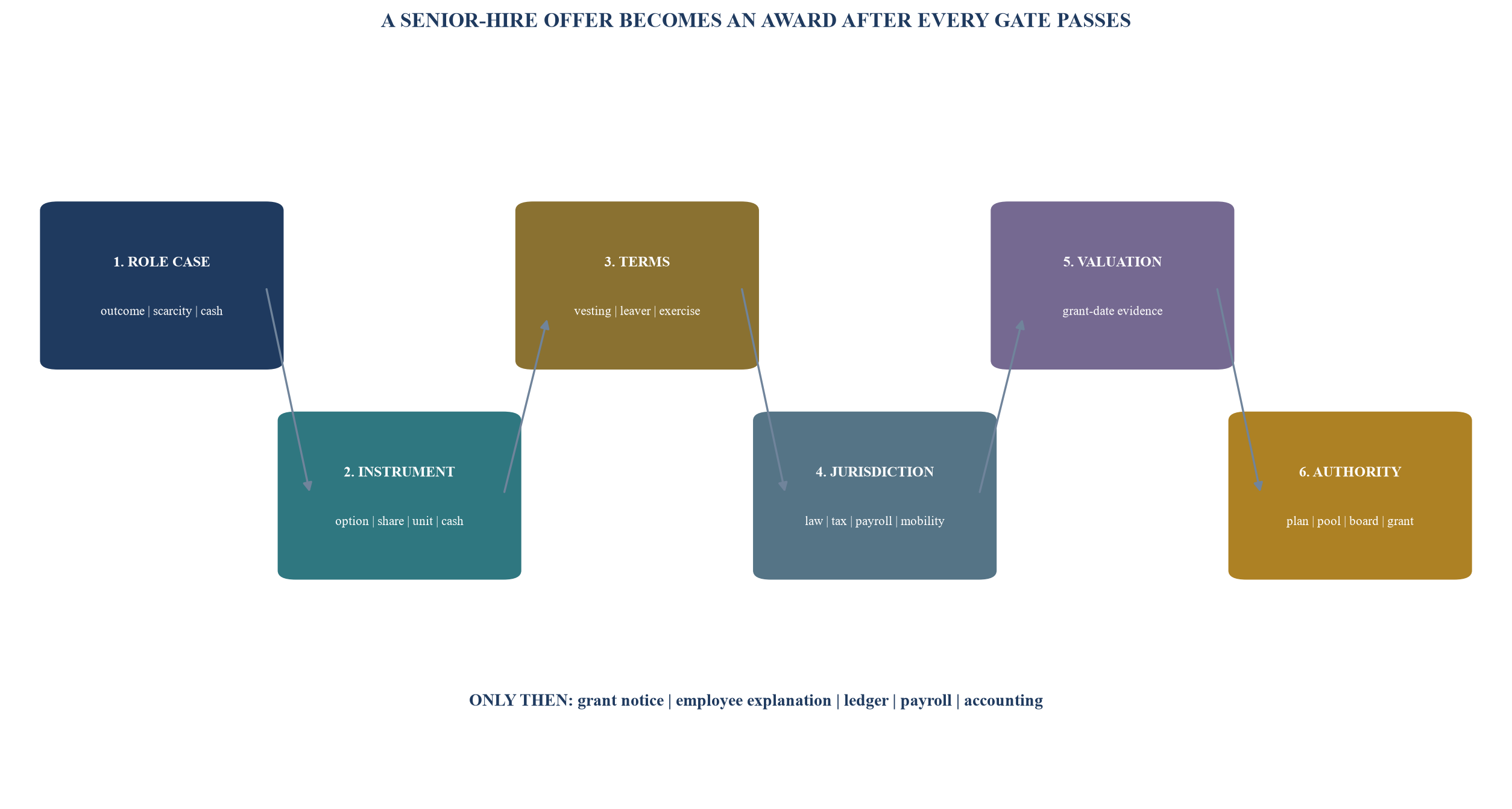
Each award passes through role, instrument, jurisdiction, valuation and authority gates before communication as an approved grant.
7. Control grant-date valuation and exercise price
Valuation is a governance input, a tax input and an accounting input. The relevant definition and method can differ across those purposes. The board should establish which entity and security are being valued, the valuation date, the rights of the underlying share, the financing history, material events, methodology, assumptions, discounts, currency and approval. A valuation prepared for one purpose should not automatically be reused for another.
In the United States, Treasury regulations under section 409A generally place a stock right outside section 409A when the exercise price is at least the fair market value of the underlying service-recipient stock on the grant date and other conditions are met. Discounted options can fall within section 409A. IRS Topic 427 explains that a nonstatutory option without a readily determinable fair market value generally produces taxable income on exercise equal to fair market value less the amount paid. These rules make grant date, fair market value and documentation material.
Australia's employee-share-scheme start-up concession has specific eligibility conditions. The Australian Taxation Office states that qualifying start-up companies must meet listing, age and turnover requirements; qualifying options must have an exercise price at least equal to the market value of an ordinary share at grant. The ATO also publishes approved valuation methods. The company must test the current law and its facts before relying on a concession.
The valuation calendar should connect board dates, offer dates, grants, financings and material events. A signed term sheet, major contract, regulatory approval, loss of a customer or acquisition discussion can affect whether an earlier valuation remains reliable. Management should create a material-event checklist and ask the valuation and legal advisers whether an update is needed before grant approval.
The employee communication should distinguish the exercise price from the company's future value. An option with a low exercise price is not cash and does not promise a gain. The employee bears vesting, exercise, tax, holding and liquidity risks. Clear communication supports informed acceptance and reduces later disputes.
8. Model dilution as a sequence of events
Dilution should be shown as a waterfall, not a single before-and-after percentage. The sequence can include current fully diluted ownership, ungranted pool, new senior grants, pool top-up, convertible conversion and the financing issuance. The order matters because a pre-money pool increase is generally borne by existing holders, while a post-money reserve allocation includes the new investor in the denominator according to the agreed documents.
Figure 4 uses illustrative management assumptions. It begins with 10 million fully diluted units, including a 6 per cent available reserve. Planned senior grants consume 2.5 percentage points. A pre-money refresh restores the available pool to 10 per cent by increasing the denominator. A financing then issues 20 per cent of the post-money fully diluted capital. The figure demonstrates sequence and does not state market terms.
The board should run at least four cases: the base hiring plan; accelerated hiring; delayed financing; and a financing that requires a larger pre-money pool. Each case should show founder, employee, existing investor, convertible and new investor ownership. It should also show authorised headroom and the accounting expense profile, because a legally possible grant can still exceed the board's cost or dilution tolerance.
Negotiation should focus on the role plan behind the pool request. Investors often seek sufficient capacity to fund the next phase without an immediate top-up. Founders should present the named hiring envelope, timing, unallocated reserve, recycling policy and refresh triggers. This evidence allows the parties to negotiate the required capacity and who bears dilution.
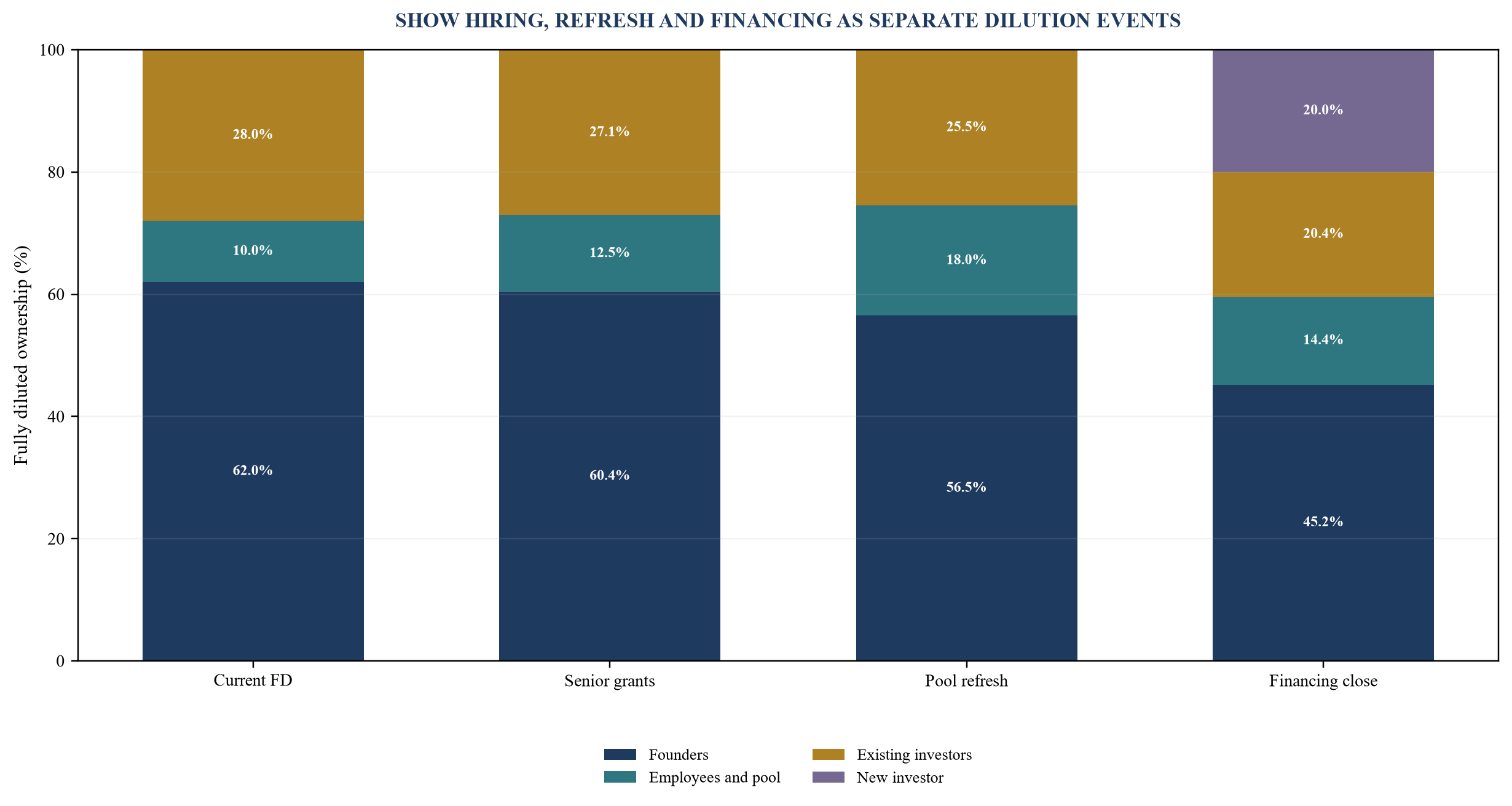
Units and percentages are illustrative management assumptions; the transaction documents determine the actual denominator and dilution allocation.
Table 3. Illustrative pool and dilution bridge
| Event | Pool action | Existing-holder effect | Required evidence |
|---|---|---|---|
| verified opening | reconcile issued securities and existing reserve | establishes the common denominator | statutory registers, instruments, plan ledger and approvals |
| senior-hire grants | allocate awards from the available reserve | transfers contingent future participation | role memos, valuation, approvals and executed grants |
| cancellations | return eligible awards under the plan rules | can restore capacity if legally permitted | leaver records, cancellation notices and recycling authority |
| pre-money refresh | increase reserve before the financing issuance | dilution falls on pre-financing holders under the agreed model | hiring plan, shareholder approval and term-sheet definition |
| financing issuance | issue the new investor security | all post-money holders reflect the agreed capitalisation | closing cap table, charter or articles and subscription documents |
| post-close refresh | add capacity after closing | dilution allocation includes holders under the post-close documents | board and shareholder rights, plan amendment and investor consent |
The figures are illustrative management assumptions and must be replaced with the company's verified securities and agreed financing definitions.
9. Build a four-year pool-runway model
The pool-runway model links hiring dates to expected award consumption. It should start with the available pool and subtract probability-weighted new-hire grants, approved promotions, refresh grants, board or adviser awards and any other commitments. It should add expected cancellations only when plan documents permit recycling and management has a defensible forecast. A cancellation is not available capacity until the legal and ledger event has occurred.
The model should distinguish committed, planned and unallocated amounts. Committed awards have been approved or promised under binding terms. Planned awards relate to approved roles with expected ranges. The unallocated reserve protects the company against candidate negotiations, unexpected critical hires and changes in start dates. These categories help the board avoid counting the same capacity twice.
Runway is measured in hiring events and time. A company may have two years of nominal capacity and only one critical hire of practical capacity if the remaining pool is fragmented or the required grant exceeds the approval envelope. The model should flag the date when available capacity falls below the next two priority roles, the next planned grant cycle or the unallocated-reserve threshold.
Figure 5 uses illustrative management assumptions over sixteen quarters. It begins with an available pool equal to 10 per cent of the opening fully diluted capital, applies quarterly hiring and refresh consumption, and includes cancellations at selected dates. The warning threshold is 3 per cent. The purpose is to show how a seemingly sufficient pool can reach a decision point before the next financing.
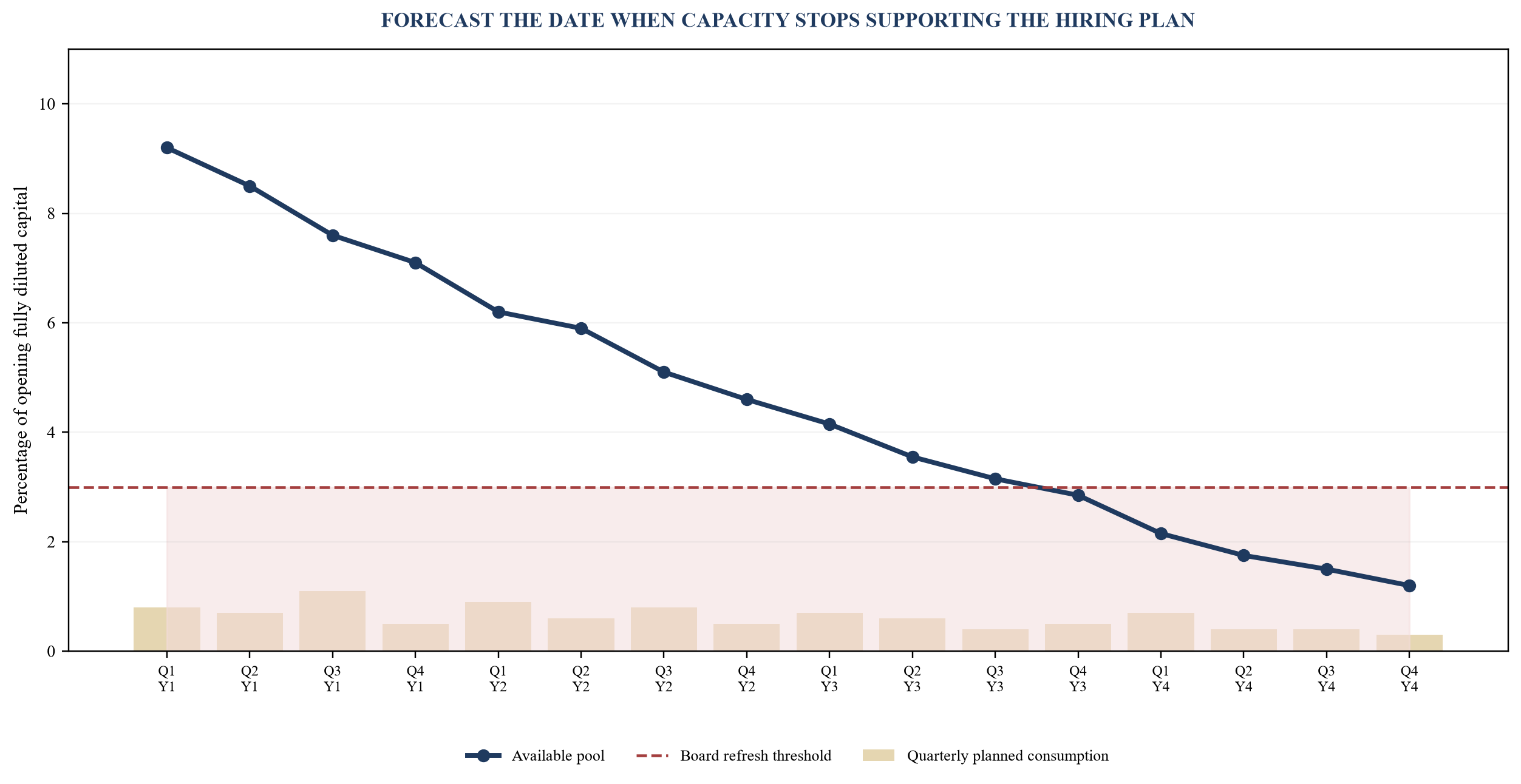
Percentages and quarterly movements are illustrative management assumptions; the board should replace them with its approved hiring portfolio and legal recycling rules.
10. Define refresh grants as a separate investment decision
A refresh grant can retain a high-performing executive, recognise an expanded mandate, replace exhausted incentive value or respond to a changed market. It should not automatically restore the executive to the original ownership percentage. That approach can create an endless anti-dilution promise that other employees and shareholders do not receive.
The board should define refresh triggers. Examples include completion of an initial vesting period, a material promotion, sustained performance, a transformation mandate, retention risk or a significant reduction in the incentive value of the outstanding grant. Each trigger should have evidence. A falling share or company value alone may not justify replacement if the entire shareholder base has experienced the same loss.
Underwater options require a structured response. Alternatives include retaining the original grant, extending the exercise window where lawful, granting a new award, exchanging or repricing the option with the required approvals, or using a performance-based award. Each alternative has securities, tax, accounting, shareholder and employee consequences. A repricing can also affect investor perception and plan rules.
Refresh policy should protect internal equity. The company should compare the proposed award with peers inside the organisation by role scope, level, tenure, performance and existing unvested value. The comparison should be reviewed for unexplained differences and legal risks. Personal data should be restricted to the decision-makers who need it.
The decision memo should show the executive's vested and unvested holdings, current exercise price, remaining vesting, estimated award value under the approved valuation method, dilution and the business case. This allows the board to distinguish retention need from a request to recover a historical percentage.
11. Create leaver, acceleration and exercise-window rules
Leaver treatment defines what happens when employment or service ends. The plan and grant documents should identify the relevant event, who determines the category, treatment of vested and unvested awards, exercise deadline, repurchase or forfeiture, restrictive covenants where lawful, tax handling and dispute process. The rules should align with employment law and should be explained before acceptance.
Good-leaver and bad-leaver labels can conceal very different facts. Death, disability, redundancy, retirement, dismissal without cause, resignation for good reason and ordinary resignation can warrant different treatment. Misconduct and breach cases require due process and careful drafting. The board should avoid relying on broad discretion that cannot be applied consistently or lawfully.
Acceleration determines whether vesting advances on a transaction or termination. Single-trigger acceleration occurs on the transaction event; double-trigger acceleration generally requires both the transaction and a qualifying employment event. The company should model the resulting dilution and retention effect during a sale. Full acceleration for every senior hire can weaken buyer retention economics, while no protection may expose executives to losing value after a change of control.
Exercise windows affect practical value. A short post-termination window can require a departing employee to fund exercise and tax before liquidity. A longer window can increase the period during which the cap table includes outstanding options and may affect tax qualification. Counsel and tax advisers should confirm the jurisdictional consequences before the board changes a window.
Table 4. Leaver and transaction governance matrix
| Event | Unvested award question | Vested award question | Board evidence |
|---|---|---|---|
| ordinary resignation | forfeiture date and any pro-rata discretion | exercise window, expiry and payment | notice, service end date and plan-rule application |
| dismissal without cause | continued or pro-rata vesting where approved | exercise and settlement timing | termination basis, employment advice and approval |
| misconduct dismissal | forfeiture or cancellation within lawful terms | vested-right and clawback analysis | findings, due process, conflicts and legal advice |
| death or disability | accelerated or pro-rata treatment | exercise by estate or settlement route | evidence, beneficiary or estate process and tax advice |
| sale of company | single-trigger, double-trigger or assumption | conversion, cash-out, rollover or exercise | transaction model, buyer terms and holder communications |
| role expansion | prospective refresh rather than retroactive rewrite | existing grant remains governed by signed terms | revised mandate, performance record and dilution analysis |
The categories are decision prompts; applicable law and signed documents determine treatment.
12. Build jurisdiction-specific implementation packs
A global plan is a framework. Each employing and employee jurisdiction can require a local analysis of securities exemptions, offer documents, corporate authority, employment law, tax, social security, payroll, exchange control, data protection and reporting. The company should maintain a jurisdiction pack rather than assuming the parent-company plan produces the same result everywhere.
In the United States, Securities Act Rule 701 provides a federal exemption for certain compensatory offers and sales by non-reporting companies to employees, consultants and advisers. The SEC states that the exemption is available up to at least USD 1 million in a twelve-month period, with formula-based limits above that amount, and additional disclosure when sales exceed USD 10 million in a twelve-month period. State securities rules and other conditions still require review. Rule 701 securities are restricted securities.
In the United Kingdom, EMI can provide tax-advantaged options for qualifying companies and employees. HMRC's current public guidance states that, for options granted on or after 6 April 2026, most qualifying companies must have gross assets of no more than GBP 120 million and fewer than 500 full-time employees. It also states a GBP 250,000 employee option limit within three years and includes working-time and excluded-activity conditions. Qualification should be confirmed at grant and monitored.
In Singapore, IRAS states that gains from employment-related stock options and share awards are taxable when the relevant conditions are met; option gains are generally taxed on exercise and share awards generally on vesting. Foreign employees can face deemed-exercise rules when employment ends or they leave Singapore, subject to the applicable rules and reliefs. Tax-clearance processes should be integrated with HR and payroll.
India's SEBI Share Based Employee Benefits and Sweat Equity Regulations 2021, as amended, govern listed-company schemes within their scope, including employee stock options, employee stock purchase, stock appreciation rights and other schemes. Private and unlisted-company awards require the applicable company, tax, foreign-exchange and employment analysis. Australia provides a start-up concession with detailed eligibility, holding and pricing conditions. These differences make local advice a condition of implementation.
Table 5. Cross-border implementation questions
| Jurisdiction | Official framework considered | Board implementation question | Evidence owner |
|---|---|---|---|
| UAE and ADGM | company allotment, plan authority, employment and applicable tax rules | which entity grants, employs and records the award? | legal, HR, finance and company secretary |
| United States | Rule 701, section 409A, option tax and state-law review | is the exemption, valuation, disclosure and exercise-price process current? | US counsel, valuation adviser, payroll and finance |
| United Kingdom | EMI or non-tax-advantaged employment-related securities | does the company and employee qualify, and are reporting and working-time conditions monitored? | UK tax adviser, counsel, HR and payroll |
| Singapore | ESOP and share-award taxation, tax clearance and deemed exercise | when is the taxable event and who funds withholding? | Singapore tax adviser, payroll and mobility |
| India | company law, tax, foreign exchange and SEBI rules where applicable | which listed or private-company framework applies to the issuer and employee? | India counsel, tax adviser and company secretary |
| Australia | ESS rules and start-up concession eligibility | does the issuer, employee, instrument, price and holding condition qualify? | Australian tax adviser, counsel and payroll |
The table summarises official frameworks and diligence questions; it does not state a tax outcome for any employee or company.
13. Manage mobile employees and cross-border tax events
Senior employees often move between countries, hold regional roles or work for one group entity while receiving an award from another. The tax outcome can depend on grant, vesting, exercise, settlement, sale, residence, workdays and sourcing rules. The company needs a mobility protocol before the employee relocates or leaves.
The protocol should trigger a review when an employee changes employing entity, country, tax residence, work pattern or board role. It should capture dates, workday allocation, award history, vesting schedule, payroll obligations, tax clearance, employer reporting, social security and any treaty analysis. The employee should be told to obtain personal advice; the company should avoid giving individual tax assurances.
Singapore's IRAS guidance illustrates this operational need. Employment-linked option and award gains can be taxable, and foreign employees can be subject to a deemed exercise rule in the tax-clearance process. In the United States, option category and exercise can affect income recognition and reporting. In the United Kingdom, tax-advantaged status depends on conditions that can be affected by employment and working time. A single grant therefore requires a continuing facts record.
Intercompany recharge and transfer pricing also require review when the issuer and employer differ. The group should determine which entity receives the employee service, which entity records the cost, whether a recharge is made, and how the arrangement is documented. IFRS 2 contains requirements for group share-based payment arrangements; local statutory and tax accounting may differ.
The cap-table ledger should link to the mobility register without exposing unnecessary personal data. Tax, payroll and HR teams need sufficient information to perform their duties; the board and investors generally need aggregated compliance evidence rather than personal tax files.
14. Integrate IFRS 2 and cash planning
An award can be cash-light at grant and economically significant in the accounts. IFRS 2 requires entities to recognise share-based payment transactions in profit or loss and financial position. Equity-settled and cash-settled awards have different measurement models. Vesting conditions, modifications, cancellations, net settlement and group arrangements can affect the expense and liability profile.
The finance team should model accounting before approval. The model should include award type, grant date, quantity, fair value, vesting period, service and performance conditions, expected forfeiture treatment under the applicable policy, modifications and settlement. The accounting valuation may use option-pricing inputs that differ from the tax valuation or the board's headline enterprise value.
Cash obligations remain relevant. Options can require the employee to fund exercise, while the company may have withholding or settlement obligations. Cash-settled awards create future liquidity needs and remeasurement risk. Net settlement can use shares to cover withholding where legally and administratively available, and IFRS 2 contains specific classification guidance for certain net-settlement features. The company should confirm authority, payroll mechanics and accounting.
The board pack should show dilution and expense together. A low-dilution cash plan can create a large payment at exit. An equity award can preserve cash and create a material expense. The decision should reflect the company's financing runway, shareholder preferences, retention objective and ability to administer the instrument.
Auditors should receive the plan documents, grant approvals, valuation reports, ledger reconciliation, forfeiture records, modifications, mobility data and expense calculation. A clean audit trail reduces the risk that transaction diligence discovers an expense, liability or control deficiency late in the process.
15. Use the reset to improve financing readiness
Investors test whether the fully diluted cap table is complete, the pool is sufficient, grants are authorised, valuations are current, employee intellectual-property and confidentiality agreements are signed, and key executives are retained. An ESOP reset should produce a financing-ready evidence pack rather than a revised spreadsheet alone.
The evidence pack contains the current constitution or charter, plan and amendments, shareholder and board approvals, valuation support, grant templates, executed awards, employee and consultant agreements, statutory registers, cap-table reconciliation, accounting schedules, tax and securities advice, payroll records, mobility exceptions and a schedule of outstanding promises. Each item should have an owner and date.
The financing model should isolate the option-pool adjustment. It should show the agreed fully diluted definition, the existing pool, outstanding awards, new reserve, pre-money and post-money treatment, convertibles and the new investor issuance. The term sheet and closing cap table should use the same definitions. If the investor requires a pool top-up, management should tie the amount to a hiring plan and explain the time horizon.
Senior-hire retention should also be tested against transaction timing. A candidate may expect a grant before the round, while the investor may expect the pool to be increased before its investment. The grant date, valuation and dilution bearer can change with the sequence. The company should approve a timeline that is legally and commercially coherent rather than backdating or implying that an unsigned offer has already become equity.
The board should disclose material exceptions. An award promised without approval, an expired valuation, an inconsistent exercise price or a mobile-employee issue should be corrected through advice and documented action. Concealing the exception until diligence creates greater execution risk.
16. Prepare the company for an acquisition or secondary transaction
An acquisition changes the questions. The buyer will ask whether awards are assumed, converted, cashed out, accelerated, cancelled or replaced. It will test change-of-control definitions, leaver rights, option exercise, tax withholding, employee communications, shareholder approvals and the treatment of awards that exceed the available pool.
The transaction model should show the proceeds waterfall for issued shares and every award class. Options may be in or out of the money. Restricted units may vest or remain contingent. Phantom awards may create cash liabilities. The model should identify the holder, quantity, exercise price, vesting, acceleration, tax withholding and expected consideration. All values are transaction-specific and should reconcile to the legal documents.
Secondary transactions require allocation rules. The board may allow employees to sell a portion of vested shares, exercise and sell options, or participate through another mechanism. Eligibility, price, transfer restrictions, tax, information, insider dealing, investor rights and cap-table administration need counsel review. A secondary can provide liquidity and retention, while changing employee exposure to future value.
The company should negotiate buyer treatment early enough to communicate responsibly. An executive who learns at signing that an award will be cancelled or taxed differently may disengage during integration. The plan should identify who can communicate, when information can be shared, which statements are conditional and how tax advice boundaries are expressed.
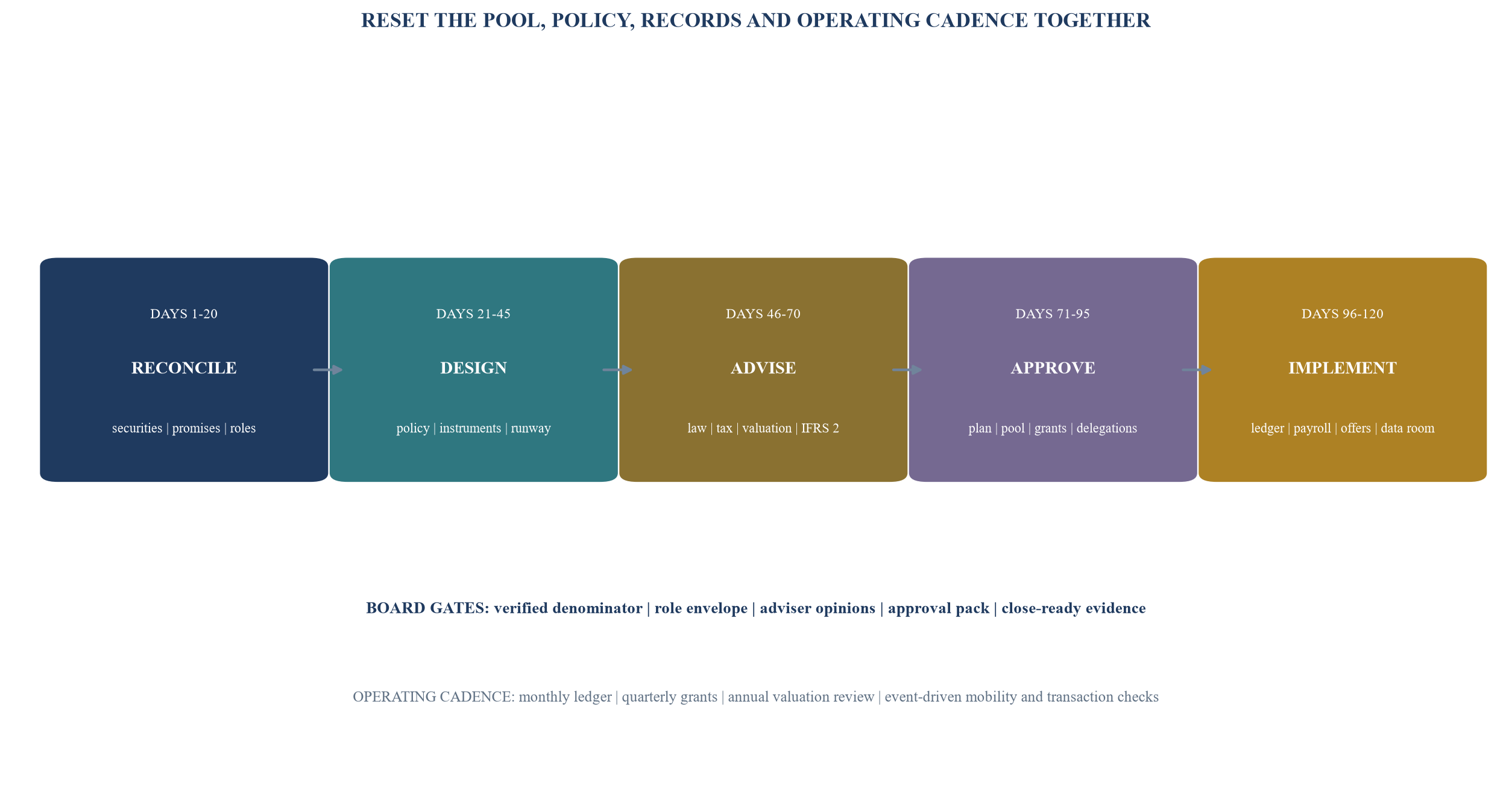
The sequence is an illustrative management programme; actual timing depends on approvals, valuations, jurisdictions, employee consultation and transaction calendars.
17. Govern the reset through a board close
The reset should have a formal close. Management confirms that the opening securities register was reconciled, every identified promise was resolved, the role portfolio and runway were approved, the plan and pool have legal authority, valuations are current, jurisdiction packs are complete, grants are documented, payroll and accounting instructions are active, and the data room matches the ledger.
The board close memo should list residual exceptions. An exception can remain open when it has an owner, deadline, risk assessment and action. The company should avoid declaring the system clean while unresolved promises or missing approvals remain outside the record. The close date creates a baseline from which later movements are controlled.
Ongoing governance can use three cadences. A monthly operating control reconciles new hires, leavers, vesting, exercises, cancellations and mobility changes. A quarterly grant committee or board meeting approves awards and receives runway, diversity, retention and exception information. An annual review tests plan design, valuation cadence, accounting, jurisdiction changes and alignment with the next financing or transaction.
Management information should remain decision-useful. The board needs available pool, committed and planned use, priority roles, upcoming grants, unapproved promises, valuation age, legal authority, expense, cash obligations, leavers, exercises, mobility exceptions and projected refresh date. Candidate and employee personal data should be restricted.
Table 6. Board close and continuing control gate
| Control area | Close evidence | Continuing cadence | Escalation trigger |
|---|---|---|---|
| cap table and pool | reconciled register, plan ledger and fully diluted bridge | monthly | any unexplained difference or negative capacity |
| hiring portfolio | approved roles, ranges, timing and reserve | quarterly | grant outside policy or pool runway below threshold |
| valuation | purpose-specific report and material-event checklist | event driven and at approved intervals | financing, major contract, restructuring or other material event |
| grants and leavers | approvals, executed notices and leaver records | each event | unsigned promise, backdating request or disputed treatment |
| tax, payroll and mobility | jurisdiction pack, reporting and employee-location register | monthly and on movement | new country, employing entity or missed filing |
| accounting and transaction readiness | IFRS 2 schedule, audit trail and data-room index | monthly close and pre-transaction | modification, cash settlement, acquisition or investor diligence |
The gate is complete only when the stated evidence exists or an exception has an approved owner, action and date.
18. Measure whether equity is creating operating value
The company should measure the hiring system rather than celebrate grant issuance. Relevant indicators include priority-role time to hire, offer acceptance, first-year retention, outcome achievement, regretted attrition, grant-cycle time, valuation freshness, ledger exceptions, accounting close issues and pool runway. The indicators should be analysed by role and cohort where the data is sufficient and lawful.
Equity effectiveness is difficult to isolate from cash compensation, leadership, culture, market conditions and role design. The board should avoid claiming that a grant caused an operating result. It can compare cohorts, record candidate feedback and test whether the equity proposition is understood. It can also measure control quality directly: days from approval to executed grant, percentage of awards reconciled, mobility reviews completed and exceptions closed.
The retention measure should distinguish desired retention from tenure. Keeping an executive whose mandate is no longer required does not create value. The board should evaluate whether the person delivered the defined outcomes, built organisational capacity and transferred knowledge. A grant policy should support strategic adaptation rather than lock the company into roles that no longer fit.
The pool should also be assessed against financing outcomes. Investors may accept the model, request a top-up or challenge the hiring plan. Management should record the reason and update the evidence. A larger pool request may reveal an aggressive hiring plan; a smaller request may reveal underinvestment in leadership. The board should test the operating assumptions behind both.
These measures create a learning loop. Role outcomes inform future ranges; candidate feedback improves communication; leaver experience improves terms; accounting and payroll exceptions improve administration; and financing feedback improves the runway model. The company should document changes prospectively rather than altering signed awards without advice and approval.
19. Board decision and implementation agenda
The first decision is whether the company has a verified denominator. If statutory records, instruments, promises and the plan ledger do not reconcile, the board should commission a controlled remediation before approving a major refresh. The second decision is whether the operating plan identifies the senior roles, outcomes, timing and cash alternatives that justify pool use.
The third decision is the award architecture: instruments, ranges, vesting, performance, leaver treatment, acceleration, exercise windows and refresh policy. The fourth is the jurisdiction and valuation process for each award population. The fifth is the dilution envelope and refresh sequence across the next financing. The sixth is the continuing control cadence and named owners.
A practical 120-day programme can proceed through five phases. Days 1 to 20 reconcile the cap table, pool, promises and priority roles. Days 21 to 45 design the policy, instruments and four-year runway. Days 46 to 70 obtain legal, tax, valuation and accounting analysis. Days 71 to 95 approve the plan, pool, delegation and grants. Days 96 to 120 execute documents, update registers, activate payroll and accounting, brief employees and release a verified data-room pack.
The final output is a controlled talent-capital system. It shows which hires equity is funding, how much capacity remains, who approved each award, how the employee can earn and realise value, how legal and tax obligations are handled, and how the pool interacts with a financing or transaction. This evidence supports recruitment, governance and investor diligence at the same time.
All numerical examples and timelines in this paper are illustrative management assumptions. They should be replaced with verified company data and adviser conclusions. Transaction-specific legal, tax, securities, accounting, valuation, employment, immigration and data advice is required before a plan, grant, modification, exercise, relocation, financing, secondary or acquisition is implemented.
References
- Abu Dhabi Global Market. Companies Regulations 2020. https://assets.adgm.com/download/assets/ADGM1547_20963_VER072020.pdf/fb4a15ce5d4111efaccc3653e4bba5a5
- Australian Taxation Office. Employee share schemes. https://www.ato.gov.au/employeeshareschemes
- Australian Taxation Office. Key ESS changes in detail. https://www.ato.gov.au/businesses-and-organisations/corporate-tax-measures-and-assurance/employee-share-schemes/in-detail/key-ess-changes-in-detail
- Australian Taxation Office. Income Tax Assessment Methods for Valuing Unlisted Shares for the Employee Share Scheme start-up concession, explanatory statement. https://www.ato.gov.au/law/view/pdf?DocId=ESO%2FESLI2025D16%2F00001&PiT=99991231235958&filename=law%2Fview%2Fpdf%2Fesg%2Fesli2025-d016.pdf
- Delaware Code Online. Title 8, Chapter 1, Subchapter V, section 157. https://delcode.delaware.gov/title8/c001/sc05/index.html
- IFRS Foundation. IFRS 2 Share-based Payment. https://www.ifrs.org/issued-standards/list-of-standards/ifrs-2-share-based-payment/
- IFRS Foundation. IFRS 2 supporting material. https://www.ifrs.org/supporting-implementation/supporting-materials-by-ifrs-standards/ifrs-2/
- Inland Revenue Authority of Singapore. Gains from the exercise of stock options. https://www.iras.gov.sg/taxes/individual-income-tax/basics-of-individual-income-tax/what-is-taxable-what-is-not/employment-income/gains-from-the-exercise-of-stock-options/
- Inland Revenue Authority of Singapore. Tax treatment of employee stock options and other forms of employee share ownership plans, 30 January 2026. https://www.iras.gov.sg/media/docs/default-source/e-tax/etaxguides_iit_esop_2026-01-30.pdf?sfvrsn=a27b49fd_58
- Inland Revenue Authority of Singapore. How to complete Form IR21. https://www.iras.gov.sg/taxes/individual-income-tax/employers/tax-clearance-for-foreign-spr-employees-%28ir21%29/filing-tax-clearance/how-to-complete-the-form-ir21
- HM Revenue & Customs. Enterprise Management Incentives. https://www.gov.uk/tax-employee-share-schemes/enterprise-management-incentives-emis
- HM Revenue & Customs. Employment Related Securities Manual. https://www.gov.uk/hmrc-internal-manuals/employment-related-securities/ersm300000
- HM Revenue & Customs. EMI options: exercisable only on specified event. https://www.gov.uk/hmrc-internal-manuals/employee-tax-advantaged-share-scheme-user-manual/etassum54340
- Internal Revenue Service. Topic No. 427, Stock options. https://www.irs.gov/taxtopics/tc427
- Internal Revenue Service. Instructions for Forms 3921 and 3922. https://www.irs.gov/instructions/i3921
- Internal Revenue Service. Final regulations under section 409A. https://www.irs.gov/pub/irs-regs/15808004.pdf
- National Venture Capital Association. Model Legal Documents. https://nvca.org/model-legal-documents/
- Securities and Exchange Board of India. Share Based Employee Benefits and Sweat Equity Regulations 2021. https://www.sebi.gov.in/legal/regulations/aug-2021/securities-and-exchange-board-of-india-share-based-employee-benefits-and-sweat-equity-regulations-2021_51889.html
- Securities and Exchange Board of India. Consolidated Share Based Employee Benefits and Sweat Equity Regulations, December 2025. https://www.sebi.gov.in/sebi_data/attachdocs/dec-2025/1766568633261.pdf
- United States Securities and Exchange Commission. Employee Benefit Plans, Rule 701. https://www.sec.gov/resources-small-businesses/exempt-offerings/employee-benefit-plans-rule-701-0
- United States Securities and Exchange Commission. Securities Act Rules Compliance and Disclosure Interpretations. https://www.sec.gov/rules-regulations/staff-guidance/corporation-finance-interpretations/securities-act-rules
