

1. Define the integration decision
The board decision is how to transfer ownership without interrupting the customer relationships, people, knowledge, systems and permissions that support the acquisition thesis. The decision should state which value must be preserved at closing, which capabilities can change after evidence is available, and which changes require a separate investment case. This definition prevents the integration programme from treating organisational activity as evidence of value creation.
The integration mandate should identify the strategic value expected from the transaction. It may include access to European technology, engineering capability, customer relationships, certifications, intellectual property, routes to market or specialist delivery capacity. Each element needs an observable measure, an accountable executive and a date by which the board can judge whether the asset remains intact.
The mandate should also define pause conditions. Examples include loss of a priority customer, departure of a critical technical authority, inability to transfer data lawfully, failure to maintain a regulated permission, a technology cutover without tested recovery, or a consultation obligation that has not been satisfied. A pause protects the thesis when speed would create irreversible damage.
2. Establish an Integration Office with board authority
The Integration Office should be a decision and evidence function, not a reporting secretariat. It should maintain the value-at-risk ledger, resolve cross-workstream dependencies, control changes to the operating model, and escalate thresholds to the board. Its remit should begin during confirmatory diligence and continue until the permanent organisation accepts the remaining risks and controls.
The office should include leaders for customers, people, technical capability, technology and data, regulation, finance and communications. Legal, tax, competition, employment and cyber advisers support decisions within their mandates. The office leader needs direct access to the buyer chief executive and the target chief executive because delayed escalation can convert a manageable dependency into lost revenue or capability.
Decision rights should distinguish recommendation, approval, execution, verification and exception authority. The same person should not define success, execute the action and certify completion when the consequence is material. A controlled exception records the evidence gap, exposure, interim safeguard, expiry and approving authority.
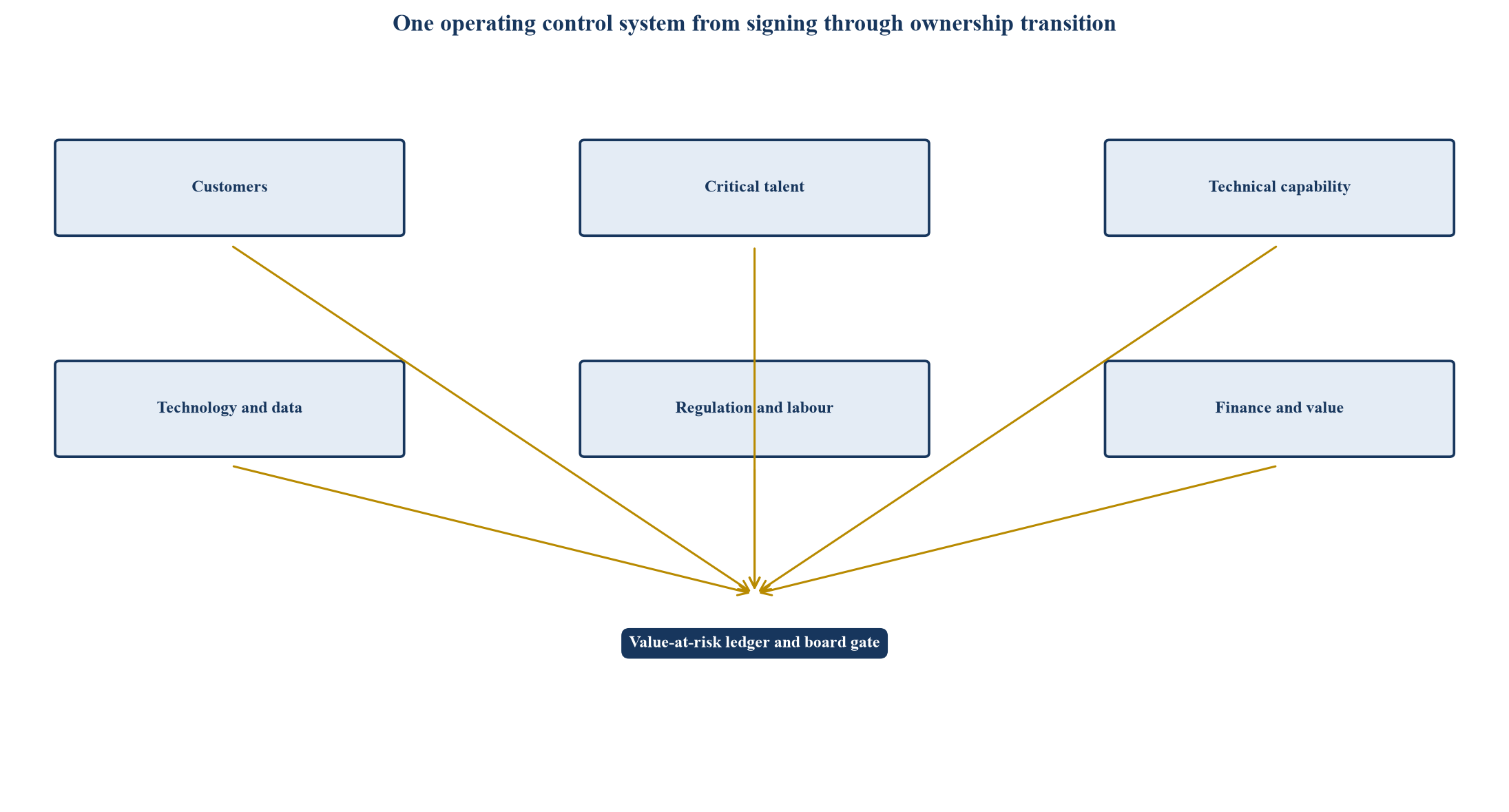
Six workstreams feed a common value-at-risk ledger and board decision gate.
3. Convert the acquisition thesis into a value-at-risk ledger
The ledger connects each thesis element to the asset that carries it. A customer-access thesis depends on named relationships, contract rights, service quality and delivery capacity. A technology thesis depends on people, code, equipment, data, intellectual-property rights, development environments and external licences. A regional-growth thesis depends on transferable propositions, local approvals, commercial capacity and investment.
Each ledger entry should show current value, failure mode, leading indicator, evidence, owner, intervention threshold and fallback. It should distinguish gross exposure from value likely to be lost under a stated scenario. This structure lets the board compare unlike risks without pretending that every item can be reduced to one probability-adjusted number.
The ledger should reconcile to the valuation model and integration budget. If customer retention, technical capability or separation investment supported the purchase price, the relevant control should appear in the ledger. An unbudgeted control exposes a gap between the transaction model and the operating plan.
| Value carrier | Hypothetical exposure | Leading evidence | Trigger | Accountable owner |
|---|---|---|---|---|
| Priority customers | EUR 155m revenue | Renewal, pipeline, incidents, sponsor contact | Retention below 92% | Chief commercial officer |
| Critical talent | 85 roles | Signed stay plan, engagement, successor cover | Retention below 88% | Chief people officer |
| Technical capability | 24 single-person dependencies | Authority map, paired decisions, repository evidence | More than 10 unresolved at Day 100 | Chief technology officer |
| Technology separation | 18 material dependencies | Tested migration and recovery evidence | Critical path slips over 30 days | Chief information officer |
| Regulated permissions | 11 permissions | Change-of-control and continuity status | Required approval or filing incomplete | General counsel |
| Synergy programme | EUR 12m annual target | Validated initiative and customer impact | Benefit lacks owner or baseline | Chief financial officer |
Amounts and indicators are illustrative management assumptions.
4. Separate legal completion from operational control
Legal ownership changes at closing. Operational control becomes reliable only when authority, information, access, processes and safeguards function in the new structure. The Integration Office should maintain a readiness schedule that identifies which decisions can transfer on Day One, which remain with target management, and which depend on consultation, regulatory approval, contract consent or system separation.
The buyer should avoid assuming that shareholder control permits immediate changes to employment, customer delivery, product release, data access or regulated operations. European transfer-of-undertakings, consultation, collective-redundancy, works-council and local employment requirements can affect sequence and timing. Qualified local advice should translate those requirements into the transaction calendar.
Day-One authority should therefore be limited and explicit. Reserved matters, payment authority, customer commitments, hiring, product release, cyber incidents, regulatory communication and external statements need named owners and deputies. Access should follow approved need and lawful transfer conditions rather than corporate hierarchy alone.
5. Identify the customer value perimeter
Customer diligence should identify the contracts and relationships that carry the thesis. Revenue concentration alone is insufficient. The buyer should map renewal dates, termination and change-of-control rights, service levels, data-processing roles, key-person dependencies, pricing, backlog, disputes, credit exposure, pipeline quality and executive sponsorship.
The priority perimeter should combine current revenue, contribution, renewal timing, strategic reference value, technical dependency and contagion risk. A smaller customer can be critical where its certification, reference status or ecosystem influence affects several other accounts. The perimeter should be approved before customer contact begins.
Every priority customer needs a continuity hypothesis. The Integration Office should know what the customer may fear, what evidence will address that concern, who owns the relationship, which commitments are authorised, and which concessions would damage value. Messages should be truthful, specific and consistent with competition-law and gun-jumping constraints before closing.
6. Stabilise customers before pursuing cross-sell
The first commercial objective is continuity. Management should confirm service teams, escalation routes, delivery capacity, data handling, contract compliance and executive sponsorship. Cross-sell should begin only when the customer has accepted continuity and the combined proposition has a credible delivery owner.
A customer plan should sequence signing communication, regulatory clearance, pre-close preparation, closing confirmation, renewal protection, service review and growth proposal. The plan should avoid blanket communication where customer circumstances differ. Regulated, public-sector or security-sensitive customers may require distinct approvals or information boundaries.
The office should monitor leading indicators such as delayed orders, reduced usage, unusual support escalation, slower approvals, procurement review, legal queries and staff access requests. These indicators may reveal risk before revenue declines. Each signal requires an owner, response time and board escalation threshold.
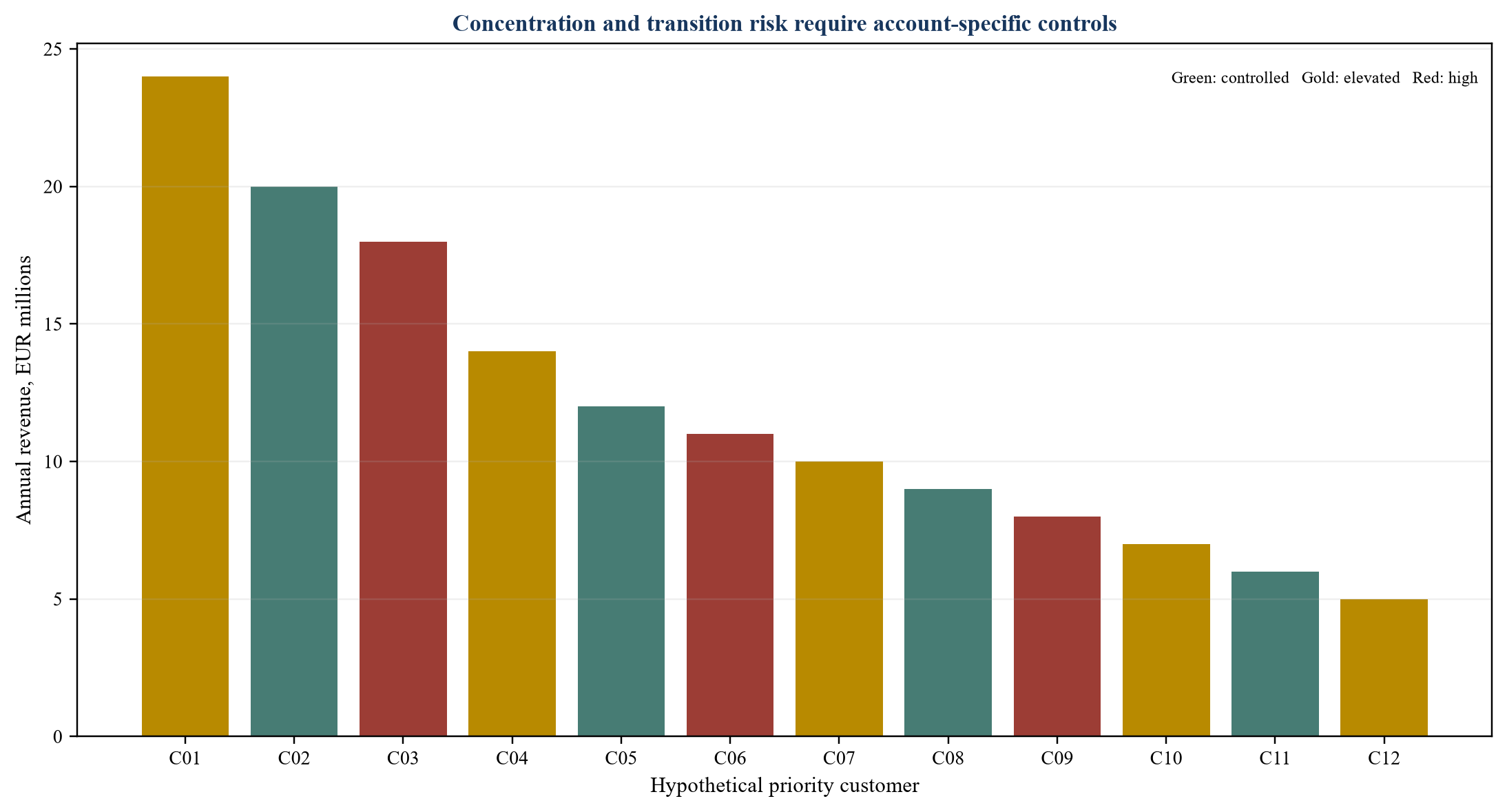
Revenue concentration and transition risk are illustrative management assumptions.
7. Govern customer promises
Transition teams often solve uncertainty by making commitments on price, staffing, localisation, product roadmaps, data residency or investment. Those commitments can conflict with the transaction model, regulatory filings or operating capacity. The Integration Office should operate a commitment register with approval thresholds and delivery owners.
The register should include the exact promise, customer, economic effect, legal basis, operational dependency, approval, due date and evidence of completion. Oral promises should enter the register. Unauthorised promises should be corrected promptly through the relationship owner and legal team.
The board should see the aggregate economic and operating effect. Several individually modest commitments can consume the synergy case or create inconsistent customer treatment. A controlled promise protects credibility because management can demonstrate that the combined business has authority and capacity to deliver.
8. Define critical talent by decision dependency
Critical talent should be identified by the decisions and outcomes that depend on a person, not by grade or historical status. A specialist may control product safety, architecture, regulatory submissions, customer acceptance, plant settings, intellectual-property strategy or failure diagnosis. Loss of that person may delay revenue or increase risk even when a nominal successor exists.
The talent map should show role, decision authority, unique knowledge, customer dependence, location, mobility, contractual position, likely motivation, successor readiness and evidence repository. It should distinguish retention need from permanent organisational design. Some people are essential through a transition; others are essential to the long-term thesis.
The buyer should validate the map with multiple sources. Management nominations can overstate hierarchy and understate informal technical authority. Repository history, product approvals, incident records, customer correspondence and peer interviews can reveal hidden dependencies.
9. Design retention around the employee proposition
Retention requires clarity on role, authority, reporting line, location, resources, career path, incentives and purpose. A cash award cannot compensate indefinitely for loss of professional standing or uncertainty about the buyer's intentions. The Integration Office should build a role-specific proposition and record what is genuinely approved.
Retention instruments may include stay awards, transaction bonuses, long-term incentives, deferred consideration, project milestones, promotion, research funding, mobility support or succession responsibility. Local employment, tax, discrimination, works-council and consultation requirements should be reviewed before implementation.
The programme should monitor acceptance, engagement, absence, resignation signals, recruiter activity where lawfully available, handover completion and successor readiness. Leaders should avoid coercive messaging. A voluntary employee decision needs respectful treatment and a continuity plan.
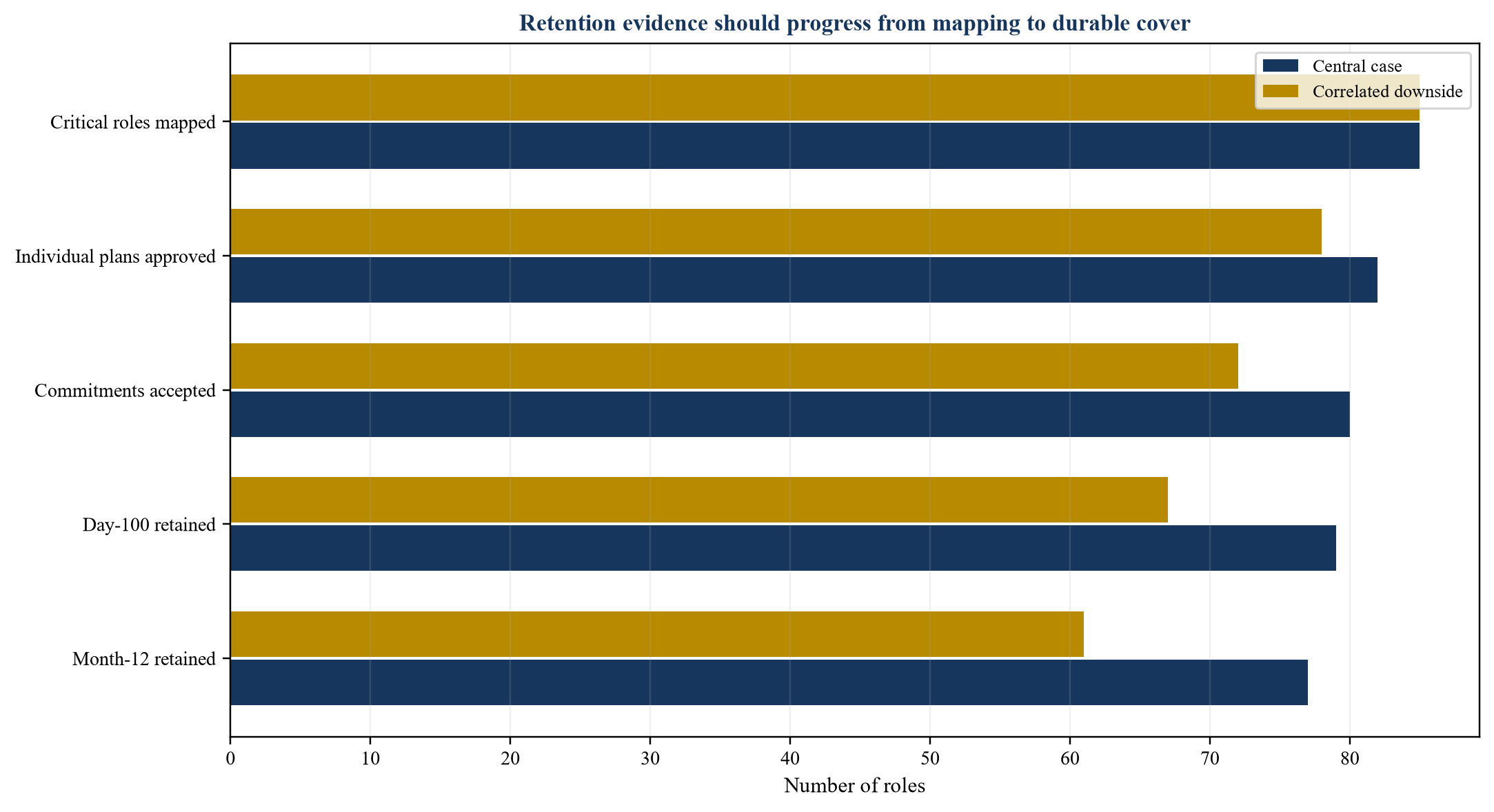
Counts and percentages are illustrative management assumptions.
10. Respect employee information and consultation
Employee rights can affect the integration sequence. EU rules on transfers of undertakings protect employment rights in qualifying transfers and require information or consultation in relevant circumstances. European Works Council rules address transnational information and consultation in qualifying multinational groups. Collective-redundancy rules require timely consultation where proposed measures meet applicable thresholds.
The Integration Office should maintain a jurisdiction-by-jurisdiction labour calendar. It should identify the employing entity, affected population, representative body, information requirement, consultation step, authority, planned decision and earliest implementation date. Local law, collective agreements and transaction structure determine the actual obligation.
The operating plan should distinguish a proposal from a final decision where consultation is required. Documents, budgets and communications need consistent status. Management should not announce an outcome as settled while representatives are being asked to engage on it. A credible process supports trust and reduces execution challenge.
11. Map technical capability as an operating system
Technical capability combines people, methods, data, tools, equipment, suppliers, licences, standards, test environments and decision rights. The buyer should map how an idea becomes an approved product or service, how a defect is diagnosed, how a change is released and how evidence is retained.
The map should identify authoritative repositories and informal workarounds. Important knowledge can sit in personal files, laboratory notebooks, source-code branches, design histories, customer portals, equipment settings or supplier correspondence. Diligence should establish ownership, accessibility, retention and lawful transfer.
Capability preservation needs live tests. Examples include reproducing a design decision, rebuilding software from controlled source, repeating a laboratory result, completing a regulatory submission, handling a customer incident or releasing a product without seller intervention. Passing a documentation checklist alone does not prove capability.
12. Transfer authority through paired decisions
Knowledge transfer becomes credible when the successor performs the decision under observation and the outcome is independently checked. The programme should identify high-consequence decisions and run paired cycles in which the current authority explains, the successor executes, and a qualified reviewer verifies.
Each cycle should retain the evidence used, alternatives considered, approval, result and lessons. Failed cycles are useful because they reveal gaps before the predecessor leaves. The Integration Office should track competence and decision cover separately from document completion.
Authority should transfer gradually. A successor can begin with recommendation rights, then joint approval, then independent approval with review. The final state should include a deputy and an escalation path so that the acquisition does not replace one single-person dependency with another.
13. Protect intellectual property and know-how
The buyer should reconcile registered rights, unregistered know-how, employee and contractor assignments, joint-development terms, open-source obligations, university rights, customer-funded developments and licences. Ownership should be tested against the acquired perimeter and the intended GCC use.
Know-how needs controlled access and evidence. Access logs, confidentiality, clean-team rules, export controls, cybersecurity and employee obligations should align with the transfer plan. Broad copying can create legal or security risk while incomplete transfer can leave the buyer unable to operate.
The Integration Office should connect each valuable capability to its legal right and operational evidence. If a licence cannot transfer, the plan needs consent, replacement, redesign or a transitional right. If rights depend on named people, retention and assignment actions belong in the same control record.
14. Build a technology and data separation map
The technology map should connect business services to applications, interfaces, infrastructure, identities, data, vendors, licences and recovery. It should identify seller dependencies, shared tenants, privileged access, data locations, retention requirements and security controls. A list of applications without business-service dependency is insufficient.
Each separation item needs an end state, interim service, owner, test, exit criterion, cost and date. The map should distinguish replacement, migration, replication, isolation and retirement. It should also identify which systems must remain stable until customer or regulatory events pass.
The office should govern scope change. New interfaces, acquisitions, product releases or organisational changes can alter the critical path. A change should show customer effect, security effect, data-transfer basis, recovery effect, cost, timing and approval before entering the plan.
15. Control international data transfers
Customer, employee and technical data can move across entities, vendors and jurisdictions during integration. The data map should identify controller and processor roles, data categories, purpose, lawful basis, location, recipient, access, retention, security and transfer mechanism.
For personal data transferred from the European Economic Area to a country without an adequacy decision, organisations may need appropriate safeguards such as standard contractual clauses or binding corporate rules, together with the applicable assessment and supplementary measures. UK transfers require the relevant UK mechanism and analysis. Qualified privacy counsel should confirm the route.
Access is a transfer risk as well as a cybersecurity risk. Remote administration, support, analytics and shared collaboration tools can expose data across borders. The Integration Office should prevent broad post-close access until purpose, authority and safeguard are evidenced.
16. Treat cybersecurity as service continuity
Integration changes identity, networks, suppliers, endpoints, data flows and incident responsibilities. The cyber workstream should prioritise continuity of critical services and safe recovery. It should validate privileged access, segmentation, logging, backup, restoration, vulnerability management and incident escalation across the combined perimeter.
The buyer should avoid rapid network convergence before inventories and controls are proven. Temporary monitored connectivity or controlled data exchange can preserve operations while reducing propagation risk. Each connection needs a purpose, owner, security design, test, monitoring and removal date.
NIS2 and sector requirements may apply to European entities depending on jurisdiction and activity. The legal assessment should feed the operating model, incident reporting, governance and supplier controls. Compliance responsibility should remain clear during transitional services.
17. Preserve product and service assurance
Product release, engineering sign-off, quality, safety, certification and customer acceptance should retain named authorities through transition. The buyer should identify the evidence required for each decision and confirm that tools, laboratories, suppliers and records remain available.
Change control should tighten around closing. Material product, architecture, supplier, manufacturing or hosting changes need an explicit customer, regulatory and assurance assessment. Integration deadlines should not override safety or quality gates.
The office should monitor defects, rework, service incidents, release delays, warranty claims and acceptance failures. An apparent cost saving that increases failure demand or customer concern can destroy value. Benefits should therefore include quality and continuity measures.
18. Sequence competition and foreign-investment controls
Merger-control and foreign-investment reviews can constrain information exchange, implementation and completion. The Integration Office should maintain a jurisdiction and remedy map covering filing thresholds, review timetable, standstill obligations, information barriers, potential conditions and operational consequences.
The EU Foreign Subsidies Regulation can require notification of qualifying concentrations based on EU turnover and foreign financial contributions. EU and national investment-screening regimes may examine control of sensitive technologies, infrastructure or services. The UK National Security and Investment regime includes mandatory notification for qualifying acquisitions in specified sensitive areas.
The programme should prepare separable operating plans where remedies or delayed clearance are plausible. Hold-separate arrangements, access restrictions, governance limits or asset divestment can alter customer service, talent retention and technology plans. Those effects belong in the valuation and liquidity model before signing.
19. Translate regulatory conditions into operating controls
A clearance condition has value only when it becomes a process, owner, evidence source and monitoring routine. The Integration Office should convert each commitment into specific prohibited actions, required actions, reporting dates, decision rights and audit evidence.
The control register should cover licences, sector approvals, product certifications, government contracts, security clearances, export controls, sanctions and ownership restrictions. It should identify conditions that attach to a legal entity, facility, product, person or customer.
Regulatory communication needs authority and consistency. Local management should know who can contact a regulator, what has been represented and which changes require notice. The board should receive exceptions that could impair permission, customer delivery or transaction validity.
20. Govern transitional services as a declining dependency
Transitional service agreements support continuity when systems, people or processes cannot separate at closing. Each service should have scope, volume, service level, security, data role, charging, change process, incident route, dependency owner, exit criterion and long-stop date.
The buyer should maintain an exit plan from signing. A service is complete when the receiving organisation can perform and recover the capability, not when a migration task is marked finished. Exit evidence can include parallel operation, reconciliation, performance, recovery and user acceptance.
TSA extension should require approval because it can conceal missing capability and create seller leverage. The extension case should state operational need, cost, risk, alternative, revised exit date and accountable executive. Critical services need an emergency continuity option.
21. Design the target operating model in stages
The Day-One model should preserve authority and service. The Day-100 model should resolve the most material ambiguities and establish permanent governance. The longer-term model can optimise structure, location, systems and shared services after customer, employee and regulatory evidence is available.
The design should show legal entities, business units, decision rights, management forums, policies, service ownership, geographic responsibility and escalation. Reporting lines alone do not define an operating model. The model should also explain how European technical independence and GCC commercial sponsorship work together.
Each design decision should trace to the thesis or a control need. Centralisation can improve scale while weakening local customer authority or regulatory responsiveness. Local autonomy can preserve expertise while limiting group control. The board should choose the balance using evidence and stated thresholds.
22. Integrate finance without obscuring operating evidence
Finance integration should establish cash visibility, payment authority, accounting policy, management reporting, tax calendars, controls and performance measures. It should preserve the operational detail needed to monitor customers, capability, quality and separation.
The opening balance sheet, purchase-price allocation, integration costs, restructuring provisions and synergy reporting should use controlled definitions. IFRS 3 governs accounting for business combinations and IAS 36 addresses impairment testing. Accounting treatment does not replace the operating evidence needed to assess whether the thesis remains intact.
The Integration Office should reconcile benefits to cash, capacity and customer outcomes. A headcount reduction is not a benefit when it creates contractor cost, delivery delay or lost revenue. One-time costs, stranded costs and dual running should be recorded against the initiative that caused them.
23. Use a benefits case with protective conditions
Every synergy initiative should state baseline, action, investment, timing, owner, dependencies, customer effect, talent effect, technical effect, cash effect and verification method. Initiatives that touch a critical capability require a protective condition and a rollback plan.
The hypothetical case assumes EUR 12 million of annual run-rate synergy and EUR 28 million of integration and separation cost. These amounts are management assumptions. The board should release benefit actions only when continuity evidence supports them and the cost remains funded.
Benefits should be net of dis-synergies, retained transitional capacity, remediation and tax. The office should report realised cash and sustainable run rate separately. Forecast benefits should not offset observed customer or capability loss.
| Decision | Recommends | Approves | Verifies | Escalation trigger |
|---|---|---|---|---|
| Customer commitment above EUR 1m | Account lead | Chief commercial officer | Finance and legal | Margin or delivery outside plan |
| Critical-role change | Business leader | Chief people officer | Capability owner | Single-person dependency created |
| Priority system cutover | Technology lead | Chief information officer | Independent recovery lead | Recovery test incomplete |
| Product authority transfer | Technical leader | Chief technology officer | Quality or safety authority | Competence evidence incomplete |
| Regulatory representation | General counsel | Designated executive | Compliance | New condition or inconsistency |
| Synergy release | Initiative owner | Chief financial officer | Integration Office | Customer or capability threshold breached |
The matrix illustrates governance and does not prescribe legal authority.
24. Model central and correlated-downside outcomes
The downside should combine events that can occur together. Customer uncertainty can reduce orders while critical employees leave and technology separation slips. The same events can increase remediation cost, delay synergies and consume management attention. A scenario that changes one variable at a time understates this interaction.
In the hypothetical central case, priority-customer revenue retention is 94 per cent, critical-talent retention is 90 per cent, priority separation completes on schedule and Year-Two EBITDA reaches EUR 43 million. In the correlated downside, customer retention is 82 per cent, talent retention is 72 per cent, separation is delayed and Year-Two EBITDA is EUR 25 million.
The board should identify the earliest observable boundary between the cases. It should pre-authorise actions such as customer executive intervention, retention reinforcement, additional engineering capacity, TSA extension, liquidity reserve, slower restructuring or a change to the synergy plan. Reverse stress should identify the point at which the acquisition thesis requires re-underwriting.
| Measure | Central case | Correlated downside | Decision use |
|---|---|---|---|
| Enterprise value | 360 | 300 supportable value | Price and impairment discipline |
| Priority-customer revenue retention | 94% | 82% | Customer intervention |
| Critical-talent retention | 90% | 72% | Retention and succession |
| Material dependencies open at Month 12 | 2 | 11 | TSA and separation funding |
| Year-Two EBITDA | 43 | 25 | Operating resilience |
| Annual synergy run rate | 12 | 4 | Benefit reset |
| Integration and separation cash cost | 28 | 42 | Liquidity reserve |
| Priority system recovery tests passed | 100% | 78% | Cutover authority |
Values and outcomes are illustrative management assumptions; amounts are EUR millions unless stated.
25. Run Day-One control before closing
Day-One readiness should prove authority, access, communication, customer service, employee support, cash control, incident response, regulatory continuity and technology operations. The office should run scenario rehearsals rather than rely on document review.
Rehearsals can include a priority-customer escalation, cyber incident, failed payment, product defect, employee grievance, regulatory enquiry, unavailable seller system and media question. Each test should confirm decision rights, contact routes, evidence access, response time and fallback.
Open items need an interim control, owner and expiry. The board should know which gaps are tolerable at closing and which require a condition, reserve, delayed cutover or pause. Completion should not convert known gaps into unowned operational risk.
26. Execute a disciplined first 100 days
The first 30 days should stabilise customers, people, cash, authority, systems and regulatory reporting. Days 31 to 60 should validate capability transfer, permanent governance and separation evidence. Days 61 to 100 should re-underwrite the thesis, approve the staged operating model and release only supported transformation actions.
The office should operate a weekly value-at-risk review and a shorter incident cadence where required. Reporting should show change since the prior period, evidence, threshold, action, owner and decision. Long lists of completed activities can obscure deterioration in the few outcomes that matter.
At Day 100, the board should compare actual customer retention, talent, capability, service, separation, cost and cash against the acquisition model. Differences should alter investment, pace, organisation, benefits and valuation assumptions.
27. Build an eighteen-month roadmap
The roadmap should connect transaction approvals, customer continuity, employee consultation, authority transfer, data safeguards, separation, operating-model decisions and benefit release. Shared gates prevent one workstream from declaring completion while another lacks the dependency it needs.
Pre-close work should establish the value perimeter, information boundaries, Day-One authority, consultations, customer plans and separation design. The first 100 days should stabilise and validate. Months four to nine should complete priority capability transfer and permanent governance. Months ten to eighteen should finish separation, optimise the operating model and confirm durable benefits.
Every milestone should state evidence and a consequence for failure. A missed date without consequence becomes a reporting event. A gate that changes cutover, spending, customer action or board approval creates operational control.
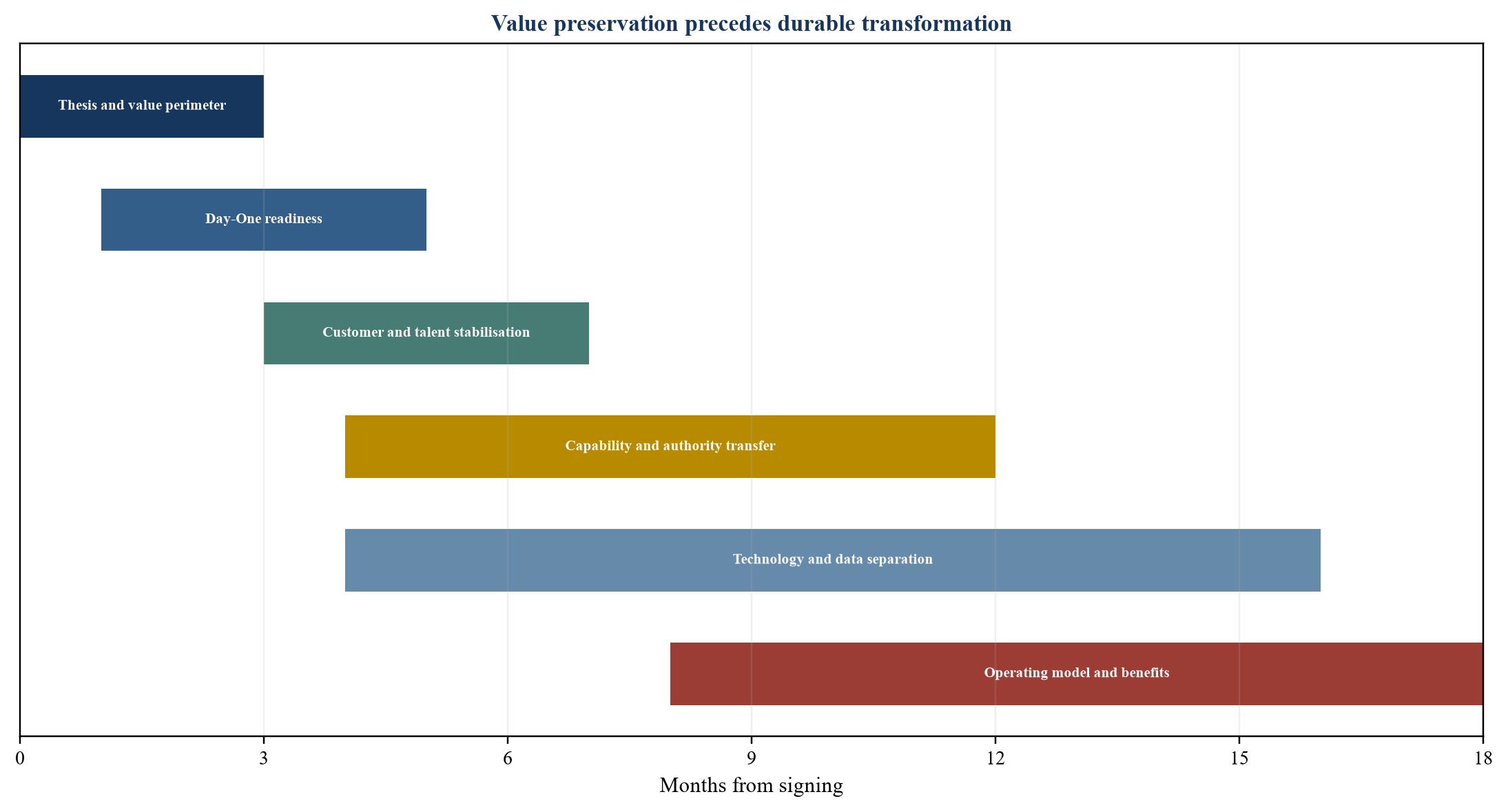
Customer, talent, capability and technology gates are integrated into one programme.
28. Transfer controls to the permanent organisation
The Integration Office should close when permanent owners can operate the controls, not when the calendar ends. Each workstream should provide accepted processes, authority, evidence repositories, open risks, budgets, measures and review forums.
The transfer should identify residual single-person dependencies, customer commitments, regulatory conditions, TSA items, cyber risks, deferred investment and benefit assumptions. Permanent owners should accept these items explicitly. Unaccepted exposure remains with the Integration Office and board.
A post-integration review should compare thesis, valuation, promised benefits, actual cash, customer outcomes and capability. Lessons should change future diligence and integration playbooks. The review should preserve evidence rather than rely on participant recollection.
29. Define board reporting around decisions
Board reporting should focus on value at risk, threshold breaches, decision requests and changes to the acquisition case. Core measures can include priority-customer retention, renewal exposure, critical-talent retention, authority-transfer completion, service incidents, open regulatory conditions, separation critical path, recovery evidence, cash cost and net benefits.
Measures should include definitions, source, frequency, owner and confidence. A green status should mean that current evidence supports the planned outcome. It should not mean that a workstream submitted its report on time.
The board pack should reconcile operating evidence to financial effect. It should show management action and the consequence of delay. Material assumptions, especially about future retention or benefit, should remain labelled as assumptions until observed.
30. Define a successful Europe-GCC ownership transition
A successful transition preserves priority-customer revenue, retains or replaces critical talent, transfers technical authority, maintains lawful data and technology operations, satisfies employee and regulatory obligations, exits transitional dependencies and converts the acquisition thesis into durable operating capability.
The final board record should include the value-at-risk ledger, customer outcomes, talent and succession evidence, capability tests, technology and data controls, regulatory conditions, benefits bridge, cash cost, open risks and permanent owners. It should explain deviations from the acquisition model and their valuation consequence.
Residual uncertainty should be explicit and governed. Integration quality comes from timely decisions supported by evidence, protected fallbacks and accountable ownership. The Integration Office provides that control during the period when legal ownership has changed and operating capability is most exposed.
| Gate | Required evidence | Board decision | Pause signal |
|---|---|---|---|
| Value perimeter | Thesis-to-asset map and exposure | Approve protected outcomes | Material value carrier lacks owner |
| Customers | Account plans, consent and continuity evidence | Approve contact and commitments | Priority revenue below threshold |
| Talent | Critical-role, retention and succession evidence | Approve programme and authority | Critical dependency has no cover |
| Capability | Tested decisions, repositories and rights | Approve authority transfer | Successor cannot perform critical decision |
| Technology and data | Dependency, safeguard and recovery evidence | Approve cutover or continued isolation | Recovery or transfer basis incomplete |
| Regulation and labour | Filing, consultation and condition register | Approve implementation sequence | Required approval or consultation incomplete |
| Benefits | Baseline, investment, cash and protection test | Release or defer initiative | Customer or capability threshold breached |
Each gate requires current evidence and a named decision owner.
Implementation playbook for transaction teams
A. Build the evidence room before signing
The integration evidence room should sit alongside the transaction data room and use the same controlled perimeter. It should contain the thesis-to-asset map, priority-customer files, critical-role records, technical-authority maps, service architecture, application and interface inventories, data flows, licences, consultation calendars, regulatory conditions, TSA design and the integration cost model. Each item needs a source, owner, review date and confidence assessment. Missing evidence should appear as an exposure with a planned verification step; it should not disappear inside a general diligence qualification.
The team should preserve the distinction between information that the buyer may review before clearance and information that requires a clean team or post-close access. Customer pricing, competitively sensitive strategy, personal data and restricted technical material may require specific arrangements. The evidence room should record the lawful and competition-compliant basis for access. That control protects the transaction while allowing the integration plan to be built from verified facts.
B. Reconcile the contract and relationship view
For each priority customer, the contract summary should reconcile to invoices, service records, pipeline, renewal history and the responsible executives. A contract can appear stable while the relationship is vulnerable because a key sponsor is leaving, service incidents remain unresolved or a procurement cycle has begun. The account plan should therefore distinguish legal term, expected commercial behaviour and current operating evidence.
The buyer should test the effect of ownership change on customer consent, termination, exclusivity, security review, data processing, subcontracting, location, intellectual-property rights and government approval. Where consent is required, the plan should state timing, message, evidence, concession authority and fallback. Revenue should not be treated as retained until the relevant contract and relationship conditions are satisfied.
C. Create a role and authority inventory
The role inventory should begin with critical decisions and work backwards to people. For every decision, the team should identify the primary authority, deputy, required evidence, systems, external dependencies and consequence of absence. This method exposes roles that an organisation chart misses. It also prevents retention awards from being allocated solely by seniority or negotiation leverage.
The inventory should record contractual notice, restrictive covenant, location, immigration, mobility, compensation, incentive eligibility and succession status where lawfully available. The people team should separate personal data from wider programme access. The Integration Office needs the risk and action; it does not need unrestricted access to every personnel detail.
D. Prove capability through transaction-specific tests
Capability tests should reflect the acquired business. An engineering target may need to reproduce a design calculation, approve a drawing revision, diagnose a field failure and demonstrate configuration control. A software target may need to build from controlled source, deploy to a clean environment, restore from backup and resolve a production incident. A regulated service may need to complete a filing or customer approval under the successor authority.
The test record should include participants, inputs, environment, decision, output, reviewer, defects and remediation. Repetition matters where the first test depends on exceptional support. A capability is durable when the new operating team can perform, evidence and recover it within the required service window.
E. Establish an integration cash envelope
The cash envelope should include retention, severance, consultation support, customer remedies, TSA charges, technology migration, duplicate systems, cyber remediation, regulatory conditions, advisers, travel, facilities, rebranding, training, working capital and contingency. The envelope should distinguish committed cost, approved reserve and discretionary transformation.
Cash releases should follow gates. A system investment may be released when the target architecture and data-transfer route are approved. A restructuring cost may be released after consultation and continuity evidence. A customer remedy may require commercial and legal approval. Gated cash supports control because it links expenditure to verified readiness without depriving the programme of necessary funding.
F. Use a single dependency register
The dependency register should connect workstreams. A customer migration may depend on employee consultation, a data-transfer mechanism, a new hosting environment, a licence, a security test and customer consent. Separate plans can each appear green while the combined milestone cannot occur. The register should identify the controlling dependency and the effect of delay.
Each dependency needs a provider, receiver, required date, evidence, current status, fallback and escalation. The Integration Office should challenge dates that depend on unapproved assumptions. Critical-path changes should update customer commitments, cash, TSAs, regulatory communication and the board forecast at the same time.
G. Control communications as an operating process
Communications should be audience-specific and tied to decisions. Customers need service, governance and contact clarity. Employees need truthful information about ownership, process, role and support. Regulators need timely, authorised and consistent representations. Suppliers need payment, order and access instructions. Public statements should align with legal obligations and the actual operating plan.
The communications register should show audience, purpose, content owner, factual verifier, legal review, release authority, timing and follow-up. Questions and reactions should feed the value-at-risk ledger. Communication is evidence gathering as well as message delivery because it reveals concerns, dependencies and commitments that the original plan may have missed.
H. Prepare failure playbooks
The Integration Office should maintain short playbooks for plausible failures: priority-customer loss, critical resignation, regulatory delay, consultation challenge, cyber incident, failed cutover, unavailable seller service, product-quality event and liquidity shortfall. Each playbook should identify immediate containment, authority, communication, evidence, customer protection, recovery and board escalation.
Playbooks should be rehearsed with the actual decision makers and contact routes. A document that depends on an unavailable person or inaccessible system will fail when needed. Rehearsal outcomes should update access, deputies, recovery time and reserves. The purpose is controlled response, not prediction of every event.
I. Verify benefits independently
Benefit verification should be independent from initiative delivery for material items. Finance can confirm the baseline and cash effect; operational owners can confirm capacity and service; customer leaders can confirm revenue and relationship outcomes. The Integration Office should reconcile these views before reporting a realised benefit.
The benefit record should prevent double counting across procurement, headcount, pricing, working capital and capital expenditure. It should distinguish recurring cash, recurring accounting effect, one-time release and avoided future cost. Customer losses, quality cost, separation overruns and retained stranded cost should reduce the reported result where causally connected.
J. Close with an evidence-based value review
The final review should compare the investment committee case with observed results. It should reconcile purchase assumptions, customer retention, critical talent, capability, regulation, separation, integration cost, synergy, cash and current valuation. Differences should be explained by evidence and assigned to future action or accepted residual risk.
The review should also identify which controls become part of normal governance. Priority-customer monitoring may move to the commercial review; technical-authority succession to the technology committee; regulatory conditions to compliance; separation residuals to the chief information officer; and benefits to finance. The board should receive confirmation that each permanent forum has accepted the measure, threshold and owner.
The closing record should remain accessible for later assurance, refinancing, acquisition reviews and leadership succession.
Sources
- EUR-Lex, Council Directive 2001/23/EC on safeguarding employees' rights in transfers of undertakings. Read the primary source
- EUR-Lex, Directive 2009/38/EC on European Works Councils. Read the primary source
- EUR-Lex, Summary of European Works Council rules and Directive EU 2025/2450. Read the primary source
- European Commission, European Works Councils. Read the primary source
- EUR-Lex, Council Directive 98/59/EC on collective redundancies. Read the primary source
- European Data Protection Board, International transfers and international cooperation. Read the primary source
- European Data Protection Board, Guidelines 05/2021 on Article 3 and international transfers. Read the primary source
- European Data Protection Board, Final guidelines on transfers to third-country authorities, 5 June 2025. Read the primary source
- European Commission, Foreign Subsidies Regulation legislation and 2026 guidelines. Read the primary source
- European Commission, Foreign Subsidies Regulation overview. Read the primary source
- European Commission, Investment screening. Read the primary source
- European Commission, Strengthened EU foreign-investment screening framework, 26 June 2026. Read the primary source
- EUR-Lex, Directive EU 2022/2555 on network and information systems, NIS2. Read the primary source
- European Commission, EU merger procedures. Read the primary source
- UK Government, National Security and Investment Act guidance on acquisitions. Read the primary source
- UK Competition and Markets Authority, Merger Assessment Guidelines, updated September 2026. Read the primary source
- UK Competition and Markets Authority, Mergers guidance on jurisdiction and procedure, December 2025. Read the primary source
- Information Commissioner's Office, International Data Transfer Agreement. Read the primary source
- IFRS Foundation, IFRS 3 Business Combinations. Read the primary source
- IFRS Foundation, IAS 36 Impairment of Assets. Read the primary source
