

1. Define the strategic gap before screening targets
The board should begin with a capability, customer or market-access gap that has a named economic consequence. A target list assembled around geography or reputation encourages narrative-led bidding. The decision file should specify the missing product, certification, distribution route, engineering discipline, recurring customer relationship or operating system and quantify the cost of building it internally.
The acquisition objective should state where the capability will earn revenue, which Gulf customers have demonstrated demand, what time advantage matters and how the buyer will protect the capability after control changes. Alternatives should include internal build, licensing, joint venture, minority investment, commercial partnership and team acquisition. Every alternative needs the same risk-adjusted cash-flow test.
A clear problem definition also improves confidentiality and outreach. Management can screen targets using observable capability markers without disclosing the buyer's maximum price or strategic dependency. The board can then distinguish an attractive company from a company that solves the defined strategic problem.
The opening gate should identify the owner of the strategic thesis, evidence date, minimum capability threshold, target geographies, excluded activities, capital envelope and walk-away conditions. These controls allow the transaction team to reject weak fits before diligence cost, competitive tension and internal advocacy make withdrawal more difficult.
The strategic-gap record should also state the cost of delay. A quantified delay case helps the board compare acquisition speed with the time, execution risk and foregone contribution of internal build. It prevents urgency from becoming an unsupported reason to relax price or diligence discipline.
2. Use the Europe-to-GCC Capability Acquisition and Value Framework
The framework links seven questions: what capability is scarce, whether Gulf demand is evidenced, whether the capability transfers, whether regulation permits the operating model, whether the organisation can integrate it, whether the price preserves returns and whether the combined group can execute. Each question must connect to evidence, cash flow and a responsible executive.
A single target score is insufficient unless the underlying dimensions remain visible. A highly differentiated technology can rank poorly because key licences are entity-specific or because the acquirer cannot retain the team. A modest product can rank well when Gulf customers already want it, regulatory transfer is straightforward and the buyer owns a credible distribution advantage.
The framework should be maintained from first screen through post-close review. Scores change as customer interviews, technical diligence, regulatory advice and management meetings replace assumptions. The investment committee should see both the current score and the evidence movement that caused it.
The output is a controlled chain from strategic gap to target attribute, diligence evidence, integration action and financial result. This discipline stops the value case from splitting into separate strategy, legal, commercial and finance narratives that cannot be reconciled at signing.
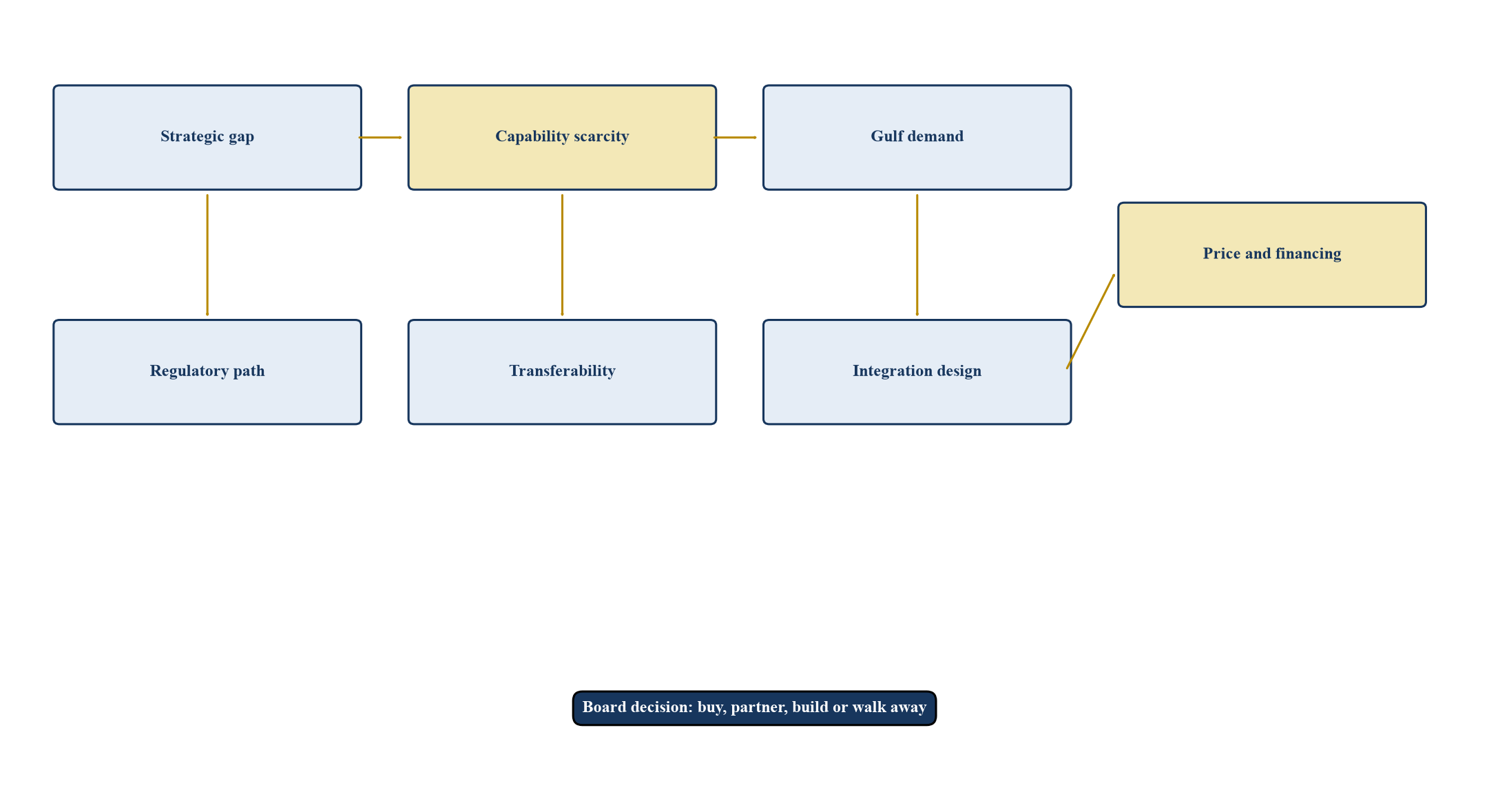
The transaction thesis must connect strategic need, transferable capability, evidenced demand, regulatory feasibility, integration and value.
3. Separate company value from capability value
Enterprise value reflects the cash flows and assets of the target as a going concern. Capability value reflects the incremental value that a specific buyer may realise through market access, product combination, customer credibility, delivery capacity or time saved. Combining these concepts without a bridge creates an uncontrolled strategic premium.
The buyer should identify each acquired capability, the source asset that supports it and the conditions required for use. Relevant assets can include patents, trade secrets, data, certifications, software, customer references, engineering methods, supplier relationships, brands, licences, people and embedded routines. Their value depends on control, durability and transferability.
Capability value should be measured through incremental cash flow after transfer cost, retention, localisation, regulatory compliance, cannibalisation and execution risk. The model should avoid counting the same benefit in target projections, revenue synergies and terminal value. A capability with no accountable deployment plan belongs outside the central case.
Purchase-price governance should distinguish stand-alone value, control value, evidenced buyer-specific synergies and speculative option value. The board can then decide which layer supports price, which requires contingent consideration and which should remain an upside outside the offer.
Where a capability supports several business lines, allocate benefits through a transparent driver such as qualified pipeline, installed capacity or avoided build cost. Allocation should never create value by moving the same cash flow between business units. Group reporting needs one reconciled owner for the benefit.
| Value layer | Evidence required | Principal risk | Decision treatment |
|---|---|---|---|
| Stand-alone cash flow | Audited and diligence-adjusted operating case | Forecast quality | Valuation base |
| Control value | Governance and operating rights | Overlap with stand-alone case | Separately evidenced |
| Buyer-specific capability value | Transfer map and deployment plan | Non-transferability | Risk-adjusted synergy |
| Gulf market access | Customer proof and route to market | Pipeline conversion | Milestone-based case |
| Option value | Defined future choices | Narrative inflation | Upside outside offer |
The bridge prevents unsupported strategic premium from being embedded in price.
4. Build the market-demand evidence before price
A Gulf growth story needs evidence from customers, tenders, installed-base gaps, regulation, procurement plans and willingness to pay. Macro growth, government strategy and sector ambition can explain context. They do not prove that the target's product will win specific orders at the assumed price and margin.
Commercial diligence should test customer problem, urgency, buying authority, procurement route, specification fit, localisation requirement, competing alternatives, sales cycle, reference needs and payment behaviour. Interviews should cover current buyers, lost prospects, channel partners, technical evaluators and procurement stakeholders. Management estimates should remain separately labelled.
Revenue should be built account by account or segment by segment with a probability, start date, delivery dependency, gross margin and working-capital profile. The same exercise should identify displacement of the buyer's existing products and channel conflict with the target's European partners.
A demand gate should require signed backlog, qualified pipeline evidence, customer interviews or another defined proof standard before synergies enter the central case. Strategic interest can remain in the upside case until the evidence threshold is met.
Demand evidence should be refreshed near signing because customer priorities, procurement calendars and competitor actions can move during a process. The refresh should reconcile lost opportunities and negative interviews alongside positive interest. Selective evidence creates a biased revenue case and weakens post-close accountability.
5. Map the capability-transfer chain
A capability often depends on a system rather than one asset. A patented component may require tacit engineering knowledge, test equipment, approved suppliers, certification records, software tools and experienced project managers. Moving one element can damage the performance that justified the acquisition.
Create a transfer map from source asset to people, process, technology, contract, licence, data, supplier, facility and customer proof. For each element, record ownership, location, control, consent, retention dependency, localisation action, transfer cost, timing and failure consequence. This map should reconcile with the legal perimeter and the integration plan.
The buyer should decide what remains in Europe, what is replicated in the Gulf, what is licensed across entities and what must be integrated. Replication can preserve resilience while increasing cost. Full migration can reduce duplication while increasing execution and continuity risk.
The value model should release capability benefits only after the required transfer milestones are complete. This creates an auditable link between integration spending and revenue or margin, and it prevents a day-one synergy claim from depending on a multi-year capability build.
6. Rank targets with a decision-grade scorecard
The scorecard should weight strategic capability, Gulf demand, customer quality, transferability, intellectual-property control, regulatory portability, talent dependency, integration feasibility, valuation and downside resilience. Weighting should follow the defined strategic gap rather than use a generic M&A template.
Scoring needs anchored definitions. A high transferability score can require documented ownership, transferable contracts, retained personnel and a tested replication plan. A low score can reflect entity-specific licences, undocumented know-how or customer consents. Anchors reduce advocacy and make different targets comparable.
Scores should be supported by evidence references and confidence levels. A management assertion, third-party report and signed customer contract carry different evidential weight. The committee should see both attractiveness and confidence so that uncertain high scores do not outrank verified moderate ones automatically.
The scorecard is a screening and governance tool. It should not replace valuation or judgement. Its purpose is to expose why one target advances, what evidence remains missing and which weakness must be reflected in structure, price or integration.
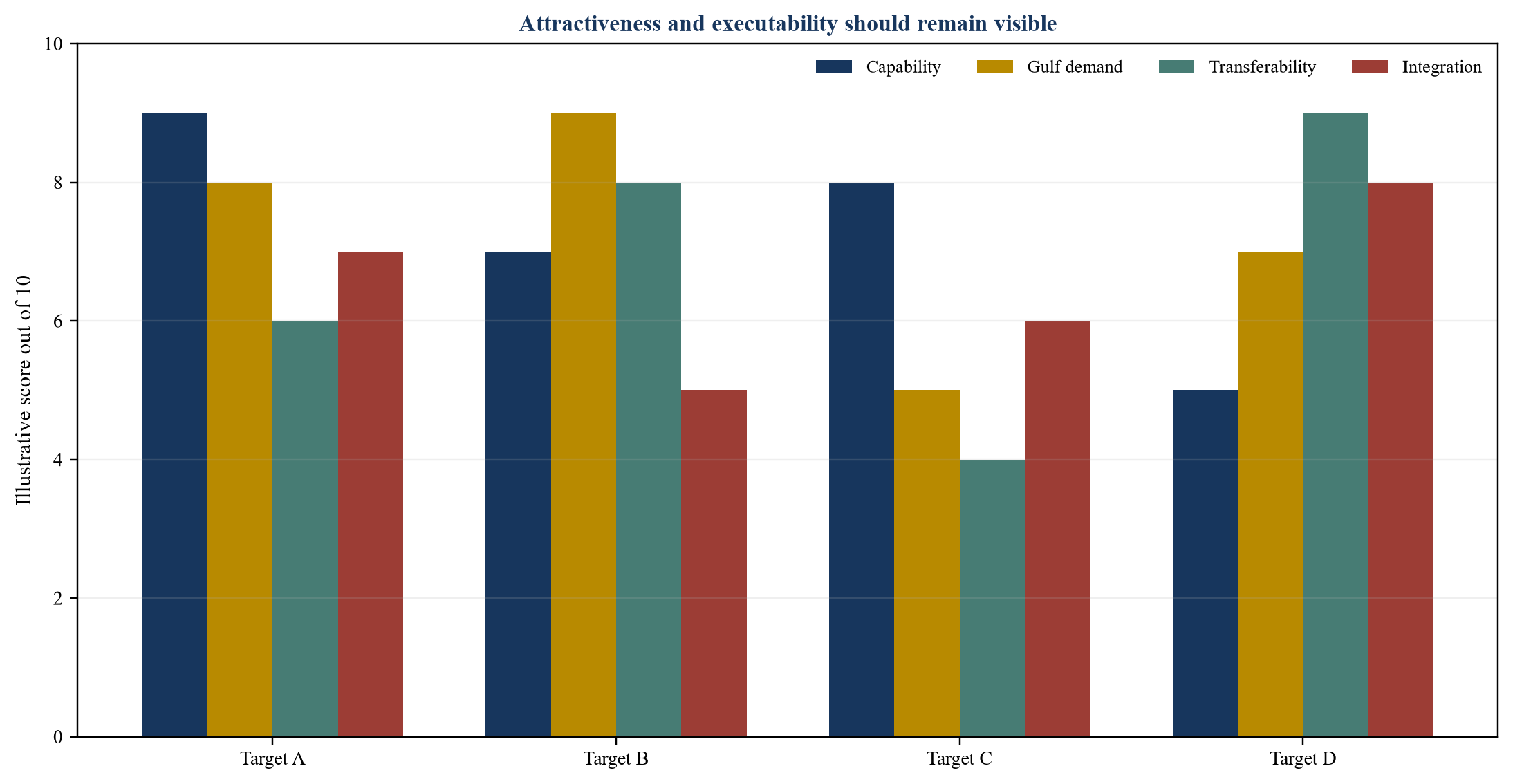
Scores are hypothetical management assumptions and require evidence-backed definitions.
7. Design the cross-border regulatory path
The transaction can trigger merger control, foreign-investment screening, foreign-subsidy review, sector licences, export controls, sanctions checks, data-transfer rules and Gulf ownership or registration requirements. Filing analysis should cover the target, buyer, financing sources, state relationships, subsidiaries and planned post-close structure.
The European Commission's merger and foreign-subsidy regimes have separate tests, information requirements and timetables.[5][6] National regimes can add parallel reviews. In the UAE, economic concentration falls within the competition framework, with thresholds under Cabinet Resolution No. 3 of 2025 taking effect in April 2025.[9][10] Saudi investment activity requires registration and relevant sector licences.[11][12]
A filing matrix should state jurisdiction, trigger, responsible party, pre-notification work, information needs, review phases, standstill obligation, likely remedies, appeal, long-stop date and interaction with financing. The matrix should be validated by qualified counsel in each relevant jurisdiction.
Regulatory sequencing belongs in the valuation model. Delay consumes financing commitment periods, exposes the target to trading risk and defers synergies. Remedies can remove assets, constrain governance or change the operating model. Price and transaction documents should reflect those outcomes before signing.
A cross-border timetable should include information production as well as statutory review. Group structure, public relationships, market data and translation can determine filing readiness. The long-stop date should reflect the actual critical path, including time to negotiate and implement a remedy package.
| Review area | Core question | Evidence | Transaction consequence |
|---|---|---|---|
| Merger control | Does the combination meet filing or substantive tests? | Turnover, market and control data | Standstill, remedy or delay |
| Foreign investment | Is ownership or control screened? | Buyer, target and sensitive-activity facts | Approval or mitigation |
| EU foreign subsidies | Are relevant financial contributions and thresholds engaged? | Group-wide contribution inventory | Notification, review or commitments |
| Gulf competition | Is an economic concentration filing required? | Local turnover, market and control evidence | Clearance before implementation |
| Sector licences | Can ownership, licences and registrations continue? | Licence and change-of-control records | Condition, restructuring or consent |
Actual filing obligations require current jurisdiction-specific legal advice.
8. Test European foreign-subsidy exposure
A Gulf buyer can fall within the European Union's Foreign Subsidies Regulation when an acquisition meets the relevant conditions. The regime examines financial contributions from non-EU public sources and can review whether a foreign subsidy distorts the internal market.[5][6] The information perimeter can extend beyond conventional acquisition financing.
The buyer should build a financial-contribution inventory across the group, including capital injections, guarantees, loans, tax treatment, grants, contracts with public entities and other reportable relationships. Classification should follow current law and qualified advice. Ordinary-course transactions can require careful evidence of market terms.
The diligence timetable should allow collection across jurisdictions and subsidiaries. Incomplete contribution data can delay filing readiness. Governance should identify the legal owner of the inventory, source-system evidence, materiality assessment, review sign-off and update process through closing.
The value case should test an information delay, an in-depth review and possible commitments. The board should know whether the transaction remains financeable if closing moves and whether the strategic capability remains available if a structural measure changes the perimeter.
9. Protect intellectual property and data value
Technology and brand value depends on verified ownership, enforceability and freedom to operate. Diligence should trace patents, software, source code, models, data sets, designs, trademarks, domains, trade secrets and know-how from creator to current owner. Contractor and employee assignment gaps can undermine control.
The review should identify licences in and out, open-source obligations, joint-development rights, research funding conditions, security interests, infringement claims, territorial limits and change-of-control terms. Data rights require separate analysis of collection, consent, use, localisation, transfer and customer restrictions.
The buyer should distinguish intellectual property that can be deployed in the Gulf from rights restricted to a product, entity, customer, territory or purpose. A strong European patent position may provide limited value if the commercial model relies on data that cannot be transferred or if certification must be repeated.
Transaction protections can include conditions, remediation covenants, escrow, indemnities, licence continuity and retention of technical custodians. The integration plan should preserve evidence, repositories, access controls and development discipline from signing onward.
The technology perimeter should reconcile with the sources-and-uses model. Intellectual property retained by a seller, shared with an affiliate or dependent on a change-of-control consent can require a licence, transition service, escrow or price adjustment. These arrangements belong in both legal documents and integration cost.
10. Underwrite brands and customer trust
A European brand can accelerate access where customers associate it with quality, safety, design or regulated-market performance. Brand value can also be narrow, distributor-dependent or tied to a founder. The buyer should measure awareness, preference, pricing power, channel acceptance and reputation by product and geography.
Customer diligence should test whether Gulf buyers recognise the brand, whether local endorsement is required and whether ownership change affects trust. Existing European customers may react to a new controlling shareholder, operating model or data location. Contract reviews should identify consent, termination, exclusivity and public-procurement restrictions.
Architecture choices include retaining the target brand, endorsed branding, co-branding, product branding or migration to the buyer's name. Each option changes marketing cost, customer continuity and integration pace. The decision should reflect evidence rather than executive preference.
The model should attribute brand value to observable price, conversion, retention or sales-cycle effects. A broad strategic premium without a measured commercial mechanism should remain outside the central case.
11. Retain critical people and tacit knowledge
Capability acquisitions can fail when employees who hold customer relationships, engineering judgement or operating routines leave. Organisation charts and job titles rarely reveal this concentration. Diligence should identify critical-role holders, knowledge networks, succession depth, motivation, mobility and contractual restrictions.
Retention design should combine role clarity, leadership access, incentives, career path, autonomy, location, cultural integration and credible investment in the capability. Cash awards alone can postpone departure without preserving commitment. Local labour law, works councils and consultation obligations require qualified advice.
The transfer plan should capture documentation, shadowing, training, dual staffing, communities of practice and knowledge repositories. Milestones should measure operating capability, not only employee presence. A retained team that cannot deliver under the new governance model does not preserve value.
The financial model should include retention cost, replacement lead time, productivity loss and revenue at risk. Key-person downside should reduce price or support contingent consideration where the capability remains inseparable from named individuals.
Critical-role analysis should include teams that maintain systems, certifications and customer confidence even when they do not appear in the leadership plan. The buyer should test concentration across locations, age cohorts and succession. A single-point dependency can justify staged transfer, retention and an explicit contingency team.
12. Reconcile culture with operating design
Cross-border integration risk often reflects incompatible decision rights, incentives and work systems rather than national stereotypes. The buyer should compare how each organisation sells, prices, approves investment, manages risk, develops products, serves customers and escalates problems.
The target operating model should define which decisions remain local, which move to group functions and which require joint governance. Protecting autonomy can preserve innovation while leaving duplicated controls. Immediate centralisation can damage speed and accountability. The choice should follow the value thesis.
Integration leaders need behavioural evidence from management interviews, employee listening, process observation and historical change. Generic culture scores have limited value unless they connect to specific execution dependencies such as tender approval, engineering sign-off or customer response.
The board should approve cultural and operating design together. Each proposed governance change should state the value enabled, decision owner, transition risk, measurable outcome and reversal plan.
13. Build the target operating model before signing
The transaction thesis should specify how European capability reaches Gulf customers. Choices include a European centre of excellence, Gulf commercial hub, replicated delivery cell, joint product team, local manufacturing, distributor network or regulated subsidiary. Each structure changes control, cost, tax, talent and regulatory exposure.
Design should cover legal entities, reporting lines, decision rights, customer ownership, product road map, engineering authority, data access, intellectual-property use, procurement, quality, risk, finance and technology. Interfaces matter because value can leak between target and buyer when responsibilities remain ambiguous.
The model should distinguish day-one continuity from the future operating state. Day one prioritises legal control, customers, cash, people, cyber security and compliance. Later waves can integrate platforms, supply chains, facilities and brands after dependencies are tested.
A signed operating-model blueprint gives diligence a destination and turns integration cost into defined work. It also allows lenders and regulators to assess the structure that will actually operate rather than a generic combination.
Operating design should also specify management information. Revenue, pipeline, margin, product progress, quality, people risk and transfer milestones need common definitions across European and Gulf entities. Without this layer, the board cannot determine whether the capability is transferring or whether performance reflects unrelated market movement.
14. Test supply-chain and localisation economics
European capability may rely on specialised suppliers, long lead times, export-controlled components, single-source tooling or energy-intensive production. Gulf deployment can require local content, approved vendors, new logistics, climate adaptation and different inventory. These changes affect margin and delivery reliability.
Diligence should map bill of materials, supplier concentration, contractual protections, capacity, quality, currency, logistics, tariffs, origin, inventory policy and alternative sources. Localisation scenarios should compare import, final assembly, licensed production, full manufacturing and strategic supplier relocation.
Localisation benefits should include evidenced tender eligibility, transport savings, lead-time reduction, resilience and customer preference. Costs include duplicate tooling, training, qualification, scrap, working capital and lower initial utilisation. Incentives should be treated under applicable conditions and verified before inclusion.
The integration plan should stage localisation around customer demand and technical acceptance. Building capacity before product-market evidence can convert a strategic acquisition into an underutilised capital programme.
15. Validate technology and product road maps
A target can appear differentiated because of historical products while its current road map is underfunded, technically weak or misaligned with Gulf demand. Technical diligence should assess architecture, performance, scalability, cyber security, maintainability, development process, technical debt and dependency on third parties.
Product-market fit should be tested for Gulf climate, language, regulation, infrastructure, customer workflows and procurement standards. The buyer should identify required redesign, certification, localisation and support. A sales forecast without an engineering release plan remains incomplete.
The combined road map should resolve overlapping products, platform choices, research priorities, product ownership and funding. It should preserve valuable target experimentation while stopping duplication that cannot earn an adequate return.
Valuation should use milestone-based scenarios for products that are not commercially proven. Contingent consideration, staged investment or minority ownership may protect the buyer when technical and commercial evidence will mature after signing.
16. Analyse certifications and regulated-market credentials
Certifications, approvals, quality systems and reference projects can shorten entry into regulated sectors. Their value depends on scope, holder, product version, facility, geography, renewal and change-of-control consequences. A certificate may not transfer automatically to a new entity or manufacturing location.
Build a credential register covering issuing body, legal holder, covered products and sites, validity, surveillance, renewal, audit history, non-conformities, customer reliance and transfer requirements. Map each target revenue stream to the credentials that permit delivery.
The Gulf deployment plan should identify local registration, conformity assessment, testing, professional licensing and customer prequalification. Timelines should reflect document preparation, sample testing, facility inspection and remediation rather than assume immediate portability.
The value case should release regulated-market revenue only after the relevant credentials are available. Transaction documents should protect against undisclosed lapses, failed audits and loss of qualifying references.
17. Build the commercial synergy bridge
Commercial synergies should start with specific customers, products and channels. The buyer needs to show which relationship opens access, which product meets a known need, who owns the sale, what proof is required and when revenue can begin. Broad cross-selling percentages provide weak governance.
The bridge should separate price, volume, mix, retention, channel, new product and geographic expansion. It should include implementation cost, sales capacity, localisation, working capital, customer concentration and cannibalisation. Gross margin matters because low-margin expansion can inflate revenue without increasing value.
Evidence can include qualified pipeline, customer interviews, framework agreements, tender calendars and reference requirements. Each synergy should have an owner, probability, milestone and warning indicator. The buyer should reconcile the bridge with the target's stand-alone forecast.
The central case should contain benefits supported by an executable route to market. Additional opportunities can remain in a separately disclosed upside case so that price does not capitalise uncertain demand.
Pipeline governance should distinguish buyer-introduced opportunities, target-originated opportunities and joint wins. Attribution affects incentive, earn-out and synergy reporting. It also reveals whether the acquisition is genuinely opening access or whether the target would have won the revenue without the buyer.
18. Build the cost and capability investment bridge
Cost savings can arise from procurement, facilities, systems, professional services, insurance and duplicated corporate functions. Capability acquisitions also require deliberate investment in people, product, localisation, marketing, compliance and delivery capacity. The net bridge should show both sides.
Each initiative should state baseline, owner, action, timing, one-off cost, recurring benefit, customer impact and dependency. Headcount reductions can conflict with capability retention. Platform consolidation can disrupt product development. Procurement changes can damage certified supply chains.
The model should distinguish avoidable cost from allocated accounting cost and should eliminate benefits already included in target forecasts. Phasing should follow employee consultation, contract termination, migration and operational readiness.
A board-approved reinvestment envelope protects the strategic thesis from a narrow savings programme. Value comes from the capability earning more under the new owner while resilient operations and customer outcomes are preserved.
19. Value the target with multiple decision lenses
Discounted cash flow, trading comparables, precedent transactions, replacement cost and strategic-option analysis answer different questions. The buyer should reconcile them rather than choose the method that supports the desired price. Market multiples require adjustments for growth, margin, recurring revenue, capital intensity, customer concentration and geography.
The stand-alone case should use independently tested revenue, margin, capital expenditure, tax and working capital. The buyer-specific case should add only evidenced synergies after implementation cost and risk. Replacement cost can inform capability value while recognising that rebuilding may take longer and produce a different commercial outcome.
Scenario valuation should include regulatory delay, talent loss, slower Gulf revenue, product redesign, integration cost, currency and financing. Correlations matter because adverse events can occur together. A simple sensitivity around a single discount rate can understate execution risk.
The offer should be linked to the verified value bridge and return threshold. Earn-outs, seller rollover, deferred consideration and performance rights can allocate uncertainty when both parties disagree about future evidence.
| Item | Central case | Correlated downside | Governance response |
|---|---|---|---|
| Entry EBITDA | 54 | 54 | Verify baseline |
| EBITDA after value initiatives | 78 | 62 | Release by evidence |
| Maintenance and transfer capital | (18) | (23) | Fund capability plan |
| Tax and working-capital use | (12) | (12) | Track cash conversion |
| Cash before debt service | 48 | 27 | Set liquidity threshold |
| Annual debt service | (38) | (38) | Size debt to downside |
| Debt-service coverage | 1.26x | 0.71x | Reprice, restructure or protect |
EUR millions; every value is an illustrative management assumption.
20. Design financing around capability risk
Debt capacity depends on cash that remains after maintenance, working capital, integration and capability investment. Lenders may give limited credit to uncontracted Gulf synergies and can require restrictions around acquisitions, distributions, intellectual property, material contracts and disposals.
The financing model should align bridge maturity, term debt, amortisation, covenant testing, hedging and refinancing with regulatory closing and integration. Currency mismatches should be visible where European cash flow supports Gulf funding or purchase consideration. Sources and uses should include fees, tax, retention and contingency.
The downside case should test lower EBITDA, delayed synergies, higher working capital, additional capital expenditure and a later close. Liquidity should survive the period in which integration spending occurs before benefits arrive. The buyer should define cure options and decision triggers.
Financing documentation should preserve necessary investment in the acquired capability. An aggressive debt structure can force cost cuts or delayed product spending that destroys the strategic rationale.
The financing case should include a controlled currency policy for purchase consideration, European cash generation, Gulf operating costs and debt service. Hedging decisions need exposure, instrument, accounting and liquidity owners. Currency gains should not be used to conceal underdelivery in the operating value bridge.
21. Structure consideration around evidence
Cash at close gives the seller certainty while leaving the buyer exposed to forecast error. Deferred consideration, earn-outs, seller rollover and escrows can allocate risk when value depends on retention, regulatory milestones, product delivery or Gulf revenue. Each mechanism introduces governance and dispute risk.
Earn-out measures should be objective, auditable and resistant to operational manipulation. Revenue, gross profit, EBITDA, orders, certifications and product milestones each create different incentives. The agreement should define accounting policies, control rights, investment commitments, exclusions and dispute resolution with qualified counsel.
Seller rollover can preserve alignment and knowledge while complicating governance and exit. Escrow can secure specific identified exposures. Completion accounts or locked-box structures should reflect cash, debt, working capital and leakage characteristics.
The consideration architecture should match uncertainty revealed by diligence. Structure cannot make a weak target attractive, though it can prevent the buyer from paying full value before critical evidence appears.
22. Protect the transaction in definitive documents
Cross-border documents should translate diligence findings into conditions, warranties, covenants, indemnities, price mechanisms and termination rights. Generic protections can miss the exact capability at risk. Each material finding should map to a contractual response or an accepted residual exposure.
Key areas include intellectual-property ownership, data rights, licences, certifications, key employees, customer contracts, public funding, export controls, financial contributions, regulatory filings, cyber incidents, tax and leakage. Interim covenants should protect ordinary operations without breaching competition rules.
Conditions precedent and long-stop dates should reflect realistic review timetables and information dependencies. Cooperation clauses should allocate filing control, remedy decisions and communications. Financing conditions require careful treatment because sellers may resist execution uncertainty.
The board paper should show which risks are eliminated, transferred, shared or retained. Contractual protection has value only when it is enforceable, sized to the exposure and supported by a credible counterparty.
23. Plan integration before control changes
Integration planning can begin before closing within legal constraints. The team should prepare day-one governance, communication, cash control, cyber security, compliance, customer continuity and talent actions while maintaining required separation and clean-team rules. Premature operational coordination can create regulatory risk.
The integration architecture should follow the value thesis. Workstreams can cover customer growth, product, talent, technology, supply chain, finance, legal entities, tax, risk, brand and culture. Each initiative should link to a value or protection outcome and have an accountable owner.
A dependency map should identify actions that require regulatory clearance, employee consultation, customer consent, system access or data transfer. The team can then distinguish preparation from implementation and avoid a plan that assumes unrestricted day-one access.
Board gates should control high-risk migrations and capital release. Integration pace should respond to evidence from customers, employees and operations rather than a fixed calendar alone.
Clean-team design should define permitted data, members, purpose, storage, access and destruction. Sensitive customer, pricing and employee information should flow only through approved channels. The legal protocol and the integration workplan need to agree so that readiness can advance without contaminating competitive independence.
24. Build the hypothetical acquisition case
The hypothetical target has EUR 360 million of revenue and EUR 54 million of EBITDA. The assumed enterprise value is EUR 420 million, with EUR 170 million of debt funding and EUR 45 million of one-off integration and capability-transfer expenditure. These figures are management assumptions used to demonstrate the framework.
The central case reaches EUR 78 million of EBITDA through evidenced Gulf revenue, procurement, delivery and product improvements. After EUR 18 million of maintenance and transfer capital and EUR 12 million of tax and working-capital use, cash before debt service is EUR 48 million. Annual debt service is EUR 38 million, producing 1.26x coverage.
The correlated downside produces EUR 62 million of EBITDA, EUR 23 million of maintenance and transfer capital and EUR 12 million of tax and working-capital use. Cash before debt service is EUR 27 million and coverage is 0.71x. The downside therefore requires lower debt, liquidity support, price protection or faster corrective action.
The worked case demonstrates decision mechanics and does not represent a real company. Every operating, regulatory, financing and timing input requires independent validation in an actual transaction.
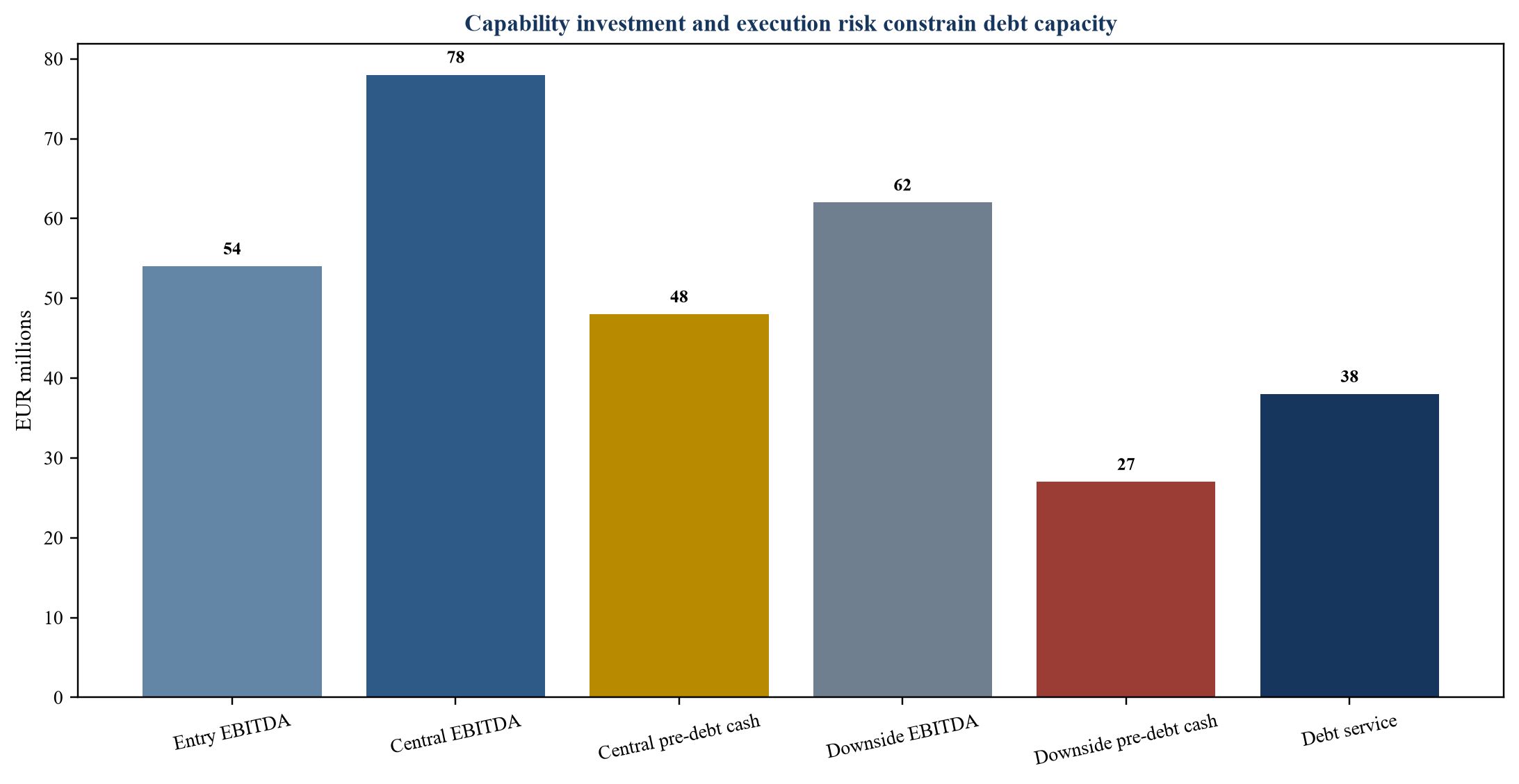
EUR millions; every value is an illustrative management assumption.
25. Run correlated downside scenarios
Strategic acquisitions can suffer concurrent pressure from regulatory delay, key-person departure, slower customer conversion, product redesign, supply disruption, integration cost and tighter financing. Testing each variable alone can create false comfort because the same underlying execution weakness can affect several lines.
The downside should connect cause, operational effect, cash consequence and response. A six-month certification delay can defer revenue, extend retention cost, increase working capital and postpone debt reduction. A regulatory remedy can change governance while customer uncertainty weakens pipeline conversion.
For each scenario, define warning indicator, observation frequency, decision threshold, accountable owner, funding response and contractual protection. Management should show which actions remain available before liquidity or covenant headroom becomes constrained.
The board should use correlated downside results to set price, leverage, contingency, conditions and integration pace. A transaction that depends on every independent sensitivity remaining central-case should not be described as resilient.
26. Establish value-realisation governance
Value creation needs a baseline that reconciles to diligence, the investment memorandum and the opening balance sheet. Each initiative should define financial measure, operational driver, owner, timing, cost, dependency and evidence. Adjustments to the baseline require controlled approval.
A capability acquisition also needs non-financial measures such as critical-role retention, certification status, product milestones, customer conversion, local delivery readiness, quality and intellectual-property protection. These measures provide earlier warning than EBITDA alone.
Reporting should separate stand-alone performance, market effects, integration cost, synergy delivery and one-off items. Finance, operations and integration teams should agree the same definitions so that value is not claimed twice or attributed without evidence.
The board should review protection and growth together. Savings achieved by reducing the acquired capability can improve short-term reporting while eroding the reason for the transaction.
27. Build the diligence data room and evidence chain
A decision-grade data room should let reviewers trace every major claim to source evidence. Commercial claims should connect customer and pipeline records to contracts and cash. Technology claims should connect architecture and road maps to repositories, tests and intellectual-property ownership. Regulatory claims should connect licences and filings to current legal entities.
The request list should cover corporate structure, financials, tax, customers, suppliers, people, pensions, intellectual property, data, cyber security, product, quality, litigation, public funding, sanctions, export controls, competition and environmental matters. Scope should reflect the target and jurisdictions.
Missing evidence should remain visible in an exception register with owner, due date, value at risk and decision consequence. A verbal answer should not silently replace a missing contract, licence or assignment record.
The final evidence index should support board approval, financing, insurance, contractual disclosure and post-close action. It becomes the controlled handover from diligence to integration and continuing compliance.
28. Execute a controlled first 100 days
The first 100 days should protect customers, critical people, cash, intellectual property, cyber security, licences and delivery. Leadership appointments and communication need to explain the operating model and investment commitment. Uncertainty can accelerate employee and customer decisions before formal integration begins.
Early value actions should be few, evidence-backed and reversible where possible. Examples include joint account planning, a defined Gulf product pilot, procurement fact base, retention conversations and a capability-transfer workshop. Large platform or legal-entity changes should follow dependency and risk review.
Management should track a day-one control register, customer issues, employee risk, operational incidents, regulatory commitments and synergy milestones. Escalation thresholds need named decision-makers and response times.
At day 100, the board should compare actual evidence with the acquisition case, reset initiatives and funding where required and preserve an audit trail of changes. The review is an investment re-underwrite rather than a ceremonial integration update.
29. Build a thirty-month acquisition roadmap
The roadmap should integrate thesis definition, screening, diligence, valuation, regulatory filing, financing, signing, closing, capability transfer and value realisation. Workstreams need common milestones because delay in one area can change price, financing and operational readiness elsewhere.
The pre-signing phase should complete strategic-gap evidence, target ranking, preliminary regulatory analysis, value range and integration hypothesis. Confirmatory diligence should close priority evidence gaps and establish definitive protections. Pre-close planning should prepare control without unlawful coordination.
Post-close waves can secure continuity, launch evidenced commercial initiatives, replicate capability, localise delivery and integrate selected systems. Capital should release against verifiable milestones such as certification, customer award, team readiness and operating performance.
Each board gate should state the decision, evidence required, owner, financial exposure and fallback. This converts the transaction from a sequence of functional tasks into a controlled investment programme.
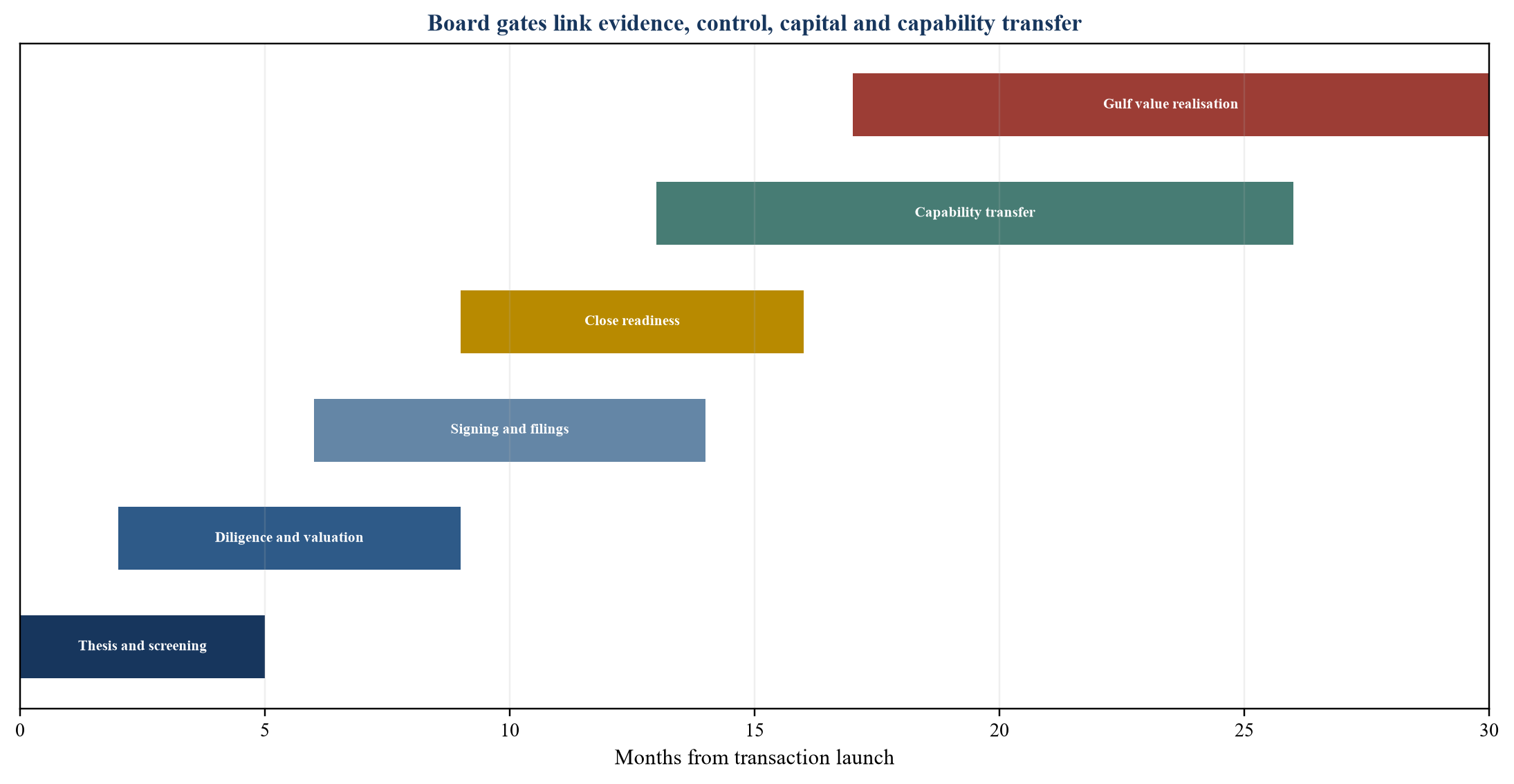
Transaction, regulatory, capability-transfer and value-realisation milestones are integrated.
30. Define the investable Europe-to-GCC acquisition case
An investable case combines a specific strategic gap, scarce and controlled capability, evidenced Gulf demand, regulatory feasibility, transferable people and assets, executable integration, defensible price and resilient financing. Weakness in one dimension should be visible in structure, price or conditions.
The final memorandum should include target ranking, capability map, demand evidence, regulatory path, stand-alone valuation, synergy bridge, downside, financing, transaction protections, operating model, integration plan and governance. Assumptions should be dated, owned and linked to source evidence.
The buyer should state the maximum price and leverage that survive the correlated downside, the evidence required before signing and closing, and the milestones that release capability investment after control. Unresolved dependencies should remain explicit.
This discipline allows a Gulf buyer to acquire more than a corporate shell. It creates a practical route for specialised European capability, brands and market access to earn durable value under a new owner.
| Gate | Required evidence | Approval decision | Walk-away signal |
|---|---|---|---|
| Strategic fit | Defined gap and ranked alternatives | Authorise diligence | No distinctive capability |
| Commercial proof | Customer and route-to-market evidence | Include central synergies | Unverified demand |
| Regulatory feasibility | Filing and licence path | Accept timetable and remedies | Unfinanceable perimeter change |
| Capability transfer | People, IP, data and credential map | Fund transfer plan | Critical asset cannot transfer |
| Price and financing | Value bridge and correlated downside | Approve offer and leverage | Returns fail downside threshold |
| Integration readiness | Operating model and day-one controls | Release post-close capital | No accountable execution path |
Every gate requires current evidence and a named decision owner.
Sources
- European Commission, EU trade relations with the Gulf region. Read the primary source
- European Commission, EU-Gulf relations. Read the primary source
- European Commission, EU and United Arab Emirates factsheet. Read the primary source
- Eurostat, International trade in goods information and methodology. Read the primary source
- European Commission, Foreign Subsidies Regulation legislation. Read the primary source
- European Commission, Foreign Subsidies Regulation questions and answers. Read the primary source
- European Commission, EU merger legislation. Read the primary source
- European Commission, EU Merger Regulation. Read the primary source
- UAE Ministry of Economy and Tourism, Regulation of Competition. Read the primary source
- UAE Ministry of Economy and Tourism, Cabinet Resolution No. 3 of 2025 competition thresholds. Read the primary source
- Saudi Ministry of Investment, Updated Investment Law. Read the primary source
- Saudi Ministry of Investment, Investment Law Implementing Regulations. Read the primary source
- OECD, Investment Policy Perspectives in the United Arab Emirates. Read the primary source
- OECD, FDI Regulatory Restrictiveness Index. Read the primary source
- OECD, FDI Regulatory Restrictiveness Index 2024. Read the primary source
- UN Trade and Development, World Investment Report 2026. Read the primary source
- European Central Bank, Financial Stability Review May 2026. Read the primary source
- European Central Bank, Euro area bank lending survey second quarter 2026. Read the primary source
- European Central Bank, Survey on the Access to Finance of Enterprises. Read the primary source
- European Commission, Open consultation on EU-GCC trade sustainability impact assessment. Read the primary source
