

1. Define the carve-out investment decision
A carve-out decision should ask whether the divested business can operate, finance, comply and create value after it loses the parent systems that currently support it. The acquisition thesis may include technology, customers, licences, brands, manufacturing capacity or talent. Each claimed advantage must be tested against the cost and time required to make the business independent.
The buyer should record the strategic capability sought, the legal and operating perimeter, the minimum viable standalone state, the maximum separation exposure, the regulatory path and the post-close ownership model. These choices determine which assets and liabilities must transfer, which services can be transitional and which dependencies must be eliminated before closing.
The decision record should identify pause conditions. Examples include an incomplete revenue perimeter, unassignable customer contracts, missing intellectual property, an unfinanceable downside, a transition-service timetable that exceeds seller support, or a foreign-investment remedy that removes the capability being acquired. Price cannot compensate for a business that cannot legally or operationally stand alone.
The board should also state the evidence needed to proceed from indicative offer to exclusivity, signing and closing. A staged evidence standard prevents the transaction team from treating management assurances as completed separation work. The investment case should remain open to revision as the perimeter, operating model and regulatory obligations become more precise.
2. Use the Carve-Out Standalone Viability Framework
The framework has eight connected gates: strategic purpose, perimeter completeness, standalone economics, separation design, legal and regulatory feasibility, financing resilience, Day-One control and value delivery. Each gate produces a decision, evidence set, accountable owner, funding requirement and fallback. A gate remains open until the buyer can explain how the business functions without the seller.
The framework separates temporary dependence from permanent capability. A transition services agreement can bridge payroll, hosting or accounting; it cannot substitute indefinitely for management authority, licences, customer ownership or a secure data architecture. The buyer should classify every dependency as transfer, replicate, replace, license, outsource, retain temporarily or remove.
The analysis should run at process and legal-entity level. Group reporting may aggregate activities that require separate contracts, employees, permits, systems and bank accounts after closing. A viable business therefore needs a reconciled map of commercial flow, legal ownership, cash movement, data movement and decision rights.
The framework remains active through separation. Diligence findings alter price and protection; signed documents allocate risk; Day-One performance tests readiness; actual costs update the value case. A controlled separation register should link every material assumption to evidence, owner, milestone, expenditure and escalation route.
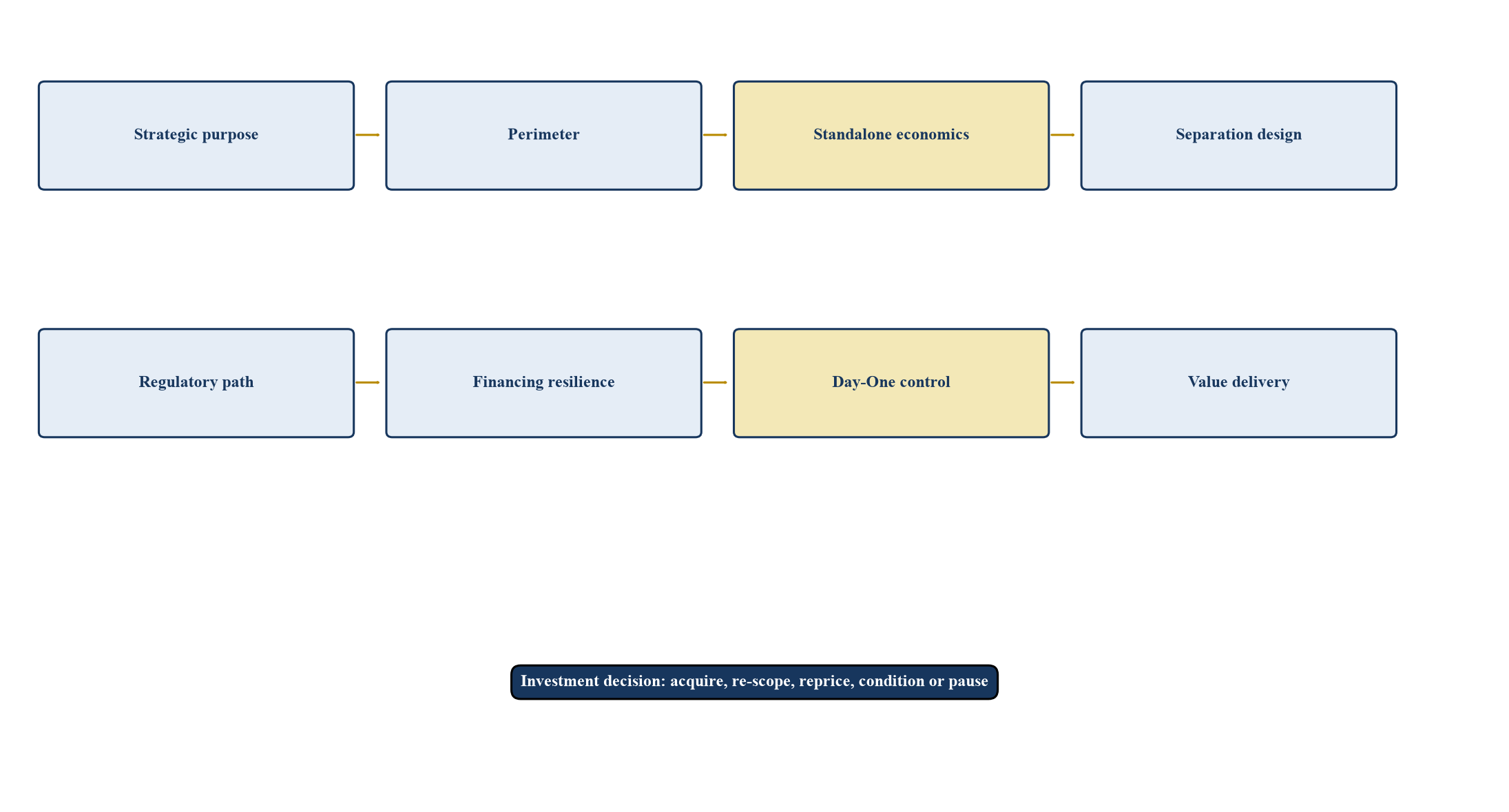
The buyer should prove a complete operating company before relying on value creation.
3. Fix the perimeter before valuing the business
The perimeter should identify the products, customers, contracts, employees, facilities, inventory, receivables, payables, intellectual property, data, permits, legal entities and liabilities that form the business. It should also identify resources that support the division but sit elsewhere in the group. A commercial label or segment disclosure is not an executable transfer perimeter.
Revenue should be traced from customer contract through fulfilment, invoicing and collection. Shared contracts need assignment, novation, replication or a temporary agency arrangement. Product and service obligations should include warranties, rebates, service-level commitments, returns and claims. Historical sales without transferable contract rights can overstate the acquired franchise.
The asset and liability boundary should reconcile the sale agreement, completion accounts, tax perimeter and operating plan. Owned and leased assets require title, location, condition and transferability. Liabilities should include employee obligations, environmental matters, product claims, deferred revenue, customer advances and commitments that may not appear in management reporting.
The buyer should maintain a perimeter difference log from indicative offer through closing. Every addition or exclusion should show the value, cash, capability, regulatory and financing impact. This prevents late drafting changes from altering the economic business without a corresponding price or protection adjustment.
| Perimeter domain | Evidence | Separation question | Closing control |
|---|---|---|---|
| Revenue and customers | Contract and invoice reconciliation | Can rights and obligations transfer? | Consent or alternative route |
| People | Role, employer and cost map | Which employees support the business? | Transfer and consultation plan |
| Technology and data | Application and interface inventory | What must move, clone or remain? | Tested access and migration |
| Assets and facilities | Title, lease and condition schedule | Is capacity controlled independently? | Ownership or enforceable access |
| Intellectual property | Registration and use map | Is the business acquiring sufficient rights? | Assignment or durable licence |
| Liabilities | Legal, operational and accounting ledger | Which obligations follow the activity? | Allocation and funded remedy |
Every perimeter item needs evidence, a transfer route and a Day-One owner.
4. Distinguish legal ownership from operating ownership
A legal entity can transfer while the seller continues to control essential processes. Conversely, an asset deal can create operational ownership when contracts, employees, systems, facilities and licences move together. The buyer should therefore map who owns each process, who performs it, who authorises it, where the data sits and which legal entity bears the obligation.
Operating ownership requires authority over pricing, sales, purchasing, production, cash, employment, technology, risk and compliance. Delegated authority should be designed before closing and reflected in bank mandates, system permissions, approval matrices and board reservations. A chief executive without access to cash or customer data does not control the company in practice.
The map should expose seller-retained dependencies hidden behind informal cooperation. These can include group credit insurance, import licences, treasury guarantees, procurement frameworks, enterprise resource planning, cybersecurity operations, laboratory certification and quality systems. Each dependency needs a documented route to independent control.
The sale agreement and transition plan should use the same operating-ownership map. When legal drafting allocates an obligation differently from the process design, the parties create a gap that may surface only after closing. Joint legal, financial and operational sign-off reduces this risk.
5. Reconstruct the standalone profit and loss account
Segment accounts are designed for group reporting, not acquisition underwriting. They may include parent allocations that do not represent future costs, exclude services supplied centrally, use transfer prices that change after separation, or omit functions the standalone company must create. The buyer should rebuild revenue, gross margin, operating expense and capital requirements from operational drivers.
Revenue analysis should identify products, customers, geography, channel, recurring elements, rebates, warranties and intercompany sales. Costs should distinguish direct expenditure, allocated expenditure, absent standalone functions, one-time separation costs and seller-stranded costs. The objective is a maintainable cash earning base, not a negotiation adjustment that maximises EBITDA.
The reconstruction should reconcile reported segment EBITDA to standalone EBITDA through named adjustments. Each adjustment needs a source, calculation, owner and persistence assessment. Functions such as finance, human resources, legal, technology, tax, treasury, procurement and compliance should be costed at the service level required by the acquired business.
The buyer should also establish the seller's stranded-cost response. A seller may seek price for reported earnings even though it cannot remove all group costs after divestment. The buyer should price the costs it will incur, while the seller separately plans stranded-cost removal. Mixing the two perspectives creates an unsupported compromise EBITDA.
6. Build the standalone balance sheet and cash cycle
The opening balance sheet should show the assets, liabilities and liquidity required for independent operation. It should cover receivables, inventory, payables, provisions, leases, tax balances, employee obligations, deferred revenue, warranty reserves and capital assets. The transaction perimeter and completion mechanism should use the same definitions.
Working capital should be analysed through operational drivers and seasonality. Group treasury may have concealed payment timing, cash pooling, supplier finance, receivables programmes or parent guarantees. The buyer should model the cash needed when these arrangements end, including the first payroll, tax, customs, insurance and vendor deposits.
Net debt definitions require attention to debt-like and cash-like items. Accrued bonuses, overdue capital expenditure, restructuring commitments, customer advances, factoring, guarantees and trapped cash can alter equity value and funding. Items should be allocated according to their economic substance and the purchase agreement definitions.
The opening balance sheet should be tested against Day-One bank accounts and authority. Cash availability is a control issue as well as a valuation item. The business should know which accounts receive customers, which entities pay suppliers and payroll, and how liquidity moves across jurisdictions after closing.
7. Quantify stranded, duplicated and separation costs
Carve-out costs fall into three categories. Standalone costs recur because the company needs functions previously supplied by the parent. Duplicated costs arise temporarily while old and new systems operate together. Separation costs are one-time expenditures for migration, rebranding, advisers, infrastructure, consent and organisation change. Each category affects value differently.
The cost model should be work-package based. Technology may include applications, licences, hosting, identity, interfaces, data migration and cyber controls. People costs may include recruitment, retention, consultation and duplicated teams. Commercial costs may include new contracts, packaging, regulatory registrations and customer communications.
Every cost should have a base, timing, contingency and cash treatment. A single percentage of enterprise value hides the dependencies that determine actual spending. The transaction team should identify costs required before closing, at Day One, during transition and at exit from each seller service.
The board should review cost correlation. Technology delay can extend transition services, increase duplicate staff, delay customer migration and postpone synergies. Scenario analysis should therefore combine related events rather than varying one line at a time.
8. Design transition services as a controlled bridge
A transition services agreement should preserve continuity while the buyer builds independent capability. The schedule should identify service scope, users, volumes, service level, security, price, term, extension rights, change control, incident response, liability, audit access and exit assistance. Business language and legal language should describe the same service.
The buyer should avoid broad labels such as finance support or information technology services. Payroll, accounts payable, tax reporting, cash management, application hosting, help desk, identity management and cybersecurity are different services with different dependencies and exit tests. Each service needs an accountable recipient and provider.
Pricing should reflect expected usage, pass-through costs, transition incentives and extension consequences. A low initial charge can become expensive if it reduces seller priority or conceals the cost of independence. Extension pricing should encourage an orderly exit while allowing continuity when migration cannot safely complete.
Governance should include service reporting, issue severity, escalation, root-cause analysis, change approval and a joint exit plan. The buyer should monitor whether transition services are declining as planned. A stable service can still represent a delayed separation risk.
| Service | Day-One requirement | Exit evidence | Escalation trigger |
|---|---|---|---|
| Payroll | Accurate and timely employee payment | Parallel run and statutory acceptance | Missed file or unresolved variance |
| Enterprise applications | Secure role-based access | Migrated data and tested interfaces | Critical access or integrity failure |
| Treasury | Funded accounts and payment authority | Independent banking and liquidity controls | Payment delay or insufficient cash |
| Finance reporting | Close calendar and reconciled ledgers | Standalone close completed | Material unreconciled balance |
| Cybersecurity | Monitoring and incident response | Independent controls tested | Critical vulnerability or incident |
| Procurement | Continued supply and approved orders | Independent contracts operational | Essential supplier interruption |
The agreement should connect service continuity to a funded exit plan.
9. Make every transition service exit-ready
Exit planning should begin when the service is designed. Each service needs an end-state owner, target architecture, budget, dependencies, migration sequence, acceptance test and fallback. The buyer should avoid signing a service without knowing what capability replaces it.
Exit criteria should be objective. A technology service may require migrated data, reconciled records, user acceptance, security approval and stable operation for a defined period. A finance service may require a completed month-end close, tax filing, payment cycle and management report. The criteria should protect continuity rather than create a subjective dispute.
The plan should identify long-lead items such as software licences, regulated approvals, specialist recruitment, network connectivity and bank onboarding. The seller's support should cover information, access and reasonable assistance needed to complete these steps. Buyer delay and seller non-cooperation should have distinct consequences.
The board should receive a transition burn-down showing services active, cost, remaining dependencies, forecast exit and risk. Extension decisions should be taken before expiry and supported by operational evidence. Silent reliance after the agreed term can weaken service quality and legal protection.
10. Separate technology and data without breaking the business
Technology separation requires an inventory of applications, infrastructure, identities, interfaces, licences, devices, data stores, reports and third parties. The inventory should connect each component to a business process and legal owner. The buyer should know which systems transfer, which are cloned, which are replaced and which remain temporarily with the seller.
Data separation should distinguish operational, customer, employee, supplier, financial, intellectual-property and regulated data. The parties should define the lawful basis, extraction method, cleansing, migration, access, retention and deletion. The GDPR restricts transfers of personal data to third countries unless the relevant conditions and safeguards are satisfied.[8]
The buyer should test interfaces and reports, not only applications. A functioning enterprise resource planning system can still fail if pricing, inventory, quality, tax or bank interfaces are missing. Reconciliations should demonstrate completeness and accuracy from source through transaction processing to financial reporting.
Cutover planning should include freeze periods, fallback, incident authority, communication and evidence preservation. Sensitive data should move through controlled channels. The buyer should prevent the separation programme from creating unrestricted copies or privileged access that weakens security.
11. Establish independent cybersecurity and resilience
The carve-out should have a security control baseline covering governance, identity, privileged access, vulnerability management, monitoring, incident response, backup, recovery, third parties and employee awareness. Shared parent controls should be identified explicitly. The buyer should avoid assuming that a group certification or policy automatically follows the business.
The NIS2 Directive requires risk-management measures for covered essential and important entities and emphasises continuity and proportionate cybersecurity controls.[9] Scope and national implementation require current jurisdiction-specific advice. The separation plan should identify regulated entities, reporting obligations, competent authorities and controls that must remain effective through the transition.
The buyer should commission threat-led testing of the target architecture and cutover plan. Carve-outs create elevated risk because identities, networks and responsibilities change while staff are under delivery pressure. Temporary connections to the seller should use least privilege, monitoring, defined purpose and removal dates.
Cyber incidents should be integrated with transaction governance. The parties need notification duties, investigation access, evidence preservation, remediation ownership and decision rights before and after closing. Insurance, warranties and indemnities should align with the technical control plan rather than operate as a substitute for it.
12. Transfer employees and decision capability
The people perimeter should identify employees who work wholly or partly for the business, their employer, location, role, cost, contractual rights, collective arrangements, incentives, pensions, leave, mobility and retention risk. Shared roles require an evidence-based allocation or a recruitment plan. Organisation charts alone do not show operational dependency.
Council Directive 2001/23/EC provides for transfer of employment rights and obligations in qualifying transfers, subject to national implementation and transaction facts.[4] Works councils, employee representatives and local consultation timetables can affect signing, closing and communications. Qualified employment counsel should establish the process in each relevant jurisdiction.
The buyer should map decision capability as well as headcount. Critical roles may sit in the parent, and transferring employees may lack authority, systems or supporting teams after closing. A Day-One organisation needs accountable leaders for commercial decisions, operations, finance, people, technology, risk and compliance.
Retention should focus on capability and knowledge transfer. Incentives need clear service periods, performance conditions and treatment at closing. The business should document customer, product, regulatory and system knowledge so that continuity does not depend on a small number of individuals.
13. Secure customer contracts and revenue continuity
Customer diligence should reconcile reported revenue to contracts, orders, invoices, cash and service obligations. The buyer should identify change-of-control, assignment, consent, termination, pricing, exclusivity, data, warranty and service provisions. A customer relationship can remain commercially supportive while the legal contract fails to transfer.
Consent strategy should rank customers by revenue, margin, concentration, strategic importance and operational dependency. The parties should agree who approaches each customer, when, with what message and which alternatives apply if consent is delayed. Confidentiality and competition rules should guide pre-closing contact.
Revenue continuity also depends on brand, sales channels, product approvals, credit terms, service teams and data access. The buyer should model the cash and margin effect of delayed consents, renegotiated terms and customer attrition. A blanket retention assumption is weaker than account-level evidence.
Closing conditions should focus on material exposure. Requiring every consent can make closing impractical; accepting unrestricted missing consents can transfer a hollow business. The agreement can use thresholds, alternative arrangements, price adjustments, holdbacks or termination rights based on defined customer outcomes.
14. Rebuild supplier and procurement independence
The supplier perimeter should cover materials, components, logistics, utilities, contractors, software, professional services and critical single-source relationships. Group purchasing can provide prices, rebates, credit, specifications and allocation priority that the standalone company cannot reproduce immediately.
The buyer should identify contracts that transfer, framework agreements that require replacement and vendors that need credit approval or deposits. Product bills of material should connect critical inputs to supplier, lead time, inventory, substitute, quality approval and customer obligation. This map supports both value and continuity analysis.
Intercompany supply should be converted into a priced and governed commercial arrangement or replaced. Transfer-pricing history does not establish future market terms. The buyer should test margin and working capital under independent pricing, minimum-order quantities, payment terms, tariffs and logistics.
Day-One procurement controls should cover authority, approved vendors, sanctions, conflicts, purchase orders, goods receipt, invoices and payment. Emergency buying may be necessary during transition, but it should have defined limits and retrospective review. Continuity should not remove basic financial control.
15. Acquire sufficient intellectual property and brand rights
The intellectual-property perimeter should include patents, designs, trademarks, domains, software, source code, know-how, drawings, specifications, databases, trade secrets, licences and employee-created rights. Registration ownership should be reconciled with actual use. Rights held by a parent or another affiliate require assignment or a durable licence.
The buyer should test whether the acquired rights support current products, planned development, manufacturing, service, export and GCC commercialisation. Field, geography, duration, exclusivity, sublicensing, change of control and termination matter. A narrow licence can limit the value case even when current European operations continue.
Brand transition requires a controlled plan for names, packaging, websites, customer materials, certifications and product markings. Transitional brand use should have duration, quality controls and a replacement timetable. The cost and commercial risk of rebranding should appear in the separation budget.
Knowledge protection should continue through employee transfer, access controls and confidentiality. The seller and buyer should define treatment of shared developments, retained know-how and post-close improvements. Practical separation is required so that each party can operate without unauthorised access to the other's information.
16. Allocate facilities, assets and environmental obligations
The physical perimeter should identify owned and leased sites, machinery, tooling, laboratories, warehouses, vehicles, inventory and shared infrastructure. The buyer should confirm title, lease rights, condition, maintenance, capacity and compliance. A facility can appear dedicated while utilities, access, permits or safety systems remain shared.
Where the business remains on a seller site, the parties need property rights and service arrangements covering access, utilities, security, maintenance, capital expenditure, insurance and exit. A short licence can support Day One but may weaken customer approvals or financing if the relocation timetable is unrealistic.
Environmental diligence should cover permits, emissions, waste, soil, water, hazardous materials, decommissioning and historical liability. The allocation should reflect law and operational control. Contractual indemnities may allocate economic exposure between the parties, while regulators can still pursue the legally responsible entity.
The capital plan should include catch-up maintenance, compliance investment and relocation. Deferred expenditure can inflate historical EBITDA and depress post-close cash flow. Engineering evidence should support estimates for critical assets rather than relying only on accounting depreciation.
17. Build the tax and transfer-pricing separation plan
Tax separation should cover transaction taxes, corporate tax, value-added tax, customs, payroll, withholding, permanent establishments, tax attributes, financing, intellectual property and legal-entity simplification. Asset and share structures can produce different results across jurisdictions. Qualified advisers should confirm current law and treaty application.
Historical tax filings may sit within group arrangements that do not continue. The buyer should identify registrations, compliance calendars, audits, rulings, group relief, loss use and tax-sharing agreements. Tax records and system data need a retention and access plan after closing.
The OECD Transfer Pricing Guidelines address business restructurings and reallocation of functions, assets, risks and profit potential.[11][12] Post-close intercompany arrangements should reflect the actual operating model and arm's-length conditions. The transaction team should avoid designing commercial flows around unsupported tax assumptions.
Tax indemnities, covenants and conduct provisions should align with control of filings and audits. The buyer needs access to evidence for pre-close periods; the seller needs protection against buyer actions that alter historical exposure. Clear responsibility reduces disputes and supports financing diligence.
18. Sequence European regulatory approvals
The approval map should cover EU and national merger control, foreign-investment screening, foreign-subsidy review, sector licences, export controls, data, environmental and employee procedures. The buyer should identify filing triggers, responsible parties, information requirements, timetable, standstill obligations and potential remedies in each jurisdiction.
The European Commission requires notification of concentrations with an EU dimension and prohibits implementation before clearance.[5][6] National authorities may also review transactions, while Article 22 referral can be relevant in defined circumstances. Turnover calculations and control analysis should use current qualified advice.
EU foreign-investment screening operates through national mechanisms and a cooperation framework. The Commission reported continuing growth in screening activity, and the December 2025 political agreement would strengthen and harmonise core requirements.[13][14] A carve-out perimeter involving technology, infrastructure, data or security-sensitive capability deserves early jurisdiction analysis.
The regulatory timetable should be integrated with employee consultation, financing, long-stop dates and separation readiness. A fast operational plan cannot override a standstill obligation. The transaction documents should allocate filing cooperation, remedy authority, information access, cost and termination consequences.
19. Assess foreign-subsidy exposure and remedy risk
The Foreign Subsidies Regulation allows the European Commission to examine financial contributions from non-EU public authorities. Mandatory concentration notification applies above specified thresholds; the Commission can also request notification below thresholds in defined circumstances.[1][2][3] A GCC buyer should map relevant contributions early across the notifying group.
The contribution inventory can include capital, loans, guarantees, tax measures, contracts and other economic benefits from third-country public authorities or attributable entities. The legal test and reporting rules are detailed. The transaction team should collect complete evidence rather than assuming that commercial terms or general availability remove the item from consideration.
Carve-out financing can interact with the review when state-linked funding, guarantees or favourable terms support the acquisition. The buyer should distinguish contribution, subsidy, distortion and balancing analysis. Qualified counsel should guide classification, disclosure and pre-notification engagement.
Remedy risk should be tested against the acquisition thesis. Commitments affecting funding, governance, capacity, technology or market behaviour can change value and financing. The board should approve remedy limits and walk-away conditions before the filing process creates timetable pressure.
20. Establish the GCC ownership, financing and operating path
The buyer should define the acquiring entity, ownership chain, funding source, governance, tax residence, substance, reporting and post-close operating relationship. The European target may remain locally governed while receiving capital, commercial access and strategic oversight from the GCC. Authority should be explicit across the group.
UAE economic-concentration rules use turnover and market-share thresholds under Cabinet Decision No. 3 of 2025, with enforcement from April 2025.[15][16] Saudi Arabia's updated Investment Law and 2025 Implementing Regulations establish registration, restricted-activity and investor-protection processes.[17][18] Current local and sector advice remains necessary.
The structure should support acquisition financing, security, dividends, capital contributions, guarantees and future exit. Lender and regulatory requirements can differ by legal entity. The buyer should avoid building a chain that creates trapped cash, unsupported guarantees or governance rights inconsistent with operating responsibility.
The post-close model should state which capabilities the GCC owner will provide and at what cost. Market access, procurement, financing and relationships require accountable workstreams. A value thesis based on the buyer's network should be underwritten with the same discipline as product or customer growth.
21. Value the business on standalone transferable cash flow
Carve-out valuation should start from reconstructed standalone earnings and the cash required to establish independence. The buyer should separate enterprise value, separation funding, working capital, capital expenditure, financing fees and contingency. A headline multiple applied to reported segment EBITDA can conceal both recurring cost and one-time cash needs.
The valuation bridge should identify revenue and margin normalisation, parent allocations removed, standalone functions added, transfer-pricing changes, leases, maintenance capital, tax, working capital and transition costs. Each item should be classified as recurring, temporary or one-time. This prevents the same cost from reducing both EBITDA and equity value without explanation.
Comparable-company and transaction evidence should be adjusted for business mix, growth, customer concentration, capital intensity, geography and control. A carve-out may warrant a lower value where separation risk is material; it can justify a stronger value when the perimeter contains scarce capability and the buyer has a funded route to remove dependencies.
The board should view price as one component of total exposure. Seller support, risk allocation, deferred consideration, holdback, rollover and remedies can change the economic outcome. The approved offer should include a maximum all-in cash commitment and minimum operating package.
22. Design acquisition finance around separation risk
Lenders need a credible standalone borrower, security package, cash-flow model and reporting system. The buyer should engage financing providers with reconstructed financials, the transition-service plan, opening balance sheet, separation budget and regulatory timetable. Funding certainty should not depend on information that becomes available only after signing.
Debt sizing should use cash after maintenance capital, tax, working capital and unavoidable transition expenditure. The ECB's second-quarter 2026 SAFE reported tighter bank loan interest rates and other lending conditions for euro-area firms.[10] The model should therefore test pricing, fees, collateral, covenants and refinancing under conservative conditions.
The financing structure can combine buyer equity, term debt, revolving liquidity, seller rollover, deferred consideration and contingent consideration. Each source has control, cash and subordination implications. Working-capital and separation facilities should remain available when the business experiences the pressure they were intended to cover.
Security and guarantees should align with legal ownership and regulatory restrictions. Lenders should understand which assets, accounts, contracts and cash flows are available. The buyer should avoid upstream guarantees or distributions that weaken the operating company during transition.
23. Build the hypothetical carve-out case
The hypothetical division has revenue of EUR 340 million and reported allocated EBITDA of EUR 44 million. Removing EUR 10 million of parent charges and adding EUR 16 million for independent finance, people, technology, legal, tax, treasury, procurement and compliance produces reconstructed standalone EBITDA of EUR 38 million. This is a management assumption, not observed company evidence.
The assumed enterprise value is EUR 320 million. The total funding requirement is EUR 365 million, comprising enterprise value plus EUR 45 million for separation, technology and opening working capital. Sources comprise EUR 175 million of buyer equity, EUR 150 million of term debt, EUR 20 million of seller rollover and EUR 20 million of deferred consideration.
The central Year-Three case assumes revenue of EUR 390 million and EBITDA of EUR 54 million. EBITDA less EUR 12 million of capital expenditure and EUR 8 million of tax and working-capital movement produces EUR 34 million before debt service. Assumed debt service of EUR 24 million gives 1.42x coverage.
The case tests whether the buyer can fund independence and growth without relying on immediate synergies. The model should treat any GCC revenue, procurement benefit or financing advantage as a separate initiative with evidence, cost, owner and timing. These benefits should not compensate automatically for a weak standalone base.
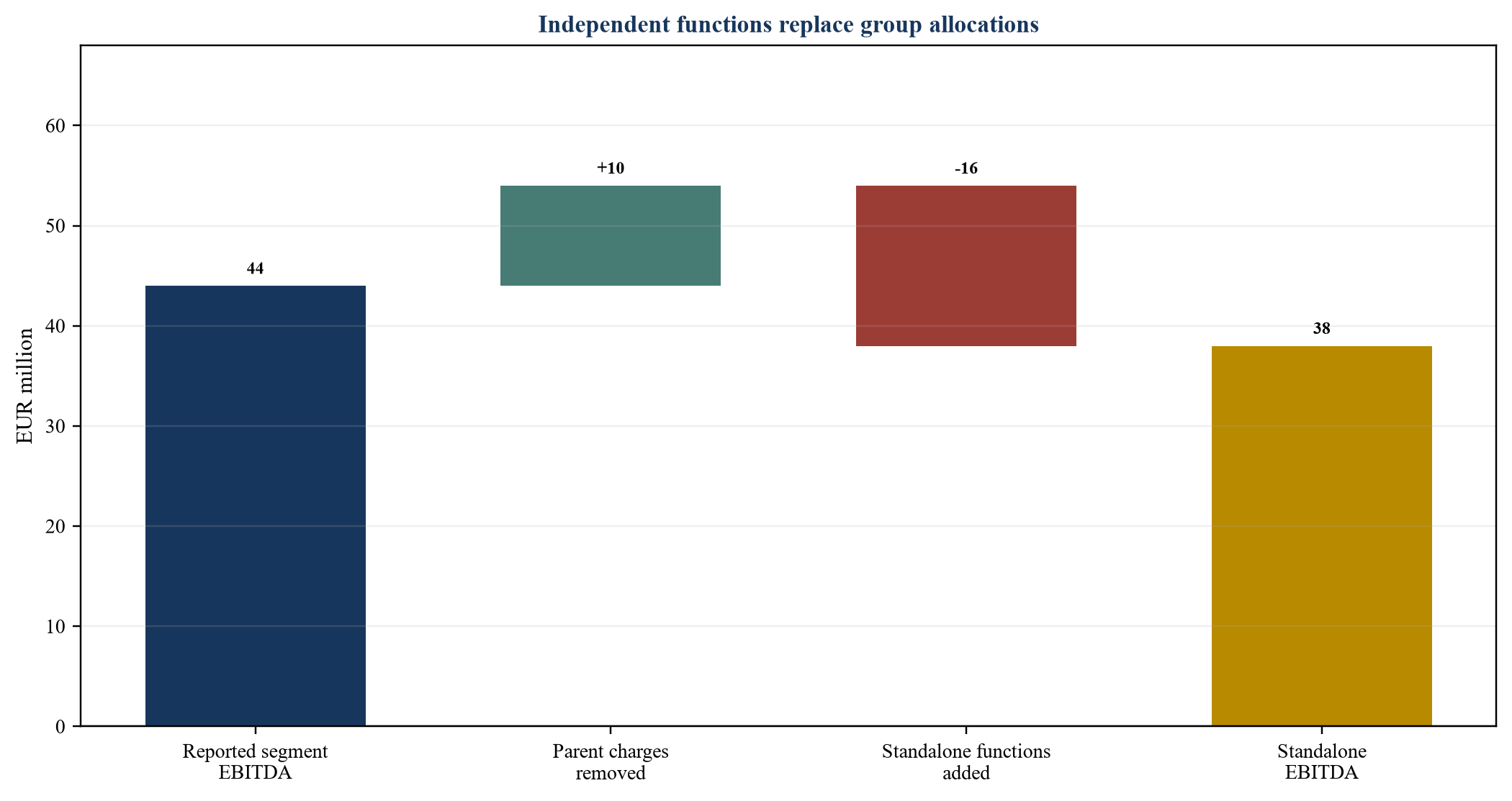
All amounts are hypothetical management assumptions in EUR millions.
| Item | Central case | Correlated downside | Decision use |
|---|---|---|---|
| Enterprise value | EUR 320m | EUR 280m supportable value | Price discipline |
| Separation and liquidity funding | EUR 45m | EUR 60m | Funding reserve |
| Standalone EBITDA at close | EUR 38m | EUR 34m | Debt sizing |
| Year-Three EBITDA | EUR 54m | EUR 42m | Value delivery |
| Cash before debt service | EUR 34m | EUR 20m | Liquidity resilience |
| Annual debt service | EUR 24m | EUR 24m | Fixed obligation |
| Debt-service coverage | 1.42x | 0.83x | Covenant and equity need |
Values and outcomes are illustrative management assumptions; totals may reflect rounding.
24. Run correlated downside and liquidity scenarios
The downside should combine events that share a cause. Delayed technology migration can extend transition services, increase duplicate costs and interrupt billing. Customer consent delay can reduce revenue and working capital while increasing retention spending. Regulatory delay can extend financing commitments and separation preparation without transferring control.
The hypothetical downside assumes Year-Three EBITDA of EUR 42 million, capital expenditure of EUR 14 million and tax and working-capital movement of EUR 8 million. Cash before debt service is EUR 20 million against EUR 24 million of debt service, producing 0.83x coverage. The model therefore needs liquidity, covenant and equity responses before signing.
Each scenario should state cause, operational effect, cash consequence, covenant impact, management response and board trigger. Responses can include delayed discretionary capital expenditure, additional equity, revolving liquidity, cost actions, seller support or a revised perimeter. The plan should distinguish actions that preserve value from actions that damage the business.
Reverse stress should identify the combination of revenue loss, margin pressure, separation delay and working-capital use that exhausts liquidity or breaches financing terms. The board can then set a lower price, larger reserve, tighter closing condition or pause decision based on a measurable boundary.
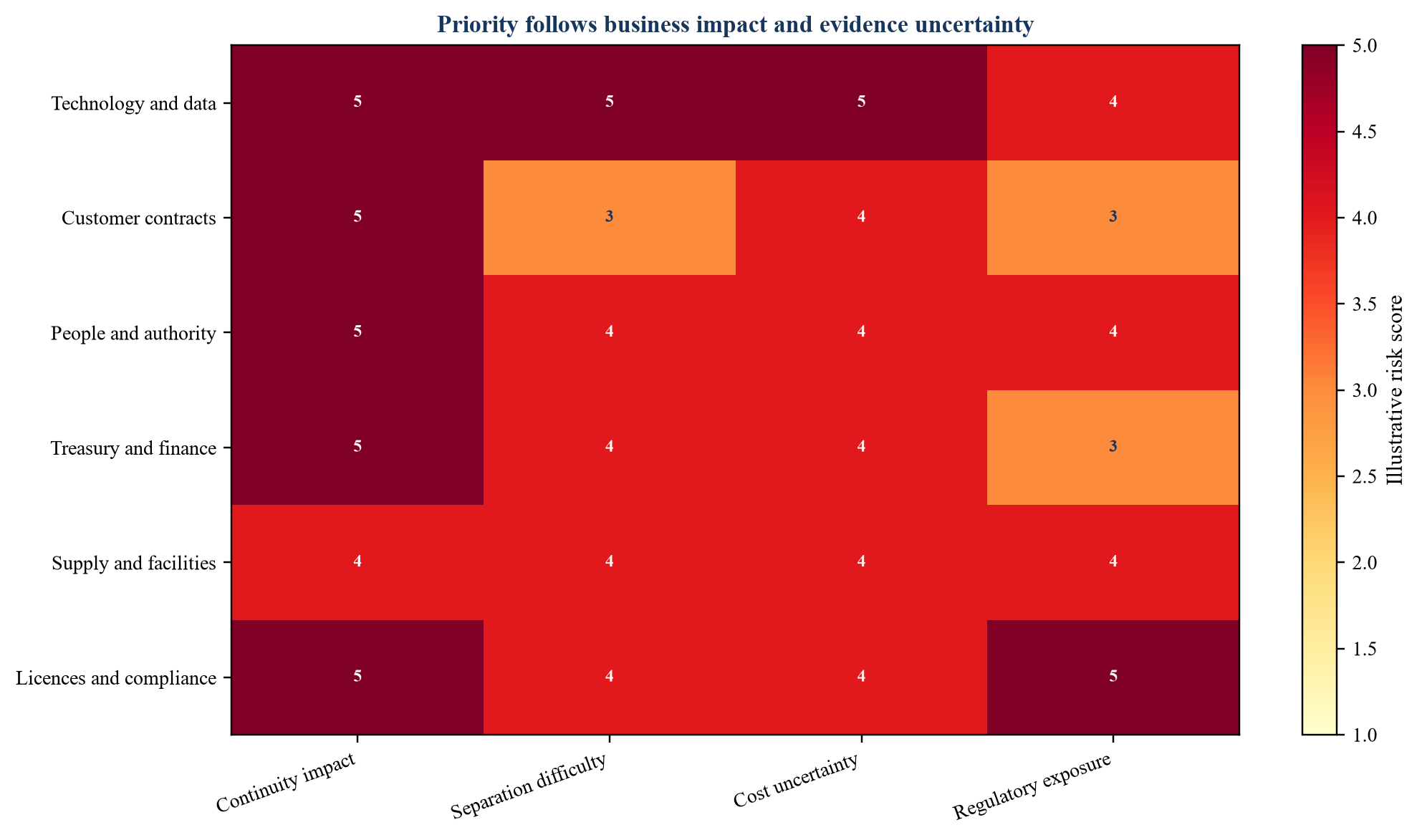
Ratings are hypothetical management assumptions used to prioritise separation evidence.
25. Choose the completion-account and price mechanism
Completion accounts can adjust equity value for actual cash, debt and working capital at closing. A locked-box can provide price certainty based on a historical balance sheet with leakage protection. The choice should follow financial-reporting quality, separation changes, closing timetable and the buyer's ability to verify the opening balance sheet.
Definitions are more important than the label. Net debt, cash, working capital, transaction costs, leases, provisions, factoring, customer advances, capital expenditure and separation liabilities should be addressed explicitly. Illustrative calculations should test ambiguous items before signing.
Carve-outs often need specific adjustments for intercompany balances, cash pooling, parent receivables, shared inventory, deferred revenue and services supplied around closing. The mechanism should prevent value transfer through changes in ordinary course while allowing the seller to operate the business.
The dispute process should set evidence, timetable, accounting hierarchy, expert authority and payment mechanics. The buyer should maintain operational control while the adjustment is resolved. A price dispute should not restrict payroll, suppliers or customer service.
26. Convert diligence into transaction protection
Diligence should produce a risk-allocation decision, not a descriptive report. A verified issue can lead to perimeter change, price adjustment, closing condition, covenant, warranty, indemnity, holdback, insurance, seller service or post-close action. The selected protection should match the likelihood, quantum, control and remedy.
Fundamental matters include title, authority and ownership of transferred assets and shares. Operational warranties can address contracts, employees, systems, intellectual property, compliance, tax and financial information. Disclosure should be specific enough for the buyer to understand the matter and assess its effect.
Indemnities may suit identified liabilities with a defined allocation. Holdbacks or escrow can support recovery where credit is a concern. Warranty and indemnity insurance can alter recourse, exclusions and diligence requirements. Qualified counsel should design the package for the transaction and jurisdictions.
The buyer should avoid treating legal protection as operational readiness. Damages after a failure do not restore customer trust or production continuity. Critical dependencies still need Day-One controls, tested systems and accountable people.
27. Prove Day-One readiness before closing
Day-One readiness means the company can sell, deliver, invoice, collect, pay, employ, secure data, comply and make decisions when ownership changes. The readiness plan should cover customers, suppliers, employees, facilities, technology, banking, accounting, tax, insurance, licences, cybersecurity, communications and governance.
Each workstream needs a minimum operating condition, evidence, owner, test, fallback and escalation. Green status should mean the control has been demonstrated, not that work is expected to finish. Dependencies requiring seller action should appear in both the operational plan and transaction documents.
The buyer should run integrated simulations. A test order can examine pricing, stock, fulfilment, invoicing, tax, receivables and reporting. A payroll simulation tests employee data, bank files, approvals and reconciliation. Incident exercises test authority and communication under pressure.
The closing committee should receive a concise exception list. Residual issues should have quantified exposure, temporary control, owner and deadline. The committee should know which exceptions are acceptable and which require a closing condition, delay or waiver by the authorised board.
28. Execute a control-led first 100 days
The first 100 days should stabilise cash, customers, people, supply, systems and compliance. Management should confirm authority, bank access, reporting, service governance and issue escalation immediately. Communications should explain what changes, what remains and where decisions sit.
The buyer should establish a daily control room for the initial period, followed by a disciplined weekly cadence. Measures should include cash, payroll, orders, delivery, billing, collections, incidents, customer concerns, supplier continuity, employee retention, transition-service performance and separation milestones.
Value initiatives should release only after dependencies are controlled. Rapid commercial expansion can increase strain on a newly separated finance, supply or technology platform. The board should distinguish stabilisation, independence and growth phases and fund them accordingly.
At Day 100, the board should re-underwrite the investment case using actual standalone costs, working capital, customer outcomes and separation progress. It should revise capital, milestones and management support where evidence differs from the original plan.
29. Build a twenty-four-month separation and value roadmap
The roadmap should connect transaction milestones, employee processes, regulatory approvals, Day-One readiness, transition-service exits, technology migration, organisation build, financing and value initiatives. Activities should share decision gates because delay in one workstream can change cost and risk elsewhere.
The first phase establishes the perimeter, standalone model and filing strategy. The second prepares signing and closing through consents, financing, services and control design. The third stabilises operations and exits high-risk dependencies. The fourth scales value initiatives on an independent operating platform.
Every gate should state the decision, evidence, owner, cash requirement, fallback and effect on the investment case. The roadmap should retain contingency for migration and regulation while preserving accountability. A schedule without decision gates can show activity without proving readiness.
Board reporting should focus on exceptions, cash and dependency reduction. The company should measure whether it is becoming more independent and valuable, rather than celebrating project completion alone. Transition expenditure should reconcile to approved sources and uses.
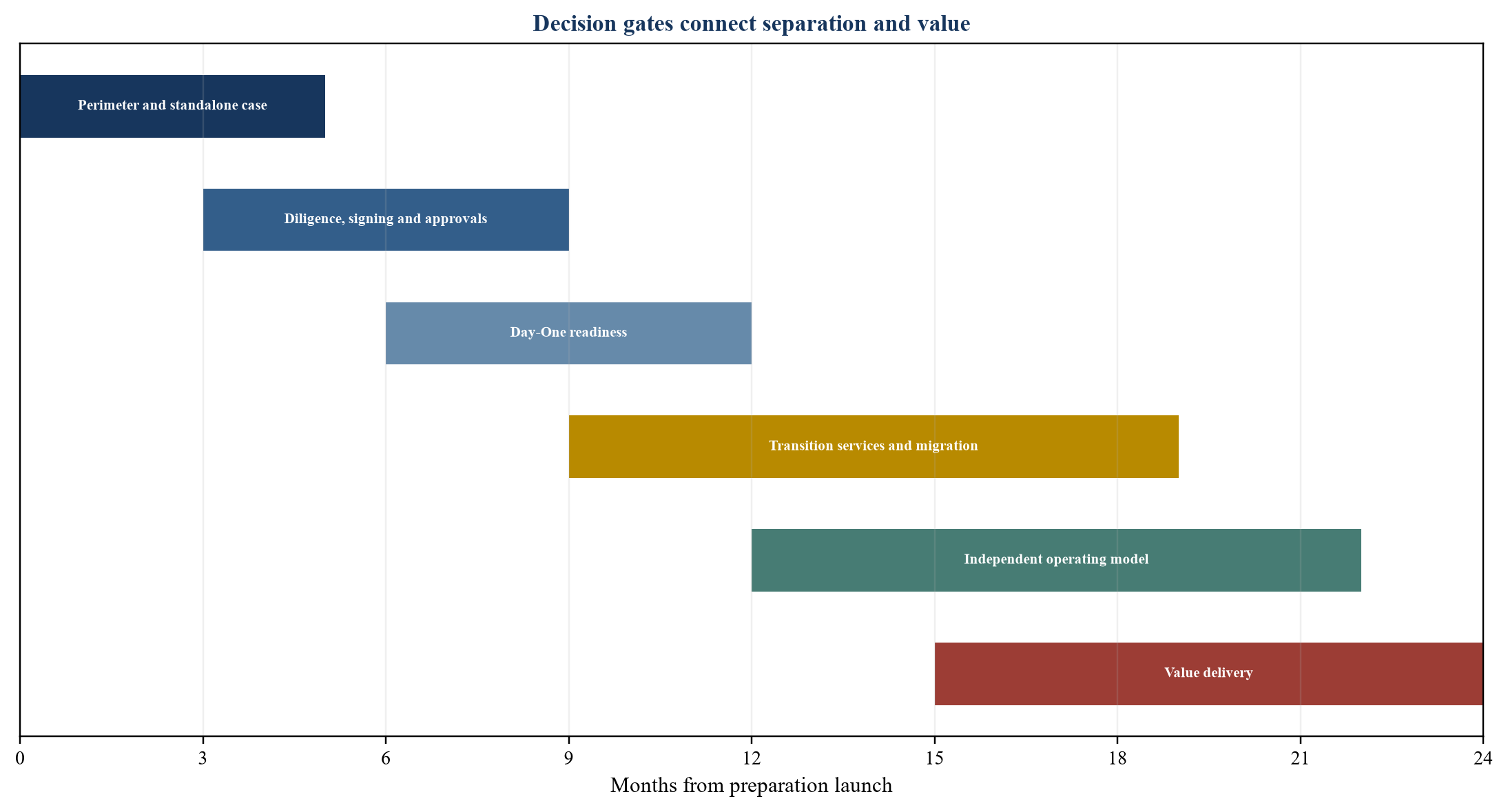
Perimeter, approval, readiness, independence and value milestones should operate as one programme.
30. Define the investable carve-out case
An investable carve-out combines strategic relevance, a complete perimeter, verified standalone economics, funded separation, feasible approvals, resilient financing, Day-One control and accountable value delivery. Weakness in one area should appear in price, structure, conditions, capital or a decision to pause.
The final investment memorandum should include the capability thesis, perimeter map, revenue proof, standalone profit and loss account, opening balance sheet, separation cost model, transition-service schedule, regulatory path, financing, downside, transaction protection, Day-One plan and twenty-four-month roadmap.
The board should approve maximum enterprise value, maximum all-in cash exposure, minimum transferred capability, financing headroom, remedy limits, closing conditions and walk-away triggers. It should also identify evidence that requires reapproval before signing or closing.
Residual uncertainty should be explicit. A transaction can remain investable when uncertainty is priced, funded, governed and monitored. It becomes fragile when missing capability is described as transition, unverified earnings are treated as cash flow or regulatory assumptions are embedded in an inflexible timetable.
| Gate | Required evidence | Approval decision | Pause signal |
|---|---|---|---|
| Strategic purpose | Scarce capability and buyer contribution | Confirm investment thesis | Capability can be sourced more safely |
| Perimeter | Reconciled assets, liabilities and contracts | Accept transfer boundary | Material revenue or rights excluded |
| Standalone economics | Costed functions and cash cycle | Approve valuation base | Earnings depend on unsupported allocation |
| Separation | Funded plan and transition exits | Approve all-in commitment | Seller support cannot bridge readiness |
| Regulation | Filing and remedy analysis | Accept timetable and limits | Remedy removes strategic capability |
| Financing | Correlated downside and liquidity | Approve debt and equity | Coverage fails without uncommitted capital |
| Day One | Tested controls and fallbacks | Authorise closing | Critical process lacks demonstrated control |
Each gate requires current evidence and a named decision owner.
Sources
- European Commission, Foreign Subsidies Regulation legislation. Read the primary source
- European Commission, Foreign Subsidies Regulation questions and answers. Read the primary source
- European Commission, Foreign Subsidies Regulation overview. Read the primary source
- EUR-Lex, Council Directive 2001/23/EC on safeguarding employees' rights in transfers of undertakings. Read the primary source
- European Commission, Merger legislation. Read the primary source
- European Commission, Merger procedures. Read the primary source
- European Commission, Best practices in merger control proceedings. Read the primary source
- EUR-Lex, Regulation EU 2016/679, General Data Protection Regulation. Read the primary source
- EUR-Lex, Directive EU 2022/2555, NIS2. Read the primary source
- European Central Bank, Survey on the Access to Finance of Enterprises, second quarter 2026. Read the primary source
- OECD, Transfer Pricing Guidelines for Multinational Enterprises and Tax Administrations 2022. Read the primary source
- OECD, Transfer pricing aspects of business restructurings, Chapter IX. Read the primary source
- European Commission, Investment screening. Read the primary source
- European Commission, Foreign direct investment screening continues to boost EU economic security, 14 October 2025. Read the primary source
- UAE Ministry of Economy and Tourism, Cabinet Decision No. 3 of 2025 on competition thresholds. Read the primary source
- UAE Ministry of Economy and Tourism, Cabinet resolution on competition-law thresholds and economic concentrations. Read the primary source
- Saudi Ministry of Investment, Updated Investment Law. Read the primary source
- Saudi Ministry of Investment, Investment Law Implementing Regulations 2025. Read the primary source
- IFRS Foundation, IFRS 5 Non-current Assets Held for Sale and Discontinued Operations. Read the primary source
- European Commission, Review of the merger guidelines. Read the primary source
