

1. Define the succession decision before discussing price
A succession transaction should begin with the outcomes that the family, the company and management need to secure. These can include partial liquidity, continuity of the enterprise, investment capacity, management authority, employment, brand identity, family influence and a credible route for the next generation. A price discussion without this decision architecture encourages each party to assume a different end state.
The European Commission treats successful business transfers as economically important because they preserve activity and employment, while its June 2026 Recommendation addresses legal, tax, financing, awareness and cross-border barriers.[1][2][3] The transaction team should therefore separate the family's private objectives from the company's operating requirements and from the investor's return case. Each objective needs an owner, evidence and priority.
The opening board and family council record should state the preferred ownership outcome, acceptable alternatives, capital requirement, management model, time horizon, legacy commitments and walk-away conditions. It should also identify decisions that require unanimity, independent advice or a conflict process. This record becomes the reference point for target investor selection, valuation, documentation and post-close governance.
The decision record should include the cost of delay. Deferred succession can reduce investment, increase founder dependency and compress the eventual process. KfW's 2025 monitoring found that clarified succession was associated with stronger investment willingness among German SMEs, while uncertainty weakened it.[5] A dated readiness plan allows the family to preserve choice before health, market or liquidity events remove it.
2. Use the Succession Capital and Continuity Framework
The framework has seven linked gates: family alignment, company readiness, management continuity, capital purpose, ownership structure, regulatory feasibility and value resilience. Each gate produces a defined decision, supporting evidence, risk allocation and implementation owner. The gates should run together because ownership, governance, financing and operating capacity are interdependent.
A family can accept an attractive headline value and still create an unstable company if management authority is unclear, the retained stake lacks protection, primary capital is insufficient or the buyer's operating model conflicts with customer and employee expectations. A GCC investor can also overpay when the founder remains the main commercial system or when expansion assumptions rely on undocumented relationships.
The framework should remain live from preparation through the first three years after closing. Evidence gathered in diligence changes structure and price; documentation changes governance; actual performance changes capital allocation. A controlled decision log should show why each material term exists, the risk it addresses and the evidence required to amend it.
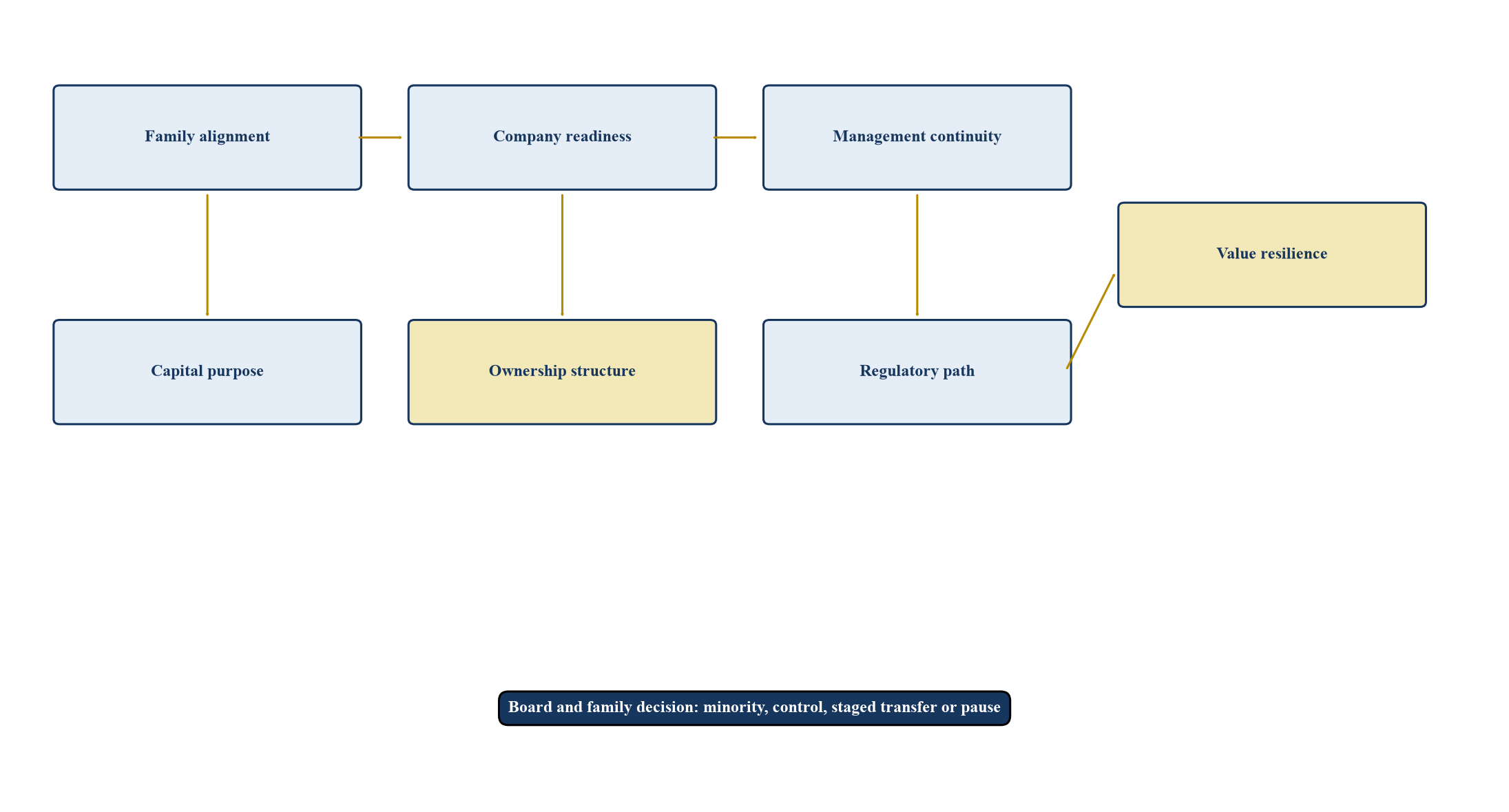
Family alignment, company readiness and capital design lead to an ownership structure that can execute.
3. Treat legacy as a set of enforceable choices
Legacy is often described through identity, stewardship and reputation. These concepts become transaction-ready when translated into choices about name, headquarters, employment, product quality, customer promises, community commitments, environmental standards, long-term investment and family representation. Each choice has a cost, operating implication and governance owner.
The parties should distinguish commitments that are essential from preferences that can evolve. A permanent restriction on relocation can reduce flexibility and value; a time-bound consultation right or investment covenant can protect transition while allowing later adaptation. Vague legacy language creates conflict because it cannot guide a board or support a remedy.
The transaction memorandum should list each proposed commitment, duration, measurement, approval threshold, breach consequence and interaction with law and financing. Qualified counsel should convert agreed matters into appropriate constitutional documents, shareholder agreements, covenants or policies. The valuation should reflect any constraint that changes cash flow, capital deployment or exit flexibility.
4. Build a verified family and ownership map
The legal shareholder register can conceal the practical ownership system. Economic interests may sit across individuals, trusts, foundations, holding companies, marital property, estates and voting arrangements. Family members can hold different liquidity needs, tax positions, operating roles and views on control. These differences should be surfaced before investor engagement.
The map should identify legal title, beneficial interest, voting rights, transfer restrictions, pledges, pre-emption, inheritance exposure, family governance and decision authority. It should also capture unresolved estates, absent consents and family disputes. The purpose is decision readiness; sensitive personal information should be handled through controlled channels and qualified advisers.
A transaction cannot progress reliably when one stakeholder can block a transfer late in the process or when sale proceeds cannot be distributed as assumed. The adviser should establish who can approve preparation, exclusivity, signing, closing, rollover and future exit, and which parties require independent representation because their interests differ.
The ownership map should be reconciled with bank mandates, guarantees, property arrangements and intellectual-property ownership. A shareholder can hold limited voting influence while remaining economically important through guarantees or leased assets. The transaction perimeter should show which relationships continue, which terminate and which require market-based contracts so that the buyer and company understand the full transition.
5. Diagnose the company's capital requirement
Succession capital can fund several needs: shareholder liquidity, debt reduction, working capital, capacity, technology, acquisitions, international growth, management equity and contingency. These uses should be separated because secondary consideration does not strengthen the company and primary capital does not provide family liquidity. Combining them in one headline number obscures the transaction's economic purpose.
Management should build a three-year sources-and-uses plan tied to specific operating milestones. Growth capital should have a deployment schedule, expected cash effect, decision owner and downside response. Deferred projects, maintenance capital and working-capital peaks remain visible so that an ambitious expansion plan does not weaken the inherited business.
The investor should underwrite the company's capital absorption capacity as carefully as the amount requested. A business that depends on the founder for approvals or customer relationships may need organisation and systems before rapid expansion. Capital should release against evidence such as management appointments, contracted demand, capacity readiness and governance controls.
6. Choose the ownership outcome deliberately
Minority investment, control acquisition and staged transfer solve different problems. Minority capital can provide liquidity and growth funding while preserving family control. A control transaction can resolve succession when no family operator is available and the investor can provide leadership or strategic resources. A staged transaction can transfer risk and authority over time, though it creates future valuation and governance complexity.
The choice should follow family objectives, management depth, capital need, investor contribution, regulatory path and downside resilience. A minority structure is weak when the company needs decisive transformation and the parties cannot agree reserved matters. A control deal is weak when value depends on family relationships that the buyer cannot retain. A staged route is weak when future pricing lacks objective rules.
The board should compare structures through the same value, cash, control and execution model. The comparison should show consideration at close, primary capital, retained exposure, decision rights, financing, future liquidity, tax assumptions, regulatory approvals and failure scenarios. The selected route should solve the succession problem under both central and downside cases.
| Structure | Primary benefit | Principal risk | Required control |
|---|---|---|---|
| Minority investment | Capital with family control | Deadlock and weak execution authority | Reserved matters and information |
| Control acquisition | Clear authority and liquidity | Disruption and loss of family capability | Transition role and operating model |
| Staged transaction | Gradual transfer and risk sharing | Future valuation and governance dispute | Complete option and pricing mechanics |
| Management-led route | Operating continuity and alignment | Funding and concentration risk | Finance, governance and succession depth |
| Strategic partnership | Market testing before ownership | Limited control and dependency | Contractual milestones and exit rights |
Legal, tax and regulatory outcomes require current transaction-specific advice.
7. Design minority capital around real influence
A minority GCC investor needs information, protection and a credible path to value without operating the business through vetoes. The family needs protection against loss of practical control through financing covenants, board dynamics or future dilution. These interests can be reconciled through a defined governance perimeter and a board that distinguishes oversight from management.
Reserved matters can cover budget, leverage, acquisitions, disposals, related-party transactions, dividends, equity issuance, senior appointments, strategy changes and exit. Thresholds, materiality, emergency authority and deadlock procedures should be precise. Overbroad consent rights can make ordinary operations slow; narrow rights can leave the investor exposed to changes in risk.
The information package should include timely management accounts, cash, covenant status, pipeline, capital projects, people risks and value-creation milestones. The investor's board representatives owe duties under applicable law and should receive information through agreed protocols. Minority protections should align with the G20/OECD emphasis on equitable treatment, transparency and control of related-party risk.[18][19]
Minority governance should include a budget failure process. The prior-year budget cannot simply continue when investment, leverage or liquidity has materially changed. A controlled interim plan, escalation timetable and independent evidence route can preserve operations while shareholders resolve disagreement. Deadlock mechanisms should protect the company from paralysis before they create an exit or transfer right.
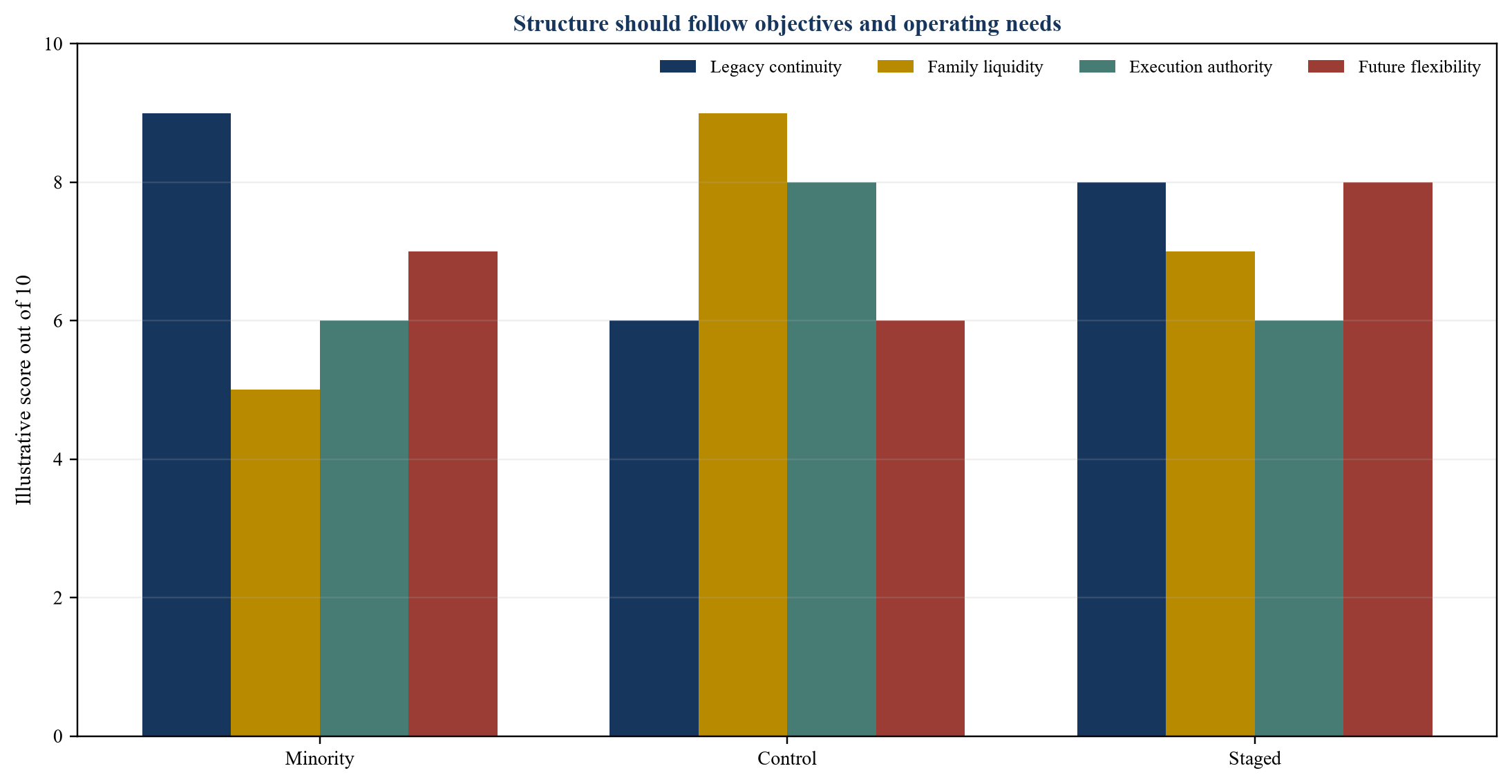
Scores are hypothetical management assumptions; every criterion requires a defined evidence standard.
8. Structure control while preserving continuity
A control investor can provide capital, governance and market access, yet the transfer can destabilise employees, customers and suppliers when authority changes abruptly. The target operating model should identify the family role, chair, chief executive, executive committee, board composition, delegated authorities and local autonomy before signing.
Continuity should be protected through customer ownership, critical-role retention, supplier communication, licence maintenance, banking access and operating decision rights. The buyer should avoid making the founder a permanent informal authority outside the governance structure. A defined transition role with milestones and an end date is more stable than ambiguous influence.
Control value should be linked to actions the buyer can execute, including strategic investment, professionalisation, acquisitions or GCC market access. It should not be assumed simply because more than half the voting rights transfer. The price must reconcile stand-alone cash flow, control benefits, implementation cost and the value of retained family and management participation.
9. Make staged transactions mechanically complete
A staged transaction can combine immediate capital with gradual transfer through call options, put options, earn-outs, future tranches or performance-based ownership. The structure can help parties learn to work together and can preserve founder involvement during management transition. It also creates exposure to future disagreement over performance, price and control.
The documents should define the timing, exercise conditions, valuation formula, accounting policies, permitted actions, funding certainty, security, dispute process and consequences of death, disability, breach or regulatory delay. Future price should reflect a measurable enterprise value or equity value bridge rather than a single multiple applied to an adjustable number.
Governance during each stage requires its own specification. Decision rights, dividends, business plan, leverage, related-party transactions, management appointments and exit should not depend on an undefined future understanding. The parties should model central, downside and dispute scenarios before treating staged consideration as risk protection.
10. Establish management continuity
Succession fails operationally when ownership transfers without a capable decision system. The company should identify who owns customers, pricing, operations, finance, technology, people and capital allocation after closing. Current titles may overstate authority where major decisions still return to the founder or family office.
Management assessment should cover role scope, judgement, team depth, succession, incentives, mobility and relationships. Critical gaps can be addressed through recruitment, phased delegation, coaching, retention and clearer governance. The process should respect employment, consultation and privacy requirements in each jurisdiction.
The transaction model should include recruitment cost, retention awards, handover time and productivity effects. Management equity can create alignment when vesting, good-leaver and bad-leaver provisions, information, dilution and liquidity are understood. Incentives should reward durable cash and strategic milestones rather than a single accounting outcome.
Management continuity also depends on the second line. The assessment should identify deputies for finance, operations, sales, technology and people, and test whether those deputies can lead during absence or transition. A company with one capable chief executive and no functional depth remains exposed. Recruitment and development should begin before closing where confidentiality and law permit.
11. Separate founder knowledge from enterprise capability
A family company can appear institutional while key pricing, supplier, technical and customer decisions remain tacit. Diligence should map the processes, relationships and judgement that depend on the founder or a small group. The objective is to preserve capability, not merely retain a person for a fixed period.
The transition plan should convert tacit knowledge into customer plans, delegation matrices, technical records, supplier strategies, pricing rules, relationship maps and decision forums. Shadowing and joint meetings can transfer context. Documentation alone is insufficient where judgement develops through repeated decisions, so successors need graduated authority and feedback.
Milestones should measure whether the company can operate without founder intervention. Indicators can include customer retention, approval cycle time, forecast quality, pricing discipline, issue escalation and independent management decisions. Deferred consideration or retention can support the transition, though payment conditions should remain objective and auditable.
12. Build a governance constitution
The post-close governance constitution should align ownership, board authority, management delegation and family participation. It can comprise constitutional documents, shareholder agreement, board charter, committee terms, delegation of authority, information policy and conflicts protocol. Each instrument should use consistent definitions and approval thresholds.
The board needs the skills required for the next phase, including sector, finance, international growth, people and risk. Independent directors can help mediate between controlling, family and management interests when they have clear duties and credible authority. Family representation should reflect agreed governance rather than informal attendance.
Related-party transactions require disclosure, approval and market-based evidence. Family employment, property, brand, services and procurement arrangements should be mapped and either documented or resolved. Transparent treatment supports minority confidence and reduces the risk that commercial decisions become proxies for unresolved family issues.[18][19]
| Governance layer | Core decision | Evidence | Failure to avoid |
|---|---|---|---|
| Shareholders | Ownership, capital and exit | Agreement and constitutional rights | Informal vetoes |
| Board | Strategy, budget, risk and leadership | Board pack and delegated authority | Operating through consent lists |
| Management | Customers, operations and people | KPIs and accountability | Founder shadow management |
| Family forum | Legacy, communication and family matters | Family charter and representatives | Parallel company governance |
| Committees | Audit, remuneration and transactions | Terms and independent review | Uncontrolled conflicts |
Rights should support oversight, operating speed and equitable treatment.
13. Rebuild valuation from transferable earnings
Valuation should begin with earnings and cash flow that survive the founder transition, ownership change and investment plan. Historical EBITDA can include family remuneration, related-party pricing, underinvestment, exceptional items and customer concentration. Adjustments require evidence and should distinguish normalisation from future synergy.
The model should reconcile enterprise value to equity value through debt, debt-like items, cash, working capital, tax, pensions, leases, claims and transaction costs. The parties should agree the completion mechanism and leakage rules with qualified advisers. Family balance-sheet assets should be separated from operating assets where the intended perimeter requires it.
GCC market access, accelerated investment and professionalisation can create buyer-specific value. These benefits should be modelled after execution cost, tax, capital, timing and risk. The buyer should avoid funding full expected synergy through price when the family or management is better placed to share delivery risk through rollover or contingent consideration.
Valuation sensitivity should distinguish operating performance from transaction mechanics. A lower completion balance, delayed capital deployment or higher financing cost can reduce equity returns without changing the underlying company. The investment committee should see a reconciled bridge from business value to investor cash return, including dilution, distributions, retained stake, future consideration and exit assumptions.
14. Prepare the vendor evidence base
A prepared seller reduces uncertainty by presenting a reconciled view of ownership, financials, tax, customers, suppliers, people, assets, intellectual property, data, compliance and disputes. Preparation should test the information rather than package management claims. Each major number should trace to a source record and cash where relevant.
The data room should include corporate records, family ownership documents, management accounts, audited statements, quality of earnings, tax filings, contracts, licences, employee data, pensions, real estate, environmental matters, cyber security and insurance. Access should be role-based and privacy-conscious, with a complete question and answer log.
A vendor diligence report can accelerate review when its scope, independence and reliance are clear. It should preserve negative findings, unresolved evidence and sensitivity. A clean marketing narrative that conceals the actual succession dependencies increases renegotiation and damages trust with the selected investor.
15. Prove the growth thesis before allocating capital
A GCC investor can offer distribution, capital, relationships and regional operating support. The company still needs product-market fit, procurement access, localisation, pricing, delivery, certification and collections in each target market. Strategic interest and national ambition provide context; they do not constitute contracted revenue.
Commercial diligence should build Gulf growth from named segments, customer problems, buying processes, competitive alternatives, qualification requirements and sales capacity. The EU and UAE are negotiating a bilateral free trade agreement intended to facilitate goods, services, digital trade and investment, while broader EU-GCC trade work continues.[14][15] The final operating assumptions must reflect current rules and actual customers.
Growth capital should release against evidence such as product approval, local team readiness, distributor performance, qualified pipeline or signed orders. The model should include working capital, local cost, tax, service obligations and execution delays. Unverified opportunities belong in a separate upside case.
16. Map capability and brand transfer
The European company may derive value from brands, certifications, engineering methods, patents, software, customer references, people and supplier networks. Each element should be mapped to its legal owner, operating custodian, geography, consent, transfer restriction, renewal and replacement cost. A corporate acquisition does not automatically make every capability deployable in the Gulf.
Brand and customer trust should be tested by market and stakeholder. The buyer should decide whether to retain, endorse, co-brand or migrate the name. Product claims, warranties, quality systems and regulated certifications need continuity plans. A family name used as a brand may also require personal and reputational arrangements.
The integration budget should include replication, localisation, training, systems, licences, customer qualification and retention. Benefits should enter the central case after the relevant transfer milestone. This creates an auditable link between investment and value rather than treating ownership itself as delivery.
17. Build the European regulatory path
A GCC investment can engage national foreign-investment screening, European Union cooperation, merger control, sector regulation, labour consultation, data rules and export controls. The European Commission's FDI screening framework coordinates Member States, and the revised framework reached political agreement in December 2025 with mandatory national mechanisms and a common minimum scope.[7][8] Actual application remains fact and jurisdiction specific.
The filing matrix should identify jurisdiction, activity, control rights, threshold, pre-notification, information, review phase, standstill, remedy, appeal and long-stop date. Minority investments can be reviewable where governance rights or sensitive activities create influence. Qualified local counsel should validate triggers and timetable.
Regulatory delay affects financing, employee communication, family timing and business performance. The model should include commitment periods, ticking cost, interim covenants and a remedy case. The board should approve the maximum perimeter change or governance restriction it will accept before signing.
The screening analysis should include the ultimate investor, co-investors, governance rights, financing and post-close plan. Authorities can examine influence, sensitive activities and public-order considerations beyond a direct share percentage. Filing preparation should preserve a consistent explanation across jurisdictions and avoid committing to an operating model that the integration team cannot execute.
18. Address foreign subsidies and merger control
The European Union Foreign Subsidies Regulation can require notification of certain concentrations where turnover and foreign financial contribution conditions are met. The Commission can also investigate other situations. The buyer should build a group-wide inventory of relevant financial contributions, guarantees, financing, tax treatment, grants and public contracts using current legal advice.[9][10]
EU merger control applies to concentrations meeting the applicable tests, with national authorities covering other transactions and referral mechanisms available.[11][12] Family ownership, joint control, staged rights and shareholder agreements can affect the control analysis. The filing assessment should use the final governance package rather than a simplified percentage test.
Regulatory work should begin before exclusivity where possible because group information and market data can take time. Conditions, cooperation, remedy authority, information covenants and long-stop dates should allocate execution risk. The buyer should preserve financing and strategic value if the review timetable extends.
19. Design the Gulf ownership and operating path
The acquisition vehicle, funding source and post-close Gulf activities require a separate legal and regulatory workstream. Saudi Arabia's updated Investment Law and implementing regulations include foreign-investor registration and sector-specific restrictions or conditions.[16][17] In the UAE, competition notification thresholds under Cabinet Decision No. 3 of 2025 include annual sales and market-share tests.[13]
The buyer should map holding jurisdictions, beneficial ownership, investment approvals, competition, sector licences, tax, substance, employment, banking, data and distributions. A European acquisition structure does not itself establish the licences or resources needed to operate in each GCC market.
The operating model should state which entity contracts, employs, owns intellectual property, invoices, bears risk and receives cash. Intercompany arrangements need commercial purpose, governance and current qualified tax and legal review. The structure should support the value thesis without creating unnecessary complexity or trapped cash.
20. Finance the transition and growth plan
Debt capacity should be based on cash after maintenance capital, working capital, tax, transition cost and committed growth investment. Lenders may give limited credit to uncontracted GCC expansion and may restrict acquisitions, distributions, related-party payments or changes in control. The financing case should reconcile these terms with family liquidity and retained ownership.
The ECB's second-quarter 2026 SAFE results reported further tightening of bank loan interest rates and other lending conditions for euro-area firms.[6] Financing assumptions should therefore be current, lender-tested and sensitive to margin, amortisation, covenant and refinancing risk. Public or guarantee-backed programmes can be relevant in specific countries, subject to eligibility.[5]
Sources and uses should include secondary consideration, primary capital, debt repayment, fees, tax, retention, integration and contingency. The correlated downside should test lower earnings, slower growth, higher investment and delayed regulatory completion. Liquidity support, equity cure and capital deferral need explicit ownership and approval.
Financing should also protect the company's seasonal and event-driven liquidity. The succession timetable can coincide with tax, inventory, bonus, pension or customer-payment peaks. A closing model based only on annual EBITDA can miss the minimum cash required during the first year. Monthly cash, covenant and headroom should therefore support the sources-and-uses decision.
21. Keep legal and tax assumptions qualified
Business transfers operate within national company, inheritance, tax, labour and regulatory systems. The European Commission identifies taxation, advisory quality and cross-border inheritance among transfer barriers.[2] The paper cannot determine the treatment of a specific family, trust, holding company, rollover, dividend or disposal. Each party should obtain current independent advice.
The transaction model should label tax assumptions and show cash consequences for the company, selling holders, rollover and investor. It should also identify where tax affects structure, price allocation, financing, distributions and future exit. A structure that improves one stakeholder's outcome can change risk or cost elsewhere.
Legal and tax diligence should run alongside commercial design. Late restructuring can trigger consent, timing, financing and regulatory effects. Decisions should be recorded with adviser, date, jurisdiction, facts relied upon and residual uncertainty so that the board knows which amounts are contractual and which remain assumptions.
22. Build the hypothetical succession-capital case
The hypothetical company has EUR 260 million of revenue, EUR 31 million of EBITDA, assumed enterprise value of EUR 280 million and net debt of EUR 70 million. A GCC investor provides EUR 150 million, comprising EUR 115 million of secondary liquidity and EUR 35 million of primary growth capital, for an assumed 60 per cent fully diluted interest. The family retains 30 per cent and management holds 10 per cent.
The central case reaches EUR 47 million of EBITDA. After EUR 9 million of maintenance and growth capital and EUR 8 million of tax and working-capital use, cash before debt service is EUR 30 million. Assumed annual debt service is EUR 21 million, producing 1.43x coverage. These amounts are illustrative management assumptions.
The correlated downside reaches EUR 35 million of EBITDA. After EUR 11 million of capital expenditure and EUR 8 million of tax and working-capital use, cash before debt service is EUR 16 million. Coverage falls to 0.76x. The structure therefore requires lower debt, liquidity support, staged capital, price protection or corrective action before the downside becomes a financing event.
The hypothetical ownership percentages and capital flows are illustrative and would require a fully diluted capitalisation table, legal structuring and tax review in an actual transaction. The model's purpose is to show how secondary liquidity, primary capital, retained ownership and management participation interact. It does not prescribe a fair price, ownership split or financing package for any company.
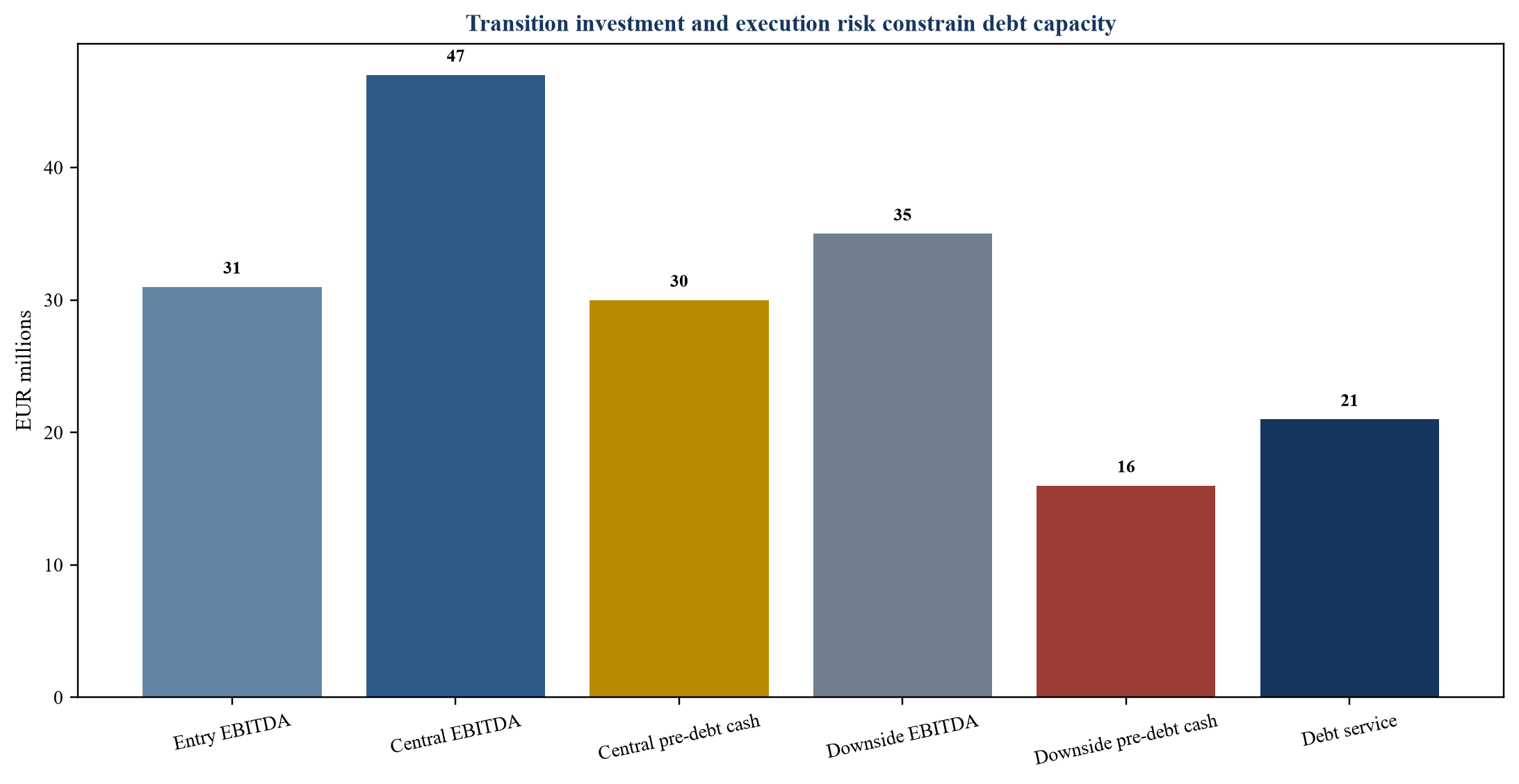
EUR millions; every value is an illustrative management assumption.
| Item | Central case | Correlated downside | Governance response |
|---|---|---|---|
| Entry EBITDA | 31 | 31 | Verify transferable baseline |
| EBITDA after transition and growth | 47 | 35 | Release value by evidence |
| Capital expenditure | (9) | (11) | Protect maintenance and growth |
| Tax and working-capital use | (8) | (8) | Track cash conversion |
| Cash before debt service | 30 | 16 | Set liquidity threshold |
| Annual debt service | (21) | (21) | Size financing to downside |
| Debt-service coverage | 1.43x | 0.76x | Reduce debt or add support |
EUR millions except percentages and coverage; every value is an illustrative management assumption.
23. Run correlated downside scenarios
Succession risks can occur together. Founder withdrawal can weaken customer retention, expose management gaps, slow decision-making and reduce forecast accuracy while growth investment increases cash use. Regulatory delay can extend financing cost and employee uncertainty. Testing variables independently can therefore overstate resilience.
Each scenario should link cause, operational effect, cash consequence, covenant impact and response. The model should test customer loss, margin pressure, delayed GCC revenue, management departure, higher working capital, capex overrun and a later close. It should also show whether dividends, earn-out or future tranches remain payable.
For each downside, management should define warning indicator, reporting frequency, intervention threshold, action owner and funding source. The board should use the correlated results to set leverage, liquidity, price, contingent consideration, capital release and walk-away conditions.
24. Control distributions and retained capital
Family shareholders can expect continuing distributions while the investor expects reinvestment and deleveraging. The policy should reconcile maintenance, growth, covenant headroom, working capital and reserve needs before dividends. A percentage payout without a cash and leverage test can undermine the agreed growth plan.
The shareholder agreement should define distributable cash, approval, minimum liquidity, leverage conditions, tax distributions, exceptional payments and treatment of shareholder loans. Related-party remuneration and services should be transparent. The company should avoid using dividends to resolve personal liquidity that the transaction was intended to address.
Reporting should show cash generated, capital deployed, debt service, reserves and distributions against the approved plan. Deviations need a documented business reason. The retained family and management should understand how investment choices affect future liquidity and exit value.
25. Convert diligence into transaction protection
Every material finding should result in remediation, price, structure, condition, warranty, indemnity, covenant, escrow, insurance or accepted residual risk. Generic protections cannot replace a precise response to ownership, tax, customer, people, intellectual-property, pension, environmental or regulatory exposure.
The completion mechanism should address cash, debt, working capital, leakage and debt-like items. Interim covenants should protect the business while respecting competition rules. Conditions should cover required ownership consents, regulatory approvals, financing, key contracts, restructuring and material remediation where appropriate.
The board paper should distinguish risk eliminated, transferred, shared and retained. Protection has value only when it is enforceable, collectible, proportionate and aligned with the exposure period. Qualified counsel should confirm the operation of definitive documents in each relevant jurisdiction.
26. Execute a continuity-led first 100 days
The first 100 days should protect customers, employees, cash, suppliers, licences, systems and decision continuity. Communication should explain ownership, management authority, investment and what remains unchanged. Silence or conflicting messages can allow uncertainty to become a commercial problem.
Early actions should follow the succession thesis: formalise delegated authority, secure critical relationships, establish board reporting, fund agreed priorities and begin evidence-backed GCC initiatives. Large system, brand or organisation changes should follow dependency and risk review. The family transition role should operate through the agreed governance structure.
A day-one register should track banking authority, payroll, customer issues, people risk, cyber access, insurance, regulatory commitments and decision escalations. At day 100, the board should re-underwrite the investment case using actual evidence and adjust capital, governance and milestones where required.
The first 100 days should include a customer and employee listening process with controlled follow-up. Concerns, commitments and exceptions need owners and dates. Management should distinguish issues caused by the ownership transition from pre-existing operating weaknesses. This evidence helps the board determine whether the continuity plan works and whether value initiatives can accelerate safely.
27. Build a thirty-six-month transition roadmap
The roadmap should connect preparation, investor selection, diligence, documentation, approvals, closing, management transfer, growth investment and value realisation. Workstreams need shared milestones because family decisions, management appointments, regulation and financing can alter each other's timing.
The pre-signing phase should align the family, establish the capital plan, verify the company, compare structures and select an investor. Confirmatory work should close priority evidence gaps and negotiate governance. Pre-close preparation should establish day-one control without premature coordination.
Post-close waves should secure continuity, transfer founder knowledge, build management capacity, deploy primary capital, validate GCC growth and strengthen reporting. Capital and decision rights should release against evidence. Each board gate should state the decision, evidence, owner, cash exposure and fallback.
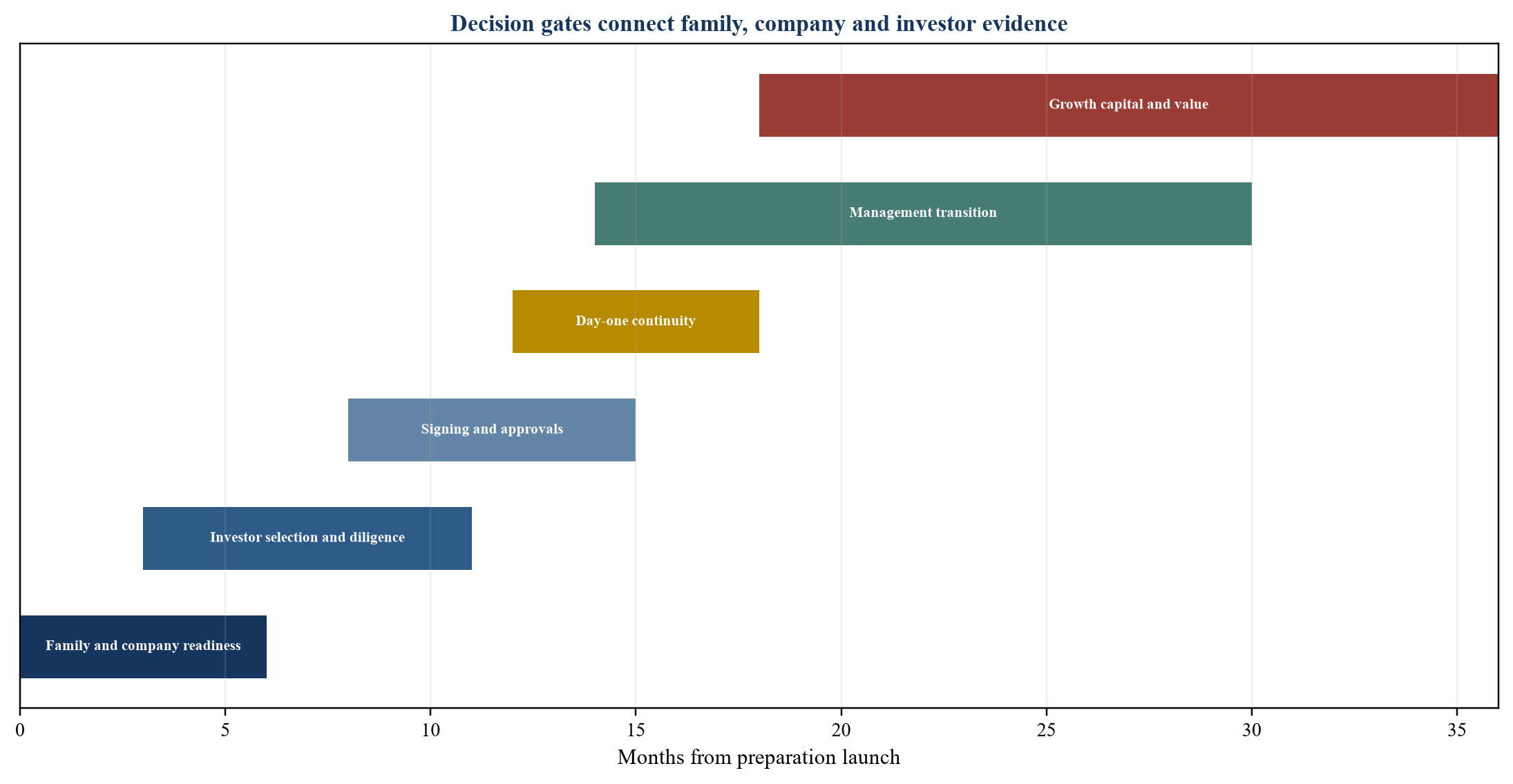
Ownership, management, capital and growth milestones are governed as one programme.
28. Establish value and continuity reporting
The opening baseline should reconcile diligence, the investment memorandum, completion accounts and the first post-close forecast. Measures should separate stand-alone performance, market movement, growth investment, transaction effects and value initiatives. Definitions should remain consistent across family, investor, management and lender reporting.
Continuity indicators can include customer retention, employee retention, decision independence, founder handover, supplier performance, quality, licences and forecast accuracy. Growth indicators can include qualified pipeline, orders, local delivery readiness, product approval and cash collection. EBITDA alone provides late and incomplete evidence.
Each initiative needs a financial measure, operating driver, owner, timing, cost, dependency and source record. Baseline changes require approval. This prevents value from being counted twice or claimed through accounting classification while the underlying succession objective weakens.
29. Plan the next liquidity and ownership transition
A succession transaction creates a new ownership system that will eventually face another transition. The documents should address future family liquidity, investor exit, management equity, pre-emption, tag, drag, transfer restrictions, initial public offering, trade sale and buyback where relevant. Rights should align with financing and regulation.
Exit design should avoid forcing a sale before the company can deliver the growth plan while providing a credible route to liquidity. A staged control transfer may resolve this when valuation and funding mechanics are complete. A minority investment needs stronger consideration of deadlock and an investor's ability to realise value.
The board should review ownership readiness annually, including shareholder objectives, management depth, capital needs and potential buyers. Advance preparation protects the company from another compressed process and allows future liquidity to follow performance rather than personal urgency.
30. Define the investable succession-capital case
An investable case combines aligned family objectives, verified ownership, capable management, a defined capital purpose, suitable transaction structure, defensible valuation, regulatory feasibility, resilient financing and executable post-close governance. Weakness in one area should appear in price, structure, conditions or the decision to pause.
The final memorandum should include the family decision record, ownership map, company readiness, management plan, sources and uses, structure comparison, valuation, regulatory path, downside, definitive protections, target operating model, first 100 days and thirty-six-month roadmap. Assumptions should be dated, owned and linked to evidence.
The parties should approve the maximum price and leverage, minimum primary capital, governance perimeter, legacy commitments, management transition, future liquidity and walk-away conditions. This discipline allows GCC capital to support a European family company's continuity and growth through a transaction that remains accountable after the founder steps back.
The final decision should record residual uncertainty. A transaction can remain investable when risks are understood, funded and governed; it becomes fragile when unsupported assumptions are embedded in price, leverage or timing. The approval minute should identify the evidence that would cause management to return to the board before closing or before releasing further capital.
| Gate | Required evidence | Approval decision | Pause signal |
|---|---|---|---|
| Family alignment | Objectives, ownership and authority map | Approve process perimeter | Material owner conflict |
| Company readiness | Verified earnings, management and capital plan | Launch investor engagement | Founder dependency unresolved |
| Structure | Comparable minority, control and staged cases | Select preferred route | Rights do not match needs |
| Regulatory path | Filing, licence and timetable analysis | Accept execution plan | Unfinanceable remedy or delay |
| Price and financing | Value bridge and correlated downside | Approve offer and leverage | Liquidity fails downside |
| Continuity | Governance, management and first 100 days | Authorise closing readiness | No accountable operating model |
Each gate requires current evidence and a named decision owner.
Sources
- European Commission, SME continuity and exit. Read the primary source
- European Commission, Business transfers. Read the primary source
- European Commission, Recommendation on facilitating business transfers, 23 June 2026. Read the primary source
- European Commission, Family business. Read the primary source
- KfW, Business succession financing. Read the primary source
- European Central Bank, Survey on the Access to Finance of Enterprises, second quarter 2026. Read the primary source
- European Commission, Investment screening. Read the primary source
- European Commission, Fifth annual report on screening foreign direct investments into the Union. Read the primary source
- European Commission, Foreign Subsidies Regulation overview. Read the primary source
- EUR-Lex, Regulation EU 2022/2560 on foreign subsidies distorting the internal market. Read the primary source
- European Commission, Mergers overview. Read the primary source
- European Commission, Merger procedures. Read the primary source
- UAE Ministry of Economy and Tourism, Cabinet Decision No. 3 of 2025 competition thresholds. Read the primary source
- European Commission, EU-United Arab Emirates agreement. Read the primary source
- European Commission, EU-GCC trade sustainability impact assessment consultation. Read the primary source
- Saudi Ministry of Investment, Updated Investment Law. Read the primary source
- Saudi Ministry of Investment, Investment Law Implementing Regulations 2025. Read the primary source
- OECD, G20/OECD Principles of Corporate Governance 2023. Read the primary source
- OECD, Rights and equitable treatment of shareholders and key ownership functions. Read the primary source
- UN Trade and Development, World Investment Report 2026. Read the primary source
