

1. Define the acquisition decision
The board decision is whether the target's physical assets, market access and operating capability support the proposed acquisition price and financing plan. The buyer needs evidence that forecast revenue can be earned without breaching market rules, technical limits, contractual commitments or degradation assumptions. A high-level market study cannot answer that question because storage value is created by a sequence of forecasts, bids, dispatch instructions, settlements and maintenance decisions.
The decision should permit several outcomes. The buyer may accept the price, reduce the price, defer completion, require a seller-backed earn-out, change the financing structure or exclude an asset or software component. Each outcome should be linked to evidence. A generic statement that the optimiser uses artificial intelligence does not establish incremental value. The buyer must reproduce the forecast and identify which part comes from market exposure, asset availability, data quality, execution and model skill.
European electricity-market reform recognises storage as a source of flexibility and requires national assessments of non-fossil flexibility needs [1,2,18]. That policy direction supports deployment. It does not establish the revenue of a particular battery. Acquisition underwriting still requires product-level eligibility, observed performance and forward assumptions that can withstand market redesign.
| Decision area | Required evidence | Main test | Transaction consequence |
|---|---|---|---|
| Market access | Registrations, prequalification, licences, route-to-market contracts | Can each asset enter every forecast product? | Exclude ineligible revenue or make access a condition |
| Revenue forecast | Source data, code version, feature set, bids, dispatch and settlement | Does the forecast reproduce out of sample? | Rebase value, earn-out or warranty |
| Physical capability | Connection, duration, efficiency, availability and warranties | Can the asset deliver the stacked schedule? | Cap volume and fund remediation |
| Degradation | State-of-health data, cycle history, thermal record and warranty model | Is economic wear charged to each dispatch choice? | Adjust EBITDA, reserves and replacement capex |
| Algorithm and rights | Ownership, licences, vendor agreements, people and change control | Does optimisation capability transfer at completion? | Transfer, licence, TSA or price adjustment |
| Regulation and compliance | Market conduct, cyber, battery and transaction approvals | Are automated bids and operations controlled? | Conditions, covenants and governance |
Original framework. The evidence and approval route must be adapted to the relevant assets, jurisdictions, market rules and transaction documents.
2. Decompose the revenue stack
The buyer should rebuild revenue from separate products rather than accept one blended yield per megawatt. Merchant arbitrage earns the spread between charging and discharging after losses, fees and imbalance. Balancing revenue depends on accepted bids or offers and actual dispatch. Ancillary services remunerate availability or response under product-specific rules. Capacity mechanisms pay for eligible availability and may impose penalties. Tolling or floor arrangements transfer selected risks to a counterparty and introduce credit, basis and termination exposure.
Each stream needs a product definition, jurisdiction, market window, eligible capacity, duration requirement, response obligation, price source, probability of dispatch, settlement rule, collateral need and degradation charge. The same megawatt-hour cannot be committed twice. A battery that reserves state of charge for frequency response may lose an arbitrage opportunity. A capacity obligation can restrict the operating envelope during system stress. These interactions belong in the schedule engine rather than in separate, unconstrained revenue tabs.
The EU market design preserves short-term price signals and creates a framework for flexibility and storage support while requiring efficient market exposure [2]. Directive 2019/944 protects market access for storage and addresses double charging in specified circumstances [3]. The buyer should verify national implementation and asset-specific treatment rather than assume uniform economics across Europe.
3. Establish a product eligibility register
The eligibility register should identify every forecast market product and the evidence that the asset can participate. It should record technical prequalification, metering, telemetry, minimum bid size, duration, ramp rate, response time, state-of-charge constraints, aggregator or balancing-responsible-party arrangements and the governing rulebook. Market names that sound similar can have different technical and settlement requirements across countries.
The register should distinguish current access from planned access. Revenue from a product awaiting prequalification, a code change or a new connection should remain conditional. The buyer should identify the party responsible for achieving access, the cost, the earliest operating date and the evidence required. A model that assumes immediate access can overstate the first years of cash flow even when long-term eligibility is credible.
ENTSO-E reports continuing integration of European balancing markets and access for storage and demand-side resources [5,6]. ACER also identifies flexibility as a central system need and tracks barriers to market entry [4,18,19]. Those developments can expand opportunity and change competition. The underwriting case should model the transition path and the possibility that additional flexible capacity compresses prices.
4. Reconcile physical and commercial capacity
Nameplate power and energy capacity are starting points. Commercial capacity depends on usable state-of-charge range, round-trip efficiency, auxiliary load, connection limits, outages, cell imbalance, temperature, warranty restrictions and the reserve required for contracted services. The buyer should reconcile each forecast interval to the asset's achievable operating envelope.
The reconciliation begins with meter data and the energy-management system. It should explain differences among installed capacity, warranted capacity, tested capacity, registered capacity and the quantity offered to market. It should also identify shared connections, export caps and network constraints. A portfolio forecast may treat assets independently even when they share a grid boundary or dispatch instruction.
Battery operation is state dependent. JRC research published in 2026 shows that efficiency can vary with power rate and state of charge and demonstrates optimisation that links short-term scheduling to long-term revamping and degradation [14,15]. The transaction model should therefore avoid a constant-efficiency assumption unless asset evidence supports it. The economic model needs a clear link from dispatch to losses, wear and future usable capacity.
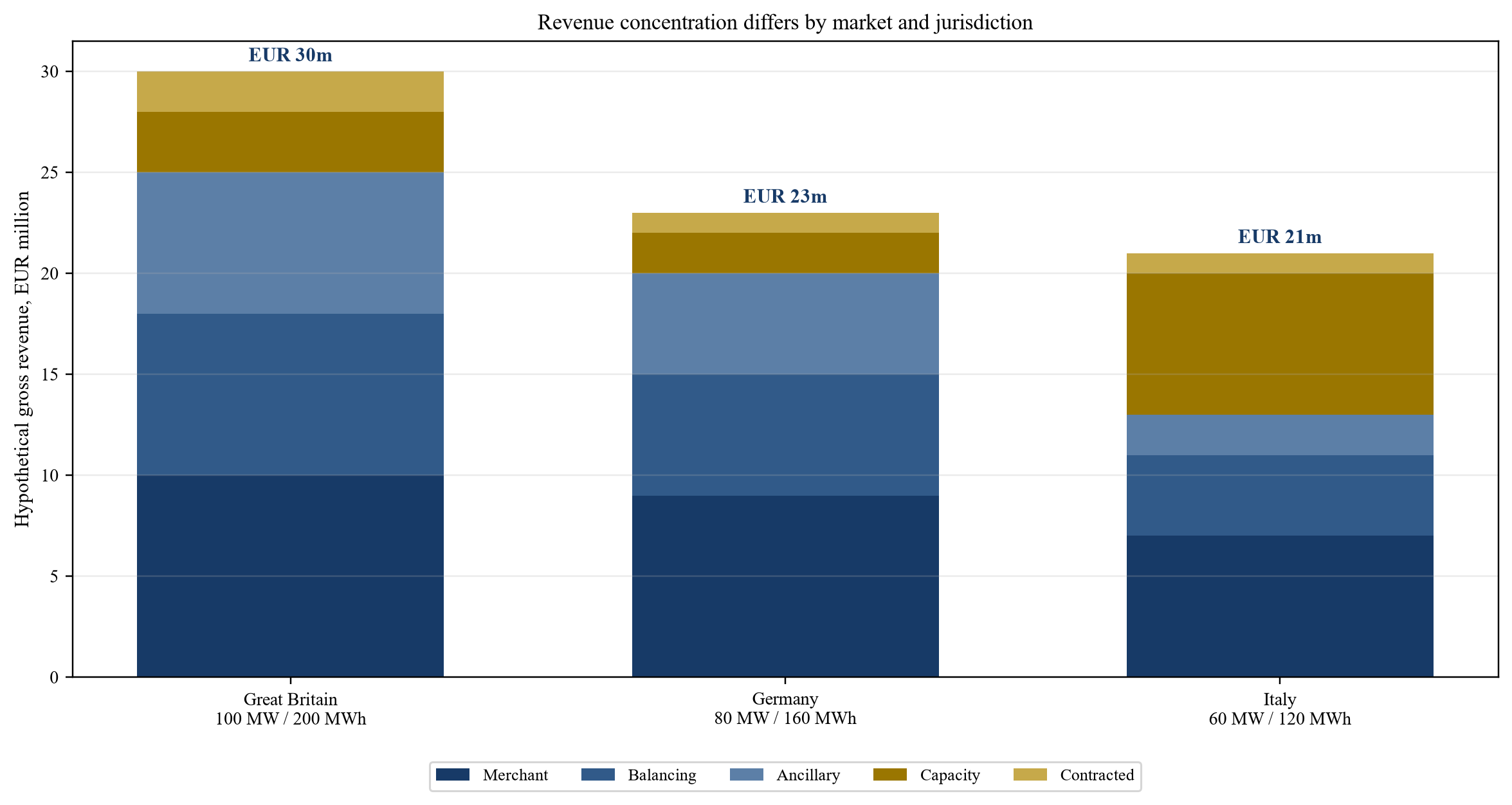
Hypothetical 2027 gross revenue for three illustrative assets. Values do not represent observed market outcomes or an investment forecast.
5. Build the forecast data lineage
The buyer should trace each forecast input to its source, timestamp, legal right, transformation and use. Typical inputs include day-ahead and intraday prices, balancing prices, accepted volumes, ancillary-service auctions, capacity payments, outages, constraints, weather, renewable output, demand, fuel prices, interconnector flows, asset telemetry and settlement data. Historical price data without contemporaneous availability and bid data can create false backtest results.
The lineage should distinguish information available when a decision was made from information learned later. Forecast features must use the publication time that an operator could actually observe. Weather revisions, final settlement data and corrected outage records can introduce hindsight. The buyer should recreate a decision-time dataset with immutable timestamps and documented adjustments.
Data rights matter at completion. Some feeds may belong to the seller, an optimiser vendor, a route-to-market provider or an exchange. The buyer needs the rights and credentials required to continue operations, reproduce historical results and meet audit obligations. A transfer of executable software without its training data, feature store and licence terms leaves forecast capability incomplete.
6. Reproduce the historical dispatch record
Observed dispatch is the bridge between forecast claims and cash. The buyer should reconstruct bids, offers, awards, instructions, state of charge, meter volumes, imbalance, availability, settlement, fees and degradation for a representative period. The record should reconcile to audited or management accounts and explain manual overrides, outages and curtailment.
Great Britain's experience illustrates why accepted dispatch cannot be inferred from price alone. NESO has published work on battery skip rates, Open Balancing Platform changes and new limited-duration parameters [10-12]. Elexon began publishing Maximum Delivery Offer and Maximum Delivery Bid data in June 2026 after implementation of changes for limited-duration assets [13]. The buyer should test whether historical under-dispatch arose from system constraints, data limitations, unavailable state of charge, bid strategy or platform capability.
The record should keep market opportunity separate from realised execution. A high theoretical spread is irrelevant when the asset is unavailable or committed elsewhere. Conversely, a weak historical period may not represent future capability after a verified systems change. The acquisition case should identify the evidence for each adjustment.
7. Audit the optimisation objective
The optimiser's objective function determines what it values. It may maximise gross revenue, net revenue, contribution after degradation, cash flow, or a risk-adjusted measure. It may also include penalties for missed commitments, imbalance, cycling, warranty limits and liquidity. The buyer should obtain a mathematical description, code version and configuration for the forecast used in the sale process.
Gross-revenue maximisation can destroy value when small spreads consume scarce cycle life or conflict with contracted availability. An optimiser that ignores bid acceptance may repeatedly select theoretical actions that the system operator does not dispatch. An optimiser that forecasts each market independently may allocate the same capacity to several products. The objective must represent the legal and physical decision the operator can make.
The board does not need to review source code line by line. It needs evidence that the model objective matches the investment case, that constraints are complete and that material changes require approval. Model documentation should state the decision horizon, solver, forecast inputs, uncertainty treatment, fallback mode and human intervention rights.
8. Test forecasts out of sample
The buyer should freeze the model at historical dates and test subsequent periods without retraining on future outcomes. Results should cover revenue, price, volume, dispatch acceptance, state of charge, losses and degradation. A single annual error metric is insufficient because a model can match total revenue while missing the timing and market source that determine liquidity and debt service.
The test should compare the seller model with simple benchmarks. Useful comparators include persistence, seasonal averages, a transparent spread rule and a no-optimisation operating schedule. Incremental model value is the performance above the benchmark after transaction costs and wear. The buyer should also test periods of price spikes, negative prices, market-rule changes and outages.
Forecast uncertainty belongs in valuation. Prediction intervals should widen when market conditions move beyond the training sample. The model should report calibration, not only point accuracy. When realised outcomes repeatedly fall outside the forecast range, the buyer should revise the distribution or reduce reliance on the result.
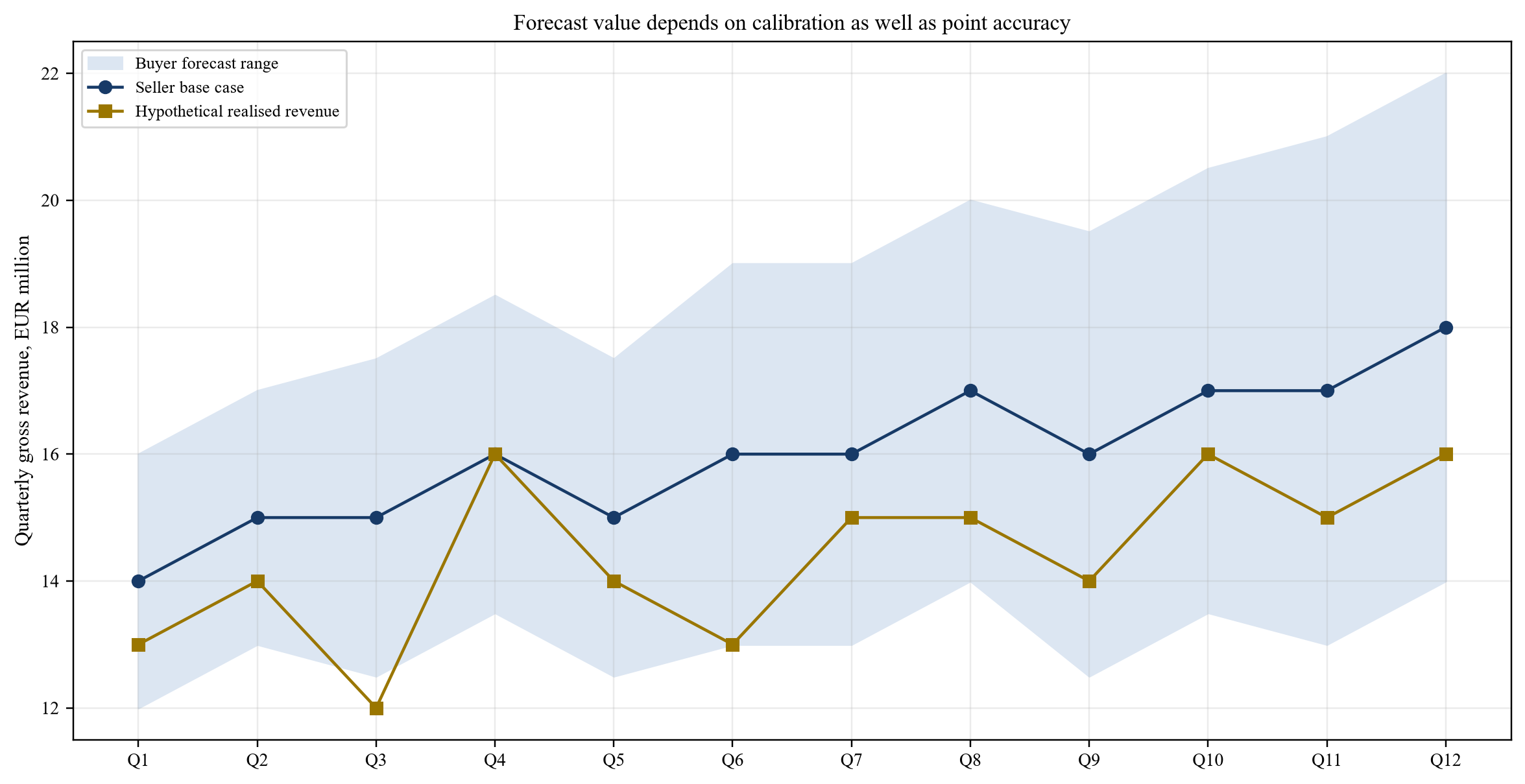
Hypothetical values for the illustrative portfolio. The bands demonstrate forecast calibration and are not observed performance.
9. Separate market beta from optimisation alpha
Seller materials may describe all outperformance as proprietary optimisation. The buyer should decompose results into market conditions, asset characteristics, contractual position and model contribution. Market beta includes price volatility, negative-price frequency, renewable penetration and system scarcity. Asset advantage includes location, duration, connection and availability. Contractual advantage includes route-to-market fees and product access. Model contribution is the residual improvement that remains after controlling for those factors.
The decomposition should use contemporaneous benchmarks and paired tests where possible. If two similar assets faced the same market, the buyer can compare their dispatch after adjusting for constraints and availability. If the model changed during the period, the buyer can test performance before and after with a defined control. The analysis should avoid attributing a favourable market regime to the algorithm.
The EUR 9 million optimiser uplift in the hypothetical case is a seller assumption. The buyer accepts no uplift until the model can be reproduced and benchmarked. Verified value may support price or an earn-out. Unverified value belongs in the risk adjustment rather than in base EBITDA.
10. Model revenue conflicts and opportunity cost
Revenue stacking is a constrained allocation problem. Reserving power and energy for one service reduces what remains for other services. The model should represent product windows, response duration, recharge, minimum state of charge, activation risk and penalties. It should calculate the opportunity cost of each commitment under the information available at the time.
The buyer should identify priority rules. A capacity obligation may take precedence during scarcity. A frequency product may require symmetric headroom. Merchant charging can make a later discharge unavailable. A network service can restrict location and timing. The operating policy should explain when the optimiser can depart from the forecast and who approves overrides.
The diligence team should run collision tests. Each test should attempt to schedule the same megawatt, megawatt-hour or state-of-charge reserve twice. The model should reject infeasible combinations and preserve an audit log. A spreadsheet that adds independent revenue forecasts without a joint constraint layer should not be used for valuation.
| Revenue stream | Forecast driver | Evidence required | Main interaction risk |
|---|---|---|---|
| Merchant arbitrage | Price spread, losses, liquidity and imbalance | Decision-time prices, orders, fills and meter data | Cycle use and conflict with reserved capacity |
| Balancing energy | Bid price, acceptance, system need and dispatch | Submitted bids, acceptances, instructions and settlement | Skip risk, state of charge and location |
| Ancillary service | Auction price, availability and response quality | Prequalification, awards, telemetry and performance | Symmetric headroom and non-delivery penalty |
| Capacity mechanism | Accredited capacity and stress availability | Contract, de-rating, tests, penalties and dispatch | Restricted operation before and during stress |
| Toll or floor | Counterparty formula and availability | Executed contract, credit support and settlement | Basis, termination and operating-control limits |
Original framework. Products and rules differ by country and change over time.
11. Price market redesign explicitly
European power-market rules are changing. Regulation 2024/1747 requires national flexibility assessments and allows support schemes for non-fossil flexibility under stated design principles [2]. ACER's 2025 methodology guides national assessments, with national reports due under the implementation timetable [18,19]. These measures may create new capacity-like revenues while also attracting new supply.
The buyer should model rule changes as scenarios rather than a single policy uplift. A support scheme can increase stable revenue and reduce merchant exposure. Competitive procurement can also clear below expectations. Terna's first MACSE auction awarded 10 GWh for delivery from 2028, with bids exceeding demand by more than four times and a weighted average award price reported below the reserve premium [16,17]. That evidence shows both demand for storage and competitive price discovery.
The model should record the legal basis, consultation status, qualification requirements, auction date, delivery date and award evidence for each policy-linked assumption. Revenue before an award should remain conditional. The buyer should test a scenario in which the scheme is delayed, undersubscribed by the asset or clears at a lower price.
12. Evaluate merchant-price formation
Merchant value depends on the distribution of prices within the battery's operating horizon. Annual average prices do not establish arbitrage revenue. The forecast needs intraday spreads, negative-price events, scarcity, liquidity, gate closure, imbalance and the cost of charging. It should also represent cannibalisation as storage capacity increases and more participants pursue the same intervals.
ACER's 2025 monitoring finds continuing volatility and identifies flexibility investment as a central challenge [4]. The integrated market can reduce national price differences while congestion and local scarcity remain important. The buyer should distinguish system-wide price formation from location-specific access and constraints. Cross-zonal integration can change spreads without removing network limitations.
Merchant forecasts should be stress tested against lower volatility, faster renewable forecast improvement, more interconnection, additional storage and altered market timing. A durable case should not depend on every favourable condition persisting. The acquisition model should expose the revenue sensitivity to each assumption and preserve the correlation among them.
13. Treat ancillary-services saturation as a valuation risk
Ancillary markets can provide attractive early revenues because batteries respond quickly and accurately. Those products are finite. As qualified capacity grows, clearing prices can fall and procurement design can change. The buyer should forecast service volume, eligible competing supply, auction rules, response requirements and asset performance rather than extrapolate historical unit prices.
ENTSO-E monitoring provides information on balancing and ancillary-service design across Europe [5,6]. National system operators publish product and auction data at different levels of detail. The diligence team should obtain the target's submitted bids and awards and reconcile them to public results. A claim that the asset captured a premium should be tested against its technical performance and the market clearing process.
Revenue concentration matters. If the acquisition case relies on one ancillary product, the buyer should calculate the value under price compression, reduced procurement and altered response requirements. Diversification across products only reduces risk when access and operating constraints permit genuine substitution.
14. Underwrite capacity and flexibility payments
Capacity and flexibility payments can support debt because they may be more predictable than merchant spreads. Their quality depends on contract duration, accreditation, de-rating, availability tests, penalty design, indexation, termination and political or regulatory change. The buyer should model gross payment, expected penalty, compliance cost and operating restrictions.
ACER describes capacity mechanisms as temporary measures that remunerate availability for security of supply [20]. EU market reform requires Member States with capacity mechanisms to consider adaptations that promote non-fossil flexibility and also permits dedicated non-fossil flexibility support under conditions [2]. These rules create routes to revenue and impose design constraints intended to preserve market signals.
The buyer should avoid capitalising an indicative policy target as contracted revenue. A forecast payment should enter the base case only when the asset has an enforceable award and can meet the conditions. Earlier-stage opportunities belong in weighted scenarios with documented probabilities approved by the investment committee.
15. Charge degradation to the dispatch decision
Battery degradation is an economic cost even when accounting does not record it as an immediate expense. Calendar aging, equivalent cycles, depth of discharge, power rate, state of charge and temperature affect usable capacity and future replacement needs. The optimiser should charge a marginal wear cost to each dispatch decision and protect warranty and capacity obligations.
The buyer should reconcile the degradation model to cell chemistry, supplier warranty, commissioning tests, operating history and current state of health. A generic curve can misstate an asset that experienced unusual temperatures, deep cycles or prolonged high state of charge. The model should distinguish reversible calibration effects from permanent capacity loss and document uncertainty.
The hypothetical case records EUR 7 million of annual economic degradation cost. This amount is a management assumption, not observed expense. If the seller's EUR 38 million EBITDA excludes that wear, the buyer should show EBITDA and cash after an economic reserve. The reserve should update when operating strategy or warranty evidence changes.
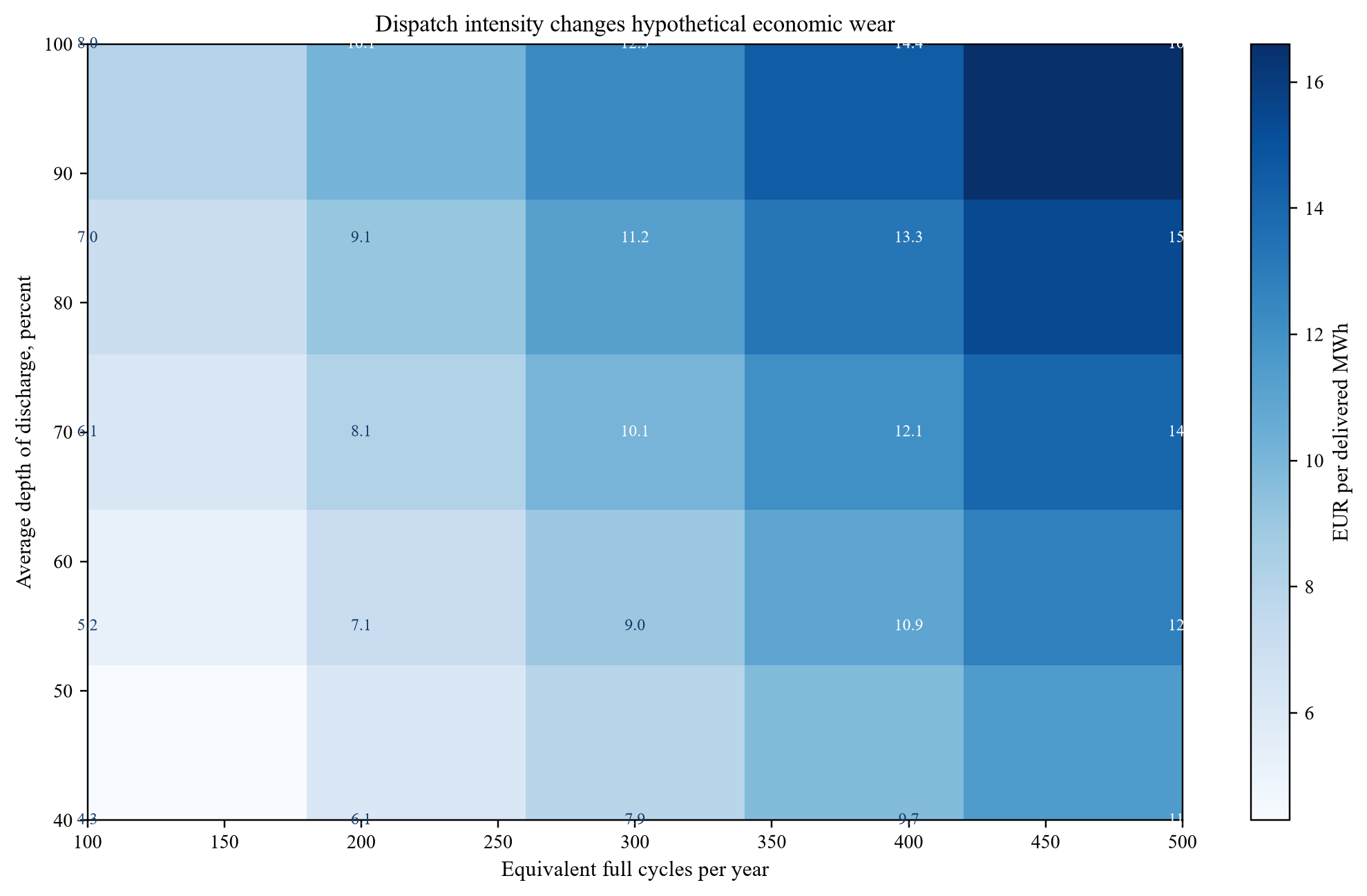
Hypothetical annualised economic wear in EUR per delivered MWh. The surface is illustrative and is not a battery engineering specification.
16. Inspect warranties and augmentation plans
The warranty sets technical conditions that may conflict with the forecast. It can limit throughput, cycles, depth of discharge, temperature, response profile and maintenance. It can also define testing procedures, exclusions, cure rights and the supplier's liability. The buyer should map each forecast operating mode to warranty headroom.
Augmentation can restore usable capacity by adding or replacing cells, modules or associated equipment. The acquisition model should state timing, cost, downtime, procurement lead time, compatibility and residual warranty. A plan that assumes future equipment at an unsupported price shifts technology and supply-chain risk to the buyer.
The EU Batteries Regulation establishes lifecycle, information and due-diligence requirements, with later amendments affecting timing for specified obligations [22,23]. Transaction diligence should identify the entity responsible for compliance, the documentation that transfers and the treatment of repurposed or replaced batteries. Legal and technical advisers should confirm the rules applicable to the asset and supply chain.
17. Value the algorithm as a transferable capability
The optimiser may be owned by the target, licensed from a vendor or supplied through a route-to-market agreement. The buyer should identify source-code ownership, licence scope, models, training data, feature engineering, interfaces, cloud resources, deployment tooling, monitoring, documentation and key people. The transaction must transfer enough capability to operate and improve the system.
A black-box vendor arrangement can still support value when the contract provides service levels, audit rights, data access, change control, cyber obligations, continuity and exit assistance. The risk increases when the vendor can change fees, withhold historical data or terminate after a change of control. The buyer should price replacement time and performance uncertainty.
The value of the algorithm should follow reproducible net cash improvement and durability. Development cost, marketing claims and model complexity are weak substitutes. The buyer should also identify whether performance depends on proprietary access held by the seller's wider group. Those dependencies may require transfer, licence, transition service or a reduction in price.
18. Apply model-risk controls
The model inventory should contain purpose, owner, version, data, features, parameters, validation, limitations, approval, deployment date and monitoring thresholds. Material forecasts should have independent review. Changes that affect bidding, state of charge, degradation or contracted performance should require testing and documented approval.
The validation plan should include data leakage, feature stability, outliers, missing data, regime change, calibration, benchmark performance, sensitivity and fallback. It should test whether the model behaves safely when data feeds fail or prices move outside the training range. Monitoring should compare forecast, decision, dispatch and settlement so that drift can be traced to market, data, model or execution.
Human accountability remains necessary. A trader or operator should understand the model's intended use and override conditions. Overrides should be logged with reason and outcome. A model can support decisions without becoming the unreviewed authority for acquisition value or critical operation.
| Test | Evidence | Failure signal | Buyer response |
|---|---|---|---|
| Decision-time replay | Frozen code, timestamped inputs and historical orders | Future data or revised settlement enters the test | Rebuild the dataset and reject contaminated results |
| Benchmark comparison | Transparent rules and matched operating constraints | Complex model fails to beat a simple benchmark | Remove claimed optimiser uplift |
| Constraint audit | State of charge, duration, connection, warranty and commitments | Same capacity is allocated twice | Rebuild schedule and revenue stack |
| Drift monitoring | Forecast, bid, dispatch and settlement by period | Error rises outside approved tolerance | Recalibrate, limit use or change controls |
| Failure mode | Missing feed, extreme price and vendor outage tests | Unsafe bid or uncontrolled position | Implement fallback and operating limit |
| Transferability | Rights, people, code, data and deployment evidence | Capability depends on seller or non-transferable vendor | TSA, licence, replacement cost or price adjustment |
Original framework. Tests should be performed on the actual production model and decision-time data.
19. Address automated-trading obligations
An optimiser that determines timing, price or quantity of orders with limited human intervention may fall within the relevant definition of algorithmic trading under amended REMIT rules. Regulation 2024/1106 adds provisions on algorithmic trading, risk controls, testing and information that national regulators may request [24]. Counsel should determine the application to the actual operating model and markets.
The buyer should inspect registrations, policies, testing, limits, monitoring, incident logs, order records and market-conduct controls. The system should prevent erroneous orders, uncontrolled positions and behaviour that could create false or misleading signals. Model performance does not excuse weak conduct controls.
Transaction documents should allocate pre-completion breaches, investigations and remediation. The buyer should also confirm that compliance records and order history can transfer. A vendor-operated algorithm does not remove the market participant's accountability.
20. Integrate cyber and operational resilience
Storage operations depend on telemetry, control systems, cloud services, trading interfaces and remote access. A cyber incident can affect dispatch, safety, settlement and market conduct. The buyer should map the architecture, privileged access, software supply chain, network segmentation, incident response, recovery and vendor connectivity.
NIS2 establishes a common European cybersecurity framework and identifies energy as a critical sector [25]. The AI Act may apply to specified high-risk uses, including certain safety components used in critical infrastructure [26]. Legal classification depends on intended purpose and the system's role. The buyer should avoid treating every forecast model as high risk while still testing safety and compliance where automated systems influence critical operation.
Completion planning should remove seller access, rotate credentials, preserve logs and prove recovery. An optimisation engine should fail into a controlled operating mode when a data or service dependency is unavailable. The acquisition model should include the cost and downtime required to reach the target architecture.
21. Build a risk-adjusted valuation bridge
The valuation should begin with seller enterprise value and reconcile to buyer value through specific evidence. Adjustments can address forecast rebasing, degradation, missing capex, market-access conditions, software transfer, operating costs, tax, debt and transaction risk. Each adjustment needs an owner, amount, trigger and release condition.
In the hypothetical case, the seller asks for EUR 310 million. The buyer applies a EUR 42 million risk adjustment before remediation. The adjustment is not a probability-weighted market fact. It is an illustrative control that holds value against unverified optimiser uplift, revenue overlap, degradation uncertainty and transfer dependencies. Evidence can release EUR 28 million. The remaining amount reflects risks that continue after diligence.
The bridge should avoid double counting. A lower revenue forecast may already capture some market saturation, while a separate multiple reduction may capture it again. Degradation can appear in EBITDA, replacement capex or the discount rate. The buyer should choose one primary location for each risk and reconcile secondary effects.
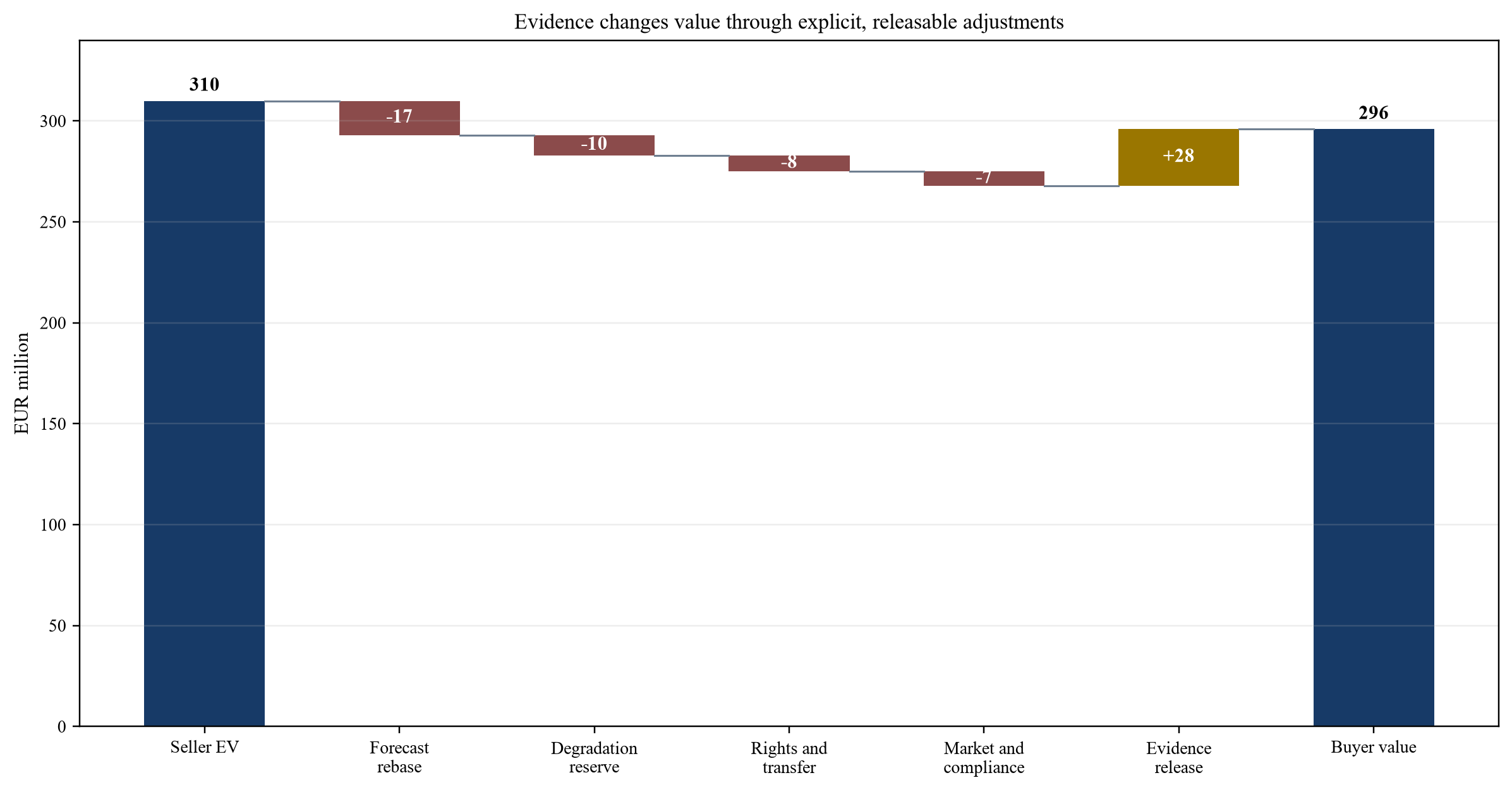
Hypothetical management assumptions in EUR million. The bridge does not represent an actual transaction or valuation opinion.
| Adjustment | Initial holdback | Evidence required for release | Residual treatment |
|---|---|---|---|
| Forecast rebase | 17 | Product-level forward case reconciled to decision-time data and observable market rules | Retain any unsupported revenue uplift |
| Degradation reserve | 10 | Independent state-of-health review, duty-cycle reconstruction and augmentation plan | Retain lifecycle cost not reflected in operating cash flow |
| Rights and transfer | 8 | Executable software, data, licences, audit rights and tested fallback transferred at completion | Retain replacement cost and transition risk |
| Market and compliance | 7 | Registrations, route-to-market agreements, conduct controls and cyber remediation verified | Retain unresolved eligibility, penalty and control exposure |
| Evidence release | (28) | Defined tests completed and approved by accountable transaction owners | Release only the portion supported by reproducible evidence |
All amounts are illustrative management assumptions in EUR million and do not represent an actual transaction or valuation opinion.
22. Design price protection and earn-outs
An earn-out can bridge disagreement when its metric is observable, controllable and auditable. Revenue alone may reward excessive cycling or favourable market beta. EBITDA may depend on cost allocation. A stronger metric can combine net revenue after market fees, imbalance, degradation reserve and availability penalties, with agreed treatment of rule changes and force majeure.
The transaction document should define data sources, model version, asset availability, operating policy, disputes, audit rights, payment caps and the effect of buyer decisions. The seller should not bear risks controlled entirely by the buyer after completion. The buyer should not pay for revenue created by additional capital that was outside the acquisition plan.
Warranties should address historical data, market registrations, compliance, intellectual-property rights, material model changes, cyber incidents, warranties and operating records. Specific indemnities may be appropriate for identified breaches. Legal advisers should draft the actual protections.
23. Test financing resilience
Lenders should size debt against cash that remains after operating cost, market fees, degradation reserve, maintenance, tax and required capex. Merchant and ancillary revenues may require lower leverage or stronger reserves than contracted capacity payments. The model should show debt service under correlated downside cases rather than independent haircuts.
The debt case should separate revenue availability from cash availability. A market operator may settle different products on different calendars. A route-to-market provider may retain collateral, net fees or correct invoices after the initial statement. Capacity revenue may be seasonal or subject to later performance adjustment. Augmentation, insurance and grid charges can create large cash outflows between debt-service dates. The model should therefore include settlement lags, collateral calls, reserve-account rules and minimum operating liquidity by month. Annual EBITDA cannot demonstrate that each payment date is funded.
The lender should trace every protected cash flow through the legal and banking structure. Market registrations, aggregation contracts and bank accounts may sit in different entities from the battery assets. An acquisition can change control, credit support or eligibility. The financing plan should identify the party that bids, receives settlement, pays the asset company and provides collateral. It should test whether cash can move to the borrower under the central case and during a dispute, default or insolvency of a service provider.
The buyer should test lower spreads, ancillary-price compression, delayed capacity awards, reduced availability, increased degradation and higher augmentation cost. It should also test collateral and liquidity needs during volatile markets. A battery can be economically solvent and still face a cash shortfall when settlement, margin and repair timing diverge.
Correlated stresses deserve explicit treatment. Low volatility can compress arbitrage while additional battery capacity weakens ancillary prices. A technical limitation can reduce availability at the same time that high prices increase collateral requirements. A cell-quality problem can require augmentation when lender headroom is already consumed. The model should combine these pathways and show the resulting cash available for debt service, reserve draws, covenant state and cure requirement. Management should explain which actions are operationally possible within the relevant period.
Financing documents can require minimum availability, state of health, reserve funding, hedging controls, information delivery and restrictions on material optimiser changes. These covenants should reflect the operating model. A covenant that uses seller EBITDA without an economic degradation charge provides weak protection.
Information undertakings should cover product-level revenue, dispatch, state of charge, cycling, availability, degradation indicators, forecast performance, model changes and exceptions. Trigger levels should connect to decisions: additional reserve funding, reduced distributions, independent engineering review, optimiser remediation or augmentation. A lender consent right over every software change can obstruct normal operation. A materiality framework can distinguish routine model maintenance from a change that alters risk, market conduct, asset duty or the evidence supporting the credit case.
24. Establish post-completion revenue assurance
The buyer should continue the diligence controls after completion. Monthly reporting should reconcile forecast, orders, dispatch, meter data, settlement, market fees, degradation and cash. Variances should identify market, asset, data, model and execution causes. The same evidence should support investment-committee reporting and lender compliance.
The operating team should maintain a product eligibility register, model inventory, data lineage, change log, cyber controls and warranty headroom. Material model releases should use controlled testing and rollback. Vendor performance should be measured against service levels and data-access obligations.
The first hundred days should prioritise access, control and reproducibility. The buyer should secure credentials, preserve historical data, validate state of health, retest market registrations, reproduce the acquisition forecast and establish a baseline. Value-capture initiatives should follow verified control of the assets and decision system.
25. Use a ninety-day diligence plan
During the first thirty days, create the asset and product register, obtain source data, freeze the sale model and reconcile historical cash. Identify market-access gaps, vendor dependencies, change-of-control clauses and key people. Establish a clean-room protocol for competitively sensitive information where required.
During days thirty-one to sixty, reproduce dispatch and settlement, run out-of-sample tests, audit constraints, validate state of health and rebuild the revenue stack. Complete the degradation and augmentation model. Map legal, regulatory, cyber and transaction approvals. Feed quantified findings into valuation and financing.
During days sixty-one to ninety, close critical evidence gaps, agree price protections, finalise transfer plans, test operational fallback and present the board with the value bridge and residual risks. The timetable is an illustrative management sequence. The actual process should follow transaction access, regulatory requirements and specialist advice.
26. Maintain an acquisition evidence register
The evidence register should contain market registrations, prequalification, route-to-market contracts, capacity awards, connection documents, asset tests, state-of-health reports, warranties, bids, dispatch, settlement, source data, feature definitions, code versions, backtests, validation, vendor contracts, cyber architecture, compliance records, forecasts, valuation models and financing cases.
Each item should record owner, source, date, version, period, asset, jurisdiction, access restriction, validation status and decision supported. A document should be complete only when an identified reviewer accepts it against a stated criterion. Material differences among operating, finance and model records should remain open until reconciled.
The register becomes the transaction audit trail and the baseline for post-completion revenue assurance. It should protect sensitive trading and operational information through proportionate access. The board should receive a concise exception report linked to the underlying evidence.
Sources
- European Commission, Electricity market design. Read the primary source
- European Union, Regulation (EU) 2024/1747 on improving the Union electricity market design. Read the primary source
- European Union, Directive (EU) 2019/944 on common rules for the internal market for electricity. Read the primary source
- ACER, Progress of EU electricity wholesale market integration, Monitoring Report 2025. Read the primary source
- ENTSO-E, Market Report 2025. Read the primary source
- ENTSO-E, Network Codes Monitoring Reports. Read the primary source
- International Energy Agency, Batteries and Secure Energy Transitions, Executive Summary, 2024. Read the primary source
- International Energy Agency, Batteries and Secure Energy Transitions, Policy implications and recommendations, 2024. Read the primary source
- European Commission, Key facts on energy storage. Read the primary source
- National Energy System Operator, Skip rates. Read the primary source
- National Energy System Operator, Positive progress on skip rates and next steps, 2026. Read the primary source
- National Energy System Operator, Skip rates open data portal. Read the primary source
- Elexon, New battery storage data available on Insights Solution, 2026. Read the primary source
- European Commission Joint Research Centre, A state-dependent experimental model of storage efficiency for optimized battery system operation, 2026. Read the primary source
- European Commission Joint Research Centre, RESIDE project report, 2026. Read the primary source
- Terna, Terna completes first MACSE auction, 2025. Read the primary source
- Terna, M for MACSE. Read the primary source
- ACER, Flexibility and the flexibility-needs assessment methodology. Read the primary source
- ACER, Decision 05-2025 on flexibility-needs data and methodology. Read the primary source
- ACER, Capacity mechanisms. Read the primary source
- European Commission, Recommendation on energy storage, 2023. Read the primary source
- European Union, Regulation (EU) 2023/1542 concerning batteries and waste batteries. Read the primary source
- European Union, Summary of Regulation (EU) 2023/1542 and amending Regulation (EU) 2025/1561. Read the primary source
- European Union, Regulation (EU) 2024/1106 on wholesale-energy market integrity and algorithmic trading. Read the primary source
- European Union, Directive (EU) 2022/2555 on cybersecurity across the Union. Read the primary source
- European Union, Regulation (EU) 2024/1689, Artificial Intelligence Act. Read the primary source
