

Introduction
Heat reuse changes the perimeter of a data-centre transaction. A conventional model treats cooling as a facility cost required to protect computing equipment. A district-energy project can convert part of the rejected heat into a contracted product, yet the conversion requires additional assets and counterparties. A valuation therefore needs a thermal schedule, an electricity schedule, a network schedule, an offtake contract and a clear allocation of capital and operating responsibility.
European policy now produces more consistent data. Delegated Regulation (EU) 2024/1364 requires measurement of reused heat at the data-centre boundary and measurement of average waste-heat temperature. Its energy reuse factor divides reused energy by total data-centre energy. The Energy Efficiency Directive and the Commission's interpretive recommendation require assessment of local heat demand, seasonal variation, technical feasibility, cost efficiency and connection to district heating or other recovery applications. These measures improve comparability while preserving the need for site-specific analysis. [1][2][3]
The central transaction question is who owns the cash flow. The data-centre operator may receive a heat payment, a cooling-service credit, a connection contribution or no direct revenue. The district-energy operator may own the heat pumps and pipes, bear electricity-price exposure, control dispatch and sell heat to end users. A municipality may influence planning, tariffs or concession terms. Public support can reduce capex while adding eligibility, performance and clawback conditions. Each item belongs in the model and purchase agreement.
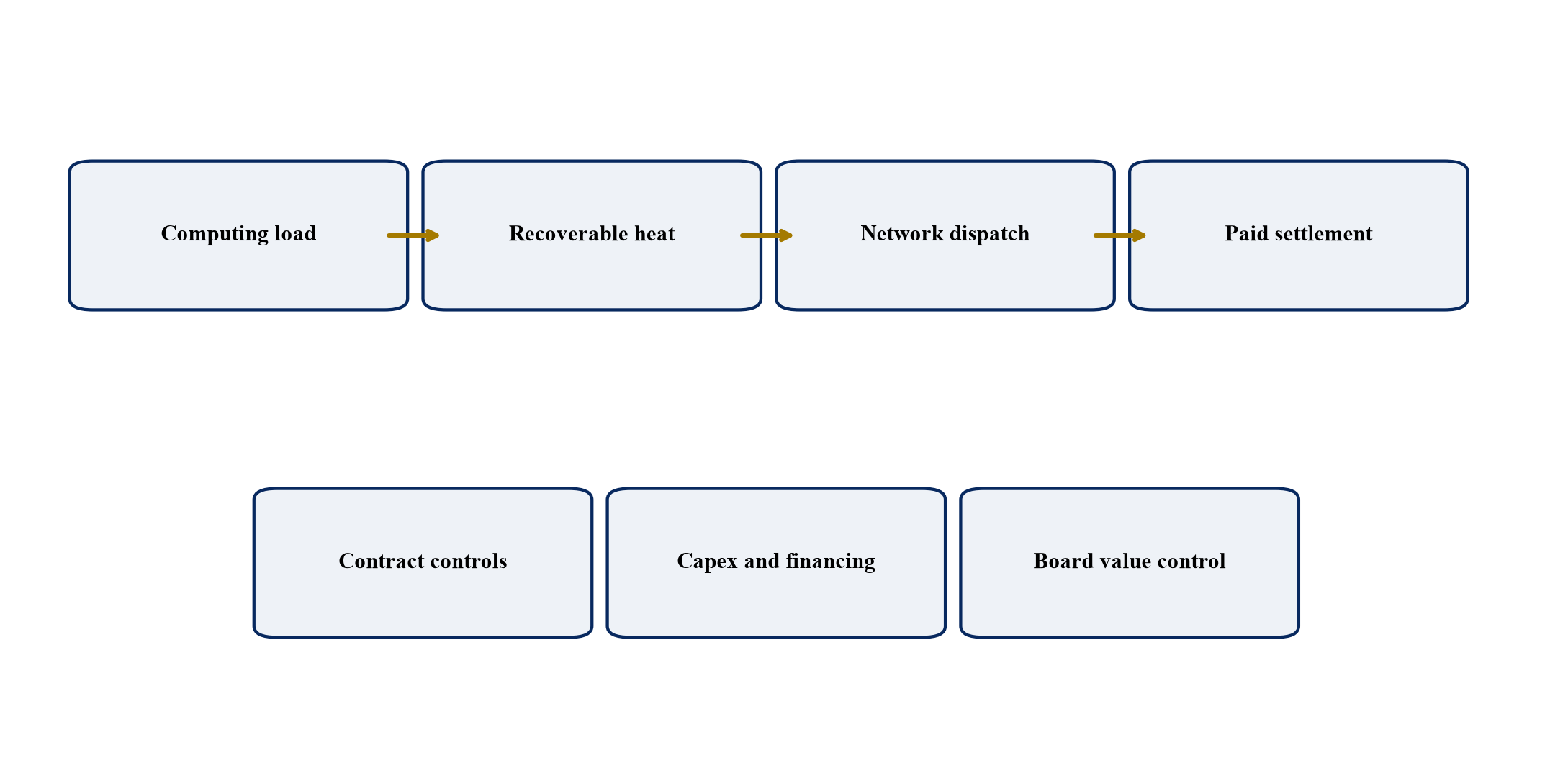
This framework is intended for an investment committee, strategic buyer, infrastructure investor or lender. It begins with the physical and legal perimeter, progresses through heat delivery and contract economics, and ends with valuation, financing and transaction protections. Public sources establish regulatory requirements and observed projects. Target-specific conclusions require metering data, engineering design, heat-pump performance, network studies, permits, contracts, capex evidence, tariffs, invoices, receipts and operating records.
1. Define the acquisition thesis and value perimeter
State whether the buyer seeks a data-centre operating platform, a heat-recovery development pipeline, contracted district-energy cash flow, land and grid rights, or an integrated energy-infrastructure position. Set the valuation date, legal perimeter, funding plan, return threshold, integration budget and downside tolerance. Identify which entity owns the data centre, connection assets, heat exchangers, heat pumps, storage, mains and offtake rights.
Build separate data-centre and heat-reuse cases. The data-centre case should stand on contracted computing or colocation economics. The heat-reuse case should show incremental capex, operating cost, revenue, savings, tax and financing. A combined case can recognise interaction benefits after the contract and engineering evidence establish who receives them. This separation prevents sustainability assumptions from obscuring the core facility valuation.
2. Map the physical heat path
Map heat from information-technology equipment through cooling loops, heat exchangers, heat pumps, storage, transmission mains and the district network. Record inlet and outlet temperatures, flow, pressure, redundancy, parasitic electricity, losses, maintenance and control points. Identify the delivery point at which ownership, measurement and operational responsibility transfer.
The Commission's reporting rule measures reused heat at the boundary where energy is handed off for use by another party. This boundary is a useful diligence anchor because it distinguishes heat produced in the data centre from heat accepted by the external system. The transaction model should carry both measures and the losses between them. [3]
3. Reconcile the legal and operating perimeter
Identify the entities that own the land, grid connection, data-centre equipment, heat plant, mains, permits, software, customer contracts and operating licences. Review easements, rights of way, leases, concessions, grants and intercompany arrangements. Confirm that change-of-control and assignment rights permit the acquisition and financing structure.
An operating map should show which party schedules heat, operates pumps, maintains meters, purchases electricity, provides backup, responds to outages and pays for network reinforcement. A legal map should reconcile those duties to contracts and insurance. Any duty without a capable and funded owner becomes a valuation and integration risk.
4. Apply the European regulatory screen
Directive (EU) 2023/1791 addresses data centres with total rated energy input exceeding 1 MW and requires Member States to ensure waste heat or other recovery applications are used unless technical or economic feasibility is not demonstrated. Installation-level cost-benefit analysis must consider local demand, seasonal variation, connection and alternative uses. National implementation, permitting and enforcement still require jurisdiction-specific legal advice. [1][2]
Delegated Regulation (EU) 2024/1364 creates a reporting framework for significant data centres, including reused heat, waste-heat temperature, power usage, water and renewable energy. The European Commission is also developing a broader energy-efficiency package and rating scheme. A buyer should confirm reporting scope, prior submissions, measurement controls and consistency between sustainability claims and regulatory records. [3][4][5]
5. Translate reporting metrics into transaction evidence
Energy reuse factor indicates how much total data-centre energy is reused outside the boundary. It does not by itself prove profitability, availability or customer payment. Reconcile annual reported figures to interval meters, heat invoices, settlement statements and maintenance logs. Test whether the metric includes only eligible off-site reuse and whether any internal cooling energy has been deducted as required.
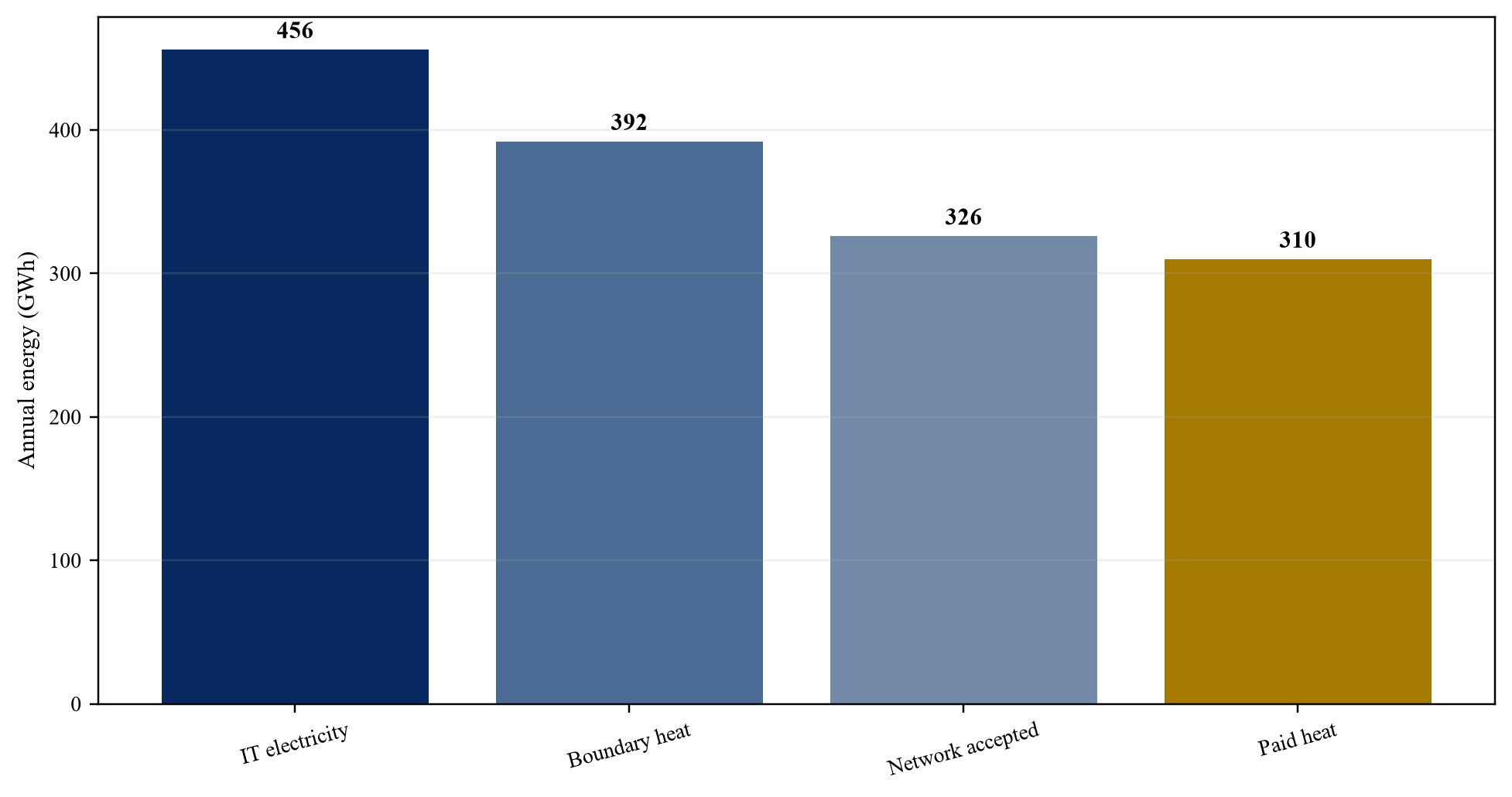
Create a monthly bridge from information-technology electricity to rejected heat, boundary heat, heat-pump input, network delivery, billed volume and collected cash. Record temperature and flow alongside energy. This reveals whether a higher reuse factor reflects sustainable delivery or a limited period with favourable load and weather.
6. Establish the hourly computing-load profile
Heat availability follows computing load, not installed megawatts. Obtain interval data for information-technology power, total facility power, cooling systems and heat delivery. Separate commissioned capacity from occupied capacity and contracted capacity. Test ramp schedules for new halls and customer-specific load volatility.
Model central, delayed-ramp and customer-loss cases. A data centre can have a high design load and a low average load during lease-up. A heat utility may invest ahead of computing demand and carry stranded or underused assets. The offtake model should therefore rely on measured load and contracted ramp rather than nameplate capacity alone.
7. Convert electrical load into recoverable heat
Nearly all electrical energy consumed by computing becomes heat, while the fraction recoverable at a useful boundary depends on cooling architecture, temperatures and operating design. The IEA states that around 70 to 80 per cent can be recoverable using heat pumps. Use this as sector context and determine the target's actual fraction from engineering and meter evidence. [6]
Build a loss bridge covering server-to-loop capture, heat-exchanger loss, pump electricity, heat-pump coefficient of performance, storage loss and network loss. Record temperature as well as energy because low-temperature heat can require more heat-pump electricity. A recoverable megawatt at the rack does not equal a delivered megawatt at the network boundary.
8. Test temperature compatibility
Compare the data-centre source temperature with the district network's supply and return temperatures in each season. Review whether direct use is possible or whether a heat pump must upgrade the temperature. Assess how liquid cooling, warmer-water operation and low-temperature networks change the conversion efficiency.
The IEA notes that heat pumps can use sources below 45 degrees Celsius and that lower-temperature networks facilitate integration. Existing networks may require higher supply temperatures during cold periods. Model coefficient of performance by source temperature, network temperature and ambient conditions rather than using one annual average. [7][8][9]
9. Model seasonal demand and curtailment
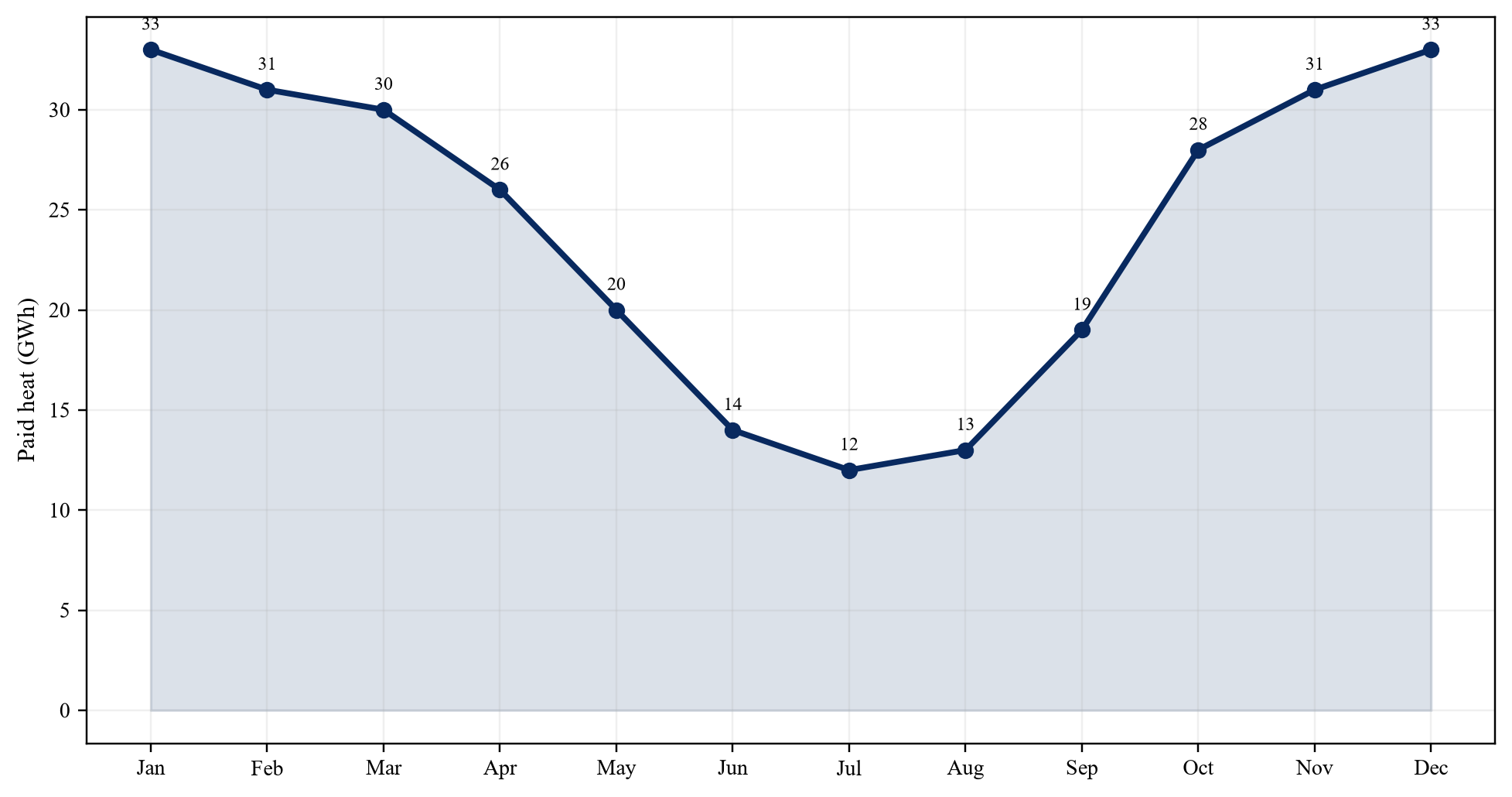
Data-centre heat is comparatively steady while building heat demand is seasonal. Obtain hourly or daily network load, competing generation merit order, return temperature, storage capacity and minimum operating constraints. Determine how much heat the network can accept in summer and shoulder periods.
Distinguish available heat, nominated heat, accepted heat and paid heat. If the utility may curtail without payment, the data centre retains cooling responsibility and receives no revenue for rejected volume. A take-or-pay floor, availability payment or capacity charge can reduce this mismatch, subject to performance and credit terms.
10. Assess network proximity and connection capex
Measure the route from the data centre to the useful network node. Review pipe diameter, road and rail crossings, land access, easements, planning consent, construction interface and reinforcement. Separate data-centre interface capex from utility plant and network capex. Include owner engineering, contingency, commissioning and financing cost.
Fortum disclosed approximately EUR 225 million of investment in Espoo and Kirkkonummi waste-heat projects, including heat-pump plants and around 15 kilometres of new or upgraded district-heating mains. This illustrates the infrastructure scale that can sit outside the data-centre boundary. Target-specific economics require the actual route and scope. [15]
11. Allocate heat-pump electricity exposure
The heat pump consumes electricity to raise the source temperature. Contract terms should identify the purchasing party, tariff, network charges, taxes, guarantees of origin, hedging rights and pass-through mechanism. Model coefficient of performance and electricity price together because their interaction can dominate margin.
The IEA's 2026 district-energy work identifies electricity price structures and waste-heat valuation frameworks as material to project economics. Test fixed, indexed, pass-through and collar arrangements. If the utility owns the heat pump, confirm whether the heat price embeds electricity costs or allows reopening when power prices move. [7][24]
12. Read the offtake contract as a dispatch instrument
Extract contract term, start date, delivery point, temperature band, pressure, metering, nomination, minimum volume, maximum volume, availability, curtailment, outage, maintenance, quality, backup and force-majeure provisions. Convert each provision into an operating assumption and cash-flow rule.
Review whether the buyer acquires a firm heat-sale contract, a cooperation agreement, a development memorandum or a non-binding intention. Potential contracts under negotiation are commercially relevant but require different accounting and valuation treatment from executed rights. Link every forecast year to the contract and remaining term.
13. Decompose the heat price
Separate energy price, capacity payment, availability payment, avoided-cooling credit, connection contribution, indexation, environmental attribute and balancing payment. Identify taxes, network fees and deductions. Compare the settlement formula with the utility's alternative heat-production cost and the data centre's alternative cooling cost.
Stockholm Exergi publishes a model under which qualifying suppliers can be paid for excess heat delivered into the network. This demonstrates an observable market mechanism while leaving price, temperature, location and contract terms specific to the network. A buyer should avoid transferring one network's payment model to another jurisdiction without evidence. [13][21]
14. Test indexation and reopeners
Heat contracts can reference consumer prices, electricity, gas, biomass, carbon costs or regulated tariffs. Map each index, lag, floor, cap and reset. Test whether the price follows the data centre's cost base and whether extraordinary electricity or regulatory changes trigger renegotiation.
Model basis risk between the contract price and the electricity actually consumed by heat pumps. Review termination or hardship rights tied to adverse economics. A long contract with asymmetric reopener rights may create less value than a shorter contract with transparent and balanced indexation.
15. Assess credit and concentration
Evaluate the district-energy counterparty, concession, customer base, regulation, financial statements and public support. Determine whether obligations sit with an operating company, municipality, special-purpose vehicle or parent-guaranteed entity. Review security, collateral, step-in rights and payment history.
Heat-reuse value may depend on one network and one delivery point. Model counterparty default, licence loss and tariff intervention. Identify alternative uses such as adjacent industry, greenhouses, commercial buildings or on-site processes; recognise them only when technical connection and commercial demand are evidenced.
16. Test operational availability and outage allocation
Reconcile data-centre uptime commitments with heat-delivery commitments. Planned computing maintenance, cooling maintenance and heat-plant maintenance can affect different parts of the system. Define notice, coordination, permitted outage hours, liquidated damages and backup obligations.
Fortum reported in May 2026 that its large heat-pump plants at two Finnish sites had started heat production using ambient air and electric boilers, with data-centre heat to be integrated in phases as data-centre construction and commissioning progressed. This sequencing illustrates why backup and staged commissioning belong in valuation. [16]
17. Verify metering, settlement and data rights
Inspect meter class, calibration, redundancy, timestamps, cybersecurity, ownership and audit rights. Recalculate settlement for selected months from raw readings through invoices and receipts. Test how missing or disputed data are resolved.
Secure access to operating data after change of control. District-energy optimisation can require forecasts of computing load, heat availability and network demand. Contractual limits on data use or interfaces can constrain integration and financing. Align disclosure with data-centre security and customer confidentiality requirements.
18. Reconcile sustainability claims to measured displacement
Heat reuse can displace fossil or other heat production, yet the avoided emissions depend on the network's marginal and counterfactual supply. Record the method, boundary, emission factors and treatment of heat-pump electricity. Separate project emissions, contractual claims and municipal climate reporting.
The JRC advises that off-site waste heat contributes only when it is genuinely residual and meets applicable accounting conditions. Fortum and Espoo have published expected emissions and heat-demand effects for their project; these are project statements, not default factors for another asset. [12][14][17]
19. Treat public support as a conditional asset
Inventory grants, tax support, concessional finance and public infrastructure contributions. Review eligibility, milestones, reporting, operating period, change-of-control consent, state-aid conditions and clawback. Reconcile recognised grant income and deferred balances to cash receipts and obligations.
Value only support that is legally available and expected to be retained. Any breach or change-of-control exposure belongs in the enterprise-to-equity bridge or transaction protection. Future support applications belong in an upside case until approved.
20. Build the integrated project model
The model should connect information-technology load, recoverable heat, temperature, coefficient of performance, heat-pump electricity, network acceptance, heat price, cooling savings, operating cost, capex, working capital, tax and financing. Use monthly or hourly detail where seasonality and electricity prices are material.
Separate data-centre operating cash flow from heat-reuse cash flow. Show cash received by each legal entity and eliminate intercompany items. Include development, outage and commissioning periods. Run sensitivities on load factor, recoverable fraction, accepted volume, coefficient of performance, electricity price, heat price, capex and start date.
21. Apply the hypothetical central case
The hypothetical asset has 80 MW of installed information-technology capacity and a 65 per cent average load factor. Engineering evidence supports an 86 per cent recoverable share at the facility boundary. Network demand, temperature and contract tests support 310 GWh of annual paid delivery in the central year.
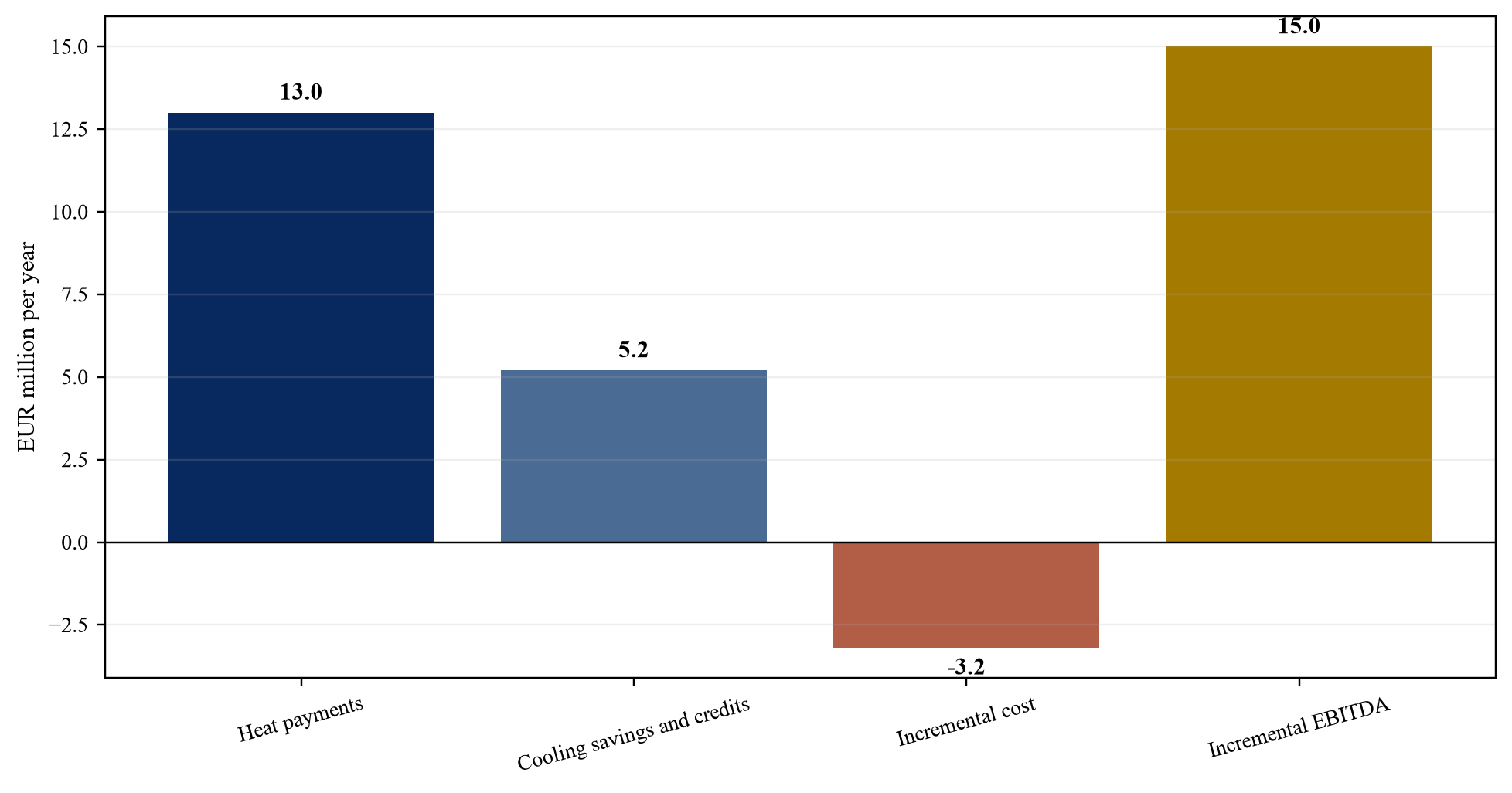
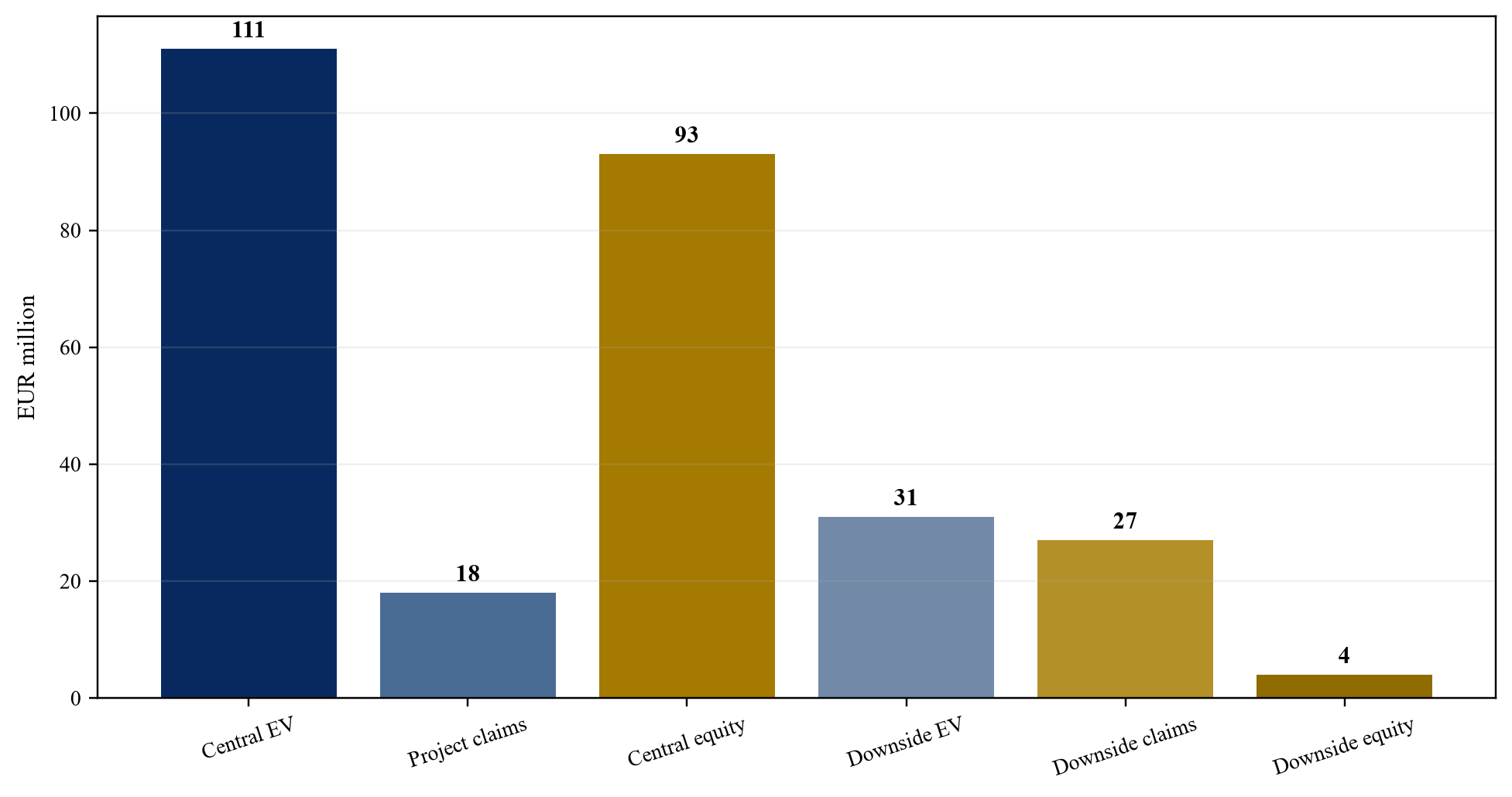
The data-centre owner funds EUR 36 million of interface capex. The utility funds the heat-pump plant, storage and mains. Heat revenue, avoided cooling cost and contract credits produce EUR 18.2 million of annual benefit; incremental operations, maintenance and retained energy costs total EUR 3.2 million. Incremental EBITDA is EUR 15.0 million. Discounted cash flow supports EUR 111 million of incremental enterprise value.
22. Run the combined downside
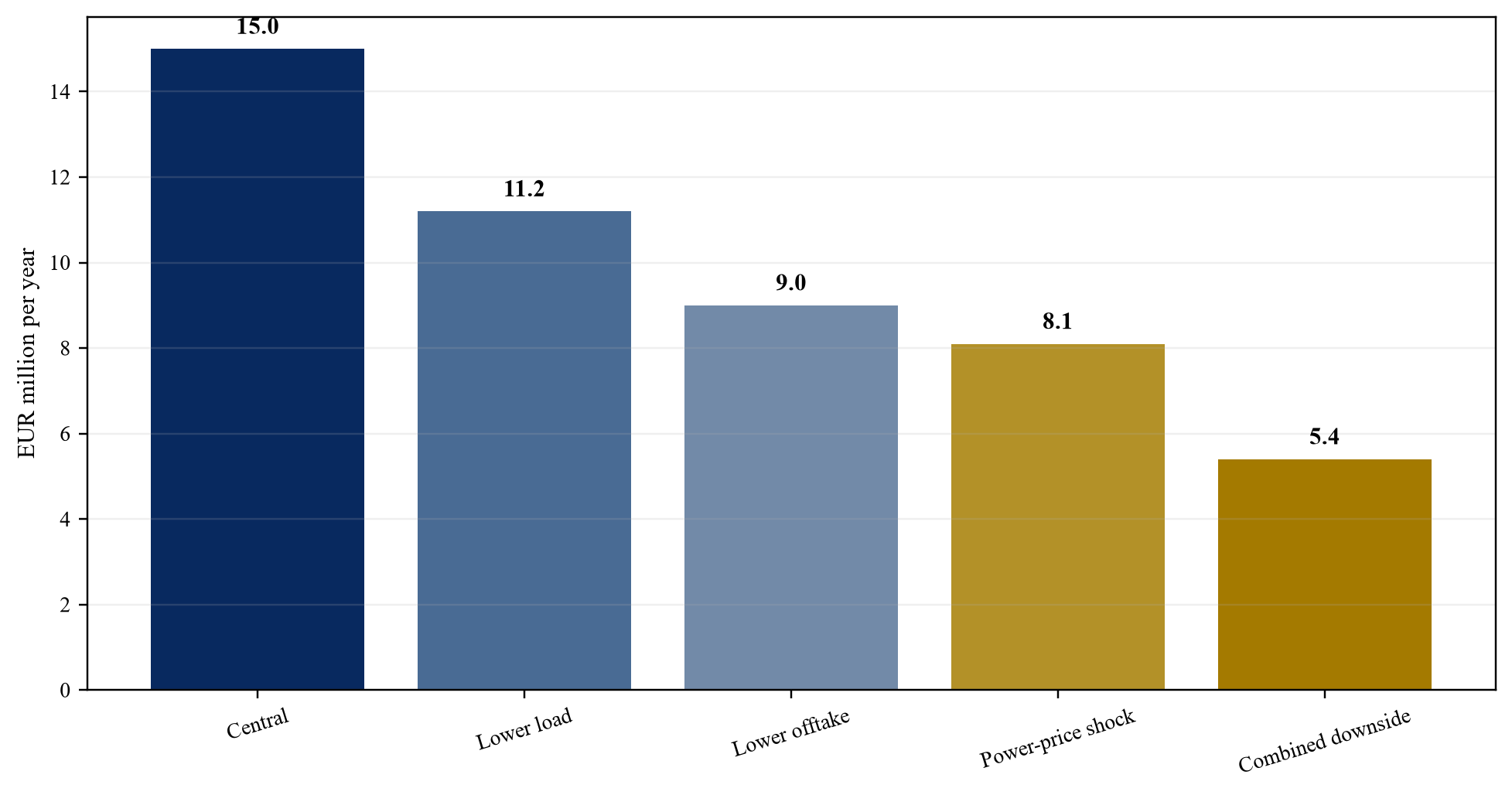
The downside combines a slower computing ramp, 48 per cent average information-technology load, lower recoverable temperature, 180 GWh of paid annual offtake, lower heat price, higher retained energy cost, six-quarter commissioning delay and 22 per cent capex overrun. Annual incremental EBITDA falls to EUR 5.4 million.
The downside incremental enterprise value is EUR 31 million. Additional interface capex and delay claims reduce the equity contribution further. The buyer should test whether core data-centre debt covenants remain compliant without heat revenue and whether project debt has completion support, reserve funding and long-stop protections.
23. Triangulate incremental enterprise value
Use discounted cash flow as the primary method where contracts and infrastructure are specific. Cross-check against replacement cost, avoided alternative cooling or heat-production cost, and observable infrastructure yields after aligning contract term, counterparty, inflation, capex and residual value. Do not apply a data-centre EBITDA multiple to regulated or infrastructure-like heat cash flows without adjustment.
The value of a long-dated heat offtake can appear partly in land, permits, customer relationships, contract-based intangibles, plant, network assets or goodwill depending on ownership and accounting. Reconcile the transaction price to the rights and obligations actually acquired.
24. Apply IFRS acquisition-accounting discipline
IFRS 3 requires identifiable acquired assets and assumed liabilities to be measured at acquisition-date fair value. IFRS 13 uses market-participant assumptions and current market conditions. Assess whether offtake contracts, customer relationships, permits, grants, software and favourable or unfavourable terms are separately identifiable. [25][26]
Avoid double counting the same cash flow in the data-centre customer relationship, heat offtake, property and goodwill. Document contributory assets and contract term. Apply IAS 36 impairment analysis to the relevant cash-generating units after acquisition and monitor whether delayed load, network changes or contract termination reduce recoverable amount. [27]
25. Build the enterprise-to-equity bridge
Deduct debt, leases, unpaid capex, grant clawback exposure, decommissioning obligations, customer prepayments requiring performance, tax, litigation, transaction expenses and contingent project claims. Add only unrestricted cash available to the acquired perimeter. Address heat-project working capital and reserve accounts consistently with the purchase agreement.
In the hypothetical central case, EUR 111 million of incremental enterprise value is supported by the heat project. EUR 18 million of incremental project claims and remaining interface capex produce EUR 93 million of incremental equity value. In the downside, EUR 31 million of enterprise value and EUR 27 million of adjusted claims leave EUR 4 million of incremental equity value.
26. Assess financing capacity
Lenders may credit contracted heat revenue according to counterparty, tenor, volume protection, price formula, completion status and operational history. Build debt-service coverage under central and downside cases. Include construction draw, interest during construction, reserve funding, amortisation, covenant definitions and distribution lock-up.
Separate project finance from data-centre corporate debt. Determine whether lenders have security over the offtake, meters, interface equipment, accounts and step-in rights. Avoid assuming that a heat contract improves debt capacity before completion tests and assignment consents are satisfied.
27. Apply merger-control and foreign-subsidy screens
Assess EU and national merger-control thresholds, jurisdiction, standstill and filing timetable with qualified counsel. The European Commission publishes turnover tests for transactions with an EU dimension and maintains national authority routes below those thresholds. Review local energy concessions and municipal consents separately. [28]
Data-centre and energy transactions can also involve public support and non-EU investors. Screen the Foreign Subsidies Regulation, foreign-investment regimes and public procurement where applicable. Regulatory analysis should follow the actual parties, financing and jurisdiction rather than a generic European assumption.
28. Convert diligence into transaction protection
Use closing conditions for permits, assignment, financing, metering, network connection and material capex contracts. Use price adjustment, escrow, holdback, contingent consideration or indemnity for unresolved volume, delay, grant, tax or capex exposure. Define milestones by objective source evidence.
Useful milestones include first heat, completion test, seasonal performance, minimum paid GWh, coefficient-of-performance band, capex cap and retention of operating personnel. Avoid contingent consideration based only on available heat because the seller may have limited control over network dispatch or customer demand.
29. Establish post-closing value control
Create a monthly dashboard covering computing load, recoverable heat, source temperature, heat-pump electricity, accepted heat, billed heat, price, cash, curtailment, outages, capex, grant compliance and safety. Reconcile operating metrics to the contract and financial ledger.
Name owners for data-centre operations, utility interface, settlement, regulatory reporting and capital delivery. Preserve a clear escalation process for under-delivery, network constraints and disputed meters. Compare central and downside cases without rewriting the original assumptions.
30. Model the district-network merit order
Obtain the network's generation stack by season and hour. Record fuel, electricity, carbon, start cost, minimum output, ramp, reliability and contractual priority for each heat source. Determine where recovered data-centre heat sits in that order and which sources remain available for peak and backup demand. A low marginal heat cost can still yield limited data-centre dispatch if the network has inflexible combined heat and power, waste incineration, contractual minimums or transmission constraints.
Link curtailment to the actual merit-order rules. Test whether the contract pays for availability when cheaper or mandatory heat sources displace delivery. Review how new geothermal, biomass, electric boiler, nuclear or industrial waste-heat projects could change dispatch during the offtake term. A buyer should treat forecast market share as a network-planning assumption until the utility's approved plan and contract protect it.
31. Value thermal storage and flexibility
Thermal storage can shift heat from periods of high data-centre output or low electricity prices into periods of stronger network demand. Identify storage capacity, charge and discharge rate, temperature range, losses, ownership, control and cycling limits. Determine whether the data centre receives any share of balancing, capacity or electricity-market value.
Model storage dispatch jointly with heat-pump electricity and network demand. A storage asset can reduce curtailment and improve coefficient-of-performance operation, while adding capex, maintenance and degradation. Attribute value according to contractual rights. If the utility owns and optimises storage across several sources, the data-centre seller should not claim the full system benefit without a settlement mechanism.
32. Test competition from alternative heat sources
Map existing and planned waste incineration, biomass, geothermal, wastewater, industrial waste heat, electric boilers, combined heat and power, ambient heat pumps and thermal storage. Compare temperature, availability, marginal cost, carbon treatment, location and policy priority. District-energy networks often diversify sources, and a data centre may compete for dispatch and connection capacity.
Review utility procurement, municipal heat plans and disclosed capital programmes. Test whether the data-centre contract ranks ahead of future sources or permits rebalancing. Use scenario analysis for a lower-cost competing source entering before contract expiry. This risk affects accepted volume, price reopener probability and residual value even when the data centre itself performs as designed.
33. Verify planning, environmental and construction dependencies
Create a permit and consent register for the data centre, heat plant, transmission main, road works, water, noise, refrigerants, pressure systems and grid connection. Record application date, authority, conditions, appeals, expiry and transfer on change of control. Review construction access and interfaces with live data-centre operations.
Convert each dependency into schedule and cost. A main crossing a constrained urban route can determine the heat project's critical path. Conditions on noise, working hours, water or refrigerants can affect equipment design and operating cost. Use a long-stop date and funded contingency for unresolved permits; do not preserve the original revenue start date after critical-path evidence changes.
34. Build lifecycle and replacement capex
Separate initial connection capex from recurring replacement of compressors, pumps, heat exchangers, controls, meters, storage components and network equipment. Use equipment life, operating hours, maintenance history and supplier support. Include overhaul downtime and temporary cooling or heat supply.
The offtake term may exceed the useful life of material components. Model replacement responsibility and residual value by legal owner. A contract price that covers operating expenditure but excludes major replacement can create a negative later-life cash flow. Align the terminal value with remaining contract rights, asset condition, network need and decommissioning obligations rather than applying a perpetual growth rate to a finite infrastructure arrangement.
35. Separate stand-alone value from buyer synergies
Stand-alone value includes cash flows controlled by the target under existing rights and funded plans. Buyer synergies may include lower electricity procurement, shared operations, portfolio dispatch, better financing, tax efficiency, accelerated customer ramp or integration with another heat source. Record every synergy by owner, action, cost, timing, dependency and probability.
Avoid transferring buyer-specific financing or portfolio benefits into seller value without a negotiated sharing mechanism. Preserve a stand-alone case for price discipline and a combined case for the buyer's return analysis. Integration cost should include systems, metering, cybersecurity, contract management, reporting, people and operating procedures. Delayed or disrupted integration can affect both computing uptime and heat delivery.
36. Link purchase-price allocation to operating evidence
Potential identifiable items include property, plant, network connection rights, permits, customer or offtake relationships, favourable or unfavourable contracts, software, grants and deferred tax. Establish separability or contractual rights, expected life, attrition, contributory assets and market-participant assumptions. Reconcile the cash flows used for each asset to the transaction model.
A heat offtake can create a contract-based intangible when its terms are separately identifiable, while associated plant remains tangible infrastructure. A below-market obligation can create a liability. Accountants, valuation specialists, tax advisers and operating teams should use the same contract term, volume, price and capex evidence. This discipline reduces double counting and creates a clearer basis for later impairment testing.
37. Reconcile computing customers with heat commitments
Review whether colocation, cloud or enterprise customer agreements permit use and disclosure of operating data needed for heat forecasting. Identify customer rights over cooling architecture, environmental attributes, service changes, maintenance windows and sustainability reporting. A heat project should not create a constraint that weakens computing-service commitments or customer security.
Map customer lease and capacity ramp to the heat contract. If a major customer can delay deployment, reduce load or terminate, model the resulting heat shortfall and any offtake damages. Determine whether the data-centre operator has minimum-power commitments, reservation revenue or parent support that cushions this risk. Keep computing revenue and heat revenue separate while using one reconciled load forecast.
Review ownership of emissions reductions and environmental claims. A computing customer, data-centre operator, utility and municipality may each communicate benefits from the same project. The agreements should prevent double claims, define data access and preserve required regulatory reporting. Acquisition diligence should identify any promised environmental performance that could become a service credit, renewal issue or reputational exposure when heat delivery underperforms.
Appendix A. Heat-reuse cash-flow model
The model begins with interval information-technology load. It converts electricity to recoverable heat using a documented capture factor and temperature profile. It applies heat-exchanger losses, heat-pump coefficient of performance, pumping electricity, thermal storage and network loss. Network dispatch determines accepted volume; the contract then determines billed volume, price and deductions.
Operating cost includes retained electricity, maintenance, meter services, water, chemicals, insurance, network charges, labour and lifecycle replacement. Capex includes data-centre interface, heat exchanger, heat pumps, substations, storage, mains, roads, easements, design, owner cost, contingency and financing. Each asset has an owner, useful life and replacement schedule.
The data-centre case carries computing revenue and facility cost. The heat case carries only incremental cash flow. A reconciliation shows revenue, cooling savings and compliance value by recipient. The model therefore avoids assigning utility revenue or public emissions benefit to the data-centre shareholder without a contractual mechanism.
Appendix B. Minimum confirmatory evidence
The technical room should include interval electricity and heat data, temperatures, flows, design drawings, hydraulic model, equipment specifications, heat-pump performance maps, storage design, commissioning tests, meter certificates, outage records and maintenance history. The network room should include demand curves, supply and return temperatures, merit order, connection study, route, easements, permits and expansion plans.
The commercial room should include offtake agreements, amendments, indexation, settlement statements, invoices, cash receipts, counterparty credit, guarantees, grants and tariff decisions. The finance room should include capex commitments, remaining cost, contingencies, debt, leases, reserves, tax and insurance. The legal room should include entity ownership, land rights, assignment, change of control, concession, environmental and foreign-investment analysis.
Evidence should be graded by source and reconciliation status. A feasibility study identifies an opportunity; a commissioned plant and paid settlement support recognised cash flow. Exceptions should retain an owner, amount, resolution plan and date. Missing evidence should change the model or transaction terms.
Appendix C. Hypothetical worked case
Installed information-technology capacity is 80 MW. The central average load is 52 MW, equal to a 65 per cent load factor. The facility-boundary recoverable fraction is 86 per cent. Gross recoverable heat is reduced by temperature, maintenance and seasonal network limits. The contract supports 310 GWh of paid annual heat in the central year.
Annual gross heat-related benefit is EUR 18.2 million, including contracted payments, avoided cooling cost and interface credits. Incremental recurring cost is EUR 3.2 million, producing EUR 15.0 million of EBITDA. Data-centre interface capex is EUR 36 million. The utility's plant and network capex remain outside the acquired perimeter. Discounted cash flow supports EUR 111 million of incremental enterprise value.
The combined downside reduces average load to 38.4 MW, paid heat to 180 GWh and incremental EBITDA to EUR 5.4 million. Commissioning is delayed by six quarters and interface capex increases by 22 per cent. Incremental enterprise value is EUR 31 million. Adjusted project claims rise to EUR 27 million, leaving EUR 4 million of illustrative incremental equity value.
These assumptions describe no identified asset, contract or transaction. They demonstrate how load, temperature, seasonal demand, electricity, price, capex and timing interact. A real model requires site, network and contract evidence.
Appendix D. Investment-committee questions
Physical delivery: What heat is available by hour and temperature? Where is it measured? What losses occur before acceptance? Which party controls dispatch? What volume was accepted and paid in each month?
Contract: Is the agreement binding and assignable? Who bears electricity and capex risk? How are price, indexation, curtailment, outage and force majeure settled? What security supports the counterparty?
Infrastructure: Which assets transfer? What capex remains? Are route, permits, easements and grid reinforcement complete? What backup heat or cooling is required?
Valuation: Which benefits accrue to the acquired entity? Is any cash flow counted twice? What value survives the combined downside? What claims sit ahead of equity?
Governance: Who owns regulatory reporting, metering, settlement, maintenance and grant compliance? Which post-closing decisions require utility or municipal consent?
Appendix E. Scenario governance
Preserve the approved valuation date and evidence set. Changes to load, heat, temperature, price, cost, capex or timing should identify the new source, approver and financial effect. A project moves from feasibility to contracted status only when binding rights and conditions are evidenced. It moves to operating status only after completion tests and metered delivery.
Run load-delay, low-temperature, seasonal-curtailment, high-electricity-price, capex-overrun, contract-reopener and combined cases. Maintain internal consistency; higher electricity cost should affect heat-pump dispatch and settlement under the actual contract. Record actual versus forecast performance monthly.
Appendix F. Data dictionary
The facility record should include installed information-technology MW, occupied MW, average load, total energy, cooling architecture, boundary, recoverable fraction and temperature. The heat record should include available MWh, nominated MWh, accepted MWh, billed MWh, price, deductions and cash. The infrastructure record should include asset, owner, location, capex, completion, useful life and maintenance.
The contract record should include counterparty, term, delivery point, temperature, volume, availability, curtailment, indexation, electricity treatment, outage, security, assignment and termination. The regulatory record should include reporting scope, submitted metrics, cost-benefit analysis, permits, grants and compliance obligations. The valuation record should identify cash-flow recipient, method, discount rate, term, residual value and sensitivity.
Appendix G. Decision figures and tables
Wholly hypothetical; Matchpoint Partners analysis.
| State | Minimum evidence | Valuation treatment |
|---|---|---|
| Technical potential | load and temperature study | feasibility only |
| Connectable potential | network study, route and capex | probability-adjusted option |
| Contracted project | binding offtake and funded scope | risk-adjusted forecast |
| Commissioned delivery | passed completion tests and meters | operating cash flow |
| Paid heat | settlement, invoice and receipt | strongest value evidence |
Proposed framework unless stated otherwise.
Wholly hypothetical; Matchpoint Partners analysis.
| Provision | Evidence | Model effect |
|---|---|---|
| Volume | take-or-pay, nomination and curtailment | paid MWh and downside |
| Temperature | delivery band and test | coefficient of performance |
| Price | energy, capacity and indexation | revenue and basis risk |
| Availability | outage allowance and damages | operating risk |
| Termination | rights, compensation and security | contract life and recovery |
Proposed framework unless stated otherwise.
Wholly hypothetical; Matchpoint Partners analysis.
| Asset | Hypothetical owner | Diligence focus |
|---|---|---|
| Data-centre heat interface | data-centre owner | design, remaining cost and outage |
| Heat-pump plant | district-energy utility | completion, electricity and performance |
| Thermal storage | district-energy utility | dispatch value and cycling |
| Transmission main | district-energy utility | route, easements and losses |
| Meters and controls | allocated by contract | calibration, cybersecurity and data rights |
Proposed framework unless stated otherwise.
Wholly hypothetical; Matchpoint Partners analysis.
| Method | Central indication | Principal dependency |
|---|---|---|
| Discounted cash flow | EUR 111m | contract, dispatch and capex |
| Replacement-cost cross-check | EUR 102m | service capacity and obsolescence |
| Avoided-cost cross-check | EUR 118m | alternative heat and cooling cost |
| Reconciled incremental EV | EUR 111m | evidence-weighted conclusion |
Proposed framework unless stated otherwise.
Wholly hypothetical; Matchpoint Partners analysis.
| Item | Central | Combined downside |
|---|---|---|
| Average IT load factor | 65% | 48% |
| Paid heat | 310 GWh | 180 GWh |
| Incremental EBITDA | EUR 15.0m | EUR 5.4m |
| Incremental enterprise value | EUR 111m | EUR 31m |
| Incremental equity value | EUR 93m | EUR 4m |
Figures describe no identified asset.
Proposed governance framework.
| Unresolved issue | Protection | Release evidence |
|---|---|---|
| Network connection | closing condition | permit, easement and funded contract |
| Volume ramp | contingent consideration | paid GWh by measurement period |
| Capex overrun | price adjustment or escrow | final cost and completion certificate |
| Grant exposure | indemnity | consent and compliance confirmation |
| Performance | holdback | seasonal test and meter settlement |
Proposed framework unless stated otherwise.
| Metric | Source | Trigger |
|---|---|---|
| IT load and recoverable heat | interval meters | ramp or temperature variance |
| Accepted and paid heat | network meter and settlement | curtailment or dispute |
| Heat-pump electricity | utility meter and tariff | coefficient or price variance |
| Capex and completion | project ledger and certificates | overrun or delay |
| Contract and grant compliance | obligations register | consent or clawback risk |
Proposed framework unless stated otherwise.
Sources
- European Union, Directive (EU) 2023/1791 on energy efficiency. Read the primary source
- European Commission, Recommendation (EU) 2024/2395 on interpretation of Article 26 of Directive (EU) 2023/1791. Read the primary source
- European Commission, Delegated Regulation (EU) 2024/1364 establishing a common Union rating scheme for data centres. Read the primary source
- European Commission, Energy performance of data centres. Read the primary source
- European Commission, Commission adopts EU-wide scheme for rating sustainability of data centres, 15 March 2024. Read the primary source
- International Energy Agency, Opportunities for district heating in the changing energy landscape, 2025. Read the primary source
- International Energy Agency, Renewables in District Energy, 2026. Read the primary source
- International Energy Agency, Heat pumps in district heating and cooling systems. Read the primary source
- International Energy Agency, Waste heat sources for district heating and cooling with temperature ranges, 2025. Read the primary source
- European Commission Joint Research Centre, EU green public procurement criteria for data centres, server rooms and cloud services. Read the primary source
- European Commission Joint Research Centre, Best Environmental Management Practice in the Telecommunications and ICT Services Sector. Read the primary source
- European Commission Joint Research Centre, Defining and accounting for waste heat and cold. Read the primary source
- Stockholm Exergi, Heat recovery and Open District Heating payment model. Read the primary source
- Fortum, collaboration with Microsoft on data-centre waste heat, 17 March 2022. Read the primary source
- Fortum, approximately EUR 225 million investment in Espoo and Kirkkonummi waste-heat projects, 21 June 2023. Read the primary source
- Fortum, heat production started at two large Finnish data-centre sites, 6 May 2026. Read the primary source
- City of Espoo, Using waste heat from a new data center to cover 40% of Espoo's district heating needs, 2024. Read the primary source
- Microsoft Finland, Microsoft and Fortum data-centre heat collaboration, 17 March 2022. Read the primary source
- European Commission, District heating and cooling in the European Union, 2022. Read the primary source
- European Commission, Overview of heating and cooling markets and regulatory frameworks for decarbonisation, 2023. Read the primary source
- International Energy Agency, District heating needs flexibility to navigate the energy transition. Read the primary source
- European Investment Bank, Mijnwater Sustainable Heating and Cooling. Read the primary source
- European Investment Bank, Gradyent Intelligent Heating project. Read the primary source
- International Energy Agency, Heat Pump Monitor 2026, key findings. Read the primary source
- IFRS Foundation, IFRS 3 Business Combinations. Read the primary source
- IFRS Foundation, IFRS 13 Fair Value Measurement. Read the primary source
- IFRS Foundation, IAS 36 Impairment of Assets. Read the primary source
- European Commission, EU merger procedures and jurisdictional thresholds. Read the primary source
- European Commission, Review of the Merger Guidelines, 2026. Read the primary source
- European Commission, Minimum performance standards for EU data centres. Read the primary source
