

1. INTRODUCTION
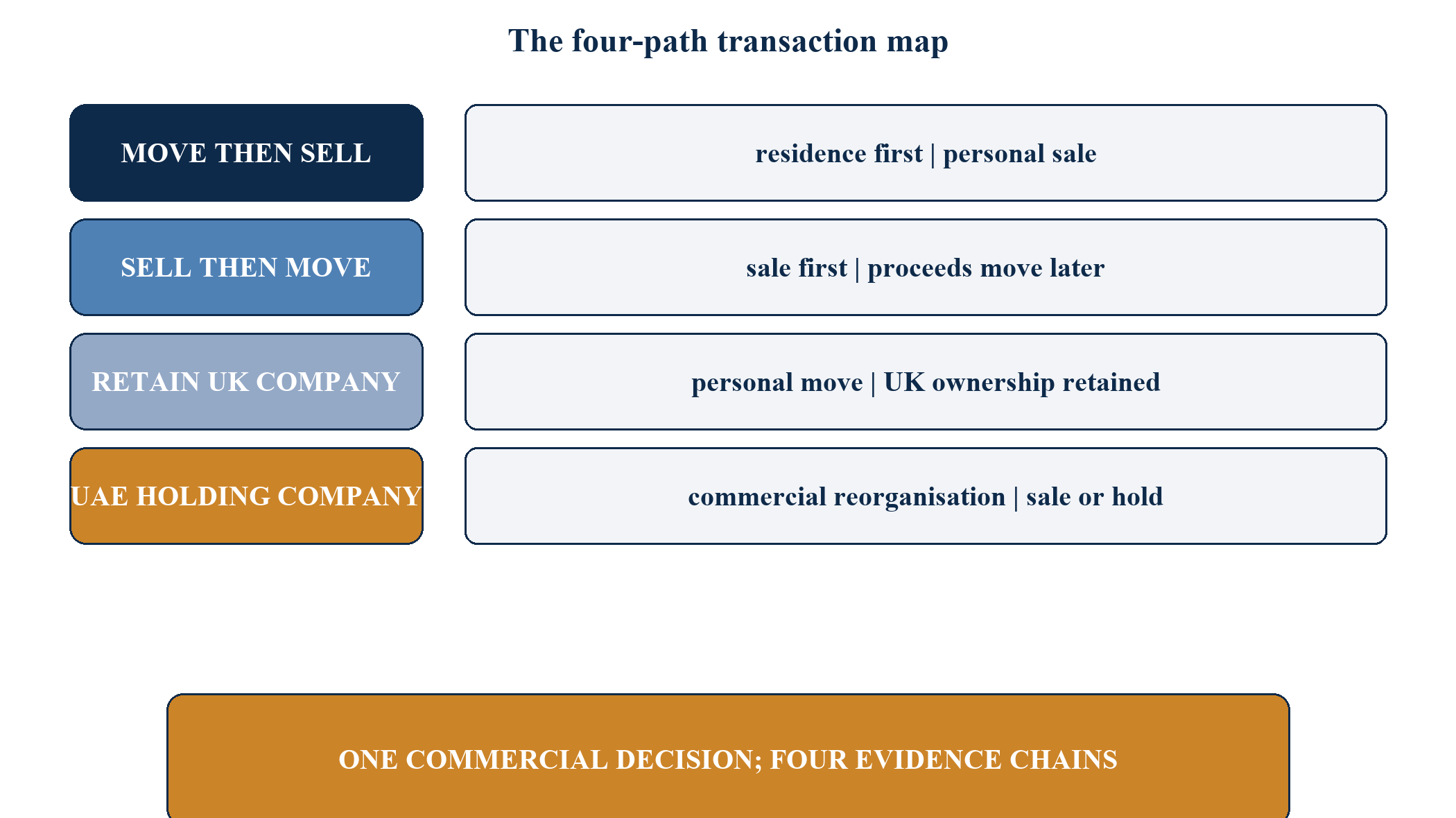
A founder preparing to sell a United Kingdom business can face two major transitions at once: a personal move to the United Arab Emirates and a change of ownership. The order matters. The founder may relocate before selling, sell before relocating, retain the UK company after moving, or introduce a UAE holding company before the transaction. Each route creates a different evidence, timing, tax, governance and execution problem.
The decision should begin with commercial facts. Buyers price the operating business, management continuity, intellectual property, customer concentration, liabilities, cash generation and deal certainty. A late ownership reorganisation can delay diligence, create clearance questions and complicate warranties. A premature personal move can disrupt management, weaken buyer confidence or fail to establish non-UK residence. A sale completed first can crystallise a UK tax result before the founder has changed residence.
This paper develops a four-path sequencing framework. It integrates the United Kingdom's Statutory Residence Test, split-year rules, temporary non-residence, non-resident capital-gains rules, the UK-UAE tax convention, company residence, share exchanges, transactions-in-securities clearances and the 2026 anti-avoidance changes. It then connects those sources to UAE individual and corporate-tax rules, holding-company substance and participation exemption.
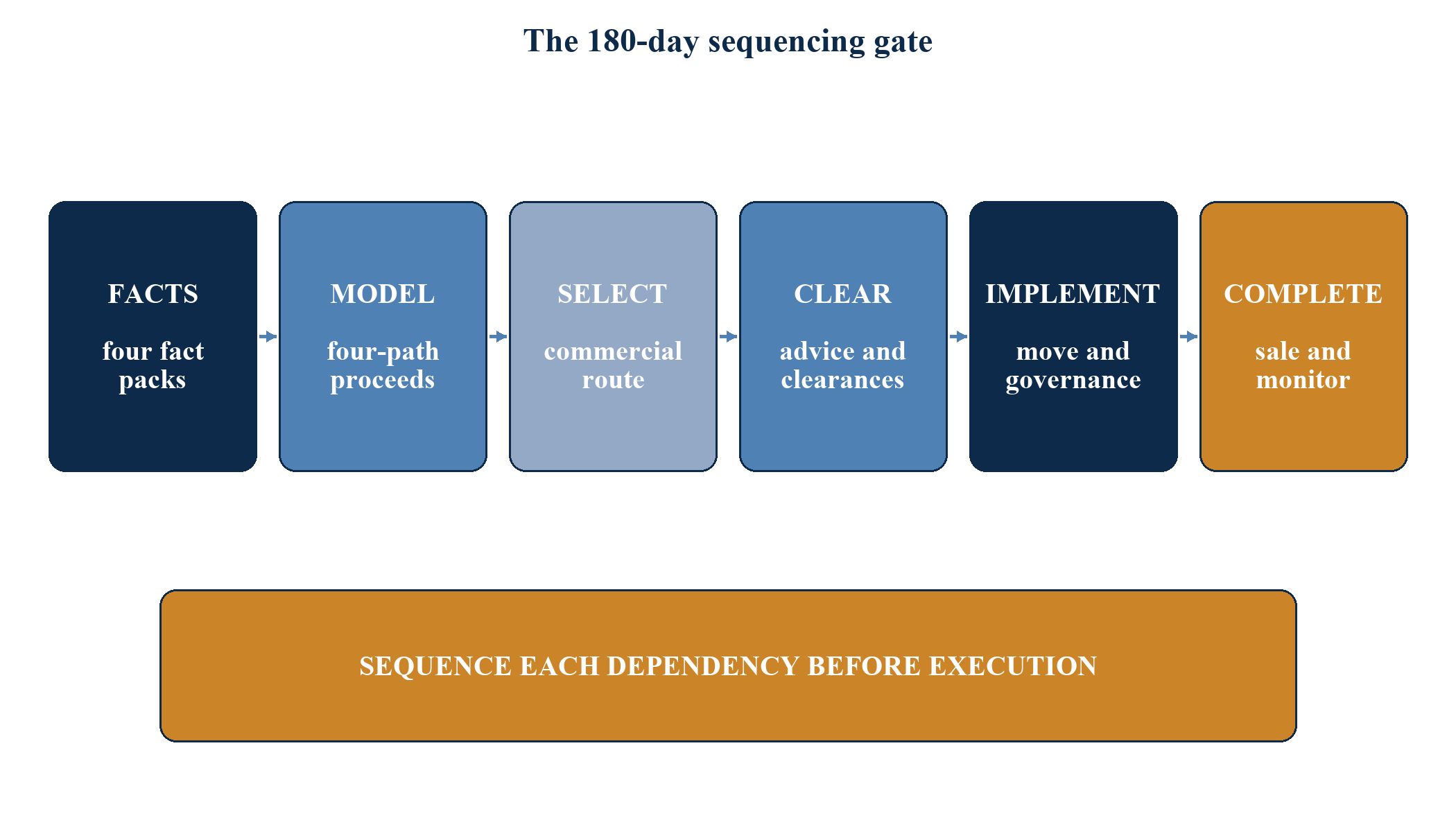
The central proposition is that there is no universal optimal sequence. The correct route follows the founder's real residence, the asset being sold, the expected return horizon, the buyer process, the company's property exposure, the commercial purpose of any holding structure and the time available to obtain evidence and clearances. A governance gate should prevent transaction steps from being executed until personal residence, ownership, company control and sale mechanics have been reconciled.
2. THE FOUR PATHS
2.1 Path A: relocate, then sell personally
The founder becomes non-UK resident under the Statutory Residence Test, establishes UAE residence and later sells shares held personally. This route can place a non-property-rich share gain outside the ordinary UK charge for a non-resident individual, subject to the temporary non-residence rules, residence being valid, treaty issues and other specific provisions [1-8].
The main risks are factual. The founder may remain UK resident because of days, homes, work or ties. Split-year treatment may not apply from the expected date. The business may be UK property rich. A return to the UK within the relevant temporary non-residence period can bring the gain into charge in the return period [6,7]. The founder also has to remain able to lead the business and buyer process from the new operating base.
2.2 Path B: sell, then relocate
The founder completes the sale while UK resident and relocates afterwards. The sale has a clearer residence fact pattern and the founder can remain fully available during diligence, negotiation and completion. UK Capital Gains Tax and any available relief are determined under the sale-year rules [11,12]. From 6 April 2026, Business Asset Disposal Relief applies a published 18 per cent rate to qualifying gains within its lifetime limit [12].
This route can maximise transaction certainty while producing a different after-tax result. It can also reduce the risk that the move appears designed around an imminent disposal, although purpose remains only one part of the wider analysis.
2.3 Path C: relocate and retain the UK company
The founder moves but keeps the UK operating company, possibly selling later. The company remains UK incorporated and ordinarily UK resident. The founder's location can change employment, directorship, payroll, permanent-establishment and governance facts. The move should not cause the board to become ceremonial or shift material company decisions without analysis [13-16].
2.4 Path D: introduce a UAE holding structure
A UAE holding company acquires the founder's UK shares before the sale. The reorganisation can pursue genuine commercial objectives such as regional governance, acquisitions, investor participation or reinvestment. It also raises share-exchange, anti-avoidance, stamp, clearance, valuation, company-residence, UAE corporate-tax and buyer-diligence questions [17-24]. A structure created only when a sale is imminent requires especially careful professional review.
| Path | Ownership at sale | Main attraction | Primary gating issue |
|---|---|---|---|
| relocate, then sell | founder personally | residence-aligned disposal | valid non-residence and return horizon |
| sell, then relocate | founder personally | deal certainty | UK sale-year tax result |
| relocate, retain UK company | founder personally | strategic flexibility | continuing governance and residence |
| UAE holding structure | UAE company | institutional platform | commercial purpose, clearance and substance |
3. ESTABLISH THE FACTS BEFORE CHOOSING A SEQUENCE
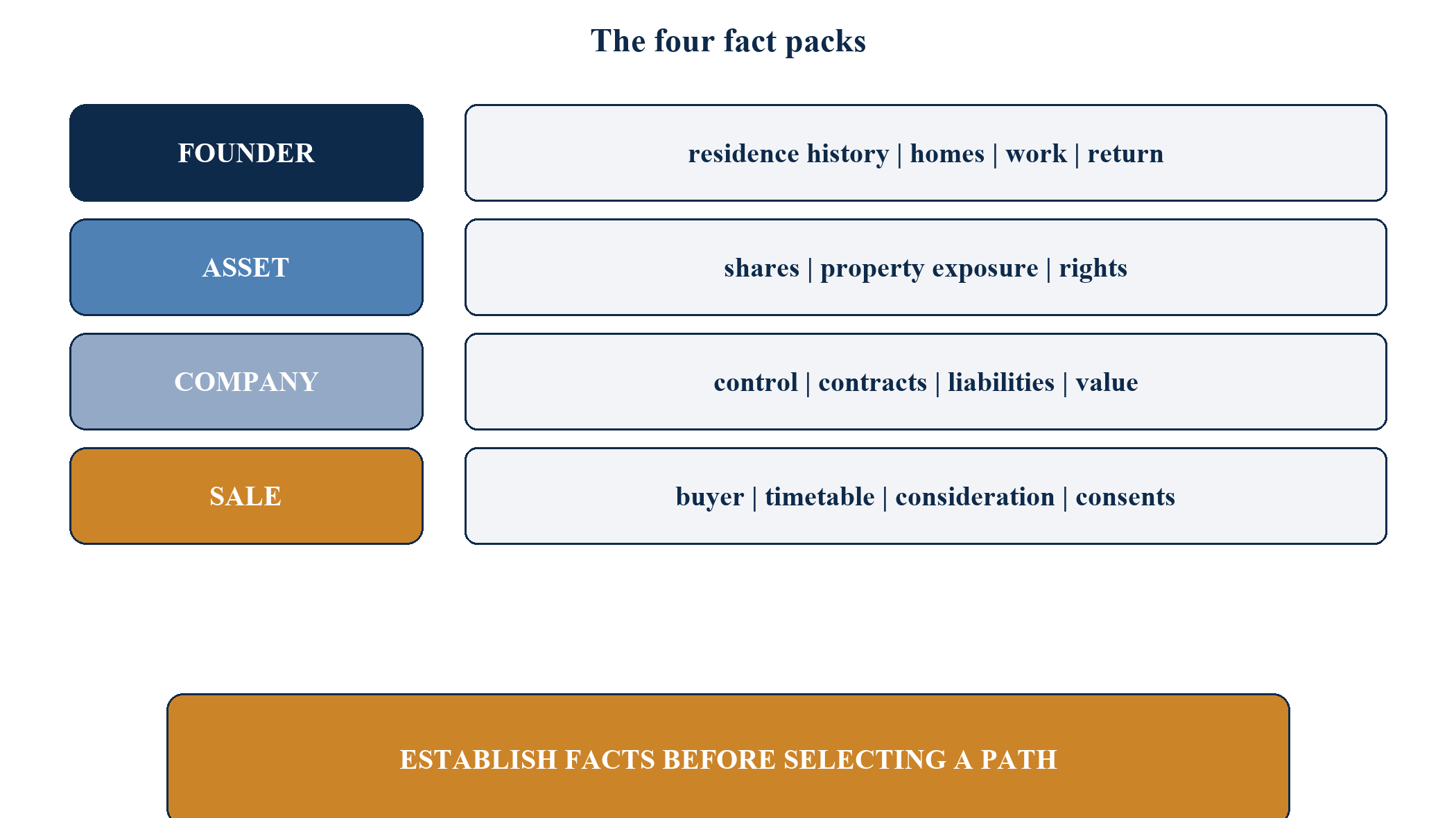
3.1 The founder fact pack
The founder file should establish recent UK residence, UK days, homes, family, work pattern, prior periods abroad, planned return, citizenship, UAE home and business activity. Residence should be analysed separately for the departure year, disposal year and possible return year. A buyer timetable should not be treated as proof that a tax-year transition occurred.
3.2 The asset fact pack
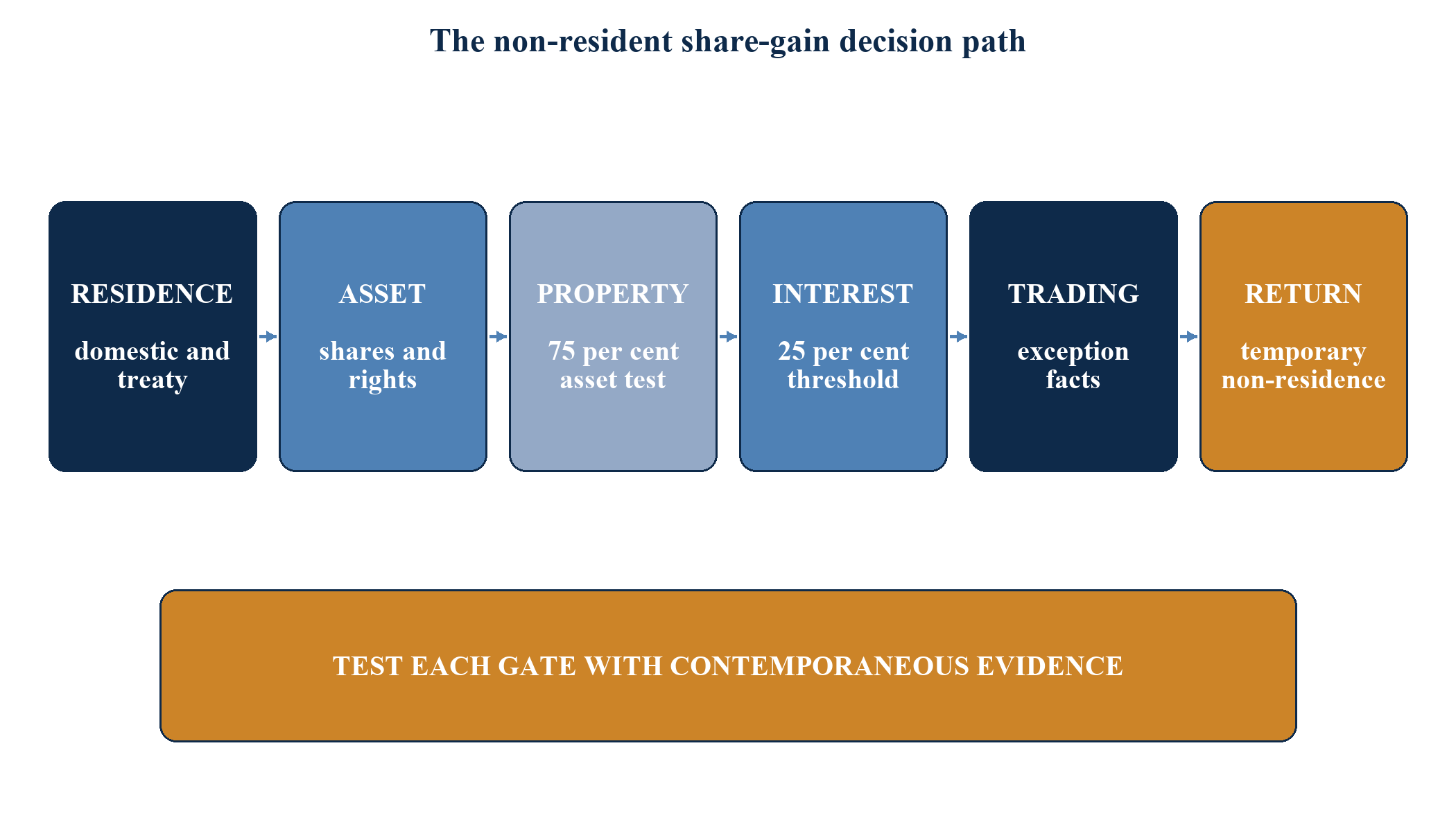
Record the exact shares, options, growth shares, loan notes, trusts, nominees, employee securities and any interests held by connected persons. Establish base cost, acquisition date, elections, relief history, restrictions, pledges and the company's gross asset composition. UK land exposure matters because non-resident indirect-disposal rules can apply when an entity derives at least 75 per cent of gross asset value from UK land and the person meets the substantial-interest test [8-10].
3.3 The company fact pack
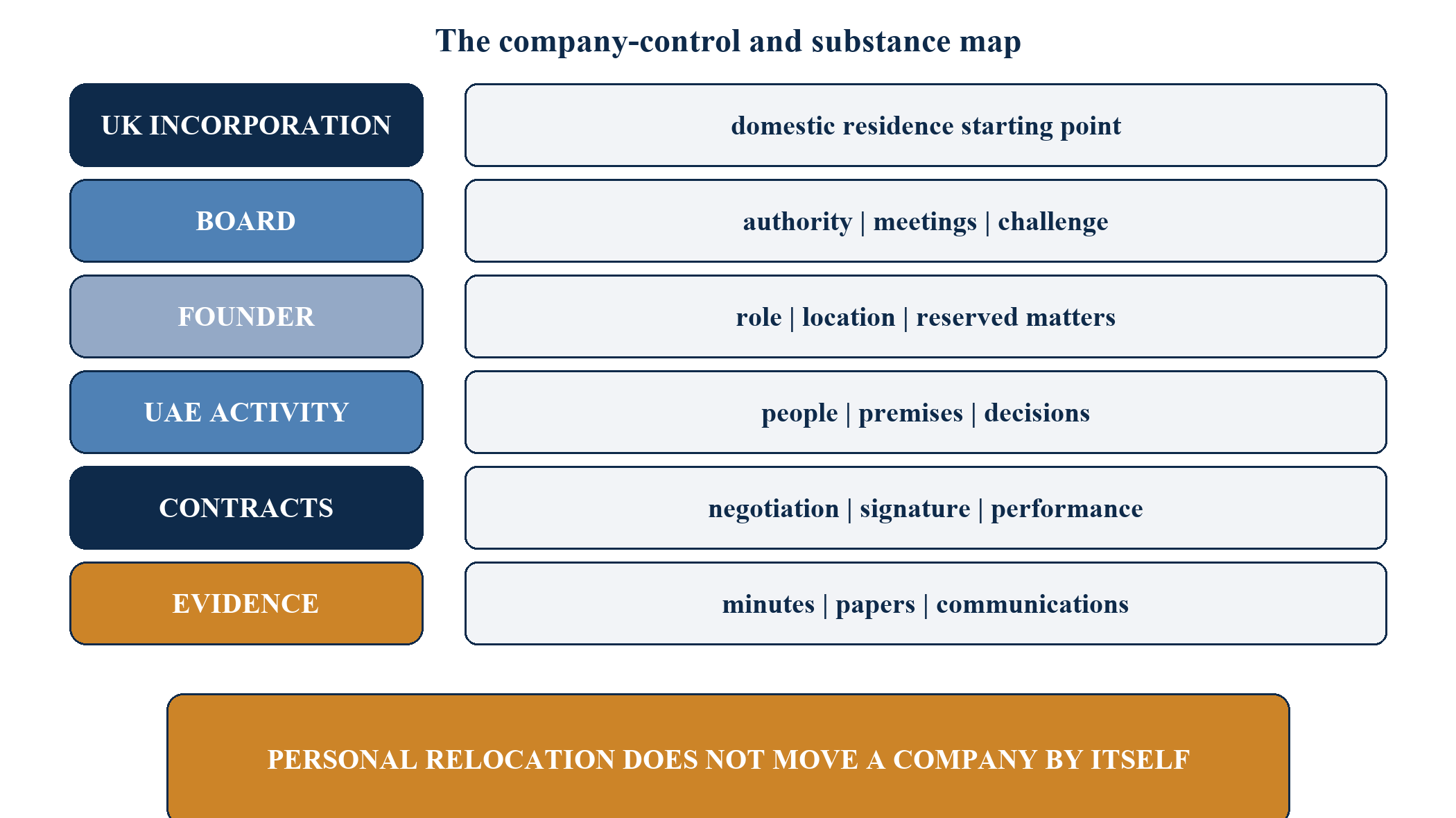
The company file should contain incorporation, tax residence, management, board authority, operations, intellectual property, employees, premises, contracts, tax attributes and regulatory permissions. It should identify every material jurisdiction in which people negotiate, decide, sign or deliver. The founder's move does not automatically move the company.
3.4 The sale fact pack
Record buyer identity, indicative value, process stage, exclusivity, conditions, rollover equity, earn-out, escrow, completion accounts, deferred consideration, warranties and expected signing and completion dates. A transaction can have several economically significant dates. Tax and legal advice should identify which date controls each issue.
The four fact packs should be complete before a route is selected. Unknowns should appear as unresolved items with owners, not as favourable assumptions.
4. PATH A: RELOCATE, THEN SELL
4.1 Residence must precede the conclusion
The founder should satisfy the Statutory Residence Test for the relevant tax year and document the result [1-5]. Automatic overseas tests, automatic UK tests and sufficient ties are sequential. Split-year treatment applies only when a statutory case and all its conditions are met [3-5]. A move date, visa or UAE tenancy does not alone determine UK residence.
4.2 The disposal asset matters
GOV.UK guidance states that a non-resident individual does not usually pay UK Capital Gains Tax on other UK assets such as shares in UK companies, subject to returning within five years and the UK property-rich indirect-disposal rules [8]. The detailed legislation, treaty and facts must be applied. Shares in a company deriving at least 75 per cent of gross asset value from UK land can fall within the indirect-disposal regime when the ownership conditions are met [9,10]. A trading exception can apply in specified circumstances and requires its own analysis [10].
4.3 The buyer process continues
The founder may need to manage the company, negotiate, attend diligence meetings and execute documents. UK workdays can affect personal residence. Location of high-level decisions can affect company-residence or permanent-establishment analysis for any foreign vehicle. The transaction calendar should classify every UK visit and decision.
4.4 Return risk
If the founder returns to UK residence after a short period abroad, temporary non-residence can bring specified gains realised during the non-resident period into charge in the period of return [6,7]. The plan should state the earliest contemplated return, family contingencies and transactions affected. A five-year slogan is inadequate; advisers should calculate the statutory period from the actual departure and return facts.
5. PATH B: SELL, THEN RELOCATE
5.1 Commercial simplicity
Selling before moving allows the founder to remain in the established management and transaction environment. The buyer sees continuity in management, governance and information flow. Tax residence at disposal is less dependent on a newly created fact pattern.
5.2 UK sale-year analysis
A UK-resident founder is generally within Capital Gains Tax on the share disposal, subject to computation, losses, reliefs and the nature of consideration. GOV.UK publishes an 18 per cent Business Asset Disposal Relief rate for qualifying disposals from 6 April 2026 and sets out the ownership, voting, employment and trading-company conditions [12]. The lifetime limit and detailed eligibility require current advice.
Deferred consideration, earn-outs, loan notes, rollover equity and escrow can change timing and character. The sale model should separate cash at completion, later receipts and retained investment. It should also test employment-related securities and transactions-in-securities questions where relevant.
5.3 Moving proceeds
After completion, the founder can relocate with a liquid portfolio rather than an operating business. Residence, remittance, banking, source-of-funds, investment governance and inheritance-tax exposure remain relevant. From 6 April 2025, UK Inheritance Tax uses long-term residence rules for overseas assets; a former long-term resident can remain within scope for three to ten tax years depending on residence history [25,26].
5.4 When this path dominates
This path can be rational when the sale is imminent, residence change cannot be established with confidence, buyer certainty is valuable, family plans remain UK-centred, a rapid UK return is likely or restructuring would disrupt the transaction. The conclusion should be based on after-tax and risk-adjusted proceeds, not nominal tax alone.
6. PATH C: RELOCATE AND RETAIN THE UK COMPANY
6.1 Personal and company residence are separate
A founder can become non-UK resident while the UK company remains UK resident. UK incorporation generally creates UK residence, subject to treaty provisions. The founder's personal location does not change the company's incorporation or existing UK obligations.
6.2 Management from the UAE
The founder may continue as director, chief executive or controlling shareholder. The operating model should state which decisions belong to the UK board, which functions are delegated and where the founder performs work. HMRC's company-residence guidance focuses on where central management and control actually abides and whether those legally entrusted with control exercise it [13,14].
A UAE service company, branch or management role can create transfer-pricing, payroll, permanent-establishment and corporate-tax questions. Agreements and invoices should match actual functions. Minutes should record genuine consideration, challenge and approval.
6.3 Preserving strategic options
Retaining the company creates time to establish UAE residence, improve sale readiness and choose between later personal disposal, investment, partial liquidity or a commercial group reorganisation. It also exposes the founder to business risk for longer and leaves future tax rules uncertain.
6.4 Governance controls
Maintain a board calendar, decision-location ledger, role matrix, intercompany agreements, UK workday diary and buyer-readiness file. A distributed model should be designed for the operating business, not only for a future sale.
7. PATH D: INTRODUCE A UAE HOLDING COMPANY
7.1 Commercial purposes
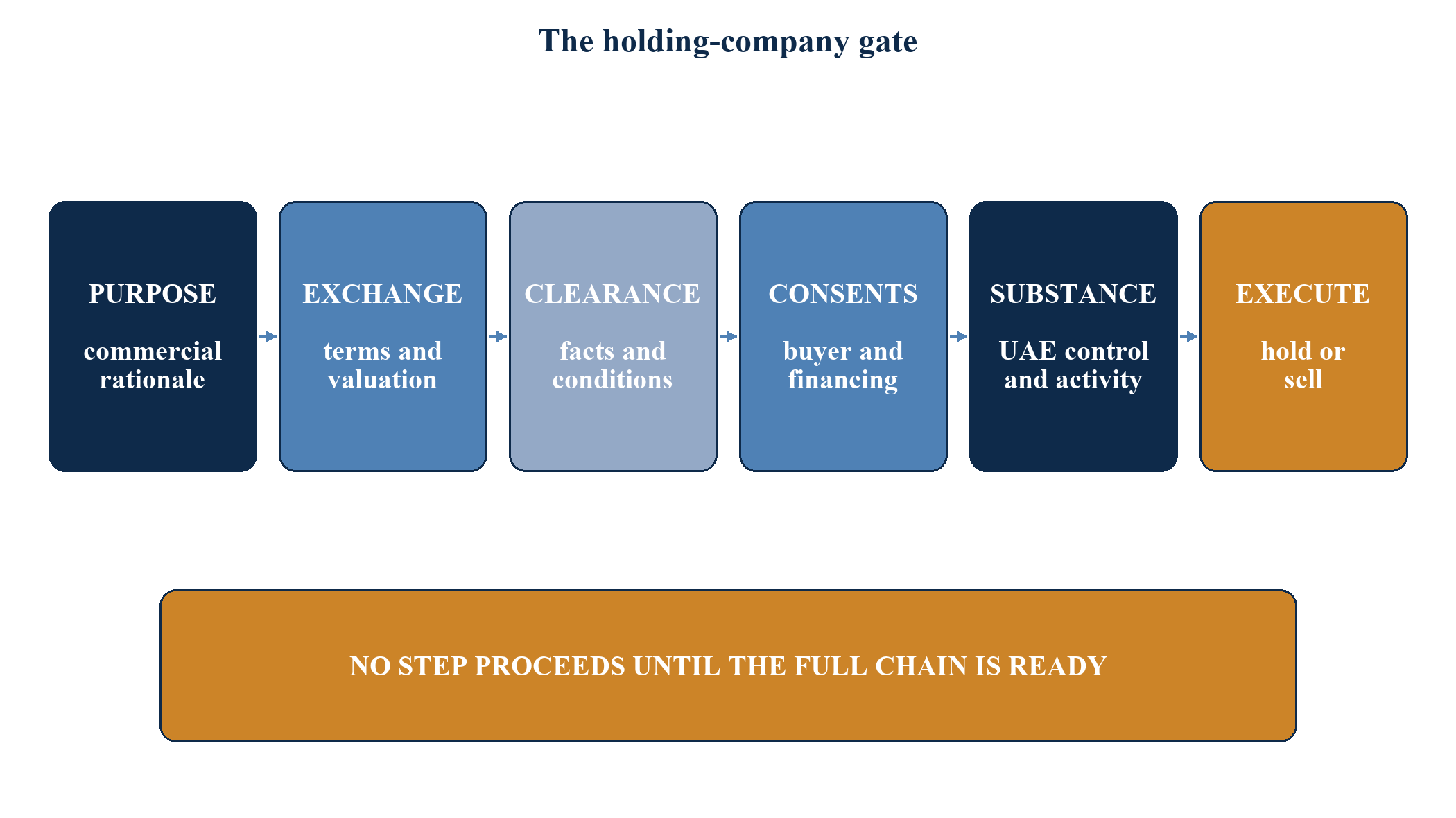
A UAE parent can provide a platform for regional acquisitions, capital raising, management participation, reinvestment, treasury or succession. The board, banking, people and records should support those objectives. A paper entity created shortly before a signed sale process can create diligence and anti-avoidance risk.
7.2 Share exchange
A common route is an exchange of the founder's UK company shares for shares issued by a new UAE parent. UK share-exchange provisions and anti-avoidance conditions determine whether the exchange is treated as a reorganisation rather than an immediate disposal [17-19]. HMRC guidance notes a specific rule for exchanges involving non-UK incorporated close companies from 17 November 2022 and further Finance Act 2026 amendments [18,19]. The facts and effective date should be reviewed under current legislation.
7.3 Clearances and stamp consequences
HMRC provides advance-clearance procedures for share exchanges and transactions in securities. A clearance depends on accurate and complete disclosure; HMRC can review transactions that differ from the application [20,21]. Stamp-duty reconstruction or acquisition relief can have its own conditions and evidence [19]. Legal ownership should not move until advice, valuation, consents and clearances are complete.
7.4 UAE position
A UAE company is within the corporate-tax framework. Dividends and gains from a qualifying participation can be exempt when statutory conditions are met, including ownership or acquisition-cost, holding-period, subject-to-tax and asset composition conditions [22-24]. Expenditure connected with acquisition or disposal can receive specific treatment [23]. A personal-investment exclusion applicable to an individual should not be applied to a juridical holding company.
8. PERSONAL RESIDENCE AND SPLIT-YEAR TIMING
8.1 Whole-year starting point
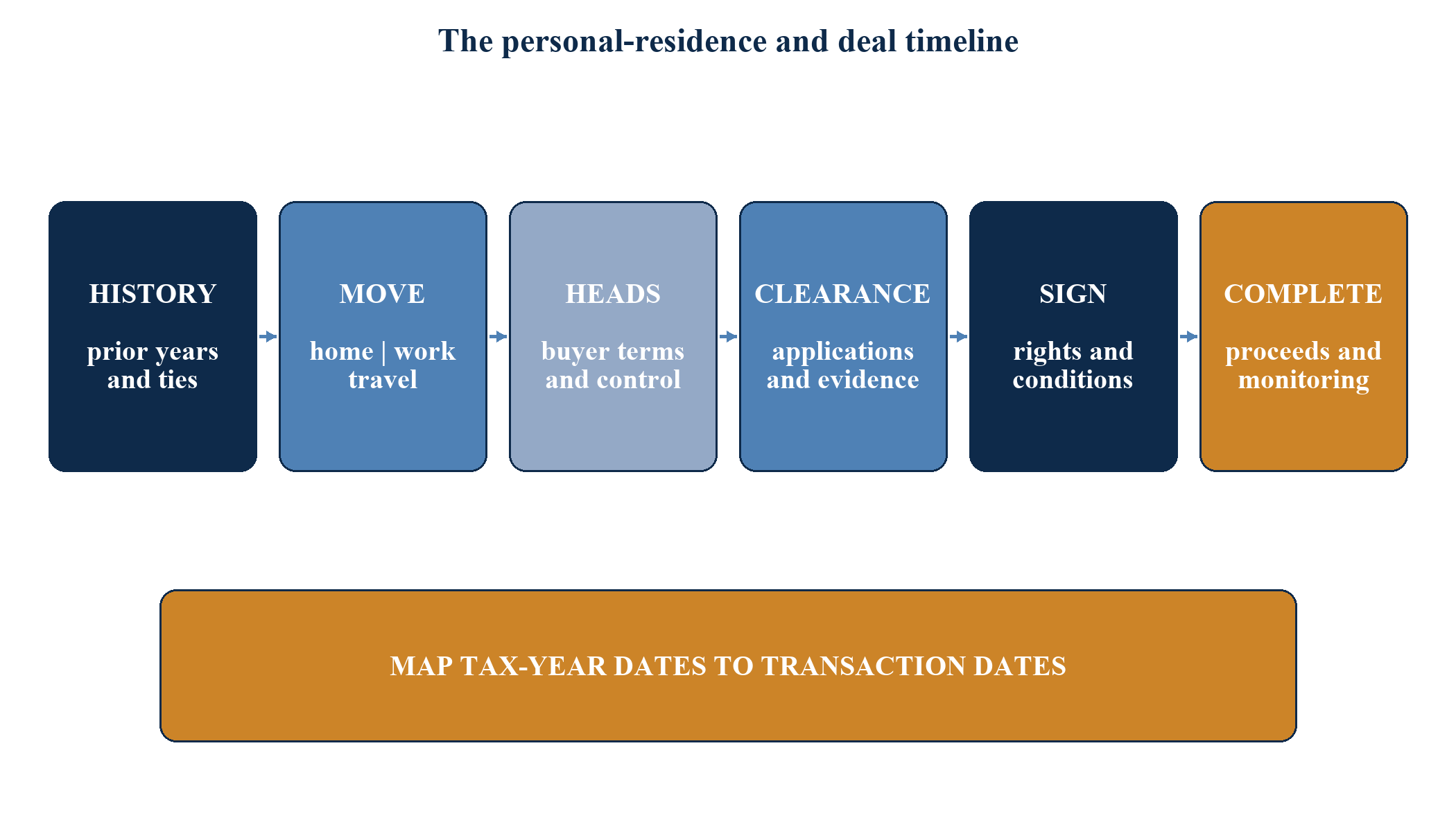
The Statutory Residence Test determines residence for a tax year [1]. Split-year treatment can divide specified income and gains between UK and overseas parts only when a statutory case applies [3-5]. The departure date, work pattern, homes and family position should be documented contemporaneously.
8.2 Transaction milestones
The sequence should distinguish heads of terms, exclusivity, signing, exchange, satisfaction of conditions, completion, payment and transfer of beneficial ownership. Advisers should determine the relevant disposal date under the transaction documents and tax rules. A move completed after the controlling disposal event cannot be assumed to change the result.
8.3 UK visits during the process
Buyer meetings, management presentations, board approvals and completion activity can create UK presence and workdays. The residence ledger should reconcile travel with deal calendars. A final-week visit can matter if the founder is near a day or work threshold.
8.4 Treaty residence
When domestic rules treat the founder as resident in both countries, Article 4 of the UK-UAE convention applies permanent home, centre of vital interests, habitual abode, nationality and competent-authority steps [27]. Treaty residence is a separate conclusion. It requires UAE residence evidence and a complete UK fact pattern.
9. NON-RESIDENT GAINS AND PROPERTY-RICH COMPANIES
9.1 Ordinary shares in a trading company
GOV.UK's published guidance says a non-resident does not usually pay UK Capital Gains Tax on shares in UK companies unless the individual returns within five years or the company is UK property rich and the indirect-disposal conditions are met [8]. This is a useful starting point, not a transaction opinion.
9.2 The 75 per cent and 25 per cent tests
HMRC guidance describes the property-rich test as 75 per cent or more of gross asset value derived from UK land [9]. The substantial-interest test generally looks for at least a 25 per cent investment at the disposal date or within the preceding two years, with detailed rights and connected-person rules [9,10]. Gross value is used for property richness; liabilities generally do not reduce the numerator or denominator in the basic test [9].
9.3 Trading exception
HMRC describes a trading exception for specified disposals where all or almost all UK land is used in a qualifying trade before and after the disposal [10]. A founder selling an operating retailer, hotel or industrial group should not assume that owning operational land automatically produces or removes a charge. The precise asset, group and trade facts require review.
9.4 Diligence evidence
The seller should prepare a gross-asset schedule, independent valuations where necessary, ownership-rights analysis and trading-use evidence. The buyer's due diligence may test the same facts for covenant and reporting purposes.
10. TEMPORARY NON-RESIDENCE
10.1 The return rule
HMRC guidance states that specified capital gains arising while an individual is temporarily non-resident can be charged in the period of return [6]. The detailed conditions consider prior residence and the length of the non-resident period [7]. A founder who expects family, health or business reasons to bring them back should model the rule before relying on non-residence.
10.2 Five full tax years
Public guidance often summarises the return risk as returning within five years [8]. The statutory calculation can depend on tax years and split years. The transaction file should record the last UK-resident year, departure-year treatment, first complete non-resident year, expected return and earliest date on which the rule ceases to apply under current advice.
10.3 Contingencies
The model should include an early return, spouse or child returning, UK employment, sale of the UAE home, substantial UK work and unexpected care obligations. The temporary non-residence register should also list dividends, close-company benefits and other specified items requiring review.
10.4 Governance
A board or family-office process cannot bind personal residence. It can ensure that a contemplated return prompts professional advice before travel, home and work facts change. The return protocol should remain active until the adviser confirms the relevant period has ended.
11. THE UK-UAE TREATY AND CAPITAL GAINS
11.1 Article 13
Article 13 of the UK-UAE convention allows the state where immovable property is situated to tax gains from that property. It also allows that state to tax gains from shares or comparable interests deriving their value or the greater part of their value from immovable property in that state, subject to the treaty wording [27]. Other gains are generally taxable only in the state of residence of the alienator under paragraph 5 [27].
11.2 Treaty residence first
The founder must be a treaty resident of the UAE for the relevant claim. Domestic UAE and UK residence, permanent homes, personal and economic relations, habitual abode and nationality can all require evidence [27-29]. The treaty does not turn a planned move into residence.
11.3 Domestic law and treaty interaction
Domestic law identifies the charge; the treaty can allocate or limit taxing rights. Anti-avoidance provisions, temporary non-residence and property-rich rules require current professional analysis. Treaty language should be cited directly in the advice file rather than paraphrased into a general exemption.
11.4 Evidence
Maintain the UAE tax-residence certificate file, entry and exit records, home evidence, centre-of-interests memorandum, UK return, transaction documents and legal opinion. Any relief claim should be consistent across buyer documents, tax filings and banking explanations.
12. THE UK COMPANY AFTER THE FOUNDER MOVES
12.1 Incorporation and real control
A UK incorporated company is generally UK resident. A new UAE entity can also be considered resident in the UAE if incorporated or effectively managed and controlled there under UAE rules [24]. Dual-residence and treaty questions depend on the entities and facts.
HMRC guidance states that central management and control is where the highest level of control actually abides [13]. Boards that merely implement a founder's decisions do not create reliable separation. The constitution, director authority and actual conduct should align [14].
12.2 Permanent establishment and services
The founder's UAE office, authority and activities can create UAE corporate-tax and permanent-establishment issues for the UK company. A UAE service company can create transfer-pricing, VAT, payroll, licensing and related-party obligations. Agreements should identify services, assets, risks, people and remuneration.
12.3 Buyer perception
Buyers will test whether the operating model changed before the sale, whether key-person risk increased, whether intellectual property moved, and whether intercompany arrangements are enforceable. A governance change designed only for tax presentation can reduce deal certainty.
12.4 Minimum operating record
Maintain director locations, meeting packs, minutes, reserved matters, powers, signing authority, employee locations, intercompany contracts and actual performance. The record supports tax analysis and buyer diligence.
13. SHARE EXCHANGES, CLEARANCE AND 2026 ANTI-AVOIDANCE
13.1 Reorganisation does not mean automatic neutrality
UK share-exchange rules can treat new shares as standing in the place of old shares when statutory conditions are met. Anti-avoidance provisions can prevent that treatment. HMRC's manuals and Finance Act 2026 materials should be applied to the exact exchange date and purpose [17-19,30].
13.2 Non-UK close-company shares
HMRC guidance describes a rule for shares issued by a non-UK close company in exchange for UK close-company shares from 17 November 2022, including treatment of the new securities as UK situated in specified circumstances [18]. Finance Act 2026 amended capital-gains anti-avoidance rules for share exchanges and reconstructions [19,30]. A UAE holding company should therefore be analysed under current law, not under an older generic share-for-share template.
13.3 Clearance process
Applications can address share-exchange anti-avoidance and transactions in securities. HMRC states that clearance is based on the transactions and particulars disclosed; a materially different transaction can still be reviewed [20,21]. The application should include the full commercial purpose, ownership, negotiations, sale process, consideration, financing and subsequent steps.
13.4 Buyer and financing consents
Existing shareholders, lenders, regulators, option holders, employees and counterparties may need to consent. A reorganisation can reset change-of-control, tax covenant, option and warranty analysis. The transaction team should integrate clearance timing with commercial approvals.
14. UAE PERSONAL AND CORPORATE TAX
14.1 Personal investment income
UAE Cabinet Decision No. 49 of 2023 excludes wages, personal investment income and specified real-estate investment income from the businesses or business activities of a natural person subject to Corporate Tax, regardless of amount, under its conditions [28,29]. The Ministry of Finance describes personal investment income as outside the natural-person corporate-tax charge while business income can be within scope when turnover exceeds AED 1 million [28]. The classification of a founder's shareholding and activity requires fact-specific advice.
14.2 UAE holding company
A UAE juridical person is within Corporate Tax and must register and comply subject to the applicable rules [24]. The standard framework differs from the natural-person exclusion. Free-zone status does not remove compliance and produces a zero rate only on qualifying income when all conditions are satisfied [24].
14.3 Participation exemption
The participation exemption can cover dividends and gains from a qualifying ownership interest. Ministry and FTA guidance describes ownership or acquisition-cost thresholds, a 12-month holding condition, subject-to-tax conditions and further requirements [22,23]. Disposal expenses connected with an exempt participation can be non-deductible and capitalised under the relevant decision [23].
14.4 Business restructuring relief
UAE business-restructuring relief under Article 27 addresses transfers of an entire business or independent part between qualifying taxable persons [31]. It is not a general solution for an individual's exchange of UK shares. Any UAE relief should be mapped to the actual transferor, transferee and asset.
15. BUYER PROCESS AND DEAL MECHANICS
15.1 The buyer values certainty
Any move or reorganisation should be assessed for its effect on diligence, financing, regulatory approvals, warranties and completion. A buyer may ask why ownership changed, whether tax clearances were obtained, whether the new parent has substance and who bears historic liabilities.
15.2 Consideration design
Cash, rollover equity, loan notes, earn-outs and escrow can create different timing and risk. The founder's residence may change before a deferred amount is received. The tax model should map each consideration component to the relevant disposal, income and reporting rules.
15.3 Signing and completion
Some transactions sign and complete on different dates. Conditions can include regulatory approval, financing, employee consultation and reorganisation. The legal team should identify when beneficial ownership changes and which obligations survive.
15.4 Warranties and covenants
The sale agreement should address residence, reorganisation, clearances, filings, property-rich status, payroll, permanent establishments and intercompany arrangements. Statements should follow verified evidence. A tax-saving narrative should not substitute for a factual disclosure.
16. AFTER-TAX PROCEEDS SCENARIOS
All scenarios in this section are hypothetical and simplified. They illustrate modelling architecture and do not state the tax result for any person.
Assume gross equity value of 100 units, base cost of 10, transaction costs of 3 and gross gain before detailed adjustments of 87. The model should calculate tax by consideration component, jurisdiction, residence period, relief and return contingency. It should also deduct relocation, restructuring, compliance, financing and delay costs.
| Scenario | UK residence at disposal | Ownership | Model variables | Key reserve |
|---|---|---|---|---|
| A | non-UK under verified analysis | personal | property richness, treaty, return rule | return and evidence reserve |
| B | UK resident | personal | gain, losses, BADR eligibility and limit | UK tax and deferred consideration |
| C | non-UK; sale later | personal | future law, business value, return horizon | operating and market risk |
| D | fact specific | UAE holding company | exchange, clearance, UAE participation | anti-avoidance and substance reserve |
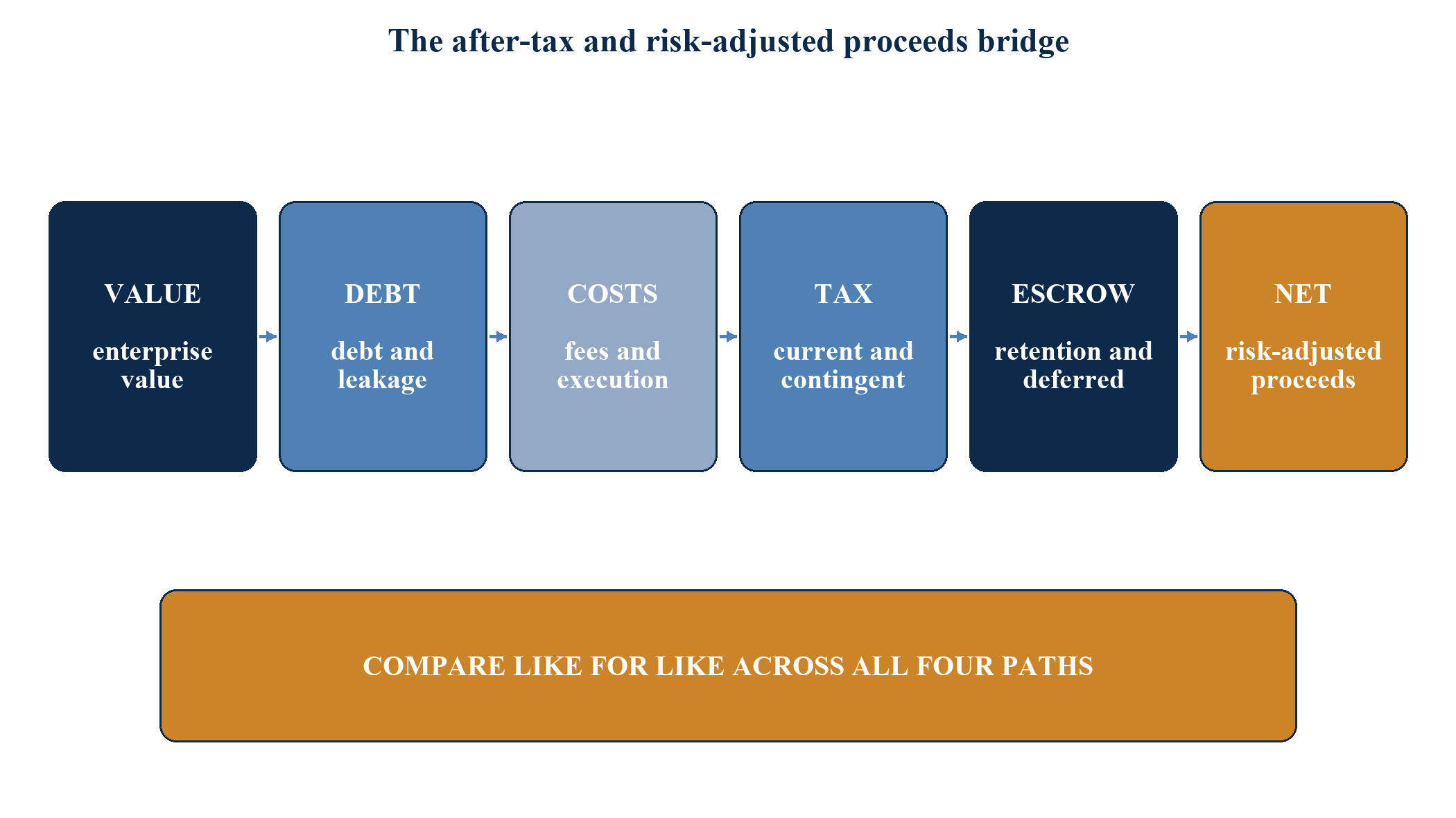
After-tax proceeds should be expressed as: cash received plus present value of deferred consideration plus rollover equity value, less sale tax, restructuring tax, professional costs, debt and working-capital adjustments, escrow, contingent-liability reserve and relocation costs.
A risk-adjusted model should apply probabilities to deal completion, successful residence position, temporary non-residence, clearance, UAE exemption, earn-out achievement and future exit value. Management estimates should be clearly labelled in the model and approved by the founder. Sensitivity should include lower valuation, delayed completion, early UK return and failure of a relief.
17. VALUE, TAX AND EXECUTION RISKS
17.1 Value leakage
A move can distract management, weaken buyer confidence or delay completion. Reorganisation can create consent costs, option changes and new diligence. The lost enterprise value can exceed a projected tax difference.
17.2 Residence failure
Unexpected UK days, homes, family ties or work can invalidate the assumed residence position. The control is a live residence calendar with professional review, not a retrospective explanation.
17.3 Anti-avoidance and clearance mismatch
Clearance can be undermined when actual steps differ from those disclosed. Buyer changes, financing, consideration or pre-sale negotiations should be compared with the application before execution.
17.4 Substance failure
A UAE company with nominee decision making, no commercial function or UK-directed control can create residence, treaty, corporate-tax and buyer concerns. Substance should follow real business needs.
17.5 Return and succession risk
An early UK return can affect temporary non-residence. Long-term UK residence can keep overseas assets within inheritance-tax scope after departure for a period determined by residence history [25,26]. The sale plan should coordinate return, investment and succession advice.
18. A 180-DAY SEQUENCING CHECKLIST
18.1 Days 180 to 121: establish facts
Complete founder, asset, company and sale fact packs. Obtain residence, transaction-tax, corporate, treaty, UAE and legal advice. Identify buyer-process constraints and consent requirements. Build the four-path proceeds model.
18.2 Days 120 to 91: choose a route
Compare after-tax and risk-adjusted proceeds. Decide whether the commercial plan genuinely supports relocation, immediate sale, continued ownership or a UAE platform. Record rejected routes and reasons. Begin clearance only when facts are stable.
18.3 Days 90 to 61: implement foundations
Establish homes, roles, governance and evidence appropriate to the selected route. Obtain valuations, clearances and consents. Prepare buyer disclosures and data-room evidence. Do not execute ownership transfers before the gate is complete.
18.4 Days 60 to completion
Reconcile actual travel, work and decision locations. Compare transaction documents with clearances. Confirm consideration, disposal date, property-rich analysis, treaty evidence and filings. Maintain a contingency plan for delay or route change.
18.5 After completion
Close tax and corporate filings, monitor deferred consideration, retain evidence, manage rollover equity and keep the temporary non-residence and long-term-residence review active. Test any proposed UK return before facts change.
19. LIMITATIONS AND CONCLUSION
This paper provides a decision and governance framework based on official sources available at the publication date. It is not tax, legal, investment, immigration, employment, valuation or transaction advice. Legislation, guidance, treaties and facts can change. Current professional advice is essential before a move, share exchange, clearance application or sale.
The worked scenarios are hypothetical and simplified. They do not model every option, trust, security, relief, anti-avoidance rule, earn-out, employment-related security, property-rich group, regulatory consent or family circumstance. Numerical units illustrate model structure and are not an estimate of tax or proceeds.
Four routes remain distinct. Relocating before a personal sale depends on verified residence, the asset, treaty and return horizon. Selling before moving prioritises transaction certainty and determines the sale under the UK-resident rules. Retaining the UK company preserves optionality while requiring a credible cross-border operating model. A UAE holding company can support genuine regional strategy but requires current share-exchange, clearance, substance and corporate-tax analysis.
The sequence should be selected by comparing after-tax and risk-adjusted proceeds, buyer certainty, commercial purpose and personal constraints. The founder should not execute one part of the plan in isolation. Personal residence, ownership, company control, buyer mechanics and future return should pass one integrated gate.
APPENDIX A. FOUR-PATH DECISION QUESTIONNAIRE
Record the founder's intended move date, reason, family plan, expected UK days, work, homes and possible return. Record sale status, buyer contact, value range, timing, consideration and conditions. Record the company's assets, UK land, governance, employees, intellectual property and regulatory position. Record proposed ownership changes, commercial purpose, advisers, clearances and consents.
For each route, state the legal steps, earliest feasible date, residence assumption, tax variables, transaction risks, professional costs, buyer impact and evidence required. Any unresolved item should have an owner and deadline.
APPENDIX B. CRITICAL-DATES LEDGER
The ledger should contain tax-year boundaries, residence transition, UAE home availability, visa and certificate dates, buyer approaches, heads of terms, exclusivity, clearance submissions, HMRC responses, board approvals, share exchange, signing, completion, payment, earn-out tests and contemplated return.
Each date should identify its legal or tax significance, source document and adviser. The ledger should distinguish expected, contractual and actual dates.
APPENDIX C. DEAL-STRUCTURE EVIDENCE FILE
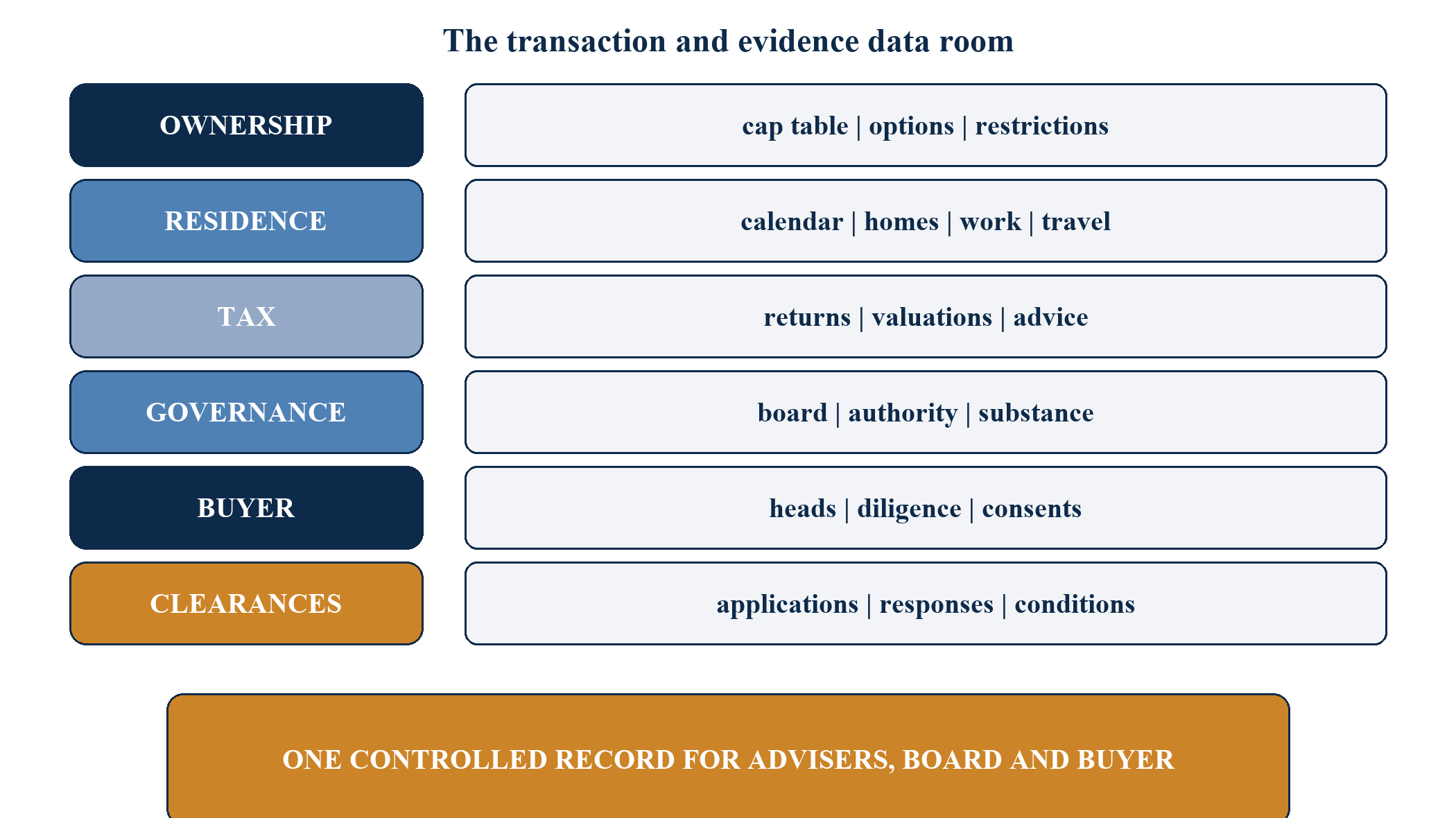
Minimum evidence includes cap table, option schedule, share certificates, acquisition cost, elections, valuation, group chart, asset schedule, UK-land analysis, accounts, board authorities, intercompany agreements, sale documents, consideration schedule, buyer correspondence and disclosure letter.
For a UAE structure, add incorporation, licence, directors, office, bank, decision records, business plan, commercial-purpose memorandum, corporate-tax registration and participation analysis.
APPENDIX D. CLEARANCE AND GOVERNANCE REGISTER
For every clearance, record statutory provision, applicant, transaction description, disclosed commercial purpose, ownership, negotiations, consideration, subsequent steps, submission date, questions, response and expiry or change trigger. Compare final documents with the disclosed facts before signing.
Governance evidence should identify who proposed, challenged, approved, signed and implemented each step, with physical location and authority.
APPENDIX E. PROCEEDS MODEL
Model gross value, debt, working capital, transaction costs, base cost, losses, available relief, tax by component, escrow, earn-out, rollover equity, restructuring cost, relocation cost and present value. Add probability-weighted downside cases for residence failure, early return, sale delay, value reduction and relief failure.
Every tax rate and treatment should cite current professional advice. Every commercial probability should be labelled as a management estimate and dated.
APPENDIX F. QUESTIONS FOR ADVISERS
- What is the founder's UK and UAE residence for each relevant tax year?
- Does split-year treatment apply, and from which date?
- What is the disposal date for each consideration component?
- Is the company UK property rich, and does a trading exception apply?
- Could temporary non-residence charge the gain on return?
- How does Article 13 of the UK-UAE convention apply?
- What UK tax and relief apply if the sale occurs before relocation?
- What are the company-residence and permanent-establishment consequences after the move?
- Do share-exchange or transactions-in-securities anti-avoidance rules apply?
- Which HMRC clearances and stamp reliefs should be obtained?
- How is a UAE natural-person disposal classified?
- Can a UAE holding company satisfy participation-exemption conditions?
- What consents, valuations and buyer disclosures are required?
- How long should return and inheritance-tax exposure remain under review?
APPENDIX G. IMPLEMENTATION SIGN-OFF
The transaction lead should circulate one dated implementation memorandum before any irreversible step. The memorandum should identify the selected path, explain the rejected paths, list the evidence reviewed, record the professional advice received and confirm every outstanding dependency. The founder, board, tax adviser, legal adviser and transaction adviser should approve the parts within their responsibility.
| Sign-off area | Minimum confirmation | Owner |
|---|---|---|
| Founder residence | Historic status, current-year model, split-year case, day and work limits, return contingency | Personal tax adviser |
| Disposal asset | Legal owner, rights attached, base cost, property exposure and relief assumptions | Tax and legal advisers |
| Company control | Incorporation, board authority, reserved matters, decision locations and evidence | Company secretary and board |
| Transaction | Buyer timetable, consideration, conditions, escrow, earn-out, rollover and warranties | Transaction counsel |
| Reorganisation | Commercial purpose, valuation, exchange terms, clearances, stamp treatment and consents | Tax and legal advisers |
| UAE position | Individual classification, corporate-tax status, substance, participation exemption and filings | UAE tax adviser |
| Proceeds | Banking, currency, liquidity, investment policy, reporting and succession treatment | Founder and wealth advisers |
| Monitoring | Completion file, future returns, earn-out events, return to the UK and record retention | Named compliance owner |
The sign-off should distinguish confirmed facts, professional conclusions and management estimates. Any assumption that can change the chosen path should have an owner, an evidence requirement and a deadline. A missed condition should reopen the route selection rather than be carried into completion as an undocumented exception.
The final file should contain the executed transaction documents, board papers, valuation support, clearance correspondence, residence calendar, travel and work evidence, buyer communications, funds-flow statement and post-completion monitoring calendar. This record supports tax filings, audit, buyer claims, banking reviews and future succession decisions.
REFERENCES
[1] HM Revenue & Customs. *Guidance note for Statutory Residence Test (RDR3).* Updated 2026. https://www.gov.uk/government/publications/rdr3-statutory-residence-test-srt/guidance-note-for-statutory-residence-test-srt-rdr3
[2] HM Revenue & Customs. *RFIG20520: Number of UK ties.* https://www.gov.uk/hmrc-internal-manuals/residence-and-fig-regime-manual/rfig20520
[3] HM Revenue & Customs. *RFIG21010: Split-year treatment overview.* https://www.gov.uk/hmrc-internal-manuals/residence-and-fig-regime-manual/rfig21010
[4] HM Revenue & Customs. *RFIG21040: Split year, Case 1.* https://www.gov.uk/hmrc-internal-manuals/residence-and-fig-regime-manual/rfig21040
[5] HM Revenue & Customs. *RFIG21130: Split year, Case 3.* https://www.gov.uk/hmrc-internal-manuals/residence-and-fig-regime-manual/rfig21130
[6] HM Revenue & Customs. *RFIG21630: Temporary non-residence, capital gains and offshore income gains.* Updated 2026. https://www.gov.uk/hmrc-internal-manuals/residence-and-fig-regime-manual/rfig21630
[7] HM Revenue & Customs. *CG26500: Temporary non-residents.* https://www.gov.uk/hmrc-internal-manuals/capital-gains-manual/cg26500
[8] HM Revenue & Customs. *Capital Gains Tax: what you pay it on.* https://www.gov.uk/capital-gains-tax/what-you-pay-it-on
[9] HM Revenue & Customs. *CG73932: Indirect disposals, the basics.* https://www.gov.uk/hmrc-internal-manuals/capital-gains-manual/cg73932
[10] HM Revenue & Customs. *CG73946: Indirect disposals, trading exception.* https://www.gov.uk/hmrc-internal-manuals/capital-gains-manual/cg73946
[11] HM Revenue & Customs. *Tax when you sell shares: tax relief.* https://www.gov.uk/tax-sell-shares/relief
[12] HM Revenue & Customs. *Business Asset Disposal Relief: eligibility and rates.* https://www.gov.uk/business-asset-disposal-relief
[13] HM Revenue & Customs. *INTM120060: Company residence, central management and control.* Updated 2026. https://www.gov.uk/hmrc-internal-manuals/international-manual/intm120060
[14] HM Revenue & Customs. *INTM120180: How to review company residence.* Updated 2026. https://www.gov.uk/hmrc-internal-manuals/international-manual/intm120180
[15] HM Revenue & Customs. *INTM120070: Treaty non-resident companies.* Updated 2026. https://www.gov.uk/hmrc-internal-manuals/international-manual/intm120070
[16] HM Revenue & Customs. *International Manual: permanent establishments.* https://www.gov.uk/hmrc-internal-manuals/international-manual/intm261010
[17] HM Revenue & Customs. *CG52500: Share exchanges.* https://www.gov.uk/hmrc-internal-manuals/capital-gains-manual/cg52500
[18] HM Revenue & Customs. *CG52637: Share exchanges involving non-UK incorporated close companies.* Updated 2026. https://www.gov.uk/hmrc-internal-manuals/capital-gains-manual/cg52637
[19] HM Revenue & Customs. *STSM042360: Reconstruction and acquisition relief, commercial reasons and avoidance.* Updated 2026. https://www.gov.uk/hmrc-internal-manuals/stamp-taxes-shares-manual/stsm042360
[20] HM Revenue & Customs. *Apply for statutory clearance for a transaction.* https://www.gov.uk/guidance/apply-for-statutory-clearance-for-a-transaction
[21] HM Revenue & Customs. *CTM36845: Transactions in securities, response to a clearance application.* Updated 2026. https://www.gov.uk/hmrc-internal-manuals/company-taxation-manual/ctm36845
[22] UAE Ministry of Finance. *Ministerial Decision No. 116 of 2023 on the Participation Exemption.* https://www.mof.gov.ae/wp-content/uploads/2023/08/Ministerial-Decision-No.-116-of-2023-on-the-Participation-Exemption-for-Corporate-Tax-Purposes.pdf
[23] UAE Federal Tax Authority. *Corporate Tax Guide: Exempt Income, Dividends and Participation Exemption.* https://tax.gov.ae/Datafolder/Files/Guides/CT/CT%20-%20Exempt%20Income%20-%20Dividends%20and%20Participation%20Exemption%20-%2016%2010%202023.pdf
[24] UAE Ministry of Finance. *Corporate Tax in the UAE.* Updated 2026. https://mof.gov.ae/en/public-finance/tax/corporate-tax/
[25] HM Revenue & Customs. *Inheritance Tax if you are a long-term UK resident.* https://www.gov.uk/guidance/inheritance-tax-if-youre-a-long-term-uk-resident
[26] HM Revenue & Customs. *IHTM47020: Long-term UK residence test.* Updated 2026. https://www.gov.uk/hmrc-internal-manuals/inheritance-tax-manual/ihtm47020
[27] HM Revenue & Customs. *2016 UK-UAE Double Taxation Convention, Articles 4 and 13.* https://www.gov.uk/government/publications/united-arab-emirates-tax-treaties/2016-uk-uae-double-taxation-convention
[28] UAE Ministry of Finance. *Cabinet Decision No. 49 of 2023 on natural persons.* https://mof.gov.ae/wp-content/uploads/2023/05/Cabinet-Decision-No.-49-of-2023.pdf
[29] UAE Ministry of Finance. *Treatment of natural persons undertaking a business or business activity.* https://mof.gov.ae/en/news/ministry-of-finance-announces-issuance-of-uae-cabinet-decision-on-treatment-of-natural-persons-undertaking-a-business-or-business-activity/
[30] United Kingdom. *Finance Act 2026.* https://www.legislation.gov.uk/ukpga/2026/11/pdfs/ukpga_20260011_en.pdf
[31] UAE Federal Tax Authority. *Corporate Tax Guide: Business Restructuring Relief.* https://tax.gov.ae/Datafolder/Files/Guides/CT/Business%20Restructuring%20Relief%20-%2017%2004%202024.pdf
ABOUT THE AUTHOR
Chennakeshav Adya is an independent researcher whose work examines capital, ownership, governance and cross-border decision making. His research converts complex legal, financial and institutional frameworks into practical tools for principals, founders, family offices, investors and management teams.
Authored by Chennakeshav Adya
Independent Researcher
