

1. Exit readiness is an operating system
Exit readiness begins long before a sale process. Every new customer, dataset, employee, contractor, software dependency, patent filing, channel agreement and financing round creates evidence that a future buyer may need to understand. When the evidence is created and controlled at the same time as the underlying business activity, diligence becomes a normal extension of operating governance. When evidence is assembled only after a buyer arrives, management must reconstruct years of decisions while continuing to run the business.
The central board question is whether a third party can verify what it is being asked to buy. A revenue number should connect to signed contracts, invoices, delivery records, cash collection and the accounting ledger. A software claim should connect to source-control records, contributor rights, third-party dependencies, security controls and customer permissions. A data advantage should connect to lawful collection, contractual rights, provenance, quality, retention, access and transferability. An intellectual-property claim should connect to identifiable assets, named owners, executed assignments, registrations, licences and renewal status.
The operating system proposed in this paper has four linked ledgers. The data-rights ledger records what data exists, where it came from, why it may be used, where it is stored, who can access it and what happens in a transaction. The intellectual-property register records owned, licensed and third-party rights, together with the evidence supporting each position. The contract-control matrix identifies revenue, cost, operational and legal dependencies, including assignment, change-of-control, termination and consent provisions. The evidence index maps every important claim to the definitive document, version, owner and review date.
The four ledgers should be owned by operating leaders and reviewed by the board through a concise readiness dashboard. Legal counsel, privacy specialists, cybersecurity advisers, accountants and tax advisers validate matters within their disciplines. Management remains responsible for connecting their conclusions to the commercial model and implementing remediation. A readiness programme that lives entirely with external advisers can produce a large data room without producing an operationally coherent company.
Readiness also requires restraint. A company should avoid describing every internal document as transaction-ready. Working files, drafts, privileged advice and sensitive security materials need access controls and clear release rules. The evidence architecture should make good information easy to retrieve while protecting material that requires staged disclosure, redaction, clean-team treatment or adviser review.
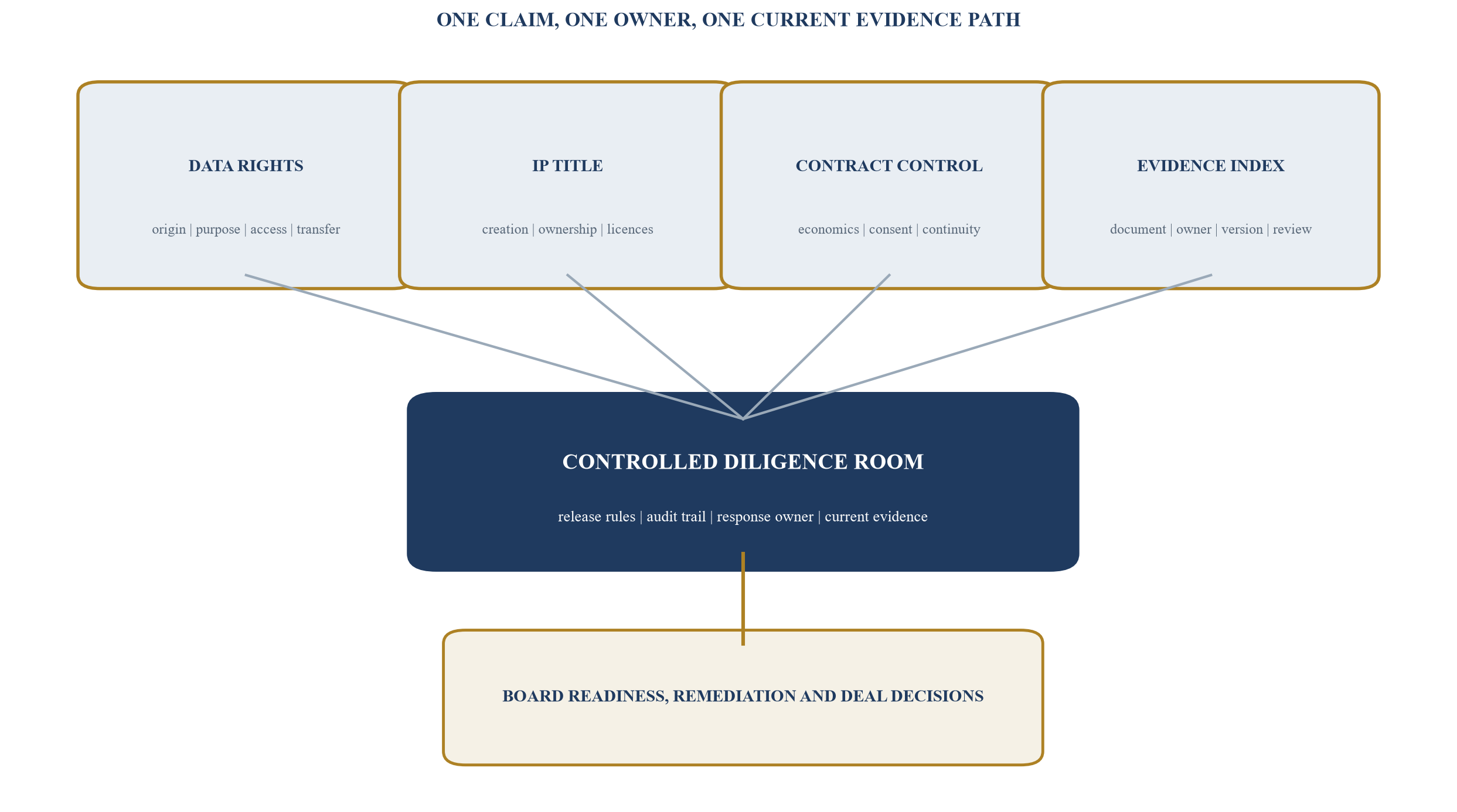
Four operating ledgers feed a controlled diligence room and a board decision layer.
2. Start with the buyer's decision questions
A diligence request list can contain hundreds of items. The board gains more control by organising those items around the decisions the buyer must make. The buyer needs to know what it will own, what it must continue paying for, what may terminate, what requires consent, which liabilities may transfer, whether reported performance is reproducible, and how much remediation is required after completion. Each question affects value, certainty, timing, structure or integration.
Ownership questions cover shares, intellectual property, data rights, physical assets, domain names, brands, permits and contractual benefits. Dependency questions cover founders, critical employees, cloud providers, data licensors, manufacturers, distributors, landlords, lenders and major customers. Restriction questions cover exclusivity, non-compete obligations, data-use limits, geographic restrictions, security interests, assignment clauses and regulatory approvals. Quality questions cover recurring revenue, gross margin, cash conversion, customer concentration, churn, pipeline definitions, product performance and cybersecurity history.
Management should translate these questions into a transaction value-leak map. A missing signature may be curable before a process. A customer consent may require relationship management and careful timing. A licence that cannot transfer may require a replacement plan. A disputed cap table may affect signing authority and consideration allocation. A weak data-rights position may narrow the product a buyer can deploy. The map should state the commercial consequence, evidence available, responsible owner, adviser required, remediation path and decision deadline.
Readiness does not mean that every issue must be eliminated. Some restrictions are ordinary features of commercial contracts and regulated businesses. The company should identify them early, quantify the operating dependency where possible, and prepare a credible path through consent, amendment, replacement, escrow, covenant, indemnity, price adjustment or integration planning. A buyer is better able to underwrite a known issue with a controlled response than an issue discovered late through inconsistent answers.
The founder and board should also distinguish a business defect from an evidence defect. A business defect exists when the company lacks a right, control or capability it needs. An evidence defect exists when the company may have the right or control but cannot demonstrate it quickly. Both can delay a transaction. Their remedies differ. A missing assignment may require a new instrument and negotiation. A misplaced assignment may require document recovery, verification and indexing. The diagnostic should preserve that distinction.
Table 1. Multi-domain exit-readiness diagnostic
| Domain | Buyer decision | Minimum evidence | Typical remediation route | Board indicator |
|---|---|---|---|---|
| data | can the buyer lawfully use, combine, retain and transfer the data? | inventory, lineage, purpose, notices, contracts, transfers, retention and access records | rights confirmation, notice update, consent or lawful-basis review, segregation, deletion or revised architecture | percentage of material datasets with complete rights chain |
| intellectual property | does the target own or control the assets needed to operate and scale? | asset register, assignments, registrations, licences, contributor records and renewal status | assignments, licence amendment, filing, renewal, source-code or brand remediation | percentage of critical IP with verified title and permitted use |
| contracts | will economics and operational rights continue through the transaction? | executed contracts, amendments, schedules, consent and change-of-control analysis | consent plan, amendment, replacement, waiver, pricing or structure response | revenue and critical spend covered by completed clause review |
| cybersecurity | can the buyer rely on the control environment and incident record? | asset inventory, policies, testing, incident logs, remediation and governance | control remediation, testing, disclosure review and integration plan | critical findings open and average closure age |
| corporate and equity | can the buyer verify authority, ownership and consideration allocation? | constitutional documents, registers, approvals, cap table, instruments and filings | ratification, register correction, conversion or waiver | reconciled fully diluted ownership and approval map |
| evidence governance | can each material answer be supported by a current definitive record? | index, owner, version, access, review date and response log | document recovery, version control, privilege review and staged release | median time to a complete diligence response |
Scores and thresholds should be set by management and advisers for the company's transaction, jurisdiction and risk profile.
3. Design the evidence index before the data room
A virtual data room is a delivery environment. The evidence index is the control system behind it. A company can upload thousands of files and still leave a buyer uncertain about which agreement is current, whether an amendment is missing, who approved a decision, or how a number reconciles to the accounts. The index should therefore exist independently of any sale platform and remain useful throughout the company's life.
Every evidence item should have a unique identifier, descriptive title, domain, legal entity, counterparty or asset, effective date, expiry or renewal date, definitive status, confidentiality tier, owner, reviewer, last review date, source system and linked dependencies. Executed agreements should be separated from drafts. Amendments should be linked to the base agreement. Board approvals should be linked to the action they authorise. Data-protection records should be linked to the relevant dataset and processing activity. Intellectual-property assignments should be linked to each creator and asset family.
The index should also record what a file proves. A certificate of incorporation proves a particular registration event; it does not prove the current shareholding. A patent registration proves a recorded right in a jurisdiction; it does not by itself prove that every inventor's interest was properly assigned or that the product avoids third-party rights. A customer contract proves agreed terms; it does not by itself prove delivery, invoice quality, collection or renewal probability. Evidence design requires precise claims.
Access tiers are equally important. A broad management room can contain routine corporate, financial and commercial documents. A restricted room may contain employee information, detailed customer data, security testing, source-code materials or competitively sensitive pricing. A clean-team process may be required where competition or confidentiality concerns arise. Privileged material requires counsel-led review. The index should state the release authority and permitted recipient for each tier.
The response log sits alongside the index. It records the buyer's question, internal interpretation, answer owner, evidence links, adviser review, date released and any qualification. This reduces the risk of different workstreams giving incompatible answers. It also gives the board a live view of issues, overdue responses and assertions that still depend on missing proof.
4. Build a data-rights ledger
Data can support product performance, customer insight, risk decisions, pricing, automation and recurring revenue. Its transaction value depends on the buyer's ability to understand and use it within applicable law and contract. A data-rights ledger converts a broad claim such as "we own our data" into a disciplined description of origin, role, purpose, permission, control and restriction.
The ledger begins with a business-level dataset inventory. Entries can include customer-account data, transaction records, telemetry, user behaviour, training data, derived features, model outputs, supplier data, public data, employee data and research datasets. Each entry identifies the relevant legal entity, system, geography, data subjects, sensitivity, source and accountable business owner. Technical metadata should connect to this business record without forcing the board to interpret raw infrastructure inventories.
Rights should be described carefully. Personal data is generally subject to legal duties and data-subject rights rather than ordinary property language. Customer contracts may allow processing only to deliver the service, while restricting product improvement, benchmarking, model training, cross-customer aggregation or onward transfer. Publicly accessible information may still carry database, copyright, confidentiality, terms-of-use or privacy constraints. Licensed data may be usable during the contract term and unavailable after termination or a change of control.
The ledger should therefore record the purpose of use, legal or contractual basis, notice or consent position where relevant, controller or processor role, retention rule, cross-border transfer mechanism, security classification, subprocessor chain and transaction consequence. It should identify whether the data can remain in the target, move to the buyer, be combined with the buyer's data, support new purposes, or require separation and deletion.
The UAE's federal data-protection framework, the UK GDPR and the EU GDPR each make governance, transparency, security and international transfer relevant to company data. The ICO's due-diligence guidance specifically directs organisations to identify the data being transferred, establish purposes and lawful basis, document sharing, assess technical and organisational measures, address accuracy and retention, and consider information to individuals. The EDPB has also called for transparent assessment of privacy implications in significant mergers. These materials support a transaction workstream that begins before the final diligence phase.
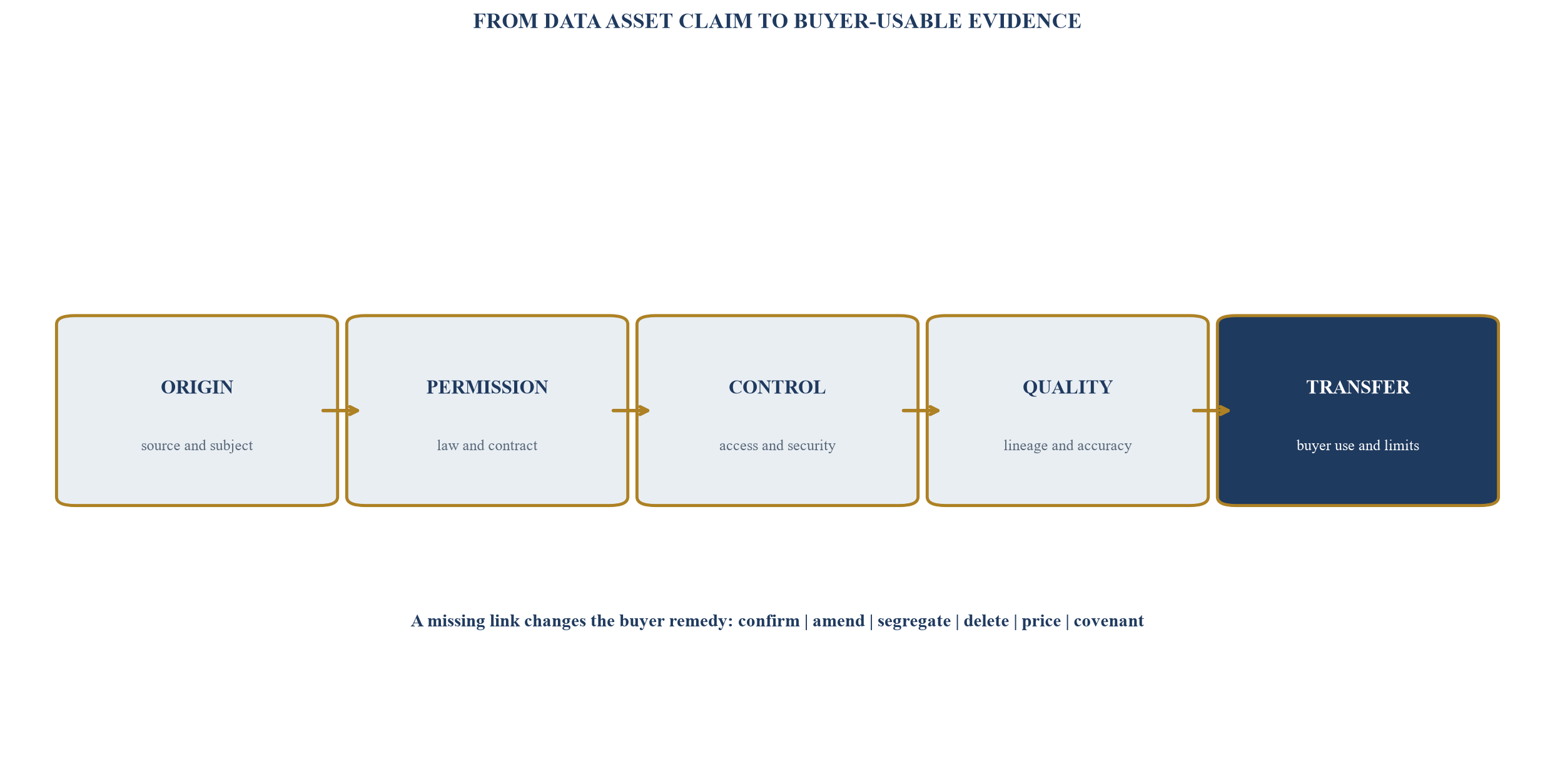
A dataset reaches transaction-ready status only when origin, permission, control, quality and transfer position are connected.
Table 2. Data asset and rights register
| Field | Question | Evidence | Transaction action |
|---|---|---|---|
| dataset and system | what information exists and where is the authoritative record? | system inventory, schema, owner and data-flow map | reconcile duplicate stores and define authoritative source |
| origin | was the data collected, generated, licensed, purchased or derived? | collection record, supplier agreement, methodology or lineage log | verify provenance and isolate unsupported inputs |
| permitted purpose | which current and future uses are authorised? | notice, consent record, contract, policy and legal analysis | align use, update documentation or stop unsupported processing |
| role and parties | which entity acts as controller, processor, licensor or recipient? | group map, processing terms and subprocessor register | correct entity and contract mismatches |
| geography and transfer | where are subjects, systems, users and recipients located? | transfer map, safeguards, localisation analysis and vendor locations | implement approved transfer or local architecture |
| quality and retention | can the company explain accuracy, lineage, correction and deletion? | quality tests, retention schedule and deletion logs | remediate unreliable data and expired holdings |
| transaction position | can the dataset remain, transfer and support buyer integration? | clause review, privacy analysis, security plan and consent map | define transfer, segregation, clean-room or deletion path |
The register is a management control. Privacy counsel and other specialists should validate jurisdiction- and use-specific positions.
5. Make lineage and quality reproducible
Buyer diligence often begins with a strategic claim and ends with a sample test. Management may describe a proprietary dataset, a superior model, accurate customer cohort reporting or a repeatable pricing engine. The buyer then asks where the underlying records originated, how transformations were applied, which exclusions changed the result and whether the output can be reproduced from controlled source data.
Lineage should connect source, ingestion, transformation, storage, feature creation, model use, reporting and deletion. Material manual steps require named owners and review controls. If a management dashboard combines finance, CRM, product and spreadsheet data, the company should document definitions, reconciliation rules and the point at which each source becomes authoritative. A metric dictionary is part of transaction evidence because it prevents the same term from carrying several meanings.
Quality controls should be proportionate to the value and risk of the dataset. They can include completeness, validity, uniqueness, consistency, accuracy and timeliness checks. Exceptions need an owner and resolution trail. A dataset used for a customer report may require different tolerances from a dataset used for credit, healthcare, safety or regulated decisions. The buyer needs to see that management understands this distinction and has designed controls around the actual use.
Model and analytics evidence should preserve training and validation data descriptions, feature definitions, model versions, evaluation methods, known limitations, access, approval and monitoring. Where third-party models or application programming interfaces are used, the register should identify provider terms, data handling, availability, pricing, model-change risk and exit options. The EU AI Act and other evolving AI regimes may add obligations according to role, system type and use. A transaction plan should identify applicable requirements through current specialist advice.
The board should ask for reproducibility tests before a transaction. Select a small number of critical figures and product claims, then require an independent internal team to rebuild them using indexed evidence. A result that cannot be reproduced is a readiness issue even when the headline appears plausible. The exercise often reveals missing definitions, manual adjustments, inconsistent access and undocumented dependencies while remediation remains manageable.
6. Treat privacy as a deal-design workstream
Privacy diligence should inform transaction design, integration sequencing and communication. The buyer may intend to combine customer records, link identities, train models, centralise infrastructure, change providers or use information for new products. The target's current notices, contracts and legal bases may support only its existing purposes. The post-transaction plan therefore matters alongside the historical compliance review.
Management should prepare a transaction privacy brief. It identifies material processing activities, sensitive or high-risk data, applicable regimes, international transfers, processors, incidents, complaints, regulator engagement, retention, children's data where relevant and automated decision-making. It should state the intended transaction steps at signing, completion and integration. The brief gives counsel and privacy specialists a concrete operating model to review.
The company should also test disclosure pathways. Broad data extracts should not enter an early diligence room merely because the buyer asks for customer-level detail. Aggregation, anonymisation, synthetic samples, redaction, controlled query environments and clean-team access can provide decision-useful evidence while reducing unnecessary exposure. The method depends on the question, applicable law, contract and competition concerns.
Incident and complaint records require completeness and context. The log should state what happened, affected systems and data, containment, assessment, notifications, remediation, recurrence controls and open obligations. A buyer will compare the record with security reports, insurance notifications, customer communications and board minutes. Consistency matters. A carefully documented minor event can be easier to underwrite than an incomplete record that suggests undisclosed scope.
Privacy representations in customer and supplier contracts should be mapped to actual operations. Commitments about location, deletion, audit, subprocessor approval, encryption, incident notice and data use can be more demanding than baseline law. The contract-control matrix and data-rights ledger must therefore be linked. A legal conclusion based only on statute may miss a commercially important contractual promise.
7. Build evidence-ready cybersecurity governance
Cybersecurity diligence examines the target's capacity to identify, govern, protect, detect, respond and recover. NIST's Cybersecurity Framework 2.0 gives governance explicit prominence and links cybersecurity outcomes to enterprise risk management. CISA's Secure by Design and software-supply-chain resources emphasise accountable product security and transparency. These frameworks can help management organise evidence without representing a voluntary framework as a legal conclusion.
The evidence pack should include the asset inventory, system architecture, identity and access controls, privileged access, logging, vulnerability management, penetration tests, remediation, backups, recovery tests, incident response, supplier controls, security training, insurance and board governance. The buyer will often seek a view of the current control state and the trend. Findings should therefore show severity, owner, due date, status, exception approval and closure evidence.
Security testing reports need disciplined handling. An outdated test can be misleading; an unredacted report can expose sensitive details. The company should prepare a controlled summary, current remediation tracker and staged access to technical evidence. Material statements should reconcile with customer security questionnaires, regulatory submissions, insurance applications and public disclosures. US public-company rules illustrate the importance of processes, management responsibility and board oversight for material cybersecurity risks, even when the target itself is not an SEC registrant.
Software companies should maintain a software bill of materials or equivalent dependency inventory appropriate to their product. The record should identify components, versions, licences, known vulnerabilities, maintenance status and replacement plans. The commercial consequence matters. A critical unmaintained dependency can affect security, uptime, customer obligations and integration cost. A restrictive open-source licence can affect distribution or source-code obligations. Security and IP reviews should therefore share a dependency record.
The buyer's integration model should enter the analysis early. A target that relies on its founder's personal cloud account, informal administrator access or an unsupported environment may operate today and still require immediate separation or migration. Management should present an executable Day One plan: identity, network connectivity, data access, incident escalation, backup, key suppliers and privileged credentials. Readiness converts a technical inventory into transaction continuity.
8. Prove the intellectual-property chain of title
Intellectual property can include patents, patent applications, trademarks, domain names, copyright, source code, designs, databases, confidential know-how, trade secrets, documentation and contractual rights. WIPO's IP audit guidance begins with an inventory, ownership proof, third-party rights and transferability. That sequence is well suited to transaction readiness because it separates identifiable assets from broad assertions about innovation.
The IP register should state the asset, type, creator, creation date, legal owner, beneficial or economic interest where relevant, jurisdiction, registration or application number, status, renewal, security interest, licence, dispute, product use and evidence link. Registered rights should be checked against official registers. The legal entity named in the register should match the target structure or have a documented licence or assignment.
Chain of title begins with people. Founders may create code, designs, data, brands or inventions before incorporation. Employees may work across group entities. Contractors, agencies, universities, accelerators and joint-development partners may contribute. An employment or consultancy relationship does not answer every ownership question in every jurisdiction. The company should obtain jurisdiction-specific advice, preserve executed agreements and link contributors to the relevant asset family.
Assignments should identify the right and parties with enough precision for applicable law and registration practice. The USPTO provides official recordation pathways for patent and trademark ownership changes and maintains assignment information. Recordation is a component of evidence; the company and advisers still need to examine the underlying instrument, scope, execution, timing and conflicting interests. Other jurisdictions have their own requirements and registers.
The board should review the IP register during product and financing milestones. New products, brand launches, acquisitions, employee departures, contractor programmes, open-source adoption, university collaborations and security interests can change the position. A register refreshed only before a sale can reveal an unreachable contributor or expired right when leverage is weakest.
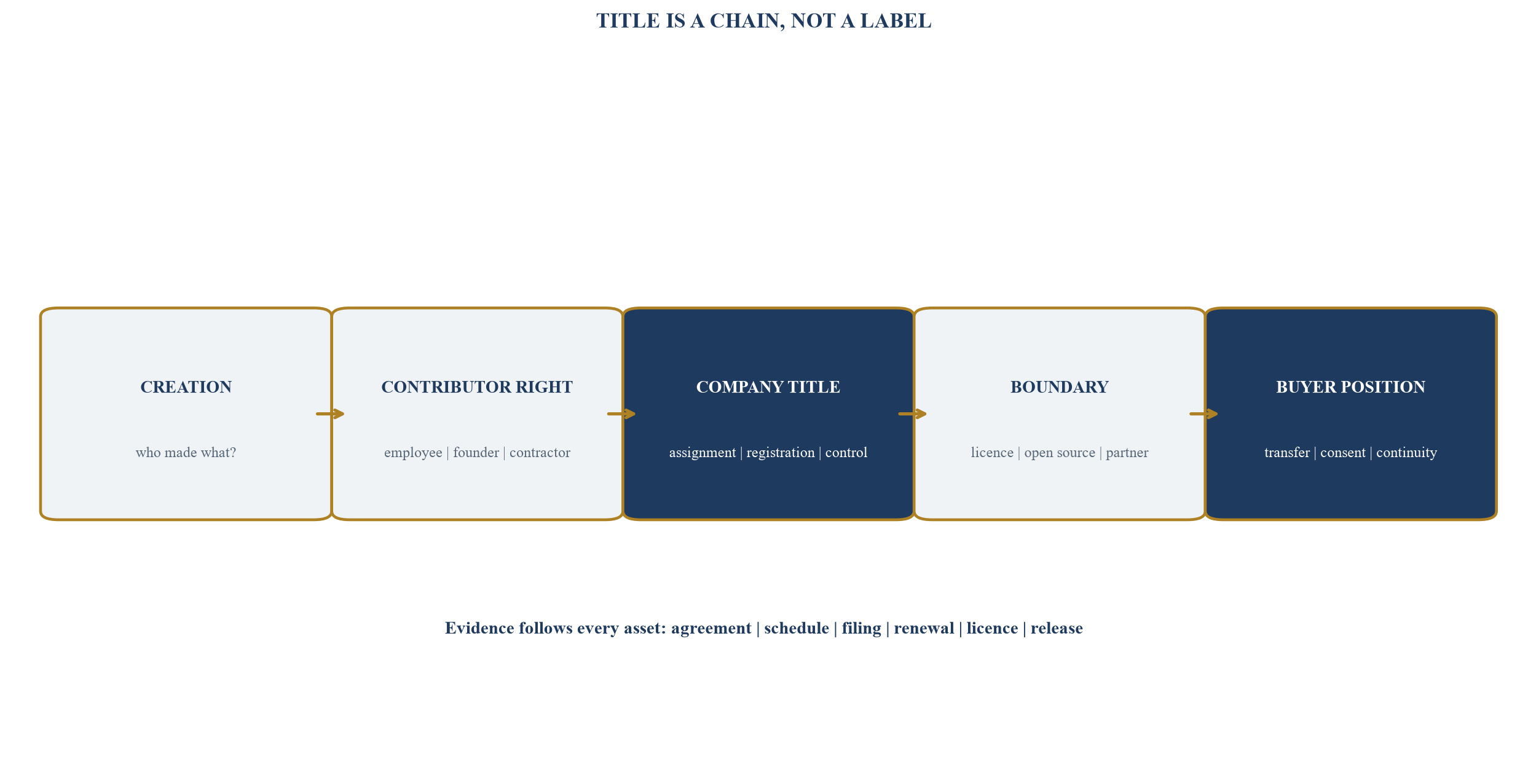
The chain connects creation, contributor rights, company ownership, third-party boundaries and buyer transfer.
Table 3. Intellectual-property register
| Asset family | Evidence of creation and title | Third-party boundary | Buyer diligence test | Remediation path |
|---|---|---|---|---|
| source code and software | repository history, employee and contractor terms, assignments and product mapping | open-source components, libraries, APIs, cloud and development tools | can the buyer trace contributors and operate the current release? | assignments, dependency review, licence remediation and repository controls |
| patents and inventions | invention disclosures, assignments, application and registration records, renewals | joint inventors, research partners, licences and security interests | does title match the target and the commercial product? | correct ownership, record instruments, renew rights and resolve encumbrances |
| trademarks, brands and domains | creation records, filings, registrations, domain control and renewals | agencies, founders, distributors, coexistence arrangements and local marks | can the buyer use and defend the brand in priority markets? | assignments, registrations, account transfer and conflict plan |
| trade secrets and know-how | identified secret, access controls, confidentiality terms and handling procedures | employees, contractors, suppliers, customers and public disclosures | has the company taken practical steps to preserve confidentiality? | classify, restrict, document and refresh confidentiality measures |
| data and databases | provenance, rights ledger, schema, transformation records and access | personal data, customer rights, licences, database rights and public sources | can the buyer continue each material use? | confirm rights, segregate, amend, delete or redesign use |
| content, designs and documentation | author records, assignments, source files and publication history | agencies, stock assets, customer content and platform terms | is ownership complete and is every embedded component licensed? | obtain releases, replace assets and document licences |
The table is a transaction-control template; ownership and transfer conclusions require current jurisdiction-specific advice.
9. Control open-source and third-party technology
Modern products are assembled from internal code, open-source software, commercial libraries, cloud services, application programming interfaces, data feeds and development tools. The relevant diligence question is whether the company understands this composition and can continue to distribute and operate the product under the applicable terms.
An open-source policy should define approved licences, review thresholds, component intake, attribution, source-code obligations, vulnerability handling and exceptions. The dependency inventory should connect each component to the product version and distribution method. Licence analysis depends on the licence text, linking or interaction, modifications, distribution and deployment architecture. Technical and legal reviewers should work from the same product facts.
Commercial dependencies require a parallel review. A product may depend on a model provider, mapping service, communications platform, payments service, database, identity provider or hosting environment. The register should capture term, price mechanics, usage limits, audit rights, data handling, service levels, termination, assignment, change of control, export restrictions and transition support. A buyer may view a low-cost dependency as material when it has no practical substitute.
OpenChain's ISO-based materials and CISA's software-bill-of-materials work provide useful process anchors for open-source compliance and component transparency. Management should choose controls appropriate to product risk and scale. A list produced once for diligence has limited value if engineering can introduce unreviewed components the following day. Integration with development and release workflows makes the evidence current.
The transaction plan should include a dependency concentration view. It shows which products, customers and revenue streams rely on each critical provider or component. It also records migration time, data portability, replacement cost and contractual support. This turns a technical bill of materials into a commercial continuity analysis.
10. Protect trade secrets through operating conduct
Trade-secret value depends on the information and the measures used to preserve secrecy under applicable law. WIPO's trade-secret management guidance emphasises identification, access control, contractual protection, employee processes and response to leakage. A company should therefore identify its actual secrets rather than placing a generic confidentiality label on every document.
The register can describe algorithms, process know-how, pricing logic, customer strategies, manufacturing methods, formulas, technical configurations and other confidential information. It should state where the information resides, who needs access, how access is approved, which agreements apply, how departures are handled and which disclosures have occurred. Excessive access weakens control and complicates buyer integration.
Employee and contractor offboarding requires particular attention. Access should be removed promptly, equipment and materials returned, continuing obligations restated where appropriate, and material repositories checked. Departures of founders or technical leaders should trigger a review of accounts, credentials, development history and retained copies. The company should document lawful, proportionate steps and obtain advice where monitoring or investigation is contemplated.
Diligence disclosure itself can expose secrets. The staged release plan should use redaction, summaries, controlled viewing, watermarking, clean teams or source-code escrow according to the transaction. The company should record what was disclosed, to whom, under which confidentiality agreement and with what download rights. The evidence index becomes part of the trade-secret control environment.
11. Build a contract-control matrix
Contracts convert commercial relationships into rights, obligations, cash flows and dependencies. A buyer needs the complete executed record, including schedules, order forms, statements of work, data-processing terms, security addenda, amendments, waivers and side letters. A contract summary created from an incomplete document set can produce a confident and wrong conclusion.
The matrix should cover material customer, supplier, financing, property, channel, employment, technology, data, intellectual-property and partnership agreements. Materiality should reflect value and operational importance. A small supplier can be critical if it provides an irreplaceable component. A customer can be material through reference value, data access or channel influence even when current revenue is modest.
Each row records parties, legal entity, term, renewal, termination, price, volume, service obligations, liability, indemnity, intellectual-property terms, data rights, security, exclusivity, most-favoured terms, non-compete provisions, assignment, change of control, consent, notice, governing law, disputes and evidence completeness. The commercial owner should validate how the relationship operates. Counsel should review legal interpretation.
The company should connect the matrix to financial and operational systems. Customer contract values should reconcile to billing and collections. Supplier commitments should reconcile to spend and product dependencies. Financing agreements should reconcile to debt balances, security and covenant reporting. This makes the matrix a value and continuity tool rather than a legal catalogue.
Contract management from day one creates compounding benefits. Standard clause positions become visible. Non-standard concessions can be approved and tracked. Renewals and notices can be managed. Entity errors and missing signatures can be corrected promptly. By the time a transaction begins, the company can explain its contracting policy and the exceptions that matter.
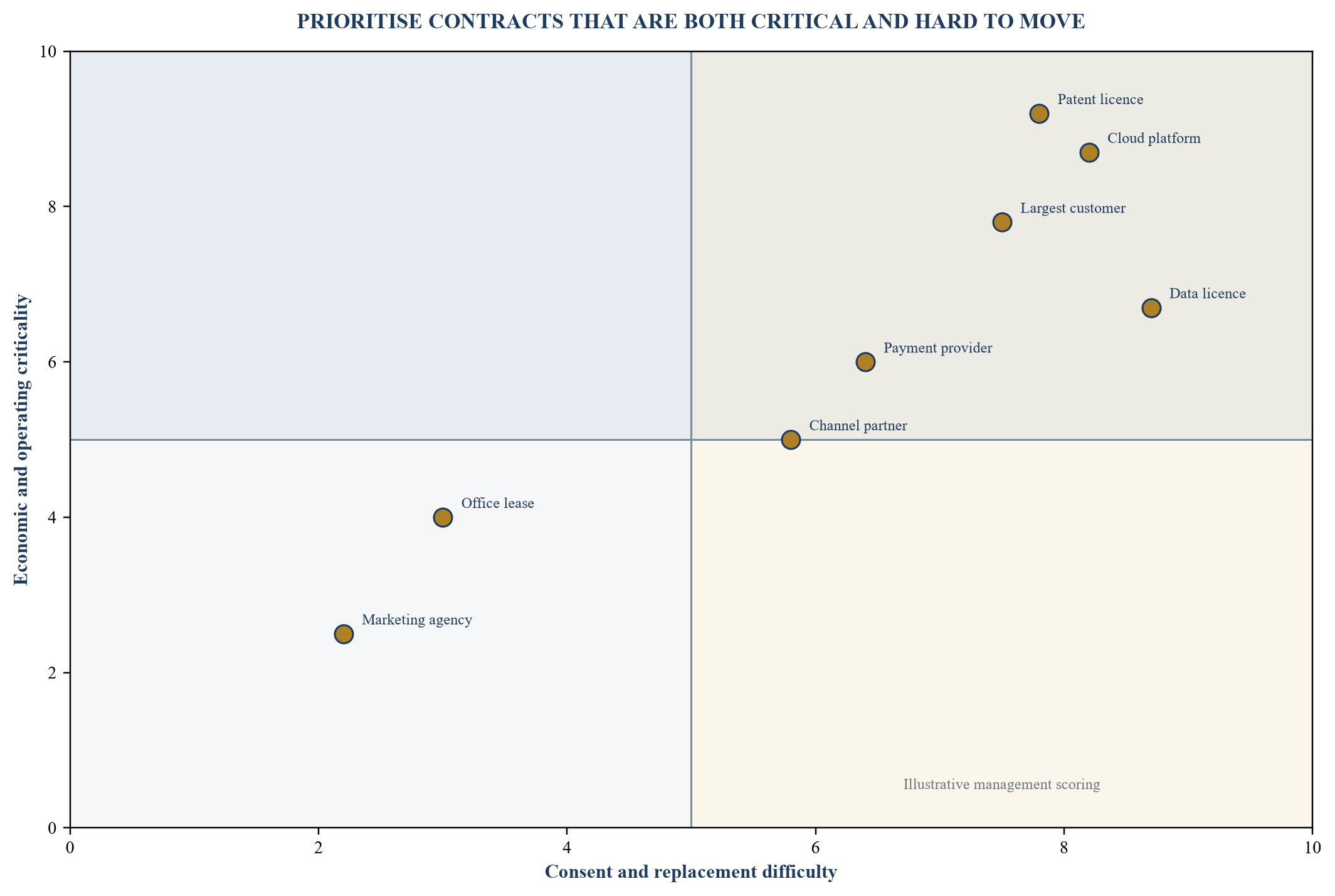
Illustrative matrix; management should score economic importance and execution difficulty using company-specific evidence and legal advice.
Table 4. Contract review and consent matrix
| Contract control | Evidence question | Commercial consequence | Owner response | Deal workstream |
|---|---|---|---|---|
| complete document set | are base agreement, schedules, orders, amendments and side letters present and executed? | economics or obligations may differ from the summary | recover documents, confirm definitive version and reconcile systems | evidence index and legal review |
| assignment | does transfer of rights or obligations require consent or meet stated conditions? | asset or contract transfer may be restricted | analyse structure, obtain consent or prepare replacement | legal structure and consent plan |
| change of control | does a direct or indirect ownership change trigger consent, notice, termination or repricing? | transaction certainty, timing or value may be affected | map trigger, relationship and negotiation sequence | signing, completion and communications |
| termination and renewal | can either party terminate for convenience, breach or transaction event; when does renewal occur? | revenue or service continuity may be shorter than forecast | quantify exposure, cure breaches and manage notice dates | valuation, warranties and integration |
| data and security | what processing, location, audit, incident and deletion commitments apply? | operations may conflict with contractual promises | reconcile data ledger and controls; amend or remediate | privacy, cyber and product integration |
| IP and exclusivity | who owns outputs and improvements; what licences, restrictions or most-favoured terms apply? | product freedom, margins and buyer synergies may narrow | map rights, seek amendment or price limitation | IP, commercial and valuation review |
Clause interpretation and consent requirements depend on the complete contract, transaction structure and applicable law.
12. Map assignment, change of control and consent
Assignment and change-of-control clauses require transaction-specific analysis. A share sale, asset sale, merger, internal reorganisation and financing enforcement can produce different consequences. The company should avoid relying on a clause label or a spreadsheet summary without counsel reviewing the complete agreement and proposed structure.
The consent plan starts with the contracts that combine high economic importance and high execution difficulty. For each, management identifies the contractual trigger, consent or notice recipient, timing, information rights, termination or repricing remedy, relationship owner, negotiation leverage, confidentiality constraints and fallback. The plan should coordinate customer, supplier, lender, landlord, licensor and regulator communications.
Timing is a strategic decision. Early contact can protect completion certainty and provide time for amendment. It can also reveal a confidential process, invite renegotiation or affect the relationship. Late contact can preserve confidentiality while concentrating completion risk. The deal team should approve a sequence based on contractual requirements, relationship evidence and transaction milestones.
Fallbacks should be operationally credible. A statement that a supplier can be replaced needs evidence of alternatives, qualification, integration, data migration, cost and time. A statement that customer consent is likely needs relationship ownership, decision-maker mapping and a prepared value proposition. Where the restriction cannot be removed, the buyer may consider structure, covenant, holdback, condition, indemnity, transitional service or price. Management should model the commercial effect without assuming the buyer's ultimate response.
The consent tracker becomes a controlled deal document. It records current status, latest communication, required approvals, supporting materials, dependency and escalation. It should not contain casual commentary that could damage a relationship if disclosed. Counsel should determine privilege and disclosure treatment.
13. Make the revenue story auditable
Buyers frequently test whether reported revenue is contracted, delivered, recognised and collected according to consistent definitions. Exit readiness should therefore connect the contract-control matrix to the customer master, order forms, invoices, revenue ledger, cash receipts, credits, refunds and deferred revenue. The objective is a traceable revenue bridge for each material customer and cohort.
The company should define recurring revenue, annual contract value, bookings, backlog, pipeline, gross retention, net retention, churn and expansion. Each definition should state inclusions, exclusions, currency, timing and source system. Management should avoid changing definitions between board materials, fundraising decks and transaction analysis without a documented reconciliation.
Contract terms shape quality. Termination for convenience, acceptance conditions, service credits, minimum commitments, usage pricing, customer concentration, renewal mechanics and implementation obligations can change the durability and cash profile of a headline number. Data and IP rights can also affect economics. A contract that permits only narrow customer-specific use may support current revenue while limiting cross-customer product improvement.
Customer evidence should include delivery and relationship context. Product usage, support history, renewal discussions, implementation status, outstanding disputes and executive sponsorship help explain the contractual record. Management should identify customers whose economics depend on unpaid custom work, founder attention or non-standard concessions. These relationships may still be valuable; the buyer needs a realistic operating view.
The quality-of-revenue workstream should also test cash. Invoice dates, payment terms, collection history, concentration, disputes, credit notes and bad debt reveal whether accounting revenue converts to accessible cash. A working-capital mechanism in the transaction may depend on consistent classifications and cut-off. Finance should reconcile the analysis before the buyer or its advisers perform the same exercise under greater time pressure.
14. Connect people, invention and continuity
People evidence sits across intellectual property, contracts, security and operations. The company should maintain executed employment and consultancy agreements, role and entity mapping, compensation and incentive records, confidentiality and invention provisions, immigration or work-authorisation records where relevant, performance documentation and departure controls. Sensitive personal information needs staged access and lawful handling.
The contributor map links founders, employees, contractors and partners to product releases, inventions, designs, content, datasets and know-how. It identifies missing agreements, entity changes and pre-incorporation work. Where a contributor is no longer engaged, remediation may require careful contact and negotiation. Early review protects leverage and reduces transaction pressure.
Continuity analysis identifies critical roles, decision rights, system access, customer relationships and knowledge concentration. A buyer may distinguish value tied to transferable systems from value tied to one person. Management should document processes, delegate authority, create succession coverage and maintain controlled technical and commercial records. These steps improve the operating business as well as transaction readiness.
Equity incentives require accurate records. Grant approvals, plan rules, exercise prices, vesting, leaver terms, acceleration, tax treatment and transaction treatment should reconcile to the fully diluted cap table. Informal promises create uncertainty. The company should document management's understanding, then ask legal and tax advisers to confirm the position.
Retention planning should begin with roles and transaction needs. The company should avoid assuming that every senior employee requires the same arrangement. Some roles are essential through signing; others through completion, separation or integration. The plan should consider existing incentives, communication, fairness, legal constraints and buyer involvement. Any illustrative retention budget remains a management assumption until approved by the relevant parties.
15. Reconcile corporate authority and the cap table
A buyer needs to verify that the seller owns the shares, the company issued securities properly, decision-makers have authority, and the consideration can be allocated. The evidence pack should include constitutional documents, registers, shareholder agreements, subscription documents, option plans, grants, convertible instruments, warrants, board and shareholder approvals, filings, security interests and historic reorganisations.
The fully diluted cap table should be rebuilt from definitive instruments rather than accepted from a presentation. Each line should connect to issue date, class, price, vesting, conversion, exercise, preference, consent and evidence. The model should reconcile to statutory or official records where applicable and explain differences. Funding-round models, accounting records and the legal cap table should use consistent transaction histories.
Board and shareholder minutes should evidence actual decisions. Blanket retrospective approvals can create additional questions if they do not match conduct or legal requirements. Counsel should advise on ratification and corrective steps. The objective is a clean authority chain from formation through financing, hiring, IP acquisition, material contracts and the proposed transaction.
The company should maintain a distribution waterfall using the current instruments and management transaction assumptions. It should show gross consideration, debt-like items, working-capital adjustment, transaction costs, preference, conversion, option treatment, escrow or holdback and net distributions. The result is a decision model. It is not a forecast of sale value or a substitute for legal, tax and financial advice.
Table 5. Corporate, equity and authority control
| Control area | Definitive evidence | Reconciliation test | Potential transaction consequence |
|---|---|---|---|
| legal entities | incorporation, constitutional documents, official registers and group chart | every asset, employee and contract maps to the correct entity | transfer scope, approvals, tax and stranded assets |
| issued securities | subscription and issue documents, registers, certificates and approvals | issued and outstanding amounts reconcile across legal and finance records | seller title and consideration allocation |
| options and incentives | plan, grant, acceptance, vesting, exercises and leaver records | grant-level schedule reconciles to fully diluted model | dilution, acceleration, retention and payroll or tax treatment |
| convertibles and warrants | executed instruments, amendments, notices and side letters | conversion and exercise logic reconciles to cap table assumptions | closing mechanics, consent and distribution waterfall |
| security interests | financing documents, filings, releases and covenant records | registered and contractual security maps to assets and debt | repayment, release and completion condition |
| approvals and authority | board, shareholder and committee records plus delegations | each material issue, acquisition, contract and proposed transaction has valid authority | enforceability, warranties and closing deliverables |
The board should require a single reconciled record backed by definitive instruments and current professional review.
16. Turn the data room into a controlled response process
A diligence room should have a release protocol, folder taxonomy, naming convention, index, access tiers and audit trail. It should reflect the evidence architecture rather than become the first place the company tries to organise its history. Management should designate a room administrator and domain owners, with counsel controlling legal review and privilege.
The initial room should contain current, definitive and decision-useful evidence. Superseded versions can be retained in the source repository and released when needed. File names should include meaningful identifiers and dates. Password-protected attachments, unreadable scans, broken links and undocumented archives should be resolved before upload. Personally identifiable information and security-sensitive material should be minimised and protected.
Every response should pass four checks: the question has been interpreted correctly; the evidence is complete and current; the answer is consistent with other disclosures; the release is authorised. An answer may be accurate within one department and inconsistent with a financing deck, customer questionnaire or board paper. Cross-domain review is particularly important for revenue, data use, IP ownership, incidents and regulatory matters.
Response service levels help management preserve momentum. Simple indexed requests can have a short internal target. Complex legal, technical or accounting matters receive an owner, adviser and realistic date. The company should avoid filling silence with provisional assertions. A concise status and controlled follow-up is safer than an unsupported answer that later requires correction.
The board dashboard should show open requests by severity and age, missing critical documents, material issues, consent status, upcoming decisions and management load. It should also show business performance during the process. Transaction readiness has failed if the entire leadership team abandons customers and operations to feed the data room.
Table 6. Diligence response and evidence governance
| Request class | Response standard | Required review | Release control | Board escalation |
|---|---|---|---|---|
| indexed factual document | definitive file, clear title and index link | domain owner | room administrator | missing or inconsistent definitive record |
| financial or KPI analysis | definition, source, reconciliation and period | finance owner and transaction lead | approved workbook or controlled PDF | material change to reported performance |
| contract or legal conclusion | complete document set and scoped explanation | legal counsel | staged according to privilege and confidentiality | consent, termination, dispute or authority risk |
| privacy, cyber or technical matter | current control evidence, limitations and remediation status | privacy, security or technical owner plus counsel where required | restricted room, redaction or controlled review | material incident, critical finding or unsupported claim |
| commercial relationship | contract evidence plus operating context | account owner and transaction lead | customer-sensitive tier | concentration, churn, dispute or consent risk |
| unresolved issue | known facts, missing evidence, owner, next action and date | relevant adviser and executive sponsor | issue log with controlled narrative | value, structure, timing or completion impact |
Service levels are company-designed management controls; they should be adjusted for complexity, sensitivity and adviser review.
17. Score readiness by evidence and consequence
A readiness score should direct remediation rather than create false precision. Each domain can be assessed across completeness, validity, consistency, ownership, recency, transferability and operational consequence. The board should see both the score and the underlying evidence. A high average can conceal one critical gap, such as missing founder IP assignments or a change-of-control right in the largest customer contract.
The proposed model classifies findings into four groups. A title or authority defect questions whether the company owns or can transfer the relevant right. A continuity defect threatens revenue, product or operations through termination, dependency or consent. A compliance defect concerns law, regulation or contractual obligation. An evidence defect concerns missing, inconsistent or outdated proof. Each finding receives an impact, likelihood or uncertainty assessment, remedy, cost range, owner and deadline.
The remediation queue should be ordered by consequence and lead time. A patent renewal deadline, regulatory approval, customer consent or former-contractor assignment may require early action. File naming and indexing can be completed later and in parallel. The board should reserve management capacity and adviser budget according to the queue rather than treating readiness as a generic administrative project.
Progress should be measured through evidence gates. Examples include all critical datasets mapped; all material software dependencies classified; all critical contributors covered by reviewed agreements; all contracts representing a defined share of revenue and critical spend analysed; cap table reconciled; critical cyber findings closed or formally accepted; and a sample diligence request completed within target time. Thresholds remain management decisions informed by advisers and transaction context.
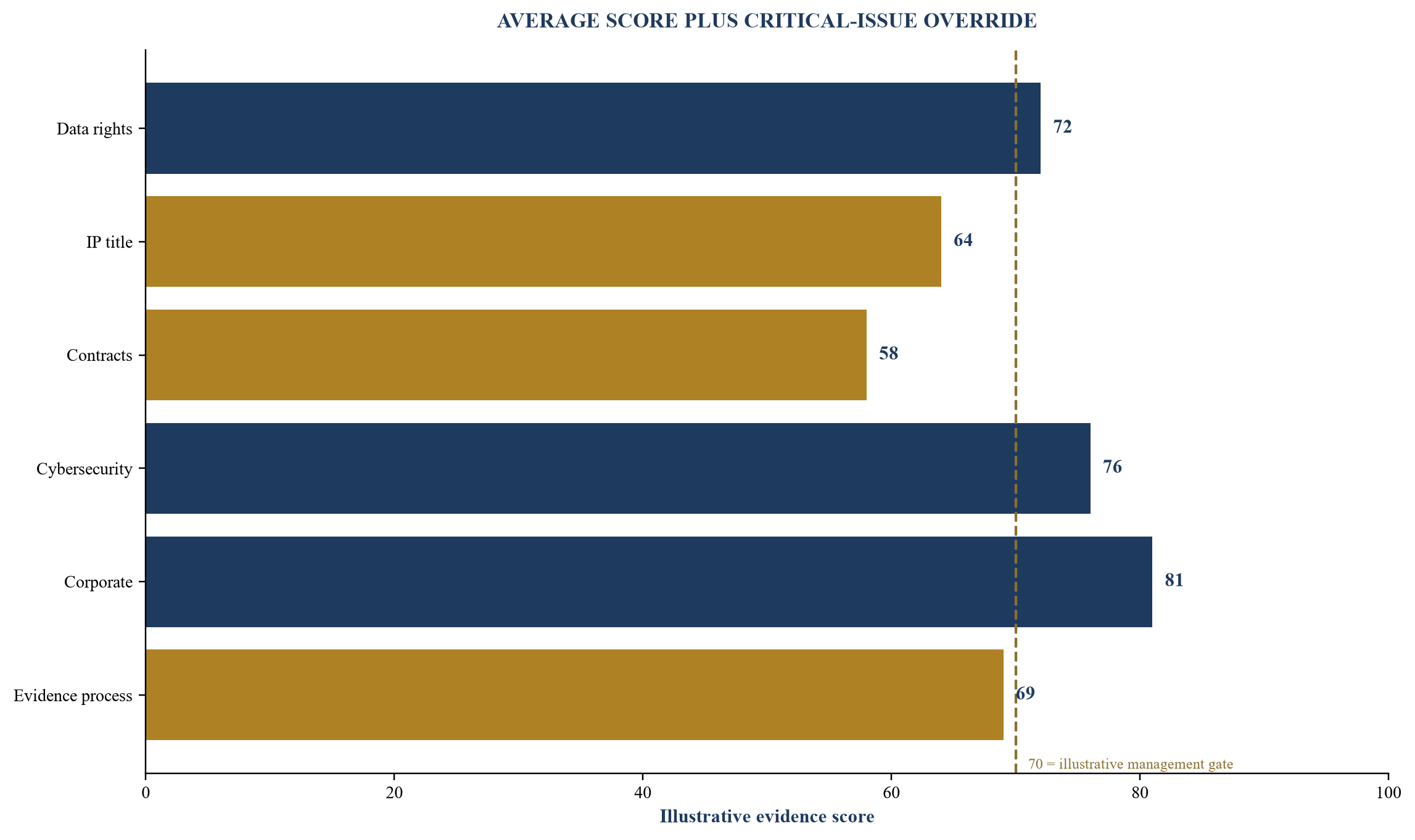
Illustrative management scoring; the critical-issue override prevents a strong average from concealing a transaction-blocking gap.
18. Execute a 180-day readiness programme
The first thirty days establish governance and scope. The board appoints an executive sponsor and domain owners. Management identifies likely transaction perimeter, entities, products, geographies and strategic buyer questions. The team creates the evidence index, data-rights ledger, IP register and contract-control matrix. Counsel and other advisers define review boundaries. A first diagnostic identifies critical gaps and long-lead remediation.
Days thirty-one to sixty focus on ownership and completeness. The company recovers executed contracts, assignments, board records, cap-table instruments and registrations. Finance reconciles revenue and equity records. Product and security teams build the system and dependency inventory. Privacy work maps processing, transfers, incidents and contractual commitments. Former-contributor, expired-right and missing-document issues begin immediately because response time is uncertain.
Days sixty-one to ninety address transferability and continuity. Counsel reviews assignment, change-of-control, consent and termination provisions for material contracts. Management builds replacement and consent plans. IP advisers validate chain of title, registrations and third-party boundaries. Technology leaders test software dependencies, access controls, recovery and separation needs. The team defines Day One and post-completion integration risks.
Days ninety-one to one hundred and twenty address performance evidence. Finance rebuilds the quality-of-revenue bridge and working-capital classifications. Commercial leaders validate customer status, renewal, concentration and delivery obligations. Product leaders reproduce critical usage and performance claims. The transaction team aligns management presentations, board reporting and the indexed evidence.
Days one hundred and twenty-one to one hundred and fifty run a mock diligence process. An internal or independent team issues a sample request list and management answers through the controlled workflow. The test measures response time, completeness, consistency and escalation. Material defects return to the remediation queue. The board reviews deal structure implications, consent timing and management capacity.
Days one hundred and fifty-one to one hundred and eighty prepare controlled launch readiness. The room is refreshed, access tiers tested, disclosure schedules planned and issue narratives reviewed. The company confirms adviser roles, approval paths, communication protocols and business-continuity coverage. Readiness then becomes a recurring monthly control until a process begins and a daily control during execution.
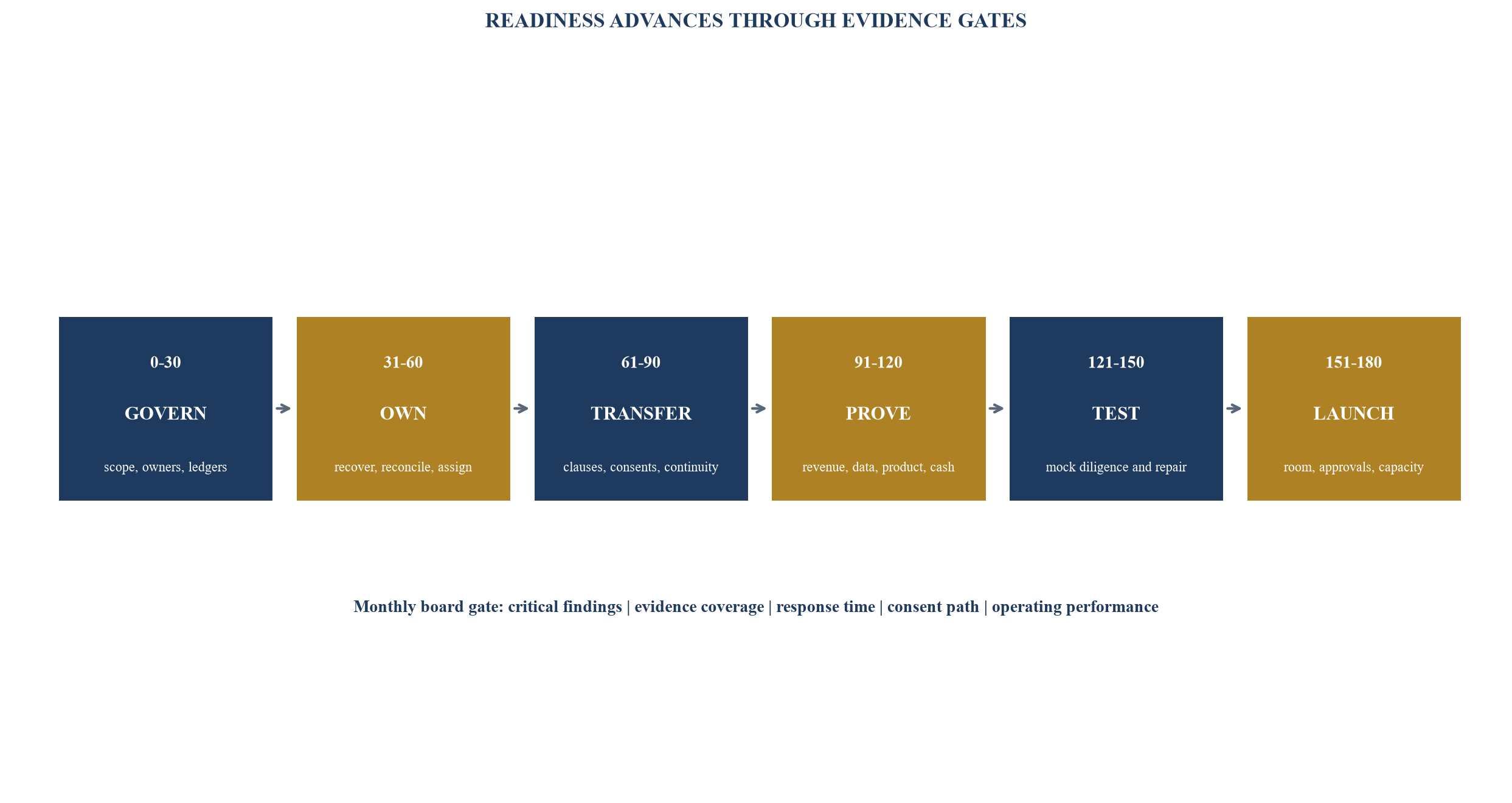
The sequence is an illustrative management plan; actual timing depends on company complexity, evidence gaps, jurisdictions and transaction objectives.
19. Use readiness to improve transaction choices
Readiness gives the board earlier information about transaction perimeter and structure. A dataset with restricted transfer rights may be segregated or excluded. A contract portfolio with concentrated consent risk may favour an ownership structure that preserves counterparties, subject to legal analysis. Intellectual property held outside the intended target may need assignment, licence or perimeter adjustment. A regulated activity may require approval or a different completion sequence.
The same information improves buyer selection. A strategic buyer may value data combination or product integration and face particular privacy, competition or architecture constraints. A financial buyer may focus on management continuity, recurring revenue, leverage capacity and separation. A buyer already using the same infrastructure may view a dependency differently from a buyer that requires migration. Management should present evidence relevant to the buyer's value thesis without overstating synergies.
Readiness also sharpens valuation discussion. IFRS 3 and IAS 38 distinguish identifiable intangible assets through separability or contractual and legal rights in relevant accounting contexts. The transaction price remains a negotiated outcome influenced by many factors. A complete IP and contract record can help advisers analyse identifiable assets, useful life, customer relationships, technology, brands and other value drivers. It cannot guarantee recognition, valuation or price.
The board should model issue-specific economics. A consent risk can be translated into affected revenue, margin, replacement time and customer-concentration exposure. A data limitation can be translated into products or jurisdictions affected and remediation cost. A missing IP assignment can be analysed through asset criticality, contributor status and alternative development path. These are structured management estimates, with ranges and explicit assumptions.
The resulting negotiation is more precise. The parties can discuss a defined risk, evidence, remedy and allocation rather than exchange broad assertions. The buyer may accept remediation before completion, a covenant, escrow, indemnity, retention arrangement, transitional service, price adjustment or exclusion. The seller can evaluate the cost and certainty of each route. Early evidence expands the board's decision set.
20. Maintain the system after the transaction decision
Exit readiness remains useful when the board decides not to sell. The ledgers support financing, insurance, enterprise sales, audit, product governance, partnerships and succession. They can also expose operational improvements: faster contracting, clearer data permissions, better software dependency control, more accurate cap tables and stronger customer evidence.
The system should be refreshed through operating events. New product releases update the data and dependency records. New hires and contractors update contributor evidence. Contract execution updates the matrix and revenue bridge. Financing updates authority, security and the cap table. Incidents update the security and privacy record. Acquisitions bring their own ledgers and remediation plans.
Board reporting should remain concise. The board needs critical findings, changes since the last review, overdue remediation, evidence coverage, consent concentration, response performance and decisions required. Detailed registers remain with management. This preserves oversight without converting board meetings into document administration.
Professional advice remains essential. Data, intellectual property, contracts, employment, securities, tax, competition, cybersecurity, accounting and valuation requirements vary across jurisdictions and transactions. Official guidance also changes. Management should validate current requirements and the proposed structure before taking action.
The enduring discipline is simple: every material value claim should have a named owner, a precise definition, a current evidence path and a known transfer consequence. A company that maintains those connections can engage a buyer with greater control over facts, timing and remedies. The board still faces market, negotiation and execution risk. It enters that process with a business that can explain what it owns, how it operates and what a buyer can carry forward.
Sources and further reading
- UK Information Commissioner's Office, Due diligence in data sharing and mergers Official source
- UK Information Commissioner's Office, Data Sharing Code of Practice Official source
- European Union, Regulation (EU) 2016/679 General Data Protection Regulation Official source
- European Data Protection Board, Statement on privacy implications of mergers Official source
- European Commission, European Data Act Official source
- European Commission, Regulatory framework for artificial intelligence Official source
- UAE Government, Data protection laws Official source
- Dubai International Financial Centre, Data Protection Law Official source
- Abu Dhabi Global Market, Data Protection Official source
- World Intellectual Property Organization, IP Audit Official source
- World Intellectual Property Organization, Accelerate by Working with Investors and Buyers Official source
- World Intellectual Property Organization, IP Diagnostics Official source
- World Intellectual Property Organization, IP Valuation Official source
- World Intellectual Property Organization, Guide to Trade Secrets and Innovation Official source
- World Intellectual Property Organization, Buying or selling a business with IP assets Official source
- United States Patent and Trademark Office, Patent assignments and ownership Official source
- United States Patent and Trademark Office, Trademark assignments and ownership Official source
- United Kingdom Intellectual Property Office, IP for business tools and guidance Official source
- National Institute of Standards and Technology, Cybersecurity Framework 2.0 Official source
- National Institute of Standards and Technology, Privacy Framework Official source
- Cybersecurity and Infrastructure Security Agency, Secure by Design Official source
- Cybersecurity and Infrastructure Security Agency, Software Bill of Materials Official source
- United States Securities and Exchange Commission, Cybersecurity Risk Management, Strategy, Governance and Incident Disclosure Official source
- OpenChain Project, ISO/IEC 5230 and open-source compliance Official source
- IFRS Foundation, IAS 38 Intangible Assets Official source
- IFRS Foundation, IFRS 3 Business Combinations Official source
- OECD, G20/OECD Principles of Corporate Governance 2023 Official source
- UK National Cyber Security Centre, Supply chain security guidance Official source
- UAE Ministry of Economy and Tourism, Intellectual property services Official source
- International Organization for Standardization, ISO/IEC 27001 information security management systems Official source
