

1. Make financeability a condition of accepting the order
The board should approve an export opportunity only when the company can finance and control the complete cash cycle. Commercial teams often focus on price, volume and strategic access. Treasury sees facility headroom and currency. Operations sees procurement and delivery. Legal sees the contract. Compliance sees the buyer, goods, route and payment. These are parts of one decision and should reach the board in one evidence pack.
The finance design should be completed before the contract becomes difficult to change. Payment terms, delivery obligations, Incoterms, inspection, acceptance, retention, performance security, governing law, dispute procedure, currency and document requirements determine bankability. A late request for a letter of credit or export-credit cover may fail because the buyer has already signed, the loan has already been disbursed, the product is ineligible or the contract allocates risk in a way that a bank or insurer will not accept.
The board mandate should set an export-risk appetite. It should define eligible countries and buyers, single-buyer and country concentrations, unsecured exposure, maximum cash conversion, facility headroom, minimum risk-adjusted margin, foreign-exchange limits, prohibited goods and routes, and the authorities required to approve deviations. A growing exporter also needs a portfolio view because several individually attractive orders can mature in the same month and exhaust liquidity together.
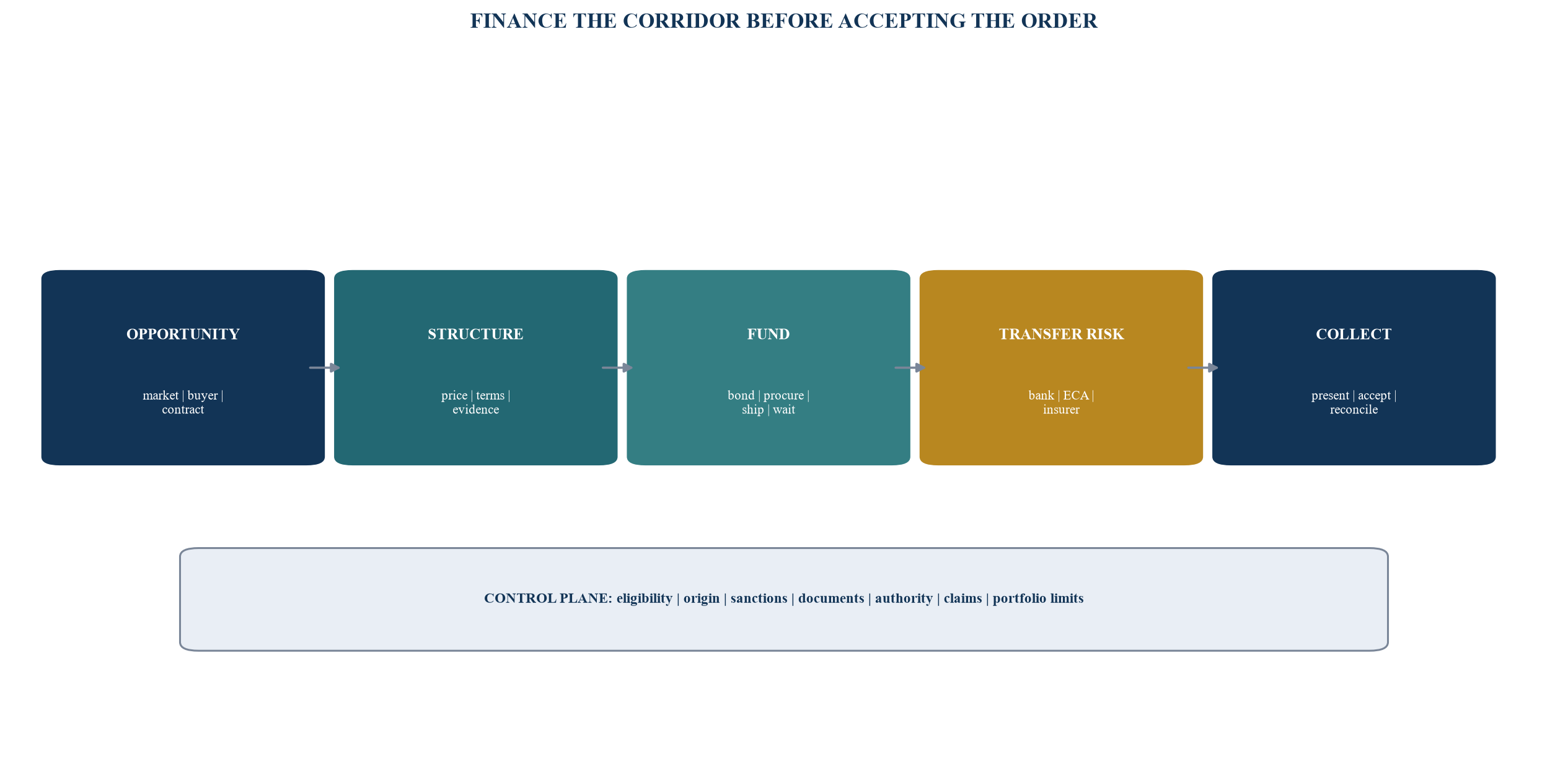
The commercial contract, funding, risk transfer, evidence and collection system should be designed as one operating model.
2. Ground the corridor in current evidence
Trade finance is an infrastructure constraint as well as a banking product. The Asian Development Bank's 2025 programme materials continue to place the global trade-finance gap at USD 2.5 trillion and identify SMEs, women-led businesses and firms in fragile or remote markets as particularly affected. Its Trade and Supply Chain Finance Program provides guarantees and loans through more than 250 partner financial institutions. In 2025 the programme reports supporting 24,722 transactions valued at USD 5.7 billion, with nearly 61 percent co-financed by private and development partners.
Africa contains a material financing gap. Afreximbank's African Trade Report 2025 estimates an annual gap of about USD 100 billion and notes that SMEs represent the large majority of African firms. WTO work on West Africa has shown that finance constraints can suppress otherwise viable trade. AfCFTA creates a larger commercial framework, while rules of origin, tariff schedules, customs implementation and national practice continue to determine whether a specific product receives preferential treatment.
The UAE has built official export-support channels. Etihad Credit Insurance describes trade-credit insurance, political-risk insurance, export finance and debt-collection support for UAE exports and re-exports. The Abu Dhabi Exports Office describes direct lending to overseas buyers, guarantees to lenders and indirect financing through overseas financial institutions for qualifying UAE goods and services. These channels can change the allocation of buyer, country and funding risk; they do not replace transaction preparation.
Table 1. Official evidence and board implications
| Authority | Current evidence | Board implication | Decision boundary |
|---|---|---|---|
| Asian Development Bank | global gap remains USD 2.5 trillion; guarantees and loans operate through partner banks | identify partner-bank routes before bidding into constrained markets | programme support depends on bank and transaction eligibility |
| IFC | guarantees support documentary, bond and supplier-credit instruments | structure the underlying trade instrument so a confirming bank can seek risk cover | exporter access is mediated through participating banks |
| Afreximbank and WTO | Africa has a large persistent gap and rejected finance suppresses trade | treat finance access as part of route-to-market design | regional evidence does not determine a single buyer's risk |
| ECI | UAE export-credit, political-risk and financing support is available for qualifying trade | seek indicative cover and policy terms before final contract commitment | exclusions, limits and underwriting remain transaction-specific |
| ADEX | direct, guaranteed and indirect facilities can support eligible UAE exports | test whether buyer credit can solve a buyer's funding constraint | UAE origin, borrower credit and minimum-size rules apply |
| UAE and India official data | Africa and South Asia are significant trade corridors for the UAE | build sector and country priorities from actual buyer evidence | macro trade does not substitute for pipeline validation |
Published programme terms and statistics require current transaction-specific confirmation.
3. Select a market, buyer and transaction together
An exporter should avoid selecting a country in isolation. The financeable unit is the market-buyer-transaction combination. A country can have strong growth and an unsuitable buyer. A credible buyer can be associated with an ineligible product or a contract whose acceptance terms are hard to evidence. A good contract can become unbankable because the shipping route, currency or governing process creates disproportionate risk.
The market screen should include legal and sanctions eligibility, currency convertibility, payment infrastructure, import licensing, customs capacity, product standards, taxes, political risk, enforcement and practical collection. The screen should distinguish sovereign, state-owned, bank, large corporate, distributor, project company and SME buyers because the source of repayment and the evidence available differ.
Buyer diligence should establish legal identity, ownership, authority, audited or credible financial information, payment history, banking relationships, litigation, sanctions exposure, business model, debt service, group support and transaction purpose. For a project buyer, the exporter should identify the funded source of cash and the conditions to draw. For a distributor, it should understand inventory turnover and downstream demand. For a public buyer, it should confirm appropriation, procurement validity and the authority to issue the obligation.
Transaction diligence should then test contract value, tenor, product origin, delivery schedule, currency, advance payment, milestone evidence, acceptance, retention, warranties, performance obligations, termination, dispute and governing law. The company should identify every party whose certificate or action can delay payment. A certificate controlled entirely by the buyer can create an exposure that insurance or a bank may not fully neutralise.
Table 2. Market-buyer-transaction eligibility matrix
| Dimension | Evidence required | Acceptable condition | Escalation trigger |
|---|---|---|---|
| market | sanctions, convertibility, licensing, customs, enforcement and collection route | lawful route with operable payment and recovery path | restricted country, unstable conversion or missing licence |
| buyer | identity, ownership, authority, financial capacity and payment record | identifiable obligor with credible source of repayment | opaque ownership, weak authority or unexplained arrears |
| product and origin | HS classification, bill of materials, origin evidence and standards | eligible UAE good or service with documented origin | classification conflict or unsupported preference claim |
| contract | price, delivery, acceptance, retention, currency and dispute terms | objective payment trigger and controlled document set | buyer-controlled acceptance or open-ended performance |
| finance | cash timing, facility, security, insurance and lender appetite | committed or credible funding through final collection | order creates a liquidity deficit beyond approved headroom |
| portfolio | country, buyer, sector, currency and maturity concentration | exposure remains inside approved aggregate limits | correlated maturities or concentration breach |
The matrix is a diagnostic; final eligibility rests with the exporter, relevant authorities, banks, insurers and advisers.
4. Map the cash-conversion cycle before pricing
Export working capital begins before shipment. A bid may require a tender bond. Contract signature can require an advance-payment guarantee or performance bond. Production can require imported inputs, supplier deposits, labour and inspection. Freight, insurance, taxes and customs services may become payable before the exporter presents documents. The buyer can then receive credit through shipment, acceptance, retention or final certification.
The cash-conversion map should show weekly or monthly cash movements by order. It should include VAT or indirect-tax timing, refundable deposits, bond cash collateral, margin calls, supplier credit, payroll, logistics, bank fees, insurance premium and expected collection. The model should distinguish committed cash from forecast cash and gross exposure from the amount transferred to a bank or insurer.
The board should see the maximum cumulative funding need, the duration of the peak, the delay sensitivity and the loss given a failed collection. Scenario analysis should apply plausible delays to buyer acceptance, document examination, customs, shipment and collection. The company should also test a facility renewal failure, an insurer limit reduction and a currency movement. Those scenarios reveal whether the apparent gross margin survives the finance structure.
The purpose of the model is a funding decision, not a decorative forecast. Treasury should reserve facility headroom before operations commits expenditure. Commercial pricing should recover the cost of finance, risk transfer, guarantees, document handling and expected delay. Management should refuse or restructure an order that creates a liquidity gap beyond approved resources, even when the accounting margin appears attractive.
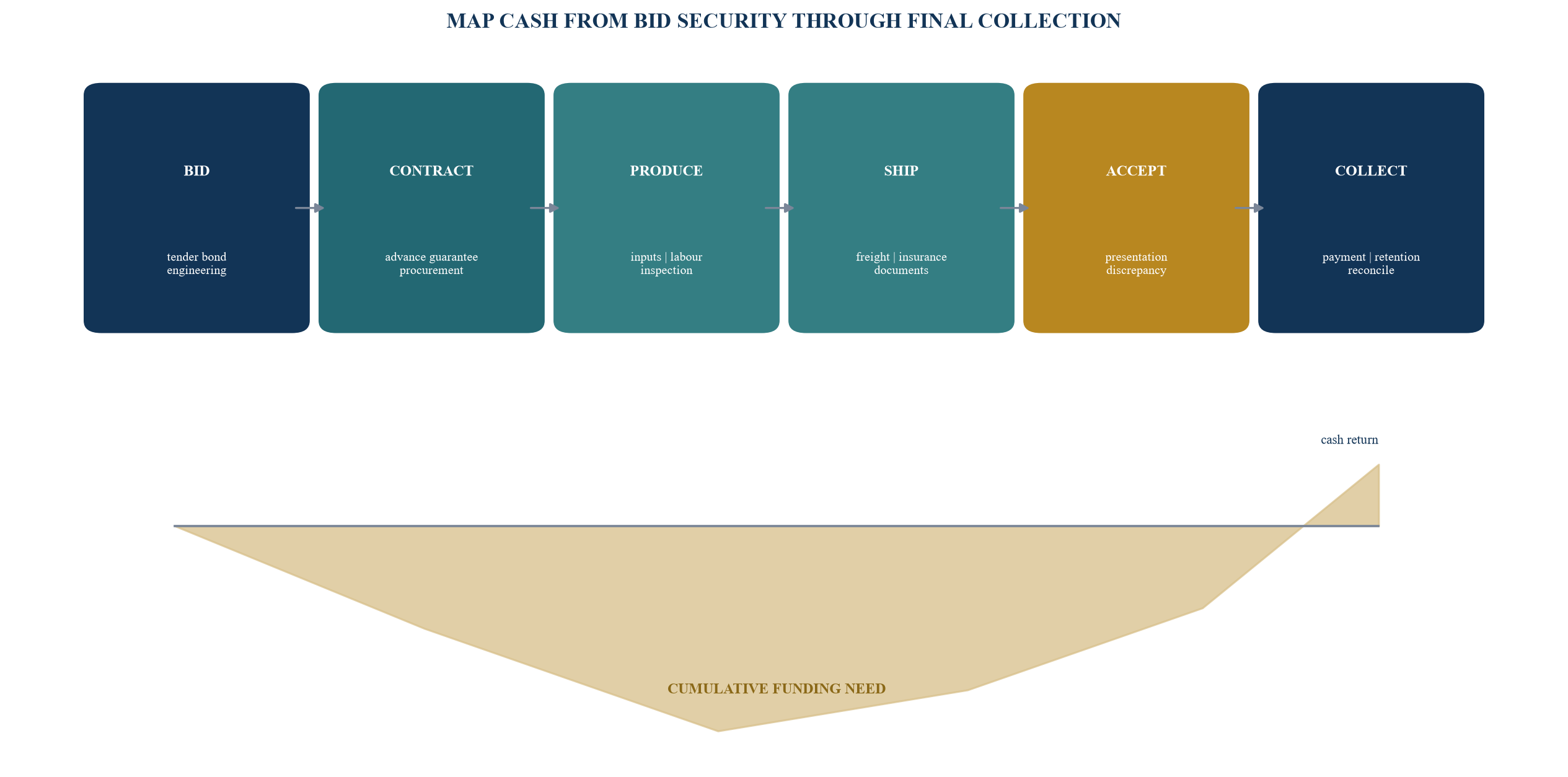
The funding peak can occur before shipment and persist through acceptance, presentation and collection.
5. Design payment and acceptance terms as credit controls
Payment terms determine whether the exporter relies on the buyer, a bank, an insurer or a combination. Cash in advance transfers liquidity and performance risk toward the buyer. A confirmed documentary credit can transfer bank and country payment risk subject to compliant presentation. An unconfirmed credit leaves issuing-bank and country exposure. Documentary collection gives banks a document-handling role without creating the same payment undertaking. Open account maximises buyer convenience and leaves the exporter carrying collection risk unless receivables are insured or sold.
The choice should follow bargaining power, buyer quality, country conditions, amount, tenor, document controllability and the strategic value of the relationship. A first transaction may use an advance and confirmed credit. Repeated performance can support an insured open-account limit. A buyer facing local funding constraints may require buyer credit, with loan proceeds paid to the exporter under the approved structure.
Acceptance should be objective and time-bound. The contract should define the test, evidence, responsible party, cure period and deemed-acceptance condition where legally appropriate. Technical disputes and payment obligations should be separated when possible. A buyer should not gain an indefinite right to withhold the entire price for a minor defect. Retention should be quantified, release conditions should be clear and the company should model its financing cost.
Document terms should be built from what operations can reliably produce. A credit requiring unavailable certificates or inconsistent descriptions invites discrepancies. ICC's UCP 600 gives the global framework for documentary credits and provides banks with a maximum of five banking days to determine whether a presentation complies. The data in documents need not be identical, but it must not conflict. The exporter should use current specialist banking and legal advice when drafting documentary terms.
6. Select an instrument stack for the underlying risk
The exporter should separate funding from risk transfer. A working-capital loan provides cash and can remain fully recourse. Trade-credit insurance transfers an agreed portion of eligible non-payment risk subject to policy terms. A confirmed letter of credit substitutes or adds bank risk for buyer risk. Receivables purchase can accelerate cash, with or without recourse. Buyer credit funds the overseas buyer while paying the exporter under the approved arrangement. Guarantees support bid, advance-payment, performance and warranty obligations.
The instrument decision begins with the obligor and payment event. Where the buyer can pay in advance, the exporter may need a guarantee rather than receivables finance. Where the buyer requires credit and has strong banking access, a confirmed documentary credit may work. Where the buyer has a long operating history but insists on open account, whole-turnover or single-buyer insurance can protect part of the exposure and support bank funding. Where the buyer needs medium-term capital for UAE goods, an official buyer-credit route may be relevant.
The cheapest quoted fee may not produce the lowest economic cost. Management should compare the all-in cost of finance, cover, collateral, guarantees, document preparation, legal work, administration, capital usage and residual risk. It should also measure the revenue and margin lost if a finance structure constrains price or delays bid submission.
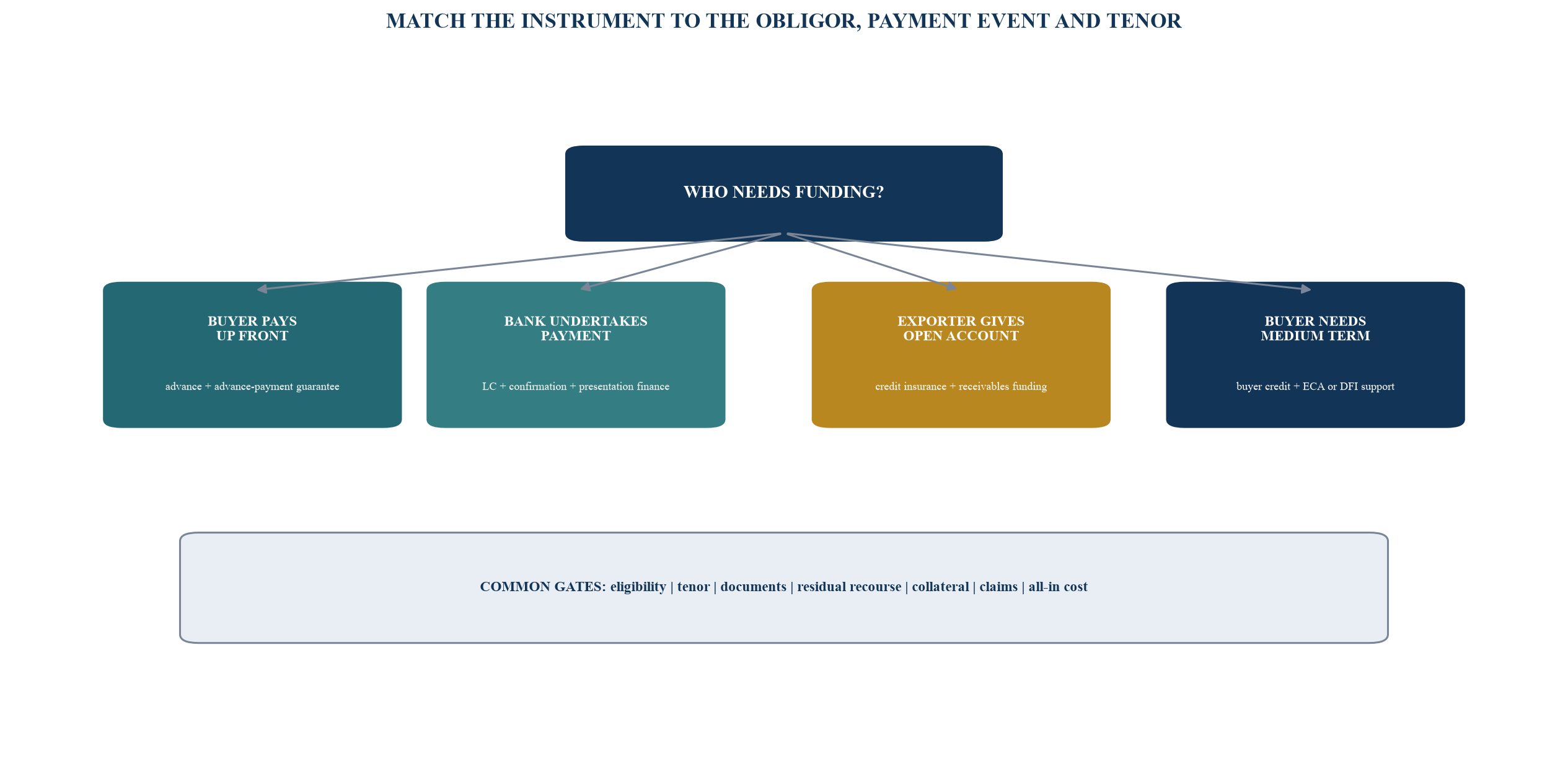
Start with the buyer's funding need, the payment undertaking and the exporter's documentary control.
Table 3. Export-finance instrument stack
| Instrument | Risk or funding role | Evidence gate | Residual exposure |
|---|---|---|---|
| advance payment | funds mobilisation and procurement before delivery | enforceable contract and acceptable advance guarantee | performance, refund and guarantee-call risk |
| confirmed documentary credit | adds confirming-bank undertaking for complying documents | operable credit text and discrepancy-free presentation | performance dispute outside documents and uncovered terms |
| pre-shipment finance | funds inputs, production and shipment | order, facility, borrowing base and monitored use | exporter performance and cancellation risk |
| insured open account | protects an agreed share of eligible non-payment | approved buyer limit, policy compliance and debt evidence | deductible, waiting period, exclusions and disputes |
| receivables purchase | converts eligible invoice into earlier cash | assignment, acknowledgement and acceptable receivable | recourse, dilution and documentation defects |
| buyer credit | funds overseas buyer for qualifying UAE exports | eligible contract, buyer credit, bank and official approval | uncovered portion, project and performance risk |
| guarantees and bonds | supports bid, advance, performance or warranty obligation | defined underlying obligation and expiry | wrongful call, collateral use and extension risk |
Terms are indicative categories; current bank, insurer and official-programme documentation controls.
7. Use UAE official support early in the transaction
Etihad Credit Insurance is the UAE's official export-credit company. Its public materials describe trade-credit insurance, political-risk insurance, export financing and debt-collection support. Its buyer-credit insurance product is designed for UAE banks lending to foreign buyers to purchase UAE exports. The current product page states that eligible private-buyer finance can extend up to seven years and sovereign finance up to fifteen years, with coverage of commercial and political risks up to 95 percent. Actual cover, tenor, premium and conditions are subject to underwriting and policy.
The sequencing is important. ECI states that the exporter and financing bank should consult it before the final loan agreement, and that already signed or disbursed loans are not eligible for that buyer-credit product. This creates a commercial discipline: the exporter should seek an indicative structure while price, payment, security and delivery terms can still be aligned with the proposed cover.
ECI also publishes exclusions and eligibility signals. Its application page lists oil and gas transactions, precious metals, third-port trading structures and sanctioned or restricted countries among exclusions. Management should check the current definition and application directly; it should not assume that a transaction qualifies because the exporter is incorporated in the UAE.
The Abu Dhabi Exports Office states that eligible UAE goods and services can be supported through direct loans to overseas buyers, guarantees to banks and indirect financing through institutions in importing countries. Its National Exports Program booklet describes financing of up to 100 percent depending on the facility, while direct loans and guarantees can cover up to 90 percent of contract value. It also identifies minimum transaction sizes and potential tenors. Current availability and terms require direct confirmation.
8. Build a bankable transaction data room
A bankable export order is evidenced through a disciplined data room. The lender, insurer and internal approval committee need to understand the exporter, buyer, underlying trade, cash cycle, legal obligations, goods, route, documents, security and repayment. Missing or inconsistent evidence creates delay at the moment when procurement or bond issuance requires cash.
The transaction file should contain the signed or draft contract, purchase order, technical scope, pricing build, Incoterms, delivery schedule, product classification, origin evidence, inspection and acceptance terms, warranty, retention, guarantees, insurance, shipping route, logistics parties, invoices, document list and dispute process. A cash-flow model should reconcile contract amounts to cost, taxes, collateral, fees and collection timing.
The data room is also a negotiation tool. It shows the bank or insurer that the company understands the transaction and can operate the required controls. It allows management to compare offers on a common evidence base. A standard architecture reduces the marginal time to finance subsequent orders and becomes an enterprise capability rather than a one-off administrative exercise.
Table 4. Bank and insurer transaction data room
| Workstream | Core evidence | Owner | Approval use |
|---|---|---|---|
| exporter capacity | corporate, financial, facility, performance and control records | CFO and finance | establish capacity, recourse and facility headroom |
| buyer credit | identity, ownership, authority, financials and payment history | commercial and risk | set buyer limit and repayment confidence |
| underlying trade | contract, price, scope, origin, delivery and document schedule | commercial and operations | prove genuine trade and acceptable cash trigger |
| cash and security | cash-flow model, collateral, guarantees, insurance and assignment | treasury | size funding and residual exposure |
| compliance | KYC, sanctions, goods, licensing, route and payment review | compliance | confirm lawful, controlled transaction path |
| claims and recovery | notices, debt evidence, collection procedure and responsibility | legal and finance | preserve policy rights and recovery capacity |
The document list should be adapted to the product, market, institution and applicable law.
9. Underwrite the buyer and control the credit limit
Export insurance and bank support do not remove the need for buyer underwriting. The company remains exposed to uncovered percentages, deductibles, exclusions, disputes, waiting periods, collection cost and the operational consequence of a default. It also bears the cost of production before an eligible debt exists.
The credit assessment should identify the obligor that is legally required to pay. A trading name, local affiliate, ministry department or project vehicle may differ from the entity shown in the purchase order. Management should confirm authority, beneficial ownership, group relationships and the capacity of any guarantor. Public or state-related status should be evidenced rather than assumed.
Payment experience should be measured by actual days, disputes, deductions and ageing. References are useful only when they identify the entity, period and transaction type. Where evidence is limited, the exporter can start with a smaller limit, shorter tenor, advance payment, confirmed bank undertaking or single-buyer policy. Limit increases should follow observed performance and refreshed underwriting.
The credit limit should be a live control. Orders, invoices, shipments, overdue amounts, retention and unbilled work should consume the limit according to policy. Amendments and extensions can change the insured or bankable position and should require approval. A portfolio dashboard should show exposure by buyer, country, sector, currency, bank, insurer, maturity and risk-transfer status.
10. Price the true financing economics
The exporter should price from cash and risk, not only production cost. The all-in economics include facility interest, utilisation and commitment fees, confirmation charges, insurance premium, bond commission, collateral cost, legal and documentation expense, currency hedging, administration, expected discrepancies, collection delay and residual loss exposure. The cost also includes management time and the opportunity cost of facility headroom used by one order.
An illustrative management case can make the decision visible. Assume a contract value of AED 10 million, direct and delivery cost of AED 7.6 million, a 10 percent advance, a 150-day production-to-collection period and an annualised funding cost of 9 percent. If the exporter funds the net cash requirement progressively and incurs insurance, guarantee and document costs, the apparent 24 percent gross margin may compress materially. A 60-day delay adds finance cost and can block the next order.
The model should compare structures. A larger advance can reduce peak borrowing but increase guarantee exposure. A confirmed credit can reduce payment risk while adding bank charges and documentary discipline. Insured open account can support buyer convenience but leave an uncovered share and a claims waiting period. Buyer credit can accelerate exporter cash while requiring deeper buyer and transaction diligence.
Management should approve a risk-adjusted contribution after all finance and control costs. The quote should include a contingency for defined scenarios and a change mechanism for major scope, tax, tariff or logistics changes. Where the required price is not competitive, the company can change the payment schedule, scope, delivery, security or target customer rather than accept an uneconomic exposure.
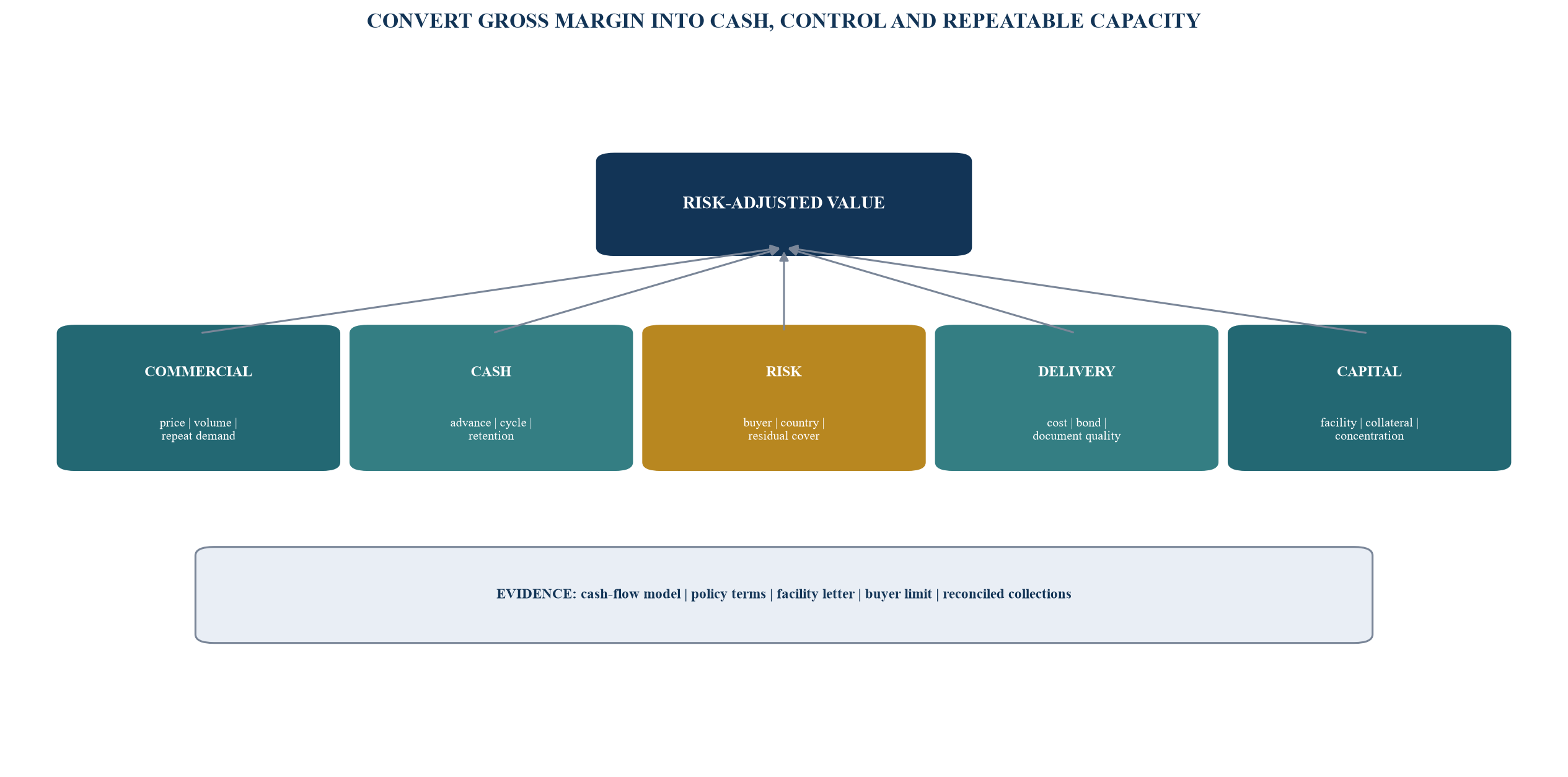
Revenue becomes enterprise value only after cash timing, risk transfer, delivery and control costs are reconciled.
11. Integrate bonds and guarantees with the cash plan
Export contracts can require tender, advance-payment, performance, retention and warranty guarantees. These instruments support the buyer while creating contingent liabilities for the exporter. A successful order can therefore consume guarantee lines and cash collateral before it consumes funded working capital. The board should see both exposures together.
The guarantee should match a clearly defined underlying obligation, amount, reduction schedule, expiry and claim process. Open-ended expiry, automatic extension, broad demand language or conditions detached from actual performance can create disproportionate risk. The company should negotiate staged reductions as advances are earned, delivery occurs, acceptance is achieved and the warranty period ends.
Collateral use should be included in pricing and capacity planning. A guarantee backed by cash may neutralise the funding value of an advance. A bank can apply a margin, require security or reduce other facility availability. Management should compare the net liquidity created by the advance after collateral and fees. It should also model an extension, call or delayed cancellation.
Operations must own release evidence. Delivery certificates, acceptance records, return of originals and formal cancellation requests should be tracked. A bond register should show beneficiary, bank, amount, currency, expiry, auto-extension, collateral, contract milestone, owner and next action. Expired commercial risk should not remain as unused contingent exposure because the company failed to obtain cancellation.
12. Treat origin, customs and preferences as finance evidence
Preferential access can improve competitiveness only when the product satisfies the applicable rule of origin and the exporter holds acceptable evidence. The UAE-India Comprehensive Economic Partnership Agreement entered into force on 1 May 2022. The UAE Ministry of Economy states that tariffs were reduced or removed on more than 80 percent of products and that the agreement covers services, customs, standards and government procurement. A specific shipment still depends on its tariff line, origin rule, documentation and import treatment.
AfCFTA similarly requires product-specific analysis. The African Union publishes rules of origin, and UNCTAD provides a tariff tool using submitted offers and related rules. The exporter should confirm the importing state, tariff schedule, HS code, originating criterion, accumulation, direct-transport or other requirements, certificate form and record retention. A preference should not be priced until a qualified customs review supports it.
Customs evidence also affects bank and insurer confidence. Inconsistent values, quantities, descriptions, country names or routes can create documentary discrepancies and financial-crime alerts. The invoice, packing list, transport document, certificate of origin, inspection certificate and payment instruction should describe the same genuine transaction without unexplained conflict.
The company should distinguish tariff preference from product compliance. Standards, labelling, conformity assessment, health or technical approvals may apply even when duty is reduced. A financing schedule should include time for classification, licences, certificates, inspection and customs clearance. Delay in any of these steps can extend the cash-conversion cycle and defeat a delivery or presentation deadline.
13. Build sanctions and trade-financial-crime controls into the route
The UAE Central Bank's current guidance on trade-based money laundering and illicit transshipment describes the UAE's role as a global trade hub and requires licensed financial institutions to identify trade-related money-laundering, terrorist-financing, proliferation-financing and sanctions risks. Enhanced measures include attention to dual-use or high-risk goods, export and import controls, routes through sanctioned countries and document authenticity. An exporter's bank will ask questions that reflect these duties.
The company should screen parties, ownership, banks, vessels, ports, countries, goods and payment routes at onboarding and again when a material fact changes. Screening should use current authoritative lists and record the date, data and disposition. A name match should be investigated rather than automatically treated as a conclusion. The exporter should obtain specialist advice where sanctions, export controls or proliferation risk may apply.
Controls should sit before shipment and payment. Commercial should not promise a route that compliance has not reviewed. Operations should prevent a carrier, port or consignee change without approval. Treasury should accept funds only through authorised counterparties and accounts. Document owners should validate authenticity and consistency. Exceptions should be escalated with the underlying evidence and an auditable decision.
The process also needs a stop rule. If the company cannot identify the beneficial owner, legitimate purpose, goods, route or source of payment, it should pause and obtain qualified advice. A deadline or revenue target should not weaken the review. The bank and insurer should be notified of material changes according to facility and policy terms so that the company does not create an uncovered exposure.
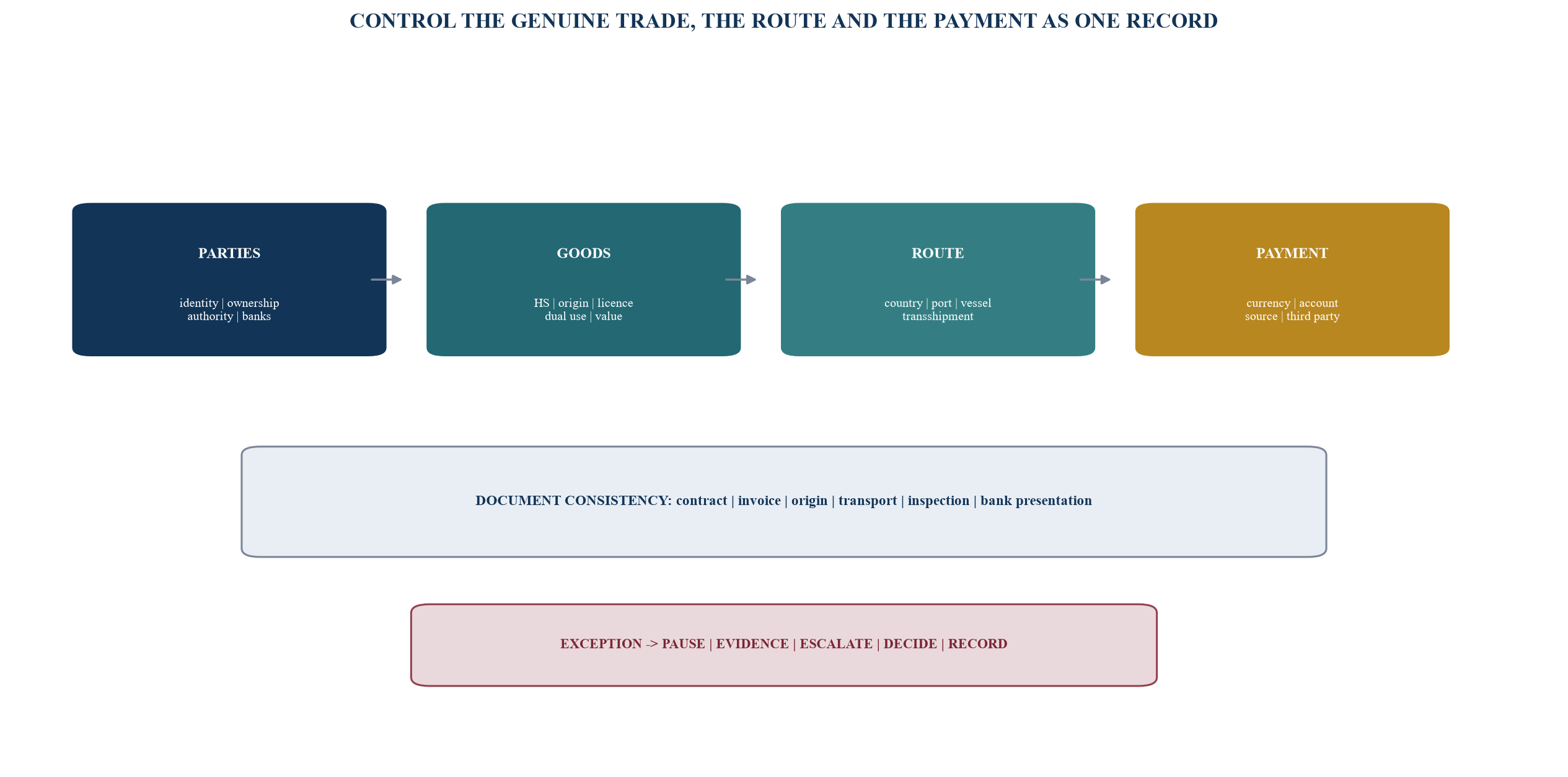
Buyer, goods, route, documents and payment should remain consistent from onboarding through collection.
14. Engineer documentary presentation and digital evidence
Documents convert performance into payment. The export-finance office should create a document schedule from the contract and credit before shipment. Each item should have an issuer, required wording, data source, due date, reviewer, original or electronic format, presentation route and discrepancy response. Operations should complete a dry run while correction remains possible.
For documentary credits, the company should compare the proposed credit with the sales contract before advising acceptance. It should remove conditions that depend on documents the exporter cannot control or produce. Names, addresses, goods, values, quantities, dates, ports, Incoterms, currencies and shipment terms should be consistent across the controlled sources. Amendments should be accepted only after commercial, treasury and document owners understand the effect.
ICC's eUCP supplements UCP 600 when the credit expressly allows electronic records. Electronic presentation changes format and delivery; it does not remove the need for authenticity, integrity, timing and compliance. The company should confirm the bank's operational capacity, portal, file type, authentication and contingency process before relying on electronic presentation.
Digitalisation should create a stronger evidence chain. The source document, approved data, issuer, timestamp, signature or authentication, amendment, presentation, bank response and final accepted version should be linked to the transaction. A shared folder of ungoverned files can reproduce paper problems in electronic form. Access control, version control, retention and recovery are part of financeability.
Table 5. Documentary and compliance control register
| Control point | Evidence | Accountable owner | Failure response |
|---|---|---|---|
| pre-contract eligibility | market, buyer, product, origin, route and sanctions review | commercial and compliance | restructure, seek advice or decline |
| credit or contract terms | agreed payment trigger and producible document schedule | treasury and legal | amend before acceptance |
| pre-shipment readiness | approved goods, licences, inspection, carrier and document data | operations | hold shipment and correct evidence |
| presentation | complete version-controlled document set and submission receipt | trade-finance operations | cure discrepancy or obtain authorised waiver |
| payment and reconciliation | bank advice, value date, charges, currency and ledger match | treasury and finance | investigate shortfall, deduction or routing error |
| overdue and claim | notices, debt evidence, policy compliance and recovery record | credit, legal and insurer liaison | preserve rights, collect and submit claim on time |
Responsibilities and evidence should be tailored to the contract, instrument and jurisdiction.
15. Design collections, claims and recoveries before default
Collections begin when the contract is drafted. The company needs an undisputed debt, an identifiable obligor, objective payment evidence, authorised bank instructions and a practical notice and dispute route. Insurance cannot repair a contract whose payment obligation remains ambiguous or whose documentation is incomplete.
The receivables ledger should distinguish due, disputed, retained, unbilled, insured, assigned, financed and overdue amounts. Ageing should be measured against the contractual due date and any policy definition. The exporter should monitor buyer-limit utilisation, maximum extension periods, overdue-reporting duties and shipment-stop conditions. Continued shipments after a material overdue event can increase an uncovered exposure.
Claims require policy discipline. ECI explains that trade-credit insurance generally indemnifies an agreed portion rather than the complete loss. Product pages and policies can contain credit limits, waiting periods, exclusions, notification duties, collection obligations and recoveries sharing. The actual policy controls. Management should assign a named policy owner and maintain a calendar of reporting and claims deadlines.
Recoveries should remain integrated with the customer strategy. Legal action, insurer collection, restructuring, settlement and continued trade can have different consequences. The board should see gross debt, insured amount, expected timing, costs, recovery actions, accounting treatment and liquidity effect. Lessons from disputes and claims should change pricing, contract terms, limits, document controls and market selection.
16. Establish an accountable export-finance office
An export-finance office connects commercial ambition to cash and control. It can be a small cross-functional team rather than a new department. The commercial lead owns buyer need, price and relationship. Treasury owns facility, currency, bank and liquidity. Finance owns margin, accounting and reconciliation. Operations owns production, shipment and documents. Compliance owns party, goods and route controls. Legal owns contract and dispute design. The credit owner sets and monitors buyer limits.
The office should maintain one transaction register from qualified lead through final collection. The register should show stage, buyer, country, product, value, currency, gross margin, cash peak, payment instrument, guarantee use, insurer, bank, facility, credit limit, compliance status, document status, shipment, due date, overdue position, claims and owner. Data should come from controlled systems where possible and be reconciled regularly.
The office should use standard packs. The opportunity screen, cash-conversion model, buyer memo, contract checklist, instrument comparison, data-room index, compliance record, document schedule, shipment release, overdue pack and board scorecard should follow repeatable formats. Templates reduce omission while allowing the facts of each order to drive the decision.
External advisers can support structuring, bank and insurer engagement, financial modelling, transaction documentation, market entry, implementation and portfolio governance. Specialist legal, tax, customs, sanctions, export-control, accounting and regulatory advice should be provided by qualified professionals. Internal owners retain accountability for the decision and evidence.
17. Execute through a 120-day sequence
The first 30 days establish the corridor thesis and the control boundary. Management analyses its current products, origin, export history, margins, buyer evidence and facility capacity. It selects two or three priority market-buyer archetypes in Africa and South Asia, maps the complete cash cycle, assigns owners, sets portfolio limits and identifies candidate banks, ECI, ADEX and multilateral partner routes.
Days 31 to 60 build the finance architecture. The team creates the opportunity screen, buyer-credit memo, contract and document checklist, cash-conversion model, instrument comparison, guarantee register, data-room index and compliance control. It meets banks and official institutions with real transaction facts, obtains indicative appetite and identifies changes required in payment, security, origin, tenor or documentation.
Days 61 to 90 prepare a pilot transaction. Commercial negotiates an objective payment trigger. Treasury reserves facility capacity and obtains term indications. Operations conducts a document dry run. Compliance completes party, goods and route review. Legal reviews contract and guarantee wording. Finance validates risk-adjusted contribution. The transaction committee records the residual risks, conditions and decision.
Days 91 to 120 execute and learn. The company funds procurement under the approved plan, monitors bond and facility use, controls shipment release, presents documents, records discrepancies, reconciles payment and updates the portfolio dashboard. Any delay, deduction, compliance exception or control failure receives a root-cause review. The team updates the templates before scaling.
The implementation should create a repeatable operating capability. A successful pilot is evidenced by a financed cash cycle, controlled documentation, compliant route, reconciled payment and measured margin. Expansion to another market or buyer should repeat the eligibility and underwriting gates. Standardisation should reduce effort without converting assumptions from one corridor into facts for another.
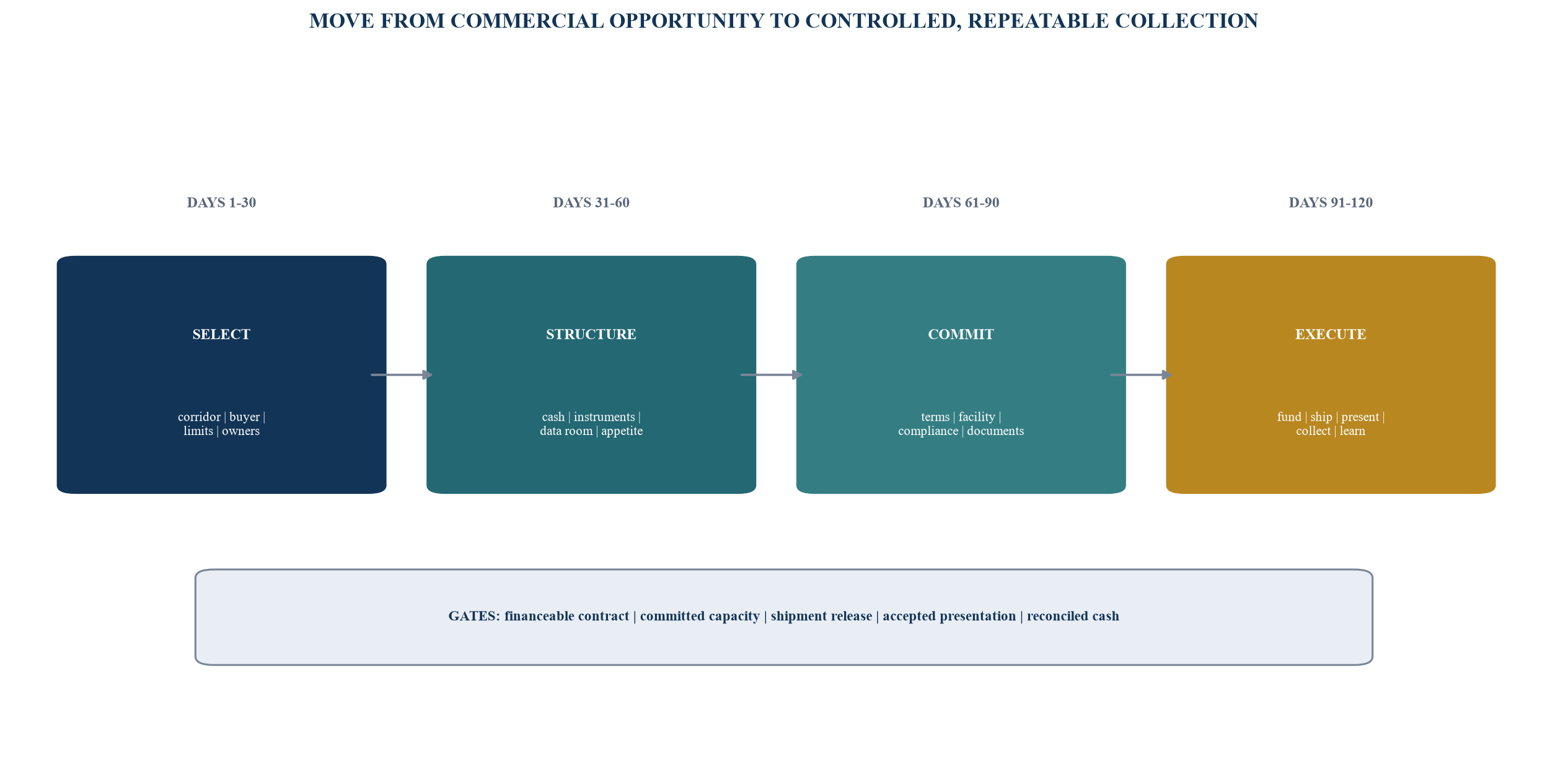
The office advances from corridor truth to a controlled pilot and reconciled collection.
18. Measure cash, control, commercial value and enterprise value
The board scorecard should begin with cash. It should show order value, advance, facility use, guarantee exposure, collateral, peak funding, cash-conversion days, due amounts, overdue amounts, insured exposure and collected cash. Gross revenue and gross margin should be shown beside risk-adjusted contribution after finance and control costs.
Commercial measures should include qualified opportunities, approval rate, win rate, repeat orders, average price, payment terms and concentration. These measures explain whether finance capability improves market access. They should not reward sales teams for orders that consume excessive liquidity, violate risk appetite or fail to collect.
Control measures should include buyer files current, compliance reviews complete, origin evidence accepted, document discrepancies, unauthorised route changes, facility exceptions, policy-limit breaches, overdue reporting, claims deadlines and unreconciled cash. The objective is to expose weak execution early. A low exception count is meaningful only when the controls are operating and the transaction population is complete.
Enterprise value can improve through a broader addressable market, faster and more reliable cash conversion, larger financeable contracts, repeatable controls, diversified customers and stronger evidence for lenders or buyers. These effects should be based on observed transactions. A transaction-ready business can demonstrate that growth is funded, margins reconcile to cash, risks are controlled and the operating system can scale beyond one individual.
Commercial delivery should connect diagnostic work to execution. Matchpoint Partners can support corridor prioritisation, buyer and transaction screening, cash and margin modelling, instrument comparison, lender and insurer materials, export-finance office design, implementation governance and board reporting. Engagement success should be evidenced through accepted deliverables, financing capacity, signed mandates, collected fees and sustained client outcomes.
Table 6. Board scorecard for the export-finance corridor
| Dimension | Primary evidence | Board measure | Escalation trigger |
|---|---|---|---|
| cash and capacity | bank, facility, bond, collateral and cash-flow records | peak funding, headroom, cash-conversion days and collections | committed order exceeds available capacity |
| commercial outcome | pipeline, contracts, prices and repeat orders | win rate, risk-adjusted contribution and customer concentration | growth depends on weak terms or one buyer |
| buyer and country risk | credit files, limits, overdue and policy records | exposure, cover, overdue and expected loss | limit, concentration or reporting breach |
| documents and operations | shipment, presentation, discrepancy and acceptance records | on-time shipment, clean presentation and deduction rate | payment delayed by preventable evidence failure |
| compliance and origin | KYC, sanctions, goods, route, origin and licence records | complete reviews, exceptions and accepted preference claims | unexplained party, goods, route or document conflict |
| enterprise capability | templates, owners, institutions and reconciled outcomes | repeatable cycle, institution response and scalable headroom | capability depends on one person or unsupported assumption |
Targets are illustrative management choices and should be approved for the relevant strategy and risk appetite.
Implementation conclusion
GCC SMEs can use export finance to enter Africa and South Asia with greater liquidity and control when financeability becomes part of contract design. The practical sequence begins with a market-buyer-transaction screen, maps the complete cash cycle and selects the payment, funding, guarantee and insurance instruments that correspond to the underlying risk.
Official UAE support, bank facilities and multilateral programmes can transfer or fund defined exposures. Their value depends on early engagement, eligibility, buyer evidence, product origin, document quality and compliance. The exporter retains responsibility for residual risk, delivery, policy conditions, collections and portfolio concentration.
A 120-day export-finance office can establish the governance, data room, cash model, compliance path, document control and institution relationships needed for a pilot transaction. The evidence of success is a financeable contract, protected liquidity, compliant shipment, accepted presentation, reconciled cash and repeatable risk-adjusted value.
References
- Etihad Credit Insurance. Official website and export-credit support overview. https://www.eci.gov.ae/en/
- Etihad Credit Insurance. Frequently Asked Questions. https://www.eci.gov.ae/en/faq
- Etihad Credit Insurance. Apply for Cover, including published exclusions. https://www.eci.gov.ae/en/apply-for-cover
- Etihad Credit Insurance. Buyer Credit Insurance. https://www.eci.gov.ae/en/products/buyer-credit-insurance-2
- Etihad Credit Insurance. How Trade Credit Insurance Works. https://www.eci.gov.ae/en/blog/how-trade-credit-insurance-works
- Etihad Credit Insurance. Indemnity Explained: What Is Covered and to What Extent. https://www.eci.gov.ae/en/blog/indemnity-explained-what-is-covered-and-to-what-extent
- Abu Dhabi Exports Office. National Exports Program booklet. https://www.adex.ae/assets/download/2d87dbe2/ADEX_National%20Exports%20Program_Booklet_V09%20FOR%20WEB.PDF.aspx
- Asian Development Bank. Trade Finance Gaps, Growth, and Jobs Survey 2023. https://www.adb.org/publications/2023-trade-finance-gaps-growth-jobs-survey
- Asian Development Bank. Trade and Supply Chain Finance Program, Trade Finance, updated 2026. https://www.adb.org/what-we-do/trade-supply-chain-finance-program/trade-finance
- International Finance Corporation. Global Trade Finance Program, updated July 2026. https://www.ifc.org/en/what-we-do/sector-expertise/trade-and-supply-chain-finance/global-trade-finance-program
- International Finance Corporation. Trade and Supply Chain Finance, FY2025. https://www.ifc.org/content/dam/ifc/doc/2025/fy25-ifc-trade-and-supply-chain-finance.pdf
- African Export-Import Bank. African Trade Report 2025. https://media.afreximbank.com/afrexim/African-Trade-Report_2025.pdf
- World Trade Organization. Trade Finance and SMEs. https://www.wto.org/english/res_e/publications_e/tradefinsme_e.htm
- World Trade Organization. Trade Finance in West Africa. https://www.wto.org/english/res_e/publications_e/tfinwestafrica_e.htm
- World Trade Organization. Improving trade finance access can boost African trade, 21 March 2023. https://www.wto.org/english/news_e/news23_e/trfin_21mar23_e.htm
- UAE Ministry of Economy and Tourism. UAE-India Comprehensive Economic Partnership Agreement. https://www.moet.gov.ae/en/cepa_india
- UAE Ministry of Economy and Tourism. Final UAE-India CEPA text. https://www.moet.gov.ae/documents/20121/1347101/Final%20Agreement_UAE%20India%20CEPA.pdf
- India Ministry of Commerce and Industry. Lok Sabha answer No. 305, 22 July 2025. https://www.commerce.gov.in/wp-content/uploads/2025/07/LSUSQ-No.-305.pdf
- UAE Ministry of Foreign Affairs. Foreign Policy, including UAE-Africa trade and investment data. https://www.mofa.gov.ae/en/foreign-policy
- African Union. AfCFTA Rules of Origin, published 18 June 2026. https://static.au.int/ar/node/30988
- UN Trade and Development. AfCFTA tariff liberalisation database. https://afcfta.unctad.org/tariffs
- Pan-African Payment and Settlement System. How PAPSS Works. https://papss.com/how-it-works/
- World Bank. South Asia Economic Update, April 2026. https://www.worldbank.org/en/region/sar/publication/south-asia-economic-update
- UNCITRAL. Model Law on Electronic Transferable Records. https://uncitral.un.org/en/texts/ecommerce/modellaw/electronic_transferable_records
- Central Bank of the UAE. Guidance on Trade-Based Money Laundering and Illicit Transshipment, effective 7 November 2025. https://rulebook.centralbank.ae/en/entiresection/6788
- Central Bank of the UAE. Enhanced Due Diligence Measures for Heightened Trade-Related Risks. https://rulebook.centralbank.ae/en/rulebook/422-edd-measures-heightened-trade-related-risks
- Financial Action Task Force. Trade-Based Money Laundering Risk Indicators. https://www.fatf-gafi.org/en/publications/Methodsandtrends/Trade-based-money-laundering-indicators.html
- International Chamber of Commerce. UCP 600 Uniform Rules for Documentary Credits. https://library.iccwbo.org/content/tfb/RULES/tfb-ucp600-rules.htm?AGENT=ICC_CHE
- International Chamber of Commerce. User's Guide to the eUCP. https://2go.iccwbo.org/explore-our-products/free-downloads/rules-codes/users-guide-to-the-eucp.html
About the Author
Chennakeshav Adya is an Independent Researcher and Managing Partner at Matchpoint Partners. His work focuses on corporate finance, capital strategy, transaction execution and the operating systems that connect financial evidence, board decisions and measurable enterprise performance.
