

1. INTRODUCTION
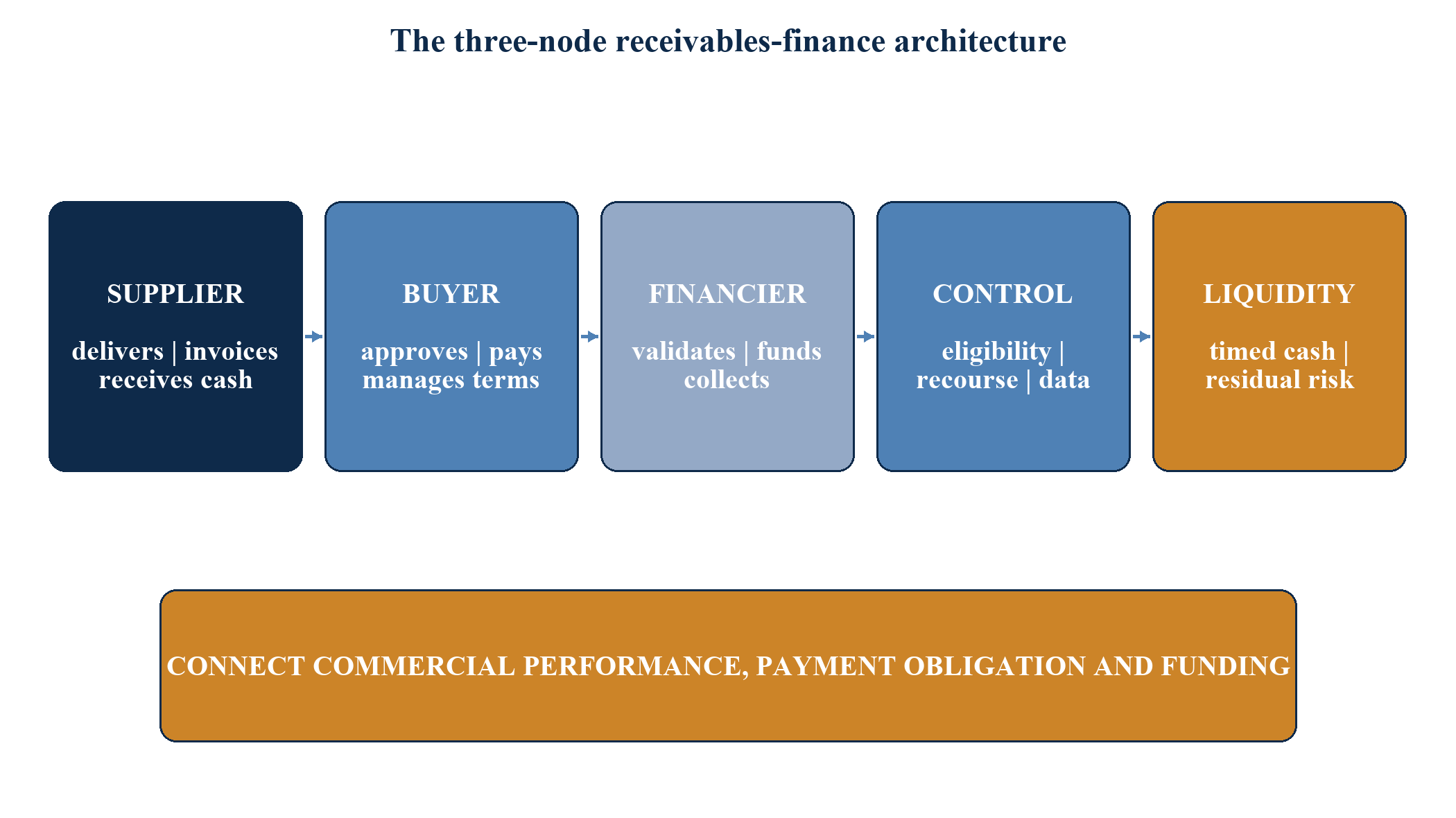
An invoice can be commercially valid and financially inactive. The supplier has delivered goods or services, the buyer has accepted an obligation to pay, and the cash may still be sixty, ninety or more days away. During that interval, the supplier continues to fund payroll, inventory, logistics, tax and the next order. Factoring and supply-chain finance convert part of that waiting period into current liquidity.
The financing decision is more demanding than selling an invoice at a discount. The parties must determine whether the receivable exists, whether it is transferable, who bears customer default and performance risk, how notices and collections operate, which invoices remain eligible, what the all-in cost is, and how the transaction appears in the financial statements. A programme can release substantial working capital while still creating concentration, fraud, accounting, disclosure and operational risks if those questions are handled separately.
Current evidence makes the subject timely. The Central Bank of the UAE reported that working capital requirements were the most important driver of business credit demand in the first quarter of 2026. Business-loan demand remained positive at a net balance of 4.7 percentage points, while lender appetite softened and collateral requirements increased for some borrowers [1]. The Asian Development Bank estimated that the global trade-finance gap remained USD 2.5 trillion in 2025 and reported that demand was expected to rise as supply chains realigned [2]. These are market-level signals; they do not establish availability or pricing for an individual business.
This paper develops an integrated GCC decision framework for receivables purchase, invoice discounting and buyer-led supply-chain finance. It connects product choice to the cash-conversion cycle, legal transfer, invoice data, risk allocation, pricing, accounting, tax, systems, onboarding and ongoing governance. The central principle is simple: liquidity becomes dependable when commercial evidence, legal rights, finance mechanics and operating data describe the same transaction.
Every worked case, amount, ratio and timetable in this paper is hypothetical and simplified. The examples do not represent Matchpoint Partners, its clients or any identified company. Current law, accounting standards, tax rules, Sharia requirements, lender terms and transaction-specific professional advice must be verified for the actual structure.
2. CHOOSE THE PRODUCT FROM THE RISK ALLOCATION
2.1 Receivables purchase and factoring
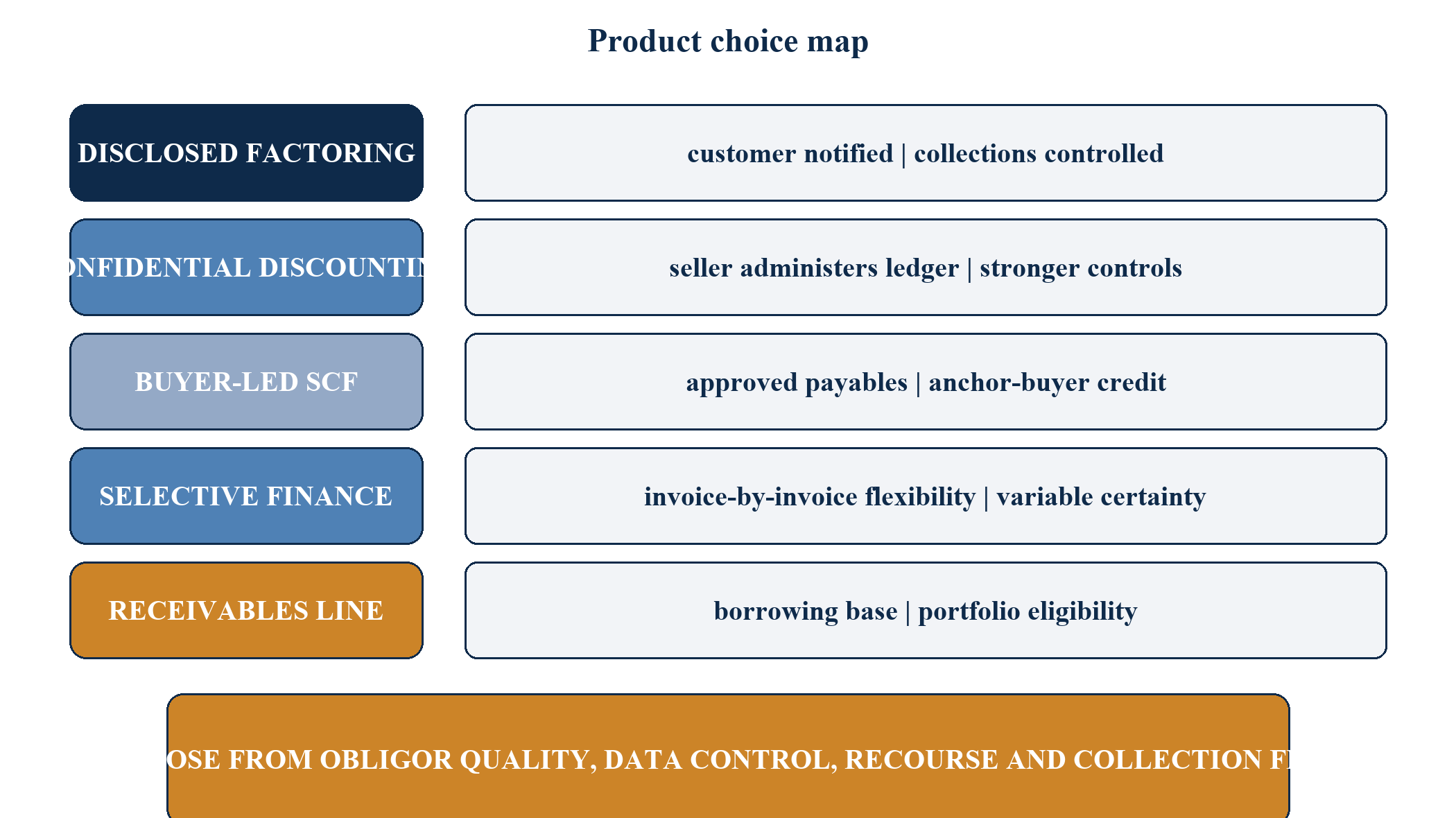
In a receivables-purchase structure, a supplier transfers eligible receivables to a financier for an advance or purchase price. Collections repay or settle the financing. The factor may provide funding, ledger administration, collection and credit protection in different combinations. The economic label depends on the contract, transfer of risks and benefits, control, recourse and applicable law.
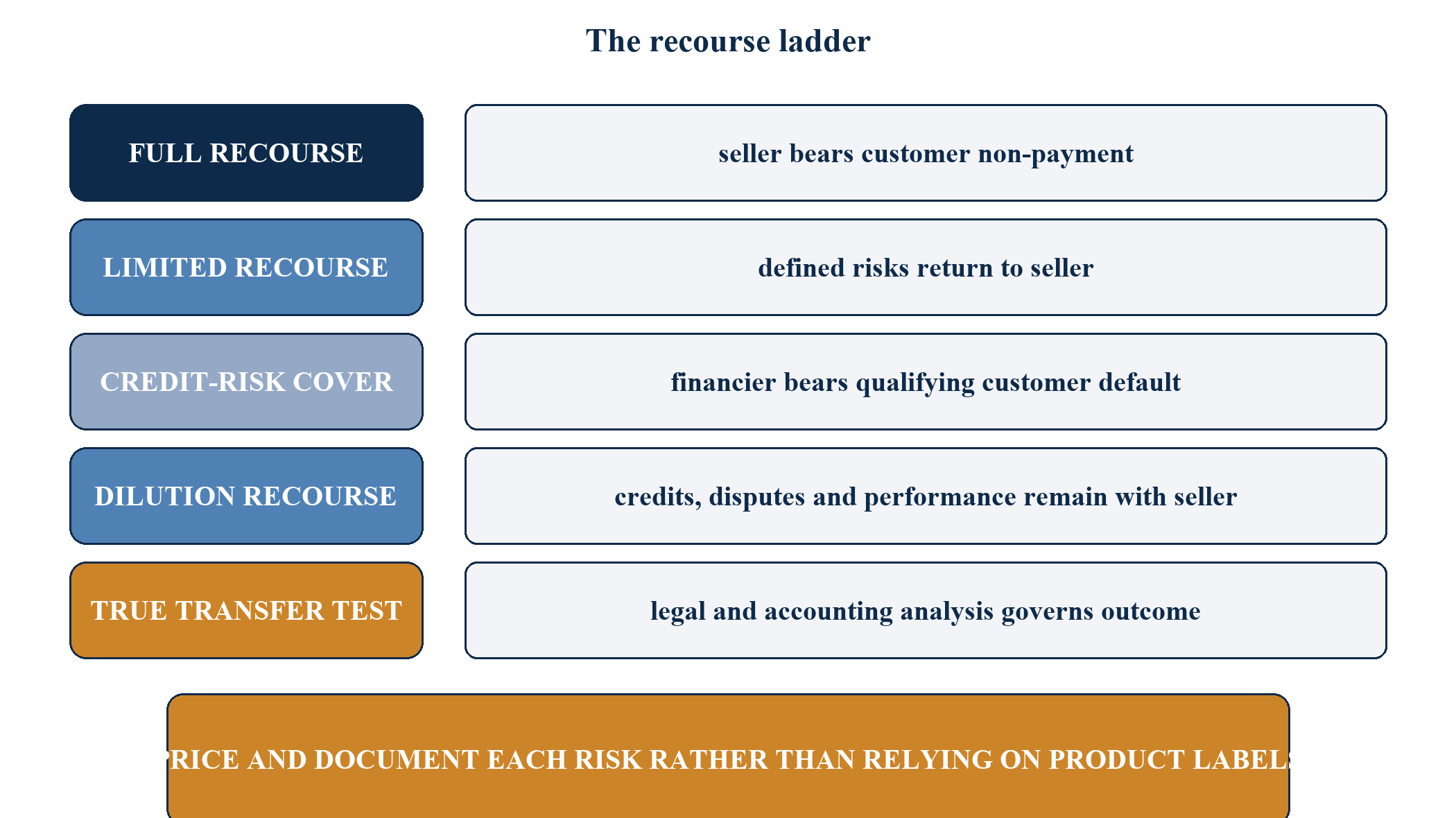
With-recourse factoring leaves specified customer or performance risk with the supplier. Non-recourse factoring transfers defined credit risk to the factor, subject to exclusions. Partial-recourse structures allocate risk by amount, time or cause. A non-recourse label can still leave the supplier responsible for disputes, dilution, fraud, invalid invoices, breach of warranty, sanctions issues and contractual defences.
2.2 Invoice discounting
Invoice discounting generally advances funds against receivables while the supplier continues to administer the ledger and collection process. The arrangement may be confidential or disclosed. Availability commonly depends on an agreed borrowing base, advance rate, customer concentration limits, ageing, reserves and periodic certificates. The supplier gains liquidity and accepts a continuing obligation to produce accurate invoice and collection data.
2.3 Buyer-led supply-chain finance
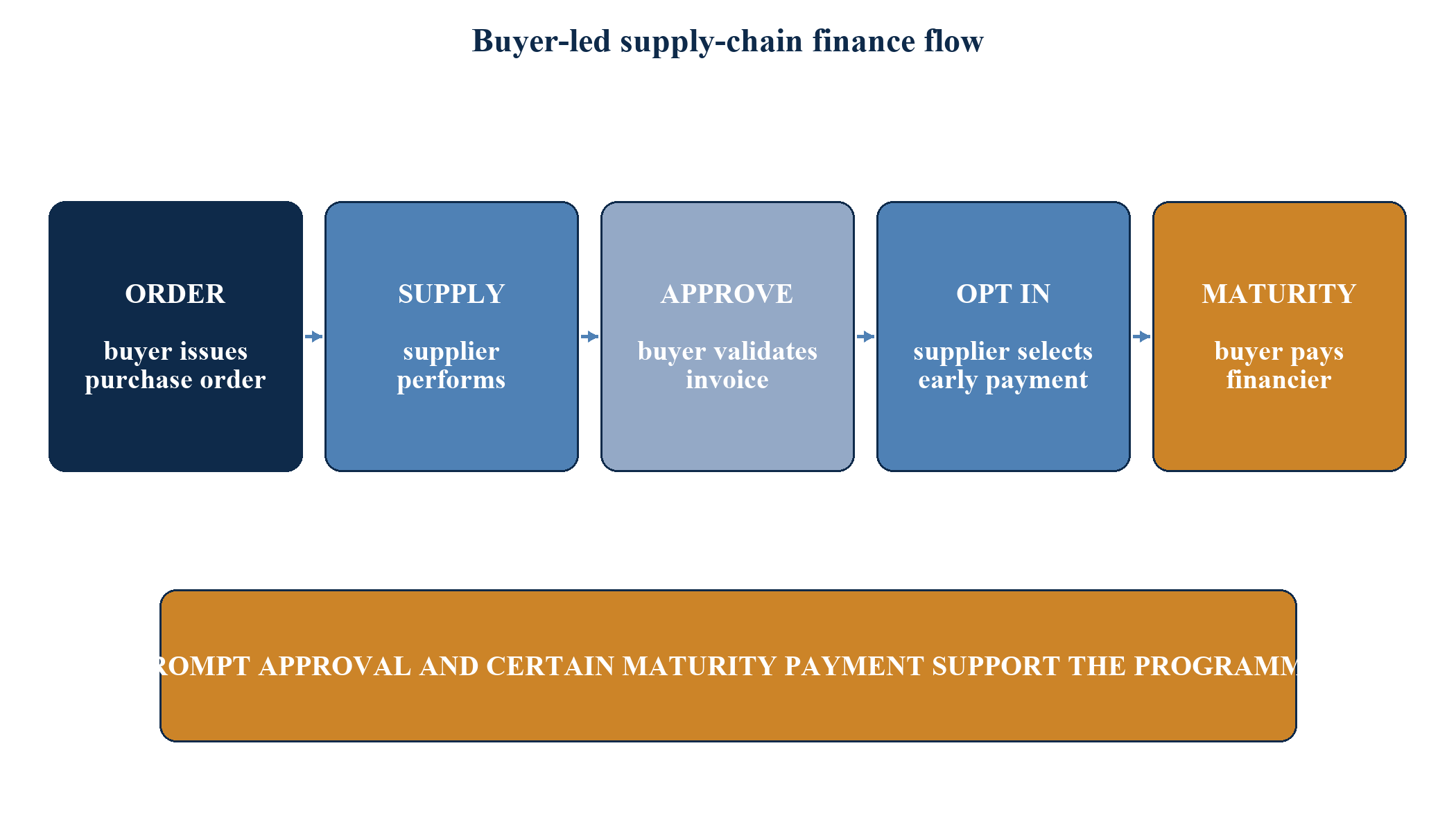
Buyer-led supply-chain finance, often called reverse factoring, begins after an anchor buyer approves a supplier invoice. The financier offers early payment to the supplier, usually pricing the advance with reference to the anchor buyer's credit. The buyer pays the financier on the scheduled date. The structure can reduce the supplier's financing cost and extend or stabilise the buyer's payable cycle, provided invoice approval is timely and the accounting, disclosure and operating treatment is appropriate.
| Product | Primary credit focus | Collection route | Common risk retained by supplier | Natural use case |
|---|---|---|---|---|
| disclosed factoring | customer and receivable | customer pays factor or controlled account | dilution, dispute, warranty and agreed recourse | diversified approved invoices |
| confidential invoice discounting | supplier, ledger and receivables | customer pays supplier or controlled account | collection, servicing, dilution and broad recourse | strong finance systems and stable ledger |
| non-recourse receivables purchase | customer and transfer effectiveness | customer pays purchaser | performance, fraud, invalidity and exclusions | creditworthy customers and clean evidence |
| buyer-led supply-chain finance | anchor buyer after approval | buyer pays financier | supplier performance before approval | large buyer with many suppliers |
| dynamic discounting | buyer liquidity and approval | buyer pays early from own cash | performance before approval | cash-rich buyer seeking return and supplier resilience |
3. THE 2026 CREDIT AND TRADE CONTEXT
3.1 Working capital remains a live financing need
The CBUAE's first-quarter 2026 survey found that working capital was the leading driver of business credit demand. Financial institutions reported an overall lending-appetite net balance of negative 3.2 percentage points, weaker appetite towards SMEs, higher collateralisation requirements and increased premiums on riskier loans [1]. The survey covers UAE institutions and expresses sentiment through net balances. It does not quote transaction terms or represent a GCC-wide forecast.
The OECD's 2026 SME financing review describes a cautious environment in which outstanding SME loan stocks broadly stagnated in 2024 and businesses relied more heavily on short-term finance for immediate needs [3]. The ADB's January 2026 release estimates a USD 2.5 trillion global trade-finance gap in 2025 and records bank expectations that supply-chain realignment will increase demand [2]. Together, these sources support a practical conclusion: an SME that can convert verified commercial assets into finance may create an additional route beside an unsecured working-capital line.
3.2 Public platforms and guarantee channels
Emirates Development Bank publishes supply-chain finance, receivables finance and purchase-finance solutions for eligible UAE businesses [5,6]. Its national supply-chain finance platform was designed to connect buyers, suppliers and banks, automate onboarding and accelerate supplier access to cash [7]. Qatar Development Bank's current credit-guarantee programme includes working capital and bill discounting through partner institutions [19]. QDB also publishes a local bill-discounting product for qualifying Qatar-based invoices [20].
These programmes illustrate policy support for working-capital access. Each application remains subject to current eligibility, documentation, credit approval, pricing, sector, ownership and programme terms. A management team should verify the live rules with the institution and should not treat a public programme as committed capacity before formal approval.
| Market development | Practical opportunity | Required caution |
|---|---|---|
| working-capital demand remains important | use receivables as an evidenced repayment source | lender appetite and collateral requirements remain borrower-specific |
| buyer-led platforms are available | link supplier pricing to anchor approval and credit | delayed approval can destroy the promised liquidity benefit |
| guarantee programmes cover working capital | test risk-sharing routes early | guarantees are conditional and do not replace underwriting |
| trade-finance demand is rising globally | build scalable digital evidence and multiple funding routes | cross-border law, sanctions, fraud and currency risks remain |
4. CASH-CONVERSION CYCLE AND RECEIVABLE ECONOMICS
4.1 Liquidity is created by shortening funded days
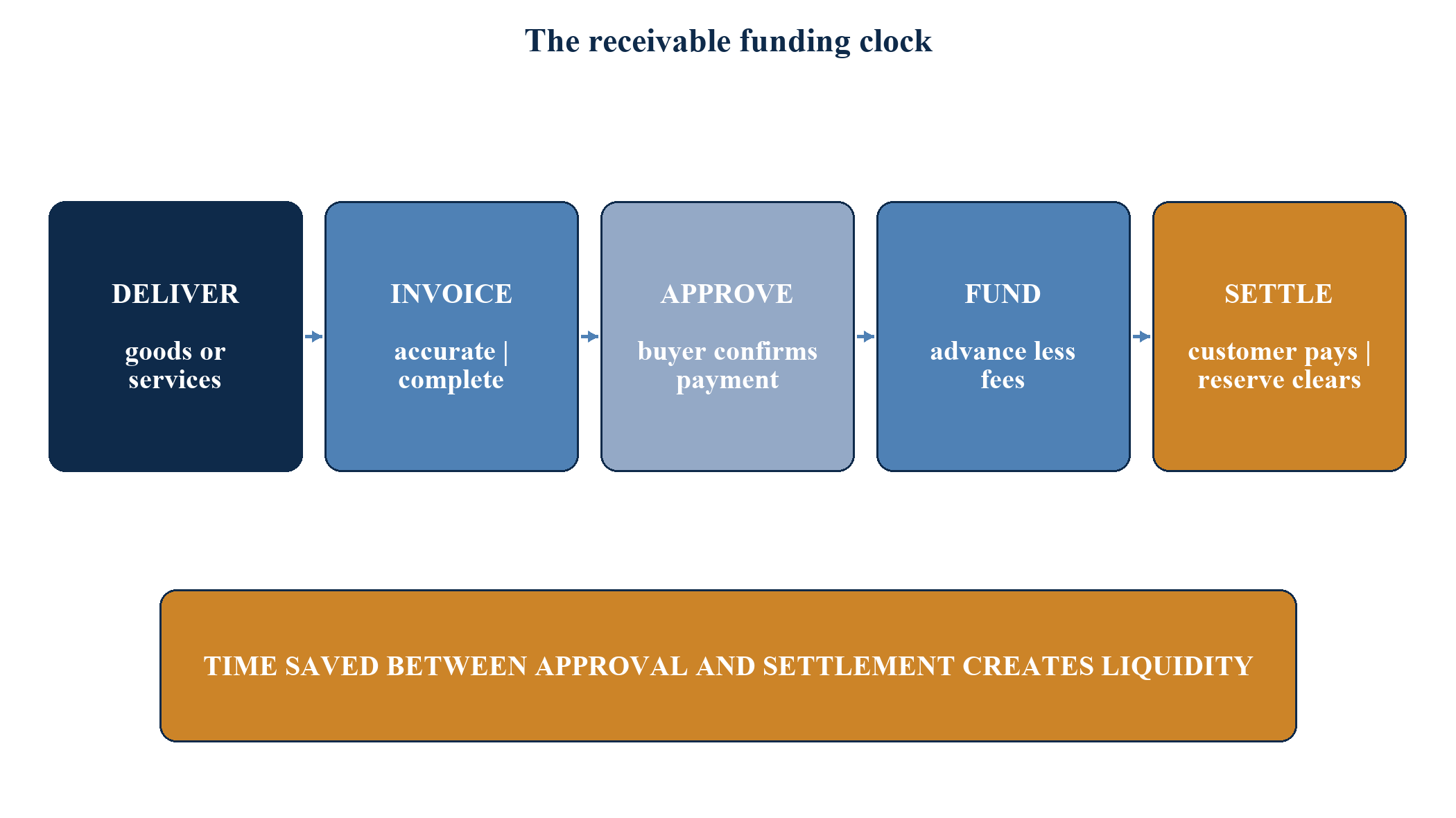
The cash-conversion cycle is commonly expressed as inventory days plus receivable days less payable days. Factoring directly addresses the receivable component. Buyer-led supply-chain finance can also affect payable timing and supplier liquidity. The relevant measure is the actual cash-release date, not the date on which a programme is announced or an invoice is uploaded.
Suppose a supplier pays for raw materials on day 0, completes production on day 25, delivers on day 35, issues an invoice on day 36 and receives customer cash on day 96. The receivable funds sixty days of the cycle. If a factor advances 85 per cent on day 41, the supplier receives most of the cash fifty-five days earlier. The retained amount, less fees and permitted deductions, is settled after the customer pays.
4.2 Volume, margin and timing interact
Days-sales-outstanding alone cannot determine facility size. The model also needs monthly sales, gross margin, invoice approval lag, dispute rates, credit notes, taxes, customer concentration and seasonality. A rapidly growing business can require more liquidity even when receivable days improve because the absolute ledger expands. A low-margin distributor can be highly sensitive to a seemingly modest financing discount.
The operating team should calculate cash release by invoice cohort. Cohorts reveal whether new sales, specific customers or particular product lines create delays. They also help distinguish customer-payment risk from internal invoicing and approval failures.
| Cycle event | Evidence | Timing measure | Financing implication |
|---|---|---|---|
| delivery completed | delivery note, acceptance or milestone certificate | delivery-to-invoice days | finance cannot begin before the right to bill exists |
| invoice issued | tax invoice and ledger entry | invoice-to-approval days | approval lag delays buyer-led funding |
| invoice approved | buyer portal or authenticated confirmation | approval-to-offer days | approved amount becomes the programme base |
| supplier funded | financier settlement and bank receipt | offer-to-cash days | defines actual liquidity release |
| buyer pays | remittance and controlled-account receipt | days from invoice or approval | closes the funded cycle |
5. INVOICE DATA READINESS
5.1 A financeable invoice needs a clean evidence chain
The invoice must arise from a real, completed or contractually earned commercial obligation. The financier will commonly require the underlying contract or purchase order, delivery or performance evidence, invoice, buyer details, due date, currency, tax treatment, ageing and confirmation that the invoice has not been assigned, pledged, paid, disputed or credited. The required package depends on product and jurisdiction.
Data should reconcile across the enterprise resource planning system, tax records, buyer portal, bank account and general ledger. Variations in legal names, dates, currency, purchase-order numbers, quantities or delivery status can delay funding or create an eligibility breach. Manual spreadsheets may support a small pilot; scale requires controlled interfaces, immutable identifiers and exception handling.
5.2 Build an eligibility dictionary
An eligibility dictionary turns legal and credit terms into executable data rules. It defines an eligible customer, permitted country, maximum invoice age, excluded contract type, acceptable currency, concentration cap, dispute treatment, credit-note reserve, related-party exclusion and evidence status. Each rule needs a named data field, authoritative source, owner, calculation and escalation path.
| Eligibility test | Pass condition | Source system | Common exception |
|---|---|---|---|
| valid debtor | approved legal entity and identifier | customer master and KYC record | trading name differs from contracting entity |
| earned receivable | delivery or milestone accepted | logistics, project system or buyer portal | invoice issued before acceptance |
| no dispute | no open quality, quantity or price dispute | CRM and collections log | verbal dispute not recorded in ERP |
| unique financing | no prior transfer, pledge or payment | assignment register and lender confirmations | duplicate invoice number across entities |
| age within limit | invoice and due dates inside policy | receivables ledger | backdated invoice or extended terms |
| eligible currency and country | within approved programme parameters | contract and invoice | collection account cannot receive the currency |
6. UAE LEGAL ARCHITECTURE FOR RECEIVABLE TRANSFER
6.1 Transfer, notice and debtor rights
UAE Federal Decree-Law No. 16 of 2021 establishes a framework for factoring and the transfer of receivables [8]. The law addresses current and future receivables, transfer effectiveness, debtor notice, payment instructions, priority and the rights of the transferor, transferee and receivable debtor. Article 13 provides that a transfer does not alter the debtor's rights and obligations under the original contract unless the debtor accepts the change. Article 14 addresses when notice of transfer or payment instructions become effective [8].
The practical file should identify the receivable, transfer agreement, representations, consideration, notice method, payment instructions, collection account and evidence of receipt. Counsel should test contractual restrictions, governing law, conflict-of-laws rules, set-off, counterclaims, public-sector restrictions, data protection, tax and enforcement for the actual receivable pool.
6.2 Security rights and competing claims
UAE Federal Law No. 4 of 2020 permits security over a broad range of movable assets, including accounts receivable, bank accounts, equipment, goods and future assets [9]. A financing structure may involve an outright transfer, a security transfer, a pledge over receivables, account control or a combination. The substance and legal steps matter more than the commercial label.
The parties should verify creation, third-party effectiveness, registration, priority, proceeds, commingling, amendments and release. A receivable can be commercially valid and still provide weak financing protection if a prior security interest, contractual defence or defective notice impairs the financier's rights.
6.3 Cross-border receivables require separate analysis
A GCC supplier may sell to a buyer in another country, invoice in a third currency and assign to a financier governed by a different law. The governing law of the sales contract, transfer, debtor obligation, security interest and collection account may not be the same. The UNCITRAL Model Law on Secured Transactions treats receivables and outright transfers within a functional framework and highlights registration, priority and debtor protection [22]. It provides a useful analytical reference; it is not a substitute for the enacted law of each relevant jurisdiction.
7. THE RECOURSE CONTINUUM
7.1 Credit risk is only one part of recourse
Recourse should be mapped by cause. Customer insolvency, late payment, dispute, returned goods, price adjustment, tax error, fraud, sanctions, warranty breach and defective transfer can be allocated differently. A factor may assume approved customer credit risk while retaining full recourse for commercial disputes and invalid invoices. The supplier therefore needs a recourse matrix rather than a binary label.
7.2 Time and amount shape the exposure
Recourse can activate after a defined number of days past due, after a dispute is raised, or immediately when a representation fails. It may cover the entire funded amount, only the advance, or a first-loss layer. The financier may debit a reserve account, reduce new availability, demand repurchase or exercise security rights.
The supplier should model peak repurchase obligations under correlated stress. A single large customer that delays payment across many invoices can create a rapid liquidity reversal. A nominally self-liquidating programme then behaves like a concentrated short-term borrowing.
| Event | Possible allocation | Supplier control | Liquidity response |
|---|---|---|---|
| buyer insolvency | factor, insurer, supplier or shared | customer limits and monitoring | suspend new funding and claim protection |
| performance dispute | usually supplier | delivery evidence and dispute resolution | reserve or repurchase affected invoice |
| credit note or return | usually supplier | pricing and quality controls | dilution reserve and true-up |
| fraud or duplicate financing | supplier and wrongdoer; contractual allocation varies | unique invoice controls and confirmations | immediate exclusion, investigation and recovery |
| late payment without insolvency | depends on overdue and recourse terms | collections and buyer engagement | ageing reserve or recourse after trigger |
8. BUYER-LED SUPPLY-CHAIN FINANCE DESIGN
8.1 The approved-payable event
A buyer-led programme should define the precise event that converts a supplier invoice into an approved payable. Approval may require receipt, quantity match, quality acceptance, tax validation and internal authorisation. The financier needs an authenticated approval message and a reliable undertaking that the buyer will pay the approved amount on the agreed date, subject to the programme documents.
Approval latency is a central design variable. If a supplier waits twenty days for approval and then receives early payment within one day, the programme only releases cash for the remaining period. The buyer should measure delivery-to-invoice, invoice-to-approval and approval-to-funding separately.
8.2 Voluntary supplier participation
The supplier should be able to evaluate the price, payment date, currency, recourse and accounting treatment before accepting early payment. Programme communications should explain that non-participation does not change the contractual payment obligation. Procurement teams should avoid commercial pressure that obscures the financing decision.
8.3 Programme capacity and concentration
The financier underwrites the anchor buyer, programme terms and operational controls. Capacity can be limited by buyer exposure, supplier concentration, country, currency, tenor and facility sublimits. A buyer with a wide supplier base should prioritise segments where earlier payment creates material resilience or pricing benefit.
| Programme stage | Anchor-buyer responsibility | Financier responsibility | Supplier responsibility |
|---|---|---|---|
| onboarding | approve supplier population and data-sharing basis | KYC, credit and platform setup | provide legal, bank and tax records |
| invoice approval | validate obligation and due date | authenticate approval file | resolve performance exceptions |
| early-payment offer | transmit approved amount promptly | calculate price and present offer | accept or decline voluntarily |
| settlement | pay financier on contractual date | fund supplier and reconcile receipt | verify bank receipt and accounting |
| exception handling | correct cancellations, credits and disputes | apply programme rules and controls | return or net amounts where required |
9. FACILITY SIZING AND ADVANCE RATES
9.1 Size from eligible receivables and cash need
Facility size should reconcile three quantities: the supplier's forecast cash requirement, the eligible receivable pool and the financier's approved risk capacity. A large ledger does not automatically produce equivalent availability. Eligibility exclusions, concentration caps, advance rates, reserves, recourse and programme limits reduce the funded amount.
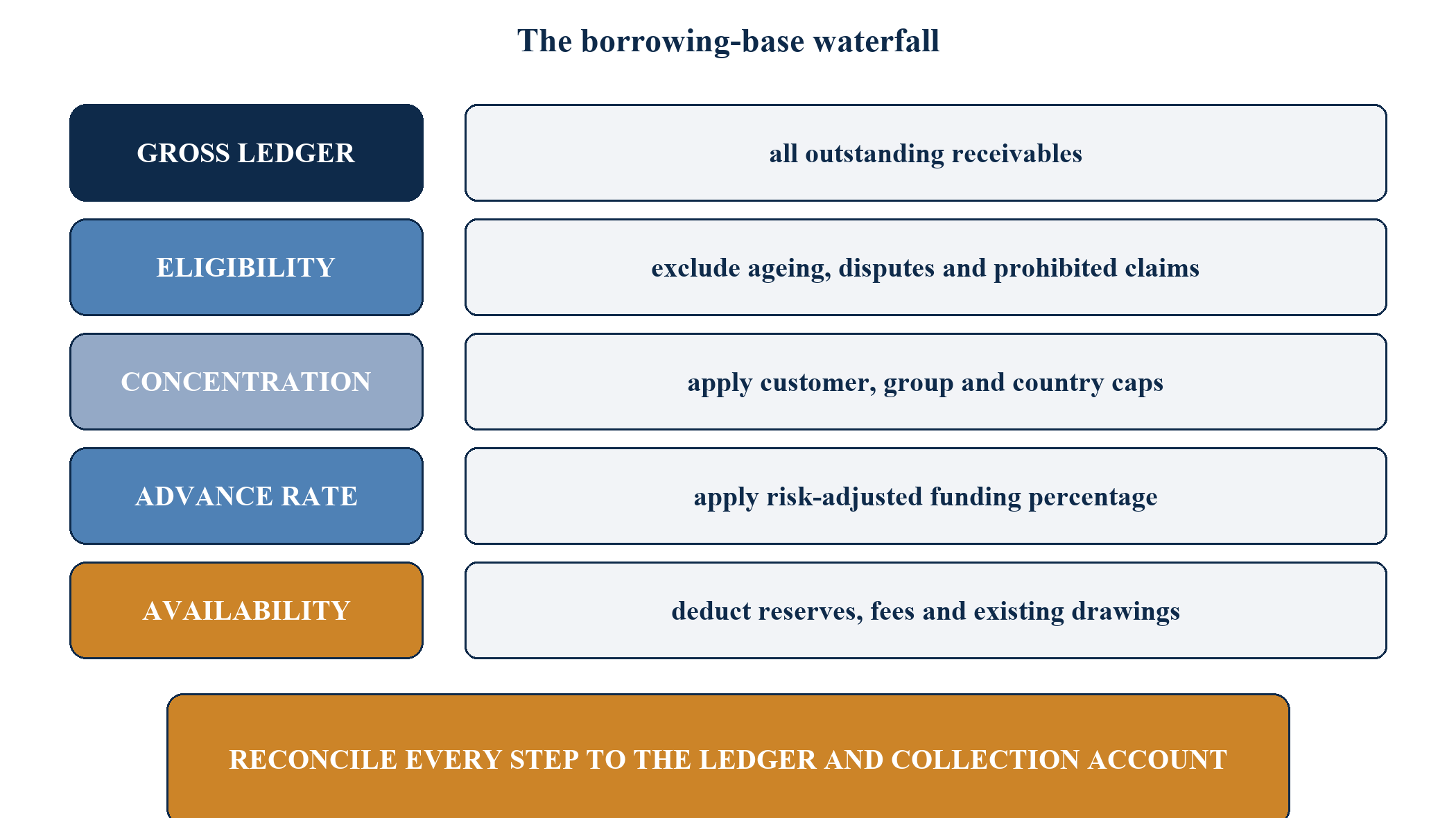
A receivables borrowing base can be expressed as eligible receivables multiplied by an advance rate, less reserves and prior drawings. Buyer-led finance can instead fund selected approved payables, subject to buyer and programme limits. In both cases, the company should model base, downside and severe-but-plausible conditions.
9.2 Hypothetical borrowing-base example
Consider a hypothetical supplier with AED 60 million of gross trade receivables. AED 8 million is overdue beyond the eligibility threshold, AED 4 million is disputed, AED 3 million is related-party and AED 5 million exceeds a customer concentration cap. Eligible receivables equal AED 40 million. At an 85 per cent advance rate, gross support is AED 34 million. A AED 2 million dilution reserve produces AED 32 million of availability before existing drawings.
If the forecast peak working-capital deficit is AED 28 million and the board requires AED 4 million of minimum cash, the model indicates a AED 32 million need. The coincidence with supported availability is fragile. A reserve increase, customer delay or new concentration can create an immediate shortfall. A separate contingency plan remains necessary.
| Sizing component | Hypothetical amount | Basis |
|---|---|---|
| gross receivables | AED 60m | ledger total |
| ageing exclusion | AED 8m | invoices outside policy |
| disputes and related parties | AED 7m | ineligible commercial or connected items |
| concentration exclusion | AED 5m | amount above customer cap |
| eligible receivables | AED 40m | gross less exclusions |
| support at 85 per cent | AED 34m | eligible amount times advance rate |
| dilution reserve | AED 2m | credits, returns and adjustments |
| borrowing-base availability | AED 32m | support less reserve |
10. ALL-IN COST COMPARISON
10.1 Translate every quote into a common basis
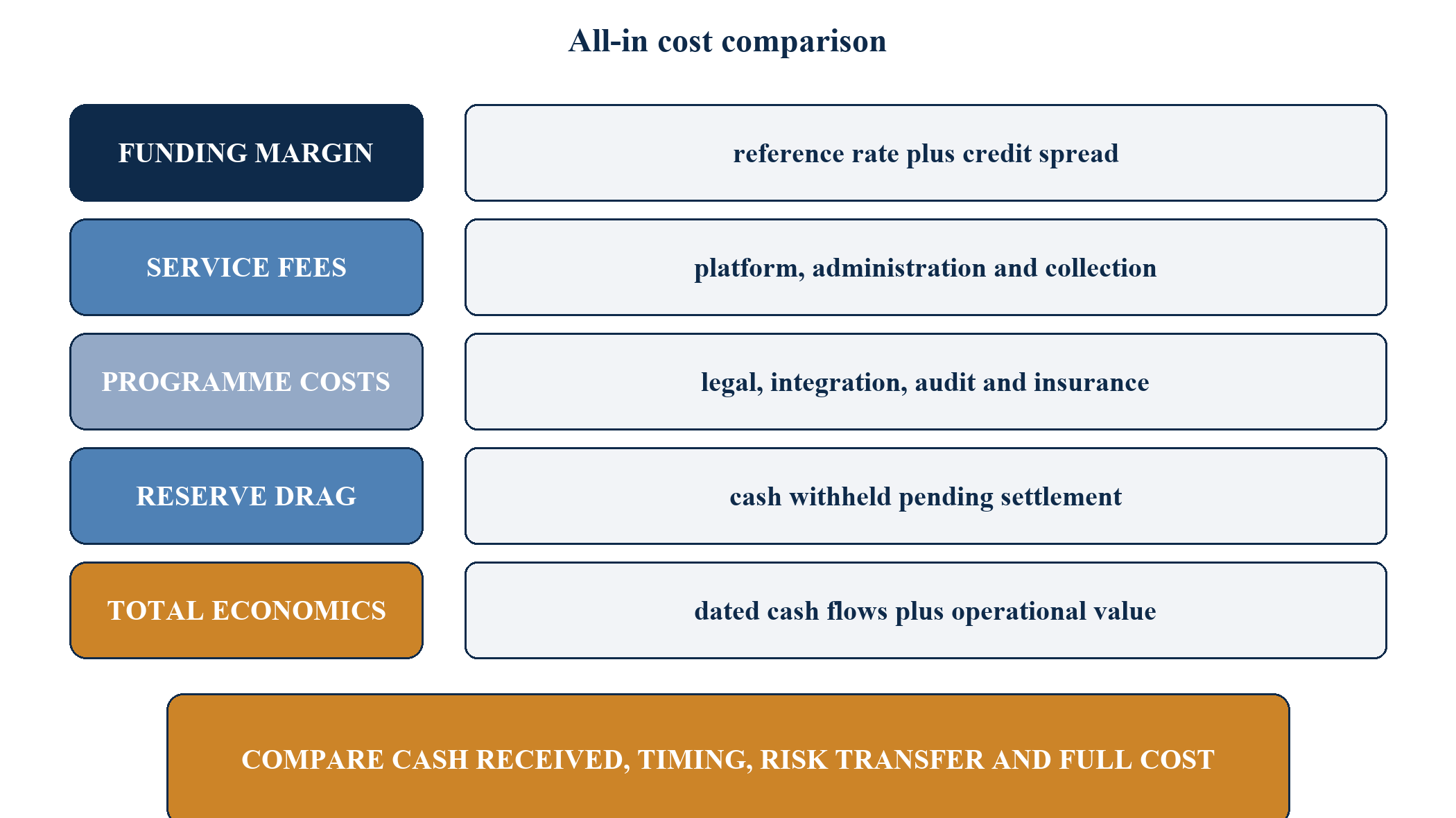
Factoring cost can include a discount or profit rate, service fee, arrangement fee, platform fee, credit-protection charge, audit fee, minimum-volume fee, reserve funding cost, late-payment charge and legal cost. Buyer-led finance may quote a discount rate for the period from funding to buyer payment. Invoice discounting may charge interest on advances plus a service or monitoring fee.
The comparison should use the actual funded amount and funded days. A fee stated as a percentage of invoice face value can have a much higher annualised effect when the advance period is short. A rate stated per annum can still produce a different cash cost when the day-count convention, floor, payment timing and fees vary.
10.2 Hypothetical cost example
Assume a hypothetical AED 1 million approved invoice due in 60 days. A financier advances 90 per cent, or AED 900,000, and charges a 9 per cent annual discount on the advance for 60 days plus a 0.35 per cent service fee on invoice face value. Using a 360-day convention, the discount is AED 13,500 and the service fee is AED 3,500. The supplier receives AED 883,000 initially and, after the buyer pays, receives the retained AED 100,000 if no deductions apply. Total explicit cost is AED 17,000.
An early-payment alternative may offer a 1.4 per cent discount on face value for payment 55 days early, producing AED 14,000 of cost. The lower cash cost does not automatically make it preferable. The supplier must compare recourse, certainty, available amount, accounting, buyer relationship, disclosure, tax and operational requirements.
| Cost component | Calculation base | Review question |
|---|---|---|
| funding discount or profit | advance, face value or approved amount | which amount, days and convention apply? |
| service fee | turnover, invoice or facility | what administration and collection services are included? |
| credit protection | protected receivable amount | which causes of non-payment are covered and excluded? |
| reserve opportunity cost | retained cash and duration | when is the reserve released and can it be increased? |
| minimum volume or utilisation | agreed annual or monthly level | what happens if sales or programme adoption is lower? |
| legal, audit and platform cost | fixed or activity based | which costs recur and who controls their frequency? |
11. CASH-FLOW IMPACT AND WORKED CASE
11.1 Measure cash release, not accounting revenue
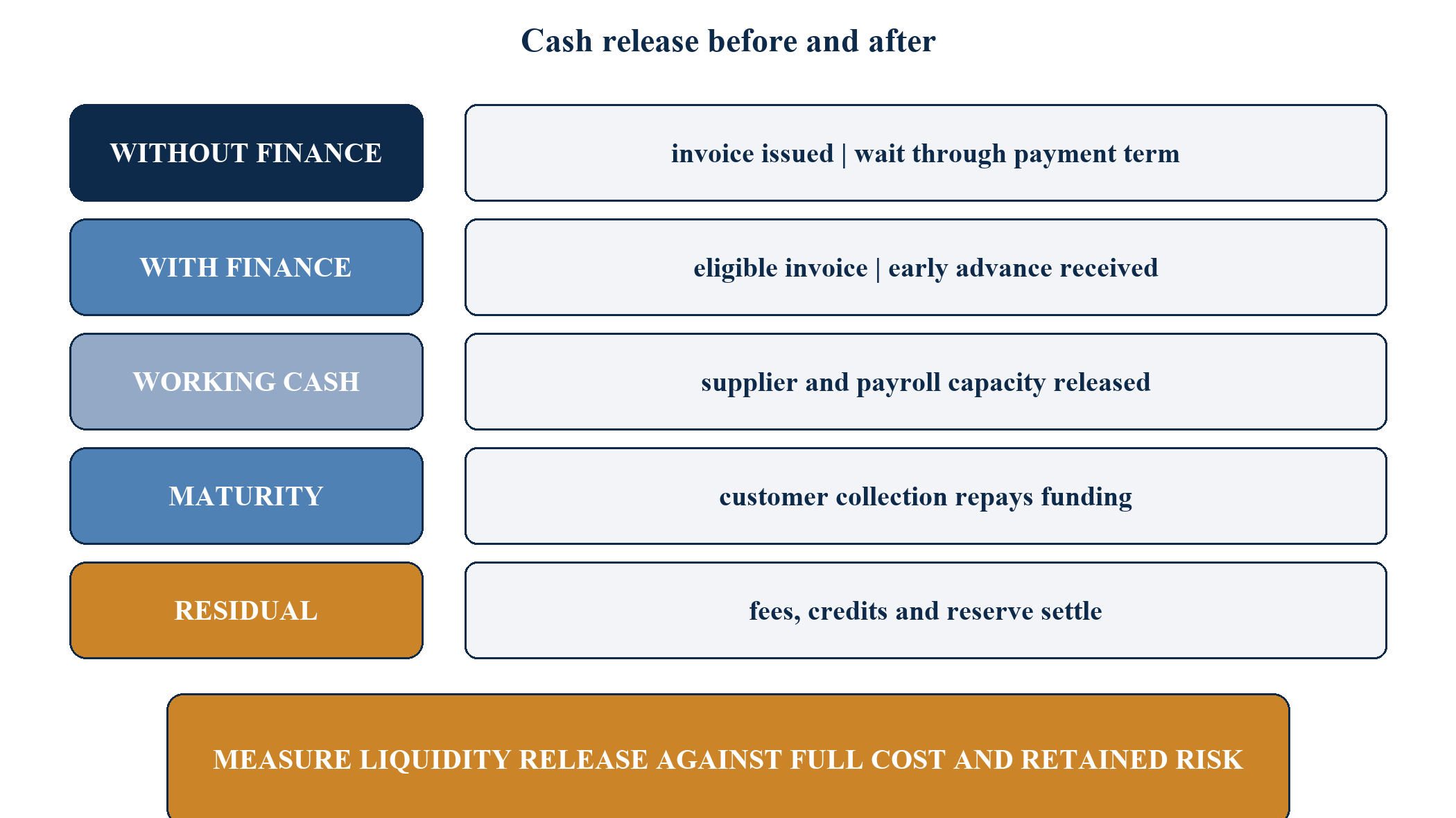
Receivables finance changes the timing and form of cash. It does not create new revenue or margin. The board model should show opening cash, invoice generation, eligible receivables, advances, fees, reserves, customer payments, recourse payments and closing liquidity by week. The model should also reconcile facility utilisation to the balance sheet and cash-flow statement.
11.2 Hypothetical three-month case
Consider a hypothetical manufacturer that invoices AED 20 million each month on 90-day terms. Without finance, it receives no cash from the first month's invoices during the first two months of a new growth cycle. The company funds production and overhead from existing cash and a revolver. A receivables programme advances 85 per cent five days after each invoice, subject to a 5 per cent reserve and stated fees.
In month one, the programme releases AED 17 million before fees. In month two, another AED 17 million is available if the new invoices remain eligible and programme capacity is sufficient. When the customer pays the first invoice in month four, the factor settles the retained amount after fees, credits and adjustments. The programme can therefore replace part of a general revolving line with asset-linked funding.
The result depends on continued eligibility. If a customer dispute makes AED 6 million of invoices ineligible in month two, expected cash release falls by AED 5.1 million at an 85 per cent advance rate. Treasury needs a weekly bridge between forecast and actual eligibility.
| Month | New invoices | Eligible percentage | Advance rate | Gross cash release | Main sensitivity |
|---|---|---|---|---|---|
| 1 | AED 20m | 100% | 85% | AED 17.0m | onboarding and first funding date |
| 2 | AED 20m | 70% | 85% | AED 11.9m | dispute makes 30% ineligible |
| 3 | AED 22m | 90% | 85% | AED 16.8m | concentration cap and growth |
| 4 | AED 18m | 95% | 85% | AED 14.5m | first customer payment and reserve settlement |
11.3 Compare with the counterfactual
The investment case should compare the programme with the best available alternative. The counterfactual may be a committed revolver, overdraft, supplier-term negotiation, equity, slower growth or self-funded discounting. Benefits can include lower borrowing cost, higher order capacity, fewer late supplier payments, stronger early-payment terms and reduced peak revolver use. Costs include programme fees, systems, legal work, audits, internal operations and retained risk.
12. BUYER CREDIT AND CUSTOMER CONCENTRATION
12.1 The debtor can become the principal risk
Receivables finance can shift underwriting from the SME's balance sheet to the quality of its customers. This is valuable when the supplier sells to creditworthy anchor buyers. It can also create a concentrated dependency. A facility supported by one buyer may contract immediately if that buyer is downgraded, disputes invoices, changes payment behaviour or exceeds a concentration cap.
The credit file should cover the buyer's legal identity, ownership, financial condition, payment history, contract, jurisdiction, currency, industry, public-sector status, sanctions exposure and right of set-off. Portfolio limits should be expressed as both a percentage of eligible receivables and an absolute amount.
12.2 Correlation matters
Several customers may belong to one group, depend on the same project, operate in the same sector or be exposed to the same commodity. Apparent diversification can disappear in stress. A supplier serving construction contractors across different legal entities can still face one economic risk if all invoices depend on the same development programme.
| Concentration lens | Example | Control |
|---|---|---|
| legal entity | multiple invoices to one buyer | single-debtor limit |
| corporate group | subsidiaries share a parent | connected-group aggregation |
| sector | customers depend on the same cycle | sector cap and stress |
| project | several counterparties rely on one project | project-level exposure view |
| geography and currency | buyers share country or transfer risk | country and currency limits |
| payment channel | collections depend on one bank or platform | backup collection route |
13. DILUTION, DISPUTES AND RETURNS
13.1 Face value is not necessarily collectable value
Dilution is the reduction between gross invoiced receivables and cash ultimately collected because of credit notes, returns, rebates, discounts, shortages, pricing errors, set-off or disputes. Historical dilution should be calculated by customer, product, cause and invoice cohort. Average dilution can conceal volatile months that exceed the programme reserve.
A financier may set a dilution reserve, reduce the advance rate or exclude customers with unstable adjustments. The supplier should treat reserve methodology as a working-capital variable. A two-percentage-point reserve increase on a AED 50 million eligible ledger removes AED 1 million of availability.
13.2 Dispute management is a financing process
Disputes need a central register with invoice, amount, cause, owner, evidence, expected resolution and ageing. Sales, operations and finance should agree whether an invoice remains collectable, requires a credit note or should be repurchased from the programme. Repeated root causes should feed contract, delivery and billing improvements.
An invoice that is technically overdue because a proof-of-delivery document was omitted may be resolved quickly. An invoice challenged for defective performance can represent a substantive commercial loss. Both can appear as past due in the ledger; the financing response should differ.
14. FRAUD AND DUPLICATE-FINANCING CONTROL
14.1 The core fraud scenarios
Receivables structures are vulnerable to fictitious invoices, duplicate invoices, altered bank details, circular trading, related-party transactions, premature invoicing, forged delivery evidence, undisclosed credit notes and multiple assignments. Fraud can be committed by an employee, supplier, customer or colluding parties. Strong documentation alone is insufficient when the source data can be manipulated.
The control architecture should verify the commercial event independently. Techniques include buyer confirmation, three-way matching, delivery-system integration, bank-account validation, tax-record reconciliation, duplicate detection, customer call-back, site visits and analytics across invoice number, amount, date, purchase order, bank account and device.
14.2 Segregate creation, approval and funding
The person who creates an invoice should not control buyer approval, assignment and bank-detail changes. Programme users need role-based access, dual approval, transaction limits, immutable logs and rapid revocation when staff leave. Bank-account changes should require an out-of-band confirmation through a previously verified channel.
| Fraud indicator | Why it matters | Verification response |
|---|---|---|
| repeated round amounts or sequential same-day invoices | may indicate fabricated or split invoices | compare to purchase order, delivery and historical pattern |
| bank account changed shortly before funding | diversion risk | independent call-back and account ownership check |
| invoice appears in more than one funding file | duplicate financing risk | unique registry and cross-funder representation |
| rapid credits after funding | inflated invoice or performance issue | increase reserve and investigate origin |
| customer contact uses supplier-controlled domain | false confirmation risk | verify through independent corporate source |
| unusual goods, route or price | trade-based laundering or fraud risk | enhanced trade and sanctions review |
15. KYC, AML, SANCTIONS AND TRADE CONTROLS
15.1 Know all relevant parties
A programme can involve the supplier, anchor buyer, financier, platform, collection bank, insurer, guarantor and logistics parties. Onboarding should identify legal entities, beneficial owners, directors, authorised signatories, bank accounts, jurisdictions, business activity and expected transaction behaviour. The financier's regulatory obligations and the buyer's procurement standards may create overlapping requirements.
The FATF Recommendations, updated through October 2025, provide the international framework for customer due diligence, beneficial ownership, record keeping, suspicious transaction reporting and sanctions-related controls [25]. FATF's trade-based money-laundering material highlights risks involving mispricing, false documentation, unusual trade routes, shell companies and inconsistent transaction activity [24]. These sources guide risk analysis; applicable local law and institutional procedures govern the actual programme.
15.2 Screening continues after onboarding
Parties, goods, vessels, banks and jurisdictions can change during the programme. Screening should occur at onboarding, funding and material change. Escalation should cover unusual invoice growth, new countries, unexplained intermediaries, high-risk goods, ownership changes and inconsistencies between commercial documents and payment routes.
Data sharing must have a lawful basis and appropriate controls. Programme agreements should define purpose, fields, retention, access, security, incident handling and cross-border transfer. A supplier should know which data the anchor buyer and financier can see and how errors are corrected.
16. BUYER ACCOUNTING AND SUPPLIER-FINANCE DISCLOSURE
16.1 Supplier-finance arrangements require transparency
In May 2023, the International Accounting Standards Board issued amendments to IAS 7 and IFRS 7 requiring additional disclosures about supplier-finance arrangements [13,14]. The disclosures are intended to help users assess effects on liabilities, cash flows and liquidity risk. The requirements focus on arrangements under which finance providers pay amounts that an entity owes its suppliers and the entity pays the finance provider under agreed terms.
The accounting analysis should begin before launch. Management should identify which liabilities are within the arrangement, where they are presented, the range of payment due dates, carrying amounts for which suppliers have already received payment, non-cash changes and liquidity-risk information. The programme team should capture these fields in a reporting-ready data model.
16.2 Presentation and cash-flow classification need judgement
The IFRS Interpretations Committee's reverse-factoring agenda decision discusses whether liabilities remain trade payables or should be presented separately and whether cash flows are operating or financing [16]. Relevant factors include whether additional security exists and whether the terms differ from ordinary trade payables. The analysis depends on facts and applicable accounting policy.
Extending buyer payment terms can create commercial value, but material changes may influence presentation, disclosure and liquidity assessment. The board should review payment-term changes, programme utilisation, concentration by financier and the amount of supplier obligations already funded.
| Buyer reporting field | Purpose | Data owner |
|---|---|---|
| carrying amount within programme | identify scale of arrangement | financial reporting |
| amount already paid to suppliers by financier | distinguish funded obligations | financier and treasury |
| range of programme due dates | compare with ordinary payables | procurement and accounts payable |
| non-cash changes | explain movements not visible in cash flow | controllership |
| concentration by finance provider | assess liquidity dependency | treasury and risk |
17. SELLER ACCOUNTING AND DERECOGNITION
17.1 Sale treatment depends on transferred rights and retained exposure
IFRS 9 requires an entity to derecognise a financial asset when contractual rights to cash flows expire or when the asset is transferred and the transfer qualifies for derecognition [15]. The analysis examines transfer of rights or pass-through arrangements, transfer of substantially all risks and rewards, and control. Factoring with broad recourse may continue to be recognised as a receivable with a financing liability.
Legal sale, commercial non-recourse wording and accounting derecognition are related but distinct conclusions. Credit-risk protection does not necessarily transfer performance, dilution, late-payment or control risks. The supplier's auditors need the final agreements, recourse matrix, customer data, collection mechanics and evidence of actual operation.
17.2 Build the accounting memorandum from the transaction
The memorandum should identify the unit of account, cash-flow rights, risks transferred and retained, control, continuing involvement, fees, reserves, servicing, presentation, expected-credit-loss treatment and disclosures. It should reconcile programme reports to the general ledger and bank statements.
A launch timetable that defers accounting review until year-end can create restatement, covenant and audit risk. The review should occur at term-sheet stage and be refreshed when recourse, pricing, payment terms, collection accounts or programme participants change.
18. TAX, VAT AND DEDUCTIBILITY
18.1 Separate discount, interest and service elements
Factoring documentation can include purchase-price discount, financing return, servicing, collection, platform and guarantee components. Tax treatment may differ by component, counterparty, jurisdiction and legal character. The invoicing and ledger design should preserve this separation rather than recording one net financing charge.
For UAE corporate tax, the Federal Tax Authority's Interest Deduction Limitation Rules guide explains the general limitation based on the higher of the stated de minimis amount and 30 per cent of adjusted EBITDA, subject to the law, exclusions and specific rules [12]. Whether a factoring cost is interest or economically equivalent to interest requires transaction-specific analysis. The paper does not determine that classification.
18.2 VAT and cross-border tax require factual review
VAT treatment can depend on whether a service is exempt financial service, taxable administration or another supply, as well as the location and status of the parties. Withholding tax, permanent establishment, transfer pricing and stamp or registration charges may arise in cross-border structures. A gross-up clause can move tax cost between parties.
The finance model should use after-tax cash cost under a documented assumption set. Tax advisers should confirm treatment before contracts and systems are finalised. A tax conclusion embedded only in a spreadsheet can fail when legal form, invoice wording or counterparty changes.
19. TECHNOLOGY AND DATA INTEGRATION
19.1 The golden record
The programme needs one authoritative record linking purchase order, goods receipt or service acceptance, invoice, buyer approval, assignment, funding, collection, credit note and settlement. Each event should carry a stable identifier, timestamp, source, status and authorised user. Reconciliation should identify missing, duplicated and changed records.
An application programming interface can reduce manual effort, but automation also transmits errors faster. The control design should validate schemas, totals, duplicates, dates, currency, beneficiary account and approval authority before a file is accepted. Failed records should enter a visible exception queue rather than disappear from the funding population.
19.2 Cybersecurity is a liquidity control
A compromised platform or bank-detail change can divert cash and stop funding. Controls should include multifactor authentication, least-privilege access, encryption, secure key management, maker-checker approval, activity logging, incident response, recovery objectives and periodic penetration testing. The continuity plan should define how approved invoices and collections are processed during an outage.
| Interface | Critical fields | Control |
|---|---|---|
| supplier ERP to buyer portal | invoice, purchase order, delivery, tax and bank details | schema validation and duplicate test |
| buyer portal to financier | authenticated approval, amount, currency and due date | digital signature or controlled secure channel |
| financier to bank | funding instruction and beneficiary account | dual approval and account verification |
| collection account to ledger | payer, amount, value date and invoice reference | automated matching with exception queue |
| programme data to reporting | outstanding, reserve, recourse, fees and maturity | daily reconciliation and locked period close |
20. SHARIA-COMPLIANT STRUCTURES
20.1 Economic purpose and contractual form must align
GCC businesses may require Sharia-compliant working-capital solutions. Structures can use commodity murabaha, wakala, purchase and agency arrangements, or other approved forms depending on the institution, jurisdiction and underlying transaction. QDB's published local bill-discounting solution describes a Sharia-compliant process involving purchase and agency steps [20].
The Sharia board or adviser should review asset, price, sequence, ownership, agency, profit, late-payment, recourse and documentation. A conventional interest calculation cannot simply be renamed. System workflows must execute the approved contractual sequence and retain evidence.
20.2 Operational detail determines compliance
The parties should map when ownership transfers, when the financier pays, who acts as agent, how collections are received, how profit is calculated and what occurs on late payment or dispute. The accounting and tax analysis remains necessary even when the commercial objective resembles invoice financing.
A dual-product programme should prevent accidental mixing of conventional and Sharia documentation, pricing and approvals. Separate templates, product codes, accounts and audit trails can support control.
21. CROSS-BORDER, CURRENCY AND COLLECTION RISK
21.1 Map every jurisdiction and currency
A cross-border receivable can connect supplier incorporation, buyer incorporation, delivery location, sales-contract law, invoice currency, factor location, collection account and enforcement forum. The legal memorandum should map each connection and identify which law governs transfer, debtor discharge, priority, set-off and insolvency.
Currency risk can arise between invoice, advance and collection. If an AED supplier finances a USD invoice, the advance may be converted while the customer payment remains in USD. The facility should define conversion rates, timing, hedging, reserve and responsibility for shortfalls. A multi-currency pool needs concentration limits and daily equivalent-value monitoring.
21.2 Payment channels can be interrupted
Correspondent-bank availability, sanctions, holidays, cut-off times and documentation can delay cross-border settlement. A receivable due on a contractual date may not produce usable cash on that date. The programme should identify the collection bank, correspondent path, permitted payer, reference fields and contingency route.
Export-credit insurance or non-recourse cover may address specified commercial or political risks. Coverage, waiting periods, exclusions, claim evidence and assignment of policy proceeds require review. The funded amount should not exceed the amount that remains protected after deductibles and exclusions unless the financier accepts the residual exposure.
22. COLLECTIONS, RECONCILIATION AND CASH CONTROL
22.1 Collections close the economic cycle
The collection process should identify each payer, amount, value date, currency, invoice and funded position. Unapplied cash creates uncertainty about availability and recourse. Automated matching should use remittance data and controlled tolerances, with unresolved items assigned to an owner on the same day.
In disclosed factoring, the debtor may pay the factor or a controlled account. In confidential invoice discounting, the supplier may collect as servicer and remit or sweep proceeds. The agreement should address commingling, trust or agency concepts where applicable, account control, permitted withdrawals, misdirected payments and insolvency consequences.
22.2 Daily and monthly reconciliations serve different purposes
Daily reconciliation protects liquidity and identifies missing cash. Monthly reconciliation connects the financier statement, receivables ledger, reserve, fees, recourse and general ledger. Differences should be categorised as timing, data, commercial, bank or accounting issues.
| Reconciliation | Frequency | Key assertion | Escalation trigger |
|---|---|---|---|
| funded invoice to approval | each funding run | every funded invoice was validly approved | unmatched or altered approval |
| bank receipt to invoice | daily | every collection is identified and allocated | unapplied cash beyond one business day |
| factor statement to subledger | weekly | outstanding, reserve and availability agree | unexplained balance or fee |
| subledger to general ledger | month end | assets, liabilities, fees and cash reconcile | period-close difference |
| assignment register to security records | on change and quarterly | transfers and priorities remain current | missing release, amendment or notice |
23. RESERVES, TRIGGERS AND COVENANTS
23.1 Availability changes before maturity
Receivables facilities use eligibility, advance rates, reserves and concentration caps as dynamic controls. They may also include financial covenants, performance triggers and termination events. A company can remain current on interest and still lose availability when dilution rises, customer concentration increases or reporting is late.
The term sheet should define calculation, discretion, notice and cure. A financier may need discretion to protect against new risk; the supplier needs enough predictability to manage payroll and procurement. Objective thresholds, agreed data and escalation periods can reduce surprise.
23.2 Forecast trigger headroom
Management should calculate current and forecast headroom for each trigger. Examples include maximum overdue percentage, minimum eligible ledger, maximum dilution, minimum tangible net worth, leverage, concentration and programme utilisation. The dashboard should show the date on which a forecast breach first appears.
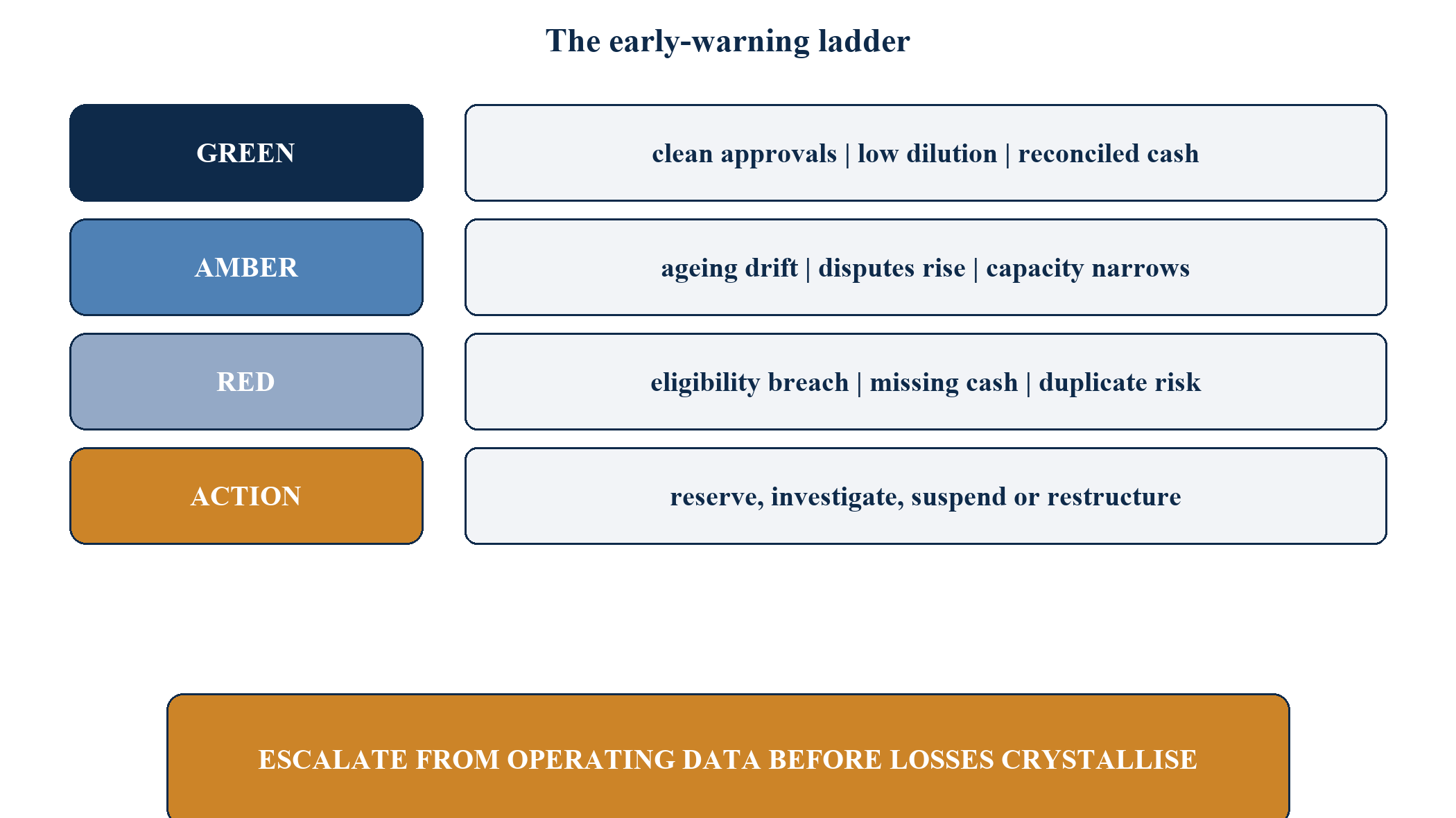
| Status | Example condition | Management response |
|---|---|---|
| green | stable eligibility, low disputes and ample unused capacity | normal monitoring and optimisation |
| amber | concentration or dilution approaching threshold | customer action plan and contingency liquidity |
| red | forecast ineligibility or covenant breach | senior escalation, waiver and alternative funding |
| event | actual breach, fraud or material payment failure | contract response, cash control and recovery plan |
24. ANCHOR-BUYER PROGRAMME GOVERNANCE
24.1 The programme is part of procurement and treasury
An anchor buyer should establish a steering group covering treasury, procurement, accounts payable, finance, legal, tax, compliance, technology, information security and supplier management. The group owns policy, provider selection, supplier segmentation, payment terms, disclosures, service levels, incidents and performance.
Procurement incentives require care. A programme can improve supplier resilience and generate commercial value. It can also create pressure to extend payment terms beyond sustainable levels. Governance should examine supplier cash-flow impact, voluntary participation, rejection rates and complaints alongside buyer working-capital metrics.
24.2 Provider selection should test resilience
The request for proposal should cover pricing, capacity, countries, currencies, onboarding, KYC, technology, data ownership, security, service levels, supplier support, accounting data, reporting, continuity and exit. The anchor should test whether another financier can join or replace the provider without rebuilding the entire programme.
An exit plan should address outstanding funded invoices, supplier communications, data extraction, bank accounts, notices and payment continuity. A platform or financier failure must not make the buyer unable to identify its actual supplier obligations.
25. SME SUPPLIER ONBOARDING
25.1 Reduce friction without weakening control
Smaller suppliers can abandon a programme when documentation, portals and pricing are difficult to understand. Onboarding should request only necessary information, reuse verified data where lawful, explain each step and provide a named support channel. Digital identity and bank validation can reduce time while preserving evidence.
The supplier pack should state programme purpose, parties, fees, recourse, funding option, payment timeline, data use, accounting considerations, complaints and termination. It should avoid implying assured savings or guaranteed funding. The financier retains credit and compliance discretion under the actual terms.
25.2 Segment the supplier population
Suppliers differ in size, country, invoice volume, payment terms, financial sophistication and working-capital need. Segmentation helps prioritise high-impact suppliers and design an appropriate channel. A small supplier with five invoices a year needs a different interface from a distributor uploading thousands each month.
| Supplier segment | Programme priority | Onboarding design |
|---|---|---|
| critical small supplier | resilience and continuity | assisted onboarding and clear fixed workflow |
| high-volume distributor | automation and capacity | API or structured file integration |
| cross-border supplier | currency and legal access | country-specific documentation and payment route |
| occasional service provider | simplicity | portal workflow and transaction-level choice |
| financially strong supplier | optional yield comparison | transparent price and voluntary use |
26. FINANCIER UNDERWRITING
26.1 Underwrite transaction integrity and repayment
The financier evaluates the legal receivable, customer credit, supplier performance, data quality, collections, fraud controls, concentration and recovery. Buyer-led finance shifts focus towards the anchor buyer after approval, while factoring may require deeper review of the supplier's ledger and customer portfolio.
The credit memorandum should describe product, purpose, parties, sales process, receivable creation, approval, transfer, collection, recourse, collateral, systems, accounting, tax, compliance, limits, reserves, covenants, monitoring and exit. A site visit and transaction walkthrough can reveal gaps that financial statements miss.
26.2 Build from verifiable performance data
Useful evidence includes invoice volumes, ageing, days sales outstanding, payment curves, disputes, dilution, returns, write-offs, customer concentration, historic borrowing-base certificates and bank collections. Data should cover enough cycles to capture seasonality and stress. Management estimates should be identified as such in the credit file and tested against source records.
The lender should distinguish late payment from default, commercial dispute and process delay. Each cause has a different probability, loss and control response. Aggregate overdue percentages can obscure this distinction.
27. NEGOTIATING THE TERM SHEET AND DOCUMENTS
27.1 Negotiate economics and operability together
The commercial discussion should cover facility amount, eligible pool, advance rate, reserves, concentration, recourse, pricing, minimum volume, fees, tenor, renewal, security, collections, reporting, audit, discretion, termination and exclusivity. A low headline price can be offset by narrow eligibility, high reserves or operational burden.
Definitions drive availability. The supplier should model the proposed definitions against its actual ledger before signing. A 90-day ageing limit may operate from invoice date, due date or month end. A concentration cap may aggregate connected entities. A reserve may be formulaic or discretionary. These distinctions need cash-flow testing.
27.2 Protect continuity and information rights
The documents should address notice before material changes, cure periods, continued servicing, access to data, confidentiality, permitted assignments, change of control, termination, transition and release. Where the programme is critical to payroll or production, treasury should preserve a backup facility or contingency reserve.
| Term | Model question | Negotiation focus |
|---|---|---|
| advance rate | how much cash is released on each eligible invoice? | formula, reserve interaction and change rights |
| recourse | which event creates repayment by the supplier? | cause, timing, amount and dispute process |
| concentration | how much of the best customer remains eligible? | group aggregation and temporary waivers |
| pricing | what is the all-in cash and annualised cost? | base, fees, floors, minimums and taxes |
| termination | how quickly can availability stop? | notice, existing invoices and transition |
| audit | what evidence can be requested and how often? | scope, cost, confidentiality and remediation |
28. A NINETY-DAY IMPLEMENTATION ROADMAP
28.1 Days 1 to 30: diagnose and design
The first month establishes the cash need, invoice population, customer concentration, payment behaviour, disputes, legal entities, systems and current security. Management selects the product hypothesis and confirms the target service page, accounting and tax workstreams. The output is a verified data pack and decision criteria.
28.2 Days 31 to 60: structure and test
The second month covers provider engagement, indicative terms, legal analysis, accounting memorandum, tax review, security and notice design, system mapping, fraud controls and a pilot borrowing base. The team runs the full path from invoice creation to collection using historical data.
28.3 Days 61 to 90: execute and stabilise
The final month completes credit approval, documents, KYC, accounts, interfaces, user access, supplier onboarding, training, first funding and daily reconciliation. A hypercare forum reviews every exception. The programme moves to business-as-usual only when balances, fees, reserves and ledger entries reconcile.
| Phase | Deliverable | Exit test |
|---|---|---|
| diagnose | cash need, invoice tape and risk map | source data reconciles to ledger and bank |
| design | product, recourse and control blueprint | board and advisers approve the structure |
| structure | term sheet, legal, accounting and tax analysis | model works on historical invoices |
| build | interfaces, accounts, notices and procedures | end-to-end test passes with controlled exceptions |
| launch | first funded cohort and reconciliation | cash, receivable and financier records agree |
| stabilise | dashboard and issue log | service levels and controls operate for three cycles |
29. MONITORING DASHBOARD AND BOARD OVERSIGHT
29.1 Measure liquidity, risk and service
The dashboard should show gross and eligible receivables, funded amount, reserve, unused capacity, cash release, all-in cost, ageing, dilution, disputes, concentration, recourse, approval time, funding time, collection time and reconciliation exceptions. Buyer-led programmes should add supplier adoption, approved-payable value, payment-term distribution and amount already paid to suppliers by financiers.
Metrics need definitions and owners. A reported adoption rate can mean invited suppliers, onboarded suppliers, active suppliers or financed volume. Board reporting should state the denominator and period. Cost should include explicit fees, reserve opportunity cost and implementation expense where material.
29.2 Escalate trends before a trigger
Warning indicators include falling eligibility, rising dispute age, repeated approval delays, high customer concentration, reserve increases, more bank-detail changes, unexplained credits, late reconciliations and dependence on one financier. The management response should identify owner, deadline, cash impact and contingency.
An annual programme review should retest provider capacity, pricing, legal effectiveness, accounting, tax, cyber controls, supplier experience and exit readiness. Material changes should trigger an earlier review.
30. CONCLUSION
Factoring and supply-chain finance can transform the timing of cash for GCC SMEs when the commercial obligation is real, the receivable is transferable, invoice data is reliable and risk allocation is understood. The product choice should follow the transaction state: unapproved performance risk, approved invoice, diversified receivable pool or anchor-buyer payable.
The strongest programmes connect five systems. The commercial system proves delivery and acceptance. The legal system transfers or secures the receivable. The finance system prices and funds the exposure. The accounting and tax system reports the result. The operating system reconciles approvals, cash, reserves and exceptions. A weakness in one system can remove liquidity from the whole structure.
Management should therefore treat receivables finance as an operating capability. The implementation begins with a reconciled invoice tape and cash forecast, continues through legal, accounting, tax and provider design, and settles into daily collection control and board-level monitoring. The resulting liquidity is governed, measurable and connected to identifiable trade flows.
APPENDIX A. PROGRAMME DUE-DILIGENCE CHECKLIST
A.1 Commercial and portfolio
- Define the funded purpose and expected cash benefit.
- Reconcile twelve to twenty-four months of invoices, credits and collections to the general ledger.
- Segment customers by legal entity, group, country, currency, sector and project.
- Calculate ageing, payment curves, disputes, dilution, returns and write-offs.
- Identify contractual restrictions, set-off rights, retention and performance obligations.
- Confirm that proposed pricing preserves acceptable unit economics.
A.2 Legal, accounting and tax
- Map governing law for the sales contract, transfer, security, debtor and collection account.
- Verify transfer, notice, registration, priority, proceeds and release.
- Prepare the IFRS 9 derecognition or financing analysis for the supplier.
- Prepare IAS 7 and IFRS 7 analysis for buyer-led supplier finance.
- Classify fees, discount, interest-equivalent amounts and service components for tax and VAT.
- Review data protection, confidentiality, sanctions and beneficial ownership.
A.3 Operations and technology
- Establish the golden invoice identifier and source-system ownership.
- Separate invoice creation, approval, assignment and bank-detail change roles.
- Test duplicate financing, fictitious invoices, credit notes and unusual growth.
- Validate interfaces, user access, incident response and continuity.
- Reconcile funding, collection, reserve, recourse and fees daily or weekly as appropriate.
- Define service levels, exceptions, escalation and programme exit.
APPENDIX B. HYPOTHETICAL COST FORMULAS
B.1 Funding discount
For a simple annual discount applied to the advance:
Funding discount = Advance amount x Annual rate x Funded days / Day-count base
If an AED 900,000 advance is funded for 60 days at 9 per cent on a 360-day basis, the illustrative funding discount equals AED 13,500.
B.2 Cash released
Initial cash released = Eligible invoice face value x Advance rate - Upfront fees - Withheld amounts
Final settlement = Customer collection - Advance repayment - Remaining fees - Credits - Recourse deductions
The retained amount is not equivalent to freely available cash until the settlement conditions are met.
B.3 Annualised simple cost indicator
Simple annualised indicator = Total explicit cost / Initial cash received x Day-count base / Funded days
This indicator supports comparison and is not an internal rate of return, annual percentage rate or regulatory disclosure. A complete model should use dated cash flows and current applicable disclosure rules.
APPENDIX C. MONTHLY OPERATING PACK
The monthly operating pack should include:
- executive liquidity bridge and programme utilisation;
- gross-to-eligible receivables waterfall;
- customer, group, country, sector and currency concentrations;
- ageing, dilution, dispute and credit-note trends;
- cash released, fees, reserve movement and all-in cost;
- recourse events, overdue invoices and recoveries;
- approval, funding and settlement service levels;
- reconciliation exceptions and cyber or fraud incidents;
- covenant, eligibility and trigger headroom;
- accounting, tax, legal and programme changes;
- supplier adoption and complaints for buyer-led programmes; and
- forecast availability and contingency actions for the next thirteen weeks.
REFERENCES
[1] Central Bank of the UAE. Credit Sentiment Survey Q1 2026. 2026. https://www.centralbank.ae/en/news-and-publications/publications/quarterly-reports/credit-sentiment-survey-q1-2026/
[2] Asian Development Bank. Demand for Trade Finance to Rise Amid Supply Chain Realignment. 15 January 2026. https://www.adb.org/news/demand-trade-finance-rise-amid-supply-chain-realignment-adb-report
[3] OECD. Financing SMEs and Entrepreneurs 2026. 2026. https://www.oecd.org/en/publications/financing-smes-and-entrepreneurs-2026_075d8058-en/full-report.html
[4] International Finance Corporation. Supply Chain Finance Knowledge Guide. https://www.ifc.org/en/insights-reports/2019/supply-chain-finance-knowledge-guide
[5] Emirates Development Bank. Supply Chain Finance. https://www.edb.gov.ae/index.php/solutions/supply-chain-finance
[6] Emirates Development Bank. SME Financing Solutions in UAE. https://edb.gov.ae/customers/small-and-medium-enterprises
[7] Emirates Development Bank. Emirates Development Bank Launches National Supply Chain Finance Platform. 11 October 2020. https://edb.gov.ae/index.php/posts/emirates-development-bank-launches-national-supply-chain-finance-platform
[8] United Arab Emirates. Federal Decree-Law No. 16 of 2021 on Factoring and Transfer of Receivables. https://uaelegislation.gov.ae/en/legislations/1515
[9] United Arab Emirates. Federal Law No. 4 of 2020 on Securing the Rights in Movables. https://uaelegislation.gov.ae/en/legislations/1446/download
[10] United Arab Emirates. Federal Decree-Law No. 51 of 2023 Promulgating the Financial Reorganisation and Bankruptcy Law. https://uaelegislation.gov.ae/
[11] United Arab Emirates. Federal Decree-Law No. 50 of 2022 Promulgating the Commercial Transactions Law. https://uaelegislation.gov.ae/en/legislations/1610
[12] UAE Federal Tax Authority. Interest Deduction Limitation Rules, Corporate Tax Guide CTGIDL1. https://tax.gov.ae/Datafolder/Files/Guides/CT/Interest-Deduction-guide.pdf
[13] IFRS Foundation. Supplier Finance Arrangements, amendments to IAS 7 and IFRS 7. 2023. https://www.ifrs.org/projects/completed-projects/2023/supplier-finance-arrangements/
[14] IFRS Foundation. IAS 7 Statement of Cash Flows. https://www.ifrs.org/issued-standards/list-of-standards/ias-7-statement-of-cash-flows/
[15] IFRS Foundation. IFRS 9 Financial Instruments. https://www.ifrs.org/issued-standards/list-of-standards/ifrs-9-financial-instruments/
[16] IFRS Foundation. IFRIC Update December 2020, Supply Chain Financing Arrangements, Reverse Factoring. https://www.ifrs.org/news-and-events/updates/ifric/2020/ifric-update-december-2020/
[17] Saudi Central Bank. Finance Companies Control Law. https://rulebook.sama.gov.sa/en/finance-companies-control-law
[18] Saudi Central Bank. Rules Governing Disposal of Finance Assets or Their Contractual Rights. https://rulebook.sama.gov.sa/en/rules-governing-disposal-finance-assets-or-their-contractual-rights
[19] Qatar Development Bank. Credit Guarantee Program. https://www.qdb.qa/financing-and-funding/credit-guarantees
[20] Qatar Development Bank. Local Bill Discounting. https://www.qdb.qa/ar-QA/financing-and-funding/direct-financing/local-bill-discounting
[21] Qatar Development Bank. Initial Working Capital. https://www.qdb.qa/Financing-And-Funding/Direct-Financing/Initial-Working-Capital
[22] UNCITRAL. Model Law on Secured Transactions. 2016. https://uncitral.un.org/en/texts/securityinterests/modellaw/secured_transactions
[23] World Bank Group. Secured Transactions, Collateral Registries and Movable Asset-Based Financing. https://documents.worldbank.org/curated/en/193261570112901451/
[24] Financial Action Task Force. Best Practices on Trade Based Money Laundering. https://www.fatf-gafi.org/en/publications/Fatfrecommendations/Bestpracticesontradebasedmoneylaundering.html
[25] Financial Action Task Force. The FATF Recommendations, as amended October 2025. https://www.fatf-gafi.org/en/publications/Fatfrecommendations/Fatf-recommendations.html
[26] Basel Committee on Banking Supervision. Basel Framework. https://www.bis.org/basel_framework/
[27] Asian Development Bank. 2023 Trade Finance Gaps, Growth, and Jobs Survey. https://www.adb.org/publications/2023-trade-finance-gaps-growth-jobs-survey
[28] OECD. Financing SMEs and Entrepreneurs Scoreboard: 2025 Highlights. https://www.oecd.org/en/publications/oecd-financing-smes-and-entrepreneurs-scoreboard-2025-highlights_64c9063c-en.html
