

Start with the failure event
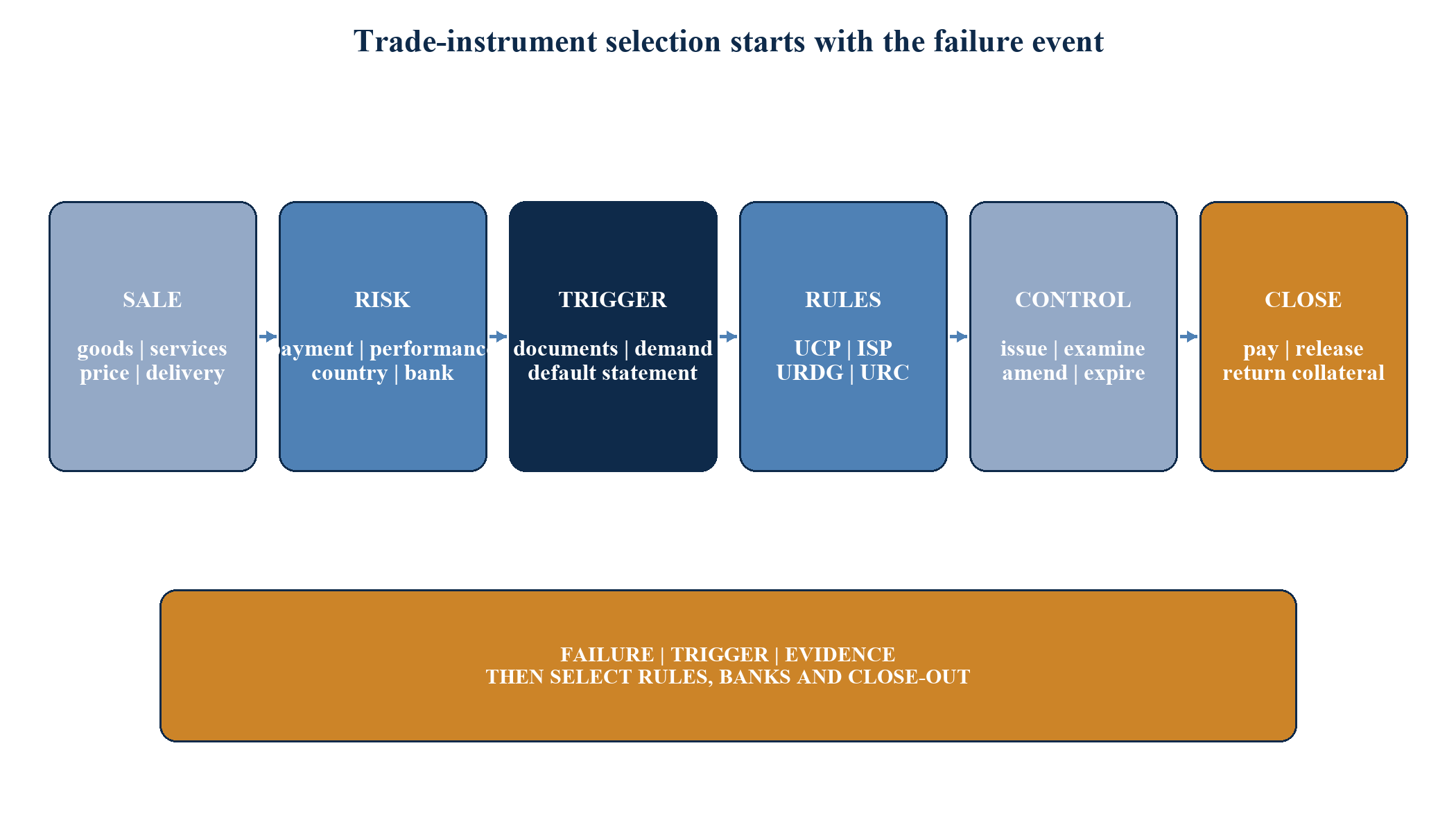
A trade instrument sits between a commercial promise and a cash outcome. A seller may need evidence that payment will arrive after compliant documents are presented. A buyer may need assurance that an advance can be recovered or that a contractor will perform. The first design question is therefore precise: which failure event should create a right to payment, and what evidence can a bank examine objectively?
Separate payment risk from performance risk
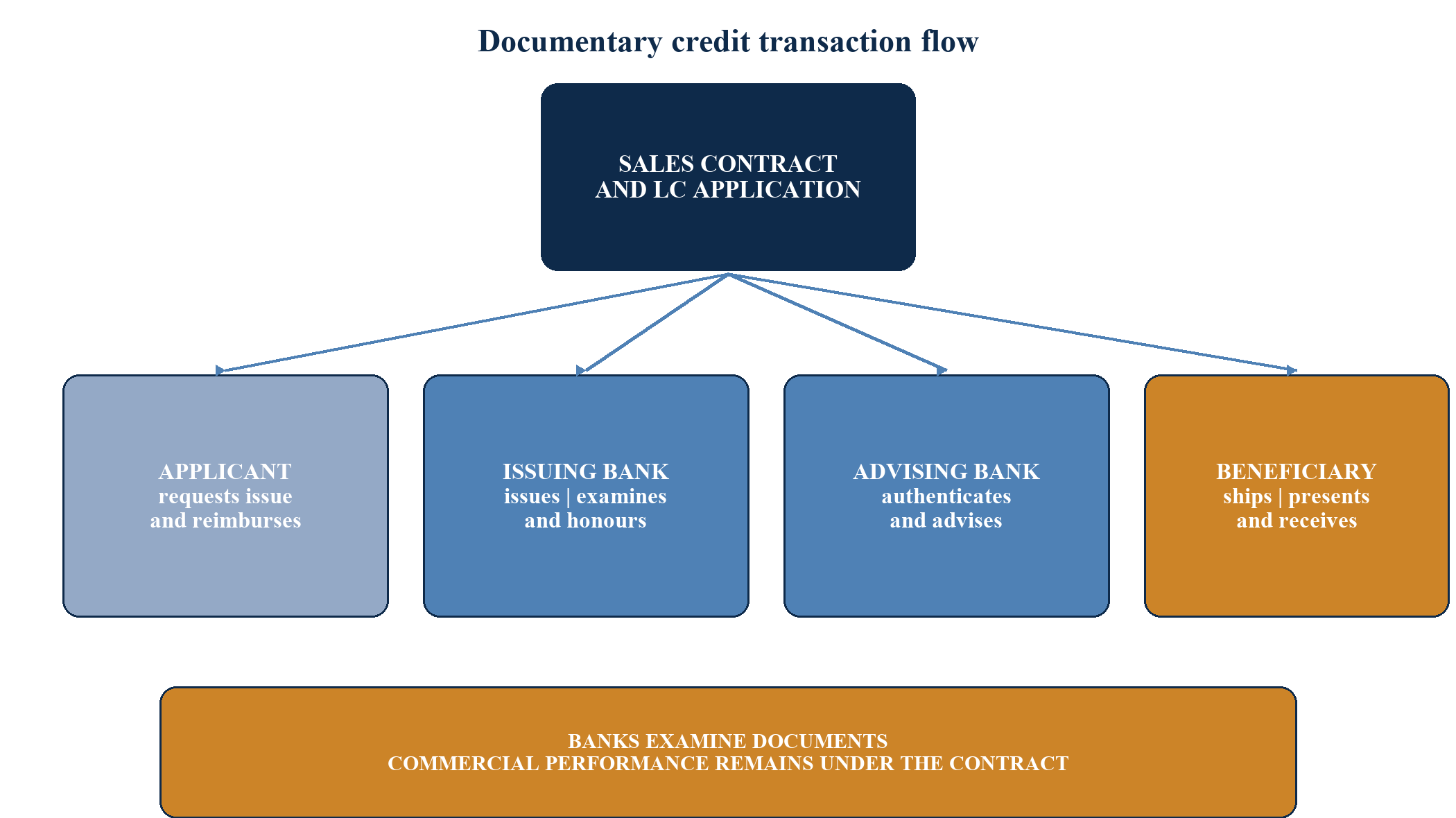
A documentary credit addresses payment against stipulated documents. A standby letter of credit or demand guarantee supports a defined default or non-performance scenario. A documentary collection routes documents through banks without creating an independent payment promise. Open-account trade leaves payment risk with the seller unless insurance, factoring, receivables finance, a standby or another overlay changes that allocation.
Choose the instrument after mapping the transaction
The transaction team should record the underlying obligation, buyer and seller risks, bank route, required evidence, applicable rules, currency, amount, tenor, tolerance, expiry, presentation place, reduction mechanics, collateral and close-out. The commercial label alone is insufficient. A performance bond, conditional bond, demand guarantee and standby may create materially different documentary and legal outcomes.
The World Trade Organization describes trade finance as supporting the great majority of world trade. The Asian Development Bank's global survey records persistent unmet demand, especially for smaller businesses. Availability, price and facility capacity therefore belong in the commercial decision from the outset.
| Transaction question | Evidence required | Control consequence |
|---|---|---|
| What commercial failure must be covered? | sale, supply, construction or financing obligation | choose payment, documentary or performance instrument |
| What must the bank examine? | precise documents, data fields, signatures, dates and presentation route | draft an objectively examinable undertaking |
| Which risk is transferred? | buyer, seller, bank, country, transfer, fraud and compliance analysis | select issuer, confirmer, collateral and rules |
| What is the all-in cost? | fee schedule, funding period, cash margin, amendments and discrepancy history | compare instruments on equivalent assumptions |
| How does the instrument end? | payment, reduction, cancellation, return or expiry evidence | maintain register and release collateral promptly |
Documentary credits, standbys and guarantees
The ICC Uniform Customs and Practice for Documentary Credits, UCP 600, provides the principal international framework for documentary credits when incorporated into the instrument. Banks deal with documents and examine a presentation against the credit. The application should avoid conditions that cannot be evidenced by a stipulated document, and the sales contract should align goods descriptions, shipping terms and document requirements with the credit.
Use confirmation deliberately
Confirmation adds an independent undertaking from a confirming bank to honour or negotiate a complying presentation. It can address issuing-bank or country risk, transfer restrictions or beneficiary policy. Its value depends on availability, tenor, price, operational routing and the confirming bank's ability to receive a presentation before expiry.
Match standby rules to standby practice
ISP98 addresses the standby lifecycle, including presentation, examination, notice, transfer, cancellation and reimbursement. The standby should state the maximum amount, beneficiary, expiry, presentation place, required demand, supporting statement, permitted drawings, transfer rights and extension mechanics.
Control direct and indirect guarantees
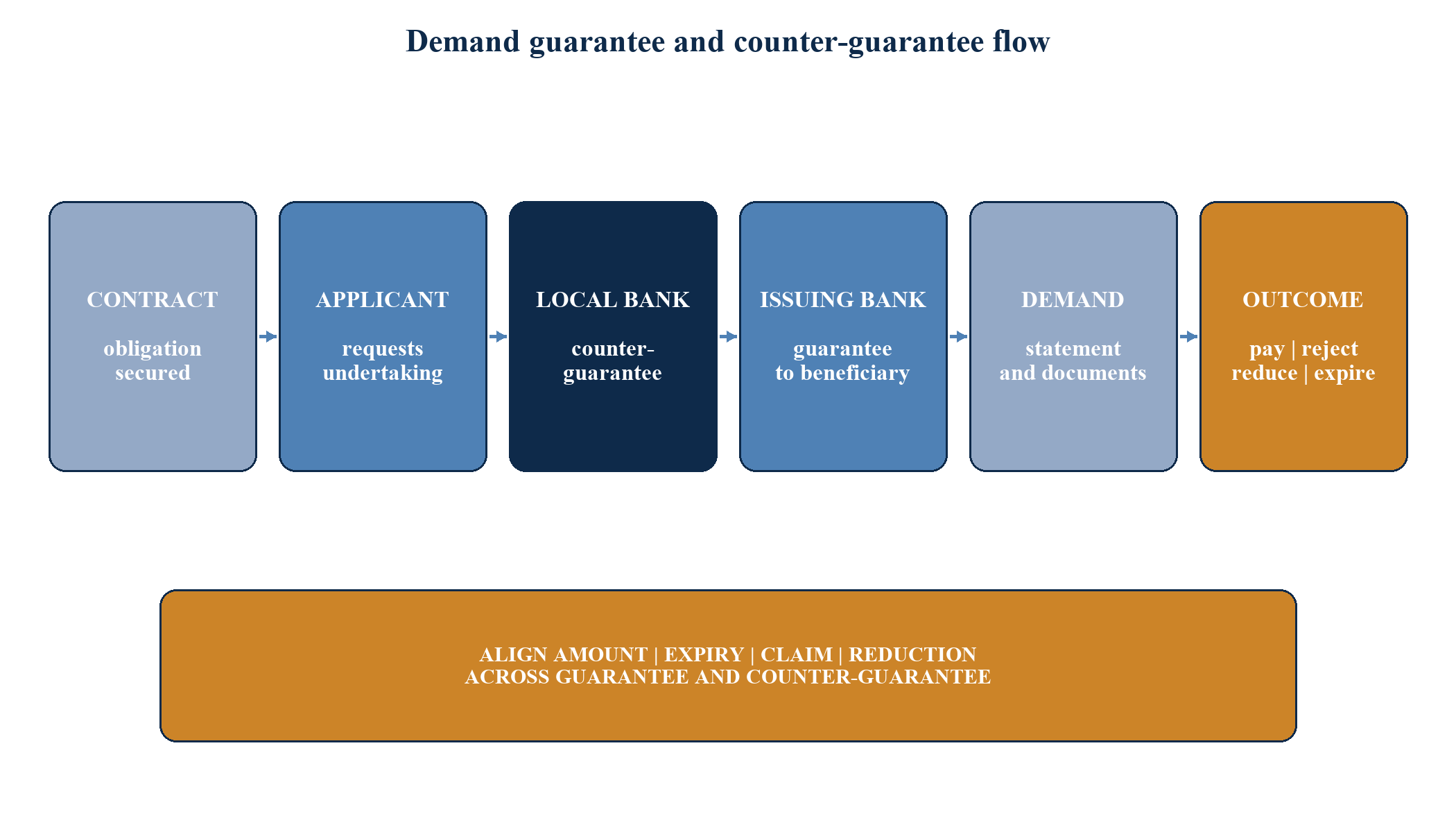
The ICC Uniform Rules for Demand Guarantees, URDG 758, provides a common framework for demand guarantees and counter-guarantees when incorporated. An indirect structure creates two documentary paths: a counter-guarantee from the applicant's bank and a local guarantee issued for the beneficiary. Amount, currencies, expiry, claim periods, reduction events, charges and release should be aligned across both paths.
Collections, open account and document design
Under a documentary collection, banks release specified documents against payment or acceptance under the collection instruction. They do not ordinarily add an independent promise to pay. The seller retains buyer and country risk and needs a plan for goods, storage, demurrage, insurance, resale and repatriation if documents are refused. The ICC collection rules and electronic supplement provide a standard framework when incorporated.
Build a controlled document matrix
The document matrix should identify the exact title, issuer, signatory, content fields, data source, date rule, permitted format, originals or copies, presentation channel, owner and quality-review date for every required document. Typical items include the commercial invoice, packing list, transport document, certificate of origin, insurance document, inspection certificate and demand statement.
Draft conditions for objective examination
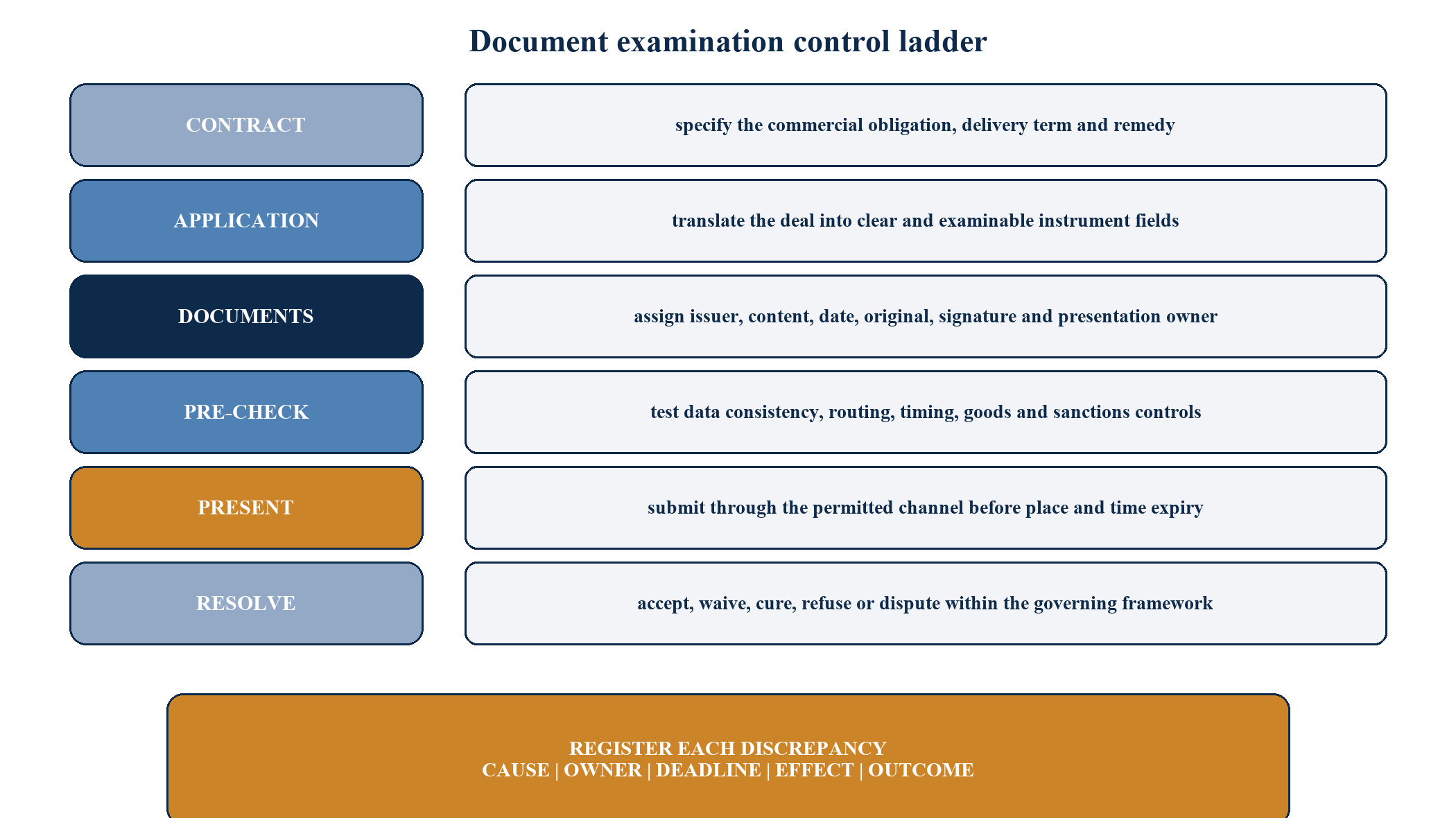
Every condition should be linked to a stipulated document. Subjective satisfaction, a missing issuer, inconsistent data or an unavailable certificate can make the presentation unworkable. A cross-document review should test entity names, addresses, contract references, goods descriptions, quantities, currency, shipment periods, ports, delivery terms and signatures before issuance and again before presentation.
Plan amendments and discrepancies
Amendments should record the reason, fields affected, fee allocation, latest acceptance date and effective version. Discrepancies should be triaged into curable, waiver-dependent and contested categories. A commercial willingness to accept goods does not compel a bank to disregard the instrument, applicable law, sanctions obligations or its own regulatory duties.
| Commercial need | Common instrument | Core trigger | Close-out evidence |
|---|---|---|---|
| protect tender commitment | bid guarantee | demand stating specified bid failure | award, expiry or beneficiary release |
| secure return of advance | advance-payment guarantee | demand stating repayment obligation | reduction record and final release |
| support contract performance | performance guarantee | demand stating specified non-performance | acceptance certificate and release |
| replace cash retention | retention guarantee | demand under defects or completion obligation | end of retention period and release |
| support post-completion obligations | warranty guarantee | demand under warranty obligation | warranty expiry and release |
| support buyer payment | payment guarantee or financial standby | non-payment statement and required invoice evidence | paid invoices, cancellation or expiry |
Bank, country, fraud and compliance control
Instrument independence supports reliable bank processing, yet documentary compliance does not establish the physical quality or existence of goods. Parties retain responsibility for counterparty diligence, inspection, logistics, transport control and fraud escalation. The Financial Action Task Force's trade-based money-laundering indicators identify risks across business structure, trade activity, documents, commodities, accounts and transactions.
Screen the full transaction route
Pre-issuance controls should cover applicants, beneficiaries, banks, vessels, ports, countries, goods, technology and end use. The process should use current official lists and controlled-goods sources, retain evidence of review, and define escalation for unusual prices, routes, document inconsistencies, ownership opacity or unexpected changes. The Central Bank of the UAE's targeted financial sanctions resources form part of the current UAE control environment.
Reserve bank and country capacity early
A confirmed credit can transfer issuing-bank or country exposure to the confirming bank for a complying presentation. An indirect guarantee depends on both counter-guarantee and local-bank capacity. Currency conversion, sanctions, correspondent networks, operational cut-off times, transport corridors and claim timing can all affect availability. Bank-route confirmation belongs before contract signature when the transaction depends on a particular structure.
Keep the legal layers distinct
The transaction comprises the underlying contract, the instrument text, incorporated practice rules and applicable law. UAE Federal Decree-Law No. 50 of 2022 contains provisions on bank guarantees, letters of guarantee and documentary credits. Transaction-specific counsel should review wording, jurisdiction, mandatory rules, injunction risk, transfer, assignment, expiry and collateral release.
Model the all-in cost and working-capital effect
Headline issuance commission understates the economic cost. An all-in model should capture issuance, advising, confirmation, negotiation, examination, reimbursement, SWIFT or messaging, courier, amendment, discrepancy, cancellation, legalisation, insurance, funding, foreign exchange, collateral opportunity cost and internal processing. Each rate should be applied to a stated amount, exposure period and charging basis.
Separate quoted cost from transaction value
Bank tariffs, facility letters and transaction quotations are observable inputs. Funding cost and cash-margin opportunity cost depend on the applicable amount, tenor and rate. Discrepancy and amendment assumptions should remain identifiable. Comparing alternatives requires equivalent assumptions about payment timing, buyer credit, seller performance, country risk, document capability and collateral.
Use sensitivity analysis before approval
A practical model tests confirmation rate, funding duration, cash-margin percentage, number of discrepancies, number of amendments, foreign-exchange movements and delayed release. The output should show visible fees, liquidity consumed, collateral held, break-even improvement in payment certainty and the owner of each controllable cost driver.
The paper's worked equipment transaction uses a hypothetical AED 12 million purchase to demonstrate the calculation mechanics. Under its stated assumptions, visible fees and the cash-margin opportunity cost are calculated separately. The example is a modelling illustration based on stated inputs; it is not a bank quotation, client transaction or observed saving.
| Cost component | Calculation basis | Control source |
|---|---|---|
| issuance | amount multiplied by annual rate and exposure days | facility letter and bank tariff |
| advising | flat fee per issue or amendment | beneficiary bank tariff |
| confirmation | amount multiplied by risk rate and exposure days | confirming-bank quotation |
| examination | flat or percentage charge per presentation | bank tariff and presentation count |
| discrepancy | fee per discrepant presentation | bank tariff and discrepancy register |
| funding | funded amount multiplied by funding rate and days | loan or discount terms |
| cash margin | cash amount multiplied by opportunity-cost rate and days | treasury hurdle or actual deposit yield |
| internal process | staff time, legalisation, courier and systems | transaction operating record |
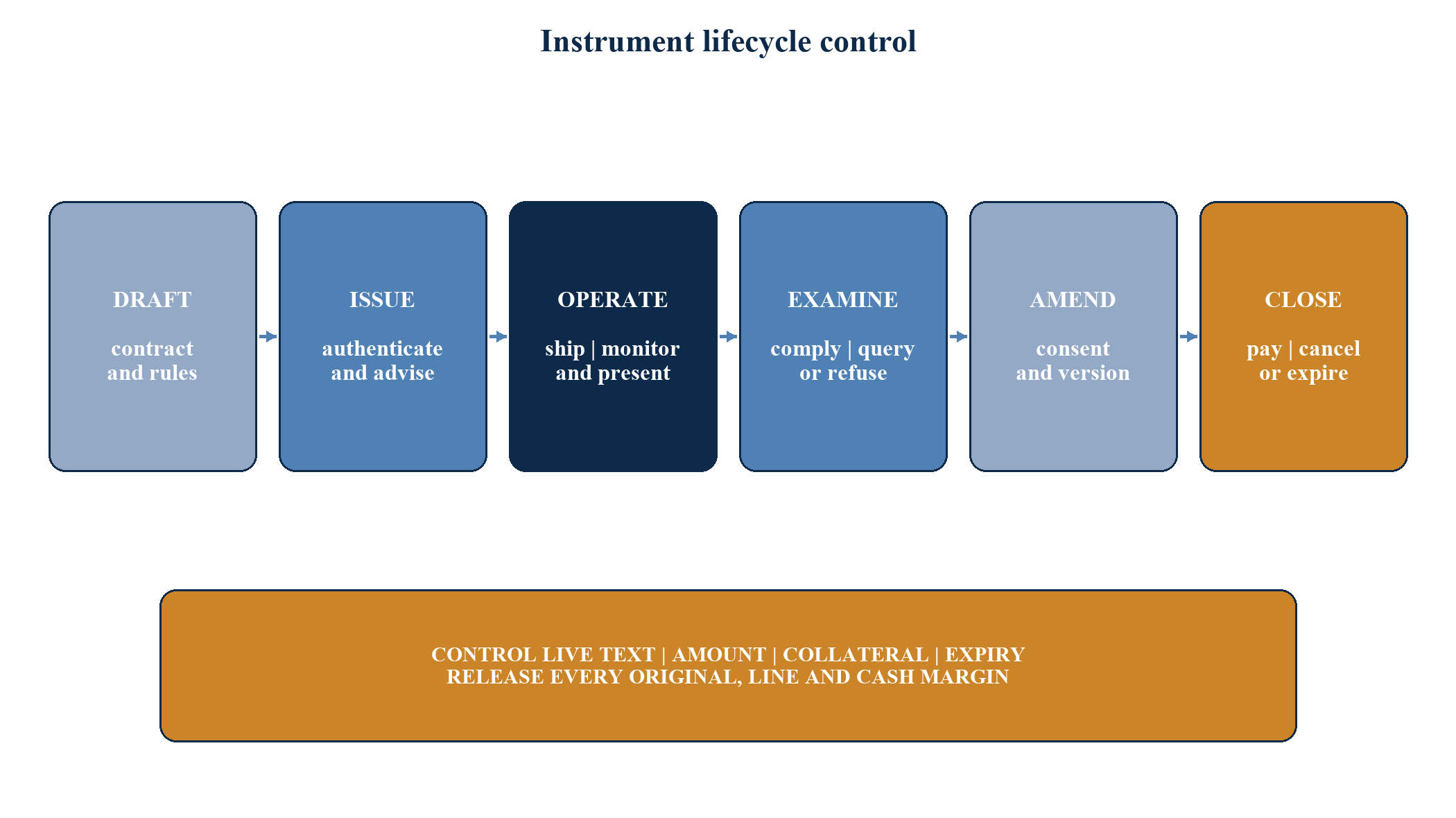
Operate one lifecycle from draft to close-out
A live instrument register should record the legal form, applicant, beneficiary, bank route, amount, currency, issue and expiry dates, claim tail, governing rules, collateral, line usage, reduction events, amendments, document owner, release status and next action. Automated calendar controls should cover expiry, non-extension notice, presentation, provisional acceptance and collateral release.
Assign named owners and acceptance tests
Commercial, procurement, treasury, finance, logistics, compliance, legal, insurance and operations teams need one transaction owner and a defined specialist role. Template libraries should be organised by instrument and purpose. Every template should retain transaction-specific review. Useful management information includes issue time, amendment count, discrepancy rate, first-pass compliance, claim rate, expired-unreleased exposure, collateral-release days and avoidable fee leakage.
Adopt digital instruments with legal and operational control
The UNCITRAL Model Law on Electronic Transferable Records provides principles for functional equivalence, integrity and control of electronic transferable records. Electronic presentation also needs agreed systems, authenticated users, protected records, accepted formats, audit trails, contingency routes, retention and applicable electronic ICC supplements.
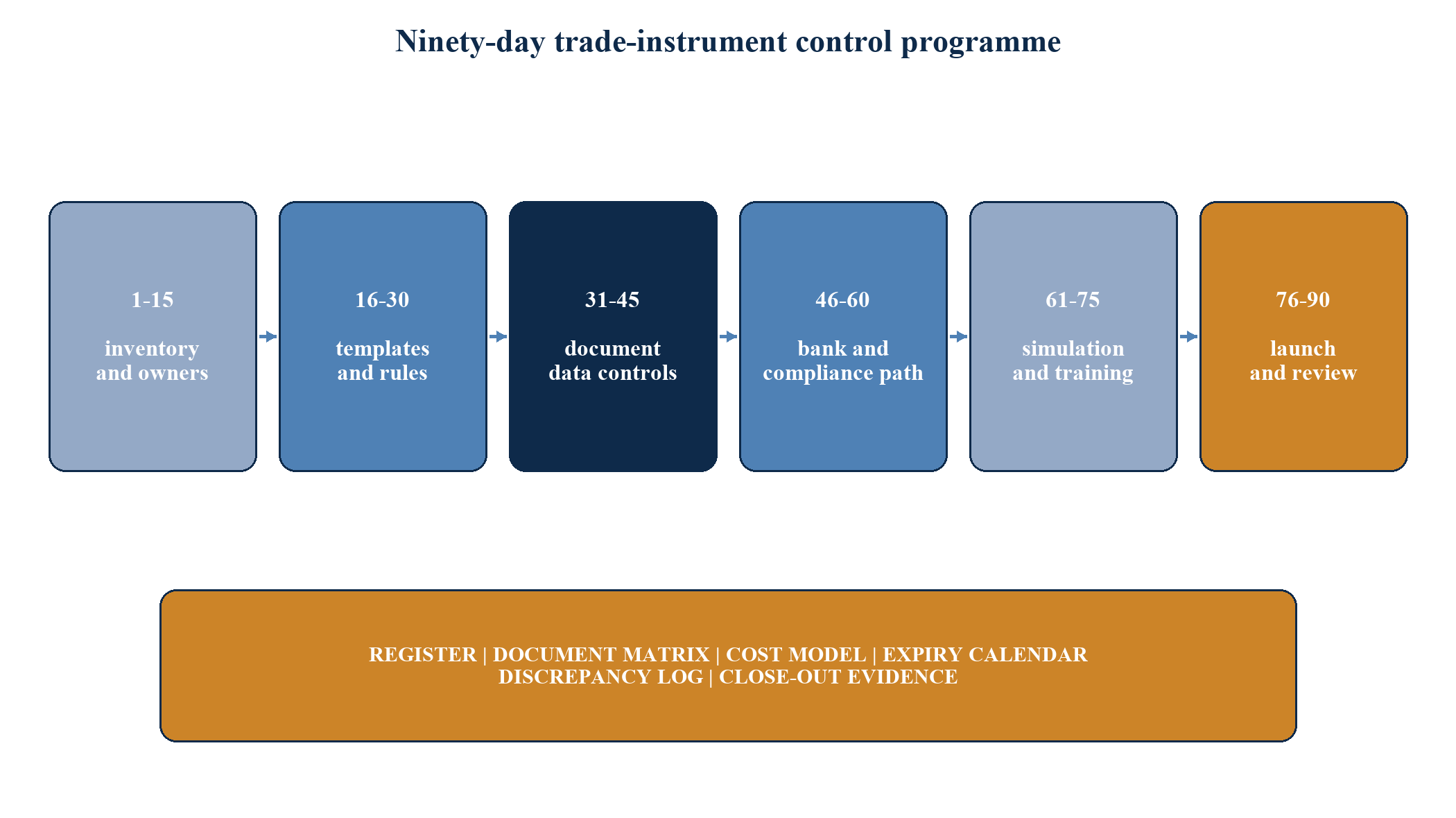
Use a ninety-day control programme
Days 1 to 15 establish the inventory and baseline. Days 16 to 30 approve selection policy and templates. Days 31 to 45 create the document matrix, cost model and approval memorandum. Days 46 to 60 map banks, compliance controls and routes. Days 61 to 75 run documentary-credit and guarantee simulations. Days 76 to 90 launch the controlled register and review the first transactions in a weekly forum.
The best instrument converts a defined commercial risk into a clear documentary path at an acceptable all-in cost. Its value depends on precise text, capable banks, disciplined operations, current compliance and complete close-out evidence.
| Deliverable | Minimum acceptance test | Owner |
|---|---|---|
| instrument register | reconciles to bank outstanding and collateral | treasury |
| selection policy | identifies failure event, trigger, risk and approval | treasury and legal |
| template library | versioned, approved and linked to transaction types | legal and operations |
| document matrix | every required document has data and owner | operations |
| cost model | captures fees, funding, collateral and exceptions | finance and treasury |
| compliance path | screens parties, goods, route, banks and changes | compliance |
| close-out workflow | releases instrument, line, original and collateral | treasury |
