

1. INTRODUCTION
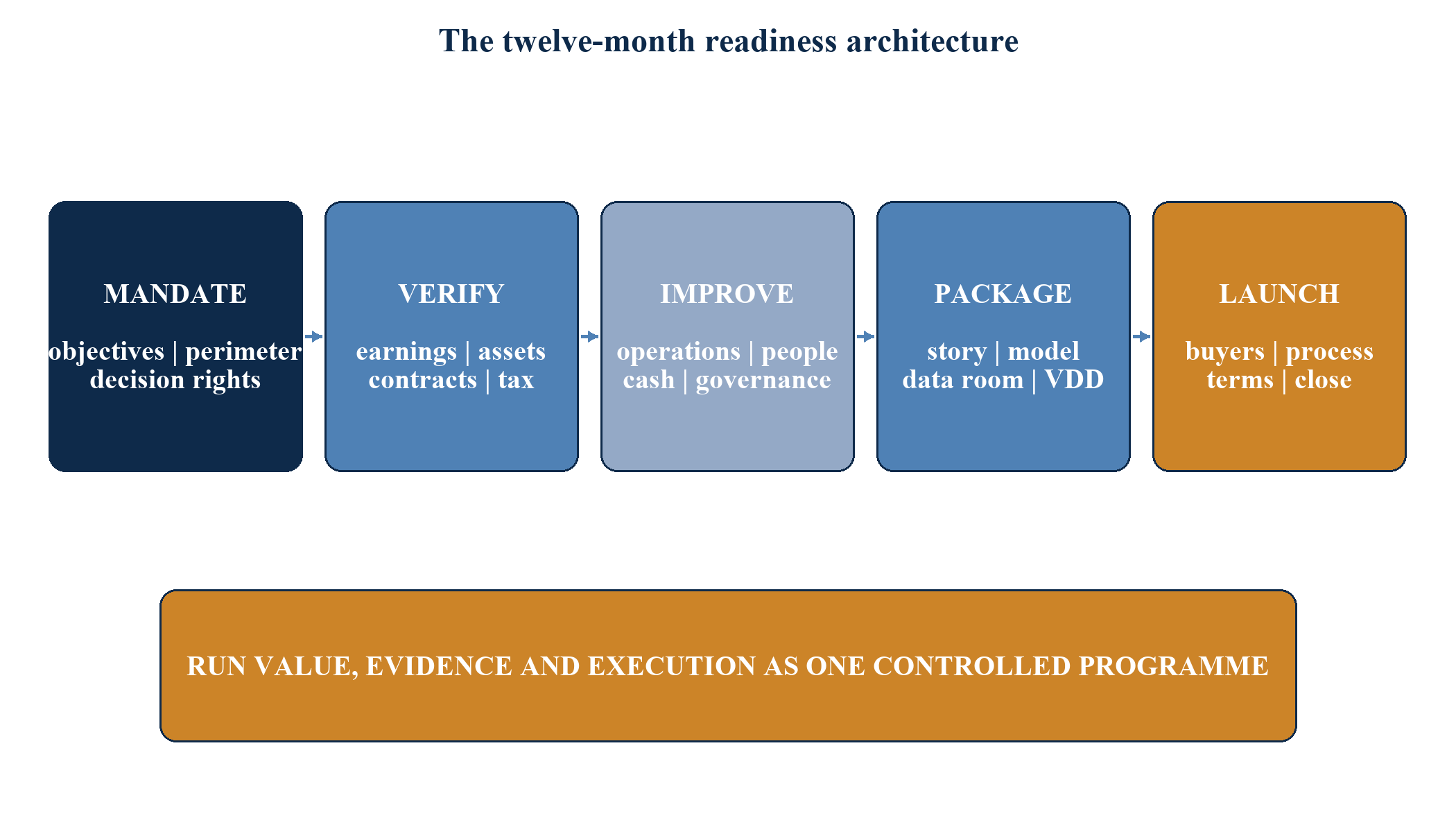
A family-business sale begins long before the first buyer receives a teaser. The decisive work is usually the quiet work completed while the company is still under the family's control: defining what will be sold, making the financial record reproducible, separating private and corporate arrangements, transferring relationships from individuals to the institution and deciding which risks should be corrected, disclosed, priced or retained. A twelve-month readiness programme gives those tasks an owner and an order.
The sale transfers more than shares. It transfers an operating system, contractual rights, licences, employees, data, physical and digital assets, claims, obligations and future expectations. The buyer will test whether these elements belong to the selling group, whether they can continue after control changes and whether the cash flows presented in the valuation can be delivered without the founder's informal intervention. Gaps translate into lower value, contingent consideration, wider warranties, specific indemnities, escrow, holdback or a failed process.
The UAE legal framework makes the fact base central. Limited liability companies and joint stock companies have annual accounting and audit obligations under Federal Decree-Law No. 32 of 2021, while a transfer becomes effective through the applicable register and constitutional process [3, 4]. Family businesses may also use arrangements contemplated by Federal Decree-Law No. 37 of 2022, including rules that affect ownership continuity, transfer and governance [1, 2]. A seller should therefore reconcile commercial reality, accounting records, registers and transaction documents before a buyer attempts the same reconciliation under time pressure.
This paper develops a practical exit-readiness architecture. It treats value as an evidence problem, readiness as a governance programme and launch as a gated decision. The month labels count backward from the intended market approach. They can be compressed for a smaller company or extended where a carve-out, regulated activity, environmental exposure, dispersed ownership or material remediation is involved.
| Workstream | Core question | Buyer consequence |
|---|---|---|
| owner mandate | what outcome, perimeter, timing and minimum terms are acceptable? | a coherent process and clear authority |
| financial verification | can earnings, cash, debt and working capital be reperformed? | confidence in valuation and completion mechanics |
| legal and regulatory | does the group own, control and comply with what it presents? | fewer conditions, warranties and indemnities |
| operations and people | can performance continue after the founder leaves? | higher continuity and lower integration risk |
| transaction packaging | can evidence be disclosed consistently and securely? | faster diligence and fewer contradictory answers |
2. EXIT READINESS IS A VALUE-CREDIBILITY PROGRAMME
2.1 Price is a conclusion drawn from evidence
An indicative valuation commonly begins with maintainable earnings, a market multiple and adjustments for net debt, working capital and other claims. Every term in that bridge is contestable. Reported earnings may include owner remuneration, related-party rent, exceptional litigation cost, non-recurring project margin or temporary savings. The applicable multiple can move with growth quality, concentration, governance, scale and buyer synergies. The equity cheque then depends on definitions negotiated in the sale agreement.
The seller improves credibility when each value claim has a source record, a reconciliation and a sustainability explanation. A schedule prepared only for the sale carries less weight than one that reconciles to the ledger, audited financial statements, tax filings, bank statements and operating systems. The objective is not an aggressive adjusted number. The objective is a number that survives repetition by advisers, buyers, lenders and the buyer's investment committee.
2.2 Readiness lowers the buyer's uncertainty premium
A buyer pays for expected cash flow and assumes the risk that evidence is incomplete. Unresolved issues can affect value through several mechanisms:
- a lower earnings base after rejected adjustments;
- a lower multiple for concentration, key-person or governance risk;
- a debt-like deduction for obligations not captured in reported borrowings;
- a higher normal working-capital target;
- deferred, contingent or escrowed consideration;
- broader warranties and indemnities;
- a longer timetable with greater information leakage; and
- loss of competitive tension if bidders withdraw at different stages.
Readiness cannot remove ordinary deal risk. It gives the seller earlier visibility, more response options and better control over the sequence in which information reaches the market.
2.3 One programme should govern value and disclosure
Finance, legal, tax, commercial, operational and people teams often prepare separately. Buyers assess their interactions. A customer contract may support revenue while also containing a change-of-control consent. A property may support capacity while being owned by the family outside the transaction perimeter. A senior manager may drive margin while lacking a retention arrangement. The readiness office should maintain one red-flag register that connects value, evidence, remediation, disclosure and transaction terms.
3. DEFINE THE OWNER MANDATE
3.1 Write the objectives before choosing the process
The family should record the commercial outcome it seeks. Relevant dimensions include cash at completion, retained ownership, continuing employment, property retention, brand continuity, treatment of employees, speed, confidentiality, buyer identity and certainty of closing. Some objectives can coexist. Others require an explicit ranking. A strategic buyer may offer synergy value while seeking full control and integration. A financial sponsor may preserve management continuity while requiring rollover equity and leverage.
The mandate should state the minimum acceptable outcome, the preferred outcome and the authority to change them. It should also identify matters reserved for the family council, shareholders, board, executive team and transaction committee. This record reduces late-stage disagreement when a bid is commercially attractive on one dimension and weak on another.
3.2 Map economic interests and decision rights
The cap table should reconcile legal ownership, beneficial ownership, voting rights, options, pledges, nominee arrangements, inheritance positions and side agreements. Cabinet Resolution No. 109 of 2023 requires relevant entities to maintain accurate real-beneficiary and partner or shareholder information [12]. A buyer and its financiers will also conduct customer and beneficial-owner due diligence under applicable anti-money-laundering rules [13, 14].
The seller should create a signed ownership pack containing the constitutional documents, licences, registers, certificates, transfer history, powers of attorney, shareholder arrangements, pledges and a plain-language rights map. Any discrepancy should have a legal owner, remediation path and completion date.
3.3 Establish process governance
A readiness committee usually needs the managing owner, finance lead, legal lead, operations lead and one person responsible for the integrated programme. It should meet on a fixed cadence and maintain:
- the approved mandate and sale perimeter;
- the red-flag and decision registers;
- the valuation and earnings bridge;
- the evidence-room index;
- the buyer and conflict list;
- the disclosure log;
- the adviser and cost budget; and
- the launch-gate criteria.
The committee should distinguish fact verification from negotiation preference. An unresolved factual issue should not be hidden within a preferred transaction position.
4. DEFINE THE SALE PERIMETER
4.1 Start with entities, assets, rights and dependencies
The sale perimeter is the set of interests the buyer will acquire. It may include shares in an operating company, subsidiaries, branches, joint ventures, property, intellectual property, licences, equipment, inventory, contracts and employees. It may exclude surplus property, investment assets, related businesses, family loans or personal-use assets. Each exclusion can create a dependency that must be replaced through a lease, licence, supply agreement, transitional service agreement or separation project.
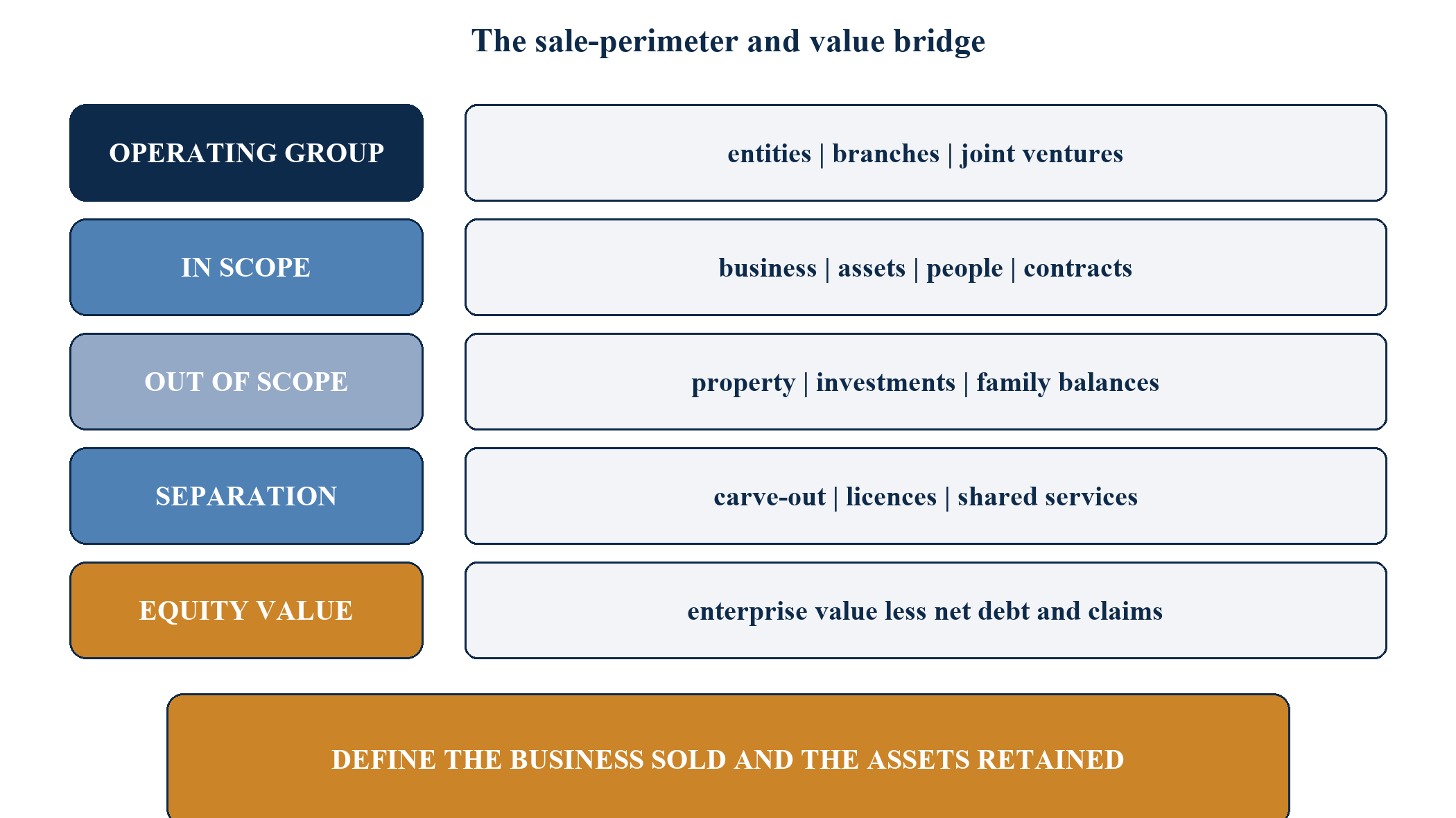
The seller should build four maps:
- a legal-entity map showing ownership, jurisdiction and licences;
- an operating map showing where revenue, people, assets and systems sit;
- a cash-and-debt map showing accounts, facilities, guarantees and security; and
- a related-party map showing property, services, balances and shared resources.
The maps should reconcile. If a customer contract sits in one entity while people and costs sit in another, the buyer needs a supported explanation and a post-closing solution.
4.2 Separate retained assets early
Moving property, investments, trademarks or related businesses shortly before a sale may require corporate approvals, lender consents, tax analysis, valuations and contractual novations. The FTA's business-restructuring relief guidance explains the conditions, elections, records and potential clawback relevant to qualifying transfers under the Corporate Tax Law [7, 8]. The transaction team should obtain current advice before relying on any relief.
The separation model should show the economic position before and after the proposed step. Shared costs should be allocated on a supportable basis. The buyer should be able to see the stand-alone earnings, working capital, capital expenditure and management structure of the business it will own.
4.3 Identify change-of-control and transfer gates
Material contracts should be reviewed for assignment, novation, change-of-control, termination, exclusivity, pricing, minimum volume, audit, data-transfer and notice provisions. Licences, permits, concessions and registrations may have separate control-change requirements. Bank facilities, security documents, leases and insurance policies require the same review.
The resulting consent matrix should state the counterparty, legal trigger, commercial sensitivity, required disclosure, earliest approach date, expected lead time and fallback. Premature consent requests can reveal the process. Late requests can delay closing. The timetable should protect both confidentiality and execution certainty.
5. BUILD THE FINANCIAL FACT BASE
5.1 Reconcile management reporting to audited accounts
Federal Decree-Law No. 32 of 2021 requires applicable companies to prepare annual financial accounts and apply international accounting standards and principles [3, 4]. Exit readiness should begin with a three-year bridge from audited statements to the monthly management accounts used for valuation. The bridge should explain consolidation differences, late journals, related-party entries, discontinued activities, foreign-exchange treatment and changes in accounting policy.
The seller should prepare monthly profit-and-loss, balance-sheet and cash-flow information by business line or geography where the underlying systems support it. Any management allocation should have a documented method. Buyer confidence falls when attractive segment economics exist only in a spreadsheet that cannot be traced to source systems.
5.2 Create a quality-of-earnings ledger
Every proposed adjustment should be captured in a controlled ledger with:
- description and category;
- period and amount;
- general-ledger account and source documents;
- tax and accounting treatment;
- reason it is non-recurring, non-operating or owner-specific;
- expected post-sale treatment;
- management owner; and
- adviser conclusion.
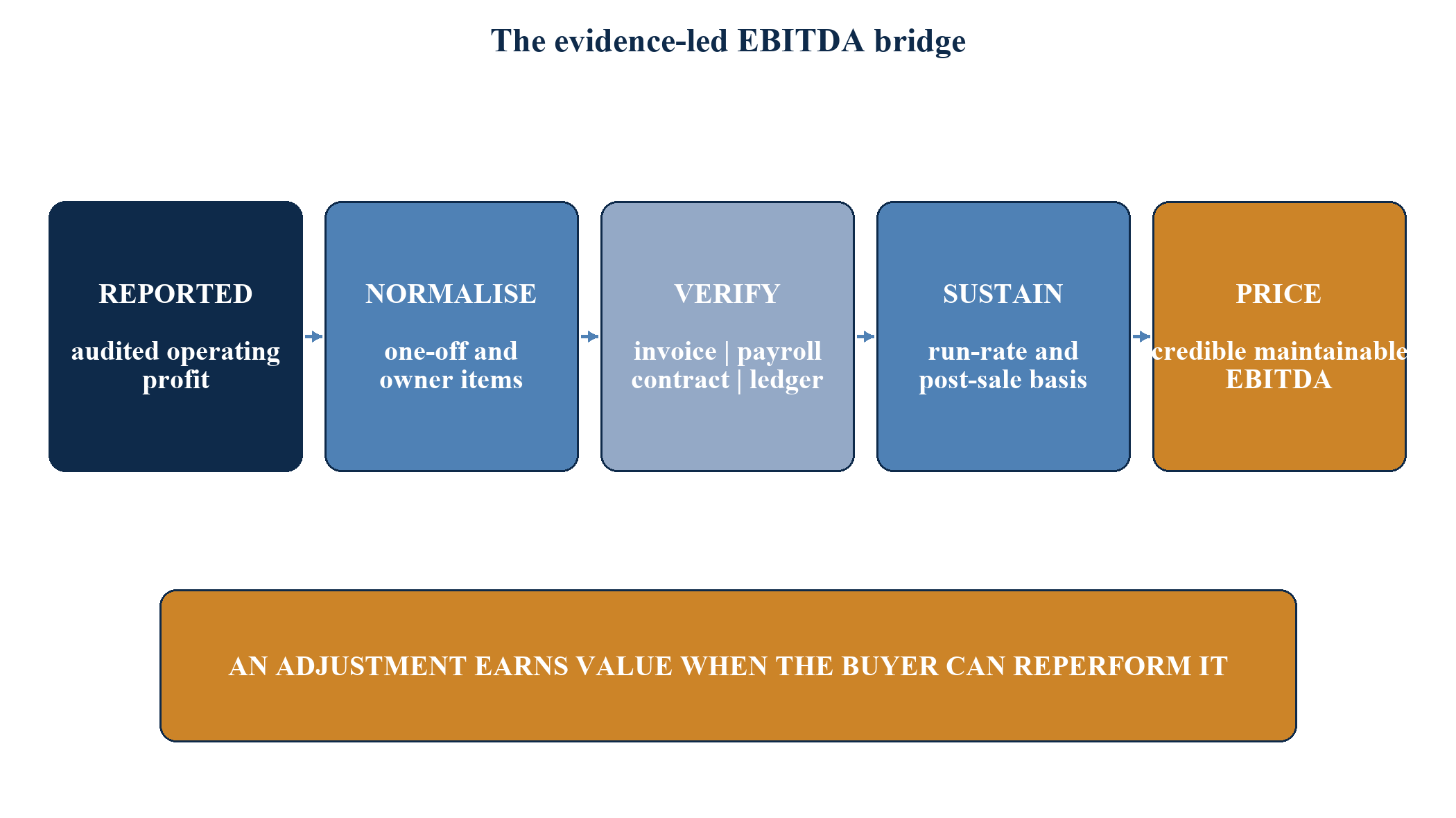
Common adjustments include private or discretionary owner costs, non-market related-party rent, duplicated salaries, exceptional legal cost, discontinued products, one-off project losses, start-up costs for new sites and recent cost savings. Each item should be symmetrical. If a seller adds back a cost, it should also deduct any unavailable owner contribution, below-market input or deferred expense that a buyer will need to replace.
5.3 Test revenue quality
Revenue analysis should move beyond the top-line total. The seller should understand customer concentration, recurring and non-recurring revenue, contract duration, renewal history, pricing, discounts, rebates, returns, cancellations, backlog, pipeline conversion, gross margin, geography and channel. Revenue recognition policies should be compared with contract terms and performance evidence.
The buyer will test whether reported growth is repeatable. A seller should distinguish contracted backlog from management pipeline and management pipeline from market aspiration. The assumptions in a forecast should be linked to named drivers, capacity, sales resources and historical conversion where available.
5.4 Verify cash conversion
Earnings create value when they convert to cash. The readiness pack should explain days sales outstanding, inventory turns, supplier terms, customer advances, retention balances, disputed receivables, aged stock, seasonality and capital expenditure. It should reconcile operating cash flow to reported earnings and identify structural cash absorption.
Cash conversion should be analysed monthly, since a year-end snapshot may mask seasonal funding. A buyer may price a business on earnings and then reduce the equity cheque through a higher working-capital target or debt-like classification. Early modelling lets the seller correct operations and negotiate definitions with evidence.
6. DEFINE MAINTAINABLE EARNINGS
6.1 Use an adjustment taxonomy
The seller should group adjustments into owner-specific, non-recurring, accounting, run-rate, separation and synergy categories. Owner-specific and non-recurring items may support maintainable earnings if properly evidenced. Buyer-specific synergies usually belong in the buyer's valuation, while separation costs may reduce the seller's stand-alone number.
An adjustment should answer four tests:
- Did the reported accounts include the amount?
- Is the cause identifiable and bounded?
- Would the expense or income continue under normal ownership?
- Can a reviewer reproduce the amount from reliable evidence?
If any answer is weak, the adjustment should remain a sensitivity rather than a headline claim.
6.2 Document run-rate changes
A recently signed contract, completed cost programme or new facility can affect future earnings. The seller should separate observed results from forward extrapolation. A run-rate bridge should show the implementation date, contractual evidence, realised months, remaining execution cost, capacity requirement and downside case.
The same discipline applies to cost savings. Redundancy, procurement, rent, system and logistics savings should be net of implementation cost and replacement needs. The buyer should be able to determine what has already occurred and what remains a management plan.
6.3 Protect the base case
The valuation model should include a base case, downside case and management upside. The base case should use supportable operating assumptions. The downside should focus on the risks most likely to affect value or closing: a major-customer loss, margin compression, delayed project, working-capital outflow, higher replacement management cost or regulatory condition.
This approach creates an internal negotiating range. It also identifies which commercial improvements matter enough to complete before launch.
7. BUILD THE VALUATION CORRIDOR
7.1 Use more than one method
IFRS 13 describes fair value as a market-based measurement using assumptions market participants would use [19]. International Valuation Standards effective from 31 January 2025 strengthen requirements around data, inputs and documentation [21]. A transaction value remains deal-specific, yet these principles support disciplined analysis.
The seller should ordinarily consider relevant methods such as trading comparables, precedent transactions, discounted cash flow and asset-based analysis. The method should match the business model, data quality and transaction perimeter. A single headline multiple can conceal differences in growth, margin, recurring revenue, scale, control and geography.
7.2 Reconcile enterprise value to equity value
The value bridge should define cash, debt, leases, shareholder balances, overdue tax, bonuses, claims, provisions, deferred capital expenditure and transaction costs. Items should be classified once. A liability cannot reduce maintainable earnings and then be deducted again without a principled reason.
The bridge should also address minority interests, non-operating assets and the value of retained property arrangements. If the business will lease a property from the family after closing, maintainable earnings should reflect the expected market lease cost.
7.3 Model structure as part of value
Headline price can be paid through cash at closing, rollover equity, vendor financing, earnout, escrow or holdback. The family should model timing, conditions, credit risk, subordination, governance and tax consequences. AED 100 million at completion is economically different from AED 100 million dependent on future performance and buyer control.
The board should therefore compare bids using a risk-adjusted proceeds bridge with transparent assumptions. Management estimates should be identified as such and tested through sensitivities.
8. NORMAL WORKING CAPITAL AND NET DEBT
8.1 Build a monthly working-capital history
Working capital at completion is commonly compared with a normal target. The seller should calculate monthly operating working capital over at least two full annual cycles where data permit. The definition should exclude cash, debt and items already treated elsewhere, while capturing the balances needed to deliver ordinary operations.
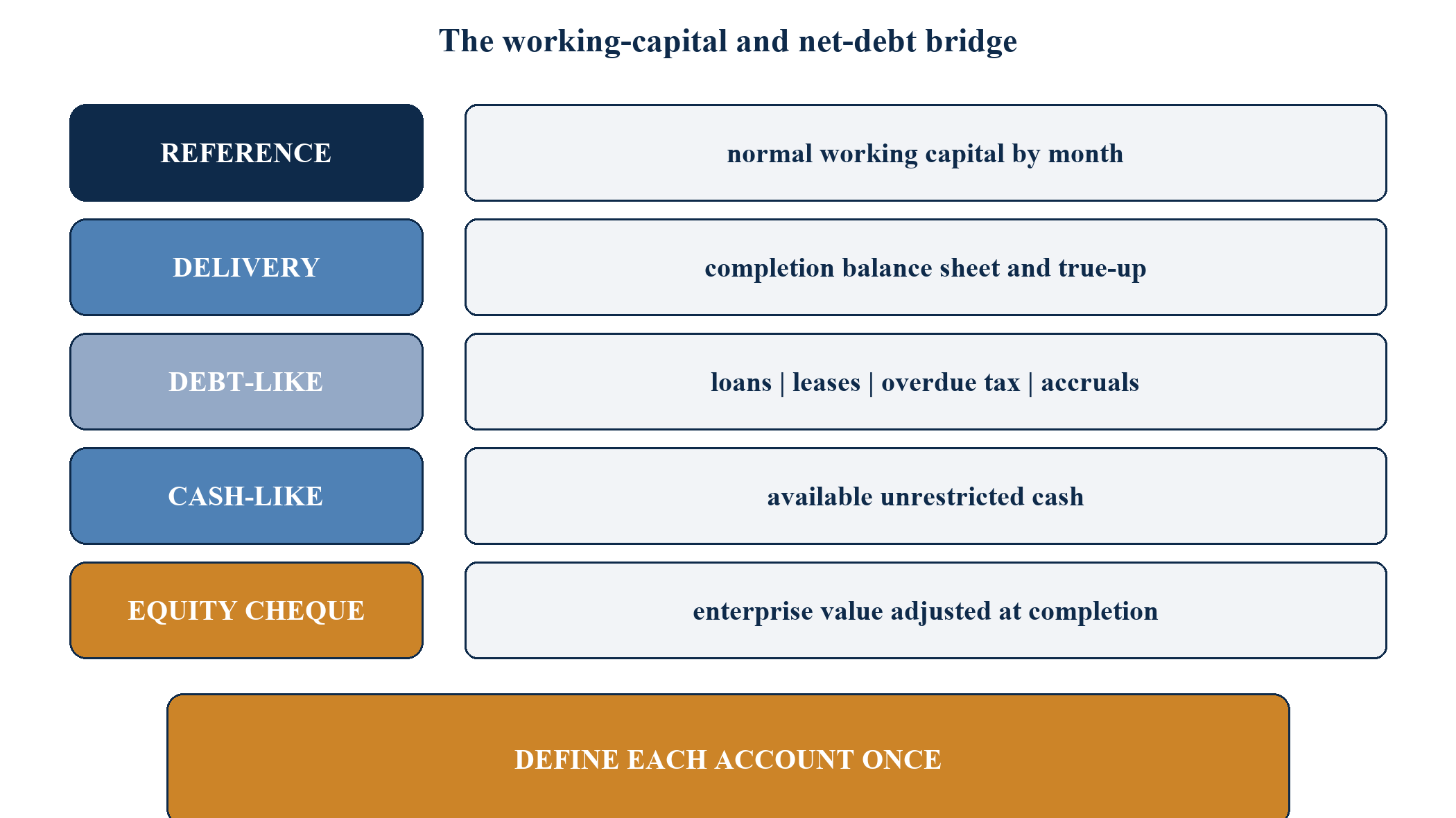
Seasonality, growth, customer advances, retention, ageing and supplier stretch require explicit treatment. A target based only on the latest year-end can transfer seasonal funding value from seller to buyer.
8.2 Prepare account-by-account definitions
The completion mechanism should define every material balance. For receivables, the parties may debate overdue, doubtful, related-party and factored amounts. For inventory, they may debate obsolescence, slow-moving stock and consignment. For payables, they may debate normal trading balances, overdue suppliers and capital creditors.
The seller should prepare a sample calculation and supporting schedules before buyer engagement. A clear accounting hierarchy and dispute mechanism reduce later ambiguity.
8.3 Identify debt-like items early
Debt-like items can include borrowings, shareholder loans, lease obligations, unpaid interest, overdue tax, unpaid dividends, transaction bonuses, litigation balances, customer compensation and unfunded employee obligations. Classification depends on transaction terms and facts. The readiness objective is to identify the universe, document the seller's position and model the equity-cheque effect.
9. TAX READINESS
9.1 Reconcile registrations, returns and accounts
The tax data room should include registrations, returns, payment evidence, assessments, elections, correspondence and reconciliations to the financial statements. Corporate Tax applies to relevant financial years beginning on or after 1 June 2023, and FTA guidance should be checked for current requirements [6]. The seller should document tax positions rather than rely on oral history.
The review should cover Corporate Tax, VAT, customs, payroll-related obligations, withholding exposures in other jurisdictions, transfer pricing, permanent establishments and property or sector charges as applicable. Intercompany and related-party transactions deserve particular attention because they can affect both tax and maintainable earnings.
9.2 Analyse pre-sale restructuring separately
Removing assets, consolidating entities or transferring a business before sale may change the tax, legal and accounting profile. FTA business-restructuring relief can apply only when its statutory conditions are met, an election is made and records are maintained; clawback can arise within the prescribed period [7, 8]. The seller should prepare a transaction-step plan and obtain current advice before execution.
9.3 Build the tax covenant evidence file
A buyer may seek warranties, a tax covenant and specific indemnities. The seller should create a schedule of known issues, open periods, uncertain treatments, correspondence and proposed remedies. Early quantification supports a specific response. An unbounded issue discovered during exclusivity is more likely to affect price or escrow.
10. LEGAL TITLE, GOVERNANCE AND RECORDS
10.1 Prove the ownership chain
The corporate record should show incorporation, licences, constitutional changes, issuances, transfers, beneficial ownership, pledges, board appointments and authorities. The seller should confirm that the legal register agrees with the economic understanding. Historic gaps may require filings, ratifications, legal opinions or court and notarial steps.
10.2 Reconstruct board and shareholder approvals
Material transactions, related-party arrangements, distributions, borrowing, guarantees and asset transfers should have appropriate approvals. Missing minutes can create uncertainty about authority and conflicts. The readiness team should obtain legal advice on any corrective action and preserve a clear audit trail.
10.3 Review disputes and contingent liabilities
The disputes schedule should include threatened and current claims, regulatory matters, employee disputes, customer complaints, warranty issues, insurance notifications and settlement history. It should state the factual chronology, amount claimed, adviser assessment, accounting treatment and disclosure position.
The objective is a controlled explanation supported by documents. Overly broad privilege waivers and inconsistent oral answers can increase risk.
11. COMMERCIAL CONTRACT READINESS
11.1 Identify the contracts that support value
The contract universe should be ranked by revenue, margin, strategic importance, dependency, renewal date and control-change sensitivity. Executed copies, amendments and side letters should be collected. Commercial terms in the system should reconcile to the signed contract.
11.2 Resolve leakage and undocumented practice
Family businesses can accumulate informal rebates, extended credit, personal assurances, handshake exclusivity or service beyond the written scope. The readiness programme should record these practices, quantify their economics and formalise them where commercially appropriate.
11.3 Protect the process from information leakage
Customer and supplier approaches should be sequenced. The seller should use clean-team arrangements or redacted disclosure where competition, privacy or relationship sensitivity requires it. Any final consent plan should be tied to transaction milestones and fallback options.
12. OPERATIONS, ASSETS AND CAPITAL EXPENDITURE
12.1 Validate the operating model
The operations pack should explain capacity, utilisation, yield, quality, maintenance, procurement, logistics, service levels and business continuity. Management should identify the operational metrics that drive revenue, margin and cash, then provide a consistent historical series.
12.2 Verify asset ownership and condition
Material property, plant, equipment, vehicles, inventory and technology assets should be tied to registers, invoices, title, leases, maintenance records and insurance. Assets owned by family members or related entities need explicit treatment. Deferred maintenance should be reflected in forecast capital expenditure and the valuation bridge.
12.3 Separate maintenance and growth expenditure
The buyer will test whether reported cash flow relies on underinvestment. Capital expenditure should be divided into maintenance, compliance, replacement, capacity and growth categories. The plan should explain committed projects, contracted spend, cancellation rights and expected returns.
13. PEOPLE AND FOUNDER DEPENDENCY
13.1 Map critical roles and relationships
Founder dependency can sit in customer trust, supplier negotiations, bank access, pricing, quality decisions, staff loyalty and exception handling. The team should identify each dependency, its current owner and a transfer plan.
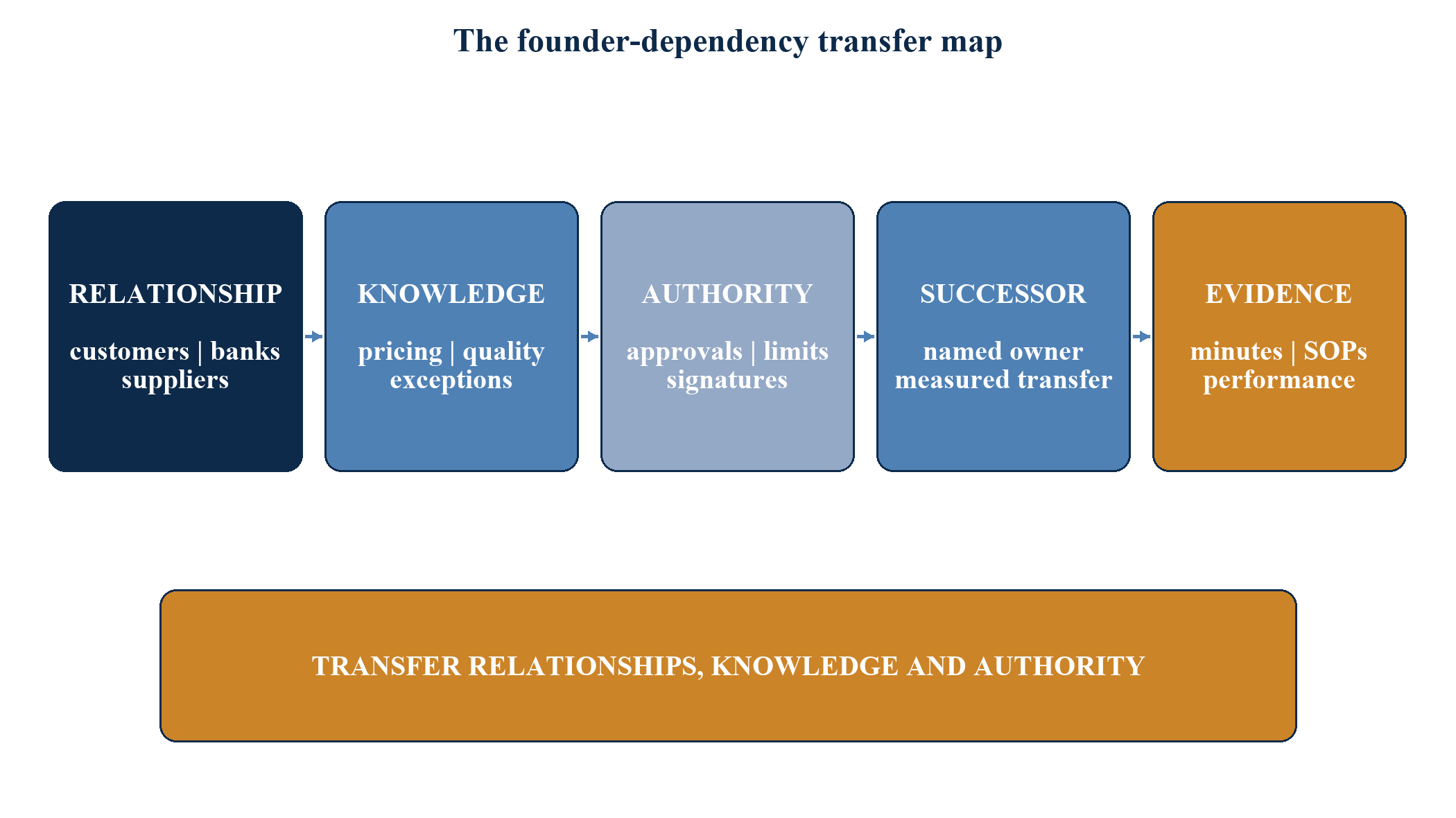
The transfer should be demonstrated through behaviour and evidence. A named successor who has not led meetings or exercised authority remains an aspiration. The programme should create observed performance: joint meetings, delegated limits, documented procedures and board reporting.
13.2 Verify employment records and obligations
Federal Decree-Law No. 33 of 2021 and its Executive Regulation govern relevant private-sector employment relationships [25, 26]. The seller should reconcile contracts, compensation, leave, end-of-service obligations, restrictive covenants, disciplinary matters, visas, secondments and contractor classifications. Free-zone or sector-specific rules may also apply.
13.3 Design retention and transaction incentives
Critical employees may need retention, completion or transition incentives. The terms should align performance, confidentiality and continued service without creating unintended debt-like items or conflicting sale incentives. Funding, approvals, accounting and tax treatment should be modelled before commitments are made.
14. TECHNOLOGY, DATA AND CYBER READINESS
14.1 Map systems, licences and access
The seller should inventory core applications, infrastructure, cloud services, source code, licences, domains, integrations, privileged accounts and outsourced providers. It should confirm ownership, assignment rights, renewal dates, support and change-of-control provisions.
14.2 Build a privacy-compliant disclosure plan
Federal Decree-Law No. 45 of 2021 regulates personal data within its scope [27]. Employee, customer and supplier information should be disclosed only through an approved legal basis and proportionate process. The data room should use redaction, role-based access, watermarking and download control where appropriate.
14.3 Prepare the cyber incident record
The buyer will ask about incidents, vulnerabilities, backups, disaster recovery, third-party access and remediation. The seller should maintain a factual chronology, testing evidence and open-action register. A clean answer acknowledges known events and shows measured response.
15. INTELLECTUAL PROPERTY AND BRAND
15.1 Confirm that the company owns what it uses
Trade names, trademarks, designs, patents, content, source code, databases, domains and know-how should be mapped to legal ownership and licences. Founder-created or contractor-created materials require particular attention. Employment and contractor terms should contain appropriate assignment and confidentiality provisions.
15.2 Connect intellectual property to earnings
The seller should explain which revenue streams depend on particular intellectual property, where protection exists and how infringement is monitored. A long trademark list has limited value if the commercial connection is unclear.
16. ESG, HEALTH, SAFETY AND ENVIRONMENT
16.1 Define the material exposures
The scope depends on sector, assets and jurisdictions. Relevant matters can include permits, hazardous materials, emissions, waste, product safety, workplace incidents, energy consumption, supply-chain standards and community obligations.
16.2 Evidence compliance and remediation
The seller should provide permits, inspections, incident registers, training, insurance and remediation plans. Cost estimates should be tied to the financial model. A buyer may treat an unquantified compliance issue as a wide valuation range.
17. COMPETITION AND REGULATORY PATH
17.1 Screen buyers before outreach
Federal Decree-Law No. 36 of 2023 regulates competition and economic concentration [9]. Cabinet Decision No. 3 of 2025 provides notification thresholds based on UAE relevant-market sales or market share [10]. The Ministry of Economy states that the regime took effect in April 2025 and describes its review timetable [11].
The seller should screen likely buyers for horizontal, vertical and conglomerate overlaps, market definition, revenue and share data, sector regulators and foreign approvals. This analysis should inform buyer ranking, information protocols and the expected signing-to-closing period.
17.2 Preserve optionality for remedies and conditions
A bidder with high synergy value may have a more complex regulatory path. The seller should assess which party bears filing risk, timing risk, information burden and remedy risk. The sale agreement may address cooperation, efforts standards, long-stop dates and termination rights.
17.3 Integrate licences and ownership restrictions
Regulated sectors, local activities, government contracts and free-zone licences can have ownership, control or approval requirements. The seller should obtain current, fact-specific advice and avoid generic assumptions based on another transaction.
18. VENDOR DUE DILIGENCE
18.1 Use diligence to find problems while choices remain
Vendor due diligence is most valuable when it starts early enough to influence conduct. A financial review can test earnings and working capital. Legal, tax, commercial, operational, technology, people, environmental and insurance reviews should be scoped to the material risks of the business.
The first output should be a private red-flag report for the seller. Management then chooses among remediation, further investigation, disclosure, contractual protection and process delay. A public-facing report prepared before that private challenge may lock the seller into incomplete positions.
18.2 Maintain independence and scope clarity
The report should state its scope, periods, sources, limitations and reliance terms. Management representations should be identified. Material assumptions should not be presented as verified facts. The buyer may still conduct its own work, but a coherent vendor report can focus questions and reduce duplication.
18.3 Reconcile every report to one fact base
Financial, tax, legal and commercial advisers may use different definitions and dates. The readiness leader should reconcile their reports to the same entity perimeter, reporting periods, forecasts, transaction assumptions and issue register. A contradiction between the information memorandum, vendor report and data room creates avoidable concern.
19. THE BUYER-GRADE DATA ROOM
19.1 Build from a requirements index
The data room should follow a numbered index covering corporate, finance, tax, commercial, material contracts, employees, pensions and benefits, property, assets, intellectual property, technology, privacy, litigation, insurance, regulatory, environmental and transaction materials. Each request should have an owner, status, confidentiality level and quality check.
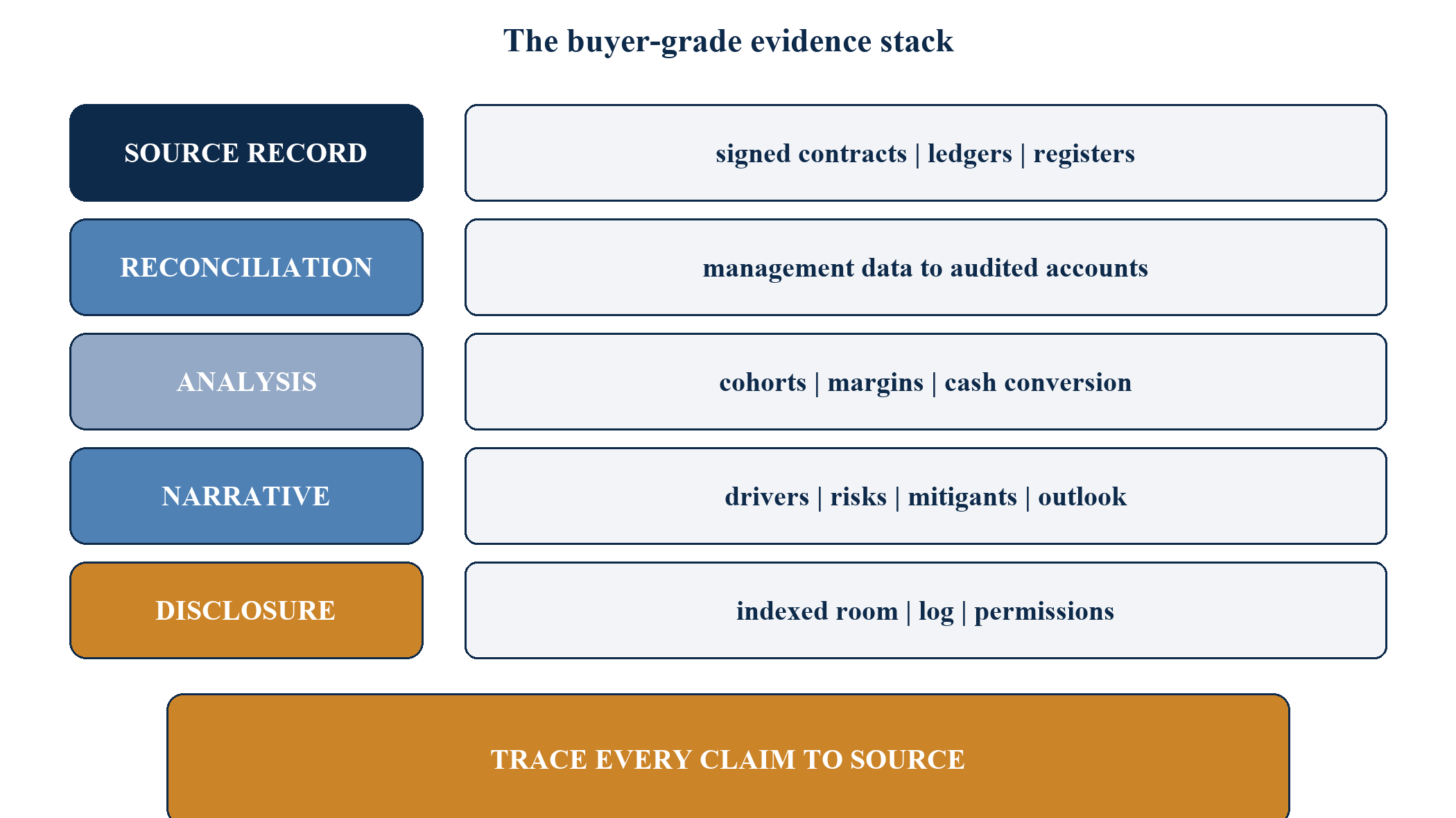
Documents should be complete, executed, dated and searchable. Drafts should be clearly identified. Personal data, legally privileged material, competitively sensitive information and restricted third-party content require controlled treatment.
19.2 Establish source-to-claim traceability
Each headline claim in the information memorandum and management presentation should link to an evidence folder and financial reconciliation. The same principle applies to operational KPIs, customer cohorts, pipeline, sustainability claims and market data.
19.3 Control access and disclosure
The room should use bidder-specific access, permissions, logs and staged disclosure. The team should keep a disclosure record showing what was provided, when and to whom. Questions and answers should be approved centrally and made available consistently where process fairness requires it.
20. PREPARE THE EQUITY STORY
20.1 Build the story from verified drivers
The equity story should explain the market need, customer proposition, competitive position, operating model, growth record, margin structure, management capacity, cash conversion and credible growth options. It should acknowledge material risks and show the control system around them.
The strongest story is specific. It links historic outcomes to named operating drivers and forward assumptions to evidence. It avoids unsupported market-size claims and unbounded synergy promises.
20.2 Keep the model, materials and management answers aligned
The information memorandum, financial model, vendor reports, management presentation and data room should use the same definitions. A central assumptions register should record volume, price, margin, headcount, working capital, capital expenditure and exchange-rate assumptions.
20.3 Rehearse the buyer's challenge
Management should rehearse questions on concentration, pricing, underperforming periods, unusual margins, working-capital swings, founder dependency, compliance, forecast delivery and post-sale roles. The objective is clear, accurate and consistent answers supported by evidence.
21. BUYER UNIVERSE AND CONFIDENTIALITY
21.1 Segment the buyer universe
Potential buyers can include strategic corporates, private-equity sponsors, family offices, management teams and regional consolidators. Each should be assessed for strategic fit, financial capacity, decision authority, transaction experience, confidentiality, conflicts, regulatory pathway and likely structure.
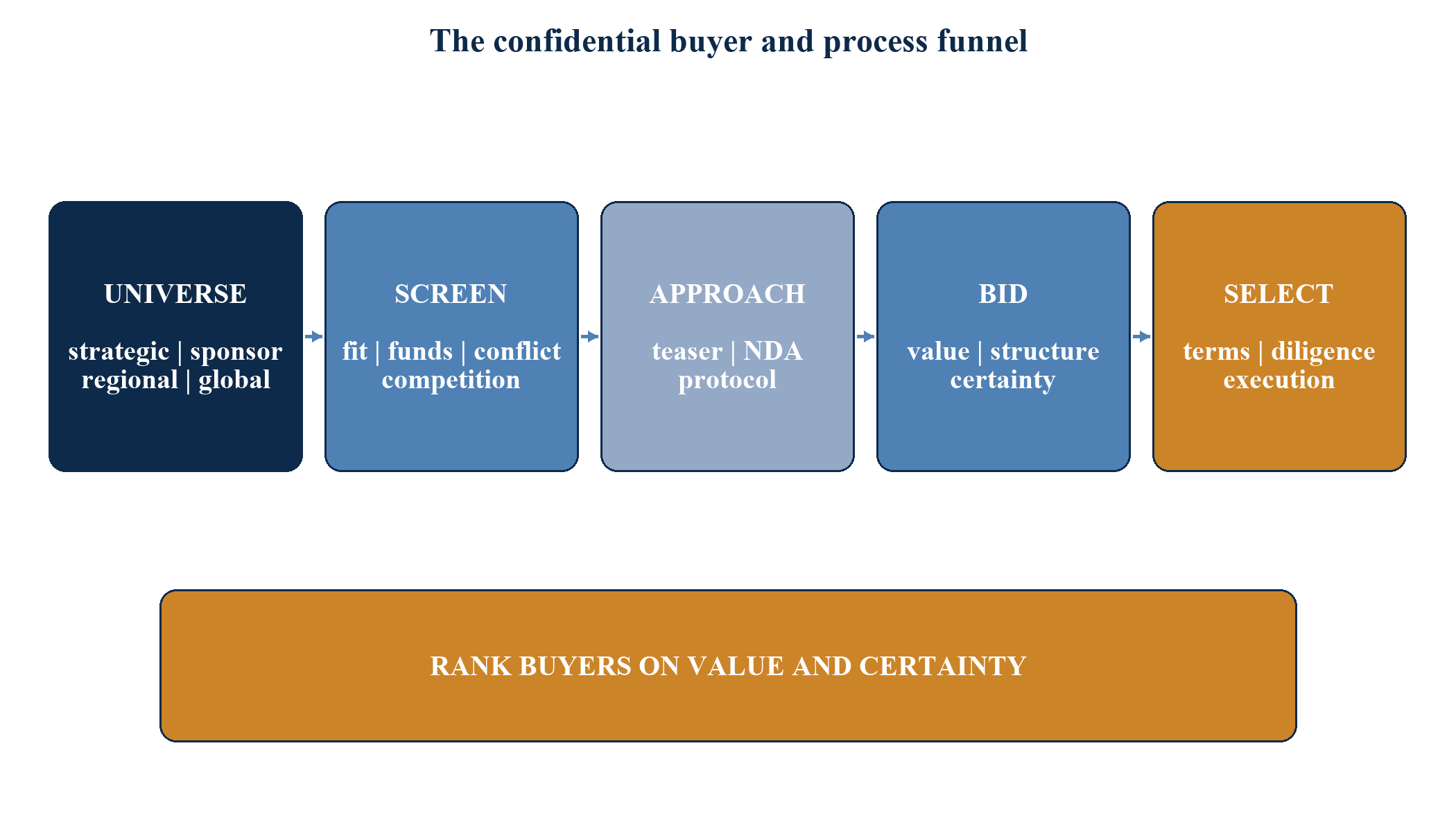
A longer buyer list does not automatically create better tension. The seller should prioritise credible parties and control the sequence of approach.
21.2 Use a staged information protocol
The initial teaser should avoid identifying detail where possible. A non-disclosure agreement should address permitted recipients, use, contact restrictions, data security, return or destruction, publicity and legal process. Sensitive customer, pricing or employee information may remain restricted until later stages or a clean-team process.
21.3 Track conflicts and financing certainty
Advisers, lenders and buyers may have conflicts. The seller should maintain a conflict log and approve exceptions. Financial sponsors and acquisition vehicles should provide evidence of funds, financing plans and investment-committee status appropriate to the stage.
22. SELECT THE SALE PROCESS
22.1 Match process design to the objective
A broad auction can maximise market tension but increases disclosure and leakage. A targeted auction can balance competition and control. A bilateral process may offer speed or strategic fit while reducing price discovery. The family mandate should guide the choice.
22.2 Define bid instructions before launch
Bid instructions should request enterprise value, equity bridge, form and timing of consideration, financing, approvals, diligence conditions, management expectations, exclusivity request, regulatory analysis and proposed timetable. Comparable bids require comparable definitions.
22.3 Preserve leverage through gates
The seller should decide what must be achieved before exclusivity: acceptable value, evidence of funds, agreed headline terms, limited confirmatory diligence and a credible closing plan. Premature exclusivity can transfer leverage before the buyer has committed.
23. TRANSACTION TERMS THAT AFFECT REAL VALUE
23.1 Price mechanism
Completion accounts adjust the price using accounts prepared after closing under agreed definitions. A locked-box uses a historical balance sheet and protects value through leakage covenants. The appropriate mechanism depends on accounting quality, seasonality, forecast visibility, complexity and buyer expectations.
23.2 Deferred and contingent consideration
An earnout can bridge a valuation gap, but it transfers future operating and control risk. The seller should define the metric, accounting policy, management conduct, investment assumptions, information rights, dispute mechanism and acceleration events. Deferred fixed consideration creates buyer credit risk that may require security or guarantee analysis.
23.3 Warranties, indemnities and disclosure
Warranties allocate information risk. Specific indemnities address identified matters. The seller should model caps, baskets, time limits, exclusions, mitigation, conduct of claims and insurance. Disclosure should be specific enough to qualify the relevant warranty under the governing transaction documents.
24. HYPOTHETICAL VALUE-UPLIFT CASE
24.1 Starting position
Consider a hypothetical GCC family-owned services company with reported EBITDA of AED 18.0 million. The owners initially expect an enterprise-value multiple of 7.0 times, implying AED 126.0 million. The first internal review identifies AED 1.8 million of proposed adjustments, AED 5.0 million of debt-like items and a working-capital target risk of AED 3.0 million.
The case is illustrative. It does not represent a real company, offer or market multiple.
24.2 Evidence and operating work
The twelve-month programme validates AED 1.2 million of the proposed adjustments. The remaining AED 0.6 million is excluded because the supporting evidence or sustainability case is insufficient. Management also converts an undocumented customer renewal into a signed two-year agreement, reduces overdue receivables and transfers two critical customer relationships from the founder to the commercial director.
The board's valuation analysis uses a hypothetical corridor of 6.5 to 7.5 times maintainable EBITDA. At the mid-point, maintainable EBITDA of AED 19.2 million implies AED 134.4 million enterprise value.
24.3 Equity bridge
| Item | Before readiness | After readiness |
|---|---|---|
| reported EBITDA | AED 18.0m | AED 18.0m |
| accepted adjustments | AED 0.0m | AED 1.2m |
| maintainable EBITDA | AED 18.0m | AED 19.2m |
| illustrative multiple | 7.0x | 7.0x |
| enterprise value | AED 126.0m | AED 134.4m |
| debt-like items | AED 5.0m | AED 3.5m |
| working-capital shortfall | AED 3.0m | AED 0.8m |
| illustrative equity value | AED 118.0m | AED 130.1m |
The AED 12.1 million difference is a hypothetical arithmetic outcome, not a forecast. Part comes from evidenced earnings, part from resolving obligations and part from working-capital improvement. A real process could produce a lower or higher result due to market conditions, buyer strategy, risk, terms and execution.
24.4 Structure sensitivity
If a bidder offers AED 135 million with 20 per cent contingent on a two-year earnout, the risk-adjusted proceeds may be below a fully funded AED 128 million cash offer. The family should compare expected value, downside, timing, buyer credit and continuing obligations.
25. THE TWELVE-MONTH ROADMAP
25.1 Months 12 to 10: mandate, perimeter and red flags
Approve owner objectives, decision rights, transaction perimeter and internal confidentiality. Appoint the readiness leader and core advisers. Complete the legal-entity, ownership, related-party, debt and dependency maps. Launch private financial, legal and tax red-flag reviews.
The gate at the end of month 10 asks whether the proposed perimeter is transferable, whether any issue could block a sale and whether the target launch date remains credible.
25.2 Months 9 to 7: financial and operational remediation
Reconcile audited accounts to monthly management information. Build the quality-of-earnings ledger, revenue analysis, working-capital history, net-debt schedule and three-case forecast. Formalise material contracts, complete priority filings, resolve ownership discrepancies and implement founder-dependency transfers.
The gate at the end of month 7 asks whether maintainable earnings, stand-alone operations and the equity bridge can be supported from source evidence.
25.3 Months 6 to 4: diligence and packaging
Conduct scoped vendor due diligence. Complete the data room, information memorandum, financial model, management presentation and disclosure strategy. Prepare the tax and competition analyses and the buyer-ranking framework.
The gate at the end of month 4 asks whether materials tell one consistent story and whether open issues have a documented transaction treatment.
25.4 Months 3 to 2: buyer strategy and launch rehearsal
Finalise the buyer universe, conflicts, approach sequence, non-disclosure agreement, clean-team protocol and bid instructions. Rehearse management. Update trading, forecasts and all reports. Confirm board, shareholder and regulatory approvals needed for launch.
25.5 Month 1: launch gate and controlled outreach
The committee should sign a launch certificate covering perimeter, evidence, open issues, materials, approvals, buyer list, disclosure controls, process timetable and fallback plan. Figure 8 presents the full countdown.
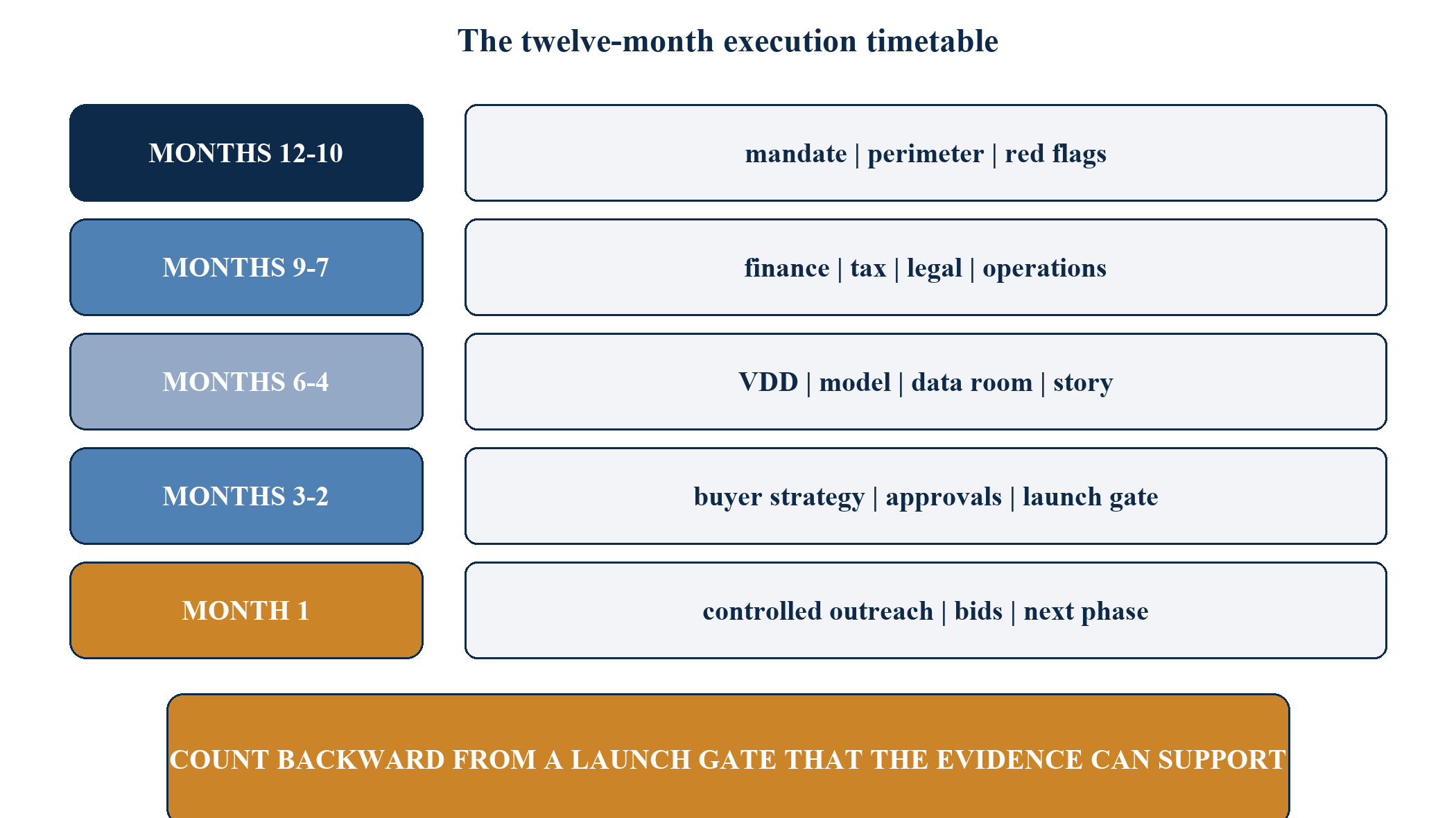
The programme should retain the ability to defer launch if trading, evidence or remediation no longer supports the story.
26. VALUE-DRIVER CHECKLIST
26.1 Earnings and cash
- audited-to-management reporting reconciled;
- adjustment ledger fully evidenced;
- revenue and margin cohorts reproducible;
- forecast tied to operational drivers;
- cash conversion and capital expenditure understood;
- normal working capital supported by monthly history; and
- debt-like items identified and quantified.
26.2 Commercial and operational
- material contracts executed and indexed;
- concentration and renewal risks explained;
- licences and permits current;
- maintenance and growth capital separated;
- business-continuity plan tested; and
- related-party dependencies documented on market terms.
26.3 Governance and people
- legal and beneficial ownership reconciled;
- board and shareholder records complete;
- founder dependencies transferred;
- critical managers retained and incentivised;
- authorities and succession documented; and
- disputes and compliance matters governed.
26.4 Transaction execution
- sale perimeter and separation steps complete;
- buyer universe screened for conflicts and competition;
- data room controlled and searchable;
- vendor reports reconciled;
- management presentation rehearsed;
- bid instructions use common definitions; and
- fallback plan approved.
27. RISK REGISTER AND DECISION RULES
27.1 Classify each issue
Every issue should be classified by value impact, probability, legal severity, buyer sensitivity, remediation cost, disclosure stage and owner. The possible treatments are fix, evidence, insure, disclose, price, retain or defer.
27.2 Use dated decision gates
A decision gate should have objective criteria and named authority. Examples include proceeding with a carve-out only after lender consent, launching only after financial reconciliation, entering exclusivity only after proof of funds and signing only after regulatory analysis.
27.3 Escalate through one dashboard
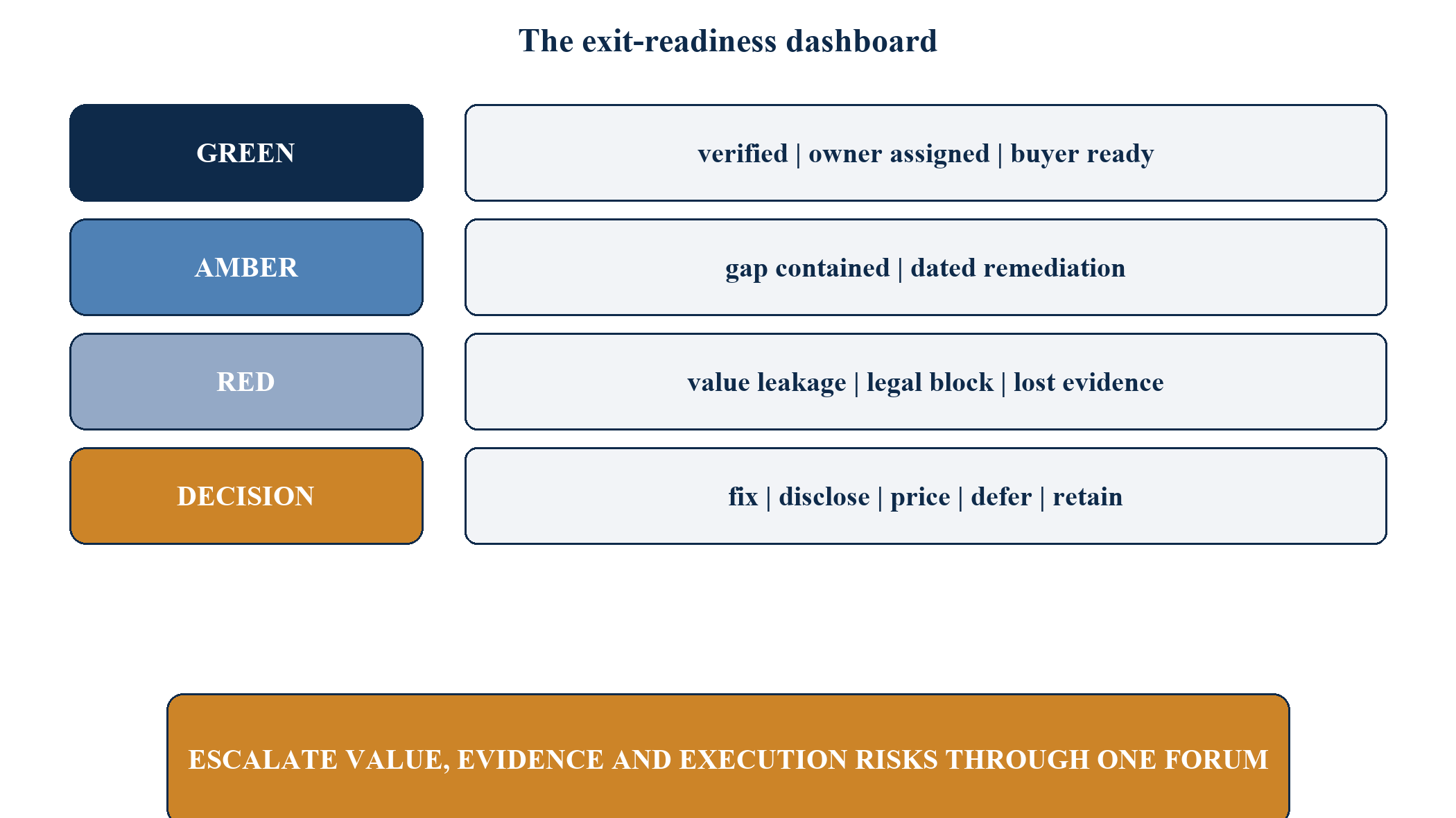
The dashboard should report current status, trend, overdue actions, decision required and value exposure. Green should mean buyer ready and evidenced. Amber should mean contained with a dated plan. Red should mean a credible threat to value, legality or execution.
28. BOARD SCORECARD
| Criterion | Board question | Required evidence |
|---|---|---|
| mandate | do owners agree on outcome, authority and minimum terms? | signed mandate and reserved-matters schedule |
| perimeter | can the buyer acquire a coherent stand-alone business? | entity, asset, contract and dependency maps |
| earnings | can maintainable EBITDA be reperformed? | audit bridge and adjustment ledger |
| cash | are working capital, debt and capital expenditure understood? | monthly history and equity bridge |
| legal | are ownership, approvals, licences and material contracts sound? | legal red-flag report and remediation log |
| people | can performance continue without the founder? | critical-role and transfer evidence |
| disclosure | are materials consistent, accurate and controlled? | data-room index and disclosure log |
| execution | can the chosen buyers fund and close? | buyer screen, approvals map and timetable |
| resilience | is there a fallback if price or timing deteriorates? | downside plan and board decision rules |
29. CONCLUSION
The year before a sale can materially influence the quality of the process. The core discipline is to treat every value claim as an evidence chain and every unresolved issue as a decision. Owners define the outcome and perimeter. Management verifies earnings, cash and operations. Advisers challenge legal, tax, regulatory and transaction assumptions. The board governs launch through explicit gates.
A prepared seller can answer the buyer's central questions with consistency: what is being acquired, what it earns, how it converts earnings to cash, which risks remain, who will run it and how the transaction can close. That confidence can support valuation, terms and speed while preserving the family's ability to stop, reshape or defer the process when conditions change.
APPENDIX A. TWELVE-MONTH IMPLEMENTATION PLAN
| Month before launch | Primary output | Approval gate |
|---|---|---|
| 12 | owner mandate and confidentiality protocol | family and board approval |
| 11 | entity, ownership, perimeter and dependency maps | perimeter confirmation |
| 10 | private red-flag reports | remediation budget and timetable |
| 9 | audited-account and management-reporting bridge | finance sign-off |
| 8 | earnings, revenue and cash-conversion analysis | valuation assumptions |
| 7 | working-capital, net-debt and forecast model | equity bridge sign-off |
| 6 | legal, tax, people, technology and operations remediation | issue treatment decisions |
| 5 | vendor due diligence and buyer-grade data room | disclosure approval |
| 4 | information memorandum, model and management presentation | materials consistency gate |
| 3 | buyer universe, conflicts and competition screen | approach-list approval |
| 2 | management rehearsal, NDA and bid protocol | launch-readiness review |
| 1 | updated trading, certificate and controlled outreach | formal launch gate |
APPENDIX B. DATA-ROOM INDEX
B.1 Corporate and ownership
Constitutional documents, licences, registers, beneficial ownership, share history, powers, board and shareholder minutes, group chart, joint ventures, pledges and related-party arrangements.
B.2 Finance and tax
Audited accounts, monthly management information, ledgers, bank statements, budgets, forecasts, debt, working capital, capital expenditure, tax registrations, returns, assessments, reconciliations and correspondence.
B.3 Commercial and operations
Customer and supplier contracts, pipeline and backlog, pricing, revenue and margin analysis, sites, permits, assets, maintenance, quality, health and safety, environmental and insurance records.
B.4 People, technology and intellectual property
Organisation, critical roles, employment terms, incentives, visas, disputes, systems, licences, cyber and privacy records, intellectual-property registrations, assignments and contractor agreements.
APPENDIX C. QUALITY-OF-EARNINGS LEDGER
Each line should contain the reporting period, account, amount, adjustment type, narrative, source document, tax and accounting treatment, post-sale basis, internal owner, adviser status and buyer-disclosure reference.
APPENDIX D. MANAGEMENT-QUESTION REHEARSAL
- Which three customers contribute most to gross profit and how are those relationships institutionalised?
- Which earnings adjustments can be traced to invoices, contracts, payroll and ledger entries?
- Why did working capital move in each material month?
- What capital expenditure is required to maintain current earnings?
- Which licences or contracts require consent at a change of control?
- Which decisions still depend on the founder?
- What related-party arrangements will continue after closing?
- Which forecast assumptions have already been observed?
- Which compliance or dispute matters could affect value?
- What can delay closing after signing?
APPENDIX E. LAUNCH CERTIFICATE
The readiness committee should certify that the approved transaction perimeter is current; ownership and authority are reconciled; materials agree with the financial model and vendor reports; open issues have approved treatments; the data room is controlled; buyers have been screened; regulatory paths have been considered; management is prepared; and a fallback plan remains funded.
REFERENCES
[1] United Arab Emirates. Federal Decree-Law No. 37 of 2022 Concerning Family Businesses. https://uaelegislation.gov.ae/en/legislations/1608
[2] United Arab Emirates. Federal Decree-Law No. 37 of 2022, official English PDF. https://uaelegislation.gov.ae/en/legislations/1608/download
[3] United Arab Emirates. Federal Decree-Law No. 32 of 2021 on Commercial Companies. https://uaelegislation.gov.ae/en/legislations/1542
[4] United Arab Emirates. Federal Decree-Law No. 32 of 2021 on Commercial Companies, official English PDF. https://uaelegislation.gov.ae/en/legislations/1542/download
[5] United Arab Emirates. Federal Decree-Law No. 47 of 2022 on the Taxation of Corporations and Businesses. https://mof.gov.ae/en/public-finance/tax/corporate-tax/
[6] United Arab Emirates Federal Tax Authority. Corporate Tax Guides, References and Public Clarifications. https://tax.gov.ae/en/taxes/corporate.tax/corporate.tax.guides.references.aspx
[7] United Arab Emirates Federal Tax Authority. Business Restructuring Relief Guide CTGBRR1. https://tax.gov.ae/Datafolder/Files/Guides/CT/Business%20Restructuring%20Relief%20-%2017%2004%202024.pdf
[8] United Arab Emirates Ministry of Finance. Ministerial Decision No. 133 of 2023 on Business Restructuring Relief. https://mof.gov.ae/wp-content/uploads/2023/05/Ministerial-Decision-No.-133-of-2023-on-Business-Restructuring-Relief-for-Corporate-Tax-Purposes.pdf
[9] United Arab Emirates. Federal Decree-Law No. 36 of 2023 Regarding Regulating Competition. https://uaelegislation.gov.ae/en/legislations/2117
[10] United Arab Emirates Cabinet. Cabinet Decision No. 3 of 2025 on thresholds related to the Competition Law. https://www.moec.gov.ae/documents/20121/0/Cabinet%2BDecision%2BNo.%2B%283%29%2Bof%2B2025%2BOn%2Bthe%2BThresholds%2BRelated%2Bto%2Bthe%2BImplementation%2Bof%2BFederal%2BDecree-Law%2BNo.%2B%2836%29%2Bof%2B2023%2BRegulati.pdf/0f228724-8dd5-9b9c-0ed8-0b94d5ae0873
[11] United Arab Emirates Ministry of Economy. Competition thresholds and economic concentration controls, 20 February 2025. https://www.moec.gov.ae/en/-/-%D8%%D9%84%D8%%D9%82%D8%AA%D8%%D8%%D8%AF-%D8%AA%D8%%D8%AA%D8%%D8%%D8%-%D9%82%D8%%D8%%D8%-%D9%85%D8%AC%D9%84%D8%-%D8%%D9%84%D9%88%D8%%D8%%D8%%D8%-%D8%%D8%%D8%%D9%86-%D8%%D9%84%D9%86%D8%%D8%-%D9%88%D8%%D9%84
[12] United Arab Emirates. Cabinet Resolution No. 109 of 2023 Regulating the Real Beneficiary Procedures. https://uaelegislation.gov.ae/en/legislations/2176
[13] United Arab Emirates. Federal Decree-Law Regarding Anti-Money Laundering and Combating the Financing of Terrorism and Proliferation Financing. https://uaelegislation.gov.ae/en/legislations/3314
[14] United Arab Emirates. Executive Regulations Regarding Anti-Money Laundering and Combating the Financing of Terrorism and Proliferation Financing. https://uaelegislation.gov.ae/en/legislations/3857
[15] IFRS Foundation. IFRS 3 Business Combinations. https://www.ifrs.org/issued-standards/list-of-standards/ifrs-3-business-combinations/
[16] IFRS Foundation. IFRS 5 Non-current Assets Held for Sale and Discontinued Operations. https://www.ifrs.org/issued-standards/list-of-standards/ifrs-5-non-current-assets-held-for-sale-and-discontinued-operations/
[17] IFRS Foundation. IFRS 10 Consolidated Financial Statements. https://www.ifrs.org/issued-standards/list-of-standards/ifrs-10-consolidated-financial-statements/
[18] IFRS Foundation. IAS 24 Related Party Disclosures. https://www.ifrs.org/issued-standards/list-of-standards/ias-24-related-party-disclosures/
[19] IFRS Foundation. IFRS 13 Fair Value Measurement. https://www.ifrs.org/issued-standards/list-of-standards/ifrs-13-fair-value-measurement/
[20] IFRS Foundation. IAS 36 Impairment of Assets. https://www.ifrs.org/issued-standards/list-of-standards/ias-36-impairment-of-assets/
[21] International Valuation Standards Council. International Valuation Standards effective 31 January 2025. https://ivsc.org/new-edition-of-the-international-valuation-standards-ivs-published/
[22] International Finance Corporation. Family Business Governance Handbook. https://www.ifc.org/content/dam/ifc/doc/mgrt/family-business-governance-handbook.pdf
[23] International Finance Corporation. Family Business Governance. https://www.ifc.org/en/what-we-do/sector-expertise/corporate-governance/family-business-governance
[24] International Finance Corporation. Corporate Governance Matrix for Family or Founder-Owned Business. https://www.ifc.org/en/insights-reports/2018/cg-matrix-family-founder-owned
[25] United Arab Emirates. Federal Decree-Law No. 33 of 2021 Concerning Regulating Labour Relations. https://uaelegislation.gov.ae/en/legislations/1541
[26] United Arab Emirates. Cabinet Resolution No. 1 of 2022 Concerning the Executive Regulation of Federal Decree-Law No. 33 of 2021. https://uaelegislation.gov.ae/en/legislations/1547
[27] United Arab Emirates. Federal Decree-Law No. 45 of 2021 Concerning the Protection of Personal Data. https://uaelegislation.gov.ae/en/legislations/1972
[28] Central Bank of the UAE. Anti-Money Laundering and Combating the Financing of Terrorism and Illegal Organisations Guidelines for Financial Institutions. https://rulebook.centralbank.ae/en/rulebook/anti-money-laundering-and-combating-financing-terrorism-and-illegal-organisations
[29] United Arab Emirates Ministry of Economy. Economic Concentration. https://www.moec.gov.ae/en/economic-concentration
[30] United Arab Emirates Ministry of Finance. Corporate Tax in the UAE. https://mof.gov.ae/en/public-finance/tax/corporate-tax/
