

1. INTRODUCTION
Family-business succession is often described as a leadership decision. Capital determines whether the decision can be executed. A founder may want to transfer control to the next generation, equalise value among family branches, provide liquidity to an exiting shareholder, protect the operating company from a forced sale and preserve enough cash for growth. Those objectives can require different owners, instruments, dates and approval processes.
The financing problem begins when family value and company cash are treated as the same thing. A profitable business can still lack the liquidity to purchase a departing branch. A valuable shareholder can still lack voting authority. A capable successor can still lack the personal resources to acquire shares. A company can still breach lender restrictions if it funds family liquidity without testing distributable reserves, solvency, security and debt-service capacity. Governance documents can define the intended destination; capital structure determines whether the journey is affordable.
This paper develops a practical framework for financing generational transition in UAE and GCC family businesses. It separates four transitions: ownership, voting control, management and family liquidity. It then evaluates retained cash, dividends, company share purchases, seller notes, acquisition facilities, holding-company debt, asset-backed funding, minority capital, strategic investment, insurance and foundation-based ownership. The analysis uses current UAE legislation, official financial-centre materials, central-bank rules and international governance guidance [1-18].
Worked amounts and ratios in this paper are hypothetical and simplified. They are decision tools rather than forecasts, valuations, credit approvals or legal conclusions. The appropriate structure depends on the company form, governing jurisdiction, constitutional documents, family arrangements, tax position, lender terms, accounting treatment and personal circumstances. Qualified legal, tax, accounting, valuation, insurance and financing advisers should confirm every transaction.
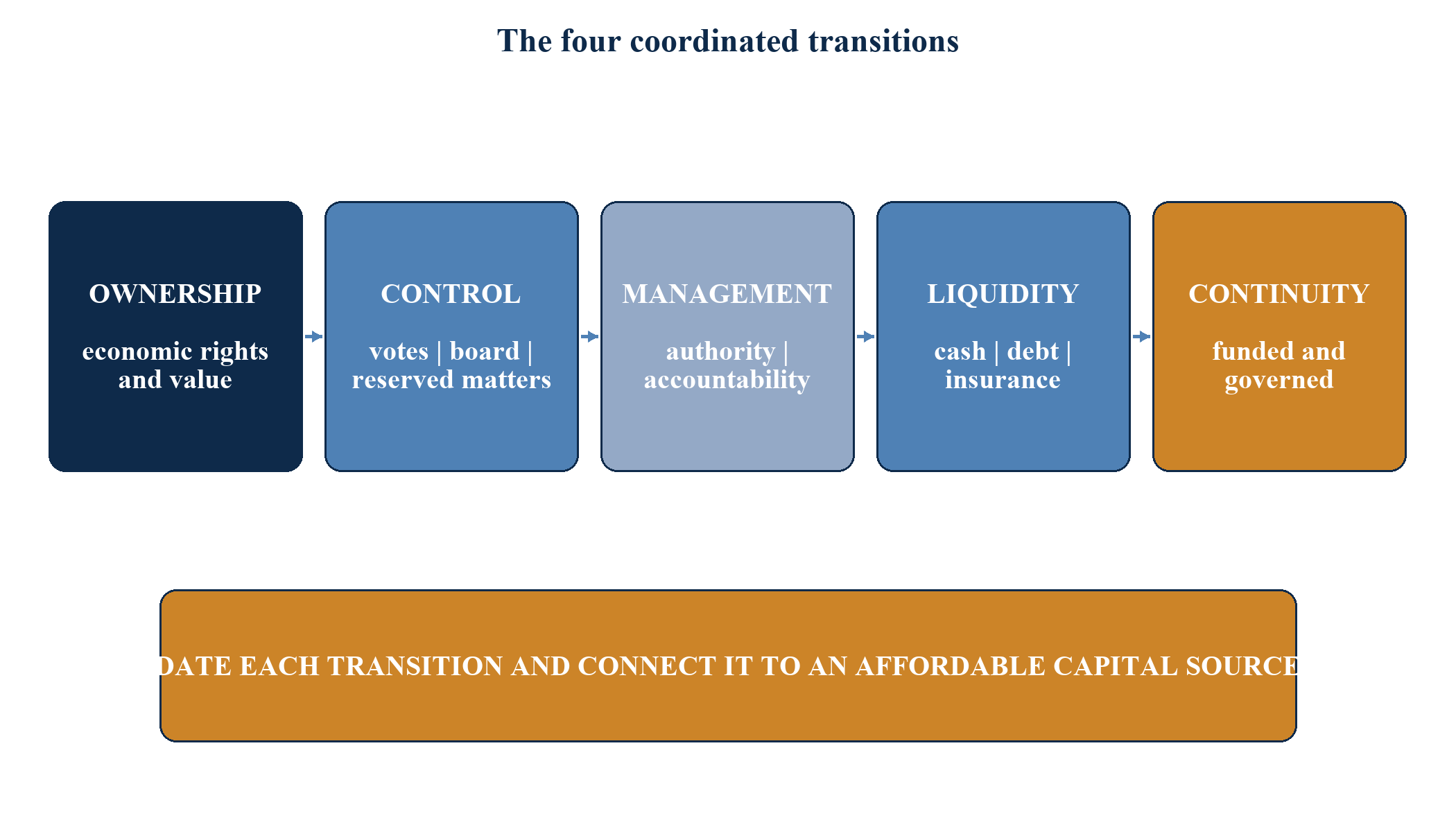
| Transition | Core question | Capital consequence |
|---|---|---|
| ownership | who receives the economic interest? | price, gift, exchange, dilution or redemption |
| voting control | who can appoint directors and approve reserved matters? | voting classes, transfer conditions and control premium |
| management | who runs the business and bears executive accountability? | remuneration, incentives, retention and performance gates |
| family liquidity | who needs cash, when and for what purpose? | distribution, buyout, debt service, insurance or sale |
2. SUCCESSION IS A CAPITAL EVENT
2.1 The company, owner and family have separate balance sheets
The operating company owns productive assets, employs people, contracts with customers and carries business liabilities. The shareholder owns an interest in the company. The family may own property, portfolios, trusts, foundations, insurance and other businesses. A succession plan should show all three balance sheets and the cash flows between them.
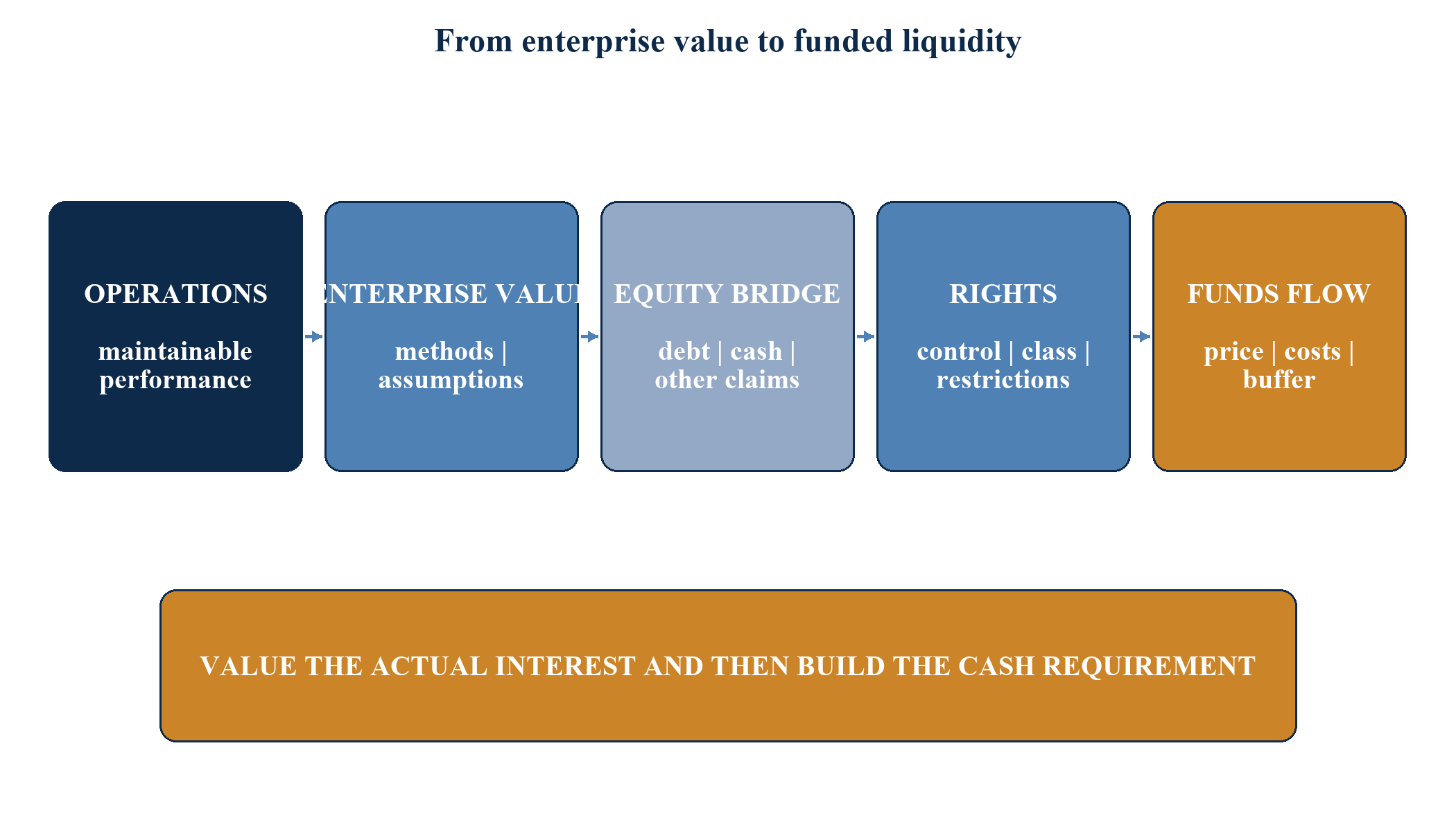
This separation prevents a common analytical error: assuming that an equity valuation is available cash. Enterprise value is first reconciled to debt, cash and other claims. Shareholder value is then allocated by legal and economic rights. Any buyout must still be funded from a lawful source. A valuation can support fairness and credit analysis; it does not itself create liquidity.
2.2 Four events can occur on different dates
The founder can cease to be chief executive while retaining voting control. A child can receive non-voting economic shares before joining management. A passive branch can sell part of its interest while preserving an information right. A foundation can hold shares while family members occupy different council, guardian, board and executive roles. The transition timetable should state the legal effective date for each role.
| Event | Evidence | Financing gate |
|---|---|---|
| management handover | board resolution, employment terms, authority matrix | successor incentives and founder retirement funding |
| voting transition | amended constitutional documents and registers | control value, lender consent and reserved matters |
| economic transfer | transfer instrument, valuation and ownership register | consideration, tax, accounting and funding source |
| liquidity payment | funds flow, distribution or facility drawdown | solvency, covenants, security and repayment |
2.3 The financing objective should be written before instruments are chosen
The family should specify whether it seeks continuity, equalisation, concentration of active ownership, retirement income, emergency liquidity, growth capital or a partial exit. A single transaction can serve several purposes, yet each purpose should have its own measurement. An acquisition facility may fund an exiting shareholder while weakening growth capacity. A dividend may equalise cash while leaving voting tensions intact. Minority equity may strengthen the balance sheet while changing family control.
3. THE UAE FAMILY-BUSINESS LEGAL ARCHITECTURE
3.1 Federal Decree-Law No. 37 of 2022 creates a dedicated framework
Federal Decree-Law No. 37 of 2022 concerning family businesses provides a federal framework for eligible family businesses, subject to its scope, registration and local or free-zone implementation [1,2]. The law should be read with the applicable commercial companies legislation, constitutional documents, local rules and any free-zone regime. Its English translation expressly notes that the original Arabic text governs interpretation.
The law addresses ownership continuity, transfer conditions, share categories, governance and dispute mechanisms. Article 12 permits categories that separate profit rights and voting rights and allows further differentiation in value, voting power, profits, priority and other privileges, subject to the law and implementing requirements [2]. These tools can help a family distinguish economic participation from management or control. They require careful drafting, valuation and consent analysis.
3.2 Transfer restrictions and liquidity must be designed together
A restriction that keeps shares within the family can reduce the available buyer pool. A narrow buyer pool can increase the need for company liquidity, branch financing or seller credit. Transfer conditions should therefore be tested against death, disability, divorce, insolvency, retirement, disagreement and voluntary exit.
The family should answer five questions for each permitted transfer:
- Who can initiate a sale or transfer?
- Who has a first opportunity or obligation to buy?
- How is value determined and challenged?
- How long does the process take?
- What happens if no permitted buyer has sufficient funding?
3.3 Share categories can separate economics and control
Different share classes may support a staged transition. Voting shares can remain with active stewards while non-voting economic shares spread value more widely. Conversion conditions can link rights to age, training, board service, employment or a future event where lawful. The family should avoid using class design as a substitute for a coherent governance agreement.
Class rights influence valuation. A non-voting interest may have a different economic value from a controlling voting block. Dividend priority, transferability, information rights, redemption and conversion all affect the analysis. The valuation mandate should describe the precise instrument rather than value an undifferentiated percentage.
3.4 Constitutional and family documents should agree
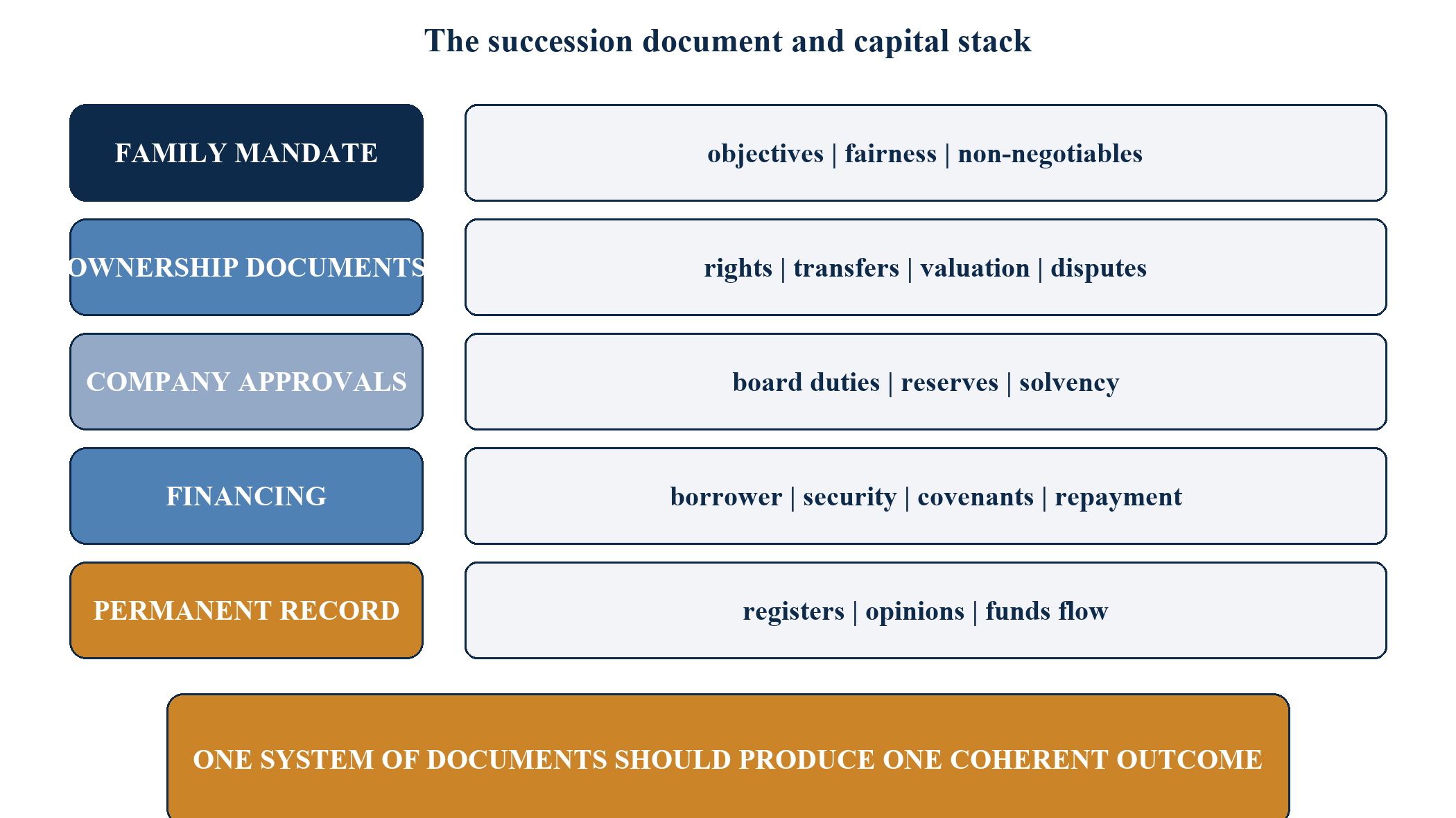
The articles, shareholder agreement, family charter, wills, foundation documents, board charters, powers of attorney and financing agreements should be reviewed as one system. Conflicting documents create execution risk at the moment liquidity is needed. The permanent record should state which document governs each decision, who can amend it and which consent is required.
4. DEFINE THE FAMILY OUTCOME
4.1 Build an owner-role map
Each family member can be an owner, director, employee, beneficiary, creditor, guarantor or none of these. The owner-role map records current and intended positions. It should also show spouses, minors, trusts, foundations, nominees and corporate shareholders where relevant.
The map reveals economic asymmetry. An active family executive may receive salary and dividends; a passive owner may rely only on distributions. A branch with more voting shares may have less economic value. A founder may need retirement cash while retaining guarantees. These differences should be quantified before fairness is debated.
4.2 Define fairness as a policy
Equal ownership, equal cash and equal influence are different policies. A family may choose one or combine them. The decision should identify the reference date, valuation method, treatment of prior gifts, employment compensation, shareholder loans and contingent benefits.
| Policy | Advantage | Financing consequence |
|---|---|---|
| equal shares | simple visible allocation | may place passive and active owners in one pool |
| equal value | accommodates different assets | requires reliable valuation and liquidity |
| stewardship concentration | aligns control with active leadership | requires buyout or non-voting interests for others |
| needs-based liquidity | addresses personal circumstances | requires a transparent approval and repayment policy |
| performance-based ownership | rewards future contribution | requires measurable vesting and leaver terms |
4.3 Record non-negotiables and flex points
Non-negotiables can include continued family control, no personal guarantees from a particular branch, protection of a core asset, minimum annual investment, Sharia compliance or a maximum debt threshold. Flex points can include timing, payment form, staged transfer, partial sale or outside capital. Negotiations are more productive when these categories are explicit.
5. VALUE THE INTEREST THAT WILL ACTUALLY MOVE
5.1 Begin with maintainable operating performance
Valuation should distinguish reported earnings from maintainable earnings. Related-party rent, owner remuneration, personal expenses, one-off projects, non-recurring gains, customer concentration and underinvestment can affect the result. The finance team should reconcile adjustments to audited accounts, management information and source documents.
The valuation date matters because succession can take years. A fixed value creates certainty but can become stale. A formula can remain current but can be disputed. An independent valuation at each transfer can improve objectivity but adds time and cost. The family should select the method and challenge process before a triggering event.
5.2 Reconcile enterprise value to equity value
The bridge normally considers financial debt, cash, shareholder loans, leases, pension or employee obligations, contingent liabilities, surplus assets and working-capital assumptions. The precise bridge depends on the transaction and accounting framework. Each item should have an owner and evidence source.
5.3 Apply rights and restrictions to the specific interest
The value of a minority, non-voting or restricted interest can differ from its simple pro rata share of total equity. Control rights, distribution history, transferability, information rights, tag and drag provisions, redemption, conversion and dispute mechanisms are relevant. A fairness opinion or independent valuation should state the basis clearly.
5.4 Use a valuation corridor
A decision corridor can show a low, central and high value using transparent operating and market assumptions. Funding should be tested at each point. If the structure only works at the lowest value, the buyout is not resilient. The corridor can also support an earn-out, contingent value right or staged price.
6. SIZE THE SUCCESSION FUNDING NEED
6.1 Separate price from total cash requirement
The purchase price can be only one component. The total need can include transaction costs, debt refinancing, tax reserves, insurance premiums, founder retirement cash, working-capital protection, management incentives and a liquidity buffer. The model should show gross need, available family cash, available company cash and external capital.
6.2 Preserve operating liquidity
Succession funding competes with payroll, suppliers, maintenance, growth and contingencies. The operating company should retain a board-approved minimum liquidity floor and a downside buffer. A structure that empties the company on completion can transfer ownership while damaging the underlying asset.
6.3 Build a thirteen-week and three-year cash view
The thirteen-week forecast controls execution. It identifies immediate receipts, payments, facility conditions, distributions and transaction costs. The three-year model tests debt service, investment, dividends, covenants and downside performance. Both should reconcile to the same opening cash and debt balances.
| Cash component | Timing | Evidence |
|---|---|---|
| consideration at completion | closing | signed funds-flow statement |
| deferred consideration | scheduled | note or purchase agreement |
| transaction costs | before and at closing | adviser budgets and invoices |
| operating buffer | continuous | board policy and cash forecast |
| debt service | monthly or quarterly | facility model |
| founder retirement income | periodic | approved family and company policy |
7. THE FUNDING ROUTE MAP
7.1 Internal sources
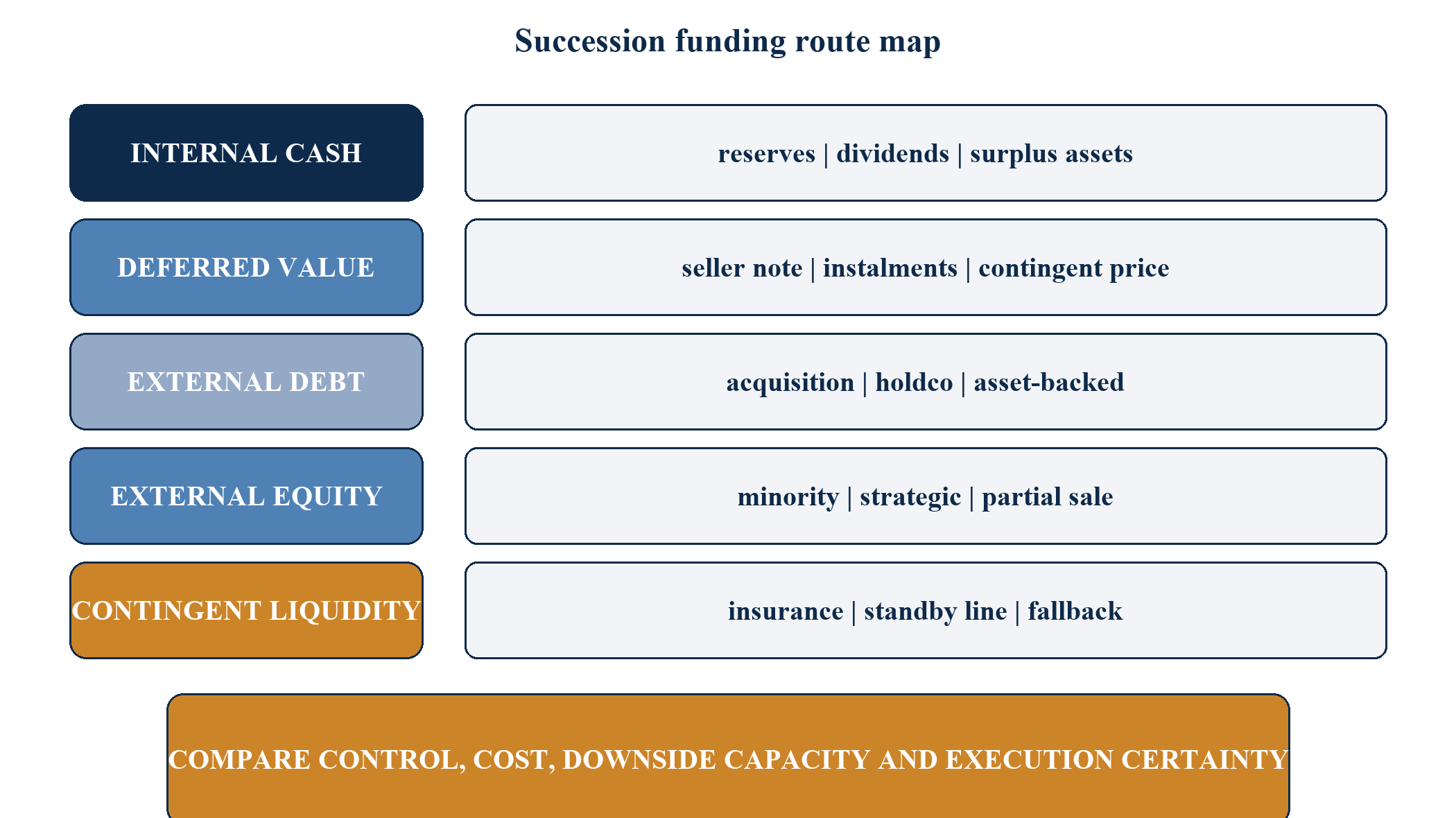
Internal sources include retained cash, lawful dividends, repayment of shareholder loans and disposal of surplus assets. They can reduce external debt and preserve privacy. Their availability depends on solvency, reserves, covenants, tax, board duties and operating needs.
7.2 Deferred and contingent sources
Seller notes, instalments, earn-outs and contingent value arrangements reduce closing cash. They expose the exiting owner to future company, buyer and enforcement risk. Security, subordination, information rights, acceleration and dispute mechanisms should be negotiated with the same discipline as third-party debt.
7.3 External debt
External routes include acquisition facilities, holding-company loans, asset-backed facilities, revolving credit and private credit. The borrower, security package, guarantees, cash sweep and distribution restrictions determine where risk sits. Debt should be sized from cash flow and downside capacity rather than available collateral alone.
7.4 External equity
Minority growth capital or strategic investment can fund a buyout and strengthen the balance sheet. It introduces a new owner, governance rights, exit expectations and information obligations. The family should model control after all reserved matters, board seats, vetoes, conversion rights and future dilution.
8. RETAINED CASH AND DIVIDEND FUNDING
8.1 Cash already in the business has an opportunity cost
Using retained cash can appear cheapest because it has no explicit coupon. The company gives up liquidity, growth options and resilience. The decision model should assign a liquidity floor and compare the expected return on retained investment with the value of reducing succession debt.
8.2 Distributions require legal and financial gates
The board should confirm applicable company-law requirements, distributable reserves, solvency, lender restrictions, tax and equal-treatment issues. The approval record should state why the distribution is in the company's interests and how operating obligations remain funded.
8.3 Establish a pre-funded succession reserve
A multi-year reserve can accumulate cash before a planned transfer. It reduces closing risk and demonstrates discipline to lenders. The reserve policy should define annual contributions, permitted investments, access controls, target amount and treatment if succession is delayed.
9. COMPANY PURCHASE OR REDEMPTION OF SHARES
9.1 A company-funded exit can simplify ownership
Where lawful and properly approved, a company purchase or redemption can remove an exiting shareholder without requiring active family members to fund the entire price personally. The transaction affects company cash, capital, distributable reserves, treasury-share treatment, creditor protection and remaining ownership percentages.
9.2 The company should model post-transaction capacity
The post-transaction model should show cash, debt, net leverage, fixed-charge coverage, working capital, covenant headroom and capital expenditure. A buyback that concentrates family control can also concentrate financial risk in the operating company.
9.3 Governance conflicts require independent process
Directors and shareholders may sit on both sides. Independent valuation, conflicted-director procedures, separate advice and documented approvals can improve the process. The family should also decide whether every branch receives the same liquidity opportunity.
10. SELLER NOTES AND INSTALMENT CONSIDERATION
10.1 Seller finance closes the liquidity gap
The exiting owner can accept part of the price over time. The note can carry a fixed or floating return, amortise, mature in a bullet, convert, or vary with performance. It reduces initial external funding and aligns payment with company cash generation.
10.2 The note is a credit instrument
The seller should evaluate borrower capacity, priority, security, guarantees, subordination, permitted distributions, information rights, events of default, remedies and transferability. Emotional trust does not replace credit documentation. The active branch should test whether note service and senior debt service remain affordable together.
10.3 Subordination affects price and fairness
A senior lender may require the seller note to rank behind its facility and restrict payments. The seller then carries a longer and riskier exposure. Pricing, security and total consideration should reflect that position. The family should record whether a discount or premium is intended.
11. ACQUISITION AND HOLDING-COMPANY DEBT
11.1 Choose the borrower deliberately
Debt can sit in the operating company, a new acquisition vehicle, a family holding company or an individual borrower. Each route affects security, cash movement, guarantees, tax, accounting and covenant design. The structure diagram should show the legal borrower and every source of repayment.
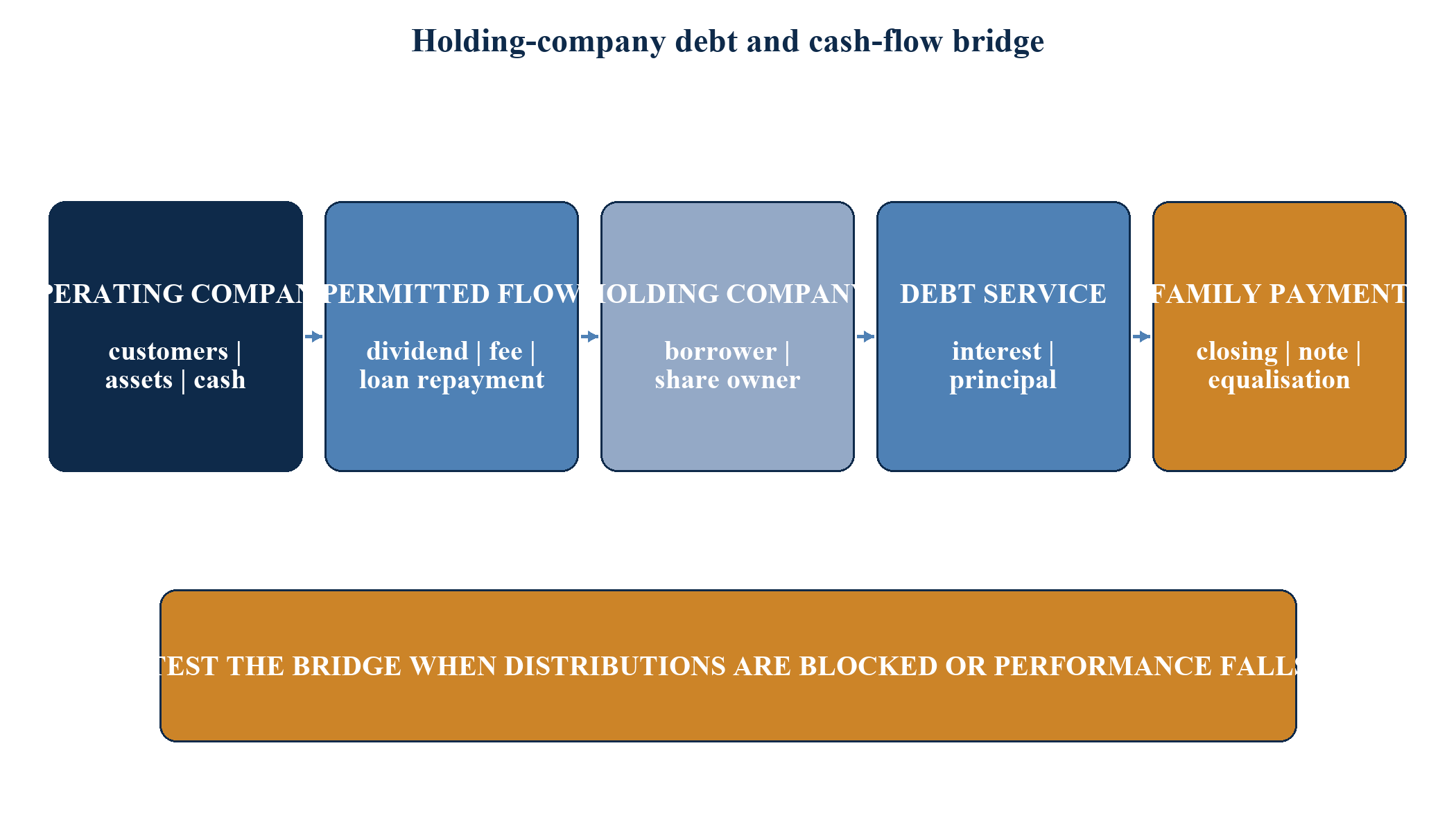
11.2 Cash must reach the debt service point
Holding-company debt often depends on dividends, management fees, permitted upstream loans or asset disposals. These flows may be restricted by law, tax, minority rights, lender covenants and operating needs. The facility model should include a distribution-block scenario.
11.3 Avoid structural overreach
A lender may have claims at a holding company while operating creditors sit closer to cash-generating assets. Security over shares can give enforcement leverage without direct access to operating cash. The family and lender should understand structural priority and applicable insolvency rules [4].
12. ASSET-BACKED AND CASH-FLOW FACILITIES
12.1 Collateral and repayment are separate tests
Real estate, equipment, receivables, inventory and investment assets can support financing. The lender still needs a credible repayment route. The family should avoid pledging strategic assets solely because they are available.
12.2 Map existing security and negative pledges
The due-diligence file should include all facilities, guarantees, security registrations, account controls, liens, pledges and negative undertakings. UAE secured-transactions law and the relevant registry framework can affect creation, perfection and priority of security over movable assets [5]. Local counsel should confirm the applicable steps.
12.3 Match asset tenor to succession tenor
Short-term working-capital lines are unsuitable for a long-dated ownership transfer if repayment depends on repeated renewal. A term facility can better match the buyout period. Revolving capacity can remain available for seasonal operations. The capital stack should avoid refinancing concentration.
13. MINORITY AND STRATEGIC CAPITAL
13.1 Minority equity can fund liquidity and growth
An investor can purchase shares from an exiting branch, subscribe new capital into the business, or combine both. A secondary purchase creates family liquidity. A primary subscription strengthens the company. The funds flow should distinguish them.
13.2 Governance rights determine practical control
A minority percentage can carry broad vetoes, board rights, information rights, anti-dilution, transfer controls and exit mechanisms. The family should model ordinary decisions, reserved matters, deadlock and future financing. Control should be assessed from the full documents.
13.3 The investor's exit becomes part of family succession
Put rights, redemption, drag rights, an IPO objective or a future sale can create another capital event. The family should model the exit price, timing and funding source before accepting the investment.
14. INSURANCE AND CONTINGENT LIQUIDITY
14.1 Planned succession and emergency succession need different tools
A planned retirement can use reserves, debt and staged consideration. Death, disability or sudden incapacity can require immediate liquidity and authority. Insurance may support a buy-sell arrangement, key-person protection, debt repayment or estate liquidity, subject to policy terms and applicable law.
14.2 Align ownership, beneficiary and purchase obligations
The policy owner, insured person, beneficiary and buyer under the share arrangement should be coordinated. The plan should address premium funding, exclusions, valuation mismatch, claim timing and any shortfall. Legal and insurance advisers should review the structure.
14.3 Maintain an emergency authority file
The file should contain board and bank authorities, shareholder contacts, insurance details, powers of attorney, key contracts, lender notices, succession documents and a seventy-two-hour cash plan. It should be tested periodically.
15. FOUNDATIONS, HOLDING COMPANIES AND PERPETUAL OWNERSHIP
15.1 A foundation can separate ownership continuity from individual mortality
ADGM describes its foundation as a legal entity with separate personality, a foundation council, optional founder controls, guardian oversight and perpetual existence [8,9]. It identifies family succession planning, wealth preservation, asset protection and corporate structuring as uses. The suitability, tax and legal effects require case-specific advice.
15.2 Governance and funding should be designed together
A foundation can hold operating-company shares while beneficiaries receive economic benefits under governing documents. It does not automatically fund a departing branch, tax, debt service or family expenditure. The plan should show which entity holds cash, incurs debt, receives distributions and approves payments.
15.3 DIFC offers a family-wealth ecosystem
DIFC's Family Wealth Centre supports family businesses and wealth owners on succession, governance and intergenerational wealth transfer [10,11]. Any DIFC family arrangement, prescribed company, foundation or holding structure should be assessed under its current regulations and professional advice. The family should select a jurisdiction and vehicle from objectives rather than labels.
16. SHARIA-COMPLIANT SUCCESSION FINANCING
16.1 Economic purpose and contractual form must align
Families seeking Sharia-compliant financing can consider asset-based, partnership or sale structures depending on the transaction and assets. The legal steps, ownership, profit calculation, security, late-payment treatment and use of proceeds should be reviewed by qualified advisers and the relevant Sharia governance process.
16.2 Separate share transfer from financing documentation
The ownership transfer, financing arrangement and security package may have different conditions and effective dates. The funds flow should prove that each contractual step occurred in the intended order. Tax, accounting and legal treatment should be assessed on the executed form and substance.
17. CREDIT CAPACITY AND COVENANTS
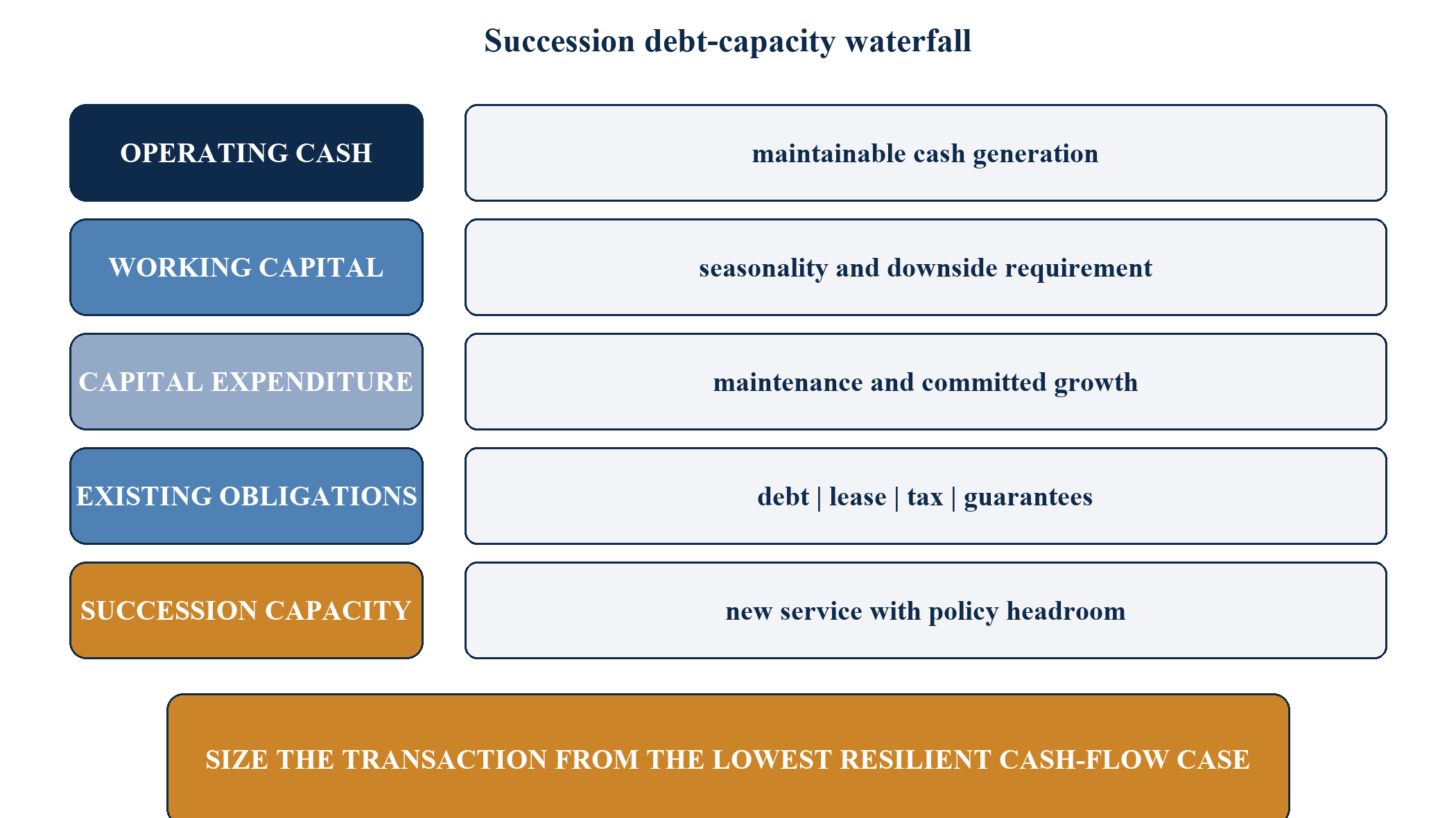
17.1 Size debt from downside cash flow
The base case should use maintainable earnings, normal working capital and required capital expenditure. Downside cases should test revenue decline, margin pressure, slower collections, customer loss, higher rates and restricted distributions. The maximum affordable debt is the lowest level that preserves the board's required headroom across relevant scenarios.
17.2 Define covenant headroom before term-sheet negotiation
Likely measures include leverage, debt-service coverage, fixed-charge coverage, minimum liquidity, loan to value, distribution restrictions and permitted indebtedness. Definitions can materially change outcomes. The family should model the lender's exact definitions when available.
17.3 Guarantees are family decisions
Personal guarantees, share pledges, asset security and cross-guarantees can move risk among branches. The approval process should show who bears the risk, whether compensation is provided, when guarantees are released and what happens after a change in ownership.
18. HYPOTHETICAL WORKED CASE
18.1 Starting position
Consider a hypothetical UAE family business with enterprise value of AED 300 million, financial debt of AED 45 million and cash of AED 15 million. The simplified equity value is AED 270 million before other adjustments. One passive branch owns 25 per cent and seeks full liquidity. Its simple pro rata value would be AED 67.5 million before any rights, restrictions, valuation adjustments, tax or transaction costs.
The company produces hypothetical maintainable EBITDA of AED 36 million. It needs at least AED 12 million of operating cash and plans AED 8 million of annual capital expenditure. Existing debt service is AED 7 million per year. These figures are illustrative and do not represent a real company or financing offer.
18.2 Illustrative funding mix
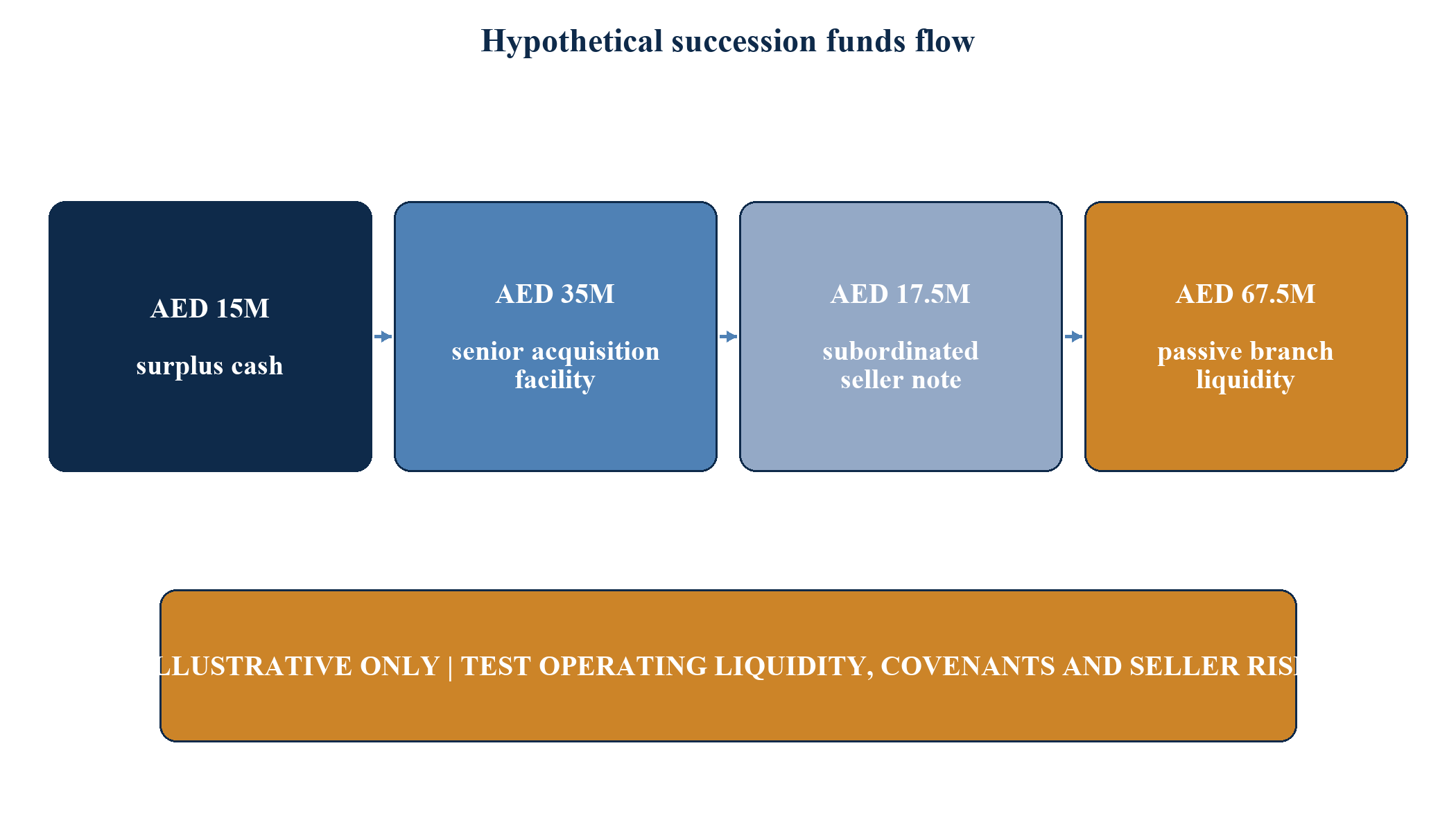
The family considers AED 15 million from surplus cash above its protected operating floor, an AED 35 million five-year acquisition facility and an AED 17.5 million seller note. The facility amortises; the seller note is subordinated and begins amortising after year two. The actual availability, pricing, security, covenants, legal ability and tax treatment would require professional confirmation.
| Source | Hypothetical amount | Key risk |
|---|---|---|
| surplus company or holding cash | AED 15.0m | operating liquidity falls |
| senior acquisition facility | AED 35.0m | covenant and refinancing pressure |
| seller note | AED 17.5m | exiting branch retains credit exposure |
| total | AED 67.5m | combined debt service and execution risk |
18.3 Downside test
If maintainable EBITDA fell by 20 per cent to AED 28.8 million, the company would still need operating investment and existing debt service. The model should calculate cash taxes, working-capital movement, capital expenditure, senior facility service and permitted seller-note payments. If the seller note becomes blocked under senior covenants, the family agreement should already state whether maturity extends, return accrues or another remedy applies.
18.4 Alternative structures
The family can reduce senior debt by extending the seller note, selling a non-core asset, admitting a minority investor or purchasing only part of the passive branch initially. Each alternative changes risk and governance. The decision should compare total cost, control, timing, certainty, downside headroom and family acceptability.
19. THE SUCCESSION CAPITAL COMMITTEE
19.1 Establish a temporary transaction body
A succession capital committee can coordinate the founder, family council, board, finance team and external advisers. Its mandate should state decision rights, conflicts, confidentiality, information flow and the matters reserved to shareholders or directors.
19.2 Use independent challenge
Independent directors, valuation experts, legal advisers and credit advisers can challenge assumptions. IFC guidance emphasises formal governance, clear family policies, capable boards and structured CEO succession [12-14]. The committee should preserve written alternatives and reasons.
19.3 Maintain one verified data room
The data room should contain corporate records, ownership, valuation, finance, contracts, assets, litigation, tax, accounting, insurance, family documents and approvals. Access should follow role and confidentiality. Every material model input should point to a source document.
20. NEXT-GENERATION MANAGEMENT AND INCENTIVES
20.1 Ownership should not automatically determine executive office
IFC guidance recommends a formal succession process, objective selection criteria, career development and board involvement [12]. The family should define the skills, experience and performance expected for chief executive and other roles. External candidates should remain available where the family lacks a ready successor.
20.2 Incentives can bridge the transition
Salary, bonus, profit participation, phantom equity, options or restricted shares can align future leadership. The arrangement should define performance, vesting, leaver treatment, transfer, dilution, tax and accounting. Family compensation should be distinguishable from shareholder distributions.
20.3 Founder transition needs its own contract
The founder may serve as chair, adviser, ambassador, guarantor or landlord after leaving executive management. Responsibilities, time, remuneration, authority, information access and termination should be documented. An undefined founder role can undermine successor authority and lender confidence.
21. FAMILY-LIQUIDITY POLICY
21.1 Replace ad hoc requests with a transparent framework
The policy can cover ordinary dividends, emergency loans, education, medical needs, housing, philanthropy, tax, shareholder exits and branch equalisation. It should state eligibility, approval, documentation, pricing, security, limits and disclosure.
21.2 Distinguish company purpose from family purpose
The operating company should not become an undocumented family bank. Related-party transactions should follow applicable law, tax, accounting, governance and lender requirements. UAE corporate-tax guidance requires attention to arm's-length treatment and connected-person rules where applicable [6,7].
21.3 Create a liquidity ladder
The ladder can begin with personal liquidity, then family-office resources, insurance, shareholder loans, permitted distributions, company funding and external finance. Each level should have a trigger and responsible decision body.
22. TAX AND ACCOUNTING WORKSTREAMS
22.1 Tax follows the executed facts
Share transfers, gifts, redemptions, reorganisations, dividends, interest, related-party arrangements and cross-border structures can produce different tax consequences. UAE corporate-tax law and FTA guidance should be reviewed with the applicable free-zone, foreign and personal tax regimes [6,7]. Advice should cover both parties and every entity in the funds flow.
22.2 Accounting affects distributable capacity and covenants
The accounting team should assess purchase, redemption, business combination, common-control, financial-instrument, consolidation, related-party and impairment questions under the applicable framework [15-18]. Lender covenant definitions may differ from statutory accounts. The model should reconcile both.
22.3 Keep a permanent basis file
The file should include valuations, tax opinions, clearances, accounting papers, board minutes, transfer documents, registers, facility documents and settlement evidence. Future heirs, auditors, banks and regulators may need to understand the transaction years later.
23. LENDER AND INVESTOR DUE DILIGENCE
23.1 Governance is part of credit quality
Lenders examine ownership, authority, related parties, succession, customer concentration, financial reporting, security and repayment. A disputed transition can affect access to cash and decision-making. A clear ownership and authority record supports underwriting.
23.2 Prepare the transaction story
The financing memorandum should explain the business, family objective, ownership before and after, valuation, funds flow, management plan, facility request, repayment, downside cases, security and approvals. It should distinguish verified history from hypothetical forecasts.
23.3 Anticipate conditions precedent
Likely conditions can include corporate approvals, ownership records, valuation, legal opinions, KYC, beneficial ownership, security perfection, insurance, financial statements, management contracts, shareholder subordination and no-default confirmations. The closing checklist should allocate each condition and evidence item.
24. NEGOTIATING THE TERM SHEET
24.1 Compare total economics
Pricing includes margin, reference rate, fees, hedging, legal cost, monitoring, early repayment, unused commitment and security cost. The comparison should use dated cash flows and show base and downside cases.
24.2 Protect operational flexibility
The family should negotiate permitted acquisitions, capital expenditure, working-capital facilities, distributions, related-party payments, additional debt, asset sales and management changes. A succession facility should support the business rather than freeze ordinary operations.
24.3 Plan the exit from day one
Amortisation, refinancing, cash sweep, asset sale, investor exit and prepayment should be modelled. The last repayment should occur before a known founder, family or market event creates another liquidity concentration where practical.
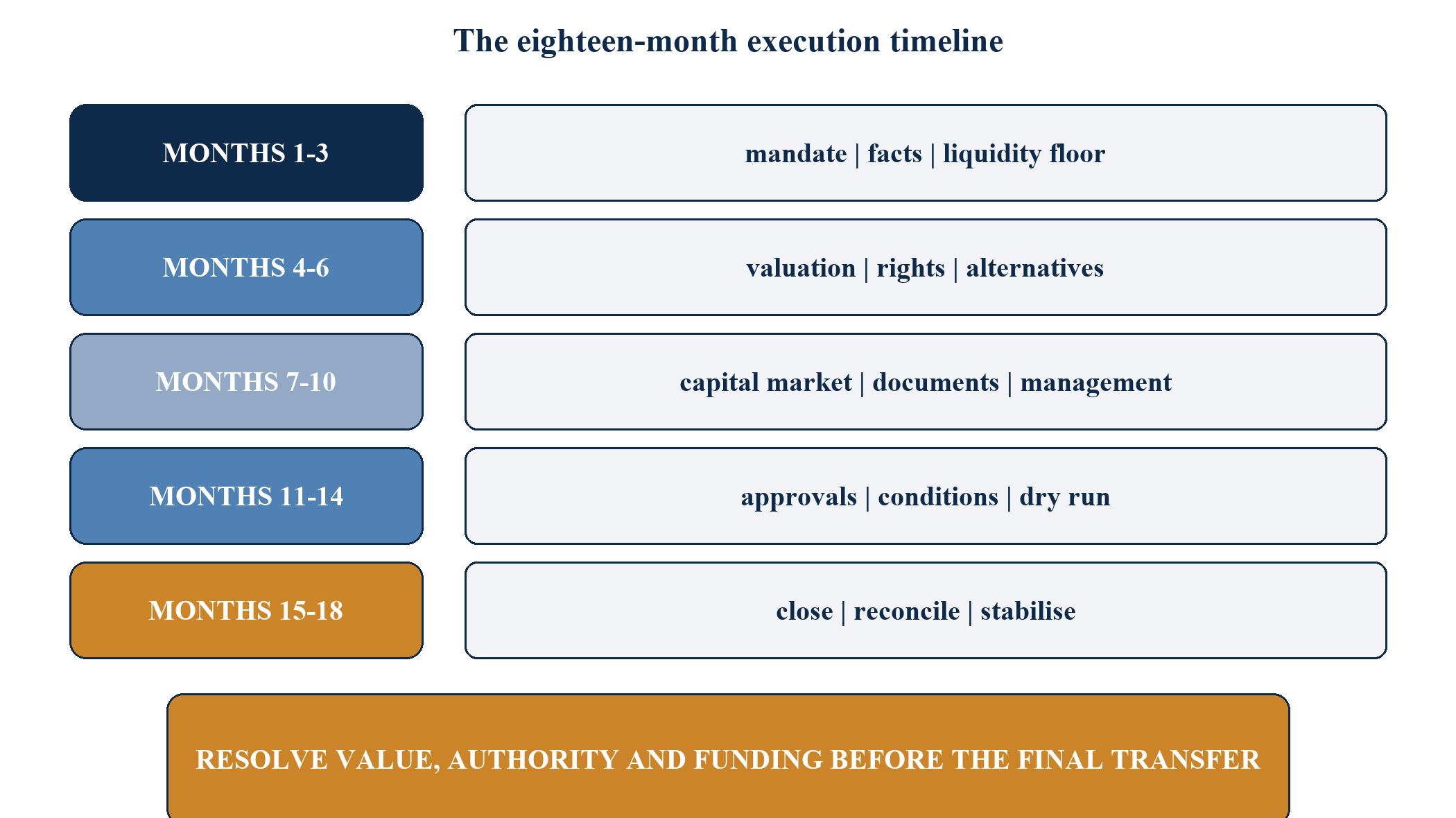
25. AN EIGHTEEN-MONTH EXECUTION TIMELINE
25.1 Months 1 to 3: family mandate and fact base
The family agrees objectives, roles, non-negotiables and confidentiality. Advisers verify ownership, governance, valuation inputs, tax, accounting and existing finance. The board establishes the liquidity floor and downside parameters.
25.2 Months 4 to 6: structure and valuation
The team completes independent valuation, rights analysis, transfer alternatives, initial funds flow and financing capacity. The family selects a preferred path and a fallback.
25.3 Months 7 to 10: market and documentation
The company obtains financing proposals or investor indications, negotiates key terms, drafts constitutional and transaction documents and develops the management transition plan. Lender and family conditions are aligned.
25.4 Months 11 to 14: approvals and readiness
Final credit, board, shareholder, regulatory, tax and legal approvals are obtained. Security, insurance, KYC, accounts, registers and closing deliverables are prepared. The team tests the funds flow.
25.5 Months 15 to 18: close and stabilise
The transaction closes only when legal ownership, cash, security, authority and records reconcile. A ninety-day stabilisation period monitors cash, covenants, management authority, seller-note service and family communications.
26. RISK REGISTER
26.1 Family and governance risk
Risks include unclear objectives, branch conflict, disputed value, founder reversal, unready successors, minority oppression, information asymmetry and document inconsistency. Controls include a written mandate, independent valuation, conflict procedures, staged approvals and mediation or dispute routes.
26.2 Financial risk
Risks include overvaluation, excessive leverage, interest-rate movement, cash leakage, distribution blocks, customer loss, refinancing concentration and seller-note default. Controls include valuation corridors, downside sizing, hedging analysis, liquidity floors, covenants and fallback funding.
26.3 Execution risk
Risks include missing consents, incomplete KYC, unperfected security, tax or accounting surprises, failed funds flow and stale registers. Controls include a detailed closing checklist, adviser sign-offs, dry-run settlement and post-closing reconciliation.
27. BOARD DASHBOARD
27.1 Monitor company and family outcomes separately
Company metrics include revenue, EBITDA, operating cash, working capital, capital expenditure, liquidity, leverage, debt service, covenant headroom and facility maturity. Succession metrics include ownership transferred, payments made, seller-note balance, guarantee release, successor readiness, disputes and document completion.
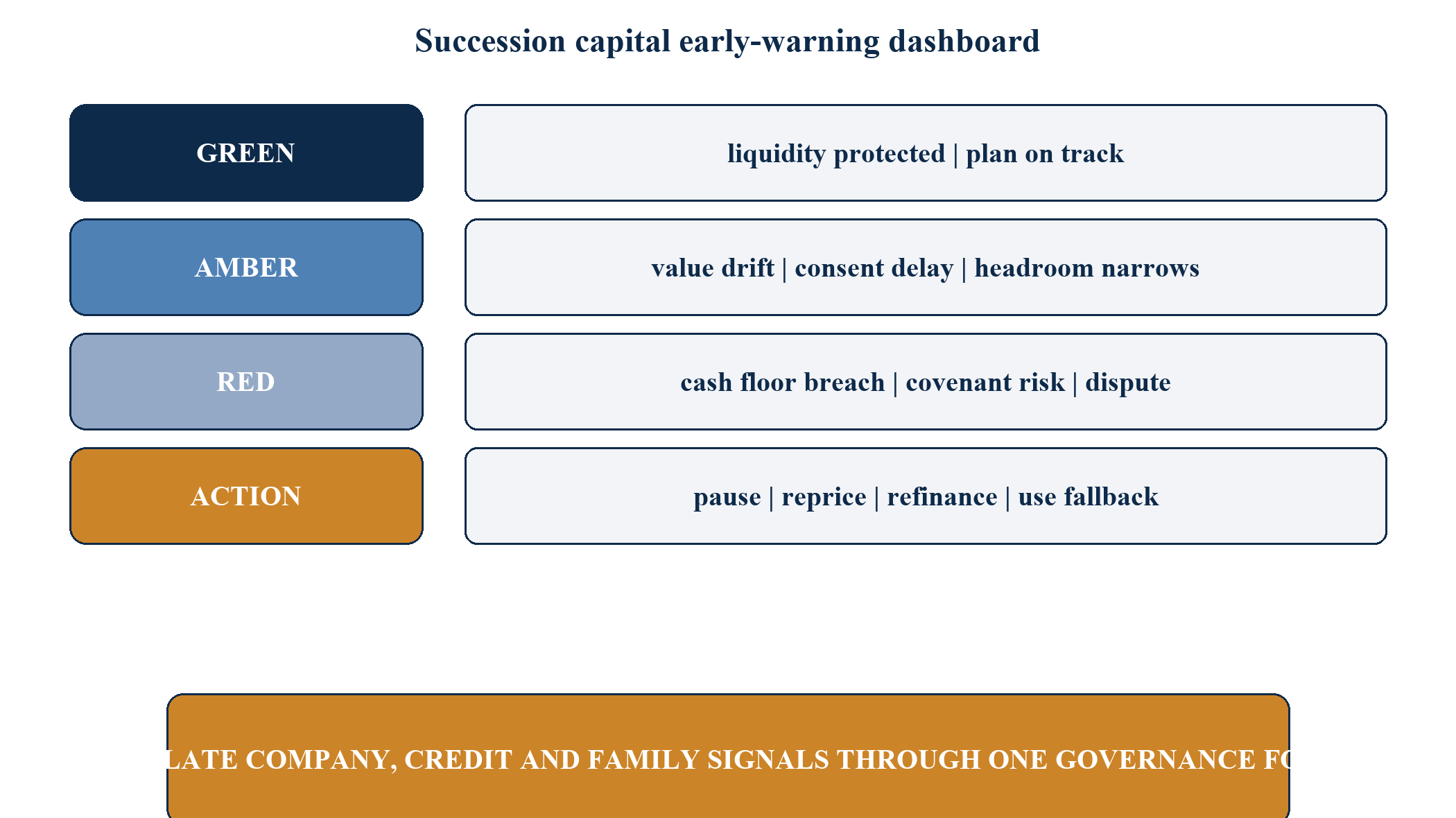
27.2 Use trigger levels
Green, amber and red thresholds should be agreed for liquidity, leverage, coverage, overdue consideration, management readiness and unresolved conditions. Each breach requires an owner, response and deadline.
27.3 Review the structure annually
Valuation, family circumstances, law, tax, lender terms, insurance and business performance change. The board and family council should review the plan at least annually and after any material event.
28. DECISION SCORECARD
The scorecard compares routes across affordability, control, fairness, speed, legal complexity, tax and accounting certainty, lender dependence, downside resilience and future flexibility. Weights should reflect the family's written objectives.
| Criterion | Question | Evidence |
|---|---|---|
| affordability | can the structure service all obligations in downside cases? | integrated cash model |
| control | who decides after closing? | rights and reserved-matters matrix |
| fairness | how is value allocated and evidenced? | independent valuation and policy |
| resilience | what happens if cash, value or timing deteriorates? | downside and contingency plan |
| execution | can every consent and condition be obtained? | closing checklist |
| flexibility | can the business still invest, borrow and distribute? | covenant and capacity model |
29. CONCLUSION
Generational transition becomes executable when ownership, control, management and liquidity are treated as separate but coordinated workstreams. The legal documents define rights. Valuation defines the economic reference point. The capital plan converts that point into an affordable funds flow. Governance decides who can approve, monitor and revise the plan.
The strongest structure protects the operating company while delivering the agreed family outcome. It preserves minimum liquidity, sizes debt from downside cash flow, documents seller exposure, values the actual rights transferred, resolves conflicts independently and maintains a complete evidence file. It also preserves a fallback path if valuation, lender appetite, family consent or business performance changes.
A family should begin before a trigger event. The first practical outputs are an owner-role map, three-balance-sheet view, valuation corridor, liquidity policy, eighteen-month timeline and integrated cash model. These outputs turn succession from an informal expectation into a governed capital programme.
APPENDIX A. SUCCESSION CAPITAL DUE-DILIGENCE CHECKLIST
A.1 Family and ownership
- Confirm every direct, indirect, beneficial, nominee, trust and foundation interest.
- Record voting, economic, information, transfer, redemption and conversion rights.
- Map each family member's owner, board, employment, beneficiary, creditor and guarantee roles.
- Reconcile wills, family charters, shareholder agreements and constitutional documents.
- Record objectives, non-negotiables, fairness policy and conflict procedures.
A.2 Company and finance
- Reconcile three years of financial statements to current management information.
- Normalise earnings and identify related-party adjustments.
- Build thirteen-week cash and three-year integrated forecasts.
- List debt, security, guarantees, covenants, negative pledges and maturity.
- Set liquidity, leverage and debt-service limits.
A.3 Transaction and compliance
- Obtain independent valuation of the exact interest.
- Prepare legal, tax and accounting structure papers.
- Complete KYC, beneficial-ownership and sanctions checks.
- Obtain every lender, shareholder, board, regulatory and third-party consent.
- Dry-run the funds flow and update all registers after closing.
APPENDIX B. HYPOTHETICAL MODELLING FORMULAS
B.1 Equity-value bridge
Simplified equity value = Enterprise value - Financial debt + Cash - Other debt-like items + Surplus assets
Every adjustment requires a definition, valuation date and evidence source.
B.2 Branch liquidity requirement
Indicative branch value = Equity value x Economic ownership percentage, adjusted for the rights and restrictions of the specific interest.
Total funding need = Consideration + Transaction costs + Required reserves + Refinancing - Available lawful internal cash.
B.3 Debt-service test
Debt-service coverage indicator = Cash available for debt service / Scheduled principal, return and required fees.
The appropriate numerator, denominator and minimum threshold depend on the facility documents and professional analysis.
APPENDIX C. SUCCESSION TERM-SHEET QUESTIONS
- Who is the borrower, buyer, seller and guarantor?
- What interest transfers and when does title pass?
- How is price determined, adjusted and challenged?
- How much is paid at closing, deferred or contingent?
- What security, priority and subordination apply?
- Which distributions and related-party payments are permitted?
- Which management changes require consent?
- What financial covenants and liquidity floors apply?
- What happens after default, death, disability or dispute?
- How can the debt or investor be repaid, refinanced or exited?
APPENDIX D. MONTHLY SUCCESSION CAPITAL PACK
The monthly pack should include:
- ownership and management transition status;
- consideration paid and outstanding;
- senior facility and seller-note balances;
- operating cash and protected liquidity;
- leverage, coverage and covenant headroom;
- working capital and capital expenditure;
- guarantee and security release status;
- successor performance and authority milestones;
- family disputes, information requests and approvals;
- tax, accounting, legal and insurance actions; and
- forecast funding needs and contingency decisions.
APPENDIX E. FINANCING ROUTE DECISION MATRIX
The matrix should be completed for the family's preferred structure and at least two credible alternatives. Scores should be supported by documents, current financing terms or professional conclusions. A high score is useful only when the underlying assumption can be executed. The committee should record any condition that could reverse the result.
| Route | Funding source | Primary strength | Primary constraint | Required evidence |
|---|---|---|---|---|
| retained cash | company or holding cash | execution simplicity | reduces operating resilience | solvency, reserve and liquidity analysis |
| staged dividend | future distributable cash | avoids acquisition debt at closing | depends on future profit and approvals | dividend capacity and covenant forecast |
| company purchase | company cash or company debt | directly consolidates ownership | company-law, reserve and conflict requirements | legal opinion, valuation and board record |
| active-branch purchase | personal, holdco or acquisition debt | aligns ownership with stewardship | repayment depends on upstream cash or personal resources | borrower model and permitted-flow analysis |
| seller note | exiting branch provides credit | reduces initial cash requirement | seller retains performance and enforcement risk | note, security, subordination and information rights |
| senior acquisition facility | bank or private-credit lender | creates certain closing cash | covenants, security and amortisation | credit model, term sheet and conditions list |
| asset-backed facility | financier lends against eligible assets | can increase available capacity | strategic collateral and asset-tenor mismatch | valuation, title, security and repayment analysis |
| minority investment | financial investor | shares risk and can add growth capital | governance rights and future exit | shareholder terms and control matrix |
| strategic partial sale | industry investor | liquidity plus commercial resources | integration, information and control change | strategic plan, competition and governance review |
| insurance-funded buy-sell | insurer pays after covered event | supports emergency liquidity | coverage, exclusions and valuation mismatch | policy, beneficiary and purchase documents |
The affordability test should use a single integrated model. Internal cash, external debt and seller credit should not be evaluated in separate spreadsheets with inconsistent opening balances. The model should reconcile purchase price, fees, operating cash, debt draws, distributions, seller-note payments and closing cash on each legal entity's balance sheet.
The control test should use the executed rights. Percentage ownership alone is insufficient where an investor or lender can approve budgets, acquisitions, management changes, distributions, additional debt or asset sales. The matrix should show who decides in the ordinary case, in a deadlock and after a default.
The resilience test should apply at least three cases. The base case uses board-approved assumptions. The operating downside tests lower revenue, margin and collections. The execution downside delays consent, financing or a family payment. The committee should identify the first date on which minimum liquidity, a covenant or a required family payment fails in each case.
The family-acceptability test should be completed separately by each relevant branch before the final meeting. Differences can then be discussed explicitly. One branch may prioritise immediate cash, another continuing control and another protection from guarantees. A blended structure can address these preferences when the economic cost and governance terms remain transparent.
The final recommendation should state the selected route, maximum funding, protected liquidity, expected closing window, approvals, advisers, fallback route and abandonment conditions. It should also state which matters remain subject to valuation, legal, tax, accounting, insurance or credit confirmation. The board and family council should approve only the matters within their respective authority.
REFERENCES
[1] United Arab Emirates. Federal Decree-Law No. 37 of 2022 Concerning Family Businesses. https://uaelegislation.gov.ae/en/legislations/1608
[2] United Arab Emirates. Federal Decree-Law No. 37 of 2022, official English PDF. https://uaelegislation.gov.ae/en/legislations/1608/download
[3] United Arab Emirates. Federal Decree-Law No. 32 of 2021 on Commercial Companies. https://uaelegislation.gov.ae/en/legislations/1542
[4] United Arab Emirates. Federal Decree-Law No. 51 of 2023 Promulgating the Financial Reorganisation and Bankruptcy Law. https://uaelegislation.gov.ae/en/legislations/2202
[5] United Arab Emirates. Federal Law No. 4 of 2020 on Securing the Rights in Movables. https://uaelegislation.gov.ae/en/legislations/1446
[6] United Arab Emirates Federal Tax Authority. Corporate Tax Guides. https://tax.gov.ae/en/taxes/corporate.tax/corporate.tax.guides.references.aspx
[7] United Arab Emirates Federal Tax Authority. Transfer Pricing Guide CTGTP1. https://tax.gov.ae/DataFolder/Files/Guides/CT/Transfer%20Pricing%20Guide%20EN.pdf
[8] Abu Dhabi Global Market. Foundations Regulations 2017, current consolidated legislation. https://www.adgm.com/legal-framework/rules-and-regulations
[9] Abu Dhabi Global Market. Setting up with ADGM: Foundations Regime FAQs. https://www.adgm.com/faqs/setting-up
[10] Dubai International Financial Centre. DIFC Family Wealth Centre. https://www.difc.com/ecosystem/difc-family-wealth-centre
[11] Dubai International Financial Centre. Family Wealth Centre Expert Advisory Council. https://www.difc.com/ecosystem/difc-family-wealth-centre/the-expert-advisory-council
[12] International Finance Corporation. Family Business Governance Handbook. https://www.ifc.org/content/dam/ifc/doc/mgrt/family-business-governance-handbook.pdf
[13] International Finance Corporation. Family Business Governance. https://www.ifc.org/en/what-we-do/sector-expertise/corporate-governance/family-business-governance
[14] International Finance Corporation. Corporate Governance Matrix for Family or Founder-Owned Business. https://www.ifc.org/en/insights-reports/2018/cg-matrix-family-founder-owned
[15] IFRS Foundation. IFRS 3 Business Combinations. https://www.ifrs.org/issued-standards/list-of-standards/ifrs-3-business-combinations/
[16] IFRS Foundation. IAS 24 Related Party Disclosures. https://www.ifrs.org/issued-standards/list-of-standards/ias-24-related-party-disclosures/
[17] IFRS Foundation. IFRS 10 Consolidated Financial Statements. https://www.ifrs.org/issued-standards/list-of-standards/ifrs-10-consolidated-financial-statements/
[18] IFRS Foundation. IFRS 13 Fair Value Measurement. https://www.ifrs.org/issued-standards/list-of-standards/ifrs-13-fair-value-measurement/
[19] Central Bank of the UAE. Small to Medium Sized Enterprises Market Conduct Regulation. https://rulebook.centralbank.ae/en/entiresection/2200
[20] Central Bank of the UAE. Responsible Financing Practice. https://rulebook.centralbank.ae/en/rulebook/article-4-responsible-financing-practice
[21] Central Bank of the UAE. Anti-Money Laundering and Combating the Financing of Terrorism and Illegal Organisations Guidelines for Financial Institutions. https://rulebook.centralbank.ae/en/rulebook/anti-money-laundering-and-combating-financing-terrorism-and-illegal-organisations
[22] United Arab Emirates. Cabinet Resolution Regarding the Regulation of Beneficial Owner Procedures. https://uaelegislation.gov.ae/en/legislations/2176
[23] OECD. Financing SMEs and Entrepreneurs 2026. https://www.oecd.org/en/publications/financing-smes-and-entrepreneurs-2026_075d8058-en/full-report.html
