

1. Treat registration as the starting gate
Registration can give a qualifying UAE family business formal status within the unified framework. The Ministry of Economy and Tourism states that registration is intended to organise ownership, support continuity and enable recognised governance arrangements. The registration process described by the Ministry begins with a request through the competent licensing authority, followed by verification, information exchange and entry in the unified register. A family charter may also be deposited under the applicable process.
The operating challenge begins after those formal steps. A charter may state that a family council exists, that family members should be prepared for leadership and that shares should be valued under an agreed method. The family still needs a council membership list, a chair, a secretary, a meeting calendar, information packs, voting rules, conflict declarations, minutes, action tracking and a tested valuation process. Without these components, a documented right can remain difficult to exercise.
Implementation should therefore begin with an evidence-led diagnostic. The review should map every statement in the charter and articles of association to an accountable body, a decision process, required information, an approval threshold, a record and an escalation route. It should also identify matters covered in employment contracts, board charters, shareholder agreements, policies, wills, foundations, trusts and financing documents. Contradictions and gaps require qualified legal review before operating procedures are approved.
The board should sponsor the programme while respecting the family's distinct constitutional role. One executive should coordinate delivery, and each governance body should approve the procedures that fall within its mandate. The objective is a repeatable system in which decisions can be made, explained and evidenced across generations.
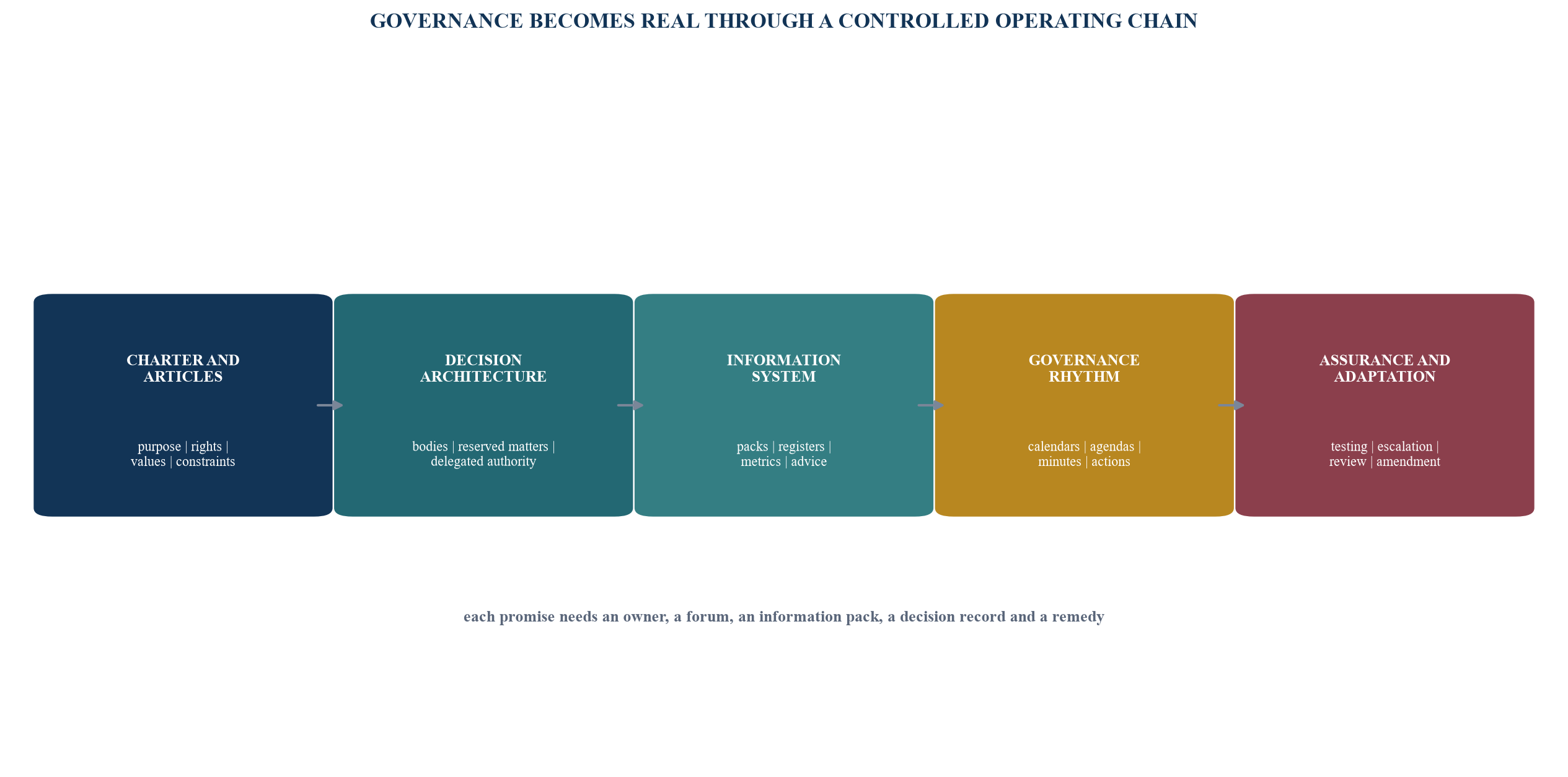
Written intent becomes operational only when authority, information, cadence, evidence and escalation are connected.
2. Establish the legal and document hierarchy
The implementation file should start with a dated legal-and-document matrix. Federal Decree-Law No. 37 of 2022 states that the family charter can address family ownership, goals, values, valuation, profit distribution, education and qualification for work, disputes and other provisions. The same law provides that the articles of association prevail if they conflict with the charter. It also applies alongside the Commercial Companies Law, relevant local legislation and free-zone rules, subject to the boundaries stated in the law.
This hierarchy matters operationally. A family council cannot use a procedure in its handbook to override a voting threshold in the articles. A board policy cannot grant management authority that the articles reserve to shareholders. A family-employment policy should align with employment law, company authority and the charter. Financing documents can also constrain dividends, asset sales, acquisitions, guarantees and changes of control.
The matrix should list the operative document, legal entity, jurisdiction, approving body, effective date, amendment route, custodian and matters governed. It should flag translations, unsigned drafts, inconsistent definitions and provisions whose enforceability requires advice. Counsel should confirm the relationship among the charter, articles, shareholder arrangements and estate-planning structures before the family builds procedures around them.
Management should maintain a controlled version register. Every governance pack should reference the current approved document, and superseded versions should remain archived. A scheduled annual review and event-driven review should cover changes in ownership, marriage or death, restructurings, new jurisdictions, financing, acquisitions, disposals and legal developments.
Table 1. Legal, constitutional and operating document matrix
| Document or source | Primary function | Operating translation | Approval and evidence |
|---|---|---|---|
| applicable law and registration decisions | define eligibility, rights, constraints and process | legal scoping memo and compliance calendar | current official source, counsel conclusion and review date |
| articles of association | establish company powers, ownership and formal authority | reserved matters, voting thresholds and delegations | authenticated version and amendment record |
| family charter | express family ownership rules, values and governance | council mandate, family policies and dispute pathway | approved charter, deposit evidence where applicable and version control |
| board and committee charters | organise oversight and decision process | annual calendar, agendas, packs, minutes and actions | board approval and effectiveness review |
| shareholder, financing and estate documents | govern specific rights, obligations and continuity | consent matrix, covenant calendar and event protocol | executed documents and adviser interpretation |
| operating policies | direct recurring behaviour | employment, conflicts, related parties, information and liquidity processes | named owner, training, testing and periodic approval |
Qualified advisers should confirm priority, enforceability and amendment requirements for the specific entity and jurisdiction.
3. Separate the four governance rooms
Family enterprises often combine several roles in one person. A founder may be a parent, shareholder, chair and chief executive. A sibling may be an owner, employee and trustee of a family structure. Those roles can be legitimate, but each decision should be made in the correct capacity and forum.
The family room addresses identity, values, education, communication, cohesion and the relationship between the family and the enterprise. The ownership room addresses capital, dividends, liquidity, transfer, risk appetite and long-term owner strategy. The board room governs the company, oversees management, sets strategy, monitors risk and performance and exercises powers under the law and articles. The management room executes the approved strategy and runs operations within delegated authority.
The governance design should specify membership, chair, mandate, matters excluded, decision standard, information rights, meeting cadence and secretariat for each room. It should also define how a matter moves between rooms. For example, the family council may develop a family-employment policy; the board should consider the company's operating and legal requirements; management applies the approved employment process; and the owners receive agreed reporting on outcomes.
Minutes should identify the capacity in which each participant acted. Combined meetings may be efficient for information sharing, but formal decisions should still be recorded under the correct body. This discipline protects authority, makes challenge visible and reduces the risk that family consensus is mistaken for a valid company approval.
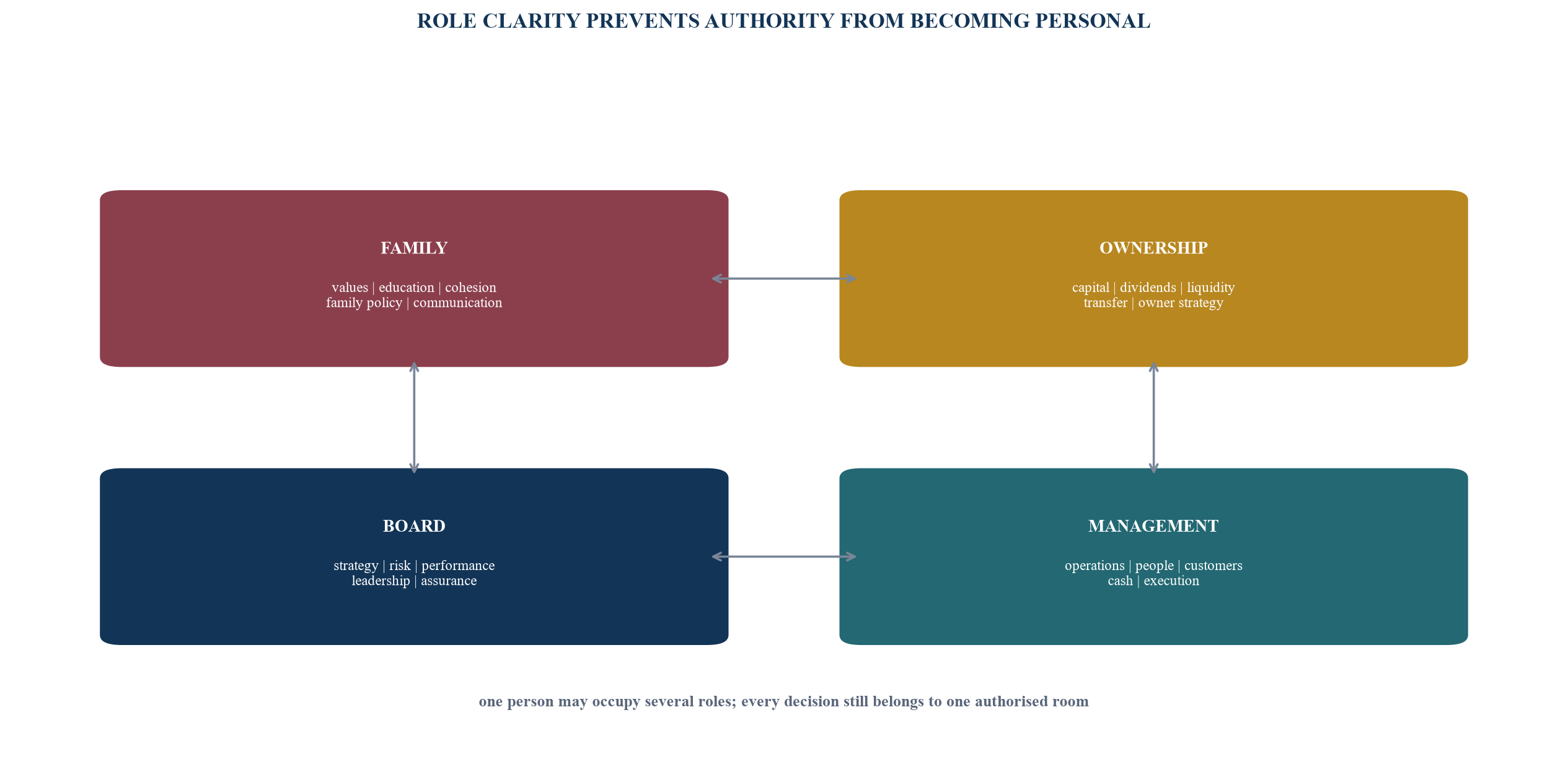
Clear boundaries preserve the distinct responsibilities of family, owners, board and management while enabling controlled information flow.
4. Convert the charter into a decision-rights map
The decision-rights map is the central implementation document. It should identify decisions reserved to shareholders, matters assigned to the family council, powers held by the board and authority delegated to management. Each decision should include an approval threshold, consultation requirement, information standard, time limit and escalation route.
Reserved matters commonly cover changes to capital, share classes, transfers outside the family, material acquisitions and disposals, borrowing above an approved threshold, guarantees, dividends, related-party transactions, appointment or removal of directors and amendments to constitutional documents. The final list must come from the governing documents and current advice. Operational limits should reflect company scale, financing covenants and risk appetite.
Delegations should be expressed in a matrix that staff can use. A financial threshold alone is insufficient. Authority may vary by transaction type, budget status, counterparty, related-party status, risk, geography and strategic significance. Emergency authority should have a defined duration and retrospective review.
The map also needs a consultation layer. The board may hold formal power over strategy, while an owner council provides a documented long-term owner mandate. Management may select executives, while a family-employment committee confirms that family candidates passed the agreed eligibility process. Consultation should inform authorised decisions without creating an undeclared veto.
Table 2. Illustrative decision-rights architecture
| Decision domain | Family or owner role | Board role | Management role |
|---|---|---|---|
| owner purpose and values | approve owner mandate and family principles | reflect approved purpose in strategy | translate purpose into culture and operating priorities |
| strategy and annual plan | communicate risk, liquidity and horizon preferences | challenge and approve strategy and budget | develop options and execute the approved plan |
| capital structure and dividends | approve matters reserved by the articles | recommend and test resilience | model cash, covenants and funding choices |
| leadership and succession | define family eligibility and development policy | appoint, evaluate and replace the chief executive | build executive bench and succession evidence |
| major transactions | exercise reserved approvals where required | evaluate value, risk and execution readiness | originate, diligence and implement within authority |
| conflicts and related parties | disclose family interests and follow protocol | approve or oversee under independent process | maintain register and submit complete evidence |
Thresholds and approvals are illustrative management assumptions and require alignment with the law, articles, charter and financing documents.
5. Design the family council as a working institution
Federal Decree-Law No. 37 of 2022 recognises councils and committees that can organise family affairs connected with the family business. A family council can become the primary institution for education, communication, family policy and structured dialogue. Its mandate should avoid running the company or displacing the board.
The council design should specify constituencies, eligibility, terms, rotation, chair selection, voting, quorum, observers, confidentiality, conflicts, committees and secretariat. Representation may account for branches and generations, while maintaining a workable size and capability. Members need induction on the charter, company structure, financial literacy, fiduciary boundaries and meeting conduct.
An annual calendar can include owner education, next-generation development, family employment, philanthropy, communication, charter review and succession preparation. The council should receive a defined information pack that protects company confidentiality and respects director duties. Its minutes should record decisions, recommendations, questions, declared conflicts and actions.
Effectiveness can be measured through meeting completion, attendance, decision closure, policy review, development milestones and unresolved issues. Satisfaction scores can supplement this evidence but should not replace it. The council should conduct an annual self-review and commission periodic independent facilitation when relationships or complexity warrant it.
6. Build an owner-strategy process
A family charter often contains values and aspirations; the owner-strategy process converts them into capital decisions. Owners should agree the purpose of ownership, time horizon, risk tolerance, reinvestment expectations, dividend philosophy, liquidity approach, control preferences, diversification boundary and conditions for external capital or sale.
The process can begin with confidential owner interviews and a fact pack covering company performance, capital needs, debt capacity, concentration, family demographics and foreseeable liquidity requirements. Facilitated workshops should then identify areas of alignment, explicit choices and unresolved tensions. The result should be a concise owner mandate approved through the correct forum.
The board uses this mandate as an input to strategy. It should not receive a list of operational instructions from individual owners. The mandate can state, for example, that the family prefers durable control, accepts a specified leverage range, expects a resilient dividend and supports selective diversification when return and governance gates are met. The board then develops and approves a commercial strategy within its authority.
The owner mandate should be reviewed on a scheduled cycle and after material events. It should include a process for dissent and reconsideration. A recorded minority view can be important when unanimity is unavailable, provided the valid approval process is followed.
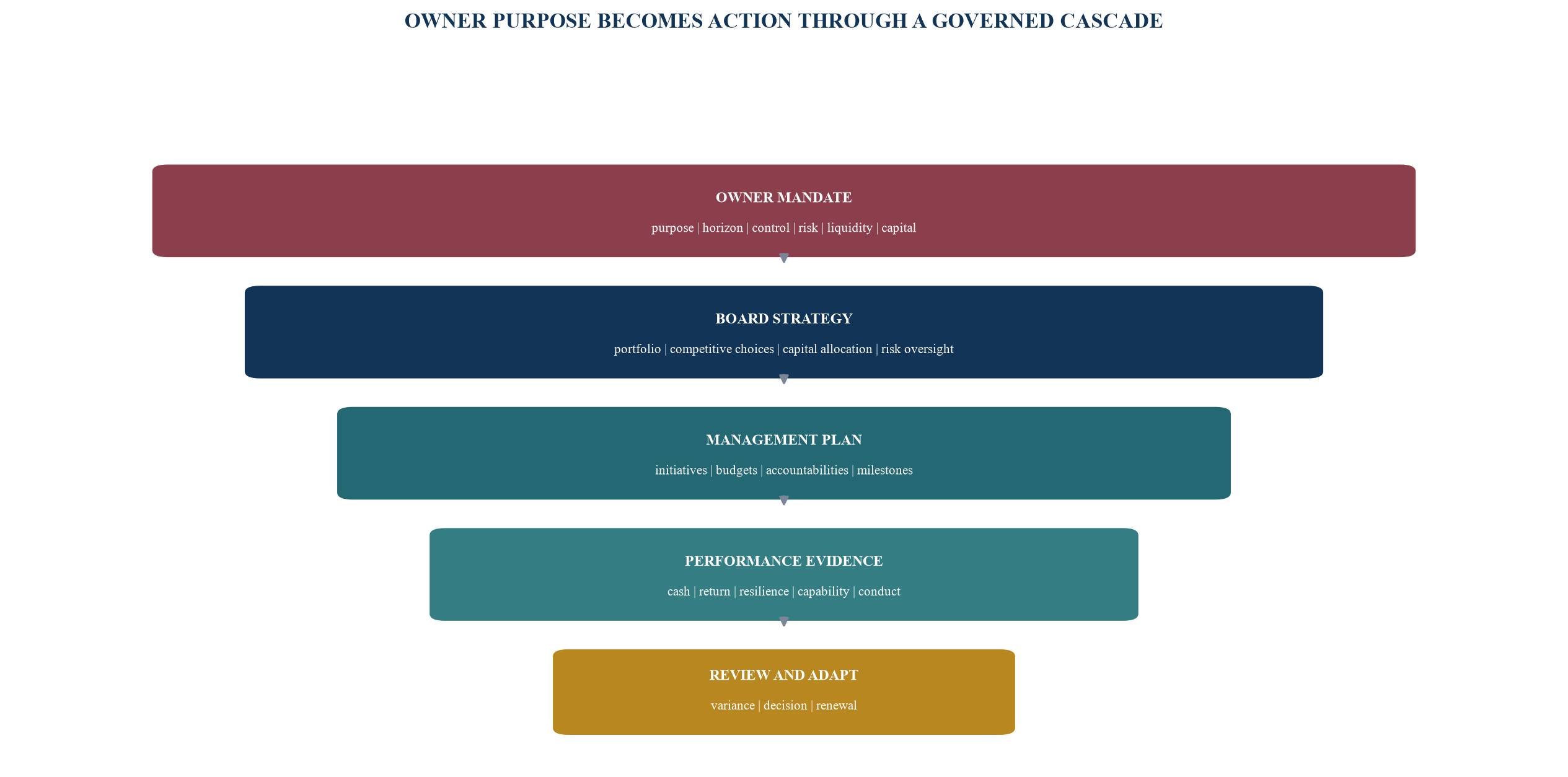
Owner intent guides the board; the board governs strategy; management delivers measurable execution.
7. Establish board composition, mandate and challenge
The board should be designed for the company's strategy, risk and complexity. The UAE family-business law permits an appropriate company structure to provide for a board and to define its composition, powers, term, committees and decision process in the articles. The law also addresses director competence, care, fairness and independence of judgment.
A skills matrix should assess strategy, sector, finance, risk, technology, people, transactions, international markets and family-enterprise experience. Family directors can bring owner context and long-term commitment. Independent directors can add specialist capability and objective challenge. Independence should be assessed through relationships, tenure, economic interests and ability to exercise judgment, rather than through title alone.
The chair should shape agendas, information quality, participation, constructive challenge and follow-through. Chair and chief-executive responsibilities should be documented. Committees should exist only where workload, risk and capability justify them. Audit and risk, nomination and remuneration, and investment or transactions committees may be relevant, with charters and reporting lines approved by the board.
An annual evaluation should test board composition, agenda balance, information, challenge, decision quality, committee performance and relationship with owners and management. Actions should enter the governance roadmap. Director induction and continuing education should address the business, governance documents, duties, conflicts, financing and emerging risks.
Table 3. Governance bodies, mandates and evidence
| Body | Core mandate | Recurring evidence | Boundary to protect |
|---|---|---|---|
| family assembly | inform and engage the broader family | annual agenda, education record and communication | does not direct company operations |
| family council | family policy, development, cohesion and recommendations | calendar, minutes, policies and action register | does not exercise board powers |
| owner forum or general assembly | exercise shareholder rights and approve reserved matters | resolutions, voting record and owner mandate | respects company law and articles |
| board of directors | govern strategy, leadership, risk, performance and capital | board packs, minutes, decisions and evaluations | maintains authority and independent judgment |
| board committees | prepare focused oversight and recommendations | committee packs, reports and escalation | operates within delegated committee charter |
| executive management | run operations and execute approved strategy | operating reviews, forecasts and control evidence | remains within delegated authority |
Final bodies and powers depend on the company's legal form, governing documents and scale.
8. Build the governance information architecture
Governance quality depends on information that is timely, relevant, accurate and understood. Each body should have a standard pack aligned with its decisions. The family council may need ownership education, family policy and development information. Owners may need capital, dividends, liquidity and concentration. The board needs strategy, financial performance, cash, risk, people, controls and major decisions. Management needs operating detail.
The information-rights schedule should identify each report, owner, source, frequency, cut-off, reviewer, recipients and confidentiality classification. It should also define access for family members who are owners, directors, employees or none of these. Sensitive personal, customer, employee and transaction information requires lawful handling and controlled circulation.
Every major decision paper should state the decision requested, authority, options, financial impact, risk, stakeholder effect, conflicts, advice, implementation plan and proposed resolution. Figures should reconcile to approved source systems. Late papers, unresolved data differences and material assumptions should be visible.
The company secretary or governance lead should maintain board and council portals, version control, attendance, declarations, minutes and action logs. Records should be searchable and retained according to law and policy. Access should be removed promptly when roles change.
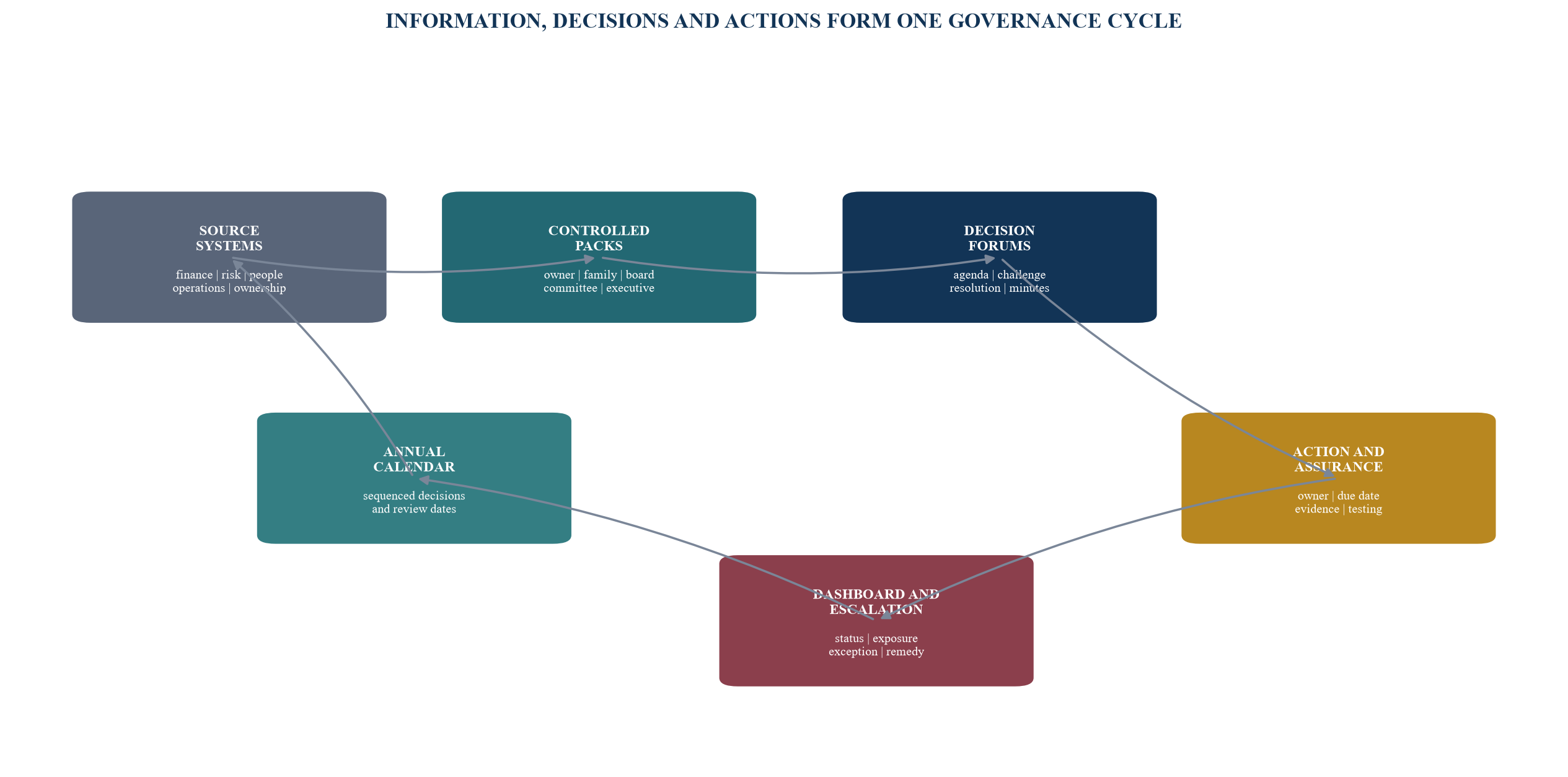
Distinct packs flow to each body through a controlled annual calendar and action cycle.
9. Govern family employment and executive careers
Family employment is a recurring test of whether the charter operates fairly. The policy should define entry qualifications, relevant external experience, recruitment, reporting lines, remuneration, performance evaluation, promotion, development, conflicts, discipline and exit. The policy should apply consistently while recognising legal requirements and the company's talent needs.
Roles should exist because the business needs them. A family candidate should follow a documented recruitment process and report to a manager with authority to set objectives and evaluate performance. Pay should reflect role, market, capability and performance. Ownership distributions and employment compensation should remain conceptually and administratively separate.
The family council can oversee education and readiness policy; management should run recruitment and performance; the board should govern executive appointments and succession within its authority. A committee may audit compliance with family qualification criteria, as contemplated by the UAE law, while avoiding interference in daily supervision.
Development plans should give family members several legitimate paths: operating leadership, board service, informed ownership, entrepreneurship, philanthropy or careers outside the enterprise. Each path needs capability standards and evidence. The family should also define how underperformance, misconduct, redundancy and voluntary exit are handled with dignity and procedural fairness.
10. Build succession as a portfolio of readiness gates
Succession includes ownership, board leadership, executive leadership, family governance and critical operating roles. A single named heir does not address this portfolio. The company should identify each critical role, emergency cover, medium-term candidates, readiness gaps, decision authority and development evidence.
Chief-executive succession should begin with a role mandate based on the future strategy. Candidate assessment can cover leadership, commercial judgment, capital allocation, people, governance, sector knowledge and values. Family and non-family candidates should be evaluated against the approved mandate. The board should make the appointment under its authority and document the decision process.
Emergency continuity requires current signatories, delegated powers, banking access, customer and lender contacts, technology access, communication protocols and interim leadership. A rehearsal can expose missing authority or key-person dependencies. The plan should be updated after role, ownership, financing and system changes.
Ownership succession needs a different process. It should coordinate estate planning, share rights, transfer restrictions, valuation, liquidity, governance education and document alignment. Qualified legal, tax and Sharia advisers should confirm the design. The family council can prepare next-generation owners through financial literacy, observer roles and staged responsibilities.
Table 4. Succession and emergency-continuity gates
| Succession domain | Readiness evidence | Decision body | Trigger for action |
|---|---|---|---|
| emergency chief executive | named interim, powers, signatories, contact plan and rehearsal | board | incapacity, sudden departure or defined crisis |
| permanent chief executive | future role mandate, assessed slate, references and transition plan | board | scheduled review or vacancy forecast |
| chair and directors | skills matrix, candidate pipeline, independence review and induction | owners and board as authorised | term expiry, skills gap or strategic change |
| family council leadership | elected or selected candidates, facilitation capability and handover | family council or family assembly | term rotation or leadership vacancy |
| ownership transition | estate structure, transfer process, valuation and owner education | owners and relevant legal bodies | death, gift, sale, restructuring or agreed milestone |
| critical executives | role map, successor coverage, retention and development plan | chief executive with board oversight | vacancy risk or capability gap |
Time horizons are illustrative; each family should approve role-specific gates and advice requirements.
11. Operationalise transfer, valuation and owner liquidity
The UAE family-business law contains provisions concerning share disposal, redemption, company purchase of shares and share categories. The articles and charter may contain additional mechanisms, and implementing decisions may apply. A working process is needed before an owner asks to sell or an estate event occurs.
The process should state who may initiate a transfer, notice requirements, permitted transferees, right-of-first-offer or redemption steps, valuation date, valuation standard, expert appointment, funding source, payment terms, approvals, dispute route and record updates. Counsel should confirm every step against current documents and law.
The valuation policy should define purpose, basis, frequency, information, adjustments, expert qualifications and challenge process. One value may not suit every purpose. A recurring indicative valuation for owner education can differ from a binding transaction valuation. Discounts, control, liquidity, tax and debt require case-specific treatment.
Liquidity planning should connect foreseeable owner needs with company cash, dividends, insurance, financing, secondary transfers and family investment structures. The company should avoid promising liquidity that would breach law, solvency, covenants or operating needs. An annual owner-liquidity forecast can identify concentration and timing risk early.
12. Create a conflict and dispute protocol before it is needed
Conflict is a normal governance condition; unmanaged conflict can impair decisions, relationships and business continuity. The UAE family-business law permits governance arrangements and dispute mechanisms, including a reconciliation body described in the articles or charter and routes to the relevant committee, arbitration or financial-free-zone courts under the conditions stated in the law.
The operating protocol should define issues that can be handled through direct discussion, facilitated family dialogue, mediation, a family dispute body, board conflict procedures, expert determination, arbitration or court. It should distinguish family relationship disputes from company, employment, ownership and fiduciary matters. Counsel should confirm jurisdiction and enforceability.
Every stage needs a notice, time limit, confidentiality rule, conflict declaration, evidence standard and interim authority. Urgent matters may need steps that preserve cash, assets, customer relationships, data, reputation and decision continuity while the dispute is considered.
The family should train members and governance leaders in interest-based negotiation, meeting conduct and recusal. A protected speak-up channel should cover misconduct and control concerns. The protocol should prohibit retaliation and state how independent investigation is commissioned.
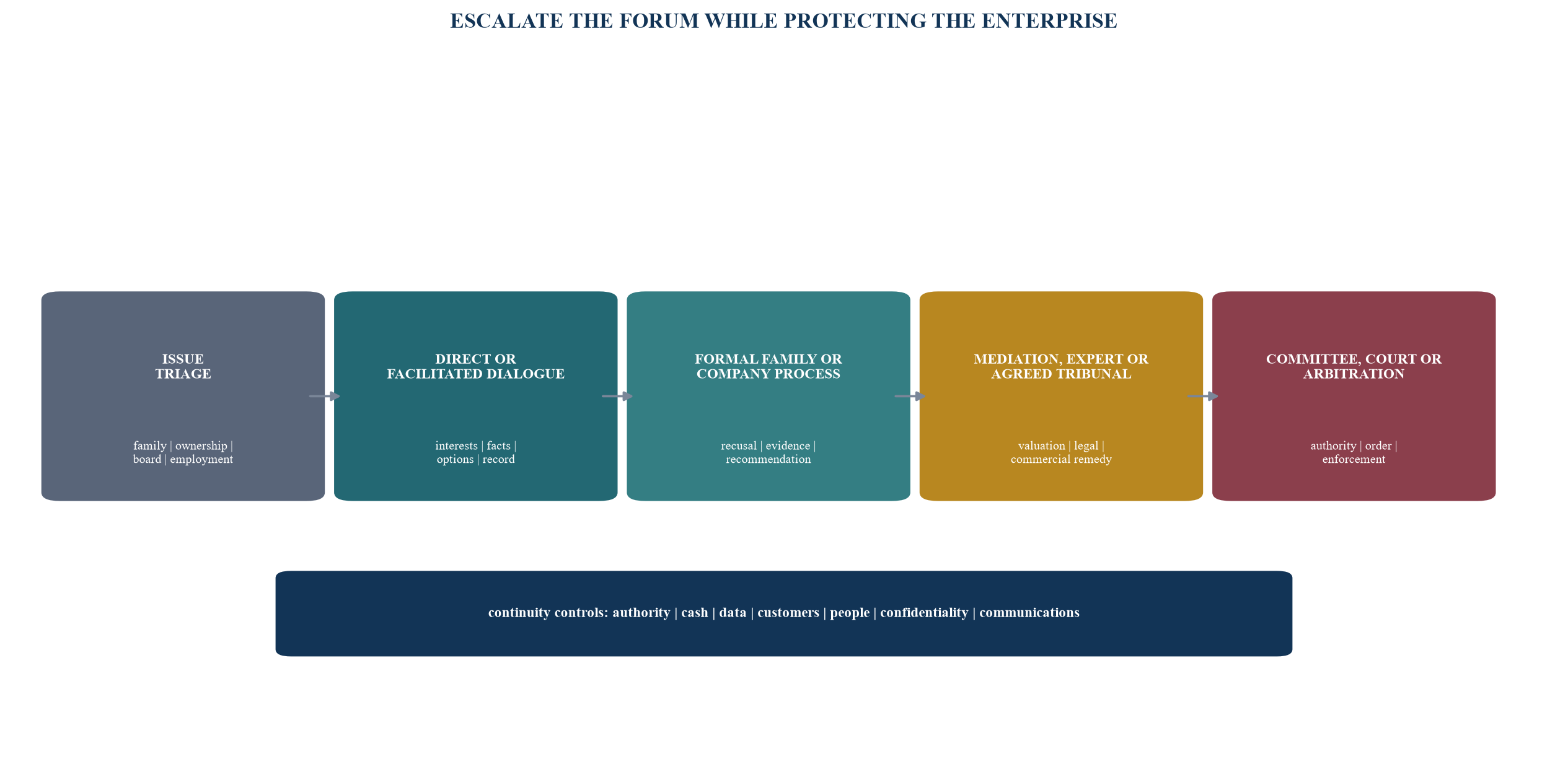
The pathway matches the issue to an appropriate forum while preserving company continuity and legal rights.
13. Govern related parties, conflicts and family assets
Family enterprises frequently transact with owners, directors, relatives, affiliated businesses and family investment vehicles. The governance system should maintain a relationship register, conflict declarations, approval rules, pricing evidence, agreements, settlement terms and reporting. Tax, accounting, company-law and financing requirements should be incorporated through qualified advice.
The UAE law expects directors to exercise care, treat partners fairly, maintain independent judgment and put the family business's interests first. The board should therefore use an independent process when a director, owner or family member has an interest. Recusal, independent advice, benchmarking and formal minutes can support the decision record.
Family assets and company assets should be mapped and administered separately. Property, aircraft, vehicles, staff, guarantees, intellectual property, expenses and shared services need documented ownership, business purpose, access, pricing and approval. The family office should not become an unrecorded extension of company treasury.
A quarterly certification can capture new relationships, transactions, balances and changes. Internal audit or an independent reviewer should test a risk-based sample from initiation through approval, accounting, settlement and disclosure. Exceptions should be quantified and remediated.
14. Link governance to capital allocation and transactions
Governance becomes economically visible when the family enterprise allocates capital. The owner mandate sets the horizon and boundary; the board compares opportunities; management develops cases and executes. The capital-allocation process should cover reinvestment, dividends, debt reduction, acquisitions, disposals, new ventures and family liquidity.
Each material proposal should include strategic fit, return, cash profile, funding, downside, execution capacity, conflicts, tax and legal advice, stakeholder impact and exit conditions. Transaction thresholds should appear in the decision-rights map. Related-party proposals require an independent process.
A family may disagree because one branch prioritises dividends while another prioritises growth. The owner-strategy process should surface that tension before a transaction is presented. Scenario modelling can show the effect of each option on control, leverage, liquidity, distributions and concentration.
Post-investment reviews should compare the approved case with actual performance. Acquisition synergies, capital expenditure benefits and new-venture milestones should have named owners and measurement dates. The board should decide whether to continue, remediate, resize or exit using current evidence.
Table 5. Annual governance calendar and information packs
| Cycle point | Family and owner agenda | Board and management agenda | Required pack |
|---|---|---|---|
| first quarter | owner purpose, education and liquidity outlook | prior-year performance, risk and executive objectives | ownership map, audited results, risk report and development plan |
| second quarter | family policy and next-generation review | strategy options and capital capacity | strategic scenarios, cash, debt, talent and market evidence |
| third quarter | succession and charter effectiveness | budget assumptions, major investments and succession slate | succession scorecard, budget ranges and investment cases |
| fourth quarter | owner mandate, dividend and calendar approval | strategy, budget, remuneration and board calendar | approved mandate, plan, liquidity analysis and committee reports |
| every meeting | conflicts, actions and emerging issues | performance, cash, risk, people and decisions | standard dashboard, decision papers and action register |
| event driven | transfer, dispute, death, incapacity or family change | transaction, covenant, crisis or leadership event | applicable protocol, advice, authority and continuity plan |
Timing is illustrative and should follow the company's financial year, strategy cycle and legal obligations.
15. Sequence a 180-day implementation programme
The first thirty days should establish legal scope, document hierarchy, ownership map, role map, active forums, current decisions, information flows and critical risks. Interviews reveal expectations; signed documents, minutes, registers, system access and decision records show operation. The diagnostic should end with a prioritised gap register and approved design principles.
Days 31 to 60 should design the four-room model, reserved matters, delegations, council and board charters, policies, information rights, annual calendar and secretariat. Counsel reviews legal alignment. Owners, directors and management test whether the design handles real decisions.
Days 61 to 90 should complete approvals, appointments, declarations, induction and controlled document publication. Days 91 to 120 should run the first meeting cycle using real packs, decision papers, minutes and actions. Days 121 to 150 should rehearse a transfer, emergency succession, conflict and major investment. Days 151 to 180 should remediate findings, complete assurance, approve the dashboard and hand over recurring ownership.
Each phase needs acceptance evidence. A signed policy is not complete until owners understand it, staff can follow it, the required data exists and a real or simulated case passes. The programme should preserve a decision log and explicitly close each gap.
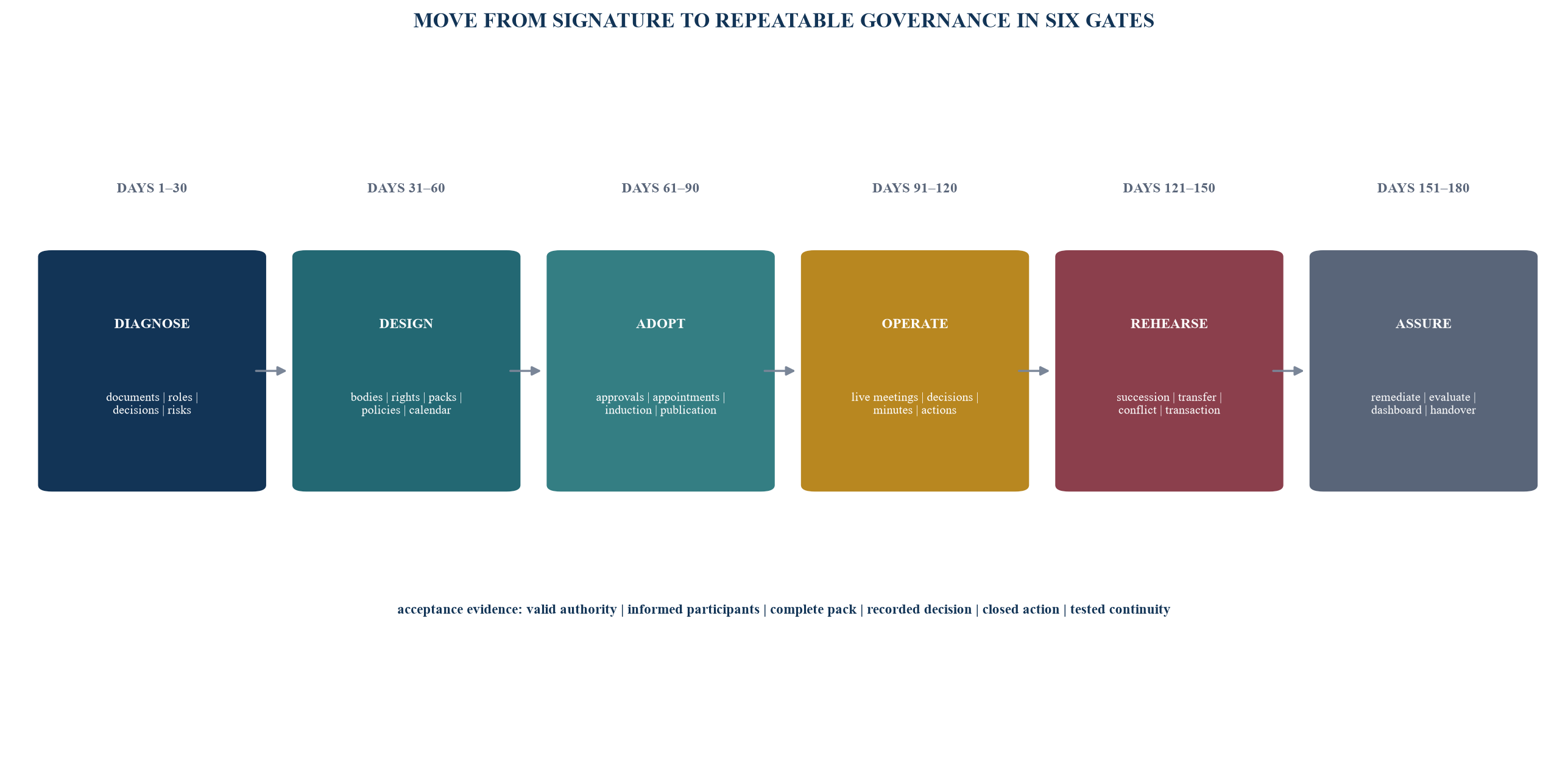
Formal adoption is followed by live operation, rehearsal, remediation and handover.
16. Measure operation through a board-ready scorecard
The governance scorecard should measure whether the system operates. Structural measures include approved charters, filled roles, current declarations and published calendars. Process measures include pack timeliness, attendance, quorum, decision closure, policy compliance and completed evaluations. Outcome measures include leadership coverage, dispute aging, owner-liquidity readiness, control findings and transaction follow-through.
Metrics need definitions, sources, owners and thresholds. A green meeting-completion measure should mean that the authorised body met with quorum, received the required pack, recorded decisions and closed or escalated actions. Attendance alone is insufficient. A green succession measure should require assessed candidates and tested emergency cover.
The dashboard should show material exceptions by value, time and consequence. A single unresolved ownership-transfer issue may deserve more attention than several late routine actions. Each red item should state the decision required, interim protection, owner and due date.
The board, owner forum and family council should receive the subset relevant to their authority. The governance lead should reconcile the underlying registers and certify completeness. Periodic independent review can test whether recorded practices match actual behaviour.
Table 6. Governance operating scorecard and acceptance gates
| Dimension | Measure | Evidence-based acceptance gate | Escalation trigger |
|---|---|---|---|
| authority | current decision-rights map and valid appointments | every sampled decision traces to valid authority | invalid, unclear or competing approval route |
| information | packs delivered, reconciled and decision-ready | complete pack within approved lead time | missing material data or unresolved difference |
| meetings | quorum, challenge, minutes and action closure | all scheduled forums operate through the full cycle | cancelled meeting or overdue material action |
| succession | emergency cover and assessed successor pipeline | critical roles have tested continuity and development | uncovered role or untested signatory access |
| ownership | current register, transfer process and liquidity forecast | records reconcile and a scenario rehearsal passes | ownership mismatch or unfunded foreseeable event |
| conduct and conflicts | declarations, recusals, cases and remediation | complete register and independently reviewed material cases | undisclosed interest, retaliation or overdue dispute |
Targets are illustrative management assumptions and should be approved for the family's scale, documents and risk.
17. Test the system with scenarios
Scenario rehearsal exposes gaps that documents conceal. The family should select realistic events: sudden chief-executive incapacity, an owner seeking liquidity, a disputed family appointment, a major acquisition, a dividend conflict, a cyber incident or a covenant pressure. The exercise should use current authority, packs, contacts and systems.
Participants should receive only the information that would be available in the event. Observers record who convened the forum, whether quorum existed, how conflicts were declared, whether the decision paper was sufficient, who communicated, what records were created and whether actions closed. Legal and specialist observers should review issues within their remit.
The transfer rehearsal can test notice, valuation-expert appointment, information delivery, approval, funding, payment and register updates. The emergency succession rehearsal can test signatory authority, banking, technology, customer and lender communication. The transaction rehearsal can test owner mandate, board authority, conflicts, capital capacity and integration accountability.
Findings should distinguish document, capability, information, authority, behaviour and system gaps. Each gap needs a remedy, owner, date and retest. The board should receive the material findings; the family council and owners should receive those within their mandates.
18. Convert implementation into a retained governance mandate
A defined implementation mandate can move the enterprise from diagnostic to operating rhythm. The initial phase maps documents, ownership, decisions, forums and gaps. Design converts the charter into the four-room model, decision rights, policies, packs and calendar. Adoption secures valid approvals and induction. Live operation, rehearsal and assurance prove the system.
Client leadership remains responsible for facts, decisions, authority and compliance. An adviser can coordinate the programme, facilitate owner strategy, design operating procedures, build packs and scorecards, manage the action register, coordinate legal and tax specialists and provide an independent implementation challenge. Qualified advisers should give or confirm legal, tax, Sharia, regulatory and estate-planning conclusions.
A retained cadence can support the governance office through calendar management, decision-paper quality, action tracking, quarterly effectiveness reviews, succession and liquidity updates and annual charter-operation assessment. The mandate should define deliverables, responsibility, confidentiality, conflicts, access, acceptance and exit.
Commercial outcomes should be evidenced. Governance may improve decision clarity, continuity and diligence readiness when the system operates consistently. Any effect on financing terms, transaction speed, valuation, family cohesion or commercial performance requires actual evidence. Signed mandates and collected fees are the appropriate evidence of consulting demand.
Implementation conclusion
The family charter becomes operational when written intent is connected to authorised institutions and repeatable evidence. The family, owners, board and management need distinct mandates; major decisions need a rights map; every forum needs a calendar, pack, minutes and action register; succession, liquidity, transfer and conflict need tested protocols.
A 180-day programme can establish that system through diagnostic, design, adoption, live operation, rehearsal and assurance. The enduring result is a governance cycle that can absorb new generations, changing strategy and difficult decisions while preserving lawful authority, accountability and continuity.
References
- UAE Legislation. Federal Decree-Law No. 37 of 2022 Concerning Family Businesses. https://uaelegislation.gov.ae/en/legislations/1608
- UAE Ministry of Economy and Tourism. Family Business registration and governance information. https://www.moet.gov.ae/en/web/guest/family-business
- UAE Ministry of Economy and Tourism. Ministry starts accepting applications for registration of family businesses in the unified registry, 22 May 2024. https://www.moet.gov.ae/en/-/ministry-of-economy-starts-accepting-applications-for-registration-of-family-businesses-in-the-unified-registry
- UAE Ministry of Economy and Tourism. Ministry launches Unified Family Businesses Registry and reviews four new decisions, 26 December 2023. https://www.moet.gov.ae/en/-/ministry-of-economy-launches-unified-family-businesses-registry-and-reviews-four-new-decisions-to-strengthen-the-sector-s-governance
- Dubai Chambers. Dubai Centre for Family Businesses launches new corporate governance toolkit, 3 April 2024. https://www.dubaichambers.com/en/w/dubai-centre-for-family-businesses-launches-new-corporate-governance-toolkit-1
- International Finance Corporation. IFC Family Business Governance Handbook. https://www.ifc.org/en/insights-reports/2011/ifc-family-business-governance-handbook
- International Finance Corporation. Corporate Governance Methodology Tools for Family or Founder-Owned Businesses. https://www.ifc.org/en/what-we-do/sector-expertise/corporate-governance/cg-methodology-tools
- International Finance Corporation. Frequently Asked Questions on Corporate Governance in the Middle East and North Africa. https://www.ifc.org/en/insights-reports/2016/corporate-governance-faqs
- G20 and OECD. G20/OECD Principles of Corporate Governance 2023. https://www.oecd.org/corporate/principles-corporate-governance/
- Financial Reporting Council. The Wates Corporate Governance Principles for Large Private Companies. https://www.frc.org.uk/library/standards-codes-policy/corporate-governance/the-wates-corporate-governance-principles-for-large-private-companies/
- Dubai International Financial Centre. DIFC Family Wealth Centre. https://www.difc.com/ecosystem/difc-family-wealth-centre
About the Author
Chennakeshav Adya is an Independent Researcher and Managing Partner at Matchpoint Partners. His work focuses on corporate finance, capital strategy, transaction execution and the operating systems that connect owner intent, board decisions and measurable enterprise performance.
