

1. Volatility tests authority before it tests allocation
A portfolio can be well constructed and still be governed poorly under stress. Normal committee meetings permit a full agenda, scheduled valuations, complete papers and unhurried consultation. A market discontinuity compresses the same decisions into hours or days. Listed assets reprice immediately. Private assets update slowly. lenders change collateral treatment. Capital calls remain due. A family operating business can require liquidity at the same time that the investment portfolio appears weakest.
The committee therefore needs an operating model for decision pressure. It should identify the decisions that remain reserved to the family council, foundation council, board or other governing body; the decisions delegated to the investment committee; the actions management can execute inside pre-approved limits; and the narrow powers that can activate during a defined stress event.
The CFA Institute's institutional investment-policy material states that an investment policy statement should specify responsibility for determining policy, executing it and monitoring implementation, and should define how the policy is reviewed as circumstances change.[1] A family can adapt this governance discipline while preserving its own legal structure, objects and decision culture.
Stress authority should remain entity-specific. A committee recommendation for a family holding company does not itself authorise an action by a foundation, trust, special-purpose vehicle or personally held account. The relevant instrument, governing document, mandate and professional advice determine who can approve and execute.
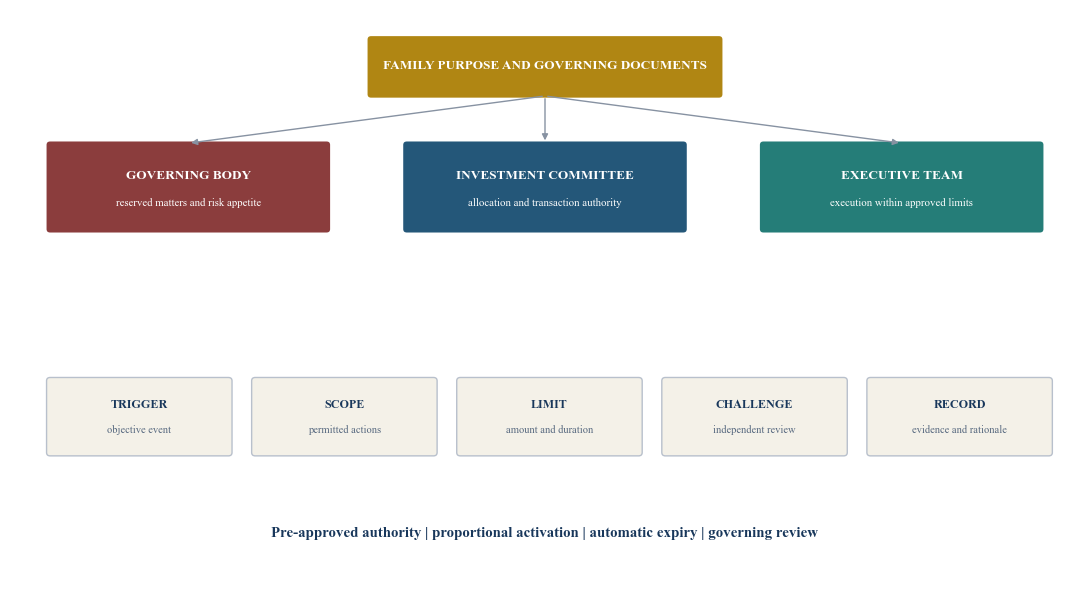
Author framework. Each action remains subject to the correct entity authority and governing documents.
2. Write the authority map before stress begins
The authority map begins with governing documents, board resolutions, committee terms of reference, bank mandates, investment-management agreements, custody instructions and signatory records. It should connect each decision to the legal entity that owns the asset or obligation. The map then separates policy, approval, execution, monitoring and escalation.
Reserved matters commonly include changing the strategic asset allocation, borrowing above a limit, pledging core assets, selling a family-controlled business, entering a new high-risk jurisdiction, using derivatives outside an approved purpose, changing a distribution policy or amending the committee mandate. The actual list is family-specific and requires current legal review.
Delegated decisions can include rebalancing within bands, approving managers or direct investments within an annual programme, drawing an authorised facility, funding approved commitments and executing hedges within documented limits. Management actions can include transferring cash between approved accounts, placing orders, calling advisers, collecting valuations and convening an extraordinary meeting.
Emergency authority should be narrow. It identifies an objective trigger, eligible decision-makers, maximum amount, permitted instruments, excluded actions, required evidence, second-person control, reporting deadline and expiry. Every action receives ratification or review by the normal authority within a defined period.
Table 1. Illustrative reserved and delegated decision matrix
| Decision | Normal authority | Permitted delegation | Stress condition | Evidence and record |
|---|---|---|---|---|
| Change strategic allocation | governing body | implementation only | extraordinary meeting can be called | revised objectives, liquidity, risk and resolution |
| Rebalance within approved bands | investment committee | CIO within transaction limit | wider temporary execution band if pre-approved | exposure report, trade rationale and post-trade check |
| Raise short-term liquidity | governing body or investment committee according to entity | treasury within approved facility | draw inside documented amount, tenor and covenant limits | cash forecast, facility terms, approvals and use of proceeds |
| Sell a concentrated holding | authority defined by ownership and mandate | staged execution within price and volume guardrails | accelerated sale only within approved stress limit | conflict check, liquidity need, valuation range and execution report |
| Meet capital calls | investment committee for approved commitments | treasury execution | priority waterfall activates when cash buffer breaches trigger | notice validation, entity cash, FX and payment evidence |
| Approve follow-on capital | investment committee within mandate | none unless explicitly delegated | enhanced downside and dilution test | current company data, rights, alternatives and decision rationale |
| Enter or change hedge | investment committee | CIO within instrument, counterparty and notional limits | rapid adjustment when exposure trigger is crossed | exposure source, hedge objective, basis risk and unwind plan |
| Accept private valuation | valuation authority defined in policy | valuation team prepares | range and uncertainty disclosure required | method, inputs, source date, sensitivity and independent challenge |
| Resolve member conflict | unconflicted chair or governing body | compliance process | conflicted member excluded from materials, discussion and vote | declaration, recusal, quorum and decision record |
| Communicate with beneficiaries | governing body or authorised spokesperson | prepared factual update | accelerated cadence under communication protocol | approved facts, audience, confidentiality and release log |
Every family should reconcile the matrix to its actual governing documents, entities, mandates and professional advice.
3. Define a risk appetite that works in stressed conditions
A risk appetite is useful when it changes decisions. The Financial Stability Board's principles describe risk appetite as the aggregate level and types of risk a firm is willing to assume within its capacity to achieve its objectives. The principles connect risk appetite to strategic, capital and financial plans, quantitative limits, qualitative statements and stressed conditions.[2] Their supervisory focus is financial institutions; a family office can use the underlying governance logic proportionately.
The family should distinguish capacity, appetite, tolerance and limit. Risk capacity is the maximum risk the family can absorb without breaching hard obligations or governing constraints. Appetite is the risk it chooses to take. Tolerance describes acceptable variation around an objective. A limit is an operational boundary that triggers action or escalation.
The statement should cover total loss capacity, liquidity, concentration, leverage, collateral, currency, duration, illiquid commitments, counterparty, operational dependency, private-asset valuation and family distributions. Qualitative limits can restrict unacceptable sectors, instruments, jurisdictions, counterparties, governance arrangements or reputational exposures.
The committee should specify which indicators are warnings and which are hard stops. A warning can increase monitoring and require a plan. A limit breach can suspend new commitments or require escalation. A hard legal, covenant or mandate constraint permits no discretionary override by a committee lacking authority.
4. Build a trigger ladder that changes the process
The trigger ladder converts market and portfolio conditions into governance states. A green state uses the normal meeting cycle. Amber increases monitoring and requests management options. Red activates an extraordinary committee, tighter execution controls and governing-body notification. Black represents an entity, legal, liquidity or operational condition that requires immediate action by the competent authority.
Triggers should combine market, portfolio, liquidity, collateral, operational and information measures. A broad index decline alone does not describe family risk. A modest market move can be material when a borrowing base, currency mismatch, concentrated position or capital-call schedule magnifies the effect.
The Basel Committee's 2018 stress-testing principles address banks and supervisors. They emphasise objectives, governance, policies, processes, methodology, resources, documentation and use of results.[4] A family office can borrow these disciplines for its own scenario programme without suggesting regulatory equivalence.
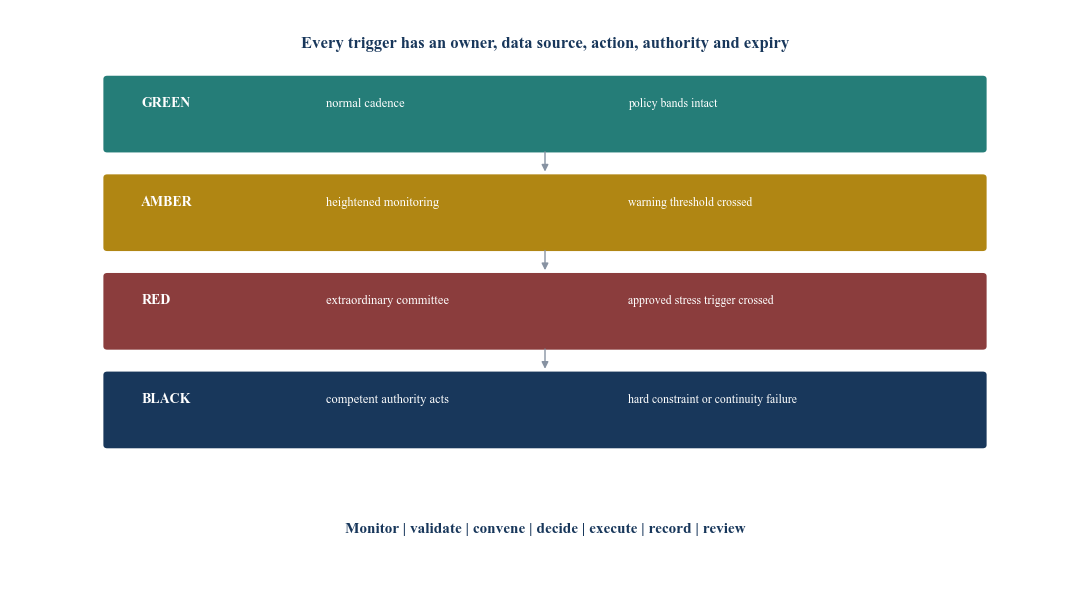
Author framework. Thresholds and actions are illustrative and require family-specific approval.
Table 2. Trigger-to-action design
| Domain | Warning example | Stress example | Immediate action | Escalation owner |
|---|---|---|---|---|
| Liquid assets | buffer approaches policy floor | verified uses exceed available sources inside the planning horizon | freeze discretionary deployments and refresh cash forecast | treasury lead and committee chair |
| Unfunded commitments | calls rise above base case | stressed calls exceed funded reserve and facility headroom | activate capital-call priority waterfall | CIO and governing body where required |
| Concentration | exposure exceeds review band | price or operating shock creates unacceptable family dependency | prepare reduce, hedge, finance and retain options | investment committee |
| Leverage and collateral | headroom narrows | covenant or margin threshold is forecast to breach | validate lender calculation and execute approved cure plan | entity board or authorised committee |
| Currency | net exposure exceeds tolerance | cash obligation and funding currency diverge materially | quantify basis and execute permitted hedge | treasury and investment committee |
| Private valuation | reporting becomes stale | uncertainty range changes a liquidity or covenant decision | commission updated evidence and show range | valuation authority |
| Counterparty | credit quality or service deteriorates | access, settlement or custody is impaired | activate alternate provider and reconcile positions | operations and governing body as applicable |
| Information | key report misses deadline | decision data cannot be reconciled to source | restrict action to protective measures and document limitation | committee chair |
| Governance | member availability falls | quorum, conflict or authority is invalid | use approved alternate path or escalate | secretary and legal adviser |
| Communication | family questions increase | inconsistent external or beneficiary messages emerge | use authorised factual briefing and release log | approved spokesperson |
Values are illustrative. The governing body should approve definitions, sources, frequencies and authorities.
5. Start with an entity-aware liquidity map
Liquidity cannot be inferred from aggregate net worth. Cash held by one entity may be unavailable to another. A listed position can be liquid in market terms and unavailable because it is pledged, restricted, concentrated or tax-sensitive. A credit line can exist and still be constrained by borrowing-base, covenant, draw-condition, counterparty or approval requirements.
The committee should map cash and near-cash by legal owner, currency, location, custodian and access condition. Uses should include family distributions, operating-company needs, tax, debt service, margin, capital calls, property expenditure, payroll, insurance and minimum operational reserves. Sources should distinguish available cash, realisable securities, distributions expected with confidence, committed facilities and contingent sources requiring approval.
The forecast should cover base, downside and severe scenarios over daily, weekly, monthly and quarterly horizons. Assumptions about fund calls, distributions, asset-sale proceeds, haircut, settlement time, foreign exchange and facility availability need an owner and a last-verified date.
Decision priority should be approved in advance. The family can distinguish legally unavoidable payments, value-preserving obligations, strategic commitments, discretionary investments and distributions. Any decision to default, delay, transfer value between entities or change beneficiary payments requires the proper authority and professional advice.
6. Stress the whole family balance sheet
The family balance sheet can combine public portfolios, private funds, direct companies, property, debt, guarantees, derivative exposures, foundations and personal assets. Stress can transmit across these pools through collateral, distributions, operating-company support, cross-defaults, common counterparties and shared family expectations.
Scenario design should identify a coherent narrative and translate it into asset prices, cash flows, calls, distributions, refinancing, collateral, currency and operating-company effects. Reverse stress testing starts from a failure condition, such as inability to meet all hard obligations for 90 days, and works backwards to identify combinations that produce it.
The output is a decision tool. The committee should see the action available at each point, the authority required, the lead time, the cost of waiting and the evidence that would invalidate the action. The model should make dependencies visible rather than imply precision beyond its inputs.
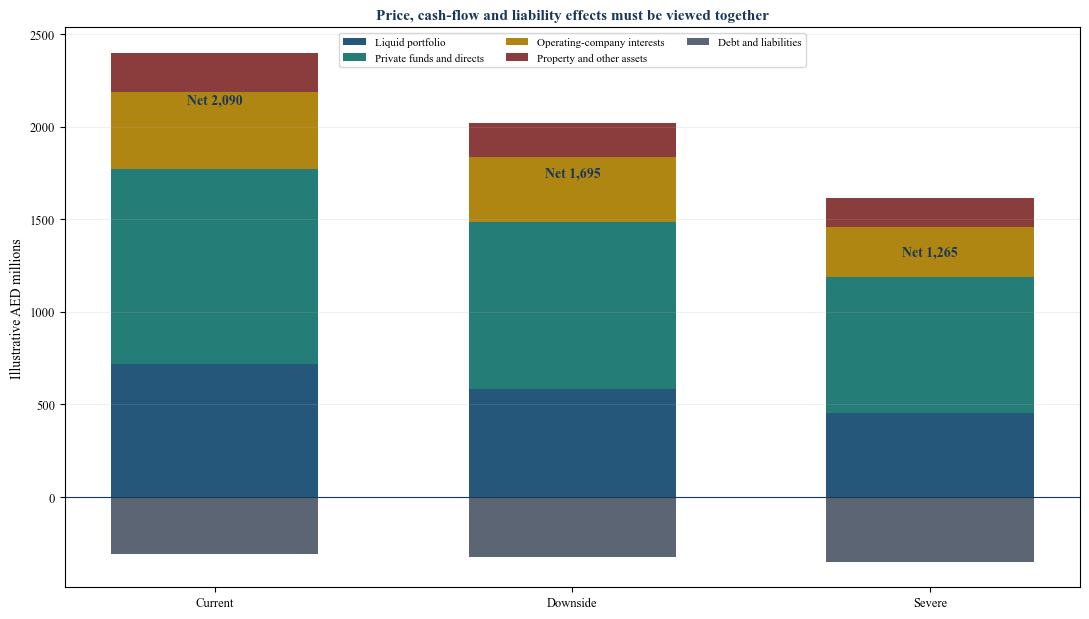
Management assumptions for framework demonstration only; AED millions.
7. Give the committee a minimum stress pack
A long board book can slow a decision and obscure the few facts that matter. The stress pack should be concise, reconciled and linked to sources. It begins with the decision requested, the authority available and the deadline. It then shows the relevant exposures, cash effects, scenario range, conflicts, alternatives and execution dependencies.
Risk information should arrive at the same cut-off time. Listed prices, foreign-exchange rates, bank balances, capital calls, debt balances and private valuations taken at different times can create a false picture. The pack should show each source, as-of time, reconciliation status and owner.
The Basel Committee's current corporate-governance principles apply to banks. Within that scope, they emphasise timely, accurate and understandable risk communication, concise contextual reporting and prompt presentation of material information requiring action.[3] These are useful design qualities for family investment committees as long as the family does not imply bank regulatory status.
The pack should separate fact, estimate, scenario and recommendation in reader-friendly prose. A cash balance can be a verified fact. A private-company value can be an estimate based on stated inputs. A distribution forecast can be a scenario assumption. A proposed asset sale is a recommendation. The decision record should preserve these distinctions.
Table 3. Minimum extraordinary investment-committee pack
| Page | Required content | Source and cut-off | Owner | Decision use |
|---|---|---|---|---|
| Decision cover | requested action, amount, entity, authority, deadline and proposed resolution | governing documents and current request | committee secretary | establishes whether the committee can act |
| Situation | event chronology, verified facts, open questions and next information time | source log with timestamps | CIO or deal lead | prevents narrative drift |
| Exposure | asset, entity, currency, counterparty, pledge, commitment and concentration | reconciled position records | investment operations | defines what is at risk |
| Liquidity | available sources, hard uses, priority waterfall and forecast horizon | bank, custody, facility and obligation records | treasury | tests ability to meet obligations |
| Scenario | base, downside, severe and reverse-stress outcomes | approved assumptions and model version | risk owner | shows vulnerability and action points |
| Valuation | point estimate or range, method, evidence date, sensitivity and uncertainty | valuation file and independent evidence | valuation authority | prevents false precision |
| Options | act now, stage, hedge, finance, wait or exit; benefits, costs and reversibility | market evidence and adviser input | CIO | supports explicit comparison |
| Conflicts | member, adviser, related party, opportunity-allocation and personal-interest checks | declarations and restricted records | compliance or secretary | determines access, recusal and quorum |
| Execution | counterparty, documentation, settlement, systems and signatories | operations checklist | COO or transaction lead | tests whether approval can be implemented |
| Resolution | decision, conditions, dissent, rationale, owner, expiry and review date | signed minutes and action log | chair and secretary | creates the authoritative record |
The pack should remain concise, source-linked and specific to the decision requested.
8. Design meetings for challenge and speed
Speed should come from preparation and defined authority. The chair confirms quorum, conflicts and the decision requested before substantive discussion. Management then states the current facts, the range of uncertainty and the latest time at which delay changes the available options.
The committee should hear an affirmative case, a downside case and the consequences of inaction. A named challenger can test the source quality, scenario severity, liquidity assumptions, execution feasibility and consistency with the mandate. Challenge is useful when it changes assumptions or conditions; ritual opposition adds little.
Members should receive materials with enough time to evaluate them. ILPA Principles 3.0 addresses limited-partner advisory committees and conflict matters in private funds. It advocates advance agendas and materials, notification of planned votes and responsive meetings for time-sensitive conflicts.[9] A family committee can adapt these meeting disciplines for private-fund exposures while recognising the different legal and governance context.
The resolution should be capable of execution. It specifies the entity, instrument, amount, price or range, counterparty conditions, maximum discretion, authorised signatories, expiry and reporting. A resolution to reduce risk without these details can transfer the real decision to an individual who lacks documented authority.
Minutes should capture the evidence reviewed, material assumptions, conflicts, alternatives, dissent, conditions and reason for the decision. They should avoid a transcript while preserving enough context to demonstrate an informed process.
9. Use a decision tree that starts with authority
The first question is whether the committee has authority for the proposed action. If authority is absent or uncertain, the committee can request information and protective steps within existing mandates, then escalate to the competent body. It should not rely on urgency to create power.
The second question is whether the information is sufficient for the type of action. Protective and reversible actions can sometimes proceed with a narrower evidence set than an irreversible sale, pledge or new investment. The committee should record the limitation and the reason the action remains proportionate.
The third question is whether a conflict affects access, discussion, recommendation, vote or execution. The fourth is whether the action remains inside risk, liquidity and mandate limits. The fifth is whether operations can implement and monitor it.
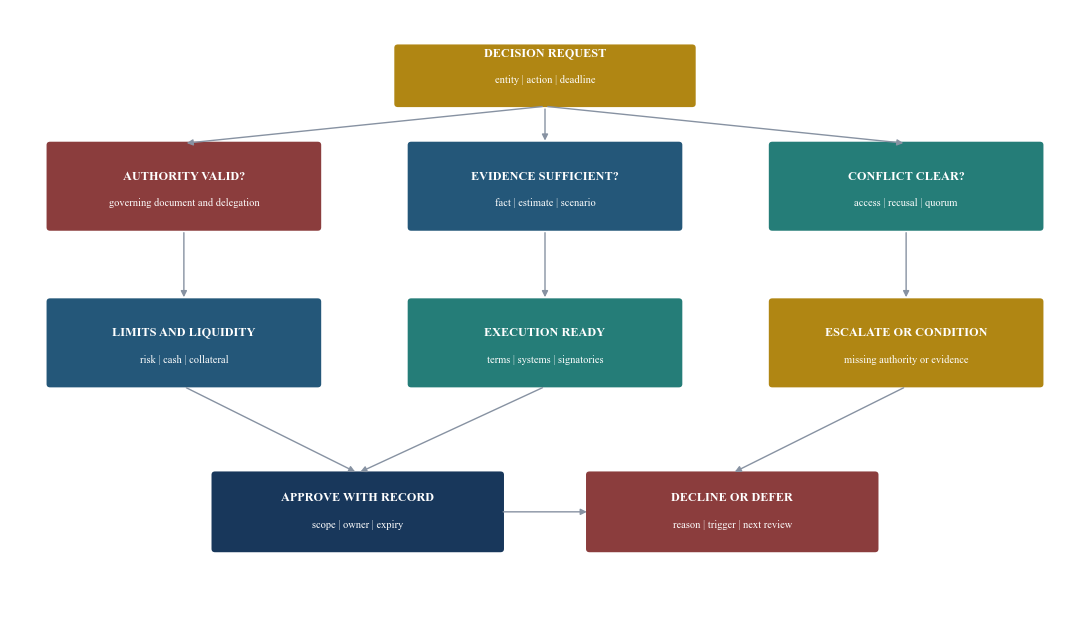
Author framework. Legal authority, governing documents and professional advice take precedence.
10. Govern family, adviser and opportunity conflicts
Stress can intensify conflicts. A family member may own the operating company requesting support. An adviser can earn more from one product or transaction. A committee member can hold the same security personally. One branch of the family can benefit from liquidity while another bears the cost. A direct opportunity can be allocated between family entities with different beneficiaries.
The conflict register should cover financial, relational, role, information and opportunity-allocation conflicts. The response can include disclosure, restricted access, independent information, recusal, a separate committee, external advice, governing-body approval or rejection. Disclosure alone may be insufficient when the conflict cannot be managed.
The United States SEC's investment-adviser code-of-ethics rule and staff conflict materials apply within the registered-adviser context. They illustrate the value of written standards, personal-trading records, pre-approval for certain private placements, conflict identification and records explaining approvals.[8] A Gulf family office should obtain advice on the rules applicable to its actual entities and activities rather than treating United States requirements as generally applicable.
The committee secretary should confirm whether a recusal affects quorum. The conflicted person should not receive restricted papers, shape the recommendation indirectly or execute the decision if the approved control requires separation.
Table 4. Conflict-response matrix under time pressure
| Conflict | How it can appear during stress | Minimum evidence | Potential control | Governing question |
|---|---|---|---|---|
| Family operating company | request for liquidity, guarantee or asset purchase | entity need, alternatives, terms and beneficiary effects | independent terms, separate approval and exposure limit | is the action authorised and fair to the relevant entity? |
| Personal holding | member owns or trades the same asset | declaration, holding and transaction timeline | restricted access, recusal and personal-trading review | could the member benefit from committee information or action? |
| Adviser economics | fee, spread, financing or product revenue differs by option | complete compensation and alternative pricing | independent comparison and unconflicted approval | would the recommendation change without the incentive? |
| Opportunity allocation | one deal suits several family entities | eligibility, capacity, mandate and allocation method | pre-agreed allocation policy and documented rationale | why did this entity receive this amount? |
| Related-party transaction | buyer, seller, lender or service provider is connected | ownership, terms, market evidence and approvals | independent valuation, abstention and reserved-matter review | can the conflict be managed under governing requirements? |
| Family distribution | one branch seeks cash during portfolio stress | distribution policy, entity cash and equalisation terms | governing-body decision and transparent record | which rights and constraints govern the payment? |
| Information asymmetry | some members receive earlier or fuller information | access log, version history and meeting record | controlled distribution and equal decision pack | did every voting member receive decision-useful information? |
| External mandate overlap | manager or adviser acts for another interested party | mandate scope, confidentiality and conflict statement | information barrier, consent or separate adviser | whose interest is the adviser serving for this decision? |
The applicable duty and remedy depend on the entity, role, jurisdiction and facts.
11. Show valuation uncertainty rather than hiding it
Volatile markets can widen the range of reasonable values. Listed securities provide observable prices, although a large or restricted position may have execution considerations outside a simple screen price. Private-company, property, fund and structured-credit valuations depend on models, inputs, transaction evidence and judgement that can update at different speeds.
IFRS 13 defines fair value for financial reporting when another standard requires or permits it. It focuses on an orderly transaction between market participants at the measurement date and requires assumptions about risk under current market conditions.[5] IFRS 13 also addresses decreases in market activity and the need to analyse whether observed transactions are orderly. Its accounting scope should remain distinct from an investment committee's own decision value, liquidation analysis or strategic value.
The International Valuation Standards Council's 2026 perspectives paper distinguishes valuation risk arising from process error from value uncertainty inherent in complex markets. It advocates transparent communication of the sources and implications of uncertainty.[6] The committee should therefore see the method, evidence date, range, sensitivity and decision consequence.
A range can be more useful than a stale point estimate. The lower end can inform collateral and severe-liquidity analysis. The central case can support portfolio reporting. The upper case can show value retained if the family avoids a forced transaction. The committee should avoid selecting whichever value supports the preferred action.
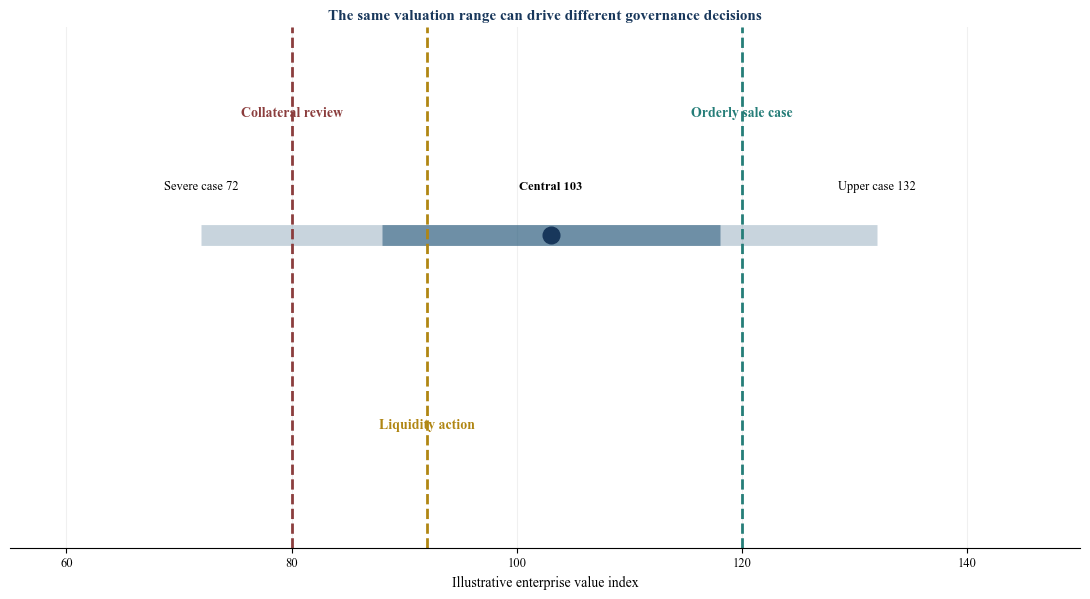
Management assumptions for demonstration only; values do not represent a client, recommendation or market forecast.
12. Align public and private-market decision clocks
Public markets can move before private managers report. A family with substantial alternatives exposure can see a sharp decline in listed assets while private net asset values still reflect the previous quarter. This creates apparent increases in private-market allocation, concentration and unfunded-commitment ratios even before managers update valuations.
The committee should maintain a current reported view and a stress-adjusted decision view. The reported view preserves the official values and dates used for accounting or manager reporting. The decision view applies transparent sensitivities to test liquidity, allocation and concentration. The two views should never be confused.
Commitment pacing should respond to cash capacity, portfolio construction and opportunity quality. A market fall can produce attractive entry points and a distribution drought at the same time. The committee should compare new commitments with existing unfunded obligations, reserve policy, debt capacity and severe-case uses.
Rebalancing bands can include rules for stale private values. A policy can require a stress-adjusted exposure range, a higher liquidity reserve or governing-body review before new illiquid commitments. The committee should document any departure from policy and its expiry.
13. Compare action, delay and reversibility
Stress decisions often present more than a buy-or-sell choice. The family can reduce, hedge, finance, stage, syndicate, amend, wait, seek information or combine actions. Each option has cost, time, reversibility, execution risk and second-order effects.
An immediate sale can provide certainty and crystallise a poor price. A hedge can reduce beta while introducing basis, counterparty and liquidity risk. A facility can bridge timing while adding leverage and covenants. A staged sale can reduce market impact while leaving residual exposure. A commitment amendment can preserve a relationship while changing economics or rights.
The committee should state the cost of delay. Waiting can improve evidence and lose an execution window. Acting can protect liquidity and remove upside. A decision deadline is therefore part of the economics.
Conditions can improve a decision. The committee can approve an action subject to a minimum price, maximum spread, verified counterparty, completed conflict check, legal opinion, updated cash forecast or second signature. Conditions require an owner who confirms satisfaction before execution.
14. Demonstrate the framework with a hypothetical UAE family office
Consider a hypothetical UAE family office with AED 2.4 billion of gross assets and AED 310 million of debt. The family owns a diversified liquid portfolio, private funds and direct investments, operating-company interests and property. Every number and circumstance is a management assumption created solely to demonstrate the framework. It does not describe a client, market forecast, expected return or recommendation.
The governing body has approved a minimum AED 150 million 12-month liquidity reserve, an additional AED 70 million capital-call reserve and limits for secured borrowing. The investment committee can rebalance within approved bands, select managers, approve follow-ons and execute hedges within named instruments and notional limits. Asset pledges above a threshold and support for family operating companies remain reserved.
A three-part stress occurs over ten business days. Listed assets fall 17 percent, a private manager signals a larger capital call, and a family operating company requests AED 55 million of temporary support. One committee member sits on the operating-company board. A secured facility remains available, although the haircut on a concentrated listed holding increases.
The committee activates red governance. It validates entity cash and obligations, recuses the conflicted member from the operating-company item, separates the investment-portfolio and operating-company decisions, and presents three scenarios. It pauses discretionary commitments for ten business days under pre-approved authority, stages a permitted hedge, validates the capital call and requests the governing body to decide the related-party support on independently reviewed terms.
Table 5. Hypothetical stress scenarios and governed responses
| Item | Current | Downside | Severe | Governed response |
|---|---|---|---|---|
| Net asset value | 2,090 | 1,695 | 1,265 | show official and stress-adjusted views with uncertainty ranges |
| Available liquid sources | 220 | 176 | 128 | preserve hard-obligation and operational floors by entity |
| Twelve-month hard uses | 104 | 137 | 169 | validate notices, debt service, tax and operating needs |
| Unfunded calls inside horizon | 42 | 68 | 96 | activate reserve, prioritise approved obligations and test facility headroom |
| Operating-company request | 55 | 55 | 75 | separate related-party decision, independent terms and governing-body authority |
| Facility availability | 110 | 82 | 43 | confirm draw conditions, haircut, covenant and collateral effects |
| Concentrated listed position | 190 | 148 | 111 | compare stage, hedge, finance and retain options inside mandate |
| Private valuation adjustment | 0 | negative 14 percent | negative 30 percent | retain reported value and add transparent decision sensitivity |
| Committee governance | normal | amber | red | change cadence, pack, limits, conflict process and escalation |
| First actions | scheduled review | refresh liquidity and options | extraordinary meeting and controlled protective actions | assign owners, expiry and governing review |
All values are illustrative management assumptions in AED millions and should not be used as forecasts or recommendations.
The case demonstrates why governance cannot be replaced by one portfolio loss number. The decisions belong to different entities, authorities and time horizons. Liquidity, conflict, valuation and execution evidence determine the permitted path.
15. Communicate facts, decisions and uncertainty
Family beneficiaries can experience volatility differently. Some focus on long-term capital preservation. Others rely on distributions. Operating-family members can see business risk that the investment committee does not observe. Inconsistent communication can create pressure for premature action or conceal a material constraint.
The governing body should authorise who communicates, to whom, how often and with what confidentiality. A factual update can describe the event, current exposures, actions taken inside authority, decisions pending, uncertainties and next review time. It should avoid unsupported reassurance and speculative forecasts.
Information rights differ by entity and role. Sensitive deal, personal, employment, legal, tax, health or security information should be limited to authorised recipients. The release log records version, time, audience and approver.
External communications to banks, managers, counterparties, employees, regulators or media require the appropriate owner and professional review. A family-office committee should avoid disclosing material non-public information or creating commitments beyond its authority.
16. Monitor the decision system, not only the portfolio
A board dashboard should show financial exposure and governance readiness. Financial indicators can include liquid sources, hard uses, unfunded commitments, facility headroom, collateral, concentration, currency, counterparty and valuation uncertainty. Governance indicators can include open decisions, trigger state, quorum, conflicts, expired delegations, unresolved conditions, execution status and overdue reviews.
The dashboard should preserve the source and cut-off for each measure. A red indicator requires an owner and next action. The committee can distinguish a breached limit, an unverified input and a missing control because they require different responses.
After the event, the committee should compare scenario assumptions with outcomes, decisions with execution, and expected controls with actual behaviour. The review can amend thresholds, packs, authorities, data sources and exercises.
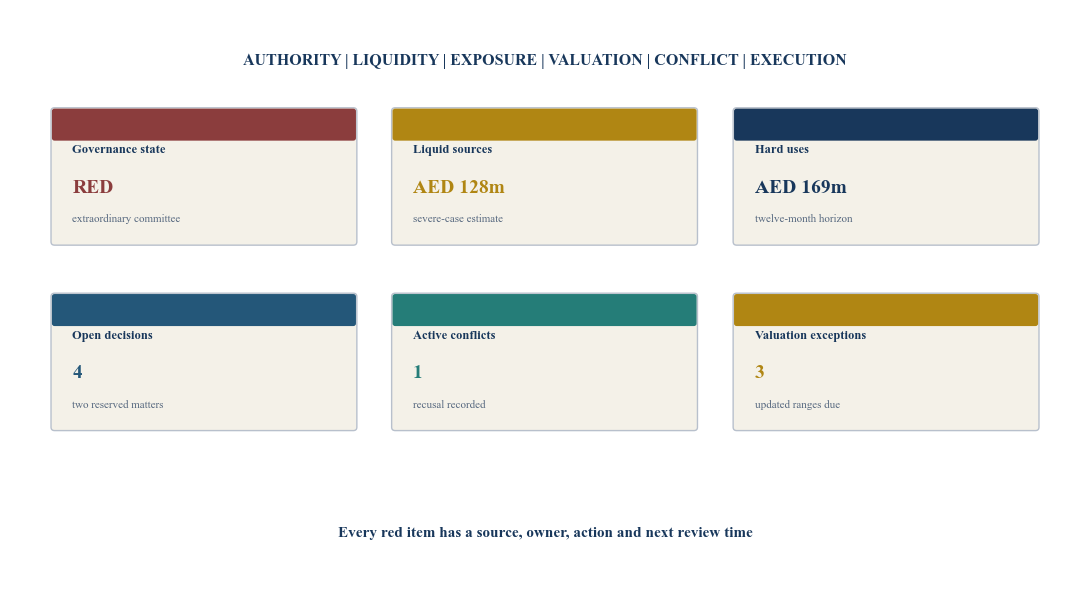
Every displayed value is an illustrative management assumption for operating-model design.
17. Implement the capability in 100 days
Days one to ten establish the sponsor, legal entities, governing documents, committee mandate, current policy and known stress decisions. The team identifies every authority source and unresolved conflict between documents and practice.
Days 11 to 30 reconcile positions, cash, obligations, commitments, debt, collateral, guarantees, signatories and information systems. The family defines its critical liquidity horizons and validates the data owners.
Days 31 to 50 approve the risk-appetite structure, trigger ladder, reserved matters, delegated actions, emergency limits, conflict protocol and extraordinary meeting process. Legal, tax, accounting, regulatory and entity advice reviews the relevant boundaries.
Days 51 to 70 build scenarios, the minimum stress pack, valuation-range presentation, options template, beneficiary communication and decision record. Representative decisions are rehearsed with actual committee members.
Days 71 to 90 run a tabletop exercise combining market decline, capital calls, operational unavailability and a family conflict. The office tests data retrieval, quorum, alternate authority, restricted information, execution and communication.
Days 91 to 100 remediate failures, obtain final approvals, publish the controlled playbook and set quarterly indicator review plus an annual exercise. The committee records unresolved dependencies with owners and due dates.
Table 6. One-hundred-day stress-governance programme
| Days | Workstream | Controlled deliverable | Gate |
|---|---|---|---|
| 1 to 10 | authority | entity and governing-document inventory | competent sponsor confirms scope and unresolved authority questions |
| 11 to 20 | portfolio | reconciled assets, liabilities, commitments and guarantees | population agrees to source records by entity |
| 21 to 30 | liquidity | base and stressed cash map with collateral and facilities | hard uses and available sources validated |
| 31 to 40 | risk appetite | capacity, appetite, tolerance, limits and triggers | governing body approves definitions and breach response |
| 41 to 50 | delegation | reserved, delegated and emergency decision matrix | legal and governance review completed for each entity |
| 51 to 60 | decision pack | source-linked minimum stress pack and resolution template | committee can identify fact, estimate, scenario and recommendation |
| 61 to 70 | conflicts and valuation | conflict register, recusal path and uncertainty presentation | quorum, access and valuation controls approved |
| 71 to 80 | exercise | market, liquidity, continuity and family-conflict scenario | alternates retrieve evidence and make a controlled decision |
| 81 to 90 | execution | banking, custody, trading, signing and communication paths | authorised action completes without shared credentials or informal authority |
| 91 to 100 | governance | dashboard, playbook, review calendar and remediation log | governing body accepts controlled production scope |
Timing depends on family structure, entities, governing documents, adviser availability and data condition.
18. Limitations and conclusion
Family investment governance crosses legal entities, jurisdictions, ownership forms and personal relationships. Current professional advice should determine fiduciary duties, corporate and foundation authority, trust and partnership obligations, tax, accounting, securities, sanctions, anti-money-laundering, privacy, employment, financing, collateral, derivatives and contractual consequences.
The CFA Institute material provides an institutional investment-policy framework.[1] It does not determine a family's legal authority. The FSB risk-appetite principles and Basel governance and stress-testing principles arise from supervised financial-institution contexts.[2][3][4] A family office can adapt their decision disciplines proportionately while accurately describing its regulatory perimeter.
IFRS 13 governs fair value when another accounting standard requires or permits it.[5] A strategic decision value, forced-sale outcome or internal sensitivity can serve a different purpose and should be labelled accordingly. IVSC material helps explain value uncertainty and process risk.[6]
DIFC Family Arrangements Regulations and ADGM Foundations Regulations provide relevant Gulf structural context.[7][10] The actual effect depends on the entity, instruments and governing documents. ILPA guidance concerns private-fund governance, including conflict processes.[9] SEC code-of-ethics and conflict materials concern United States registered-adviser obligations and related staff views within their scope.[8]
The hypothetical UAE family-office case contains management assumptions solely for framework demonstration. It does not describe a client, market forecast, expected outcome or recommendation.
A family investment committee becomes faster under pressure when the system has already decided who can do what, for which entity, within which limit, using which evidence and for how long. A trigger changes cadence and control in proportion to stress. A liquidity map connects assets to obligations. A valuation range reveals uncertainty. A conflict process protects the decision. A resolution gives operations something executable.
The objective is disciplined adaptability. The committee can protect capital, preserve optionality and act with clarity when markets, information and family priorities are moving at the same time.
References
- [1] CFA Institute, Elements of an Investment Policy Statement for Institutional Investors, governance and policy-review guidance, accessed 13 August 2026. https://rpc.cfainstitute.org/sites/default/files/-/media/documents/article/position-paper/investment-policy-statement-institutional-investors.pdf
- [2] Financial Stability Board, Principles for an Effective Risk Appetite Framework, 18 November 2013. https://www.fsb.org/2013/11/cos_131118/
- [3] Basel Committee on Banking Supervision, Corporate Governance Principles for Banks, 8 July 2015, current status on BIS site when accessed 13 August 2026. https://www.bis.org/bcbs/publ/d328.htm
- [4] Basel Committee on Banking Supervision, Stress Testing Principles, 17 October 2018, current status on BIS site when accessed 13 August 2026. https://www.bis.org/bcbs/publ/d450.htm
- [5] IFRS Foundation, IFRS 13 Fair Value Measurement and supporting overview, accessed 13 August 2026. https://www.ifrs.org/issued-standards/list-of-standards/ifrs-13-fair-value-measurement/
- [6] International Valuation Standards Council, Managing and Communicating Value Uncertainty, 19 May 2026. https://ivsc.org/managing-and-communicating-value-uncertainty/
- [7] Dubai International Financial Centre Authority, Family Arrangements Regulations 2023. https://assets.difc.com/v1/media/edge/images/dubaiintern0078-difcexperie96c5-production-3253/media/project/difcexperiences/difc/difcwebsite/documents/familydocs/family_arrangements_regulations_updated_april23.pdf
- [8] United States Securities and Exchange Commission, Investment Adviser Codes of Ethics, Release IA-2256, 2 July 2004, last reviewed or updated 29 December 2025. https://www.sec.gov/rule-release/ia-2256
- [9] Institutional Limited Partners Association, ILPA Principles 3.0, 2019. https://ilpa.org/wp-content/uploads/2019/06/ILPA-Principles-3.0_2019.pdf
- [10] Abu Dhabi Global Market, Foundations Regulations 2017, official consolidated document accessed 13 August 2026. https://assets.adgm.com/download/assets/foundations-regulations-2017.pdf/a9b58092643811efb33122e97052245a
About the Author
Chennakeshav Adya is an independent researcher and Managing Partner of Matchpoint Partners. His research focuses on investment strategy, capital formation, transaction execution, governance and operating-model design across the Gulf and international markets.
