

1. Finance the delivery system around AI infrastructure
An AI infrastructure project is the visible endpoint of a much wider capital cycle. Compute equipment must be manufactured, allocated, exported, transported, installed, connected, tested, accepted and operated. Power and cooling systems must be procured before a rack can serve a customer. Fibre, networking, security, software and technical services must work together before revenue begins.
The firms performing these tasks can face a financing gap even when demand is strong. A vendor may pay a deposit to an original-equipment manufacturer months before delivery. An engineering contractor can fund labour and materials between milestones. A distributor can hold high-value inventory against a customer order. An integrator can wait for commissioning and acceptance before collecting. A managed-service provider can invest before minimum usage or capacity fees become payable.
The International Energy Agency reports that global investment in data centres amounted to about USD 0.5 trillion in 2024. It projects global data-centre electricity consumption to rise from about 415 terawatt-hours in 2024 to around 945 terawatt-hours in 2030 in its base case.[1] The same report identifies servers, storage, networking, cooling, uninterruptible power, backup generation and grid connections as distinct parts of the infrastructure system.[2]
Private credit can support this system when the lender identifies a verifiable cash claim and controls its transformation into cash. Demand for AI alone does not establish repayment. The underwriting unit is a defined receivable, inventory pool, equipment asset, milestone, service contract or capacity agreement supported by evidence and tested under delay, cancellation, obsolescence and concentration scenarios.
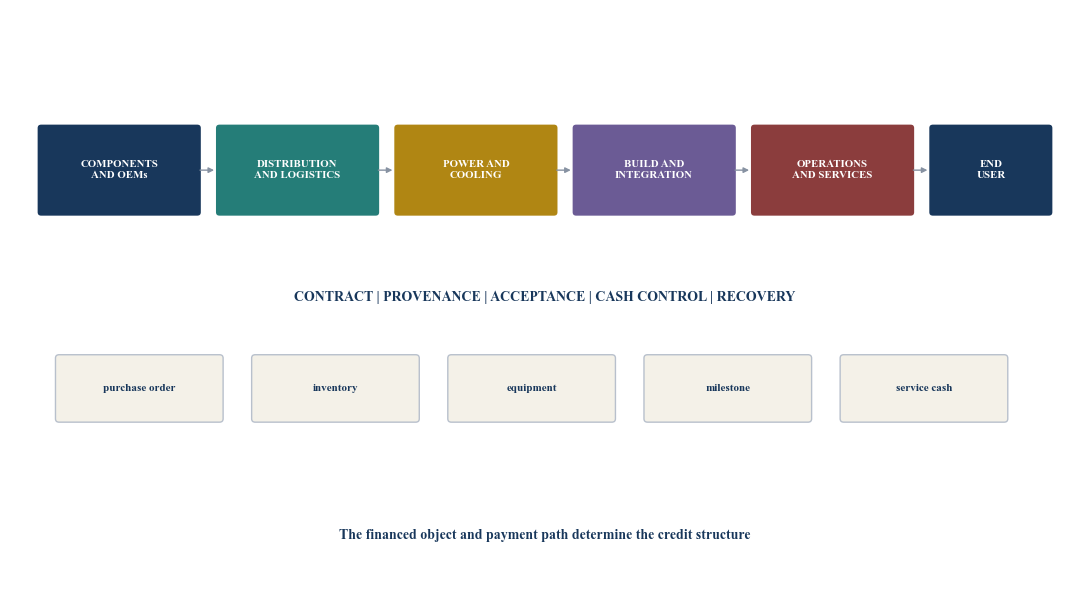
Author framework. Financing follows the evidence and cash claim at each delivery stage.
2. Map each segment to a financeable claim
The supply chain should be separated into economically different segments. Semiconductor and server supply can involve allocation risk, export restrictions, rapid technical change and high unit values. Power and cooling equipment can have long production lead times and specialised installation. Construction and integration can be governed by milestone certification, retention and performance security. Managed services and capacity arrangements can depend on service levels, usage, renewal and customer termination rights.
Each segment produces a different cash claim. A confirmed receivable from an accepted delivery has different risk from inventory held for an expected order. Equipment installed at a controlled location has different recovery prospects from components in transit. A certified construction milestone differs from unapproved work in progress. A minimum capacity payment differs from a usage forecast.
The lender should record what creates the customer's legal payment obligation. Evidence can include an executed order, master agreement, statement of work, bill of materials, manufacturer confirmation, shipping record, import approval, delivery note, commissioning certificate, independent engineer report, customer acceptance, invoice and controlled collection record.
Payment evidence should be tested against cancellation, set-off, warranty, liquidated damages, retention, dispute, change order, assignment and consent terms. A purchase order can be cancellable. An invoice can remain subject to acceptance. A service payment can be reduced by availability credits. The lender should finance the enforceable claim reflected in the complete document chain.
Table 1. AI supply-chain segment and credit-claim map
| Segment | Working-capital need | Potential financeable claim | Primary evidence | Principal risk |
|---|---|---|---|---|
| Components and servers | deposits, allocation and transit | assigned order, inventory or receivable | OEM confirmation, serials, licences and acceptance | export control, allocation and obsolescence |
| Power equipment | advance payment and long lead time | equipment, milestone or receivable | factory schedule, inspection, delivery and warranty | delay, specification and replacement |
| Cooling and mechanical systems | fabrication, installation and commissioning | milestone or certified receivable | design approval, progress certificate and acceptance | performance and interface failure |
| Fibre and networking | equipment and deployment cost | inventory, milestone or receivable | route rights, equipment record and test result | permit, interoperability and delay |
| Construction and fit-out | labour, materials and retention | certified milestone and retention claim | engineer certificate, invoice and payment terms | cost overrun, variation and dispute |
| Systems integration | equipment plus technical labour | accepted deliverable or receivable | statement of work, test and acceptance record | integration and dependency risk |
| Maintenance and managed services | mobilisation and payroll | contracted recurring cash | service contract, SLA report and invoice | termination, service credit and renewal |
| Compute or cloud capacity | equipment and reserved capacity | minimum payment or contracted usage | capacity contract, availability record and collection | customer concentration and utilisation |
The actual financeable claim depends on executed documents, performance evidence and applicable law.
3. Define the finance object before the facility
Four finance objects cover much of the opportunity. The first is a receivable created by delivered and accepted goods or services. The second is inventory or identifiable equipment supported by an order, title, location and disposition route. The third is milestone work or work in progress supported by certified performance and an executable path to completion. The fourth is contracted capacity supported by minimum payment, availability, creditworthy customers and controlled cash.
The finance object determines the legal rights, monitoring cadence, advance rate and maturity. A short-dated accepted receivable can be monitored through invoice and collection data. High-value equipment can require serial-level tracking, insurance, storage control, inspection and current resale evidence. Work in progress can require an independent engineer, cost-to-complete analysis and contingency reserve. Contracted capacity can require customer credit, service performance and termination analysis.
The facility should avoid blending distinct objects without a transparent rule set. A borrowing base that gives the same value to accepted receivables, unfinished work and unallocated inventory obscures risk. Separate eligibility categories allow each object to carry its own advance rate, concentration cap and reserve.
Funding should follow evidence maturity. A lender can offer a lower advance at confirmed order, increase it when equipment is shipped, increase it again after installation and move the exposure to receivables after acceptance. This staged approach aligns capital with verified de-risking events.
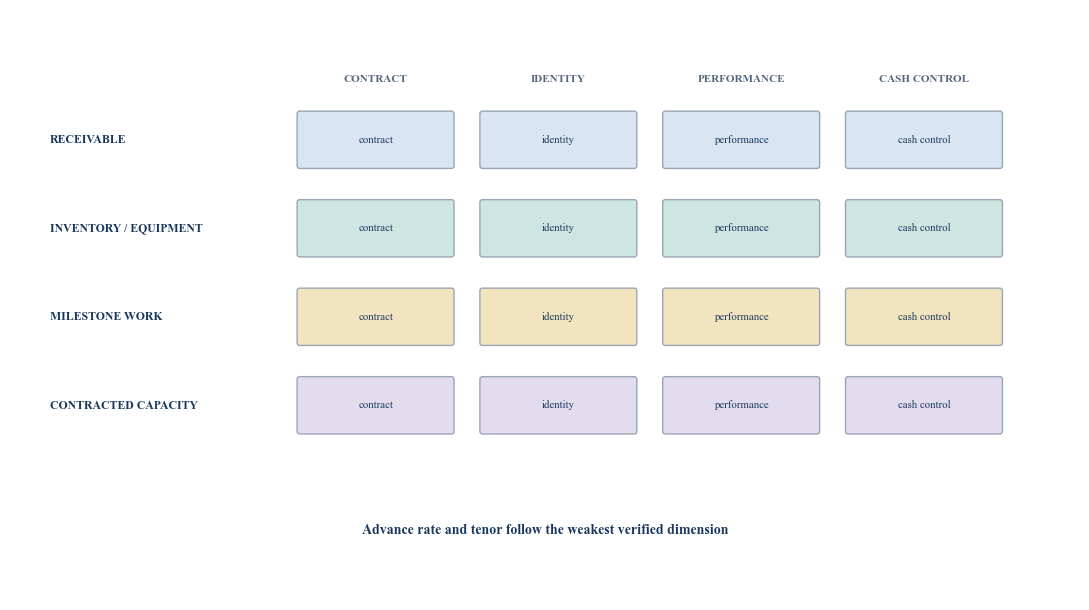
Author framework. Evidence depth increases from commercial intent to controlled cash.
4. Establish obligor and end-user credit quality
Supply-chain finance can look through a vendor toward a stronger customer, although the lender should define how much legal and economic reliance is placed on that customer. A vendor's invoice remains exposed to its own performance, warranty and dispute obligations. The customer's credit quality supports repayment only when the payment obligation is valid, accepted and enforceable.
Underwriting should cover the vendor's ownership, management, financial statements, liquidity, bank debt, contingent liabilities, customer concentration, supplier concentration, margins, working-capital cycle, tax, litigation, sanctions and operating controls. The lender should reconcile orders, invoices, revenue, inventory, payables, cash and bank statements. Rapid growth can consume cash and increase operational errors.
End-user review should cover identity, ownership, jurisdiction, business activity, credit quality, approved use, technology requirements, procurement authority and payment history. The review should also establish whether the end user, intermediate consignee, cloud provider, reseller or data-centre operator is the party that creates payment.
Where a programme contains many vendors or customers, common data fields and grading rules are essential. The lender should aggregate related groups across legal entities and channels. A distributor can appear diversified by invoice while relying on one hyperscaler, one OEM allocation or one government project.
5. Make end-use and export-control eligibility a funding gate
Advanced computing equipment can be subject to export-control and end-use requirements. The applicable analysis depends on the item, classification, origin, destination, parties, ownership, end user, ultimate use, licence, exception, authorisation and current law. Conditions can change during a facility's life.
The United States Bureau of Industry and Security announced on 10 July 2026 that the UAE would be placed in Country Group A:5 under the Export Administration Regulations.[8] Current EAR provisions and authorisations contain conditions that require specialist analysis.[9] A lender should use the current official rules and transaction-specific legal advice rather than a static country assumption.
The credit file should record item classifications, licence or exception basis, exporter, re-exporter, consignee, approved end user, intended use, location, serial identity, reporting obligations and continuing conditions. The lender should also test contractual consequences if an authorisation is delayed, suspended, revoked or conditioned.
Funding controls can include an export-control certificate, legal memorandum, screening refresh, document condition, approved-party list, location covenant and stop-funding trigger. The control should reach subcontractors and resellers where they affect the regulated chain. A representation alone provides weak protection when the lender cannot verify the transaction evidence.
6. Verify provenance, identity and cyber integrity
The value of high-performance equipment depends on authenticity, specification, title, condition, firmware and an authorised chain of custody. Counterfeit, substituted, tampered or unauthorised equipment can fail technically and become difficult to sell or support.
NIST Special Publication 1800-34 addresses risks including counterfeiting, unauthorised production, tampering and theft in computing-device supply chains and presents methods for validating device integrity.[6] NIST Special Publication 1326 provides a due-diligence framework covering supplier foreign ownership, control or influence; provenance; stability; foundational cyber practices; and upstream supplier tiers.[5]
The lender's evidence file can include manufacturer and distributor authority, purchase invoice, serial number, part number, configuration, bill of materials, certificate of origin, export document, shipping and customs record, secure storage evidence, insurance, installation record, firmware validation and acceptance test.
Provenance should be monitored through the financed object's life. Equipment can move between warehouses, sites and customers. Components can be replaced during commissioning. A controlled asset register should record changes, authorisation and evidence. Cyber or integrity exceptions should trigger technical review before continued funding or release of reserves.
Table 2. Eligibility and evidence file for AI supply-chain finance
| Field | Required evidence | Funding relevance | Exception response |
|---|---|---|---|
| Financed object | order, asset, invoice, milestone or capacity record | defines the cash claim | suspend object until reconciled |
| Parties and end user | legal identity, ownership, screening and authority | validates obligor and permitted chain | compliance review and stop funding |
| Product identity | manufacturer, model, serial, configuration and quantity | prevents substitution and duplication | inspection and reserve |
| Export and import basis | classification, licence, exception and customs evidence | establishes permitted movement and use | legal review and funding condition |
| Title and location | invoice, title terms, warehouse or site record | supports control and recovery | perfect interest or exclude |
| Performance | delivery, commissioning, milestone and acceptance | establishes payment maturity | defer advance or retain reserve |
| Cash obligation | invoice, certification, set-off and payment terms | sizes collection value | haircut disputed or conditional amount |
| Insurance and security | policy, loss payee, filing and custody | protects collateral route | cure before funding |
| Data quality | system reconciliation and exception log | supports repeatable borrowing base | ineligibility or data reserve |
| Exit evidence | buyer universe, supportability and sale lead time | informs recovery and tenor | lower advance and shorter maturity |
Eligibility requires current documentary, operational and compliance evidence for the actual transaction.
7. Underwrite power and grid dependencies
An equipment order can be technically complete and commercially stranded if the destination lacks usable power. The IEA estimates that around 20 percent of planned data-centre projects could face delay if identified grid risks are not addressed. It reports that new transmission lines can take four to eight years in advanced economies and that waiting times for transformers and cables have doubled in three years.[1]
The lender should connect supply-chain funding to the destination project's power evidence. Relevant documents can include land rights, utility application, connection offer, load allocation, energisation schedule, network study, generation arrangement, backup plan, fuel agreement, permits, transformer and switchgear delivery, commissioning sequence and curtailment terms.
Power dependencies affect different borrowers differently. A transformer manufacturer can rely on a specific project and customer deposit. A server distributor can redirect standard equipment if an energisation date slips, subject to licences and market demand. A bespoke cooling system can have fewer alternative uses. A managed-service provider can carry fixed capacity costs before customer revenue begins.
The credit model should therefore link project delay to each financed object. It should estimate storage cost, warranty start, cancellation rights, remarketing time, price erosion, inventory financing, contract extension and liquidity need. Funding milestones can be tied to verified power and site progress where those factors determine take-out.
8. Treat procurement deposits and allocation as credit exposures
Scarce or long-lead equipment can require deposits or prepayments. A deposit converts cash into a contractual claim against a supplier before the lender controls a completed asset or customer receivable. Supplier solvency, allocation priority, cancellation, refund, specification, delivery and substitution terms become central.
The lender should distinguish refundable deposits, progress payments, irrevocable prepayments and letters of credit. It should identify who owns components during manufacture, whether title passes, which jurisdiction governs, what security exists and what happens if the supplier misses the delivery date.
Allocation evidence should come from the manufacturer or authorised distributor. A downstream customer order does not prove upstream allocation. The lender should reconcile ordered model, quantity, configuration, delivery window, destination and end user across the documents.
Advance rates can increase as the asset moves from deposit to manufacture, shipment, customs clearance, delivery, installation and acceptance. Reserves can cover duties, logistics, installation, warranty, storage and price erosion. The facility maturity should include plausible delay and a funded exit path.
9. Build the borrowing base from eligible objects
The borrowing base should list every financed object with a unique identifier, category, customer, supplier, amount, currency, evidence stage, location, expected collection date, advance rate, reserve and concentration group. It should reconcile to the borrower ledger, bank records, inventory system, project system and controlled accounts.
Eligibility rules can exclude cancelled or disputed orders, prohibited parties, unauthorised end uses, unsupported products, unverified serials, obsolete models, incomplete title, late milestones, uninsured goods, excessive aging, extended collection, cross-aged customers and objects outside approved jurisdictions.
Concentration caps can apply by customer, customer group, OEM, product family, component, project, country, currency, warehouse, data-centre site, power connection, revenue model and maturity month. A portfolio with many invoices can remain economically concentrated in one chip supply, one grid connection or one end user.
The calculation should deduct reserves for dilution, warranty, returns, service credits, retention, installation, tax, logistics, future cost, FX, data exceptions and recovery expense. Existing secured claims and minimum liquidity should be deducted before available drawing is determined.
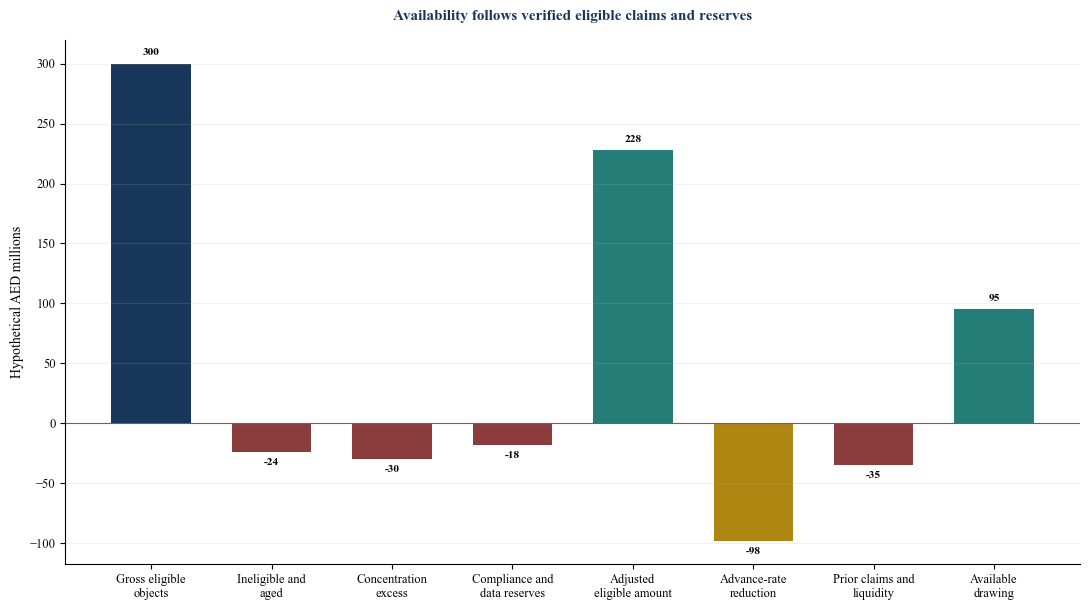
Every value is a hypothetical management assumption in AED millions and demonstrates the calculation method only.
10. Match structures to the financed object
Receivable facilities can provide revolving availability against accepted invoices, with notice, assignment or controlled collection as the documents permit. The lender should test dilution, set-off, credit notes, warranty, dispute, aging and customer concentration.
Inventory and equipment facilities can fund deposits, imports or identified assets. They require title, identity, custody, insurance, release controls and a credible disposition route. The advance rate should recognise technical change, remarketing cost, licence restrictions and the difference between replacement cost and executable sale value.
Milestone facilities can fund certified work, materials and cost to complete. They require a base budget, approved programme, change-order control, independent certification and completion reserve. Retention, performance guarantees and liquidated damages affect the eligible amount.
Contracted-capacity facilities can rely on minimum commitments, reserved capacity or recurring service payments. They require customer credit, contract tenor, termination analysis, service levels, availability, usage and controlled cash. Tenor should fit the period during which the contract remains a dependable source of repayment.
Table 3. Structure comparison for AI supply-chain finance
| Structure | Core collateral or claim | Availability event | Main control | Natural repayment |
|---|---|---|---|---|
| Accepted receivables | valid customer payment claim | delivery and acceptance | assignment, aging and controlled collection | customer payment |
| Purchase-order finance | order and funded procurement | verified order plus supplier condition | tripartite evidence and controlled supplier payment | delivery and receivable collection |
| Inventory finance | identifiable owned goods | title, custody and eligibility | serial tracking, warehouse control and insurance | sale or customer delivery |
| Equipment finance | installed or controlled equipment | delivery, title and commissioning stage | security, location, maintenance and value | lease, service cash or sale |
| Milestone facility | certified work and contract claim | independent certification | budget, cost to complete and retention | milestone payment |
| Contracted-capacity finance | minimum or reserved-capacity cash | availability and contract condition | customer credit, SLA and cash control | contracted payment |
| Hybrid revolving programme | multiple segregated object pools | category-specific eligibility | separate advance rates, reserves and caps | collections and mandatory prepayment |
Terms depend on the actual borrower, object, documents, jurisdiction, regulation and recovery route.
11. Control milestone and acceptance risk
Project cash can move through deposits, shipment, delivery, installation, testing, commissioning, acceptance, retention and final payment. The vendor may fund cost before a milestone becomes billable and wait again before collection. A delay at one stage can create additional labour, storage, financing and warranty cost.
The lender should create a milestone schedule that reconciles contract value, approved variation, cost incurred, cost to complete, certified amount, invoiced amount, collected cash, retention and remaining contingency. The independent engineer or technical reviewer should have a defined scope and evidence standard.
Acceptance language deserves close review. Deemed acceptance, partial acceptance, rejection, remedial work and performance testing can change when the payment obligation becomes unconditional. A certificate issued by the borrower's own employee can carry different evidentiary value from a customer or independent engineer certificate.
Funding should retain enough liquidity to complete the financed work. A lender that advances against incurred cost without reserving the remaining cost can hold an unfinished asset that creates no receivable. Completion reserve, contingency, sponsor contribution and stop-funding conditions should be quantified.
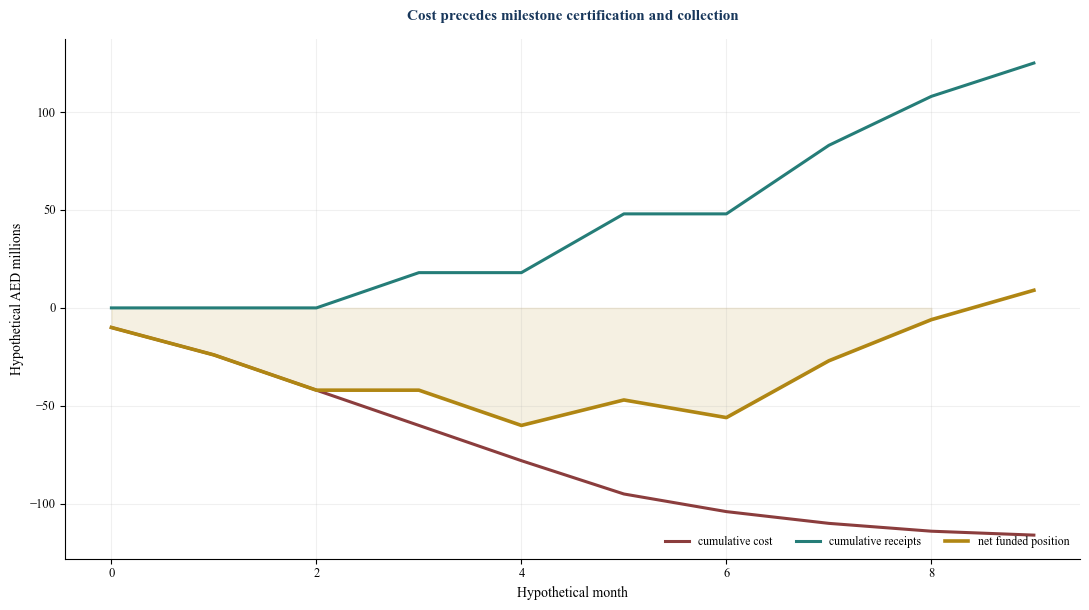
Timing and values are hypothetical management assumptions used solely to illustrate the financing gap.
12. Model obsolescence and residual value
AI infrastructure can lose economic value through new product releases, lower price-performance ratios, software incompatibility, unsupported firmware, export restrictions, customer specification changes and power or cooling constraints. Book value and replacement cost can therefore diverge from recovery value.
Residual-value analysis should identify the exact configuration, age, support status, remaining warranty, installed base, compatible software, energy efficiency, rack density, cooling requirement, location, removal cost, licence status and buyer universe. The lender should obtain current market evidence and update it at a cadence linked to technology change.
Recovery can depend on the ability to relocate, re-export, reconfigure and support the equipment. A technically functional asset may have a narrow permitted buyer set. Bespoke power and cooling equipment can require expensive removal or have little value outside the original site.
Advance rates and tenor should reflect value decay. A lender can use shorter eligibility periods, amortisation, mark-to-market triggers, product-generation caps and mandatory prepayment after customer cancellation. Recovery models should include time, storage, tax, logistics, de-installation, testing, broker cost and legal restrictions.
13. Aggregate concentration and shock transmission
AI supply-chain portfolios can concentrate through relationships that ordinary invoice data does not show. Several borrowers can depend on one manufacturer, chip architecture, distributor, hyperscaler, cloud customer, project, utility connection, transformer model, cooling technology, logistics route or government authorisation.
The portfolio data model should therefore include economic dependency fields. The lender should group suppliers and customers by ultimate parent, link each object to destination site and power connection, and tag product generation, key components, export basis, installation partner and revenue model.
A shock can transmit across layers. An export delay can postpone equipment delivery, milestone acceptance, invoice creation and customer collection. A grid delay can strand installed assets and reduce service cash. A technical defect can affect many units from the same batch. A hyperscaler procurement pause can affect multiple vendors simultaneously.
Portfolio limits should use gross and stress exposure. A customer cap can be supplemented by OEM, product, site, power, jurisdiction and maturity caps. The lender should also estimate correlated draws because borrowers can use revolving availability at the same time during disruption.
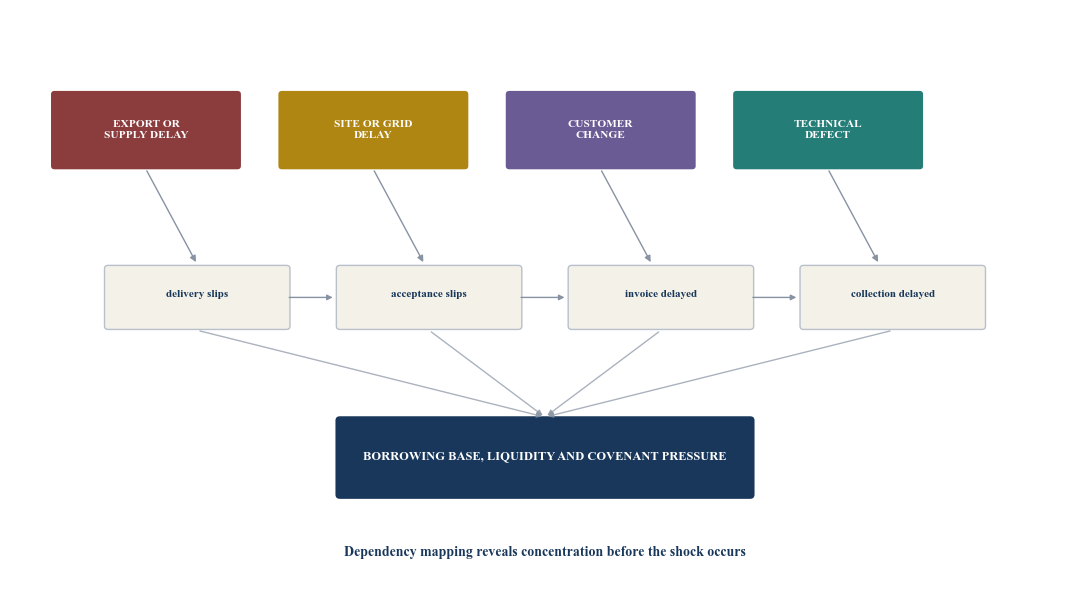
Author framework. A single constraint can affect multiple financed claims and borrowers.
14. Design covenants around leading indicators
Financial covenants alone can identify deterioration after operational causes have developed. The programme should monitor leading indicators that connect orders, supply, compliance, site readiness, performance, acceptance and collection.
Core measures can include confirmed backlog, cancellation, customer credit, supplier allocation, deposit exposure, aged inventory, serial reconciliation, licence expiry, shipment delay, site progress, energisation date, milestone variance, cost to complete, test failure, acceptance delay, disputed invoices, dilution, collection days, warranty claims and service-level credits.
Covenants can require minimum eligible borrowing-base coverage, maximum customer and supplier concentration, maximum aged inventory and receivables, minimum cash, minimum order coverage, completion reserve, timely licences, current insurance, controlled accounts and reporting. Negative covenants can restrict relocation, substitution, related-party sales, additional liens, unauthorised end users and material contract amendment.
Trigger actions should be predefined. A warning can increase reporting, require technical review or reduce advance rates. A breach can stop new funding, trap collections, add reserves, require paydown, redirect inventory, accelerate a sale or invoke sponsor support. Each cure should have authority, cash, evidence, timing and an accountable owner.
Table 4. AI supply-chain stress and management-action matrix
| Stress | Immediate effect | Borrowing-base transmission | Required management evidence |
|---|---|---|---|
| Export authorisation delay | shipment or use postponed | eligibility suspension and aging | current legal analysis and revised delivery path |
| OEM allocation reduction | insufficient equipment | order and milestone shortfall | manufacturer confirmation and substitute plan |
| Grid or site delay | acceptance postponed | inventory aging and cash delay | utility, construction and customer schedule |
| Product-generation change | residual value declines | haircut and lower advance rate | current market and technical evidence |
| Customer cancellation | take-out removed | ineligibility and concentration increase | contract rights and remarketing plan |
| Cost-to-complete increase | more liquidity required | completion reserve increases | independent budget and funded cure |
| Technical or cyber exception | product acceptance at risk | object quarantined | investigation, remediation and revalidation |
| Collection delay | revolver remains drawn | aging and coverage deterioration | invoice, dispute and cash forecast |
| Correlated borrower draw | facility utilisation rises | liquidity and concentration pressure | portfolio draw assumptions and committed liquidity |
Scenario magnitudes and actions require current transaction and portfolio evidence.
15. Apply a clear governance and professional perimeter
The credit committee should approve the target segments, finance objects, jurisdictions, end users, suppliers, eligibility rules, concentration limits, advance rates, reserves, tenor, monitoring, valuation, security, exceptions and cure actions. Business development should not approve its own exceptions.
Credit, legal, compliance, technical, cyber, operations and finance teams should each have a defined evidence role. External export-control counsel, local counsel, technical engineers, cyber specialists, valuers, insurance advisers, tax advisers and Shari'ah advisers can be required according to the transaction.
The Central Bank of the UAE Credit Risk Management Regulation and Standards require licensed financial institutions within their scope to maintain robust credit governance, underwriting, monitoring, collateral management, portfolio management and reporting.[10][11] A non-bank fund or vehicle requires analysis under its own regulatory perimeter, governing documents and investor terms.
The UAE National Strategy for Artificial Intelligence 2031 sets national ambitions across priority sectors, capacity and governance.[3] UAE AI policy guidance provides policy principles for responsible deployment.[4] Those documents provide strategic context. They do not replace transaction-level approvals, technology assurance or credit evidence.
Committee materials should distinguish verified facts, professional opinions and hypothetical management scenarios. Models should record sources, dates, definitions and manual adjustments. Decisions, exceptions and dissent should be preserved with the supporting evidence.
16. Demonstrate a hypothetical financing programme
Consider a hypothetical AED 120 million revolving programme for a diversified pool of Gulf vendors supplying servers, network equipment, transformers, cooling systems, integration and managed services. The proposed maturity is 24 months with category-specific advance rates and a controlled collection account.
The hypothetical gross object pool is AED 300 million. Ineligible and aged objects reduce the pool by AED 24 million. Customer, OEM and site concentration excess reduces it by AED 30 million. Compliance, data, warranty and completion reserves reduce it by AED 18 million. The hypothetical adjusted eligible amount is AED 228 million.
Category advance rates reduce availability by AED 98 million. Prior secured claims and minimum programme liquidity reduce it by AED 35 million. The hypothetical available drawing is AED 95 million. The programme limits funded exposure to that amount even though its committed ceiling is AED 120 million.
The hypothetical deployment plan allocates AED 28 million to accepted receivables, AED 22 million to identified equipment, AED 20 million to certified milestones and AED 15 million to contracted capacity. AED 10 million remains undrawn for verified future eligibility. Every amount, term and result is a hypothetical management assumption.
Table 5. Hypothetical AI supply-chain financing plan
| Category | Gross approved object | Hypothetical advance | Funded amount | Principal control |
|---|---|---|---|---|
| Accepted receivables | 50 | 56 percent | 28 | acceptance, aging and controlled collection |
| Identified equipment | 40 | 55 percent | 22 | title, serial, location, insurance and exit |
| Certified milestones | 40 | 50 percent | 20 | independent certificate and completion reserve |
| Contracted capacity | 30 | 50 percent | 15 | minimum payment, SLA and customer credit |
| Current funded exposure | 160 | blended | 85 | category and portfolio tests |
| Undrawn availability | 68 | subject to future eligibility | 10 | verified object and coverage before draw |
| Adjusted eligible amount | 228 | portfolio basis | 95 | reconciled borrowing base |
| Programme commitment | 120 | maximum contractual ceiling | 120 | availability remains evidence-limited |
Every value and term is a hypothetical management assumption in AED millions created solely to demonstrate the framework.
17. Stress the programme as a connected system
The base case should include contracted delivery, acceptance, collection, operating cost, interest, fees, FX and amortisation by date. Stress cases should alter several connected variables rather than one ratio at a time.
An export-delay case can postpone shipment by three months, add storage cost, extend facility use and delay customer collection. A grid-delay case can postpone commissioning, increase installation cost and reduce contracted-capacity cash. A technology case can reduce equipment value, narrow the buyer universe and increase advance-rate reserves. A demand case can cancel orders and lengthen sales.
The model should measure eligible amount, available drawing, cash balance, customer concentration, interest coverage, maturity exposure and cure need in each period. It should identify the earliest trigger date and the action required before cash becomes insufficient.
Cures should be executable. They can include stopping new advances, trapping collections, reducing purchase commitments, redirecting standard equipment, obtaining customer prepayment, adding sponsor equity, selling eligible receivables, refinancing accepted assets or extending customer contracts. A cure that depends on an uncommitted future investor or an untested equipment sale provides weak protection.
18. Operate through one evidence-linked dashboard
The dashboard should combine portfolio, compliance, technical and cash information. Each metric should have a definition, owner, source system, timestamp, exception threshold and decision response.
Core measures include gross and adjusted eligible objects, funded exposure, undrawn commitment, customer concentration, OEM concentration, project concentration, aged inventory, unaccepted milestones, disputed receivables, serial exceptions, licence exceptions, site and grid status, weighted collection days, residual-value movement, minimum cash and covenant headroom.
The dashboard should allow users to trace a portfolio number to the underlying object and document. A concentration total should open to the related customers, suppliers, sites and invoices. A compliance exception should identify the item, end user, rule basis, reviewer and disposition. A cash forecast should reconcile to controlled accounts.
Committee reporting should include movement since the prior date, new funding, collections, ineligibility, overrides, late evidence, customer changes, supplier changes, technical events and cures. Actual performance should be compared with the original underwriting assumptions.
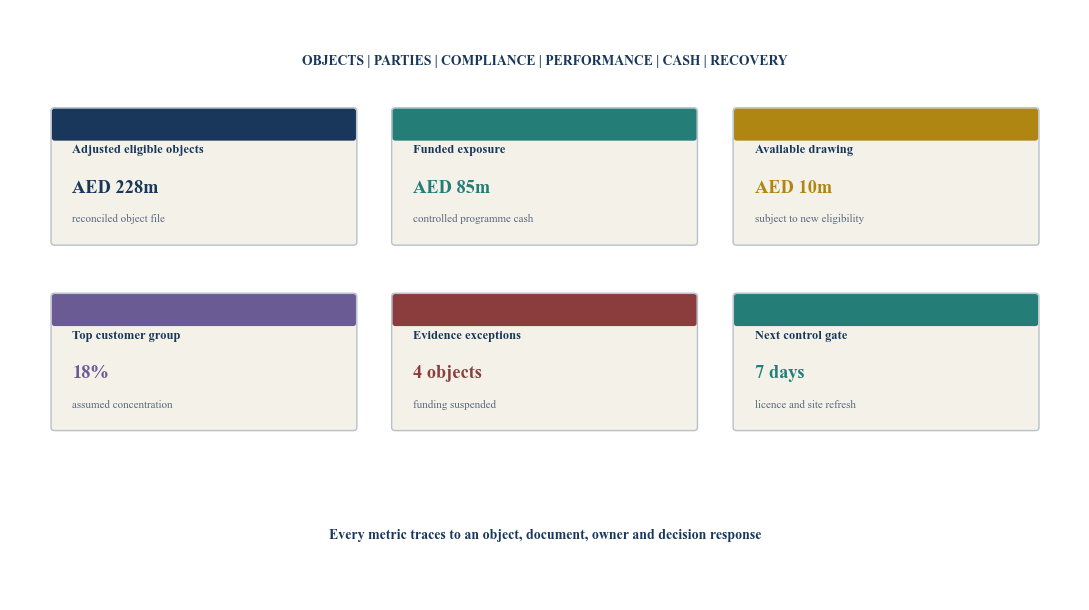
Every displayed value is a hypothetical management assumption created solely to demonstrate the dashboard design.
19. Implement the programme in 120 days
Days one to twenty define the approved segments, finance objects, jurisdictions, parties, professional perimeter, credit policy and governance. The team identifies source systems and preserves a document sample for each proposed category.
Days twenty-one to forty build the object-level data model, eligibility rules, customer and supplier grouping, product taxonomy, end-use fields, site dependencies and cash map. Credit, compliance, operations and technical reviewers validate the population.
Days forty-one to sixty design category advance rates, reserves, concentration limits, covenants, controlled accounts, legal structure and reporting. The team reproduces the borrowing base from source evidence and tests duplicate, substitution and missing-data controls.
Days sixty-one to eighty run connected stresses, obtain current legal and technical opinions, review recovery routes and conduct pilot diligence. The committee approves or revises the target programme based on verified evidence.
Days eighty-one to one hundred prepare facility documents, security, accounts, insurance, conditions, agent procedures, monitoring and exception workflows. Operations performs a dry run from funding request to controlled collection and paydown.
Days one hundred and one to one hundred and twenty close the approved structure, fund a controlled pilot, reconcile every object and activate reporting. The committee reviews actual cycle time, exceptions, cash, dilution, evidence quality and recovery readiness before scaling.
Table 6. One-hundred-and-twenty-day AI supply-chain finance programme
| Days | Workstream | Controlled deliverable | Gate |
|---|---|---|---|
| 1 to 10 | mandate and governance | approved segments, objects and decision owners | governing body confirms scope |
| 11 to 20 | perimeter and evidence | legal, compliance, technical and data map | reviewers confirm required evidence |
| 21 to 30 | object population | reconciled orders, assets, milestones and contracts | credit and operations validate sample |
| 31 to 40 | dependencies | customer, supplier, product, site and power links | concentration map is complete |
| 41 to 50 | borrowing base | eligibility, advance rates, reserves and caps | calculation is independently reproduced |
| 51 to 60 | structure and cash | security, accounts, payments and reporting | legal and treasury mechanics accepted |
| 61 to 70 | stress and recovery | connected scenarios and executable cures | downside remains funded and governable |
| 71 to 80 | pilot diligence | live object sample and exceptions | committee approves pilot population |
| 81 to 90 | documents and controls | conditions, covenants and monitoring | documentary control set is complete |
| 91 to 100 | operating dry run | request, evidence, funding, collection and paydown | independent observer confirms reconciliation |
| 101 to 110 | controlled closing | executed documents and first eligible draw | all conditions are evidenced |
| 111 to 120 | adoption | first report, lessons and scaling decision | committee accepts controlled operation |
Timing depends on the actual parties, documents, systems, permissions, regulation and professional review.
20. Limitations and conclusion
The AI supply chain changes quickly. Official rules, authorisations, technologies, product generations, supplier conditions, power schedules and customer requirements can change during an underwriting or facility period. The lender requires current evidence at each decision date.
The IEA scenarios describe energy and data-centre pathways rather than a forecast for a specific borrower or project.[1][2] NIST publications provide cybersecurity supply-chain and device-integrity guidance within their stated purpose.[5][6] United States export-control sources apply within their legal scope.[8][9] UAE strategy and policy documents provide national context.[3][4]. The CBUAE framework applies to licensed financial institutions within its scope.[10][11]
Every amount, rate, advance rate, probability, haircut, timing assumption, programme term and result in the worked example is a hypothetical management assumption. No borrower, customer, lender, manufacturer, project, authorisation, transaction or realised outcome is claimed.
Private credit can finance credible AI demand beyond a data-centre owner when it underwrites the exact cash claim and controls the path from order to cash. The essential disciplines are object-level evidence, party and end-use eligibility, provenance, acceptance, cash control, residual-value analysis, concentration mapping and executable cures.
The resulting programme treats the AI supply chain as a connected credit system. Capital follows verified de-risking events, portfolio limits reflect shared dependencies, and committee decisions remain traceable to current evidence.
References
- [1] International Energy Agency, Energy and AI, Executive Summary, 10 April 2025. https://www.iea.org/reports/energy-and-ai/executive-summary
- [2] International Energy Agency, Energy and AI, Energy Demand from AI, 10 April 2025. https://www.iea.org/reports/energy-and-ai/energy-demand-from-ai
- [3] UAE Government, UAE National Strategy for Artificial Intelligence 2031. https://ai.gov.ae/wp-content/uploads/2021/07/UAE-National-Strategy-for-Artificial-Intelligence-2031.pdf
- [4] UAE Artificial Intelligence Office, UAE Guiding Principles on AI Policy, October 2024. https://ai.gov.ae/wp-content/uploads/2024/10/UAE-Guiding-on-ai-policy-EN-V3.pdf
- [5] National Institute of Standards and Technology, SP 1326, Cybersecurity Supply Chain Risk Management: Due Diligence Assessment Quick-Start Guide, July 2026. https://csrc.nist.gov/pubs/sp/1326/final
- [6] National Institute of Standards and Technology, SP 1800-34, Validating the Integrity of Computing Devices, December 2022. https://csrc.nist.gov/pubs/sp/1800/34/final
- [7] United States Department of Energy, Powering AI and Data Center Infrastructure: Recommendations, July 2024. https://www.energy.gov/sites/default/files/2024-11/Powering%20AI%20and%20Data%20Center%20Infrastructure%20Recommendations%20July%202024.pdf
- [8] United States Department of Commerce, Department of Commerce Eases Export Controls on the UAE, 10 July 2026. https://www.bis.gov/press-release/department-commerce-eases-export-controls-uae
- [9] United States Bureau of Industry and Security, Export Administration Regulations, Part 740, current official regulations accessed 13 August 2026. https://www.bis.gov/regulations/ear/740
- [10] Central Bank of the UAE, Credit Risk Management Regulation, C 3/2024, effective 30 November 2024. https://rulebook.centralbank.ae/en/rulebook/credit-risk-management-regulation
- [11] Central Bank of the UAE, Credit Risk Management Standards, C 3/2024, effective 30 November 2024. https://rulebook.centralbank.ae/en/rulebook/credit-risk-management-standards
- [12] Central Bank of the UAE, Article 11: Portfolio Management and Internal Reporting, Credit Risk Management Standards. https://rulebook.centralbank.ae/en/rulebook/article-11-portfolio-management-and-internal-reporting-0
- [13] International Energy Agency, Energy and AI, AI and Energy Security, 10 April 2025. https://www.iea.org/reports/energy-and-ai/ai-and-energy-security
- [14] United States Department of Commerce, UAE and US Presidents Attend Unveiling of Phase 1 of New 5GW AI Campus in Abu Dhabi, 15 May 2025. https://www.commerce.gov/news/press-releases/2025/05/uae-and-us-presidents-attend-unveiling-phase-1-new-5gw-ai-campus-abu
- [15] National Institute of Standards and Technology, Cybersecurity Supply Chain Risk Management Practices for Systems and Organizations, SP 800-161 Rev. 1, May 2022. https://csrc.nist.gov/pubs/sp/800/161/r1/final
About the Author
Chennakeshav Adya is an independent researcher and Managing Partner of Matchpoint Partners. His research focuses on investment strategy, capital formation, transaction execution, governance and operating-model design across the Gulf and international markets.
