

1. Define the financing decision before choosing instruments
The financing decision is whether the buyer can pay the purchase price, fund the acquired business, withstand correlated downside and move cash to each obligation when due. Instrument selection should follow this decision. A low headline margin has limited value when the borrower lacks access to operating cash, the security cannot be perfected or an exchange-rate move consumes the equity reserve.
The board should approve the acquisition currency, maximum all-in cash commitment, minimum equity, maximum debt service, required liquidity, acceptable hedge loss, security perimeter, permitted guarantees, upstreaming assumptions and refinancing deadline. It should identify the evidence needed at indicative offer, signing, closing and each post-close funding release.
The decision should distinguish funds certainty from economic resilience. A committed facility can finance completion while an inflexible repayment profile destabilises the business later. Conversely, a conservative operating structure can fail if the buyer has not controlled signing-to-closing currency or satisfied conditions precedent.
The approval record should include pause conditions. These can include an unhedgeable purchase-price exposure, missing guarantee capacity, unenforceable collateral, an unsupported interest deduction, a prohibited distribution, a covenant breach in the central case or reliance on discretionary cash transfers for scheduled debt service.
2. Use the Europe-to-GCC Acquisition Finance Control Framework
The framework has eight connected gates: total uses, currency exposure, borrower and debt location, security and guarantees, tax capacity, cash mobility, downside resilience and operating control. Each gate produces evidence, an owner, a decision, a funding consequence and a fallback. A transaction remains open until the board can trace cash from committed source to final obligation.
The framework separates four ledgers that are often combined incorrectly. The transaction ledger records purchase price, fees and refinancing. The operating ledger records cash generated and retained in each legal entity. The financing ledger records interest, principal, hedges and covenants. The distribution ledger records lawful dividends, interest, service fees, capital reductions and other permitted movements.
Each ledger should reconcile by entity, currency and date. A euro amount available in an operating subsidiary cannot automatically satisfy a United States dollar obligation at a Gulf holding company. Legal ownership, bank control, distributable reserves, withholding tax and regulatory approvals can interrupt the path.
The framework remains active after closing. Actual exchange rates, interest, working capital, cash balances, covenant headroom and distribution capacity should update the original underwriting. Deviations should trigger pre-agreed liquidity, hedge, capital or refinancing actions before a payment failure.
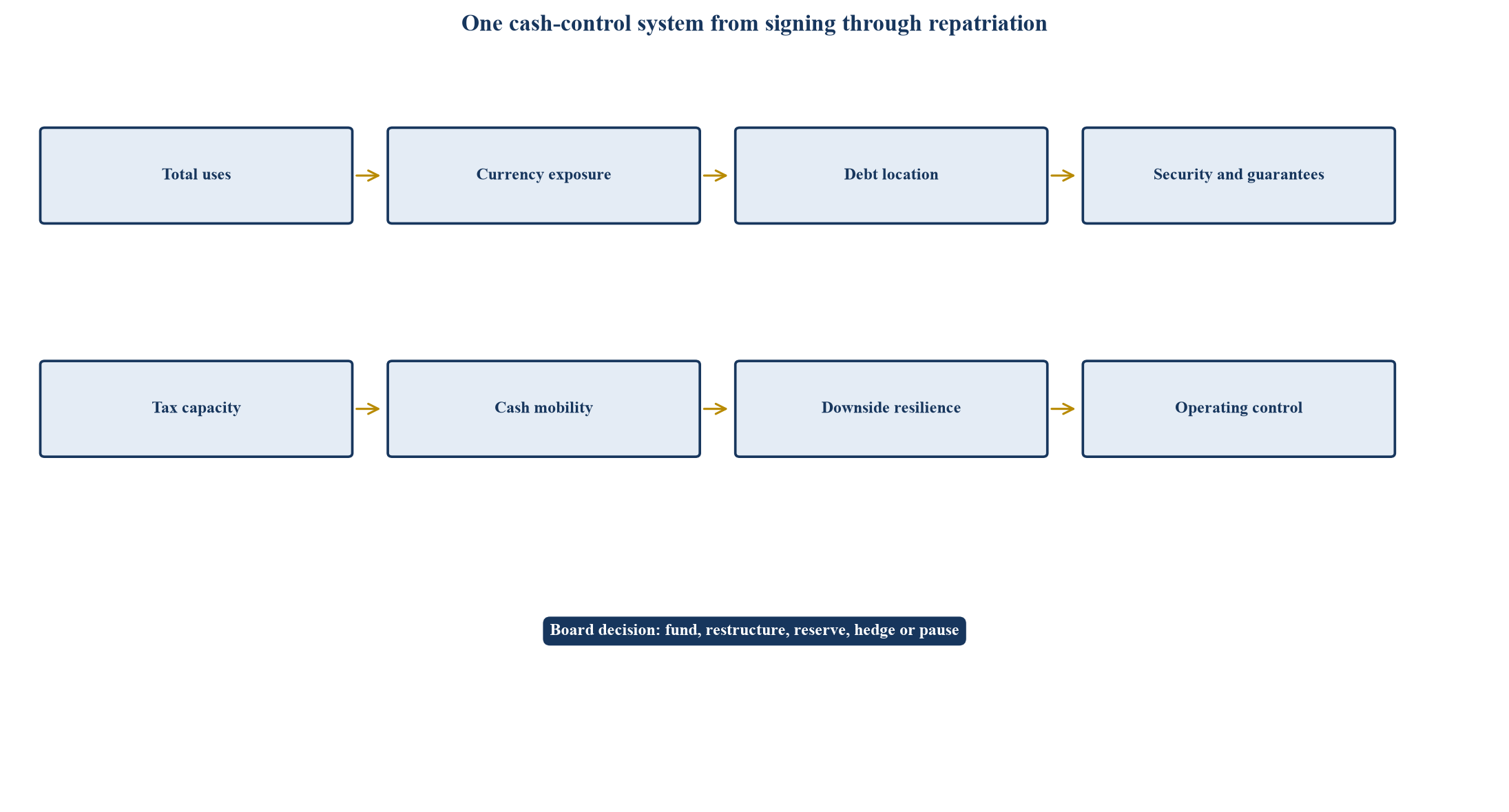
Funding certainty, enforceable control and cash mobility should be approved as one system.
3. Build a complete uses schedule
The uses schedule should extend beyond enterprise value. It should include equity purchase price, refinancing of target debt, transaction taxes, lender fees, hedging cost, adviser fees, separation expenditure, integration expenditure, minimum cash, working-capital support, regulatory capital, pension funding and contingency. Each use needs a currency, entity, due date and evidence source.
Debt-like and cash-like items should reconcile to the purchase agreement. Factoring, leases, guarantees, customer advances, overdue capital expenditure, accrued bonuses, tax balances and trapped cash can alter equity value and funding. The finance model and legal definitions should use the same perimeter.
The schedule should distinguish completion uses from post-close commitments. A delayed technology migration or regulatory remedy can require cash after the acquisition facility has been drawn. These amounts need committed sources or reserved equity rather than an assumption that the acquired business will self-fund immediately.
The board should approve maximum all-in uses, not only maximum enterprise value. Every bid revision should update fees, hedge exposure, financing availability, taxes and liquidity. This prevents a price increase from consuming the cash intended to make the acquisition operable.
| Uses | EUR m | Sources | EUR m |
|---|---|---|---|
| Enterprise value | 420 | Buyer equity | 240 |
| Refinance existing debt | 70 | Senior term debt | 210 |
| Fees and transaction taxes | 18 | Seller financing | 40 |
| Separation and integration | 17 | Transition and liquidity facility | 50 |
| Opening liquidity and contingency | 15 | Total sources | 540 |
| Total uses | 540 | Funding surplus or deficit | 0 |
All amounts are illustrative management assumptions in EUR millions and may reflect rounding.
4. Separate commitment currency from economic currency
The acquisition has several currency exposures. The purchase agreement creates a commitment currency. Debt creates interest and principal currencies. The target creates revenue, cost, tax and capital-expenditure currencies. The buyer creates a reporting and equity currency. These exposures should be mapped separately because a single hedge ratio cannot resolve all of them.
A UAE buyer may report in dirhams while the dirham is fixed against the United States dollar. CBUAE describes the intervention framework used to maintain the peg.[4][5] A euro purchase price therefore creates a euro-dollar economic exposure for dirham-funded equity. European operating cash can provide a natural hedge for euro debt, subject to cash mobility.
The exposure register should state amount, start date, expected settlement, probability, accounting treatment and cancellation consequence. It should distinguish signed exposure, forecast exposure, debt exposure and net-investment exposure. The board should know which movements affect purchase price, profit and loss, reserves, covenant ratios and distributable cash.
The finance team should avoid netting exposures merely because they use the same currency. Cash at an operating subsidiary may be unavailable to the acquisition borrower. Legal access and timing determine whether an economic offset is a usable hedge.
5. Control signing-to-closing foreign-exchange risk
Signing can create a large contingent currency commitment before ownership transfers. The buyer should measure the purchase-price exposure after committed same-currency debt and identify the remaining equity and fee exposure. Closing probability, long-stop date, regulatory milestones and termination rights affect the hedge design.
Available instruments can include forwards, options, collars and deal-contingent hedges. A forward fixes value but can create break cost if the transaction fails. An option preserves participation and limits loss in exchange for premium. A deal-contingent instrument aligns settlement with completion but embeds pricing, documentation and counterparty conditions. Qualified treasury and accounting advisers should assess the instrument.
The board mandate should define authorised counterparties, notional, tenor, permitted products, collateral, credit limits, accounting objective, amendment authority and reporting. The hedge should reference the purchase agreement's currency, expected completion date and adjustment mechanics.
The team should test delayed closing, reduced consideration, termination and counterparty default. It should also establish who funds margin or break cost and whether that amount ranks within the maximum transaction commitment.
6. Match debt currency to accessible cash flow
Debt denomination should follow the currency of cash available to service it, not the buyer's preferred reporting currency. Euro debt can reduce translation exposure when the target generates accessible euro cash. It can increase fragility when earnings are generated in sterling, dollars or emerging-market currencies or when cash remains trapped below the borrower.
The model should separate operating currency, invoice currency and collection currency. A company can report euro revenue while customer contracts, procurement and working capital create different cash exposures. Currency clauses, transfer pricing and hedging cost affect the actual debt-service capacity.
Debt can also sit at different levels. Acquisition debt at BidCo depends on upstream distributions. Operating debt at local entities may have direct access to cash and collateral but compete with working-capital needs. Parent debt can offer flexibility while exposing the GCC balance sheet to target risk.
The approved structure should state why each debt currency and borrower has a reliable repayment route. Natural hedges should be supported by legal access, not only consolidated financial statements.
7. Choose the borrower and funding path deliberately
The structure may include a GCC parent, a regional holding company, a European acquisition vehicle and multiple operating subsidiaries. Every entity should have a defined purpose, funding source, tax residence, substance, governance, bank account, liabilities and route to repay or distribute cash.
The funding path should document equity subscriptions, shareholder loans, external debt, seller financing and post-close contributions. It should identify currency conversion, bank processing, know-your-customer evidence, regulatory notifications and transaction-document conditions. Funds should not move through dormant or unsupported entities merely because the path appears tax efficient.
The borrower should own sufficient assets or rights to support its obligations. A pure acquisition vehicle may depend entirely on dividends from the target. The debt model should therefore test distribution restrictions, upstream guarantee capacity and the timing of completion accounts before assuming cash service.
The organisation chart should distinguish legal ownership from cash control. Directors of each company retain duties under applicable law. Board and shareholder approvals should reflect the entity's interests and the transaction's actual benefits and risks.
8. Design the senior debt around cash resilience
Senior debt should be sized from cash available for debt service after tax, maintenance capital expenditure, working capital, lease payments and unavoidable separation expenditure. EBITDA can support comparison, but repayment comes from cash. Lenders should receive reconciled historical information, a standalone model, liquidity forecast and downside analysis.
ECB's second-quarter 2026 SAFE reported further tightening in bank-loan interest rates and other conditions for euro-area firms.[1] The July 2026 bank lending survey reported moderate tightening of credit standards and terms for enterprise lending.[2] These observations support current market context; they do not determine the terms available to a specific borrower.
The term sheet should cover margin, reference rate, amortisation, maturity, cash sweep, covenant definitions, permitted debt, acquisitions, distributions, disposals, hedging, information and cure rights. A revolving facility should remain available during the stress it is intended to cover.
The model should include fees, floors, commitment cost and hedge settlements. Refinancing risk should appear before maturity through a tested readiness timetable and market-access conditions.
9. Integrate seller financing and deferred consideration
Seller financing can reduce closing cash and align the seller with transition. Its value depends on subordination, maturity, interest, payment blockage, security, set-off, transferability and interaction with senior debt. A seller note that accelerates during operating stress can weaken the buyer's liquidity.
Deferred consideration and earn-outs should use verifiable metrics and complete currency rules. The documents should state calculation, accounting hierarchy, conduct obligations, information rights, dispute process, tax treatment, funding and settlement currency. The buyer should model the payment as a cash obligation rather than treating it as value-neutral.
The intercreditor agreement should allocate payment priority, enforcement, standstill, amendments and recoveries. Senior lenders may restrict payments to the seller. The seller may require security or information that conflicts with the senior package. These issues should be resolved before signing.
The board should include seller instruments in leverage, fixed-charge and liquidity analysis according to economic substance. Deferral changes timing; it does not eliminate the obligation.
10. Establish a lawful and enforceable security perimeter
The security package should identify shares, bank accounts, receivables, material contracts, movable assets, real estate, intellectual property, insurance proceeds and intercompany claims by legal owner and jurisdiction. Each item needs a security type, governing law, perfection step, filing, priority, control arrangement and enforcement path.
EU rules facilitate certain cross-border uses of cash and securities as financial collateral, including enforcement and conflict-of-law certainty within their scope.[13] The availability of that framework does not replace local analysis for shares, receivables, real estate, intellectual property or operating assets. Rome I addresses the law applicable to contractual obligations, while proprietary and insolvency questions can follow separate rules.[14]
The lender should understand whether collateral is essential to operations, subject to licences, co-owned, leased or restricted by contract. Value should reflect enforceability, transferability, priority, tax and continuity cost. A nominally comprehensive pledge can have limited recovery value.
Closing evidence should include executed documents, filings, notices, account controls, legal opinions where appropriate and a post-closing perfection register. Unfinished security should have a deadline, owner and consequence.
11. Test guarantee capacity and corporate benefit
An upstream or cross-stream guarantee can connect operating cash and assets to acquisition debt. It can also expose an operating company to obligations incurred for another entity's acquisition. The analysis should therefore identify corporate benefit, financial-assistance restrictions, director duties, solvency, capital maintenance, minority interests, works-council issues, regulated-entity limits and required approvals in every jurisdiction.
The benefit memorandum should describe what the guarantor receives, such as capital, refinancing, group access or operational support. It should quantify the maximum obligation and show that the company can meet liabilities after granting the guarantee. Generic group-benefit language is weak evidence when the operating entity assumes substantial risk.
Guarantee limitations may use agreed caps, whitewash procedures, limitation language or excluded assets. Qualified local counsel should determine their operation and enforceability. The finance model should reflect the actual guarantee perimeter rather than assuming unrestricted recourse.
The board should distinguish support that is legally available, support that requires future conditions and support that is prohibited or commercially unacceptable. Scheduled debt service should rely on the first category.
12. Protect working capital from acquisition leverage
Working capital is the operating company's first liquidity requirement. Acquisition financing should not drain cash needed for payroll, suppliers, tax, inventory, customer commitments and maintenance. The opening plan should model seasonality, first payroll, deposits, insurance, customs, delayed receivables and the loss of seller treasury arrangements.
Facilities should distinguish acquisition debt, revolving liquidity, receivables finance, guarantees and local overdrafts. Each has different availability tests, security, borrowing bases, pricing and repayment mechanics. A cash sweep should preserve agreed minimum liquidity and necessary capital expenditure before upstreaming excess cash.
The buyer should test whether target cash is legally and operationally available at closing. Cash in restricted, regulated, joint-venture or foreign subsidiaries may be excluded from completion accounts or unavailable for acquisition debt. Customer advances and factoring balances can also have a cash-like presentation with debt-like obligations.
The board should approve a minimum liquidity floor by entity and currency. Breach should trigger restrictions on distributions, discretionary capital expenditure and seller payments before it becomes a payment default.
13. Build an integrated hedge architecture
The hedge architecture should connect purchase-price currency, floating interest, operating currencies, intercompany balances and planned distributions. Each exposure needs a designated owner, instrument, notional, maturity, counterparty, settlement account and accounting treatment. Separate exposures should not be combined unless their timing and legal cash access align.
Interest-rate protection can use swaps, caps or a blended structure. A static swap can become over-hedged when debt amortises, is prepaid or refinanced. The notional schedule should follow expected debt while retaining enough flexibility for downside and voluntary repayment.
Foreign-exchange hedges should distinguish transactional cash flows from translation of a net investment. IFRS 9 establishes requirements for financial instruments and hedge accounting; qualified accounting advice should assess designation, effectiveness and reporting for the actual instruments.[15]
The hedge policy should address collateral and liquidity. A hedge that limits economic exposure can create margin calls or break costs before the protected cash is received. Treasury reporting should show both value and cash consequences.
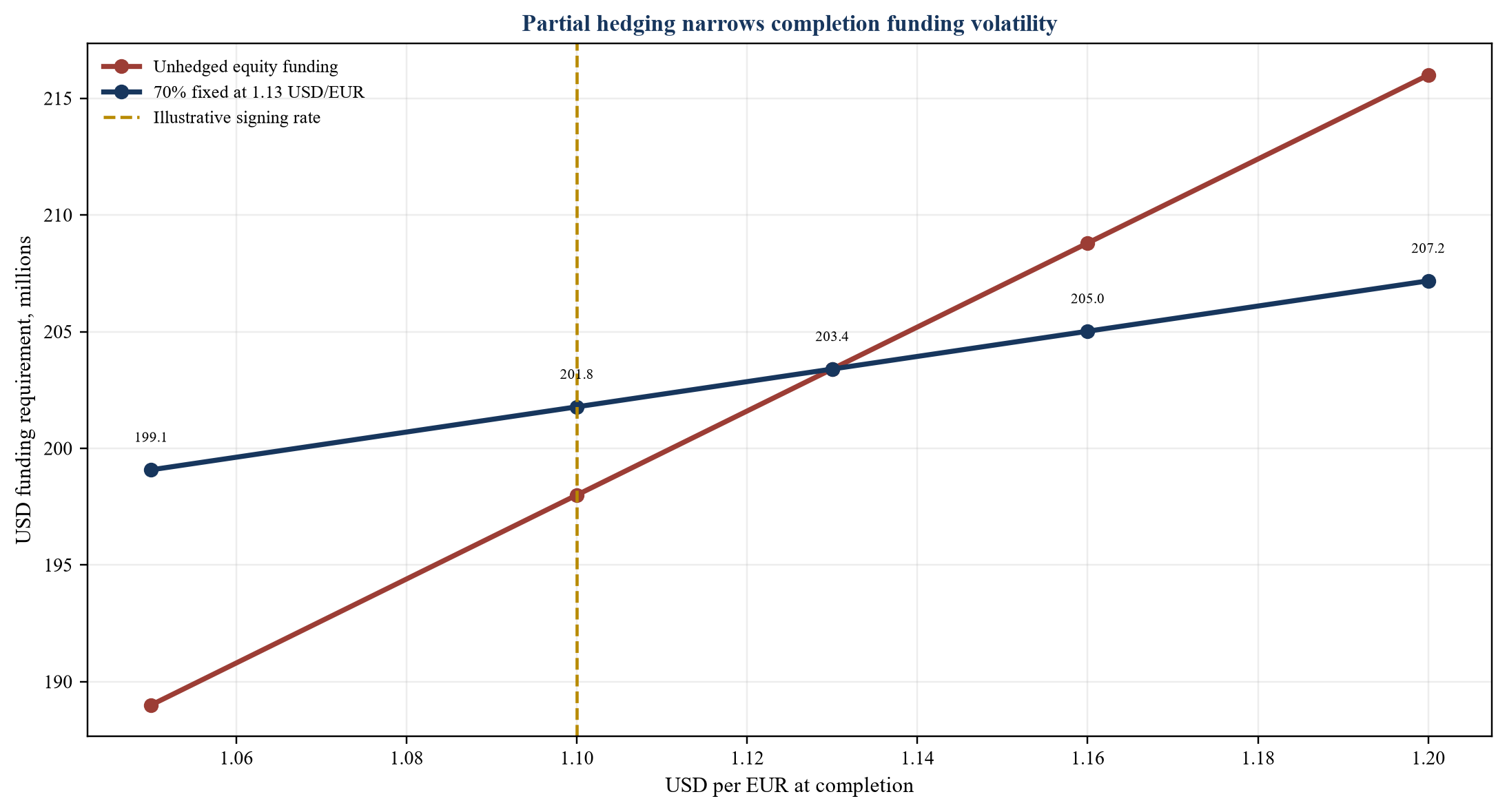
The remaining EUR 180 million equity exposure is partly hedged; all rates and amounts are illustrative management assumptions.
14. Align hedge documentation with transaction documents
The hedge should use the same amount definitions, completion conditions, currencies and dates as the purchase agreement and debt documents. A mismatch between the transaction's adjustment mechanics and the hedge notional can create an unintended residual exposure at closing.
The treasury confirmation should identify settlement method, disruption events, termination events, break-cost calculation, collateral, tax, representations and governing law. Deal-contingent structures should define precisely which completion event activates settlement and how amendments or partial completion are treated.
The buyer should establish authority to amend or close hedges as transaction probability changes. Regulatory delay, remedy, price adjustment and financing change can alter notional and timing. A daily exposure record should reconcile the purchase agreement, lender commitment, hedge confirmations and available equity.
Closing procedures should synchronise currency purchase, debt draw, equity funding and consideration payment. Bank cut-off times, value dates, settlement accounts and fraud controls require rehearsal. A financially sound transaction can still fail operationally when funds arrive late or to the wrong account.
15. Model tax capacity before relying on interest deductions
Acquisition interest can reduce taxable profit only when the borrower, instrument, purpose and applicable rules support deduction. The EU Anti-Tax Avoidance Directive establishes an interest-limitation rule based on exceeding borrowing costs and EBITDA, subject to national implementation and permitted options.[10] OECD Action 4 provides related policy guidance on base-erosion risks involving interest.[11]
The model should therefore separate accounting interest, cash interest and deductible interest by entity and year. It should test standalone limitations, group ratios, carryforwards, anti-hybrid rules, transfer pricing, debt-equity characterisation and changes after integration. National rules and treaties require current qualified advice.
Shareholder loans and acquisition debt should have commercial terms, legal substance and a credible repayment path. Capitalisation, subordination and guarantee support affect both financing and tax analysis. A tax benefit should not be treated as cash until timing and utilisation are supported.
The board should compare structures on after-tax cash and resilience. A higher nominal deduction can be outweighed by withholding tax, trapped losses, foreign-exchange exposure or restricted distributions.
16. Map withholding tax and treaty evidence
Cross-border interest, dividends, royalties and service payments can attract withholding tax in the source jurisdiction. The rate can depend on domestic law, treaty eligibility, beneficial ownership, residence certificates, substance, payment character and filing procedure. The cash model should show gross payment, tax withheld, relief timing and recoverability.
The EU Parent-Subsidiary Directive addresses qualifying distributions between eligible EU companies; it does not automatically apply to a direct distribution to a GCC parent.[9] The OECD Model Tax Convention provides a framework used in bilateral treaty negotiations, while the operative result depends on the relevant treaty and facts.[12]
Saudi ZATCA guidance addresses withholding on payments to non-residents, including dividends and debt-claim income, and the use of double-taxation agreements.[19][20] UAE Ministry of Finance guidance states that the current UAE withholding-tax rate for relevant non-resident income is zero, subject to the governing law and facts.[8]
The closing data room should contain ownership charts, residence evidence, financing documents, payment classifications and treaty forms. Missing evidence can delay or increase cash tax even when relief may ultimately be available.
17. Test participation exemption and distribution character
A GCC parent may expect dividends and disposal gains to receive favourable tax treatment. The UAE Corporate Tax Law and the participation-exemption decision establish conditions relevant to qualifying ownership interests and distributions.[6][7] The transaction team should test the actual holding, duration, subject-to-tax, classification and anti-abuse conditions with qualified advisers.
Distribution character matters. A dividend, interest payment, management fee, royalty, capital reduction, loan repayment or return of capital can have different company-law, accounting, tax and covenant consequences. The legal documents, invoices and accounting records should reflect the same substance.
The model should avoid assuming that consolidated profit equals exempt distributable cash. Local losses, reserves, impairments, reorganisation steps and financing deductions can alter both capacity and treatment. A holding company also needs sufficient substance and governance for its functions.
The board should receive an entity-by-entity after-tax cash bridge. Any benefit dependent on future elections, rulings, residence or restructuring should remain a scenario until the evidence is complete.
18. Prove distributable reserves and lawful dividends
A profitable group can lack distributable reserves at the entity that must pay a dividend. The analysis should begin with local statutory accounts, capital-maintenance rules, accumulated losses, legal reserves, solvency tests, audit status, interim-account requirements and board or shareholder approvals.
The distribution calendar should state the earliest lawful date, evidence, approving body, bank process and expected receipt. It should account for annual accounts, interim accounts, audit, lender consent and regulatory notice. A debt model requiring quarterly upstreaming cannot rely on an annual dividend process without another liquidity source.
The buyer should distinguish retained operating liquidity from legally distributable profit. Cash needed for tax, payroll, working capital, maintenance and regulatory capital should remain protected even when a dividend is technically permitted.
Alternative routes such as interest, service fees, loan repayment or capital reduction require their own legal, tax, transfer-pricing and covenant analysis. They should not be inserted after closing as an improvised substitute for an unworkable dividend plan.
| Route | Core evidence | Principal constraint | Control response |
|---|---|---|---|
| Dividend | Distributable reserves, approvals and tax status | Timing, losses or covenant restriction | Forecast and pre-clear distribution calendar |
| Interest | Debt instrument, pricing and deduction support | Withholding tax or interest limitation | Gross-up and after-tax debt model |
| Service fee | Actual service, benefit and transfer pricing | Recharacterisation or non-deductibility | Contract, evidence and invoice controls |
| Loan repayment | Valid principal balance and payment capacity | Subordination or cash lock-up | Intercompany ledger and consent register |
| Capital reduction | Company-law process and creditor protection | Long timetable or regulatory approval | Use only as planned structural route |
| Cash pooling | Account authority and legal participation | Set-off, insolvency or trapped cash | Entity limits and daily reconciliation |
Every route requires current jurisdiction-specific legal, tax, accounting and banking confirmation.
19. Build a cash-repatriation waterfall
The waterfall should begin with operating cash at each subsidiary and deduct protected liquidity, local debt service, tax, capital expenditure, pension, regulatory capital and other mandatory reserves. It should then apply legal distribution capacity, lender restrictions, withholding tax, bank processing and holding-company obligations.
The output is cash actually available at the acquisition borrower or GCC parent on a stated date. This amount can differ materially from consolidated free cash flow. The model should show the source entity, payment route, currency, gross amount, deduction, net receipt and documentary condition.
The waterfall should operate monthly during the first year and at least quarterly thereafter. It should identify cash that is unrestricted, restricted, distributable, pending approval or unavailable. Forecast error should update revolver needs and covenant headroom.
Management should reconcile actual payments to the approved route. Unexpected local cash accumulation can signal working-capital improvement, delayed investment or blocked distribution. The cause determines whether the value is available to lenders or shareholders.
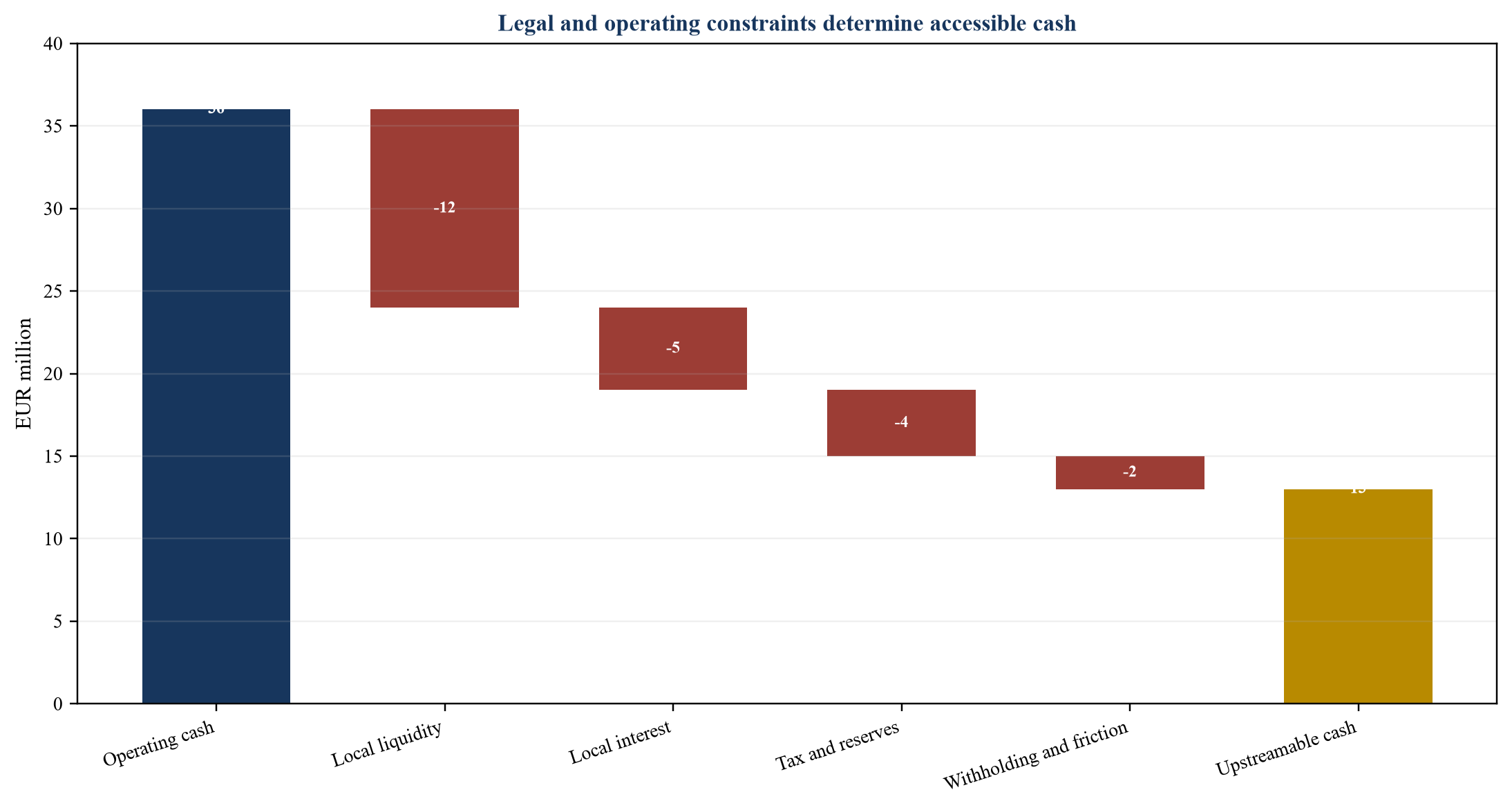
All amounts are illustrative management assumptions in EUR millions.
20. Govern cash pooling and intercompany funding
Cash pooling can improve visibility and reduce idle balances. It also creates intercompany claims, set-off exposure, transfer-pricing questions, insolvency risk and possible restrictions in regulated or minority-owned entities. Each participant should have authority, benefit, limits and documented terms.
The policy should distinguish physical sweeping, notional pooling and information-only visibility. It should define minimum balances, overdraft limits, interest, currencies, participating accounts, cut-off times, emergency access and termination. Restricted funds should remain outside the pool.
Intercompany funding should reconcile legal agreements, bank records and accounting ledgers. Currency, interest, maturity, subordination and repayment should match the financing model. Repeated informal transfers can obscure structural leverage and create disputes over beneficial ownership or tax.
The treasury team should report gross cash, gross debt and net pool positions by entity. Consolidated net cash can conceal an entity that cannot pay its own obligations. Directors and finance leaders need entity-level liquidity before approving a sweep or distribution.
21. Integrate sanctions, anti-money-laundering and bank execution
Cross-border funding and repatriation require banks to understand ownership, source of funds, purpose, counterparties and payment routes. The transaction team should prepare a bank-ready evidence pack covering the ownership chain, purchase agreement, financing, approvals, tax basis, invoices and authorised accounts. Late requests can delay completion or distributions.
Sanctions, export controls and anti-money-laundering obligations should be assessed for the buyer, sellers, lenders, counterparties, customers, jurisdictions and payment banks. The European Commission's blocking-statute materials also illustrate how conflicting legal regimes can affect EU operators.[18] Qualified counsel and regulated institutions should determine the applicable requirements.
Payment controls should use verified account details, dual approval, independent callback, protected communications and change detection. Transaction periods create elevated fraud risk because large payments, new parties and compressed timetables coincide.
The funding plan should identify alternative banks and escalation routes while avoiding attempts to circumvent a control. A delayed payment needs a lawful, documented resolution. The closing committee should know the last safe decision time for each currency and bank channel.
22. Define covenants from the actual cash system
Covenants should use definitions that reflect the transaction's legal and operating structure. EBITDA, net debt, cash, permitted distributions, acquisitions, disposals, capital expenditure and exceptional items need clear treatment. The model should reproduce the agreement calculation rather than using a management approximation.
Financial covenants may include leverage, interest cover, debt-service cover, minimum liquidity and capital measures. Information and undertaking covenants can govern hedging, security, bank accounts, distributions, tax, guarantees and post-closing perfection. Each should have an owner, evidence source, test date, forecast and cure route.
The board should maintain headroom above the contractual threshold. A covenant can remain technically compliant while liquidity weakens. Management triggers should activate earlier restrictions on distributions, seller payments, discretionary capital expenditure or acquisitions.
The reporting pack should bridge management accounts to covenant calculations and lender certificates. Changes in accounting policy, acquisitions, disposals or restructuring should follow the agreement's adjustment process. Consistent evidence reduces disputes and supports refinancing.
23. Construct the hypothetical financing case
The hypothetical acquisition has enterprise value of EUR 420 million. Total uses are EUR 540 million after EUR 70 million of target-debt refinancing and EUR 50 million of fees, transaction taxes, separation, integration and opening liquidity. Sources comprise EUR 240 million of buyer equity, EUR 210 million of senior term debt, EUR 40 million of seller financing and EUR 50 million of committed transition and liquidity funding.
The central Year-Three case assumes EBITDA of EUR 72 million. Cash available for debt service is EUR 46 million after maintenance capital expenditure, tax and working-capital movement. Scheduled interest and principal are EUR 28 million, producing 1.64x debt-service coverage. These amounts are management assumptions.
The model isolates currency and cash mobility. EUR 210 million of same-currency senior debt reduces the purchase-price exposure. The illustrative remaining EUR 180 million equity exposure is 70 percent fixed at 1.13 USD per EUR and 30 percent left floating. The structure narrows currency volatility without claiming to eliminate it.
The operating subsidiaries generate an illustrative EUR 36 million of cash before upstream constraints. The central distribution bridge retains EUR 12 million of local liquidity and deducts EUR 11 million for local interest, tax, reserves and friction, leaving EUR 13 million available to the acquisition borrower.
| Measure | Central case | Correlated downside | Decision use |
|---|---|---|---|
| Enterprise value | 420 | 370 supportable value | Price discipline |
| Total uses | 540 | 560 including added liquidity | Equity reserve |
| Year-Three EBITDA | 72 | 55 | Operating resilience |
| Cash available for debt service | 46 | 28 | Debt capacity |
| Annual debt service | 28 | 31 | Fixed obligation |
| Debt-service coverage | 1.64x | 0.90x | Covenant and cure need |
| Upstreamable operating cash | 13 | 5 | BidCo liquidity |
| Minimum liquidity | 30 | 45 | Funding commitment |
Values and outcomes are illustrative management assumptions; amounts are EUR millions unless stated.
24. Run a correlated downside
The downside should combine events that can occur together. A weaker European market can reduce EBITDA and working-capital release while lenders tighten terms and interest rises. Regulatory delay can extend the signing-to-closing hedge. Integration delay can increase costs and defer distributions. Currency movement can increase parent funding at the same time.
The hypothetical downside assumes Year-Three EBITDA of EUR 55 million, cash available for debt service of EUR 28 million and debt service of EUR 31 million. Coverage falls to 0.90x. Upstreamable cash declines to EUR 5 million while minimum liquidity rises to EUR 45 million. These figures require an equity, covenant, amortisation or restructuring response before signing.
Each scenario should state cause, entity-level cash effect, currency effect, tax effect, covenant impact, management action and board trigger. Responses can include additional equity, revolver drawing, hedge adjustment, delayed seller payment, reduced distributions, capital-expenditure prioritisation and refinancing.
Reverse stress should identify the combination that exhausts liquidity or breaches covenant. The board can then set maximum price, minimum reserve, committed facility and walk-away conditions against a measurable boundary.
25. Protect debt service from trapped cash
Trapped cash can arise from distributable-reserve limits, lender blocks, regulatory capital, minority rights, tax disputes, sanctions controls, bank processing, exchange controls or operational liquidity needs. The model should classify each balance by restriction, expected release date, approval and alternative use.
Debt service at BidCo should have a reserve or committed liquidity sized to the distribution timetable and downside. The structure should avoid relying on a same-day dividend from an entity whose accounts, approvals or bank transfer can be delayed.
Cash-trap triggers should appear in lender and board reporting. These can include lower covenant headroom, missing tax certificates, overdue audit, disputed reserves, regulatory inquiry, blocked account or deteriorating working capital. Early visibility allows refinancing or equity action.
Management should not move cash merely to improve a parent metric. Local entities need solvent, funded operations. An upstream payment that weakens payroll, suppliers, compliance or customer delivery destroys the value meant to support debt.
26. Convert diligence into financing conditions
Financing diligence should produce conditions, pricing, reserves, covenants and actions. A missing share certificate may become a security condition. An uncertain tax deduction may reduce debt capacity. A delayed licence may require liquidity. A restricted subsidiary may be excluded from guarantee and cash-flow calculations.
The conditions-precedent register should identify document, responsible party, form, reviewer, due date and waiver authority. It should separate transaction conditions, financing conditions, regulatory approvals, security perfection, hedging, bank onboarding and funds flow.
Post-closing conditions require equal discipline. Security filings, account control, tax registrations, intercompany agreements and refinancing can remain open after completion. Each should have a deadline, interim control and consequence. Lenders and management should receive a common completion record.
The board should approve waivers that change economic risk. A documentation waiver can alter security, cash access or priority. It should show quantified exposure, fallback and expiry rather than appearing as an administrative exception.
27. Prove closing funds flow
The funds-flow statement should list every payer, payee, bank account, currency, amount, purpose, timing and documentary condition. It should reconcile sources and uses, completion accounts, lender drawdowns, equity contributions, hedge settlements, fees, taxes, debt repayment and retained cash.
Account details should be verified independently. The closing team should use version control, dual approval and a final locked statement. Changes after lock require documented authority and renewed verification. Payment references and confirmations should support the closing record.
The parties should run a rehearsal covering bank cut-off times, currency value dates, time zones, same-day confirmation and failed-payment escalation. The buyer should know which payments are sequential and which can occur concurrently.
Completion evidence should include bank confirmations, release documents, debt discharge, security creation and purchase-price receipt. The accounting opening balance sheet should reconcile to the legal funds flow. Unreconciled amounts should remain on a controlled exception register.
28. Execute a treasury-led first 100 days
The first 100 days should secure cash visibility, account authority, payment controls, covenant reporting, hedge monitoring, tax calendars, distribution planning and lender communication. Treasury should establish daily balances and a thirteen-week cash forecast by entity and currency immediately after closing.
Management should confirm bank mandates, system permissions, signatories, payment templates, fraud controls and emergency funding. Seller treasury services should have clear scope, service levels and exit tests. The acquired company should understand where decisions sit under the new ownership.
The first covenant forecast and distribution calendar should use actual opening balances. The team should update financing fees, hedge values, interest, completion adjustments and working capital. Variances should change cash actions, not wait for the first formal reporting date.
At Day 100, the board should re-underwrite debt capacity, liquidity, hedge position, cash mobility and refinancing. It should revise reserves or capital where actual evidence differs from the transaction model.
29. Build an eighteen-month financing and repatriation roadmap
The roadmap should connect financing design, tax and legal analysis, lender diligence, hedging, approvals, documentation, funds flow, security, Day-One control, distribution proof and refinancing. Shared gates are necessary because change in one workstream can alter several others.
Pre-signing work should establish sources and uses, currency exposure, borrower structure, tax capacity and lender appetite. Signing-to-closing work should finalise commitments, hedges, security, bank onboarding, conditions precedent and funds flow. Post-close work should perfect security, stabilise cash, prove upstreaming and prepare refinancing.
Every gate should state the decision, evidence, owner, cash exposure and fallback. The programme should maintain an integrated issues register rather than separate tax, legal, treasury and lender lists that conceal dependencies.
Board reporting should focus on liquidity, hedge exposure, covenant headroom, trapped cash, distribution capacity and remaining conditions. Completion of documents is evidence only when the cash-control objective is achieved.
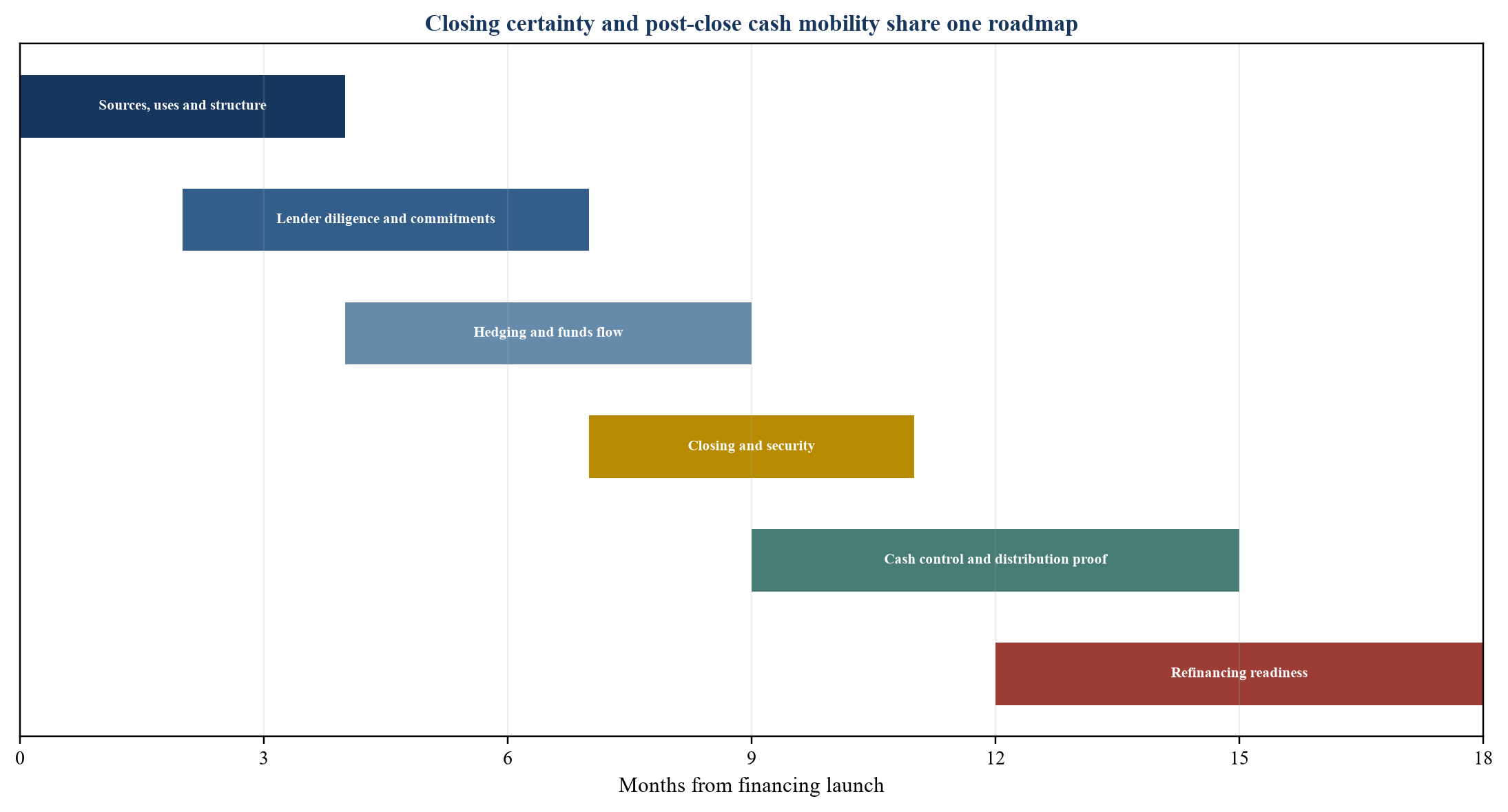
Transaction funding, control and cash mobility are governed through shared decision gates.
30. Define the financeable Europe-to-GCC transaction
A financeable transaction has complete uses, committed sources, controlled currency exposure, a viable borrower, enforceable security, lawful guarantees, supportable interest, sufficient liquidity, resilient covenants and a documented route for cash to reach every obligation. Weakness in one area should change price, equity, debt, reserve, condition or the decision to pause.
The final financing memorandum should include sources and uses, entity and currency maps, debt terms, hedge architecture, security and guarantee analysis, tax and withholding bridge, distributable-reserve evidence, cash-repatriation waterfall, downside, conditions precedent, funds flow, first 100 days and refinancing plan.
The board should approve maximum all-in uses, minimum equity, permitted debt, hedge limits, security perimeter, guarantee limits, minimum liquidity, distribution assumptions, covenant headroom and walk-away triggers. It should identify evidence requiring reapproval before signing, closing or a material post-close distribution.
Residual uncertainty should be explicit. A transaction can remain financeable when uncertainty is reserved, governed and monitored. It becomes fragile when consolidated cash is assumed to be accessible, tax benefits are treated as immediate cash or currency and refinancing risks are left outside the commitment decision.
| Gate | Required evidence | Approval decision | Pause signal |
|---|---|---|---|
| Total uses | Reconciled price, refinancing, fees and liquidity | Approve maximum cash commitment | Material unfunded post-close use |
| Currency | Exposure register and authorised hedge | Accept retained volatility | Break cost or funding exceeds limit |
| Debt | Cash-based capacity and downside | Approve instrument and borrower | Coverage depends on inaccessible cash |
| Security | Local perfection and enforceability analysis | Accept collateral perimeter | Critical priority or guarantee gap |
| Tax | Interest, withholding and distribution bridge | Approve after-tax structure | Benefit lacks evidence or timing |
| Cash mobility | Reserves, approvals and bank process | Accept upstreaming plan | Scheduled service relies on blocked cash |
| Closing | Tested funds flow and conditions register | Authorise completion | Funding or release evidence incomplete |
Each gate requires current evidence and a named decision owner.
Sources
- European Central Bank, Survey on the Access to Finance of Enterprises, second quarter of 2026. Read the primary source
- European Central Bank, July 2026 euro area bank lending survey. Read the primary source
- European Banking Authority, Guidelines on loan origination and monitoring. Read the primary source
- Central Bank of the UAE, Domestic Market Operations. Read the primary source
- Central Bank of the UAE, How the Monetary System Works. Read the primary source
- UAE Ministry of Finance, Federal Decree-Law No. 47 of 2022 on the Taxation of Corporations and Businesses. Read the primary source
- UAE Ministry of Finance, Ministerial Decision No. 116 of 2023 on the Participation Exemption. Read the primary source
- UAE Ministry of Finance, Corporate Tax in the UAE. Read the primary source
- European Commission, Parent-Subsidiary Directive. Read the primary source
- EUR-Lex, Council Directive EU 2016/1164 laying down rules against tax avoidance practices. Read the primary source
- OECD, Limiting Base Erosion Involving Interest Deductions and Other Financial Payments, Action 4, 2016 Update. Read the primary source
- OECD, Model Tax Convention on Income and on Capital. Read the primary source
- European Commission, Financial collateral arrangements. Read the primary source
- EUR-Lex, Regulation EC No. 593/2008 on the law applicable to contractual obligations, Rome I. Read the primary source
- IFRS Foundation, IFRS 9 Financial Instruments. Read the primary source
- European Commission, Foreign Subsidies Regulation overview. Read the primary source
- European Commission, Investment screening. Read the primary source
- European Commission, Extraterritoriality and the Blocking Statute. Read the primary source
- Saudi Zakat, Tax and Customs Authority, General Guideline for Withholding Tax. Read the primary source
- Saudi Zakat, Tax and Customs Authority, Withholding Tax Implementation Under Double Taxation Agreements. Read the primary source
