

1. Define the financing decision
The financing decision is how much capital an autonomous laboratory requires, which instruments fit each asset and which evidence should release funding. The analysis should determine whether the lab is research infrastructure, a service business, a software and data platform, a programme developer or a combination.
Self-driving laboratories can support materials, chemistry, biotechnology, formulation and other experimental domains. The scientific workflow can vary widely. A standard financing template should therefore begin with the specific question, experiment, output, customer and decision supported.
The lender or investor should identify which assets are available at closing, which must be built, and which future value depends on scientific success. Equipment, contracted services and speculative programme value should not share the same risk treatment.
Table 1. Financing layers in a self-driving laboratory
| Asset or value layer | Primary evidence | Cash or value source | Candidate capital |
|---|---|---|---|
| Robotics and instruments | Title, condition, commissioning and resale | Capacity and service delivery | Equity, lease or equipment finance |
| Integration software | Working interfaces, uptime and portability | Lower operating cost and usable capacity | Equity or venture debt |
| Experimental data | Rights, provenance, quality and reuse | Platform learning and customer value | Equity or strategic capital |
| Scientific models | Context, performance and monitoring | Better experiment selection and decisions | Equity and milestone capital |
| Contracted programmes | Signed scope, backlog and acceptance | Research fees and recurring use | Working capital or venture debt |
| Owned pipeline | Reproduced evidence and programme rights | Future licence or product economics | Equity and contingent capital |
Capital instruments should follow asset life, cash-flow visibility and evidence.
2. Define the autonomous loop
A self-driving laboratory connects goal definition, experiment selection, physical execution, measurement, interpretation and the next decision. Automation performs tasks. Autonomy closes the feedback loop so that evidence changes the next experimental choice under defined human governance.
NIST describes autonomous laboratories as systems in which algorithms select samples and characterisation within a feedback loop that seeks to maximise knowledge. NIST also notes that the technology is emerging across materials, chemistry and biosciences. The financing model should avoid assuming that a partial automation stack has full-loop economics.
The diligence team should map where human intervention remains necessary. Scientists can define objectives, resolve anomalies, maintain instruments and approve consequential changes. These activities create cost and capacity constraints and can provide essential quality control.
3. Map the experiment-to-decision cycle
The cycle begins with a scientific objective and an admissible design space. An algorithm selects an experiment. Robotics prepare and move samples. Instruments collect measurements. Software processes results. A model updates its state and proposes the next action. A scientist or governed system decides whether to continue, validate, scale or stop.
Each stage should have a time, capacity, failure code, quality gate and owner. The borrower should show end-to-end cycle performance rather than isolated robot speed. Queues can move from sample preparation to characterisation, analysis or human review.
The financing case should connect the cycle to a customer deliverable, programme milestone or owned asset. An experiment has limited economic meaning without that link.
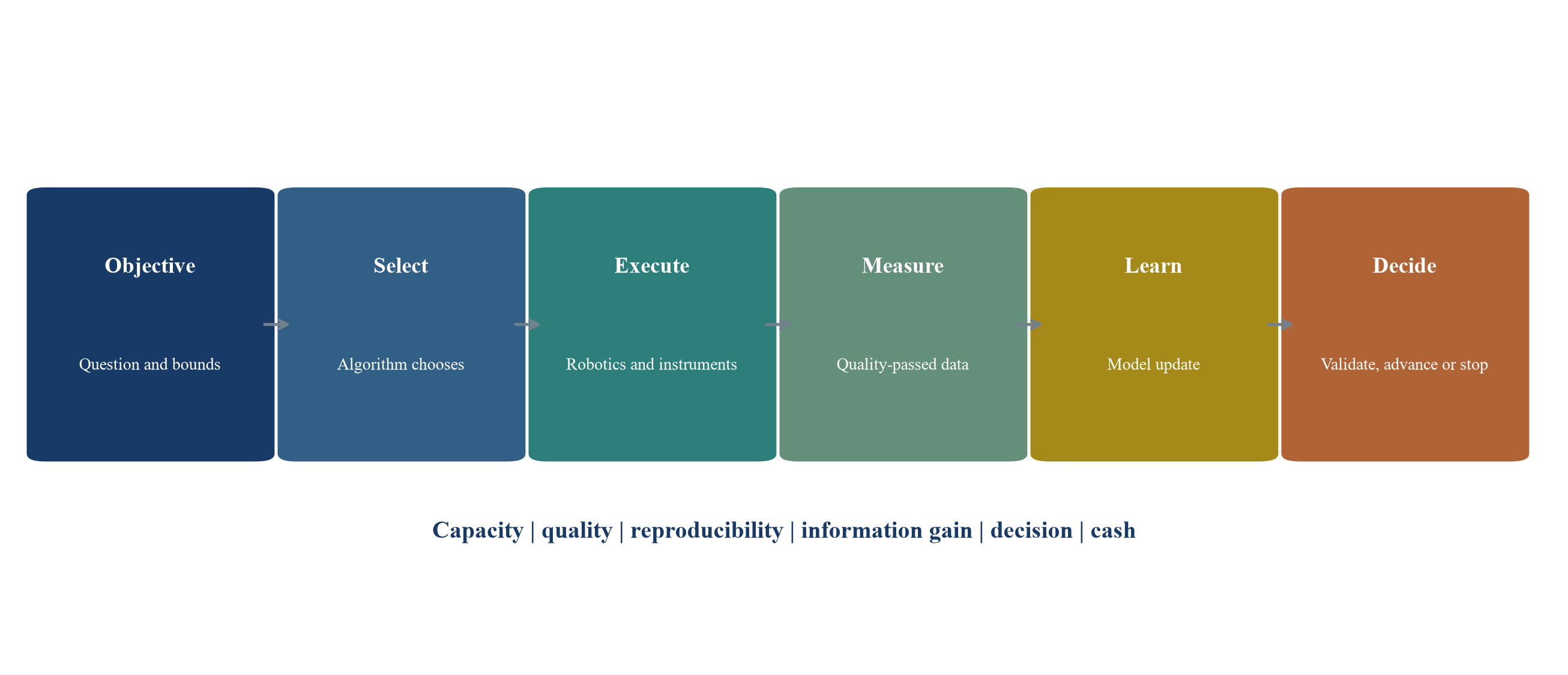
Activity becomes financeable output after quality, reproducibility and decision gates.
4. Classify the operating model
An autonomous laboratory can operate as internal R&D infrastructure, a fee-for-service facility, a programmable cloud lab, a collaboration platform or a proprietary discovery engine. Each model supports a different revenue and capital profile.
Internal infrastructure creates value through faster or better portfolio decisions. It may not generate external revenue. A service lab can produce backlog and cash while carrying utilisation and customer-concentration risk. A cloud lab can support remote and repeat users, subject to standardised workflows and reliable access. A proprietary engine depends on programme outcomes.
The borrower should allocate staff, equipment, data and cost across these uses. Shared capacity can improve economics and can create conflicts when owned programmes displace contracted work.
5. Build the physical asset register
The asset register should include robots, liquid handlers, reactors, furnaces, synthesis equipment, analytical instruments, sample stores, safety systems, servers, networking, fit-out and utilities. It should record title, serial number, age, condition, location, lien, warranty, maintenance and replacement plan.
Asset specificity affects collateral value. A standard instrument can have a secondary market. Custom integration and facility work can have limited recovery. Robotics may be removable while utilities and clean-room fit-out remain attached to the premises.
Equipment financiers should fund delivered and commissioned assets against verified invoices. Deposits, installation, validation and software can require equity or a controlled construction facility.
6. Underwrite integration risk
The laboratory depends on interfaces among robotics, instruments, scheduling, data systems and algorithms. NIST identifies sample management, instrument communication, data management and algorithm integration as areas requiring standards. Fragile custom interfaces can create operational and key-person risk.
The diligence team should inspect architecture, source control, testing, deployment, observability, access, vendor support and failure recovery. It should test whether instruments can operate safely if the orchestration layer fails.
Integration cost should be separated from equipment cost. Commissioning is an evidence milestone. A laboratory that has purchased hardware but has not completed end-to-end runs does not have usable financed capacity.
7. Measure installed and usable capacity
Installed capacity describes theoretical output under stated assumptions. Usable capacity accounts for setup, calibration, maintenance, changeover, cleaning, consumables, quality review and realistic product mix. Decision-linked capacity is lower again because results can fail quality or lack programme relevance.
The borrower should calculate capacity by bottleneck and workflow. One high-throughput preparation system can overwhelm a slower analytical instrument. A model can generate more experiments than the laboratory can execute. Human review can become the final constraint.
Financing covenants should follow quality-passed and accepted output. Experiment count alone can reward low-value repetition.
8. Define the experimental unit
The experimental unit should correspond to an independent intervention and decision-relevant observation. A well, image, spectrum or time point can be a measurement rather than an independent experiment. The denominator affects every throughput claim.
The lender should reconcile management metrics to laboratory records. It should identify cancelled, repeated, failed and manual runs. It should segment simple and complex workflows.
A governed experiment identifier should connect objective, protocol, materials, equipment, raw data, processing, model, quality and decision. This traceability supports both scientific reproducibility and borrowing-base control.
9. Measure quality-passed output
A completed run becomes usable after predefined controls and acceptance criteria are met. Criteria can address identity, calibration, contamination, signal, replicates, missingness, batch effects and instrument state. Failures should remain in the record.
The quality-pass rate should use all scheduled or initiated units under a clear rule. Excluding failed runs can overstate productivity. Rework consumes capacity and cash even when the final result passes.
The financing model should connect pass rate to revenue, consumables, labour and maintenance. Improvement assumptions should be supported by operating evidence.
10. Test reproducibility
Repeatability tests the same workflow under closely matched conditions. Reproducibility tests whether results persist across operators, instruments, sites or relevant methods. Both affect financeability because assets, staff and systems can change through the investment period.
The team should select high-value claims and observe blinded or pre-registered reruns. It should include successful and failed results. Acceptance ranges should follow the decision.
Reproducibility milestones can release capital or contingent consideration. The protocol should be agreed before the result is known and reviewed by a qualified party.
11. Measure information gain
Autonomous systems aim to select experiments that reduce uncertainty efficiently. Experiment volume can therefore be less important than information gain. A negative result can be valuable when it eliminates a large region of the design space.
The borrower should explain its acquisition function or selection rule in terms understandable to scientific and investment committees. It should compare expected and realised information gain. Uncertainty estimates can be poorly calibrated outside the model's training domain.
The model should connect information gain to an economic decision: candidate selection, formulation, process window, material property or stop decision. A metric without decision impact should not support valuation.
12. Distinguish demonstration from operating evidence
Peer-reviewed demonstrations establish technical feasibility under reported conditions. The A-Lab study, for example, reported 353 experiments over 17 days and realised 36 of 57 targeted inorganic materials using robotics, computation, literature-derived heuristics and active learning. This is important primary evidence for autonomous synthesis.
The result does not establish identical performance for another laboratory, scientific domain or commercial workflow. Diligence should verify the target's own objectives, materials, hardware, models, results and limitations.
Public demonstrations can also use focused campaigns and expert support that differ from routine service operations. Sustainable uptime, customer changeover and cost require separate evidence.
13. Evaluate workflow autonomy
Autonomy exists on a continuum. A piecewise workflow can require humans between experimental and computational steps. A semi-closed loop can automate selected connections. A closed loop can run goal-directed iterations without human intervention inside defined boundaries. A self-motivated system that defines its own scientific objectives remains an advanced concept.
The borrower should disclose the autonomy level by workflow. One laboratory can have several levels. Manual exception handling should be measured rather than hidden.
Greater autonomy can reduce labour and extend operating hours. It can also increase control, safety and validation requirements. The financing case should include both benefits and operating safeguards.
14. Audit scientific data rights
Experimental data can originate from customers, public sources, licensed databases, internal runs and collaborators. The rights register should cover collection, access, use, model training, derivatives, disclosure, retention and deletion.
Customer data can support a deliverable while reuse for general model training is prohibited. Academic or grant-funded data can carry sharing or publication requirements. Proprietary materials can have transfer restrictions.
Data value depends on provenance, context and comparability. Raw records, metadata, protocols, failed experiments and transformations should remain connected. A large dataset without these elements may be difficult to reuse.
15. Build the IP and dependency graph
The graph should connect patents, trade secrets, software, models, protocols, instrument interfaces, data, materials, customer contracts and programme rights. It should identify ownership, licence, exclusivity, field, territory, improvement and exit.
Open-source components can accelerate integration and require compliance with licence terms. Vendor software can restrict automation or data extraction. Custom connectors can belong to employees, contractors or suppliers if assignments are incomplete.
The graph should expose which cash flows depend on each right. It also identifies overlap when the same data or model is valued in service revenue and pipeline value.
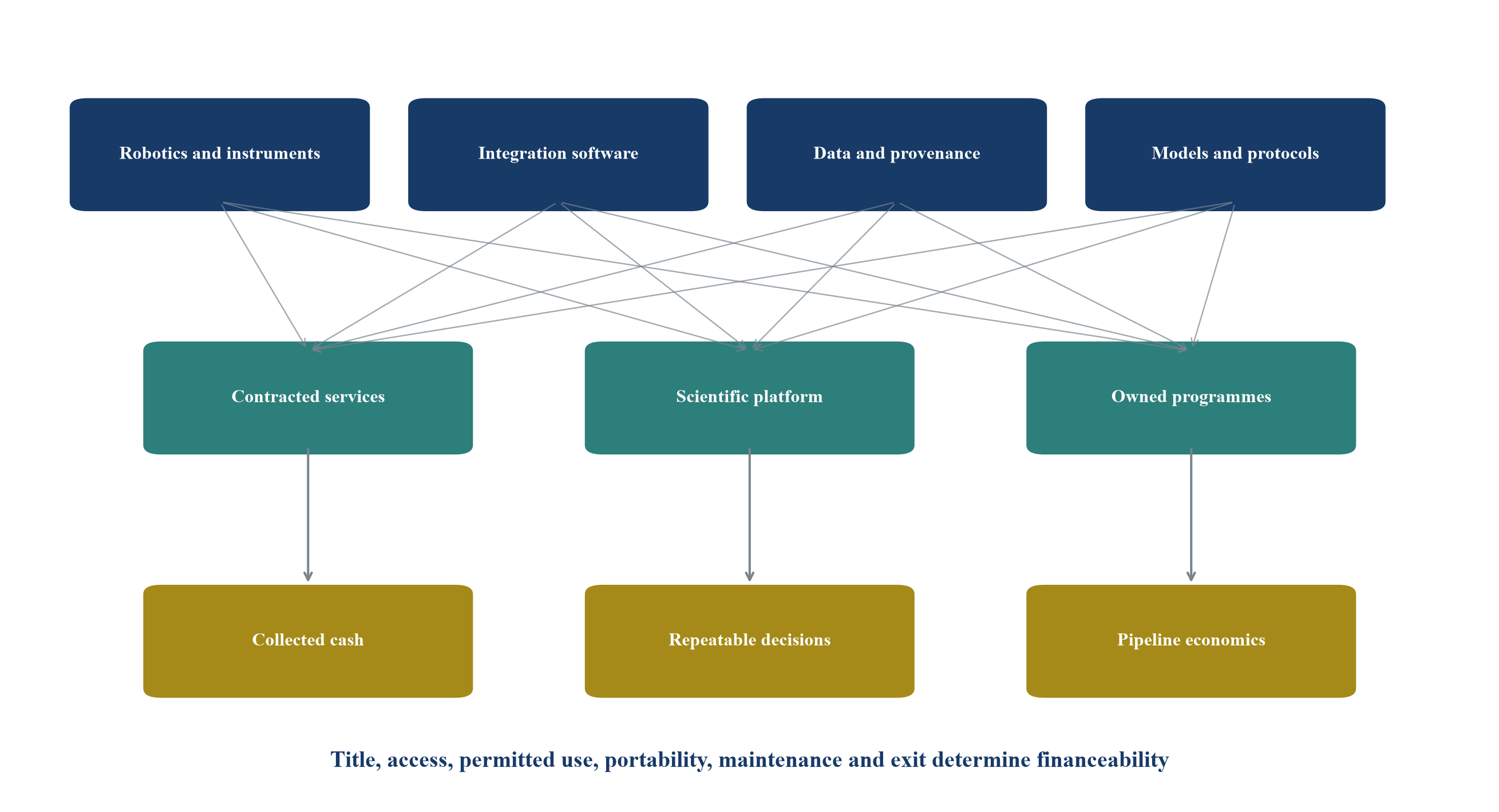
Financeable value depends on transferable rights and operating dependencies.
16. Govern AI context and performance
Each model should have a defined user, input, output, scientific decision, limitation and monitoring plan. NIST's AI Risk Management Framework organises work around govern, map, measure and manage. The laboratory can apply these functions to experiment-selection and interpretation systems.
Performance should be tested prospectively where practical. Historical benchmarks can contain leakage or differ from current scientific work. The system should record overrides, exceptions and drift.
Human accountability remains essential. Scientists should define objectives and boundaries, review consequential findings and stop unsafe or invalid campaigns.
17. Underwrite robotics reliability
Robotics reliability should be measured through uptime, mean time between failure, recovery time, intervention, calibration and error detection. A laboratory can operate continuously only when consumables, waste, safety and maintenance are also managed.
Redundancy can protect throughput and increases capital. A single robotic arm, scheduler or sample store can become a system-wide point of failure. Spare parts and vendor response should be reviewed.
Equipment finance covenants can include maintenance, insurance, location and reporting. Technical covenants should avoid forcing unsafe operation to meet utilisation targets.
18. Build customer-backed revenue
External revenue should be reconciled from signed contract to scheduled work, accepted deliverable, invoice and collection. Programmes can be fixed fee, time based, usage based, subscription, milestone or royalty linked. Each has different visibility.
The lender should test cancellation, acceptance, data rights, capacity reservation, concentration and working capital. A customer-funded build can reduce capital and create exclusivity or pricing obligations.
Renewal and expansion are stronger evidence of platform value than unpaid pilots. Customer interviews should distinguish satisfaction with scientific staff from dependence on the autonomous system.
19. Value internal programme output
Owned programmes can create licensing or product value. They also consume capacity and capital without near-term cash. The borrower should stage programmes by completed evidence rather than internal labels.
Risk-adjusted value should include technical probability, time, cost, rights and commercial economics. The laboratory's contribution can improve programme probability or speed. It does not remove downstream development, manufacturing, regulatory or market risk.
Pipeline value should remain outside the debt borrowing base unless monetised through a contract or other eligible asset. Equity and contingent capital are better aligned with early uncertainty.
20. Separate collateral value from enterprise value
Robotics and instruments can have identifiable title and resale value. Fit-out, integration and software can have limited liquidation recovery. Data and models can support enterprise value while being difficult to realise through enforcement.
The financing model should show original cost, orderly liquidation, forced-sale sensitivity and removal cost. It should identify liens, vendor rights, landlord claims and software needed to operate equipment. Collateral value can fall as instruments age or become specialised.
Enterprise value follows the laboratory's ability to produce contracted or owned value. A lender can consider both and should remain explicit about which source supports repayment.
21. Structure the capital stack
Equity should fund scientific uncertainty, integration and first-loss risk. Equipment finance can fund identifiable assets after delivery and commissioning. Venture debt can extend runway once operations, customers and liquidity are credible. Customer prepayments and grants can fund defined programmes or shared infrastructure.
The maturities should match asset life and cash conversion. Short debt against long scientific development creates refinancing risk. A large bullet repayment should not depend on an unverified future equity round.
Security, intercreditor arrangements and permitted liens should reflect equipment, intellectual property, receivables and bank accounts. Essential licences should survive an enforcement or change of control where possible.
22. Use a staged drawdown
Capital should release against evidence. Initial equity can fund detailed design, deposits and hiring. Equipment facilities can draw on delivery, title and insurance. Integration capital can draw after tested interfaces. Later debt can draw after commissioning, reproducibility and customer thresholds.
The borrower should maintain a cost-to-complete model. Delays, vendor changes, facility work and validation can create overruns. Contingency should remain controlled.
Draw conditions should be objective and within a defined review period. Scientific milestones need protocols and independent review. Vague satisfaction conditions make the financing unreliable.
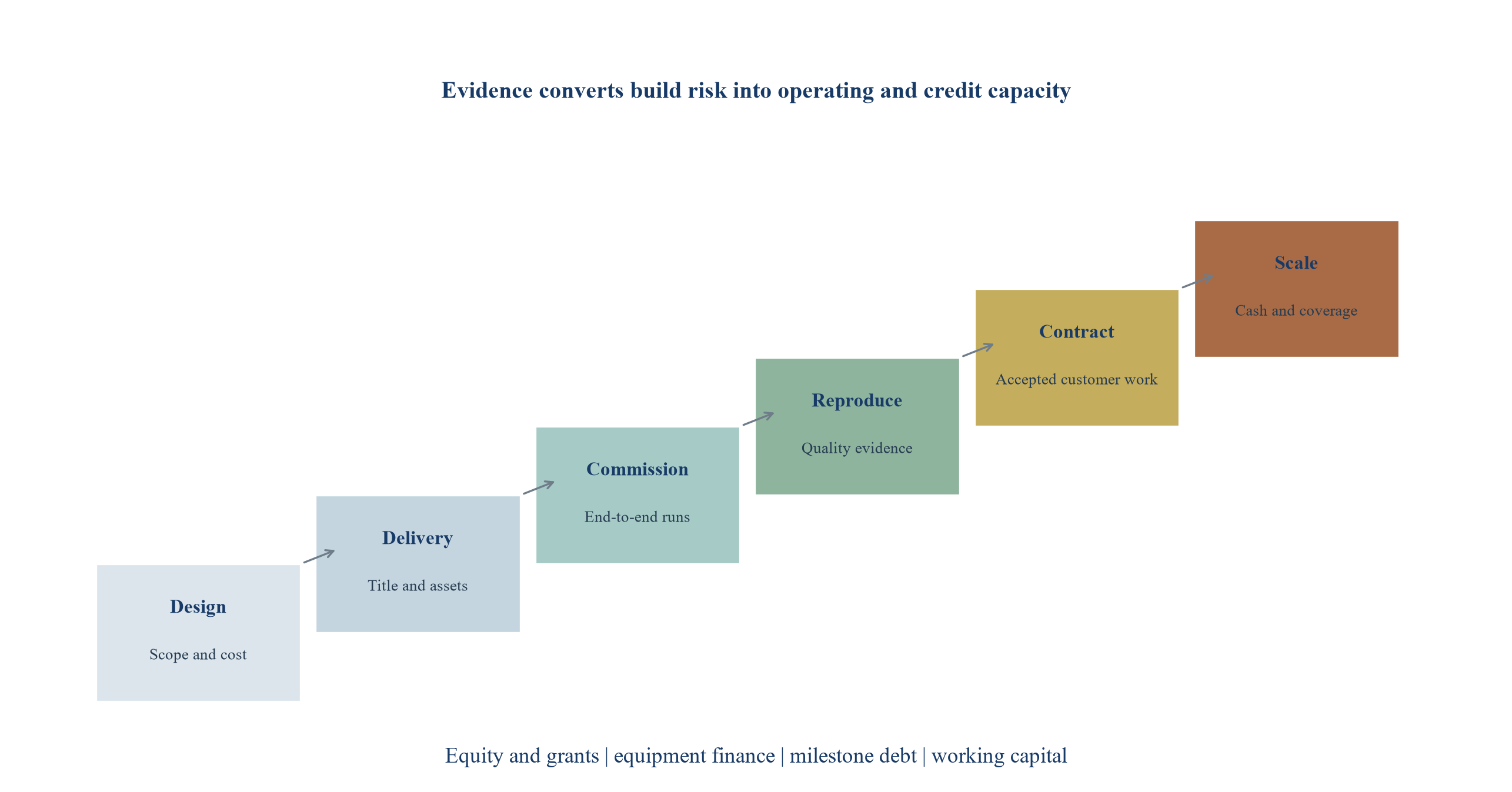
Risk-bearing capital enters before operating evidence; debt capacity rises with commissioned assets and contracted cash.
23. Build the hypothetical financing case
Consider a wholly hypothetical autonomous laboratory seeking USD 85 million. The programme includes robotics, scientific instruments, facility integration, data infrastructure and working capital. Management forecasts 1.6 million experimental units per year, twelve external programmes and USD 38 million of annual revenue by year four.
Evidence review distinguishes installed from quality-passed capacity. It identifies integration and commissioning work that must occur before customer delivery. It also identifies concentration and scientific-pipeline risk.
The proposed structure includes USD 32 million of equity, USD 23 million of equipment finance, USD 15 million of milestone-linked venture debt, and USD 15 million of customer prepayments and grant capital. The equipment facility draws after delivery and commissioning. Venture debt draws after reproducibility, customer and liquidity tests. All figures are illustrative assumptions.
Table 2. Hypothetical self-driving-lab financing plan
| Capital source | Amount | Primary use | Evidence gate |
|---|---|---|---|
| Sponsor and strategic equity | 32 | Design, deposits, integration and first loss | Committed at close |
| Equipment finance | 23 | Identifiable robotics and instruments | Delivery, title, insurance and commissioning |
| Milestone-linked venture debt | 15 | Expansion and working capital | Reproducibility, contracts, liquidity and concentration |
| Customer and grant capital | 15 | Programme-specific capacity and research | Contract or award conditions |
| Total | 85 | Complete and operate the laboratory | Controlled cost-to-complete plan |
All amounts are illustrative management assumptions in USD millions.
24. Define equipment-finance eligibility
Eligible equipment should have clear title, invoice, delivery, location, acceptance, insurance and maintenance. It should not be subject to another lien. The lender should understand removal, software dependence and secondary demand.
Advance rates can vary by instrument. Standard analytical equipment can support more value than bespoke robotic integration. Facility fit-out may require landlord consent and can have little recovery.
The facility should not fund taxes, overruns, prepayments or soft costs beyond agreed limits. Sponsor equity can cover those elements and the gap between cost and collateral value.
25. Define venture-debt eligibility
Venture debt should follow evidence of runway, governance, customers and credible enterprise value. The lender should test burn, liquidity, concentration, covenants, future funding need and exit alternatives.
Warrants or success fees can compensate for risk and do not replace repayment capacity. Financial covenants can include minimum cash, liquidity runway, recurring or contracted revenue and debt service coverage. Technical covenants can track commissioned capacity, quality and material incidents.
Milestone debt should stop drawing when evidence weakens. The documents should define cure, waiver, reporting and consequences without forcing unsafe scientific or laboratory behaviour.
26. Build the borrowing base
A working-capital borrowing base can include eligible receivables from creditworthy customers. It should exclude disputed, unaccepted, aged, related-party and highly contingent amounts. Customer prepayments can create performance obligations rather than free liquidity.
Equipment can support a separate collateral schedule. Grants are governed by award terms and may restrict use or require matching funds. Milestones are not receivables until earned under the contract.
The borrower should provide monthly reconciliations. Scientific progress should not be converted into a receivable without contractual acceptance.
27. Set covenant thresholds
Covenants should protect liquidity and operating capability. Minimum cash and runway can trigger early discussion. Customer concentration can limit debt growth. Capital-expenditure and acquisition controls can protect the financed plan.
Technical reporting can include uptime, quality-pass rate, reproducibility, accepted deliverables, safety incidents and data-rights exceptions. These measures support oversight and should be defined carefully.
Covenants should preserve appropriate scientific judgement. A shortfall can require a remediation plan, additional equity or restricted draw rather than automatic pressure to report a positive result.
28. Price utilisation risk
Revenue and margin depend on utilisation. The model should separate booked, scheduled, executed, quality-passed, accepted and collected capacity. Each conversion can fail.
Customer programmes differ in complexity, instrument mix and review. A simple volume metric can hide resource demand. The capacity model should use constrained-resource hours and changeover where possible.
Pricing can include reservation, usage, programme and outcome components. A reservation fee improves visibility and can require service-level credits. Outcome pricing creates upside and scientific uncertainty.
29. Price obsolescence and refresh
Scientific instruments, robotics, compute and software have different lives. The borrower should maintain a refresh plan, vendor roadmap and parts strategy. Equipment value can decline before accounting depreciation when better methods arrive.
Open interfaces can reduce switching cost. Proprietary integration can improve performance and increase lock-in. The investment case should recognise both.
Maintenance capital belongs in sustainable cash flow. Deferring calibration or replacement can temporarily improve liquidity while weakening quality and uptime.
30. Protect scientific and operational safety
Autonomy must operate within defined chemical, biological, mechanical and cyber boundaries. The system should prevent incompatible materials, unsafe conditions and unauthorised actions. Emergency stop and manual recovery should be tested.
Risk assessment should cover samples, reagents, pressure, heat, radiation, waste, contamination and robotic movement as applicable. Remote operation adds access and response requirements.
Insurance and financing documents should require compliance, incident notification and remediation. Safety events can interrupt operation and affect collateral and enterprise value.
31. Secure the data and control plane
The control plane connects experiment objectives, instruments, robots, analysis and models. Cyber compromise can alter results, stop operation or create physical risk. Identity, segmentation, code signing, logging, backup and recovery should span laboratory and cloud systems.
Customer data should be isolated according to contract. Model and protocol changes should be approved and versioned. Vendor remote access should be controlled.
The financing plan should include cybersecurity staff, testing and insurance. Security cannot be treated as an unfunded overhead after commissioning.
32. Design customer and grant restrictions
Customer-funded assets can carry exclusivity, capacity priority, IP, data and change-of-control rights. Grants can carry eligible-cost, reporting, access, publication or domestic-use conditions. The lender should review these restrictions before recognising value.
A customer can fund equipment while retaining ownership or removal rights. A grant can restrict collateral. Prepayments can be refundable if delivery fails.
The capital model should show restricted and unrestricted cash. It should align each expenditure with the relevant source and avoid double funding.
33. Define milestones around reproducible evidence
Milestones should follow the evidence hierarchy: delivered assets, commissioned workflow, quality-passed runs, reproduced findings, accepted customer output, decision-linked science and collected cash. Each state has a different risk.
The protocol should define sample, controls, acceptance, reviewer, timing and treatment of deviations. A milestone based on experiment count alone can reward activity without scientific value.
Milestones can release debt, equity tranches, vendor holdbacks or contingent acquisition consideration. The party controlling the work should have clear obligations.
Table 3. Evidence gates and financing consequences
| Evidence state | Minimum proof | Financing consequence | Principal risk remaining |
|---|---|---|---|
| Asset delivered | Title, location and acceptance | Equipment draw | Integration and performance |
| Workflow commissioned | End-to-end run and recovery test | Integration tranche | Quality and reproducibility |
| Reproduced output | Predefined repeatability and reproducibility | Milestone debt draw | Customer and scale |
| Customer accepted | Contractual deliverable accepted | Working-capital eligibility | Collection and renewal |
| Decision-linked science | Governed programme decision | Equity or contingent value | Downstream programme risk |
| Collected cash | Bank receipt and reconciled obligation | Debt service and expansion | Sustainability |
Gates should be objective, auditable and connected to capital use.
34. Value data and models without duplication
Data and model value should be derived from incremental cash flow or avoided cost, subject to rights and performance. Historical expenditure and file volume do not establish value. Replacement cost can provide a diagnostic and does not show economic contribution.
Service cash flows can already include the benefit of better data and models. Owned-programme value can also depend on them. Adding separate data value can double count the same benefit.
The valuation team should build a dependency matrix and assign each benefit once. Market-participant value should remain separate from buyer-specific synergy.
35. Design an exit and enforcement plan
The lender and investors should understand how the business can refinance, sell, partner or wind down. Equipment enforcement requires access, removal and software. Customer programmes require continuity and confidentiality. Data and models require lawful transfer.
Essential licences should survive or provide a transition period. Landlord, vendor, grant and customer consents can affect enforcement. Staff retention can be necessary to preserve enterprise value.
An orderly sale can produce more value than isolated equipment recovery. The security package and intercreditor terms should preserve that option.
36. Establish the board dashboard
The board should see capital, capacity, quality, science, customers and cash. Capital measures include cost to complete, contingency, committed spend and runway. Operations include uptime, bottleneck utilisation, intervention and maintenance.
Scientific measures include quality pass, reproducibility, information gain and decision conversion. Commercial measures include backlog, acceptance, concentration, margin and collection. Data and AI measures include provenance, rights, model performance, overrides and incidents.
Definitions and owners should be approved. A composite autonomy score can conceal the evidence needed for a financing decision.
Table 4. Board and lender control dashboard
| Domain | Core measure | Evidence owner | Decision |
|---|---|---|---|
| Capital | Cost to complete, liquidity and runway | CFO and project office | Fund, rephase or resize |
| Equipment | Delivery, commissioning, uptime and maintenance | Laboratory operations | Draw, remediate or replace |
| Science | Quality pass, reproducibility and decision conversion | Scientific lead | Advance, validate or stop |
| Data and AI | Provenance, rights, performance and incidents | Data and model owner | Permit, restrict or retrain |
| Commercial | Backlog, acceptance, concentration and cash | Commercial and finance | Price, expand or collect |
| Risk | Safety, security, insurance and compliance | Risk and quality | Cure, suspend or escalate |
Measures link operating evidence to financing and investment decisions.
37. Run the first 100 days
The first 100 days should confirm scope, vendors, site, asset register, rights, cost to complete and commissioning plan. The team should establish a single experiment identifier and reporting definitions before scale.
Representative workflows should be tested end to end. Failure recovery, manual intervention, data export and safety should be observed. Customer and grant obligations should be translated into the plan.
The board should approve draw conditions, authority, contingency and change control. Early discipline reduces the risk of a technically impressive but unfinanceable build.
38. Recognise limitations
Autonomous laboratories span different scientific domains, hazards and business models. Evidence from one workflow does not establish performance in another. Standards and interfaces continue to develop.
Peer-reviewed studies establish reported results under stated conditions. They do not validate a target laboratory. NIST and NSF programmes describe emerging infrastructure and standardisation needs. Commercial demand and financing terms require transaction-specific evidence.
The hypothetical case illustrates method only. Actual underwriting requires contracts, records, assets, rights, costs, scientific results and professional legal, technical, tax, accounting and valuation advice.
39. Underwrite the facility and lease
The laboratory's premises can determine whether equipment can be installed, operated and removed. Power, ventilation, water, drainage, gases, vibration, floor loading, access, fire protection and waste systems should match the scientific workflow. The borrower should hold the required permits and landlord approvals.
Lease term should cover the financing period and a practical renewal or relocation path. Restoration obligations can create a material exit cost. A landlord waiver or access agreement can protect equipment enforcement, subject to local law.
Relocation can interrupt validated workflows and data comparability. The downside model should include decommissioning, move, recommissioning and customer disruption. Site dependency belongs in both liquidity and collateral analysis.
40. Underwrite the scientific workforce
Autonomous laboratories still depend on scientists, automation engineers, software developers, instrument specialists, quality personnel and safety staff. The borrower should map critical roles to workflows, systems and customer relationships. Key-person risk should be measured by operating consequence.
Documentation, training and code review improve transferability. A laboratory that requires one scientist to resolve every failed run has lower scalable capacity than its robot count suggests. Hiring plans should reflect the actual mix of development, operation and customer work.
Retention and incentive arrangements should align with commissioning and customer delivery. The financing plan should include realistic recruitment time and compensation. Immigration, location and security restrictions can affect access to specialised staff.
41. Test vendor and consumable concentration
Robots and instruments can depend on proprietary consumables, service contracts, software keys and replacement parts. The borrower should identify sole sources, lead times, minimum orders, inflation, export restrictions and alternatives. A low-cost instrument can carry a high lifetime dependency.
Consumable availability should be matched to contracted work and liquidity. Safety stock can protect continuity and consume working capital. Vendor credit terms can change as usage scales.
The laboratory should qualify substitutes before a shortage where scientifically appropriate. A change in reagent or component can affect comparability and may require new validation. The cost-to-complete and margin model should reflect this work.
42. Evaluate network and cloud-laboratory economics
Programmable cloud laboratories can distribute access to expensive instruments and standardised workflows. NSF's test-bed initiative identifies remotely accessible AI-powered laboratories as infrastructure that can improve reproducibility and access. A network model can raise utilisation and create coordination requirements.
The operator should define scheduling, identity, sample logistics, data isolation, service levels and cross-site comparability. A user should know which workflow and equipment generated the result. Remote access should not weaken safety or quality authority.
Network economics depend on density, repeat use and standard interfaces. A single flagship site can have valuable capability and limited redundancy. Financing assumptions for geographic expansion should follow proven customer demand and transferable operations.
43. Build unit economics by workflow
The finance model should calculate revenue and contribution by workflow, customer and instrument constraint. Direct cost includes consumables, instrument time, robotics, scientist review, data processing, quality, waste and rework. Shared facility and platform costs should be allocated transparently.
Gross margin can improve with utilisation and can decline when complex customer work requires bespoke integration. The model should separate learning-period cost from a sustainable run rate. Planned efficiency gains need measured operating evidence.
Price should reflect capacity, scientific value and risk. Usage pricing is transparent and can under-reward valuable decisions. Programme pricing can support collaboration and creates scope risk. Outcome pricing should remain limited to objectively measurable results.
44. Run an integrated downside case
The downside case should combine delayed commissioning, lower quality pass, slower customer conversion, concentration loss, equipment downtime and a financing delay. These risks can interact. Lower revenue can reduce maintenance, which lowers uptime and delays customer work further.
Management should identify actions available at each stage: reduce expansion, defer non-essential equipment, shift capacity to contracted work, raise equity, sell assets or partner programmes. Actions should respect grant, customer and safety obligations.
The board should define liquidity triggers before cash becomes critical. A financing plan that works only when every technical and commercial assumption succeeds does not provide a credible runway.
45. Conclude with evidence-linked capital
The self-driving laboratory is an integrated operating system. Robotics provide physical capacity. Integration makes that capacity usable. Data and models guide the next experiment. Scientists govern objectives, exceptions and meaning. Customers and programmes convert output into cash or asset value.
Capital should follow this evidence chain. Equity and grants absorb build and scientific uncertainty. Equipment finance follows title and commissioning. Venture debt follows reproducibility, customers and liquidity. Working capital follows accepted receivables.
The financeable moat is reproducible scientific output delivered through assets and rights that persist. Experiment speed matters when it changes a valuable decision and that value can service the capital stack.
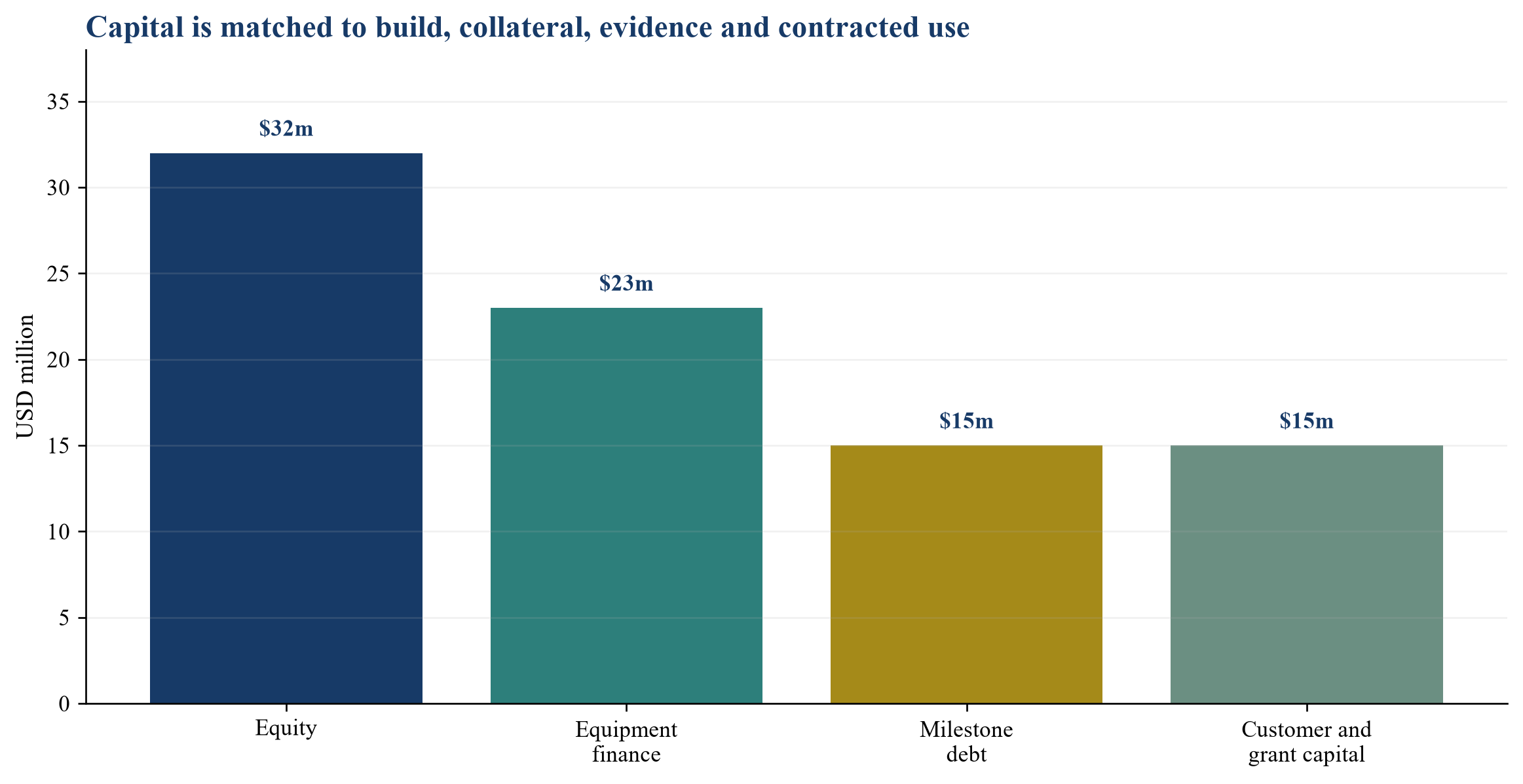
Amounts are illustrative management assumptions in USD millions.
References
- National Institute of Standards and Technology. Autonomous Laboratories. https://www.nist.gov/autonomous-laboratories
- National Institute of Standards and Technology. Development of Standards to Support a Modular and Autonomous Laboratory Ecosystem. https://www.nist.gov/programs-projects/development-standards-support-modular-and-autonomous-laboratory-ecosystem
- National Institute of Standards and Technology. Autonomous Formulation Laboratory. https://www.nist.gov/programs-projects/autonomous-formulation-lab
- National Institute of Standards and Technology. AFL-automation Instrument Control Framework. https://pages.nist.gov/AFL-automation/en/main/index.html
- National Institute of Standards and Technology. Driving U.S. Innovation in Materials and Manufacturing Using AI and Autonomous Labs. https://tsapps.nist.gov/publication/get_pdf.cfm?pub_id=958246
- National Institute of Standards and Technology. Artificial Intelligence Risk Management Framework. https://www.nist.gov/itl/ai-risk-management-framework
- U.S. National Science Foundation. Test Bed: Toward a Network of Programmable Cloud Laboratories. https://www.nsf.gov/funding/opportunities/pcl-test-bed-test-bed-toward-network-programmable-cloud-laboratories
- Szymanski, N. J. et al. An autonomous laboratory for the accelerated synthesis of inorganic materials. Nature 624, 86-91 (2023). https://www.nature.com/articles/s41586-023-06734-w
- Volk, A. A. et al. AlphaFlow: autonomous discovery and optimization of multi-step chemistry using a self-driven fluidic lab guided by reinforcement learning. Nature Communications 14, 1403 (2023). https://www.nature.com/articles/s41467-023-37139-y
- Tom, G. et al. Self-driving laboratories for chemistry and materials science. Chemical Reviews 124, 9633-9732 (2024). https://pubs.acs.org/doi/10.1021/acs.chemrev.4c00055
- Tamasi, M. J. et al. Automation of the materials synthesis laboratory: workflows and paradigms. Nature Communications 15, 1378 (2024). https://www.nature.com/articles/s41467-024-45569-5
- Baird, S. G. et al. Self-driving laboratories to autonomously navigate the protein fitness landscape. Nature Chemical Engineering 1, 97-107 (2024). https://www.nature.com/articles/s44286-023-00002-4
- Caramelli, D. et al. A dynamic knowledge graph approach to distributed self-driving laboratories. Nature Communications 15, 462 (2024). https://www.nature.com/articles/s41467-023-44599-9
- Burger, B. et al. A mobile robotic chemist. Nature 583, 237-241 (2020). https://www.nature.com/articles/s41586-020-2442-2
- Cooper, A. I. et al. Autonomous mobile robots for exploratory synthetic chemistry. Nature 635, 890-897 (2024). https://doi.org/10.1038/s41586-024-08173-7
- IFRS Foundation. IAS 16 Property, Plant and Equipment. https://www.ifrs.org/issued-standards/list-of-standards/ias-16-property-plant-and-equipment/
- IFRS Foundation. IFRS 16 Leases. https://www.ifrs.org/issued-standards/list-of-standards/ifrs-16-leases/
- IFRS Foundation. IAS 38 Intangible Assets. https://www.ifrs.org/issued-standards/list-of-standards/ias-38-intangible-assets/
- IFRS Foundation. IAS 36 Impairment of Assets. https://www.ifrs.org/issued-standards/list-of-standards/ias-36-impairment-of-assets/
- IFRS Foundation. IFRS 13 Fair Value Measurement. https://www.ifrs.org/issued-standards/list-of-standards/ifrs-13-fair-value-measurement/
- Ginkgo Bioworks Holdings, Inc. Annual Report for the year ended 31 December 2025. U.S. Securities and Exchange Commission. https://www.sec.gov/Archives/edgar/data/1830214/000162828026012346/dna-20251231.htm
- Absci Corporation. Annual Report for the year ended 31 December 2025. U.S. Securities and Exchange Commission. https://www.sec.gov/Archives/edgar/data/1672688/000167268826000068/absi-20251231.htm
About the Author
Chennakeshav (CK) is a corporate finance and investment banking executive with 25+ years of global experience in deal origination, structuring and execution across M&A, growth capital and corporate strategy. He has led value-creation mandates for founders, corporates and funds — bridging the boardroom view to hands-on execution and close.
His career spans Morgan Stanley, HSBC, Lloyds Banking Group, EWEC, ADQ portfolio companies and Emirates Growth Fund, across TMT, real estate, fintech, deeptech, cleantech, infrastructure and energy. He has partnered with C-suite leaders, private equity and venture funds, sovereign wealth funds and family offices to finance complex fund raises and scale-up ventures, and has led M&A due diligence, post-merger integration and business-transformation initiatives to create value.
At Matchpoint Partners he is Managing Partner, leading the firm's corporate finance, M&A and capital-raising practice. He holds an MBA from London Business School, an engineering degree from VTU and a Master of Laws (LLM, in progress) from UCL London.
An active start-up mentor, CK mentors at Techstars, DIFC FinTech Hive, Startup Grind, Founder Institute and IN5, serves as Entrepreneur Mentor in Residence (EMiR) at London Business School, and judges the Entrepreneurship World Cup.
https://www.linkedin.com/in/ckadya/
https://www.matchpoint-partners.com/team/ck-adya.html
This paper is part of a continuing series on the structure of private and alternative markets. The views expressed are the author's own. The paper is for information only, describes market structure in general terms, and does not constitute investment, legal, tax or regulatory advice or a recommendation in respect of any security, vehicle or counterparty.
