

1. Frame the transaction decision
The valuation decision is whether a protein-design company contains a transferable technical platform, a contract-backed discovery business, an owned development pipeline, or a combination of the three. Each category has a different cash-flow pattern, evidence burden, risk profile and appropriate valuation method. The analysis must therefore start with economic classification rather than a description of the science.
Protein design can use physics-based computation, sequence models, structure prediction, generative models, laboratory screening and iterative optimisation. Those tools can support antibodies, enzymes, binding proteins, vaccines, industrial biocatalysts and research reagents. The same technical stack can be deployed for a customer, under a collaboration, or for an internally owned asset. Ownership and economics change even when the laboratory workflow looks identical.
The transaction team should map every material activity to the party that controls programme decisions, owns foreground intellectual property, funds the work, bears development cost and receives downstream economics. This produces the first auditable boundary between a repeatable platform, a paid service and a speculative programme.
Table 1. Economic classification of a protein-design company
| Value layer | Primary evidence | Typical cash flow | Principal valuation method |
|---|---|---|---|
| Platform | Reusable models, data, workflow and customer adoption | Subscription, licence or repeat-use fee | Revenue and cash-flow method |
| Service | Executed work order, funded research plan and acceptance | Research funding, programme fee or FTE payment | Contract cash flow and margin method |
| Partnered pipeline | Programme rights and contingent payment schedule | Milestones and royalties | Probability-adjusted contract value |
| Owned pipeline | Owned candidate, evidence package and development plan | Future product or out-licensing economics | Risk-adjusted programme value |
| Enabling assets | Transferable IP, data, software, laboratory and team | Indirect support for other layers | Incremental asset or replacement-cost test |
Classification follows rights and cash flows rather than management labels.
2. Define what qualifies as a platform
A platform is a reusable capability that improves outcomes across more than one programme without requiring the full cost and time of rebuilding the system. Reuse can arise from models, experimental data, assay systems, design software, automation, protocols, integration code and accumulated scientific judgement. The commercial test is whether the capability creates recurring or repeatable economics beyond a single asset.
Management presentations often call the entire company a platform. The diligence team should test repeatability at the level of a defined use case. A model trained for one protein family may not transfer to another. An assay optimised for one target can require substantial redevelopment. A laboratory workflow may scale only while a small group of scientists remains in place. Reuse must be demonstrated through time, cost, quality and decision improvement across independent programmes.
A defensible platform metric set includes number of external and internal programmes, reuse of common components, time to validated design, quality-passed success rate, customer renewal, gross margin, incremental programme cost and the share of output generated without bespoke intervention.
3. Distinguish software from integrated discovery
Some protein-design companies sell software licences or cloud access. Others provide an integrated discovery outcome supported by proprietary software and wet-laboratory work. The second model can have valuable technology while retaining service-like economics. Revenue classification should follow the customer obligation and delivery cost.
Schrodinger's public reporting illustrates the distinction. It reports software revenue separately from drug-discovery revenue and discloses different gross-margin and risk characteristics. Its collaborations can include upfront payments, research funding, milestones and royalties, while its proprietary programmes carry development risk. The filing provides an observable example of segment separation; it does not establish a valuation multiple for another company.
The buyer should reconcile contracts to recognised revenue, deferred revenue, research cost and customer acceptance. Software revenue that depends on continuous bespoke modelling, laboratory execution or embedded scientific teams should be analysed with the associated delivery cost. A platform premium requires scalable economics, durable rights and evidence of continued customer use.
4. Identify the service business
Discovery services convert scientific work into contractually defined consideration. The contract can fund personnel, experiments, deliverables or a complete programme. Service value depends on backlog quality, capacity utilisation, renewal, pricing, gross margin, working capital and concentration. Headline scientific sophistication does not remove these operating drivers.
The contract review should determine whether fees are fixed, time based, reimbursable, success based or cancellable. Termination rights, acceptance criteria, intellectual-property ownership, publication rights, exclusivity and data reuse can materially affect value. Research funding that merely reimburses cost may support the technical engine without creating attractive standalone margin.
The acquirer should build a cohort view by customer and programme. It should separate first projects from expansions, measure sales-cycle length, compare contracted and delivered scope, and identify how much revenue depends on founders or named scientists. Backlog should be discounted for cancellation, unresolved acceptance and capacity constraints.
5. Separate partnered programmes
Partnered programmes occupy the boundary between service and pipeline. A collaborator may pay research funding during discovery, an option fee when it elects to continue, development and regulatory milestones as evidence advances, commercial milestones after launch and royalties on sales. These amounts should not be combined into a single undifferentiated contract value.
Public announcements can describe aggregate potential milestones across several targets. The headline is a contractual ceiling, subject to programme selection, technical success, development decisions, regulatory approval and commercial performance. It is not current revenue or enterprise value. The diligence team should model each payment by trigger, payer discretion, probability, timing, tax and cost to achieve.
Absci's public filings and collaboration announcements provide an example of this structure. They describe research activity, milestones and royalties while noting the early state of downstream economics. The relevant lesson is methodological: funded work, contingent payments and royalties require separate models.
6. Define the owned pipeline
An owned pipeline contains programmes for which the target retains material development and commercial rights. Value depends on target rationale, candidate quality, preclinical or clinical evidence, safety, manufacturability, regulatory path, competition, addressable use, pricing, development cost and time. Protein design can improve candidate creation while leaving many downstream risks intact.
The buyer should define the asset being valued. A computational design, a binding result, a lead series, a development candidate and a clinical-stage product represent different evidence states. Internal programme names can imply maturity that the records do not support. Stage should follow completed evidence and governed decisions.
Pipeline valuation should include future cost as well as future revenue. It should also test whether the programme can continue after separation from shared platform staff and infrastructure. A programme that depends on an untransferred model, unavailable dataset or founder judgement has lower standalone value.
7. Map the common technical engine
Platform, service and pipeline activities often share a common engine. The engine can include sequence and structure repositories, proprietary experimental observations, model code, compute infrastructure, assay development, high-throughput expression, binding measurements, developability tests, laboratory information systems and programme governance.
Shared capability creates efficiency and creates a valuation risk. The same dataset can support recurring customer revenue, improve partnered programmes and raise the probability of owned assets. Adding a platform multiple, full partnership value and full pipeline value can therefore count the dataset three times.
The buyer should build a dependency graph connecting every cash-flow layer to the underlying assets and costs. The graph should identify exclusive rights, shared rights, customer restrictions, open-source dependencies, key-person dependencies and capacity bottlenecks. It becomes the basis for overlap removal and integration planning.
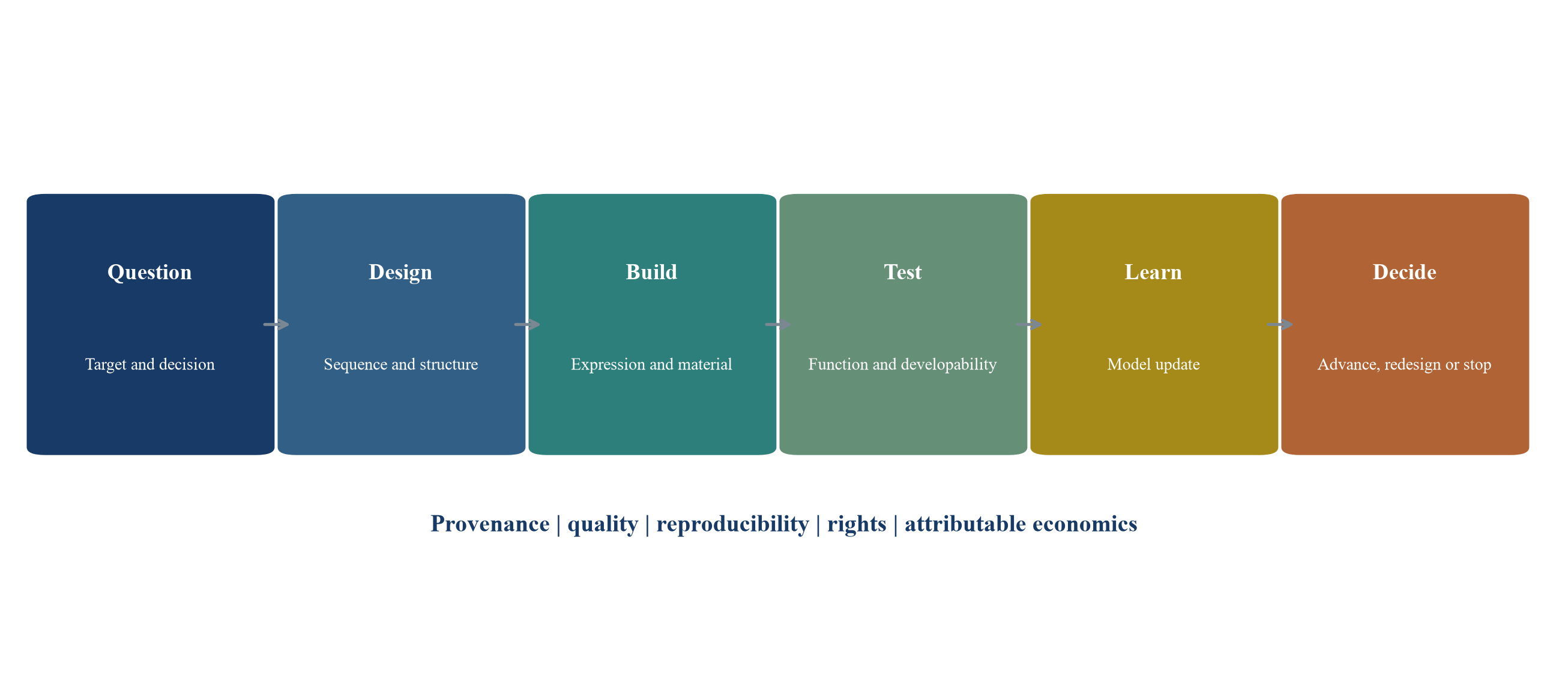
A designed sequence earns economic value only as evidence advances through governed physical validation and programme decisions.
8. Test design-to-validation speed
Generative models can propose many sequences quickly. Transaction value depends on the complete time from a defined design objective to quality-passed experimental evidence. Computational throughput alone can move the bottleneck into synthesis, expression, purification, testing or data review.
The team should measure cycle time by programme and stage, including queues and rework. It should compare predicted performance with observed laboratory outcomes and record negative results. A short cycle with weak reproducibility can destroy value by accelerating noise. A longer cycle can be superior when it resolves a material uncertainty and creates a transferable record.
Primary research on RFdiffusion and ProteinMPNN demonstrates important advances in structure and sequence design with experimental validation. These methods establish technical possibility under specified conditions. They do not establish that every commercial implementation has equivalent performance, data rights or economics. Target-specific validation remains necessary.
9. Audit data provenance and rights
Protein-design models can use public databases, licensed datasets, customer data, internal experimental results, simulated structures and human annotations. The buyer needs a data register describing source, licence, consent, permitted purpose, retention, deletion, transformation, version, quality and programme use.
Rights can differ across training, fine-tuning, inference, derivative data and commercial output. Customer contracts may permit delivery of results while limiting reuse of raw data. Academic licences may restrict commercial activity. Biological samples and clinical data can carry consent, privacy and jurisdictional obligations. The diligence team should connect each material model and programme to its data-rights chain.
Data volume has limited meaning without comparability. Protocol changes, assay drift, batch effects and selective recording can weaken learning. The target should show raw data, failed experiments, quality rules and versioned transformations.
10. Evaluate model context of use
FDA's January 2025 draft guidance proposes a risk-based framework for assessing credibility of AI model outputs used to support regulatory decisions in drug and biological product development. The framework starts with a question of interest and a defined context of use, then assesses model risk and develops a credibility plan. The recommendations are draft and non-binding; they provide a useful diligence structure.
FDA and EMA good-AI-practice principles emphasise human-centric design, multidisciplinary expertise, data governance, risk-based performance assessment, documentation and lifecycle management. A target should therefore define who uses each model, which inputs are accepted, what output is produced, which decision it supports, how uncertainty is communicated and how performance is monitored.
A model credible for candidate ranking may not be credible for safety, manufacturing or regulatory evidence. Value should attach to the supported use. Expansion into higher-consequence decisions belongs in a milestone or scenario.
11. Validate experimental evidence
Designed proteins must be expressed, purified and tested under controls appropriate to the claim. Binding does not prove functional activity. Functional activity does not establish selectivity, stability, pharmacology, manufacturability or safety. Each step requires defined methods and acceptance criteria.
The buyer should select a risk-based sample of high-value claims and trace them from design inputs to raw laboratory data, quality review and programme decision. It should include successes, failures and borderline results. Independent or blinded reproduction can be appropriate where value depends heavily on a small number of claims.
Reproducibility tolerances should follow the decision. A discovery screen can accept broader variability than a release method. The valuation should reflect the strongest completed evidence that survives this review.
12. Assess developability and manufacturing
A protein can show compelling biological activity and remain commercially unsuitable. Developability assessment can include expression yield, aggregation, solubility, viscosity, thermal stability, chemical liabilities, immunogenicity risk, formulation and process compatibility. Requirements differ across therapeutic, diagnostic and industrial uses.
Manufacturing economics should enter valuation early. Yield, purity, process steps, raw-material requirements, scale, quality controls and cold-chain needs affect cost and capital. A design optimised only for potency can create an expensive downstream programme.
The target should show how developability constraints enter design objectives and how laboratory results update the model. The buyer should compare early predictions with later observed performance. A platform earns greater value when it reduces downstream failure and cost across independent programmes.
13. Build the intellectual-property graph
The IP graph should include patents, applications, know-how, copyrights, database rights, trade secrets, licences, open-source software, material-transfer agreements, employee inventions and collaboration rights. It should connect claims and contractual rights to models, datasets, assays, candidates and commercial uses.
Protein-design IP can contain several layers: platform methods, model architecture, training data, designed sequences, compositions of matter, therapeutic uses, manufacturing methods and screening outputs. Ownership can vary by programme. A collaboration can grant the partner exclusive rights to a target while the company retains platform improvements.
Freedom to operate and defensibility are separate questions. The buyer should examine claim scope, priority, inventorship, prosecution, territorial coverage, expiry, challenges and design-around risk. Trade-secret value depends on secrecy controls and practical transfer.
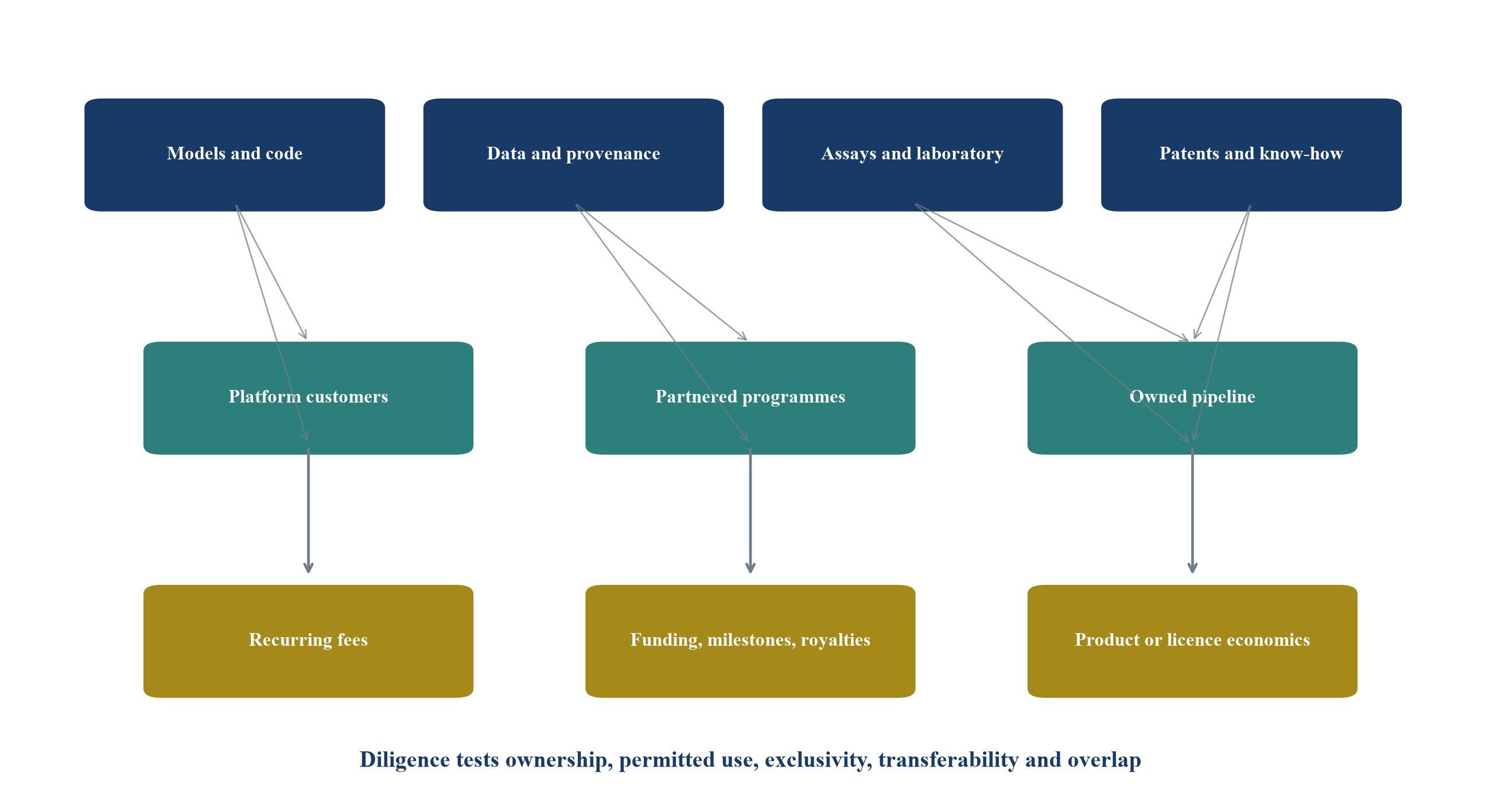
A value claim is supportable when the acquirer can trace a cash flow to transferable rights and operating capability.
14. Test organisational transferability
The platform must survive the transaction. The diligence team should identify who designs objectives, maintains models, interprets assays, manages quality, resolves failures, controls customer relationships and makes programme decisions. Key-person concentration should be measured by workflow, not title.
Transferability depends on documentation, code ownership, deployment practices, laboratory procedures, training, vendor access, immigration, retention and incentive alignment. A technically impressive system can lose value when critical knowledge remains tacit or employment arrangements are uncertain.
The integration plan should preserve scientific challenge and decision quality. Immediate consolidation of data systems or laboratories can break comparability. Day-one controls should protect access, continuity and security while a validated migration plan is developed.
15. Build a revenue-quality bridge
Revenue should be reconciled from contract to invoice, collection, recognised amount and remaining obligation. The analysis should separate software licence, research funding, reimbursed cost, programme fee, option exercise, milestone and royalty. Each category has a different recurrence and margin profile.
Customer concentration can be high because large collaborations are material. The buyer should assess renewal and expansion by cohort, contract termination, programme cancellations, remaining performance obligations and the cost required to deliver backlog. A large upfront payment can raise reported revenue while creating future work.
Quality of revenue also depends on rights. A low-margin collaboration can generate high-value reusable data or platform improvements when the contract permits. A high-margin project can restrict reuse and therefore contribute little to platform compounding. Both cash and retained rights should be modelled explicitly.
16. Value recurring platform economics
Recurring platform value should be based on contract cash flows and sustainable unit economics. The model should include renewal, expansion, price, usage, cost to serve, hosting, scientific support, sales expense, research maintenance and capitalised development. Reported gross margin should be normalised for labour and laboratory costs that support delivery.
Comparable-company multiples can provide a market cross-check when business models, growth, margins, customer concentration and risk are sufficiently similar. They should not replace a cash-flow model. A therapeutics company with collaboration revenue is not automatically comparable to a software business, and a software company with proprietary pipeline investment has consolidated economics that require segment analysis.
The valuation should test downside cases for slower renewal, lower utilisation and loss of a major customer. Upside should be supported by capacity, validated use cases and a credible sales pathway. Buyer synergies should remain outside standalone value until separately quantified.
17. Value contracted services
The service model begins with signed backlog, expected conversion and the cost to deliver. Revenue should be phased by work plan and acceptance rather than booked at the contract maximum. Direct scientific labour, laboratory consumables, compute, third-party studies, quality review and programme management should be included.
Backlog needs adjustment for cancellation, scope change, customer funding, scientific feasibility and capacity. A programme can be contracted and still lack sufficient staff or laboratory slots. The model should also identify whether completion generates an additional milestone or only satisfies an obligation already paid.
Service enterprise value can be estimated through discounted cash flow and tested against relevant specialist research organisations. Margin normalisation should reflect the target's required investment in model and assay capability. Underinvestment can temporarily inflate margin while weakening future delivery.
18. Value collaboration milestones
Milestone value should be built from individual payment triggers. For each trigger, the team should record the programme, contractual wording, decision maker, prerequisite evidence, amount, expected date, probability, cost and any offset or credit. Commercial sales milestones require a market and product forecast in addition to technical and regulatory probability.
Dependencies matter. Development milestones can be conditional on a partner choosing to progress the asset after a technical result. Royalties depend on approval, launch, sales and contractual deductions. Aggregate milestone ceilings often include mutually exclusive or remote outcomes. The expected value must reflect those conditions.
The discount rate cannot substitute for transparent probability and timing. The preferred model shows both. Payments that are substantially within the partner's discretion should carry an explicit decision probability. Contract disputes, audit rights, sublicensing shares and change-of-control provisions also affect value.
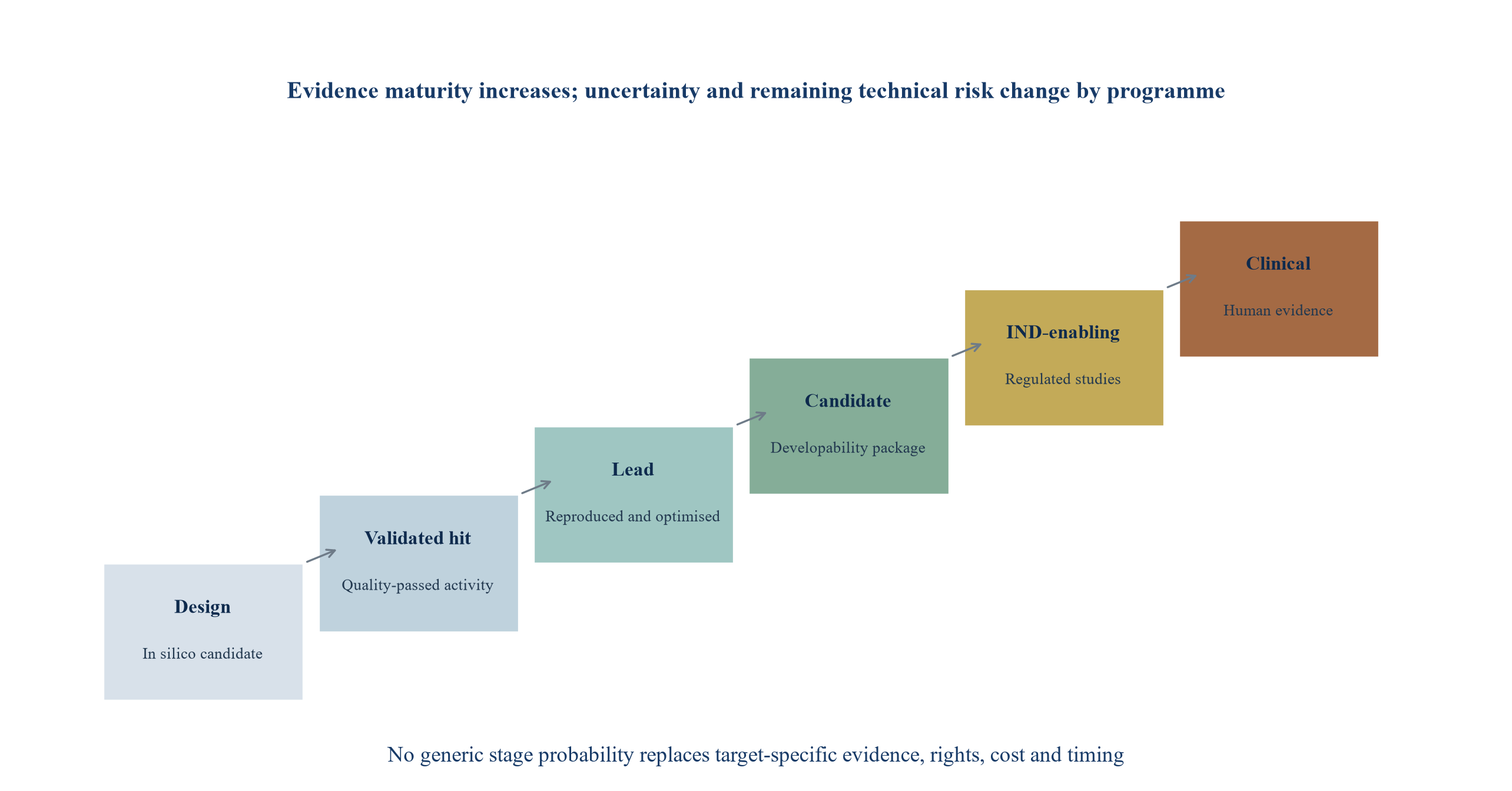
Each state requires completed evidence and a governed decision; probabilities and remaining costs are programme specific.
19. Value the owned pipeline
An owned-programme model should estimate probability-adjusted future cash flows or licensing economics from the current evidence state. Inputs include development path, time, cost, technical probability, regulatory probability, launch probability, addressable population or industrial demand, price, penetration, competition, manufacturing cost and retained economics.
Probabilities should be supported by programme evidence and relevant external benchmarks. A generic industry probability can serve as a starting reference and should not override target-specific results. Correlation across programmes also matters. Programmes sharing a target class, model, assay or manufacturing approach may fail together.
The team should run a stop-or-partner alternative. A buyer may choose to out-license, co-develop or stop an asset rather than fund full development. That flexibility can have value, subject to market interest and transaction cost. The model should distinguish value available to any market participant from buyer-specific strategic value.
20. Test enabling-asset value
Data, software, patents, laboratory equipment and workforce can support the operating valuation. A separate asset value should be added only when it represents incremental economics that are absent from platform, service and pipeline cash flows. Replacement cost can be informative and is not automatically fair value.
Historical R&D spend is also an unreliable proxy. Failed experiments can create learning, while expenditure can produce no transferable asset. The relevant question is how the asset changes future cash flows for a market participant. Rights, obsolescence, reproducibility and integration cost affect that contribution.
IFRS 3 and IAS 38 provide a useful accounting framework for identifying acquired technology, contractual relationships, in-process research and development and other intangibles. IFRS 13 frames fair value as a market-participant exit price. Transaction valuation and purchase-price allocation serve different purposes, but both require disciplined identification and avoidance of duplication.
21. Remove double counting
Double counting occurs when the same economic benefit appears in more than one component. A platform multiple can capitalise future customer growth that depends on the same dataset and scientists valued separately as an asset. A partnership model can include milestone value for a programme that also appears in the owned pipeline. A pipeline forecast can include buyer distribution synergies added again in a synergy schedule.
The dependency graph should be converted into an overlap matrix. Each value component is tested against its revenue, cost, data, intellectual property, team, laboratory capacity and programme rights. Shared costs should be allocated. Shared benefits should be assigned to the cash flow where they are realised.
When separation is impractical, the model can value the consolidated company and use component models as diagnostic cross-checks. Precision should not be manufactured. A transparent range with documented dependencies is more useful than a point estimate built from overlapping stories.
Table 2. Tests for overlap across the valuation stack
| Potential overlap | Diligence test | Adjustment |
|---|---|---|
| Platform and service | Does the platform multiple already capitalise service-supported renewal? | Normalise margin or reduce multiple |
| Service and milestones | Is research funding already included in contracted revenue? | Exclude from contingent value |
| Partnered and owned pipeline | Who owns each territory, indication and programme right? | Allocate only retained economics |
| Pipeline and enabling IP | Does pipeline cash flow already require the patents and data? | Avoid a separate additive asset value |
| Standalone value and synergies | Could any market participant realise the benefit? | Separate market-participant value from buyer value |
A value component is added only when its benefit is incremental to the other components.
22. Build the hypothetical valuation case
Consider a hypothetical company with USD 24 million of annual software and research revenue, three partnered programmes and four owned discovery programmes. Management presents USD 420 million of potential future partner milestones and estimates enterprise value at USD 310 million. The company operates an integrated design and wet-laboratory platform.
The diligence model first values recurring platform and service cash flows at USD 78 million after normalising delivery cost, customer concentration and renewal. It values contract-backed future collaboration economics at USD 46 million after modelling individual triggers, probabilities, timing and cost. Owned programmes contribute USD 71 million on a risk-adjusted basis. Transferable data, patents and laboratory infrastructure contribute USD 18 million beyond those cash flows.
The bridge deducts USD 39 million for remaining programme capital, infrastructure commitments and operating liabilities. It removes USD 28 million of overlap because several programme values depend on platform capability already captured in recurring economics and the enabling-asset component. The resulting standalone reference value is USD 146 million. These values are wholly hypothetical assumptions.
Table 3. Hypothetical standalone valuation bridge
| Component | Headline claim | Modelled standalone value | Key reason for adjustment |
|---|---|---|---|
| Platform and services | 24 annual revenue | 78 | Normalised recurrence, margin and concentration |
| Partnered programmes | 420 milestone ceiling | 46 | Trigger, probability, timing and cost |
| Owned pipeline | 4 discovery programmes | 71 | Evidence state, probability and remaining cost |
| Enabling assets | Integrated engine | 18 | Incremental transferable contribution only |
| Remaining obligations | Development and infrastructure | (39) | Future capital and liabilities |
| Overlap adjustment | Shared engine and rights | (28) | Removes duplicated economics |
| Standalone reference value | Management estimate 310 | 146 | Sum after evidence and dependency adjustments |
All amounts are illustrative management assumptions in USD millions and do not represent an observed company or valuation opinion.
23. Model milestone mechanics
The hypothetical collaboration portfolio should be modelled payment by payment. Assume one programme has a USD 10 million option exercise, a USD 20 million development milestone and a USD 45 million regulatory milestone. If the model assigns respective probabilities of 55, 24 and 9 percent and payment dates of one, three and seven years, present value falls far below the USD 75 million ceiling even before cost and tax.
The purpose is not to assert a correct probability. The purpose is to expose the assumptions and the decisions that drive value. The team can then update the model as experiments reproduce, a partner exercises an option, a candidate is nominated or a regulatory event occurs.
Milestone consideration can also inform deal structure. A buyer can pay cash at closing for validated transferable capability and use contingent value rights, earn-outs or programme-specific payments for later evidence. The trigger must be objective, auditable and within an agreed operating covenant.
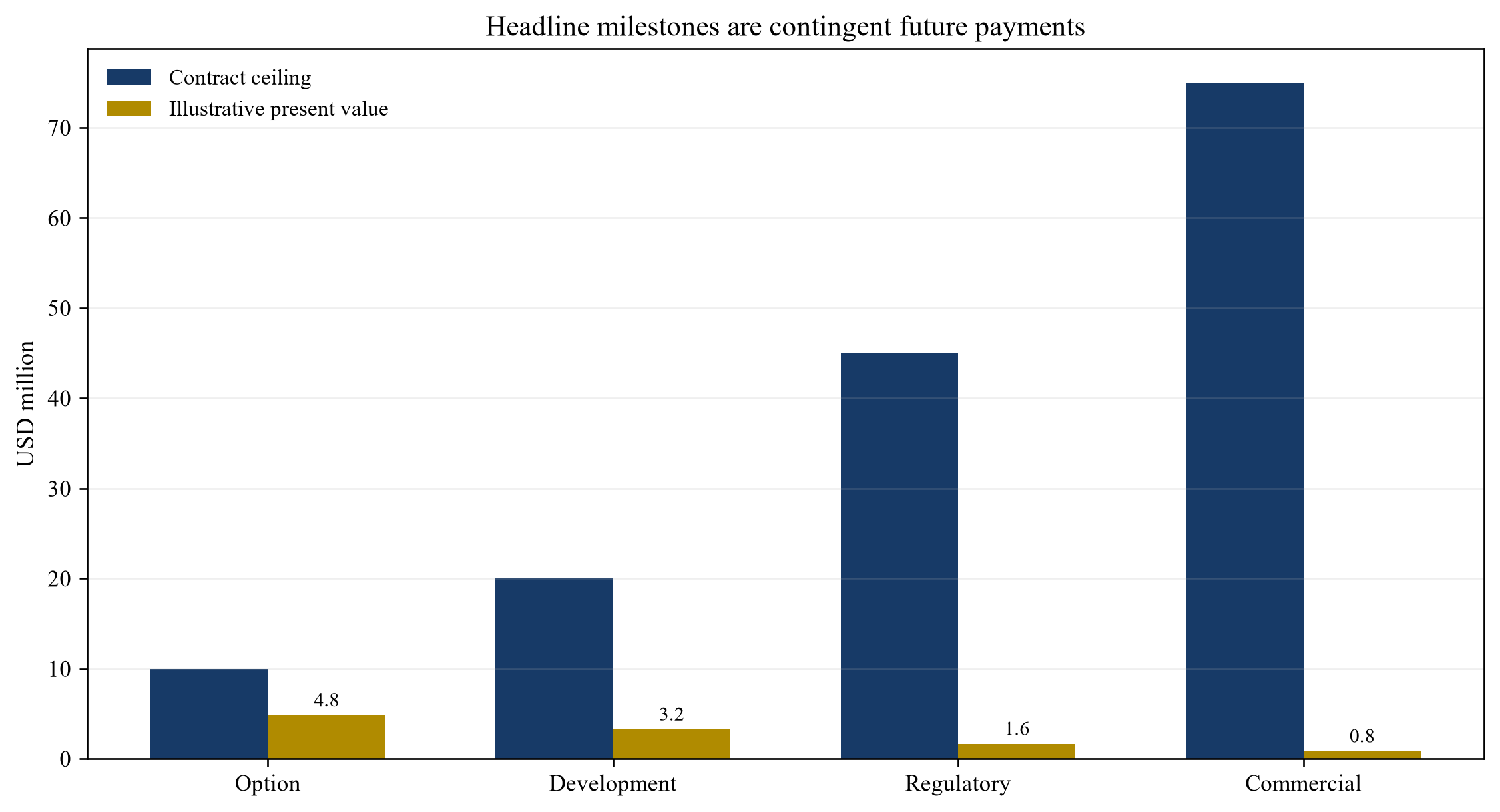
Illustrative assumptions only; amounts and probabilities do not describe an actual contract.
24. Run valuation sensitivities
The valuation should show which assumptions matter most. Platform value can be sensitive to renewal, gross margin and customer concentration. Collaboration value can be sensitive to partner continuation, payment timing and programme probability. Pipeline value can be sensitive to technical success, development cost, price and time to market.
The hypothetical case should include a downside that loses the largest customer, delays programme milestones and increases remaining laboratory investment. It should include a base case supported by current evidence. An upside can include validated reuse across programmes and successful partner elections, provided these remain scenarios.
Sensitivity analysis should preserve dependencies. Increasing pipeline probability can require additional cost. Faster programme progression can consume constrained laboratory capacity. A platform expansion can require sales and customer-support investment. Isolated upside toggles can overstate value.
25. Design consideration around evidence
Consideration structure can allocate uncertainty. Cash at closing can reflect validated technology, collectible contracts and transferable assets. Escrow can cover title, data rights, compliance and customer claims. Earn-outs can follow revenue, margin or programme evidence. Contingent value rights can follow clinical, regulatory or commercial milestones.
Scientific triggers should be precisely defined. A phrase such as successful lead is vulnerable to dispute. The agreement should identify protocol, acceptance criteria, independent review, timing, control of development and treatment of deviations. A milestone controlled by the buyer may require operating covenants and dispute procedures.
Retention and invention arrangements should support continuity without converting all purchase price into employment compensation. Tax, accounting, regulatory and securities treatment require specialist advice in the relevant jurisdictions.
26. Plan confirmatory diligence
Confirmatory diligence should focus on claims that drive the valuation. A practical work plan includes contract reconciliation, customer reference calls, design-to-result traceability, blinded reproduction of selected experiments, code and model review, data-rights mapping, patent analysis, developability review, laboratory inspection, security testing and key-person interviews.
The buyer should establish a clean protocol for competitively sensitive data. Customer and partner agreements can restrict disclosure. Personal, genomic and clinical data require appropriate controls. Review environments should preserve provenance and audit trails.
Findings should flow directly into the model. A failed reproduction can reduce a programme probability, create an escrow or change a closing condition. A confirmed renewal can improve revenue quality. A rights gap can require consent, remediation or exclusion.
27. Protect the first 100 days
The first 100 days should preserve the technical engine while establishing control. Priorities include access and cybersecurity, customer and partner continuity, key-person retention, laboratory quality, data provenance, model monitoring, programme governance, budget authority and decision rights.
Systems migration should follow validation. Changes to laboratory protocols, instruments, cloud environments or data schemas can break comparability and regulatory records. The integration team should define which systems remain stable, which interfaces require monitoring and which migrations need parallel runs.
Programme review should test the combined portfolio for duplicate targets, conflicting rights, capacity constraints and capital priorities. Stop decisions can preserve value. Integration success is measured by continued quality-passed decisions and contracted delivery, rather than activity alone.
28. Establish a board dashboard
The board dashboard should connect scientific operations to cash and programme value. Useful platform measures include design-to-validation time, quality-pass rate, reproducibility, model calibration, programmes supported, reuse, customer renewal and gross margin. Service measures include backlog, utilisation, delivery, acceptance, concentration and cash collection.
Partnered-programme measures include funded work, next trigger, evidence gap, partner decision date, probability change and remaining cost. Owned-pipeline measures include evidence state, decision milestone, development spend, risk-adjusted value and strategic alternative. Rights and compliance measures include data exceptions, patent events, security incidents and regulatory commitments.
Metrics require definitions and owners. The dashboard should show denominators, cohorts and changes over time. A single experiment count or aggregate milestone ceiling should not stand in for value creation.
Table 4. Transaction and ownership dashboard
| Domain | Board metric | Evidence owner | Decision supported |
|---|---|---|---|
| Platform | Reuse, cycle time, reproducibility, renewal and margin | Technology and finance | Invest, price or redesign |
| Services | Backlog, utilisation, acceptance and cash | Commercial and operations | Capacity and customer action |
| Partnered programmes | Next trigger, probability, partner date and cost | Alliance and programme lead | Fund, renegotiate or stop |
| Owned pipeline | Evidence state, remaining cost and risk-adjusted value | R&D and portfolio committee | Advance, partner or stop |
| Rights and controls | Exceptions, consents, patents, security and compliance | Legal and quality | Remediate or restrict use |
Metrics should be defined, reconciled and linked to responsible decision owners.
29. Recognise limitations
Protein-design technologies, regulatory expectations and commercial models continue to evolve. Public disclosures provide useful examples and do not reveal complete private operating data. Primary research establishes results under specified experimental conditions and does not validate a target company's implementation.
Early programmes contain substantial biological, technical, manufacturing, regulatory and commercial uncertainty. Risk-adjusted values depend on assumptions that can change sharply with new evidence. Market comparables can be volatile and can combine different business models. Contract interpretation depends on full agreements and applicable law.
The framework improves traceability; it does not produce certainty. Independent scientific, legal, regulatory, tax, accounting and valuation advice remains necessary for a transaction. Hypothetical figures in this paper should not be used as forecasts or valuation conclusions.
30. Test customer willingness to pay
The platform case should include direct evidence of customer willingness to pay. Signed contracts, renewals, expansions and collected cash provide stronger evidence than non-binding discussions or technical evaluations. The buyer should reconstruct the commercial funnel from qualified opportunity through paid programme and repeat engagement. It should identify where scientific success fails to convert into procurement approval or budget.
Pricing should be compared with the economic decision supported. A protein-design engagement that avoids months of laboratory work or improves the probability of a valuable programme can support value-based pricing. The target must still demonstrate that the customer recognises and pays for that benefit. Discounts, unpaid pilots, bundled options and partner-funded infrastructure should remain visible.
Customer interviews should distinguish satisfaction with individual scientists from reliance on the institutional platform. They should test switching cost, alternative providers, internal build options, data portability, security, delivery quality and future budget. These findings affect recurrence, margin and the persistence of platform value after a change of control.
31. Assess compute and infrastructure economics
Model training, structure prediction, molecular simulation and large-scale inference can require material compute. Laboratory automation, sequencing, mass spectrometry, imaging and storage add physical and digital infrastructure. The valuation model should separate fixed capacity, variable use, committed cloud spend, equipment leases, maintenance, calibration and refresh requirements.
Compute cost per design has limited meaning unless connected to validated output. The team should calculate compute and laboratory cost per quality-passed candidate, reproduced result and programme decision. It should test whether improved algorithms reduce cost or whether larger model and screening ambitions absorb the saving.
Infrastructure can constrain growth. A customer pipeline that exceeds assay, synthesis or data-review capacity creates delayed revenue and execution risk. Conversely, unused capacity can depress margin. Capacity planning should reconcile commercial forecasts, programme demand, workforce and capital requirements over the valuation period.
32. Evaluate regulatory and quality readiness
Protein-design companies can operate across research, regulated development and manufacturing support. The applicable quality system depends on the activity and the evidence used. The buyer should map which workflows support exploratory research, regulated submissions, clinical development or product release and test whether controls match the intended use.
Records should include model and software versions, protocol approval, instrument status, sample identity, deviations, access, review and retention. A result used for internal exploration can require a different control level from evidence supporting a regulatory decision. The transaction model should include remediation cost and schedule where the existing system does not support the forecast use.
Regulatory readiness also influences partnering. A sophisticated collaborator can require auditable provenance, security and quality before accepting a result or exercising an option. Weak controls can delay payment even when the underlying science is promising.
33. Translate findings into bid discipline
The investment committee should receive a bridge from management's headline value to evidence-supported standalone value, buyer-specific value and consideration at risk. Each adjustment should identify the finding, affected cash flow, model change, contractual response and integration owner. This creates a record of how diligence changed the bid.
A bid can contain a base amount for validated transferable value, contingent payments for specified future evidence and a funded operating plan for the capital required after close. The buyer should avoid paying at signing for an outcome that it must finance and execute later unless competitive or strategic considerations justify the choice.
Walk-away conditions should be explicit. Examples include unresolved title to core intellectual property, inability to transfer critical data rights, failure to reproduce a central claim, loss of a material collaboration or unacceptable compliance exposure. Bid discipline converts technical diligence into an executable transaction decision.
34. Conclude with an evidence-based valuation rule
A protein-design company can contain a valuable platform, service business and pipeline at the same time. Value should be earned separately by each layer. The platform must show repeatable capability and scalable economics. Services must show collectible contract cash and sustainable delivery margin. Partnered programmes must show enforceable contingent rights. Owned programmes must show risk-adjusted evidence and retained economics.
The final bridge should add only incremental value, deduct the capital and obligations required to realise it, and remove overlap across shared data, intellectual property, laboratories and people. Buyer-specific synergies should remain visible outside standalone value.
This discipline changes the transaction conversation. Scientific promise becomes a set of auditable rights, evidence states, cash flows and decisions. It gives boards a valuation that can be challenged, updated and tied to consideration.
References
- U.S. Food and Drug Administration. Considerations for the Use of Artificial Intelligence to Support Regulatory Decision-Making for Drug and Biological Products. Draft Guidance. January 2025. https://www.fda.gov/regulatory-information/search-fda-guidance-documents/considerations-use-artificial-intelligence-support-regulatory-decision-making-drug-and-biological
- U.S. Food and Drug Administration. Artificial Intelligence for Drug Development. https://www.fda.gov/about-fda/center-drug-evaluation-and-research-cder/artificial-intelligence-drug-development
- U.S. Food and Drug Administration and European Medicines Agency. Guiding Principles of Good AI Practice in Drug Development. https://www.fda.gov/about-fda/artificial-intelligence-drug-development/guiding-principles-good-ai-practice-drug-development
- U.S. Food and Drug Administration. Artificial Intelligence and Machine Learning in Biological and Other Products Regulated by CBER. https://www.fda.gov/vaccines-blood-biologics/artificial-intelligence-and-machine-learning-aiml-biological-and-other-products-regulated-cber
- Watson, J. L. et al. De novo design of protein structure and function with RFdiffusion. Nature 620, 1089-1100 (2023). https://www.nature.com/articles/s41586-023-06415-8
- Dauparas, J. et al. Robust deep learning-based protein sequence design using ProteinMPNN. Science 378, 49-56 (2022). https://www.science.org/doi/10.1126/science.add2187
- Abramson, J. et al. Accurate structure prediction of biomolecular interactions with AlphaFold 3. Nature 630, 493-500 (2024). https://www.nature.com/articles/s41586-024-07487-w
- European Bioinformatics Institute. AlphaFold Protein Structure Database. https://alphafold.ebi.ac.uk/
- IFRS Foundation. IAS 38 Intangible Assets. https://www.ifrs.org/issued-standards/list-of-standards/ias-38-intangible-assets/
- IFRS Foundation. IFRS 3 Business Combinations. https://www.ifrs.org/issued-standards/list-of-standards/ifrs-3-business-combinations/
- IFRS Foundation. IFRS 13 Fair Value Measurement. https://www.ifrs.org/issued-standards/list-of-standards/ifrs-13-fair-value-measurement/
- Absci Corporation. Annual Report for the year ended 31 December 2025. U.S. Securities and Exchange Commission. https://www.sec.gov/Archives/edgar/data/1672688/000167268826000068/absi-20251231.htm
- Absci Corporation. Absci and Invetx Partner to Bring Generative AI Drug Creation to Animal Health. https://investors.absci.com/news-releases/news-release-details/absci-and-invetx-partner-bring-generative-ai-drug-creation
- Absci Corporation. Almirall and Absci Expand AI Drug Creation Collaboration. https://investors.absci.com/news-releases/news-release-details/almirall-and-absci-expand-ai-drug-creation-collaboration-adding
- Schrodinger, Inc. Annual Report for the year ended 31 December 2025. U.S. Securities and Exchange Commission. https://www.sec.gov/Archives/edgar/data/1490978/000149097826000010/sdgr-20251231.htm
- Schrodinger, Inc. 2025 Financial Results and Business Update. U.S. Securities and Exchange Commission. https://www.sec.gov/Archives/edgar/data/1490978/000149097826000009/sdgr-20251231xexx991.htm
- Schrodinger, Inc. Collaboration and License Agreement with Novartis. U.S. Securities and Exchange Commission. https://www.sec.gov/Archives/edgar/data/1490978/000149097825000014/sdgr-20241231xexx1048novar.htm
- National Institute of Standards and Technology. Artificial Intelligence Risk Management Framework. https://www.nist.gov/itl/ai-risk-management-framework
- World Intellectual Property Organization. Patent Landscape Report: Generative Artificial Intelligence. https://www.wipo.int/publications/en/details.jsp?id=4710
- International Organization for Standardization. ISO/IEC 42001:2023 Information technology; Artificial intelligence; Management system. https://www.iso.org/standard/81230.html
About the Author
Chennakeshav (CK) is a corporate finance and investment banking executive with 25+ years of global experience in deal origination, structuring and execution across M&A, growth capital and corporate strategy. He has led value-creation mandates for founders, corporates and funds — bridging the boardroom view to hands-on execution and close.
His career spans Morgan Stanley, HSBC, Lloyds Banking Group, EWEC, ADQ portfolio companies and Emirates Growth Fund, across TMT, real estate, fintech, deeptech, cleantech, infrastructure and energy. He has partnered with C-suite leaders, private equity and venture funds, sovereign wealth funds and family offices to finance complex fund raises and scale-up ventures, and has led M&A due diligence, post-merger integration and business-transformation initiatives to create value.
At Matchpoint Partners he is Managing Partner, leading the firm's corporate finance, M&A and capital-raising practice. He holds an MBA from London Business School, an engineering degree from VTU and a Master of Laws (LLM, in progress) from UCL London.
An active start-up mentor, CK mentors at Techstars, DIFC FinTech Hive, Startup Grind, Founder Institute and IN5, serves as Entrepreneur Mentor in Residence (EMiR) at London Business School, and judges the Entrepreneurship World Cup.
https://www.linkedin.com/in/ckadya/
https://www.matchpoint-partners.com/team/ck-adya.html
This paper is part of a continuing series on the structure of private and alternative markets. The views expressed are the author's own. The paper is for information only, describes market structure in general terms, and does not constitute investment, legal, tax or regulatory advice or a recommendation in respect of any security, vehicle or counterparty.
