

1. Define the acquisition decision
The acquisition decision is whether an AI-synthetic-biology platform can repeatedly convert a relevant biological question into evidence that changes a product, programme or capital-allocation decision. The buyer needs this answer before assigning value to laboratory automation, proprietary data, machine-learning models, discovery pipelines, collaboration revenue or forecast synergies.
Synthetic biology can combine sequence design, strain or cell engineering, automated liquid handling, imaging, multi-omics, chemical synthesis, computational modelling and iterative experimentation. AI can select candidates, predict properties, design experiments, interpret measurements and recommend the next cycle. The commercial product may be a therapeutic candidate, engineered organism, biological material, research tool, manufacturing process, model, dataset or service programme.
The platform claim should therefore be translated into an auditable chain. What question was posed? Which intervention was built? Which controls were used? What was measured? Did the result meet quality standards? Can another qualified team reproduce it? What uncertainty was reduced? Which authorised decision changed? What economic right and cash flow followed? Transaction value depends on the strength and continuity of this chain.
Table 1. The evidence stack for pricing an AI-synthetic-biology lab cycle
| Evidence layer | Core question | Minimum record | Transaction consequence |
|---|---|---|---|
| Scientific question | Which uncertainty must the experiment resolve? | Hypothesis, programme stage and decision rule | Defines relevance |
| Design | Why were constructs, samples and controls selected? | Versioned protocol and design rationale | Defines experimental validity |
| Execution | Can the physical workflow run consistently? | Instrument, batch, operator and deviation logs | Defines operational repeatability |
| Measurement | Is the output reliable and comparable? | Calibration, quality controls and raw data | Defines usable evidence |
| Learning | Does the model improve decisions within a stated context? | Training lineage, evaluation and uncertainty | Defines computational value |
| Economics | Does the cycle advance an owned or contracted value right? | Programme decision, milestone, revenue and cash | Defines transaction value |
Each layer should be tested for scientific relevance, transferability and economic consequence.
2. Treat speed as a system property
Laboratory speed is often expressed as experiments per week, images captured, sequences screened or compounds tested. These are capacity indicators. A defensible M&A analysis asks whether the entire system moves faster from a defined question to a reliable decision. Faster execution at one step can create queues, rework or low-value data elsewhere.
The cycle begins before a robot moves. Scientific teams must define the context, available evidence, candidate space, controls and stopping rule. Automation then schedules materials, instruments and protocols. Measurement systems create raw signals. Data pipelines transform those signals into comparable records. Models interpret the result and propose the next action. Programme leaders decide whether to repeat, advance, redesign or stop.
The buyer should calculate end-to-end cycle time and waiting time by step. A laboratory can complete physical runs quickly while samples wait for preparation, quality review or model analysis. Speed becomes a moat when the integrated system completes more decision-relevant cycles per unit of time, cost and scarce expert attention than a credible alternative.
3. Define the design-build-test-learn unit
The design-build-test-learn cycle should be defined at the level where a decision occurs. A design can be a DNA construct, guide RNA, protein sequence, microbial strain, cell line, assay condition or chemical route. Build converts the design into a physical intervention. Test measures a pre-specified outcome. Learn updates the model or programme judgement.
Cycle definitions can be manipulated. Counting each well as an experiment produces a larger number than counting each independent hypothesis. Multiple measurements on the same biological replicate do not create independent experiments. Repeated failed runs can increase activity while reducing productivity. The diligence team should reconcile management's metric with protocol, sample, plate, instrument and programme records.
A useful unit links one controlled intervention to one decision-relevant observation and its provenance. The acquirer should retain both granular events and an aggregated cycle record. This enables productivity analysis without losing the evidence required to reproduce the result.
4. Map the complete experiment cycle
The process map should begin with intake of the scientific question and end with the recorded programme decision. It should identify queues, rework, handoffs, approvals, data transformations and manual judgement. Each stage should have an owner, service level, quality gate and failure code.
In an integrated platform, software can connect design tools, laboratory information management, robotic scheduling, instrument control, data processing, model training and programme tracking. Integration can reduce transcription and coordination delay. It can also create concentrated operational risk when undocumented interfaces, custom scripts or one engineer connect critical systems.
The buyer should select representative programmes and replay their cycles. It should trace original design parameters through physical materials, raw measurements, processed features, model outputs and decision records. A platform diagram supports diligence only when the underlying records reconcile.
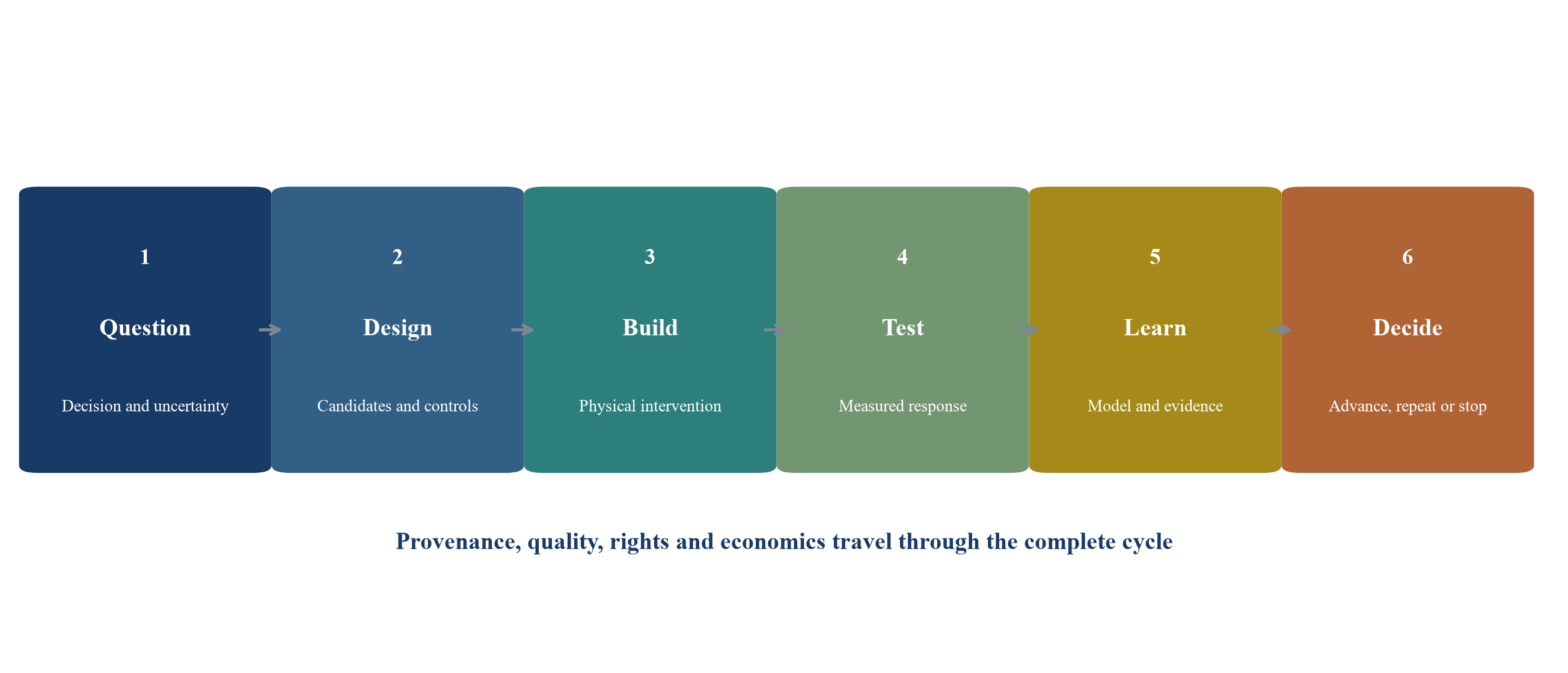
Speed creates value when every stage preserves provenance, quality and an authorised decision link.
5. Build a throughput metric hierarchy
Throughput should be reported through a hierarchy. Installed capacity describes what instruments could process under stated assumptions. Scheduled capacity describes allocated operating time. Completed runs show physical activity. Quality-passed results show usable outputs. Reproducible results show repeatable evidence. Decision-linked results show programme relevance. Economically attributable results show value.
The hierarchy prevents a large headline number from carrying more meaning than the records support. A buyer can calculate conversion at each stage and identify the constraint. Low scheduled use can indicate insufficient demand or poor planning. Low completion can indicate operational instability. Low quality pass can indicate materials, protocol or measurement problems. Low decision conversion can indicate weak biological relevance or programme governance.
Management should provide the denominator, period and inclusion rules for every metric. Throughput should be segmented by assay, programme, instrument, customer and development stage. Aggregation across simple and complex experiments can hide economics and quality.
6. Measure usable result rate
A completed experiment is not automatically usable. The protocol should define acceptance criteria before results are reviewed. Criteria can cover positive and negative controls, signal range, contamination, replicate agreement, instrument state, sample identity, missingness and batch effects. Deviations should be recorded and dispositioned.
The usable result rate is the share of completed experimental units that pass the defined quality gates and enter the governed evidence base. The rate should be calculated without quietly excluding failed plates, cancelled batches or manual reruns. A high rate can indicate mature operations. It can also reflect permissive thresholds, so the buyer must inspect the quality definitions.
OECD guidance on GLP data integrity emphasises data flow, criticality and the full data lifecycle. Its principles are relevant to transaction diligence even where a particular discovery activity is outside formal GLP scope. The acquirer should determine which records support regulated work, which support research decisions and which controls apply to each.
7. Test reproducibility rather than repetition
Repeatability asks whether the same team and system obtain a consistent result under closely matched conditions. Reproducibility asks whether the result persists across relevant operators, batches, instruments, sites or methods. Both matter. An acquisition can change people, systems, vendors and locations, making reproducibility a direct integration question.
The buyer should select high-value claims and commission or observe blinded reruns under a pre-agreed protocol. It should include successful, failed and borderline results. Replicate structure, batch allocation and statistical analysis should be fixed before execution. Material deviations should remain visible.
Reproducibility does not require identical numeric output. The accepted tolerance should follow the decision. A screening assay may tolerate variation while preserving rank order. A manufacturing control or release test may need narrower limits. Value should attach to the reproducibility standard that the product and regulatory context require.
8. Measure information gain
The most valuable experiment may eliminate an attractive but incorrect path. Experiment count therefore needs a measure of uncertainty reduction. Information gain can be estimated through changes in a probability distribution, candidate ranking, expected programme value or decision confidence. The chosen measure should be understandable to scientific and investment teams.
The acquirer should compare predicted and realised information gain. Active-learning systems can select experiments expected to be informative, yet a model may favour regions where its uncertainty estimate is poorly calibrated. Historical records should show which proposed experiments were run, which results were surprising and how subsequent choices changed.
Information gain should be connected to cost and time. A complex experiment that resolves a programme-killing uncertainty can have greater value than thousands of inexpensive screens. The portfolio needs a balanced queue of exploration, validation, optimisation and confirmatory work.
9. Assess model context of use
FDA's January 2025 draft guidance proposes a risk-based credibility framework for AI model outputs used to support regulatory decision-making for drugs and biological products. It begins with the question of interest and context of use, assesses model risk, and calls for a credibility plan, execution and documentation. The guidance is draft and contains non-binding recommendations. It provides a useful diligence structure for claims that AI output can support a consequential product decision.
EMA's adopted reflection paper addresses AI across the medicinal-product lifecycle and places responsibility on applicants to understand model use, data, performance, governance and applicable legal requirements. FDA and EMA later published joint guiding principles that include clear context of use, risk-based performance assessment, data governance, documentation and lifecycle management.
The target should define each production model's users, input population, output, decision, limitations and monitoring. A model that performs well for candidate ranking may not be credible for safety, quality or regulatory evidence. Transaction value should follow the supported context, with expansion treated as a future milestone.
10. Reconstruct training and evaluation data
AI-synthetic-biology models can train on public sequences, licensed databases, customer data, internal experiments, simulated data and human annotations. The buyer should build a dataset register that records source, rights, consent, permitted use, transformation, version, quality, population, retention and deletion.
Experimental comparability matters as much as volume. Differences in cell type, protocol, reagent lot, instrument, incubation, image processing or label construction can cause the model to learn laboratory artefacts. Recursion's public filings, for example, describe deliberate architecture and data practices intended to improve cross-sample and cross-experiment relatability. Such disclosures illustrate the value of controlled data generation. They remain company statements that require transaction-specific verification.
Evaluation should use data separated by relevant biology, time and programme. Random splitting can place highly related samples in training and test sets. The buyer should inspect leakage controls, external validation, negative findings, subgroup performance and uncertainty calibration.
11. Value the closed learning loop
A platform creates a closed loop when experimental results update the model and the model changes the next experiment. The loop can compound advantage when the company controls the relevant data, protocols, infrastructure and decisions. It can also amplify bias or measurement error when poor results become new training data without sufficient review.
The buyer should identify which loops operate in production. It should compare model-proposed designs with scientist-proposed alternatives and record acceptance, override and outcome. Model influence can range from prioritisation to fully automated scheduling. Human accountability should remain explicit for consequential scientific, safety, regulatory and capital decisions.
Loop value depends on exclusivity and learning rights. Customer contracts may restrict use of programme data for general model training. Partner data may be segregated. Public or licensed inputs may impose attribution or field restrictions. The economic model should use only learning that the target can lawfully retain and deploy.
12. Build the IP and rights graph
The IP review should move beyond a patent list. It should connect patents, applications, trade secrets, source code, model weights, datasets, protocols, biological materials, constructs, laboratory methods, licences, university agreements, employee assignments, customer rights and partner restrictions. Each asset should connect to the product or programme it supports.
WIPO data show rapid growth in generative-AI patenting and meaningful activity in life and medical sciences. Patent volume indicates a crowded and evolving field. It does not establish freedom to operate, enforceability or product value. The buyer needs claim-level analysis for material inventions and a view of neighbouring rights.
Background IP, foreground IP and improvements should be separated. Joint-development contracts can allocate inventions by field, inventorship, funding or programme. Change-of-control provisions, consent rights and termination consequences can determine whether the lab cycle survives the acquisition.
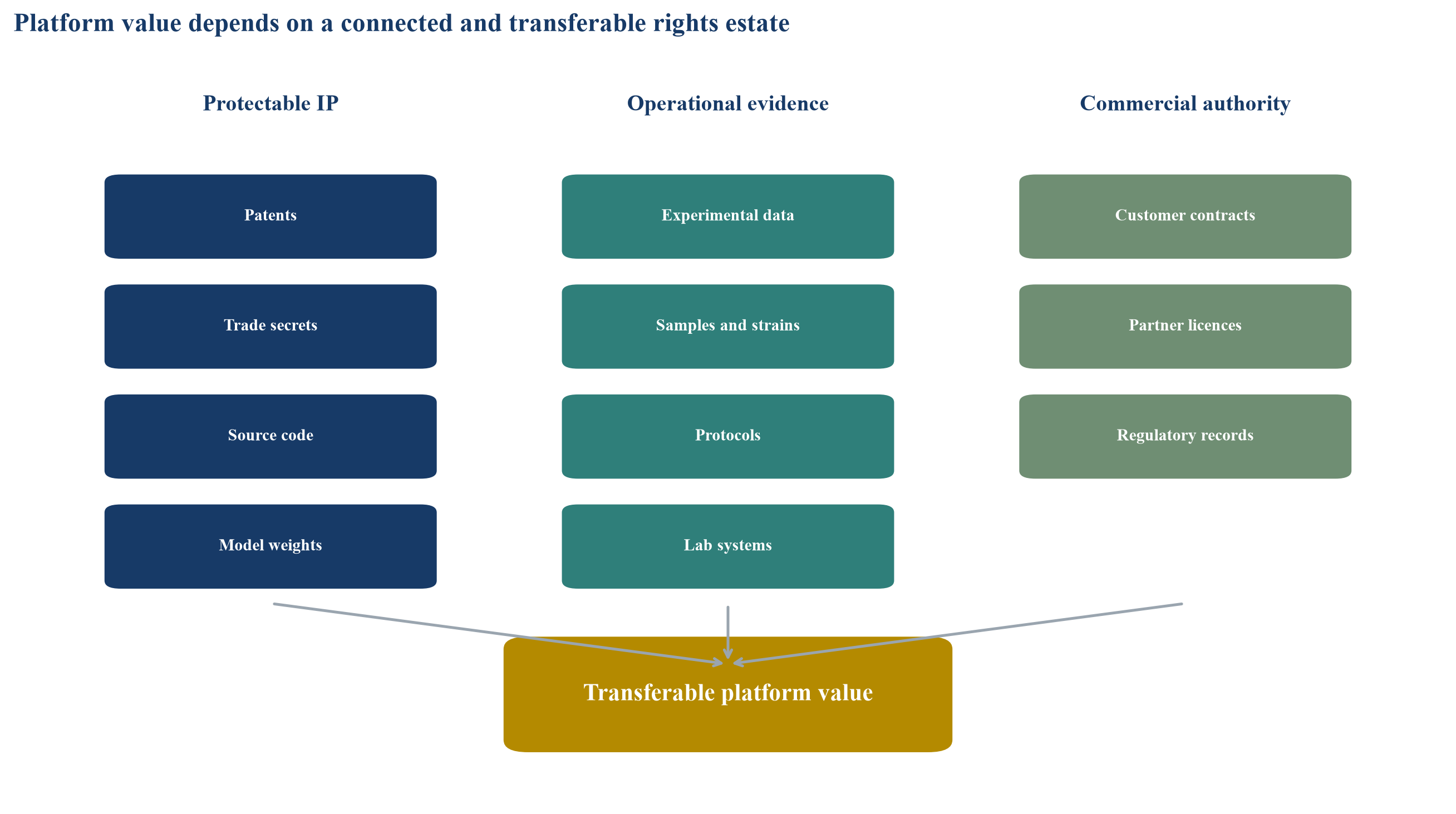
An acquirer needs usable rights across data, software, biology, laboratories and commercial programmes.
13. Test patent position and freedom to operate
Patent diligence should identify jurisdictions, priority, ownership, prosecution, claim scope, expiry, maintenance, encumbrance and challenges. The review should connect claims to commercial implementations. Broad descriptions of AI, biology or automation can create little exclusionary value when the enforceable claims do not cover the actual product.
Freedom to operate is distinct from ownership. A target can own important patents while requiring third-party rights to practise a platform or commercialise an output. The review should map sequence design, genome editing, delivery, host cells, assays, data processing and intended products. Geographic and field-of-use differences matter.
Trade secrets can protect protocols, negative results, parameter choices and operational know-how. Their value depends on access controls, documentation and reasonable protection. An undocumented process held by one scientist creates retention risk rather than a fully transferable asset.
14. Secure biological materials and provenance
Samples, strains, cell lines, plasmids, libraries and reference materials are part of the operating estate. The buyer should verify identity, chain of custody, consent, source agreements, permits, storage, viability, contamination controls and rights to use, modify and transfer.
Material-transfer agreements can restrict commercial use, redistribution, publication, patenting or transfer to an acquirer. University and public-repository materials may carry specific conditions. Customer-provided samples can require return or destruction. The rights graph should connect each critical material to programmes and generated data.
Provenance also affects reproducibility. A result can depend on passage number, culture conditions, reagent lot or undocumented handling. The buyer should inspect inventory records and select materials for independent identity and viability checks where proportionate.
15. Govern genomic and human data
Human genomic and associated data require purpose, consent, access and security controls. NIH's Genomic Data Sharing Policy expects broad and responsible sharing for covered NIH-funded work while applying controlled-access requirements to protected data. NIH guidance effective in 2025 reinforces security expectations for approved users and institutions.
NIH has also cautioned researchers about using controlled-access genomic data to develop generative-AI tools and about the risk of distributing protected data or derivatives without approval. The target should demonstrate that model development, external access, cloud use and downstream distribution remain within the applicable data-use terms.
The acquirer should map data subjects, jurisdictions, consent, repository terms, de-identification, access, model training, outputs and deletion. A model trained on restricted data can create remediation and transfer questions even when raw records are not copied at closing.
16. Assess biosafety and biosecurity
WHO's 2024 laboratory biosecurity guidance addresses the full value chain for high-consequence biological material, technology and information. It includes consequence-driven risk assessment, cybersecurity, information security, molecular techniques and AI. These topics belong in transaction diligence because an acquisition can change access, systems, people and oversight.
The target should identify biological hazards, containment, institutional oversight, incident history, access controls, inventories, dual-use review, cyber controls, emergency plans and regulatory permissions. Controls should match the actual work. A platform focused on non-pathogenic industrial organisms has a different risk profile from one working with high-consequence materials, yet both need documented assessment.
The buyer should test whether automation can execute unapproved designs or protocols. Order screening, sequence review, role-based access and human authorisation can form layered controls. The acquisition plan should preserve competent oversight through systems migration and organisational change.
17. Evaluate laboratory automation as an operating asset
Automation value comes from availability, precision, flexibility, integration and total cost. The buyer should inventory instruments, robotics, custom hardware, control software, maintenance, calibration, consumables, vendor support, spare parts and facility dependencies. Installed equipment should reconcile to the cycle map.
High utilisation can signal demand and mature operations. It can also reduce maintenance windows and resilience. Low utilisation can represent spare growth capacity or an uneconomic build. The analysis should separate constraint equipment from interchangeable capacity and calculate effective output after setup, maintenance, quality failure and rework.
Custom systems may create genuine performance advantage. They can also be difficult to support after key engineers leave. The acquirer should test documentation, source access, safety certification, vendor rights and the ability to restore operation after failure.
18. Calculate cycle economics
Cycle economics should include design labour, biological materials, reagents, consumables, instrument time, compute, data storage, quality review, failed runs, depreciation, facility cost and specialist oversight. Reported marginal cost can omit the platform resources needed to produce a usable decision.
Cost should be calculated per completed cycle, quality-passed result, reproducible finding and programme decision. These denominators show whether scale is improving or merely increasing activity. The buyer should compare internal costs with external alternatives, including contract research organisations, cloud laboratories and licensed datasets.
Learning can create value across programmes. Allocation should remain transparent. A shared model or dataset can support several programmes without allowing the same benefit to be counted repeatedly. The transaction model should distinguish direct programme value, platform reuse and buyer-specific synergy.
19. Connect throughput to programme decisions
Programme records should show when evidence changed a candidate, target, assay, development stage, manufacturing route or stop decision. The buyer should sample decisions and compare them with the underlying data. Decision quality includes stopping weak work early, not merely advancing assets.
Public filings from AI-enabled drug-discovery companies illustrate different operating claims. Recursion's 2025 annual report describes more than two million experiments per week and an integrated platform spanning data generation, models and pipeline decisions. Twist Bioscience describes an integrated DNA-writing platform intended to improve quality, automation and manufacturing throughput. These are issuer disclosures. They show the types of evidence buyers should request and do not validate a particular transaction.
Decision conversion should be segmented by programme stage. Early exploration can generate many cycles with few formal advancement decisions. Later development uses fewer, more controlled experiments. A single conversion ratio across stages can mislead.
20. Separate platform revenue from pipeline value
Platform economics can include fees, research funding, access payments, milestones, royalties, product sales and equity interests. Pipeline economics can include owned candidates and rights retained in partner programmes. Each stream has different probability, timing, control and capital requirements.
Ginkgo Bioworks' public filings describe service revenue and potential downstream value share from milestone, royalty or equity consideration. Its 2025 reporting also describes programme rationalisation and a focus on autonomous laboratories. Such disclosures show why buyers should separate reported activity, current revenue and contingent downstream value.
The acquirer should trace each material contract through scope, acceptance, intellectual property, data rights, termination, change of control, payment, milestone definitions and collection. Total possible milestones should not be treated as pipeline value without technical, contractual and probability analysis.
21. Test collaboration quality
Collaborations can validate platform demand and provide non-dilutive funding. They can also impose exclusivity, data restrictions, service obligations and programme dependencies. The buyer should assess concentration, renewal, decision rights, termination history, deferred obligations and margin by partner.
A partner's decision to advance or stop may depend on strategy, budget and portfolio priorities beyond platform performance. Milestone attrition should therefore be decomposed. Scientific failure, partner reprioritisation, contractual dispute and operational delay have different implications for platform value.
Reference calls should address integration, data quality, reproducibility, responsiveness, decision usefulness and willingness to expand. Contracted revenue should be adjusted for unperformed work, pass-through cost and collection risk.
22. Value pipeline assets through evidence states
Pipeline valuation should begin with asset rights, development stage, target-product profile, evidence, remaining work, capital, timing and probability. A discovery asset should not receive clinical probability merely because AI supported its design. The model should distinguish platform contribution from biological and clinical uncertainty.
Risk-adjusted net present value can support an asset view when assumptions are explicit. Comparable transactions can support a market view when rights, stage and economics are genuinely comparable. Replacement cost can inform platform assets while failing to capture future returns. The buyer should reconcile methods and avoid adding overlapping values.
The framework uses evidence states rather than one blended probability. A candidate can move from computational proposal to experimentally confirmed effect, reproduced finding, development candidate, regulatory filing and clinical evidence. Consideration can follow these transitions.
Table 2. Evidence states for milestone-adjusted pipeline valuation
| Evidence state | Required evidence | Principal uncertainty | Typical transaction treatment |
|---|---|---|---|
| Computational proposal | Versioned model output and rationale | Model relevance and data bias | Option value or excluded |
| Initial experimental support | Quality-passed controlled result | Repeatability and mechanism | Limited base value |
| Reproduced finding | Predefined rerun across relevant conditions | Portability and causality | Higher base value or milestone |
| Programme decision | Documented advancement against criteria | Development execution | Staged consideration |
| External or regulatory evidence | Independent, partner or authority record | Approval and adoption | Milestone or contingent value |
| Commercial cash | Accepted delivery and collection | Persistence and margin | Core value at signing |
Stage labels should reflect the actual programme and do not imply a universal probability of success.
23. Model integration value carefully
An acquirer may expect to combine target data with its models, route internal programmes through the laboratory, reduce external spend or accelerate milestones. Each synergy needs a technical pathway, rights, capacity, accountable owner, cost and timing.
Data combination can fail because schemas, protocols, populations or rights differ. Model transfer can fail because the target's performance depends on laboratory conditions that the buyer cannot reproduce. Laboratory consolidation can interrupt ongoing programmes. Talent loss can weaken the scientific interpretation that makes automation useful.
Synergy should be recognised in stages. Data compatibility can be tested before close through controlled samples or a clean team. Parallel runs can demonstrate transfer. Capacity benefits should be based on quality-passed output and actual queue. Revenue synergy should require a customer pathway and collection assumptions.
24. Address workforce and tacit knowledge
AI-synthetic-biology platforms depend on interdisciplinary teams. Biology, chemistry, automation, data engineering, machine learning, product, regulatory and programme leadership must communicate through shared records and decisions. A bilingual operating culture can be an important capability.
The buyer should identify key-person dependencies, undocumented methods, approval authorities, retention risk and incentive alignment. An assembled workforce is not separately recognised as an identifiable asset under IFRS 3, yet workforce continuity can determine whether recognised technology and customer assets remain productive.
Retention plans should focus on roles required to sustain the cycle, not only senior titles. Documentation, paired ownership and reproducibility exercises can reduce dependence. Integration governance should preserve scientific challenge and prevent output targets from overwhelming quality.
25. Apply business-combination and intangible-asset discipline
IFRS 3 requires an acquirer to recognise identifiable acquired assets and liabilities separately from goodwill when the criteria are met. IAS 38 describes an identifiable intangible asset as separable or arising from contractual or legal rights. Acquired in-process research and development can qualify for separate recognition even where internal research expenditure would have been expensed.
The valuation should identify patents, licences, software, datasets, customer relationships, contracts and in-process research where supported. Complementary assets can be grouped when appropriate. Potential contracts under negotiation and assembled workforce value generally remain within goodwill rather than becoming separate identifiable assets.
Accounting measurement does not replace deal valuation. Purchase-price allocation uses market-participant assumptions at acquisition. The investment case should also show buyer-specific integration cost, synergy and downside. The two analyses should reconcile without being conflated.
26. Construct a hypothetical acquisition
Consider a wholly hypothetical target reporting 1.8 million experiments per month, 14 active programmes, USD 31 million of annual platform and collaboration revenue, and USD 210 million of management-estimated pipeline and buyer synergy value. Management reports a median physical run time of 52 hours and an end-to-end decision cycle of 24 days.
Record review finds that 62 percent of completed experiments pass predefined quality controls. Forty-one percent can be reproduced under the specified conditions. Nine of 14 programmes have a documented link between experimental evidence and an advancement, redesign or stop decision. Seven programmes have clear ownership and partner rights for the proposed transaction.
The valuation bridge retains USD 86 million of attributable pipeline and synergy value at signing. A further USD 54 million is placed behind defined reproducibility, partner-consent, regulatory and collected-cash milestones. The remaining USD 70 million is excluded from current consideration because it depends on unsupported expansion, overlapping value or rights that have not transferred. These figures illustrate method only.
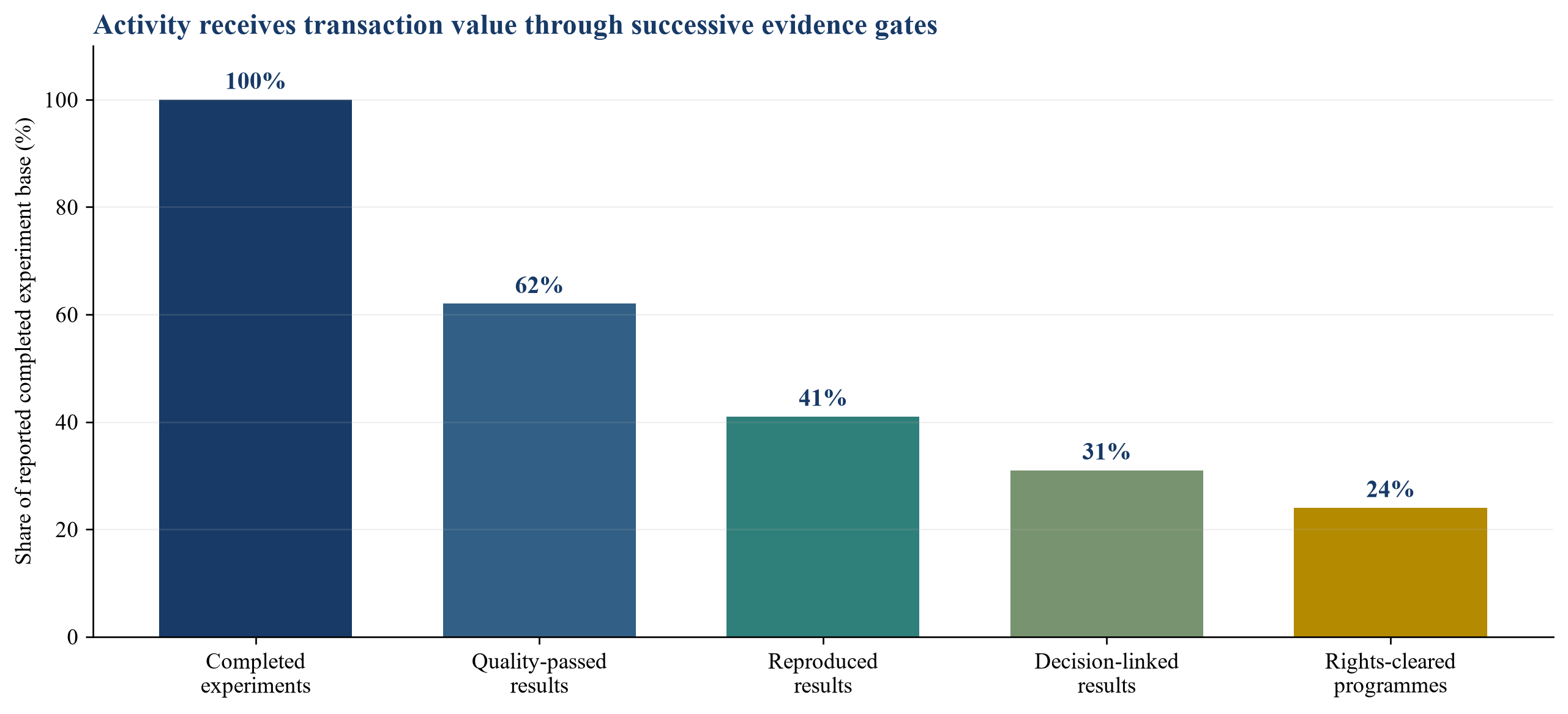
Percentages are illustrative management assumptions and do not describe an actual company.
27. Translate evidence into price and terms
Consideration at signing should reflect assets, rights, revenue and programme evidence the buyer can reproduce. Future value can be allocated through milestones tied to quality, reproducibility, partner consent, programme advancement, regulatory evidence, revenue, margin and collected cash.
Representations should cover IP ownership, licences, data and sample rights, provenance, model documentation, laboratory quality, biosafety, biosecurity, regulatory correspondence, customer contracts, revenue recognition, incidents and undisclosed restrictions. Targeted indemnities or holdbacks can address defined exposures.
Milestones need precise definitions and records. A throughput milestone should use quality-passed and decision-relevant output, not raw activity. A scientific milestone should specify protocol, controls, evaluator and acceptance. A commercial milestone should specify revenue recognition, pass-through cost, cancellations and collection.
Table 3. Hypothetical value bridge and transaction treatment
| Value layer | Management case | Retained at signing | Contingent value | Principal gate |
|---|---|---|---|---|
| Platform and data | 70 | 38 | 12 | Rights, reproducibility and transfer |
| Owned pipeline | 65 | 27 | 23 | Evidence state and remaining capital |
| Partner programmes | 40 | 14 | 12 | Consent, milestones and economics |
| Buyer synergy | 35 | 7 | 7 | Compatibility, capacity and execution |
| Total | 210 | 86 | 54 | Evidence-linked consideration |
Values in USD millions are illustrative management assumptions.
28. Build the diligence workplan
Scientific diligence should review programme hypotheses, protocols, controls, raw data, quality results, reproducibility, negative evidence and decision records. Technical diligence should review code, models, training data, evaluation, infrastructure, security, lineage and change control. Laboratory diligence should review equipment, capacity, maintenance, calibration, deviations and safety.
Legal and regulatory diligence should cover intellectual property, licences, materials, data, privacy, biosafety, biosecurity, permits, regulated records and change-of-control terms. Commercial diligence should cover contracts, partner programmes, cohorts, concentration, margin, service effort, milestones and collection. Financial diligence should reconcile capitalised and expensed development, revenue, deferred obligations, capex and cash requirements.
The workstreams should meet around shared evidence. A data restriction can alter model value and synergy. A laboratory deviation can change scientific confidence and contingent consideration. A partner termination right can reduce both revenue and pipeline value. The final investment paper should show these connections.
29. Plan the first one hundred days
Day one should preserve evidence, access and operating continuity. The buyer should freeze inventories of models, protocols, data, samples, instruments, customer deployments and programme decisions. Critical systems should retain named owners and tested recovery paths.
During the first thirty days, management should reconcile the cycle map and establish common definitions for completed, quality-passed, reproducible and decision-linked experiments. Days thirty-one to sixty should reproduce material claims, resolve rights gaps and run selected programmes in parallel. Days sixty-one to one hundred should approve the combined model, data, laboratory and programme governance.
Integration should protect active experiments and contractual milestones. System migration can follow evidence continuity. Board reporting should separate activity, usable evidence, programme decisions, revenue, margin and cash.
Table 4. Transaction gates and first-one-hundred-day ownership
| Workstream | Pre-close evidence | Day-one control | Day-one-hundred outcome |
|---|---|---|---|
| Lab cycle | Cycle map, throughput and failure codes | Inventory freeze and owner | Common evidence metrics |
| Models and data | Rights, lineage and evaluation | Access and version control | Approved combined registry |
| IP and materials | Ownership, licences and provenance | Consent and custody controls | Closed critical rights gaps |
| Programmes | Decision records and remaining work | Milestone and risk register | Rebased portfolio value |
| Commercial | Contracts, effort, margin and cash | Renewal and collection watch | Verified synergy plan |
Named owners should remain accountable from diligence through integration.
30. Set board controls
The board should receive a balanced view of scientific, operational, model and commercial performance. Activity metrics can include scheduled capacity and completed runs. Evidence metrics can include quality pass, reproducibility, information gain and decision conversion. Commercial metrics can include accepted milestones, recurring revenue, gross margin and collected cash.
Model reporting should include context of use, performance, drift, limitations, incidents and material changes. Laboratory reporting should include deviations, downtime, contamination, safety and corrective actions. Programme reporting should show evidence state, next decision, capital and value at risk.
One composite platform score can conceal weakness. The board needs reconciled measures and a register of accepted limitations. Expansion into a new assay, customer, organism, jurisdiction or decision context should require proportionate evidence.
31. Test assay transfer across sites
An acquisition can require assays to move between facilities, instrument fleets or operating teams. Transfer should be treated as a defined validation exercise. The parties should agree critical reagents, reference materials, equipment ranges, sample handling, controls, acceptance criteria, statistical analysis and deviation treatment before the receiving site begins production work.
The buyer should distinguish method transfer from method redevelopment. A transferred assay reproduces the intended performance within an accepted range. Redevelopment changes material elements and can alter comparability with historical data. When redevelopment is necessary, old and new methods should overlap long enough to quantify the bridge.
Site transfer also tests the reality of tacit knowledge. Repeated dependence on the original scientist, bespoke troubleshooting or undocumented calibration indicates that the platform is less portable than its process maps suggest. This finding can change retention needs, integration timing and consideration. Successful transfer provides direct evidence that protocols, materials, systems and people form a reproducible operating asset.
32. Stress capacity and resilience
Throughput economics should be tested under growth and disruption. The buyer should model demand peaks, instrument failure, reagent shortage, contamination, network outage, cloud interruption, staff absence and supplier delay. The model should show which bottleneck limits quality-passed output and how long recovery takes.
Capacity claims often assume ideal batch size, product mix and uptime. Actual portfolios contain priority changes, complex protocols and low-volume work. Changeovers, cleaning, calibration and quality review reduce effective capacity. A constraint can move from liquid handling to imaging, storage, analysis or scientist review as volume grows.
Resilience may justify deliberate spare capacity, qualified alternative suppliers and duplicated control systems. These costs belong in sustainable margin. A buyer should avoid valuing unused equipment as immediate growth while excluding the operating capital required to staff, validate and maintain it. The relevant capacity is the output that remains quality-passed, decision-linked and recoverable under realistic operating conditions.
33. Validate negative data and failed experiments
Negative results are a material platform asset when they are trustworthy, searchable and connected to design decisions. They can prevent repeated work, define biological boundaries and improve model calibration. They lose value when failure causes are ambiguous or when only successful outputs enter the formal dataset.
The diligence team should compare raw run logs, quality systems, programme records and model-training datasets. It should determine whether failed experiments were excluded because the biology was negative, the protocol failed or the measurement was invalid. These categories should remain separate. Training on mislabeled technical failure can degrade predictions, while deleting valid negative biology can create selection bias.
Publication and partner incentives can favour positive findings. The acquirer should test whether governance preserves adverse evidence and stop decisions. A platform that learns which candidates and methods fail can reduce future cost. Transaction value depends on the integrity and lawful reusability of that record, rather than the number of negative files stored.
34. Reconcile model improvement with biological outcome
A model can improve on an internal metric without improving the biological or commercial decision. Higher prediction accuracy, lower loss or better benchmark ranking should be connected to candidate selection, experimental success, programme time, cost or quality. The relationship should be tested prospectively where feasible.
The buyer should inspect model releases across time and compare pre-release expectations with post-release outcomes. It should identify changes to data, labels, evaluation sets and thresholds. Apparent improvement can arise from easier test data, leakage or a narrower population. A stable benchmark can also become less relevant as programmes change.
Prospective comparison can allocate candidate slots between a new model, prior method and scientific judgement under agreed rules. The objective is to estimate decision contribution within the relevant context. Human expertise remains part of the system. The commercial question is whether the combined process produces better evidence and economics than a credible alternative.
35. Design separation and clean-team controls
Pre-close diligence can expose competitively sensitive sequences, targets, customer data, model weights and programme plans. The parties should use staged access, clean teams, secure data rooms and purpose-limited analysis. Access should match the transaction question and applicable contractual, privacy, competition and biosecurity requirements.
A clean team can compare schemas, protocols, rights and capacity without transferring raw protected data to operating personnel. Synthetic or masked samples can support preliminary compatibility testing. Material conclusions should state the limits created by restricted access and identify the confirmatory work required before closing or value release.
Separation planning also matters when assets will be carved out. The parties should identify shared laboratories, cloud environments, licences, data, staff, quality systems and partner relationships. Transitional services should specify scope, security, service levels, cost, exit and evidence preservation. A platform that cannot operate independently may still have value, with separation cost and timing reflected in the transaction structure.
36. Recognise limitations
This framework does not validate a particular company, model, experiment, product or transaction. Synthetic biology covers diverse applications with different scientific, regulatory, safety and commercial conditions. Applicable requirements vary by jurisdiction and use.
Public-company disclosures provide examples of operating claims and business models. They are not independent validation of the disclosed performance or future value. Regulatory and policy sources can change. Transaction teams should confirm current requirements with qualified scientific, legal, regulatory, accounting and valuation advisers.
The hypothetical case does not estimate market demand, probability of technical success or transaction value. Its figures demonstrate an evidence bridge. A real valuation requires asset-specific rights, data, protocols, results, contracts, capital, timing and market-participant assumptions.
37. Conclude with the lab-cycle moat
An AI-synthetic-biology platform creates a defensible transaction case when it resolves relevant uncertainty faster, more reliably and at lower decision cost. The moat lies in the connected system: scientific questions, experimental design, physical execution, measurement, governed learning, rights and programme decisions.
Raw throughput is a starting point. Quality-passed output, reproducibility, information gain and decision conversion show whether speed creates evidence. Data, intellectual property, samples, protocols, models, laboratory systems and people determine whether that evidence engine transfers to the buyer. Contracts and pipeline rights determine who receives the economics.
The pricing discipline is straightforward. Value the cycle that can be reproduced at closing. Stage consideration for evidence, rights and cash that will become available later. Preserve human accountability and biological judgement throughout. A faster laboratory becomes a moat when the buyer can show how each cycle changes a decision and how that decision produces durable enterprise value.
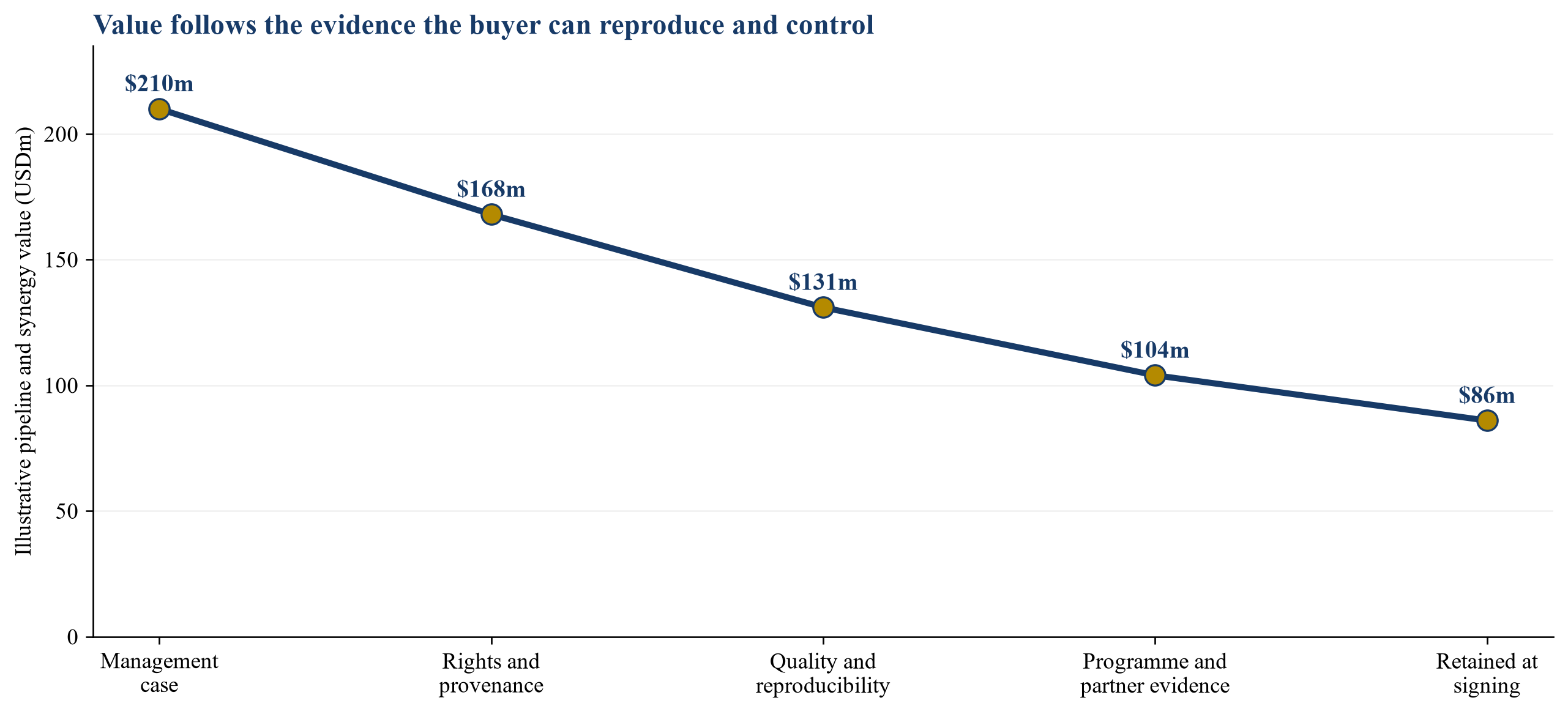
Values in USD millions are illustrative management assumptions.
References
- U.S. Food and Drug Administration. Considerations for the Use of Artificial Intelligence To Support Regulatory Decision-Making for Drug and Biological Products, Draft Guidance, January 2025. https://www.fda.gov/regulatory-information/search-fda-guidance-documents/considerations-use-artificial-intelligence-support-regulatory-decision-making-drug-and-biological
- U.S. Food and Drug Administration. Artificial Intelligence and Machine Learning for Biological and Other Products Regulated by CBER. https://www.fda.gov/vaccines-blood-biologics/artificial-intelligence-and-machine-learning-aiml-biological-and-other-products-regulated-cber
- U.S. Food and Drug Administration and European Medicines Agency. Guiding Principles of Good AI Practice in Drug Development. https://www.fda.gov/about-fda/artificial-intelligence-drug-development/guiding-principles-good-ai-practice-drug-development
- European Medicines Agency. Reflection Paper on the Use of Artificial Intelligence in the Medicinal Product Lifecycle, adopted September 2024. https://www.ema.europa.eu/en/use-artificial-intelligence-ai-medicinal-product-lifecycle-scientific-guideline
- European Medicines Agency. Artificial Intelligence. https://www.ema.europa.eu/en/about-us/how-we-work/data-regulation-big-data-other-sources/artificial-intelligence
- OECD. GLP Data Integrity, OECD Series on Principles of Good Laboratory Practice and Compliance Monitoring No. 22, 2021. https://www.oecd.org/en/publications/glp-data-integrity_45779212-en.html
- World Health Organization. Laboratory Biosecurity Guidance, June 2024. https://www.who.int/publications/i/item/9789240095113
- National Institutes of Health. Genomic Data Sharing Policy Overview. https://grants.nih.gov/policy-and-compliance/policy-topics/sharing-policies/gds/overview
- National Institutes of Health. Using Genomic Data Responsibly Under the NIH Genomic Data Sharing Policy. https://www.grants.nih.gov/policy-and-compliance/policy-topics/sharing-policies/accessing-data/using-genomic-data
- National Institutes of Health. Protecting Human Genomic Data when Developing Generative Artificial Intelligence Tools and Applications, NOT-OD-25-081, March 2025. https://grants.nih.gov/grants/guide/notice-files/NOT-OD-25-081.html
- National Institute of Standards and Technology. Artificial Intelligence Risk Management Framework. https://www.nist.gov/itl/ai-risk-management-framework
- World Intellectual Property Organization. Generative Artificial Intelligence Patent Landscape Report and Patent Trends Update. https://www.wipo.int/web-publications/spark-patent-trends-update-in-genai/en/key-takeaways-and-what-comes-next.html
- World Intellectual Property Organization. GenAI at the Beginning: Patent Owners and Application Areas, August 2025. https://www.wipo.int/en/web/patent-analytics/w/blog/2025/genai-at-the-beginning
- IFRS Foundation. IFRS 3 Business Combinations. https://www.ifrs.org/issued-standards/list-of-standards/ifrs-3-business-combinations/
- IFRS Foundation. IFRS 13 Fair Value Measurement. https://www.ifrs.org/issued-standards/list-of-standards/ifrs-13-fair-value-measurement/
- IFRS Foundation. IAS 38 Intangible Assets. https://www.ifrs.org/issued-standards/list-of-standards/ias-38-intangible-assets/
- Recursion Pharmaceuticals. Annual Report for the year ended 31 December 2025. https://www.sec.gov/Archives/edgar/data/1601830/000160183026000039/rxrx-20251231.htm
- Recursion Pharmaceuticals. Recursion and Exscientia Have Officially Combined, November 2024. https://ir.recursion.com/news-releases/news-release-details/recursion-and-exscientia-two-leaders-ai-drug-discovery-space
- Ginkgo Bioworks Holdings. Annual Report for the year ended 31 December 2025. https://www.sec.gov/Archives/edgar/data/1830214/000162828026012346/dna-20251231.htm
- Ginkgo Bioworks Holdings. Fourth Quarter and Full Year 2025 Financial Results. https://www.sec.gov/Archives/edgar/data/1830214/000162828026012339/ex991earningspr.htm
- Twist Bioscience. Annual Report for the year ended 30 September 2024. https://www.sec.gov/Archives/edgar/data/1581280/000162828025000643/proxyannualreport.pdf
About the Author
Chennakeshav (CK) is a corporate finance and investment banking executive with 25+ years of global experience in deal origination, structuring and execution across M&A, growth capital and corporate strategy. He has led value-creation mandates for founders, corporates and funds — bridging the boardroom view to hands-on execution and close.
His career spans Morgan Stanley, HSBC, Lloyds Banking Group, EWEC, ADQ portfolio companies and Emirates Growth Fund, across TMT, real estate, fintech, deeptech, cleantech, infrastructure and energy. He has partnered with C-suite leaders, private equity and venture funds, sovereign wealth funds and family offices to finance complex fund raises and scale-up ventures, and has led M&A due diligence, post-merger integration and business-transformation initiatives to create value.
At Matchpoint Partners he is Managing Partner, leading the firm's corporate finance, M&A and capital-raising practice. He holds an MBA from London Business School, an engineering degree from VTU and a Master of Laws (LLM, in progress) from UCL London.
An active start-up mentor, CK mentors at Techstars, DIFC FinTech Hive, Startup Grind, Founder Institute and IN5, serves as Entrepreneur Mentor in Residence (EMiR) at London Business School, and judges the Entrepreneurship World Cup.
https://www.linkedin.com/in/ckadya/
https://www.matchpoint-partners.com/team/ck-adya.html
This paper is part of a continuing series on the structure of private and alternative markets. The views expressed are the author's own. The paper is for information only, describes market structure in general terms, and does not constitute investment, legal, tax or regulatory advice or a recommendation in respect of any security, vehicle or counterparty.
