
1. Finance a system rather than a building
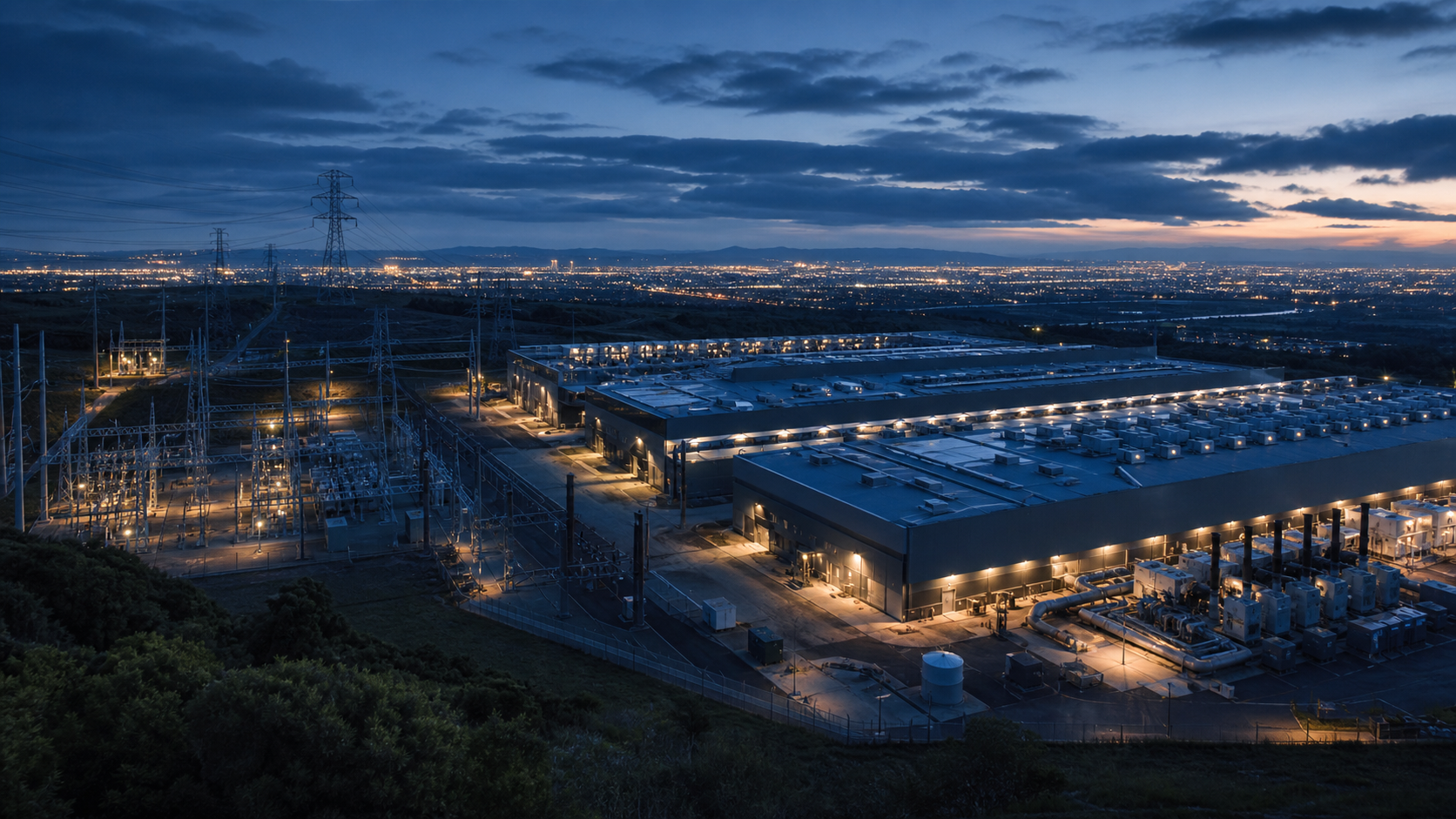
An AI data centre creates revenue only when several asset systems work together. The project needs an enforceable site right, zoning and permits, sufficient utility or on-site power, transmission and distribution capacity, a completed powered shell, cooling, network connectivity, compute equipment, software, skilled operations and a customer workload. A lender that underwrites only land and construction value can miss the dependencies that convert the asset into billable compute.
The credit memorandum should begin with the present state of each system. Site control can be owned land, a ground lease, a powered-shell lease or a development agreement. Power can be a completed interconnection, an executed service agreement subject to upgrades, reserved capacity, co-located generation or an operating plan that combines grid and on-site resources. Compute can be ordered, financed, delivered, installed, accepted, allocated or producing revenue. Customer demand can be an indication, reservation, cancellable order, committed contract or accepted service.
The project's repayment route should be written as a chain of dated transitions. Land becomes an approved site. The approved site becomes energised capacity. Energised capacity receives accepted equipment. Accepted equipment delivers contracted service. Contracted service produces controlled cash. Each transition requires evidence, cost, time, responsible party and remedy. A failure at an early transition can make later headline contract value unavailable.
Six gates organise the financing. Gate one establishes site and development control. Gate two proves power and interconnection. Gate three funds construction and compute deployment. Gate four establishes offtake and revenue quality. Gate five controls equipment collateral and operations. Gate six demonstrates refinance or exit. Facility availability should follow the state of those gates rather than a single closing-date valuation.
The method is particularly relevant beyond the investment-grade balance sheet. A specialised operator may have strong customer demand and technical capability while lacking the unrestricted cash or public debt access of a hyperscaler. Private credit can provide delayed-draw, project, asset-backed, equipment or contract-linked capital. The structure must keep completion, technology, concentration and refinancing risk within an evidenced envelope.
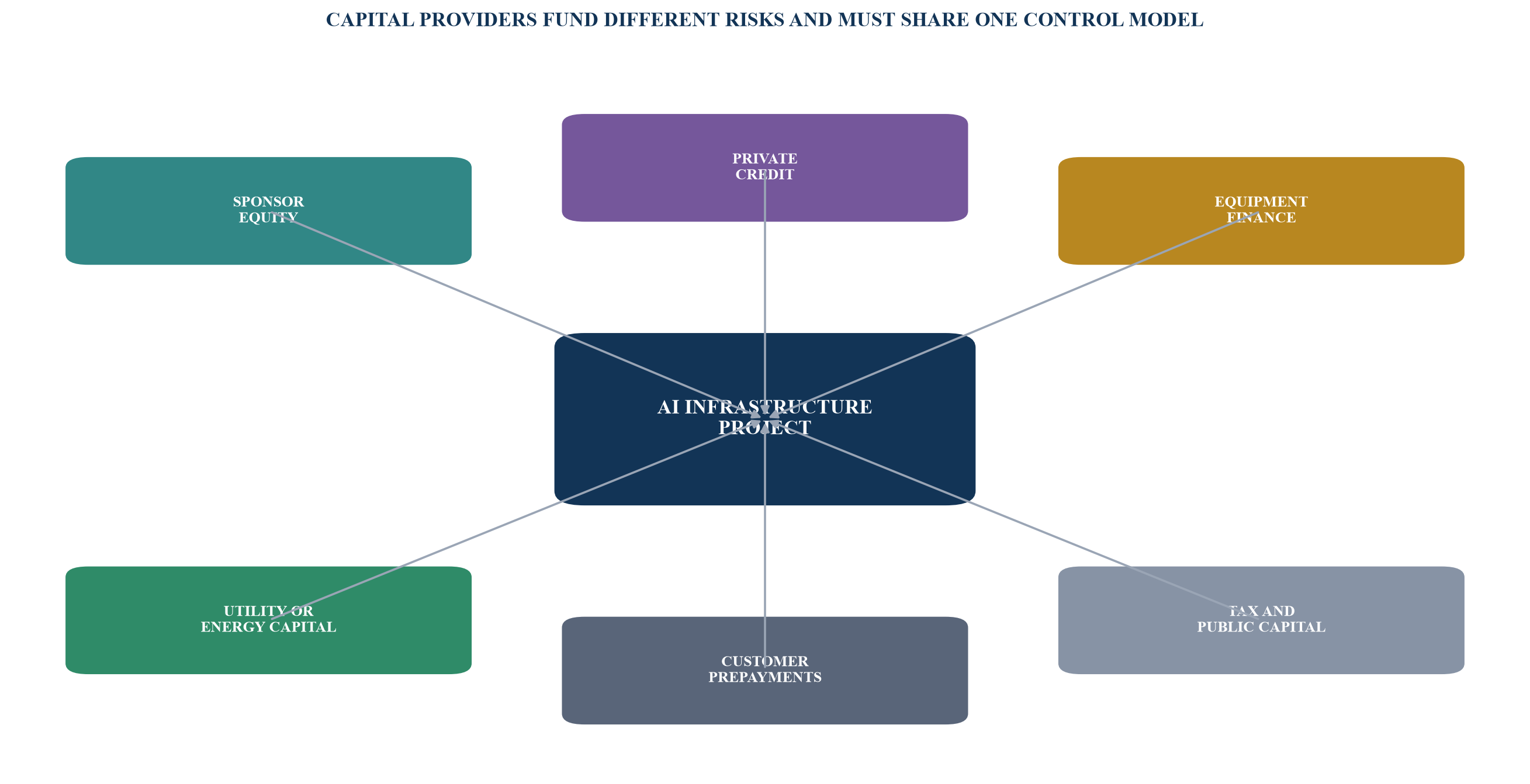
The provider mix should be reconciled through one sources, priority, draw and repayment schedule.
2. Establish site and development control
The first gate identifies the precise project boundary. The file should reconcile land or lease rights, parcel maps, access, easements, zoning, development approvals, environmental conditions, water, utilities, fibre routes, taxes and title encumbrances. A powered-shell lease must identify landlord works, tenant works, delivery condition, rent commencement, casualty, condemnation, expansion, assignment, mortgagee protection and termination.
Site economics depend on more than acreage. Power density, substation proximity, transmission constraints, water and cooling strategy, network diversity, flood and weather exposure, construction labour, tax treatment, community response and permitting time affect financeability. A site with inexpensive land and an uncertain energisation date may be less valuable than a higher-cost site with firm capacity and a credible construction route.
The special-purpose structure should match the assets and contracts. Land, powered shell, equipment, energy and customer agreements can sit in different entities. The lender needs enforceable rights across that structure, including equity pledges, mortgages or leasehold security, assignments, account control, equipment liens, contract rights, insurance and step-in. Bankruptcy-remote language does not remove operational dependency on sponsors, affiliates or shared services.
Development approvals should enter a dated register. Each permit, environmental obligation, utility approval, construction milestone and occupancy condition should show authority, source document, issue date, expiry, cost and responsible owner. Local counsel and technical advisers should confirm the requirements for the actual jurisdiction. A projected permit date remains an assumption until the relevant authority acts.
Community and resource commitments can become schedule or operating risks. Noise, emissions, water, backup generation, traffic and ratepayer concerns can influence approvals or tariffs. The project should present credible mitigation, monitoring and stakeholder ownership. A credit model that excludes funded compliance measures understates cost-to-complete.
Table 1. Site and development-control register
| Dimension | Minimum evidence | Credit question | Facility response when unresolved |
|---|---|---|---|
| property right | title, ground lease, powered-shell lease and survey | can the borrower develop, operate, mortgage and transfer the intended project? | exclude unsupported value or require enforceable control |
| zoning and permits | approvals, conditions and inspection schedule | can the defined use and density operate lawfully? | condition precedent, reserve or delayed availability |
| access and fibre | easements, carrier orders and route diversity | can equipment, staff and network service reach the site? | direct agreement and completion milestone |
| environmental and water | studies, permits, cooling design and discharge plan | are construction and operating obligations funded? | contingency, monitoring and covenant |
| tax and incentives | executed agreements and eligibility analysis | which benefits survive delay, ownership change or default? | recognise only controlled and transferable value |
| insurance | builder's risk, property, equipment, business interruption and cyber | is the project protected through construction and operation? | agreed coverage before relevant draw |
| enforcement transfer | consents, cure periods and replacement rights | can a qualified successor operate or sell the project? | consent package and downside plan |
The register requires current property, permitting, utility and transaction evidence.
3. Make power an availability condition
Power is frequently the binding resource. A credit file should distinguish requested megawatts, studied capacity, reserved capacity, contracted service, construction-ready capacity, energised capacity, critical IT load and actual operating load. Each measure answers a different question. Customer contracts and equipment orders should use the capacity that can be delivered within the programme.
The US Department of Energy reported that domestic data-centre load reached approximately 176 TWh in 2023 and projected 325 to 580 TWh in 2028.[1] The IEA expects the United States and China to account for nearly 80% of global data-centre electricity-consumption growth through 2030.[3] Those national projections show demand scale; they do not establish availability at an individual node.
The power schedule should identify utility, transmission owner, regional transmission organisation or independent system operator where relevant, point of interconnection, service voltage, load ramp, network upgrades, deposits, contribution in aid of construction, security, curtailment, outage, commissioning and long-stop dates. The project should allocate delay and cost between utility, developer, landlord, energy provider and customer.
Co-location and behind-the-meter arrangements require careful analysis. FERC's December 2025 PJM action addressed rates, terms and conditions for co-located load and recognised that large loads had pursued co-location partly because of interconnection delays.[7] A project should not assume that physical proximity to generation removes transmission service, reliability, tariff or cost-allocation issues. Regulatory counsel and system engineers should assess the actual arrangement.
NERC's 2025 long-term assessment projects substantial North American peak-demand growth and identifies data centres as a major driver.[4] Resource adequacy and transmission conditions can change between commitment and operation. The facility should require periodic confirmation of service status, upgrade schedule, contingency operation and material regulatory developments.
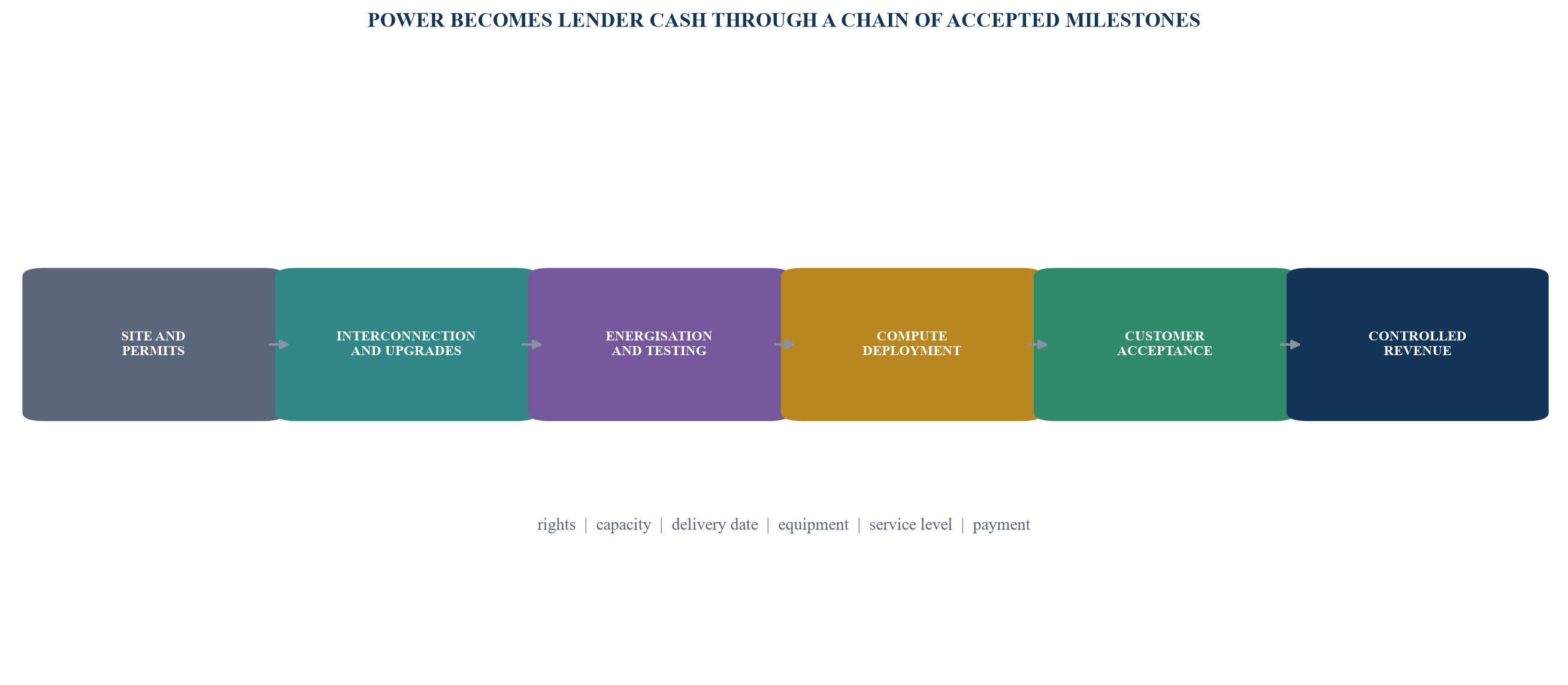
Later-stage contract value is recognised only when preceding power, construction and acceptance dependencies are funded and evidenced.
Table 2. Power-readiness evidence schedule
| Stage | Evidence | Principal risk | Credit control |
|---|---|---|---|
| service request | accepted request and study scope | requested capacity may not be deliverable | no revenue recognition from request alone |
| system study | completed study and upgrade estimate | cost and schedule can change | funded contingency and milestone update |
| executed agreement | signed service and construction terms | conditions, deposits and customer obligations remain | draw tied to satisfied conditions |
| network works | utility and developer progress evidence | critical equipment or permits can slip | independent schedule and long-stop trigger |
| energisation | test certificates and available capacity | partial capacity may limit deployment | tranche availability by accepted megawatt |
| operating service | tariff, curtailment, outage and backup plan | operating cost and uptime can vary | coverage test and resilience covenant |
Power rights, costs and dates should be confirmed for the specific utility and market.
4. Build a sources-and-uses statement across asset layers
An AI-infrastructure budget should separate land and site works, utility and interconnection, shell and mechanical-electrical-plumbing systems, cooling, network, compute equipment, software and deployment, commissioning, professional cost, financing, tax, contingency and operating ramp. Each layer has different ownership, payment terms, useful life and security.
Committed sources can include sponsor equity, private-credit facilities, construction debt, equipment leases or loans, vendor finance, customer prepayments, utility contributions, tax credits or incentives, and asset-sale proceeds. The model should show legal availability, conditions, priority and timing. A customer prepayment restricted to specific equipment cannot fund a network-upgrade invoice unless documents permit that use.
The project must close on a committed-source basis and a cash-timing basis. Executed sources should cover every defined cost through customer acceptance and the agreed liquidity period. A monthly model and rolling thirteen-week forecast should demonstrate that cash arrives before each payment. Long-lead deposits, utility security and equipment orders can create early peaks before revenue begins.
The Federal Reserve's project-level analysis estimated data-centre investment at an annualised $370 billion by the second quarter of 2026 and illustrated a wide range for 2027 based on project-pipeline uncertainty.[9] That work supports scenario discipline. It does not prove that all announced capacity will be built or financed.
Cost contingency should be allocated by risk. Utility upgrades, switchgear, transformers, turbines, cooling, structural work, GPUs, networking and commissioning have distinct lead times. A general percentage can conceal concentrated procurement risk. The budget should identify cancellation, restocking, storage, logistics, foreign-exchange, tariff and obsolescence exposure where relevant.
Table 3. Illustrative committed-sources and uses test
| Uses | Amount | Sources | Amount |
|---|---|---|---|
| site, permits and civil works | $90m | sponsor equity | $190m |
| utility, substation and power works | $170m | private-credit construction facility | $360m |
| shell, cooling and network | $260m | equipment facility | $330m |
| compute and deployment | $410m | customer prepayment | $90m |
| financing, commissioning and ramp | $75m | utility or incentive support | $35m |
| contingency and liquidity | $55m | committed reserve facility | $55m |
| total | $1,060m | total | $1,060m |
Dollar amounts are management assumptions used to demonstrate the method and do not represent an identified project.
5. Match capital provider to the risk it can control
Sponsor equity should absorb early development uncertainty and preserve alignment through completion and ramp. Private credit can fund construction, contract-linked capital or a blended asset pool through delayed draws and milestones. Equipment finance can match advances to serialised assets and acceptance. Customer prepayments can reduce external capital when their use, refund conditions and priority are clear.
Each provider needs a defined attachment point. Land and shell lenders may have mortgage or leasehold security. Equipment financiers may hold purchase-money or other liens in servers and components. Working-capital providers may rely on receivables and accounts. Customers may have title, reservation, refund or step-in rights. Utilities may hold deposits or reimbursement claims. The intercreditor map should identify priority in every asset and cash account.
Private credit is an established source for below-investment-grade US businesses. The Federal Reserve reported approximately $1.4 trillion of private-credit loans in the second half of 2025, around 10% of US nonfinancial-corporate debt.[10] Scale does not remove project-specific liquidity, valuation or concentration risk. Fund-level financing, investor redemption and bank exposure can influence lender capacity.
The capital stack should preserve rescue funding. A delayed utility milestone, equipment replacement or customer acceptance dispute may require new money. Documents should state who can provide protective advances, their priority, permitted use, cap, voting and repayment. A facility that assumes unanimous approval during distress may lack an executable completion route.
Draw conditions should correspond to the financed risk. Land and early works can require sponsor equity and permits. Power works can require executed agreements and independent progress. Shell advances can require monitor certification. Equipment draws can require purchase orders, delivery, serial records, insurance and customer allocation. Revenue-linked advances can require acceptance and controlled receipts.
6. Convert construction into accepted capacity
The independent monitor should integrate building, power, cooling, network and compute. A conventional construction percentage can overstate readiness when the shell is complete but the substation, cooling loop or network remains untested. Reporting should identify each system's design, procurement, installation, test and acceptance status.
The baseline schedule should show site works, utility works, long-lead equipment, shell, mechanical and electrical systems, cooling, network, compute delivery, commissioning, customer testing and service commencement. Critical-path ownership must be explicit. A vendor's expected ship date and a utility's target energisation date are not equivalent to enforceable completion commitments.
Change control should join technical, commercial and financing decisions. A new chip architecture can alter rack density, cooling, power distribution, network and customer economics. A cooling redesign can affect permitting and commissioning. A customer configuration change can alter equipment orders and acceptance. The lender should require cost, schedule, contract and collateral effects before approving material change.
Payment control can include direct payment, controlled project accounts, approved budgets, monitor certification, invoice and purchase-order matching, serial records and evidence of prior draw use. The process should remain fast enough to preserve procurement slots. Standard draw calendars and data formats reduce operational friction.
Completion needs several definitions: physical completion, energisation, integrated systems testing, equipment installation, substantial completion under a lease, customer acceptance and revenue service. The repayment model should use the milestone that produces contractually payable cash. Earlier construction milestones support progress but cannot substitute for acceptance.
7. Underwrite compute equipment as a changing asset
GPU servers and associated equipment have significant acquisition cost and potential resale value. Their credit value changes with architecture, performance, memory, interconnect, software support, warranty, export controls, physical condition, location, demand and ability to redeploy. Accounting depreciation does not establish liquidation value.
The equipment register should identify manufacturer, model, configuration, serial number, purchase price, delivery, title, lien, location, acceptance, warranty, maintenance, insurance, customer allocation, utilisation and software dependencies. It should reconcile purchase orders, invoices, shipping, installation and financing. Movement between sites requires lender control where collateral depends on location and possession.
Public filings show how market participants combine equipment and contract finance. CoreWeave stated that it primarily finances infrastructure development through asset-level debt supported by take-or-pay customer contracts and reported $5.2 billion of OEM and software financing arrangements at year-end 2025.[12] Its disclosures provide a public example rather than a universal financing template.
The collateral curve should be forward looking. Advance rates can decline with age, new product releases, contract expiry, utilisation weakness, loss of support or narrower buyer pools. Installed equipment with validated operation and contracted cash may have stronger going-concern value than unopened inventory. Equipment embedded in a site with no transfer or access rights may have weaker recovery despite physical value.
The downside plan should identify resale, redeployment and operation routes. It should address de-installation, packaging, transport, data sanitisation, software licences, export restrictions, warranty transfer, required specialists and time. A lender may prefer continued operation under a replacement manager when service cash exceeds liquidation proceeds.
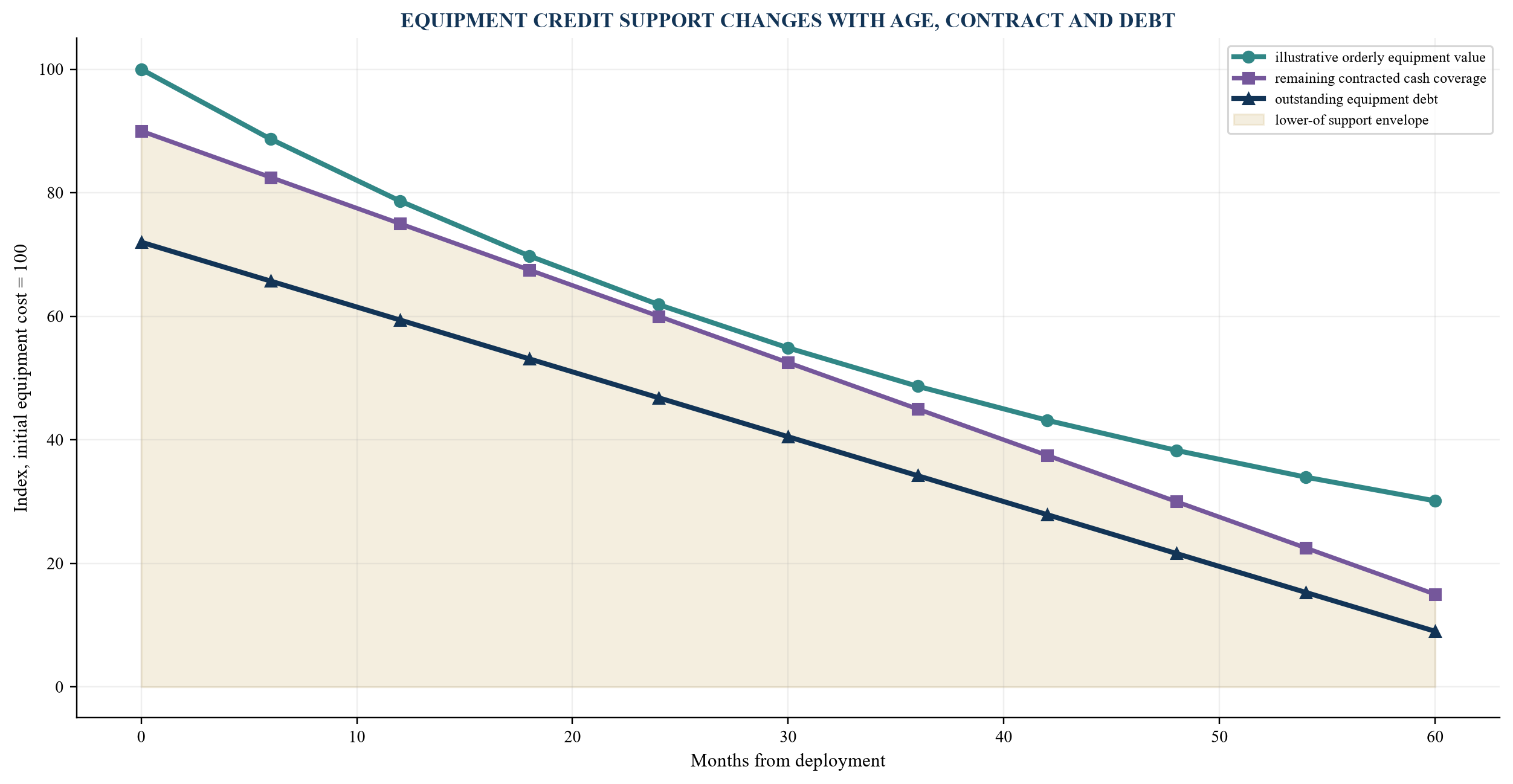
Values, contract coverage and debt balances are illustrative management assumptions and do not represent market prices or an identified financing.
Table 4. Equipment collateral and control schedule
| Attribute | Evidence | Value implication | Credit control |
|---|---|---|---|
| title and lien | invoices, payment, serial list and UCC search | determines enforceable ownership and priority | filing, bailee and access controls |
| configuration | model, memory, network and cooling specification | affects workload usefulness and buyer pool | approved equipment schedule |
| deployment state | delivered, installed, tested and accepted status | affects completion cost and cash generation | milestone-based advance |
| contract allocation | customer, term and committed capacity | links asset to revenue support | eligibility and concentration limits |
| age and roadmap | deployment date, support and product cycle | affects economic usefulness and resale | declining advance curve and reappraisal |
| location and access | site register, landlord and operator rights | affects repossession and continued operation | access agreement and movement covenant |
| disposition | brokers, operators, buyers and estimated time | affects net recovery and liquidity | annual route test and downside reserve |
Advance rates require current appraisal, transaction documents and specialist disposition evidence.
8. Score offtake rather than headline contract value
A customer contract supports debt only through its enforceable and economic terms. The lender should identify customer entity, guarantor, credit quality, committed quantity, service location, deployment tranches, price, indexation, minimum payment, take-or-pay language, acceptance, service level, credits, termination, force majeure, change control, assignment, set-off, confidentiality and dispute process.
Remaining performance obligations or announced contract value can exceed lender cash. Revenue may depend on equipment deployment, availability, acceptance and service. Customer payments may be reduced by credits, disputes, taxes or permitted set-off. Contract duration may be shorter than equipment life or loan maturity. The model should build cash from contracted units and dates rather than divide a headline amount evenly.
Customer credit and contract quality are separate. An investment-grade counterparty can retain broad termination, volume or acceptance rights. A smaller customer can provide strong collateral through prepayment, deposit, parent support or committed minimums. The scorecard should show both dimensions and concentration.
Nebius disclosed a five-year dedicated GPU agreement with Microsoft whose obligations were linked to financing and deployment conditions, and stated an expectation of contract-secured debt financing.[15] Applied Digital disclosed long-duration leases for high-performance-computing capacity and material customer concentration.[16][17] These filings illustrate how contract, construction, financing and concentration interact.
The lender should test renewal and residual exposure. If a five-year customer contract finances equipment and infrastructure with a longer recovery period, the project needs amortisation, residual value or a replacement-customer strategy. A contract that ends shortly before debt maturity can create a refinancing cliff even after strong early cash flow.
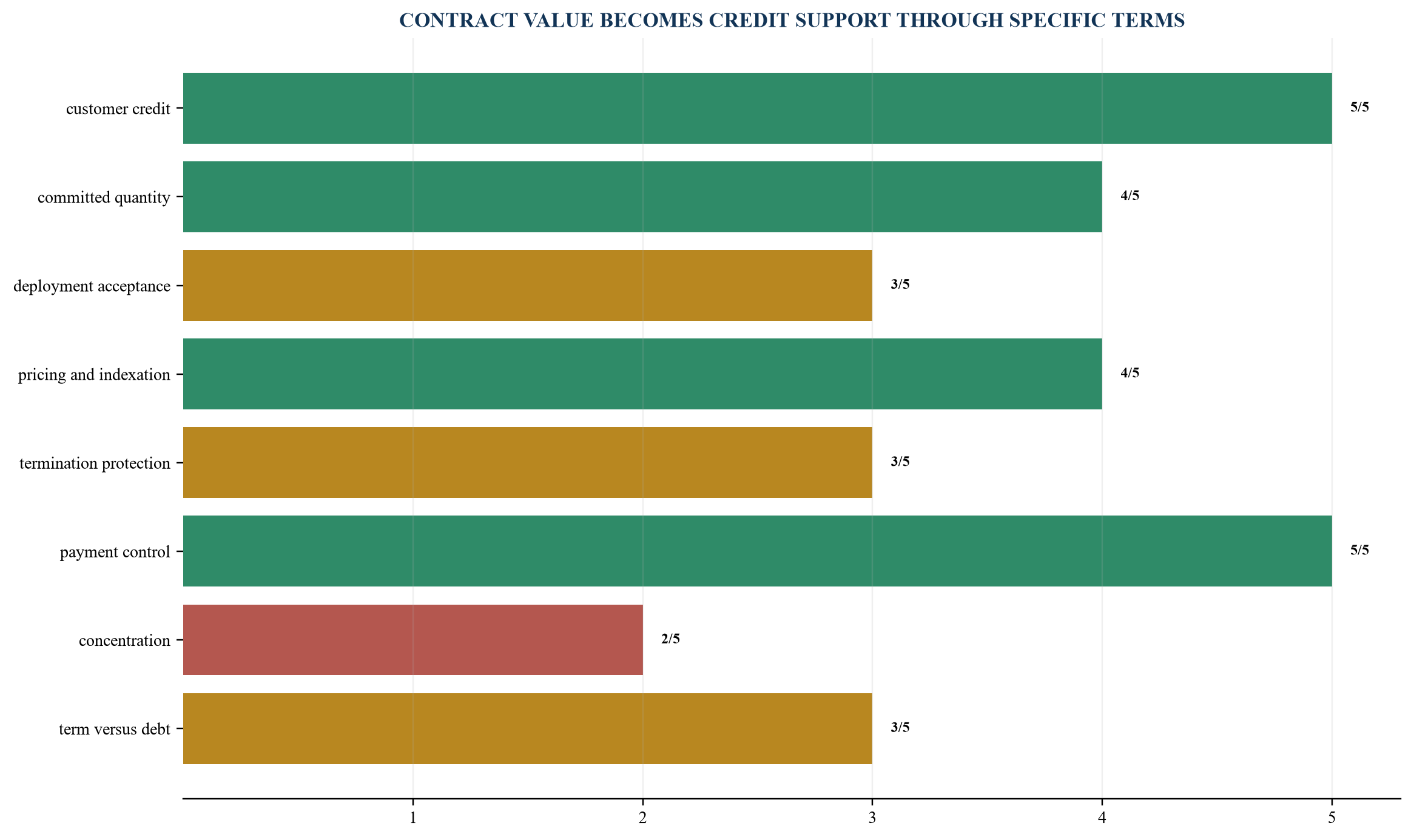
Scores are illustrative; the underwriting file should retain the underlying contract evidence and exceptions.
Table 5. Offtake underwriting schedule
| Dimension | Stronger evidence | Principal weakness | Structural response |
|---|---|---|---|
| counterparty | creditworthy obligor and enforceable guarantee | thin special-purpose customer | deposit, guarantee or lower eligibility |
| quantity | committed minimum or take-or-pay capacity | discretionary or forecast usage | borrowing-base haircut |
| acceptance | objective tests and defined deemed acceptance | subjective or open-ended approval | independent test and long-stop remedy |
| price | fixed or transparent index with pass-through | repricing unrelated to project cost | coverage stress and reserve |
| termination | limited rights and funded termination payment | convenience termination without make-whole | amortisation and concentration cap |
| payment | short cycle into controlled account | broad set-off, credits or delayed dispute | reserve and cash control |
| assignment | finance-party assignment and step-in | consent blocks enforcement transfer | direct agreement before reliance |
| term | contract extends through debt repayment | material merchant tail | faster amortisation and replacement plan |
Contract interpretation requires transaction-specific legal advice.
9. Build the borrowing base from eligible states
The facility can recognise collateral in stages. Eligible land and completed improvements may support one advance. Utility deposits can be recognised when refundable or transferable under verified terms. Equipment can enter at purchase, delivery, installation or acceptance with different haircuts. Receivables can enter after service delivery, invoice and absence of dispute.
The borrowing base should avoid double counting. Equipment value and contracted cash can support the same debt only if the model understands their dependency. A customer prepayment may reduce receivables while funding equipment. A lease receivable may already embed equipment recovery. The base should calculate the lower of value, cost, eligible contract cash and policy limits where appropriate.
Concentration limits should apply to customer, site, utility, region, equipment generation, manufacturer and service provider. A portfolio with multiple buildings can still have one power node or customer. Correlated failure should drive limits and stress.
Advance rates should adjust with completion and evidence. Equipment ordered but not delivered may receive no advance or a limited deposit advance backed by refund and vendor credit. Delivered equipment may receive a cost-based advance. Installed and accepted equipment may receive a higher contract-supported amount. Older or uncontracted equipment may receive a declining percentage of appraised net orderly value.
The base should be recalculated at least monthly and after material events. Required inputs include costs, progress, megawatts, serial records, customer allocation, invoices, collections, disputes, utilisation, outages, contract changes, appraisal and debt. A qualified exception should show amount, cause, cure and deadline.
10. Model operating economics below gross revenue
AI-infrastructure operating cash depends on contracted price, delivered quantity, utilisation, power cost, demand charges, network, software, maintenance, staffing, lease cost, insurance, property tax and replacement capital. Gross contract value cannot be used as debt service without that bridge.
Power cost can include energy, capacity, transmission, demand, backup fuel, hedging and environmental attributes. Contract pass-through mechanisms may be partial or delayed. The model should test higher prices, demand peaks, curtailment and lower efficiency. Power usage effectiveness is relevant, yet the actual bill depends on tariff and operating profile.
Availability credits and outages can affect revenue precisely when repair cost rises. The facility should understand redundancy, maintenance, spare capacity, warranty, mean time to repair and customer service-level remedies. Business-interruption insurance requires policy-specific review and may not cover every contractual deduction.
Utilisation risk differs by contract. Dedicated take-or-pay capacity can provide predictable minimum revenue, subject to acceptance and service. On-demand revenue depends on workload demand and pricing. Reserved capacity can combine fixed and variable elements. The model should separate each pool and apply evidence-based stress.
Replacement capital must be explicit. Compute equipment can require upgrades before building or power infrastructure reaches the end of its life. Cash retained for refresh reduces debt capacity. Financing a refresh with new debt assumes future market access and collateral value; the base case should not rely entirely on that rollover.
11. Allocate technology and supply-chain risk
Technology risk is not limited to chip obsolescence. It includes software compatibility, networking, cooling density, power delivery, firmware, security, export controls and customer workload change. The project should identify which party bears configuration and performance risk under purchase, lease, service and customer agreements.
Supply-chain diligence should cover manufacturer allocation, integrator capacity, long-lead components, shipping, tariffs, warranty and replacement. The IEA notes that accelerated-server electricity consumption is projected to grow rapidly and that high-density equipment places pressure on electricity technologies and supply chains.[3] A project-specific procurement schedule should use current vendor evidence.
The lender should distinguish replaceable equipment from platform dependence. Standard servers with transferable warranties may have broader markets. A tightly integrated cluster can have stronger operating value but require specialised software, network and staff. Security should include access to documentation, keys, licences and operational support where legally and commercially possible.
Vendor finance can align payment with delivery while creating lien and termination complexity. Purchase-money claims, retention of title, software suspension and support rights should be mapped. UCC searches and filings require counsel for the relevant states and collateral.
Change approval should preserve customer economics. A less expensive substitute can fail contractual specifications or reduce performance. A newer platform can increase cost and density while improving revenue. The decision should show incremental capital, power, cooling, schedule, contract acceptance, collateral and debt service.
12. Control cash and performance data
Revenue should flow through controlled accounts with a documented waterfall. The account map should identify customer receipts, taxes, operating expenses, power, required reserves, debt service, permitted distributions and sweep. Multi-site or multi-customer platforms need rules for allocation and cross-collateralisation.
Data quality is a credit control. The lender should receive meter data, available and critical load, installed equipment, utilisation, service availability, invoices, collections, credits, outages, maintenance, operating costs and contract changes. Definitions must reconcile technical and financial systems. A megawatt reported by development, utility, operations and billing teams can represent different states.
Independent verification should be risk based. Construction monitors can certify works. Engineers can review power and commissioning. Equipment auditors can reconcile serials and location. Accountants can test revenue and cost. Cyber and operational specialists can assess controls. The lender should own the scope, reliance and exception process.
Cybersecurity and physical security matter to collateral cash flow. The project needs identity and access controls, segmentation, monitoring, incident response, backup, supplier management and customer notification consistent with its obligations. A cyber event can interrupt service, trigger credits, create remediation cost or affect customer confidence. Technical specialists should assess the actual environment.
The reporting pack should distinguish observed evidence, professional opinion and management assumptions. Forecast overrides need explanation, owner and approval. Repeated late or inconsistent reporting can trigger enhanced monitoring before a financial covenant fails.
13. Use covenants that follow the project lifecycle
During development, covenants should focus on permits, power milestones, budget, contingency, sponsor equity, procurement, construction progress, equipment delivery, customer acceptance and liquidity. During operation, focus shifts to capacity, utilisation, revenue, customer concentration, coverage, equipment value, outages, reserves and refinancing.
Financial covenants can include loan-to-cost, loan-to-value, debt service coverage, fixed-charge coverage, minimum liquidity and leverage. Asset covenants can include eligible equipment coverage and serial reconciliation. Contract covenants can include minimum committed revenue and concentration. Power covenants can include energised capacity and service status.
A covenant ladder creates proportional response. Watch thresholds increase information and meetings. Control thresholds trap cash, restrict distributions or require appraisal. Draw-stop thresholds prevent exposure growth. Cure thresholds require equity, prepayment, additional collateral or contract action. Default thresholds preserve enforcement rights.
The remedy should match the risk. A utility delay can require programme and liquidity protection. A customer downgrade can reduce eligible contract cash and increase amortisation. Equipment-value decline can require additional collateral or debt reduction. An outage can require repair, customer communication and insurance action.
Table 6. Lifecycle covenant and remedy ladder
| Indicator | Watch response | Control response | Escalation response |
|---|---|---|---|
| energisation delay | updated utility and construction schedule | additional reserve and restricted draw | funded alternative or stop commitment |
| cost-to-complete deficit | independent validation | sponsor equity and contingency lock | default if completion remains unfunded |
| equipment delivery or value | serial and appraisal review | reduced advance and cash trap | additional collateral or prepayment |
| customer acceptance | joint test and issue plan | delayed eligibility and reserve | replacement offtake or debt reduction |
| concentration | customer-credit and contract review | concentration haircut | mandatory amortisation or diversification |
| service availability | root-cause and repair report | distribution block and reserve | operator replacement or restructuring |
| refinance milestone | lender pipeline and data-room test | adviser appointment and cash sweep | asset sale or recapitalisation process |
Thresholds and remedies must be calibrated to the actual project and documents.
14. Design the refinancing case before deployment
Construction debt should not depend on an unspecified future market. The take-out case should identify the expected lender type, asset state, minimum operating history, contract profile, valuation approach, advance rate, coverage, amortisation, maturity, concentration limits and information requirements. It should state which conditions remain after customer service begins.
Exit debt includes drawn principal, capitalised interest, payment-in-kind return, fees, hedging, break cost, unpaid expenses and required reserves. Take-out proceeds should be the lower of value-based, cash-flow-based, equipment-based and contract-based limits. Transaction costs reduce available repayment.
Customer contract term should exceed debt repayment or leave a financed residual plan. A five-year contract supporting a five-year loan can create a maturity problem once underwriting and closing time are considered. Amortisation should convert early contracted cash into declining debt. A merchant or renewal tail needs a conservative value and customer pipeline.
The operator's public-market access should remain a separate scenario. Public equity, convertible debt or unsecured issuance may offer efficient capital when available. Private-credit repayment should not assume market conditions or valuation. A sale to an infrastructure owner, strategic buyer or larger platform can be an alternative only after net proceeds, consent and timing are tested.
Refinancing preparation should begin during construction. The data room needs property rights, power agreements, permits, construction and commissioning records, equipment register, customer contracts, operating data, insurance, cyber controls, financial statements, tax and legal records. The schedule should allow due diligence, appraisal, lender approval and documentation before maturity.
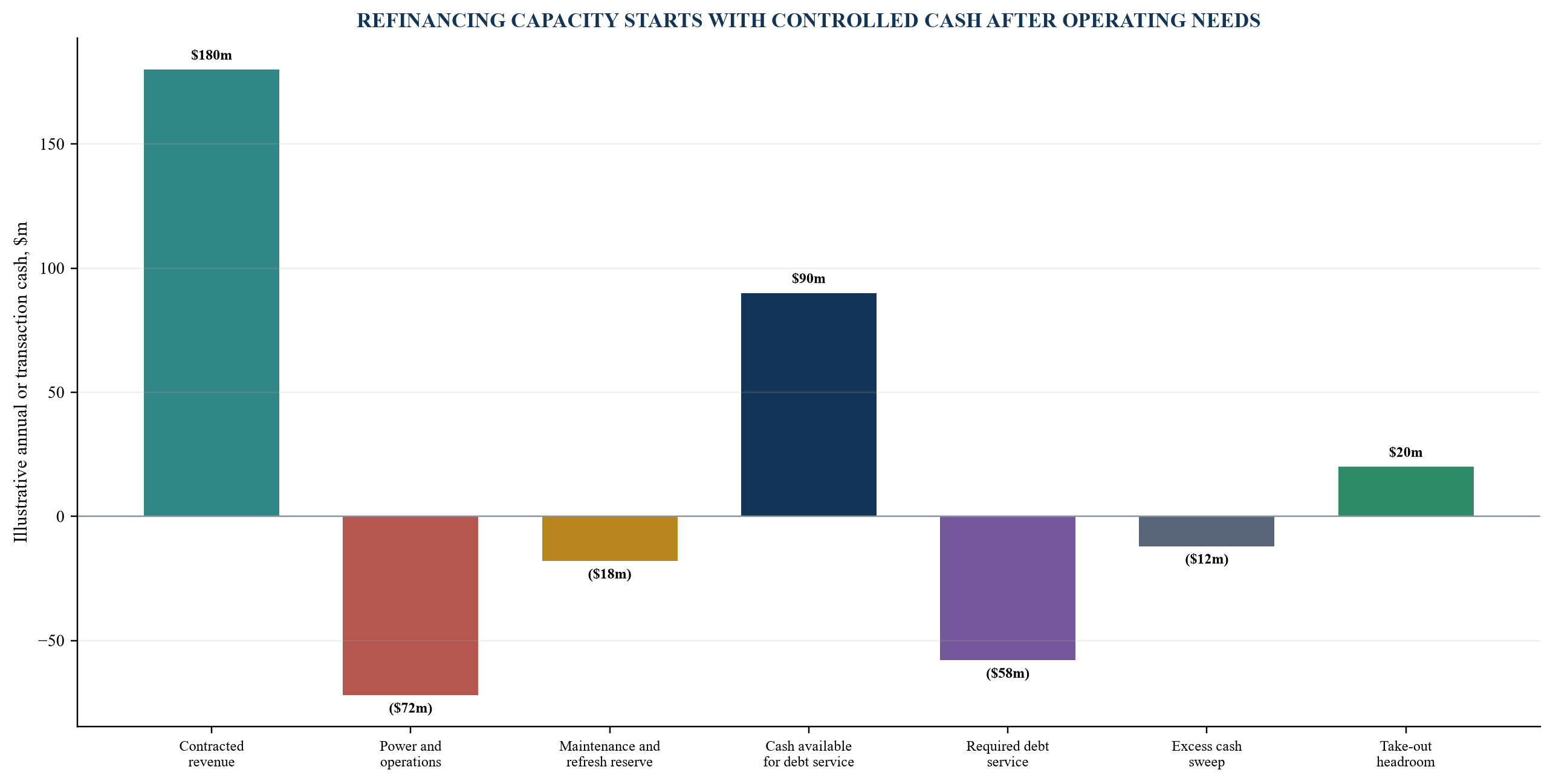
Amounts are illustrative management assumptions and do not represent an identified project's revenue, cost or debt capacity.
15. Plan downside operation and disposition
AI infrastructure can lose value if operations stop. The downside plan should evaluate continued operation, replacement operator, customer transition, equipment redeployment, partial sale, project sale, contract sale or equipment liquidation. The highest recovery route may require new money and specialised management.
The security package should be tested for practical control. Can the lender access the site and equipment? Can it maintain power, cooling, network and security? Can customer and vendor contracts be assigned or stepped into? Can software and support continue? Can data be protected and sanitised? Which consents and licences are required?
Landlord, utility, vendor, customer and intercreditor agreements should address notice, cure, access and transfer where achievable. A lien in equipment has reduced value if a landlord can block access or a software provider can suspend essential rights. Counsel should assess creation, perfection, priority and enforcement for each collateral class.
The stabilisation budget should include power, rent, staff, maintenance, insurance, cyber, customer service, legal, technical advisers, de-installation and marketing. Lenders should decide before closing whether protective advances can fund those items and how they rank.
Disposition assumptions need evidence. Equipment brokers, operators, strategic buyers, infrastructure investors and customer counterparties can form distinct buyer pools. Recovery should deduct downtime, service credits, removal, transport, reconfiguration, taxes, fees and time. A going-concern sale can preserve contracts and operations but may require consent and execution capacity.
16. Run a ten-day financing diagnostic
Days one and two establish entities, assets, site rights, project scope, existing capital and requested use of proceeds. Days three and four map power, permits, utility works, construction and long-lead procurement. Days five and six rebuild sources and uses, monthly liquidity, equipment schedule and intercreditor priority. Days seven and eight test customer contracts, operating economics, borrowing base and downside. Days nine and ten present structure, terms, conditions, covenants and refinance.
The minimum evidence pack includes corporate records, property and lease documents, permits, utility agreements, studies, power schedule, construction contracts, monitor reports, procurement and equipment registers, customer contracts, operating plan, financial model, existing debt, security, insurance, tax and disputes. Missing evidence remains a visible condition rather than an optimistic assumption.
The output should include a one-page decision summary, dependency map, sources-and-uses test, critical path, power-to-revenue chain, collateral curve, offtake scorecard, borrowing base, covenant ladder, security map and refinancing waterfall. Each exception should show amount, date, owner and remedy.
Green items have current evidence and acceptable control. Amber items require a condition, reserve, haircut, covenant, adviser conclusion or funded action. Red items prevent reliance or funding. The committee should see how each amber and red item changes availability, timing and recovery.
The diagnostic supports proceed, proceed after specified evidence, restructure or decline. A rapid decision can preserve project and lender resources. A conditional proceed should state what must be true before term sheet, credit approval, closing and each draw.
17. Use a 100-day execution plan
Days one to twenty establish owners, definitions, data room, opening budget, project schedule, asset register and contract register. The team resolves differences between development, utility, technical, commercial and finance data. Advisers receive a controlled evidence set.
Days twenty-one to forty-five complete property, power, technical, equipment, customer, tax, insurance and legal diligence. The lender tests source commitment, liquidity, collateral, coverage and downside. Material assumptions receive an evidence owner and date.
Days forty-six to seventy align terms and documents. Facility amount, draws, equity, interest, reserves, accounts, security, intercreditor, covenants, reporting, defaults, cures, protective advances and transfer rights must agree with the credit model. Direct agreements and consents remain on a dated critical path.
Days seventy-one to ninety rehearse operation. The team tests a draw, utility payment, equipment advance, serial reconciliation, customer invoice, controlled-account sweep and monthly reporting pack. Exceptions are corrected before material utilisation.
Days ninety-one to one hundred transfer governance into the operating phase. Weekly liquidity and critical-path reviews continue during construction. Monthly reporting updates power, progress, equipment, customers, cash, collateral and covenants. Quarterly review refreshes appraisal, technology, concentration, downside and refinance milestones.
18. Conclusion
US AI infrastructure beyond the hyperscaler balance sheet can attract private credit when the financing treats the project as a connected operating system. Land and buildings provide a foundation. Power, compute, customer acceptance and operational capability convert that foundation into cash.
The six-gate method establishes a disciplined route. Site control defines the project. Power diligence proves usable capacity. Committed sources fund construction and deployment. Offtake analysis converts contracts into eligible cash. Equipment controls measure changing collateral. Refinancing and downside plans preserve repayment alternatives.
The resulting facility is dynamic. Availability grows as permits, power, construction, equipment and acceptance are evidenced. Advance rates and covenants respond to customer concentration, equipment age, utilisation, outages and market conditions. Cash control and independent reporting allow action before maturity or reserve exhaustion.
The central credit question is direct: after every remaining cost, power dependency, contract condition, operating expense, collateral haircut and month of execution, how much controlled cash can repay the lender? A project that answers this question with current evidence can use private credit as a bridge from development capital to durable digital infrastructure.
References
- US Department of Energy. DOE Releases New Report Evaluating Increase in Electricity Demand from Data Centers, 20 December 2024. https://www.energy.gov/articles/doe-releases-new-report-evaluating-increase-electricity-demand-data-centers
- Lawrence Berkeley National Laboratory. 2024 United States Data Center Energy Usage Report. https://eta-publications.lbl.gov/sites/default/files/2024-12/lbnl-2024-united-states-data-center-energy-usage-report.pdf
- US Department of Energy. Powering America's AI Future: Data Center Resource Hub. https://www.energy.gov/powering-americas-ai-future-data-center-resource-hub
- International Energy Agency. Energy and AI: Energy Demand from AI. https://www.iea.org/reports/energy-and-ai/energy-demand-from-ai
- International Energy Agency. Electricity 2026: Executive Summary. https://www.iea.org/reports/electricity-2026/executive-summary
- US Department of Energy. Clean Energy Resources to Meet Data Center Electricity Demand. https://www.energy.gov/oe/clean-energy-resources-meet-data-center-electricity-demand
- Federal Energy Regulatory Commission. Commissioner Chang's Concurrence on PJM Co-Location, 18 December 2025. https://www.ferc.gov/news-events/news/e-1-commissioner-changs-concurrence-pjm-co-location
- Federal Energy Regulatory Commission. Docket No. EL26-67-000. https://www.ferc.gov/sites/default/files/2026-06/EL26-67-000.pdf
- Federal Reserve Board. Estimating Aggregate Data Center Investment with Project-level Data. https://www.federalreserve.gov/econres/feds/estimating-aggregate-data-center-investment-with-project-level-data.htm
- Federal Reserve Board. Financial Stability Report: Funding Risks, May 2026. https://www.federalreserve.gov/publications/2026-may-financial-stability-report-funding-risks.htm
- Federal Reserve Board. Bank Lending to Private Credit: Size, Characteristics, and Financial Stability Implications, 23 May 2025. https://www.federalreserve.gov/econres/notes/feds-notes/bank-lending-to-private-credit-size-characteristics-and-financial-stability-implications-20250523.html
- CoreWeave, Inc. Annual Report on Form 10-K for the year ended 31 December 2025. https://www.sec.gov/Archives/edgar/data/1769628/000176962826000104/crwv-20251231.htm
- CoreWeave, Inc. 2026 proxy disclosure of delayed-draw term facilities. https://www.sec.gov/Archives/edgar/data/1769628/000176962826000191/crwv-20260422.htm
- Nebius Group N.V. Annual Report on Form 20-F for the year ended 31 December 2025. https://www.sec.gov/Archives/edgar/data/1513845/000110465926052948/nbis-20251231x20f.htm
- Nebius Group N.V. Prospectus disclosure of Microsoft GPU infrastructure agreement. https://www.sec.gov/Archives/edgar/data/1513845/000110465925088885/tm2525503-3_424b5.htm
- Applied Digital Corporation. Annual Report on Form 10-K for the year ended 31 May 2026. https://www.sec.gov/Archives/edgar/data/1144879/000114487926000048/apld-20260531.htm
- Applied Digital Corporation. SEC-filed announcement of 250 MW AI data-centre leases, 2 June 2025. https://www.sec.gov/Archives/edgar/data/1144879/000164117225013199/ex99-2.htm
- North American Electric Reliability Corporation. 2025 Long-Term Reliability Assessment. https://www.nerc.com/globalassets/our-work/assessments/nerc_ltra_2025.pdf
