

1. Define the corridor decision
The board decision is whether a fintech business can lawfully and profitably transfer a product, operating model and control system from Southeast Asia into one or more Gulf markets. Market growth, digital adoption and investor appetite provide context. Approval requires evidence that the target activity is permitted, the product solves a defined customer problem, the economics survive corridor costs and the organisation can operate within local supervisory expectations.
The decision can support an acquisition, minority investment, joint venture, commercial partnership, licence application or organic launch. These routes distribute control, speed, capital and regulatory responsibility differently. A transaction team should compare routes against the same evidence rather than beginning with a preferred legal structure.
The corridor is not one market at either end. Southeast Asia contains distinct licensing, payments, privacy, competition and consumer-protection regimes. GCC markets also differ in regulatory perimeter, financial-centre jurisdiction, local incorporation, outsourcing, payments, credit, insurance and data rules. A product-country pair is therefore the unit of diligence.
The approval memorandum should state the product, customer, legal entity, regulated activity, revenue flow, money flow, data flow, technology dependencies, partner obligations, required capital, implementation sequence and stop conditions. A broad approval to pursue GCC expansion does not provide enough control for capital release.
2. Use the FinTech Corridor Diligence Framework
The framework has eight connected gates: product permission, customer demand, unit economics, financial crime, data and technology, partnership design, capital resilience and governance. Each gate produces a board conclusion, evidence record, unresolved-issue list and action owner. Failure at one gate can change the transaction route or invalidate the investment case.
Product permission identifies what the service actually does and which entity performs each regulated step. Customer demand distinguishes contracted or tested need from general market potential. Unit economics translate pricing, acquisition, servicing, fraud, payment and compliance into corridor contribution. Financial-crime diligence tests customer identification, monitoring, sanctions, fraud and reporting.
Data and technology diligence maps consent, collection, processing, hosting, transfer, access and deletion. Partnership design allocates regulatory, commercial and operational responsibility. Capital resilience tests licence capital, safeguarding, losses, working capital and delayed launch. Governance assigns decision rights, reporting, incident escalation and integration control.
The framework is iterative. A local bank partnership can narrow the activity perimeter while reducing margin and customer control. Local hosting can improve regulatory acceptance while adding cost and operational complexity. A joint venture can accelerate distribution while creating governance dependence. The board should review the combined system rather than a list of isolated workstreams.
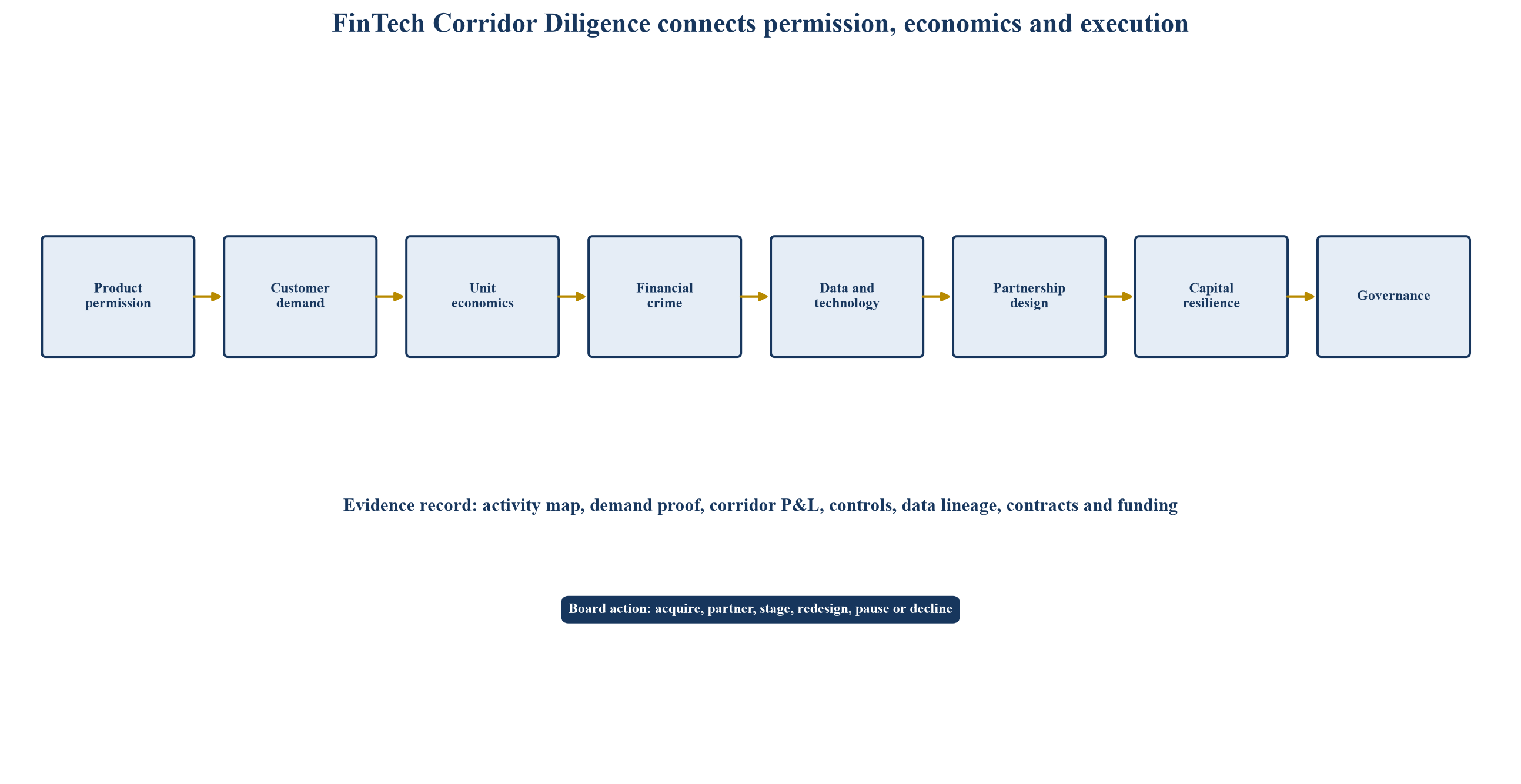
The framework is a proposed decision system and requires product-specific professional advice.
3. Define the product before naming the licence
Fintech labels are too broad for regulatory diligence. A wallet, marketplace, treasury platform, lender, remittance application, data aggregator or embedded-finance product may perform several regulated and unregulated activities. The team should decompose the customer journey into account access, data access, advice, arranging, credit, payment initiation, money transmission, foreign exchange, custody, insurance, investment and technology services.
Each step should identify the contracting entity, customer, payer, payee, asset, legal obligation, discretion, fee, settlement account, data used and outsourcing dependency. Marketing language should be compared with legal terms and actual system behaviour. A platform can enter a regulated perimeter through functionality, even when its contract describes the service as software.
The UAE framework subjects licensed financial activities to Central Bank oversight regardless of the medium or technology employed.[9] The UAE Open Finance Regulation creates licensed data-sharing and service-initiation activities while specifying that an Open Finance licence does not authorise advice, arranging or holding customer funds.[10] These distinctions show why one label cannot establish permission.
Product decomposition also improves valuation. Revenue from regulated execution, data services, software subscriptions, interchange, foreign exchange and credit should be separated because licence requirements, margins, capital and risks differ. The buyer should not apply one growth multiple to a mixed activity base without understanding the components.
4. Build a product-country permission matrix
The permission matrix should cover every product-country combination in the base case and expansion plan. For each combination it should state the regulated activity, responsible authority, licence category, legal entity, local-presence requirement, minimum capital, safeguarding or client-money treatment, permitted outsourcing, data constraints, distribution rule and approval dependency.
The matrix should distinguish current permission, transitional relief, sandbox participation, application status, legal analysis and management intention. A licence held by one group company may not cover another company, customer type or activity. A sandbox admission does not by itself establish permission for commercial scale.
Regulatory frameworks evolve. The UAE Open Finance Regulation became an in-force framework with phased participation for mandated entities and a new category for Open Finance Providers.[10] Saudi Arabia moved from sandbox development to licensing fintech companies for open banking services in March 2026.[13] The timing and scope of each change require current jurisdiction-specific confirmation.
The board should classify each route as permitted, conditionally permitted, application-dependent, partner-dependent or prohibited. Financial forecasts should match that classification. Revenue should not begin before the evidence supports lawful launch, and capital should be staged where approval timing remains uncertain.
| Product component | Southeast Asian evidence | GCC evidence | Transaction response |
|---|---|---|---|
| Account information | Consent, API standard, participant status and permitted data use | Open-finance permission, user consent and API participation | Licence, deemed-licensed status or regulated partner |
| Payment initiation | Payment-institution scope, authentication and settlement route | Payment-service category, scheme access and safeguarding | Local licence or sponsor-bank model |
| Cross-border transfer | Money-transfer permission, FX execution and payout network | Remittance, exchange and payment permissions | Corridor entity map and contractual allocation |
| Embedded credit | Lending, broking, underwriting and collections scope | Finance-company, bank or platform perimeter | Balance-sheet, originate-to-distribute or referral model |
| Digital investment | Advice, dealing, custody and suitability scope | Securities regulator, financial-centre and custody rules | Separate regulated entity and customer journey |
| Technology service | Outsourcing, cloud, cyber and audit requirements | Critical-service, data and outsourcing expectations | Service agreement, audit rights and exit plan |
Entries are diligence questions and require current legal and regulatory confirmation.
5. Verify the target's licence as an operating asset
A licence has value only when the licensed entity can operate the relevant product at the expected scale. Diligence should verify the issuing authority, licence number, category, activities, conditions, ownership approvals, controllers, approved managers, regulatory capital, safeguarding, reporting, complaints, audits, inspections and enforcement history.
The team should compare the licence with actual revenue. Products can drift beyond the original permission as features, partners and customer segments change. Regulatory returns, audited accounts, scheme records, bank statements and system configuration can reveal whether the licence and operating model remain aligned.
Change of control can trigger approval, notification or re-application. The target may depend on approved individuals, local shareholders, bank sponsors, scheme memberships, agents or outsourced providers. A transaction that removes a qualifying relationship can weaken the licence even when the legal entity survives.
Conditions precedent should cover required approvals and evidence that the post-close structure satisfies ownership, governance, capital and management requirements. Where timing is uncertain, the buyer can use staged acquisition, deferred consideration or a pre-closing operating covenant. Full value should not transfer before the regulated operating asset is available.
6. Map the cross-border entity and money flow
The group diagram should show every legal entity, regulator, bank, scheme, processor, agent, merchant, borrower, investor and service provider involved in the corridor. It should distinguish contractual flow, information flow and money flow. These flows often follow different paths.
Customer money can move through safeguarded accounts, settlement accounts, correspondent banks, payment schemes, local payout partners and foreign-exchange providers. Each handoff creates timing, reconciliation, counterparty and legal risks. The company should be able to explain who owns the money and who bears loss at every stage.
Revenue may be recorded in one entity while regulatory responsibility and operating cost sit elsewhere. Transfer pricing, withholding tax, permanent establishment, value-added tax and profit repatriation need professional advice. The investment model should use cash available by entity rather than consolidated accounting profit alone.
The transaction team should reconcile diagrams to contracts, bank accounts, settlement files and general-ledger entries. An attractive schematic prepared for investors is evidence only after it matches the actual operating records.
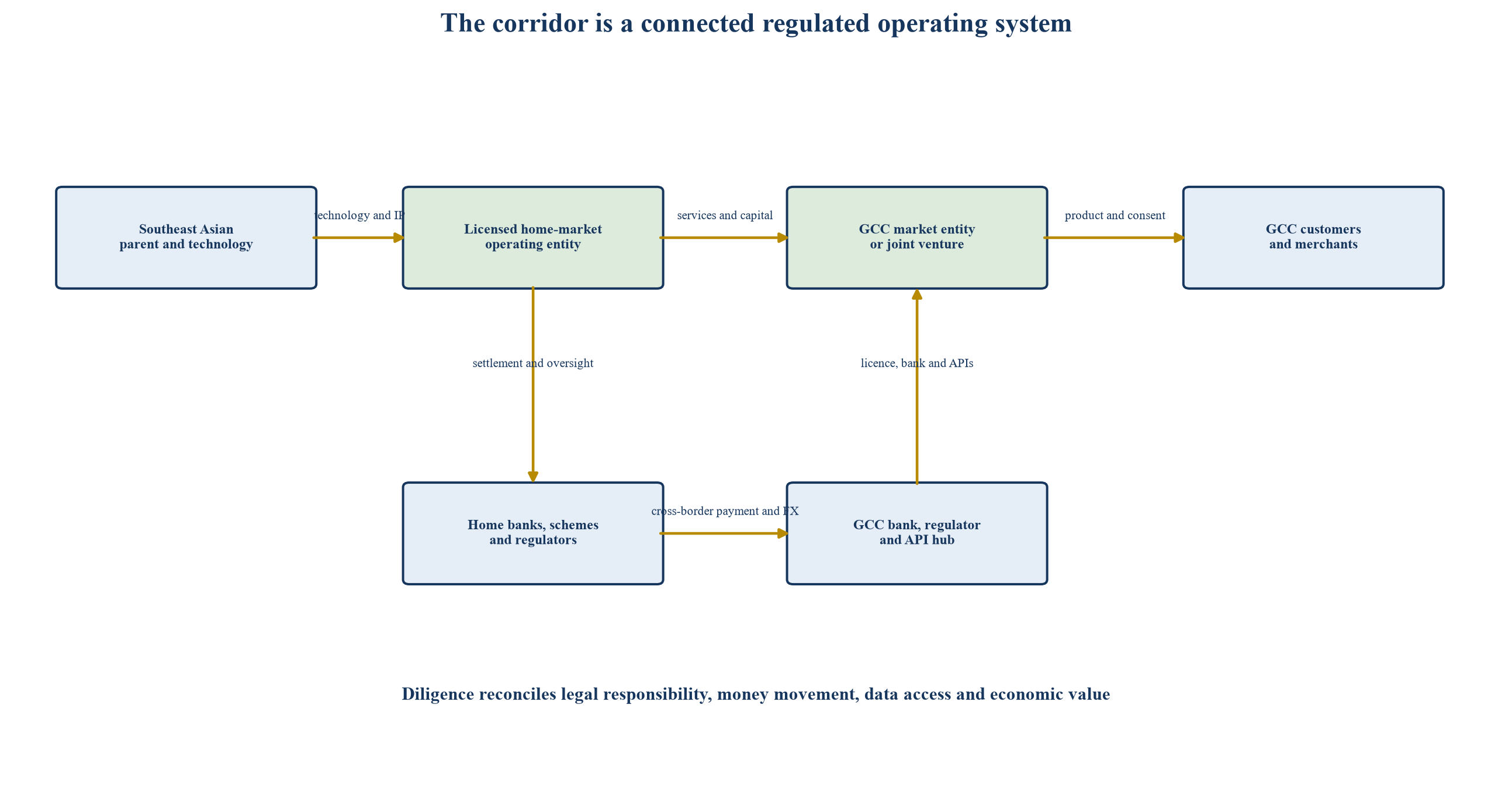
Entities and flows are illustrative management assumptions.
7. Prove demand at the product-country level
Demand should be evidenced by customer problem, segment, geography, channel, price and regulatory status. A regional market-size estimate does not show whether the product can acquire a qualified customer in the target jurisdiction. The company should provide interviews, trials, signed contracts, usage data or partner commitments that correspond to the proposed launch.
Customer evidence should separate interest, pilot, approved procurement, signed contract, activated customer, funded account and recurring use. Each stage has a different probability, time and cost. Enterprise financial institutions can require security, legal, compliance, integration and vendor-risk reviews before revenue begins.
The board should identify whether demand depends on a local bank, employer, marketplace, government entity or distribution partner. Partner-assisted demand can reduce acquisition cost while creating concentration and bargaining risk. A letter of intent from a distributor should not be treated as end-customer revenue.
Demand testing should also examine willingness to switch, trust, language, service expectations, complaints, cash usage, payment method, Sharia considerations and pricing transparency. The objective is to show repeatable paid use within the permitted operating model.
8. Build corridor-level unit economics
Group-level gross margin can conceal corridor costs. The model should begin with revenue per active customer or transaction and deduct payment processing, scheme fees, foreign exchange, partner share, fraud, chargebacks, safeguarding cost, customer support, cloud, compliance, data, local staff and allocated platform cost.
Customer acquisition cost should include sales, marketing, incentives, onboarding, verification, partner integration and failed applications. Activation and retention should use cohorts rather than cumulative registrations. A fintech can report rapid account growth while funded, transacting or retained customers remain limited.
The model should separate fixed launch cost from variable service cost. Licensing, local management, audit, legal, security certification, bank integration and data architecture can create a high corridor break-even point. These costs should be associated with the product and jurisdiction that causes them.
Unit economics require cash timing. Merchant settlement, customer refunds, partner payment terms and delayed collections can create funding needs even when contribution is positive. The board should see both accounting margin and cash contribution by cohort.
| Measure | Required evidence | Common distortion | Diligence response |
|---|---|---|---|
| Revenue per active customer | Invoice, pricing rule, usage and collection | Registered users treated as active | Cohort revenue and cash receipt |
| Customer acquisition cost | Channel spend, partner fees, onboarding and failures | Incentives or integration omitted | Fully loaded cost by channel |
| Variable contribution | Processing, FX, fraud, support and partner share | Compliance treated as fixed | Product-country contribution bridge |
| Retention | Repeated funded use by cohort | App login treated as retention | Transaction and balance cohort |
| Break-even | Fixed local cost and contribution | Shared platform cost omitted | Corridor stand-alone P&L |
| Cash conversion | Settlement, refunds, receivables and reserves | EBITDA treated as cash | Monthly cash and liquidity model |
The measures are diagnostic; the board should replace them with verified cohort evidence.
9. Separate payment economics from foreign-exchange economics
Cross-border payment revenue can include a visible fee, exchange-rate margin, interchange, subscription, float or partner rebate. The company should identify each source and disclose the reference rate, timing, spread, customer price and counterparty. A low transfer fee can coexist with a material foreign-exchange margin.
The World Bank reported a 6.36 percent global average cost for remittances in the third quarter of 2025, with digital-only money-transfer operators averaging 3.54 percent.[15] These benchmarks provide context; they do not establish the economics of a specific Southeast Asia-to-Gulf corridor, ticket size or customer segment.
The model should test currency volatility, liquidity, weekend pricing, failed settlement, prefunding, hedging and partner limits. Margin generated through uncontrolled currency exposure should be separated from operating contribution. The treasury policy should define position limits, execution, reconciliation and escalation.
Price comparison should include amount received, total fee, exchange-rate margin, speed, failure rate and customer remedy. Sustainable value comes from reliable service and controlled cost rather than opaque pricing that can attract regulatory or reputational risk.
10. Choose the partnership route deliberately
The main routes include local licence, sponsor-bank model, regulated payment partner, joint venture, white-label distribution, technology vendor and acquisition of a licensed entity. Each route changes speed, margin, customer ownership, data access, regulatory accountability and exit flexibility.
A bank partner can provide accounts, safeguarding, settlement, compliance support and distribution. It can also control pricing, roadmap, onboarding, customer access and termination. The agreement should define service levels, change control, data, audit, subcontracting, regulatory cooperation, incident response, customer migration and exit assistance.
A joint venture can combine local permission and relationships with technology and capital. Governance should allocate board rights, reserved matters, budgets, product approval, key appointments, bank mandates, related-party contracts, data, intellectual property, capital calls, deadlock and exit. Economic ownership without operating authority can expose the investor to regulatory and service risk.
The board should compare partnership routes using cash economics and failure modes. The fastest route can become expensive if the partner controls customers and data. The highest-control route can destroy value if licensing and fixed cost delay launch beyond the funding runway.
| Route | Control | Speed | Margin | Principal risk |
|---|---|---|---|---|
| Local licence | High after approval | Slow to medium | Potentially high | Approval, capital and fixed-cost exposure |
| Sponsor bank or regulated partner | Medium to low | Medium to fast | Shared | Dependency, termination and customer control |
| Joint venture | Shared | Medium | Shared | Deadlock, related-party and execution risk |
| White-label technology | Low commercial control | Fast | Service-fee margin | Commoditisation and limited customer evidence |
| Licensed acquisition | High after close | Medium | Full, subject to integration | Change of control, legacy compliance and integration |
| Minority strategic investment | Influence | Medium | Equity participation | Limited authority and uncertain exit |
Ratings require transaction-specific evidence and current professional advice.
11. Treat data localisation as a system-design question
Data localisation cannot be answered with a server-location statement. The team should map personal data, financial data, authentication data, transaction data, risk features, support records, logs, backups, analytics and model outputs. For each dataset it should record origin, purpose, legal basis, controller, processor, storage, access, transfer, retention and deletion.
The architecture may use a Gulf customer interface, regional cloud, Southeast Asian engineering team, global fraud provider and third-party analytics. Remote access can constitute a transfer even when the primary database remains local. Support tools and logs can contain sensitive information outside the principal application.
Consent should be specific, informed, revocable and connected to the actual use. The UAE Open Finance framework makes consent, authentication and secure communication central to data sharing and service initiation.[10] The BSP Open Finance Framework similarly emphasises consent-driven portability, privacy-by-design and secure sharing.[6]
The transaction model should include the cost of regional hosting, data separation, encryption, key management, monitoring, audit and migration. A promise to localise after closing needs a design, budget, dependency map, validation plan and customer transition.
12. Test API interoperability and product portability
Open-finance and payment APIs can reduce integration cost only when standards, participant rules and operating practices align. Bank Indonesia's SNAP standard covers technical, security, data and governance requirements for open API payments.[7] The UAE framework uses an API Hub, trust framework and common infrastructure.[10] Saudi Arabia's framework includes use cases, business rules and technical standards.[11]
The buyer should inventory every API, version, authentication method, certificate, rate limit, consent scope, data field, error code, service level and dependency. A product built around one home-market standard may require material changes in the Gulf. Integration estimates should come from interface comparison and test results rather than management analogy.
Project Nexus demonstrates a multilateral model for connecting domestic instant-payment systems through a common platform, with a scheme and governance framework, commercial model and technology blueprint.[4] Corridor diligence should still assess whether the target can access relevant domestic systems through licensed participants and compliant customer journeys.
Portability also depends on product configuration, language, currency, tax, calendars, identifiers, accessibility, complaints and reporting. The architecture should separate reusable platform capability from jurisdiction-specific controls.
13. Reconstruct AML and customer-due-diligence control
Financial-crime diligence should follow the customer and transaction from onboarding through monitoring, investigation, reporting, restriction and exit. Policy documents are insufficient without evidence of system rules, case handling, quality review, management information and regulatory reporting.
The team should inspect identity proofing, beneficial ownership, sanctions, politically exposed persons, adverse media, risk scoring, source of funds, transaction monitoring, alert disposition, suspicious-activity reporting, record keeping and employee access. It should compare policy thresholds with production configuration and sample outcomes.
Digital identity can strengthen inclusion and control when the assurance level is appropriate. FATF guidance recognises both the potential of digital identity and the cybersecurity, privacy, fraud and governance risks of weak systems.[14] The target should explain the reliability, independence and assurance of each identity source used in the corridor.
Cross-border operations add transliteration, multiple identifiers, data quality, local reporting and information-sharing constraints. The buyer should not assume that a home-market customer file satisfies a Gulf entity's obligations. The operating model needs entity-specific accountability and escalation.
14. Integrate fraud, scam and cyber evidence
Instant and cross-border payments compress the time available to identify and stop fraud. The control system should link authentication, device intelligence, behavioural indicators, beneficiary risk, transaction monitoring, velocity, customer confirmation, intervention and recovery.
Loss data should be analysed by product, channel, customer, geography, typology and stage. Gross fraud, prevented fraud, customer reimbursement, partner recovery, chargebacks and operating cost should remain distinct. A declining loss rate can result from transaction mix rather than stronger control.
Cyber diligence should cover identity and access, secure development, vulnerability management, penetration testing, encryption, key management, logging, incident response, third parties and recovery. Management certifications should be reconciled with findings, exceptions and remediation records.
The transaction agreement should allocate responsibility for pre-close incidents, undisclosed vulnerabilities, customer remediation and regulatory response. Cyber insurance does not replace operating control or evidence of recoverability.
15. Test cloud and third-party concentration
Fintech platforms often depend on cloud hosting, identity vendors, messaging, fraud tools, core banking, payment processors, card schemes and bank partners. A service inventory should identify legal entity, service, data, region, subcontractor, concentration, service level, audit right, incident duty, resilience evidence and exit plan.
The board should distinguish replaceable vendors from critical dependencies. A provider can be technically substitutable while migration, certification and customer change require months. The concentration analysis should include common cloud regions and shared identity or messaging providers across the group.
Contracts should support regulatory access, audit, security standards, incident notification, data return, deletion, business continuity and transition. Commercial terms should not prevent the regulated entity from meeting its obligations.
The funding plan should include dual running, migration, re-certification and data transfer if a critical provider fails or becomes unacceptable. An uncosted exit plan is not an executable control.
16. Measure operational resilience through customer service
Operational resilience should begin with important customer services, tolerable disruption and dependencies. Uptime of individual components does not show whether a customer can onboard, authenticate, pay, receive money, obtain support or recover funds.
The company should provide incident history, severity, duration, affected customers, financial impact, root cause, regulatory notice and remediation. Repeated low-severity events can reveal architecture or change-management weaknesses. Near misses and manual workarounds also matter.
Testing should include cloud-region loss, bank-partner outage, payment-scheme failure, cyber incident, data corruption, staff unavailability and sudden transaction surge. Recovery targets should be supported by observed tests and reconciled data.
The buyer should identify who can declare an incident, suspend service, communicate with regulators and customers, release reserves and approve restoration. These authorities should operate across time zones and legal entities.
17. Test the hypothetical acquisition case
Assume a Southeast Asian fintech provides SME treasury, collections and cross-border payment software. The buyer proposes to acquire 70 percent, retain management and launch in the UAE and Saudi Arabia through a combination of local entities and regulated partners. Total initial uses are assumed at USD 96 million, including consideration, debt settlement, integration, licence work and launch capital.
The central case assumes year-three corridor revenue of USD 70 million and EBITDA of USD 14 million. It requires two bank partnerships, one local payment permission, open-finance connectivity, regional hosting and enterprise distribution. Peak corridor funding is assumed at USD 96 million including acquisition uses.
The correlated downside delays one permission by twelve months, increases enterprise acquisition cost by 35 percent, reduces payment contribution by two percentage points and requires additional safeguarding and integration reserves. Year-three revenue falls to USD 48 million, EBITDA falls to USD 4.8 million and peak funding rises to USD 116 million.
The staged case acquires 51 percent initially, defers consideration, launches one product-country pair through a regulated partner and releases further capital after permission, customer and unit-economics gates. Initial committed capital falls to USD 61 million. Year-three revenue is assumed at USD 62 million and EBITDA at USD 10.5 million. All figures are hypothetical management assumptions and are not forecasts.
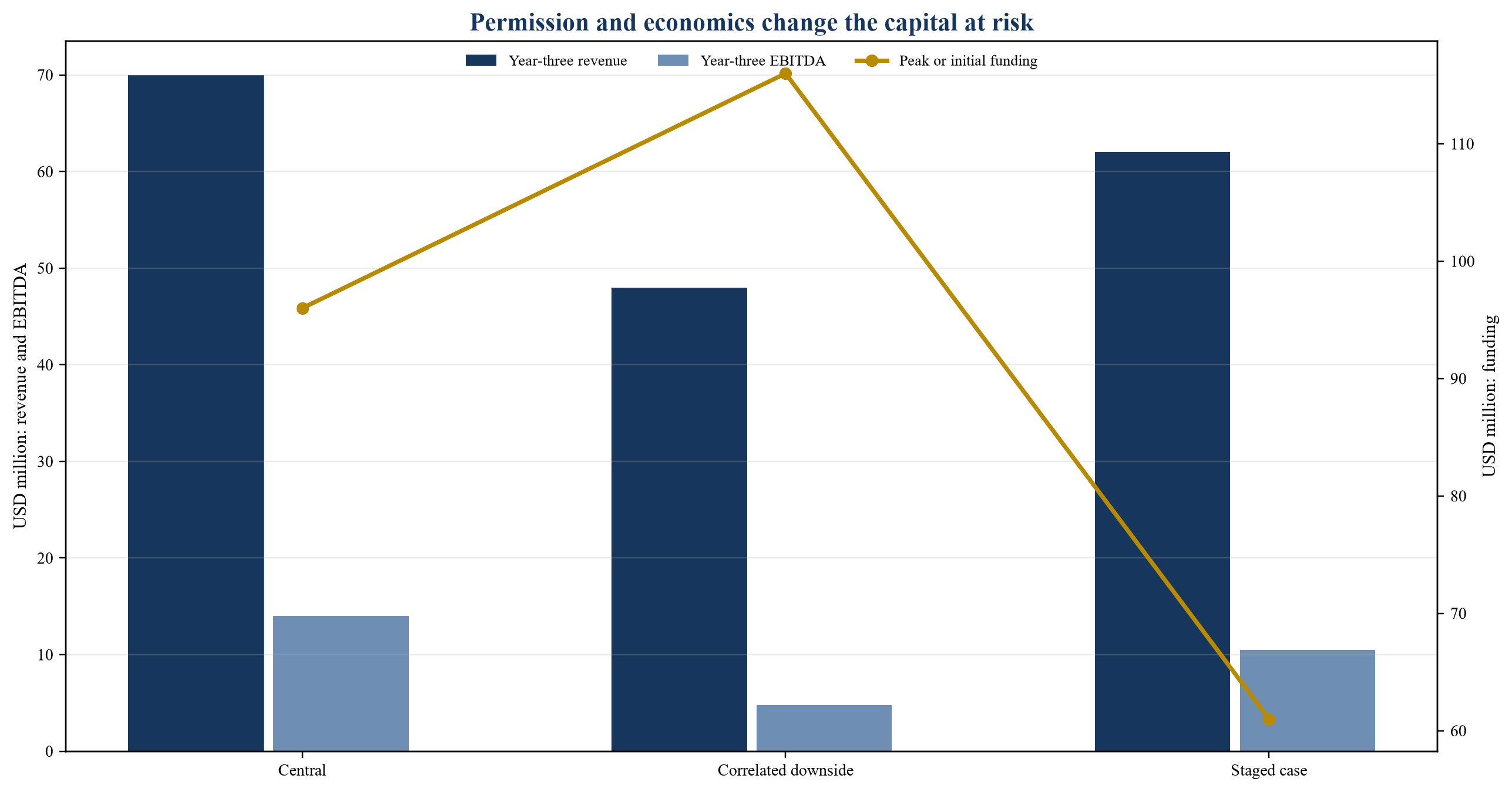
All amounts are hypothetical management assumptions and do not describe an actual company.
18. Match funding model to regulated activity
Fintech funding can include ordinary equity, preference equity, venture debt, warehouse funding, customer balances, bank facilities, revenue share and partner prefunding. These sources fund different risks and should not be treated as interchangeable liquidity.
Corporate equity should fund product development, licensing, control build and operating losses. Customer safeguarded money should remain outside general corporate use. Warehouse or receivables facilities require eligible assets, perfected security, reporting and collection control. Venture debt adds fixed claims before the corridor has proven cash generation.
The funding model should identify cash by entity, currency, restriction and purpose. A profitable home business may be unable or unwilling to support a regulated Gulf entity. Dividend, intercompany loan, capital maintenance, tax and foreign-exchange constraints need current advice.
Capital calls should be linked to evidence gates. The board can release licence capital after an approvable application, integration capital after tested interfaces and growth capital after qualified demand and contribution evidence. This sequencing contains downside without starving necessary control investment.
19. Value the business by permission and evidence state
Valuation should separate proven home-market value, transferable platform value and conditional corridor value. Existing revenue and cash flow can be valued using appropriate methods and comparables. Corridor value should be discounted for permission, customer, integration, capital and timing risks.
Reported technology expenditure does not establish an economically transferable platform. Diligence should identify reusable code, data rights, integrations, documentation, security evidence, team capacity and jurisdiction-specific work. Technical debt and vendor dependence can turn expected operating leverage into additional capital.
Transaction terms can bridge evidence gaps through deferred consideration, earn-outs, seller rollover, staged control, escrow and milestone funding. Measures should remain within appropriate control and distinguish buyer-funded growth from seller-created value.
The investment committee should see a value bridge from stand-alone enterprise value through licence, concentration, compliance, technology and funding adjustments to risk-adjusted value. A corridor premium without a cash-flow and evidence basis should be rejected.
20. Price safeguarding, settlement and working capital
Fintech businesses can require material cash outside ordinary operating expense. Safeguarding, settlement prefunding, scheme collateral, chargeback reserves, regulatory capital, customer refunds, partner deposits and working capital should be modelled separately.
The buyer should reconcile customer liability, safeguarded cash, settlement receivable, settlement payable and bank balance daily. Differences need ageing, ownership and resolution. A balance described as cash can be restricted, customer-owned or required for settlement.
Growth can increase liquidity needs before producing distributable cash. Higher transaction volume can require additional prefunding and reserves. Delayed enterprise collections can coincide with immediate partner payments and customer obligations.
The acquisition agreement should define cash, debt, customer money, restricted cash, regulatory capital and settlement balances. Closing accounts need fintech-specific definitions to avoid transferring an unexpected funding deficit to the buyer.
21. Design governance for regulated execution
The governance model should allocate product approval, regulatory communication, risk acceptance, pricing, credit, treasury, data, technology change, outsourcing, incidents and complaints. Authority should sit with the entity that bears the obligation, supported by group expertise and independent challenge.
The board needs corridor management information that connects customers, transactions, revenue, contribution, liquidity, fraud, complaints, incidents, regulatory obligations and remediation. Aggregated global metrics can obscure a local breach or failing product.
Reserved matters should cover licence changes, material outsourcing, new products, capital, bank partners, related-party services, data transfers, acquisitions and shutdown. Emergency authority should allow service restriction and customer protection without waiting for a routine meeting.
Minority or joint-venture structures need information, audit, inspection and escalation rights. Economic protection without access to regulatory and operating evidence provides weak control.
22. Make regulatory change an operating process
Regulatory change should be owned, interpreted, implemented, tested and evidenced. A register alone does not show whether product, contract, system, customer communication and reporting changed in time.
The corridor team should monitor each authority, consultation, standard, licence condition and supervisory communication. Impact assessment should identify affected entities, products, controls, contracts, data, technology and capital. Decisions should have accountable owners and deadlines.
The ASEAN Digital Economy Framework Agreement agenda includes digital trade, cross-border e-commerce, payments, e-invoicing, digital identity and authentication.[1] Regional interoperability can create opportunity while national permission and implementation remain decisive.
The investment model should include known implementation cost and scenarios for foreseeable change. A static regulatory assumption is unsuitable for a multi-year fintech investment.
23. Test customer protection and complaints
Customer protection should be visible in product design, pricing, disclosure, consent, service, complaints, refunds and vulnerable-customer treatment. Terms and screens should explain total price, exchange rate, timing, failure, liability and recourse.
Complaint data should be classified by product, channel, issue, severity, resolution time, outcome and root cause. Low complaint volumes can result from inaccessible channels or poor classification. The team should sample cases from intake to resolution and confirm management reporting.
Partner models can fragment responsibility. Customers should know who provides the service and where to seek help. Contracts should allocate investigation, communication, refund and regulatory reporting, with service levels and data access.
The board should connect complaints and conduct outcomes to product approval and remuneration. Growth incentives should not reward acquisition or transaction volume without quality and customer-outcome measures.
24. Examine competition and distribution dependence
Fintech economics can depend on access to app stores, search, social media, employers, banks, marketplaces or merchant platforms. Distribution concentration should be measured by acquired customer, revenue, contribution and contractual control.
The target should disclose exclusivity, most-favoured-nation terms, data access, ranking, pricing, termination and customer portability. A partner can become a competitor or restrict access after the fintech has invested in integration and compliance.
Competition analysis should identify incumbent response, switching costs, multi-homing, price transparency and product differentiation. A feature advantage can narrow as open API standards reduce technical barriers. Durable value can arise from trust, regulated execution, workflow integration and service quality.
The transaction model should stress loss or repricing of the largest distribution partner. Remediation can include direct channels, multiple partners, customer portability and modular integration.
25. Protect technology and intellectual property
The buyer should establish ownership of code, models, interfaces, data rights, documentation, domains, trademarks and inventions. Employee and contractor assignments should match the jurisdictions and entities where work occurred.
Open-source and third-party components require licence, security and maintenance review. A commercially successful platform can contain unsupported libraries, restrictive licences or vendor code that limits transfer. Software bills of materials and dependency scanning strengthen the evidence.
Model and decision systems should have purpose, data lineage, validation, monitoring, override and change records. Where automated outputs affect customer access, price, credit or fraud restriction, governance should address error, bias, explainability and appeal.
Transaction warranties and indemnities should reflect identified ownership and compliance risks. Post-close integration should avoid moving code or data across entities before rights and permissions are clear.
26. Apply a risk heat map tied to action
The risk register should score likelihood and consequence while identifying evidence quality, owner, mitigation, residual exposure and decision trigger. Heat-map colour without an action rule provides limited control.
High-consequence risks can include operating without permission, loss of bank partner, safeguarding shortfall, sanctions failure, major fraud, data breach and prolonged service outage. Lower-probability events can still require conditions precedent or contingency funding.
The committee should distinguish uncertainty from accepted risk. Missing licence interpretation, customer evidence or data mapping is an information gap. It should remain open until resolved or explicitly reflected in structure and price.
Triggers should connect to action: pause launch, stop onboarding, increase reserves, change partner, redesign product, notify authority or return to the board. The operating team should know the threshold and authority before an incident.
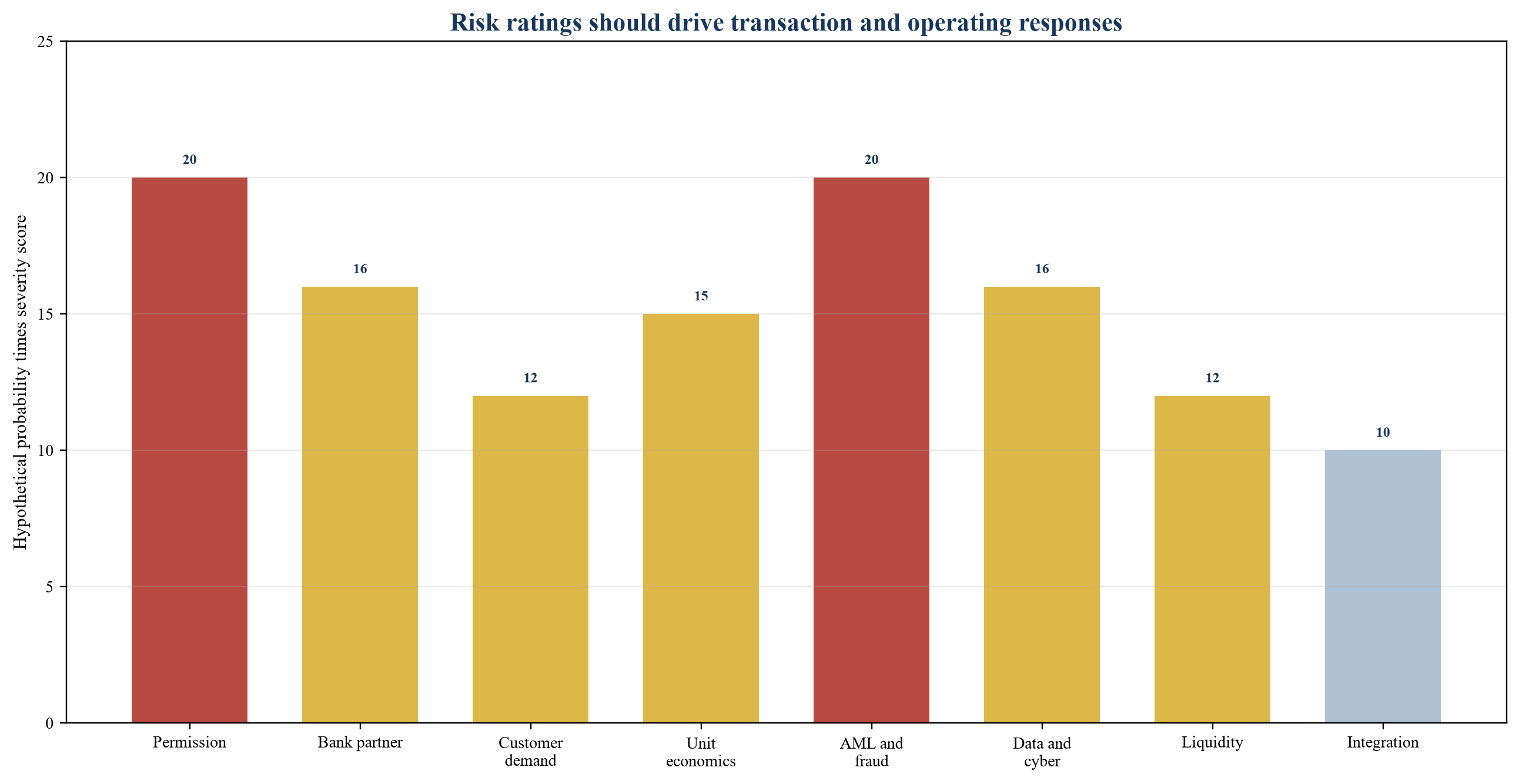
Scores are hypothetical and should be replaced with verified evidence.
27. Sequence the first two hundred days
Days one to thirty should secure licence and partner continuity, reconcile customer money, confirm regulatory contacts, freeze uncontrolled product changes and establish incident authority. The team should validate critical reports, bank access, key staff and customer communication.
Days thirty-one to seventy-five should complete product-country activity maps, customer and cohort evidence, data lineage, technology dependencies, outsourcing inventory and remediation priorities. The board should approve the initial corridor perimeter and capital gates.
Days seventy-six to one hundred and thirty should execute licence or partner work, remediate control gaps, test APIs, validate hosting, complete customer pilots and build entity-level management information. Further growth funding should depend on agreed evidence.
Days one hundred and thirty-one to two hundred should stabilise service, measure contribution, conduct resilience exercises, verify regulatory reporting and decide whether to scale, redesign or stop each product-country combination.
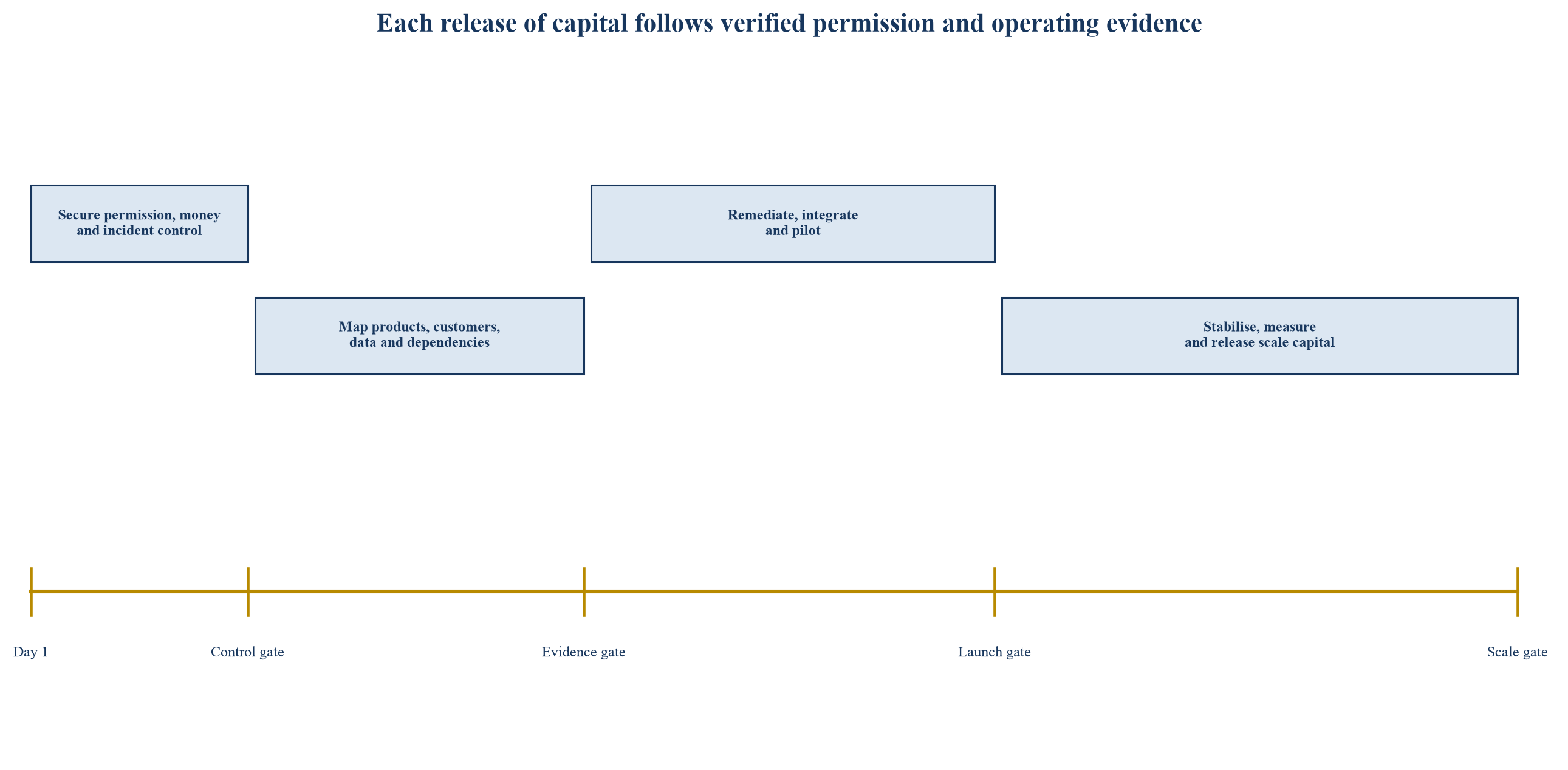
The timetable is illustrative and should be adapted to transaction and regulatory requirements.
28. Present a falsifiable investment case
The investment memorandum should state the product-country perimeter, permission route, customer evidence, unit economics, money and data flows, partner obligations, technology dependencies, financial-crime control, capital requirement, governance, integration plan and unresolved issues.
Each material assumption should have a source and evidence grade. Regulator correspondence, executed contracts, production data and reconciled cash records carry more weight than management intention. The committee should see which value depends on lower-grade evidence.
Approval should specify purchase consideration, initial capital, conditions precedent, deferred consideration, regulatory approvals, partner contracts, capital gates, risk acceptance and return triggers. It should also identify rejection conditions.
The case should remain active after signing. A licence delay, partner change, customer loss, incident or integration finding can alter value and funding. Material changes should return to the board before more capital is committed.
| Decision area | Evidence required | Committee decision |
|---|---|---|
| Product and permission | Activity map, legal analysis and regulator-ready route | Approve perimeter and conditions |
| Demand and economics | Qualified customers, cohorts and cash contribution | Approve base case and downside |
| Data and technology | Lineage, rights, security, resilience and migration | Approve architecture and remediation |
| Partners and control | Executable contracts, governance and exit | Approve route and reserved matters |
| Capital and liquidity | Entity cash, safeguarding, reserves and funding | Approve tranches and contingency |
| Implementation | Owners, milestones, reporting and stop triggers | Approve first two hundred days |
The checklist supports decision control and does not replace specialist advice.
29. Apply the framework by fintech archetype
Payments and remittance businesses require detailed money-flow, safeguarding, settlement, foreign-exchange, fraud and bank-partner diligence. Revenue should be reconciled to corridor price and cash. Merchant-acquiring models add chargeback, scheme, terminal and settlement risks.
Open-finance and data businesses require consent, API participation, permitted use, data quality and customer-value evidence. Access to data does not itself create a durable business; the company needs distribution, repeatable use and an economic model.
Lending and embedded-credit businesses require origination, underwriting, funding, collections, provisioning and conduct diligence. The board should distinguish technology revenue from credit risk and funding spread. An originate-to-distribute model remains dependent on funder appetite and asset quality.
Wealth, insurance and capital-markets businesses add advice, suitability, custody, product governance and market-conduct requirements. The activity map should follow what the product actually recommends, arranges, executes or holds.
30. Use a board action plan
The board should begin with a product-country inventory and classify each route as permitted, partner-dependent, application-dependent or outside appetite. Management should then produce qualified demand, corridor economics, data lineage, partner terms and funding requirements for the priority combination.
Confirmatory diligence should reconcile licences, contracts, customer money, regulatory reporting, cohort economics, data, technology and incident evidence. Material gaps should become conditions, price adjustments, deferred consideration, capital gates or rejection triggers.
The first two hundred days should protect permission and customer service before accelerating growth. Capital should follow verified regulatory and operating evidence. Reporting should connect product, customer, transaction, contribution, liquidity and control outcomes.
The transaction succeeds when the business can provide a permitted and valued service, generate controlled cash economics and sustain trust across both ends of the corridor. Strategic narrative should remain subordinate to evidence and execution.
Sources
- ASEAN, ASEAN Digital Economy Framework Agreement Public Summary. Read the primary source
- ASEAN, Leaders' Declaration on Advancing Regional Payment Connectivity and Promoting Local Currency Transaction. Read the primary source
- ASEAN, ASEAN-GCC Joint Declaration on Economic Cooperation, 29 May 2025. Read the primary source
- Bank for International Settlements, Project Nexus. Read the primary source
- Monetary Authority of Singapore, Financial Institutions Directory. Read the primary source
- Bangko Sentral ng Pilipinas, Open Finance Philippines. Read the primary source
- Bank Indonesia, National Open API Payment Standard. Read the primary source
- Bank Negara Malaysia, Regulatory Sandbox. Read the primary source
- Central Bank of the UAE Rulebook, Article 62: Carrying on Licensed Financial Activities through Emerging Technologies. Read the primary source
- Central Bank of the UAE Rulebook, Open Finance Regulation: Introduction and Scope. Read the primary source
- Saudi Central Bank, Open Banking in Saudi Arabia. Read the primary source
- Saudi Central Bank, Open Banking Policy. Read the primary source
- Saudi Central Bank, SAMA Commences Licensing of Fintech Companies to Provide Open Banking Services, 26 March 2026. Read the primary source
- Financial Action Task Force, Guidance on Digital Identity. Read the primary source
- World Bank, Remittance Prices Worldwide, Issue 54, September 2025. Read the primary source
- Bank for International Settlements, Nexus: Enabling Instant Cross-Border Payments. Read the primary source
- Committee on Payments and Market Infrastructures, Enhancing Cross-Border Payments. Read the primary source
- Central Bank of the UAE, Annual Report 2024. Read the primary source
- Central Bank of the UAE, FinTech and Digital Transformation. Read the primary source
- Central Bank of the UAE, Payment System Supervision. Read the primary source
- Bank Indonesia, Regulation on the National Standard for Open API Payments. Read the primary source
- Bangko Sentral ng Pilipinas, Report on the Philippine Financial System, First Semester 2025. Read the primary source
- Organisation for Economic Co-operation and Development, Guidelines for Multinational Enterprises on Responsible Business Conduct. Read the primary source
- International Finance Corporation, Corporate Governance Methodology. Read the primary source
- National Institute of Standards and Technology, Cybersecurity Framework 2.0. Read the primary source
- Financial Stability Board, G20 Roadmap for Enhancing Cross-Border Payments. Read the primary source
